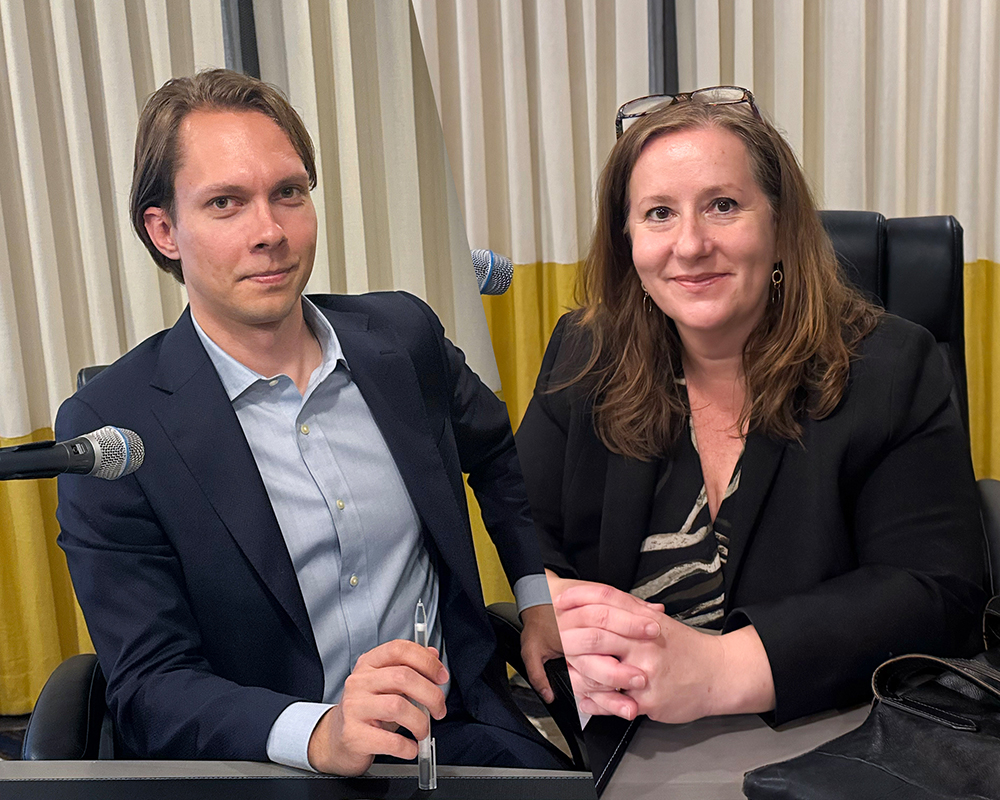
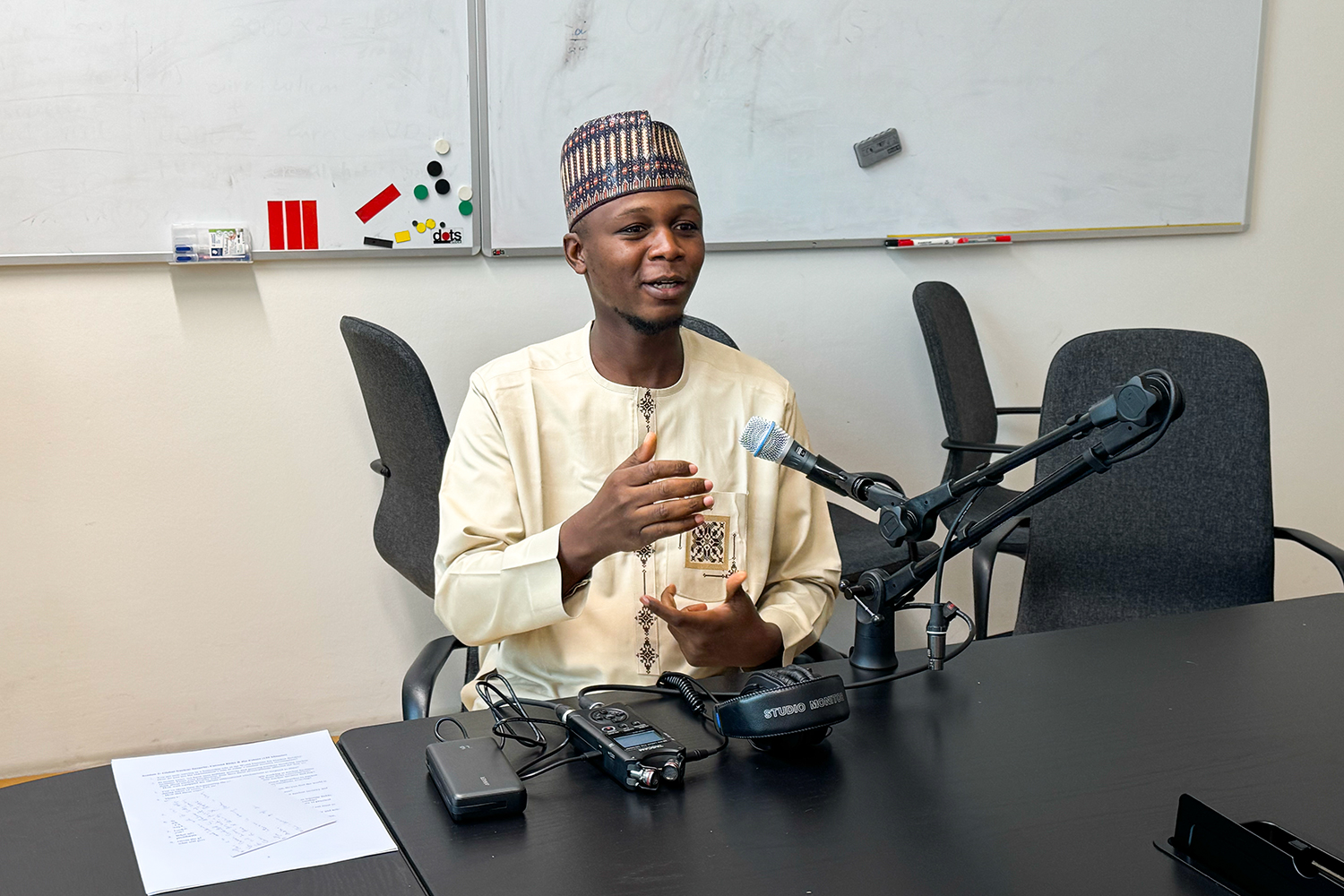
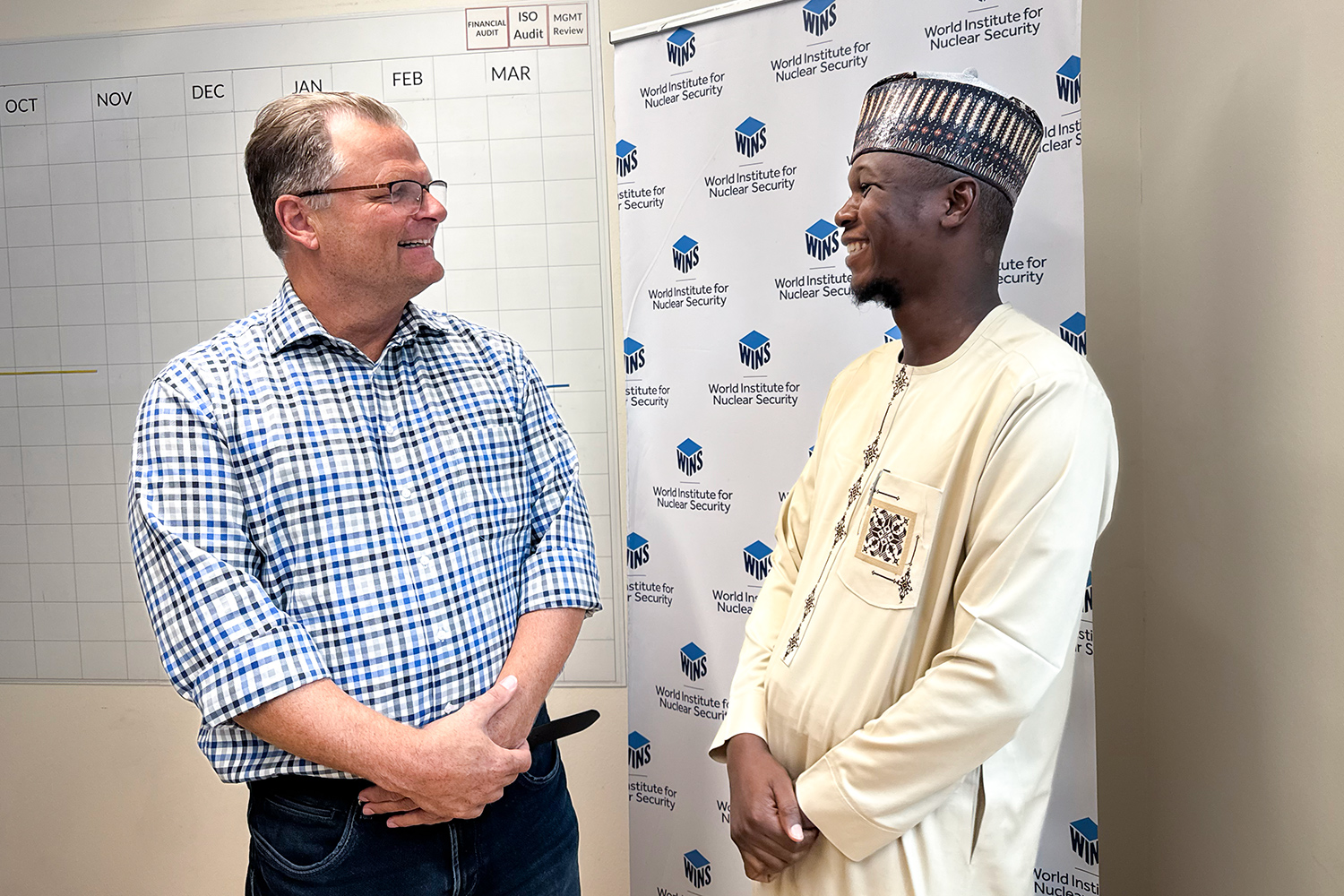
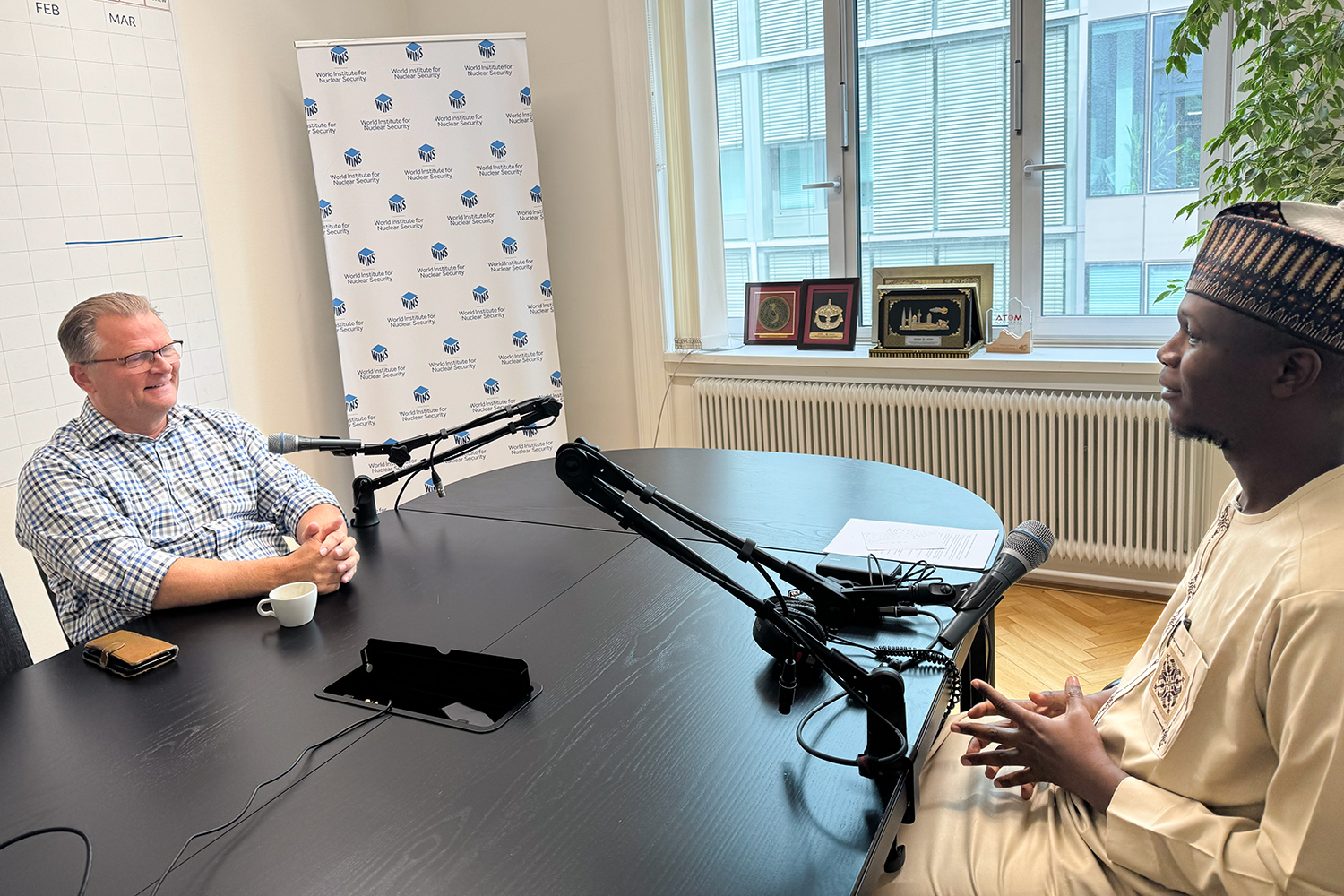
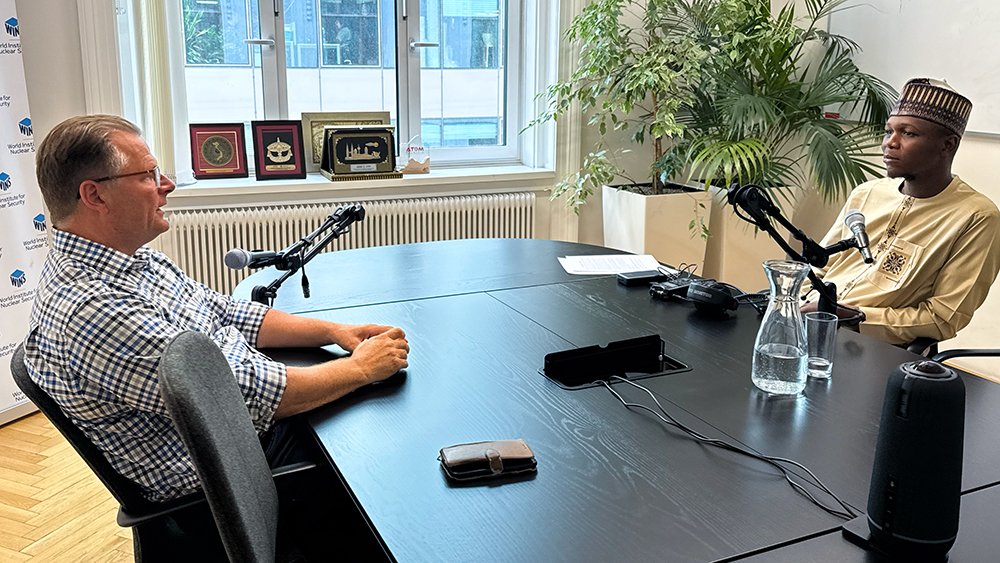
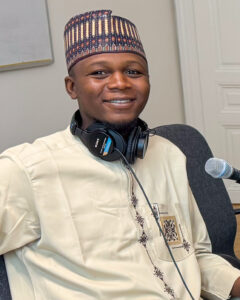
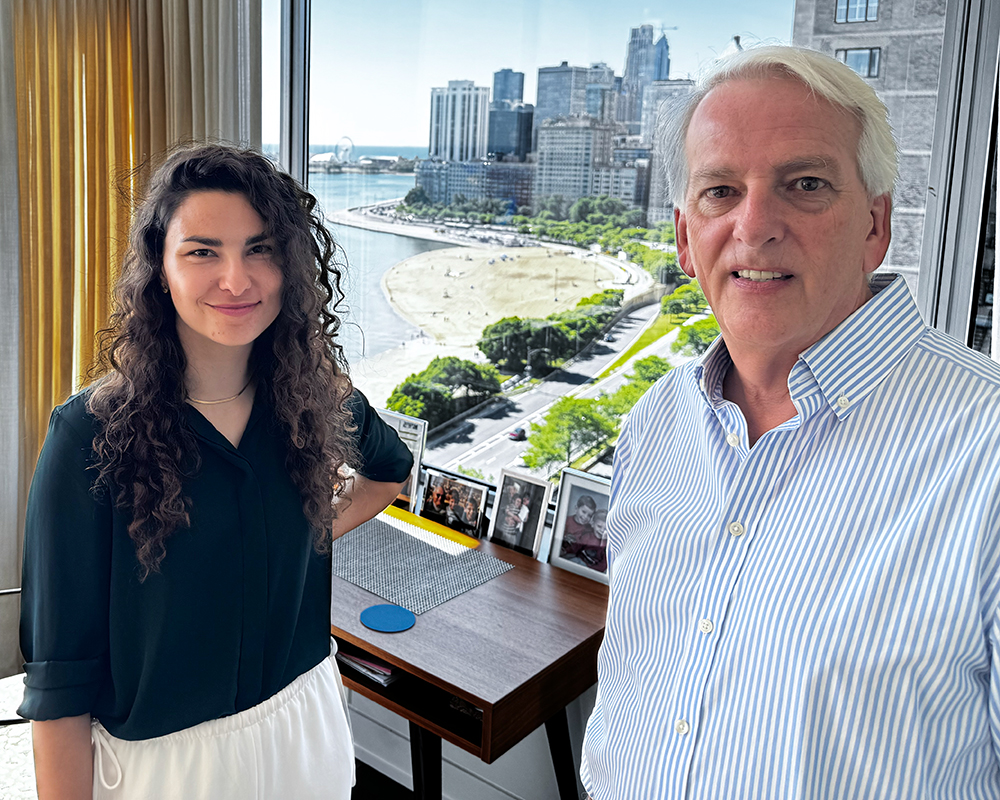
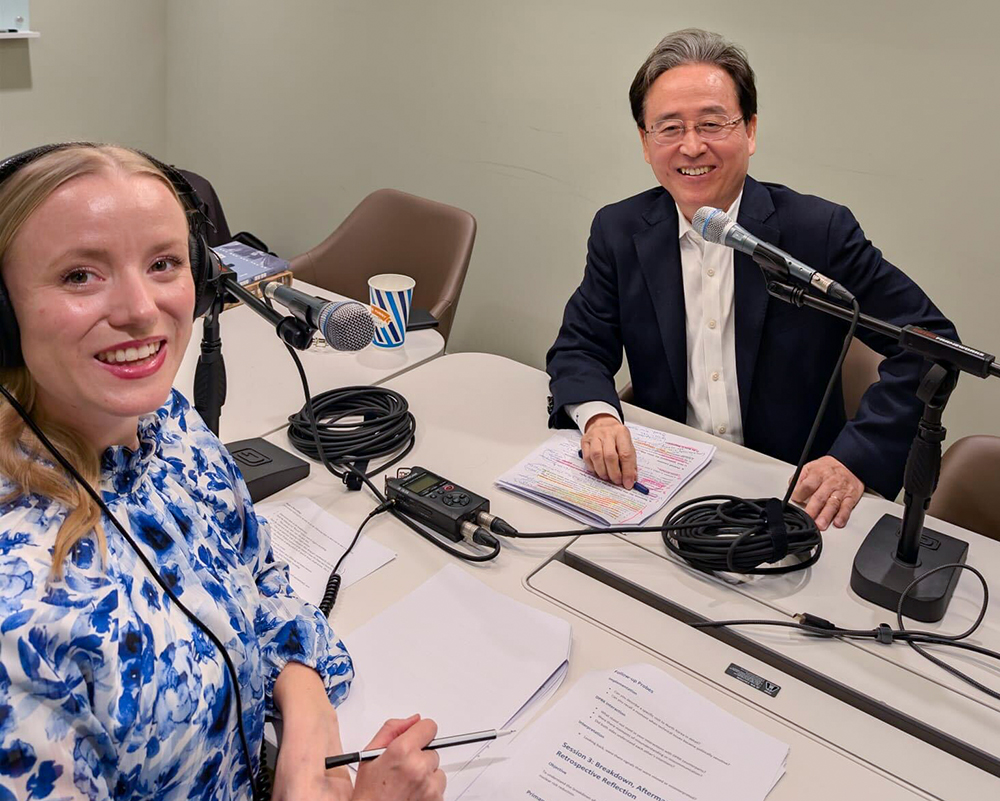
array(1) {
[0]=>
array(323) {
[0]=>
array(4) {
["speaker"]=>
string(20) "Abubakar Sadiq Aliyu"
["timestamp"]=>
string(8) "00:00:02"
["seconds"]=>
int(2)
["text"]=>
string(536) "This is an interview with Dr. Lars van Dassen, conducted by Abubakar Sadiq Aliyu for Oral History Project, a project of Stanley Center for Peace and Security and BASIC. The interview is taking place in Vienna, Austria, and this is session one of two. So Dr. Lars, thank you for agreeing to have this interview with us. I'm very honored. So without wasting much of your time, I will go straight into the questions. So to start, could you share with me a bit of your background, and what first drew you towards pace and conflict research?"
}
[1]=>
array(4) {
["speaker"]=>
string(15) "Lars van Dassen"
["timestamp"]=>
string(8) "00:00:40"
["seconds"]=>
int(40)
["text"]=>
string(1166) "Good. Thank you. Well, it's a long story, you can always say that. I was born in 1963. I grew up the first couple of years in the Netherlands, my mother is from the Netherlands. Then we moved to Denmark, my father is from Denmark. I went to university after doing military service and studied political science, and I did that in a quite careless manner for a couple of years. I also studied philosophy on the side, enjoyed that very much. Yeah. And then by complete coincidence, I came into the nuclear field. It's a very strange story. But I was on a trip with two friends in Greece in the summer of 1986, and they had gone to Greece by airplane and I'd gone there by train and I would go back by train and travel through Europe. So they brought me to the railway station and I went into a train compartment, and then one of my friends stood outside and he said, "Go into the compartment next to you because there are two good-looking women." And so I did that, of course, and I came in there and sat down. And then came a fourth person who sat down and the train started rolling. And this fourth person had a big suitcase. You know, these old big brown suitcases."
}
[2]=>
array(4) {
["speaker"]=>
string(15) "Lars van Dassen"
["timestamp"]=>
string(8) "00:02:46"
["seconds"]=>
int(166)
["text"]=>
string(852) "And suddenly something started running out of the suitcase, and it looked like sugar or salt or sand or something. It was difficult to say. So I said to him, "Look at that." And this young man, he didn't have a language that I knew or anything, so he just looked at it and then he opened the window and took the suitcase and threw it out of the window, and at the next station he got out of the train. And then it was me and these two women in the compartment and we started laughing and then we started communicating. And it was two sisters, and the younger of them, she and I we were talking out in the corridor for a large part of the night, and then afterwards we stayed in touch. And she was Austrian and lived in Salzburg, and two years later I came to visit her and met her. And then we had a relationship and that went on for a couple of years."
}
[3]=>
array(4) {
["speaker"]=>
string(15) "Lars van Dassen"
["timestamp"]=>
string(8) "00:03:59"
["seconds"]=>
int(239)
["text"]=>
string(1117) "But as part of that, I had thought, "Well, what could I actually do to go to Austria? Maybe to study in Austria or something?" And then I started applying for internships, and then I thought, "Okay, what would be interesting?" And I looked at which organizations are there in Vienna and I applied with a couple of them, and wrote one of these student assignments papers on the IAEA [International Atomic Energy Agency] and other UN [United Nations] stuff, and then I was accepted. I studied political science. And so I was accepted actually, this was in 1990. I was accepted as the first student with a social science background. That's at least what they told me. And I came to the IAEA and I was in the division of external relations, and it was very, very kind and nice people. And this was just as the first Gulf War was going to happen, after the Iraqi invasion of Kuwait and the International Coalition to kick out the Iraqis from Kuwait. And of course the UN was very central and essential in all this, including the IAEA. So there were lots of things going on, and not least in external relations where I was."
}
[4]=>
array(4) {
["speaker"]=>
string(15) "Lars van Dassen"
["timestamp"]=>
string(8) "00:05:42"
["seconds"]=>
int(342)
["text"]=>
string(1031) "So I thought that this was incredibly interesting, and so I stayed in the field. Then I joined a research group, established by the Peace Research Institute in Frankfurt, where we did comparative studies of European countries and their nonproliferation policies. And that group was then also related to a similar group established by the Monterey Institute of International Studies that did parallel similar work concerning the 15 states that came out of the Soviet Union, and some of these conferences that we had over the years were for both us from Europe and those from the former Soviet Union. So that was only something that strengthened my interest in this. Then I was offered a summer job with the Peace Research Institute in Frankfurt to do a study by its leader, Harald Müller, who was my boss and he was a fabulous person to work with. Simply fantastic. On the treaty changes of the European Union and what that would mean for nonproliferation. So that was over the summer that I worked with him, and we wrote a report."
}
[5]=>
array(4) {
["speaker"]=>
string(15) "Lars van Dassen"
["timestamp"]=>
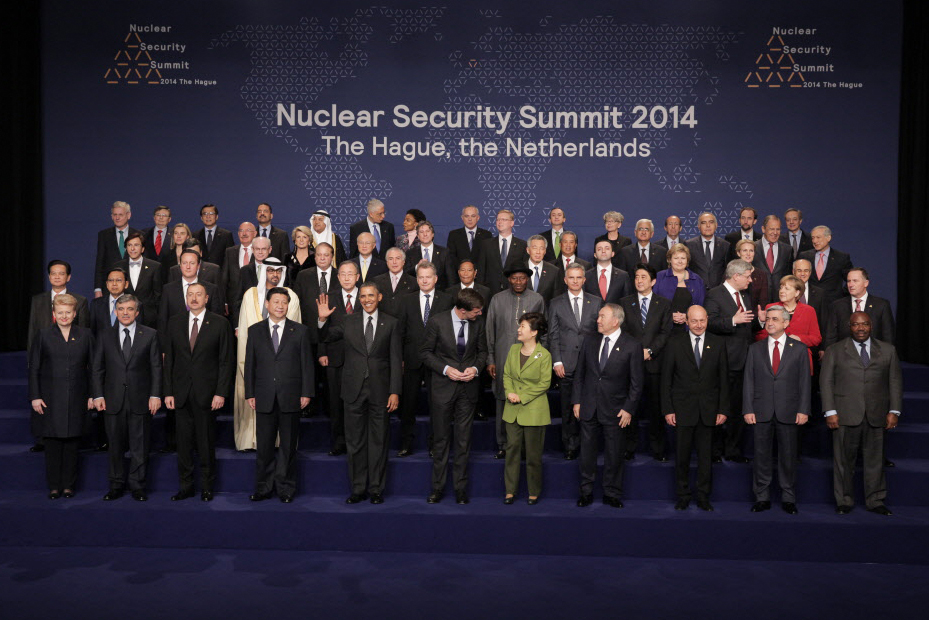
string(8) "00:07:12"
["seconds"]=>
int(432)
["text"]=>
string(1342) "And then I had applied for an internship with the European Union. And so I came to Brussels just as the Maastricht Treaty was entering into force, and then the department where I was related to nonproliferation, so this department was reading the report that Harald Müller had written together with me. So that was all very fascinating. And from there, I then came to Sweden, to Swedish Institute of International Affairs, and this was then in '94 or '95. From there I applied for a PhD position with Uppsala University, Department of Peace and Conflict Research, and I was accepted. I had contacts with the Swedish Nuclear Power Inspectorate, and they were then the funder of this work. And so because I worked... I had funding from Swedish Nuclear Power Inspectorate, and they pulled me into various pieces of work related to Eastern Europe and former Soviet Union. And so it was actually very early on that I went with them on trips to Kazakhstan and other places, the Baltic States, Ukraine and so on. And then I was going to... I was very close to finalizing my PhD, but then I was asked by the Swedish Nuclear Power Inspectorate whether I would be interested to apply for position to implement these projects in Russia, Ukraine, Kazakhstan, et cetera, et cetera. So Sweden's projects in nonproliferation and nuclear security and so on."
}
[6]=>
array(4) {
["speaker"]=>
string(15) "Lars van Dassen"
["timestamp"]=>
string(8) "00:09:17"
["seconds"]=>
int(557)
["text"]=>
string(912) "I applied and was accepted, and then this was then in early in January 2000, and I was going to take up the position in September. And I would work in parallel with a gentleman that I was replacing Paul Ek, but he became very, very sick in cancer and died very, very quickly, which was very sad because he and I worked well together. And suddenly I stood there and had to take over everything. He had a very good assistant that I worked well with, Sarmite Andersson, and so we just started working. But it also meant that I never got to completing my PhD, because immediately I was sucked into so many trips and going everywhere and traveling. Then I stayed on with the Swedish Nuclear Power Inspectorate doing these projects in Eastern Europe, and that was of course fascinating and it was a pioneering job in many respects coming to facilities where there had not really been non-Russians before, for instance."
}
[7]=>
array(4) {
["speaker"]=>
string(15) "Lars van Dassen"
["timestamp"]=>
string(8) "00:10:40"
["seconds"]=>
int(640)
["text"]=>
string(549) "Then I moved management in 2008. There was a reorganization of the organizations in the nuclear field in Sweden. There were two regulators before, and then they turned them into one in 2008. Then I became a section head for everything related to work in former Soviet Union, and later on I became department head, it was Office for International Relations. So then I also had responsibility for all the issues for Sweden's adherence to the various treaties, Convention on Nuclear Safety, Joint Convention on Spent Nuclear Fuel, et cetera, et cetera."
}
[8]=>
array(4) {
["speaker"]=>
string(15) "Lars van Dassen"
["timestamp"]=>
string(8) "00:11:29"
["seconds"]=>
int(689)
["text"]=>
string(307) "And then that went on until when in 2019 I had a new boss, new director general whom I did not get along with at all, and so I decided to apply for the position as executive director at WINS [World Institute for Nuclear Security], and then I started the 1st of January in 2021 and I've been here ever since."
}
[9]=>
array(4) {
["speaker"]=>
string(20) "Abubakar Sadiq Aliyu"
["timestamp"]=>
string(8) "00:11:59"
["seconds"]=>
int(719)
["text"]=>
string(226) "Yeah, that's great. I bet that's like a summary, but I pick quite a number of things from that. Now I just want to know if there were particular things that made you interested in nuclear nonproliferation and nuclear security?"
}
[10]=>
array(4) {
["speaker"]=>
string(15) "Lars van Dassen"
["timestamp"]=>
string(8) "00:12:21"
["seconds"]=>
int(741)
["text"]=>
string(1029) "So I would put it this way. I think I very early on understood that all the talk at the time, let's say in the late 1980s, early '90s was about disarmament. Soviet Union, the United States, Russia and United States disarmament of their nuclear weapons and how far would it go and so on. But it was a much lesser understood issue that there's also something called proliferation. That it could be that they were disarmed, but there would be others that would arm themselves with nuclear weapons. And at the time there was also thought relationship between this, that some of the materials out of control, for instance in Russia, could end up in the hands of states that had nuclear weapons ambitions and so on. That turned out maybe to be exaggerated, because if you want a nuclear weapon and you really want to know what kind of materials you have and you don't want to buy from taxi drivers and so on. But still, it was an issue that was given less focus. So it became proliferation, nonproliferation that was my interest in it."
}
[11]=>
array(4) {
["speaker"]=>
string(15) "Lars van Dassen"
["timestamp"]=>
string(8) "00:13:48"
["seconds"]=>
int(828)
["text"]=>
string(405) "The nuclear security aspects actually only came to me after I came to the Swedish Nuclear Power Inspectorate, because then it became very practical. That you have nuclear materials here and there, what do you do then for controlling them? It's not only a question of controlling them in relation to the nonproliferation treaty, but it's also physical, that they stay in their place as regulated and so on."
}
[12]=>
array(4) {
["speaker"]=>
string(15) "Lars van Dassen"
["timestamp"]=>
string(8) "00:14:27"
["seconds"]=>
int(867)
["text"]=>
string(602) "Exactly. So it became very... I remember in the first project I came into was a very physical one, and it was about physical protection of Russian icebreakers that were nuclear-powered. So it became very concrete in this day it was highly enriched uranium and such stuff. So it was around these issues that I understood here is something, here's a security political dimension. There's not the one that gets most attention. Today it does get much more attention, but at the time it was very much strategic armament and disarmament and less attention to the proliferation aspects. But today it's better."
}
[13]=>
array(4) {
["speaker"]=>
string(20) "Abubakar Sadiq Aliyu"
["timestamp"]=>
string(8) "00:15:13"
["seconds"]=>
int(913)
["text"]=>
string(187) "Okay. That's interesting. Having said all that, what do you remember about entering the field in the years after the Cold War? Did it feel like a moment of optimism, uncertainty, or both?"
}
[14]=>
array(4) {
["speaker"]=>
string(15) "Lars van Dassen"
["timestamp"]=>
string(8) "00:15:48"
["seconds"]=>
int(948)
["text"]=>
string(111) "See, it was about at the same time that this happened, the end of the Cold War and that I came into this field."
}
[15]=>
array(4) {
["speaker"]=>
string(15) "Lars van Dassen"
["timestamp"]=>
string(8) "00:16:01"
["seconds"]=>
int(961)
["text"]=>
string(699) "So I would say that there was an enormous optimism with the fall of the Berlin Wall, the dissolution of the Soviet Union in late 1991, and then in 1992 there was suddenly 15 new states. But that was of course then also what do you do then? The heritage from the Soviet Union was that the mainstay of the critical installations were in what was then Russia, and had been the Russian Socialist Soviet Republic before that. But in fact, you had 15 countries where there were in all of them sizable nuclear activities. And suddenly you have to... Out of something that used to be union republics and parts of Soviet Union, you had to create state formations that also needed to have nuclear regulators.."
}
[16]=>
array(4) {
["speaker"]=>
string(15) "Lars van Dassen"
["timestamp"]=>
string(8) "00:17:20"
["seconds"]=>
int(1040)
["text"]=>
string(94) "Where you needed to keep people in place and in control of things to the best of your ability."
}
[17]=>
array(4) {
["speaker"]=>
string(15) "Lars van Dassen"
["timestamp"]=>
string(8) "00:17:28"
["seconds"]=>
int(1048)
["text"]=>
string(662) "But where this was also difficult because it was so incredibly poor, there was immediately a deep, deep economic crisis, and that went on for most of a decade in the former of Soviet Union, so of course there were not really the resources to do something about it. So there was on the one hand this incredibly elated feeling that the immediate threats that were so daunting during the Cold War, that they had gone. It was thought, "Okay, now the risk of a nuclear weapons exchange between the East and the West, that that was something that was diminishing by the hour." On the other hand, it also became obvious that there were other risks that were increasing."
}
[18]=>
array(4) {
["speaker"]=>
string(15) "Lars van Dassen"
["timestamp"]=>
string(8) "00:18:21"
["seconds"]=>
int(1101)
["text"]=>
string(1023) "And I have to say that if we look at it today, I think we have to be surprised by how little thinking there had been about this situation. I mean I can only remember a couple of articles from the 1970s or something that were dealing with what could be nuclear terrorism. And there was very little thinking about this with, "Could the Soviet Union disappear?" People thought of it as... Took it for granted that the Soviet Union exists and will always exist, and suddenly it was not there and no one had given it a thought, "What do we do hereafter?" From what I hear, it's a very late realization. I've heard this from Sam Nunn, member of Congress at the time, that in October '91 he was in Moscow where he spoke with Gorbachev and asked him... During the coup that was against Gorbachev for like four or five days, he said to Gorbachev, "Were you in control of the nuclear weapons all the time?" And Gorbachev didn't say yes or no, he just looked at him in as a way of saying, "No, either I don't know or no I'm not sure.""
}
[19]=>
array(4) {
["speaker"]=>
string(15) "Lars van Dassen"
["timestamp"]=>
string(8) "00:20:07"
["seconds"]=>
int(1207)
["text"]=>
string(548) "So it was obvious that there was a new situation arising, and that then led Sam Nunn and others to bring forward a huge American program for stabilizing things around nuclear weapons. But then, little by little, also into all nuclear facilities in first Russia, but then also in all the neighboring states that came out of the Soviet Union. So it's a little bit this dichotomy that signifies that age. Elation that the immediate threats of nuclear war are over, but then a growing realization that there are other nuclear risks coming in its place."
}
[20]=>
array(4) {
["speaker"]=>
string(20) "Abubakar Sadiq Aliyu"
["timestamp"]=>
string(8) "00:20:57"
["seconds"]=>
int(1257)
["text"]=>
string(238) "Okay, okay. I think that's fair. So we move to the next question. You've described a period you called "Detsky Camp", when you put it as a Swedish disarmament enthusiast become a Russian nuclear pro. Can you tell me more about that story?"
}
[21]=>
array(4) {
["speaker"]=>
string(15) "Lars van Dassen"
["timestamp"]=>
string(8) "00:21:19"
["seconds"]=>
int(1279)
["text"]=>
string(975) "This is a small, sweet little story. It gives somehow also a little bit of a view into how there is much dichotomy in the whole thing of nuclear weapons. That they are instabilizers, you want to get rid of them. They are also stabilizers. This was in 2003 or 2004, the Swedish Regulatory Authority wher e I worked, we opened a cooperation with the Tomsk State University and Tomsk Polytechnical University, so that's right in the middle of Russia. And we were discussing what can we do together and so on. So we did summer schools for students from the university, but not only from Tomsk, but also from other regions. And the issues... It was fantastic also because it was a time where each time you came to Russia, it became more and more open and free. So I remember that I so enjoyed going to Russia. It was always really a great experience, and when you're invited to universities to give talks that were full of students that were interested and were excited and so on."
}
[22]=>
array(4) {
["speaker"]=>
string(15) "Lars van Dassen"
["timestamp"]=>
string(8) "00:23:02"
["seconds"]=>
int(1382)
["text"]=>
string(1036) "So we had this summer school in a resort outside of Tomsk out in the forest, in the Siberian forest. And what I would do at the end of the afternoon was to go running, and this is really wonderful in Siberian forests. You have these sandy roads that go into forest with enormously high trees, and I went running there and suddenly I felt lost a little bit. But then came a car, an old car, and I stopped the car and I asked this man, "So would you know where is this place where I'm staying?" And he said, "Oh yes, I know where it is." And he said to me, "Jump into the car. I can drive you back, but I have to go back to where I am first." And he was the leader of a Detsky camp, which was a children's summer camp. So we drove there and he stepped out of the car and he just clapped his hand two times, and then suddenly all the kids were there. And it was a place it looked like 1930s, 1940s, incredibly run down. And kids running around in very little clothing, but you can also tell they had a good time playing football and so on."
}
[23]=>
array(4) {
["speaker"]=>
string(15) "Lars van Dassen"
["timestamp"]=>
string(8) "00:24:33"
["seconds"]=>
int(1473)
["text"]=>
string(769) "So the minute he clapped his hand, they came and then they stood in a row in front of him. And I had been speaking with him, he had been asking me what I was doing and my Russian at the time was not fantastic. It's still not fantastic, but I could explain to him that we had this summer school for nuclear weapons and nonproliferation and so on. And he was, "Ah, very interesting." So then he said he had this lineup of kids and he said, "This man, he is from Sweden and he is a hero, because he has come here to help us build our nuclear weapons." And these kids, they started applauding of course. But this was actually so funny, and it was not really the occasion where you want them to say, "But by the way, here's a misunderstanding. It's the other way around it.""
}
[24]=>
array(4) {
["speaker"]=>
string(15) "Lars van Dassen"
["timestamp"]=>
string(8) "00:25:38"
["seconds"]=>
int(1538)
["text"]=>
string(230) "Yeah, yeah, yeah. It was really fun for the moment and good. So and then he drove me back to the place where I was. I actually met him two times later during the course, and a year later again and then we talked a little bit more."
}
[25]=>
array(4) {
["speaker"]=>
string(20) "Abubakar Sadiq Aliyu"
["timestamp"]=>
string(8) "00:25:56"
["seconds"]=>
int(1556)
["text"]=>
string(102) "Okay. Now having had that kind of experience, did that teach you anything about trust and cooperation?"
}
[26]=>
array(4) {
["speaker"]=>
string(15) "Lars van Dassen"
["timestamp"]=>
string(8) "00:26:10"
["seconds"]=>
int(1570)
["text"]=>
string(28) "Yes, it has taught me a lot."
}
[27]=>
array(4) {
["speaker"]=>
string(20) "Abubakar Sadiq Aliyu"
["timestamp"]=>
string(8) "00:26:15"
["seconds"]=>
int(1575)
["text"]=>
string(27) "Okay. Can you tell me more?"
}
[28]=>
array(4) {
["speaker"]=>
string(15) "Lars van Dassen"
["timestamp"]=>
string(8) "00:26:17"
["seconds"]=>
int(1577)
["text"]=>
string(251) "Yes. See, there's one thing that I came to understand very much, particularly in Russia, but probably initially actually in all of the states that came out of the Soviet Union, and that is that people don't trust institutions. They trust other people."
}
[29]=>
array(4) {
["speaker"]=>
string(20) "Abubakar Sadiq Aliyu"
["timestamp"]=>
string(8) "00:26:36"
["seconds"]=>
int(1596)
["text"]=>
string(12) "Individuals?"
}
[30]=>
array(4) {
["speaker"]=>
string(15) "Lars van Dassen"
["timestamp"]=>
string(8) "00:26:37"
["seconds"]=>
int(1597)
["text"]=>
string(4) "Yes."
}
[31]=>
array(4) {
["speaker"]=>
string(15) "Lars van Dassen"
["timestamp"]=>
string(8) "00:26:38"
["seconds"]=>
int(1598)
["text"]=>
string(541) "So the thing is you can come in and then give a business card and you're a representative of something, and it might sound good but they've seen it all before, heard it all before. And so it all comes with a personal relationship, and particularly in Russia that was very, very pronounced. But it's been actually in all of those countries. And actually today I see it more and more also in other places. It is actually a very Western, and maybe European phenomenon, that you trust institutions. In the rest of the world, people trust people."
}
[32]=>
array(4) {
["speaker"]=>
string(15) "Lars van Dassen"
["timestamp"]=>
string(8) "00:27:19"
["seconds"]=>
int(1639)
["text"]=>
string(1009) "And then so if it is that people start trusting an institution, then it's because they trust the people who represented it. And for me it became very obvious. I remember the first time I went to Kazakhstan was in 1998, and then I went also in 1998 to Ukraine and Estonia, but my first trip to Russia was in 2000 or 1999. And then when I started working with the Swedish Nuclear Power Inspectorate, there was one day I had a phone call from a Swedish man who worked with some small towns in Northern Russia with energy efficiency. And one of the places where he was working was in one of the towns that is next to where there is submarine bases and a submarine shipyard. So he said to me, "You know what? I've been there so many times, and I heard this that they have problems with nuclear security. And there's materials being stolen and smuggled out and they don't know what to do with it." So I said to him, "Okay, how quickly can we go there?" And at that time you could get visas for Russia quite quickly."
}
[33]=>
array(4) {
["speaker"]=>
string(15) "Lars van Dassen"
["timestamp"]=>
string(8) "00:28:52"
["seconds"]=>
int(1732)
["text"]=>
string(760) "And so within three weeks we went there. And the thing was that there had been two or three other delegations already, and they said, "Okay, there was this delegation from Belgium, and there was one delegation from Germany and so on." And so I said, "So what happened?" Well, yes it was for trade or buying or selling stuff, but they had never heard from them again. And I understood one thing, and that was I have to document action immediately, and even if it's small, then it has to be something that is visible and tangible. So we were inside this hole... There was like the access control for people who came by foot to the shipyard, and this was also where they knew that the main smuggling was and so on. So there was no detection equipment or anything."
}
[34]=>
array(4) {
["speaker"]=>
string(15) "Lars van Dassen"
["timestamp"]=>
string(8) "00:30:01"
["seconds"]=>
int(1801)
["text"]=>
string(972) "And it was very, very old-fashioned in terms of how the passage control in and out was. And so I could see this was incredibly dilapidated. So I asked this guy who was a chief engineer and who was showing me around and it was very, very desolate. The whole place in their shipyard in Northwest Russia. And so I said to him, "What will it cost to ask a painter to come and paint the whole thing here on the inside, all the walls? So it gets shiny white instead of this 1950s green or blue or what." And then he said... Well, I mean at that time things didn't cost anything in Russia. "Well, the paint would be so-and-so." And yeah, so they calculated it and then said, "Okay, let's agree on that. And so a down payment for let's say one third of the work, I can take out money in the cash machine tomorrow in Murmansk. And then I'll be back in a month when it's all done and then we'll pay the last." And it was a small amount of money. Let's say it's 1,000 or 1,500 euros."
}
[35]=>
array(4) {
["speaker"]=>
string(15) "Lars van Dassen"
["timestamp"]=>
string(8) "00:31:24"
["seconds"]=>
int(1884)
["text"]=>
string(215) "So next to nothing for... It was a huge place. And then when I then came back three weeks later, then it was that all these people that... Last time I was there, they didn't even pay attention that there was anyone."
}
[36]=>
array(4) {
["speaker"]=>
string(15) "Lars van Dassen"
["timestamp"]=>
string(8) "00:31:41"
["seconds"]=>
int(1901)
["text"]=>
string(342) "Then it was, "Aha, something is happening." And then I said, "Okay, we have to use this occasion to define what we do next." And here I also made a discovery. That is that you can have lots of projects that are fancy in terms of computers and all that stuff, but you have to do things also. Or at least you have to do things that are visible."
}
[37]=>
array(4) {
["speaker"]=>
string(15) "Lars van Dassen"
["timestamp"]=>
string(8) "00:32:08"
["seconds"]=>
int(1928)
["text"]=>
string(565) "There were two big platforms that were used that were placed next to these nuclear-powered submarines, and these platforms had all the auxiliary equipment for lifting things in and out, both fuel and nuclear weapons and so on. And then we made an access control system for these platforms so that only people with authority could get aboard. And then of course, also putting fences around and so on. So immediately people could see, "Aha, now things are happening. They're working on the security. The fences are visible,” and so on. I've always tried to do that."
}
[38]=>
array(4) {
["speaker"]=>
string(15) "Lars van Dassen"
["timestamp"]=>
string(8) "00:32:51"
["seconds"]=>
int(1971)
["text"]=>
string(1093) "I came to another place outside of St. Petersburg. It was a very, very strange place. It started coming in the 2000s where you had these books that were about various facilities in Russia. The whole NTIs published them and others and so on. And here was a facility that was not in any of these books. There was a facility called Center for Applied Chemistry, and it was a place where they used chemical products and radioactive materials for various industrial things, and also it was a storage sites for tritium. And it was a place completely run down, and it was known to the people working there that there were lots of radioactive materials that were stolen. So I was there the first time and I did something similar to say, "What will it cost to do so-and-so?" And then it was like a couple of weeks, two or three weeks later I was back. And here comes a guy who is like a blacksmith from next town and he was wearing kind of like a purse on his stomach where there was money and tools. And so I asked him... And it was a long building that was like 100 meters long, two or three stories."
}
[39]=>
array(4) {
["speaker"]=>
string(15) "Lars van Dassen"
["timestamp"]=>
string(8) "00:34:23"
["seconds"]=>
int(2063)
["text"]=>
string(710) "And I said, "What will it cost to put iron bars on every window?" And so he started calculating on a piece of paper and he said, "Well, that would be the price." And I said, "How quickly can you do it?" And it was obvious, this was just when there was economic crisis. It was probably... I remember when it was, it was 2007. And he said, "Well, we have so little to do, I can do it very quickly as soon as I can get these iron materials." And then that was done very, very quickly, and I came there soon after and it was so nicely done, all the window bars, and painted black and so on. And then next steps we did. And again, it was this that the people working there suddenly could see something is happening."
}
[40]=>
array(4) {
["speaker"]=>
string(15) "Lars van Dassen"
["timestamp"]=>
string(8) "00:35:16"
["seconds"]=>
int(2116)
["text"]=>
string(393) "So that was a boost to morale and confidence and what it was that we were doing. And then we went on with other things for security, like access control and surveillance cameras and all that. So it's one of the things. Trust is about personal relationship and it is also about action. That you're not just talking about, that you say, "Okay, what is then the next?" And then you help that out."
}
[41]=>
array(4) {
["speaker"]=>
string(20) "Abubakar Sadiq Aliyu"
["timestamp"]=>
string(8) "00:35:44"
["seconds"]=>
int(2144)
["text"]=>
string(249) "Okay. That's interesting. So from the so far, I understand that you've involved, or let's say, much of your work involved the cooperation in the countries across the former Soviet space. What were the realities of doing work on ground in that space?"
}
[42]=>
array(4) {
["speaker"]=>
string(15) "Lars van Dassen"
["timestamp"]=>
string(8) "00:36:06"
["seconds"]=>
int(2166)
["text"]=>
string(334) "See, it was something that was... All people remember seeing these spy movies, how things work in the Soviet Union, and suddenly you're there and then things really are that way. I mean it is rooms that are cold where it's stone floors. If it's wooden floors and the wooden boards are loose so you can click-clack when you're walking."
}
[43]=>
array(4) {
["speaker"]=>
string(15) "Lars van Dassen"
["timestamp"]=>
string(8) "00:36:39"
["seconds"]=>
int(2199)
["text"]=>
string(519) "So I would say all the prejudice that you had about what the Soviet Union was and so on, it was there. But it was also great to see the transformation. You would then come three or four months later and it had been modernized and it was different. The period from 2000 to 2010, '11 was one where each time you came to Russia it was different and better. It was mentally open. You could do anything with people, you could have discussions with them. I remember on one occasion we had a student conference in Novosibirsk."
}
[44]=>
array(4) {
["speaker"]=>
string(15) "Lars van Dassen"
["timestamp"]=>
string(8) "00:37:33"
["seconds"]=>
int(2253)
["text"]=>
string(547) "And so one of the students who was a participant, I had met him at a similar occasion earlier so I knew him quite well. Sergei, a lovely guy. And he said that he came from somewhere else in Russia. So he was staying with some relatives in Novosibirsk. And he came to them and then they had said to him, "But you know, Sergei, we saw in the media that there was some spies coming from Sweden to do something in the nuclear field at our universities." And so I said, "What?" "Yeah." And then he had this newspaper article or something and showed me."
}
[45]=>
array(4) {
["speaker"]=>
string(15) "Lars van Dassen"
["timestamp"]=>
string(8) "00:38:19"
["seconds"]=>
int(2299)
["text"]=>
string(712) "And so the next day when the student conference was, then in the back of the room, I could see that there were two men sitting there that they were not students. So I start by saying, "We are here in openness to discuss issues of common concern. And if anyone has any issues with that, then I'm ready to answer any questions. And if there are any uncertainties on the part of Russian authorities, then please ask us." And then started this with students presenting their works and so on. And one thing that I noted was that they were not really afraid of saying things. They would address issues in openness, what they thought as opportunities for better nuclear security or more disarmament or things like that."
}
[46]=>
array(4) {
["speaker"]=>
string(15) "Lars van Dassen"
["timestamp"]=>
string(8) "00:39:26"
["seconds"]=>
int(2366)
["text"]=>
string(163) "And then it took like 30 minutes and these two men in the back of the room, they just stood up and walked out. They understood that here is nothing to worry about."
}
[47]=>
array(4) {
["speaker"]=>
string(15) "Lars van Dassen"
["timestamp"]=>
string(8) "00:39:38"
["seconds"]=>
int(2378)
["text"]=>
string(422) "So I would say there was a big part of me that loved going to Russia. There were many people that I really became very close with and liked associating with and so on. And at one stage it also became that I met two guys my own age in Tomsk that I became close friends with. And then you're invited to their homes and meeting their parents and all this. And then suddenly you're into something that's actually very special."
}
[48]=>
array(4) {
["speaker"]=>
string(15) "Lars van Dassen"
["timestamp"]=>
string(8) "00:40:23"
["seconds"]=>
int(2423)
["text"]=>
string(435) "But then there are always uncertainties particularly in Russia, how things are working and not working. But there really was a time when I spent a lot of time going to Russia. And there was one summer in 2008 where I did a language course and I stayed longer, had my own private teacher and so on. I stayed in Tomsk. And you know usually when you go on a trip, you're always with a colleague or something, but suddenly I was on my own."
}
[49]=>
array(4) {
["speaker"]=>
string(15) "Lars van Dassen"
["timestamp"]=>
string(8) "00:40:59"
["seconds"]=>
int(2459)
["text"]=>
string(434) "But I mean I survived that also. I think I melted in well because I made a habit out of it in Tomsk to always wear a city map and people would ask me for directions. So I took that as an expression that I look like everyone else and so on. So I practiced my Russian in telling them, "This is the Lenina Street and this is the Krasnoarmeyskaya Street." And I could point people in all directions, starting knowing the town really well."
}
[50]=>
array(4) {
["speaker"]=>
string(20) "Abubakar Sadiq Aliyu"
["timestamp"]=>
string(8) "00:41:32"
["seconds"]=>
int(2492)
["text"]=>
string(136) "Okay. So having said that, were there any challenges, especially in the most early days you were there, any challenges? Or any surprise?"
}
[51]=>
array(4) {
["speaker"]=>
string(15) "Lars van Dassen"
["timestamp"]=>
string(8) "00:41:45"
["seconds"]=>
int(2505)
["text"]=>
string(459) "In Russia. Russia was actually, is doing work in Russia in this field is so full of challenges. Because it has a lot. I mean there's so many layers in it. One of the things that I discovered was that I could bring a lot of technical experts. And then if there was a problem in a Physical protection installation or things, setting that up, the technical people both on my side and their side, would look for solutions in details that were smaller and smaller."
}
[52]=>
array(4) {
["speaker"]=>
string(15) "Lars van Dassen"
["timestamp"]=>
string(8) "00:42:24"
["seconds"]=>
int(2544)
["text"]=>
string(691) "But then it's not enough ampere or volts in the equipment for the sensor cameras and so on. But I soon discovered that all the problems were in administration and in bureaucracy surrounding everything. And the best thing was actually always those that were closest to the material. The people working with the issues, the foreman in charge of storage where it is that he really needed a security installation for that storage of radioactive materials. With the chief engineer who really wanted that improvement because he knew that if they could document that they were so-and-so good with nuclear security, then they would give different opportunities for business in other areas and so on."
}
[53]=>
array(4) {
["speaker"]=>
string(15) "Lars van Dassen"
["timestamp"]=>
string(8) "00:43:21"
["seconds"]=>
int(2601)
["text"]=>
string(569) "But the big problem came after that and that it was of course that you needed to have a go ahead from someone in Moscow or somewhere else and that could really be difficult. I made it kind of said, "Okay, no, I can do all this stuff with you, but the thing with the administration, that's your responsibility." And on paper that works well and it did in many cases, but sometimes they also find out, okay, but if you are then the one who sends a letter making a request, then that request means much more than if the request comes from the local people at the facility."
}
[54]=>
array(4) {
["speaker"]=>
string(15) "Lars van Dassen"
["timestamp"]=>
string(8) "00:44:08"
["seconds"]=>
int(2648)
["text"]=>
string(239) "So all of these countries that came out of Soviet Union, they started out at being heavily centralized, so that nothing could be done really locally without having it granted centrally. And yeah, little by little you find ways around that."
}
[55]=>
array(4) {
["speaker"]=>
string(20) "Abubakar Sadiq Aliyu"
["timestamp"]=>
string(8) "00:44:29"
["seconds"]=>
int(2669)
["text"]=>
string(139) "So you mentioned that the field was very special at that time. Now how did you feel when you joined the Swedish Radiation Safety Authority?"
}
[56]=>
array(4) {
["speaker"]=>
string(15) "Lars van Dassen"
["timestamp"]=>
string(8) "00:44:43"
["seconds"]=>
int(2683)
["text"]=>
string(457) "I felt like it was an enormous freedom. The guy that I mentioned before that took me to the Nerpa Shipyard, the guy who was working on Central Heating, Rolf, he said to other people that, "Lars is the most unusual civil servant you'll ever meet, maybe with the exception of James Bond." I mean, there was so much to do in terms of nuclear security issues unsolved, that you could start anywhere and end anywhere and whatever you did was a great improvement."
}
[57]=>
array(4) {
["speaker"]=>
string(15) "Lars van Dassen"
["timestamp"]=>
string(8) "00:45:44"
["seconds"]=>
int(2744)
["text"]=>
string(419) "The first years I often think about that and people who work in those areas, they don't really think about it. But at the time you could do projects that were enormous. Like, okay, see the Soviet Union didn't really have physical protection around facilities because what they control, they control the minds of people. So if they knew the people who work here, they are under control and will have no issues and so on."
}
[58]=>
array(4) {
["speaker"]=>
string(15) "Lars van Dassen"
["timestamp"]=>
string(8) "00:46:15"
["seconds"]=>
int(2775)
["text"]=>
string(301) "Then the Soviet Union disappears and suddenly you have people thinking differently for good and for bad, but you don't have any walls around it. So you have to create new structures and ways of dealing with security. But it was an enormous freedom to do these big projects. They were very interesting."
}
[59]=>
array(4) {
["speaker"]=>
string(15) "Lars van Dassen"
["timestamp"]=>
string(8) "00:46:40"
["seconds"]=>
int(2800)
["text"]=>
string(397) "One thing that has happened then over the years, I mean now it's for me it's then 25 years later, but it started already maybe 10 years ago. That I started to say to people, "The times for these big projects, they are gone." Now it's these fine-tuning calibration projects, they can be very essential because it can be small things that make bigger things add up and connect, et cetera, et cetera."
}
[60]=>
array(4) {
["speaker"]=>
string(15) "Lars van Dassen"
["timestamp"]=>
string(8) "00:47:17"
["seconds"]=>
int(2837)
["text"]=>
string(323) "But it was something that was very obvious to me that in the beginning these huge things, where you say, "This unprotected facility, we'll build a fence around it and we'll have access control and we'll so-and-so-and-so." And then we improve security by 95%. But those projects are, I would say, they are really gone. Yeah."
}
[61]=>
array(4) {
["speaker"]=>
string(15) "Lars van Dassen"
["timestamp"]=>
string(8) "00:47:45"
["seconds"]=>
int(2865)
["text"]=>
string(319) "And work today is somehow both easier and harder. It's harder because many of the people now working in the field, they don't know where the big projects come from and where would be the missing links. And it's easier because it's smaller projects. These huge projects, they were very, very difficult to deal with also."
}
[62]=>
array(4) {
["speaker"]=>
string(20) "Abubakar Sadiq Aliyu"
["timestamp"]=>
string(8) "00:48:08"
["seconds"]=>
int(2888)
["text"]=>
string(207) "Yeah. So apart from those projects within the former Soviet space, were there any other priorities in the international nuclear security cooperation for the [Swedish Radiation Safety] Authority at that time?"
}
[63]=>
array(4) {
["speaker"]=>
string(15) "Lars van Dassen"
["timestamp"]=>
string(8) "00:48:22"
["seconds"]=>
int(2902)
["text"]=>
string(266) "Yes. Then came the Nuclear Security Summit process and those were four summits that were in 2010, '12, '14, and '16. And that was all during the Obama presidency. And I would say it was interesting to see that unfold and I was involved all through the entire period."
}
[64]=>
array(4) {
["speaker"]=>
string(15) "Lars van Dassen"
["timestamp"]=>
string(8) "00:48:55"
["seconds"]=>
int(2935)
["text"]=>
string(390) "There was a function that was appointed that was to be the Sherpa for each country. So the person who went to these meetings and I was the sous Sherpa, so the helper of the Sherpa. And the Sherpa was always someone from Ministry of Foreign Affairs. But that also meant that I was a continuation of knowledge from the first center, from the first summit to the second to the third and so on."
}
[65]=>
array(4) {
["speaker"]=>
string(15) "Lars van Dassen"
["timestamp"]=>
string(8) "00:49:22"
["seconds"]=>
int(2962)
["text"]=>
string(271) "It was interesting to see it all unfold. I remember that most countries were a little bit hesitant to say, "Okay, summits around nuclear security, does that make sense?" But they knew, "Okay, Obama has invited us so we better go." And that is actually what then happened."
}
[66]=>
array(4) {
["speaker"]=>
string(15) "Lars van Dassen"
["timestamp"]=>
string(8) "00:49:50"
["seconds"]=>
int(2990)
["text"]=>
string(420) "Out of that came actually a large degree of consciousness around the issues. It became deeper and deeper and broader and broader across the summits. And the interesting thing was that when there'd been one summit, it was unknown that there would come another one. When there'd been the second one, it was unknown there'd be the third one. When there'd been the third one, it was unknown that there would be a fourth one."
}
[67]=>
array(4) {
["speaker"]=>
string(15) "Lars van Dassen"
["timestamp"]=>
string(8) "00:50:22"
["seconds"]=>
int(3022)
["text"]=>
string(245) "But it was very good that there was this sequence. I think for many issues that we deal with in world politics, it would actually be very good to have this recurrence of being back with the issue. That became, of course, also a Swedish priority."
}
[68]=>
array(4) {
["speaker"]=>
string(20) "Abubakar Sadiq Aliyu"
["timestamp"]=>
string(8) "00:50:42"
["seconds"]=>
int(3042)
["text"]=>
string(64) "Okay, yeah. You referred to something also as Operation Bighorn."
}
[69]=>
array(4) {
["speaker"]=>
string(15) "Lars van Dassen"
["timestamp"]=>
string(8) "00:50:55"
["seconds"]=>
int(3055)
["text"]=>
string(4) "Yes."
}
[70]=>
array(4) {
["speaker"]=>
string(20) "Abubakar Sadiq Aliyu"
["timestamp"]=>
string(8) "00:50:56"
["seconds"]=>
int(3056)
["text"]=>
string(40) "Can you take me through that story also?"
}
[71]=>
array(4) {
["speaker"]=>
string(15) "Lars van Dassen"
["timestamp"]=>
string(8) "00:51:01"
["seconds"]=>
int(3061)
["text"]=>
string(226) "Yeah, I think this is an untold story, but I think it's a very interesting one. And what I think is interesting in it is that it is actually possible to exercise a large influence even if you are at a low level in a hierarchy."
}
[72]=>
array(4) {
["speaker"]=>
string(15) "Lars van Dassen"
["timestamp"]=>
string(8) "00:51:20"
["seconds"]=>
int(3080)
["text"]=>
string(481) "This was in February 2014 and all countries that were part of the Nuclear Security Summit process were preparing for the summit that would then be in March in The Hague in the Netherlands. And at the same time, Russia had occupied Crimea from Ukraine. And one thing that kind of surprised me was that it was as if there was no connection between these two things. You didn't hear anyone saying, "Oh, but this is then something that'll be a hot topic to be discussed at the summit.""
}
[73]=>
array(4) {
["speaker"]=>
string(15) "Lars van Dassen"
["timestamp"]=>
string(8) "00:52:10"
["seconds"]=>
int(3130)
["text"]=>
string(426) "Not at all. There was no mentioning of that. But then I went to Norway to Oslo and to have a meeting with my counterpart who was in charge of international relation at the Norwegian Regulator, Ingar Amundsen is his name. And the person in the Ministry of Foreign Affairs who was in charge of the nuclear dealings. And he would be involved with the whole thing with the preparations for the summit, Johnny Almestad is his name."
}
[74]=>
array(4) {
["speaker"]=>
string(15) "Lars van Dassen"
["timestamp"]=>
string(8) "00:52:52"
["seconds"]=>
int(3172)
["text"]=>
string(544) "We had a dinner one evening in a restaurant called Bighorn, like Texas with big steaks and all that. So we sat there drinking beer. So then I said, I remember I said that, "But wouldn't it be good if it was that the Swedish Foreign Minister who was going, Carl Bildt, and the Norwegian Prime Minister, Erna Solberg, that they would address this issue. That they would say something about this is unacceptable what it is Russia has done. Also, because they have occupied a research reactor, a Ukrainian research reactor in Sevastopol in Crimea.""
}
[75]=>
array(4) {
["speaker"]=>
string(15) "Lars van Dassen"
["timestamp"]=>
string(8) "00:53:41"
["seconds"]=>
int(3221)
["text"]=>
string(314) "And then Johnny said, "That's true, that has to happen." And then he said, "But wouldn't it be good if they do it both of them in more or less the same language?" And it could be really something very, very strong. So the next day we had a meeting with the Director General of the Norwegian Regulator, Ole Harbitz."
}
[76]=>
array(4) {
["speaker"]=>
string(15) "Lars van Dassen"
["timestamp"]=>
string(8) "00:54:10"
["seconds"]=>
int(3250)
["text"]=>
string(412) "So the three of us who were at the dinner and we said to him, "You know what? We sat yesterday and we thought whether it would be possible for Sweden and Norway to make a common effort at the summit." And then he just looked at us and said, "This is an incredibly good idea. This afternoon, I have a meeting anyway planned with the prime minister for the preparations for the summit. I will raise this with her.""
}
[77]=>
array(4) {
["speaker"]=>
string(15) "Lars van Dassen"
["timestamp"]=>
string(8) "00:54:40"
["seconds"]=>
int(3280)
["text"]=>
string(448) "And so in the evening he sent an email and said, "I took this up with the prime minister and she was all for it. She thinks this is a great idea." And so I came back and then I tried to say towards the Minister of Foreign Affairs in Sweden, and this is where you have these problems that these naysayers and these layers that you have to get through. I mean, it's not that I could directly then call Carl Bildt or anything, that would never happen."
}
[78]=>
array(4) {
["speaker"]=>
string(15) "Lars van Dassen"
["timestamp"]=>
string(8) "00:55:15"
["seconds"]=>
int(3315)
["text"]=>
string(435) "But then it was other people said, "Yeah, no, we don't really know," and so on. So I spoke with Johnny and then he said, "Okay, but then let's try to do differently." Then he called his, he had some relationship. I think his wife is a friend, school friend of the Norwegian Prime Minister. So he was in touch with her and then she said, "Oh, okay, I get it, but this is a great idea." She said, "By the way, so I will call Carl Bildt.""
}
[79]=>
array(4) {
["speaker"]=>
string(15) "Lars van Dassen"
["timestamp"]=>
string(8) "00:55:51"
["seconds"]=>
int(3351)
["text"]=>
string(507) "[So we may assume that the Swedish Foreign Minister and the Norwegian Prime Minister spoke with each other and cleared the details. They are from similar political parties in Norway and Sweden.] So they said, "Yes, this is a good idea." And then we started writing this speech and it was in a Norwegian speech and a Swedish speech, they were not the same. But they were very close in tone in terms of that they condemned the Russian occupation of Crimea, including the Sevastopol Research Reactor and so on."
}
[80]=>
array(4) {
["speaker"]=>
string(15) "Lars van Dassen"
["timestamp"]=>
string(8) "00:56:19"
["seconds"]=>
int(3379)
["text"]=>
string(361) "Then came the summit and last minute there were all kinds of people that want to change things and, "No, no, the minister cannot say this and so on." But then it had really gotten to both the Swedish Foreign Minister and the Norwegian Prime Minister and they were adamant both that, "No, this is going to be Sweden's line. This is fabulous. We have to do this.""
}
[81]=>
array(4) {
["speaker"]=>
string(15) "Lars van Dassen"
["timestamp"]=>
string(8) "00:56:41"
["seconds"]=>
int(3401)
["text"]=>
string(402) "And then came the statements and I remember the room where all these heads of states were. It was as if the air stood still. Suddenly this summit about where otherwise the prime minister from there or the foreign minister from there, the president, they were so, "We have also joined the convention on fiscal protection of nuclear materials. We adhere to the Nonproliferation Treaty and we are for it.""
}
[82]=>
array(4) {
["speaker"]=>
string(15) "Lars van Dassen"
["timestamp"]=>
string(8) "00:57:13"
["seconds"]=>
int(3433)
["text"]=>
string(494) "They all said more or less the same. Suddenly you have two that say something else. The interesting thing was that Carl Bildt, he sat next to the Ukrainian Foreign Minister. And the Ukrainian Foreign Minister, he just sat there looking at Carl Bildt saying, "Wow, that is really amazing. That's amazing." And then Carl Bildt, he turned around and he looked at me and then he said to the Ukrainian Foreign Minister, "Yes, but it's this guy and his friends in Norway that you can thank for this.""
}
[83]=>
array(4) {
["speaker"]=>
string(15) "Lars van Dassen"
["timestamp"]=>
string(8) "00:57:44"
["seconds"]=>
int(3464)
["text"]=>
string(411) "See, for us, for Inge and Johnny and me, it was an incredible triumph. But then we thought, "Okay, what's the next in this?" And Erna Solberg, the Norwegian Prime Minister, she went then in October, so five months later. She went to Kiev and signed an agreement with Ukrainian Government on cooperation in supporting Ukraine in the nuclear sector, in nuclear safety and security, particularly the energy sector."
}
[84]=>
array(4) {
["speaker"]=>
string(15) "Lars van Dassen"
["timestamp"]=>
string(8) "00:58:25"
["seconds"]=>
int(3505)
["text"]=>
string(295) "And there is a protocol there that then also relates to Sweden's work. And my boss, he went at the time, Fredrik, he went to also sign for Sweden on that. Out of that then came a two years program where Sweden and Norway worked together on very concrete projects that we did in Ukraine together."
}
[85]=>
array(4) {
["speaker"]=>
string(15) "Lars van Dassen"
["timestamp"]=>
string(8) "00:58:50"
["seconds"]=>
int(3530)
["text"]=>
string(461) "And then came the next summit in 2016. And then I convened the Norwegian partners, the Ukrainian partners, like five from Norway, five from Ukraine, five from Sweden. And we met on a small island in Sweden, we were in a conference place. And we sat down there and wrote a brochure, I can show it to you afterwards, that was bringing all these projects together what we had done. And we said, "This we will then have as a delivery to present at the next summit.""
}
[86]=>
array(4) {
["speaker"]=>
string(15) "Lars van Dassen"
["timestamp"]=>
string(8) "00:59:25"
["seconds"]=>
int(3565)
["text"]=>
string(474) "And that came then in March 2016 in [Washington] DC. I had also made sure that our annual report for work that we'd done in Ukraine and other, Georgia and actually also in Russia, that that report was ready by when the summit was. Then came, this where all the heads of states, they sit and talk. And then the Swedish Foreign Minister, Margot Wallström, she said, "I will say one thing, and that is together with our Norwegian partners." And then she held up this brochure."
}
[87]=>
array(4) {
["speaker"]=>
string(15) "Lars van Dassen"
["timestamp"]=>
string(8) "01:00:04"
["seconds"]=>
int(3604)
["text"]=>
string(535) "She said, "We have done things together and we are very, very proud of it and we want you to know it. " Then a little later came the Ukrainian president and he said things like, it was simply fantastic. He said, "The world has given us billions for building this shelter over the Chernobyl facility and we are very grateful for that. But the world has also given us Sweden and Norway. And people who have been fighting for these projects and for making progress and it's not much money, but it is their effort that carries everything.""
}
[88]=>
array(4) {
["speaker"]=>
string(15) "Lars van Dassen"
["timestamp"]=>
string(8) "01:00:46"
["seconds"]=>
int(3646)
["text"]=>
string(340) "And then he was holding up also this brochure and our annual reports and the Norwegian Annual Report and so on. So that was an incredible triumph. And that is, I mean for me, actually I was just in Norway a couple of weeks ago and then we had a 12 years anniversary dinner for Operation Bighorn. That's what we call it, Johnny, Inge, and I."
}
[89]=>
array(4) {
["speaker"]=>
string(15) "Lars van Dassen"
["timestamp"]=>
string(8) "01:01:14"
["seconds"]=>
int(3674)
["text"]=>
string(91) "But I think this is not something that exists in any report or any school book or anywhere."
}
[90]=>
array(4) {
["speaker"]=>
string(20) "Abubakar Sadiq Aliyu"
["timestamp"]=>
string(8) "01:01:23"
["seconds"]=>
int(3683)
["text"]=>
string(33) "Yeah, you can't find it anywhere."
}
[91]=>
array(4) {
["speaker"]=>
string(15) "Lars van Dassen"
["timestamp"]=>
string(8) "01:01:24"
["seconds"]=>
int(3684)
["text"]=>
string(396) "It's just a small personal history, but it is an example of how you can actually, you can make a difference if you choose to. And another thing that I think is important that is that it is completely irrelevant, whether it's something that then gains attention or whether you became famous for it or not, the important thing is that you achieve something. It's the material progress that matters."
}
[92]=>
array(4) {
["speaker"]=>
string(20) "Abubakar Sadiq Aliyu"
["timestamp"]=>
string(8) "01:02:00"
["seconds"]=>
int(3720)
["text"]=>
string(224) "Yeah. I will draw us back on the cooperation with the Russians. You've described a moment when trust was replaced by secrecy and distance and it felt like cooperative threat reduction was winding down. What actually changed?"
}
[93]=>
array(4) {
["speaker"]=>
string(15) "Lars van Dassen"
["timestamp"]=>
string(8) "01:02:25"
["seconds"]=>
int(3745)
["text"]=>
string(251) "It was of course things outside of the room where we were. I think the last trip that I was on to Russia was in 2020. And I had colleagues who still went there in '21, but then after the war against Ukraine, then it was obvious that this cannot go on."
}
[94]=>
array(4) {
["speaker"]=>
string(15) "Lars van Dassen"
["timestamp"]=>
string(8) "01:02:51"
["seconds"]=>
int(3771)
["text"]=>
string(316) "But very early on, like in 2007, '08, I remember a meeting with the Ministry of Environment in Sweden that was in charge of the funding for our cooperation with Russia. And they said, "When we started this, it was all about that we were afraid of the environmental consequences of something bad happening in Russia.""
}
[95]=>
array(4) {
["speaker"]=>
string(15) "Lars van Dassen"
["timestamp"]=>
string(8) "01:03:24"
["seconds"]=>
int(3804)
["text"]=>
string(292) "Then she said one thing that was very interesting. She said, "But there is also a second ambition we have, and that is to have a network and a set of contacts with people in Russia in the event of relations, high political relations really, really turning bad." And I thought about that many."
}
[96]=>
array(4) {
["speaker"]=>
string(15) "Lars van Dassen"
["timestamp"]=>
string(8) "01:03:52"
["seconds"]=>
int(3832)
["text"]=>
string(320) "Then of course this lady who said that, she had another job and there were other people. But I kept always mentioning this, say there's several reasons why we do this. Even if the relationships with Russia are generally turning bad, then we do these things to improve things in Russia, but also then reduce risks for us."
}
[97]=>
array(4) {
["speaker"]=>
string(15) "Lars van Dassen"
["timestamp"]=>
string(8) "01:04:17"
["seconds"]=>
int(3857)
["text"]=>
string(459) "But also to keep an alternative set of contacts into Russia. What I think maybe became very obvious is that the last ambition is a good one, but it is impossible to fulfill in a dictatorial state. Because the people with whom you would have contacts, they don't dare to be in touch with you. And the minute the war started in February '22, let's say the 200 people that I knew quite well, in Russia. I don't have contact with one single of them, not even one."
}
[98]=>
array(4) {
["speaker"]=>
string(15) "Lars van Dassen"
["timestamp"]=>
string(8) "01:05:08"
["seconds"]=>
int(3908)
["text"]=>
string(310) "And today there's probably one Russian in Vienna that I meet every now and then, former friend who works at the IAEA, so he's an international. And then there's one who works at the university here. And the latter, he's one that I met after I came to Vienna. It's not anyone that I knew from my time in Russia."
}
[99]=>
array(4) {
["speaker"]=>
string(15) "Lars van Dassen"
["timestamp"]=>
string(8) "01:05:32"
["seconds"]=>
int(3932)
["text"]=>
string(260) "So it's a sad story how it has all gone down exactly when it happened. There's certain markers you could see. One is that first, when it gets better, then it is that it's easy to get a visa to go to Russia. It is you only need an invitation by an organization."
}
[100]=>
array(4) {
["speaker"]=>
string(15) "Lars van Dassen"
["timestamp"]=>
string(8) "01:05:58"
["seconds"]=>
int(3958)
["text"]=>
string(371) "Then it is, you have an invitation, you get a Visa, and then you can get a visa for one year and for two years. Suddenly it becomes easy. And then when it winds down, then it is that you can only get a visa one by one. And you need not only clearance from the organization that is inviting you, but also from the ministry for this and that and the ministry for so-and-so."
}
[101]=>
array(4) {
["speaker"]=>
string(15) "Lars van Dassen"
["timestamp"]=>
string(8) "01:06:25"
["seconds"]=>
int(3985)
["text"]=>
string(265) "Things that then it takes three, four months before you get access to actually getting a visa. I have no idea how it is today, but I can imagine it's very, very difficult to obtain a visa to go to Russia. And it's not too many that have the ambition of going there."
}
[102]=>
array(4) {
["speaker"]=>
string(15) "Lars van Dassen"
["timestamp"]=>
string(8) "01:06:45"
["seconds"]=>
int(4005)
["text"]=>
string(451) "One thing that was very obvious, after 2014 with the occupation of Crimea, when you then went to Russia, the flights were not empty, but there were very few people on board. Suddenly you could be in towns walking around in relatively big towns and you're actually the only foreigner. So it had an immediate effect that it was winding down relations. Probably, and I think it was a Russian ambition to wind down relations with the West from 2007, 2008."
}
[103]=>
array(4) {
["speaker"]=>
string(15) "Lars van Dassen"
["timestamp"]=>
string(8) "01:07:28"
["seconds"]=>
int(4048)
["text"]=>
string(251) "But suddenly you can see that there's a breakthrough that it becomes much more insular, much more closed. Also in the minds of people from 2014, you could not really sit and have open meetings with people and they would say their opinion about things."
}
[104]=>
array(4) {
["speaker"]=>
string(20) "Abubakar Sadiq Aliyu"
["timestamp"]=>
string(8) "01:07:43"
["seconds"]=>
int(4063)
["text"]=>
string(186) "Okay. We'll move on to another reflection. This one is about a churchyard in Murmansk and the creation of common bonds and memories... Yeah. Could you tell me also about that experience?"
}
[105]=>
array(4) {
["speaker"]=>
string(15) "Lars van Dassen"
["timestamp"]=>
string(8) "01:08:00"
["seconds"]=>
int(4080)
["text"]=>
string(294) "Yes. This is a very sweet and interesting story. And sometimes I think what will I do in another life or what will I do after my professional life? And then I'm thinking I would like to write a novel and then I know where it will start. And where it will start, that's what I will tell you now."
}
[106]=>
array(4) {
["speaker"]=>
string(15) "Lars van Dassen"
["timestamp"]=>
string(8) "01:08:24"
["seconds"]=>
int(4104)
["text"]=>
string(346) "There was once we did some great projects together with the United Kingdom. At the time it was called the Department of Trade and Industry. Fantastic folks to work with. Michael Buckland-Smith was in charge of the regulatory authority and Chris Dickson was in charge of all the transportation issues and was very, very good with nuclear security."
}
[107]=>
array(4) {
["speaker"]=>
string(15) "Lars van Dassen"
["timestamp"]=>
string(8) "01:08:59"
["seconds"]=>
int(4139)
["text"]=>
string(365) "And once we had a trip to Murmansk, all of us. And then the boss for the security at Atomflot and Atomflot was the harbor where all the nuclear power icebreaker, our powered icebreakers were. And we did various projects on these icebreakers, but also the auxiliary vessels that were used for transportation of radioactive materials and Spent Nuclear Fuel and so on."
}
[108]=>
array(4) {
["speaker"]=>
string(15) "Lars van Dassen"
["timestamp"]=>
string(8) "01:09:32"
["seconds"]=>
int(4172)
["text"]=>
string(186) "And once he said to us, "I will take you to a special place." And then this was inside Murmansk, but like an industrial area or something, but also some residential high rises and so on."
}
[109]=>
array(4) {
["speaker"]=>
string(15) "Lars van Dassen"
["timestamp"]=>
string(8) "01:09:54"
["seconds"]=>
int(4194)
["text"]=>
string(468) "And we came to a place and you would not really have, you'd never found it if you didn't know it. And it was a cemetery for British and American soldiers that had been killed in the warfighting after the revolution, let's say around 1919, 1920. So, when World War I ended, there was support by Britain and United Kingdom of the Whites against the Reds. So, there were Russians fighting against the communists, and they were supported by the British and United Kingdom."
}
[110]=>
array(4) {
["speaker"]=>
string(15) "Lars van Dassen"
["timestamp"]=>
string(8) "01:10:41"
["seconds"]=>
int(4241)
["text"]=>
string(592) "And you could see on these stones that it was soldiers that were 19, 20, 21 years old. Young boys. And where you also think it's young men, they've not really been thinking about politics against communists and so on. So, they were just sent there, and then in this warfighting, they died. But then still they had a very dignified last resting place. And Michael Buckland Smith, I remember he said that I need to speak with the Commonwealth War Graves Authority, which is a big institution in the UK, to find out whether this was one of the war graves that they were also paying attention to."
}
[111]=>
array(4) {
["speaker"]=>
string(15) "Lars van Dassen"
["timestamp"]=>
string(8) "01:11:40"
["seconds"]=>
int(4300)
["text"]=>
string(541) "But we were there, and you were walking around, and you see all these names of British and American young men. And then there was an old lady, and Maltsev, the guy who was a security boss, he stopped her and asked her what she was doing, and she was attending one of the graves. And so, he said to her why she did that, because it would not be her relative. And then she said, "But it's been for me and for my mother that we tried to find a little bit of peace in life and the world by attending and taking care of a couple of these graves.""
}
[112]=>
array(4) {
["speaker"]=>
string(15) "Lars van Dassen"
["timestamp"]=>
string(8) "01:12:35"
["seconds"]=>
int(4355)
["text"]=>
string(220) "And then she said, "And my mother, she lost her..." Either husband or brother or what it was in I think maybe World War II or another war. And the brother or father or whoever it was never returned and we have no idea..."
}
[113]=>
array(4) {
["speaker"]=>
string(20) "Abubakar Sadiq Aliyu"
["timestamp"]=>
string(8) "01:12:53"
["seconds"]=>
int(4373)
["text"]=>
string(36) "Where they [inaudible 01:12:56] are."
}
[114]=>
array(4) {
["speaker"]=>
string(15) "Lars van Dassen"
["timestamp"]=>
string(8) "01:12:56"
["seconds"]=>
int(4376)
["text"]=>
string(423) "Where his remains are. So, we somehow find that there's... We then hope that there's somewhere else in the world, there's someone else looking after the grave of our relative while we do our share here. And Maltsev said that it was really the case that these graves, they were taken care of by people who lived in the area not because they'd been instructed to do it, but just because they did it. So, that was one of them."
}
[115]=>
array(4) {
["speaker"]=>
string(15) "Lars van Dassen"
["timestamp"]=>
string(8) "01:13:26"
["seconds"]=>
int(4406)
["text"]=>
string(415) "Suddenly you see then... Now we are at Atomflot doing security work together. Suddenly you see how important that is then over this, you can say from 1920 until the year 2006, '07. So, let's say 80, 85 years later, which is in historical terms a very short span. But in that short span, we've gone from killing each other, and then came other periods of killing each other, but then trying to do something about it."
}
[116]=>
array(4) {
["speaker"]=>
string(15) "Lars van Dassen"
["timestamp"]=>
string(8) "01:14:03"
["seconds"]=>
int(4443)
["text"]=>
string(216) "So, I remember because we then drove the next day by car from Murmansk to Kierkenes in Northern Norway, and then we flew from there, and there was a very special atmosphere in our discussions. It gave an extra layer."
}
[117]=>
array(4) {
["speaker"]=>
string(20) "Abubakar Sadiq Aliyu"
["timestamp"]=>
string(8) "01:14:27"
["seconds"]=>
int(4467)
["text"]=>
string(86) "So, moments like this, how do you think they help in sustaining long-term cooperation?"
}
[118]=>
array(4) {
["speaker"]=>
string(15) "Lars van Dassen"
["timestamp"]=>
string(8) "01:14:40"
["seconds"]=>
int(4480)
["text"]=>
string(377) "They mean a lot to what it is that you think yourself and the relations that you create, but these relations and thoughts and atmospheres, et cetera, et cetera, are also washed away by big politics contexts. So, you can carry them with you and they can mean something to you yourself, but in the big turbulence of politics they're not able to penetrate anything, unfortunately."
}
[119]=>
array(4) {
["speaker"]=>
string(15) "Lars van Dassen"
["timestamp"]=>
string(8) "01:15:19"
["seconds"]=>
int(4519)
["text"]=>
string(30) "That's a little bit how it is."
}
[120]=>
array(4) {
["speaker"]=>
string(20) "Abubakar Sadiq Aliyu"
["timestamp"]=>
string(8) "01:15:23"
["seconds"]=>
int(4523)
["text"]=>
string(170) "Great. So, Lars, we were talking about cooperation, and you are currently working to foster nuclear cooperation in West Africa. What has that experience been like so far?"
}
[121]=>
array(4) {
["speaker"]=>
string(15) "Lars van Dassen"
["timestamp"]=>
string(8) "01:15:43"
["seconds"]=>
int(4543)
["text"]=>
string(438) "I think a lot about that question. I think there's some of the same issues in-built as after the Soviet Union, namely the issue of trust, trying to do something that is visible, that is something that addresses concerns and so on. Since you're into it also, you know about the project. But I will say that I've come to see that as some of the most interesting and fascinating that I've heard about ever. I think it's worth dwelling on it."
}
[122]=>
array(4) {
["speaker"]=>
string(15) "Lars van Dassen"
["timestamp"]=>
string(8) "01:16:41"
["seconds"]=>
int(4601)
["text"]=>
string(389) "Now, I've come to a phase now where when I start telling people about it, and then I know so much now compared to a year ago and two years ago that I can see that it makes an impression on people. Which is important because we need funding for this to continue. But let me put it this way, I can give you the context for it and I think actually it will be very interesting in this project."
}
[123]=>
array(4) {
["speaker"]=>
string(15) "Lars van Dassen"
["timestamp"]=>
string(8) "01:17:14"
["seconds"]=>
int(4634)
["text"]=>
string(343) "This started, let's see, in July 2024, so almost two years ago. I came back from DC where together with Nataliia [Klos], my colleague, we had presented one of our Voices of Ukraine works, which is bringing together testimony from people in the nuclear sector in Ukraine, particularly people from the occupied Zaporizhzhia nuclear power plant.."
}
[124]=>
array(4) {
["speaker"]=>
string(15) "Lars van Dassen"
["timestamp"]=>
string(8) "01:17:46"
["seconds"]=>
int(4666)
["text"]=>
string(676) "And I came back, and then I was reading one evening an article about what is happening in West Africa, and about how three countries were in the process of leaving ECOWAS. And of course you know that, but ECOWAS is like the European Union for West Africa. Economic Cooperation Organization for West African States. And the three states, Burkina Faso, Niger, and Mali were leaving because of some unpleasant pressures from external forces, we could say, and for various other reasons as well. And I thought by myself, I know how critical regional cooperation has been for the development and stability in Europe, and I thought, but this must be really critical also for Africa."
}
[125]=>
array(4) {
["speaker"]=>
string(15) "Lars van Dassen"
["timestamp"]=>
string(8) "01:18:56"
["seconds"]=>
int(4736)
["text"]=>
string(906) "So, I asked the colleagues here in the office, "Okay, this is happening in West Africa. What can we do about it? " And the first reaction was, "Well, WINS cannot do anything about it. This is for the UN Secretary General or for the UN or whoever." But then there was a colleague also, Pierre, who said, "Well, but on the other hand, we have 10,000 members in the whole world and we probably have 3,000 in West Africa. We could do something with them and find out what is happening and some fact-finding." And then I spoke with an old friend from the Nuclear Security Summit process, who is now an ambassador in the Norwegian Ministry of Foreign Affairs. And I said to him, "This is a problem. Could there be a way of thinking that nuclear security and nuclear issues could be stabilizers in this region? And he said, "Lars, that's really interesting. I'll put you in touch with colleagues in the Ministry.""
}
[126]=>
array(4) {
["speaker"]=>
string(15) "Lars van Dassen"
["timestamp"]=>
string(8) "01:19:57"
["seconds"]=>
int(4797)
["text"]=>
string(652) "And that was the next day I spoke with them, and they kind of said, "This is interesting. Send an application." And then we sent an application and we had to extend the application a little bit. And then in November, so one and a half years ago, we had funding to do something that is actually fact-finding, finding out, et cetera, et cetera, in West Africa. And you'll remember that from last year when we were together that we met in Abuja as the first station, and where there was a stakeholders meeting with many Nigerian organizations and representatives, and it was an incredible meeting and I have never in my life experienced a similar meeting."
}
[127]=>
array(4) {
["speaker"]=>
string(15) "Lars van Dassen"
["timestamp"]=>
string(8) "01:20:49"
["seconds"]=>
int(4849)
["text"]=>
string(336) "I have never been in a meeting where it was that one good thing led to the next good thing, and where people to that extent were pulling in the same direction. And I remember showing the slides, where the slides were, "What is WINS about?" And it was not necessary the show those slides because most of them are already members of WINS."
}
[128]=>
array(4) {
["speaker"]=>
string(15) "Lars van Dassen"
["timestamp"]=>
string(8) "01:21:12"
["seconds"]=>
int(4872)
["text"]=>
string(433) "But then came to the last slide, which was a picture of West Africa with the 12 current members of ECOWAS and the three former members that had left. And I remember suddenly it came out of me that I said, "What would it be like to create cooperation and integration around nuclear issues, nuclear security, but also the uses of nuclear technologies in West Africa for the 12 remaining or for any others that also would like to join?""
}
[129]=>
array(4) {
["speaker"]=>
string(15) "Lars van Dassen"
["timestamp"]=>
string(8) "01:21:52"
["seconds"]=>
int(4912)
["text"]=>
string(273) "And this led then to this incredible response that you'll remember, that people said, "This is a fantastic idea." But going into the room, I had no idea about saying that, and I think that that is very interesting. That is that things mature in your discussion with people."
}
[130]=>
array(4) {
["speaker"]=>
string(15) "Lars van Dassen"
["timestamp"]=>
string(8) "01:22:11"
["seconds"]=>
int(4931)
["text"]=>
string(587) "And things where you think, "Why didn't we ever think about that before?" Well, that's because you were not really in a neighborhood. When you are in a neighborhood of something, you can suddenly see it. And I remember when I said this, I said, "Have you heard about the Euratom Treaty in Europe for building a community around nuclear use in 1950s and '60s? Why doesn't that exist in other regions of the world?" And I think it was Christabel, our friend who almost started crying and said, "Why have we never thought of this before?" And where it was... I think your professor, Johnah?"
}
[131]=>
array(4) {
["speaker"]=>
string(20) "Abubakar Sadiq Aliyu"
["timestamp"]=>
string(8) "01:23:07"
["seconds"]=>
int(4987)
["text"]=>
string(23) "Yeah, Professor Johnah."
}
[132]=>
array(4) {
["speaker"]=>
string(15) "Lars van Dassen"
["timestamp"]=>
string(8) "01:23:08"
["seconds"]=>
int(4988)
["text"]=>
string(579) "He said, "But it is because we are so buried in our daily struggles, we don't see the most obvious opportunities." And then came the other meetings where you were also present, the meeting with the national security advisor, who then told us that it is really the case that there are these salesmen that come from various countries that want to sell nuclear reactors, and it seems to be at a low and good price. But then there's always another price that is other things, access to minerals and resources, and exploitation of African countries, just like we've heard it too much."
}
[133]=>
array(4) {
["speaker"]=>
string(15) "Lars van Dassen"
["timestamp"]=>
string(8) "01:23:55"
["seconds"]=>
int(5035)
["text"]=>
string(503) "Then came the meeting with ECOWAS, the commission, and I think that for you and me and Pamela and Asel and everyone who was there on our side at least, we were one kind of person when we went into the room, and we were different people when we came out, because it was truly transformative. Dr. [Omar Alieu] Touray, who was a commission president, he's the equivalent of Ursula von der Leyen in European Union. So, it was at the very, very highest level. It couldn't be at a higher level in West Africa."
}
[134]=>
array(4) {
["speaker"]=>
string(15) "Lars van Dassen"
["timestamp"]=>
string(8) "01:24:43"
["seconds"]=>
int(5083)
["text"]=>
string(402) "And where he then said... Well, the fabulous thing you did was when he said, "Well, I have received your letter, but there must be some misunderstanding with nuclear security because there are no countries that are stationing nuclear weapons in West Africa." And where you then said, "But sir, allow me to explain," And you gave the context of what nuclear security is, and that was very, very elegant."
}
[135]=>
array(4) {
["speaker"]=>
string(15) "Lars van Dassen"
["timestamp"]=>
string(8) "01:25:16"
["seconds"]=>
int(5116)
["text"]=>
string(384) "And the discussion back and forth, and then we could say, "But you know what? We've just spoken with a Nigerian national security advisor who says that there is this going on, and that it is these salesmen that come from, let's say from the Russian Rosatom, and they have a larger budget than the national product of many West African states. So, what is the power relationship here?""
}
[136]=>
array(4) {
["speaker"]=>
string(15) "Lars van Dassen"
["timestamp"]=>
string(8) "01:25:50"
["seconds"]=>
int(5150)
["text"]=>
string(387) "And one thing I also remember was when Dr. Touray started walking around the room with his hands on his back, and he started asking questions. And I answered one question, and he stood in front of me, and he took my hand. And then he said, "Thank you, gentlemen, for coming here," and that, "We have a common agenda because we cannot be exploited in this area like we are in all others.""
}
[137]=>
array(4) {
["speaker"]=>
string(15) "Lars van Dassen"
["timestamp"]=>
string(8) "01:26:20"
["seconds"]=>
int(5180)
["text"]=>
string(505) "And I remember saying to him, and this was also a thought that I had never thought of before, I said to him, "Just imagine what it would change that instead of the Chinese and the French and the Russians coming and wanting to sell something to Togo, and to Liberia, and to Nigeria one by one, and want to do things on their terms with West African states, consider what it would be that it would be the other way around. That you as a representative of the community would go out and do a tender process.""
}
[138]=>
array(4) {
["speaker"]=>
string(15) "Lars van Dassen"
["timestamp"]=>
string(8) "01:26:59"
["seconds"]=>
int(5219)
["text"]=>
string(344) "Say our region wants 20 SMRs [small modular reactors], and we will be very happy to receive bids, and then we will choose ourselves who we want to work with. If you have 12 countries like that that stand shoulder to shoulder, then they can accomplish something. These salesmen and sales organizations, they will not be able to meddle with them."
}
[139]=>
array(4) {
["speaker"]=>
string(15) "Lars van Dassen"
["timestamp"]=>
string(8) "01:27:29"
["seconds"]=>
int(5249)
["text"]=>
string(388) "After that came meetings in Ghana that were also fabulous. One thing that happened in Ghana, and you know this, that my parents were in Ghana when I was conceived. And I put that into my slides, a picture of my mother when she's leaving Ghana and she's pregnant, and it's me that she's pregnant with. And a picture of my father where he sits at his desk with a Ghanaian flag on his table."
}
[140]=>
array(4) {
["speaker"]=>
string(15) "Lars van Dassen"
["timestamp"]=>
string(8) "01:27:58"
["seconds"]=>
int(5278)
["text"]=>
string(555) "And you can maybe imagine what kind of an impression that made in the room with the Ghanaian friends. And this is also then something when I say, well, it's something similar to how it was in Russia and so on. That is only superficial. Because with West Africa and Ghana and so on, then I had my heart in it. Because I grew up with my parents talking about the salience of prosperity and development for a part of the world that was part of their hearts. And from there I went on to Senegal. Were you at... It was a DOE conference. No, you were not there."
}
[141]=>
array(4) {
["speaker"]=>
string(20) "Abubakar Sadiq Aliyu"
["timestamp"]=>
string(8) "01:28:49"
["seconds"]=>
int(5329)
["text"]=>
string(13) "No, I wasn't."
}
[142]=>
array(4) {
["speaker"]=>
string(15) "Lars van Dassen"
["timestamp"]=>
string(8) "01:28:51"
["seconds"]=>
int(5331)
["text"]=>
string(436) "And so, that was two weeks after Nigeria, and there I was asked to speak about WINS and so on, and I did that. But then the last slide, and here the audience was people from all of Africa, I said, "But what would it be like if you and your regions, East Africa, Southern Africa, Central Africa, West Africa, if you would start working that you would have like a Euratom treaty, that you'd start creating integration around these areas?""
}
[143]=>
array(4) {
["speaker"]=>
string(15) "Lars van Dassen"
["timestamp"]=>
string(8) "01:29:22"
["seconds"]=>
int(5362)
["text"]=>
string(493) "And it was such an overwhelming response. I remember I went down to sit on my chair, and there were people next to me that came over and shook my hand. "Thank you, sir." And some of the questions that I had were really fantastic. This lady, I forget her name, from Congo, who said, "Suddenly I see prospects for the use of the research reactor that we have but that is not in use. We cannot use it ourselves, but we could maybe find a useful context in our region with the neighboring states.""
}
[144]=>
array(4) {
["speaker"]=>
string(15) "Lars van Dassen"
["timestamp"]=>
string(8) "01:30:07"
["seconds"]=>
int(5407)
["text"]=>
string(217) "And there was a lovely lady from Tanzania who came to me and said, "Thank you for seeing the little strength we have and trying to make it more." And she stood in front of me and I was deeply moved when she said that."
}
[145]=>
array(4) {
["speaker"]=>
string(15) "Lars van Dassen"
["timestamp"]=>
string(8) "01:30:26"
["seconds"]=>
int(5426)
["text"]=>
string(570) "Because that is what it is about. After the meeting, we came out and Christabel said to me, "Lars, is it okay if I try to synthesize what we want to achieve?" I said, "Yes, please." He said, "The purpose of this project is not to bring nuclear energy to Africa. The purpose of this project is to make sure that African states on their own and together have the necessary agency to decide what they want in nuclear matters." And then it's everything, from sterilization of crop, from industrial uses, from SMRs, to medical uses, that it's being decided by African states."
}
[146]=>
array(4) {
["speaker"]=>
string(15) "Lars van Dassen"
["timestamp"]=>
string(8) "01:31:20"
["seconds"]=>
int(5480)
["text"]=>
string(558) "And I think then I went down to Togo in November. Togo was also fantastic, and I had a stakeholders meeting, like 30 people in the room from all authorities. One thing that was interesting was that they presented how their government system is for nuclear areas, and it is impressive. Really impressive. [Professor Joseph] Tchou, who is like the grand old man in Togo, and he took me then to see Minister of Energy, [Robert Koffi Messan] Eklo, and we had great conversations. The trouble was that later meetings I had to do in French, but I got away with it."
}
[147]=>
array(4) {
["speaker"]=>
string(15) "Lars van Dassen"
["timestamp"]=>
string(8) "01:32:08"
["seconds"]=>
int(5528)
["text"]=>
string(532) "But see, the purpose of that project, that is to create agency, and I think nuclear energy does not have a chance as something that is trusted if it's not based on agency. One thing that you don't know is how this has been developed now, and that is that after Kigali next week where you and I will be, I will go to Arusha in Tanzania to meet the East African community, and they have heard about this and they want to develop something similar. So, now I'm looking for funders that will fund work in West Africa and in East Africa."
}
[148]=>
array(4) {
["speaker"]=>
string(15) "Lars van Dassen"
["timestamp"]=>
string(8) "01:32:51"
["seconds"]=>
int(5571)
["text"]=>
string(782) "And I see it as... I hear this, and I thought about it this morning in preparation for this. Suddenly the word "peaceful uses" has two faces on each side of the coin. One is that peaceful use is what we know that we use it for medical purposes and things that are not military. But the other one is peaceful in the sense that we do it around and with others that we trust, namely neighboring states and so on. I will tell you one thing, why this is so seminal. After being in the region, I have had meetings with most of the embassies accredited for the IAEA from West Africa. Including so far also Burkina Faso, but Nigeria and Togo and Liberia and so on. Some of them are in Berlin, some of them in London, some of them here in Vienna, and I'll go to the remaining ones in Geneva."
}
[149]=>
array(4) {
["speaker"]=>
string(15) "Lars van Dassen"
["timestamp"]=>
string(8) "01:34:07"
["seconds"]=>
int(5647)
["text"]=>
string(632) "There are two of these ambassadors that have said one thing that I think is striking. They've said, "Lars, in the world, there are external actors related to our region that can be divided into three groups. There are those with all the colonial heritage and pretensions that basically want to ruin us and exploit us. Then there are those that are benevolent and want to help, but for instance our common institutions like ECOWAS, they use it more or less as a distribution channel. So, the Netherlands has a project for this and that in Togo, Denmark has a project for this and that in Ghana, Germany in a third country and so on.""
}
[150]=>
array(4) {
["speaker"]=>
string(15) "Lars van Dassen"
["timestamp"]=>
string(8) "01:35:06"
["seconds"]=>
int(5706)
["text"]=>
string(496) "And this corresponds with what I've heard Scandinavian and also one other European ambassador in Abuja saying. They go to meetings at ECOWAS, and they sit there and then they discuss, "This is our project that we do in Liberia and this is our..." So, using ECOWAS as a distribution channel for, let's say "hobby horses" that each of them have. The projects may be very valuable, that's not the question. But it's about what one country then pursues in one country and another in the next country."
}
[151]=>
array(4) {
["speaker"]=>
string(15) "Lars van Dassen"
["timestamp"]=>
string(8) "01:35:46"
["seconds"]=>
int(5746)
["text"]=>
string(534) "And then one of these ambassadors said, "But then there's a third category, and this is where WINS comes into the picture." And she said," I've been in this development business for 40 years as one of the ambassadors. I've been in it for 40 years, and it's the first time that I perceive that there is an external actor that is interested in strengthening our cooperation on our terms, finding an area where we can cooperate and where it is that it is not then a question of distributing things, but about the amalgamation of things.""
}
[152]=>
array(4) {
["speaker"]=>
string(15) "Lars van Dassen"
["timestamp"]=>
string(8) "01:36:26"
["seconds"]=>
int(5786)
["text"]=>
string(527) "And creating a common agenda using the common strengths like, let's say... It's maybe not all West African states that could each of them have research institutions for sterilization of crop, but in the current situation you then end up in a situation where no one has it. But what if they would have two? And they would say, okay, then we have one there and we have one there. One is focused on those issues and the other one, that issue, but we share the results because we want to be exporters to the world market and so on."
}
[153]=>
array(4) {
["speaker"]=>
string(15) "Lars van Dassen"
["timestamp"]=>
string(8) "01:37:06"
["seconds"]=>
int(5826)
["text"]=>
string(581) "And the same also for medical uses, but also for thinking the thoughts around... You don't know this either. This is very important. Thoughts around nuclear energy. One of the things that I've come to conclusion of in discussions with some British colleagues is that if it is that in West Africa and East Africa, let's say country A has an SMR from China, country B has one from the US, country C has one from Russia, country D, et cetera, from Korea, what happens then? It is that then what is opportunity turns into tragedy, because you miss the issue of supply chain advantages."
}
[154]=>
array(4) {
["speaker"]=>
string(15) "Lars van Dassen"
["timestamp"]=>
string(8) "01:37:56"
["seconds"]=>
int(5876)
["text"]=>
string(400) "Let's say if you would have 20 SMRs, it's the same kind of fuel, the same kind of maintenance, et cetera, et cetera. Then you suddenly get these economy-of-scale advantages. But if they all end up with too small, too little, we work with that counterpart, you work with that counterpart, then you end up in a quagmire where it can become very, very expensive. I spoke with ERERA... Do you know ERERA?"
}
[155]=>
array(4) {
["speaker"]=>
string(15) "Lars van Dassen"
["timestamp"]=>
string(8) "01:38:26"
["seconds"]=>
int(5906)
["text"]=>
string(699) "[ECOWAS Regional Electricity Regulatory Authority]. It's under ECOWAS, the distribution and that. They showed me their four-years' plan, double electricity production and so on, and then there was a line for developing nuclear energy that was empty. And we had this discussion, and they showed me a map of the electricity net in West Africa. And you can even be a layman and sit and say, "There right in that intersection and that intersection would be good to have something that beefs up the availability of electricity continuously." Not peaking depending on whether the wind is blowing or whether there's enough gas available or solar energy and so on, but something that is stabilizing the net."
}
[156]=>
array(4) {
["speaker"]=>
string(15) "Lars van Dassen"
["timestamp"]=>
string(8) "01:39:16"
["seconds"]=>
int(5956)
["text"]=>
string(708) "And this is one of the things also that now I have the courage to say it. Let's put it this way. I was in Togo, and they were giving this presentation and they were saying, "Yes, if we would have nuclear energy, it would be good also for CO2 emissions and climate change." And then I said, "You know what? If that is a problem, then it is not your problem. You didn't create it. The forest and vegetation in Africa absorb four times more CO2 than is emitted in Africa. So, if that is a problem, it's others. You have to think of two things: What is it that nuclear energy brings in terms of growth and also in educational sectors, et cetera, and what it brings in terms of stability for the electricity grid."
}
[157]=>
array(4) {
["speaker"]=>
string(15) "Lars van Dassen"
["timestamp"]=>
string(8) "01:40:16"
["seconds"]=>
int(6016)
["text"]=>
string(484) "And you know this as well as I. You know it much more, of all the power cuts and interruptions. If you have a small business or an industry in Nigeria or in Togo, Guinea-Bissau, your daily reality is that you have people working for you and then the electricity goes. Well, what do you do? Do you ask people to wait around for five minutes that could be five hours? Do you pay them the salary while they're waiting and you don't have the money to pay it unless you sell this and that?"
}
[158]=>
array(4) {
["speaker"]=>
string(15) "Lars van Dassen"
["timestamp"]=>
string(8) "01:40:56"
["seconds"]=>
int(6056)
["text"]=>
string(334) "It's these dilemmas that are the hard note facts for business and it's holding back Africa from its potential. And this is a context in which we have to see the nuclear promise for Africa. What can it bring in terms of growth, additional knowledge and education, et cetera, et cetera, but not least, stability of the electricity grid."
}
[159]=>
array(4) {
["speaker"]=>
string(20) "Abubakar Sadiq Aliyu"
["timestamp"]=>
string(8) "01:41:21"
["seconds"]=>
int(6081)
["text"]=>
string(217) "Exactly. Thank you so much. So, closing down in cooperation and the session entirely... Looking back at all these experiences, what have you learned about building a durable international nuclear security partnership?"
}
[160]=>
array(4) {
["speaker"]=>
string(15) "Lars van Dassen"
["timestamp"]=>
string(8) "01:41:51"
["seconds"]=>
int(6111)
["text"]=>
string(525) "In essence, I think people are all often struggling with exactly getting to the foundation. In many respects, we start the other way around. We start with doing what is most obvious, et cetera, et cetera. But getting down to thinking of what is the foundation, there is an inverted logic. For everything, if you build a house, you start with a foundation. Except that there are lots of houses that are built without a proper foundation, but still they stand. And in some cases you can actually create a foundation afterwards."
}
[161]=>
array(4) {
["speaker"]=>
string(15) "Lars van Dassen"
["timestamp"]=>
string(8) "01:42:34"
["seconds"]=>
int(6154)
["text"]=>
string(655) "So, I think in the nuclear domain, the foundation for nuclear security is consciousness. It would be very easy to say law and states' engagements and so on. But inside that is actually consciousness and awareness that this is an important issue, and understanding that if you take care of the consciousness, then it brings you very far in terms of thinking of the next consequences. If it is that nuclear security is salient, then you understand that, okay, but then it's also prerequisite for the uses in the medical sector, for energy production, et cetera, et cetera. And you do it without blinking with your eyes and without second thoughts and so on."
}
[162]=>
array(4) {
["speaker"]=>
string(15) "Lars van Dassen"
["timestamp"]=>
string(8) "01:43:56"
["seconds"]=>
int(6236)
["text"]=>
string(480) "But there is a very unfortunate tendency right now with many of the development projects in nuclear security, in SMR technology, that many of the developers see that with their concept they've solved all the nuclear safety and nuclear security issues. I think you could go in and look at the webpages of many of these companies now, and then either they don't mention safety and security issues, or they would even then mention that, "With our design, there are no such concerns.""
}
[163]=>
array(4) {
["speaker"]=>
string(15) "Lars van Dassen"
["timestamp"]=>
string(8) "01:44:42"
["seconds"]=>
int(6282)
["text"]=>
string(341) "So, I would say it's the consciousness. Deliberately paying attention to that is the most fundamental and is one that we have to strive for more than anything else. When and where that exists, and I think we have good ways of coming forward. This is also where... Consciousness is probably a big part inside what is nuclear security culture."
}
[164]=>
array(4) {
["speaker"]=>
string(15) "Lars van Dassen"
["timestamp"]=>
string(8) "01:45:15"
["seconds"]=>
int(6315)
["text"]=>
string(621) "And sometimes I'm asked what is nuclear security culture, and I have a different answer to that. And that is to say, okay, imagine you have a nuclear facility. And then for one reason or another, all the manuals and all the instructions, this and that, suddenly disappears. So what you have is only the people who are there and what is in their brains and their spine. I would say that is very much the nuclear security culture. What it is is then the taken for given: the routine, the active, the passive knowledge, the interaction, et cetera, et cetera. And at the end of the day, that has to be based on consciousness."
}
[165]=>
array(4) {
["speaker"]=>
string(20) "Abubakar Sadiq Aliyu"
["timestamp"]=>
string(8) "01:46:07"
["seconds"]=>
int(6367)
["text"]=>
string(79) "I see. Yeah. So finally, what do you think makes a cooperation succeed or fail?"
}
[166]=>
array(4) {
["speaker"]=>
string(15) "Lars van Dassen"
["timestamp"]=>
string(8) "01:46:21"
["seconds"]=>
int(6381)
["text"]=>
string(36) "See, I think many would say funding."
}
[167]=>
array(4) {
["speaker"]=>
string(15) "Lars van Dassen"
["timestamp"]=>
string(8) "01:46:25"
["seconds"]=>
int(6385)
["text"]=>
string(521) "But I will not say that. I will rather go the other way around. I can mention a couple of interesting examples of the same, namely that sometimes you think, "Now we do this project building physical protection system on this icebreaker," or this nuclear facility in Ukraine, et cetera, et cetera. And you start out and say, "And we have so much money." And you ask someone to make a design for that amount. Then you're going to start, and then suddenly you're told, "Yeah, but you only have 75% of the available funding.""
}
[168]=>
array(4) {
["speaker"]=>
string(15) "Lars van Dassen"
["timestamp"]=>
string(8) "01:47:16"
["seconds"]=>
int(6436)
["text"]=>
string(450) "Then there many would say, "Okay, that's bad. Then we can only have like 60% of what we thought we could have from the beginning." That is not necessarily true. And I've had several occasions where it is actually the other way around, that because you have less funding, you start thinking differently. One was a facility in Russia where we had to build a whole perimeter fence. But also, one part of it was across some mountains and rocks and so on."
}
[169]=>
array(4) {
["speaker"]=>
string(15) "Lars van Dassen"
["timestamp"]=>
string(8) "01:47:49"
["seconds"]=>
int(6469)
["text"]=>
string(501) "And where I said, "But if we cut that short, instead of across all these mountains that we just do it here on the inside, then we would save like a hundred meters or something." "Yeah, but that was all the designs and all the ownership of territory and all that." I said, "But you know, it's not that you claim more territory. It's that you just give up or you keep it still, but you just have the fence in." And you had people there saying, "Yeah, but it can't be done." I said, "Okay, let's try it.""
}
[170]=>
array(4) {
["speaker"]=>
string(15) "Lars van Dassen"
["timestamp"]=>
string(8) "01:48:26"
["seconds"]=>
int(6506)
["text"]=>
string(309) "And then I was in contact with the central authorities in Moscow for this and immediately they said, "Yes, of course." But it's also the case that if you have a shorter fence, you have a better nuclear security system where you can actually look around instead of behind mountains on the other side and so on."
}
[171]=>
array(4) {
["speaker"]=>
string(15) "Lars van Dassen"
["timestamp"]=>
string(8) "01:48:48"
["seconds"]=>
int(6528)
["text"]=>
string(284) "So it turned out that with 25% less funding, we had a hundred percent better solution. And that solution was actually provoked by the absence of funding. So when you have less funding, it forces you into thinking new things and new terms that you otherwise would never have considered"
}
[172]=>
array(4) {
["speaker"]=>
string(15) "Lars van Dassen"
["timestamp"]=>
string(8) "01:49:15"
["seconds"]=>
int(6555)
["text"]=>
string(593) "So that is to say that funding is not necessarily the reason to fail, but the key word for success that is... Many would turn things into saying words like, "How good is cooperation? How well do you trust each other?" Yes, that's evident that that means something. But I think, at the end of the day, it's something else, because it's something else that then goes into cooperation and trust. And that is, what is your own level of engagement and willingness to fight for this, that? Because if it shows and is visible that you are fighting for something, then that has an influence on others."
}
[173]=>
array(4) {
["speaker"]=>
string(15) "Lars van Dassen"
["timestamp"]=>
string(8) "01:50:09"
["seconds"]=>
int(6609)
["text"]=>
string(321) "And what happens? Well, it creates trust, which means that people say, "Okay. I mean, this is an institution or a person who really believes in it. Then we have to respond to that. We have to match that. We have to contribute as well." So that would somehow be my answer. That is, what is your own contribution into this?"
}
[174]=>
array(4) {
["speaker"]=>
string(15) "Lars van Dassen"
["timestamp"]=>
string(8) "01:50:34"
["seconds"]=>
int(6634)
["text"]=>
string(504) "And the good thing about this is that it turns, actually, issues around completely. If you say, "Well, it's trust and cooperation that can be built with partners," yes, but then you're also dependent on too many unknown factors. You don't know who the others are and what they're there for. But if you let it rely on your own contribution and your own willingness to fight for it, you start with something that you can control. And if you're lucky, it can be somehow the guiding principle for everything."
}
[175]=>
array(4) {
["speaker"]=>
string(15) "Lars van Dassen"
["timestamp"]=>
string(8) "01:51:13"
["seconds"]=>
int(6673)
["text"]=>
string(215) "So I would say that's the most important thing, what you put into it yourself. If you put a lot into it, then there's a good chance of it working. And then it doesn't matter whether it's in Russia or in West Africa."
}
[176]=>
array(4) {
["speaker"]=>
string(20) "Abubakar Sadiq Aliyu"
["timestamp"]=>
string(8) "01:51:28"
["seconds"]=>
int(6688)
["text"]=>
string(206) "I see. Thank you so much, Mr. Lars. It has been a wonderful and interesting session. And with this, we come to the end of the first session. We'll take a break, and then we come back for the second session."
}
[177]=>
array(4) {
["speaker"]=>
string(15) "Lars van Dassen"
["timestamp"]=>
string(8) "01:51:40"
["seconds"]=>
int(6700)
["text"]=>
string(6) "Great."
}
[178]=>
array(4) {
["speaker"]=>
string(20) "Abubakar Sadiq Aliyu"
["timestamp"]=>
string(8) "01:51:40"
["seconds"]=>
int(6700)
["text"]=>
string(10) "Thank you."
}
[179]=>
array(4) {
["speaker"]=>
string(15) "Lars van Dassen"
["timestamp"]=>
string(8) "01:51:41"
["seconds"]=>
int(6701)
["text"]=>
string(28) "Excellent. Super. Excellent."
}
[180]=>
array(4) {
["speaker"]=>
string(20) "Abubakar Sadiq Aliyu"
["timestamp"]=>
string(8) "01:51:43"
["seconds"]=>
int(6703)
["text"]=>
string(325) "This is an interview with Dr. Lars van Dassen, conducted by Abubakar Sadiq Aliyu for Oral History Project, a project of Stanley Center for Pace and Security and also BASIC. The interview is taking place in Vienna, Austria. The session is the second of two, which is the last session. And it's taking place on the 15th of May."
}
[181]=>
array(4) {
["speaker"]=>
string(20) "Abubakar Sadiq Aliyu"
["timestamp"]=>
string(8) "01:52:12"
["seconds"]=>
int(6732)
["text"]=>
string(352) "So having gone through your career and a bit of nuclear security cooperation and all that, this session will focus on the current trend of the global nuclear security dynamics and also look at the nexus between risk reduction, nuclear security, disarmament, nonproliferation, and all that, and then peek through the picture, through the future, I mean."
}
[182]=>
array(4) {
["speaker"]=>
string(20) "Abubakar Sadiq Aliyu"
["timestamp"]=>
string(8) "01:52:41"
["seconds"]=>
int(6761)
["text"]=>
string(229) "So now we'll begin with the first question, which is regarding your leadership here at the World Institute of Nuclear Security. I just want to know how do you see the organization's role today in the nuclear security environment?"
}
[183]=>
array(4) {
["speaker"]=>
string(15) "Lars van Dassen"
["timestamp"]=>
string(8) "01:53:04"
["seconds"]=>
int(6784)
["text"]=>
string(370) "I think WINS occupies a very important position in nuclear security. In this, we have to realize that there are not that many organizations that have a global outreach and ambition in the area. There are organizations that are maybe more related to disarmament, nonproliferation, nuclear safety, and so on. But specifically for nuclear security, there are not that many."
}
[184]=>
array(4) {
["speaker"]=>
string(15) "Lars van Dassen"
["timestamp"]=>
string(8) "01:53:38"
["seconds"]=>
int(6818)
["text"]=>
string(390) "Nuclear security is an issue that is at the junction of a couple of issues. On the one hand, it is an issue that is built very much on international law, that there are certain basic mechanisms. At the bottom, there are conventions, there are international recommendations from the IAEA and from others. And that then relates to national legislation and principles and how it's implemented."
}
[185]=>
array(4) {
["speaker"]=>
string(15) "Lars van Dassen"
["timestamp"]=>
string(8) "01:54:20"
["seconds"]=>
int(6860)
["text"]=>
string(340) "But then there is another junction, and that is that we are in a world where international law means less and less. Or international law still exists, but it is not the first thing that states and others think of when it is that they make the decisions, not compared to how it was just a couple of years ago. So things are changing rapidly."
}
[186]=>
array(4) {
["speaker"]=>
string(15) "Lars van Dassen"
["timestamp"]=>
string(8) "01:54:53"
["seconds"]=>
int(6893)
["text"]=>
string(566) "In this environment, I see a situation where it is that maybe the role of international organizations is going to matter less and the prevalence and interest of states on their own or in groups with like-minded states is going to increase in terms of where is nuclear security going. People will say that that is a problem. That's maybe the case, but it's also possible that there is a new equilibrium forming around a new way of doing things. It's not less necessarily the case because it was done in one way before that that is then still the best way of doing it."
}
[187]=>
array(4) {
["speaker"]=>
string(15) "Lars van Dassen"
["timestamp"]=>
string(8) "01:55:49"
["seconds"]=>
int(6949)
["text"]=>
string(587) "So at the end of the day, I think the important thing is to which extent we keep practical work and interaction between the practitioners going. That is going to be decisive. If it is that we have practitioners at various levels, facility levels, government levels, organizational levels that still want to learn, still want to bring forward issues, still want to deepen and penetrate them, then I think we have achieved quite a lot. And that is something really to consider. How is it that we continuously bring those issues forward and keep experts and the community committed to them?"
}
[188]=>
array(4) {
["speaker"]=>
string(20) "Abubakar Sadiq Aliyu"
["timestamp"]=>
string(8) "01:56:45"
["seconds"]=>
int(7005)
["text"]=>
string(364) "Okay. That's great. Just like you mentioned, things have changed. A couple of years ago the way we handled [international] law was quite different from what they are today, and we've seen how military activities and growing tensions involve nuclear facilities. From your perspective, how have this development affected the way we think about nuclear security risk?"
}
[189]=>
array(4) {
["speaker"]=>
string(15) "Lars van Dassen"
["timestamp"]=>
string(8) "01:57:13"
["seconds"]=>
int(7033)
["text"]=>
string(305) "Yes, there's been a landslide in our perceptions. There's one thing that I think is important to think of, that is that in the world there are three cases of nuclear facilities being occupied by another country. All three cases are in Ukraine, and all three cases it's been Russia that is the perpetrator."
}
[190]=>
array(4) {
["speaker"]=>
string(15) "Lars van Dassen"
["timestamp"]=>
string(8) "01:57:40"
["seconds"]=>
int(7060)
["text"]=>
string(503) "So we have a tendency where it is that things that were unheard of before occupying in other countries, nuclear facilities, that is now something else. It is something that is being done. The good news is that one of these three facilities, namely the Chernobyl Exclusion Zone, that has returned to Ukrainian control. So that means that if that can happen once, it can also happen the second and the third time. So the two other facilities can also, and hopefully will also, return to Ukrainian control."
}
[191]=>
array(4) {
["speaker"]=>
string(15) "Lars van Dassen"
["timestamp"]=>
string(8) "01:58:23"
["seconds"]=>
int(7103)
["text"]=>
string(457) "Around this, there are other things happening. We tend to think then, "Yes, but that [does] happen with facilities in Ukraine, but it hasn't happened elsewhere.” I would say that that is right and wrong. It hasn't happened physically, but there are other kinds of attacks. There are threats in terms of cyber threats. Many of them are organizations so forceful that it's not just individual hackers, but where it is actually large organizations behind it."
}
[192]=>
array(4) {
["speaker"]=>
string(15) "Lars van Dassen"
["timestamp"]=>
string(8) "01:59:02"
["seconds"]=>
int(7142)
["text"]=>
string(392) "And other is threats from drones. Drones can now... Let's say it's every year that they can probably double the distance. There was a dictum earlier on by countries, more isolated countries that would say, "Yes, but we are protected by distance." Being protected by distance, that gets harder and harder for anyone to maintain that. And eventually all nuclear facilities will be inside reach."
}
[193]=>
array(4) {
["speaker"]=>
string(15) "Lars van Dassen"
["timestamp"]=>
string(8) "01:59:40"
["seconds"]=>
int(7180)
["text"]=>
string(668) "There is another development, of course, that has happened and that is the U.S. and Israeli bombardments of Iranian nuclear facilities. There's one thing here for me that's very important to make a distinction about. Whereas it's many countries that reserve themselves the right to activities towards neighboring countries should they have a proliferation ambition. So to say blankly, "We will of course respect any other countries' nuclear facilities," I don't think that that is really the case anywhere, because many countries could be in the situation where it is that they would fear a neighboring state's nuclear ambitions and would then take actions against it."
}
[194]=>
array(4) {
["speaker"]=>
string(15) "Lars van Dassen"
["timestamp"]=>
string(8) "02:00:37"
["seconds"]=>
int(7237)
["text"]=>
string(483) "But it's important to make this distinction because what is happening in the Middle East is not an occupation, but it is an attempt to attack facilities. I mean, I don't think the Americans or Israelis have ambitions to occupy Iran and occupy these facilities, whereas the Russian ambition in Ukraine is to occupy these facilities. That's a distinction that we hear too little about. I think there should be more discussion about that in the open, but it is an important distinction."
}
[195]=>
array(4) {
["speaker"]=>
string(15) "Lars van Dassen"
["timestamp"]=>
string(8) "02:01:19"
["seconds"]=>
int(7279)
["text"]=>
string(312) "In short, we see state actors being involved where they were not really be involved before. And earlier, we used to think of nuclear threats and attacks in the nuclear domain as something that would be carried out by non-state actors, so terrorist groups. But now we also see that it is states that is behind it."
}
[196]=>
array(4) {
["speaker"]=>
string(15) "Lars van Dassen"
["timestamp"]=>
string(8) "02:01:46"
["seconds"]=>
int(7306)
["text"]=>
string(448) "Then the next level, and this is something that I think we also need to consider, and that is something that, on a couple of occasions, I have coined it the Hezbollahization of the nuclear security threat. And that is when you have a state and a terror group serving as vectors for each other, then you have a new layer of threat that I don't think we have really considered very much, but it is one that will be something that we have to consider."
}
[197]=>
array(4) {
["speaker"]=>
string(20) "Abubakar Sadiq Aliyu"
["timestamp"]=>
string(8) "02:02:21"
["seconds"]=>
int(7341)
["text"]=>
string(150) "I see. Great perspectives. So with the situation, do you think we are well-equipped in terms of international mechanisms to respond to this situation?"
}
[198]=>
array(4) {
["speaker"]=>
string(15) "Lars van Dassen"
["timestamp"]=>
string(8) "02:02:42"
["seconds"]=>
int(7362)
["text"]=>
string(468) "I think that the answer to that question is always yes. Because if there's something happening that we think is not good or beneficial for the world, then it's because there's something missing in our tools against them. It is difficult to say today what would be the measures. We can talk about it would be very good if in international law there would be this and that, and this is where you hear this about an international convention that should make it forbidden-"
}
[199]=>
array(4) {
["speaker"]=>
string(15) "Lars van Dassen"
["timestamp"]=>
string(8) "02:03:22"
["seconds"]=>
int(7402)
["text"]=>
string(244) "... to occupy other nuclear facilities and so on. Yes, that's fine to make more international law. But if we live in times where international law is not observed, then it probably doesn't have much of an impact, maybe not immediately at least."
}
[200]=>
array(4) {
["speaker"]=>
string(15) "Lars van Dassen"
["timestamp"]=>
string(8) "02:03:44"
["seconds"]=>
int(7424)
["text"]=>
string(659) "So I find it difficult to really find the one thing, you say the eureka effect, say, "Ha! If we just did this, then we would have no problems," et cetera, et cetera. The terrorism threat in the world is considerable. What is it? The past 25 years has been 60,000 terror attacks. 250,000 people have been killed. It's not the nuclear sectors that have been central in this because there are many other soft targets and softer targets. So you could say it's one of the success stories from nuclear security that it has been able to repel or deter so many from going into the nuclear sector with the terror attacks. That is, after all, important to keep in mind."
}
[201]=>
array(4) {
["speaker"]=>
string(20) "Abubakar Sadiq Aliyu"
["timestamp"]=>
string(8) "02:04:53"
["seconds"]=>
int(7493)
["text"]=>
string(227) "Okay. Regarding the international mechanism, would you think probably because people are used to the old ones, as in they're used to them? Probably new ones could bring about new momentum and they could probably adhere to them."
}
[202]=>
array(4) {
["speaker"]=>
string(15) "Lars van Dassen"
["timestamp"]=>
string(8) "02:05:11"
["seconds"]=>
int(7511)
["text"]=>
string(13) "You mean new-"
}
[203]=>
array(4) {
["speaker"]=>
string(20) "Abubakar Sadiq Aliyu"
["timestamp"]=>
string(8) "02:05:12"
["seconds"]=>
int(7512)
["text"]=>
string(12) "New laws ..."
}
[204]=>
array(4) {
["speaker"]=>
string(15) "Lars van Dassen"
["timestamp"]=>
string(8) "02:05:14"
["seconds"]=>
int(7514)
["text"]=>
string(18) "Yes, maybe. Maybe."
}
[205]=>
array(4) {
["speaker"]=>
string(15) "Lars van Dassen"
["timestamp"]=>
string(8) "02:05:18"
["seconds"]=>
int(7518)
["text"]=>
string(770) "And I think there are also efforts to go in that direction. And it's, of course, we've seen this many times that there can be conditions under which you work strongly for a certain measure, and then it doesn't really work, but then suddenly it starts working. If you take the Chemical Weapons Convention, the CTBTO [Comprehensive Test Ban Treaty Organization], if you take the landmine convention, I mean, discussed for many years and nothing happened. But then suddenly there is an opening, and then all turn to it. That can be the case also for legal management of current issues. So we shouldn't give up and think that it's all futile. It is possible. But right now, I would say many things will give us the impression that it would take time to accomplish something."
}
[206]=>
array(4) {
["speaker"]=>
string(20) "Abubakar Sadiq Aliyu"
["timestamp"]=>
string(8) "02:06:15"
["seconds"]=>
int(7575)
["text"]=>
string(235) "Yeah. Yeah. Great. Still on this issue, WINS have spent times documenting the experiences of people working at nuclear facilities during such kind of crisis, tell me what stayed with you most from these conversations you've documented."
}
[207]=>
array(4) {
["speaker"]=>
string(15) "Lars van Dassen"
["timestamp"]=>
string(8) "02:06:46"
["seconds"]=>
int(7606)
["text"]=>
string(527) "You know, what stayed most was the individual experiences from people. One particular interview is with a woman who is... She's from the Zaporizhzhia Nuclear Power Plant and from the town. And when the interview starts, then the question is, "So where do you work there?" "No, no, I'm a psychologist. I've worked not at the facility, but my husband worked as a turbine engineer." And then it's a little bit... The interview is a little bit as if, "Okay. So you didn't work there, so there's not so much we can then talk about.""
}
[208]=>
array(4) {
["speaker"]=>
string(15) "Lars van Dassen"
["timestamp"]=>
string(8) "02:07:31"
["seconds"]=>
int(7651)
["text"]=>
string(529) "But then it turns into being that her husband was ordered back into service. He had retired. And he didn't want to do that, and then they came and searched for him, and he went into hiding, But then they arrested his wife and tortured her. And then little by little, he understood that so he turned himself in, and then both he and his wife thought that then he'll start working as an engineer again at the Zaporizhzhia Nuclear Power Plant and then things would be fine, but that was not the case. He was tortured, put in prison."
}
[209]=>
array(4) {
["speaker"]=>
string(15) "Lars van Dassen"
["timestamp"]=>
string(8) "02:08:19"
["seconds"]=>
int(7699)
["text"]=>
string(304) "And suddenly, his wife didn't know where he was, and so she escaped to Kyiv. And she had an agreement with her neighbor's wife that she would go to the prison every day with new clothes for him and food and so on. But at a certain stage he was no longer there in that prison. He was taken somewhere else."
}
[210]=>
array(4) {
["speaker"]=>
string(15) "Lars van Dassen"
["timestamp"]=>
string(8) "02:08:42"
["seconds"]=>
int(7722)
["text"]=>
string(413) "And so she was also telling about the torture that she had been exposed to and the entire uncertainty about her husband's fate. Then when we were launching the book and went to Washington, I was in touch with her. And she said, "I want to come with you to Washington. I want to tell my story." We discussed it a lot, and she would have been an interesting person to have that, but she was also deeply traumatized."
}
[211]=>
array(4) {
["speaker"]=>
string(15) "Lars van Dassen"
["timestamp"]=>
string(8) "02:09:18"
["seconds"]=>
int(7758)
["text"]=>
string(335) "And then she said, "But I'm willing to go, but I can only go after I've had an eye operation," because her eye had been smashed in the torture. It's very much the individual fate of people that... When you read about what it is people have been exposed to, that is really what gets your heart beating. It's very torturing to read this."
}
[212]=>
array(4) {
["speaker"]=>
string(20) "Abubakar Sadiq Aliyu"
["timestamp"]=>
string(8) "02:09:51"
["seconds"]=>
int(7791)
["text"]=>
string(38) "Are there any other stories like that?"
}
[213]=>
array(4) {
["speaker"]=>
string(15) "Lars van Dassen"
["timestamp"]=>
string(8) "02:09:58"
["seconds"]=>
int(7798)
["text"]=>
string(476) "There are many of them. There are a couple of stories that I also find quite remarkable. One is people who then work inside the facilities suddenly... And you know, if you have an organization in the nuclear sector, it's all extremely well regulated and coordinated how various functions fit together in terms of if you work with that, then you have to report to so-and-so. And your issues relate to this and that, and that's the whole thing that a reactor gets a license for."
}
[214]=>
array(4) {
["speaker"]=>
string(15) "Lars van Dassen"
["timestamp"]=>
string(8) "02:10:33"
["seconds"]=>
int(7833)
["text"]=>
string(667) "And there's one thing that I've heard very, very few people talk about, that is what happens when you have on organization for the management of a nuclear reactor, nuclear power plant, and then comes another organization that is a military organization, Russian occupiers, and implements itself over everything else. And then comes a Russian technical organization to also fit into this. I mean, everything that we think of in terms of security and safety is already violated there because it's, of course, conflicting objectives. It's conflicting wills and power relations. So those that know most are the ones at the bottom of their hierarchy, the local Ukrainians."
}
[215]=>
array(4) {
["speaker"]=>
string(15) "Lars van Dassen"
["timestamp"]=>
string(8) "02:11:34"
["seconds"]=>
int(7894)
["text"]=>
string(292) "But one thing that struck me a lot and that I think that has been well documented both by us, but also by others, is how the Russian experts that were sent to Zaporizhzhia Nuclear Power Plant, they came from facilities that had RBMK reactors, not VVER reactors as is the case in Zaporizhzhia."
}
[216]=>
array(4) {
["speaker"]=>
string(15) "Lars van Dassen"
["timestamp"]=>
string(8) "02:11:58"
["seconds"]=>
int(7918)
["text"]=>
string(567) "So the people that were sent were completely incapable of carrying out functions as they had done at home because it was a different reactor design. And this is one thing that I think is puzzling. Did the Russians do this by accident or was it by negligence or was it on purpose? Was it that they just didn't care, say a reactor is a reactor. Or was it that they said, "But, okay." But this issue that then the people that don't add up or can't work it out together, that creates additional uncertainty and insecurity, and that's maybe a good part of the whole thing."
}
[217]=>
array(4) {
["speaker"]=>
string(15) "Lars van Dassen"
["timestamp"]=>
string(8) "02:12:52"
["seconds"]=>
int(7972)
["text"]=>
string(370) "So I think that that is an issue that people are... By the way, when I mentioned this now, this is about you have an organization and you have another organization imposing itself and putting another third organization into it, Rosatom people. What that means for nuclear safety and security, we hear nothing about that, but I think it's the essential and central issue."
}
[218]=>
array(4) {
["speaker"]=>
string(15) "Lars van Dassen"
["timestamp"]=>
string(8) "02:13:18"
["seconds"]=>
int(7998)
["text"]=>
string(848) "There's actually one more issue that maybe it fits more on an earlier issue, the question you posed me, and that is that's something very new that is also not discussed too much with the Russian occupation of Zaporizhzhia. And that is that Russia has threatened some studies, say 200 times, with the use of nuclear weapons since this war started. With the occupation of a nuclear power plant, Russia holds also a deterrence mechanism in the sense that they can either cause an accident, cause an incident or threaten to cause one or mimic that there is one. There was one occasion where they created a fire inside a cooling tower with old tires. And that's, of course, black smoke that goes up through the cooling tower. And then, of course, what is the first reaction from people? That is, is this spreading then radioactivity? Which it didn't do."
}
[219]=>
array(4) {
["speaker"]=>
string(15) "Lars van Dassen"
["timestamp"]=>
string(8) "02:14:34"
["seconds"]=>
int(8074)
["text"]=>
string(572) "But the first reaction from people is, of course, uncertainty, and that can turn into panic and so... All the same effects that if a nuclear weapon is used, then panic and et cetera, et cetera. It would not be to the same extent that it would create havoc and death and destruction, but still it's enough to have some of the effects compared And that also in the use of using a nuclear weapon. So this additional deterrence mechanism that Russia has made use of is something that I think is a very dangerous one. Yeah. And what would happen if others start doing the same?"
}
[220]=>
array(4) {
["speaker"]=>
string(20) "Abubakar Sadiq Aliyu"
["timestamp"]=>
string(8) "02:15:20"
["seconds"]=>
int(8120)
["text"]=>
string(154) "Okay. So this experiences that we've seen them for the first time, so how does these experiences shape your thinking about nuclear security and also risk?"
}
[221]=>
array(4) {
["speaker"]=>
string(15) "Lars van Dassen"
["timestamp"]=>
string(8) "02:15:39"
["seconds"]=>
int(8139)
["text"]=>
string(433) "I think it becomes obvious that risk is spreading and into areas where we didn't expect them. But I can mention one concrete example of it. I was in Japan two and a half years ago and met with experts and we talked about nuclear security and what are the main threats in Japan. And then they would say, "Well, but, you know, it's insider threats, and it's no bribes or..." Yeah, things like that towards people working in the sector."
}
[222]=>
array(4) {
["speaker"]=>
string(15) "Lars van Dassen"
["timestamp"]=>
string(8) "02:16:18"
["seconds"]=>
int(8178)
["text"]=>
string(455) "And then I was there a year later, and then they all said, "The main threat against our nuclear security, that is missile attacks or drone attacks from our three closest neighbors: China, Russia, and North Korea." And then you have the whole shift in terms of it being states that are now seen as probably the most forceful adversaries and perpetrators in nuclear security. Yeah, that was not really on anyone's radar 10 years ago, but now it's a reality."
}
[223]=>
array(4) {
["speaker"]=>
string(20) "Abubakar Sadiq Aliyu"
["timestamp"]=>
string(8) "02:17:00"
["seconds"]=>
int(8220)
["text"]=>
string(20) "Any other dimension?"
}
[224]=>
array(4) {
["speaker"]=>
string(15) "Lars van Dassen"
["timestamp"]=>
string(8) "02:17:05"
["seconds"]=>
int(8225)
["text"]=>
string(613) "Yeah. And then the dimension in that is, of course, how can you then do it in the absence of using missiles and drones? And there you have the cyber weapon. And what we'll see next is then combination of that. You have drones that have a cyber penetration capability and things like that. So it's as if the risks in where we would think of risks relating to an insider threat, an attack from outside, a drone attack, et cetera, we tended to think of them in isolation, but now we have to think of them in combination. And then suddenly you get a line that is not just linear but also exponential in certain areas."
}
[225]=>
array(4) {
["speaker"]=>
string(15) "Lars van Dassen"
["timestamp"]=>
string(8) "02:17:57"
["seconds"]=>
int(8277)
["text"]=>
string(267) "Then there, of course, can be other things that are then reducing that risk. If you make a lot of efforts and in the cyber field or drone area, then you can maybe also influence the other capability. But these are tendencies, so we have to try to look around corners."
}
[226]=>
array(4) {
["speaker"]=>
string(20) "Abubakar Sadiq Aliyu"
["timestamp"]=>
string(8) "02:18:16"
["seconds"]=>
int(8296)
["text"]=>
string(315) "Okay. Now on international approaches to nuclear security. For quite some times now, there have been this discussion about strengthening international approaches to nuclear security oversight and cooperation, which of course is a very good time to discuss about that. How do you think this conversation is evolving?"
}
[227]=>
array(4) {
["speaker"]=>
string(15) "Lars van Dassen"
["timestamp"]=>
string(8) "02:18:46"
["seconds"]=>
int(8326)
["text"]=>
string(25) "Try to repeat once again."
}
[228]=>
array(4) {
["speaker"]=>
string(20) "Abubakar Sadiq Aliyu"
["timestamp"]=>
string(8) "02:18:48"
["seconds"]=>
int(8328)
["text"]=>
string(181) "Yeah. What I'm saying is there have been discussion around strengthening international nuclear security oversight and cooperation. So how do you think this conversation is evolving?"
}
[229]=>
array(4) {
["speaker"]=>
string(15) "Lars van Dassen"
["timestamp"]=>
string(8) "02:19:06"
["seconds"]=>
int(8346)
["text"]=>
string(71) "I think it is one that is very good and prosperous at practical levels."
}
[230]=>
array(4) {
["speaker"]=>
string(15) "Lars van Dassen"
["timestamp"]=>
string(8) "02:19:16"
["seconds"]=>
int(8356)
["text"]=>
string(61) "I think it's one that has a lot of trouble at political level"
}
[231]=>
array(4) {
["speaker"]=>
string(15) "Lars van Dassen"
["timestamp"]=>
string(8) "02:19:23"
["seconds"]=>
int(8363)
["text"]=>
string(218) "If you take, for instance, discussions in the IAEA, in the board of governors, but also General Conferences, there you see that the consensus around nuclear security is breaking down. But that has been for a long time."
}
[232]=>
array(4) {
["speaker"]=>
string(15) "Lars van Dassen"
["timestamp"]=>
string(8) "02:19:39"
["seconds"]=>
int(8379)
["text"]=>
string(411) "I remember the nuclear security resolution at the General Conference of the IAEA in the year 2016. So that was just after the Nuclear Security Summit. That was first year when it was incredibly difficult and where there was disagreement about this and that and so on. [So, in the end it was very watered down resolutions on nuclear security that the member states could agree on at the IAEA General Conference.]"
}
[233]=>
array(4) {
["speaker"]=>
string(15) "Lars van Dassen"
["timestamp"]=>
string(8) "02:20:03"
["seconds"]=>
int(8403)
["text"]=>
string(797) "But that has somehow stayed. So it's been 10 years where it is that states bring their conflicts into the nuclear security area in the IAEA. And much of the debates, when you follow it, you can really read that this is about symbolism. It is about not allowing others to carry a great weight or having a great role. It's usually Iran against United States, but it has also been... And then of course Canada, UK and others, and European Union member states have carried the role of making sure that nuclear security is evolving well, but then you have a couple of outliers that do everything in order to portray that progress in nuclear security, something that is then used as a mechanism against, for instance, developing countries. That is a very unfortunate development that there is this view."
}
[234]=>
array(4) {
["speaker"]=>
string(15) "Lars van Dassen"
["timestamp"]=>
string(8) "02:21:19"
["seconds"]=>
int(8479)
["text"]=>
string(523) "There's some countries, one of them is Canada. Canada is always saying nuclear security is an enabler for other nuclear developments. I mean, if you make sure that you are fine with the development of your nuclear security mechanisms and infrastructure, then you have the prerequisites for then going to medical uses, SMRs, et cetera, et cetera. When WINS and others go out into the countryside and we have dealings with individual partners and so on, then it's of course always exactly the same, and no one questions this."
}
[235]=>
array(4) {
["speaker"]=>
string(15) "Lars van Dassen"
["timestamp"]=>
string(8) "02:22:04"
["seconds"]=>
int(8524)
["text"]=>
string(829) "I mean, I was in Kenya in August at the Kenyatta Hospital, and there of course there are concerns in the medical uses that starts with taking care of the security issues, and then afterwards gone, when that is okay, then you can do other things. And that's the case all the way around. So the interesting thing is that at the practical level, people think more or less the same and they're dedicated to that. But at the political levels, nuclear security is actually used as a crowbar against others, but not because actually some of these outliers, Iran is the worst of them, that they actually are interested in nuclear security. They're interested in creating a hard time for others. And then they also try to get a buy-in from certain countries in the Non-Aligned Movement and unfortunately they're successful here and there."
}
[236]=>
array(4) {
["speaker"]=>
string(15) "Lars van Dassen"
["timestamp"]=>
string(8) "02:23:13"
["seconds"]=>
int(8593)
["text"]=>
string(290) "But for me, the deciding moment for saying that Canada is right when it says that nuclear security is and has to be an enabler for various nuclear activities. My criteria for saying Canada is right is that when I look at practice, that is exactly how practice works everywhere in the world."
}
[237]=>
array(4) {
["speaker"]=>
string(20) "Abubakar Sadiq Aliyu"
["timestamp"]=>
string(8) "02:23:43"
["seconds"]=>
int(8623)
["text"]=>
string(195) "Yeah, yeah. I think that makes a lot of sense. Now, let's look at the broader trajectory of the nuclear security cooperation. Do you feel the world is moving towards cooperation or fragmentation?"
}
[238]=>
array(4) {
["speaker"]=>
string(15) "Lars van Dassen"
["timestamp"]=>
string(8) "02:24:02"
["seconds"]=>
int(8642)
["text"]=>
string(44) "You mean the world in general or in nuclear?"
}
[239]=>
array(4) {
["speaker"]=>
string(20) "Abubakar Sadiq Aliyu"
["timestamp"]=>
string(8) "02:24:06"
["seconds"]=>
int(8646)
["text"]=>
string(48) "Yeah, in terms of nuclear security, cooperation."
}
[240]=>
array(4) {
["speaker"]=>
string(15) "Lars van Dassen"
["timestamp"]=>
string(8) "02:24:10"
["seconds"]=>
int(8650)
["text"]=>
string(582) "I would say at WINS level it's working towards cooperation. There are certain countries with whom we don't work or where we don't have members and so on. I mean, we would not work with Iran or with North Korea, and not with Russia either, simply because the people who would sign up from those countries, they would not sign up themselves unless they were told to do it, because it's countries that in general they don't like NGOs [non-governmental organizations]. So if someone signs up from North Korea or Russia, then you can be sure that it's someone who has been told to do it."
}
[241]=>
array(4) {
["speaker"]=>
string(15) "Lars van Dassen"
["timestamp"]=>
string(8) "02:25:06"
["seconds"]=>
int(8706)
["text"]=>
string(972) "But for the rest, I would say when experts meet at various levels, when we have online conferences, when we have them in person, you can have an enormous span of where these people come from, and then still agree on everything. I think it's also interesting to say, if you look at for instance, WINS goes to an embassy here in Vienna, and it can be a country that then on the Board of Governors has been siding with certain countries and being skeptical of this and that and so on and so on. But then when it comes to sometimes we go and pay a visit before we have an activity that we implement, then they're completely on board with everything we suggest and we do and we have the best relations with someone. There can even be organizations that say that they don't like WINS, but then when we go and meet them, then it's all fine. And when we meet the members and their regulatory authorities, et cetera, it's no problem at all. That's actually very interesting to see."
}
[242]=>
array(4) {
["speaker"]=>
string(15) "Lars van Dassen"
["timestamp"]=>
string(8) "02:26:27"
["seconds"]=>
int(8787)
["text"]=>
string(681) "So, it's one of the issues that gives me hope and it's maybe one of the things that I have then seen developing from the years in Russia and Ukraine and Kazakhstan and so on, that is at practical levels you can achieve incredibly much. And sometimes you can achieve more at those levels in times of fragmentation than in times of cooperation, because in times of cooperation at political levels you get very quickly into prioritization issues, what is now important to do and not. When it is that there's fragmentation at the political top and you can do things at a practical level and really make great strides forward, that's a very interesting conclusion that I have from that."
}
[243]=>
array(4) {
["speaker"]=>
string(20) "Abubakar Sadiq Aliyu"
["timestamp"]=>
string(8) "02:27:14"
["seconds"]=>
int(8834)
["text"]=>
string(33) "Okay. So, it's more or less both."
}
[244]=>
array(4) {
["speaker"]=>
string(15) "Lars van Dassen"
["timestamp"]=>
string(8) "02:27:20"
["seconds"]=>
int(8840)
["text"]=>
string(453) "Yes, yes. See, the countries that I've been to now where you would think, well, I'll not name them. They may be not so interested in what is WINS is doing and WINS has funding from United States and Canada, it's not their best friends. But then when it comes down to practical business, then those that give us funding are fine with us working there and they are fine with us having funding from countries that they're maybe not so close with otherwise."
}
[245]=>
array(4) {
["speaker"]=>
string(20) "Abubakar Sadiq Aliyu"
["timestamp"]=>
string(8) "02:27:59"
["seconds"]=>
int(8879)
["text"]=>
string(157) "Okay. So, let's look at it from both sides of the cooperation and also the fragmentation. What could that mean for the future of nuclear security governance?"
}
[246]=>
array(4) {
["speaker"]=>
string(15) "Lars van Dassen"
["timestamp"]=>
string(8) "02:28:15"
["seconds"]=>
int(8895)
["text"]=>
string(335) "Yeah, it depends on how long the current crisis goes on. But I have a feeling that the current level of tension internationally, we haven't seen the end of it. I think more is going to happen around Iran and all that. And I think the war in Ukraine against Ukraine by Russia is not over yet. So, and much more can actually happen also."
}
[247]=>
array(4) {
["speaker"]=>
string(15) "Lars van Dassen"
["timestamp"]=>
string(8) "02:28:52"
["seconds"]=>
int(8932)
["text"]=>
string(836) "I'm now reading a very interesting book about these cycles in history, and it says that there are cycles, a big cycle is the lifetime of a person, so 90 to 100 years. But inside that there are four cycles, smaller cycles that are between like a generation, like 25 to 30 years. And so, you have four cycles inside a big cycle. And it says that the current cycle we are in, it started in 1930 with the financial crisis and so on that led to World War II and so on. And I think there's quite some plausibility. You can see that there is at the end of each of these small circles, there is a built up of tension that is then released, like financial crisis 2008 and so on. And now, we are at the end of this 100 year period. So the prediction there is 2028, 2030, there's going to be a change, and I think that could very well be the case."
}
[248]=>
array(4) {
["speaker"]=>
string(15) "Lars van Dassen"
["timestamp"]=>
string(8) "02:30:09"
["seconds"]=>
int(9009)
["text"]=>
string(108) "So, but we don't know how things are tilting and where they are going. It's very, very difficult to Predict."
}
[249]=>
array(4) {
["speaker"]=>
string(15) "Lars van Dassen"
["timestamp"]=>
string(8) "02:30:18"
["seconds"]=>
int(9018)
["text"]=>
string(290) "It is. For nuclear security, nuclear security will be fine as long as it stays practical undertaking, but it will have the same trouble as any other issue. It'll be politicized when it gets into being an issue to be discussed and in political areas and realms like at the IAEA or elsewhere."
}
[250]=>
array(4) {
["speaker"]=>
string(20) "Abubakar Sadiq Aliyu"
["timestamp"]=>
string(8) "02:30:48"
["seconds"]=>
int(9048)
["text"]=>
string(312) "I see. So, now let's look at the nexus between nuclear security and nuclear risk reduction. So over the years and all these years of experiences in different aspects of proliferation, disarmament and nuclear security, how have you come to see the relationship between nuclear security and nuclear risk reduction?"
}
[251]=>
array(4) {
["speaker"]=>
string(15) "Lars van Dassen"
["timestamp"]=>
string(8) "02:31:19"
["seconds"]=>
int(9079)
["text"]=>
string(424) "Nuclear security is an aspect of threat reduction. I think threat reduction actually started with considering nuclear weapons, breakdown of Soviet Union, then Cooperative Threat Reduction there was to take care of... that there were 30 or 40 sites in the former Soviet Union where there were missiles and what do you do with them and who takes care of the missiles, who destroys the launches for these missiles and all that."
}
[252]=>
array(4) {
["speaker"]=>
string(15) "Lars van Dassen"
["timestamp"]=>
string(8) "02:31:55"
["seconds"]=>
int(9115)
["text"]=>
string(1151) "Then a realization that there's more than just the existing missiles and nuclear warheads, but also all the facilities that are there for producing these materials, but also producing other materials and then materials that can be dangerous in other respects, radioactive materials. I mentioned this facility in St. Petersburg that was combining chemicals and radioactive materials. So, it's one of the good things about nuclear security, is that it is a subset of activities under nonproliferation and under risk reduction. So, it's good to think of nuclear security as an aspect and part of nonproliferation. Nonproliferation can often be very technical then with safeguards and national accounting and control and international safeguards on that and so on. But nuclear security is much more on... So, what are then the perimeters around this? And are the walls high enough? Has everyone been trained? Do the cameras function? And so on. So, it's a very practical undertaking. Practical undertaking always makes sense in difficult times and it's easy to make progress. You can always strengthen measures, you can always train people more and so on."
}
[253]=>
array(4) {
["speaker"]=>
string(15) "Lars van Dassen"
["timestamp"]=>
string(8) "02:33:35"
["seconds"]=>
int(9215)
["text"]=>
string(480) "And nuclear security is probably also one aspect where you can closer relate the threat to your counteractions. I think threat reduction is probably more timeless, in the sense that you think of it as we do it now but it has effect for forever. Whereas nuclear security, you do it now and it has effect now for that facility right here. I find it very gratifying to work with the things where you see immediate results, and that is actually something that nuclear security offers."
}
[254]=>
array(4) {
["speaker"]=>
string(20) "Abubakar Sadiq Aliyu"
["timestamp"]=>
string(8) "02:34:20"
["seconds"]=>
int(9260)
["text"]=>
string(254) "Okay. Now, and do you think these communities, the nuclear security community and the nuclear risk reduction community, how do you think the synergy is? Do we synergize very well, or do we talk or speak to each other? Do you think that synergy is enough?"
}
[255]=>
array(4) {
["speaker"]=>
string(15) "Lars van Dassen"
["timestamp"]=>
string(8) "02:34:42"
["seconds"]=>
int(9282)
["text"]=>
string(715) "I think we don't have much to do with each other. The nuclear threat community relates very much on nuclear weapons and military nuclear materials. Nuclear security is often thought of as something that is then for the civilian business, but that is a distinction that I think is wrong. WINS has in its statute, it says that WINS's domain is protection of nuclear materials and radioactive materials. It doesn't say peaceful, it can be anything. So, that would also be to say that WINS would be available to learn from military sectors. WINS would be available to contribute to security in military sectors. For instance, in military sectors, there are often research reactors, so that could be an aspect and so on."
}
[256]=>
array(4) {
["speaker"]=>
string(15) "Lars van Dassen"
["timestamp"]=>
string(8) "02:35:45"
["seconds"]=>
int(9345)
["text"]=>
string(342) "So, I would say when we think of nuclear security, I think it's few that would think of it as an aspect of risk reduction, but it is. And when we think of risk reduction, I think most think of eliminating materials, concentrating materials, and not as the first issue being nuclear security. But it would be very relevant to actually do that."
}
[257]=>
array(4) {
["speaker"]=>
string(20) "Abubakar Sadiq Aliyu"
["timestamp"]=>
string(8) "02:36:19"
["seconds"]=>
int(9379)
["text"]=>
string(216) "That's great. So, some people see nuclear security, nonproliferation, and disarmament as separate fields, while others think they're on the same spectrum, they are deeply connected. How do you view this relationship?"
}
[258]=>
array(4) {
["speaker"]=>
string(15) "Lars van Dassen"
["timestamp"]=>
string(8) "02:36:44"
["seconds"]=>
int(9404)
["text"]=>
string(18) "I think it's both."
}
[259]=>
array(4) {
["speaker"]=>
string(15) "Lars van Dassen"
["timestamp"]=>
string(8) "02:36:48"
["seconds"]=>
int(9408)
["text"]=>
string(452) "Sometimes it makes a lot of sense by not complicating things too much. That you say, okay, this is about making sure that this material is here and that it stays here. Whether it's accounted in the right way towards the IAEA and on the safeguards and so on, that's maybe another matter. But if we have to wait for results in order to do something with the physical protection on nuclear security, then we could wait forever and wait too long and so on."
}
[260]=>
array(4) {
["speaker"]=>
string(15) "Lars van Dassen"
["timestamp"]=>
string(8) "02:37:18"
["seconds"]=>
int(9438)
["text"]=>
string(949) "On the other hand, I also think these issues are related, and some of the relationships are quite intricate. If you think of disarmament, and I've been involved in some of these international projects, some disarmament verification. This work is very important and once you start with it and you go into it, you find out how complicated it is. And you would think, okay, you have here a nuclear weapon, you take away the missile part and you have the warhead and you take it apart and then you have one nuclear weapon less. That's not how it is. It's incredibly complicated to verify that how can we be sure that what is inside there is actually a nuclear weapon? Would we allow inspectors from somewhere else to come and inspect whether that is a nuclear weapon? Would we allow them to bring their own measurement equipment? It could be that their measurement equipment is something that triggers something with the materials, et cetera, et cetera."
}
[261]=>
array(4) {
["speaker"]=>
string(20) "Abubakar Sadiq Aliyu"
["timestamp"]=>
string(8) "02:38:40"
["seconds"]=>
int(9520)
["text"]=>
string(35) "Kind of, take information from... ."
}
[262]=>
array(4) {
["speaker"]=>
string(15) "Lars van Dassen"
["timestamp"]=>
string(8) "02:38:42"
["seconds"]=>
int(9522)
["text"]=>
string(77) "Exactly, also that. So once you get down to it, it is very, very complicated."
}
[263]=>
array(4) {
["speaker"]=>
string(15) "Lars van Dassen"
["timestamp"]=>
string(8) "02:38:51"
["seconds"]=>
int(9531)
["text"]=>
string(821) "One thing that has not really been gone into very much, that is, what are the nuclear security and Physical protection implications then in such a context of disarming a nuclear weapon? And here you have to think of, you have a nuclear weapon that comes in and then you have people that come maybe from other countries that are inspectors. And you have people there that are the host countries, those that own the nuclear weapons. So there's certain information that these inspectors cannot have, but there's also certain information that they must have. And there's certain distances towards that you have to observe with their proximity to the weapon and the materials, et cetera, et cetera. And all these things make actually this verification process very, very complicated, and we don't give that much consideration."
}
[264]=>
array(4) {
["speaker"]=>
string(15) "Lars van Dassen"
["timestamp"]=>
string(8) "02:39:53"
["seconds"]=>
int(9593)
["text"]=>
string(447) "I've been in two nuclear disarmament verification exercises, and one of the things that was said, "Yeah, yeah, the aspects of nuclear security, we leave them aside for now because it's too complicated." I mean, there can be something with nuclear security at the entrance into this site, but then through this process of taking the nuclear warhead apart and all that, storing the materials, then it gets really difficult, it gets really difficult."
}
[265]=>
array(4) {
["speaker"]=>
string(15) "Lars van Dassen"
["timestamp"]=>
string(8) "02:40:23"
["seconds"]=>
int(9623)
["text"]=>
string(387) "So I would say think of what it is that fits, what is it that can allow progress? Is it sometimes that if you say, okay, we make sure that disarmament process or the nonproliferation and safeguards work is accompanied by a nuclear security, and the one triggers the other, then it's fine. But you can also end up in a situation where it is that the one would be a blockade for the other."
}
[266]=>
array(4) {
["speaker"]=>
string(15) "Lars van Dassen"
["timestamp"]=>
string(8) "02:40:52"
["seconds"]=>
int(9652)
["text"]=>
string(127) "And then you have to make sure that you achieve the best you can achieve and then say, okay, then we do only do one thing here."
}
[267]=>
array(4) {
["speaker"]=>
string(20) "Abubakar Sadiq Aliyu"
["timestamp"]=>
string(8) "02:40:58"
["seconds"]=>
int(9658)
["text"]=>
string(176) "Okay. Now, let's look at this from this way. If that's the case, does a strong nuclear security measures contributes to disarmament efforts, like practical disarmament efforts?"
}
[268]=>
array(4) {
["speaker"]=>
string(15) "Lars van Dassen"
["timestamp"]=>
string(8) "02:41:35"
["seconds"]=>
int(9695)
["text"]=>
string(547) "I would say, yes. Well, maybe I would put it differently and say that strong nuclear security measures around anything that relates to nuclear weapons is a precondition for anything. If you have uncertain structures around nuclear facilities, bases for stationing of nuclear weapons, then you create an uncertainty that is not helpful for what you want to achieve. You want to know that, okay, now we were there and counted and there were 105 missiles. We want to know that the next time that that is also the case and this is reported, and so on."
}
[269]=>
array(4) {
["speaker"]=>
string(15) "Lars van Dassen"
["timestamp"]=>
string(8) "02:42:19"
["seconds"]=>
int(9739)
["text"]=>
string(216) "So I would say it this way, if you have bad nuclear security, then it's not good for disarmament, whether it's then that... nuclear security cannot be seen as a driver for disarmament. I don't think that that exists."
}
[270]=>
array(4) {
["speaker"]=>
string(15) "Lars van Dassen"
["timestamp"]=>
string(8) "02:42:42"
["seconds"]=>
int(9762)
["text"]=>
string(449) "The measures that dictate whether disarmament is possible, they are purely political. And it's in great politics area, high politics where it is that it's a question of you seeing strategic value and maybe cost savings, et cetera, et cetera, from downsizing an arsenal, living in times where it's not necessarily with 40,000 nuclear weapons, but where it's enough with eight. So, it's economic concerns and it's... and yeah. Are you ready to try it?"
}
[271]=>
array(4) {
["speaker"]=>
string(15) "Lars van Dassen"
["timestamp"]=>
string(8) "02:43:29"
["seconds"]=>
int(9809)
["text"]=>
string(452) "Now we talk about the workforce. The industry was very special, like you said, when you were joining the industry, not much people knew about it. And of course, the scale was not as large as what it used to be, what it is like now, but however, people managed to join the industry and we developed expertise in that area. I'm talking about now generally across the technical aspect, nuclear security, disarmament and all that, including risk reduction."
}
[272]=>
array(4) {
["speaker"]=>
string(15) "Lars van Dassen"
["timestamp"]=>
string(8) "02:44:09"
["seconds"]=>
int(9849)
["text"]=>
string(351) "In today's world, the scale has increased, in terms of interest in peaceful applications, in terms of tensions around nuclear weapons and all that, and it seems the workforce is not enough. So, what measures did the industry take in that time that could be probably applicable in this dispensation that could solve the issue of workforce and all that?"
}
[273]=>
array(4) {
["speaker"]=>
string(15) "Lars van Dassen"
["timestamp"]=>
string(8) "02:44:42"
["seconds"]=>
int(9882)
["text"]=>
string(60) "Just say that. So what could... Say the last sentence again."
}
[274]=>
array(4) {
["speaker"]=>
string(20) "Abubakar Sadiq Aliyu"
["timestamp"]=>
string(8) "02:44:45"
["seconds"]=>
int(9885)
["text"]=>
string(216) "I mean, what measures were taken at that period in order to encourage young people to join the industry that could probably be applicable in this current dispensation that could attract people to this whole industry?"
}
[275]=>
array(4) {
["speaker"]=>
string(15) "Lars van Dassen"
["timestamp"]=>
string(8) "02:45:07"
["seconds"]=>
int(9907)
["text"]=>
string(205) "I think this is where probably one of the challenges exists. If you're a young person and you're technologically gifted and so on, then you might be more interested in nanotechnology or gaming development."
}
[276]=>
array(4) {
["speaker"]=>
string(15) "Lars van Dassen"
["timestamp"]=>
string(8) "02:45:23"
["seconds"]=>
int(9923)
["text"]=>
string(607) "And artificial intelligence, than in nuclear energy and applications. There can be this aspect that nuclear energy is seen as something old-fashioned. I think it's, that's not true. I think it's both old-fashioned but I also think it's the most renewed and invigorating there is. If you look at the technical developments, maybe the past 10 years in terms of reactor configurations like in shape or fuel elements, et cetera, et cetera, there are now many thoughts in terms of how you can optimize output, for instance, of energy, by not just having fuel pins, but by having them shaped in different manners."
}
[277]=>
array(4) {
["speaker"]=>
string(15) "Lars van Dassen"
["timestamp"]=>
string(8) "02:46:26"
["seconds"]=>
int(9986)
["text"]=>
string(863) "I think eventually, much of the attraction is with the fact that those big areas like AI [artificial intelligence], et cetera, et cetera, nanotechnology, they are also issues that then apply and are relevant for the nuclear field, the many crossovers and so on. At the same time, nuclear technology, it's very much mechanical engineering, which attracts people very much in terms of how it is that there's mechanical relations between various things that are moving. Again, the aspect of things being visible. So yeah, increasing that attractivity, I don't think eventually the nuclear sector will have a problem attracting young people. Because if you look at what is happening in designs for reactors, there's also a lot of interest for the medical field, medical users. So, many things are developing and it's probably one of the strong sides for the industry."
}
[278]=>
array(4) {
["speaker"]=>
string(20) "Abubakar Sadiq Aliyu"
["timestamp"]=>
string(8) "02:47:49"
["seconds"]=>
int(10069)
["text"]=>
string(136) "Okay. Is it the same thing with the diplomatic area too, in terms of let's say the proliferation, disarmament, and risk reduction stuff?"
}
[279]=>
array(4) {
["speaker"]=>
string(15) "Lars van Dassen"
["timestamp"]=>
string(8) "02:48:00"
["seconds"]=>
int(10080)
["text"]=>
string(406) "No, it's probably the opposite. I think that there are many things that I've seen in past years where you can see that the diplomats have failed and it's a lack of experience. If you think 30, 40 years back, you could have many countries where it is that they would have like if they had a nuclear ambassador, it would be the same person for year after year. Now it is this rotation, three years and so on."
}
[280]=>
array(4) {
["speaker"]=>
string(15) "Lars van Dassen"
["timestamp"]=>
string(8) "02:48:39"
["seconds"]=>
int(10119)
["text"]=>
string(681) "The nuclear field is a very specialized one. The people who've been in it the longest are the ones that are respected the most and have the most say, but there are also diplomatic errors that is happening. One happened a couple of years ago, two years ago actually, yes. It was a board of governors meeting and there was a discussion and agenda item on the Russian occupation of Zaporizhzhia and so on. And long discussion, Russia said of course they have everything under control. Before that meeting, Russia had sent out a paper, A four-five pages paper [as I remember it] where they were saying all the things that they did in Zaporizhzhia and everything was well under control."
}
[281]=>
array(4) {
["speaker"]=>
string(15) "Lars van Dassen"
["timestamp"]=>
string(8) "02:49:32"
["seconds"]=>
int(10172)
["text"]=>
string(947) "So then you had the discussion in the board of governors and then the chairman of the board says, "Okay, now we're done with this item, we go on to the next item. So, how should I conclude this? What is the conclusion from this meeting?" And then before anyone could say anything, then Russia said, "Well, why don't we just conclude with a reference to this paper that we sent to member states?" And this is of course completely wrong, because that's very lopsided and only the Russian view of things. And before anyone could say anything and object, and no one really objected, then chairman said, "Okay, sounds good." So that means that one of the decision items in the board of governors is a reference to the Russian interpretation of this occupation of Zaporizhzhia nuclear power plant. And that is completely capturing the entire audience. This is one example of how the diplomacy is becoming less experienced. And I think that is a problem."
}
[282]=>
array(4) {
["speaker"]=>
string(20) "Abubakar Sadiq Aliyu"
["timestamp"]=>
string(8) "02:50:39"
["seconds"]=>
int(10239)
["text"]=>
string(58) "So, is there anything that could help mitigate this issue?"
}
[283]=>
array(4) {
["speaker"]=>
string(15) "Lars van Dassen"
["timestamp"]=>
string(8) "02:50:46"
["seconds"]=>
int(10246)
["text"]=>
string(549) "Yeah, two things. I think it would be helpful for states to consider more that in diplomatic core there is a hardcore group that is then around nuclear issues all the time. It can be that they go into other issues now and then, but that you have people that return to these issues and really know them well. I mean, you cannot be appointed. I mean, it's absurd. You appointed new ambassador on the 1st of September, you come to Vienna and two weeks after, it's the General Conference of the IAEA. And it can be quite tough and difficult discussions."
}
[284]=>
array(4) {
["speaker"]=>
string(15) "Lars van Dassen"
["timestamp"]=>
string(8) "02:51:33"
["seconds"]=>
int(10293)
["text"]=>
string(228) "I mean, this could be the case for many other areas as well that they're very specialized, but I do think that the nuclear area, because it has so many civilian applications and it has a military side and delineations and so on."
}
[285]=>
array(4) {
["speaker"]=>
string(15) "Lars van Dassen"
["timestamp"]=>
string(8) "02:51:50"
["seconds"]=>
int(10310)
["text"]=>
string(55) "It is an area that's more complicated than many others."
}
[286]=>
array(4) {
["speaker"]=>
string(20) "Abubakar Sadiq Aliyu"
["timestamp"]=>
string(8) "02:51:52"
["seconds"]=>
int(10312)
["text"]=>
string(412) "I think I see what you're saying. I was part of the United Nations Disarmament Fellowship Program. And to my surprise, one of my colleagues that was part of the program with me, after spending one year on the program, even before we finished, he was redeployed from the department in charge of nuclear disarmament to another department. So, it means all the experiences he's gathered from the fellowship is gone."
}
[287]=>
array(4) {
["speaker"]=>
string(20) "Abubakar Sadiq Aliyu"
["timestamp"]=>
string(8) "02:52:25"
["seconds"]=>
int(10345)
["text"]=>
string(241) "So, we are closing to the end of this interview, and it's getting more and more interesting. Looking back over more than three decades in this field, with a lot of experiences gotten, across various areas, what lessons stand out most to you?"
}
[288]=>
array(4) {
["speaker"]=>
string(15) "Lars van Dassen"
["timestamp"]=>
string(8) "02:52:51"
["seconds"]=>
int(10371)
["text"]=>
string(567) "There are a couple of lessons that I think. The first one is one that is, it's great to have an academic background and it's great to do something practical. There's one thing that I have myself profited a lot from and that was when I was in university and when I was in this PhD program. By the way, I'm not a doctor because I never finalized it, but I spent a lot of time on issues related to causation and causality. When is it that one thing causes something else? And that's harder in the social sciences than in the natural sciences, but it influenced me a lot."
}
[289]=>
array(4) {
["speaker"]=>
string(15) "Lars van Dassen"
["timestamp"]=>
string(8) "02:53:38"
["seconds"]=>
int(10418)
["text"]=>
string(450) "Then when I started working as first in project management for these projects, I was always thinking that. If I want to achieve that, what is it that then causes it? And if you think that is not enough for it, what is it that you more can add into it to make sure that you achieve that? So to think in terms of causality in order to do something practical, that is really very important. And many maybe do it subconsciously, but I did it consciously."
}
[290]=>
array(4) {
["speaker"]=>
string(15) "Lars van Dassen"
["timestamp"]=>
string(8) "02:54:15"
["seconds"]=>
int(10455)
["text"]=>
string(1124) "Then there's one thing that I learned from my first boss, Harald Müller in Frankfurt, and I think that is very, very important. He said, "If you're in academia, but probably also in other fields, there are three things you have to do. One is, you have to know a certain subject. It can be agricultural, politics. It can be agriculture methods. It can be shipping. It can be anything. And then you need to know a region. It can be Eastern Europe, it can be Asia, Africa, et cetera. Because then you can always shift. If you are an expert on agricultural issues in Africa, you can shift to agricultural issues in Latin America. But you can also, if you're an expert in agriculture in Latin America, you can shift to mining issues in Latin America. You have two legs to stand on. You cannot shift both of them at the same time, then it becomes difficult. But if you shift one of them, it's actually good for you. You bring also with your perspective from a different context and that is very good. Then came the third thing that he talked about, and I think it's a very important one. He said, "You have to think politically.""
}
[291]=>
array(4) {
["speaker"]=>
string(15) "Lars van Dassen"
["timestamp"]=>
string(8) "02:55:41"
["seconds"]=>
int(10541)
["text"]=>
string(706) "And that means you have to think in terms of... It's fine to have a good idea. We have to think in terms of what it is that can make it fly. And here is one thing that I think is important also to remember. And that is that when you consider this issue of how can you make the idea fly, you have to be a little bit cynical, and you have to put yourself in the shoes of those who listen to your story. So you have to tell a little bit on the terms of what is that will get them going. Where is their interest? So it means you could have the same story, and you tell it two times during the morning to different audiences, but you have to shift the focus a little bit in terms of where is the stress in this."
}
[292]=>
array(4) {
["speaker"]=>
string(15) "Lars van Dassen"
["timestamp"]=>
string(8) "02:56:36"
["seconds"]=>
int(10596)
["text"]=>
string(703) "And so it's a very, very important issue. And particularly for young folks who seek funding to postdoc and doctorates, and so on. It's very important to think of where's the audience? What is it that they would like to see? You can have the best ideas in the world, but you can't market them because no one thinks they'll say, "Okay, interesting, but how can I make use of it?" Another issue is that I think people in the nuclear field, they have a unique access to an area that is both technical in terms of the engineering part, technical in terms of the physics part, political in terms of uses and consequences that is legal in terms of the domestic law, international law aspect, to such an extent."
}
[293]=>
array(4) {
["speaker"]=>
string(15) "Lars van Dassen"
["timestamp"]=>
string(8) "02:57:51"
["seconds"]=>
int(10671)
["text"]=>
string(585) "I know it is the case that many that are then experts in an area, they will choose one of these. They will look in subatomic particles to find solutions to issues. But where it is that the real problem and the real solution lies somewhere else, lies in a neighboring area. It could be that you have a certain legal situation, you cannot get out of it, but it can be solved politically. You have a certain technical issue, you think that, okay, with these physical properties, that's not possible, but there might be engineering aspects that can create a solution, et cetera, et cetera."
}
[294]=>
array(4) {
["speaker"]=>
string(15) "Lars van Dassen"
["timestamp"]=>
string(8) "02:58:35"
["seconds"]=>
int(10715)
["text"]=>
string(1090) "Maybe the last issue that I think is important to mention that is, and I have this from my... He was my department head when I became section head, and his background, Leif Moberg is his name. He had a background as he'd been section head or department head for research, and he was very much into radiation protection. And he said once, and I so agree with him, he said, ultimately everything you do in nonproliferation, in risk reduction, in safeguards, in all of them, it ultimately has one purpose and that's radiation protection. And that is correct. And there is this cleavage between people in various disciplines, what is most important and when is this or that most important? I am not a radiation protection person, and I'm not the person who can tell the difference between isotopes and ions, becquerels, and millisieverts, and so on. But what I do understand is that what he said that is correct, that ultimately all our efforts aim at radiation protection, reducing the risks of something unwanted in terms of released radiation, that we want to reduce that as far as possible."
}
[295]=>
array(4) {
["speaker"]=>
string(20) "Abubakar Sadiq Aliyu"
["timestamp"]=>
string(8) "03:00:31"
["seconds"]=>
int(10831)
["text"]=>
string(644) "Okay. I think these are amazing lessons, especially the first two for me. They really stroke with me because now I see why, especially us from the technical field, we find it difficult to probably make things practical, especially if it has to do with policymakers or politicians, and now it really rings that we lack some of this understanding. We feel we're technical guys and when we want to speak, you speak to them with authority and understanding of all the science. You just want them to agree with you that this things are beneficial to human beings, and we need to do this, we need to do that. And I see where we need to really adjust."
}
[296]=>
array(4) {
["speaker"]=>
string(20) "Abubakar Sadiq Aliyu"
["timestamp"]=>
string(8) "03:01:30"
["seconds"]=>
int(10890)
["text"]=>
string(345) "Yeah. Another question is regarding young professionals. Yourself, when you joined the industry, you were young, and I'm sure there are things you probably will not have done the same when you entered the field. So what could be the advices you'll give to younger professionals entering this field of nuclear security and nonproliferation today?"
}
[297]=>
array(4) {
["speaker"]=>
string(15) "Lars van Dassen"
["timestamp"]=>
string(8) "03:02:00"
["seconds"]=>
int(10920)
["text"]=>
string(714) "I have one very important piece of advice, but it's one that I still follow, but it maybe makes more of a difference when you are young. That is when you're in a field and there is an opportunity arising, take it. Even if it's something that looks boring, like writing a report for this or that, whatever you get into creates a network with other people. It creates a lesson. It makes you a better writer. It makes you more accomplished. Everything in it has a positive aspect. It will also have negative aspects. You can find situations and do things where the burden of doing it far outshines what it is that you achieve, but you can live with that. There is so much advantage to be had from really doing things."
}
[298]=>
array(4) {
["speaker"]=>
string(15) "Lars van Dassen"
["timestamp"]=>
string(8) "03:03:10"
["seconds"]=>
int(10990)
["text"]=>
string(863) "[When the Nuclear Security Summit was first announced in August 2009], and then it was actually more obvious that it would be people in the regulator who were working in the nuclear security department, that they would do it. But then it was, "Oh, no, that doesn't really interest me, and now..." So I mean, I know they asked two or three people and they said, no. And then the question came to me and said, " But you work with the international [aspects of nuclear security, so you can also do this?" I said, "Yeah, yeah, sure." And so I was asked and then I said, "Okay, I will do it under one condition." And that is now it seems to be something that is for two years, the summit then in 2010, but if it goes on beyond that, then I also want to be the person who is in it. I don't want to do it just so then it works great and then someone else is taking over."
}
[299]=>
array(4) {
["speaker"]=>
string(15) "Lars van Dassen"
["timestamp"]=>
string(8) "03:04:23"
["seconds"]=>
int(11063)
["text"]=>
string(806) "But with that, I also said to my boss that I'm committed to it. So I was also saying something positive, but it's in whatever you then go into, it's also fine to put in your own requirement and not accepting anything blindly, but saying, "I'll do it, but so on and so on." And I see that all the time, particularly people who work in public authorities, because they think that a career is more or less already, they are more or less made automatically for you, but it's not. And maybe that was the case in the 1950s and '60s, but it's not anymore. Now you have to fight for everything, and a good way of showing your good intention is just to say, "Okay, you want me to write that report to the government about reuse of paper and environmental policies and so on. Okay, I'll do it. What happens with it?""
}
[300]=>
array(4) {
["speaker"]=>
string(15) "Lars van Dassen"
["timestamp"]=>
string(8) "03:05:26"
["seconds"]=>
int(11126)
["text"]=>
string(514) "Yeah, you get in touch with other people, in other authorities, you get in touch with the government over this issue, and suddenly a year later you're in a situation where there's something with the government and it's a person you already know. These things are very, very important. Now it happens so often to me that I'm into something and then, "Oh, [I have known him for twenty years], we worked together and so on and so on." So take every opportunity, even if it's full of work and extra work, do it anyway."
}
[301]=>
array(4) {
["speaker"]=>
string(20) "Abubakar Sadiq Aliyu"
["timestamp"]=>
string(8) "03:06:01"
["seconds"]=>
int(11161)
["text"]=>
string(30) "That's great. Any more advice?"
}
[302]=>
array(4) {
["speaker"]=>
string(15) "Lars van Dassen"
["timestamp"]=>
string(8) "03:06:06"
["seconds"]=>
int(11166)
["text"]=>
string(833) "Young generation that is I would say yes, this is maybe a very unusual one. I was in charge of a big course at Uppsala University, and it was very, very full of resources. I could invite anyone in the world to come and teach at that course. And once I had a very prominent scholar from, he was this Portuguese Spanish thing that Portuguese... No, Portuguese Indian, people from India and Portugal and the other way around from Colonial ages. And he was a very, very famous scholar in one particular field. So he came and then I was to introduce him and said, "So now that I have to introduce you late in the afternoon, how can I introduce you?" And then he said one thing that struck me, and he said, "Well, just say that I'm a student. Just say that I'm a student of everything that's interesting." And I've made that my words also."
}
[303]=>
array(4) {
["speaker"]=>
string(15) "Lars van Dassen"
["timestamp"]=>
string(8) "03:07:27"
["seconds"]=>
int(11247)
["text"]=>
string(858) "Sometimes you can have long introductions, and if people are really interested, they'll look it up, who is he and so on. But with being young generation and student, you can and you should commit yourself to having that curiosity. See, I'm interested in stuff, and if it is that you come and tell me something I didn't know, I'll be very happy to learn about it. If something happens in the afternoon that is outside my field, I think it's fantastic. Because the more you exposed to things, suddenly you start seeing relations and so on, juxtapositions and all kinds of stuff that others don't see. You'll have the world full of people say, "Well, but my field is so complicated, so I focused just on that." But again, the solution for all the complications in the field that's probably in the neighboring field, understanding a little bit of that and so on."
}
[304]=>
array(4) {
["speaker"]=>
string(15) "Lars van Dassen"
["timestamp"]=>
string(8) "03:08:33"
["seconds"]=>
int(11313)
["text"]=>
string(752) "I think that I've seen that actually quite often. Again, here we are probably back again with the same issue of why is it that no one has thought of that the model for integration in Europe in the nuclear field with Euratom, why has no other region in the world done something similar? Well, it's because those that sit and think about nuclear energy in Nigeria and in Togo, and in Thailand, they think it from our nation, our country, et cetera, et cetera. And forgetting that there is this aspect of what is it that we can have with others. But the thought would not have come to me or anyone else either had I not known something about the Euratom Treaty. So the more you are acquainted with neighboring fields the more it is important and possible."
}
[305]=>
array(4) {
["speaker"]=>
string(20) "Abubakar Sadiq Aliyu"
["timestamp"]=>
string(8) "03:09:31"
["seconds"]=>
int(11371)
["text"]=>
string(99) "Yeah. I think that makes it two constructive advices, if we can get more and more to make it three."
}
[306]=>
array(4) {
["speaker"]=>
string(15) "Lars van Dassen"
["timestamp"]=>
string(8) "03:09:39"
["seconds"]=>
int(11379)
["text"]=>
string(856) "Yes. Exactly. So keep this open mind. Think of yourself always as a student. I actually think of myself as a student. I'm interested in things around me, and there's things where I think I don't really have the time, but I'm not interested in things that are obviously non-scientific, like astrology and things like that, but for the rest, things that are related to causation, whereas you can always ask, "Well, why did that increase, and why did it increase?" I find that immensely interesting. And this is also where then after people have graduated and you have a sociologist and you have a chemist, and you give them a work assignment together, then they will solve the issue in more or less the same way because they've learned a certain way of thinking, getting through a material, understanding what is the cause, what is the consequence and so on."
}
[307]=>
array(4) {
["speaker"]=>
string(20) "Abubakar Sadiq Aliyu"
["timestamp"]=>
string(8) "03:10:52"
["seconds"]=>
int(11452)
["text"]=>
string(481) "Yeah. We've talked about our workforce and on the other end opportunities. I think I am a young person myself. I can say there are opportunities, but I think they are not much or probably we the younger generation are not keen on finding these opportunities because you talked about taking opportunities, especially in the international community in this area particularly. So what advice can you give, especially to people coming from, let's say, developing countries like myself."
}
[308]=>
array(4) {
["speaker"]=>
string(15) "Lars van Dassen"
["timestamp"]=>
string(8) "03:11:41"
["seconds"]=>
int(11501)
["text"]=>
string(248) "It's very difficult. I think today it's both easier and harder than 30 years ago. It's easier in terms of getting access to what really exists as opportunities. It's harder in the sense that there are many more, then, competing for the same things."
}
[309]=>
array(4) {
["speaker"]=>
string(15) "Lars van Dassen"
["timestamp"]=>
string(8) "03:12:03"
["seconds"]=>
int(11523)
["text"]=>
string(926) "But it is very important to make a good case for yourself, and that is not the physical appearance, but it is the mental appearance. I can maybe say what I think is the most important based on when I have been in situations of recruiting people. I remember the first time it happened when I was a section head, and I had to recruit one, and it was an expert that I needed on spent nuclear fuel and radioactive waste in Russia and so on. And there were 10 people applying, and there were four that I invited for an interview, and three of them had substantial knowledge in that area in the Swedish system with spent nuclear fuel and so on. And I had this interview with them, and I had this feeling, "I'm not getting anywhere." I mean, they know a lot about it, but you could not somehow relate to them. And in that is that you can be the best expert in anything, but if you cannot relate to other people, then it doesn't work."
}
[310]=>
array(4) {
["speaker"]=>
string(15) "Lars van Dassen"
["timestamp"]=>
string(8) "03:13:35"
["seconds"]=>
int(11615)
["text"]=>
string(899) "And then I remember, and I was actually in Moscow when it happened, I was there with my director general and she asked me, "How's it going with that recruitment?" And I said, "It's really difficult because I have three great experts, but it feels as if they're not really burning to do this." And then she said, "Who's the fourth person?" I said, "Well, it's a young woman, she's from Mexico and she's really full speed." And then she said, "It doesn't matter what people say they do or can or something. Choose the person that you think that you can work with. Anyone that you can work with, you can achieve anything with." And I think that is basically correct. If it is that you have the same like now forward energy, then you're in the best shape. So for young people to think about that, what is it that can make me shine, not necessarily with my knowledge, but with my interest and dedication."
}
[311]=>
array(4) {
["speaker"]=>
string(20) "Abubakar Sadiq Aliyu"
["timestamp"]=>
string(8) "03:14:54"
["seconds"]=>
int(11694)
["text"]=>
string(305) "I see. That's a good one. We're coming more and more closer to the end of the interview. I think we have one more important question left, and this question goes this way. Given the global tension and especially in our area of nuclear security and nonproliferation, what do you think still gives you hope?"
}
[312]=>
array(4) {
["speaker"]=>
string(15) "Lars van Dassen"
["timestamp"]=>
string(8) "03:15:27"
["seconds"]=>
int(11727)
["text"]=>
string(859) "What gives me hope is, for instance, the young generation, but also the old generation. [What gives me hope are] the people that get out of bed every day in the morning and say, "Okay, today is something to fight for," and it might not be that it's the best place in the world. It might not be that I have the best working conditions or salaries, but there's still things that need to be done, and this and that relies on me, and it could even be that if more is done, then it's better. I think that is somehow the hope, and I think we all see that everywhere. See, I was recently at Sellafield, and we had a guy who was showing us around. He did not have a degree in Physics or anything, but he was fabulous in explaining things, and he knew the history of every facility and when it was built, and when we started decommissioning, and it was so interesting."
}
[313]=>
array(4) {
["speaker"]=>
string(15) "Lars van Dassen"
["timestamp"]=>
string(8) "03:17:05"
["seconds"]=>
int(11825)
["text"]=>
string(995) "So individual dedication often has an intoxicating effect that others also give the little extra and so on. And again, these issues are easier at the practical level. It is easier to know today we have an exercise. It may be easier to do that than to sit in a ministry and say, "Oh, now we have a big conference and we have to think of something that has never been said before." Because in nuclear nonproliferation regime, everything has been said. I had a very good American friend who said, "I've been to all these review conferences. If I read one document from 1985 and from 2015, I can tell the difference between what is in 1985 and because of the formatting is different. It's nicer formatting today and the paper quality is better, and things like that. But for the rest, the content is the same." So it's gratifying to be where we are. I mean, you and I have discussed this, that what would really be great in West Africa would be to have a conference on the uses of research reactors."
}
[314]=>
array(4) {
["speaker"]=>
string(15) "Lars van Dassen"
["timestamp"]=>
string(8) "03:18:26"
["seconds"]=>
int(11906)
["text"]=>
string(989) "There are two such reactors in West Africa right now that is too many because they're not being used enough and properly enough, but right now it's also too few and particularly it's two research reactors that are too small to do great things with. And this is one of these dilemmas where it is that you can... I mean, would you have such a conference in Accra or where your reactor is, that would be very practical. It would be with the people there. People who know something about it, and you could afterwards go to the government and say, "You know what, you have a great asset, you're not using it enough. We've discussed that. Much more could be achieved. You might even be able to make money on it if you would open up for others to come and use it for material research, et cetera, et cetera." So there is something gratifying in the practical aspects of things. It's always a wonderful place to start also because most of the results of what you're doing are visible and physical."
}
[315]=>
array(4) {
["speaker"]=>
string(20) "Abubakar Sadiq Aliyu"
["timestamp"]=>
string(8) "03:19:42"
["seconds"]=>
int(11982)
["text"]=>
string(177) "Okay. Finally, if [you and I] were to leave this world today, what could be your message to the people in this field of nuclear nonproliferation, disarmament and risk reduction?"
}
[316]=>
array(4) {
["speaker"]=>
string(15) "Lars van Dassen"
["timestamp"]=>
string(8) "03:20:02"
["seconds"]=>
int(12002)
["text"]=>
string(507) "Well, it would be to say that there is a reward that comes from staying in the field for a long time. See, I came into this area by chance, as I mentioned before, in 1988, 1986 and then before it turned into something was 19... My first student paper on nuclear stuff was in 1988. But then over the years, one good thing leads to the next one, and there is a reward from... Now if I hear something in the nuclear field, it's not often that I think, wow, that's completely new. This has never happened to me."
}
[317]=>
array(4) {
["speaker"]=>
string(15) "Lars van Dassen"
["timestamp"]=>
string(8) "03:20:56"
["seconds"]=>
int(12056)
["text"]=>
string(747) "So that's somehow how it is. So that would somehow be my recommendation and say, if you stick to this and try to think... I've not been in the same field all the time. I mean, I was first a student in university, then I was a scholar in university, then I was a civil servant, and now I'm an international civil servant. And I've gone from working mainly on the nonproliferation aspects then to working on disarmament aspects for a couple of years with these international exercises. Then when I became department head, I also had responsibility for these international conventions for spent nuclear fuel and reactor safety, and so on. So then you get into different areas as well, and now that I'm working with WINS, it's purely nuclear security."
}
[318]=>
array(4) {
["speaker"]=>
string(15) "Lars van Dassen"
["timestamp"]=>
string(8) "03:22:11"
["seconds"]=>
int(12131)
["text"]=>
string(1455) "But then when people start saying, yes, but this and that with nonproliferation, so on and so on, then you can immediately then say, what is the line of delineation for this and that, and keep things apart, but also see where it is that they go together. One thing that strikes me that I find very interesting is that you have the Nonproliferation Treaty [NPT], you have the Convention for Nuclear Safety, the Joint Convention on the Safety of Spent Fuel Management and [on the Safety of] Radioactive Waste [Management]. You have the A/CPPNM [Amended Convention on the Physical Protection of Nuclear Material] for facilities and nuclear materials protection. So you have four or five, you have six, seven different conventions that are all very important. But their way of checking treaty and convention adherence is different. The NPT is a very elaborate process of negotiating, finding a common document, the Convention Nuclear Safety and Joint Convention. Here, countries have to present their national cases and what it is that they've done to fulfill certain requirements, how their progress is since the last conference, and then it all comes together in a group with like-minded countries in terms of how they then think that Country A has been doing and so on and so on. They draw positive lessons from that. And sometimes I've been thinking it could be interesting to use that joint convention on nuclear safety — to use that method on the NPT."
}
[319]=>
array(4) {
["speaker"]=>
string(15) "Lars van Dassen"
["timestamp"]=>
string(8) "03:23:50"
["seconds"]=>
int(12230)
["text"]=>
string(581) "So what have you been doing the last four years, five years? What would be your next steps, et cetera, et cetera. But you get to ask those kind of questions when you know the spectrum, and I've often found this that people are not really... Nonproliferation people are not too interested in other areas. And the same with reactor safety people are not too interested in issues in nonproliferation and nuclear security. So this cross tabulation, that becomes something that suddenly comes to your mind when you start having a broad overview and deep experience from the whole field."
}
[320]=>
array(4) {
["speaker"]=>
string(20) "Abubakar Sadiq Aliyu"
["timestamp"]=>
string(8) "03:24:38"
["seconds"]=>
int(12278)
["text"]=>
string(233) "Thank you so much. It has been a wonderful discussion, and very helpful in terms of understanding history, cooperation, and also what the future holds, in terms nuclear security cooperation and also nuclear risk reduction. Thank you."
}
[321]=>
array(4) {
["speaker"]=>
string(15) "Lars van Dassen"
["timestamp"]=>
string(8) "03:24:56"
["seconds"]=>
int(12296)
["text"]=>
string(42) "Thanks a lot, Abubakar. It was a pleasure."
}
[322]=>
array(4) {
["speaker"]=>
string(20) "Abubakar Sadiq Aliyu"
["timestamp"]=>
string(8) "03:24:58"
["seconds"]=>
int(12298)
["text"]=>
string(4) "Bye."
}
}
}
Lars van Dassen
Interviewed by Abubakar Sadiq Aliyu
--:--/--:--
Facilitated by Luisa Kenausis
May 14-15, 2026 | Vienna, Austria
World leaders pose for a group photograph on the final day of the Nuclear Security Summit (NSS) in The Hague, Netherlands, on Tuesday, March 25, 2014. Courtesy National Archives photo no. 674696286
Lars van Dassen and the President of the ECOWAS Commission, H.E. Dr. Omar Alieu Touray, during a courtesy visit to the ECOWAS Headquarters in Abuja, Nigeria, on Friday, May 2, 2025. The visit aimed to strengthen nuclear security cooperation in the West African region. ECOWAS stands for the Economic Community of West African States. Courtesy of ECOWAS.
Search
Download Transcript
Lars van Dassen | Oral History Project
In this oral history interview, Lars Van Dassen talks about how he entered the nuclear field, his early work in peace research, and his experiences working with nuclear authorities and institutions across the former Soviet Union. He reflects on some of the people and experiences that shaped his career, including his work in Russia and Ukraine and the effort he calls “Operation Bighorn,” which connected the Nuclear Security Summit with support for Ukraine. He also discusses his current work with the World Institute for Nuclear Security (WINS) and his efforts to strengthen nuclear cooperation in West Africa.
The conversation goes beyond institutions and policies to explore how trust, personal relationships, and cooperation have shaped nuclear security work. Lars also reflects on nuclear security during crises, the changing global nuclear landscape, and how nuclear security connects with nuclear risk reduction, nonproliferation, and disarmament.
This is an interview with Dr. Lars van Dassen, conducted by Abubakar Sadiq Aliyu for Oral History Project, a project of Stanley Center for Peace and Security and BASIC. The interview is taking place in Vienna, Austria, and this is session one of two. So Dr. Lars, thank you for agreeing to have this interview with us. I'm very honored. So without wasting much of your time, I will go straight into the questions. So to start, could you share with me a bit of your background, and what first drew you towards pace and conflict research?
Good. Thank you. Well, it's a long story, you can always say that. I was born in 1963. I grew up the first couple of years in the Netherlands, my mother is from the Netherlands. Then we moved to Denmark, my father is from Denmark. I went to university after doing military service and studied political science, and I did that in a quite careless manner for a couple of years. I also studied philosophy on the side, enjoyed that very much. Yeah. And then by complete coincidence, I came into the nuclear field. It's a very strange story. But I was on a trip with two friends in Greece in the summer of 1986, and they had gone to Greece by airplane and I'd gone there by train and I would go back by train and travel through Europe. So they brought me to the railway station and I went into a train compartment, and then one of my friends stood outside and he said, "Go into the compartment next to you because there are two good-looking women." And so I did that, of course, and I came in there and sat down. And then came a fourth person who sat down and the train started rolling. And this fourth person had a big suitcase. You know, these old big brown suitcases.
And suddenly something started running out of the suitcase, and it looked like sugar or salt or sand or something. It was difficult to say. So I said to him, "Look at that." And this young man, he didn't have a language that I knew or anything, so he just looked at it and then he opened the window and took the suitcase and threw it out of the window, and at the next station he got out of the train. And then it was me and these two women in the compartment and we started laughing and then we started communicating. And it was two sisters, and the younger of them, she and I we were talking out in the corridor for a large part of the night, and then afterwards we stayed in touch. And she was Austrian and lived in Salzburg, and two years later I came to visit her and met her. And then we had a relationship and that went on for a couple of years.
But as part of that, I had thought, "Well, what could I actually do to go to Austria? Maybe to study in Austria or something?" And then I started applying for internships, and then I thought, "Okay, what would be interesting?" And I looked at which organizations are there in Vienna and I applied with a couple of them, and wrote one of these student assignments papers on the IAEA [International Atomic Energy Agency] and other UN [United Nations] stuff, and then I was accepted. I studied political science. And so I was accepted actually, this was in 1990. I was accepted as the first student with a social science background. That's at least what they told me. And I came to the IAEA and I was in the division of external relations, and it was very, very kind and nice people. And this was just as the first Gulf War was going to happen, after the Iraqi invasion of Kuwait and the International Coalition to kick out the Iraqis from Kuwait. And of course the UN was very central and essential in all this, including the IAEA. So there were lots of things going on, and not least in external relations where I was.
So I thought that this was incredibly interesting, and so I stayed in the field. Then I joined a research group, established by the Peace Research Institute in Frankfurt, where we did comparative studies of European countries and their nonproliferation policies. And that group was then also related to a similar group established by the Monterey Institute of International Studies that did parallel similar work concerning the 15 states that came out of the Soviet Union, and some of these conferences that we had over the years were for both us from Europe and those from the former Soviet Union. So that was only something that strengthened my interest in this. Then I was offered a summer job with the Peace Research Institute in Frankfurt to do a study by its leader, Harald Müller, who was my boss and he was a fabulous person to work with. Simply fantastic. On the treaty changes of the European Union and what that would mean for nonproliferation. So that was over the summer that I worked with him, and we wrote a report.
And then I had applied for an internship with the European Union. And so I came to Brussels just as the Maastricht Treaty was entering into force, and then the department where I was related to nonproliferation, so this department was reading the report that Harald Müller had written together with me. So that was all very fascinating. And from there, I then came to Sweden, to Swedish Institute of International Affairs, and this was then in '94 or '95. From there I applied for a PhD position with Uppsala University, Department of Peace and Conflict Research, and I was accepted. I had contacts with the Swedish Nuclear Power Inspectorate, and they were then the funder of this work. And so because I worked... I had funding from Swedish Nuclear Power Inspectorate, and they pulled me into various pieces of work related to Eastern Europe and former Soviet Union. And so it was actually very early on that I went with them on trips to Kazakhstan and other places, the Baltic States, Ukraine and so on. And then I was going to... I was very close to finalizing my PhD, but then I was asked by the Swedish Nuclear Power Inspectorate whether I would be interested to apply for position to implement these projects in Russia, Ukraine, Kazakhstan, et cetera, et cetera. So Sweden's projects in nonproliferation and nuclear security and so on.
I applied and was accepted, and then this was then in early in January 2000, and I was going to take up the position in September. And I would work in parallel with a gentleman that I was replacing Paul Ek, but he became very, very sick in cancer and died very, very quickly, which was very sad because he and I worked well together. And suddenly I stood there and had to take over everything. He had a very good assistant that I worked well with, Sarmite Andersson, and so we just started working. But it also meant that I never got to completing my PhD, because immediately I was sucked into so many trips and going everywhere and traveling. Then I stayed on with the Swedish Nuclear Power Inspectorate doing these projects in Eastern Europe, and that was of course fascinating and it was a pioneering job in many respects coming to facilities where there had not really been non-Russians before, for instance.
Then I moved management in 2008. There was a reorganization of the organizations in the nuclear field in Sweden. There were two regulators before, and then they turned them into one in 2008. Then I became a section head for everything related to work in former Soviet Union, and later on I became department head, it was Office for International Relations. So then I also had responsibility for all the issues for Sweden's adherence to the various treaties, Convention on Nuclear Safety, Joint Convention on Spent Nuclear Fuel, et cetera, et cetera.
And then that went on until when in 2019 I had a new boss, new director general whom I did not get along with at all, and so I decided to apply for the position as executive director at WINS [World Institute for Nuclear Security], and then I started the 1st of January in 2021 and I've been here ever since.
Yeah, that's great. I bet that's like a summary, but I pick quite a number of things from that. Now I just want to know if there were particular things that made you interested in nuclear nonproliferation and nuclear security?
So I would put it this way. I think I very early on understood that all the talk at the time, let's say in the late 1980s, early '90s was about disarmament. Soviet Union, the United States, Russia and United States disarmament of their nuclear weapons and how far would it go and so on. But it was a much lesser understood issue that there's also something called proliferation. That it could be that they were disarmed, but there would be others that would arm themselves with nuclear weapons. And at the time there was also thought relationship between this, that some of the materials out of control, for instance in Russia, could end up in the hands of states that had nuclear weapons ambitions and so on. That turned out maybe to be exaggerated, because if you want a nuclear weapon and you really want to know what kind of materials you have and you don't want to buy from taxi drivers and so on. But still, it was an issue that was given less focus. So it became proliferation, nonproliferation that was my interest in it.
The nuclear security aspects actually only came to me after I came to the Swedish Nuclear Power Inspectorate, because then it became very practical. That you have nuclear materials here and there, what do you do then for controlling them? It's not only a question of controlling them in relation to the nonproliferation treaty, but it's also physical, that they stay in their place as regulated and so on.
Exactly. So it became very... I remember in the first project I came into was a very physical one, and it was about physical protection of Russian icebreakers that were nuclear-powered. So it became very concrete in this day it was highly enriched uranium and such stuff. So it was around these issues that I understood here is something, here's a security political dimension. There's not the one that gets most attention. Today it does get much more attention, but at the time it was very much strategic armament and disarmament and less attention to the proliferation aspects. But today it's better.
Okay. That's interesting. Having said all that, what do you remember about entering the field in the years after the Cold War? Did it feel like a moment of optimism, uncertainty, or both?
See, it was about at the same time that this happened, the end of the Cold War and that I came into this field.
So I would say that there was an enormous optimism with the fall of the Berlin Wall, the dissolution of the Soviet Union in late 1991, and then in 1992 there was suddenly 15 new states. But that was of course then also what do you do then? The heritage from the Soviet Union was that the mainstay of the critical installations were in what was then Russia, and had been the Russian Socialist Soviet Republic before that. But in fact, you had 15 countries where there were in all of them sizable nuclear activities. And suddenly you have to... Out of something that used to be union republics and parts of Soviet Union, you had to create state formations that also needed to have nuclear regulators..
Where you needed to keep people in place and in control of things to the best of your ability.
But where this was also difficult because it was so incredibly poor, there was immediately a deep, deep economic crisis, and that went on for most of a decade in the former of Soviet Union, so of course there were not really the resources to do something about it. So there was on the one hand this incredibly elated feeling that the immediate threats that were so daunting during the Cold War, that they had gone. It was thought, "Okay, now the risk of a nuclear weapons exchange between the East and the West, that that was something that was diminishing by the hour." On the other hand, it also became obvious that there were other risks that were increasing.
And I have to say that if we look at it today, I think we have to be surprised by how little thinking there had been about this situation. I mean I can only remember a couple of articles from the 1970s or something that were dealing with what could be nuclear terrorism. And there was very little thinking about this with, "Could the Soviet Union disappear?" People thought of it as... Took it for granted that the Soviet Union exists and will always exist, and suddenly it was not there and no one had given it a thought, "What do we do hereafter?" From what I hear, it's a very late realization. I've heard this from Sam Nunn, member of Congress at the time, that in October '91 he was in Moscow where he spoke with Gorbachev and asked him... During the coup that was against Gorbachev for like four or five days, he said to Gorbachev, "Were you in control of the nuclear weapons all the time?" And Gorbachev didn't say yes or no, he just looked at him in as a way of saying, "No, either I don't know or no I'm not sure."
So it was obvious that there was a new situation arising, and that then led Sam Nunn and others to bring forward a huge American program for stabilizing things around nuclear weapons. But then, little by little, also into all nuclear facilities in first Russia, but then also in all the neighboring states that came out of the Soviet Union. So it's a little bit this dichotomy that signifies that age. Elation that the immediate threats of nuclear war are over, but then a growing realization that there are other nuclear risks coming in its place.
Okay, okay. I think that's fair. So we move to the next question. You've described a period you called "Detsky Camp", when you put it as a Swedish disarmament enthusiast become a Russian nuclear pro. Can you tell me more about that story?
This is a small, sweet little story. It gives somehow also a little bit of a view into how there is much dichotomy in the whole thing of nuclear weapons. That they are instabilizers, you want to get rid of them. They are also stabilizers. This was in 2003 or 2004, the Swedish Regulatory Authority wher e I worked, we opened a cooperation with the Tomsk State University and Tomsk Polytechnical University, so that's right in the middle of Russia. And we were discussing what can we do together and so on. So we did summer schools for students from the university, but not only from Tomsk, but also from other regions. And the issues... It was fantastic also because it was a time where each time you came to Russia, it became more and more open and free. So I remember that I so enjoyed going to Russia. It was always really a great experience, and when you're invited to universities to give talks that were full of students that were interested and were excited and so on.
So we had this summer school in a resort outside of Tomsk out in the forest, in the Siberian forest. And what I would do at the end of the afternoon was to go running, and this is really wonderful in Siberian forests. You have these sandy roads that go into forest with enormously high trees, and I went running there and suddenly I felt lost a little bit. But then came a car, an old car, and I stopped the car and I asked this man, "So would you know where is this place where I'm staying?" And he said, "Oh yes, I know where it is." And he said to me, "Jump into the car. I can drive you back, but I have to go back to where I am first." And he was the leader of a Detsky camp, which was a children's summer camp. So we drove there and he stepped out of the car and he just clapped his hand two times, and then suddenly all the kids were there. And it was a place it looked like 1930s, 1940s, incredibly run down. And kids running around in very little clothing, but you can also tell they had a good time playing football and so on.
So the minute he clapped his hand, they came and then they stood in a row in front of him. And I had been speaking with him, he had been asking me what I was doing and my Russian at the time was not fantastic. It's still not fantastic, but I could explain to him that we had this summer school for nuclear weapons and nonproliferation and so on. And he was, "Ah, very interesting." So then he said he had this lineup of kids and he said, "This man, he is from Sweden and he is a hero, because he has come here to help us build our nuclear weapons." And these kids, they started applauding of course. But this was actually so funny, and it was not really the occasion where you want them to say, "But by the way, here's a misunderstanding. It's the other way around it."
Yeah, yeah, yeah. It was really fun for the moment and good. So and then he drove me back to the place where I was. I actually met him two times later during the course, and a year later again and then we talked a little bit more.
Okay. Now having had that kind of experience, did that teach you anything about trust and cooperation?
Yes, it has taught me a lot.
Okay. Can you tell me more?
Yes. See, there's one thing that I came to understand very much, particularly in Russia, but probably initially actually in all of the states that came out of the Soviet Union, and that is that people don't trust institutions. They trust other people.
Individuals?
Yes.
So the thing is you can come in and then give a business card and you're a representative of something, and it might sound good but they've seen it all before, heard it all before. And so it all comes with a personal relationship, and particularly in Russia that was very, very pronounced. But it's been actually in all of those countries. And actually today I see it more and more also in other places. It is actually a very Western, and maybe European phenomenon, that you trust institutions. In the rest of the world, people trust people.
And then so if it is that people start trusting an institution, then it's because they trust the people who represented it. And for me it became very obvious. I remember the first time I went to Kazakhstan was in 1998, and then I went also in 1998 to Ukraine and Estonia, but my first trip to Russia was in 2000 or 1999. And then when I started working with the Swedish Nuclear Power Inspectorate, there was one day I had a phone call from a Swedish man who worked with some small towns in Northern Russia with energy efficiency. And one of the places where he was working was in one of the towns that is next to where there is submarine bases and a submarine shipyard. So he said to me, "You know what? I've been there so many times, and I heard this that they have problems with nuclear security. And there's materials being stolen and smuggled out and they don't know what to do with it." So I said to him, "Okay, how quickly can we go there?" And at that time you could get visas for Russia quite quickly.
And so within three weeks we went there. And the thing was that there had been two or three other delegations already, and they said, "Okay, there was this delegation from Belgium, and there was one delegation from Germany and so on." And so I said, "So what happened?" Well, yes it was for trade or buying or selling stuff, but they had never heard from them again. And I understood one thing, and that was I have to document action immediately, and even if it's small, then it has to be something that is visible and tangible. So we were inside this hole... There was like the access control for people who came by foot to the shipyard, and this was also where they knew that the main smuggling was and so on. So there was no detection equipment or anything.
And it was very, very old-fashioned in terms of how the passage control in and out was. And so I could see this was incredibly dilapidated. So I asked this guy who was a chief engineer and who was showing me around and it was very, very desolate. The whole place in their shipyard in Northwest Russia. And so I said to him, "What will it cost to ask a painter to come and paint the whole thing here on the inside, all the walls? So it gets shiny white instead of this 1950s green or blue or what." And then he said... Well, I mean at that time things didn't cost anything in Russia. "Well, the paint would be so-and-so." And yeah, so they calculated it and then said, "Okay, let's agree on that. And so a down payment for let's say one third of the work, I can take out money in the cash machine tomorrow in Murmansk. And then I'll be back in a month when it's all done and then we'll pay the last." And it was a small amount of money. Let's say it's 1,000 or 1,500 euros.
So next to nothing for... It was a huge place. And then when I then came back three weeks later, then it was that all these people that... Last time I was there, they didn't even pay attention that there was anyone.
Then it was, "Aha, something is happening." And then I said, "Okay, we have to use this occasion to define what we do next." And here I also made a discovery. That is that you can have lots of projects that are fancy in terms of computers and all that stuff, but you have to do things also. Or at least you have to do things that are visible.
There were two big platforms that were used that were placed next to these nuclear-powered submarines, and these platforms had all the auxiliary equipment for lifting things in and out, both fuel and nuclear weapons and so on. And then we made an access control system for these platforms so that only people with authority could get aboard. And then of course, also putting fences around and so on. So immediately people could see, "Aha, now things are happening. They're working on the security. The fences are visible,” and so on. I've always tried to do that.
I came to another place outside of St. Petersburg. It was a very, very strange place. It started coming in the 2000s where you had these books that were about various facilities in Russia. The whole NTIs published them and others and so on. And here was a facility that was not in any of these books. There was a facility called Center for Applied Chemistry, and it was a place where they used chemical products and radioactive materials for various industrial things, and also it was a storage sites for tritium. And it was a place completely run down, and it was known to the people working there that there were lots of radioactive materials that were stolen. So I was there the first time and I did something similar to say, "What will it cost to do so-and-so?" And then it was like a couple of weeks, two or three weeks later I was back. And here comes a guy who is like a blacksmith from next town and he was wearing kind of like a purse on his stomach where there was money and tools. And so I asked him... And it was a long building that was like 100 meters long, two or three stories.
And I said, "What will it cost to put iron bars on every window?" And so he started calculating on a piece of paper and he said, "Well, that would be the price." And I said, "How quickly can you do it?" And it was obvious, this was just when there was economic crisis. It was probably... I remember when it was, it was 2007. And he said, "Well, we have so little to do, I can do it very quickly as soon as I can get these iron materials." And then that was done very, very quickly, and I came there soon after and it was so nicely done, all the window bars, and painted black and so on. And then next steps we did. And again, it was this that the people working there suddenly could see something is happening.
So that was a boost to morale and confidence and what it was that we were doing. And then we went on with other things for security, like access control and surveillance cameras and all that. So it's one of the things. Trust is about personal relationship and it is also about action. That you're not just talking about, that you say, "Okay, what is then the next?" And then you help that out.
Okay. That's interesting. So from the so far, I understand that you've involved, or let's say, much of your work involved the cooperation in the countries across the former Soviet space. What were the realities of doing work on ground in that space?
See, it was something that was... All people remember seeing these spy movies, how things work in the Soviet Union, and suddenly you're there and then things really are that way. I mean it is rooms that are cold where it's stone floors. If it's wooden floors and the wooden boards are loose so you can click-clack when you're walking.
So I would say all the prejudice that you had about what the Soviet Union was and so on, it was there. But it was also great to see the transformation. You would then come three or four months later and it had been modernized and it was different. The period from 2000 to 2010, '11 was one where each time you came to Russia it was different and better. It was mentally open. You could do anything with people, you could have discussions with them. I remember on one occasion we had a student conference in Novosibirsk.
And so one of the students who was a participant, I had met him at a similar occasion earlier so I knew him quite well. Sergei, a lovely guy. And he said that he came from somewhere else in Russia. So he was staying with some relatives in Novosibirsk. And he came to them and then they had said to him, "But you know, Sergei, we saw in the media that there was some spies coming from Sweden to do something in the nuclear field at our universities." And so I said, "What?" "Yeah." And then he had this newspaper article or something and showed me.
And so the next day when the student conference was, then in the back of the room, I could see that there were two men sitting there that they were not students. So I start by saying, "We are here in openness to discuss issues of common concern. And if anyone has any issues with that, then I'm ready to answer any questions. And if there are any uncertainties on the part of Russian authorities, then please ask us." And then started this with students presenting their works and so on. And one thing that I noted was that they were not really afraid of saying things. They would address issues in openness, what they thought as opportunities for better nuclear security or more disarmament or things like that.
And then it took like 30 minutes and these two men in the back of the room, they just stood up and walked out. They understood that here is nothing to worry about.
So I would say there was a big part of me that loved going to Russia. There were many people that I really became very close with and liked associating with and so on. And at one stage it also became that I met two guys my own age in Tomsk that I became close friends with. And then you're invited to their homes and meeting their parents and all this. And then suddenly you're into something that's actually very special.
But then there are always uncertainties particularly in Russia, how things are working and not working. But there really was a time when I spent a lot of time going to Russia. And there was one summer in 2008 where I did a language course and I stayed longer, had my own private teacher and so on. I stayed in Tomsk. And you know usually when you go on a trip, you're always with a colleague or something, but suddenly I was on my own.
But I mean I survived that also. I think I melted in well because I made a habit out of it in Tomsk to always wear a city map and people would ask me for directions. So I took that as an expression that I look like everyone else and so on. So I practiced my Russian in telling them, "This is the Lenina Street and this is the Krasnoarmeyskaya Street." And I could point people in all directions, starting knowing the town really well.
Okay. So having said that, were there any challenges, especially in the most early days you were there, any challenges? Or any surprise?
In Russia. Russia was actually, is doing work in Russia in this field is so full of challenges. Because it has a lot. I mean there's so many layers in it. One of the things that I discovered was that I could bring a lot of technical experts. And then if there was a problem in a Physical protection installation or things, setting that up, the technical people both on my side and their side, would look for solutions in details that were smaller and smaller.
But then it's not enough ampere or volts in the equipment for the sensor cameras and so on. But I soon discovered that all the problems were in administration and in bureaucracy surrounding everything. And the best thing was actually always those that were closest to the material. The people working with the issues, the foreman in charge of storage where it is that he really needed a security installation for that storage of radioactive materials. With the chief engineer who really wanted that improvement because he knew that if they could document that they were so-and-so good with nuclear security, then they would give different opportunities for business in other areas and so on.
But the big problem came after that and that it was of course that you needed to have a go ahead from someone in Moscow or somewhere else and that could really be difficult. I made it kind of said, "Okay, no, I can do all this stuff with you, but the thing with the administration, that's your responsibility." And on paper that works well and it did in many cases, but sometimes they also find out, okay, but if you are then the one who sends a letter making a request, then that request means much more than if the request comes from the local people at the facility.
So all of these countries that came out of Soviet Union, they started out at being heavily centralized, so that nothing could be done really locally without having it granted centrally. And yeah, little by little you find ways around that.
So you mentioned that the field was very special at that time. Now how did you feel when you joined the Swedish Radiation Safety Authority?
I felt like it was an enormous freedom. The guy that I mentioned before that took me to the Nerpa Shipyard, the guy who was working on Central Heating, Rolf, he said to other people that, "Lars is the most unusual civil servant you'll ever meet, maybe with the exception of James Bond." I mean, there was so much to do in terms of nuclear security issues unsolved, that you could start anywhere and end anywhere and whatever you did was a great improvement.
The first years I often think about that and people who work in those areas, they don't really think about it. But at the time you could do projects that were enormous. Like, okay, see the Soviet Union didn't really have physical protection around facilities because what they control, they control the minds of people. So if they knew the people who work here, they are under control and will have no issues and so on.
Then the Soviet Union disappears and suddenly you have people thinking differently for good and for bad, but you don't have any walls around it. So you have to create new structures and ways of dealing with security. But it was an enormous freedom to do these big projects. They were very interesting.
One thing that has happened then over the years, I mean now it's for me it's then 25 years later, but it started already maybe 10 years ago. That I started to say to people, "The times for these big projects, they are gone." Now it's these fine-tuning calibration projects, they can be very essential because it can be small things that make bigger things add up and connect, et cetera, et cetera.
But it was something that was very obvious to me that in the beginning these huge things, where you say, "This unprotected facility, we'll build a fence around it and we'll have access control and we'll so-and-so-and-so." And then we improve security by 95%. But those projects are, I would say, they are really gone. Yeah.
And work today is somehow both easier and harder. It's harder because many of the people now working in the field, they don't know where the big projects come from and where would be the missing links. And it's easier because it's smaller projects. These huge projects, they were very, very difficult to deal with also.
Yeah. So apart from those projects within the former Soviet space, were there any other priorities in the international nuclear security cooperation for the [Swedish Radiation Safety] Authority at that time?
Yes. Then came the Nuclear Security Summit process and those were four summits that were in 2010, '12, '14, and '16. And that was all during the Obama presidency. And I would say it was interesting to see that unfold and I was involved all through the entire period.
There was a function that was appointed that was to be the Sherpa for each country. So the person who went to these meetings and I was the sous Sherpa, so the helper of the Sherpa. And the Sherpa was always someone from Ministry of Foreign Affairs. But that also meant that I was a continuation of knowledge from the first center, from the first summit to the second to the third and so on.
It was interesting to see it all unfold. I remember that most countries were a little bit hesitant to say, "Okay, summits around nuclear security, does that make sense?" But they knew, "Okay, Obama has invited us so we better go." And that is actually what then happened.
Out of that came actually a large degree of consciousness around the issues. It became deeper and deeper and broader and broader across the summits. And the interesting thing was that when there'd been one summit, it was unknown that there would come another one. When there'd been the second one, it was unknown there'd be the third one. When there'd been the third one, it was unknown that there would be a fourth one.
But it was very good that there was this sequence. I think for many issues that we deal with in world politics, it would actually be very good to have this recurrence of being back with the issue. That became, of course, also a Swedish priority.
Okay, yeah. You referred to something also as Operation Bighorn.
Yes.
Can you take me through that story also?
Yeah, I think this is an untold story, but I think it's a very interesting one. And what I think is interesting in it is that it is actually possible to exercise a large influence even if you are at a low level in a hierarchy.
This was in February 2014 and all countries that were part of the Nuclear Security Summit process were preparing for the summit that would then be in March in The Hague in the Netherlands. And at the same time, Russia had occupied Crimea from Ukraine. And one thing that kind of surprised me was that it was as if there was no connection between these two things. You didn't hear anyone saying, "Oh, but this is then something that'll be a hot topic to be discussed at the summit."
Not at all. There was no mentioning of that. But then I went to Norway to Oslo and to have a meeting with my counterpart who was in charge of international relation at the Norwegian Regulator, Ingar Amundsen is his name. And the person in the Ministry of Foreign Affairs who was in charge of the nuclear dealings. And he would be involved with the whole thing with the preparations for the summit, Johnny Almestad is his name.
We had a dinner one evening in a restaurant called Bighorn, like Texas with big steaks and all that. So we sat there drinking beer. So then I said, I remember I said that, "But wouldn't it be good if it was that the Swedish Foreign Minister who was going, Carl Bildt, and the Norwegian Prime Minister, Erna Solberg, that they would address this issue. That they would say something about this is unacceptable what it is Russia has done. Also, because they have occupied a research reactor, a Ukrainian research reactor in Sevastopol in Crimea."
And then Johnny said, "That's true, that has to happen." And then he said, "But wouldn't it be good if they do it both of them in more or less the same language?" And it could be really something very, very strong. So the next day we had a meeting with the Director General of the Norwegian Regulator, Ole Harbitz.
So the three of us who were at the dinner and we said to him, "You know what? We sat yesterday and we thought whether it would be possible for Sweden and Norway to make a common effort at the summit." And then he just looked at us and said, "This is an incredibly good idea. This afternoon, I have a meeting anyway planned with the prime minister for the preparations for the summit. I will raise this with her."
And so in the evening he sent an email and said, "I took this up with the prime minister and she was all for it. She thinks this is a great idea." And so I came back and then I tried to say towards the Minister of Foreign Affairs in Sweden, and this is where you have these problems that these naysayers and these layers that you have to get through. I mean, it's not that I could directly then call Carl Bildt or anything, that would never happen.
But then it was other people said, "Yeah, no, we don't really know," and so on. So I spoke with Johnny and then he said, "Okay, but then let's try to do differently." Then he called his, he had some relationship. I think his wife is a friend, school friend of the Norwegian Prime Minister. So he was in touch with her and then she said, "Oh, okay, I get it, but this is a great idea." She said, "By the way, so I will call Carl Bildt."
[So we may assume that the Swedish Foreign Minister and the Norwegian Prime Minister spoke with each other and cleared the details. They are from similar political parties in Norway and Sweden.] So they said, "Yes, this is a good idea." And then we started writing this speech and it was in a Norwegian speech and a Swedish speech, they were not the same. But they were very close in tone in terms of that they condemned the Russian occupation of Crimea, including the Sevastopol Research Reactor and so on.
Then came the summit and last minute there were all kinds of people that want to change things and, "No, no, the minister cannot say this and so on." But then it had really gotten to both the Swedish Foreign Minister and the Norwegian Prime Minister and they were adamant both that, "No, this is going to be Sweden's line. This is fabulous. We have to do this."
And then came the statements and I remember the room where all these heads of states were. It was as if the air stood still. Suddenly this summit about where otherwise the prime minister from there or the foreign minister from there, the president, they were so, "We have also joined the convention on fiscal protection of nuclear materials. We adhere to the Nonproliferation Treaty and we are for it."
They all said more or less the same. Suddenly you have two that say something else. The interesting thing was that Carl Bildt, he sat next to the Ukrainian Foreign Minister. And the Ukrainian Foreign Minister, he just sat there looking at Carl Bildt saying, "Wow, that is really amazing. That's amazing." And then Carl Bildt, he turned around and he looked at me and then he said to the Ukrainian Foreign Minister, "Yes, but it's this guy and his friends in Norway that you can thank for this."
See, for us, for Inge and Johnny and me, it was an incredible triumph. But then we thought, "Okay, what's the next in this?" And Erna Solberg, the Norwegian Prime Minister, she went then in October, so five months later. She went to Kiev and signed an agreement with Ukrainian Government on cooperation in supporting Ukraine in the nuclear sector, in nuclear safety and security, particularly the energy sector.
And there is a protocol there that then also relates to Sweden's work. And my boss, he went at the time, Fredrik, he went to also sign for Sweden on that. Out of that then came a two years program where Sweden and Norway worked together on very concrete projects that we did in Ukraine together.
And then came the next summit in 2016. And then I convened the Norwegian partners, the Ukrainian partners, like five from Norway, five from Ukraine, five from Sweden. And we met on a small island in Sweden, we were in a conference place. And we sat down there and wrote a brochure, I can show it to you afterwards, that was bringing all these projects together what we had done. And we said, "This we will then have as a delivery to present at the next summit."
And that came then in March 2016 in [Washington] DC. I had also made sure that our annual report for work that we'd done in Ukraine and other, Georgia and actually also in Russia, that that report was ready by when the summit was. Then came, this where all the heads of states, they sit and talk. And then the Swedish Foreign Minister, Margot Wallström, she said, "I will say one thing, and that is together with our Norwegian partners." And then she held up this brochure.
She said, "We have done things together and we are very, very proud of it and we want you to know it. " Then a little later came the Ukrainian president and he said things like, it was simply fantastic. He said, "The world has given us billions for building this shelter over the Chernobyl facility and we are very grateful for that. But the world has also given us Sweden and Norway. And people who have been fighting for these projects and for making progress and it's not much money, but it is their effort that carries everything."
And then he was holding up also this brochure and our annual reports and the Norwegian Annual Report and so on. So that was an incredible triumph. And that is, I mean for me, actually I was just in Norway a couple of weeks ago and then we had a 12 years anniversary dinner for Operation Bighorn. That's what we call it, Johnny, Inge, and I.
But I think this is not something that exists in any report or any school book or anywhere.
Yeah, you can't find it anywhere.
It's just a small personal history, but it is an example of how you can actually, you can make a difference if you choose to. And another thing that I think is important that is that it is completely irrelevant, whether it's something that then gains attention or whether you became famous for it or not, the important thing is that you achieve something. It's the material progress that matters.
Yeah. I will draw us back on the cooperation with the Russians. You've described a moment when trust was replaced by secrecy and distance and it felt like cooperative threat reduction was winding down. What actually changed?
It was of course things outside of the room where we were. I think the last trip that I was on to Russia was in 2020. And I had colleagues who still went there in '21, but then after the war against Ukraine, then it was obvious that this cannot go on.
But very early on, like in 2007, '08, I remember a meeting with the Ministry of Environment in Sweden that was in charge of the funding for our cooperation with Russia. And they said, "When we started this, it was all about that we were afraid of the environmental consequences of something bad happening in Russia."
Then she said one thing that was very interesting. She said, "But there is also a second ambition we have, and that is to have a network and a set of contacts with people in Russia in the event of relations, high political relations really, really turning bad." And I thought about that many.
Then of course this lady who said that, she had another job and there were other people. But I kept always mentioning this, say there's several reasons why we do this. Even if the relationships with Russia are generally turning bad, then we do these things to improve things in Russia, but also then reduce risks for us.
But also to keep an alternative set of contacts into Russia. What I think maybe became very obvious is that the last ambition is a good one, but it is impossible to fulfill in a dictatorial state. Because the people with whom you would have contacts, they don't dare to be in touch with you. And the minute the war started in February '22, let's say the 200 people that I knew quite well, in Russia. I don't have contact with one single of them, not even one.
And today there's probably one Russian in Vienna that I meet every now and then, former friend who works at the IAEA, so he's an international. And then there's one who works at the university here. And the latter, he's one that I met after I came to Vienna. It's not anyone that I knew from my time in Russia.
So it's a sad story how it has all gone down exactly when it happened. There's certain markers you could see. One is that first, when it gets better, then it is that it's easy to get a visa to go to Russia. It is you only need an invitation by an organization.
Then it is, you have an invitation, you get a Visa, and then you can get a visa for one year and for two years. Suddenly it becomes easy. And then when it winds down, then it is that you can only get a visa one by one. And you need not only clearance from the organization that is inviting you, but also from the ministry for this and that and the ministry for so-and-so.
Things that then it takes three, four months before you get access to actually getting a visa. I have no idea how it is today, but I can imagine it's very, very difficult to obtain a visa to go to Russia. And it's not too many that have the ambition of going there.
One thing that was very obvious, after 2014 with the occupation of Crimea, when you then went to Russia, the flights were not empty, but there were very few people on board. Suddenly you could be in towns walking around in relatively big towns and you're actually the only foreigner. So it had an immediate effect that it was winding down relations. Probably, and I think it was a Russian ambition to wind down relations with the West from 2007, 2008.
But suddenly you can see that there's a breakthrough that it becomes much more insular, much more closed. Also in the minds of people from 2014, you could not really sit and have open meetings with people and they would say their opinion about things.
Okay. We'll move on to another reflection. This one is about a churchyard in Murmansk and the creation of common bonds and memories... Yeah. Could you tell me also about that experience?
Yes. This is a very sweet and interesting story. And sometimes I think what will I do in another life or what will I do after my professional life? And then I'm thinking I would like to write a novel and then I know where it will start. And where it will start, that's what I will tell you now.
There was once we did some great projects together with the United Kingdom. At the time it was called the Department of Trade and Industry. Fantastic folks to work with. Michael Buckland-Smith was in charge of the regulatory authority and Chris Dickson was in charge of all the transportation issues and was very, very good with nuclear security.
And once we had a trip to Murmansk, all of us. And then the boss for the security at Atomflot and Atomflot was the harbor where all the nuclear power icebreaker, our powered icebreakers were. And we did various projects on these icebreakers, but also the auxiliary vessels that were used for transportation of radioactive materials and Spent Nuclear Fuel and so on.
And once he said to us, "I will take you to a special place." And then this was inside Murmansk, but like an industrial area or something, but also some residential high rises and so on.
And we came to a place and you would not really have, you'd never found it if you didn't know it. And it was a cemetery for British and American soldiers that had been killed in the warfighting after the revolution, let's say around 1919, 1920. So, when World War I ended, there was support by Britain and United Kingdom of the Whites against the Reds. So, there were Russians fighting against the communists, and they were supported by the British and United Kingdom.
And you could see on these stones that it was soldiers that were 19, 20, 21 years old. Young boys. And where you also think it's young men, they've not really been thinking about politics against communists and so on. So, they were just sent there, and then in this warfighting, they died. But then still they had a very dignified last resting place. And Michael Buckland Smith, I remember he said that I need to speak with the Commonwealth War Graves Authority, which is a big institution in the UK, to find out whether this was one of the war graves that they were also paying attention to.
But we were there, and you were walking around, and you see all these names of British and American young men. And then there was an old lady, and Maltsev, the guy who was a security boss, he stopped her and asked her what she was doing, and she was attending one of the graves. And so, he said to her why she did that, because it would not be her relative. And then she said, "But it's been for me and for my mother that we tried to find a little bit of peace in life and the world by attending and taking care of a couple of these graves."
And then she said, "And my mother, she lost her..." Either husband or brother or what it was in I think maybe World War II or another war. And the brother or father or whoever it was never returned and we have no idea...
Where they [inaudible 01:12:56] are.
Where his remains are. So, we somehow find that there's... We then hope that there's somewhere else in the world, there's someone else looking after the grave of our relative while we do our share here. And Maltsev said that it was really the case that these graves, they were taken care of by people who lived in the area not because they'd been instructed to do it, but just because they did it. So, that was one of them.
Suddenly you see then... Now we are at Atomflot doing security work together. Suddenly you see how important that is then over this, you can say from 1920 until the year 2006, '07. So, let's say 80, 85 years later, which is in historical terms a very short span. But in that short span, we've gone from killing each other, and then came other periods of killing each other, but then trying to do something about it.
So, I remember because we then drove the next day by car from Murmansk to Kierkenes in Northern Norway, and then we flew from there, and there was a very special atmosphere in our discussions. It gave an extra layer.
So, moments like this, how do you think they help in sustaining long-term cooperation?
They mean a lot to what it is that you think yourself and the relations that you create, but these relations and thoughts and atmospheres, et cetera, et cetera, are also washed away by big politics contexts. So, you can carry them with you and they can mean something to you yourself, but in the big turbulence of politics they're not able to penetrate anything, unfortunately.
That's a little bit how it is.
Great. So, Lars, we were talking about cooperation, and you are currently working to foster nuclear cooperation in West Africa. What has that experience been like so far?
I think a lot about that question. I think there's some of the same issues in-built as after the Soviet Union, namely the issue of trust, trying to do something that is visible, that is something that addresses concerns and so on. Since you're into it also, you know about the project. But I will say that I've come to see that as some of the most interesting and fascinating that I've heard about ever. I think it's worth dwelling on it.
Now, I've come to a phase now where when I start telling people about it, and then I know so much now compared to a year ago and two years ago that I can see that it makes an impression on people. Which is important because we need funding for this to continue. But let me put it this way, I can give you the context for it and I think actually it will be very interesting in this project.
This started, let's see, in July 2024, so almost two years ago. I came back from DC where together with Nataliia [Klos], my colleague, we had presented one of our Voices of Ukraine works, which is bringing together testimony from people in the nuclear sector in Ukraine, particularly people from the occupied Zaporizhzhia nuclear power plant..
And I came back, and then I was reading one evening an article about what is happening in West Africa, and about how three countries were in the process of leaving ECOWAS. And of course you know that, but ECOWAS is like the European Union for West Africa. Economic Cooperation Organization for West African States. And the three states, Burkina Faso, Niger, and Mali were leaving because of some unpleasant pressures from external forces, we could say, and for various other reasons as well. And I thought by myself, I know how critical regional cooperation has been for the development and stability in Europe, and I thought, but this must be really critical also for Africa.
So, I asked the colleagues here in the office, "Okay, this is happening in West Africa. What can we do about it? " And the first reaction was, "Well, WINS cannot do anything about it. This is for the UN Secretary General or for the UN or whoever." But then there was a colleague also, Pierre, who said, "Well, but on the other hand, we have 10,000 members in the whole world and we probably have 3,000 in West Africa. We could do something with them and find out what is happening and some fact-finding." And then I spoke with an old friend from the Nuclear Security Summit process, who is now an ambassador in the Norwegian Ministry of Foreign Affairs. And I said to him, "This is a problem. Could there be a way of thinking that nuclear security and nuclear issues could be stabilizers in this region? And he said, "Lars, that's really interesting. I'll put you in touch with colleagues in the Ministry."
And that was the next day I spoke with them, and they kind of said, "This is interesting. Send an application." And then we sent an application and we had to extend the application a little bit. And then in November, so one and a half years ago, we had funding to do something that is actually fact-finding, finding out, et cetera, et cetera, in West Africa. And you'll remember that from last year when we were together that we met in Abuja as the first station, and where there was a stakeholders meeting with many Nigerian organizations and representatives, and it was an incredible meeting and I have never in my life experienced a similar meeting.
I have never been in a meeting where it was that one good thing led to the next good thing, and where people to that extent were pulling in the same direction. And I remember showing the slides, where the slides were, "What is WINS about?" And it was not necessary the show those slides because most of them are already members of WINS.
But then came to the last slide, which was a picture of West Africa with the 12 current members of ECOWAS and the three former members that had left. And I remember suddenly it came out of me that I said, "What would it be like to create cooperation and integration around nuclear issues, nuclear security, but also the uses of nuclear technologies in West Africa for the 12 remaining or for any others that also would like to join?"
And this led then to this incredible response that you'll remember, that people said, "This is a fantastic idea." But going into the room, I had no idea about saying that, and I think that that is very interesting. That is that things mature in your discussion with people.
And things where you think, "Why didn't we ever think about that before?" Well, that's because you were not really in a neighborhood. When you are in a neighborhood of something, you can suddenly see it. And I remember when I said this, I said, "Have you heard about the Euratom Treaty in Europe for building a community around nuclear use in 1950s and '60s? Why doesn't that exist in other regions of the world?" And I think it was Christabel, our friend who almost started crying and said, "Why have we never thought of this before?" And where it was... I think your professor, Johnah?
Yeah, Professor Johnah.
He said, "But it is because we are so buried in our daily struggles, we don't see the most obvious opportunities." And then came the other meetings where you were also present, the meeting with the national security advisor, who then told us that it is really the case that there are these salesmen that come from various countries that want to sell nuclear reactors, and it seems to be at a low and good price. But then there's always another price that is other things, access to minerals and resources, and exploitation of African countries, just like we've heard it too much.
Then came the meeting with ECOWAS, the commission, and I think that for you and me and Pamela and Asel and everyone who was there on our side at least, we were one kind of person when we went into the room, and we were different people when we came out, because it was truly transformative. Dr. [Omar Alieu] Touray, who was a commission president, he's the equivalent of Ursula von der Leyen in European Union. So, it was at the very, very highest level. It couldn't be at a higher level in West Africa.
And where he then said... Well, the fabulous thing you did was when he said, "Well, I have received your letter, but there must be some misunderstanding with nuclear security because there are no countries that are stationing nuclear weapons in West Africa." And where you then said, "But sir, allow me to explain," And you gave the context of what nuclear security is, and that was very, very elegant.
And the discussion back and forth, and then we could say, "But you know what? We've just spoken with a Nigerian national security advisor who says that there is this going on, and that it is these salesmen that come from, let's say from the Russian Rosatom, and they have a larger budget than the national product of many West African states. So, what is the power relationship here?"
And one thing I also remember was when Dr. Touray started walking around the room with his hands on his back, and he started asking questions. And I answered one question, and he stood in front of me, and he took my hand. And then he said, "Thank you, gentlemen, for coming here," and that, "We have a common agenda because we cannot be exploited in this area like we are in all others."
And I remember saying to him, and this was also a thought that I had never thought of before, I said to him, "Just imagine what it would change that instead of the Chinese and the French and the Russians coming and wanting to sell something to Togo, and to Liberia, and to Nigeria one by one, and want to do things on their terms with West African states, consider what it would be that it would be the other way around. That you as a representative of the community would go out and do a tender process."
Say our region wants 20 SMRs [small modular reactors], and we will be very happy to receive bids, and then we will choose ourselves who we want to work with. If you have 12 countries like that that stand shoulder to shoulder, then they can accomplish something. These salesmen and sales organizations, they will not be able to meddle with them.
After that came meetings in Ghana that were also fabulous. One thing that happened in Ghana, and you know this, that my parents were in Ghana when I was conceived. And I put that into my slides, a picture of my mother when she's leaving Ghana and she's pregnant, and it's me that she's pregnant with. And a picture of my father where he sits at his desk with a Ghanaian flag on his table.
And you can maybe imagine what kind of an impression that made in the room with the Ghanaian friends. And this is also then something when I say, well, it's something similar to how it was in Russia and so on. That is only superficial. Because with West Africa and Ghana and so on, then I had my heart in it. Because I grew up with my parents talking about the salience of prosperity and development for a part of the world that was part of their hearts. And from there I went on to Senegal. Were you at... It was a DOE conference. No, you were not there.
No, I wasn't.
And so, that was two weeks after Nigeria, and there I was asked to speak about WINS and so on, and I did that. But then the last slide, and here the audience was people from all of Africa, I said, "But what would it be like if you and your regions, East Africa, Southern Africa, Central Africa, West Africa, if you would start working that you would have like a Euratom treaty, that you'd start creating integration around these areas?"
And it was such an overwhelming response. I remember I went down to sit on my chair, and there were people next to me that came over and shook my hand. "Thank you, sir." And some of the questions that I had were really fantastic. This lady, I forget her name, from Congo, who said, "Suddenly I see prospects for the use of the research reactor that we have but that is not in use. We cannot use it ourselves, but we could maybe find a useful context in our region with the neighboring states."
And there was a lovely lady from Tanzania who came to me and said, "Thank you for seeing the little strength we have and trying to make it more." And she stood in front of me and I was deeply moved when she said that.
Because that is what it is about. After the meeting, we came out and Christabel said to me, "Lars, is it okay if I try to synthesize what we want to achieve?" I said, "Yes, please." He said, "The purpose of this project is not to bring nuclear energy to Africa. The purpose of this project is to make sure that African states on their own and together have the necessary agency to decide what they want in nuclear matters." And then it's everything, from sterilization of crop, from industrial uses, from SMRs, to medical uses, that it's being decided by African states.
And I think then I went down to Togo in November. Togo was also fantastic, and I had a stakeholders meeting, like 30 people in the room from all authorities. One thing that was interesting was that they presented how their government system is for nuclear areas, and it is impressive. Really impressive. [Professor Joseph] Tchou, who is like the grand old man in Togo, and he took me then to see Minister of Energy, [Robert Koffi Messan] Eklo, and we had great conversations. The trouble was that later meetings I had to do in French, but I got away with it.
But see, the purpose of that project, that is to create agency, and I think nuclear energy does not have a chance as something that is trusted if it's not based on agency. One thing that you don't know is how this has been developed now, and that is that after Kigali next week where you and I will be, I will go to Arusha in Tanzania to meet the East African community, and they have heard about this and they want to develop something similar. So, now I'm looking for funders that will fund work in West Africa and in East Africa.
And I see it as... I hear this, and I thought about it this morning in preparation for this. Suddenly the word "peaceful uses" has two faces on each side of the coin. One is that peaceful use is what we know that we use it for medical purposes and things that are not military. But the other one is peaceful in the sense that we do it around and with others that we trust, namely neighboring states and so on. I will tell you one thing, why this is so seminal. After being in the region, I have had meetings with most of the embassies accredited for the IAEA from West Africa. Including so far also Burkina Faso, but Nigeria and Togo and Liberia and so on. Some of them are in Berlin, some of them in London, some of them here in Vienna, and I'll go to the remaining ones in Geneva.
There are two of these ambassadors that have said one thing that I think is striking. They've said, "Lars, in the world, there are external actors related to our region that can be divided into three groups. There are those with all the colonial heritage and pretensions that basically want to ruin us and exploit us. Then there are those that are benevolent and want to help, but for instance our common institutions like ECOWAS, they use it more or less as a distribution channel. So, the Netherlands has a project for this and that in Togo, Denmark has a project for this and that in Ghana, Germany in a third country and so on."
And this corresponds with what I've heard Scandinavian and also one other European ambassador in Abuja saying. They go to meetings at ECOWAS, and they sit there and then they discuss, "This is our project that we do in Liberia and this is our..." So, using ECOWAS as a distribution channel for, let's say "hobby horses" that each of them have. The projects may be very valuable, that's not the question. But it's about what one country then pursues in one country and another in the next country.
And then one of these ambassadors said, "But then there's a third category, and this is where WINS comes into the picture." And she said," I've been in this development business for 40 years as one of the ambassadors. I've been in it for 40 years, and it's the first time that I perceive that there is an external actor that is interested in strengthening our cooperation on our terms, finding an area where we can cooperate and where it is that it is not then a question of distributing things, but about the amalgamation of things."
And creating a common agenda using the common strengths like, let's say... It's maybe not all West African states that could each of them have research institutions for sterilization of crop, but in the current situation you then end up in a situation where no one has it. But what if they would have two? And they would say, okay, then we have one there and we have one there. One is focused on those issues and the other one, that issue, but we share the results because we want to be exporters to the world market and so on.
And the same also for medical uses, but also for thinking the thoughts around... You don't know this either. This is very important. Thoughts around nuclear energy. One of the things that I've come to conclusion of in discussions with some British colleagues is that if it is that in West Africa and East Africa, let's say country A has an SMR from China, country B has one from the US, country C has one from Russia, country D, et cetera, from Korea, what happens then? It is that then what is opportunity turns into tragedy, because you miss the issue of supply chain advantages.
Let's say if you would have 20 SMRs, it's the same kind of fuel, the same kind of maintenance, et cetera, et cetera. Then you suddenly get these economy-of-scale advantages. But if they all end up with too small, too little, we work with that counterpart, you work with that counterpart, then you end up in a quagmire where it can become very, very expensive. I spoke with ERERA... Do you know ERERA?
[ECOWAS Regional Electricity Regulatory Authority]. It's under ECOWAS, the distribution and that. They showed me their four-years' plan, double electricity production and so on, and then there was a line for developing nuclear energy that was empty. And we had this discussion, and they showed me a map of the electricity net in West Africa. And you can even be a layman and sit and say, "There right in that intersection and that intersection would be good to have something that beefs up the availability of electricity continuously." Not peaking depending on whether the wind is blowing or whether there's enough gas available or solar energy and so on, but something that is stabilizing the net.
And this is one of the things also that now I have the courage to say it. Let's put it this way. I was in Togo, and they were giving this presentation and they were saying, "Yes, if we would have nuclear energy, it would be good also for CO2 emissions and climate change." And then I said, "You know what? If that is a problem, then it is not your problem. You didn't create it. The forest and vegetation in Africa absorb four times more CO2 than is emitted in Africa. So, if that is a problem, it's others. You have to think of two things: What is it that nuclear energy brings in terms of growth and also in educational sectors, et cetera, and what it brings in terms of stability for the electricity grid.
And you know this as well as I. You know it much more, of all the power cuts and interruptions. If you have a small business or an industry in Nigeria or in Togo, Guinea-Bissau, your daily reality is that you have people working for you and then the electricity goes. Well, what do you do? Do you ask people to wait around for five minutes that could be five hours? Do you pay them the salary while they're waiting and you don't have the money to pay it unless you sell this and that?
It's these dilemmas that are the hard note facts for business and it's holding back Africa from its potential. And this is a context in which we have to see the nuclear promise for Africa. What can it bring in terms of growth, additional knowledge and education, et cetera, et cetera, but not least, stability of the electricity grid.
Exactly. Thank you so much. So, closing down in cooperation and the session entirely... Looking back at all these experiences, what have you learned about building a durable international nuclear security partnership?
In essence, I think people are all often struggling with exactly getting to the foundation. In many respects, we start the other way around. We start with doing what is most obvious, et cetera, et cetera. But getting down to thinking of what is the foundation, there is an inverted logic. For everything, if you build a house, you start with a foundation. Except that there are lots of houses that are built without a proper foundation, but still they stand. And in some cases you can actually create a foundation afterwards.
So, I think in the nuclear domain, the foundation for nuclear security is consciousness. It would be very easy to say law and states' engagements and so on. But inside that is actually consciousness and awareness that this is an important issue, and understanding that if you take care of the consciousness, then it brings you very far in terms of thinking of the next consequences. If it is that nuclear security is salient, then you understand that, okay, but then it's also prerequisite for the uses in the medical sector, for energy production, et cetera, et cetera. And you do it without blinking with your eyes and without second thoughts and so on.
But there is a very unfortunate tendency right now with many of the development projects in nuclear security, in SMR technology, that many of the developers see that with their concept they've solved all the nuclear safety and nuclear security issues. I think you could go in and look at the webpages of many of these companies now, and then either they don't mention safety and security issues, or they would even then mention that, "With our design, there are no such concerns."
So, I would say it's the consciousness. Deliberately paying attention to that is the most fundamental and is one that we have to strive for more than anything else. When and where that exists, and I think we have good ways of coming forward. This is also where... Consciousness is probably a big part inside what is nuclear security culture.
And sometimes I'm asked what is nuclear security culture, and I have a different answer to that. And that is to say, okay, imagine you have a nuclear facility. And then for one reason or another, all the manuals and all the instructions, this and that, suddenly disappears. So what you have is only the people who are there and what is in their brains and their spine. I would say that is very much the nuclear security culture. What it is is then the taken for given: the routine, the active, the passive knowledge, the interaction, et cetera, et cetera. And at the end of the day, that has to be based on consciousness.
I see. Yeah. So finally, what do you think makes a cooperation succeed or fail?
See, I think many would say funding.
But I will not say that. I will rather go the other way around. I can mention a couple of interesting examples of the same, namely that sometimes you think, "Now we do this project building physical protection system on this icebreaker," or this nuclear facility in Ukraine, et cetera, et cetera. And you start out and say, "And we have so much money." And you ask someone to make a design for that amount. Then you're going to start, and then suddenly you're told, "Yeah, but you only have 75% of the available funding."
Then there many would say, "Okay, that's bad. Then we can only have like 60% of what we thought we could have from the beginning." That is not necessarily true. And I've had several occasions where it is actually the other way around, that because you have less funding, you start thinking differently. One was a facility in Russia where we had to build a whole perimeter fence. But also, one part of it was across some mountains and rocks and so on.
And where I said, "But if we cut that short, instead of across all these mountains that we just do it here on the inside, then we would save like a hundred meters or something." "Yeah, but that was all the designs and all the ownership of territory and all that." I said, "But you know, it's not that you claim more territory. It's that you just give up or you keep it still, but you just have the fence in." And you had people there saying, "Yeah, but it can't be done." I said, "Okay, let's try it."
And then I was in contact with the central authorities in Moscow for this and immediately they said, "Yes, of course." But it's also the case that if you have a shorter fence, you have a better nuclear security system where you can actually look around instead of behind mountains on the other side and so on.
So it turned out that with 25% less funding, we had a hundred percent better solution. And that solution was actually provoked by the absence of funding. So when you have less funding, it forces you into thinking new things and new terms that you otherwise would never have considered
So that is to say that funding is not necessarily the reason to fail, but the key word for success that is... Many would turn things into saying words like, "How good is cooperation? How well do you trust each other?" Yes, that's evident that that means something. But I think, at the end of the day, it's something else, because it's something else that then goes into cooperation and trust. And that is, what is your own level of engagement and willingness to fight for this, that? Because if it shows and is visible that you are fighting for something, then that has an influence on others.
And what happens? Well, it creates trust, which means that people say, "Okay. I mean, this is an institution or a person who really believes in it. Then we have to respond to that. We have to match that. We have to contribute as well." So that would somehow be my answer. That is, what is your own contribution into this?
And the good thing about this is that it turns, actually, issues around completely. If you say, "Well, it's trust and cooperation that can be built with partners," yes, but then you're also dependent on too many unknown factors. You don't know who the others are and what they're there for. But if you let it rely on your own contribution and your own willingness to fight for it, you start with something that you can control. And if you're lucky, it can be somehow the guiding principle for everything.
So I would say that's the most important thing, what you put into it yourself. If you put a lot into it, then there's a good chance of it working. And then it doesn't matter whether it's in Russia or in West Africa.
I see. Thank you so much, Mr. Lars. It has been a wonderful and interesting session. And with this, we come to the end of the first session. We'll take a break, and then we come back for the second session.
Great.
Thank you.
Excellent. Super. Excellent.
This is an interview with Dr. Lars van Dassen, conducted by Abubakar Sadiq Aliyu for Oral History Project, a project of Stanley Center for Pace and Security and also BASIC. The interview is taking place in Vienna, Austria. The session is the second of two, which is the last session. And it's taking place on the 15th of May.
So having gone through your career and a bit of nuclear security cooperation and all that, this session will focus on the current trend of the global nuclear security dynamics and also look at the nexus between risk reduction, nuclear security, disarmament, nonproliferation, and all that, and then peek through the picture, through the future, I mean.
So now we'll begin with the first question, which is regarding your leadership here at the World Institute of Nuclear Security. I just want to know how do you see the organization's role today in the nuclear security environment?
I think WINS occupies a very important position in nuclear security. In this, we have to realize that there are not that many organizations that have a global outreach and ambition in the area. There are organizations that are maybe more related to disarmament, nonproliferation, nuclear safety, and so on. But specifically for nuclear security, there are not that many.
Nuclear security is an issue that is at the junction of a couple of issues. On the one hand, it is an issue that is built very much on international law, that there are certain basic mechanisms. At the bottom, there are conventions, there are international recommendations from the IAEA and from others. And that then relates to national legislation and principles and how it's implemented.
But then there is another junction, and that is that we are in a world where international law means less and less. Or international law still exists, but it is not the first thing that states and others think of when it is that they make the decisions, not compared to how it was just a couple of years ago. So things are changing rapidly.
In this environment, I see a situation where it is that maybe the role of international organizations is going to matter less and the prevalence and interest of states on their own or in groups with like-minded states is going to increase in terms of where is nuclear security going. People will say that that is a problem. That's maybe the case, but it's also possible that there is a new equilibrium forming around a new way of doing things. It's not less necessarily the case because it was done in one way before that that is then still the best way of doing it.
So at the end of the day, I think the important thing is to which extent we keep practical work and interaction between the practitioners going. That is going to be decisive. If it is that we have practitioners at various levels, facility levels, government levels, organizational levels that still want to learn, still want to bring forward issues, still want to deepen and penetrate them, then I think we have achieved quite a lot. And that is something really to consider. How is it that we continuously bring those issues forward and keep experts and the community committed to them?
Okay. That's great. Just like you mentioned, things have changed. A couple of years ago the way we handled [international] law was quite different from what they are today, and we've seen how military activities and growing tensions involve nuclear facilities. From your perspective, how have this development affected the way we think about nuclear security risk?
Yes, there's been a landslide in our perceptions. There's one thing that I think is important to think of, that is that in the world there are three cases of nuclear facilities being occupied by another country. All three cases are in Ukraine, and all three cases it's been Russia that is the perpetrator.
So we have a tendency where it is that things that were unheard of before occupying in other countries, nuclear facilities, that is now something else. It is something that is being done. The good news is that one of these three facilities, namely the Chernobyl Exclusion Zone, that has returned to Ukrainian control. So that means that if that can happen once, it can also happen the second and the third time. So the two other facilities can also, and hopefully will also, return to Ukrainian control.
Around this, there are other things happening. We tend to think then, "Yes, but that [does] happen with facilities in Ukraine, but it hasn't happened elsewhere.” I would say that that is right and wrong. It hasn't happened physically, but there are other kinds of attacks. There are threats in terms of cyber threats. Many of them are organizations so forceful that it's not just individual hackers, but where it is actually large organizations behind it.
And other is threats from drones. Drones can now... Let's say it's every year that they can probably double the distance. There was a dictum earlier on by countries, more isolated countries that would say, "Yes, but we are protected by distance." Being protected by distance, that gets harder and harder for anyone to maintain that. And eventually all nuclear facilities will be inside reach.
There is another development, of course, that has happened and that is the U.S. and Israeli bombardments of Iranian nuclear facilities. There's one thing here for me that's very important to make a distinction about. Whereas it's many countries that reserve themselves the right to activities towards neighboring countries should they have a proliferation ambition. So to say blankly, "We will of course respect any other countries' nuclear facilities," I don't think that that is really the case anywhere, because many countries could be in the situation where it is that they would fear a neighboring state's nuclear ambitions and would then take actions against it.
But it's important to make this distinction because what is happening in the Middle East is not an occupation, but it is an attempt to attack facilities. I mean, I don't think the Americans or Israelis have ambitions to occupy Iran and occupy these facilities, whereas the Russian ambition in Ukraine is to occupy these facilities. That's a distinction that we hear too little about. I think there should be more discussion about that in the open, but it is an important distinction.
In short, we see state actors being involved where they were not really be involved before. And earlier, we used to think of nuclear threats and attacks in the nuclear domain as something that would be carried out by non-state actors, so terrorist groups. But now we also see that it is states that is behind it.
Then the next level, and this is something that I think we also need to consider, and that is something that, on a couple of occasions, I have coined it the Hezbollahization of the nuclear security threat. And that is when you have a state and a terror group serving as vectors for each other, then you have a new layer of threat that I don't think we have really considered very much, but it is one that will be something that we have to consider.
I see. Great perspectives. So with the situation, do you think we are well-equipped in terms of international mechanisms to respond to this situation?
I think that the answer to that question is always yes. Because if there's something happening that we think is not good or beneficial for the world, then it's because there's something missing in our tools against them. It is difficult to say today what would be the measures. We can talk about it would be very good if in international law there would be this and that, and this is where you hear this about an international convention that should make it forbidden-
... to occupy other nuclear facilities and so on. Yes, that's fine to make more international law. But if we live in times where international law is not observed, then it probably doesn't have much of an impact, maybe not immediately at least.
So I find it difficult to really find the one thing, you say the eureka effect, say, "Ha! If we just did this, then we would have no problems," et cetera, et cetera. The terrorism threat in the world is considerable. What is it? The past 25 years has been 60,000 terror attacks. 250,000 people have been killed. It's not the nuclear sectors that have been central in this because there are many other soft targets and softer targets. So you could say it's one of the success stories from nuclear security that it has been able to repel or deter so many from going into the nuclear sector with the terror attacks. That is, after all, important to keep in mind.
Okay. Regarding the international mechanism, would you think probably because people are used to the old ones, as in they're used to them? Probably new ones could bring about new momentum and they could probably adhere to them.
You mean new-
New laws ...
Yes, maybe. Maybe.
And I think there are also efforts to go in that direction. And it's, of course, we've seen this many times that there can be conditions under which you work strongly for a certain measure, and then it doesn't really work, but then suddenly it starts working. If you take the Chemical Weapons Convention, the CTBTO [Comprehensive Test Ban Treaty Organization], if you take the landmine convention, I mean, discussed for many years and nothing happened. But then suddenly there is an opening, and then all turn to it. That can be the case also for legal management of current issues. So we shouldn't give up and think that it's all futile. It is possible. But right now, I would say many things will give us the impression that it would take time to accomplish something.
Yeah. Yeah. Great. Still on this issue, WINS have spent times documenting the experiences of people working at nuclear facilities during such kind of crisis, tell me what stayed with you most from these conversations you've documented.
You know, what stayed most was the individual experiences from people. One particular interview is with a woman who is... She's from the Zaporizhzhia Nuclear Power Plant and from the town. And when the interview starts, then the question is, "So where do you work there?" "No, no, I'm a psychologist. I've worked not at the facility, but my husband worked as a turbine engineer." And then it's a little bit... The interview is a little bit as if, "Okay. So you didn't work there, so there's not so much we can then talk about."
But then it turns into being that her husband was ordered back into service. He had retired. And he didn't want to do that, and then they came and searched for him, and he went into hiding, But then they arrested his wife and tortured her. And then little by little, he understood that so he turned himself in, and then both he and his wife thought that then he'll start working as an engineer again at the Zaporizhzhia Nuclear Power Plant and then things would be fine, but that was not the case. He was tortured, put in prison.
And suddenly, his wife didn't know where he was, and so she escaped to Kyiv. And she had an agreement with her neighbor's wife that she would go to the prison every day with new clothes for him and food and so on. But at a certain stage he was no longer there in that prison. He was taken somewhere else.
And so she was also telling about the torture that she had been exposed to and the entire uncertainty about her husband's fate. Then when we were launching the book and went to Washington, I was in touch with her. And she said, "I want to come with you to Washington. I want to tell my story." We discussed it a lot, and she would have been an interesting person to have that, but she was also deeply traumatized.
And then she said, "But I'm willing to go, but I can only go after I've had an eye operation," because her eye had been smashed in the torture. It's very much the individual fate of people that... When you read about what it is people have been exposed to, that is really what gets your heart beating. It's very torturing to read this.
Are there any other stories like that?
There are many of them. There are a couple of stories that I also find quite remarkable. One is people who then work inside the facilities suddenly... And you know, if you have an organization in the nuclear sector, it's all extremely well regulated and coordinated how various functions fit together in terms of if you work with that, then you have to report to so-and-so. And your issues relate to this and that, and that's the whole thing that a reactor gets a license for.
And there's one thing that I've heard very, very few people talk about, that is what happens when you have on organization for the management of a nuclear reactor, nuclear power plant, and then comes another organization that is a military organization, Russian occupiers, and implements itself over everything else. And then comes a Russian technical organization to also fit into this. I mean, everything that we think of in terms of security and safety is already violated there because it's, of course, conflicting objectives. It's conflicting wills and power relations. So those that know most are the ones at the bottom of their hierarchy, the local Ukrainians.
But one thing that struck me a lot and that I think that has been well documented both by us, but also by others, is how the Russian experts that were sent to Zaporizhzhia Nuclear Power Plant, they came from facilities that had RBMK reactors, not VVER reactors as is the case in Zaporizhzhia.
So the people that were sent were completely incapable of carrying out functions as they had done at home because it was a different reactor design. And this is one thing that I think is puzzling. Did the Russians do this by accident or was it by negligence or was it on purpose? Was it that they just didn't care, say a reactor is a reactor. Or was it that they said, "But, okay." But this issue that then the people that don't add up or can't work it out together, that creates additional uncertainty and insecurity, and that's maybe a good part of the whole thing.
So I think that that is an issue that people are... By the way, when I mentioned this now, this is about you have an organization and you have another organization imposing itself and putting another third organization into it, Rosatom people. What that means for nuclear safety and security, we hear nothing about that, but I think it's the essential and central issue.
There's actually one more issue that maybe it fits more on an earlier issue, the question you posed me, and that is that's something very new that is also not discussed too much with the Russian occupation of Zaporizhzhia. And that is that Russia has threatened some studies, say 200 times, with the use of nuclear weapons since this war started. With the occupation of a nuclear power plant, Russia holds also a deterrence mechanism in the sense that they can either cause an accident, cause an incident or threaten to cause one or mimic that there is one. There was one occasion where they created a fire inside a cooling tower with old tires. And that's, of course, black smoke that goes up through the cooling tower. And then, of course, what is the first reaction from people? That is, is this spreading then radioactivity? Which it didn't do.
But the first reaction from people is, of course, uncertainty, and that can turn into panic and so... All the same effects that if a nuclear weapon is used, then panic and et cetera, et cetera. It would not be to the same extent that it would create havoc and death and destruction, but still it's enough to have some of the effects compared And that also in the use of using a nuclear weapon. So this additional deterrence mechanism that Russia has made use of is something that I think is a very dangerous one. Yeah. And what would happen if others start doing the same?
Okay. So this experiences that we've seen them for the first time, so how does these experiences shape your thinking about nuclear security and also risk?
I think it becomes obvious that risk is spreading and into areas where we didn't expect them. But I can mention one concrete example of it. I was in Japan two and a half years ago and met with experts and we talked about nuclear security and what are the main threats in Japan. And then they would say, "Well, but, you know, it's insider threats, and it's no bribes or..." Yeah, things like that towards people working in the sector.
And then I was there a year later, and then they all said, "The main threat against our nuclear security, that is missile attacks or drone attacks from our three closest neighbors: China, Russia, and North Korea." And then you have the whole shift in terms of it being states that are now seen as probably the most forceful adversaries and perpetrators in nuclear security. Yeah, that was not really on anyone's radar 10 years ago, but now it's a reality.
Any other dimension?
Yeah. And then the dimension in that is, of course, how can you then do it in the absence of using missiles and drones? And there you have the cyber weapon. And what we'll see next is then combination of that. You have drones that have a cyber penetration capability and things like that. So it's as if the risks in where we would think of risks relating to an insider threat, an attack from outside, a drone attack, et cetera, we tended to think of them in isolation, but now we have to think of them in combination. And then suddenly you get a line that is not just linear but also exponential in certain areas.
Then there, of course, can be other things that are then reducing that risk. If you make a lot of efforts and in the cyber field or drone area, then you can maybe also influence the other capability. But these are tendencies, so we have to try to look around corners.
Okay. Now on international approaches to nuclear security. For quite some times now, there have been this discussion about strengthening international approaches to nuclear security oversight and cooperation, which of course is a very good time to discuss about that. How do you think this conversation is evolving?
Try to repeat once again.
Yeah. What I'm saying is there have been discussion around strengthening international nuclear security oversight and cooperation. So how do you think this conversation is evolving?
I think it is one that is very good and prosperous at practical levels.
I think it's one that has a lot of trouble at political level
If you take, for instance, discussions in the IAEA, in the board of governors, but also General Conferences, there you see that the consensus around nuclear security is breaking down. But that has been for a long time.
I remember the nuclear security resolution at the General Conference of the IAEA in the year 2016. So that was just after the Nuclear Security Summit. That was first year when it was incredibly difficult and where there was disagreement about this and that and so on. [So, in the end it was very watered down resolutions on nuclear security that the member states could agree on at the IAEA General Conference.]
But that has somehow stayed. So it's been 10 years where it is that states bring their conflicts into the nuclear security area in the IAEA. And much of the debates, when you follow it, you can really read that this is about symbolism. It is about not allowing others to carry a great weight or having a great role. It's usually Iran against United States, but it has also been... And then of course Canada, UK and others, and European Union member states have carried the role of making sure that nuclear security is evolving well, but then you have a couple of outliers that do everything in order to portray that progress in nuclear security, something that is then used as a mechanism against, for instance, developing countries. That is a very unfortunate development that there is this view.
There's some countries, one of them is Canada. Canada is always saying nuclear security is an enabler for other nuclear developments. I mean, if you make sure that you are fine with the development of your nuclear security mechanisms and infrastructure, then you have the prerequisites for then going to medical uses, SMRs, et cetera, et cetera. When WINS and others go out into the countryside and we have dealings with individual partners and so on, then it's of course always exactly the same, and no one questions this.
I mean, I was in Kenya in August at the Kenyatta Hospital, and there of course there are concerns in the medical uses that starts with taking care of the security issues, and then afterwards gone, when that is okay, then you can do other things. And that's the case all the way around. So the interesting thing is that at the practical level, people think more or less the same and they're dedicated to that. But at the political levels, nuclear security is actually used as a crowbar against others, but not because actually some of these outliers, Iran is the worst of them, that they actually are interested in nuclear security. They're interested in creating a hard time for others. And then they also try to get a buy-in from certain countries in the Non-Aligned Movement and unfortunately they're successful here and there.
But for me, the deciding moment for saying that Canada is right when it says that nuclear security is and has to be an enabler for various nuclear activities. My criteria for saying Canada is right is that when I look at practice, that is exactly how practice works everywhere in the world.
Yeah, yeah. I think that makes a lot of sense. Now, let's look at the broader trajectory of the nuclear security cooperation. Do you feel the world is moving towards cooperation or fragmentation?
You mean the world in general or in nuclear?
Yeah, in terms of nuclear security, cooperation.
I would say at WINS level it's working towards cooperation. There are certain countries with whom we don't work or where we don't have members and so on. I mean, we would not work with Iran or with North Korea, and not with Russia either, simply because the people who would sign up from those countries, they would not sign up themselves unless they were told to do it, because it's countries that in general they don't like NGOs [non-governmental organizations]. So if someone signs up from North Korea or Russia, then you can be sure that it's someone who has been told to do it.
But for the rest, I would say when experts meet at various levels, when we have online conferences, when we have them in person, you can have an enormous span of where these people come from, and then still agree on everything. I think it's also interesting to say, if you look at for instance, WINS goes to an embassy here in Vienna, and it can be a country that then on the Board of Governors has been siding with certain countries and being skeptical of this and that and so on and so on. But then when it comes to sometimes we go and pay a visit before we have an activity that we implement, then they're completely on board with everything we suggest and we do and we have the best relations with someone. There can even be organizations that say that they don't like WINS, but then when we go and meet them, then it's all fine. And when we meet the members and their regulatory authorities, et cetera, it's no problem at all. That's actually very interesting to see.
So, it's one of the issues that gives me hope and it's maybe one of the things that I have then seen developing from the years in Russia and Ukraine and Kazakhstan and so on, that is at practical levels you can achieve incredibly much. And sometimes you can achieve more at those levels in times of fragmentation than in times of cooperation, because in times of cooperation at political levels you get very quickly into prioritization issues, what is now important to do and not. When it is that there's fragmentation at the political top and you can do things at a practical level and really make great strides forward, that's a very interesting conclusion that I have from that.
Okay. So, it's more or less both.
Yes, yes. See, the countries that I've been to now where you would think, well, I'll not name them. They may be not so interested in what is WINS is doing and WINS has funding from United States and Canada, it's not their best friends. But then when it comes down to practical business, then those that give us funding are fine with us working there and they are fine with us having funding from countries that they're maybe not so close with otherwise.
Okay. So, let's look at it from both sides of the cooperation and also the fragmentation. What could that mean for the future of nuclear security governance?
Yeah, it depends on how long the current crisis goes on. But I have a feeling that the current level of tension internationally, we haven't seen the end of it. I think more is going to happen around Iran and all that. And I think the war in Ukraine against Ukraine by Russia is not over yet. So, and much more can actually happen also.
I'm now reading a very interesting book about these cycles in history, and it says that there are cycles, a big cycle is the lifetime of a person, so 90 to 100 years. But inside that there are four cycles, smaller cycles that are between like a generation, like 25 to 30 years. And so, you have four cycles inside a big cycle. And it says that the current cycle we are in, it started in 1930 with the financial crisis and so on that led to World War II and so on. And I think there's quite some plausibility. You can see that there is at the end of each of these small circles, there is a built up of tension that is then released, like financial crisis 2008 and so on. And now, we are at the end of this 100 year period. So the prediction there is 2028, 2030, there's going to be a change, and I think that could very well be the case.
So, but we don't know how things are tilting and where they are going. It's very, very difficult to Predict.
It is. For nuclear security, nuclear security will be fine as long as it stays practical undertaking, but it will have the same trouble as any other issue. It'll be politicized when it gets into being an issue to be discussed and in political areas and realms like at the IAEA or elsewhere.
I see. So, now let's look at the nexus between nuclear security and nuclear risk reduction. So over the years and all these years of experiences in different aspects of proliferation, disarmament and nuclear security, how have you come to see the relationship between nuclear security and nuclear risk reduction?
Nuclear security is an aspect of threat reduction. I think threat reduction actually started with considering nuclear weapons, breakdown of Soviet Union, then Cooperative Threat Reduction there was to take care of... that there were 30 or 40 sites in the former Soviet Union where there were missiles and what do you do with them and who takes care of the missiles, who destroys the launches for these missiles and all that.
Then a realization that there's more than just the existing missiles and nuclear warheads, but also all the facilities that are there for producing these materials, but also producing other materials and then materials that can be dangerous in other respects, radioactive materials. I mentioned this facility in St. Petersburg that was combining chemicals and radioactive materials. So, it's one of the good things about nuclear security, is that it is a subset of activities under nonproliferation and under risk reduction. So, it's good to think of nuclear security as an aspect and part of nonproliferation. Nonproliferation can often be very technical then with safeguards and national accounting and control and international safeguards on that and so on. But nuclear security is much more on... So, what are then the perimeters around this? And are the walls high enough? Has everyone been trained? Do the cameras function? And so on. So, it's a very practical undertaking. Practical undertaking always makes sense in difficult times and it's easy to make progress. You can always strengthen measures, you can always train people more and so on.
And nuclear security is probably also one aspect where you can closer relate the threat to your counteractions. I think threat reduction is probably more timeless, in the sense that you think of it as we do it now but it has effect for forever. Whereas nuclear security, you do it now and it has effect now for that facility right here. I find it very gratifying to work with the things where you see immediate results, and that is actually something that nuclear security offers.
Okay. Now, and do you think these communities, the nuclear security community and the nuclear risk reduction community, how do you think the synergy is? Do we synergize very well, or do we talk or speak to each other? Do you think that synergy is enough?
I think we don't have much to do with each other. The nuclear threat community relates very much on nuclear weapons and military nuclear materials. Nuclear security is often thought of as something that is then for the civilian business, but that is a distinction that I think is wrong. WINS has in its statute, it says that WINS's domain is protection of nuclear materials and radioactive materials. It doesn't say peaceful, it can be anything. So, that would also be to say that WINS would be available to learn from military sectors. WINS would be available to contribute to security in military sectors. For instance, in military sectors, there are often research reactors, so that could be an aspect and so on.
So, I would say when we think of nuclear security, I think it's few that would think of it as an aspect of risk reduction, but it is. And when we think of risk reduction, I think most think of eliminating materials, concentrating materials, and not as the first issue being nuclear security. But it would be very relevant to actually do that.
That's great. So, some people see nuclear security, nonproliferation, and disarmament as separate fields, while others think they're on the same spectrum, they are deeply connected. How do you view this relationship?
I think it's both.
Sometimes it makes a lot of sense by not complicating things too much. That you say, okay, this is about making sure that this material is here and that it stays here. Whether it's accounted in the right way towards the IAEA and on the safeguards and so on, that's maybe another matter. But if we have to wait for results in order to do something with the physical protection on nuclear security, then we could wait forever and wait too long and so on.
On the other hand, I also think these issues are related, and some of the relationships are quite intricate. If you think of disarmament, and I've been involved in some of these international projects, some disarmament verification. This work is very important and once you start with it and you go into it, you find out how complicated it is. And you would think, okay, you have here a nuclear weapon, you take away the missile part and you have the warhead and you take it apart and then you have one nuclear weapon less. That's not how it is. It's incredibly complicated to verify that how can we be sure that what is inside there is actually a nuclear weapon? Would we allow inspectors from somewhere else to come and inspect whether that is a nuclear weapon? Would we allow them to bring their own measurement equipment? It could be that their measurement equipment is something that triggers something with the materials, et cetera, et cetera.
Kind of, take information from... .
Exactly, also that. So once you get down to it, it is very, very complicated.
One thing that has not really been gone into very much, that is, what are the nuclear security and Physical protection implications then in such a context of disarming a nuclear weapon? And here you have to think of, you have a nuclear weapon that comes in and then you have people that come maybe from other countries that are inspectors. And you have people there that are the host countries, those that own the nuclear weapons. So there's certain information that these inspectors cannot have, but there's also certain information that they must have. And there's certain distances towards that you have to observe with their proximity to the weapon and the materials, et cetera, et cetera. And all these things make actually this verification process very, very complicated, and we don't give that much consideration.
I've been in two nuclear disarmament verification exercises, and one of the things that was said, "Yeah, yeah, the aspects of nuclear security, we leave them aside for now because it's too complicated." I mean, there can be something with nuclear security at the entrance into this site, but then through this process of taking the nuclear warhead apart and all that, storing the materials, then it gets really difficult, it gets really difficult.
So I would say think of what it is that fits, what is it that can allow progress? Is it sometimes that if you say, okay, we make sure that disarmament process or the nonproliferation and safeguards work is accompanied by a nuclear security, and the one triggers the other, then it's fine. But you can also end up in a situation where it is that the one would be a blockade for the other.
And then you have to make sure that you achieve the best you can achieve and then say, okay, then we do only do one thing here.
Okay. Now, let's look at this from this way. If that's the case, does a strong nuclear security measures contributes to disarmament efforts, like practical disarmament efforts?
I would say, yes. Well, maybe I would put it differently and say that strong nuclear security measures around anything that relates to nuclear weapons is a precondition for anything. If you have uncertain structures around nuclear facilities, bases for stationing of nuclear weapons, then you create an uncertainty that is not helpful for what you want to achieve. You want to know that, okay, now we were there and counted and there were 105 missiles. We want to know that the next time that that is also the case and this is reported, and so on.
So I would say it this way, if you have bad nuclear security, then it's not good for disarmament, whether it's then that... nuclear security cannot be seen as a driver for disarmament. I don't think that that exists.
The measures that dictate whether disarmament is possible, they are purely political. And it's in great politics area, high politics where it is that it's a question of you seeing strategic value and maybe cost savings, et cetera, et cetera, from downsizing an arsenal, living in times where it's not necessarily with 40,000 nuclear weapons, but where it's enough with eight. So, it's economic concerns and it's... and yeah. Are you ready to try it?
Now we talk about the workforce. The industry was very special, like you said, when you were joining the industry, not much people knew about it. And of course, the scale was not as large as what it used to be, what it is like now, but however, people managed to join the industry and we developed expertise in that area. I'm talking about now generally across the technical aspect, nuclear security, disarmament and all that, including risk reduction.
In today's world, the scale has increased, in terms of interest in peaceful applications, in terms of tensions around nuclear weapons and all that, and it seems the workforce is not enough. So, what measures did the industry take in that time that could be probably applicable in this dispensation that could solve the issue of workforce and all that?
Just say that. So what could... Say the last sentence again.
I mean, what measures were taken at that period in order to encourage young people to join the industry that could probably be applicable in this current dispensation that could attract people to this whole industry?
I think this is where probably one of the challenges exists. If you're a young person and you're technologically gifted and so on, then you might be more interested in nanotechnology or gaming development.
And artificial intelligence, than in nuclear energy and applications. There can be this aspect that nuclear energy is seen as something old-fashioned. I think it's, that's not true. I think it's both old-fashioned but I also think it's the most renewed and invigorating there is. If you look at the technical developments, maybe the past 10 years in terms of reactor configurations like in shape or fuel elements, et cetera, et cetera, there are now many thoughts in terms of how you can optimize output, for instance, of energy, by not just having fuel pins, but by having them shaped in different manners.
I think eventually, much of the attraction is with the fact that those big areas like AI [artificial intelligence], et cetera, et cetera, nanotechnology, they are also issues that then apply and are relevant for the nuclear field, the many crossovers and so on. At the same time, nuclear technology, it's very much mechanical engineering, which attracts people very much in terms of how it is that there's mechanical relations between various things that are moving. Again, the aspect of things being visible. So yeah, increasing that attractivity, I don't think eventually the nuclear sector will have a problem attracting young people. Because if you look at what is happening in designs for reactors, there's also a lot of interest for the medical field, medical users. So, many things are developing and it's probably one of the strong sides for the industry.
Okay. Is it the same thing with the diplomatic area too, in terms of let's say the proliferation, disarmament, and risk reduction stuff?
No, it's probably the opposite. I think that there are many things that I've seen in past years where you can see that the diplomats have failed and it's a lack of experience. If you think 30, 40 years back, you could have many countries where it is that they would have like if they had a nuclear ambassador, it would be the same person for year after year. Now it is this rotation, three years and so on.
The nuclear field is a very specialized one. The people who've been in it the longest are the ones that are respected the most and have the most say, but there are also diplomatic errors that is happening. One happened a couple of years ago, two years ago actually, yes. It was a board of governors meeting and there was a discussion and agenda item on the Russian occupation of Zaporizhzhia and so on. And long discussion, Russia said of course they have everything under control. Before that meeting, Russia had sent out a paper, A four-five pages paper [as I remember it] where they were saying all the things that they did in Zaporizhzhia and everything was well under control.
So then you had the discussion in the board of governors and then the chairman of the board says, "Okay, now we're done with this item, we go on to the next item. So, how should I conclude this? What is the conclusion from this meeting?" And then before anyone could say anything, then Russia said, "Well, why don't we just conclude with a reference to this paper that we sent to member states?" And this is of course completely wrong, because that's very lopsided and only the Russian view of things. And before anyone could say anything and object, and no one really objected, then chairman said, "Okay, sounds good." So that means that one of the decision items in the board of governors is a reference to the Russian interpretation of this occupation of Zaporizhzhia nuclear power plant. And that is completely capturing the entire audience. This is one example of how the diplomacy is becoming less experienced. And I think that is a problem.
So, is there anything that could help mitigate this issue?
Yeah, two things. I think it would be helpful for states to consider more that in diplomatic core there is a hardcore group that is then around nuclear issues all the time. It can be that they go into other issues now and then, but that you have people that return to these issues and really know them well. I mean, you cannot be appointed. I mean, it's absurd. You appointed new ambassador on the 1st of September, you come to Vienna and two weeks after, it's the General Conference of the IAEA. And it can be quite tough and difficult discussions.
I mean, this could be the case for many other areas as well that they're very specialized, but I do think that the nuclear area, because it has so many civilian applications and it has a military side and delineations and so on.
It is an area that's more complicated than many others.
I think I see what you're saying. I was part of the United Nations Disarmament Fellowship Program. And to my surprise, one of my colleagues that was part of the program with me, after spending one year on the program, even before we finished, he was redeployed from the department in charge of nuclear disarmament to another department. So, it means all the experiences he's gathered from the fellowship is gone.
So, we are closing to the end of this interview, and it's getting more and more interesting. Looking back over more than three decades in this field, with a lot of experiences gotten, across various areas, what lessons stand out most to you?
There are a couple of lessons that I think. The first one is one that is, it's great to have an academic background and it's great to do something practical. There's one thing that I have myself profited a lot from and that was when I was in university and when I was in this PhD program. By the way, I'm not a doctor because I never finalized it, but I spent a lot of time on issues related to causation and causality. When is it that one thing causes something else? And that's harder in the social sciences than in the natural sciences, but it influenced me a lot.
Then when I started working as first in project management for these projects, I was always thinking that. If I want to achieve that, what is it that then causes it? And if you think that is not enough for it, what is it that you more can add into it to make sure that you achieve that? So to think in terms of causality in order to do something practical, that is really very important. And many maybe do it subconsciously, but I did it consciously.
Then there's one thing that I learned from my first boss, Harald Müller in Frankfurt, and I think that is very, very important. He said, "If you're in academia, but probably also in other fields, there are three things you have to do. One is, you have to know a certain subject. It can be agricultural, politics. It can be agriculture methods. It can be shipping. It can be anything. And then you need to know a region. It can be Eastern Europe, it can be Asia, Africa, et cetera. Because then you can always shift. If you are an expert on agricultural issues in Africa, you can shift to agricultural issues in Latin America. But you can also, if you're an expert in agriculture in Latin America, you can shift to mining issues in Latin America. You have two legs to stand on. You cannot shift both of them at the same time, then it becomes difficult. But if you shift one of them, it's actually good for you. You bring also with your perspective from a different context and that is very good. Then came the third thing that he talked about, and I think it's a very important one. He said, "You have to think politically."
And that means you have to think in terms of... It's fine to have a good idea. We have to think in terms of what it is that can make it fly. And here is one thing that I think is important also to remember. And that is that when you consider this issue of how can you make the idea fly, you have to be a little bit cynical, and you have to put yourself in the shoes of those who listen to your story. So you have to tell a little bit on the terms of what is that will get them going. Where is their interest? So it means you could have the same story, and you tell it two times during the morning to different audiences, but you have to shift the focus a little bit in terms of where is the stress in this.
And so it's a very, very important issue. And particularly for young folks who seek funding to postdoc and doctorates, and so on. It's very important to think of where's the audience? What is it that they would like to see? You can have the best ideas in the world, but you can't market them because no one thinks they'll say, "Okay, interesting, but how can I make use of it?" Another issue is that I think people in the nuclear field, they have a unique access to an area that is both technical in terms of the engineering part, technical in terms of the physics part, political in terms of uses and consequences that is legal in terms of the domestic law, international law aspect, to such an extent.
I know it is the case that many that are then experts in an area, they will choose one of these. They will look in subatomic particles to find solutions to issues. But where it is that the real problem and the real solution lies somewhere else, lies in a neighboring area. It could be that you have a certain legal situation, you cannot get out of it, but it can be solved politically. You have a certain technical issue, you think that, okay, with these physical properties, that's not possible, but there might be engineering aspects that can create a solution, et cetera, et cetera.
Maybe the last issue that I think is important to mention that is, and I have this from my... He was my department head when I became section head, and his background, Leif Moberg is his name. He had a background as he'd been section head or department head for research, and he was very much into radiation protection. And he said once, and I so agree with him, he said, ultimately everything you do in nonproliferation, in risk reduction, in safeguards, in all of them, it ultimately has one purpose and that's radiation protection. And that is correct. And there is this cleavage between people in various disciplines, what is most important and when is this or that most important? I am not a radiation protection person, and I'm not the person who can tell the difference between isotopes and ions, becquerels, and millisieverts, and so on. But what I do understand is that what he said that is correct, that ultimately all our efforts aim at radiation protection, reducing the risks of something unwanted in terms of released radiation, that we want to reduce that as far as possible.
Okay. I think these are amazing lessons, especially the first two for me. They really stroke with me because now I see why, especially us from the technical field, we find it difficult to probably make things practical, especially if it has to do with policymakers or politicians, and now it really rings that we lack some of this understanding. We feel we're technical guys and when we want to speak, you speak to them with authority and understanding of all the science. You just want them to agree with you that this things are beneficial to human beings, and we need to do this, we need to do that. And I see where we need to really adjust.
Yeah. Another question is regarding young professionals. Yourself, when you joined the industry, you were young, and I'm sure there are things you probably will not have done the same when you entered the field. So what could be the advices you'll give to younger professionals entering this field of nuclear security and nonproliferation today?
I have one very important piece of advice, but it's one that I still follow, but it maybe makes more of a difference when you are young. That is when you're in a field and there is an opportunity arising, take it. Even if it's something that looks boring, like writing a report for this or that, whatever you get into creates a network with other people. It creates a lesson. It makes you a better writer. It makes you more accomplished. Everything in it has a positive aspect. It will also have negative aspects. You can find situations and do things where the burden of doing it far outshines what it is that you achieve, but you can live with that. There is so much advantage to be had from really doing things.
[When the Nuclear Security Summit was first announced in August 2009], and then it was actually more obvious that it would be people in the regulator who were working in the nuclear security department, that they would do it. But then it was, "Oh, no, that doesn't really interest me, and now..." So I mean, I know they asked two or three people and they said, no. And then the question came to me and said, " But you work with the international [aspects of nuclear security, so you can also do this?" I said, "Yeah, yeah, sure." And so I was asked and then I said, "Okay, I will do it under one condition." And that is now it seems to be something that is for two years, the summit then in 2010, but if it goes on beyond that, then I also want to be the person who is in it. I don't want to do it just so then it works great and then someone else is taking over.
But with that, I also said to my boss that I'm committed to it. So I was also saying something positive, but it's in whatever you then go into, it's also fine to put in your own requirement and not accepting anything blindly, but saying, "I'll do it, but so on and so on." And I see that all the time, particularly people who work in public authorities, because they think that a career is more or less already, they are more or less made automatically for you, but it's not. And maybe that was the case in the 1950s and '60s, but it's not anymore. Now you have to fight for everything, and a good way of showing your good intention is just to say, "Okay, you want me to write that report to the government about reuse of paper and environmental policies and so on. Okay, I'll do it. What happens with it?"
Yeah, you get in touch with other people, in other authorities, you get in touch with the government over this issue, and suddenly a year later you're in a situation where there's something with the government and it's a person you already know. These things are very, very important. Now it happens so often to me that I'm into something and then, "Oh, [I have known him for twenty years], we worked together and so on and so on." So take every opportunity, even if it's full of work and extra work, do it anyway.
That's great. Any more advice?
Young generation that is I would say yes, this is maybe a very unusual one. I was in charge of a big course at Uppsala University, and it was very, very full of resources. I could invite anyone in the world to come and teach at that course. And once I had a very prominent scholar from, he was this Portuguese Spanish thing that Portuguese... No, Portuguese Indian, people from India and Portugal and the other way around from Colonial ages. And he was a very, very famous scholar in one particular field. So he came and then I was to introduce him and said, "So now that I have to introduce you late in the afternoon, how can I introduce you?" And then he said one thing that struck me, and he said, "Well, just say that I'm a student. Just say that I'm a student of everything that's interesting." And I've made that my words also.
Sometimes you can have long introductions, and if people are really interested, they'll look it up, who is he and so on. But with being young generation and student, you can and you should commit yourself to having that curiosity. See, I'm interested in stuff, and if it is that you come and tell me something I didn't know, I'll be very happy to learn about it. If something happens in the afternoon that is outside my field, I think it's fantastic. Because the more you exposed to things, suddenly you start seeing relations and so on, juxtapositions and all kinds of stuff that others don't see. You'll have the world full of people say, "Well, but my field is so complicated, so I focused just on that." But again, the solution for all the complications in the field that's probably in the neighboring field, understanding a little bit of that and so on.
I think that I've seen that actually quite often. Again, here we are probably back again with the same issue of why is it that no one has thought of that the model for integration in Europe in the nuclear field with Euratom, why has no other region in the world done something similar? Well, it's because those that sit and think about nuclear energy in Nigeria and in Togo, and in Thailand, they think it from our nation, our country, et cetera, et cetera. And forgetting that there is this aspect of what is it that we can have with others. But the thought would not have come to me or anyone else either had I not known something about the Euratom Treaty. So the more you are acquainted with neighboring fields the more it is important and possible.
Yeah. I think that makes it two constructive advices, if we can get more and more to make it three.
Yes. Exactly. So keep this open mind. Think of yourself always as a student. I actually think of myself as a student. I'm interested in things around me, and there's things where I think I don't really have the time, but I'm not interested in things that are obviously non-scientific, like astrology and things like that, but for the rest, things that are related to causation, whereas you can always ask, "Well, why did that increase, and why did it increase?" I find that immensely interesting. And this is also where then after people have graduated and you have a sociologist and you have a chemist, and you give them a work assignment together, then they will solve the issue in more or less the same way because they've learned a certain way of thinking, getting through a material, understanding what is the cause, what is the consequence and so on.
Yeah. We've talked about our workforce and on the other end opportunities. I think I am a young person myself. I can say there are opportunities, but I think they are not much or probably we the younger generation are not keen on finding these opportunities because you talked about taking opportunities, especially in the international community in this area particularly. So what advice can you give, especially to people coming from, let's say, developing countries like myself.
It's very difficult. I think today it's both easier and harder than 30 years ago. It's easier in terms of getting access to what really exists as opportunities. It's harder in the sense that there are many more, then, competing for the same things.
But it is very important to make a good case for yourself, and that is not the physical appearance, but it is the mental appearance. I can maybe say what I think is the most important based on when I have been in situations of recruiting people. I remember the first time it happened when I was a section head, and I had to recruit one, and it was an expert that I needed on spent nuclear fuel and radioactive waste in Russia and so on. And there were 10 people applying, and there were four that I invited for an interview, and three of them had substantial knowledge in that area in the Swedish system with spent nuclear fuel and so on. And I had this interview with them, and I had this feeling, "I'm not getting anywhere." I mean, they know a lot about it, but you could not somehow relate to them. And in that is that you can be the best expert in anything, but if you cannot relate to other people, then it doesn't work.
And then I remember, and I was actually in Moscow when it happened, I was there with my director general and she asked me, "How's it going with that recruitment?" And I said, "It's really difficult because I have three great experts, but it feels as if they're not really burning to do this." And then she said, "Who's the fourth person?" I said, "Well, it's a young woman, she's from Mexico and she's really full speed." And then she said, "It doesn't matter what people say they do or can or something. Choose the person that you think that you can work with. Anyone that you can work with, you can achieve anything with." And I think that is basically correct. If it is that you have the same like now forward energy, then you're in the best shape. So for young people to think about that, what is it that can make me shine, not necessarily with my knowledge, but with my interest and dedication.
I see. That's a good one. We're coming more and more closer to the end of the interview. I think we have one more important question left, and this question goes this way. Given the global tension and especially in our area of nuclear security and nonproliferation, what do you think still gives you hope?
What gives me hope is, for instance, the young generation, but also the old generation. [What gives me hope are] the people that get out of bed every day in the morning and say, "Okay, today is something to fight for," and it might not be that it's the best place in the world. It might not be that I have the best working conditions or salaries, but there's still things that need to be done, and this and that relies on me, and it could even be that if more is done, then it's better. I think that is somehow the hope, and I think we all see that everywhere. See, I was recently at Sellafield, and we had a guy who was showing us around. He did not have a degree in Physics or anything, but he was fabulous in explaining things, and he knew the history of every facility and when it was built, and when we started decommissioning, and it was so interesting.
So individual dedication often has an intoxicating effect that others also give the little extra and so on. And again, these issues are easier at the practical level. It is easier to know today we have an exercise. It may be easier to do that than to sit in a ministry and say, "Oh, now we have a big conference and we have to think of something that has never been said before." Because in nuclear nonproliferation regime, everything has been said. I had a very good American friend who said, "I've been to all these review conferences. If I read one document from 1985 and from 2015, I can tell the difference between what is in 1985 and because of the formatting is different. It's nicer formatting today and the paper quality is better, and things like that. But for the rest, the content is the same." So it's gratifying to be where we are. I mean, you and I have discussed this, that what would really be great in West Africa would be to have a conference on the uses of research reactors.
There are two such reactors in West Africa right now that is too many because they're not being used enough and properly enough, but right now it's also too few and particularly it's two research reactors that are too small to do great things with. And this is one of these dilemmas where it is that you can... I mean, would you have such a conference in Accra or where your reactor is, that would be very practical. It would be with the people there. People who know something about it, and you could afterwards go to the government and say, "You know what, you have a great asset, you're not using it enough. We've discussed that. Much more could be achieved. You might even be able to make money on it if you would open up for others to come and use it for material research, et cetera, et cetera." So there is something gratifying in the practical aspects of things. It's always a wonderful place to start also because most of the results of what you're doing are visible and physical.
Okay. Finally, if [you and I] were to leave this world today, what could be your message to the people in this field of nuclear nonproliferation, disarmament and risk reduction?
Well, it would be to say that there is a reward that comes from staying in the field for a long time. See, I came into this area by chance, as I mentioned before, in 1988, 1986 and then before it turned into something was 19... My first student paper on nuclear stuff was in 1988. But then over the years, one good thing leads to the next one, and there is a reward from... Now if I hear something in the nuclear field, it's not often that I think, wow, that's completely new. This has never happened to me.
So that's somehow how it is. So that would somehow be my recommendation and say, if you stick to this and try to think... I've not been in the same field all the time. I mean, I was first a student in university, then I was a scholar in university, then I was a civil servant, and now I'm an international civil servant. And I've gone from working mainly on the nonproliferation aspects then to working on disarmament aspects for a couple of years with these international exercises. Then when I became department head, I also had responsibility for these international conventions for spent nuclear fuel and reactor safety, and so on. So then you get into different areas as well, and now that I'm working with WINS, it's purely nuclear security.
But then when people start saying, yes, but this and that with nonproliferation, so on and so on, then you can immediately then say, what is the line of delineation for this and that, and keep things apart, but also see where it is that they go together. One thing that strikes me that I find very interesting is that you have the Nonproliferation Treaty [NPT], you have the Convention for Nuclear Safety, the Joint Convention on the Safety of Spent Fuel Management and [on the Safety of] Radioactive Waste [Management]. You have the A/CPPNM [Amended Convention on the Physical Protection of Nuclear Material] for facilities and nuclear materials protection. So you have four or five, you have six, seven different conventions that are all very important. But their way of checking treaty and convention adherence is different. The NPT is a very elaborate process of negotiating, finding a common document, the Convention Nuclear Safety and Joint Convention. Here, countries have to present their national cases and what it is that they've done to fulfill certain requirements, how their progress is since the last conference, and then it all comes together in a group with like-minded countries in terms of how they then think that Country A has been doing and so on and so on. They draw positive lessons from that. And sometimes I've been thinking it could be interesting to use that joint convention on nuclear safety — to use that method on the NPT.
So what have you been doing the last four years, five years? What would be your next steps, et cetera, et cetera. But you get to ask those kind of questions when you know the spectrum, and I've often found this that people are not really... Nonproliferation people are not too interested in other areas. And the same with reactor safety people are not too interested in issues in nonproliferation and nuclear security. So this cross tabulation, that becomes something that suddenly comes to your mind when you start having a broad overview and deep experience from the whole field.
Thank you so much. It has been a wonderful discussion, and very helpful in terms of understanding history, cooperation, and also what the future holds, in terms nuclear security cooperation and also nuclear risk reduction. Thank you.
Thanks a lot, Abubakar. It was a pleasure.
Bye.
Lars van Dassen
Lars van Dassen has worked in the nuclear nonproliferation and security field for more than 30 years. His academic background is in international relations and political science. From 1993 until 2001, he was a scholar at the Peace Research Institute Frankfurt and the Department for Peace and Conflict Research at Uppsala University. In 2001, he joined the Swedish Radiation Safety Authority (SSM) and became responsible for the implementation of international projects primarily in the field of nuclear security in Ukraine, Russia, Kazakhstan, Georgia, Moldova, and the Baltic States. Since 2008, he has served as Acting Department Head, Section Head, and Director for the Office for External Relations at SSM. He was sous-sherpa for Sweden at the Nuclear Security Summits held between 2010 and 2016. Since 2021, he has served as the Executive Director of the World Institute for Nuclear Security (WINS).
Abubakar Sadiq Aliyu
Abubakar Sadiq Aliyu is presently a Nuclear Research Fellow with the Centre for Renewable Energy and Sustainability Transitions (CREST) at Bayero University, Kano, Nigeria. His academic interests focus on nuclear physics, radiation protection, nuclear policy, nuclear security, nonproliferation, and disarmament. Mr. Aliyu is a 2025 Fellow of the United Nations Disarmament Fellowship Program and was part of the inaugural Nuclear Security Delegation of the Future at the 2024 International Atomic Energy Agency (IAEA) International Conference on Nuclear Security (ICONS). He currently serves as President of the African Young Generation in Nuclear (AYGN) and as a member of the Board of Directors (BoD) of the International Youth Nuclear Congress (IYNC), representing Nigeria. Beyond academia, he enjoys reading and travelling.
Co-hosted by BASIC and the Stanley Center for Peace and Security, the Oral History Project provides professional training on oral history methodology for policy researchers who seek to develop their research skillsets, add to the historical record, elevate the role of storytelling in policy discourse, and expand their professional networks.
Participants in the project are applying their training to prepare, conduct, publish, and archive oral history interviews with risk reduction practitioners.
World leaders pose for a group photograph on the final day of the Nuclear Security Summit (NSS) in The Hague, Netherlands, on Tuesday, March 25, 2014. Courtesy National Archives photo no. 674696286
Lars van Dassen and the President of the ECOWAS Commission, H.E. Dr. Omar Alieu Touray, during a courtesy visit to the ECOWAS Headquarters in Abuja, Nigeria, on Friday, May 2, 2025. The visit aimed to strengthen nuclear security cooperation in the West African region. ECOWAS stands for the Economic Community of West African States. Courtesy of ECOWAS.