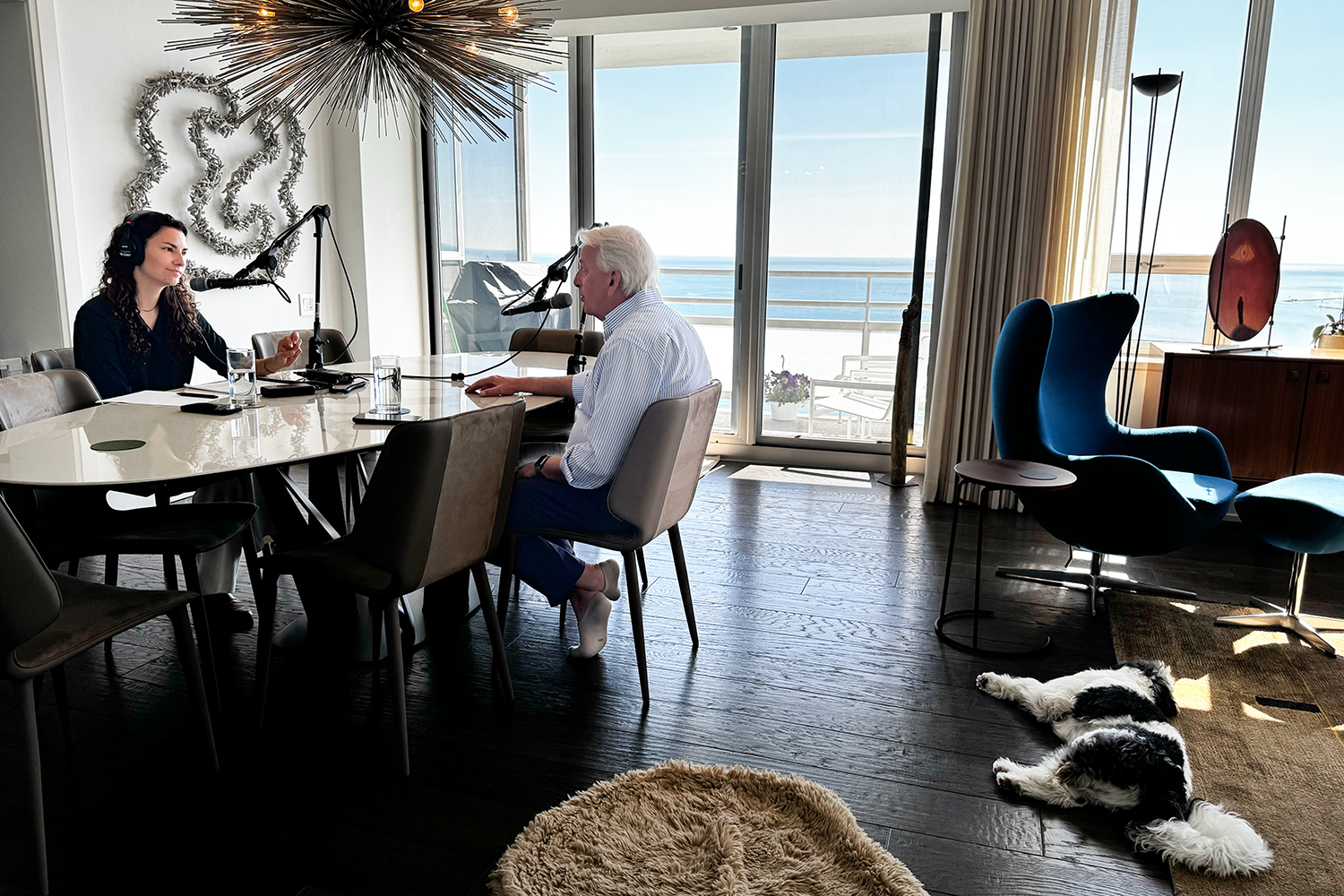
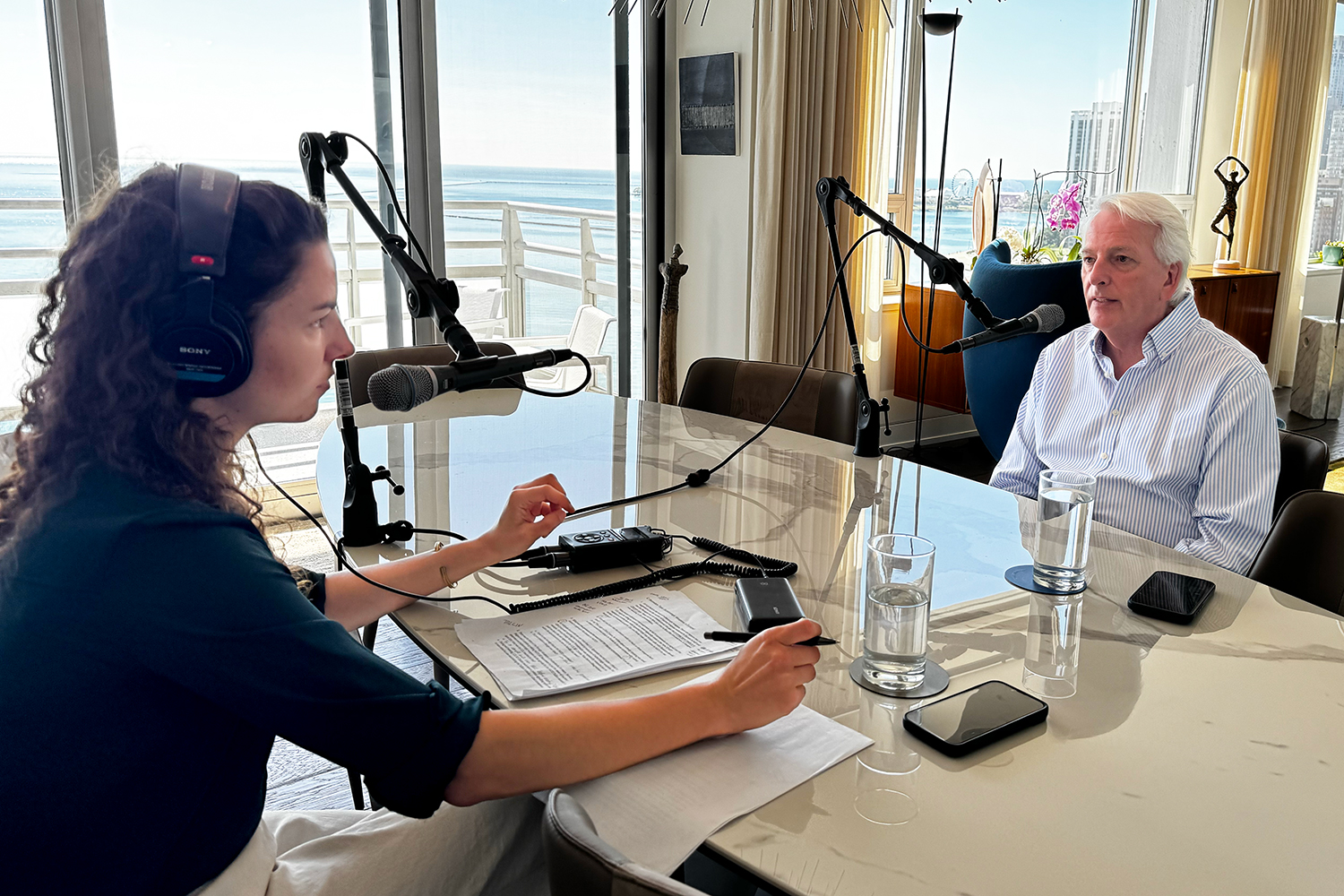
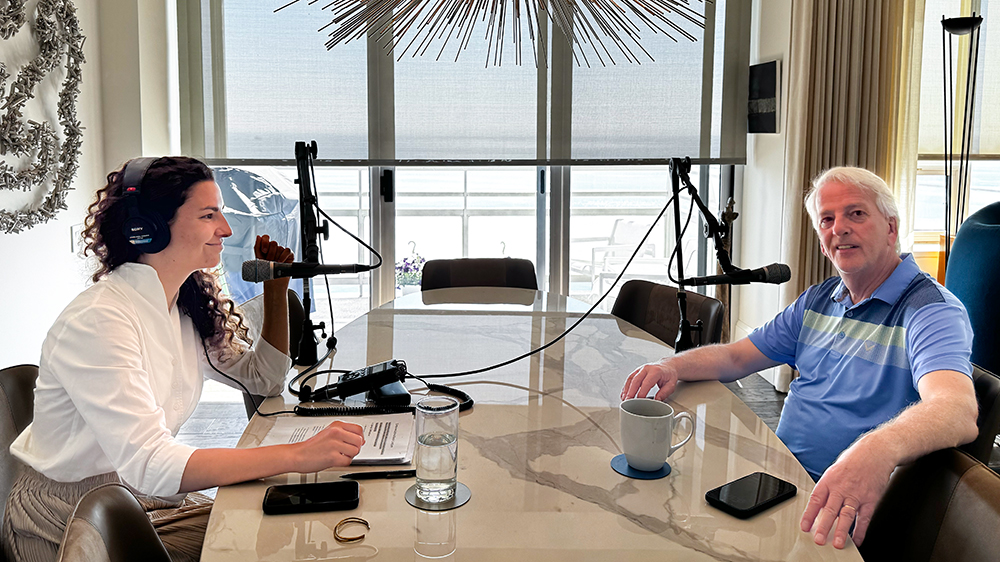
array(1) {
[0]=>
array(387) {
[0]=>
array(4) {
["speaker"]=>
string(16) "Franziska Stärk"
["timestamp"]=>
string(8) "00:00:02"
["seconds"]=>
int(2)
["text"]=>
string(538) "Okay. Hello and welcome. This is an interview with Ivo Daalder conducted by Franziska Stärk for the Oral History Project, a project of Stanley Center for Peace and Security and BASIC. This interview is taking place on June 10 in Chicago, the United States and this is session one out of three. So Ivo, thank you so much for agreeing with this interview. And I thought I would like to get us started by basically you telling me a bit how you got interested in politics in general and in nuclear politics in particular when you were young."
}
[1]=>
array(4) {
["speaker"]=>
string(11) "Ivo Daalder"
["timestamp"]=>
string(8) "00:00:38"
["seconds"]=>
int(38)
["text"]=>
string(871) "When I was young. So politics was part of my upbringing. My parents survived World War II. My mother is a survivor of the Holocaust. My father was living in occupied Holland until the end of the war in 1945 up in the north. So occupation and the Holocaust were part of our dinner conversation, very uplifting as you can imagine. But it was part of how I grew up. My father was a political scientist. Politics was very much part of our day-to-day lives, domestic politics in particular, less so international politics. I went to university in 1978, which was the beginning of the major debate about long-range nuclear missiles being deployed in Europe. The December 79 LRTNF decision, long-range theater nuclear forces decision, happened when I was at university. I wrote my first sort of major research paper back in 1980 on the decision and whether it was the right one."
}
[2]=>
array(4) {
["speaker"]=>
string(11) "Ivo Daalder"
["timestamp"]=>
string(8) "00:01:47"
["seconds"]=>
int(107)
["text"]=>
string(271) "Always been interested in it and stuck with it. I did my master's thesis on NATO nuclear forces, did my doctorate on NATO nuclear forces. So it's been an issue. I started as a political science major but soon became an international relations major and never looked back."
}
[3]=>
array(4) {
["speaker"]=>
string(16) "Franziska Stärk"
["timestamp"]=>
string(8) "00:02:04"
["seconds"]=>
int(124)
["text"]=>
string(216) "And then later on you wrote a whole PhD thesis on flexible response and NATO strategy and like the theater nuclear weapons in Europe, which is a quite transatlantic topic. So why this transatlantic focus so early on?"
}
[4]=>
array(4) {
["speaker"]=>
string(11) "Ivo Daalder"
["timestamp"]=>
string(8) "00:02:21"
["seconds"]=>
int(141)
["text"]=>
string(588) "Well, one, I wrote it in the United States, but I was born in the Netherlands. Born and raised in the Netherlands. So I'm as transatlantic as you can get. I spent about half of my life in the United States, a little more actually now. And 25 plus years in...25, 29 years in Europe. I am as transatlantic as you can get. So that was part of what it was all about. I wanted to go to the United States as a student, met my wife here, grew up, had my kids here, became an American citizen in 1994. And so transatlantic was a logical focus for somebody who lives on both sides of the Atlantic."
}
[5]=>
array(4) {
["speaker"]=>
string(16) "Franziska Stärk"
["timestamp"]=>
string(8) "00:03:06"
["seconds"]=>
int(186)
["text"]=>
string(148) "And the specific topic that you chose, like the flexible response and the nuclear theater weapons back then, what did you find fascinating about it?"
}
[6]=>
array(4) {
["speaker"]=>
string(11) "Ivo Daalder"
["timestamp"]=>
string(8) "00:03:19"
["seconds"]=>
int(199)
["text"]=>
string(874) "So I actually wrote a different dissertation first. You know, my master's thesis was about the nuclear debate in the 1960s, primarily focused on the US, Germany and France, not the UK as much. It was a different player, but it was the French and Germans doubting the deterrent commitment of the United States and how they reacted. That became my thesis. I probably could have turned it into a PhD at Oxford, but decided I wanted to go to MIT. Flexible response was sort of the outcome of my master's thesis at Oxford. It was sort of how the debate was solved in part by Germany accepting flexible response as a reassuring deterrent strategy and the French not accepting it and therefore leaving an integrated military command structure in 1966. So flexible response was a logical focus. I actually wrote my dissertation on the impact of missile defense on flexible response."
}
[7]=>
array(4) {
["speaker"]=>
string(11) "Ivo Daalder"
["timestamp"]=>
string(8) "00:04:25"
["seconds"]=>
int(265)
["text"]=>
string(536) "And the reason for that is that in March of 1983, Ronald Reagan gave his famous Star Wars speech and I wrote a book on what was called the SDI Challenge to Europe before I finished my dissertation, looking at the strategic political and economic challenges that SDI, the Strategic Defense Initiative, Star Wars, posed to Europe. And then I took that strategic part, developed this model about how to think about flexible response and apply different levels of missile defense capabilities to see if it would defeat NATO strategy or not."
}
[8]=>
array(4) {
["speaker"]=>
string(11) "Ivo Daalder"
["timestamp"]=>
string(8) "00:05:03"
["seconds"]=>
int(303)
["text"]=>
string(286) "My dissertation advisor didn't like it for reasons that have more to do with him than for me. So I got a new dissertation advisor and then started focusing on, said, ‘let me go back to where I was with theater nuclear forces. Let me just write the whole story,’ which is what I did."
}
[9]=>
array(4) {
["speaker"]=>
string(16) "Franziska Stärk"
["timestamp"]=>
string(8) "00:05:18"
["seconds"]=>
int(318)
["text"]=>
string(369) "Well, we'll certainly talk about the theater nuclear forces later on in the interview. Later on, basically you were an academic writing about foreign policy, teaching…all that. And then I think for the Clinton administration, it's the first time you joined government. What did you make…like why did you switch path and decided, ‘okay, I'll go into government?’"
}
[10]=>
array(4) {
["speaker"]=>
string(11) "Ivo Daalder"
["timestamp"]=>
string(8) "00:05:44"
["seconds"]=>
int(344)
["text"]=>
string(666) "So I taught at the University of Maryland for 10 years before I went into government and I didn't actually go into government. What I did is I applied for a Council on Foreign Relations International Affairs Fellowship, a very interesting fellowship that allows academics to spend a year in government and government people to spend a year in the academy or in think tanks, but spend a year sort of thinking about it. And the philosophy behind that fellowship is very much to help both academics and policymakers understand each other better. Policymakers understand theories and concepts and analytical tools and academics to understand the reality of policymaking."
}
[11]=>
array(4) {
["speaker"]=>
string(11) "Ivo Daalder"
["timestamp"]=>
string(8) "00:06:27"
["seconds"]=>
int(387)
["text"]=>
string(770) "That was a one-year appointment and then I was asked to stay on because we were doing interesting and important stuff mostly related to Bosnia. At the time I did this in '95 and '96. And Sandy Berger, then deputy national security advisor, asked me to stay on. And I would have probably stayed on for longer, but for the fact that we had children, my wife was working on the NSC and two people in the White House with children is not a good idea. So I went back to Maryland, but it did change everything. It changed my path. I left Maryland a year later to go to Brookings and become a sort of think tanker to allow me to write, which is what I really...I became an academic in order to write. I joined Brookings so that you could write without having to teach students."
}
[12]=>
array(4) {
["speaker"]=>
string(11) "Ivo Daalder"
["timestamp"]=>
string(8) "00:07:19"
["seconds"]=>
int(439)
["text"]=>
string(300) "So it's the best of all worlds. And the reality is think tank world in Washington is in part about how do you influence policy and the best way to influence policy is to implement it yourself. So this idea of spending time in and out of government, very American notion, was attractive and here I am."
}
[13]=>
array(4) {
["speaker"]=>
string(16) "Franziska Stärk"
["timestamp"]=>
string(8) "00:07:44"
["seconds"]=>
int(464)
["text"]=>
string(411) "Before you joined government again then for the Obama administration, you were kind of like an academic/think tanker again and you wrote this piece called The Logic of Zero, which is I think very much in tune with Obama's disarmament agenda later on. And based on this piece, I would like you to just describe to me what the nuclear zeitgeist was like back then before you joined the Obama administration again."
}
[14]=>
array(4) {
["speaker"]=>
string(11) "Ivo Daalder"
["timestamp"]=>
string(8) "00:08:21"
["seconds"]=>
int(501)
["text"]=>
string(676) "So I joined the Obama campaign in March of 2007. One of my mentors was Tony Lake, who was the national security advisor on the Clinton. I actually really got to know him afterwards, not before, not while I was there. We did a lot of stuff together including political stuff. Tony was a you know, really interesting human being who had been a foreign service officer in Vietnam, worked for Kissinger, resigned from Kissinger's…from the Nixon administration over the Cambodia bombing. Very active in politics in the McGovern campaign. He was in the Carter State Department and he was Bill Clinton's top national security advisor during the campaign together with Sandy Berger."
}
[15]=>
array(4) {
["speaker"]=>
string(11) "Ivo Daalder"
["timestamp"]=>
string(8) "00:09:12"
["seconds"]=>
int(552)
["text"]=>
string(543) "And Tony was asked by Obama to co-chair with Susan Rice an advisory group and Tony reached out to me and said, ‘We want you to join. Can you...Do you want to do Europe for us?’ And I said, ‘No, I don't want to do Europe. I'm bored with Europe. I want to do nuclear. I want to do proliferation of nuclear weapons.’ I'd already met Obama by that point a number of times. Lake had done...When Obama became a senator, Lake did a number of dinners. I talked to Obama about his views on Iran and Korea, which were the big things in '05, '06."
}
[16]=>
array(4) {
["speaker"]=>
string(11) "Ivo Daalder"
["timestamp"]=>
string(8) "00:09:56"
["seconds"]=>
int(596)
["text"]=>
string(764) "And as part of leading the effort on nuclear proliferation, we stumbled…we decided that we needed to go into this direction of thinking about ‘what do we do in nuclear weapons?’ And Obama had himself concluded that a world without nuclear weapons would be a more peaceful world. He said that during the campaign a lot. When you say that a lot, somebody needs to fill it in and we started filling in, it's not just me, and started filling in the background. We did a whole series of papers that were focused on that. At the same time, I still was writing, I still was doing my own thing and a good friend of mine, Jan Lodal, who worked in the Kissinger NSC on nuclear weapons issues and worked under Clinton was the deputy undersecretary for defensive policy."
}
[17]=>
array(4) {
["speaker"]=>
string(11) "Ivo Daalder"
["timestamp"]=>
string(8) "00:10:57"
["seconds"]=>
int(657)
["text"]=>
string(840) "And I had…We were close friends. We spent a lot of time together and we started developing this idea that there is a logic to zero if you think that the only purpose of nuclear weapons is to deter the use of nuclear weapons by others. Once no one has nuclear weapons, there is no reason for it. That was a big challenge to sort of the NATO debate and American strategic thinking. But given that the United States was the sole superpower at the time, a world in which conventional power was dominant and nuclear power couldn't be used asymmetrically to deter or counter conventional forces is a world in which the United States would be stronger. So it was in the US interest to seek a world without nuclear weapons. It wasn't just an idealist, we need to get rid of these horrible things. It was also about, this is a strategic advantage."
}
[18]=>
array(4) {
["speaker"]=>
string(11) "Ivo Daalder"
["timestamp"]=>
string(8) "00:11:52"
["seconds"]=>
int(712)
["text"]=>
string(1152) "By the way, something that Les Aspin had pointed out immediately after the end of the Cold War when he became secretary of defense. So we developed this logical theory as part of it, but it was very much in this context of ‘wouldn't it be much better if the world didn't have nuclear weapons?’ The reason Obama was willing to go in this direction was because of the Wall Street Journal article by the four horsemen, as they were called, Kissinger, Nunn, Shultz and Perry, yes, if I remember. So they gave cover to a presidential candidate to run on this. So that's the climate. I mean, the vibe was we are in a world that is increasingly moving towards cooperation rather than competition. Russia in the 1990s was weak trying to transform. China really hadn't accelerated its economic growth that wasn't part of the...Well, by the 2000s, it was still seen as a country that through economic integration will become liberal and liberalized, I think the same was just still true with Russia through good German ‘Handel uh, Annäherung, Handel durch Annäherung, Annnäherung durch Handel, yeah…?’ [struggles to remember the exact German phrase]"
}
[19]=>
array(4) {
["speaker"]=>
string(16) "Franziska Stärk"
["timestamp"]=>
string(8) "00:13:00"
["seconds"]=>
int(780)
["text"]=>
string(26) "‚Wandel durch Handel.‘"
}
[20]=>
array(4) {
["speaker"]=>
string(11) "Ivo Daalder"
["timestamp"]=>
string(8) "00:13:08"
["seconds"]=>
int(788)
["text"]=>
string(4) "Huh?"
}
[21]=>
array(4) {
["speaker"]=>
string(16) "Franziska Stärk"
["timestamp"]=>
string(8) "00:13:08"
["seconds"]=>
int(788)
["text"]=>
string(26) "‚Wandel durch Handel.‘"
}
[22]=>
array(4) {
["speaker"]=>
string(11) "Ivo Daalder"
["timestamp"]=>
string(8) "00:13:11"
["seconds"]=>
int(791)
["text"]=>
string(613) "‘Wandel durch Handel!‘ Yes, exactly. ‘Change through trade.’ A dominant perspective until February 24, 2022 in Germany. And as a result, that was the way the world was thinking. It turned out to be wrong, but that's a different issue. And there were, of course, people pointing out that this may not be the case. By 2007, Vladimir Putin had already given his famous Munich speech in February and there were doubts whether the Russians were really on board. But our argument was, if we can convince others to give up nuclear weapons, we don't need them. And that was very much part of Obama's own thinking."
}
[23]=>
array(4) {
["speaker"]=>
string(16) "Franziska Stärk"
["timestamp"]=>
string(8) "00:13:55"
["seconds"]=>
int(835)
["text"]=>
string(315) "In your piece, you basically write about a step-by-step approach and that the United States needs to take leadership, probably even do unilateral steps to reach that goal. So can you walk me through your thinking back then how you wanted to get this done? So what were the different steps you had in mind back then?"
}
[24]=>
array(4) {
["speaker"]=>
string(11) "Ivo Daalder"
["timestamp"]=>
string(8) "00:14:17"
["seconds"]=>
int(857)
["text"]=>
string(848) "God, I'd have to go back and read the article. I don't remember. [laughs] It's been a while ago, but American leadership... Stop here for a second. [brief phone interruption] I mean, it was clear that nothing would happen unless the United States moved the process along and in order for the US to move the process along, it had to demonstrate that it was serious about what it was trying to do. And that meant that thinking about moving towards a posture of Sole Purpose, where the sole purpose of nuclear weapons is to deter the use of nuclear weapons by others, which was sort of the phraseology that we'd come up with in the logic of deterrence, meant that there was a lot of excess nuclear capabilities and that becomes relevant for what happens when I go to NATO and that's true for the strategic level, but it's also true for the NATO level."
}
[25]=>
array(4) {
["speaker"]=>
string(11) "Ivo Daalder"
["timestamp"]=>
string(8) "00:15:17"
["seconds"]=>
int(917)
["text"]=>
string(865) "And so our argument was, if there's excess capabilities, why don't we actually rethink what we really need for the Sole Purpose deterrence mission, which I don't remember…I think we came up and said it's probably two legs and maybe even one, but we could get rid of land-based nuclear forces. You might want to have some capability that's air-based, but you fundamentally rely on sea-based systems because they are the most survivable. I don't remember. We might have said you need air-based systems because of catastrophic failure, breakthrough in ADSW, anti-submarine warfare. I don't remember. But the general view sort of that we were thinking about…There are weapons capabilities and land-based, particularly fixed land-based missiles are useful for first, not second, use and therefore the argument was, let's just think about how you move away from that."
}
[26]=>
array(4) {
["speaker"]=>
string(16) "Franziska Stärk"
["timestamp"]=>
string(8) "00:16:18"
["seconds"]=>
int(978)
["text"]=>
string(28) "You said that you basically-"
}
[27]=>
array(4) {
["speaker"]=>
string(11) "Ivo Daalder"
["timestamp"]=>
string(8) "00:16:19"
["seconds"]=>
int(979)
["text"]=>
string(208) "But by the way, this is an argument that Jan and I had. It wasn't an argument that we were putting into the...That's too detailed a kind of conversation to have inside the campaign or even after the campaign."
}
[28]=>
array(4) {
["speaker"]=>
string(16) "Franziska Stärk"
["timestamp"]=>
string(8) "00:16:33"
["seconds"]=>
int(993)
["text"]=>
string(312) "That was basically the question I was going to ask you next. You have these very detailed policy proposals. You have like this roadmap of step by step, how do we get there? How do you transform this into a campaign and what were the reactions you got for these really early type of campaigning work that you did?"
}
[29]=>
array(4) {
["speaker"]=>
string(11) "Ivo Daalder"
["timestamp"]=>
string(8) "00:16:52"
["seconds"]=>
int(1012)
["text"]=>
string(980) "So we drew up a policy agenda to implement the pledge to seek the peace and security of a world without nuclear weapons, which becomes the phrase of the Prague speech in 2009, which we published and was on the website and we did a couple of events in which we released that. So there was a quite detailed policy set of issues, including I think the Sole Purpose language already there. The Sole Purpose was also very much focused on internationalizing enrichment and reprocessing facilities because that was sort of key back to the early 1950s disarmament conversations. I don't remember whether we talked about unilateral steps down. I think we did probably, we being the Obama campaign. I'd have to go back and go through my...It's probably some website somewhere, but certainly on my hard drive to look at that. So it was a four or five page document about the policy, how we would implement this policy, some of which found its way into foreign affairs article, others didn't."
}
[30]=>
array(4) {
["speaker"]=>
string(16) "Franziska Stärk"
["timestamp"]=>
string(8) "00:18:08"
["seconds"]=>
int(1088)
["text"]=>
string(283) "Can you then tell me a little bit more about how you actually joined the administration itself? Because I think first you were supposed to handle the nuclear weapons just here in Washington, right? But then you became the NATO ambassador. So just walk me through the process of that."
}
[31]=>
array(4) {
["speaker"]=>
string(11) "Ivo Daalder"
["timestamp"]=>
string(8) "00:18:24"
["seconds"]=>
int(1104)
["text"]=>
string(764) "So in about must have been July or August of 2008, a second effort. So the first effort was this advisory group led by Lake and Rice. Then a second effort was started in the summer led by Jim Steinberg to start preparing for a transition. And Jim asked me...Jim was my former boss at Brookings and I'd known Jim since the late 1980s. Jim asked me to join in particular to focus on the National Security Council. So while I was doing all this nuclear stuff, I was also finishing a 15-year-long project, as Ben knows [Stanley colleague present at the interview, who was involved in this book project], on the National Security Advisor and National Security Council that I'd done with my good friend and colleague, Mac Destler. That book came out at the end of 2008."
}
[32]=>
array(4) {
["speaker"]=>
string(11) "Ivo Daalder"
["timestamp"]=>
string(8) "00:19:21"
["seconds"]=>
int(1161)
["text"]=>
string(438) "And so one of the things I had written, thought about…how to restructure the NSC. I did a paper at the Aspen Institute Strategy Group in July of 2008 on how to do that and that was kind of my thinking. So I was asked to be part of the NSC, of the transition to focus on the NSC. When Obama was elected, I became formally part of the transition and became the deputy on the NSC transition. Tony Lake was the head of it. I was the deputy."
}
[33]=>
array(4) {
["speaker"]=>
string(11) "Ivo Daalder"
["timestamp"]=>
string(8) "00:20:06"
["seconds"]=>
int(1206)
["text"]=>
string(1699) "Tony moved quite quickly to really staff then Vice President Biden. So I and a number of my colleagues did a lot of the NSC, spent a lot of time with Jim Jones who was the NSC advisor designate and probably more importantly, Tom Donilon, who was the deputy. And Tom had thought he was going to go to the State Department as the deputy secretary of state…that the 2008 financial crisis affected housing, he had been on the board of Fannie & Freddie Mae. Confirmation would have been hard, so it was decided he'd go to the NSC, but as Tom would be the first one to admit, he didn't know a lot about how the NSC worked. So I spent a lot of time with Tom on this. So I very much sort of…In fact, in the NSC, creating this new NSC created this new position for a Czar, which was also under what was required under legislation that had passed in 2008 for non-proliferation and a nuclear weapons policy, very much thinking that that's the position I was going to take because it was a logic from going from there. I don't actually exactly know how this, but by within five or six weeks, I got a question saying, ‘Would you like to go to NATO?’ And for a whole variety, including personal reasons, that sounded like a very good...I hadn't thought about that. I thought maybe I'll do that in the second term. I still had young kids. [brief interruption by alarm on the phone] And though I worked harder at NATO than I'd ever worked in my life, I would have worked harder in the White House. So it fit for a whole variety of reasons. So I went there and then spent the next eight weeks trying to figure out who should have that position, which is how we got the Gary Samore to take over that position."
}
[34]=>
array(4) {
["speaker"]=>
string(16) "Franziska Stärk"
["timestamp"]=>
string(8) "00:22:24"
["seconds"]=>
int(1344)
["text"]=>
string(606) "Okay. We'll talk later about the nuclear discussions in NATO and your role there. I first want to talk a little bit about some processes unfolding in Washington. So we had the Obama Nuclear Posture Review where in the end we had the formulation of you know, that there's the fundamental role of nuclear weapons, that it is deterring nuclear attack against the US and its allies. And the Sole Purpose suggestion that you and others put forward earlier did not make it in the NPR. So I would like you to like, kind of just explain the fault lines of this debate within the administration and your role in it."
}
[35]=>
array(4) {
["speaker"]=>
string(11) "Ivo Daalder"
["timestamp"]=>
string(8) "00:23:12"
["seconds"]=>
int(1392)
["text"]=>
string(862) "So I think, that’s very,…that's the end product and the NPR comes out what, 2010. There's a massive amount of other things that happened before. I don't know if you want to go into that, but we don't get to the NPR as it is today until well into 2010 as it came out throughout March of 2009. The NPR, as it was generally, was being drafted in the defense department and was being drafted by people who weren't part of the campaign and frankly didn't agree with Obama's perspectives. And the NPR that was originally drafted by people like Brad Roberts were…you know came to the White House…and I don't remember whether Tom Donilon had already become National Security Advisor or not, didn't matter. Tom very much saw his role as protecting the president's political standing, which is by the way, the role of a national security advisor among many others."
}
[36]=>
array(4) {
["speaker"]=>
string(11) "Ivo Daalder"
["timestamp"]=>
string(8) "00:24:23"
["seconds"]=>
int(1463)
["text"]=>
string(1029) "Tauscher! Yes, thank you. Ellen Tauscher and Gary Samore to rewrite the NPR. I think without any of them knowing except for Derek, he asked me from NATO to review every draft, to make sure that it was compatible with the president's thinking. And so the second NPR, which does things completely different, so it starts with that the greatest threat to America is not somebody else's nuclear weapons nonproliferation. Fundamental rethinking of how to talk about it. That comes out of that process. And then by the time you get to the end, there are all kinds of issues that need to be decided and the reason Sole Purpose doesn't make it is a debate in the Principals Committee in which Bob Gates argues that the threat of biological weapons is such that we want to be able, since we don't have biological weapons, but biological weapons, there's no great verification process, et cetera, the possibility that somebody uses biological weapons against us or our allies is something that we need to continue to think about deterring."
}
[37]=>
array(4) {
["speaker"]=>
string(11) "Ivo Daalder"
["timestamp"]=>
string(8) "00:27:05"
["seconds"]=>
int(1625)
["text"]=>
string(821) "What's not there is the conventional threat. Nobody's really talking about we need nuclear weapons to deal with the conventional threat, which was the NATO Cold War thinking and in fact was still in NATO documents that you know... [brief interruption by alarm on the phone] So the biological threat needed to be deterred, couldn't just be deterred by conventional forces, it needed to be deterred by something else. Since we didn't have chemical, we didn't have biological, nuclear was the only option. That was the argument Gates made. It was not the argument which was the traditional NATO argument. ‘We need nuclear weapons for the ambiguity. That's why we can't be in favor of No First Use,’ which by the way, I was not either. I thought Sole Purpose was stronger than No First Use, which is a declaratory policy."
}
[38]=>
array(4) {
["speaker"]=>
string(16) "Franziska Stärk"
["timestamp"]=>
string(8) "00:28:01"
["seconds"]=>
int(1681)
["text"]=>
string(12) "Why is that?"
}
[39]=>
array(4) {
["speaker"]=>
string(11) "Ivo Daalder"
["timestamp"]=>
string(8) "00:28:04"
["seconds"]=>
int(1684)
["text"]=>
string(899) "Because actually No First Use doesn't mean anything other than a declaration. Sole Purpose gets translated into your force structure and how to think about that...And by the way, it was politically easier because some people still want it to. And the reality was as long as you had a nuclear weapon, first use was possible. So that was the reason. Gates argued that. Clinton agreed, Secretary Clinton. I guess Jim Jones was still there. So Jones agreed. So you have your three security Principals. I'm pretty sure that Tom didn't. The vice chair of the joint chiefs of staff probably didn't either. That was General Cartwright who was an Obama favorite and was actually going to be his next chairman, but was accused of leaking to the New York Times and so didn't make it. But General Cartwright was very much…you know, argued similarly. A Marine. Therefore hates nuclear weapons, for good reason."
}
[40]=>
array(4) {
["speaker"]=>
string(11) "Ivo Daalder"
["timestamp"]=>
string(8) "00:29:28"
["seconds"]=>
int(1768)
["text"]=>
string(918) "And I guess OSTP probably was in favor of it at the time, but that wasn't the political forces. So the president wasn't going to take...And I think Biden was in favor of Sole Purpose. But the president wasn't going to take on his national security advisor, secretary of defense, secretary of state on this issue. I don't actually know whether the issue was presented to him. It might have been, this is a consensus. There probably was a memorandum that went with the NPR in which there were maybe issues he needed to sign up, but I didn't know that. I was part of the discussion at the Principals level because I also lost this and I lost another argument, which was NATO related more there. But that's how that process worked. And so this was a very much, a top-down document, very different from any other document, which is why all subsequent documents are Pentagonese pablum, just justification for the status quo."
}
[41]=>
array(4) {
["speaker"]=>
string(11) "Ivo Daalder"
["timestamp"]=>
string(8) "00:30:35"
["seconds"]=>
int(1835)
["text"]=>
string(518) "We really saw this document as the possibility of changing something fundamental. And what allowed us to do that is the President gave his speech in April at 2009 and had said, ‘This is what we want.’ And having the president having done that speech gave people like me in the bureaucracy much more power to say, ‘Well, we're just following the president's wishes. You may think he's wrong, but he happens to be president. So if you don't like it ts.’ [makes noise that indicates disagreement would not matter]"
}
[42]=>
array(4) {
["speaker"]=>
string(16) "Franziska Stärk"
["timestamp"]=>
string(8) "00:31:07"
["seconds"]=>
int(1867)
["text"]=>
string(203) "So do I get you right that basically the final decision to go for Fundamental Purpose as the language is one that is the result of this, well, high level bureaucratic debate within like the inner circle?"
}
[43]=>
array(4) {
["speaker"]=>
string(11) "Ivo Daalder"
["timestamp"]=>
string(8) "00:31:25"
["seconds"]=>
int(1885)
["text"]=>
string(678) "Still higher than the inner circle! It's at the Principals level. It is directly a debate between that...Bob Gates in particular makes the argument on BW. I think the document says ‘we're not yet ready to go to Sole Purpose.’ Something like that. So it does say we need to go there, but as long as biological...Again, I haven't looked at it for 15, 20 years, less than 20, but 15 years. But it is...In our circle, that is the second level, the Tauscher, Miller circle…There probably was disagreement. I imagine that Miller was probably where his secretary was and that's why it was teed up for an issue to be decided by the Principals and it was decided by the Principals."
}
[44]=>
array(4) {
["speaker"]=>
string(11) "Ivo Daalder"
["timestamp"]=>
string(8) "00:32:19"
["seconds"]=>
int(1939)
["text"]=>
string(347) "Again, probably was decided by the president, but I think with the consensus recommendation as opposed to a, ‘This or that,’ but I don't know that. I just don't know the document. Frankly, I don't know who would know. [chuckles] Maybe Derek Chollet, maybe Tom Donilon, whose memory is better than most. If there was a decision, Tom would know."
}
[45]=>
array(4) {
["speaker"]=>
string(16) "Franziska Stärk"
["timestamp"]=>
string(8) "00:32:45"
["seconds"]=>
int(1965)
["text"]=>
string(78) "So what is the actual influence of outside opinion on these type of processes?"
}
[46]=>
array(4) {
["speaker"]=>
string(11) "Ivo Daalder"
["timestamp"]=>
string(8) "00:32:53"
["seconds"]=>
int(1973)
["text"]=>
string(178) "Zero. The outside opinion comes with the new [inaudible 00:32:56] administration. So this is a very different...This is how the United States is different from any other country."
}
[47]=>
array(4) {
["speaker"]=>
string(11) "Ivo Daalder"
["timestamp"]=>
string(8) "00:33:03"
["seconds"]=>
int(1983)
["text"]=>
string(1030) "Ellen Tauscher was a former congresswoman who actually wrote the legislation to get a Czar into the NSC. Jim Miller was in the Obama administration...sorry, in the Clinton administration...and rose to deputy undersecretary of defense for policy, and gets...No, that's not true. He was somewhere else. He was deputy undersecretary of defense under Michèle Flournoy. Michèle was not part of this discussion. Jim was, interestingly. I'm sure that Michèle and Jim were closely aligned on this, but they were all outsiders. I came from the outside. So the way outsiders get influence is by being part of the administration, and we had a president who already made clear where he wanted to go. But that speech, the 2009 April speech, that was an internal speech. It was written internally. It was probably written by Ben Rhodes. So that's how it works. The big issue isn't outside versus inside. It's new people versus bureaucracy. And it's the new people who need to push the bureaucracy to go somewhere where they don't want to go."
}
[48]=>
array(4) {
["speaker"]=>
string(11) "Ivo Daalder"
["timestamp"]=>
string(8) "00:34:24"
["seconds"]=>
int(2064)
["text"]=>
string(506) "Now, Obama decided early on that to protect himself politically, he needed people like Bob Gates, who was left over, Clinton was a different issue, and Jim Jones to be part of his circle. And so he kept some of the inside, because both Gates and Jones, who was SACEUR, commandant at the Marine Corps, very much an insider, were very influential as opposed to people like Hillary Clinton, to some extent, although the politics plays in a different way. Tom Donilon, Steinberg, et cetera…Michèle Flournoy."
}
[49]=>
array(4) {
["speaker"]=>
string(16) "Franziska Stärk"
["timestamp"]=>
string(8) "00:35:08"
["seconds"]=>
int(2108)
["text"]=>
string(198) "So there were, if I'm correct, consultations with allies on potential changes in doctrine, on Sole Purpose. Were you part of them, and can you tell me how that unfolded, this consultation mechanism?"
}
[50]=>
array(4) {
["speaker"]=>
string(11) "Ivo Daalder"
["timestamp"]=>
string(8) "00:35:25"
["seconds"]=>
int(2125)
["text"]=>
string(1175) "Very much part of it. I mean, we basically, I remember Michèle Flournoy came and briefed the NAC probably two or three times about how to think about it. The reality was that the doctrinal debate in NATO itself was pretty stilted, and nobody had really thought about it for the last 30 years. Nobody had done a Strategic Concept in 30 years. There was a process to get a new Strategic Concept going, and that process had a group of experts that was looking at these issues. But frankly, the Secretary General, the NATO nations, even the group of experts, knew that the nuclear issue was something that had to be handled by the United States in consultation. It's the only...you know, with the Quad, basically, the other two nuclear powers and Germany, because of its critical role…And to some extent, the basing countries had to be involved in that. But Europe would...So the French don't matter because they're not part of the integrated command structure. The UK is so aligned with the United States. They do consult and they get...They're part of the NPR development. They get consulted in a special different way, and the rest of the Allies defer to the United States."
}
[51]=>
array(4) {
["speaker"]=>
string(11) "Ivo Daalder"
["timestamp"]=>
string(8) "00:36:51"
["seconds"]=>
int(2211)
["text"]=>
string(700) "So it wasn't like, ‘Well, we're thinking about this. What's your view?’ It's ‘Here's what we…Here’s our argument.’ And then there were questions, and if there were issues that needed to be resolved, they would be resolved. The Sole Purpose versus Fundamental Purpose was not one of them. It was…As long as we didn't go to No First Use. No First Use would have opened up a whole can of worms, and I very early on argued that we shouldn't open up that can of worms. It's not worth it. It's besides the point. The Sole Purpose is much more important, and that's where we should focus our efforts internally on. And then whatever the outcome of that debate is, No First Use is not an issue."
}
[52]=>
array(4) {
["speaker"]=>
string(16) "Franziska Stärk"
["timestamp"]=>
string(8) "00:37:37"
["seconds"]=>
int(2257)
["text"]=>
string(169) "So you said that the No First Use thing was kind of like off the table for the Allies. So what were their arguments? What was the feedback you got in this consultations?"
}
[53]=>
array(4) {
["speaker"]=>
string(11) "Ivo Daalder"
["timestamp"]=>
string(8) "00:37:47"
["seconds"]=>
int(2267)
["text"]=>
string(564) "Well, there was no argument. It was opening up a can of worms that didn't need to be opened up. The Allies didn't want to talk about nuclear weapons. The Belgians didn't want to talk about it. They have nuclear weapons in Belgium. It's reported. I think it's public, whatever. It's general knowledge. The Belgians said, ‘Let's not talk about it, because if we talk about it, we get a public backlash and we don't want it. So let's just do whatever. Whatever you want to do, we'll do it, but let's not talk about it.’ So there was no incentive to talk about it."
}
[54]=>
array(4) {
["speaker"]=>
string(11) "Ivo Daalder"
["timestamp"]=>
string(8) "00:38:23"
["seconds"]=>
int(2303)
["text"]=>
string(786) "The only issue that really, really started, you know made this of interest inside the alliance, not publicly, but inside the alliance, was how do we talk about it in the Strategic Concept. Because we were going to do a new Strategic Concept, because we needed to talk about nuclear weapons in some form in that Strategic Concept, that's...And the entire debate that happens in NATO is about three paragraphs in the Strategic Concept and that's it. There's no other discussion. The Secretary General basically said, ‘Not my job. You figure it out.’ He looked at me and he said, ‘You figure it out. Anything that you guys can come up with, I put in here.’ So the entire Strategic Concept draft had three paragraphs that were not touched, and that's what I spent a year working on."
}
[55]=>
array(4) {
["speaker"]=>
string(16) "Franziska Stärk"
["timestamp"]=>
string(8) "00:39:13"
["seconds"]=>
int(2353)
["text"]=>
string(158) "Okay. So when I get you right, basically the key argument that then in the end was decisive was the one about biological weapons. Not so much Allied concerns?"
}
[56]=>
array(4) {
["speaker"]=>
string(11) "Ivo Daalder"
["timestamp"]=>
string(8) "00:39:25"
["seconds"]=>
int(2365)
["text"]=>
string(3) "No."
}
[57]=>
array(4) {
["speaker"]=>
string(16) "Franziska Stärk"
["timestamp"]=>
string(8) "00:39:26"
["seconds"]=>
int(2366)
["text"]=>
string(5) "Okay."
}
[58]=>
array(4) {
["speaker"]=>
string(11) "Ivo Daalder"
["timestamp"]=>
string(8) "00:39:26"
["seconds"]=>
int(2366)
["text"]=>
string(276) "Even though all the nuclear mafia in the Pentagon, the entire nuclear mafia in the Pentagon, thinks it's about this, and we need counterforce and low-yield nuclear weapons in order to make credible this thing. The argument inside the Principals Committee meeting was about BW."
}
[59]=>
array(4) {
["speaker"]=>
string(16) "Franziska Stärk"
["timestamp"]=>
string(8) "00:39:46"
["seconds"]=>
int(2386)
["text"]=>
string(12) "Interesting-"
}
[60]=>
array(4) {
["speaker"]=>
string(11) "Ivo Daalder"
["timestamp"]=>
string(8) "00:39:48"
["seconds"]=>
int(2388)
["text"]=>
string(299) "And you're beginning in the synthetic biology period, and this idea that you could start making pretty dangerous stuff in labs and all kinds of things, so it wasn't a crazy, crazy thought. In fact, it was a very credible thought, and we had always reserved the right to use nuclear weapons for that."
}
[61]=>
array(4) {
["speaker"]=>
string(16) "Franziska Stärk"
["timestamp"]=>
string(8) "00:40:12"
["seconds"]=>
int(2412)
["text"]=>
string(190) "So you said earlier that you were reviewing this second drafting process of the NPR. How do I have to imagine this? Like, I imagine other people were not happy about you reviewing the draft."
}
[62]=>
array(4) {
["speaker"]=>
string(11) "Ivo Daalder"
["timestamp"]=>
string(8) "00:40:27"
["seconds"]=>
int(2427)
["text"]=>
string(17) "They didn't know."
}
[63]=>
array(4) {
["speaker"]=>
string(16) "Franziska Stärk"
["timestamp"]=>
string(8) "00:40:27"
["seconds"]=>
int(2427)
["text"]=>
string(61) "Okay. They didn't know it. So how did you secretly review it?"
}
[64]=>
array(4) {
["speaker"]=>
string(11) "Ivo Daalder"
["timestamp"]=>
string(8) "00:40:30"
["seconds"]=>
int(2430)
["text"]=>
string(105) "I got the draft from Derek on my computer and I read it, and I sent comments back to him and Tom Donilon."
}
[65]=>
array(4) {
["speaker"]=>
string(16) "Franziska Stärk"
["timestamp"]=>
string(8) "00:40:37"
["seconds"]=>
int(2437)
["text"]=>
string(79) "Okay. So then it was their job to kind of like implement the comments you made?"
}
[66]=>
array(4) {
["speaker"]=>
string(11) "Ivo Daalder"
["timestamp"]=>
string(8) "00:40:43"
["seconds"]=>
int(2443)
["text"]=>
string(21) "Derek was writing it."
}
[67]=>
array(4) {
["speaker"]=>
string(16) "Franziska Stärk"
["timestamp"]=>
string(8) "00:40:45"
["seconds"]=>
int(2445)
["text"]=>
string(5) "Okay."
}
[68]=>
array(4) {
["speaker"]=>
string(11) "Ivo Daalder"
["timestamp"]=>
string(8) "00:40:45"
["seconds"]=>
int(2445)
["text"]=>
string(461) "And whether it was coming out of his own mind or something he heard or whatever, so I don't think a lot of people knew that I was doing this. It wouldn't have been surprising, because I was the nuclear guy during the campaign, and I guess it still was the deputy national security advisor who asked me to do it. But I would go in on the weekend to my office and read it on the classified system, send back my comments, and sometimes just talk to Derek about it."
}
[69]=>
array(4) {
["speaker"]=>
string(16) "Franziska Stärk"
["timestamp"]=>
string(8) "00:41:17"
["seconds"]=>
int(2477)
["text"]=>
string(129) "So more of a political question, would you agree or disagree that like the reforming of doctrine can be a form of risk reduction?"
}
[70]=>
array(4) {
["speaker"]=>
string(11) "Ivo Daalder"
["timestamp"]=>
string(8) "00:41:28"
["seconds"]=>
int(2488)
["text"]=>
string(833) "Sure, absolutely. I mean, I think part of the argument about Sole Purpose was to lower the likelihood of nuclear weapons use, because it focused on deterring the one thing nuclear weapons were really good at deterring, the use of nuclear weapons, and so it would make it less likely that nuclear weapons were used. If you in fact think that unique nuclear weapons deter conventional attacks, which is the old NATO doctrine born out of conventional inferiority…then or a real threat, which by the time this exists, nobody believes exists...wrong leads, it turns out, but that was the presumption. So at that time, thinking about how you reduce the role of nuclear weapons in NATO strategy, which I think is one of the five Tallinn principles, is very much about reducing the risk of nuclear use. Absolutely. It's very much explicit."
}
[71]=>
array(4) {
["speaker"]=>
string(16) "Franziska Stärk"
["timestamp"]=>
string(8) "00:42:40"
["seconds"]=>
int(2560)
["text"]=>
string(328) "So following the publication of the NPR and then also the ratification of New START, Obama ordered this internal review of the nuclear war plan, what some call the targeting review. What were the consequences of the doctrinal discussions and the language that ended up in the NPR for this review, if there were any consequences?"
}
[72]=>
array(4) {
["speaker"]=>
string(11) "Ivo Daalder"
["timestamp"]=>
string(8) "00:43:03"
["seconds"]=>
int(2583)
["text"]=>
string(852) "So I'm not the best person. I was involved tangentially in the same way. So this review was really done by Jim Miller, but in close cooperation with Christine Wormuth. Christine was the senior director for defense policy, I guess. And again, Tom asked me to take a look at this, and what I did is I wanted to make sure that whatever was coming in the targeting doctrine was consistent with what was ever the Obama/NPR policy, and it meant that if you no longer needed nuclear weapons to deal with conventional threats, the kinds of nuclear weapons you had could be significantly changed, and the force structure. And I think in the end, although it all gets very complicated, I think intellectually the Pentagon, Miller, Cartwright, as the two sort of key people, Wormuth and of course the State Department, were all aligned on readjusting the posture."
}
[73]=>
array(4) {
["speaker"]=>
string(11) "Ivo Daalder"
["timestamp"]=>
string(8) "00:44:16"
["seconds"]=>
int(2656)
["text"]=>
string(498) "Politically, the readjustment of the posture bumped into the ratification of New START. And the ratification of New START becomes so important that the administration is willing, as by the way, every administration with every arms control agreement we've ever done, to compromise on force structure issues within the structure of New START. So you have Jon Kyl as a key voice arguing for modernization. The entire modernization program that we're still talking about now gets born out of New START."
}
[74]=>
array(4) {
["speaker"]=>
string(11) "Ivo Daalder"
["timestamp"]=>
string(8) "00:44:52"
["seconds"]=>
int(2692)
["text"]=>
string(830) "And so you have this very strange but very political and very U.S. idea that you have an agreement that is based on one set of principles, which is to reduce the role of nuclear weapons, that gets ratified on the basis of a very other set of principles, which is the modernization of your nuclear force structure. And the modernization of a nuclear force structure that gives you capabilities that are contrary force structure capability that is not part of your New START thinking. That's how politics works, and it raises fundamental issues about arms control and how…treaties and all those sorts of issues. It's the same with SALT I, it's the same as SALT II. SALT II gets you to B-2 bomber and a whole bunch of other things. And so this is the politics of treaty ratification that play out in 2010 in order to get this done."
}
[75]=>
array(4) {
["speaker"]=>
string(11) "Ivo Daalder"
["timestamp"]=>
string(8) "00:45:52"
["seconds"]=>
int(2752)
["text"]=>
string(464) "For the same reason, to just jump ahead, I had made the argument that as part of the NPT Review Conference, which was also in 2010, we should unilaterally reduce half the nuclear inventory in NATO, and everybody agreed to it. This is in the same meeting that Sole Purpose had, I think. It may not be in the same meeting. It's probably before that, but it's in a meeting that leads to the Tallinn principles, which is in April of 2010 or something like that, right?"
}
[76]=>
array(4) {
["speaker"]=>
string(16) "Franziska Stärk"
["timestamp"]=>
string(8) "00:46:29"
["seconds"]=>
int(2789)
["text"]=>
string(4) "Yes."
}
[77]=>
array(4) {
["speaker"]=>
string(11) "Ivo Daalder"
["timestamp"]=>
string(8) "00:46:32"
["seconds"]=>
int(2792)
["text"]=>
string(734) "The date I will remember because it has to do with whenever the volcano that was erupting in Iceland was preventing Clinton people from flying to Tallinn so that was...Anyway. [Chuckles] I made that argument, everybody agreed to it and then Clinton said, ‘But I don't want to do unilateral reduction before we have START ratified.’ And so the unilateral reduction is off the table. We lose the RevCon argument, which is where we should have made the argument. Again, not because people disagree with it, but if you start unilaterally reducing, then you can't get START ratified. People will say, ‘Well, you're already reducing unilaterally. Why should we ratify an arms control treaty if you're going to do this unilaterally?’"
}
[78]=>
array(4) {
["speaker"]=>
string(11) "Ivo Daalder"
["timestamp"]=>
string(8) "00:47:16"
["seconds"]=>
int(2836)
["text"]=>
string(817) "So the treaty and the mechanism that we were using, formal process...which raises questions whether that was the right mechanism, whether we should have done this, whether New START was the right way to think about it, all of which I have my own views on, though that wasn't part of my remit, so I didn't spend a lot of time thinking about it... All of that influences this debate and influences the Sole Purpose debate to some extent. It influences the targeting debate to another extent, and it hugely influences the force posture in Europe debate. Everybody agrees that these weapons are there for reassurance purposes, and whether you have 100 or 200 or 400, really. There's a survivability issue, but that's a different set of issues. That’s not…At the numbers that we're talking about, that's not the issue."
}
[79]=>
array(4) {
["speaker"]=>
string(16) "Franziska Stärk"
["timestamp"]=>
string(8) "00:48:13"
["seconds"]=>
int(2893)
["text"]=>
string(366) "I definitely want to talk more about the whole issue of you proposing to cut the numbers, and we'll do that, but I found your comment really interesting on basically the role of sequencing and timing, with all these different things happening in parallel. So what is your lesson learned for risk reduction, arms control efforts when it comes to the factor of timing?"
}
[80]=>
array(4) {
["speaker"]=>
string(11) "Ivo Daalder"
["timestamp"]=>
string(8) "00:48:42"
["seconds"]=>
int(2922)
["text"]=>
string(600) "Well, my lesson learned is that you actually should sequence it in the following manner. First, you agree on what's the role of nuclear weapons in your strategy. That's the NPR. Then you agree on what is the force posture that can implement it. That's the targeting review. And then you sit down and say, ‘Okay, how do we achieve that in negotiations with other countries?’ That's not what we did. So the first statement is actually the statement of goals, which is the presence of speech we did, then leads to the NPR, then leads to the targeting review, but the negotiations preceded all of it."
}
[81]=>
array(4) {
["speaker"]=>
string(11) "Ivo Daalder"
["timestamp"]=>
string(8) "00:49:23"
["seconds"]=>
int(2963)
["text"]=>
string(575) "We started negotiation on day one because that's how we had always done it. We also appointed someone, Rose Gottemoeller, who had tried to get this treaty at the end of the Clinton administration, did not succeed, and now saw an opportunity to get it in the Obama administration. And I think there was a disjunction between the traditional arms control community and people like me, who were saying, ‘No, arms control should follow the logic of how to think about nuclear weapons.’ And I think in the end, arms control defeats the entire purpose of what we set out to do."
}
[82]=>
array(4) {
["speaker"]=>
string(11) "Ivo Daalder"
["timestamp"]=>
string(8) "00:50:05"
["seconds"]=>
int(3005)
["text"]=>
string(631) "The other thing that changes things is Russia, and to some extent China, so you get a very different nuclear picture a few years later. I don't think we would've ever gotten where we wanted to go, but arms control made it more difficult because it set us...The ratification process and frankly the way we negotiated, which was to differentiate between strategic and non-strategic, which was a mistake. That one, I did argue quite openly that it was a mistake, but that was too hard so therefore we don't. We did INF so we don't have to worry about it and we don't have anything to trade, which anyway, is a different set of issues."
}
[83]=>
array(4) {
["speaker"]=>
string(11) "Ivo Daalder"
["timestamp"]=>
string(8) "00:50:46"
["seconds"]=>
int(3046)
["text"]=>
string(788) "That disjunction, which is a disjunction, and frankly, in the nuclear community between the arms controllers and the strategists, except the strategists under Obama were anti-nuclear strategists. They were trying to get…reduce the role of nuclear weapons, and the main people that were part of that generally tended to agree with Miller, Tauscher, Donilon, me. And non of…But we were stuck in this arms control framework, which is how you demonstrate you're, ‘We are in favor of reducing the role of nuclear weapons. Look, we're signing arms control agreements,’ except when the U.S. signs arms control agreements, we get nuclear modernization as the price for ratification. So that's where the sequencing goes wrong. What you should have done is not had arms control discussions."
}
[84]=>
array(4) {
["speaker"]=>
string(16) "Franziska Stärk"
["timestamp"]=>
string(8) "00:51:47"
["seconds"]=>
int(3107)
["text"]=>
string(295) "The result of this targeting review was basically that essentially the U.S. could do with a third less of nuclear warheads, a thousand would be enough. We had the NPR, where in the end we did have Fundamental Purpose and not Sole Purpose. In the end, we didn't have the reductions to a thousand."
}
[85]=>
array(4) {
["speaker"]=>
string(11) "Ivo Daalder"
["timestamp"]=>
string(8) "00:52:11"
["seconds"]=>
int(3131)
["text"]=>
string(21) "Because we had START."
}
[86]=>
array(4) {
["speaker"]=>
string(16) "Franziska Stärk"
["timestamp"]=>
string(8) "00:52:13"
["seconds"]=>
int(3133)
["text"]=>
string(213) "Exactly. So kind of like the drastic leap did not happen, and I would be interested in your reflections on that. Why, if you can like summarize why that was the case, and how you felt about the result at the time."
}
[87]=>
array(4) {
["speaker"]=>
string(11) "Ivo Daalder"
["timestamp"]=>
string(8) "00:52:36"
["seconds"]=>
int(3156)
["text"]=>
string(2455) "I don't know how I felt about it. [pause] But I mean, the reason it didn't happen is because the New START effort was unrelated to the entire risk reduction effort, if you want to call it that, the entire effort to reduce the role of nuclear weapons and nuclear strategy, which was the fundamental purpose of what we were trying to do, starting in the campaign through the April speech. And I think people never sat down and said, ‘Are these two paths moving in the same direction?’ And there was this assumption that because arms control is meant to help reduce nuclear weapons, that the two were compatible, when in fact they were completely incompatible, particularly if you understood that the price of ratification tends to be modernization rather than the other way around. And…But politically, the administration and the president very much saw ratification of New START as sort of a vindication of his approach to this, and I think it took him quite a long time to realize that that wasn't the case. Whether it was just before or just after ratification that he realized it, but I remember in Lisbon…So ratification happens in late 2010 after the election, after his shellacking. Lisbon is when he gets the foreign ministers of all NATO countries to come together and say, ‘We need to ratify this,’ has a big impact on the ratification debate, and Jon Kyl gets his modernization package at a trillion dollars, I think. That win was important to the president because he had just suffered a huge defeat, and it showed that in fact he could still get things done. So it became a politically important thing, divorced from the nuclear process, and it was easy to justify it of that nuclear process because it's about arms control and arms control is good, even if arms control leads to more nuclear weapons or more modern nuclear weapons. So I think that's essentially why it went wrong, and what it did to me is it reinforced my view that traditional arms control just isn't the way to deal with these issues, that you have to do it in a different way and that you can do a lot more by yourself, doctrinally, targeting and other ways, and then out of that force change in policy on others. Now, all of that falls apart really by 2014 because of the Russian invasion of Ukraine. Indeed, after I leave NATO in 2013, late 2013, I convinced Albright to co-chair with Malcolm Rifkind an effort to take a new look on nuclear weapons in Europe."
}
[88]=>
array(4) {
["speaker"]=>
string(11) "Ivo Daalder"
["timestamp"]=>
string(8) "00:55:58"
["seconds"]=>
int(3358)
["text"]=>
string(614) "We had a meeting in Munich in early 2014, February 2014, before the Crimea debacle, and that was the first and last meeting we ever had. Never went back to it, and that was very much about relooking. Let's take the logic of what we had set out to do in the nuclear…in the NATO force posture and in the deterrence and defense review, which is all the NATO stuff, and what Albright had been trying to start thinking about when she led the group of experts back in 2009 on the NATO Strategic Concept, and sort of say, ’Okay, can we now do the nuclear piece and get it right?’ But all of that disappears in 2014."
}
[89]=>
array(4) {
["speaker"]=>
string(11) "Ivo Daalder"
["timestamp"]=>
string(8) "00:56:49"
["seconds"]=>
int(3409)
["text"]=>
string(868) "Now, there's another attempt by the president in 2013. I think he does a speech in Berlin where he talks about reducing NATO nuclear weapons and non-strategic nuclear forces. And that's actually an effort led by Liz Sherwood-Randall, who at that time is the senior director for defense. This is the beginning of the second term. Later on, she becomes deputy secretary of energy with sort of responsibility for nuclear weapons policy. She pushes this line, and Liz was, Liz was…sort of half in the old world, half in the new world when it came to nuclear issues. But on this, I mean, I remember she called me and said, ‘We're pushing this.’ This was just before I left. I looked at the...I think it was in June of 2013, something like that, whenever Obama did it. It was a speech in Berlin, but that never went anywhere in part because of what happened in Crimea."
}
[90]=>
array(4) {
["speaker"]=>
string(16) "Franziska Stärk"
["timestamp"]=>
string(8) "00:58:01"
["seconds"]=>
int(3481)
["text"]=>
string(132) "That's super interesting. I wasn't aware that there was a new push in 2013. I thought that after 2012, the topic was basically done."
}
[91]=>
array(4) {
["speaker"]=>
string(11) "Ivo Daalder"
["timestamp"]=>
string(8) "00:58:11"
["seconds"]=>
int(3491)
["text"]=>
string(45) "No, there's another push, which goes nowhere."
}
[92]=>
array(4) {
["speaker"]=>
string(16) "Franziska Stärk"
["timestamp"]=>
string(8) "00:58:12"
["seconds"]=>
int(3492)
["text"]=>
string(54) "Okay. Where did the push come from? Like what was the-"
}
[93]=>
array(4) {
["speaker"]=>
string(11) "Ivo Daalder"
["timestamp"]=>
string(8) "00:58:18"
["seconds"]=>
int(3498)
["text"]=>
string(693) "Because there's still a belief that this is the right thing to do. I mean, remember, rethinking NATO's force posture, everybody agreed that that was a good idea. They didn't want to do it unilaterally because it would have interfered with START ratification. The moment START's ratified, you're done. So by 2013, START's ratified. You can open up the gate. By 2013, I'm already leaving. So I knew I was going to leave when I accepted a job here in January 2013. I knew I was going to go soon, so I wasn't really...This is for the new administration or the second-term administration to really push through. I'm pretty sure Liz was the guiding light. I don't know who else would have pushed it."
}
[94]=>
array(4) {
["speaker"]=>
string(16) "Franziska Stärk"
["timestamp"]=>
string(8) "00:59:07"
["seconds"]=>
int(3547)
["text"]=>
string(239) "Before we go to the whole NATO topic, we talked a lot about you know this doctrinal issue and also the role of sequencing. Are there any other anecdotes around this doctrinal discussion that we have missed and that you would like to share?"
}
[95]=>
array(4) {
["speaker"]=>
string(11) "Ivo Daalder"
["timestamp"]=>
string(8) "00:59:27"
["seconds"]=>
int(3567)
["text"]=>
string(572) "No. What was interesting, I would have to…Idon't know what the language was before we had the Principals Committee meeting. I have a feeling it was an open question and so we had competing language, but that was it. That was fundamentally the argument, and it was not part of the first draft of the NPR, which was basically Bush redone. The people who had written it, Brad Roberts, were extended deterrence. ‘In order to have credible extended deterrence, you need counterforce, you need small nuclear weapons’ and all that sort of stuff, something I never believed."
}
[96]=>
array(4) {
["speaker"]=>
string(11) "Ivo Daalder"
["timestamp"]=>
string(8) "01:00:11"
["seconds"]=>
int(3611)
["text"]=>
string(1436) "I mean, the NATO stuff plays into this, and one thing I'll do before we talk about this tomorrow, I'll look back at some of my...There's the five Tallinn principles, which is also decided in a Principals Committee meeting. It's a very important set of principles because they sort of open up the possibility for thinking about it, including reduction in native nuclear weapons, which is one of the five principles. But the doctrinal issue I think is really about Fundamental versus Sole Purpose, and the reason it doesn't work is because of BW. And there is..it's quite explicit, the language, that if we resolve this issue or if we find another way to do a deal with it, we want to go to Sole Purpose. I mean, once the president says we want the peace and security of a world without nuclear weapons, you've bought into the logic of zero, and the only way you get to the logic of zero is through Sole Purpose. Everybody knows that. Nobody wants to go to zero, so they have to find other reasons. And that's fundamentally, I don't think that Gates bought into zero. I don't think that Clinton bought into zero. I know that Joe Biden did, very much. I've had extensive conversations with him about it, and of course the president did. So you have to find other ways to get there, but the president's policy was there. I mean, he hadn't only campaigned on it. He'd made it as president. His first big foreign policy speech was about this."
}
[97]=>
array(4) {
["speaker"]=>
string(16) "Franziska Stärk"
["timestamp"]=>
string(8) "01:01:58"
["seconds"]=>
int(3718)
["text"]=>
string(200) "And just to put this basically on the record, this principalse meeting where you had the discussion about the biological weapons implications and all that, that was in late 2009. Do I have this right?"
}
[98]=>
array(4) {
["speaker"]=>
string(11) "Ivo Daalder"
["timestamp"]=>
string(8) "01:02:13"
["seconds"]=>
int(3733)
["text"]=>
string(39) "No, it's probably, definitely, in 2010."
}
[99]=>
array(4) {
["speaker"]=>
string(16) "Franziska Stärk"
["timestamp"]=>
string(8) "01:02:14"
["seconds"]=>
int(3734)
["text"]=>
string(11) "2010. Okay."
}
[100]=>
array(4) {
["speaker"]=>
string(11) "Ivo Daalder"
["timestamp"]=>
string(8) "01:02:15"
["seconds"]=>
int(3735)
["text"]=>
string(142) "Well, shortly before the NPR comes out, which I don't remember when it is. What is it? July or August or something like that. It's quite late."
}
[101]=>
array(4) {
["speaker"]=>
string(16) "Franziska Stärk"
["timestamp"]=>
string(8) "01:02:24"
["seconds"]=>
int(3744)
["text"]=>
string(625) "Okay, good. Let me quickly check the time for a second. I'll just pause for a second. All right. [pause] So as I said, I want to go back to the issue of sub-strategic weapons, and they were kind of like I asked other people about this episode and they basically told me, well, that you having been appointed as NATO ambassador could have been a hint that the United States wants to get serious about this issue. So I was kind of wondering if you could just like tell me how you first floated the idea of reducing the sub-strategic nuclear weapons in Europe, and how that played into your appointment as NATO ambassador later."
}
[102]=>
array(4) {
["speaker"]=>
string(11) "Ivo Daalder"
["timestamp"]=>
string(8) "01:03:18"
["seconds"]=>
int(3798)
["text"]=>
string(690) "So I was on the record, actually arguing for abolishing tactical nuclear weapons before the 1991 reduction, the unilateral reduction that Colin Powell and George Bush agreed to immediately after the Russian thing. I published a piece in The New York Times arguing we should get rid of tactical nuclear weapons, so everybody knew that was kind of my position. I'd written stuff on SLCMs. I've written a lot of stuff on this stuff, although I was not an ideologue about it. I wasn't against necessarily these weapons, and I certainly was in favor of the LRTNF decision back in the late '70s and early '80s, and still thought it was the right decision. I still think it was the right decision."
}
[103]=>
array(4) {
["speaker"]=>
string(11) "Ivo Daalder"
["timestamp"]=>
string(8) "01:04:13"
["seconds"]=>
int(3853)
["text"]=>
string(639) "The reason I went to NATO had nothing to do with my background on nuclear weapons, just the decision, which I think is made in November of 2008. There's a small group meeting with the president to start thinking about who should be the first ambassadors, and they decide that three ambassadors should be nominated first, Afghanistan, Iraq and NATO. Afghanistan because that becomes the principal effort on the war, Iraq because that becomes how do we wind it down, so those are two very important pieces, and NATO because there's a summit in April 2009 and we want our own people, and we also wanted to show that we cared about our allies."
}
[104]=>
array(4) {
["speaker"]=>
string(11) "Ivo Daalder"
["timestamp"]=>
string(8) "01:05:14"
["seconds"]=>
int(3914)
["text"]=>
string(909) "Eikenberry, who was the force commander for U.S. forces in Afghanistan, goes to Afghanistan. Chris Hill, a very seasoned diplomat, goes to Iraq, and they're sitting around saying, ‘Who can we stand to NATO?’ And I don't know how, but my name came up, ‘Why don't we do Ivo?’ And so it had nothing to do with nuclear weapons. It had nothing to do with my work on the NSC. It had nothing to do with...And nobody said, ’Oh no, we want Ivo to do the nuke stuff.’ In fact, it wasn't clear that they wanted to do that. So that's how it happened. Now, no doubt that once...I mean, I have written a number of...I have a pretty extensive record. So actually, the nuclear issue is less important in my appointment than I wrote a piece in 2006.called Global NATO where I argued with Jim Goldgeier that NATO should go global, including in membership. And that was much more controversial than the nuclear side."
}
[105]=>
array(4) {
["speaker"]=>
string(11) "Ivo Daalder"
["timestamp"]=>
string(8) "01:06:17"
["seconds"]=>
int(3977)
["text"]=>
string(589) "So the nuclear piece is not really...But people have read my article, people on the inside. The Secretary General I know very well because he's Dutch. I'm Dutch. We speak the same language. I'd known him for years. He was leaving Jaap de Hoop Scheffer. I started talking to him a little bit about this. He had appointed a group of, a sort of advisory board…council, which was co-chaired by Strobe Talbott. Strobe, at the time, was the president of the Brookings Institute, which is where I was. So I talked with Strobe and Yap about...This was the beginning of the new strategic concept."
}
[106]=>
array(4) {
["speaker"]=>
string(11) "Ivo Daalder"
["timestamp"]=>
string(8) "01:07:10"
["seconds"]=>
int(4030)
["text"]=>
string(357) "But the nuclear stuff's really not very high on the list, even there. So the perception may have been that this is about, ‘okay, here's the Obama administration is appointing Daalder to do the nuclear things.’ No. The Obama administration appointed Daalder because I happened to know about NATO and actually cared about allies and those kinds of things."
}
[107]=>
array(4) {
["speaker"]=>
string(11) "Ivo Daalder"
["timestamp"]=>
string(8) "01:07:35"
["seconds"]=>
int(4055)
["text"]=>
string(508) "That’s…But you know the Dutch ambassador of Frank Majoor, who comes in a little later, I know Frank from the time when he was the head of strategic policy, at the Dutch Defense Ministry and running disarmament stuff. So he and I have a disarmament link, all time disarmament link. And so there were people saying, ‘Well, we can use that. This is opening up things.’ And then of course I get there after the Obama speech. I didn't get to NATO in time for the summit. I get there about six weeks later."
}
[108]=>
array(4) {
["speaker"]=>
string(11) "Ivo Daalder"
["timestamp"]=>
string(8) "01:08:08"
["seconds"]=>
int(4088)
["text"]=>
string(342) "And so the Obama speech is already given. So I don't have to do anything. This is just US policy is already on the table. This is the Prague speech [inaudible 01:08:21]. There's no doubt that people look at me as the person who thinks about these issues, but I think that would have been true for almost any other person that we put together."
}
[109]=>
array(4) {
["speaker"]=>
string(16) "Franziska Stärk"
["timestamp"]=>
string(8) "01:08:33"
["seconds"]=>
int(4113)
["text"]=>
string(92) "But the proposal to reduce the numbers of nuclear weapons in Europe, when did you make that?"
}
[110]=>
array(4) {
["speaker"]=>
string(11) "Ivo Daalder"
["timestamp"]=>
string(8) "01:08:40"
["seconds"]=>
int(4120)
["text"]=>
string(11) "Much later."
}
[111]=>
array(4) {
["speaker"]=>
string(16) "Franziska Stärk"
["timestamp"]=>
string(8) "01:08:40"
["seconds"]=>
int(4120)
["text"]=>
string(6) "Later."
}
[112]=>
array(4) {
["speaker"]=>
string(11) "Ivo Daalder"
["timestamp"]=>
string(8) "01:08:44"
["seconds"]=>
int(4124)
["text"]=>
string(386) "This is what...I'll take a look at it. My recollection to the extent I can. But that's in 2010. So it's after New START is already done. The discussion…So all of this happens within the context of two things. One, the U.S. discussion on the NPR, which the allies are aware of because they get briefed, but all the internal debates they know nothing about. And I spent time doing that."
}
[113]=>
array(4) {
["speaker"]=>
string(11) "Ivo Daalder"
["timestamp"]=>
string(8) "01:09:21"
["seconds"]=>
int(4161)
["text"]=>
string(491) "And secondly, the need to write a new Strategic Concept. So there's this agreement that we need to do a strategic concept by Lisbon. The Secretary General is the one who writes the strategic concept, he gets and he wants to just do it by himself and just plop it on the table. My relationship with him was tense at the beginning, but became very strong. This is Rasmussen. And he and I spent a lot of time on that Strategic…literally on the draft. So I spent a lot of time on every aspect."
}
[114]=>
array(4) {
["speaker"]=>
string(11) "Ivo Daalder"
["timestamp"]=>
string(8) "01:09:54"
["seconds"]=>
int(4194)
["text"]=>
string(561) "And every time there was a big problem, I helped him and often did it myself to resolve this issue. The two biggest problems, NATO-EU relations because of Turkey, which doesn't get solved until literally at the Lisbon Summit itself and the deterrence/nuclear paragraphs. And Rasmussen says very early on, ‘whatever the Quad can come up with, I will put in.’ So those paragraphs are...And so we have a separate process that's principally me, Philippe Errera, who's the French ambassador, Mariot Leslie, who is the UK ambassador and off and on Martin Erdmann."
}
[115]=>
array(4) {
["speaker"]=>
string(11) "Ivo Daalder"
["timestamp"]=>
string(8) "01:10:50"
["seconds"]=>
int(4250)
["text"]=>
string(1086) "I know where he wants to go. I want to go where he wants to go. And Martin basically says, ’I know…I trust you to...’ He might have even said that directly to me. ‘I trust you to ensure our equities are protected because it's my equities or US equities.’ It's really becomes me, Marriott and Philippe, and frankly me and Philippe, because if we two can agree, the Brits can agree, too. We can talk about that in more detail later. The first…So sometime in August probably maybe September 2009 on my own initiative, [pause] I invite for lunch at Truman Hall, the nuclear basing countries and the nuclear powers, ambassadors, ambassadors only, for a very informal conversation. A conversation where I said, ‘We know we have to address this issue and how are we thinking about it?’ And before I said, ‘Can we just do this off the record? Let's not talk about it. Let's just have our own thinking.’ Within 48 hours, I get a phone call from Washington that said, ‘How the hell do you have a conversation about this?’ The French leaked it, as you can imagine. [laughs]"
}
[116]=>
array(4) {
["speaker"]=>
string(11) "Ivo Daalder"
["timestamp"]=>
string(8) "01:12:29"
["seconds"]=>
int(4349)
["text"]=>
string(560) "So all of a sudden the string got pulled back and this was both a little bit in the State Department, very much DoD. Michèle Flournoy calls me directly and talks and says, ‘You know, you can't do this. You need to have instructions and you can't...’ And you know I work for the secretary of defense and I work for the secretary of state, so that's the way it is. I Then…What I do is I actually use Donald as my conduit and say, ‘If I want to talk to nukes, you okay with that?’ And Donald said, ‘Yeah, I want you to do that.’ I said, ‘Good.’"
}
[117]=>
array(4) {
["speaker"]=>
string(11) "Ivo Daalder"
["timestamp"]=>
string(8) "01:13:08"
["seconds"]=>
int(4388)
["text"]=>
string(348) "So as long as the president tells me to do it, I don't care what the secretary of state and secretary of defense says. So that allows me to do these kinds of conversations and there are these conversations that are happening. The most important one is with the French and that really accelerates in sort of March, April of 20... No, when is Lisbon?"
}
[118]=>
array(4) {
["speaker"]=>
string(16) "Franziska Stärk"
["timestamp"]=>
string(8) "01:13:31"
["seconds"]=>
int(4411)
["text"]=>
string(28) "Lisbon was in November 2010-"
}
[119]=>
array(4) {
["speaker"]=>
string(11) "Ivo Daalder"
["timestamp"]=>
string(8) "01:13:31"
["seconds"]=>
int(4411)
["text"]=>
string(371) "Oh, much later, November. So this is October 2010. And there's the arms control stuff, this Daalder Group that you've mentioned in...I recall that the…this Dutch thing had talked about it…I think that's more the Dutch calling it than anybody else, but that's a different...They like…They think it's really nice to have an American ambassador who's Dutch. [chuckles]"
}
[120]=>
array(4) {
["speaker"]=>
string(11) "Ivo Daalder"
["timestamp"]=>
string(8) "01:13:57"
["seconds"]=>
int(4437)
["text"]=>
string(461) "So the arms control discussion really isn't very important in this because it basically says ‘we want a world without nuclear weapons. No, the French won't sign up to that so we won't get that language.’ So we have to figure out different language. The real work on all of this gets done, as I said, with Errera and the other is an internal work that we do within the US that leads due to the Tallinn principles and that's where the discussion gets teed up."
}
[121]=>
array(4) {
["speaker"]=>
string(11) "Ivo Daalder"
["timestamp"]=>
string(8) "01:14:30"
["seconds"]=>
int(4470)
["text"]=>
string(384) "So once I get slapped down on the interagency process and once the NPR starts moving in a different direction...This…I'll try to figure out if I can find this in my brain this afternoon...leads to a discussion that ends up with the five principles from Tallinn, which become the fundamental basis of US policy towards NATO and end up in one form or another in the Strategic Concept."
}
[122]=>
array(4) {
["speaker"]=>
string(11) "Ivo Daalder"
["timestamp"]=>
string(8) "01:15:04"
["seconds"]=>
int(4504)
["text"]=>
string(571) "And those five principles come out of a discussion we had at the level of Principals. So different Principals, ALS rather than LE. So with Clinton and Gates and the chairman and others. And that happens just before we get to Tallinn and we agree that Tallinn, Hillary Clinton will put on the table. I think we might have in that meeting decided that we were not going to do unilateral cuts. I don't remember. But it wouldn't be surprise me if when we agreed on the five Tallinn principles, we also agreed not to do unilateral cuts because of the START ratification issue."
}
[123]=>
array(4) {
["speaker"]=>
string(16) "Franziska Stärk"
["timestamp"]=>
string(8) "01:15:47"
["seconds"]=>
int(4547)
["text"]=>
string(243) "Okay. This is all really interesting. We'll tomorrow get into it into detail, I would say. Just like one thing that I wanted to follow up on right now, because you said basically you started to do this informal interagency process at NATO and-"
}
[124]=>
array(4) {
["speaker"]=>
string(11) "Ivo Daalder"
["timestamp"]=>
string(8) "01:16:07"
["seconds"]=>
int(4567)
["text"]=>
string(39) "Not interagency. Yeah. Among countries."
}
[125]=>
array(4) {
["speaker"]=>
string(16) "Franziska Stärk"
["timestamp"]=>
string(8) "01:16:10"
["seconds"]=>
int(4570)
["text"]=>
string(171) "Among countries. I'm sorry. And then you basically got called back in a way because there were no formal instructions. So what was like the formal instruction before that?"
}
[126]=>
array(4) {
["speaker"]=>
string(11) "Ivo Daalder"
["timestamp"]=>
string(8) "01:16:21"
["seconds"]=>
int(4581)
["text"]=>
string(22) "I had no instructions."
}
[127]=>
array(4) {
["speaker"]=>
string(16) "Franziska Stärk"
["timestamp"]=>
string(8) "01:16:21"
["seconds"]=>
int(4581)
["text"]=>
string(5) "Okay."
}
[128]=>
array(4) {
["speaker"]=>
string(11) "Ivo Daalder"
["timestamp"]=>
string(8) "01:16:22"
["seconds"]=>
int(4582)
["text"]=>
string(27) "There were no instructions."
}
[129]=>
array(4) {
["speaker"]=>
string(16) "Franziska Stärk"
["timestamp"]=>
string(8) "01:16:23"
["seconds"]=>
int(4583)
["text"]=>
string(5) "Okay."
}
[130]=>
array(4) {
["speaker"]=>
string(11) "Ivo Daalder"
["timestamp"]=>
string(8) "01:16:24"
["seconds"]=>
int(4584)
["text"]=>
string(414) "And I learned very early on in NATO that the best instructions are the ones that I write myself. You learn very early on that the way to do this is you send a cable and you say, ‘here's what's happening and I think this is what we should do.’ And it turns out then a cable comes back and said, ‘do what you said you were going to do.’ So on the nuclear side, it was hotter, but I also had major advantages."
}
[131]=>
array(4) {
["speaker"]=>
string(11) "Ivo Daalder"
["timestamp"]=>
string(8) "01:16:48"
["seconds"]=>
int(4608)
["text"]=>
string(488) "So because I was the president's guy on nukes during the campaign, I had a very close relationship with the deputy national security advisor and a pretty good relationship with the national security advisor, though the national security advisor played no role on this issue. And both in DoD and at State, most of the people were not Obama people. They were Clinton people. But the White House were Obama people and I was very much an Obama person during the campaign, early on, et cetera."
}
[132]=>
array(4) {
["speaker"]=>
string(11) "Ivo Daalder"
["timestamp"]=>
string(8) "01:17:27"
["seconds"]=>
int(4647)
["text"]=>
string(577) "The only person that gets appointed by Hillary Clinton to a policy position in State Department who's an Obama person is Phil Gordon, who's the assistant secretary for European Eurasian affairs. Phil's the only Obama guy. Everyone else are Clinton people. Much of DoD because Gates says, ‘I wanted to have control over...I want to have a say,’ much of DOD isn't really...These are not people who were part of the Obama campaign. Some of them are, but not on the levels that we were talking about. So I had an advantage because I had the White House behind me and I used it."
}
[133]=>
array(4) {
["speaker"]=>
string(16) "Franziska Stärk"
["timestamp"]=>
string(8) "01:18:06"
["seconds"]=>
int(4686)
["text"]=>
string(164) "So that means there was a divide between kind of like State and DoD on the issues. Not only about nuclear weapons in general, but also about the sub-strategic file?"
}
[134]=>
array(4) {
["speaker"]=>
string(11) "Ivo Daalder"
["timestamp"]=>
string(8) "01:18:16"
["seconds"]=>
int(4696)
["text"]=>
string(392) "Oh yeah. The whole…On all this nuclear stuff, the revolutionaries were the people who came in with Obama. We wanted to change things and the status quo, which was much more in the State and Defense Department and the Defense Department in part because there literally is status quo. The secretary of defense is the same person who comes from one...or from the Bush administration, stays on."
}
[135]=>
array(4) {
["speaker"]=>
string(11) "Ivo Daalder"
["timestamp"]=>
string(8) "01:18:46"
["seconds"]=>
int(4726)
["text"]=>
string(841) "In the State Department, the principal there, Hillary Clinton, is new, but she's very much thinking about her making sure that her right flank is protected in case she runs for president. And so she doesn't want to be out flanked to the right or more conservative side by Bob Gates and tends to side with Gates on a whole series of issues. That's a whole different...And the nuclear part...I think on the nuclear side, she was more forward leading certainly than Gates, but also didn't really...And so was trying to figure out how to...Because the president was on the record, she was after all working for the president, but also making sure that she could maneuver and we can talk about the discussions on unilateral reduction, which she makes the argument not against it on principle, but in terms of tactics vis-a-vis START ratification."
}
[136]=>
array(4) {
["speaker"]=>
string(11) "Ivo Daalder"
["timestamp"]=>
string(8) "01:19:50"
["seconds"]=>
int(4790)
["text"]=>
string(686) "She argues that we shouldn't do unilateral reduction because if we do unilateral reduction, START ratification becomes more difficult. I need to do START ratification, so let's talk about it later, which is by the way, fair, but it's not an argument against unilateral reduction. It's an argument about political tactics about how to ratify a treaty. It happens that Gates might have been against unilateral reductions, but he didn't have to make the case because she came up with a way to talk about it that allowed him to say, ‘Okay, we're all agreed. We're not going to do unilateral deductions.’ So then we had to come up with other principles, which was the Tallinn principles."
}
[137]=>
array(4) {
["speaker"]=>
string(16) "Franziska Stärk"
["timestamp"]=>
string(8) "01:20:28"
["seconds"]=>
int(4828)
["text"]=>
string(55) "Okay. Let's talk about the Tallinn principles tomorrow."
}
[138]=>
array(4) {
["speaker"]=>
string(11) "Ivo Daalder"
["timestamp"]=>
string(8) "01:20:30"
["seconds"]=>
int(4830)
["text"]=>
string(12) "That's good."
}
[139]=>
array(4) {
["speaker"]=>
string(16) "Franziska Stärk"
["timestamp"]=>
string(8) "01:20:32"
["seconds"]=>
int(4832)
["text"]=>
string(436) "So second day, this is an interview with Ivo Daalder conducted by Franziska Stärk for the Oral History Project, a project of the Stanley Center for Peace and Security and basic. The interview is taking place on June 11 in Chicago, United States. This is session two out of three. Ivo, you said that we should go back for a moment to the NPR issue and that you had some additional comments. And I'll just let you take it away from here."
}
[140]=>
array(4) {
["speaker"]=>
string(11) "Ivo Daalder"
["timestamp"]=>
string(8) "01:21:13"
["seconds"]=>
int(4873)
["text"]=>
string(387) "Yeah. Some clarifications on the NPR, three sort of big points. One, we talked about Fundamental versus Sole Purpose and the issue of biological weapons and why Bob Gates in particular insisted that we could not reduce the deterrent value of nuclear weapons with regard to current and more importantly, future biological weapons threats, which Tom Donilon called the ‘Gates codicil.’"
}
[141]=>
array(4) {
["speaker"]=>
string(11) "Ivo Daalder"
["timestamp"]=>
string(8) "01:21:51"
["seconds"]=>
int(4911)
["text"]=>
string(710) "That part was actually part less of the Sole Purpose, Fundamental Purpose. It was a very much related issue. The question of whether we would change our negative security assurances. And we'd long had a negative security assurance, it was part of the NPT negotiations in which the United States said we would not use nuclear weapons against countries that didn't have nuclear weapons were party of the NPT and were in good standing unless they were allied to a nuclear power, and we got rid of that, with the very much…with the understanding that a country that was abiding by its NPT obligations could still violate or not be party to the Biological Weapons Convention and therefore have biological weapons."
}
[142]=>
array(4) {
["speaker"]=>
string(11) "Ivo Daalder"
["timestamp"]=>
string(8) "01:22:36"
["seconds"]=>
int(4956)
["text"]=>
string(372) "And we made it explicit in the NPR that under those circumstances it would be a devastating conventional, not a nuclear response. So that was part of the discussion. Okay, if we're going to have an asterisk to the negative security assurance, at least with regard to nuclear powers, should we have a similar asterisk on the question of Sole Purpose or Fundamental Purpose?"
}
[143]=>
array(4) {
["speaker"]=>
string(11) "Ivo Daalder"
["timestamp"]=>
string(8) "01:23:01"
["seconds"]=>
int(4981)
["text"]=>
string(404) "So those two issues were related, but they were separate and the discussion was about the NSAs, the negative security assurances and not really about the Fundamental Sole Purpose. As soon as that issue had been resolved, the logical consequence was you could no longer say that the Sole Purpose, you know you had to have an asterisk on that issue. So that's one piece of that that was slightly different."
}
[144]=>
array(4) {
["speaker"]=>
string(11) "Ivo Daalder"
["timestamp"]=>
string(8) "01:23:28"
["seconds"]=>
int(5008)
["text"]=>
string(280) "Second on the question when we moved from draft 1 to draft 2. Remember, I talked about draft 1 being a very traditional, you know ‘here's the threat, here's how we're going to deal with it’ and found very little favor with the people who were closely aligned to the president."
}
[145]=>
array(4) {
["speaker"]=>
string(11) "Ivo Daalder"
["timestamp"]=>
string(8) "01:23:48"
["seconds"]=>
int(5028)
["text"]=>
string(896) "At that point, Tom Donilon, who really controlled…I'd say even as a deputy national security advisor, saw his role as being the keeper of the president's ideas, read the NPR, thought it didn't accord with the president's view of nuclear weapons and then asked Derek Chollet who he was starting to bring into the National Security Council, the senior director for strategic planning to take the pen. And he asked me and Jim Miller, and it was only the three of us, to help Derek figuring this out. Now, there was a larger group that I talked about, Ellen Tauscher and Rose Gottemoeller and some others, including, I think Gary Samore, who were part of this process, but the very quiet process was Derek, Jim, and me. And I did a lot of conversations with Jim as well as, of course, with Derek about the nature of the NPR. That's relevant to the third piece and that may be a good bridge to NATO."
}
[146]=>
array(4) {
["speaker"]=>
string(11) "Ivo Daalder"
["timestamp"]=>
string(8) "01:25:03"
["seconds"]=>
int(5103)
["text"]=>
string(533) "My biggest concern with the NPR was that the NPR was on a timeline that was faster than the Strategic Concept. The new Strategic Concept was going to be decided or agreed to by the time the Lisbon NATO summit in November 2010, the NPR was...The first draft was done in 2009 and it came out in early 2010. And so I made very clear from the beginning, not only in this process, but in the entire process to Principals and others, that the NPR should not foreclose any decision with regard to the future role of nuclear weapons in NATO."
}
[147]=>
array(4) {
["speaker"]=>
string(11) "Ivo Daalder"
["timestamp"]=>
string(8) "01:25:45"
["seconds"]=>
int(5145)
["text"]=>
string(471) "And so it actually doesn't address non-strategic nuclear forces. It doesn't address spacing. It doesn't address any of those issues because it was very explicit that this was a decision that had to be taken at 28 or 29, depending on whether the French were involved or not, and not by the United States solely. For example, if we had decided that we were not going to have a life extension program for the B61, that would have foreclosed the use of the B61 down the pike."
}
[148]=>
array(4) {
["speaker"]=>
string(11) "Ivo Daalder"
["timestamp"]=>
string(8) "01:26:16"
["seconds"]=>
int(5176)
["text"]=>
string(373) "So those decisions were all deferred and everyone was agreed that those decisions need to be deferred. So those are 3...They're tiny but they're pretty big because they become issues as we move forward in the discussion, primarily actually discussion within the United States. Once the US has made up its mind, it was pretty quickly to move forward on all the other issues."
}
[149]=>
array(4) {
["speaker"]=>
string(16) "Franziska Stärk"
["timestamp"]=>
string(8) "01:26:41"
["seconds"]=>
int(5201)
["text"]=>
string(488) "Well, thank you for these you know clarifications and additional points. I think you're right, that's kind of like crucial for what we will discuss. I'd just like to have one follow up. The issue of negative security assurances and how it then connects to the doctrinal decision…When did this issue come up like you know as a solution that the US considered, and Obama considered to say, ‘okay, let's solve a more progressive posture by including these type of negative assurances.’"
}
[150]=>
array(4) {
["speaker"]=>
string(11) "Ivo Daalder"
["timestamp"]=>
string(8) "01:27:12"
["seconds"]=>
int(5232)
["text"]=>
string(594) "Well, we had negative assurances. So it was an amendment to a 1978, I think, assurance that we had. That was part of the whole question, what is the role of nuclear weapons? And so if you say the role of nuclear weapons is no longer to deter conventional attack, which is a big, huge change in American policy and the sole purpose is to deter nuclear use, then you open up the CBW question, which in the NATO context also was a wholly...You know, NATO didn't have CBW from…[contemplates] BW since 1972, CW since 1996. In fact, no NATO country other than the United States had CW at that time."
}
[151]=>
array(4) {
["speaker"]=>
string(11) "Ivo Daalder"
["timestamp"]=>
string(8) "01:27:57"
["seconds"]=>
int(5277)
["text"]=>
string(541) "And we had always included the inflexible response, the nuclear response to a possible chemical biological attack. So no one had talked about this for a long time. Of course, nobody had talked about nuclear weapons for a long time because of the end of the Cold War. But there was a logical...Once you were starting to move on what is the role of nuclear weapons in our strategy and in deterrence, there's a logical next step, which is, ‘okay, if we're going to reduce that role, what is the impact for our positive and our negative?...’"
}
[152]=>
array(4) {
["speaker"]=>
string(11) "Ivo Daalder"
["timestamp"]=>
string(8) "01:28:28"
["seconds"]=>
int(5308)
["text"]=>
string(574) "So the positive assurances really is a NATO issue, but the negative assurances. And within that context, the BW case comes up specifically. And the big debate is ‘do we…do we possibly say that any use of BW, or any possession of use of BW could lead or use of BW could lead to a nuclear response?’ And the answer to that is ‘no, it's only for those countries that are not either members of the NPT or have..are not in compliance with the NPT. Sorry. No, the only way we would respond to BW is those who have nuclear weapons and/or who are not compliant with the NPT."
}
[153]=>
array(4) {
["speaker"]=>
string(11) "Ivo Daalder"
["timestamp"]=>
string(8) "01:29:15"
["seconds"]=>
int(5355)
["text"]=>
string(359) "So it much more limited the case under which you're really talking about, leaving France and Britain out, you're talking about China, Russia, and the four that then for non-nuclear powers who are not members of the NPT, Korea becomes a member, a fifth member of that group. You could argue Iran is the sixth because it's really not in compliance with the NPT."
}
[154]=>
array(4) {
["speaker"]=>
string(11) "Ivo Daalder"
["timestamp"]=>
string(8) "01:29:39"
["seconds"]=>
int(5379)
["text"]=>
string(505) "But that's it. That's your group of countries that if they were to use BW, we would keep open the possibility of using nuclear weapons in response, which means that the overwhelming majority in a country in the world would fall under the Sole Purpose function, which is we would not use nuclear weapons if you don't use them against us or our allies and partners. And so that's why it's a pretty important...If you hadn't done the negative security assurance, you had a huge loophole. You had to close it."
}
[155]=>
array(4) {
["speaker"]=>
string(16) "Franziska Stärk"
["timestamp"]=>
string(8) "01:30:12"
["seconds"]=>
int(5412)
["text"]=>
string(98) "And this loophole, was that something…Do you remember that as the president bringing that up or-"
}
[156]=>
array(4) {
["speaker"]=>
string(11) "Ivo Daalder"
["timestamp"]=>
string(8) "01:30:19"
["seconds"]=>
int(5419)
["text"]=>
string(47) "No, that was just part of the whole discussion."
}
[157]=>
array(4) {
["speaker"]=>
string(16) "Franziska Stärk"
["timestamp"]=>
string(8) "01:30:24"
["seconds"]=>
int(5424)
["text"]=>
string(283) "Okay. Okay, In that case, let's move actually to the whole NATO block so to say. And I wanted to start this basically by asking you again why you thought that at this point in time was actually a point in time where you could reduce the role of these sub-strategic weapons in Europe."
}
[158]=>
array(4) {
["speaker"]=>
string(11) "Ivo Daalder"
["timestamp"]=>
string(8) "01:30:48"
["seconds"]=>
int(5448)
["text"]=>
string(885) "Well, I thought we could also reduce the role of nuclear weapons and therefore it also applied to sub-strategic nuclear weapons. The logic that we had developed during the campaign that became the logic that led to the Prague speech necessarily meant that you had to revisit the NATO nuclear compact because the NATO nuclear compact, which was really last looked at in 1991 as the Strategic Concept maintained this idea that nuclear weapons are fundamental to maintaining peace. And I don't think I actually said so specifically, but it implied that the presence and existence of nuclear weapons was not only to deter nuclear use by the adversary but conventional attack. And that was the NATO strategy from the very beginning from massive retaliation through flexible response. But at the end of the Cold War, we weren't yet ready to really start thinking about a new way of thinking."
}
[159]=>
array(4) {
["speaker"]=>
string(11) "Ivo Daalder"
["timestamp"]=>
string(8) "01:31:56"
["seconds"]=>
int(5516)
["text"]=>
string(322) "We were in postural terms because the US significantly reduced unilaterally it's non-strategic nuclear forces. Denuclearized the Navy. It took all the nuclear weapons out of South Korea. It eliminated all the army and naval nuclear weapons completely and left only an air component in Europe. Those were the big decisions."
}
[160]=>
array(4) {
["speaker"]=>
string(11) "Ivo Daalder"
["timestamp"]=>
string(8) "01:32:22"
["seconds"]=>
int(5542)
["text"]=>
string(430) "The doctrinal ones were followed from it. ‘Look, nuclear weapons are in fact no longer central to what we're thinking.’ But we hadn't said that and the strategic concept hadn't said it. So it was very clear that if we're going to reduce the role of nuclear weapons globally, we needed to have this discussion within NATO. And then the question of what happens to non-strategic nuclear forces is part of that larger discussion."
}
[161]=>
array(4) {
["speaker"]=>
string(16) "Franziska Stärk"
["timestamp"]=>
string(8) "01:32:51"
["seconds"]=>
int(5571)
["text"]=>
string(156) "You said earlier that the administration didn't want to foreclose the discussion about sub-strategic nuclear weapons with the other Washington processes so-"
}
[162]=>
array(4) {
["speaker"]=>
string(11) "Ivo Daalder"
["timestamp"]=>
string(8) "01:33:02"
["seconds"]=>
int(5582)
["text"]=>
string(520) "The administration did not want to use the NPR and the decisions that were reaching the NPR to foreclose any discussion and any kind of decision in Europe. So the NPR could have reached all kinds of decisions with regard to where you would deploy nuclear weapons, what kind of nuclear weapons you would have, whether you would share it with other countries … were all legitimate US decisions, but all of those decisions would have had an implication for NATO without NATO having a role in that decision making process."
}
[163]=>
array(4) {
["speaker"]=>
string(11) "Ivo Daalder"
["timestamp"]=>
string(8) "01:33:36"
["seconds"]=>
int(5616)
["text"]=>
string(480) "So rather than opening up the NPR to a discussion with allies about what did they think and then put it into the NPR, it was explicit that we would not make any decision within the NPR that will foreclose a NATO decision. Whether NATO was increasing deploying ground-based nuclear weapons, naval weapons or reducing it or any other question, including the question of No First Use and sort of doctrinal issues, none of which were addressed or affected by what happened in the NPR."
}
[164]=>
array(4) {
["speaker"]=>
string(11) "Ivo Daalder"
["timestamp"]=>
string(8) "01:34:10"
["seconds"]=>
int(5650)
["text"]=>
string(534) "What the NPR did, should have actually been my fourth point, it put a very different view of nuclear weapons on the table. Every NPR starts with, ‘here's the threat and here's our response.’ And the threat was the nuclear capabilities of other countries. The 2010 NPR uniquely starts with ‘the biggest threat is non-proliferation and getting---getting nuclear weapons in terrorist hands. And the second chapter is reducing the role of nuclear weapons in order to address that threat. It's a very different construct than before."
}
[165]=>
array(4) {
["speaker"]=>
string(11) "Ivo Daalder"
["timestamp"]=>
string(8) "01:34:47"
["seconds"]=>
int(5687)
["text"]=>
string(303) "So the NPR sort of says, ‘this is where we're going to go,’ not a surprise given where Obama was during the campaign and then in speech, which was immediately after the NATO summit. Not a surprise when somebody like me goes to NATO. But we didn't want to foreclose any of those issues and we didn't."
}
[166]=>
array(4) {
["speaker"]=>
string(16) "Franziska Stärk"
["timestamp"]=>
string(8) "01:35:09"
["seconds"]=>
int(5709)
["text"]=>
string(150) "So is it fair to say that in this period of 2009, 2010, there was a real chance of potential reduction of numbers or even withdrawal of these weapons?"
}
[167]=>
array(4) {
["speaker"]=>
string(11) "Ivo Daalder"
["timestamp"]=>
string(8) "01:35:19"
["seconds"]=>
int(5719)
["text"]=>
string(49) "Yeah, yes, but it had nothing to do with the NPR-"
}
[168]=>
array(4) {
["speaker"]=>
string(16) "Franziska Stärk"
["timestamp"]=>
string(8) "01:35:20"
["seconds"]=>
int(5720)
["text"]=>
string(5) "Okay."
}
[169]=>
array(4) {
["speaker"]=>
string(11) "Ivo Daalder"
["timestamp"]=>
string(8) "01:35:22"
["seconds"]=>
int(5722)
["text"]=>
string(320) "Because the NPR was not going to address it. So the question then becomes as the NPR gets finished, this is the debate in March, April 2010, we turn to the question of, ‘okay, so what are we going to do on NATO?’ And there's sort of four things happening that are driving decision making processes. One is New START."
}
[170]=>
array(4) {
["speaker"]=>
string(11) "Ivo Daalder"
["timestamp"]=>
string(8) "01:35:51"
["seconds"]=>
int(5751)
["text"]=>
string(361) "So you have the negotiations with the Russians on New START. And I'll come back to New START in a minute because there's an issue that's important that we left there yet yesterday too. The second is the NPR that's going to reframe how to think about nuclear weapons in US strategy. The third is the NPT review conference, which takes place, what May, June 2010?"
}
[171]=>
array(4) {
["speaker"]=>
string(16) "Franziska Stärk"
["timestamp"]=>
string(8) "01:36:13"
["seconds"]=>
int(5773)
["text"]=>
string(21) "I think it was April."
}
[172]=>
array(4) {
["speaker"]=>
string(11) "Ivo Daalder"
["timestamp"]=>
string(8) "01:36:14"
["seconds"]=>
int(5774)
["text"]=>
string(12) "April, okay."
}
[173]=>
array(4) {
["speaker"]=>
string(16) "Franziska Stärk"
["timestamp"]=>
string(8) "01:36:14"
["seconds"]=>
int(5774)
["text"]=>
string(28) "But I'm not 100% sure. Yeah."
}
[174]=>
array(4) {
["speaker"]=>
string(11) "Ivo Daalder"
["timestamp"]=>
string(8) "01:36:17"
["seconds"]=>
int(5777)
["text"]=>
string(350) "And the fourth is the decision to have a new Strategic Concept. So you have four big events that force a decision on how to think about rethink the NATO nuclear dimension in a way that hasn't happened since 1991. So what New START does, importantly, it doesn't address non-strategic nuclear forces and it doesn't address non-deployed nuclear weapons."
}
[175]=>
array(4) {
["speaker"]=>
string(11) "Ivo Daalder"
["timestamp"]=>
string(8) "01:36:45"
["seconds"]=>
int(5805)
["text"]=>
string(353) "And of course, Obama during the campaign said that, and this comes back to sort of the sequencing and the problem that we had on New START…During the campaign said, ‘no, no, no, our future for nuclear arms control needs to be all nuclear weapons, and nuke is a nuke is a nuke, whether deployed or non-deployed, whether strategic or non-strategic.’"
}
[176]=>
array(4) {
["speaker"]=>
string(11) "Ivo Daalder"
["timestamp"]=>
string(8) "01:37:05"
["seconds"]=>
int(5825)
["text"]=>
string(254) "For reasons that history will...We decide the easier ways to go back to the old strategic nuclear weapons that are deployed, which is a mistake. But having done that, you now need to ratify it and ratification is one limit that we talked about yesterday."
}
[177]=>
array(4) {
["speaker"]=>
string(11) "Ivo Daalder"
["timestamp"]=>
string(8) "01:37:25"
["seconds"]=>
int(5845)
["text"]=>
string(665) "The second is the NPR. The NPR decision is we're not going to foreclose any decisions within NATO. So you're left with the NPT review conference and the NATO strategic concept. And so as the NPR gets debated in March and April, I suggest that we might want to take a look at our posture in Europe and see if we can use that to benefit our stand in the NPT Review Conference, which we take…we at the Obama administration take very seriously with the suggestion that a unilateral withdrawal that says, ‘if we're saying that we're reducing reliance on nuclear weapons, one way to demonstrate that to the non-nuclear countries is by reducing the nuclear weapons.’"
}
[178]=>
array(4) {
["speaker"]=>
string(11) "Ivo Daalder"
["timestamp"]=>
string(8) "01:38:14"
["seconds"]=>
int(5894)
["text"]=>
string(1385) "And there is a debate internally at a lower level, really me and Jim Miller and others to think about should it be 30% or should it be 50%? OSTP, the Office of Science and Technology Policy, run by John Holdren and with Steve Fetter as part of that saying, ‘well, why not two thirds?’ Which actually helps me because I'm at 50, DoD is at 30. And DoD is at 30, that's both the military...We talked about Cartwright. Cartwright says these weapons are useless, they're political. So it doesn't matter how much you have. As a good Marine, he would say that. So there's a debate between 30 and 50, which actually goes to Principals and it gets squashed in Principles by almost everybody because of the START agreement that we talked about yesterday. So basically the decision is we're not going to do unilateral withdrawal prior to the NPT Review Conference, which was the reason to do it, which was as you said in April. Once you make that decision because of the START ratification, you're not going to do anything until START ratification. And START ratification doesn't happen until December 2010. And after that, the decision on withdrawal gets stuck in a new procedure, which is a Defense and Deterrence Policy Review, which comes out of the Lisbon agreement. And it's called the DDPR, but we'll get there, because it's part of the compromise we get on the NATO Strategic Concept."
}
[179]=>
array(4) {
["speaker"]=>
string(11) "Ivo Daalder"
["timestamp"]=>
string(8) "01:39:53"
["seconds"]=>
int(5993)
["text"]=>
string(829) "So, the issue of reducing the number of nuclear weapons is theoretically accepted as the right way to think about it, but is because of both New START and follow-on START. So, why are we reducing nuclear weapons when our next negotiation with the Russians is going to be about non-strategic nuclear forces? Shouldn't we have something to trade? That's part of it. So, arms control once again becomes a vehicle for maintaining and/or increasing capabilities. And that's a dynamic that other people can talk about, but that's really why the issue gets raised. I think in a strategic sense, everybody agrees you can do with less. If you have 40 nuclear weapons in a country, you can take it down to 20 and it has no strategic implication, but it has political, positive political implication by reducing the role of nuclear weapons."
}
[180]=>
array(4) {
["speaker"]=>
string(11) "Ivo Daalder"
["timestamp"]=>
string(8) "01:40:56"
["seconds"]=>
int(6056)
["text"]=>
string(537) "So, as that happens, we then have a discussion. ‘Okay, if we're not doing weapons, then we have to talk about the role.’ And so, we have a debate as part of the NPR. This is why it was helpful to do some rethinking. As part of finalizing the NPR, we have a debate, ‘what should be our policy now that the NPR is done with regard to nuclear weapons in Europe? If we're not going to reduce, what are we going to say about it?’ And that leads to the discussion of the five points at Tallinn. And I can tell you where that came from."
}
[181]=>
array(4) {
["speaker"]=>
string(16) "Franziska Stärk"
["timestamp"]=>
string(8) "01:41:39"
["seconds"]=>
int(6099)
["text"]=>
string(297) "Let’s like…We will talk about Tallinn in a second. I'm interested, because yesterday you mentioned that even earlier, you started to float this idea of, ‘Okay, let's talk about the sub-strategic nuclear weapons in Europe,’ and that you had this meeting with European ambassadors, I assume."
}
[182]=>
array(4) {
["speaker"]=>
string(11) "Ivo Daalder"
["timestamp"]=>
string(8) "01:41:57"
["seconds"]=>
int(6117)
["text"]=>
string(33) "Well, that's not about reduction."
}
[183]=>
array(4) {
["speaker"]=>
string(16) "Franziska Stärk"
["timestamp"]=>
string(8) "01:41:59"
["seconds"]=>
int(6119)
["text"]=>
string(5) "Okay."
}
[184]=>
array(4) {
["speaker"]=>
string(11) "Ivo Daalder"
["timestamp"]=>
string(8) "01:41:59"
["seconds"]=>
int(6119)
["text"]=>
string(35) "That's about the role. Can we talk?"
}
[185]=>
array(4) {
["speaker"]=>
string(16) "Franziska Stärk"
["timestamp"]=>
string(8) "01:42:01"
["seconds"]=>
int(6121)
["text"]=>
string(7) "Mm-hmm."
}
[186]=>
array(4) {
["speaker"]=>
string(11) "Ivo Daalder"
["timestamp"]=>
string(8) "01:42:02"
["seconds"]=>
int(6122)
["text"]=>
string(714) "We haven't talked…That meeting, which gets leaked, with the basing countries and the nuclear power, only ambassadors. That meeting is fundamentally...‘We have to do a Strategic Concept. We haven't addressed the role of nuclear...We haven't had a new Strategic Concept since 1991. It'll be 18, 19 years since we addressed it. The world's changed a little bit, and the role of nuclear weapons will have to be discussed.’ My view is, let's start a discussion among the countries that are most affected by this issue, because they either possess or they have a direct role in the nuclear mission of NATO to see where people are. It's not about reduction. It's more about the role and it has very different views."
}
[187]=>
array(4) {
["speaker"]=>
string(11) "Ivo Daalder"
["timestamp"]=>
string(8) "01:42:58"
["seconds"]=>
int(6178)
["text"]=>
string(680) "It's got the Dutch and the Belgians who are happy. Well, they don't want to talk about it, but if they talk about it's about zero, not anything else. It's got the French who are totally unhappy to talk about anything about nuclear weapons, because nuclear weapons are God's greatest gift to the world. It's got the Brits who are sort of trying to figure out what…where they are. And it's got me, who's a very different normal person on this issue than almost anybody else who's more part of the nuclear, what I've long called the nuclear priesthood. So, that's that discussion. It's not about reductions. The reduction really is only something that happens internally in the US."
}
[188]=>
array(4) {
["speaker"]=>
string(16) "Franziska Stärk"
["timestamp"]=>
string(8) "01:43:38"
["seconds"]=>
int(6218)
["text"]=>
string(135) "And when you set up that meeting, that was kin of like the test balloon. What was your thinking when you said, "Okay, let's start this-"
}
[189]=>
array(4) {
["speaker"]=>
string(11) "Ivo Daalder"
["timestamp"]=>
string(8) "01:43:46"
["seconds"]=>
int(6226)
["text"]=>
string(611) "We were going to have a discussion. Ultimately is going to come at the NAC where the decision gets made. We could have done…had DoD lead, we could have had the State Department lead. My explicit instruction from the president indirectly, even perhaps directly, I don't remember when I talked to him about it, was, ‘You need to make sure that the view that we have on nuclear weapons is the view that gets driven.’ Well, having traditional state and Defense Department people do that, including political appointees in the Defense Department, might not get you there, because they don't have the same view."
}
[190]=>
array(4) {
["speaker"]=>
string(11) "Ivo Daalder"
["timestamp"]=>
string(8) "01:44:35"
["seconds"]=>
int(6275)
["text"]=>
string(751) "And I'm pretty uniquely placed, because I'm the only person dealing with nuclear weapons issues who was also part of the campaign, in fact, led the effort in the campaign on the nuclear policy issues. So, Donilon in particular looked to me to make sure. So, if we had said, ‘Let's do this in the normal place,’ which is the P3, and we have the assistant secretary of state for international security affairs or for nuclear policy, whatever, who happened to be very close friends of mine…(In fact, both of them got the jobs in part because I suggested them, Sandy Vershbow and Michael Nacht)…But have that group work with the UK and the French, you would have come up with the same stuff that everybody has been coming up for the last 60 years."
}
[191]=>
array(4) {
["speaker"]=>
string(11) "Ivo Daalder"
["timestamp"]=>
string(8) "01:45:21"
["seconds"]=>
int(6321)
["text"]=>
string(405) "And so the reason I took this initiative and the reason in fact why it wasn't liked by people in the Pentagon and the State Department, less so in the State Department than the Pentagon was because I was doing an end run around them. But driven by the idea that we didn’t…if somehow the control wasn't taken early on and away from the traditional bureaucratic path, we would end up at the wrong place."
}
[192]=>
array(4) {
["speaker"]=>
string(16) "Franziska Stärk"
["timestamp"]=>
string(8) "01:45:47"
["seconds"]=>
int(6347)
["text"]=>
string(64) "Do you feel like it changed your position in the administration?"
}
[193]=>
array(4) {
["speaker"]=>
string(11) "Ivo Daalder"
["timestamp"]=>
string(8) "01:45:51"
["seconds"]=>
int(6351)
["text"]=>
string(7) "Oh, no."
}
[194]=>
array(4) {
["speaker"]=>
string(16) "Franziska Stärk"
["timestamp"]=>
string(8) "01:45:52"
["seconds"]=>
int(6352)
["text"]=>
string(3) "No?"
}
[195]=>
array(4) {
["speaker"]=>
string(11) "Ivo Daalder"
["timestamp"]=>
string(8) "01:45:53"
["seconds"]=>
int(6353)
["text"]=>
string(447) "Not at all. I had more protection. I mean, I was an Obama guy, and the people who...I was more careful in the sense that if I did things, I would make sure that people like Donilon and Jim Steinberg, who was the deputy secretary of state, knew. I also talked to Gates and Clinton about it, and I made sure that the president knew. So, I was pretty comfortable about where I was and the fact that people in OSD were unhappy didn't really bother me."
}
[196]=>
array(4) {
["speaker"]=>
string(16) "Franziska Stärk"
["timestamp"]=>
string(8) "01:46:36"
["seconds"]=>
int(6396)
["text"]=>
string(19) "That was in summer-"
}
[197]=>
array(4) {
["speaker"]=>
string(11) "Ivo Daalder"
["timestamp"]=>
string(8) "01:46:38"
["seconds"]=>
int(6398)
["text"]=>
string(95) "I was more a communicate...Make sure you communicate back then. Yeah, that was the summer 2009."
}
[198]=>
array(4) {
["speaker"]=>
string(16) "Franziska Stärk"
["timestamp"]=>
string(8) "01:46:44"
["seconds"]=>
int(6404)
["text"]=>
string(173) "Exactly. Then in fall 2009, we have a lot of European nations actually starting a discourse about you know potential withdrawal, or like I think about Germany in particular-"
}
[199]=>
array(4) {
["speaker"]=>
string(11) "Ivo Daalder"
["timestamp"]=>
string(8) "01:46:55"
["seconds"]=>
int(6415)
["text"]=>
string(25) "Oh, you have Westerwelle."
}
[200]=>
array(4) {
["speaker"]=>
string(16) "Franziska Stärk"
["timestamp"]=>
string(8) "01:46:57"
["seconds"]=>
int(6417)
["text"]=>
string(323) "...where you have like Westerwelle publicly, basically making this a campaign issue, and then he travels to Washington, he meets Clinton and he basically gets shut down. How do you see this kind of like different approach within the US administration when you look back at it, because they were forces you know pushing for-"
}
[201]=>
array(4) {
["speaker"]=>
string(11) "Ivo Daalder"
["timestamp"]=>
string(8) "01:47:13"
["seconds"]=>
int(6433)
["text"]=>
string(534) "Because no one was talking about zero nuclear weapons in Europe in the administration. I wasn't. Westerwelle was. Westerwelle was off the reservation. He wanted to put his own frankly political point of view that there should be no nuclear weapons in NATO before we had reached a decision on what the role of nuclear weapons need to be. So yeah, he was shut down because he had the cart before the horse. He already knew the end point. He didn't care how you got to the end point without having decided what the road was to get there."
}
[202]=>
array(4) {
["speaker"]=>
string(11) "Ivo Daalder"
["timestamp"]=>
string(8) "01:47:50"
["seconds"]=>
int(6470)
["text"]=>
string(489) "And so we were very much against where he...Including me, I spent a lot of time with the NATO making clear to the Germans that whatever your foreign minister says, it’s not…that may be his policy, it's not clear it is, it's not even clear it's German policy, but more importantly, it's certainly not NATO policy and it's not US policy. And if you want to actually have an influence on US policy, don't push a line that's never going to work, or not going to work in the first instance."
}
[203]=>
array(4) {
["speaker"]=>
string(16) "Franziska Stärk"
["timestamp"]=>
string(8) "01:48:24"
["seconds"]=>
int(6504)
["text"]=>
string(507) "So but like overall, there was an ambience in the European states, at least, some of them towards reductions or at least discussing the role. And then there was also this letter, I think by Netherlands, Germany, Norway, Belgium, and Luxembourg asking the Secretary General to put it on the agenda for Tallinn and basically say, ‘Let's discuss the issue of nuclear weapons.’ So as an ambassador, how do you deal with these type of allied policy propositions, policy pressure? I don't know how to tell it."
}
[204]=>
array(4) {
["speaker"]=>
string(11) "Ivo Daalder"
["timestamp"]=>
string(8) "01:49:00"
["seconds"]=>
int(6540)
["text"]=>
string(640) "So I mean, their policy proposition moving in the same direction that we wanted to move, that was not a problem. And Norway is a little different because Norway is not a nuclear nation, it isn't part of the basing countries. Luxembourg isn't, but the Dutch and the Belgians, the Italians and the Germans are. And I'm very sympathetic to the idea that we cannot only talk about modernization of nuclear capabilities, which is happening at the same time. The B61 needs to be modernized for safety reasons and talk about nuclear safety and all of those issues that are important without talking about the arms control of disarmament dimension."
}
[205]=>
array(4) {
["speaker"]=>
string(11) "Ivo Daalder"
["timestamp"]=>
string(8) "01:49:38"
["seconds"]=>
int(6578)
["text"]=>
string(716) "And the German…that group of countries, the Spaniards who are…socialist government is in empower and Spain has ambassadors who reflect the political persuasion of their governments in a way that's different than in many other European countries…the Spaniards are pushing for this and some others as well. I have no issue with it. In fact, in many ways I spend a lot of time sort of talking about it, but my issue is let's not come to conclusions before we know how we're going to get there. And so I'm very supportive of the idea of putting this in the Tallinn. I think I'm supportive, maybe I'm not, but we know we need to have that discussion at some point and Tallinn is probably as good a time in the year."
}
[206]=>
array(4) {
["speaker"]=>
string(11) "Ivo Daalder"
["timestamp"]=>
string(8) "01:50:28"
["seconds"]=>
int(6628)
["text"]=>
string(505) "I mean, I think what's important before that is there is this process on the Strategic Concept, whenever you want to go talk about that. But I mean the Secretary General in Strasbourg-Kehl is tasked to present two leaders a new Strategic Concept and Rasmussen takes this idea that it is the Secretary General who does this very seriously. What he doesn't want is, he doesn't want a document written at 29. Are we 29 allies by the time? I think we are. Or 28, whatever the number of allies is that we have."
}
[207]=>
array(4) {
["speaker"]=>
string(11) "Ivo Daalder"
["timestamp"]=>
string(8) "01:51:15"
["seconds"]=>
int(6675)
["text"]=>
string(498) "He wants to make sure he controls the process and he comes to Washington and talks about this and says, ’I'm going to write it and the only person I'm going to share it with is Ivo.’ So I spent a lot of time with him through a lot of drafting on this and I suggest to him that the nuclear issue be left to the Quad. It's the only time I actually believe in the Quad. I'm not a believer in the Quad, wasn't there, didn't like the Quad, but this one is an issue that the Quad needed to deal with."
}
[208]=>
array(4) {
["speaker"]=>
string(16) "Franziska Stärk"
["timestamp"]=>
string(8) "01:51:53"
["seconds"]=>
int(6713)
["text"]=>
string(59) "Why do you think that is? What's the reasoning behind this?"
}
[209]=>
array(4) {
["speaker"]=>
string(11) "Ivo Daalder"
["timestamp"]=>
string(8) "01:51:57"
["seconds"]=>
int(6717)
["text"]=>
string(799) "Because it has all the perspectives you needed. You had the Germans who were driving the...Well, most importantly, because everybody expected the Quad to do it, because that's how you did things in NATO. Secondly, you needed the French. You needed a discussion that included the French. The French weren't going to discuss this with anybody else because they wanted to do it in the Quad. The UK would have been fine, but they liked the Quad and the reality is because Germany is a member and because the US is pushing a new line, we have all the confidence of the Norwegians and the Dutch, et cetera. And the Germans talk to them a lot because they have this group. I talk to them a lot and a lot of them look at me as sort of, ’Okay, can you figure out how to make this policy process working?’"
}
[210]=>
array(4) {
["speaker"]=>
string(11) "Ivo Daalder"
["timestamp"]=>
string(8) "01:52:44"
["seconds"]=>
int(6764)
["text"]=>
string(628) "So that's the Strategic Concept, which really, the writing of that Strategic Concept doesn't happen until after Tallinn, well after Tallinn because what he also does is he appoints a group of experts, which originally he wants to...Originally he's proposing someone who I think is the wrong person in America and I suggest to Clinton that we find another person, that's how we get Madeline. And so Madeline Albright becomes the...And Madeline decides that the nuclear issue is too hard for them to handle either and that what they really need to focus on is a relationship with Russia and to figure out the Russian relationship."
}
[211]=>
array(4) {
["speaker"]=>
string(11) "Ivo Daalder"
["timestamp"]=>
string(8) "01:53:27"
["seconds"]=>
int(6807)
["text"]=>
string(642) "And the group of experts really becomes a, although there are people in the group of experts who are looking at all the issues, it really is focused on how do you build a relationship with Russia that is both credible for all allies on one side, those Germany, Spain, Italy who literally are in bed with Putin in the case of Silvio Berlusconi, and the others, the East Europeans, some of the Nordics, particularly the Norwegians who are half-and-half, depending on which party and what day it is…who are deeply suspicious on how do we bridge that gap and they do a very good job on that. It helps that Medvedev is the president at the time."
}
[212]=>
array(4) {
["speaker"]=>
string(11) "Ivo Daalder"
["timestamp"]=>
string(8) "01:54:18"
["seconds"]=>
int(6858)
["text"]=>
string(541) "So that's the background on the Strategic Concept. So you knew at some point you had to address the question of arms control. And so the fact that the countries want to push that argument in some ways actually in the case of the Dutch and the Belgians to stop Westerwelle…They're not interested in zero unless everybody's interested in zero. They don't want a public debate about it because any debate that ends up in anything other than zero is bad. So they don't want a public debate because they frankly don't really want to go to zero."
}
[213]=>
array(4) {
["speaker"]=>
string(11) "Ivo Daalder"
["timestamp"]=>
string(8) "01:54:53"
["seconds"]=>
int(6893)
["text"]=>
string(605) "So the Dutch in particular, Frank Majoor and the Dutch government see this as a means to open up a debate while controlling its outcome. I see it the same way. It is both to start forcing a discussion which we need to have, but also to reign in Westerwelle, who's like a horse without a rider, just gone wild on this and to make sure that we end up with a position that all allies can support. The last thing you want is a debate about nuclear weapons in NATO. We've done it before, it's not a good…it’s not fun and it shouldn't happen, and it didn't happen. So that's how we get, I think, to Tallinn."
}
[214]=>
array(4) {
["speaker"]=>
string(16) "Franziska Stärk"
["timestamp"]=>
string(8) "01:55:48"
["seconds"]=>
int(6948)
["text"]=>
string(136) "So just so that I have this clear, there was this Albright group with the experts mostly dealing with like overall Russia relations and-"
}
[215]=>
array(4) {
["speaker"]=>
string(11) "Ivo Daalder"
["timestamp"]=>
string(8) "01:55:57"
["seconds"]=>
int(6957)
["text"]=>
string(727) "Well, it was sort of helping the Secretary General, the prepared report to help the Secretary General to think about the strategic concept. The big issue for…The big issue in 2009, there's two humongous issues at NATO. One is Russia. Russia's just invaded Georgia. We have stopped the NRC, the NATO Russia Council from meeting in response to Georgia, the 2008 invasion of Georgia, and there's a big difference among allies. ‘Do we reopen conversations with the Russians or do we keep it closed?’ And it's a huge issue that frankly we, because we're new, are able to resolve for Clinton. We do to reset, but we're also with Gates and Clinton, we're a pretty hard line on Putin. There's a trust there, but that's one issue."
}
[216]=>
array(4) {
["speaker"]=>
string(11) "Ivo Daalder"
["timestamp"]=>
string(8) "01:56:52"
["seconds"]=>
int(7012)
["text"]=>
string(629) "The other issue, which is, by the way, 99% of my time, is Afghanistan and I spent a lot of time with the Dutch government in this time, not only because I know these guys, but the Dutch are walking away from Afghanistan and the president has decided that we are going to increase troops in Afghanistan and rather than the US doing it all, we need 10,000 European troops. And he literally says to me, ‘It's your job to get the 10,000 and you start with the Dutch.’ So I have my marching orders to go find Dutch troops. The government falls over this. It's a pretty bad situation, but my marching orders is to get Dutch troops."
}
[217]=>
array(4) {
["speaker"]=>
string(11) "Ivo Daalder"
["timestamp"]=>
string(8) "01:57:38"
["seconds"]=>
int(7058)
["text"]=>
string(542) "So I spent a lot of time in The Hague talking to The Hague, talking to my counterpart who becomes a very close and good friend to figure out how to do it. And the nuclear issue just comes up because you meet with the minister a hundred times...not a hundred times, many times. It just comes up in that discussion as well. So we're pretty aligned on that issue. Everybody loves, that group loves the Obama way of thinking, which also gives us credibility with Westerwelle. ‘We know where you want to go, let us work this in the right way.’"
}
[218]=>
array(4) {
["speaker"]=>
string(16) "Franziska Stärk"
["timestamp"]=>
string(8) "01:58:17"
["seconds"]=>
int(7097)
["text"]=>
string(211) "And apart from that Albright group, there are like also informal consultations, right? So I'm just trying to like sort the different groups here that were involved there. So we have the Albright groups, we have-"
}
[219]=>
array(4) {
["speaker"]=>
string(11) "Ivo Daalder"
["timestamp"]=>
string(8) "01:58:32"
["seconds"]=>
int(7112)
["text"]=>
string(148) "The Albright Group is an expert group of outsiders appointed by the Secretary General reporting to the Secret General, no NATO role other than that."
}
[220]=>
array(4) {
["speaker"]=>
string(16) "Franziska Stärk"
["timestamp"]=>
string(8) "01:58:40"
["seconds"]=>
int(7120)
["text"]=>
string(317) "And then within NATO, at least to some people that I have spoken for other research projects before, they said that there were informal consultations going on, like political military consultations that you were also involved in. So this is like a separate group that informally sometimes talks about the role, issue-"
}
[221]=>
array(4) {
["speaker"]=>
string(11) "Ivo Daalder"
["timestamp"]=>
string(8) "01:59:01"
["seconds"]=>
int(7141)
["text"]=>
string(832) "It's not a group. The only group that is…even that's not formal, is the Quad. It's a long existing group. It meets every week, although again, I didn't like the Quad. I didn't start off with it, but on this issue, I knew we had to deal within the Quad. There are just a lot of issues that need to be handled that you don't handle in the NAC at 28. The Secretary General had many strengths, consensus building wasn't one of them and he was really not someone who sort of bring ambassadors together and sort of figure out how to do this. And if the Secretary General doesn't do it, somebody else has got to do it. I spent…I saw my role as building consensus on a whole set of issues. I probably spent more time on NATO EU relations with the Turks and the Greeks and God knows who else for the Strategic Concept than anything else."
}
[222]=>
array(4) {
["speaker"]=>
string(11) "Ivo Daalder"
["timestamp"]=>
string(8) "02:00:04"
["seconds"]=>
int(7204)
["text"]=>
string(695) "So there was a…an informal working method where people get together and they do stuff. I mean, the Germans and I, just to take another very important example, the Germans and I work with the three Baltic states very closely to get contingency planning for defending the Baltic states, which didn't exist. They have been members since 2004, they don't have contingency plans. So the five of us meet very frequently and there's this notion which you raised with me, this idea of a Daalder group. There were people on the arms control side, the ones who write this letter with whom I talked a lot, but there was no group in the sense that we got together and there was an agenda or anything else."
}
[223]=>
array(4) {
["speaker"]=>
string(11) "Ivo Daalder"
["timestamp"]=>
string(8) "02:00:54"
["seconds"]=>
int(7254)
["text"]=>
string(699) "It was, they knew that if they wanted to get stuff done, they need the US on board. I knew that if I wanted to get stuff done, I needed them on board, so I talked to them. And we would have...One of the most extensive conversations on nuclear weapons issues in NATO, I remember very well happens from 12:15 AM to about 2:30 AM on January 1st, 2010. I had invited a whole group of ambassadors and their spouses for New Year's and a whole bunch of others. And at the end of the evening, after the calendar turns, a bunch of us are sitting in the library at my residence and we're starting to talk about 2010 and what are we going to do? And one of the issues is we really need to get a handle on this."
}
[224]=>
array(4) {
["speaker"]=>
string(11) "Ivo Daalder"
["timestamp"]=>
string(8) "02:01:45"
["seconds"]=>
int(7305)
["text"]=>
string(518) "And I think the Norwegians are there. The Dutch are definitely there. Two or three others, I don't remember. And so that’s…Then when Michael Nacht comes through town or Ellen Tauscher comes through town, I do a dinner and we'll have an informal discussion among dinners. So in fact, I think we had an HLG discussion early on, somewhere in August of 2009 when Michael Nacht, who's the chair of the HLG…Michael, he hired me as a professor back in the University of Maryland…and we have people to talk about this."
}
[225]=>
array(4) {
["speaker"]=>
string(11) "Ivo Daalder"
["timestamp"]=>
string(8) "02:02:24"
["seconds"]=>
int(7344)
["text"]=>
string(637) "So there's an informal Kaffeeklatsch. There's an informal network of talking that happens quite a lot in order to move the ball forward. And I'm central to that conversation in part because I'm the US, in part because of the nuclear weapons and in part because frankly, there's no one else doing it and there's no one who can do it. I mean, no one can get everybody around the table other than the Secretary General who doesn't do it. And so my entire working method was doing this. I met with RC South, which was the regional command south in Afghanistan on a regular basis. There are all kinds of groups that exist, but nothing formal."
}
[226]=>
array(4) {
["speaker"]=>
string(16) "Franziska Stärk"
["timestamp"]=>
string(8) "02:03:13"
["seconds"]=>
int(7393)
["text"]=>
string(120) "And if like, I mean, these discussions, what were the main concerns that Allied nations actually brought forward to you?"
}
[227]=>
array(4) {
["speaker"]=>
string(11) "Ivo Daalder"
["timestamp"]=>
string(8) "02:03:27"
["seconds"]=>
int(7407)
["text"]=>
string(464) "They have very different ones. I mean, they basically, they wanted to make sure that we ..‘So you said you want to go to zero nuclear weapons and around the world. So how are we going to do that and what's the impact for NATO?’ It was general discussions about how should we think about the role of nuclear weapons. Everybody knew that you had this Strategic Concept and you needed to figure out that question, so you started to have that kind of conversation."
}
[228]=>
array(4) {
["speaker"]=>
string(16) "Franziska Stärk"
["timestamp"]=>
string(8) "02:03:46"
["seconds"]=>
int(7426)
["text"]=>
string(113) "Do you think that these type of informal consultation or conversation formats are crucial if you want to advance-"
}
[229]=>
array(4) {
["speaker"]=>
string(11) "Ivo Daalder"
["timestamp"]=>
string(8) "02:03:54"
["seconds"]=>
int(7434)
["text"]=>
string(21) "It's the only way to-"
}
[230]=>
array(4) {
["speaker"]=>
string(16) "Franziska Stärk"
["timestamp"]=>
string(8) "02:03:54"
["seconds"]=>
int(7434)
["text"]=>
string(37) "... risk reduction type of endeavors?"
}
[231]=>
array(4) {
["speaker"]=>
string(11) "Ivo Daalder"
["timestamp"]=>
string(8) "02:03:56"
["seconds"]=>
int(7436)
["text"]=>
string(612) "Well, anything! Going to war, we did the same thing on Libya. You can't work everything in a formal process at 28. You have to find alternative ways to do stuff. And the US role has always been critical. Frankly, the Secretary General has tended to be a very critical player in the past, starting with Rasmussen that has been much less the case in part because for a very simple reason, Rasmussen was a prime minister. Until then and every single Secretary General has been a prime minister. Until then, most of them were foreign defense ministers. They were different people. They looked at the job differently."
}
[232]=>
array(4) {
["speaker"]=>
string(11) "Ivo Daalder"
["timestamp"]=>
string(8) "02:04:41"
["seconds"]=>
int(7481)
["text"]=>
string(1259) "For Rasmussen and his successors, their counterparts are not ambassadors or even the ministers with whom they meet five times a year. They're the leaders who meet once every two years. Although Jens Stoltenberg comes once every year because he thinks that's how you get stuff done. It's not really how the stuff gets done, but that's...So this informal stuff is how it works, not on risk reduction, not on anything. The alliance is too big to operate at the level of...And Albania is just not going to have the same voice on these kinds of issues. Albania gets a voice on the Balkans and the Norwegians have a voice because they have particularly relationship and the Swedes have a voice because they have a political relationship. But the Portuguese, they don't care. Not really. The Spaniards care because of their own internal politics. They don't want Catalonia to be independent, therefore Kosovo can't be independent from Serbia, et cetera. So there's politics in that way. And so you can't talk about Kosovo without the Spaniards in the room except when you're trying to figure out how to overcome the Spanish opposition. So that's how everything works in an alliance like this, if it works. Right now it doesn't work because there's nobody doing this."
}
[233]=>
array(4) {
["speaker"]=>
string(16) "Franziska Stärk"
["timestamp"]=>
string(8) "02:06:05"
["seconds"]=>
int(7565)
["text"]=>
string(97) "Do you think that your personal background played a role in this like…the way you handled this-"
}
[234]=>
array(4) {
["speaker"]=>
string(11) "Ivo Daalder"
["timestamp"]=>
string(8) "02:06:11"
["seconds"]=>
int(7571)
["text"]=>
string(19) "No, I learned this."
}
[235]=>
array(4) {
["speaker"]=>
string(16) "Franziska Stärk"
["timestamp"]=>
string(8) "02:06:11"
["seconds"]=>
int(7571)
["text"]=>
string(58) "...issue as ambassador or is that a structural NATO thing?"
}
[236]=>
array(4) {
["speaker"]=>
string(11) "Ivo Daalder"
["timestamp"]=>
string(8) "02:06:14"
["seconds"]=>
int(7574)
["text"]=>
string(676) "It's a structural NATO thing and I was probably pretty good at it because I knew a lot of people and I have this natural...And I had an advantage, which the US Ambassadors do. We had an amazing residence and we had the best chef in Brussels. So everybody would come to dinner and that's how it's played. You know, they talk about the outrageous having these men, but these residences are meant for this kind of purpose. I think if you don't play the game this way, there is no game to be played. Unless the Secretary General who has the convening power does it and it's rare for Secretary General, certainly the ones who've been prime ministers to do it for the last 15 years."
}
[237]=>
array(4) {
["speaker"]=>
string(16) "Franziska Stärk"
["timestamp"]=>
string(8) "02:07:06"
["seconds"]=>
int(7626)
["text"]=>
string(61) "What's it like to have that convening power as an ambassador?"
}
[238]=>
array(4) {
["speaker"]=>
string(11) "Ivo Daalder"
["timestamp"]=>
string(8) "02:07:10"
["seconds"]=>
int(7630)
["text"]=>
string(29) "It's good if you use it well."
}
[239]=>
array(4) {
["speaker"]=>
string(16) "Franziska Stärk"
["timestamp"]=>
string(8) "02:07:14"
["seconds"]=>
int(7634)
["text"]=>
string(276) "Let's go forward in the timeline a little bit and actually talk about you know the kind of path to Tallinn a little bit. Can you tell me how the United States prepared for that meeting and how you actually wanted to approach it and what you wanted to achieve for that meeting?"
}
[240]=>
array(4) {
["speaker"]=>
string(11) "Ivo Daalder"
["timestamp"]=>
string(8) "02:07:36"
["seconds"]=>
int(7656)
["text"]=>
string(1576) "So I thought it was very important for the...Just to start off, I learned early on that if the United States doesn't lay on the table what needs to happen, nothing happens. Everybody waits for the US or somebody comes up with an idea that by definition isn't going to work. I learned that in one of my first and maybe even the first formal NAC meeting that I had. It was about an issue that we had no stake in. We didn't care. But as for every NAC meeting, staff had prepared my talking points. There might have even been an instruction from Washington what my talking points were and I needed to deliver those talking points. And I thought the issue wasn't important therefore why waste people's time with what the US, who was basically supporting whatever it was that needed to be supported. And so other people talked. You sort of get on a list and towards the end of the meeting, my deputy taps you on the shoulder said, ‘Mr. Ambassador, you really need to say something.’ I said, ‘It's just not important.’ He said, ‘No, no, you don't understand. Unless you say something, no one else knows what to do.’ So the US sets the tone, in a positive and in a negative way. And so my approach has always been, take the pen on anything you write because the first draft is the most important draft. And secondly, on an issue like this, as we had done in Afghanistan…In Afghanistan we came in and we told them what to do or what we were going to do and hoping other people would do. So in everything we were laying out the table. So we needed to lay out the concept."
}
[241]=>
array(4) {
["speaker"]=>
string(11) "Ivo Daalder"
["timestamp"]=>
string(8) "02:09:26"
["seconds"]=>
int(7766)
["text"]=>
string(757) "Because we had agreed in the NPR process, which came out literally at the same day or two days before Tallinn, that we were not going to foreclose any decisions on NATO and because we had agreed we weren't going to do the big thing, which was reductions, we needed to come out and say, ’Okay, so how does our thinking about the NPR, about the role of nuclear weapons affect the thinking in NATO?’ So we had that discussion and I proposed in the Principals meeting where we decided not to do the reduction. And we were starting to think about ‘What should we do in NATO?,’ I proposed the five points and I said, ‘If we're not going to do reduction, we need to talk about nuclear weapons in a different way than we've talked about it in the past.’"
}
[242]=>
array(4) {
["speaker"]=>
string(16) "Franziska Stärk"
["timestamp"]=>
string(8) "02:10:17"
["seconds"]=>
int(7817)
["text"]=>
string(132) "Can I ask you before we go to the five points, why was the decision made to say we do not do reductions? And who took that decision?"
}
[243]=>
array(4) {
["speaker"]=>
string(11) "Ivo Daalder"
["timestamp"]=>
string(8) "02:10:27"
["seconds"]=>
int(7827)
["text"]=>
string(446) "We talked about that yesterday. I mean, that was the START. The reason had to do with arms control, that if you wanted START to get ratified, reducing unilaterally nuclear weapons would have told those senators, whose vote you needed, that we were going to implement START or a reduction in nuclear weapons no matter what and so why have an arms control agreement and they wouldn't have voted for it. So it was necessary to START re-ratification."
}
[244]=>
array(4) {
["speaker"]=>
string(11) "Ivo Daalder"
["timestamp"]=>
string(8) "02:10:59"
["seconds"]=>
int(7859)
["text"]=>
string(564) "It was also necessary because we believed follow up to START was a discussion that had to include strategic and non-strategic nuclear deployed and non-deployed weapons. And so why they do a unilateral reduction when you're trying to get that part, particularly since the Russians had significantly more non-strategic nuclear weapons, why take the one card we had and rip it in half? So that decision was made and once that decision was made, the question is, ‘Okay, so we're not doing unilateral reductions, what's going to be our approach to nuclear weapons?’"
}
[245]=>
array(4) {
["speaker"]=>
string(16) "Franziska Stärk"
["timestamp"]=>
string(8) "02:11:33"
["seconds"]=>
int(7893)
["text"]=>
string(41) "Ivo Daalder (02:11:41): Not unilaterally!"
}
[246]=>
array(4) {
["speaker"]=>
string(16) "Franziska Stärk"
["timestamp"]=>
string(8) "02:11:42"
["seconds"]=>
int(7902)
["text"]=>
string(105) "Yeah, not unilaterally. Is that a president level decision where he was involved or is that a Principals-"
}
[247]=>
array(4) {
["speaker"]=>
string(11) "Ivo Daalder"
["timestamp"]=>
string(8) "02:11:50"
["seconds"]=>
int(7910)
["text"]=>
string(26) "No, it was the Principals."
}
[248]=>
array(4) {
["speaker"]=>
string(16) "Franziska Stärk"
["timestamp"]=>
string(8) "02:11:50"
["seconds"]=>
int(7910)
["text"]=>
string(13) "... decision?"
}
[249]=>
array(4) {
["speaker"]=>
string(11) "Ivo Daalder"
["timestamp"]=>
string(8) "02:11:50"
["seconds"]=>
int(7910)
["text"]=>
string(22) "It was the Principals."
}
[250]=>
array(4) {
["speaker"]=>
string(16) "Franziska Stärk"
["timestamp"]=>
string(8) "02:11:52"
["seconds"]=>
int(7912)
["text"]=>
string(93) "Okay. Okay. Let's go to the five points you mentioned. Do you want to take it off from there?"
}
[251]=>
array(4) {
["speaker"]=>
string(11) "Ivo Daalder"
["timestamp"]=>
string(8) "02:11:57"
["seconds"]=>
int(7917)
["text"]=>
string(639) "Yeah. So I mean in this meeting, and I think it's the same meeting where the decision is not to do the reduction, which, for the reasons we just talked about…We then say, ‘okay, so what are we going to do at NATO?’ And I suggest the five points, that NATO is a nuclear alliance. As long as nuclear weapons exists, NATO is a nuclear alliance. Secondly, that we want to continue to reduce the role of nuclear weapons in NATO strategies. It's language that, by the way, comes in 1991 already. Third, that we believe in broad nuclear sharing and responsibilities so that it's not just the US, but it's others…keeps the nuclear sharing."
}
[252]=>
array(4) {
["speaker"]=>
string(11) "Ivo Daalder"
["timestamp"]=>
string(8) "02:12:35"
["seconds"]=>
int(7955)
["text"]=>
string(597) "So those are the five principles which Clinton and Gates and others say, ’Great, that's fantastic.’ So we formalized that and make that the core of the presentation. So part of the presentation is the president, the president wants to…seeks the peace and security of the world without nuclear weapons. Our NPR is a fundamental rethinking of how the roll of nuclear weapons in US strategy and we think the time has come for NATO to also do that and here are the five principles on which to base it. And then those five principles, if we want to do unilateral reductions down the line, we can."
}
[253]=>
array(4) {
["speaker"]=>
string(11) "Ivo Daalder"
["timestamp"]=>
string(8) "02:14:24"
["seconds"]=>
int(8064)
["text"]=>
string(553) "It's not there. We're just not going to do it. I don't think it came up in the Tallinn discussion. The Dutch and others are really talking about, ‘We need arms control, we need arms control,’ which I thought was...To which the answer was, ‘Well, we need to ratify START.’ And once we do that, we can go to the next level. And the follow on discussion is going to be strategic, non-strategic. So you've got what you want. We're done with that. I don't remember what Westewelle was pushing, but he may have, was he still there? Probably was. Yeah."
}
[254]=>
array(4) {
["speaker"]=>
string(16) "Franziska Stärk"
["timestamp"]=>
string(8) "02:15:01"
["seconds"]=>
int(8101)
["text"]=>
string(376) "It's interesting because I think in the media reports, but also what others got out of the meeting, there was this strong notion that basically two points got picked up. ‘If we are going to do anything on nuclear weapons, it's going to be like…there has to be reciprocity from Russia, so not unilaterally and it has to be allied consensus, basically.’ So my question is-"
}
[255]=>
array(4) {
["speaker"]=>
string(11) "Ivo Daalder"
["timestamp"]=>
string(8) "02:15:28"
["seconds"]=>
int(8128)
["text"]=>
string(50) "The reciprocity is, it's not in numbers. It's very"
}
[256]=>
array(4) {
["speaker"]=>
string(16) "Franziska Stärk"
["timestamp"]=>
string(8) "02:15:33"
["seconds"]=>
int(8133)
["text"]=>
string(49) "So it could have also been transparency measures?"
}
[257]=>
array(4) {
["speaker"]=>
string(11) "Ivo Daalder"
["timestamp"]=>
string(8) "02:15:36"
["seconds"]=>
int(8136)
["text"]=>
string(22) "Need to be reciprocal."
}
[258]=>
array(4) {
["speaker"]=>
string(16) "Franziska Stärk"
["timestamp"]=>
string(8) "02:15:37"
["seconds"]=>
int(8137)
["text"]=>
string(5) "Okay."
}
[259]=>
array(4) {
["speaker"]=>
string(11) "Ivo Daalder"
["timestamp"]=>
string(8) "02:15:38"
["seconds"]=>
int(8138)
["text"]=>
string(52) "We talked about numbers, transparency, and location."
}
[260]=>
array(4) {
["speaker"]=>
string(16) "Franziska Stärk"
["timestamp"]=>
string(8) "02:15:41"
["seconds"]=>
int(8141)
["text"]=>
string(5) "Okay."
}
[261]=>
array(4) {
["speaker"]=>
string(11) "Ivo Daalder"
["timestamp"]=>
string(8) "02:15:42"
["seconds"]=>
int(8142)
["text"]=>
string(29) "We didn't say it was numbers."
}
[262]=>
array(4) {
["speaker"]=>
string(16) "Franziska Stärk"
["timestamp"]=>
string(8) "02:15:43"
["seconds"]=>
int(8143)
["text"]=>
string(117) "Okay. Were there consultations with the other nuclear weapon states in NATO before putting forward these five points?"
}
[263]=>
array(4) {
["speaker"]=>
string(11) "Ivo Daalder"
["timestamp"]=>
string(8) "02:15:52"
["seconds"]=>
int(8152)
["text"]=>
string(3) "No."
}
[264]=>
array(4) {
["speaker"]=>
string(16) "Franziska Stärk"
["timestamp"]=>
string(8) "02:15:52"
["seconds"]=>
int(8152)
["text"]=>
string(5) "Okay."
}
[265]=>
array(4) {
["speaker"]=>
string(11) "Ivo Daalder"
["timestamp"]=>
string(8) "02:15:54"
["seconds"]=>
int(8154)
["text"]=>
string(48) "Because they don't affect their nuclear weapons."
}
[266]=>
array(4) {
["speaker"]=>
string(16) "Franziska Stärk"
["timestamp"]=>
string(8) "02:15:57"
["seconds"]=>
int(8157)
["text"]=>
string(64) "What was the reactions you got for these five points at Tallinn?"
}
[267]=>
array(4) {
["speaker"]=>
string(11) "Ivo Daalder"
["timestamp"]=>
string(8) "02:16:02"
["seconds"]=>
int(8162)
["text"]=>
string(546) "They became the basis for everything we did. This is how it works. Secretary of state puts it on the table. Everybody says, ‘Great.’ And everybody then tries to protect their piece. So those who want to maintain the possibility of unilateral reductions are looking for the ways to make sure that that's not foreclosed by the wording, which it wasn't. Those who believe that nuclear weapons are essential to the alliance, look at the wording and the first thing it says, ‘As long as nuclear weapons exist, NATO will be a nuclear alliance.’"
}
[268]=>
array(4) {
["speaker"]=>
string(11) "Ivo Daalder"
["timestamp"]=>
string(8) "02:16:33"
["seconds"]=>
int(8193)
["text"]=>
string(514) "What does a nuclear alliance mean? Well, we're not going to tell you. Does it mean deploying nuclear weapons in Europe? Maybe, maybe not. I don't know. So that's how you craft language to...The five points, in my mind, covered every single contingency that you wanted to cover. And they were generally unquestioned. The French were fine with them. They loved the first point. Reducing the role of nuclear weapons, fine, except not the French. We didn't say the French nuclear weapons. We just said nuclear weapons."
}
[269]=>
array(4) {
["speaker"]=>
string(16) "Franziska Stärk"
["timestamp"]=>
string(8) "02:17:15"
["seconds"]=>
int(8235)
["text"]=>
string(53) "What was the atmosphere of this Tallinn meeting like?"
}
[270]=>
array(4) {
["speaker"]=>
string(11) "Ivo Daalder"
["timestamp"]=>
string(8) "02:17:18"
["seconds"]=>
int(8238)
["text"]=>
string(343) "It was a very positive meeting because this was an issue that assertive people had agitated. You had Westerwelle and then you had the Letter of the Six or whatever it was. You had this worry by the French that we were undermining nuclear deterrence, which was the fundamental policy of what... Hang on. My wife is [brief phone interruption]..."
}
[271]=>
array(4) {
["speaker"]=>
string(16) "Franziska Stärk"
["timestamp"]=>
string(8) "02:17:48"
["seconds"]=>
int(8268)
["text"]=>
string(22) "Should I quickly stop?"
}
[272]=>
array(4) {
["speaker"]=>
string(11) "Ivo Daalder"
["timestamp"]=>
string(8) "02:17:49"
["seconds"]=>
int(8269)
["text"]=>
string(849) "No. She's okay. I may have to just rebook our flight. So you know you have this agitation and here the US comes in very much on the...So I told the Secretary General. He knew what was going to happen and he was very much part of it, but he wanted us to do it. He wasn't going to do it. And he was the Danish prime minister. He had some nuclear weapons, there is no deployment there, so it's not really his role to do so. So they were happy that the US was putting on the table. It laid out in a way that forward that everybody could hold onto. I think that French had the most difficulty with the third point, the fourth point, I guess, on broadening deterrence. Deterrence for them is dissuasion, which means nuclear weapons. And that becomes an issue in the Strategic Concept and in the Lisbon communique. But other than that, that's where we are."
}
[273]=>
array(4) {
["speaker"]=>
string(16) "Franziska Stärk"
["timestamp"]=>
string(8) "02:18:56"
["seconds"]=>
int(8336)
["text"]=>
string(177) "At this meeting, the Dutch make a proposal that, in the future, there should be some sort of consultation about the conventional-military balance within NATO. Is that something-"
}
[274]=>
array(4) {
["speaker"]=>
string(11) "Ivo Daalder"
["timestamp"]=>
string(8) "02:19:10"
["seconds"]=>
int(8350)
["text"]=>
string(25) "The conventional balance?"
}
[275]=>
array(4) {
["speaker"]=>
string(16) "Franziska Stärk"
["timestamp"]=>
string(8) "02:19:11"
["seconds"]=>
int(8351)
["text"]=>
string(178) "The conventional nuclear balance in NATO. And then later on after Lisbon, we do have the DDPR and all that. So is that something that was born in Tallinn or do I have that wrong?"
}
[276]=>
array(4) {
["speaker"]=>
string(11) "Ivo Daalder"
["timestamp"]=>
string(8) "02:19:25"
["seconds"]=>
int(8365)
["text"]=>
string(33) "I have no idea. I don't remember."
}
[277]=>
array(4) {
["speaker"]=>
string(16) "Franziska Stärk"
["timestamp"]=>
string(8) "02:19:26"
["seconds"]=>
int(8366)
["text"]=>
string(123) "Okay. Okay. So are there other important things that you think we should take out of this Tallinn meeting that we have not-"
}
[278]=>
array(4) {
["speaker"]=>
string(11) "Ivo Daalder"
["timestamp"]=>
string(8) "02:19:37"
["seconds"]=>
int(8377)
["text"]=>
string(404) "So Tallinn just solves the problem for the Strategic Concept for all practical purposes because that entire language becomes the basis of how to think about nuclear weapons in the future. All that changes in 2014, certainly by 2016 into Warsaw, back because the language starts to change again for reasons that have to do with the changes in Russian behavior and…sort of the balance within NATO shifts."
}
[279]=>
array(4) {
["speaker"]=>
string(11) "Ivo Daalder"
["timestamp"]=>
string(8) "02:20:07"
["seconds"]=>
int(8407)
["text"]=>
string(753) "If the balance in Tallinn really is a balance because the US is on the…’we need to reduce the role of nuclear weapons,’ it shifts towards the Norways, Germanys and the Dutch. After Ukraine, Crimea, it shifts to the Baltic, Polish perspective and the Norwegians live in both camps because they live in both camps because they have a border with Russia, and so…we shift. By 2016, I think the language goes back to pretty much the same language we had before on nuclear weapons. So the strategic environment has a huge impact on where you go and how you then lead that effort, but it basically resolves for now, it resolves this issue for the Strategic Concept, which doesn't get revisited until 2022, formally, but that's post full-scale invasion."
}
[280]=>
array(4) {
["speaker"]=>
string(16) "Franziska Stärk"
["timestamp"]=>
string(8) "02:21:14"
["seconds"]=>
int(8474)
["text"]=>
string(268) "So after Tallinn, you like, you made the five points, now there's the Clinton formula, the US had set the tone. What did you think back then was the next step? So what was your personal lesson learned and you were like, ‘Okay, what am I going to do next for this?’"
}
[281]=>
array(4) {
["speaker"]=>
string(11) "Ivo Daalder"
["timestamp"]=>
string(8) "02:21:28"
["seconds"]=>
int(8488)
["text"]=>
string(557) "Make this the basis of whatever we do from now on. So the two things we needed to do, the Strategic Concept and the communique language that derived from it. So the five points make their way, I think almost literally, in the Strategic Concept. Don't remember. I think it does, because we solved that problem. And then the big debate is with the French. I mean, the big debate is between the French and the Germans. The Germans want to push more on arms control and the French want to ... Hang on one second. Can we just stop for a sec? [phone interruption]"
}
[282]=>
array(4) {
["speaker"]=>
string(16) "Franziska Stärk"
["timestamp"]=>
string(8) "02:22:12"
["seconds"]=>
int(8532)
["text"]=>
string(127) "So we were at the point, basically we have the five principles past Tallinn and what were the next steps? And I think you were-"
}
[283]=>
array(4) {
["speaker"]=>
string(11) "Ivo Daalder"
["timestamp"]=>
string(8) "02:22:20"
["seconds"]=>
int(8540)
["text"]=>
string(1143) "So I mean, the next steps is really to get it into the Strategic Concept, which I think more or less is done. The fact that Clinton has put it on the table makes it easy for Secretary General to just put it in his draft. I don't remember whether we screwed around with the language, and we may have because that's what we do at NATO. We work with the language and I think the next big step is actually less about the Strategic Concept, if I recall, and more about the question of what are we going to say in the communique? And the big issue, the big fight is about missile defense. And the German view, which we share, is that missile defense is complimentary to nuclear weapons in enhancing deterrence. The French view is that deterrence is nuclear weapons and missile defense has nothing to do with it. And the Germans insist until the very last minute that this idea of complementarity, this idea that deterrence is conventional forces, missile defense and nuclear weapons…insist that it's one plus one plus one, whereas the French say deterrence is nuclear weapons and other stuff helps, but that's about defense. That's not dissuasion."
}
[284]=>
array(4) {
["speaker"]=>
string(11) "Ivo Daalder"
["timestamp"]=>
string(8) "02:24:07"
["seconds"]=>
int(8647)
["text"]=>
string(461) "That needs to be bridged and the language we can come up with, and I don't remember who, and it could be capitals, it could have been happening in Belgium, I don't remember, is that deterrence is enhanced by an appropriate mix of conventional nuclear and missile defense forces. And the appropriate mix-language, I went back to somewhat notes just before, all of this plays out in the two weeks before the Lisbon Summit. That's really where that debate goes in."
}
[285]=>
array(4) {
["speaker"]=>
string(11) "Ivo Daalder"
["timestamp"]=>
string(8) "02:24:41"
["seconds"]=>
int(8681)
["text"]=>
string(368) "And I think, because we settle on ‘appropriate mix,’ the French insist and the Germans then buy into, ‘okay, so what is the appropriate mix?’ And rather than deciding that between conventional nuclear missile defense forces…and rather than deciding on what that is for the Lisbon Summit or, indeed, in the Strategic Concept, I believe it's a French proposal."
}
[286]=>
array(4) {
["speaker"]=>
string(11) "Ivo Daalder"
["timestamp"]=>
string(8) "02:25:15"
["seconds"]=>
int(8715)
["text"]=>
string(597) "The French proposed, why don't we have a deterrence and defense posture review, where we will actually define the appropriate mix, which is basically: We agree to disagree and we kick it down the road and we'll figure out if we can solve it there, which…that's how diplomacy works. You find a formula that you can all agree on, which in fact is a disagreement, [chuckles] and then you have more process to do it afterwards. And then the Deterrence and Defense Posture Review becomes the next phase in this discussion. So but that happens after Lisbon and that happens between Lisbon and Chicago."
}
[287]=>
array(4) {
["speaker"]=>
string(16) "Franziska Stärk"
["timestamp"]=>
string(8) "02:25:55"
["seconds"]=>
int(8755)
["text"]=>
string(140) "Who agreed in the end on this language? Yeah like, but on what level? Is this ambassadors? Is this really the chancellery having to say yes?"
}
[288]=>
array(4) {
["speaker"]=>
string(11) "Ivo Daalder"
["timestamp"]=>
string(8) "02:26:03"
["seconds"]=>
int(8763)
["text"]=>
string(645) "It's ambassadors working very… [inaudible 02:26:05]. I mean, in my case, it was the three people who were really working at it back at home were the three people who did all NATO stuff, which was Sandy Vershbow, the assistant secretary for defense for international security affairs, Phil Gordon, the assistant secretary of European and Eurasian affairs, and Liz Sherwood-Randall, who was the senior director for Europe. In the case of France and Germany, I'm sure it went all the way up to the top, whether it went to the Chancellery…I mean, I talked to Heusgen about it frequently, and so clearly it was Heusgen who was a key person there."
}
[289]=>
array(4) {
["speaker"]=>
string(11) "Ivo Daalder"
["timestamp"]=>
string(8) "02:26:46"
["seconds"]=>
int(8806)
["text"]=>
string(757) "The MOD very much stuck on the missile defense issue, and for the Germans, which is still true even today, there is this idea that, over time, conventional and missile defense might be able to substitute for nuclear weapons, which is what the French don't accept. And the internal German debate…presumably, is MOD arguing, if we can get complimentary on missile defense, we're making progress towards this end and then get MFA on board and then the Chancellery manages that. But I have no doubt that Erdmann was talking to back home. I have no doubt that Errera was talking back home. Less so the Brits. The Brits have a very good inter-agency process, but I doubt this went to Principals level. Didn't go to Principals level for us. It was not important."
}
[290]=>
array(4) {
["speaker"]=>
string(16) "Franziska Stärk"
["timestamp"]=>
string(8) "02:27:43"
["seconds"]=>
int(8863)
["text"]=>
string(73) "What was it like to negotiate with the French this missile defense issue?"
}
[291]=>
array(4) {
["speaker"]=>
string(11) "Ivo Daalder"
["timestamp"]=>
string(8) "02:27:50"
["seconds"]=>
int(8870)
["text"]=>
string(661) "Like everything with the French, hard. French are hard to negotiate with because they don't mind saying no. Most people in NATO don't want to be the ones who say no. The Turks and the French are very good at saying no. They don't care. They don't care to be the only one left out and the Turks do it in NATO-EU, which is why we spend a lot of time there. French did it on this issue. Now the reality is that Errera, I mean, we were very fortunate to have someone like Errera as a counterpart. If it had been his predecessor, Pascale Andréani, who was very good, but she didn't really grasp these kinds of issues and therefore would have just done instructions."
}
[292]=>
array(4) {
["speaker"]=>
string(11) "Ivo Daalder"
["timestamp"]=>
string(8) "02:28:32"
["seconds"]=>
int(8912)
["text"]=>
string(909) "Errera worked the issue. We did it together. We get on the phone, say, ‘How about this? And what about that word? And can you sell this?’ And it's about selling it home. In my case, it's selling it to me because I have to make sure that everybody at home agrees to it, but there is this…one, we all look at it the same way, but the sense that if Ivo can live with it, then we can live with it too. So it makes it a little easier. And so I have more opportunities, ‘Well, how about this? Or how about that?’ And the Brits do the same thing. The Brits are very easy on that. So it's really trying to bridge the gap between the French and the Germans. The Germans were pretty tough because they had a domestic problem and the French had it were tough because they had a domestic...They had a nuclear priesthood problem. But in the end, like everything, we found a way out. But it was long, deep nights."
}
[293]=>
array(4) {
["speaker"]=>
string(16) "Franziska Stärk"
["timestamp"]=>
string(8) "02:29:30"
["seconds"]=>
int(8970)
["text"]=>
string(37) "What is a nuclear priesthood problem?"
}
[294]=>
array(4) {
["speaker"]=>
string(11) "Ivo Daalder"
["timestamp"]=>
string(8) "02:29:32"
["seconds"]=>
int(8972)
["text"]=>
string(340) "[Chuckles] Well, I mean, it's the idea of nuclear weapons are the sole basis of deterrence and that's what French doctrine believes and therefore anything that weakens the idea that nuclear weapons are central to deterrence by adding other components, conventional and missile defense, weakens deterrence. And for them, that's unacceptable."
}
[295]=>
array(4) {
["speaker"]=>
string(16) "Franziska Stärk"
["timestamp"]=>
string(8) "02:29:57"
["seconds"]=>
int(8997)
["text"]=>
string(313) "Another thing that was a contentious issue leading up to Lisbon was kind of like the language on you know a nuclear weapons-free world, because that was like the first time mentioned in the Strategic Concept. I think it was more like an aspiration in the end, but do you remember how that language was negotiated?"
}
[296]=>
array(4) {
["speaker"]=>
string(11) "Ivo Daalder"
["timestamp"]=>
string(8) "02:30:18"
["seconds"]=>
int(9018)
["text"]=>
string(71) "It was solved very easily because it was…we just referred to the NPT."
}
[297]=>
array(4) {
["speaker"]=>
string(16) "Franziska Stärk"
["timestamp"]=>
string(8) "02:30:22"
["seconds"]=>
int(9022)
["text"]=>
string(5) "Okay."
}
[298]=>
array(4) {
["speaker"]=>
string(11) "Ivo Daalder"
["timestamp"]=>
string(8) "02:30:26"
["seconds"]=>
int(9026)
["text"]=>
string(448) "So a lot of countries wanted to embrace the Obama language of we ‘seek the peace and security of a world without nuclear weapons.’ The French were never going to go for that, but saying that we aspire to a world without nuclear weapons consistent with the NPT, which, after all, they had signed, was not an issue. So again, drafting is about how do you reach consensus on the text that hides fundamental disagreements. That's what alliances do."
}
[299]=>
array(4) {
["speaker"]=>
string(16) "Franziska Stärk"
["timestamp"]=>
string(8) "02:31:00"
["seconds"]=>
int(9060)
["text"]=>
string(121) "What is…Like what are your reflections on the legacy of this language that was adopted in Lisbon? How important was it?"
}
[300]=>
array(4) {
["speaker"]=>
string(11) "Ivo Daalder"
["timestamp"]=>
string(8) "02:31:09"
["seconds"]=>
int(9069)
["text"]=>
string(995) "It was an important language that got overtaken by events. I mean, the role of nuclear weapons today is different than the role it was that we were playing to in 2010. 12 years later, NATO had probably the largest nuclear crisis ... certainly since the end of the Cold War and possibly ever since 1983, with the intelligence that the Russians were thinking about using nuclear weapons in Ukraine, which is a real wake-up call for a lot of people. Particularly the French because it, all of a sudden, confronted them with the reality, ‘wait a minute, are we going to go to nuclear war over Ukraine?’ But we had a real nuclear crisis. And so we have a country that is prepared to use nuclear weapons in a different way. At least it says it's prepared to use nuclear weapons in a different way. It hasn't done so, but it does. So you are in a very different era. And then of course you have the whole question of what's happening to the US. Hang on one second.[pause; end of the second session]"
}
[301]=>
array(4) {
["speaker"]=>
string(16) "Franziska Stärk"
["timestamp"]=>
string(8) "02:32:20"
["seconds"]=>
int(9140)
["text"]=>
string(565) "So welcome back. This is an interview with Ivo Daalder conducted by Franziska Stärk for the Oral History Project, a project of the Stanley Center for Peace and Security and BASIC. The interview is taking place on June 11 in Chicago, United States, and this is session three out of three. So Ivo, we last basically talked about the legacy of the language that was adopted in Lisbon. So if you had any more thoughts on basically the longevity and the impact of that language, I would ask you to elaborate on that before we move to a few more questions on that topic."
}
[302]=>
array(4) {
["speaker"]=>
string(11) "Ivo Daalder"
["timestamp"]=>
string(8) "02:32:59"
["seconds"]=>
int(9179)
["text"]=>
string(923) "No, I think the reality was had we stayed in a world in which the Russians, Chinese were more likely to have followed the kind of path that we had hoped they would by being more integrated into the Western economic and political system than they ultimately decided to do. We may have been wrong in that hope, but it doesn't matter. The peace and security of the world may still be better without nuclear weapons, but we have adversaries who don't believe that and that changes the nuclear equation. So the longevity was, and for some, it should never have come to this, but certainly by 2014, when you have the invasion of, the first time borders are changed by the use of force in Europe since 1945, it becomes very hard to say that we are not living with an adversary, a nuclear armed adversary that requires a rethinking of the role of nuclear weapons in the way that we tried to rethink it in the time that I was there."
}
[303]=>
array(4) {
["speaker"]=>
string(16) "Franziska Stärk"
["timestamp"]=>
string(8) "02:34:15"
["seconds"]=>
int(9255)
["text"]=>
string(639) "I now have a few more detailed questions about some episodes before Lisbon, actually. So one thing I wanted to ask you about is the whole question of the modernization of the B61. And if I got that right in early April, even before the Tallinn summit, there was the decision, ‘okay, we will modernize.’ At least there are like some reports that the European command said, ‘Okay, all consultations have been finished, we're going to modernize.’ And I was wondering how much of a connection there is between the decision to modernize and this whole debate about reducing the numbers or the role of nuclear weapons in Europe. Can you-"
}
[304]=>
array(4) {
["speaker"]=>
string(11) "Ivo Daalder"
["timestamp"]=>
string(8) "02:35:04"
["seconds"]=>
int(9304)
["text"]=>
string(1117) "None. Modernization has all to do with the security and safety of the system. So actually the modernization isn't about enhancing deterrence or reassurance. It's about the system that is outdated. And there was no discussion about the trade-off between modernization and … there are B61 bombs that are not in Europe. So it's a question of the US modernizing the capabilities. There would have been a much bigger question if we had changed the system to a standoff capability or wanted to do something on the ground or something like that. But this was…You're replacing one bomb with exactly the same kind of bomb, except it's a more modern version. It's actually some of the wings are different. It's not a big deal. So it wasn't part of that. The big issue was security and enhancing security of the bunkers, of the capabilities, of the places in which they were located. And sort of the focus really was more on how do you enhance security of the nuclear bases, et cetera. That was a big focus because the big worry was not about the usability of nuclear weapons. It was about them falling into the wrong hands."
}
[305]=>
array(4) {
["speaker"]=>
string(16) "Franziska Stärk"
["timestamp"]=>
string(8) "02:36:31"
["seconds"]=>
int(9391)
["text"]=>
string(15) "Also in Europe?"
}
[306]=>
array(4) {
["speaker"]=>
string(11) "Ivo Daalder"
["timestamp"]=>
string(8) "02:36:32"
["seconds"]=>
int(9392)
["text"]=>
string(23) "Particularly in Europe."
}
[307]=>
array(4) {
["speaker"]=>
string(16) "Franziska Stärk"
["timestamp"]=>
string(8) "02:36:34"
["seconds"]=>
int(9394)
["text"]=>
string(12) "Why is that?"
}
[308]=>
array(4) {
["speaker"]=>
string(11) "Ivo Daalder"
["timestamp"]=>
string(8) "02:36:35"
["seconds"]=>
int(9395)
["text"]=>
string(565) "Because they're in bases that the United States doesn't control. Or not well enough. And the dispersal of nuclear weapons beyond your territory raises security issues. And if you move from a situation where you're most concerned about the deterrent capacity of the weapons to the security of those weapons in an environment where terrorists and others might be willing to take action and seek to acquire these capabilities, which after 9/11 becomes a big US concern, you start thinking about how do you beef up the security of the systems? And that was a big focus."
}
[309]=>
array(4) {
["speaker"]=>
string(16) "Franziska Stärk"
["timestamp"]=>
string(8) "02:37:16"
["seconds"]=>
int(9436)
["text"]=>
string(75) "So would you also classify these type of debates as risk reduction debates?"
}
[310]=>
array(4) {
["speaker"]=>
string(11) "Ivo Daalder"
["timestamp"]=>
string(8) "02:37:21"
["seconds"]=>
int(9441)
["text"]=>
string(203) "Oh yeah, absolutely, because they're about reducing the risk of weapons falling in the wrong hands. And you do that by enhancing the security around the places where they're deployed. So yes, absolutely."
}
[311]=>
array(4) {
["speaker"]=>
string(16) "Franziska Stärk"
["timestamp"]=>
string(8) "02:37:36"
["seconds"]=>
int(9456)
["text"]=>
string(219) "When there were these discussions about you know probably changing the posture in Europe, of course there was the discussion about numbers, but what other discussions in terms of like practical change were on the table?"
}
[312]=>
array(4) {
["speaker"]=>
string(11) "Ivo Daalder"
["timestamp"]=>
string(8) "02:37:53"
["seconds"]=>
int(9473)
["text"]=>
string(519) "None, because the numbers was the only thing that, and by the way, only brought up by one country, Germany at the time, which most people even in Germany didn't think was a wise idea because it was just trying to get a debate going on an issue that people didn't want to debate. But there really was no...There was you know…Among the nuclear strategists, there was this question, how credible was a nuclear weapon that you drop from an aircraft? It's a one way mission. Can we actually penetrate Russian air defenses?"
}
[313]=>
array(4) {
["speaker"]=>
string(11) "Ivo Daalder"
["timestamp"]=>
string(8) "02:38:33"
["seconds"]=>
int(9513)
["text"]=>
string(685) "In the 2010s, you're not particularly worried about Russian air defenses because the Russian economy and military buildup has really not yet started in the way that it does afterwards and our offensive capabilities remain pretty serious. So again, these are political weapons. And at their core, they're about demonstrating a commitment to the security by a major nuclear power to its allies, who happen to be living overseas across the Atlantic Ocean. That's what these weapons are about, and therefore the characteristic of a weapon is less important. Even where they are deployed is less important. The numbers are less important. It's the existence of them that ultimately matters."
}
[314]=>
array(4) {
["speaker"]=>
string(16) "Franziska Stärk"
["timestamp"]=>
string(8) "02:39:22"
["seconds"]=>
int(9562)
["text"]=>
string(97) "And were there any discussions to, I don't know, move them to one big stationing place in the UK?"
}
[315]=>
array(4) {
["speaker"]=>
string(11) "Ivo Daalder"
["timestamp"]=>
string(8) "02:39:31"
["seconds"]=>
int(9571)
["text"]=>
string(280) "There was discussion about consolidating weapons on US bases for security reasons, not the UK, per se. But I don't know how much of this is classified, so I don't know how much I can talk about it, but there was a discussion about consolidating them at US bases. Security reasons."
}
[316]=>
array(4) {
["speaker"]=>
string(16) "Franziska Stärk"
["timestamp"]=>
string(8) "02:39:54"
["seconds"]=>
int(9594)
["text"]=>
string(217) "So all of these suggestions were really like...So in the end, kind of like what I gather from our conversation is that then it was more about redefining the role and the importance and less about the structure itself."
}
[317]=>
array(4) {
["speaker"]=>
string(11) "Ivo Daalder"
["timestamp"]=>
string(8) "02:40:13"
["seconds"]=>
int(9613)
["text"]=>
string(486) "To the extent there was a structure, the focus...So the role was reducing reliance on nuclear weapons. Reducing the role of nuclear weapons in NATO strategy, was far more important than reducing the numbers. Numbers were important from a politically symbolic issue. But by the way, we had already reduced the numbers of nuclear weapons in Europe by 90% unilaterally. And the question was, would another 5% make a difference or not politically, actually less than how we talk about them."
}
[318]=>
array(4) {
["speaker"]=>
string(11) "Ivo Daalder"
["timestamp"]=>
string(8) "02:40:48"
["seconds"]=>
int(9648)
["text"]=>
string(535) "That certainly was my view, although I would have done both if I could have had the opportunity, but the role was really the issue. And then the second set of issues wasn't about the security of the weapons, because our greater concern today was not the Russians invading Europe, which is the driving force for the deterrent capacity, but someone getting a hand on a weapon who might use it in ways that would be unacceptable. So proliferation was a big issue, not for the NATO question, and then security of the actual infrastructure."
}
[319]=>
array(4) {
["speaker"]=>
string(16) "Franziska Stärk"
["timestamp"]=>
string(8) "02:41:33"
["seconds"]=>
int(9693)
["text"]=>
string(255) "That's interesting because also in your Global Zero piece, you write a lot about you know, basically proliferation being the issue and potential nuclear terrorism being the issue. Why do you think that was such a prominent agenda item in the 2010s, 2000s?"
}
[320]=>
array(4) {
["speaker"]=>
string(11) "Ivo Daalder"
["timestamp"]=>
string(8) "02:41:50"
["seconds"]=>
int(9710)
["text"]=>
string(802) "Because the idea of a major power war between NATO and Russia was regarded as less prominent. Russia had undergone a transformation economically, its military was devastated. Other than having nuclear weapons, it was Senator McCain who used to call it a petrol station with nuclear weapons. That's basically what Russia was. Even those who saw the Russian leadership, particularly under Vladimir Putin as potentially adversarial, didn't believe Russia had the capacity to actually pose a significant threat. I mentioned earlier that NATO had no contingency plans for the defense in the Baltic States, even though they were members and even though there was an Article V commitment to them, a mistake that the Bush administration made that we, in the Obama administration, tried to rectify, did rectify."
}
[321]=>
array(4) {
["speaker"]=>
string(11) "Ivo Daalder"
["timestamp"]=>
string(8) "02:42:46"
["seconds"]=>
int(9766)
["text"]=>
string(665) "But while the Balts weren't happy about it, the US didn't seem to care and the US military didn't seem to care that they didn't have contingency plans because they didn't think it was going to happen. And so if the threat is no longer Russia and it certainly wasn't China at the time, what is it? It's the proliferation of nuclear weapons, which was focused on in Iran, in particular, Iran's missile capability. So the other big thing that is happening in '09 is the change in ballistic missile defense. Policy from a Bush administration focused on deploying capabilities to defend the United States to an Obama administration to deploy capabilities to defend NATO."
}
[322]=>
array(4) {
["speaker"]=>
string(11) "Ivo Daalder"
["timestamp"]=>
string(8) "02:43:33"
["seconds"]=>
int(9813)
["text"]=>
string(558) "Huge transformation in how to think about ballistic missile defense. That was about proliferation, about Iran, complicated issues with the Russians at least, which I spent a lot of time on as well. But that was the threat. And then nuclear terrorism was the threat because this was eight years after 9/11 and there was a big worry about dirty bombs, CBW capabilities, et cetera, that might fall in the wrong hands. So security became a big issue. And it was the core of the NPR. The threat in the NPR wasn't Russia, it was proliferation of nuclear terrorism."
}
[323]=>
array(4) {
["speaker"]=>
string(16) "Franziska Stärk"
["timestamp"]=>
string(8) "02:44:26"
["seconds"]=>
int(9866)
["text"]=>
string(138) "If you look back at this whole discussion during your...well, while you were NATO ambassador and the resolve with Lisbon, what would have-"
}
[324]=>
array(4) {
["speaker"]=>
string(11) "Ivo Daalder"
["timestamp"]=>
string(8) "02:44:41"
["seconds"]=>
int(9881)
["text"]=>
string(111) "Well it wasn't resolved. The language was resolved. Then we had to do the DDPR, which didn't resolve it either."
}
[325]=>
array(4) {
["speaker"]=>
string(16) "Franziska Stärk"
["timestamp"]=>
string(8) "02:44:49"
["seconds"]=>
int(9889)
["text"]=>
string(307) "So my question is basically when you look at what happened and there were no reductions in the end, what would have had to be different both process-wise but also political-context wise for us to see a different result. So essentially I'm asking you to summarize why you think this did not bring reductions."
}
[326]=>
array(4) {
["speaker"]=>
string(11) "Ivo Daalder"
["timestamp"]=>
string(8) "02:45:18"
["seconds"]=>
int(9918)
["text"]=>
string(1857) "Well, it assumes that reductions are critical. We had reduce reductions by 90%. They are political weapons that are important to demonstrate resolve, not to the Russians, but to allies. I think far more important than reductions, which sort of suggests that if you have less nuclear weapons in Europe, somehow we all are safer. I don't believe that. Certainly not at these numbers. I thought far more important was to change the way we thought about nuclear weapons and the role they had. And I think in that we succeeded until such time the security environment changed that you had to rethink the rethinking of the role. I mean, if you asked me the question of what would I have done differently in order to perhaps have allowed for a politically significant, not military, politically significant reduction, which I thought was 50%, though it probably wouldn't have made a big difference overall…And the picture is I think we made a mistake not to insist that the arms control we were going to engage in with the Russians be not a continuation of the strategic arms control dialogue we've had, but should have been a dialogue about strategic, non-strategic, deployed and un-deployed. And it was a mistake that we decided that it was, although it was true, easier to have a New START agreement that focused only on deployed strategic weapons and forget about the more complicated stuff, which is the non-strategic and the non-deployed. But if you wanted to reduce the role of nuclear weapons, you had to treat a nuclear weapon as a nuclear weapon and argue that a non-deployed non-strategic nuclear weapon was as dangerous and significant as a deployed strategic weapon was. And the moment you start differentiating, you're actually not necessarily reducing nuclear risk. And I would argue that in many ways, we didn't reduce nuclear risk through START."
}
[327]=>
array(4) {
["speaker"]=>
string(11) "Ivo Daalder"
["timestamp"]=>
string(8) "02:47:39"
["seconds"]=>
int(10059)
["text"]=>
string(249) "In fact, I think the outcome of START was to enhance the role of nuclear weapons because we embarked on a trillion dollar modernization campaign in order to get New STARTs through. So I think that was the big mistake. Chloe! [Daalder’s dog] Sorry."
}
[328]=>
array(4) {
["speaker"]=>
string(16) "Franziska Stärk"
["timestamp"]=>
string(8) "02:48:04"
["seconds"]=>
int(10084)
["text"]=>
string(11) "No worries."
}
[329]=>
array(4) {
["speaker"]=>
string(11) "Ivo Daalder"
["timestamp"]=>
string(8) "02:48:05"
["seconds"]=>
int(10085)
["text"]=>
string(43) "Hang on. I don't want her to get near that."
}
[330]=>
array(4) {
["speaker"]=>
string(16) "Franziska Stärk"
["timestamp"]=>
string(8) "02:48:06"
["seconds"]=>
int(10086)
["text"]=>
string(41) "We can easily cut that you know. [laughs]"
}
[331]=>
array(4) {
["speaker"]=>
string(11) "Ivo Daalder"
["timestamp"]=>
string(8) "02:48:07"
["seconds"]=>
int(10087)
["text"]=>
string(300) "It's a statute that should not fall. [Laughs] All right. So I think that was the big mistake. And I probably would have had more influence over that decision if I'd actually got into the White House as I'd originally thought than going to NATO. But I think that was the original sin if there was one."
}
[332]=>
array(4) {
["speaker"]=>
string(16) "Franziska Stärk"
["timestamp"]=>
string(8) "02:48:31"
["seconds"]=>
int(10111)
["text"]=>
string(225) "What role do you think did outside opinion, public opinion play in this and the kind of like perception of like the public basically perceiving the progress of the nuclear arms control disarmament promise of the Obama agenda?"
}
[333]=>
array(4) {
["speaker"]=>
string(11) "Ivo Daalder"
["timestamp"]=>
string(8) "02:48:48"
["seconds"]=>
int(10128)
["text"]=>
string(13) "Role in what?"
}
[334]=>
array(4) {
["speaker"]=>
string(16) "Franziska Stärk"
["timestamp"]=>
string(8) "02:48:50"
["seconds"]=>
int(10130)
["text"]=>
string(38) "I mean, like basically I'm asking did-"
}
[335]=>
array(4) {
["speaker"]=>
string(11) "Ivo Daalder"
["timestamp"]=>
string(8) "02:48:54"
["seconds"]=>
int(10134)
["text"]=>
string(41) "Did the public have an impact on Obama's?"
}
[336]=>
array(4) {
["speaker"]=>
string(16) "Franziska Stärk"
["timestamp"]=>
string(8) "02:48:55"
["seconds"]=>
int(10135)
["text"]=>
string(4) "Yes."
}
[337]=>
array(4) {
["speaker"]=>
string(11) "Ivo Daalder"
["timestamp"]=>
string(8) "02:48:55"
["seconds"]=>
int(10135)
["text"]=>
string(3) "No."
}
[338]=>
array(4) {
["speaker"]=>
string(16) "Franziska Stärk"
["timestamp"]=>
string(8) "02:48:55"
["seconds"]=>
int(10135)
["text"]=>
string(3) "No?"
}
[339]=>
array(4) {
["speaker"]=>
string(11) "Ivo Daalder"
["timestamp"]=>
string(8) "02:48:57"
["seconds"]=>
int(10137)
["text"]=>
string(560) "No. Actually, I think Obama was leading the public rather than the other way around. I don't think there was any reason for Obama to have made this a big issue. He would have won the presidency without it. He would have governed this exactly the same way without it. I mean, to the extent there was a political consequence, it was perhaps negative rather than a positive because it could be seen in the US political context. He could be painted as a sort of a nuclear disarmer and therefore weak on national security grounds. So I think this was driven by him."
}
[340]=>
array(4) {
["speaker"]=>
string(11) "Ivo Daalder"
["timestamp"]=>
string(8) "02:49:41"
["seconds"]=>
int(10181)
["text"]=>
string(766) "Actually his view of how…what the dangers were in the world that we were living in, he studied this stuff when he was in college and he was fascinated by it. I don't think it had an...And I think what we did had no impact on public opinion. The fact that we did New START was not going to have a major impact on how the American people viewed either him or security or whatever. In the main, they probably supported it, but if we hadn't done it, nobody would have noticed. So this is not a driven by public, this was different by an intellectual argument, which he had himself. He was the one who believed the world without nuclear weapons would be a safer world, which by the way, is a controversial in the American public opinion, a very controversial statement."
}
[341]=>
array(4) {
["speaker"]=>
string(11) "Ivo Daalder"
["timestamp"]=>
string(8) "02:50:31"
["seconds"]=>
int(10231)
["text"]=>
string(403) "Again, as we talked about earlier, the fact that Kissinger and Schultz and Nunn and Perry had already set that out in their Wall Street Journal piece made it more acceptable. And this was also a time where people were more worried about proliferation and terrorism than they were about great power of war. Now we're more worried about great power of war and therefore nuclear weapons are more important."
}
[342]=>
array(4) {
["speaker"]=>
string(16) "Franziska Stärk"
["timestamp"]=>
string(8) "02:50:59"
["seconds"]=>
int(10259)
["text"]=>
string(178) "Can you share any other personal anecdotes from your time as an ambassador in…like with NATO handling this whole question of conventional-nuclear balance sub-strategic weapons?"
}
[343]=>
array(4) {
["speaker"]=>
string(11) "Ivo Daalder"
["timestamp"]=>
string(8) "02:51:18"
["seconds"]=>
int(10278)
["text"]=>
string(948) "Not really. I mean, the French made this big deal about this ‘appropriate mixed’-language and therefore we needed to decide what the appropriate mix is because they wanted to make sure that nuclear weapons were the number first, second, and third issue. But the DTPR was a total bust as far as I was concerned, because it basically didn't define what the appropriate mix was. It just said, ‘Here's what we need to do unconventional, here's what we need to do on missiles defense. Here's what we need to do on nuclear weapons.’ But it didn't really talk about the appropriate mix between the three. So I think it was a lost opportunity. In the end, it doesn't matter because I think all of this gets overtaken by what happens in 2014 with the Russian invasion of Crimea, which fundamentally changes the environment away from a concern first and foremost about proliferation to a concern about deterrence and defense and the European theater."
}
[344]=>
array(4) {
["speaker"]=>
string(16) "Franziska Stärk"
["timestamp"]=>
string(8) "02:52:15"
["seconds"]=>
int(10335)
["text"]=>
string(157) "So the DDPR in a sense left the flank open and this is why in 2013 we have seen this like attempt that was then not taken further to again address the issue."
}
[345]=>
array(4) {
["speaker"]=>
string(11) "Ivo Daalder"
["timestamp"]=>
string(8) "02:52:30"
["seconds"]=>
int(10350)
["text"]=>
string(611) "I mean… No no. So the issue of reductions is postponed till after New START. So the question is when is that opportunity arises? This opportunity…That doesn't arise until after Lisbon. And so it could have been folded into the DDPR. Frankly, I didn't spend a lot of time on the DDPR because I knew we weren't going to get a solution. The DDPR was the answer to a disagreement, but the disagreement was still there and we weren't going to solve that disagreement. So I didn't spend a lot of time on it. And frankly, 2012, 2010, '11, '12 was all Afghanistan and we had a war in Libya. Chloe! [Daalder’s dog]"
}
[346]=>
array(4) {
["speaker"]=>
string(16) "Franziska Stärk"
["timestamp"]=>
string(8) "02:53:21"
["seconds"]=>
int(10401)
["text"]=>
string(304) "All right. So when you look back at this episode both the Sole Purpose discussion but also the discussion about potential reductions or redefining the role of nuclear weapons in Europe, how important is in the end the influence of allies when it comes to these force posture but also doctrinal questions?"
}
[347]=>
array(4) {
["speaker"]=>
string(11) "Ivo Daalder"
["timestamp"]=>
string(8) "02:53:47"
["seconds"]=>
int(10427)
["text"]=>
string(599) "It's critical, because not necessarily in defining the posture or even the purpose issues, but because if we didn't have allies, we didn't have to worry about any of this stuff. This is all driven by the reality that the United States is providing security guarantees that include nuclear guarantees to allies for two reasons. One, fundamentally because the security of the allies is fundamental to our own security, but two, in the nuclear age, we think it is better for us, the United States, to provide security guarantees that include a nuclear dimension than for the allies to do so themselves."
}
[348]=>
array(4) {
["speaker"]=>
string(11) "Ivo Daalder"
["timestamp"]=>
string(8) "02:54:44"
["seconds"]=>
int(10484)
["text"]=>
string(822) "And the nuclear arrangements that the United States has built up with its allies were built up fundamentally to dissuade allies not to go nuclear, to convince them that they didn't need to go nuclear. And it's probably the most successful nonproliferation policy we have. It's far more successful than the NPT. There is a reason why countries like Germany and Japan ultimately didn't acquire nuclear weapons, and this was because their security was in part provided by others, other particularly the United States, nuclear powers. And it is a factor that was very explicit in the American thinking back in the 1960s, but frankly, that most people, including most allies, don't think about until the time when there's a doubt about the American commitment and they start to rethink the proposition of where they want to go."
}
[349]=>
array(4) {
["speaker"]=>
string(16) "Franziska Stärk"
["timestamp"]=>
string(8) "02:55:46"
["seconds"]=>
int(10546)
["text"]=>
string(240) "Can I..? I will try to provoke you here a little bit basically. So does that mean that essentially without the whole concern about allied security and what they might need from the US, risk reduction would be easier for the US to implement?"
}
[350]=>
array(4) {
["speaker"]=>
string(11) "Ivo Daalder"
["timestamp"]=>
string(8) "02:56:05"
["seconds"]=>
int(10565)
["text"]=>
string(799) "No, it would be much more difficult because allies would acquire nuclear weapons. Would be a far more risky proposition. It would be easier for the United States to have a capability to deter attack on the United States. And the United States is blessed by having two neighbors who are friends and two oceans. So from that perspective, it's easy. But if you believe that a limitation on the number of decision making centers with regard to nuclear weapons is part of nuclear security or risk reduction, then this is the biggest risk reduction policy we have and that may in fact require more rather than less nuclear weapons by the United States. It certainly requires a deployment of nuclear weapons beyond the borders of the United States, but the alternative from a risk perspective is far worse."
}
[351]=>
array(4) {
["speaker"]=>
string(16) "Franziska Stärk"
["timestamp"]=>
string(8) "02:56:59"
["seconds"]=>
int(10619)
["text"]=>
string(113) "What do you think is often misunderstood about a good or a not so good moment to push for nuclear risk reduction?"
}
[352]=>
array(4) {
["speaker"]=>
string(11) "Ivo Daalder"
["timestamp"]=>
string(8) "02:57:12"
["seconds"]=>
int(10632)
["text"]=>
string(967) "The worst thing is to divorce nuclear risk reduction from the strategic situation in which we are living. So you can't do this idea that somehow reducing nuclear weapons or limiting their deployment or limiting doctrine somehow will…is equal to risk reduction ignores the strategic context in which it takes place. As I've just argued, I think the deployment of American nuclear weapons in Europe, the nuclear sharing arrangement with allies, the involvement of allies in nuclear consultations indeed in nuclear planning is the most important risk reduction we have ever done with regard to nuclear weapons, more important than the strategic nuclear arms or any arms control agreements we've had with the Russians on a par with the hotline and those kinds of confidence building measures, those are far more important than a treaty that limits deployed strategic nuclear weapons to X number. It's pretty politically and strategically and risk reduction unimportant."
}
[353]=>
array(4) {
["speaker"]=>
string(11) "Ivo Daalder"
["timestamp"]=>
string(8) "02:58:21"
["seconds"]=>
int(10701)
["text"]=>
string(555) "What's important is how do you reduce the probability of nuclear weapons being used? That's ultimately what risk reduction is about. Well, one way is to make sure that there are the decision making centers, that the number of decision making centers that can actually decide to use nuclear weapons is small. Ultimately, the best is zero. Although Tom Schelling would argue that even that that's probably not the case, that a disarmed world is far more unstable and far more likely to lead to nuclear use than otherwise around. That's a different argument."
}
[354]=>
array(4) {
["speaker"]=>
string(11) "Ivo Daalder"
["timestamp"]=>
string(8) "02:58:55"
["seconds"]=>
int(10735)
["text"]=>
string(735) "But ultimately he would argue that one or two decision making centers are better than three or four. And again, US nuclear policy and the alliance, which I think most including nuclear strategists don't understand, is fundamentally about risk reduction, but it may acquire more nuclear weapons. I think the deployment of cruise and Pershing missiles widely regarded by most…much of the public as enhancing nuclear risk was critically important to reassure allies that we cared about their security, including their nuclear security, that we didn't want them to be decoupled from the US strategic umbrella and ultimately led to the INF treaty and is probably another example of doing more with nuclear weapons in order to reduce risk."
}
[355]=>
array(4) {
["speaker"]=>
string(16) "Franziska Stärk"
["timestamp"]=>
string(8) "02:59:49"
["seconds"]=>
int(10789)
["text"]=>
string(170) "Given the strategic concept, sorry context back then in 2009, 2010, at the time then, did you feel like things were going far enough? Were you satisfied with the results?"
}
[356]=>
array(4) {
["speaker"]=>
string(11) "Ivo Daalder"
["timestamp"]=>
string(8) "03:00:09"
["seconds"]=>
int(10809)
["text"]=>
string(860) "I thought we did some very significant work on changing the direction of thinking, which I thought was more important than the actual results. I think the one result we got was probably the least important New START and in fact, I would argue ultimately counterproductive. But I do think…I think the NPR remains, for example, the document that set out a different way of thinking about nuclear dangers than we had ever done. I think we're reverting back to an older way of thinking. Part of that, I understand. Part of it I think is misplaced. I'm a pretty existential deterrence kind of guy. I believe that the existence of nuclear weapons deters in a pretty fundamental way and which is why I spent my career thinking about the big problem isn't deterrence, the big problem is reassurance. It's the big problem right now, but that's what we're living with."
}
[357]=>
array(4) {
["speaker"]=>
string(16) "Franziska Stärk"
["timestamp"]=>
string(8) "03:01:11"
["seconds"]=>
int(10871)
["text"]=>
string(128) "Is there anything that you see differently about this Obama era nuclear weapons policy now compared to how you saw it back then?"
}
[358]=>
array(4) {
["speaker"]=>
string(11) "Ivo Daalder"
["timestamp"]=>
string(8) "03:01:27"
["seconds"]=>
int(10887)
["text"]=>
string(922) "I mean, the strategic context today is so different. I mean, the kinds of arguments I was making then I wouldn't make now, but I think at the time, I think ultimately we were mistaken. We were mistaken that Russia was different. We were mistaken that China was different and for those who argued that they weren't, that they remained adversarial powers, more power to them. And if I had believed that, I would have probably advocated for different policies, but I think at the time what we tried to do was important and there's things I would have done differently, talked about the arms control priests, which then if we didn't have the arms control priests, we might have been able to deal with it in a much more successful way with the Russians, dealing with the non-strategic threat, which I think is significant and is one that worries me more than the strategic nuclear threat, always worry me more, including today."
}
[359]=>
array(4) {
["speaker"]=>
string(16) "Franziska Stärk"
["timestamp"]=>
string(8) "03:02:35"
["seconds"]=>
int(10955)
["text"]=>
string(269) "So if you look at the situation today where we have, again, kind of like discussions about you know extended deterrence and reassurance in Europe, what are kind of like the lessons you draw from your time in office as NATO ambassador for that debate we're having today?"
}
[360]=>
array(4) {
["speaker"]=>
string(11) "Ivo Daalder"
["timestamp"]=>
string(8) "03:02:54"
["seconds"]=>
int(10974)
["text"]=>
string(794) "Well, it was very different because the problem in 2009 and 2010 wasn't that people didn't believe that the United States was committed to their security. We had that in some ways on the missile defense issue in a different way, but the whole question of decoupling wasn't an issue. In fact, it hasn't been an issue until now. So I don't think there's a lot of lessons that I have from that period for today, much more sort of my understanding of what happened in the '60s and the '70s is far more relevant to what's happening today. I talked to European officials and they're digging through the files on the multilateral force of the late 1950s and early 1960s because these are the questions that are coming up again. How do you create a credible deterrent that reassures non-nuclear powers?"
}
[361]=>
array(4) {
["speaker"]=>
string(11) "Ivo Daalder"
["timestamp"]=>
string(8) "03:03:51"
["seconds"]=>
int(11031)
["text"]=>
string(376) "It's very easy for a nuclear weapons state to deter, incredibly hard for nuclear weapons state to reassure. And that is something that is coming up now because Russia is seen as a significant threat and there are doubts about whether the United States shares both the view of the threat and is willing to sacrifice and certainly in nuclear terms to defend against that threat."
}
[362]=>
array(4) {
["speaker"]=>
string(16) "Franziska Stärk"
["timestamp"]=>
string(8) "03:04:23"
["seconds"]=>
int(11063)
["text"]=>
string(159) "The other part of our discussion was about doctrine basically, right. And the whole doctrine issue came again to the forefront when Biden was president, right?"
}
[363]=>
array(4) {
["speaker"]=>
string(11) "Ivo Daalder"
["timestamp"]=>
string(8) "03:04:35"
["seconds"]=>
int(11075)
["text"]=>
string(122) "Did it? Did he come from ... He wanted to go back to Sole Purpose. Yeah. Well, Vladimir Putin kind of solved that problem."
}
[364]=>
array(4) {
["speaker"]=>
string(16) "Franziska Stärk"
["timestamp"]=>
string(8) "03:04:46"
["seconds"]=>
int(11086)
["text"]=>
string(279) "So yeah, what is like the lesson learned when it comes to like the whole doctrine question? Is that just like something, like as a risk reduction measure we must kind of like store away because it's just like not feasible in the next few years. What do we do with that basically?"
}
[365]=>
array(4) {
["speaker"]=>
string(11) "Ivo Daalder"
["timestamp"]=>
string(8) "03:05:05"
["seconds"]=>
int(11105)
["text"]=>
string(28) "With the doctrinal question?"
}
[366]=>
array(4) {
["speaker"]=>
string(16) "Franziska Stärk"
["timestamp"]=>
string(8) "03:05:06"
["seconds"]=>
int(11106)
["text"]=>
string(5) "Yeah."
}
[367]=>
array(4) {
["speaker"]=>
string(11) "Ivo Daalder"
["timestamp"]=>
string(8) "03:05:06"
["seconds"]=>
int(11106)
["text"]=>
string(991) "The doctrinal question gets, again, deterring the Russians is not hard when it comes to for nuclear power. France knows that the Russians will not use nuclear weapons against France. We know they won't use it against us. The problem is can we be confident they won't use it against Estonia or Poland or Germany? And more importantly, can Germany and Poland and Estonia be confident that Russia won't use nuclear weapons against them because they are under the nuclear umbrella of the United States and doctrine is driven by that. It's not driven by deterrence, even though that's the language we use, is driven by reassurance. The French nuclear doctrine is perfectly sensible from a perspective of defending France security, but they are now finding that it is not very reassuring to Germany, let alone to Poland or Estonia to say that if Russia invades Estonia, we'll have a nuclear warning shot and then blow up the world is not reassuring to the Estonians. That's the doctrinal question."
}
[368]=>
array(4) {
["speaker"]=>
string(11) "Ivo Daalder"
["timestamp"]=>
string(8) "03:06:20"
["seconds"]=>
int(11180)
["text"]=>
string(575) "Now, I still believe that in a world in which we have conventional capabilities, that are more sufficient, more significant than that of the other side. A Sole Purpose way of thinking may be useful, but you first have to build up your conventional capabilities now against a foe that has been fighting a war that's longer than World War I and its own participation in World War II, and has threatened to use nuclear weapons against a non-nuclear non-ally, or at least has thought about using nuclear but hasn't threatened actually, but it's thought about it in a serious way."
}
[369]=>
array(4) {
["speaker"]=>
string(11) "Ivo Daalder"
["timestamp"]=>
string(8) "03:07:04"
["seconds"]=>
int(11224)
["text"]=>
string(309) "That's where the doctrinal question comes in and is this the right way, time to push Sole Purpose? No. Because we have significant questions about our ability to reassure and those questions don't get erased by changing doctrine. They get erased by building up credibility in Berlin, in Warsaw and in Tallinn."
}
[370]=>
array(4) {
["speaker"]=>
string(16) "Franziska Stärk"
["timestamp"]=>
string(8) "03:07:33"
["seconds"]=>
int(11253)
["text"]=>
string(392) "So if the topics we had on the agenda back then in 2009, 2010, the doctrine question, the question of what type of force posture might be the best in Europe and might be the most one that can bring us closer to nuclear risk reduced world...If these topics are not the ones we can or should focus on right now when it comes to nuclear risk reductions, what are the topics we can look into now?"
}
[371]=>
array(4) {
["speaker"]=>
string(11) "Ivo Daalder"
["timestamp"]=>
string(8) "03:08:07"
["seconds"]=>
int(11287)
["text"]=>
string(983) "Well, we are looking in doctrine questions and deployment questions in a way we haven't really since the 1960s because we are confronted with the reality in which US allies no longer trust the United States to come to their defense and therefore they're reopening the question of how do we provide for our security and providing for our security is the way to reduce risk. And that's the important thing. A country that feels secure will behave in ways that will reduce nuclear risk. A country that feels insecure will behave in ways that enhances nuclear risk. It's not about numbers, it's not about doctrine per se. These are not independent variables. They are related to the security perception of states. Right now in Germany, in Poland, in Sweden, in South Korea, in Japan, there are active discussions about how do you enhance your security without necessarily acquiring or maybe by acquiring nuclear weapons, which from their perspective would enhance nuclear risk reduction."
}
[372]=>
array(4) {
["speaker"]=>
string(11) "Ivo Daalder"
["timestamp"]=>
string(8) "03:09:20"
["seconds"]=>
int(11360)
["text"]=>
string(852) "But from my perspective, would make nuclear risk reduction more complicated. But if the United States were to say, ‘We are no longer interested in NATO,’ if the United States were to withdraw from NATO tomorrow and the bilateral security guarantees treaties with Japan and South Korea, I have no doubt that Germany and South Korea and Japan will acquire nuclear weapons. No doubt, because that's how they enhance their security. The war in Iran has made it more likely that Iran will get a nuclear weapon than if we didn't have a war with Iran. So security is the driving force, not treaties or negotiations or doctrines or that sort of thing. And I think most Americans, most Europeans, most strategists don't understand how important the American extended deterrence guarantee is for nuclear risk reduction and we're playing with it at our peril."
}
[373]=>
array(4) {
["speaker"]=>
string(11) "Ivo Daalder"
["timestamp"]=>
string(8) "03:10:20"
["seconds"]=>
int(11420)
["text"]=>
string(964) "And I wrote about this back in 2020, did a whole task force about why the next phase of nuclear proliferation is likely to be American allies because they have the capability and they have the incentive if the US reduces its commitment. So in that sense, it's all the same. It's about how do you maintain the security and how do you help countries to feel secure so they will take steps that lead to the reduction of the possibility of war, which ultimately leads to reduction of the possibility of nuclear use. Nuclear weapons don't blow up. They blow up only in a situational war unless the insecure terrorists can get them, et cetera. So that's what nuclear risk deduction is. It's ultimately about providing for security and you can do that by national nuclear capabilities or you can do it by relying on the capabilities of others, particularly for those countries that are facing a nuclear armed adversary, which in Russia and China you have and North Korea."
}
[374]=>
array(4) {
["speaker"]=>
string(16) "Franziska Stärk"
["timestamp"]=>
string(8) "03:11:25"
["seconds"]=>
int(11485)
["text"]=>
string(197) "I have a bit of a legacy question basically. How would you want future generations to look at the time 2010, 2009 in general? And how would you want your personal contribution back then remembered?"
}
[375]=>
array(4) {
["speaker"]=>
string(11) "Ivo Daalder"
["timestamp"]=>
string(8) "03:11:48"
["seconds"]=>
int(11508)
["text"]=>
string(592) "You know I think it was a unique period in which I think in hindsight we were naive about the nature of power, particularly by Russia and China. And in fact, if we had been less naive, we probably wouldn't have gone down this road in the first place. I mean, the peace and security of a world without nuclear weapons is only possible if you have countries that actually are committed to a world without nuclear weapons and belief that that brings peace and security. That isn't the case. It may never have been the case for the United States. It certainly isn't the case for Russia and China."
}
[376]=>
array(4) {
["speaker"]=>
string(11) "Ivo Daalder"
["timestamp"]=>
string(8) "03:12:31"
["seconds"]=>
int(11551)
["text"]=>
string(416) "China, which is building up it…its nuclear arsenal at a rate that is designed to acquire nuclear parity, if not nuclear, numerical superiority, whatever that means, is moving into the opposite direction. The Russians are enhancing their reliance on nuclear weapons. So I think it is…it's a period I look back in that was interesting intellectually, but I'm not sure it was interesting in a long-term perspective."
}
[377]=>
array(4) {
["speaker"]=>
string(11) "Ivo Daalder"
["timestamp"]=>
string(8) "03:13:06"
["seconds"]=>
int(11586)
["text"]=>
string(577) "I'm far more convinced and that’s…that may be the legacy that managing a nuclear relationship with non-nuclear allies is the most difficult thing and the most important thing we can do for security. And in that sense, I think that's what we tried to do, did it in a very different strategic context. Now we have to do it in the context that exists, but the requirements is because it is today as it was in the 1950s and the 1960s. What happened in the 1950s was a shock to the system. The United States became vulnerable to nuclear retaliation. It undermined our deterrent."
}
[378]=>
array(4) {
["speaker"]=>
string(11) "Ivo Daalder"
["timestamp"]=>
string(8) "03:13:50"
["seconds"]=>
int(11630)
["text"]=>
string(441) "Until that time, we could threaten to bomb Russia without having any consequences for us, not particularly reassuring to Germans or Dutch or anybody else, but it was credible and that was enough. After 1957, you couldn't do that anymore. You have to figure out new ways and alliance management became the most important thing that we did and needed to do and it's the most important thing we need to do now. We're really bad at it right now."
}
[379]=>
array(4) {
["speaker"]=>
string(16) "Franziska Stärk"
["timestamp"]=>
string(8) "03:14:20"
["seconds"]=>
int(11660)
["text"]=>
string(52) "You haven't talked about your personal contribution?"
}
[380]=>
array(4) {
["speaker"]=>
string(11) "Ivo Daalder"
["timestamp"]=>
string(8) "03:14:24"
["seconds"]=>
int(11664)
["text"]=>
string(765) "Yeah, you know I don't have a personal contribution that matters in that sense. I mean, I think my personal contribution of understanding that this is about an alliance management problem, not about deterrence or strategic theory is to some extent is the most important contribution. I don't think it worked out in the way we were trying to work it out from '07 to 2010, but that's because the strategic circumstances changed. They hadn't changed. If we had been right about where Russia was going in China, then that legacy would be bigger. But in the end, nobody's talking about the logic of zero right now for an understandable reason. There are too many countries who are not interested in zero and in part because of our behavior as we see with Iran right now."
}
[381]=>
array(4) {
["speaker"]=>
string(16) "Franziska Stärk"
["timestamp"]=>
string(8) "03:15:24"
["seconds"]=>
int(11724)
["text"]=>
string(226) "I in the end always like to ask if there's anything you would like to add to what we have talked about, be that about the specific episodes we talked about or be that you know basically your reflections on the broader meaning."
}
[382]=>
array(4) {
["speaker"]=>
string(11) "Ivo Daalder"
["timestamp"]=>
string(8) "03:15:44"
["seconds"]=>
int(11744)
["text"]=>
string(516) "No, I think I've said it in a variety of different ways. I think for those people who are interested in nuclear risk reduction, which ultimately in my view means to reduce the risk of a nuclear weapon going off for the second time, third time in history. The driving force is the insecurity of nations, not the cooperation among them. And the way that you reduce risk is to deal with the insecurity of nations. And you do that by making countries feel secure. Dialogue and arms control has something to do with that."
}
[383]=>
array(4) {
["speaker"]=>
string(11) "Ivo Daalder"
["timestamp"]=>
string(8) "03:16:29"
["seconds"]=>
int(11789)
["text"]=>
string(512) "But ultimately what really has something to do with it is the security of non-nuclear nations. If non-nuclear nations don't feel secure, they will acquire nuclear weapons. It's how the French did it. It's how the Chinese did it. It's how the Indians did it. It's how the Pakistanis did it. It's how the Israelis did it. To some extent, probably the North Koreans. It's how the United States did it. They acquired nuclear weapons because they believed it was fundamental to their security. So the Russians did it."
}
[384]=>
array(4) {
["speaker"]=>
string(11) "Ivo Daalder"
["timestamp"]=>
string(8) "03:17:01"
["seconds"]=>
int(11821)
["text"]=>
string(352) "And so, if you are interested in nuclear risk reduction, you have to be interested in security. How do you develop security for nations? And that's particularly as a nuclear power. How do you do that for non-nuclear powers? That's the essence of it, of the problem. And I think it's actually not well understood that that is the essence of the problem."
}
[385]=>
array(4) {
["speaker"]=>
string(16) "Franziska Stärk"
["timestamp"]=>
string(8) "03:17:23"
["seconds"]=>
int(11843)
["text"]=>
string(117) "Okay. Well then I say thank you for you know taking the time and sharing your insights. And yeah, you know thank you."
}
[386]=>
array(4) {
["speaker"]=>
string(11) "Ivo Daalder"
["timestamp"]=>
string(8) "03:17:33"
["seconds"]=>
int(11853)
["text"]=>
string(12) "My pleasure!"
}
}
}
Ivo Daalder
Interviewed by Franziska Stärk
--:--/--:--
Facilitated by Ben Loehrke
June 10-11, 2026 | Chicago, IL, United States
Search
Download Transcript
Ivo Daalder | Oral History Project
This oral history interview with Ambassador Ivo Daalder explores nuclear risk reduction debates during the first Obama administration. Drawing on his roles as an advisor to Obama on nonproliferation policy and later as U.S. Ambassador to NATO, Daalder provides firsthand insight into the drafting of the 2010 Nuclear Posture Review and the internal doctrinal debates over Sole Purpose that shaped it. He also discusses contemporaneous debates about potential reductions in the role and number of substrategic nuclear weapons stationed in Europe, before and after the informal NATO Foreign Ministers meeting in Tallinn in April 2010.
The interview explores why certain initiatives that appeared viable during a broader moment of renewed disarmament optimism nevertheless stalled or ultimately failed to produce policy change. It highlights the importance of sequencing and timing in nuclear risk reduction, showing how the prospects for advancing particular initiatives were shaped by how, when, and in what order they were pursued. The account shows how even strong political momentum ran up against domestic and bureaucratic path dependencies and the constraints of alliance politics.
Okay. Hello and welcome. This is an interview with Ivo Daalder conducted by Franziska Stärk for the Oral History Project, a project of Stanley Center for Peace and Security and BASIC. This interview is taking place on June 10 in Chicago, the United States and this is session one out of three. So Ivo, thank you so much for agreeing with this interview. And I thought I would like to get us started by basically you telling me a bit how you got interested in politics in general and in nuclear politics in particular when you were young.
When I was young. So politics was part of my upbringing. My parents survived World War II. My mother is a survivor of the Holocaust. My father was living in occupied Holland until the end of the war in 1945 up in the north. So occupation and the Holocaust were part of our dinner conversation, very uplifting as you can imagine. But it was part of how I grew up. My father was a political scientist. Politics was very much part of our day-to-day lives, domestic politics in particular, less so international politics. I went to university in 1978, which was the beginning of the major debate about long-range nuclear missiles being deployed in Europe. The December 79 LRTNF decision, long-range theater nuclear forces decision, happened when I was at university. I wrote my first sort of major research paper back in 1980 on the decision and whether it was the right one.
Always been interested in it and stuck with it. I did my master's thesis on NATO nuclear forces, did my doctorate on NATO nuclear forces. So it's been an issue. I started as a political science major but soon became an international relations major and never looked back.
And then later on you wrote a whole PhD thesis on flexible response and NATO strategy and like the theater nuclear weapons in Europe, which is a quite transatlantic topic. So why this transatlantic focus so early on?
Well, one, I wrote it in the United States, but I was born in the Netherlands. Born and raised in the Netherlands. So I'm as transatlantic as you can get. I spent about half of my life in the United States, a little more actually now. And 25 plus years in...25, 29 years in Europe. I am as transatlantic as you can get. So that was part of what it was all about. I wanted to go to the United States as a student, met my wife here, grew up, had my kids here, became an American citizen in 1994. And so transatlantic was a logical focus for somebody who lives on both sides of the Atlantic.
And the specific topic that you chose, like the flexible response and the nuclear theater weapons back then, what did you find fascinating about it?
So I actually wrote a different dissertation first. You know, my master's thesis was about the nuclear debate in the 1960s, primarily focused on the US, Germany and France, not the UK as much. It was a different player, but it was the French and Germans doubting the deterrent commitment of the United States and how they reacted. That became my thesis. I probably could have turned it into a PhD at Oxford, but decided I wanted to go to MIT. Flexible response was sort of the outcome of my master's thesis at Oxford. It was sort of how the debate was solved in part by Germany accepting flexible response as a reassuring deterrent strategy and the French not accepting it and therefore leaving an integrated military command structure in 1966. So flexible response was a logical focus. I actually wrote my dissertation on the impact of missile defense on flexible response.
And the reason for that is that in March of 1983, Ronald Reagan gave his famous Star Wars speech and I wrote a book on what was called the SDI Challenge to Europe before I finished my dissertation, looking at the strategic political and economic challenges that SDI, the Strategic Defense Initiative, Star Wars, posed to Europe. And then I took that strategic part, developed this model about how to think about flexible response and apply different levels of missile defense capabilities to see if it would defeat NATO strategy or not.
My dissertation advisor didn't like it for reasons that have more to do with him than for me. So I got a new dissertation advisor and then started focusing on, said, ‘let me go back to where I was with theater nuclear forces. Let me just write the whole story,’ which is what I did.
Well, we'll certainly talk about the theater nuclear forces later on in the interview. Later on, basically you were an academic writing about foreign policy, teaching…all that. And then I think for the Clinton administration, it's the first time you joined government. What did you make…like why did you switch path and decided, ‘okay, I'll go into government?’
So I taught at the University of Maryland for 10 years before I went into government and I didn't actually go into government. What I did is I applied for a Council on Foreign Relations International Affairs Fellowship, a very interesting fellowship that allows academics to spend a year in government and government people to spend a year in the academy or in think tanks, but spend a year sort of thinking about it. And the philosophy behind that fellowship is very much to help both academics and policymakers understand each other better. Policymakers understand theories and concepts and analytical tools and academics to understand the reality of policymaking.
That was a one-year appointment and then I was asked to stay on because we were doing interesting and important stuff mostly related to Bosnia. At the time I did this in '95 and '96. And Sandy Berger, then deputy national security advisor, asked me to stay on. And I would have probably stayed on for longer, but for the fact that we had children, my wife was working on the NSC and two people in the White House with children is not a good idea. So I went back to Maryland, but it did change everything. It changed my path. I left Maryland a year later to go to Brookings and become a sort of think tanker to allow me to write, which is what I really...I became an academic in order to write. I joined Brookings so that you could write without having to teach students.
So it's the best of all worlds. And the reality is think tank world in Washington is in part about how do you influence policy and the best way to influence policy is to implement it yourself. So this idea of spending time in and out of government, very American notion, was attractive and here I am.
Before you joined government again then for the Obama administration, you were kind of like an academic/think tanker again and you wrote this piece called The Logic of Zero, which is I think very much in tune with Obama's disarmament agenda later on. And based on this piece, I would like you to just describe to me what the nuclear zeitgeist was like back then before you joined the Obama administration again.
So I joined the Obama campaign in March of 2007. One of my mentors was Tony Lake, who was the national security advisor on the Clinton. I actually really got to know him afterwards, not before, not while I was there. We did a lot of stuff together including political stuff. Tony was a you know, really interesting human being who had been a foreign service officer in Vietnam, worked for Kissinger, resigned from Kissinger's…from the Nixon administration over the Cambodia bombing. Very active in politics in the McGovern campaign. He was in the Carter State Department and he was Bill Clinton's top national security advisor during the campaign together with Sandy Berger.
And Tony was asked by Obama to co-chair with Susan Rice an advisory group and Tony reached out to me and said, ‘We want you to join. Can you...Do you want to do Europe for us?’ And I said, ‘No, I don't want to do Europe. I'm bored with Europe. I want to do nuclear. I want to do proliferation of nuclear weapons.’ I'd already met Obama by that point a number of times. Lake had done...When Obama became a senator, Lake did a number of dinners. I talked to Obama about his views on Iran and Korea, which were the big things in '05, '06.
And as part of leading the effort on nuclear proliferation, we stumbled…we decided that we needed to go into this direction of thinking about ‘what do we do in nuclear weapons?’ And Obama had himself concluded that a world without nuclear weapons would be a more peaceful world. He said that during the campaign a lot. When you say that a lot, somebody needs to fill it in and we started filling in, it's not just me, and started filling in the background. We did a whole series of papers that were focused on that. At the same time, I still was writing, I still was doing my own thing and a good friend of mine, Jan Lodal, who worked in the Kissinger NSC on nuclear weapons issues and worked under Clinton was the deputy undersecretary for defensive policy.
And I had…We were close friends. We spent a lot of time together and we started developing this idea that there is a logic to zero if you think that the only purpose of nuclear weapons is to deter the use of nuclear weapons by others. Once no one has nuclear weapons, there is no reason for it. That was a big challenge to sort of the NATO debate and American strategic thinking. But given that the United States was the sole superpower at the time, a world in which conventional power was dominant and nuclear power couldn't be used asymmetrically to deter or counter conventional forces is a world in which the United States would be stronger. So it was in the US interest to seek a world without nuclear weapons. It wasn't just an idealist, we need to get rid of these horrible things. It was also about, this is a strategic advantage.
By the way, something that Les Aspin had pointed out immediately after the end of the Cold War when he became secretary of defense. So we developed this logical theory as part of it, but it was very much in this context of ‘wouldn't it be much better if the world didn't have nuclear weapons?’ The reason Obama was willing to go in this direction was because of the Wall Street Journal article by the four horsemen, as they were called, Kissinger, Nunn, Shultz and Perry, yes, if I remember. So they gave cover to a presidential candidate to run on this. So that's the climate. I mean, the vibe was we are in a world that is increasingly moving towards cooperation rather than competition. Russia in the 1990s was weak trying to transform. China really hadn't accelerated its economic growth that wasn't part of the...Well, by the 2000s, it was still seen as a country that through economic integration will become liberal and liberalized, I think the same was just still true with Russia through good German ‘Handel uh, Annäherung, Handel durch Annäherung, Annnäherung durch Handel, yeah…?’ [struggles to remember the exact German phrase]
‚Wandel durch Handel.‘
Huh?
‚Wandel durch Handel.‘
‘Wandel durch Handel!‘ Yes, exactly. ‘Change through trade.’ A dominant perspective until February 24, 2022 in Germany. And as a result, that was the way the world was thinking. It turned out to be wrong, but that's a different issue. And there were, of course, people pointing out that this may not be the case. By 2007, Vladimir Putin had already given his famous Munich speech in February and there were doubts whether the Russians were really on board. But our argument was, if we can convince others to give up nuclear weapons, we don't need them. And that was very much part of Obama's own thinking.
In your piece, you basically write about a step-by-step approach and that the United States needs to take leadership, probably even do unilateral steps to reach that goal. So can you walk me through your thinking back then how you wanted to get this done? So what were the different steps you had in mind back then?
God, I'd have to go back and read the article. I don't remember. [laughs] It's been a while ago, but American leadership... Stop here for a second. [brief phone interruption] I mean, it was clear that nothing would happen unless the United States moved the process along and in order for the US to move the process along, it had to demonstrate that it was serious about what it was trying to do. And that meant that thinking about moving towards a posture of Sole Purpose, where the sole purpose of nuclear weapons is to deter the use of nuclear weapons by others, which was sort of the phraseology that we'd come up with in the logic of deterrence, meant that there was a lot of excess nuclear capabilities and that becomes relevant for what happens when I go to NATO and that's true for the strategic level, but it's also true for the NATO level.
And so our argument was, if there's excess capabilities, why don't we actually rethink what we really need for the Sole Purpose deterrence mission, which I don't remember…I think we came up and said it's probably two legs and maybe even one, but we could get rid of land-based nuclear forces. You might want to have some capability that's air-based, but you fundamentally rely on sea-based systems because they are the most survivable. I don't remember. We might have said you need air-based systems because of catastrophic failure, breakthrough in ADSW, anti-submarine warfare. I don't remember. But the general view sort of that we were thinking about…There are weapons capabilities and land-based, particularly fixed land-based missiles are useful for first, not second, use and therefore the argument was, let's just think about how you move away from that.
You said that you basically-
But by the way, this is an argument that Jan and I had. It wasn't an argument that we were putting into the...That's too detailed a kind of conversation to have inside the campaign or even after the campaign.
That was basically the question I was going to ask you next. You have these very detailed policy proposals. You have like this roadmap of step by step, how do we get there? How do you transform this into a campaign and what were the reactions you got for these really early type of campaigning work that you did?
So we drew up a policy agenda to implement the pledge to seek the peace and security of a world without nuclear weapons, which becomes the phrase of the Prague speech in 2009, which we published and was on the website and we did a couple of events in which we released that. So there was a quite detailed policy set of issues, including I think the Sole Purpose language already there. The Sole Purpose was also very much focused on internationalizing enrichment and reprocessing facilities because that was sort of key back to the early 1950s disarmament conversations. I don't remember whether we talked about unilateral steps down. I think we did probably, we being the Obama campaign. I'd have to go back and go through my...It's probably some website somewhere, but certainly on my hard drive to look at that. So it was a four or five page document about the policy, how we would implement this policy, some of which found its way into foreign affairs article, others didn't.
Can you then tell me a little bit more about how you actually joined the administration itself? Because I think first you were supposed to handle the nuclear weapons just here in Washington, right? But then you became the NATO ambassador. So just walk me through the process of that.
So in about must have been July or August of 2008, a second effort. So the first effort was this advisory group led by Lake and Rice. Then a second effort was started in the summer led by Jim Steinberg to start preparing for a transition. And Jim asked me...Jim was my former boss at Brookings and I'd known Jim since the late 1980s. Jim asked me to join in particular to focus on the National Security Council. So while I was doing all this nuclear stuff, I was also finishing a 15-year-long project, as Ben knows [Stanley colleague present at the interview, who was involved in this book project], on the National Security Advisor and National Security Council that I'd done with my good friend and colleague, Mac Destler. That book came out at the end of 2008.
And so one of the things I had written, thought about…how to restructure the NSC. I did a paper at the Aspen Institute Strategy Group in July of 2008 on how to do that and that was kind of my thinking. So I was asked to be part of the NSC, of the transition to focus on the NSC. When Obama was elected, I became formally part of the transition and became the deputy on the NSC transition. Tony Lake was the head of it. I was the deputy.
Tony moved quite quickly to really staff then Vice President Biden. So I and a number of my colleagues did a lot of the NSC, spent a lot of time with Jim Jones who was the NSC advisor designate and probably more importantly, Tom Donilon, who was the deputy. And Tom had thought he was going to go to the State Department as the deputy secretary of state…that the 2008 financial crisis affected housing, he had been on the board of Fannie & Freddie Mae. Confirmation would have been hard, so it was decided he'd go to the NSC, but as Tom would be the first one to admit, he didn't know a lot about how the NSC worked. So I spent a lot of time with Tom on this. So I very much sort of…In fact, in the NSC, creating this new NSC created this new position for a Czar, which was also under what was required under legislation that had passed in 2008 for non-proliferation and a nuclear weapons policy, very much thinking that that's the position I was going to take because it was a logic from going from there. I don't actually exactly know how this, but by within five or six weeks, I got a question saying, ‘Would you like to go to NATO?’ And for a whole variety, including personal reasons, that sounded like a very good...I hadn't thought about that. I thought maybe I'll do that in the second term. I still had young kids. [brief interruption by alarm on the phone] And though I worked harder at NATO than I'd ever worked in my life, I would have worked harder in the White House. So it fit for a whole variety of reasons. So I went there and then spent the next eight weeks trying to figure out who should have that position, which is how we got the Gary Samore to take over that position.
Okay. We'll talk later about the nuclear discussions in NATO and your role there. I first want to talk a little bit about some processes unfolding in Washington. So we had the Obama Nuclear Posture Review where in the end we had the formulation of you know, that there's the fundamental role of nuclear weapons, that it is deterring nuclear attack against the US and its allies. And the Sole Purpose suggestion that you and others put forward earlier did not make it in the NPR. So I would like you to like, kind of just explain the fault lines of this debate within the administration and your role in it.
So I think, that’s very,…that's the end product and the NPR comes out what, 2010. There's a massive amount of other things that happened before. I don't know if you want to go into that, but we don't get to the NPR as it is today until well into 2010 as it came out throughout March of 2009. The NPR, as it was generally, was being drafted in the defense department and was being drafted by people who weren't part of the campaign and frankly didn't agree with Obama's perspectives. And the NPR that was originally drafted by people like Brad Roberts were…you know came to the White House…and I don't remember whether Tom Donilon had already become National Security Advisor or not, didn't matter. Tom very much saw his role as protecting the president's political standing, which is by the way, the role of a national security advisor among many others.
Tauscher! Yes, thank you. Ellen Tauscher and Gary Samore to rewrite the NPR. I think without any of them knowing except for Derek, he asked me from NATO to review every draft, to make sure that it was compatible with the president's thinking. And so the second NPR, which does things completely different, so it starts with that the greatest threat to America is not somebody else's nuclear weapons nonproliferation. Fundamental rethinking of how to talk about it. That comes out of that process. And then by the time you get to the end, there are all kinds of issues that need to be decided and the reason Sole Purpose doesn't make it is a debate in the Principals Committee in which Bob Gates argues that the threat of biological weapons is such that we want to be able, since we don't have biological weapons, but biological weapons, there's no great verification process, et cetera, the possibility that somebody uses biological weapons against us or our allies is something that we need to continue to think about deterring.
What's not there is the conventional threat. Nobody's really talking about we need nuclear weapons to deal with the conventional threat, which was the NATO Cold War thinking and in fact was still in NATO documents that you know... [brief interruption by alarm on the phone] So the biological threat needed to be deterred, couldn't just be deterred by conventional forces, it needed to be deterred by something else. Since we didn't have chemical, we didn't have biological, nuclear was the only option. That was the argument Gates made. It was not the argument which was the traditional NATO argument. ‘We need nuclear weapons for the ambiguity. That's why we can't be in favor of No First Use,’ which by the way, I was not either. I thought Sole Purpose was stronger than No First Use, which is a declaratory policy.
Why is that?
Because actually No First Use doesn't mean anything other than a declaration. Sole Purpose gets translated into your force structure and how to think about that...And by the way, it was politically easier because some people still want it to. And the reality was as long as you had a nuclear weapon, first use was possible. So that was the reason. Gates argued that. Clinton agreed, Secretary Clinton. I guess Jim Jones was still there. So Jones agreed. So you have your three security Principals. I'm pretty sure that Tom didn't. The vice chair of the joint chiefs of staff probably didn't either. That was General Cartwright who was an Obama favorite and was actually going to be his next chairman, but was accused of leaking to the New York Times and so didn't make it. But General Cartwright was very much…you know, argued similarly. A Marine. Therefore hates nuclear weapons, for good reason.
And I guess OSTP probably was in favor of it at the time, but that wasn't the political forces. So the president wasn't going to take...And I think Biden was in favor of Sole Purpose. But the president wasn't going to take on his national security advisor, secretary of defense, secretary of state on this issue. I don't actually know whether the issue was presented to him. It might have been, this is a consensus. There probably was a memorandum that went with the NPR in which there were maybe issues he needed to sign up, but I didn't know that. I was part of the discussion at the Principals level because I also lost this and I lost another argument, which was NATO related more there. But that's how that process worked. And so this was a very much, a top-down document, very different from any other document, which is why all subsequent documents are Pentagonese pablum, just justification for the status quo.
We really saw this document as the possibility of changing something fundamental. And what allowed us to do that is the President gave his speech in April at 2009 and had said, ‘This is what we want.’ And having the president having done that speech gave people like me in the bureaucracy much more power to say, ‘Well, we're just following the president's wishes. You may think he's wrong, but he happens to be president. So if you don't like it ts.’ [makes noise that indicates disagreement would not matter]
So do I get you right that basically the final decision to go for Fundamental Purpose as the language is one that is the result of this, well, high level bureaucratic debate within like the inner circle?
Still higher than the inner circle! It's at the Principals level. It is directly a debate between that...Bob Gates in particular makes the argument on BW. I think the document says ‘we're not yet ready to go to Sole Purpose.’ Something like that. So it does say we need to go there, but as long as biological...Again, I haven't looked at it for 15, 20 years, less than 20, but 15 years. But it is...In our circle, that is the second level, the Tauscher, Miller circle…There probably was disagreement. I imagine that Miller was probably where his secretary was and that's why it was teed up for an issue to be decided by the Principals and it was decided by the Principals.
Again, probably was decided by the president, but I think with the consensus recommendation as opposed to a, ‘This or that,’ but I don't know that. I just don't know the document. Frankly, I don't know who would know. [chuckles] Maybe Derek Chollet, maybe Tom Donilon, whose memory is better than most. If there was a decision, Tom would know.
So what is the actual influence of outside opinion on these type of processes?
Zero. The outside opinion comes with the new [inaudible 00:32:56] administration. So this is a very different...This is how the United States is different from any other country.
Ellen Tauscher was a former congresswoman who actually wrote the legislation to get a Czar into the NSC. Jim Miller was in the Obama administration...sorry, in the Clinton administration...and rose to deputy undersecretary of defense for policy, and gets...No, that's not true. He was somewhere else. He was deputy undersecretary of defense under Michèle Flournoy. Michèle was not part of this discussion. Jim was, interestingly. I'm sure that Michèle and Jim were closely aligned on this, but they were all outsiders. I came from the outside. So the way outsiders get influence is by being part of the administration, and we had a president who already made clear where he wanted to go. But that speech, the 2009 April speech, that was an internal speech. It was written internally. It was probably written by Ben Rhodes. So that's how it works. The big issue isn't outside versus inside. It's new people versus bureaucracy. And it's the new people who need to push the bureaucracy to go somewhere where they don't want to go.
Now, Obama decided early on that to protect himself politically, he needed people like Bob Gates, who was left over, Clinton was a different issue, and Jim Jones to be part of his circle. And so he kept some of the inside, because both Gates and Jones, who was SACEUR, commandant at the Marine Corps, very much an insider, were very influential as opposed to people like Hillary Clinton, to some extent, although the politics plays in a different way. Tom Donilon, Steinberg, et cetera…Michèle Flournoy.
So there were, if I'm correct, consultations with allies on potential changes in doctrine, on Sole Purpose. Were you part of them, and can you tell me how that unfolded, this consultation mechanism?
Very much part of it. I mean, we basically, I remember Michèle Flournoy came and briefed the NAC probably two or three times about how to think about it. The reality was that the doctrinal debate in NATO itself was pretty stilted, and nobody had really thought about it for the last 30 years. Nobody had done a Strategic Concept in 30 years. There was a process to get a new Strategic Concept going, and that process had a group of experts that was looking at these issues. But frankly, the Secretary General, the NATO nations, even the group of experts, knew that the nuclear issue was something that had to be handled by the United States in consultation. It's the only...you know, with the Quad, basically, the other two nuclear powers and Germany, because of its critical role…And to some extent, the basing countries had to be involved in that. But Europe would...So the French don't matter because they're not part of the integrated command structure. The UK is so aligned with the United States. They do consult and they get...They're part of the NPR development. They get consulted in a special different way, and the rest of the Allies defer to the United States.
So it wasn't like, ‘Well, we're thinking about this. What's your view?’ It's ‘Here's what we…Here’s our argument.’ And then there were questions, and if there were issues that needed to be resolved, they would be resolved. The Sole Purpose versus Fundamental Purpose was not one of them. It was…As long as we didn't go to No First Use. No First Use would have opened up a whole can of worms, and I very early on argued that we shouldn't open up that can of worms. It's not worth it. It's besides the point. The Sole Purpose is much more important, and that's where we should focus our efforts internally on. And then whatever the outcome of that debate is, No First Use is not an issue.
So you said that the No First Use thing was kind of like off the table for the Allies. So what were their arguments? What was the feedback you got in this consultations?
Well, there was no argument. It was opening up a can of worms that didn't need to be opened up. The Allies didn't want to talk about nuclear weapons. The Belgians didn't want to talk about it. They have nuclear weapons in Belgium. It's reported. I think it's public, whatever. It's general knowledge. The Belgians said, ‘Let's not talk about it, because if we talk about it, we get a public backlash and we don't want it. So let's just do whatever. Whatever you want to do, we'll do it, but let's not talk about it.’ So there was no incentive to talk about it.
The only issue that really, really started, you know made this of interest inside the alliance, not publicly, but inside the alliance, was how do we talk about it in the Strategic Concept. Because we were going to do a new Strategic Concept, because we needed to talk about nuclear weapons in some form in that Strategic Concept, that's...And the entire debate that happens in NATO is about three paragraphs in the Strategic Concept and that's it. There's no other discussion. The Secretary General basically said, ‘Not my job. You figure it out.’ He looked at me and he said, ‘You figure it out. Anything that you guys can come up with, I put in here.’ So the entire Strategic Concept draft had three paragraphs that were not touched, and that's what I spent a year working on.
Okay. So when I get you right, basically the key argument that then in the end was decisive was the one about biological weapons. Not so much Allied concerns?
No.
Okay.
Even though all the nuclear mafia in the Pentagon, the entire nuclear mafia in the Pentagon, thinks it's about this, and we need counterforce and low-yield nuclear weapons in order to make credible this thing. The argument inside the Principals Committee meeting was about BW.
Interesting-
And you're beginning in the synthetic biology period, and this idea that you could start making pretty dangerous stuff in labs and all kinds of things, so it wasn't a crazy, crazy thought. In fact, it was a very credible thought, and we had always reserved the right to use nuclear weapons for that.
So you said earlier that you were reviewing this second drafting process of the NPR. How do I have to imagine this? Like, I imagine other people were not happy about you reviewing the draft.
They didn't know.
Okay. They didn't know it. So how did you secretly review it?
I got the draft from Derek on my computer and I read it, and I sent comments back to him and Tom Donilon.
Okay. So then it was their job to kind of like implement the comments you made?
Derek was writing it.
Okay.
And whether it was coming out of his own mind or something he heard or whatever, so I don't think a lot of people knew that I was doing this. It wouldn't have been surprising, because I was the nuclear guy during the campaign, and I guess it still was the deputy national security advisor who asked me to do it. But I would go in on the weekend to my office and read it on the classified system, send back my comments, and sometimes just talk to Derek about it.
So more of a political question, would you agree or disagree that like the reforming of doctrine can be a form of risk reduction?
Sure, absolutely. I mean, I think part of the argument about Sole Purpose was to lower the likelihood of nuclear weapons use, because it focused on deterring the one thing nuclear weapons were really good at deterring, the use of nuclear weapons, and so it would make it less likely that nuclear weapons were used. If you in fact think that unique nuclear weapons deter conventional attacks, which is the old NATO doctrine born out of conventional inferiority…then or a real threat, which by the time this exists, nobody believes exists...wrong leads, it turns out, but that was the presumption. So at that time, thinking about how you reduce the role of nuclear weapons in NATO strategy, which I think is one of the five Tallinn principles, is very much about reducing the risk of nuclear use. Absolutely. It's very much explicit.
So following the publication of the NPR and then also the ratification of New START, Obama ordered this internal review of the nuclear war plan, what some call the targeting review. What were the consequences of the doctrinal discussions and the language that ended up in the NPR for this review, if there were any consequences?
So I'm not the best person. I was involved tangentially in the same way. So this review was really done by Jim Miller, but in close cooperation with Christine Wormuth. Christine was the senior director for defense policy, I guess. And again, Tom asked me to take a look at this, and what I did is I wanted to make sure that whatever was coming in the targeting doctrine was consistent with what was ever the Obama/NPR policy, and it meant that if you no longer needed nuclear weapons to deal with conventional threats, the kinds of nuclear weapons you had could be significantly changed, and the force structure. And I think in the end, although it all gets very complicated, I think intellectually the Pentagon, Miller, Cartwright, as the two sort of key people, Wormuth and of course the State Department, were all aligned on readjusting the posture.
Politically, the readjustment of the posture bumped into the ratification of New START. And the ratification of New START becomes so important that the administration is willing, as by the way, every administration with every arms control agreement we've ever done, to compromise on force structure issues within the structure of New START. So you have Jon Kyl as a key voice arguing for modernization. The entire modernization program that we're still talking about now gets born out of New START.
And so you have this very strange but very political and very U.S. idea that you have an agreement that is based on one set of principles, which is to reduce the role of nuclear weapons, that gets ratified on the basis of a very other set of principles, which is the modernization of your nuclear force structure. And the modernization of a nuclear force structure that gives you capabilities that are contrary force structure capability that is not part of your New START thinking. That's how politics works, and it raises fundamental issues about arms control and how…treaties and all those sorts of issues. It's the same with SALT I, it's the same as SALT II. SALT II gets you to B-2 bomber and a whole bunch of other things. And so this is the politics of treaty ratification that play out in 2010 in order to get this done.
For the same reason, to just jump ahead, I had made the argument that as part of the NPT Review Conference, which was also in 2010, we should unilaterally reduce half the nuclear inventory in NATO, and everybody agreed to it. This is in the same meeting that Sole Purpose had, I think. It may not be in the same meeting. It's probably before that, but it's in a meeting that leads to the Tallinn principles, which is in April of 2010 or something like that, right?
Yes.
The date I will remember because it has to do with whenever the volcano that was erupting in Iceland was preventing Clinton people from flying to Tallinn so that was...Anyway. [Chuckles] I made that argument, everybody agreed to it and then Clinton said, ‘But I don't want to do unilateral reduction before we have START ratified.’ And so the unilateral reduction is off the table. We lose the RevCon argument, which is where we should have made the argument. Again, not because people disagree with it, but if you start unilaterally reducing, then you can't get START ratified. People will say, ‘Well, you're already reducing unilaterally. Why should we ratify an arms control treaty if you're going to do this unilaterally?’
So the treaty and the mechanism that we were using, formal process...which raises questions whether that was the right mechanism, whether we should have done this, whether New START was the right way to think about it, all of which I have my own views on, though that wasn't part of my remit, so I didn't spend a lot of time thinking about it... All of that influences this debate and influences the Sole Purpose debate to some extent. It influences the targeting debate to another extent, and it hugely influences the force posture in Europe debate. Everybody agrees that these weapons are there for reassurance purposes, and whether you have 100 or 200 or 400, really. There's a survivability issue, but that's a different set of issues. That’s not…At the numbers that we're talking about, that's not the issue.
I definitely want to talk more about the whole issue of you proposing to cut the numbers, and we'll do that, but I found your comment really interesting on basically the role of sequencing and timing, with all these different things happening in parallel. So what is your lesson learned for risk reduction, arms control efforts when it comes to the factor of timing?
Well, my lesson learned is that you actually should sequence it in the following manner. First, you agree on what's the role of nuclear weapons in your strategy. That's the NPR. Then you agree on what is the force posture that can implement it. That's the targeting review. And then you sit down and say, ‘Okay, how do we achieve that in negotiations with other countries?’ That's not what we did. So the first statement is actually the statement of goals, which is the presence of speech we did, then leads to the NPR, then leads to the targeting review, but the negotiations preceded all of it.
We started negotiation on day one because that's how we had always done it. We also appointed someone, Rose Gottemoeller, who had tried to get this treaty at the end of the Clinton administration, did not succeed, and now saw an opportunity to get it in the Obama administration. And I think there was a disjunction between the traditional arms control community and people like me, who were saying, ‘No, arms control should follow the logic of how to think about nuclear weapons.’ And I think in the end, arms control defeats the entire purpose of what we set out to do.
The other thing that changes things is Russia, and to some extent China, so you get a very different nuclear picture a few years later. I don't think we would've ever gotten where we wanted to go, but arms control made it more difficult because it set us...The ratification process and frankly the way we negotiated, which was to differentiate between strategic and non-strategic, which was a mistake. That one, I did argue quite openly that it was a mistake, but that was too hard so therefore we don't. We did INF so we don't have to worry about it and we don't have anything to trade, which anyway, is a different set of issues.
That disjunction, which is a disjunction, and frankly, in the nuclear community between the arms controllers and the strategists, except the strategists under Obama were anti-nuclear strategists. They were trying to get…reduce the role of nuclear weapons, and the main people that were part of that generally tended to agree with Miller, Tauscher, Donilon, me. And non of…But we were stuck in this arms control framework, which is how you demonstrate you're, ‘We are in favor of reducing the role of nuclear weapons. Look, we're signing arms control agreements,’ except when the U.S. signs arms control agreements, we get nuclear modernization as the price for ratification. So that's where the sequencing goes wrong. What you should have done is not had arms control discussions.
The result of this targeting review was basically that essentially the U.S. could do with a third less of nuclear warheads, a thousand would be enough. We had the NPR, where in the end we did have Fundamental Purpose and not Sole Purpose. In the end, we didn't have the reductions to a thousand.
Because we had START.
Exactly. So kind of like the drastic leap did not happen, and I would be interested in your reflections on that. Why, if you can like summarize why that was the case, and how you felt about the result at the time.
I don't know how I felt about it. [pause] But I mean, the reason it didn't happen is because the New START effort was unrelated to the entire risk reduction effort, if you want to call it that, the entire effort to reduce the role of nuclear weapons and nuclear strategy, which was the fundamental purpose of what we were trying to do, starting in the campaign through the April speech. And I think people never sat down and said, ‘Are these two paths moving in the same direction?’ And there was this assumption that because arms control is meant to help reduce nuclear weapons, that the two were compatible, when in fact they were completely incompatible, particularly if you understood that the price of ratification tends to be modernization rather than the other way around. And…But politically, the administration and the president very much saw ratification of New START as sort of a vindication of his approach to this, and I think it took him quite a long time to realize that that wasn't the case. Whether it was just before or just after ratification that he realized it, but I remember in Lisbon…So ratification happens in late 2010 after the election, after his shellacking. Lisbon is when he gets the foreign ministers of all NATO countries to come together and say, ‘We need to ratify this,’ has a big impact on the ratification debate, and Jon Kyl gets his modernization package at a trillion dollars, I think. That win was important to the president because he had just suffered a huge defeat, and it showed that in fact he could still get things done. So it became a politically important thing, divorced from the nuclear process, and it was easy to justify it of that nuclear process because it's about arms control and arms control is good, even if arms control leads to more nuclear weapons or more modern nuclear weapons. So I think that's essentially why it went wrong, and what it did to me is it reinforced my view that traditional arms control just isn't the way to deal with these issues, that you have to do it in a different way and that you can do a lot more by yourself, doctrinally, targeting and other ways, and then out of that force change in policy on others. Now, all of that falls apart really by 2014 because of the Russian invasion of Ukraine. Indeed, after I leave NATO in 2013, late 2013, I convinced Albright to co-chair with Malcolm Rifkind an effort to take a new look on nuclear weapons in Europe.
We had a meeting in Munich in early 2014, February 2014, before the Crimea debacle, and that was the first and last meeting we ever had. Never went back to it, and that was very much about relooking. Let's take the logic of what we had set out to do in the nuclear…in the NATO force posture and in the deterrence and defense review, which is all the NATO stuff, and what Albright had been trying to start thinking about when she led the group of experts back in 2009 on the NATO Strategic Concept, and sort of say, ’Okay, can we now do the nuclear piece and get it right?’ But all of that disappears in 2014.
Now, there's another attempt by the president in 2013. I think he does a speech in Berlin where he talks about reducing NATO nuclear weapons and non-strategic nuclear forces. And that's actually an effort led by Liz Sherwood-Randall, who at that time is the senior director for defense. This is the beginning of the second term. Later on, she becomes deputy secretary of energy with sort of responsibility for nuclear weapons policy. She pushes this line, and Liz was, Liz was…sort of half in the old world, half in the new world when it came to nuclear issues. But on this, I mean, I remember she called me and said, ‘We're pushing this.’ This was just before I left. I looked at the...I think it was in June of 2013, something like that, whenever Obama did it. It was a speech in Berlin, but that never went anywhere in part because of what happened in Crimea.
That's super interesting. I wasn't aware that there was a new push in 2013. I thought that after 2012, the topic was basically done.
No, there's another push, which goes nowhere.
Okay. Where did the push come from? Like what was the-
Because there's still a belief that this is the right thing to do. I mean, remember, rethinking NATO's force posture, everybody agreed that that was a good idea. They didn't want to do it unilaterally because it would have interfered with START ratification. The moment START's ratified, you're done. So by 2013, START's ratified. You can open up the gate. By 2013, I'm already leaving. So I knew I was going to leave when I accepted a job here in January 2013. I knew I was going to go soon, so I wasn't really...This is for the new administration or the second-term administration to really push through. I'm pretty sure Liz was the guiding light. I don't know who else would have pushed it.
Before we go to the whole NATO topic, we talked a lot about you know this doctrinal issue and also the role of sequencing. Are there any other anecdotes around this doctrinal discussion that we have missed and that you would like to share?
No. What was interesting, I would have to…Idon't know what the language was before we had the Principals Committee meeting. I have a feeling it was an open question and so we had competing language, but that was it. That was fundamentally the argument, and it was not part of the first draft of the NPR, which was basically Bush redone. The people who had written it, Brad Roberts, were extended deterrence. ‘In order to have credible extended deterrence, you need counterforce, you need small nuclear weapons’ and all that sort of stuff, something I never believed.
I mean, the NATO stuff plays into this, and one thing I'll do before we talk about this tomorrow, I'll look back at some of my...There's the five Tallinn principles, which is also decided in a Principals Committee meeting. It's a very important set of principles because they sort of open up the possibility for thinking about it, including reduction in native nuclear weapons, which is one of the five principles. But the doctrinal issue I think is really about Fundamental versus Sole Purpose, and the reason it doesn't work is because of BW. And there is..it's quite explicit, the language, that if we resolve this issue or if we find another way to do a deal with it, we want to go to Sole Purpose. I mean, once the president says we want the peace and security of a world without nuclear weapons, you've bought into the logic of zero, and the only way you get to the logic of zero is through Sole Purpose. Everybody knows that. Nobody wants to go to zero, so they have to find other reasons. And that's fundamentally, I don't think that Gates bought into zero. I don't think that Clinton bought into zero. I know that Joe Biden did, very much. I've had extensive conversations with him about it, and of course the president did. So you have to find other ways to get there, but the president's policy was there. I mean, he hadn't only campaigned on it. He'd made it as president. His first big foreign policy speech was about this.
And just to put this basically on the record, this principalse meeting where you had the discussion about the biological weapons implications and all that, that was in late 2009. Do I have this right?
No, it's probably, definitely, in 2010.
2010. Okay.
Well, shortly before the NPR comes out, which I don't remember when it is. What is it? July or August or something like that. It's quite late.
Okay, good. Let me quickly check the time for a second. I'll just pause for a second. All right. [pause] So as I said, I want to go back to the issue of sub-strategic weapons, and they were kind of like I asked other people about this episode and they basically told me, well, that you having been appointed as NATO ambassador could have been a hint that the United States wants to get serious about this issue. So I was kind of wondering if you could just like tell me how you first floated the idea of reducing the sub-strategic nuclear weapons in Europe, and how that played into your appointment as NATO ambassador later.
So I was on the record, actually arguing for abolishing tactical nuclear weapons before the 1991 reduction, the unilateral reduction that Colin Powell and George Bush agreed to immediately after the Russian thing. I published a piece in The New York Times arguing we should get rid of tactical nuclear weapons, so everybody knew that was kind of my position. I'd written stuff on SLCMs. I've written a lot of stuff on this stuff, although I was not an ideologue about it. I wasn't against necessarily these weapons, and I certainly was in favor of the LRTNF decision back in the late '70s and early '80s, and still thought it was the right decision. I still think it was the right decision.
The reason I went to NATO had nothing to do with my background on nuclear weapons, just the decision, which I think is made in November of 2008. There's a small group meeting with the president to start thinking about who should be the first ambassadors, and they decide that three ambassadors should be nominated first, Afghanistan, Iraq and NATO. Afghanistan because that becomes the principal effort on the war, Iraq because that becomes how do we wind it down, so those are two very important pieces, and NATO because there's a summit in April 2009 and we want our own people, and we also wanted to show that we cared about our allies.
Eikenberry, who was the force commander for U.S. forces in Afghanistan, goes to Afghanistan. Chris Hill, a very seasoned diplomat, goes to Iraq, and they're sitting around saying, ‘Who can we stand to NATO?’ And I don't know how, but my name came up, ‘Why don't we do Ivo?’ And so it had nothing to do with nuclear weapons. It had nothing to do with my work on the NSC. It had nothing to do with...And nobody said, ’Oh no, we want Ivo to do the nuke stuff.’ In fact, it wasn't clear that they wanted to do that. So that's how it happened. Now, no doubt that once...I mean, I have written a number of...I have a pretty extensive record. So actually, the nuclear issue is less important in my appointment than I wrote a piece in 2006.called Global NATO where I argued with Jim Goldgeier that NATO should go global, including in membership. And that was much more controversial than the nuclear side.
So the nuclear piece is not really...But people have read my article, people on the inside. The Secretary General I know very well because he's Dutch. I'm Dutch. We speak the same language. I'd known him for years. He was leaving Jaap de Hoop Scheffer. I started talking to him a little bit about this. He had appointed a group of, a sort of advisory board…council, which was co-chaired by Strobe Talbott. Strobe, at the time, was the president of the Brookings Institute, which is where I was. So I talked with Strobe and Yap about...This was the beginning of the new strategic concept.
But the nuclear stuff's really not very high on the list, even there. So the perception may have been that this is about, ‘okay, here's the Obama administration is appointing Daalder to do the nuclear things.’ No. The Obama administration appointed Daalder because I happened to know about NATO and actually cared about allies and those kinds of things.
That’s…But you know the Dutch ambassador of Frank Majoor, who comes in a little later, I know Frank from the time when he was the head of strategic policy, at the Dutch Defense Ministry and running disarmament stuff. So he and I have a disarmament link, all time disarmament link. And so there were people saying, ‘Well, we can use that. This is opening up things.’ And then of course I get there after the Obama speech. I didn't get to NATO in time for the summit. I get there about six weeks later.
And so the Obama speech is already given. So I don't have to do anything. This is just US policy is already on the table. This is the Prague speech [inaudible 01:08:21]. There's no doubt that people look at me as the person who thinks about these issues, but I think that would have been true for almost any other person that we put together.
But the proposal to reduce the numbers of nuclear weapons in Europe, when did you make that?
Much later.
Later.
This is what...I'll take a look at it. My recollection to the extent I can. But that's in 2010. So it's after New START is already done. The discussion…So all of this happens within the context of two things. One, the U.S. discussion on the NPR, which the allies are aware of because they get briefed, but all the internal debates they know nothing about. And I spent time doing that.
And secondly, the need to write a new Strategic Concept. So there's this agreement that we need to do a strategic concept by Lisbon. The Secretary General is the one who writes the strategic concept, he gets and he wants to just do it by himself and just plop it on the table. My relationship with him was tense at the beginning, but became very strong. This is Rasmussen. And he and I spent a lot of time on that Strategic…literally on the draft. So I spent a lot of time on every aspect.
And every time there was a big problem, I helped him and often did it myself to resolve this issue. The two biggest problems, NATO-EU relations because of Turkey, which doesn't get solved until literally at the Lisbon Summit itself and the deterrence/nuclear paragraphs. And Rasmussen says very early on, ‘whatever the Quad can come up with, I will put in.’ So those paragraphs are...And so we have a separate process that's principally me, Philippe Errera, who's the French ambassador, Mariot Leslie, who is the UK ambassador and off and on Martin Erdmann.
I know where he wants to go. I want to go where he wants to go. And Martin basically says, ’I know…I trust you to...’ He might have even said that directly to me. ‘I trust you to ensure our equities are protected because it's my equities or US equities.’ It's really becomes me, Marriott and Philippe, and frankly me and Philippe, because if we two can agree, the Brits can agree, too. We can talk about that in more detail later. The first…So sometime in August probably maybe September 2009 on my own initiative, [pause] I invite for lunch at Truman Hall, the nuclear basing countries and the nuclear powers, ambassadors, ambassadors only, for a very informal conversation. A conversation where I said, ‘We know we have to address this issue and how are we thinking about it?’ And before I said, ‘Can we just do this off the record? Let's not talk about it. Let's just have our own thinking.’ Within 48 hours, I get a phone call from Washington that said, ‘How the hell do you have a conversation about this?’ The French leaked it, as you can imagine. [laughs]
So all of a sudden the string got pulled back and this was both a little bit in the State Department, very much DoD. Michèle Flournoy calls me directly and talks and says, ‘You know, you can't do this. You need to have instructions and you can't...’ And you know I work for the secretary of defense and I work for the secretary of state, so that's the way it is. I Then…What I do is I actually use Donald as my conduit and say, ‘If I want to talk to nukes, you okay with that?’ And Donald said, ‘Yeah, I want you to do that.’ I said, ‘Good.’
So as long as the president tells me to do it, I don't care what the secretary of state and secretary of defense says. So that allows me to do these kinds of conversations and there are these conversations that are happening. The most important one is with the French and that really accelerates in sort of March, April of 20... No, when is Lisbon?
Lisbon was in November 2010-
Oh, much later, November. So this is October 2010. And there's the arms control stuff, this Daalder Group that you've mentioned in...I recall that the…this Dutch thing had talked about it…I think that's more the Dutch calling it than anybody else, but that's a different...They like…They think it's really nice to have an American ambassador who's Dutch. [chuckles]
So the arms control discussion really isn't very important in this because it basically says ‘we want a world without nuclear weapons. No, the French won't sign up to that so we won't get that language.’ So we have to figure out different language. The real work on all of this gets done, as I said, with Errera and the other is an internal work that we do within the US that leads due to the Tallinn principles and that's where the discussion gets teed up.
So once I get slapped down on the interagency process and once the NPR starts moving in a different direction...This…I'll try to figure out if I can find this in my brain this afternoon...leads to a discussion that ends up with the five principles from Tallinn, which become the fundamental basis of US policy towards NATO and end up in one form or another in the Strategic Concept.
And those five principles come out of a discussion we had at the level of Principals. So different Principals, ALS rather than LE. So with Clinton and Gates and the chairman and others. And that happens just before we get to Tallinn and we agree that Tallinn, Hillary Clinton will put on the table. I think we might have in that meeting decided that we were not going to do unilateral cuts. I don't remember. But it wouldn't be surprise me if when we agreed on the five Tallinn principles, we also agreed not to do unilateral cuts because of the START ratification issue.
Okay. This is all really interesting. We'll tomorrow get into it into detail, I would say. Just like one thing that I wanted to follow up on right now, because you said basically you started to do this informal interagency process at NATO and-
Not interagency. Yeah. Among countries.
Among countries. I'm sorry. And then you basically got called back in a way because there were no formal instructions. So what was like the formal instruction before that?
I had no instructions.
Okay.
There were no instructions.
Okay.
And I learned very early on in NATO that the best instructions are the ones that I write myself. You learn very early on that the way to do this is you send a cable and you say, ‘here's what's happening and I think this is what we should do.’ And it turns out then a cable comes back and said, ‘do what you said you were going to do.’ So on the nuclear side, it was hotter, but I also had major advantages.
So because I was the president's guy on nukes during the campaign, I had a very close relationship with the deputy national security advisor and a pretty good relationship with the national security advisor, though the national security advisor played no role on this issue. And both in DoD and at State, most of the people were not Obama people. They were Clinton people. But the White House were Obama people and I was very much an Obama person during the campaign, early on, et cetera.
The only person that gets appointed by Hillary Clinton to a policy position in State Department who's an Obama person is Phil Gordon, who's the assistant secretary for European Eurasian affairs. Phil's the only Obama guy. Everyone else are Clinton people. Much of DoD because Gates says, ‘I wanted to have control over...I want to have a say,’ much of DOD isn't really...These are not people who were part of the Obama campaign. Some of them are, but not on the levels that we were talking about. So I had an advantage because I had the White House behind me and I used it.
So that means there was a divide between kind of like State and DoD on the issues. Not only about nuclear weapons in general, but also about the sub-strategic file?
Oh yeah. The whole…On all this nuclear stuff, the revolutionaries were the people who came in with Obama. We wanted to change things and the status quo, which was much more in the State and Defense Department and the Defense Department in part because there literally is status quo. The secretary of defense is the same person who comes from one...or from the Bush administration, stays on.
In the State Department, the principal there, Hillary Clinton, is new, but she's very much thinking about her making sure that her right flank is protected in case she runs for president. And so she doesn't want to be out flanked to the right or more conservative side by Bob Gates and tends to side with Gates on a whole series of issues. That's a whole different...And the nuclear part...I think on the nuclear side, she was more forward leading certainly than Gates, but also didn't really...And so was trying to figure out how to...Because the president was on the record, she was after all working for the president, but also making sure that she could maneuver and we can talk about the discussions on unilateral reduction, which she makes the argument not against it on principle, but in terms of tactics vis-a-vis START ratification.
She argues that we shouldn't do unilateral reduction because if we do unilateral reduction, START ratification becomes more difficult. I need to do START ratification, so let's talk about it later, which is by the way, fair, but it's not an argument against unilateral reduction. It's an argument about political tactics about how to ratify a treaty. It happens that Gates might have been against unilateral reductions, but he didn't have to make the case because she came up with a way to talk about it that allowed him to say, ‘Okay, we're all agreed. We're not going to do unilateral deductions.’ So then we had to come up with other principles, which was the Tallinn principles.
Okay. Let's talk about the Tallinn principles tomorrow.
That's good.
So second day, this is an interview with Ivo Daalder conducted by Franziska Stärk for the Oral History Project, a project of the Stanley Center for Peace and Security and basic. The interview is taking place on June 11 in Chicago, United States. This is session two out of three. Ivo, you said that we should go back for a moment to the NPR issue and that you had some additional comments. And I'll just let you take it away from here.
Yeah. Some clarifications on the NPR, three sort of big points. One, we talked about Fundamental versus Sole Purpose and the issue of biological weapons and why Bob Gates in particular insisted that we could not reduce the deterrent value of nuclear weapons with regard to current and more importantly, future biological weapons threats, which Tom Donilon called the ‘Gates codicil.’
That part was actually part less of the Sole Purpose, Fundamental Purpose. It was a very much related issue. The question of whether we would change our negative security assurances. And we'd long had a negative security assurance, it was part of the NPT negotiations in which the United States said we would not use nuclear weapons against countries that didn't have nuclear weapons were party of the NPT and were in good standing unless they were allied to a nuclear power, and we got rid of that, with the very much…with the understanding that a country that was abiding by its NPT obligations could still violate or not be party to the Biological Weapons Convention and therefore have biological weapons.
And we made it explicit in the NPR that under those circumstances it would be a devastating conventional, not a nuclear response. So that was part of the discussion. Okay, if we're going to have an asterisk to the negative security assurance, at least with regard to nuclear powers, should we have a similar asterisk on the question of Sole Purpose or Fundamental Purpose?
So those two issues were related, but they were separate and the discussion was about the NSAs, the negative security assurances and not really about the Fundamental Sole Purpose. As soon as that issue had been resolved, the logical consequence was you could no longer say that the Sole Purpose, you know you had to have an asterisk on that issue. So that's one piece of that that was slightly different.
Second on the question when we moved from draft 1 to draft 2. Remember, I talked about draft 1 being a very traditional, you know ‘here's the threat, here's how we're going to deal with it’ and found very little favor with the people who were closely aligned to the president.
At that point, Tom Donilon, who really controlled…I'd say even as a deputy national security advisor, saw his role as being the keeper of the president's ideas, read the NPR, thought it didn't accord with the president's view of nuclear weapons and then asked Derek Chollet who he was starting to bring into the National Security Council, the senior director for strategic planning to take the pen. And he asked me and Jim Miller, and it was only the three of us, to help Derek figuring this out. Now, there was a larger group that I talked about, Ellen Tauscher and Rose Gottemoeller and some others, including, I think Gary Samore, who were part of this process, but the very quiet process was Derek, Jim, and me. And I did a lot of conversations with Jim as well as, of course, with Derek about the nature of the NPR. That's relevant to the third piece and that may be a good bridge to NATO.
My biggest concern with the NPR was that the NPR was on a timeline that was faster than the Strategic Concept. The new Strategic Concept was going to be decided or agreed to by the time the Lisbon NATO summit in November 2010, the NPR was...The first draft was done in 2009 and it came out in early 2010. And so I made very clear from the beginning, not only in this process, but in the entire process to Principals and others, that the NPR should not foreclose any decision with regard to the future role of nuclear weapons in NATO.
And so it actually doesn't address non-strategic nuclear forces. It doesn't address spacing. It doesn't address any of those issues because it was very explicit that this was a decision that had to be taken at 28 or 29, depending on whether the French were involved or not, and not by the United States solely. For example, if we had decided that we were not going to have a life extension program for the B61, that would have foreclosed the use of the B61 down the pike.
So those decisions were all deferred and everyone was agreed that those decisions need to be deferred. So those are 3...They're tiny but they're pretty big because they become issues as we move forward in the discussion, primarily actually discussion within the United States. Once the US has made up its mind, it was pretty quickly to move forward on all the other issues.
Well, thank you for these you know clarifications and additional points. I think you're right, that's kind of like crucial for what we will discuss. I'd just like to have one follow up. The issue of negative security assurances and how it then connects to the doctrinal decision…When did this issue come up like you know as a solution that the US considered, and Obama considered to say, ‘okay, let's solve a more progressive posture by including these type of negative assurances.’
Well, we had negative assurances. So it was an amendment to a 1978, I think, assurance that we had. That was part of the whole question, what is the role of nuclear weapons? And so if you say the role of nuclear weapons is no longer to deter conventional attack, which is a big, huge change in American policy and the sole purpose is to deter nuclear use, then you open up the CBW question, which in the NATO context also was a wholly...You know, NATO didn't have CBW from…[contemplates] BW since 1972, CW since 1996. In fact, no NATO country other than the United States had CW at that time.
And we had always included the inflexible response, the nuclear response to a possible chemical biological attack. So no one had talked about this for a long time. Of course, nobody had talked about nuclear weapons for a long time because of the end of the Cold War. But there was a logical...Once you were starting to move on what is the role of nuclear weapons in our strategy and in deterrence, there's a logical next step, which is, ‘okay, if we're going to reduce that role, what is the impact for our positive and our negative?...’
So the positive assurances really is a NATO issue, but the negative assurances. And within that context, the BW case comes up specifically. And the big debate is ‘do we…do we possibly say that any use of BW, or any possession of use of BW could lead or use of BW could lead to a nuclear response?’ And the answer to that is ‘no, it's only for those countries that are not either members of the NPT or have..are not in compliance with the NPT. Sorry. No, the only way we would respond to BW is those who have nuclear weapons and/or who are not compliant with the NPT.
So it much more limited the case under which you're really talking about, leaving France and Britain out, you're talking about China, Russia, and the four that then for non-nuclear powers who are not members of the NPT, Korea becomes a member, a fifth member of that group. You could argue Iran is the sixth because it's really not in compliance with the NPT.
But that's it. That's your group of countries that if they were to use BW, we would keep open the possibility of using nuclear weapons in response, which means that the overwhelming majority in a country in the world would fall under the Sole Purpose function, which is we would not use nuclear weapons if you don't use them against us or our allies and partners. And so that's why it's a pretty important...If you hadn't done the negative security assurance, you had a huge loophole. You had to close it.
And this loophole, was that something…Do you remember that as the president bringing that up or-
No, that was just part of the whole discussion.
Okay. Okay, In that case, let's move actually to the whole NATO block so to say. And I wanted to start this basically by asking you again why you thought that at this point in time was actually a point in time where you could reduce the role of these sub-strategic weapons in Europe.
Well, I thought we could also reduce the role of nuclear weapons and therefore it also applied to sub-strategic nuclear weapons. The logic that we had developed during the campaign that became the logic that led to the Prague speech necessarily meant that you had to revisit the NATO nuclear compact because the NATO nuclear compact, which was really last looked at in 1991 as the Strategic Concept maintained this idea that nuclear weapons are fundamental to maintaining peace. And I don't think I actually said so specifically, but it implied that the presence and existence of nuclear weapons was not only to deter nuclear use by the adversary but conventional attack. And that was the NATO strategy from the very beginning from massive retaliation through flexible response. But at the end of the Cold War, we weren't yet ready to really start thinking about a new way of thinking.
We were in postural terms because the US significantly reduced unilaterally it's non-strategic nuclear forces. Denuclearized the Navy. It took all the nuclear weapons out of South Korea. It eliminated all the army and naval nuclear weapons completely and left only an air component in Europe. Those were the big decisions.
The doctrinal ones were followed from it. ‘Look, nuclear weapons are in fact no longer central to what we're thinking.’ But we hadn't said that and the strategic concept hadn't said it. So it was very clear that if we're going to reduce the role of nuclear weapons globally, we needed to have this discussion within NATO. And then the question of what happens to non-strategic nuclear forces is part of that larger discussion.
You said earlier that the administration didn't want to foreclose the discussion about sub-strategic nuclear weapons with the other Washington processes so-
The administration did not want to use the NPR and the decisions that were reaching the NPR to foreclose any discussion and any kind of decision in Europe. So the NPR could have reached all kinds of decisions with regard to where you would deploy nuclear weapons, what kind of nuclear weapons you would have, whether you would share it with other countries … were all legitimate US decisions, but all of those decisions would have had an implication for NATO without NATO having a role in that decision making process.
So rather than opening up the NPR to a discussion with allies about what did they think and then put it into the NPR, it was explicit that we would not make any decision within the NPR that will foreclose a NATO decision. Whether NATO was increasing deploying ground-based nuclear weapons, naval weapons or reducing it or any other question, including the question of No First Use and sort of doctrinal issues, none of which were addressed or affected by what happened in the NPR.
What the NPR did, should have actually been my fourth point, it put a very different view of nuclear weapons on the table. Every NPR starts with, ‘here's the threat and here's our response.’ And the threat was the nuclear capabilities of other countries. The 2010 NPR uniquely starts with ‘the biggest threat is non-proliferation and getting---getting nuclear weapons in terrorist hands. And the second chapter is reducing the role of nuclear weapons in order to address that threat. It's a very different construct than before.
So the NPR sort of says, ‘this is where we're going to go,’ not a surprise given where Obama was during the campaign and then in speech, which was immediately after the NATO summit. Not a surprise when somebody like me goes to NATO. But we didn't want to foreclose any of those issues and we didn't.
So is it fair to say that in this period of 2009, 2010, there was a real chance of potential reduction of numbers or even withdrawal of these weapons?
Yeah, yes, but it had nothing to do with the NPR-
Okay.
Because the NPR was not going to address it. So the question then becomes as the NPR gets finished, this is the debate in March, April 2010, we turn to the question of, ‘okay, so what are we going to do on NATO?’ And there's sort of four things happening that are driving decision making processes. One is New START.
So you have the negotiations with the Russians on New START. And I'll come back to New START in a minute because there's an issue that's important that we left there yet yesterday too. The second is the NPR that's going to reframe how to think about nuclear weapons in US strategy. The third is the NPT review conference, which takes place, what May, June 2010?
I think it was April.
April, okay.
But I'm not 100% sure. Yeah.
And the fourth is the decision to have a new Strategic Concept. So you have four big events that force a decision on how to think about rethink the NATO nuclear dimension in a way that hasn't happened since 1991. So what New START does, importantly, it doesn't address non-strategic nuclear forces and it doesn't address non-deployed nuclear weapons.
And of course, Obama during the campaign said that, and this comes back to sort of the sequencing and the problem that we had on New START…During the campaign said, ‘no, no, no, our future for nuclear arms control needs to be all nuclear weapons, and nuke is a nuke is a nuke, whether deployed or non-deployed, whether strategic or non-strategic.’
For reasons that history will...We decide the easier ways to go back to the old strategic nuclear weapons that are deployed, which is a mistake. But having done that, you now need to ratify it and ratification is one limit that we talked about yesterday.
The second is the NPR. The NPR decision is we're not going to foreclose any decisions within NATO. So you're left with the NPT review conference and the NATO strategic concept. And so as the NPR gets debated in March and April, I suggest that we might want to take a look at our posture in Europe and see if we can use that to benefit our stand in the NPT Review Conference, which we take…we at the Obama administration take very seriously with the suggestion that a unilateral withdrawal that says, ‘if we're saying that we're reducing reliance on nuclear weapons, one way to demonstrate that to the non-nuclear countries is by reducing the nuclear weapons.’
And there is a debate internally at a lower level, really me and Jim Miller and others to think about should it be 30% or should it be 50%? OSTP, the Office of Science and Technology Policy, run by John Holdren and with Steve Fetter as part of that saying, ‘well, why not two thirds?’ Which actually helps me because I'm at 50, DoD is at 30. And DoD is at 30, that's both the military...We talked about Cartwright. Cartwright says these weapons are useless, they're political. So it doesn't matter how much you have. As a good Marine, he would say that. So there's a debate between 30 and 50, which actually goes to Principals and it gets squashed in Principles by almost everybody because of the START agreement that we talked about yesterday. So basically the decision is we're not going to do unilateral withdrawal prior to the NPT Review Conference, which was the reason to do it, which was as you said in April. Once you make that decision because of the START ratification, you're not going to do anything until START ratification. And START ratification doesn't happen until December 2010. And after that, the decision on withdrawal gets stuck in a new procedure, which is a Defense and Deterrence Policy Review, which comes out of the Lisbon agreement. And it's called the DDPR, but we'll get there, because it's part of the compromise we get on the NATO Strategic Concept.
So, the issue of reducing the number of nuclear weapons is theoretically accepted as the right way to think about it, but is because of both New START and follow-on START. So, why are we reducing nuclear weapons when our next negotiation with the Russians is going to be about non-strategic nuclear forces? Shouldn't we have something to trade? That's part of it. So, arms control once again becomes a vehicle for maintaining and/or increasing capabilities. And that's a dynamic that other people can talk about, but that's really why the issue gets raised. I think in a strategic sense, everybody agrees you can do with less. If you have 40 nuclear weapons in a country, you can take it down to 20 and it has no strategic implication, but it has political, positive political implication by reducing the role of nuclear weapons.
So, as that happens, we then have a discussion. ‘Okay, if we're not doing weapons, then we have to talk about the role.’ And so, we have a debate as part of the NPR. This is why it was helpful to do some rethinking. As part of finalizing the NPR, we have a debate, ‘what should be our policy now that the NPR is done with regard to nuclear weapons in Europe? If we're not going to reduce, what are we going to say about it?’ And that leads to the discussion of the five points at Tallinn. And I can tell you where that came from.
Let’s like…We will talk about Tallinn in a second. I'm interested, because yesterday you mentioned that even earlier, you started to float this idea of, ‘Okay, let's talk about the sub-strategic nuclear weapons in Europe,’ and that you had this meeting with European ambassadors, I assume.
Well, that's not about reduction.
Okay.
That's about the role. Can we talk?
Mm-hmm.
We haven't talked…That meeting, which gets leaked, with the basing countries and the nuclear power, only ambassadors. That meeting is fundamentally...‘We have to do a Strategic Concept. We haven't addressed the role of nuclear...We haven't had a new Strategic Concept since 1991. It'll be 18, 19 years since we addressed it. The world's changed a little bit, and the role of nuclear weapons will have to be discussed.’ My view is, let's start a discussion among the countries that are most affected by this issue, because they either possess or they have a direct role in the nuclear mission of NATO to see where people are. It's not about reduction. It's more about the role and it has very different views.
It's got the Dutch and the Belgians who are happy. Well, they don't want to talk about it, but if they talk about it's about zero, not anything else. It's got the French who are totally unhappy to talk about anything about nuclear weapons, because nuclear weapons are God's greatest gift to the world. It's got the Brits who are sort of trying to figure out what…where they are. And it's got me, who's a very different normal person on this issue than almost anybody else who's more part of the nuclear, what I've long called the nuclear priesthood. So, that's that discussion. It's not about reductions. The reduction really is only something that happens internally in the US.
And when you set up that meeting, that was kin of like the test balloon. What was your thinking when you said, "Okay, let's start this-
We were going to have a discussion. Ultimately is going to come at the NAC where the decision gets made. We could have done…had DoD lead, we could have had the State Department lead. My explicit instruction from the president indirectly, even perhaps directly, I don't remember when I talked to him about it, was, ‘You need to make sure that the view that we have on nuclear weapons is the view that gets driven.’ Well, having traditional state and Defense Department people do that, including political appointees in the Defense Department, might not get you there, because they don't have the same view.
And I'm pretty uniquely placed, because I'm the only person dealing with nuclear weapons issues who was also part of the campaign, in fact, led the effort in the campaign on the nuclear policy issues. So, Donilon in particular looked to me to make sure. So, if we had said, ‘Let's do this in the normal place,’ which is the P3, and we have the assistant secretary of state for international security affairs or for nuclear policy, whatever, who happened to be very close friends of mine…(In fact, both of them got the jobs in part because I suggested them, Sandy Vershbow and Michael Nacht)…But have that group work with the UK and the French, you would have come up with the same stuff that everybody has been coming up for the last 60 years.
And so the reason I took this initiative and the reason in fact why it wasn't liked by people in the Pentagon and the State Department, less so in the State Department than the Pentagon was because I was doing an end run around them. But driven by the idea that we didn’t…if somehow the control wasn't taken early on and away from the traditional bureaucratic path, we would end up at the wrong place.
Do you feel like it changed your position in the administration?
Oh, no.
No?
Not at all. I had more protection. I mean, I was an Obama guy, and the people who...I was more careful in the sense that if I did things, I would make sure that people like Donilon and Jim Steinberg, who was the deputy secretary of state, knew. I also talked to Gates and Clinton about it, and I made sure that the president knew. So, I was pretty comfortable about where I was and the fact that people in OSD were unhappy didn't really bother me.
That was in summer-
I was more a communicate...Make sure you communicate back then. Yeah, that was the summer 2009.
Exactly. Then in fall 2009, we have a lot of European nations actually starting a discourse about you know potential withdrawal, or like I think about Germany in particular-
Oh, you have Westerwelle.
...where you have like Westerwelle publicly, basically making this a campaign issue, and then he travels to Washington, he meets Clinton and he basically gets shut down. How do you see this kind of like different approach within the US administration when you look back at it, because they were forces you know pushing for-
Because no one was talking about zero nuclear weapons in Europe in the administration. I wasn't. Westerwelle was. Westerwelle was off the reservation. He wanted to put his own frankly political point of view that there should be no nuclear weapons in NATO before we had reached a decision on what the role of nuclear weapons need to be. So yeah, he was shut down because he had the cart before the horse. He already knew the end point. He didn't care how you got to the end point without having decided what the road was to get there.
And so we were very much against where he...Including me, I spent a lot of time with the NATO making clear to the Germans that whatever your foreign minister says, it’s not…that may be his policy, it's not clear it is, it's not even clear it's German policy, but more importantly, it's certainly not NATO policy and it's not US policy. And if you want to actually have an influence on US policy, don't push a line that's never going to work, or not going to work in the first instance.
So but like overall, there was an ambience in the European states, at least, some of them towards reductions or at least discussing the role. And then there was also this letter, I think by Netherlands, Germany, Norway, Belgium, and Luxembourg asking the Secretary General to put it on the agenda for Tallinn and basically say, ‘Let's discuss the issue of nuclear weapons.’ So as an ambassador, how do you deal with these type of allied policy propositions, policy pressure? I don't know how to tell it.
So I mean, their policy proposition moving in the same direction that we wanted to move, that was not a problem. And Norway is a little different because Norway is not a nuclear nation, it isn't part of the basing countries. Luxembourg isn't, but the Dutch and the Belgians, the Italians and the Germans are. And I'm very sympathetic to the idea that we cannot only talk about modernization of nuclear capabilities, which is happening at the same time. The B61 needs to be modernized for safety reasons and talk about nuclear safety and all of those issues that are important without talking about the arms control of disarmament dimension.
And the German…that group of countries, the Spaniards who are…socialist government is in empower and Spain has ambassadors who reflect the political persuasion of their governments in a way that's different than in many other European countries…the Spaniards are pushing for this and some others as well. I have no issue with it. In fact, in many ways I spend a lot of time sort of talking about it, but my issue is let's not come to conclusions before we know how we're going to get there. And so I'm very supportive of the idea of putting this in the Tallinn. I think I'm supportive, maybe I'm not, but we know we need to have that discussion at some point and Tallinn is probably as good a time in the year.
I mean, I think what's important before that is there is this process on the Strategic Concept, whenever you want to go talk about that. But I mean the Secretary General in Strasbourg-Kehl is tasked to present two leaders a new Strategic Concept and Rasmussen takes this idea that it is the Secretary General who does this very seriously. What he doesn't want is, he doesn't want a document written at 29. Are we 29 allies by the time? I think we are. Or 28, whatever the number of allies is that we have.
He wants to make sure he controls the process and he comes to Washington and talks about this and says, ’I'm going to write it and the only person I'm going to share it with is Ivo.’ So I spent a lot of time with him through a lot of drafting on this and I suggest to him that the nuclear issue be left to the Quad. It's the only time I actually believe in the Quad. I'm not a believer in the Quad, wasn't there, didn't like the Quad, but this one is an issue that the Quad needed to deal with.
Why do you think that is? What's the reasoning behind this?
Because it has all the perspectives you needed. You had the Germans who were driving the...Well, most importantly, because everybody expected the Quad to do it, because that's how you did things in NATO. Secondly, you needed the French. You needed a discussion that included the French. The French weren't going to discuss this with anybody else because they wanted to do it in the Quad. The UK would have been fine, but they liked the Quad and the reality is because Germany is a member and because the US is pushing a new line, we have all the confidence of the Norwegians and the Dutch, et cetera. And the Germans talk to them a lot because they have this group. I talk to them a lot and a lot of them look at me as sort of, ’Okay, can you figure out how to make this policy process working?’
So that's the Strategic Concept, which really, the writing of that Strategic Concept doesn't happen until after Tallinn, well after Tallinn because what he also does is he appoints a group of experts, which originally he wants to...Originally he's proposing someone who I think is the wrong person in America and I suggest to Clinton that we find another person, that's how we get Madeline. And so Madeline Albright becomes the...And Madeline decides that the nuclear issue is too hard for them to handle either and that what they really need to focus on is a relationship with Russia and to figure out the Russian relationship.
And the group of experts really becomes a, although there are people in the group of experts who are looking at all the issues, it really is focused on how do you build a relationship with Russia that is both credible for all allies on one side, those Germany, Spain, Italy who literally are in bed with Putin in the case of Silvio Berlusconi, and the others, the East Europeans, some of the Nordics, particularly the Norwegians who are half-and-half, depending on which party and what day it is…who are deeply suspicious on how do we bridge that gap and they do a very good job on that. It helps that Medvedev is the president at the time.
So that's the background on the Strategic Concept. So you knew at some point you had to address the question of arms control. And so the fact that the countries want to push that argument in some ways actually in the case of the Dutch and the Belgians to stop Westerwelle…They're not interested in zero unless everybody's interested in zero. They don't want a public debate about it because any debate that ends up in anything other than zero is bad. So they don't want a public debate because they frankly don't really want to go to zero.
So the Dutch in particular, Frank Majoor and the Dutch government see this as a means to open up a debate while controlling its outcome. I see it the same way. It is both to start forcing a discussion which we need to have, but also to reign in Westerwelle, who's like a horse without a rider, just gone wild on this and to make sure that we end up with a position that all allies can support. The last thing you want is a debate about nuclear weapons in NATO. We've done it before, it's not a good…it’s not fun and it shouldn't happen, and it didn't happen. So that's how we get, I think, to Tallinn.
So just so that I have this clear, there was this Albright group with the experts mostly dealing with like overall Russia relations and-
Well, it was sort of helping the Secretary General, the prepared report to help the Secretary General to think about the strategic concept. The big issue for…The big issue in 2009, there's two humongous issues at NATO. One is Russia. Russia's just invaded Georgia. We have stopped the NRC, the NATO Russia Council from meeting in response to Georgia, the 2008 invasion of Georgia, and there's a big difference among allies. ‘Do we reopen conversations with the Russians or do we keep it closed?’ And it's a huge issue that frankly we, because we're new, are able to resolve for Clinton. We do to reset, but we're also with Gates and Clinton, we're a pretty hard line on Putin. There's a trust there, but that's one issue.
The other issue, which is, by the way, 99% of my time, is Afghanistan and I spent a lot of time with the Dutch government in this time, not only because I know these guys, but the Dutch are walking away from Afghanistan and the president has decided that we are going to increase troops in Afghanistan and rather than the US doing it all, we need 10,000 European troops. And he literally says to me, ‘It's your job to get the 10,000 and you start with the Dutch.’ So I have my marching orders to go find Dutch troops. The government falls over this. It's a pretty bad situation, but my marching orders is to get Dutch troops.
So I spent a lot of time in The Hague talking to The Hague, talking to my counterpart who becomes a very close and good friend to figure out how to do it. And the nuclear issue just comes up because you meet with the minister a hundred times...not a hundred times, many times. It just comes up in that discussion as well. So we're pretty aligned on that issue. Everybody loves, that group loves the Obama way of thinking, which also gives us credibility with Westerwelle. ‘We know where you want to go, let us work this in the right way.’
And apart from that Albright group, there are like also informal consultations, right? So I'm just trying to like sort the different groups here that were involved there. So we have the Albright groups, we have-
The Albright Group is an expert group of outsiders appointed by the Secretary General reporting to the Secret General, no NATO role other than that.
And then within NATO, at least to some people that I have spoken for other research projects before, they said that there were informal consultations going on, like political military consultations that you were also involved in. So this is like a separate group that informally sometimes talks about the role, issue-
It's not a group. The only group that is…even that's not formal, is the Quad. It's a long existing group. It meets every week, although again, I didn't like the Quad. I didn't start off with it, but on this issue, I knew we had to deal within the Quad. There are just a lot of issues that need to be handled that you don't handle in the NAC at 28. The Secretary General had many strengths, consensus building wasn't one of them and he was really not someone who sort of bring ambassadors together and sort of figure out how to do this. And if the Secretary General doesn't do it, somebody else has got to do it. I spent…I saw my role as building consensus on a whole set of issues. I probably spent more time on NATO EU relations with the Turks and the Greeks and God knows who else for the Strategic Concept than anything else.
So there was a…an informal working method where people get together and they do stuff. I mean, the Germans and I, just to take another very important example, the Germans and I work with the three Baltic states very closely to get contingency planning for defending the Baltic states, which didn't exist. They have been members since 2004, they don't have contingency plans. So the five of us meet very frequently and there's this notion which you raised with me, this idea of a Daalder group. There were people on the arms control side, the ones who write this letter with whom I talked a lot, but there was no group in the sense that we got together and there was an agenda or anything else.
It was, they knew that if they wanted to get stuff done, they need the US on board. I knew that if I wanted to get stuff done, I needed them on board, so I talked to them. And we would have...One of the most extensive conversations on nuclear weapons issues in NATO, I remember very well happens from 12:15 AM to about 2:30 AM on January 1st, 2010. I had invited a whole group of ambassadors and their spouses for New Year's and a whole bunch of others. And at the end of the evening, after the calendar turns, a bunch of us are sitting in the library at my residence and we're starting to talk about 2010 and what are we going to do? And one of the issues is we really need to get a handle on this.
And I think the Norwegians are there. The Dutch are definitely there. Two or three others, I don't remember. And so that’s…Then when Michael Nacht comes through town or Ellen Tauscher comes through town, I do a dinner and we'll have an informal discussion among dinners. So in fact, I think we had an HLG discussion early on, somewhere in August of 2009 when Michael Nacht, who's the chair of the HLG…Michael, he hired me as a professor back in the University of Maryland…and we have people to talk about this.
So there's an informal Kaffeeklatsch. There's an informal network of talking that happens quite a lot in order to move the ball forward. And I'm central to that conversation in part because I'm the US, in part because of the nuclear weapons and in part because frankly, there's no one else doing it and there's no one who can do it. I mean, no one can get everybody around the table other than the Secretary General who doesn't do it. And so my entire working method was doing this. I met with RC South, which was the regional command south in Afghanistan on a regular basis. There are all kinds of groups that exist, but nothing formal.
And if like, I mean, these discussions, what were the main concerns that Allied nations actually brought forward to you?
They have very different ones. I mean, they basically, they wanted to make sure that we ..‘So you said you want to go to zero nuclear weapons and around the world. So how are we going to do that and what's the impact for NATO?’ It was general discussions about how should we think about the role of nuclear weapons. Everybody knew that you had this Strategic Concept and you needed to figure out that question, so you started to have that kind of conversation.
Do you think that these type of informal consultation or conversation formats are crucial if you want to advance-
It's the only way to-
... risk reduction type of endeavors?
Well, anything! Going to war, we did the same thing on Libya. You can't work everything in a formal process at 28. You have to find alternative ways to do stuff. And the US role has always been critical. Frankly, the Secretary General has tended to be a very critical player in the past, starting with Rasmussen that has been much less the case in part because for a very simple reason, Rasmussen was a prime minister. Until then and every single Secretary General has been a prime minister. Until then, most of them were foreign defense ministers. They were different people. They looked at the job differently.
For Rasmussen and his successors, their counterparts are not ambassadors or even the ministers with whom they meet five times a year. They're the leaders who meet once every two years. Although Jens Stoltenberg comes once every year because he thinks that's how you get stuff done. It's not really how the stuff gets done, but that's...So this informal stuff is how it works, not on risk reduction, not on anything. The alliance is too big to operate at the level of...And Albania is just not going to have the same voice on these kinds of issues. Albania gets a voice on the Balkans and the Norwegians have a voice because they have particularly relationship and the Swedes have a voice because they have a political relationship. But the Portuguese, they don't care. Not really. The Spaniards care because of their own internal politics. They don't want Catalonia to be independent, therefore Kosovo can't be independent from Serbia, et cetera. So there's politics in that way. And so you can't talk about Kosovo without the Spaniards in the room except when you're trying to figure out how to overcome the Spanish opposition. So that's how everything works in an alliance like this, if it works. Right now it doesn't work because there's nobody doing this.
Do you think that your personal background played a role in this like…the way you handled this-
No, I learned this.
...issue as ambassador or is that a structural NATO thing?
It's a structural NATO thing and I was probably pretty good at it because I knew a lot of people and I have this natural...And I had an advantage, which the US Ambassadors do. We had an amazing residence and we had the best chef in Brussels. So everybody would come to dinner and that's how it's played. You know, they talk about the outrageous having these men, but these residences are meant for this kind of purpose. I think if you don't play the game this way, there is no game to be played. Unless the Secretary General who has the convening power does it and it's rare for Secretary General, certainly the ones who've been prime ministers to do it for the last 15 years.
What's it like to have that convening power as an ambassador?
It's good if you use it well.
Let's go forward in the timeline a little bit and actually talk about you know the kind of path to Tallinn a little bit. Can you tell me how the United States prepared for that meeting and how you actually wanted to approach it and what you wanted to achieve for that meeting?
So I thought it was very important for the...Just to start off, I learned early on that if the United States doesn't lay on the table what needs to happen, nothing happens. Everybody waits for the US or somebody comes up with an idea that by definition isn't going to work. I learned that in one of my first and maybe even the first formal NAC meeting that I had. It was about an issue that we had no stake in. We didn't care. But as for every NAC meeting, staff had prepared my talking points. There might have even been an instruction from Washington what my talking points were and I needed to deliver those talking points. And I thought the issue wasn't important therefore why waste people's time with what the US, who was basically supporting whatever it was that needed to be supported. And so other people talked. You sort of get on a list and towards the end of the meeting, my deputy taps you on the shoulder said, ‘Mr. Ambassador, you really need to say something.’ I said, ‘It's just not important.’ He said, ‘No, no, you don't understand. Unless you say something, no one else knows what to do.’ So the US sets the tone, in a positive and in a negative way. And so my approach has always been, take the pen on anything you write because the first draft is the most important draft. And secondly, on an issue like this, as we had done in Afghanistan…In Afghanistan we came in and we told them what to do or what we were going to do and hoping other people would do. So in everything we were laying out the table. So we needed to lay out the concept.
Because we had agreed in the NPR process, which came out literally at the same day or two days before Tallinn, that we were not going to foreclose any decisions on NATO and because we had agreed we weren't going to do the big thing, which was reductions, we needed to come out and say, ’Okay, so how does our thinking about the NPR, about the role of nuclear weapons affect the thinking in NATO?’ So we had that discussion and I proposed in the Principals meeting where we decided not to do the reduction. And we were starting to think about ‘What should we do in NATO?,’ I proposed the five points and I said, ‘If we're not going to do reduction, we need to talk about nuclear weapons in a different way than we've talked about it in the past.’
Can I ask you before we go to the five points, why was the decision made to say we do not do reductions? And who took that decision?
We talked about that yesterday. I mean, that was the START. The reason had to do with arms control, that if you wanted START to get ratified, reducing unilaterally nuclear weapons would have told those senators, whose vote you needed, that we were going to implement START or a reduction in nuclear weapons no matter what and so why have an arms control agreement and they wouldn't have voted for it. So it was necessary to START re-ratification.
It was also necessary because we believed follow up to START was a discussion that had to include strategic and non-strategic nuclear deployed and non-deployed weapons. And so why they do a unilateral reduction when you're trying to get that part, particularly since the Russians had significantly more non-strategic nuclear weapons, why take the one card we had and rip it in half? So that decision was made and once that decision was made, the question is, ‘Okay, so we're not doing unilateral reductions, what's going to be our approach to nuclear weapons?’
Ivo Daalder (02:11:41): Not unilaterally!
Yeah, not unilaterally. Is that a president level decision where he was involved or is that a Principals-
No, it was the Principals.
... decision?
It was the Principals.
Okay. Okay. Let's go to the five points you mentioned. Do you want to take it off from there?
Yeah. So I mean in this meeting, and I think it's the same meeting where the decision is not to do the reduction, which, for the reasons we just talked about…We then say, ‘okay, so what are we going to do at NATO?’ And I suggest the five points, that NATO is a nuclear alliance. As long as nuclear weapons exists, NATO is a nuclear alliance. Secondly, that we want to continue to reduce the role of nuclear weapons in NATO strategies. It's language that, by the way, comes in 1991 already. Third, that we believe in broad nuclear sharing and responsibilities so that it's not just the US, but it's others…keeps the nuclear sharing.
So those are the five principles which Clinton and Gates and others say, ’Great, that's fantastic.’ So we formalized that and make that the core of the presentation. So part of the presentation is the president, the president wants to…seeks the peace and security of the world without nuclear weapons. Our NPR is a fundamental rethinking of how the roll of nuclear weapons in US strategy and we think the time has come for NATO to also do that and here are the five principles on which to base it. And then those five principles, if we want to do unilateral reductions down the line, we can.
It's not there. We're just not going to do it. I don't think it came up in the Tallinn discussion. The Dutch and others are really talking about, ‘We need arms control, we need arms control,’ which I thought was...To which the answer was, ‘Well, we need to ratify START.’ And once we do that, we can go to the next level. And the follow on discussion is going to be strategic, non-strategic. So you've got what you want. We're done with that. I don't remember what Westewelle was pushing, but he may have, was he still there? Probably was. Yeah.
It's interesting because I think in the media reports, but also what others got out of the meeting, there was this strong notion that basically two points got picked up. ‘If we are going to do anything on nuclear weapons, it's going to be like…there has to be reciprocity from Russia, so not unilaterally and it has to be allied consensus, basically.’ So my question is-
The reciprocity is, it's not in numbers. It's very
So it could have also been transparency measures?
Need to be reciprocal.
Okay.
We talked about numbers, transparency, and location.
Okay.
We didn't say it was numbers.
Okay. Were there consultations with the other nuclear weapon states in NATO before putting forward these five points?
No.
Okay.
Because they don't affect their nuclear weapons.
What was the reactions you got for these five points at Tallinn?
They became the basis for everything we did. This is how it works. Secretary of state puts it on the table. Everybody says, ‘Great.’ And everybody then tries to protect their piece. So those who want to maintain the possibility of unilateral reductions are looking for the ways to make sure that that's not foreclosed by the wording, which it wasn't. Those who believe that nuclear weapons are essential to the alliance, look at the wording and the first thing it says, ‘As long as nuclear weapons exist, NATO will be a nuclear alliance.’
What does a nuclear alliance mean? Well, we're not going to tell you. Does it mean deploying nuclear weapons in Europe? Maybe, maybe not. I don't know. So that's how you craft language to...The five points, in my mind, covered every single contingency that you wanted to cover. And they were generally unquestioned. The French were fine with them. They loved the first point. Reducing the role of nuclear weapons, fine, except not the French. We didn't say the French nuclear weapons. We just said nuclear weapons.
What was the atmosphere of this Tallinn meeting like?
It was a very positive meeting because this was an issue that assertive people had agitated. You had Westerwelle and then you had the Letter of the Six or whatever it was. You had this worry by the French that we were undermining nuclear deterrence, which was the fundamental policy of what... Hang on. My wife is [brief phone interruption]...
Should I quickly stop?
No. She's okay. I may have to just rebook our flight. So you know you have this agitation and here the US comes in very much on the...So I told the Secretary General. He knew what was going to happen and he was very much part of it, but he wanted us to do it. He wasn't going to do it. And he was the Danish prime minister. He had some nuclear weapons, there is no deployment there, so it's not really his role to do so. So they were happy that the US was putting on the table. It laid out in a way that forward that everybody could hold onto. I think that French had the most difficulty with the third point, the fourth point, I guess, on broadening deterrence. Deterrence for them is dissuasion, which means nuclear weapons. And that becomes an issue in the Strategic Concept and in the Lisbon communique. But other than that, that's where we are.
At this meeting, the Dutch make a proposal that, in the future, there should be some sort of consultation about the conventional-military balance within NATO. Is that something-
The conventional balance?
The conventional nuclear balance in NATO. And then later on after Lisbon, we do have the DDPR and all that. So is that something that was born in Tallinn or do I have that wrong?
I have no idea. I don't remember.
Okay. Okay. So are there other important things that you think we should take out of this Tallinn meeting that we have not-
So Tallinn just solves the problem for the Strategic Concept for all practical purposes because that entire language becomes the basis of how to think about nuclear weapons in the future. All that changes in 2014, certainly by 2016 into Warsaw, back because the language starts to change again for reasons that have to do with the changes in Russian behavior and…sort of the balance within NATO shifts.
If the balance in Tallinn really is a balance because the US is on the…’we need to reduce the role of nuclear weapons,’ it shifts towards the Norways, Germanys and the Dutch. After Ukraine, Crimea, it shifts to the Baltic, Polish perspective and the Norwegians live in both camps because they live in both camps because they have a border with Russia, and so…we shift. By 2016, I think the language goes back to pretty much the same language we had before on nuclear weapons. So the strategic environment has a huge impact on where you go and how you then lead that effort, but it basically resolves for now, it resolves this issue for the Strategic Concept, which doesn't get revisited until 2022, formally, but that's post full-scale invasion.
So after Tallinn, you like, you made the five points, now there's the Clinton formula, the US had set the tone. What did you think back then was the next step? So what was your personal lesson learned and you were like, ‘Okay, what am I going to do next for this?’
Make this the basis of whatever we do from now on. So the two things we needed to do, the Strategic Concept and the communique language that derived from it. So the five points make their way, I think almost literally, in the Strategic Concept. Don't remember. I think it does, because we solved that problem. And then the big debate is with the French. I mean, the big debate is between the French and the Germans. The Germans want to push more on arms control and the French want to ... Hang on one second. Can we just stop for a sec? [phone interruption]
So we were at the point, basically we have the five principles past Tallinn and what were the next steps? And I think you were-
So I mean, the next steps is really to get it into the Strategic Concept, which I think more or less is done. The fact that Clinton has put it on the table makes it easy for Secretary General to just put it in his draft. I don't remember whether we screwed around with the language, and we may have because that's what we do at NATO. We work with the language and I think the next big step is actually less about the Strategic Concept, if I recall, and more about the question of what are we going to say in the communique? And the big issue, the big fight is about missile defense. And the German view, which we share, is that missile defense is complimentary to nuclear weapons in enhancing deterrence. The French view is that deterrence is nuclear weapons and missile defense has nothing to do with it. And the Germans insist until the very last minute that this idea of complementarity, this idea that deterrence is conventional forces, missile defense and nuclear weapons…insist that it's one plus one plus one, whereas the French say deterrence is nuclear weapons and other stuff helps, but that's about defense. That's not dissuasion.
That needs to be bridged and the language we can come up with, and I don't remember who, and it could be capitals, it could have been happening in Belgium, I don't remember, is that deterrence is enhanced by an appropriate mix of conventional nuclear and missile defense forces. And the appropriate mix-language, I went back to somewhat notes just before, all of this plays out in the two weeks before the Lisbon Summit. That's really where that debate goes in.
And I think, because we settle on ‘appropriate mix,’ the French insist and the Germans then buy into, ‘okay, so what is the appropriate mix?’ And rather than deciding that between conventional nuclear missile defense forces…and rather than deciding on what that is for the Lisbon Summit or, indeed, in the Strategic Concept, I believe it's a French proposal.
The French proposed, why don't we have a deterrence and defense posture review, where we will actually define the appropriate mix, which is basically: We agree to disagree and we kick it down the road and we'll figure out if we can solve it there, which…that's how diplomacy works. You find a formula that you can all agree on, which in fact is a disagreement, [chuckles] and then you have more process to do it afterwards. And then the Deterrence and Defense Posture Review becomes the next phase in this discussion. So but that happens after Lisbon and that happens between Lisbon and Chicago.
Who agreed in the end on this language? Yeah like, but on what level? Is this ambassadors? Is this really the chancellery having to say yes?
It's ambassadors working very… [inaudible 02:26:05]. I mean, in my case, it was the three people who were really working at it back at home were the three people who did all NATO stuff, which was Sandy Vershbow, the assistant secretary for defense for international security affairs, Phil Gordon, the assistant secretary of European and Eurasian affairs, and Liz Sherwood-Randall, who was the senior director for Europe. In the case of France and Germany, I'm sure it went all the way up to the top, whether it went to the Chancellery…I mean, I talked to Heusgen about it frequently, and so clearly it was Heusgen who was a key person there.
The MOD very much stuck on the missile defense issue, and for the Germans, which is still true even today, there is this idea that, over time, conventional and missile defense might be able to substitute for nuclear weapons, which is what the French don't accept. And the internal German debate…presumably, is MOD arguing, if we can get complimentary on missile defense, we're making progress towards this end and then get MFA on board and then the Chancellery manages that. But I have no doubt that Erdmann was talking to back home. I have no doubt that Errera was talking back home. Less so the Brits. The Brits have a very good inter-agency process, but I doubt this went to Principals level. Didn't go to Principals level for us. It was not important.
What was it like to negotiate with the French this missile defense issue?
Like everything with the French, hard. French are hard to negotiate with because they don't mind saying no. Most people in NATO don't want to be the ones who say no. The Turks and the French are very good at saying no. They don't care. They don't care to be the only one left out and the Turks do it in NATO-EU, which is why we spend a lot of time there. French did it on this issue. Now the reality is that Errera, I mean, we were very fortunate to have someone like Errera as a counterpart. If it had been his predecessor, Pascale Andréani, who was very good, but she didn't really grasp these kinds of issues and therefore would have just done instructions.
Errera worked the issue. We did it together. We get on the phone, say, ‘How about this? And what about that word? And can you sell this?’ And it's about selling it home. In my case, it's selling it to me because I have to make sure that everybody at home agrees to it, but there is this…one, we all look at it the same way, but the sense that if Ivo can live with it, then we can live with it too. So it makes it a little easier. And so I have more opportunities, ‘Well, how about this? Or how about that?’ And the Brits do the same thing. The Brits are very easy on that. So it's really trying to bridge the gap between the French and the Germans. The Germans were pretty tough because they had a domestic problem and the French had it were tough because they had a domestic...They had a nuclear priesthood problem. But in the end, like everything, we found a way out. But it was long, deep nights.
What is a nuclear priesthood problem?
[Chuckles] Well, I mean, it's the idea of nuclear weapons are the sole basis of deterrence and that's what French doctrine believes and therefore anything that weakens the idea that nuclear weapons are central to deterrence by adding other components, conventional and missile defense, weakens deterrence. And for them, that's unacceptable.
Another thing that was a contentious issue leading up to Lisbon was kind of like the language on you know a nuclear weapons-free world, because that was like the first time mentioned in the Strategic Concept. I think it was more like an aspiration in the end, but do you remember how that language was negotiated?
It was solved very easily because it was…we just referred to the NPT.
Okay.
So a lot of countries wanted to embrace the Obama language of we ‘seek the peace and security of a world without nuclear weapons.’ The French were never going to go for that, but saying that we aspire to a world without nuclear weapons consistent with the NPT, which, after all, they had signed, was not an issue. So again, drafting is about how do you reach consensus on the text that hides fundamental disagreements. That's what alliances do.
What is…Like what are your reflections on the legacy of this language that was adopted in Lisbon? How important was it?
It was an important language that got overtaken by events. I mean, the role of nuclear weapons today is different than the role it was that we were playing to in 2010. 12 years later, NATO had probably the largest nuclear crisis ... certainly since the end of the Cold War and possibly ever since 1983, with the intelligence that the Russians were thinking about using nuclear weapons in Ukraine, which is a real wake-up call for a lot of people. Particularly the French because it, all of a sudden, confronted them with the reality, ‘wait a minute, are we going to go to nuclear war over Ukraine?’ But we had a real nuclear crisis. And so we have a country that is prepared to use nuclear weapons in a different way. At least it says it's prepared to use nuclear weapons in a different way. It hasn't done so, but it does. So you are in a very different era. And then of course you have the whole question of what's happening to the US. Hang on one second.[pause; end of the second session]
So welcome back. This is an interview with Ivo Daalder conducted by Franziska Stärk for the Oral History Project, a project of the Stanley Center for Peace and Security and BASIC. The interview is taking place on June 11 in Chicago, United States, and this is session three out of three. So Ivo, we last basically talked about the legacy of the language that was adopted in Lisbon. So if you had any more thoughts on basically the longevity and the impact of that language, I would ask you to elaborate on that before we move to a few more questions on that topic.
No, I think the reality was had we stayed in a world in which the Russians, Chinese were more likely to have followed the kind of path that we had hoped they would by being more integrated into the Western economic and political system than they ultimately decided to do. We may have been wrong in that hope, but it doesn't matter. The peace and security of the world may still be better without nuclear weapons, but we have adversaries who don't believe that and that changes the nuclear equation. So the longevity was, and for some, it should never have come to this, but certainly by 2014, when you have the invasion of, the first time borders are changed by the use of force in Europe since 1945, it becomes very hard to say that we are not living with an adversary, a nuclear armed adversary that requires a rethinking of the role of nuclear weapons in the way that we tried to rethink it in the time that I was there.
I now have a few more detailed questions about some episodes before Lisbon, actually. So one thing I wanted to ask you about is the whole question of the modernization of the B61. And if I got that right in early April, even before the Tallinn summit, there was the decision, ‘okay, we will modernize.’ At least there are like some reports that the European command said, ‘Okay, all consultations have been finished, we're going to modernize.’ And I was wondering how much of a connection there is between the decision to modernize and this whole debate about reducing the numbers or the role of nuclear weapons in Europe. Can you-
None. Modernization has all to do with the security and safety of the system. So actually the modernization isn't about enhancing deterrence or reassurance. It's about the system that is outdated. And there was no discussion about the trade-off between modernization and … there are B61 bombs that are not in Europe. So it's a question of the US modernizing the capabilities. There would have been a much bigger question if we had changed the system to a standoff capability or wanted to do something on the ground or something like that. But this was…You're replacing one bomb with exactly the same kind of bomb, except it's a more modern version. It's actually some of the wings are different. It's not a big deal. So it wasn't part of that. The big issue was security and enhancing security of the bunkers, of the capabilities, of the places in which they were located. And sort of the focus really was more on how do you enhance security of the nuclear bases, et cetera. That was a big focus because the big worry was not about the usability of nuclear weapons. It was about them falling into the wrong hands.
Also in Europe?
Particularly in Europe.
Why is that?
Because they're in bases that the United States doesn't control. Or not well enough. And the dispersal of nuclear weapons beyond your territory raises security issues. And if you move from a situation where you're most concerned about the deterrent capacity of the weapons to the security of those weapons in an environment where terrorists and others might be willing to take action and seek to acquire these capabilities, which after 9/11 becomes a big US concern, you start thinking about how do you beef up the security of the systems? And that was a big focus.
So would you also classify these type of debates as risk reduction debates?
Oh yeah, absolutely, because they're about reducing the risk of weapons falling in the wrong hands. And you do that by enhancing the security around the places where they're deployed. So yes, absolutely.
When there were these discussions about you know probably changing the posture in Europe, of course there was the discussion about numbers, but what other discussions in terms of like practical change were on the table?
None, because the numbers was the only thing that, and by the way, only brought up by one country, Germany at the time, which most people even in Germany didn't think was a wise idea because it was just trying to get a debate going on an issue that people didn't want to debate. But there really was no...There was you know…Among the nuclear strategists, there was this question, how credible was a nuclear weapon that you drop from an aircraft? It's a one way mission. Can we actually penetrate Russian air defenses?
In the 2010s, you're not particularly worried about Russian air defenses because the Russian economy and military buildup has really not yet started in the way that it does afterwards and our offensive capabilities remain pretty serious. So again, these are political weapons. And at their core, they're about demonstrating a commitment to the security by a major nuclear power to its allies, who happen to be living overseas across the Atlantic Ocean. That's what these weapons are about, and therefore the characteristic of a weapon is less important. Even where they are deployed is less important. The numbers are less important. It's the existence of them that ultimately matters.
And were there any discussions to, I don't know, move them to one big stationing place in the UK?
There was discussion about consolidating weapons on US bases for security reasons, not the UK, per se. But I don't know how much of this is classified, so I don't know how much I can talk about it, but there was a discussion about consolidating them at US bases. Security reasons.
So all of these suggestions were really like...So in the end, kind of like what I gather from our conversation is that then it was more about redefining the role and the importance and less about the structure itself.
To the extent there was a structure, the focus...So the role was reducing reliance on nuclear weapons. Reducing the role of nuclear weapons in NATO strategy, was far more important than reducing the numbers. Numbers were important from a politically symbolic issue. But by the way, we had already reduced the numbers of nuclear weapons in Europe by 90% unilaterally. And the question was, would another 5% make a difference or not politically, actually less than how we talk about them.
That certainly was my view, although I would have done both if I could have had the opportunity, but the role was really the issue. And then the second set of issues wasn't about the security of the weapons, because our greater concern today was not the Russians invading Europe, which is the driving force for the deterrent capacity, but someone getting a hand on a weapon who might use it in ways that would be unacceptable. So proliferation was a big issue, not for the NATO question, and then security of the actual infrastructure.
That's interesting because also in your Global Zero piece, you write a lot about you know, basically proliferation being the issue and potential nuclear terrorism being the issue. Why do you think that was such a prominent agenda item in the 2010s, 2000s?
Because the idea of a major power war between NATO and Russia was regarded as less prominent. Russia had undergone a transformation economically, its military was devastated. Other than having nuclear weapons, it was Senator McCain who used to call it a petrol station with nuclear weapons. That's basically what Russia was. Even those who saw the Russian leadership, particularly under Vladimir Putin as potentially adversarial, didn't believe Russia had the capacity to actually pose a significant threat. I mentioned earlier that NATO had no contingency plans for the defense in the Baltic States, even though they were members and even though there was an Article V commitment to them, a mistake that the Bush administration made that we, in the Obama administration, tried to rectify, did rectify.
But while the Balts weren't happy about it, the US didn't seem to care and the US military didn't seem to care that they didn't have contingency plans because they didn't think it was going to happen. And so if the threat is no longer Russia and it certainly wasn't China at the time, what is it? It's the proliferation of nuclear weapons, which was focused on in Iran, in particular, Iran's missile capability. So the other big thing that is happening in '09 is the change in ballistic missile defense. Policy from a Bush administration focused on deploying capabilities to defend the United States to an Obama administration to deploy capabilities to defend NATO.
Huge transformation in how to think about ballistic missile defense. That was about proliferation, about Iran, complicated issues with the Russians at least, which I spent a lot of time on as well. But that was the threat. And then nuclear terrorism was the threat because this was eight years after 9/11 and there was a big worry about dirty bombs, CBW capabilities, et cetera, that might fall in the wrong hands. So security became a big issue. And it was the core of the NPR. The threat in the NPR wasn't Russia, it was proliferation of nuclear terrorism.
If you look back at this whole discussion during your...well, while you were NATO ambassador and the resolve with Lisbon, what would have-
Well it wasn't resolved. The language was resolved. Then we had to do the DDPR, which didn't resolve it either.
So my question is basically when you look at what happened and there were no reductions in the end, what would have had to be different both process-wise but also political-context wise for us to see a different result. So essentially I'm asking you to summarize why you think this did not bring reductions.
Well, it assumes that reductions are critical. We had reduce reductions by 90%. They are political weapons that are important to demonstrate resolve, not to the Russians, but to allies. I think far more important than reductions, which sort of suggests that if you have less nuclear weapons in Europe, somehow we all are safer. I don't believe that. Certainly not at these numbers. I thought far more important was to change the way we thought about nuclear weapons and the role they had. And I think in that we succeeded until such time the security environment changed that you had to rethink the rethinking of the role. I mean, if you asked me the question of what would I have done differently in order to perhaps have allowed for a politically significant, not military, politically significant reduction, which I thought was 50%, though it probably wouldn't have made a big difference overall…And the picture is I think we made a mistake not to insist that the arms control we were going to engage in with the Russians be not a continuation of the strategic arms control dialogue we've had, but should have been a dialogue about strategic, non-strategic, deployed and un-deployed. And it was a mistake that we decided that it was, although it was true, easier to have a New START agreement that focused only on deployed strategic weapons and forget about the more complicated stuff, which is the non-strategic and the non-deployed. But if you wanted to reduce the role of nuclear weapons, you had to treat a nuclear weapon as a nuclear weapon and argue that a non-deployed non-strategic nuclear weapon was as dangerous and significant as a deployed strategic weapon was. And the moment you start differentiating, you're actually not necessarily reducing nuclear risk. And I would argue that in many ways, we didn't reduce nuclear risk through START.
In fact, I think the outcome of START was to enhance the role of nuclear weapons because we embarked on a trillion dollar modernization campaign in order to get New STARTs through. So I think that was the big mistake. Chloe! [Daalder’s dog] Sorry.
No worries.
Hang on. I don't want her to get near that.
We can easily cut that you know. [laughs]
It's a statute that should not fall. [Laughs] All right. So I think that was the big mistake. And I probably would have had more influence over that decision if I'd actually got into the White House as I'd originally thought than going to NATO. But I think that was the original sin if there was one.
What role do you think did outside opinion, public opinion play in this and the kind of like perception of like the public basically perceiving the progress of the nuclear arms control disarmament promise of the Obama agenda?
Role in what?
I mean, like basically I'm asking did-
Did the public have an impact on Obama's?
Yes.
No.
No?
No. Actually, I think Obama was leading the public rather than the other way around. I don't think there was any reason for Obama to have made this a big issue. He would have won the presidency without it. He would have governed this exactly the same way without it. I mean, to the extent there was a political consequence, it was perhaps negative rather than a positive because it could be seen in the US political context. He could be painted as a sort of a nuclear disarmer and therefore weak on national security grounds. So I think this was driven by him.
Actually his view of how…what the dangers were in the world that we were living in, he studied this stuff when he was in college and he was fascinated by it. I don't think it had an...And I think what we did had no impact on public opinion. The fact that we did New START was not going to have a major impact on how the American people viewed either him or security or whatever. In the main, they probably supported it, but if we hadn't done it, nobody would have noticed. So this is not a driven by public, this was different by an intellectual argument, which he had himself. He was the one who believed the world without nuclear weapons would be a safer world, which by the way, is a controversial in the American public opinion, a very controversial statement.
Again, as we talked about earlier, the fact that Kissinger and Schultz and Nunn and Perry had already set that out in their Wall Street Journal piece made it more acceptable. And this was also a time where people were more worried about proliferation and terrorism than they were about great power of war. Now we're more worried about great power of war and therefore nuclear weapons are more important.
Can you share any other personal anecdotes from your time as an ambassador in…like with NATO handling this whole question of conventional-nuclear balance sub-strategic weapons?
Not really. I mean, the French made this big deal about this ‘appropriate mixed’-language and therefore we needed to decide what the appropriate mix is because they wanted to make sure that nuclear weapons were the number first, second, and third issue. But the DTPR was a total bust as far as I was concerned, because it basically didn't define what the appropriate mix was. It just said, ‘Here's what we need to do unconventional, here's what we need to do on missiles defense. Here's what we need to do on nuclear weapons.’ But it didn't really talk about the appropriate mix between the three. So I think it was a lost opportunity. In the end, it doesn't matter because I think all of this gets overtaken by what happens in 2014 with the Russian invasion of Crimea, which fundamentally changes the environment away from a concern first and foremost about proliferation to a concern about deterrence and defense and the European theater.
So the DDPR in a sense left the flank open and this is why in 2013 we have seen this like attempt that was then not taken further to again address the issue.
I mean… No no. So the issue of reductions is postponed till after New START. So the question is when is that opportunity arises? This opportunity…That doesn't arise until after Lisbon. And so it could have been folded into the DDPR. Frankly, I didn't spend a lot of time on the DDPR because I knew we weren't going to get a solution. The DDPR was the answer to a disagreement, but the disagreement was still there and we weren't going to solve that disagreement. So I didn't spend a lot of time on it. And frankly, 2012, 2010, '11, '12 was all Afghanistan and we had a war in Libya. Chloe! [Daalder’s dog]
All right. So when you look back at this episode both the Sole Purpose discussion but also the discussion about potential reductions or redefining the role of nuclear weapons in Europe, how important is in the end the influence of allies when it comes to these force posture but also doctrinal questions?
It's critical, because not necessarily in defining the posture or even the purpose issues, but because if we didn't have allies, we didn't have to worry about any of this stuff. This is all driven by the reality that the United States is providing security guarantees that include nuclear guarantees to allies for two reasons. One, fundamentally because the security of the allies is fundamental to our own security, but two, in the nuclear age, we think it is better for us, the United States, to provide security guarantees that include a nuclear dimension than for the allies to do so themselves.
And the nuclear arrangements that the United States has built up with its allies were built up fundamentally to dissuade allies not to go nuclear, to convince them that they didn't need to go nuclear. And it's probably the most successful nonproliferation policy we have. It's far more successful than the NPT. There is a reason why countries like Germany and Japan ultimately didn't acquire nuclear weapons, and this was because their security was in part provided by others, other particularly the United States, nuclear powers. And it is a factor that was very explicit in the American thinking back in the 1960s, but frankly, that most people, including most allies, don't think about until the time when there's a doubt about the American commitment and they start to rethink the proposition of where they want to go.
Can I..? I will try to provoke you here a little bit basically. So does that mean that essentially without the whole concern about allied security and what they might need from the US, risk reduction would be easier for the US to implement?
No, it would be much more difficult because allies would acquire nuclear weapons. Would be a far more risky proposition. It would be easier for the United States to have a capability to deter attack on the United States. And the United States is blessed by having two neighbors who are friends and two oceans. So from that perspective, it's easy. But if you believe that a limitation on the number of decision making centers with regard to nuclear weapons is part of nuclear security or risk reduction, then this is the biggest risk reduction policy we have and that may in fact require more rather than less nuclear weapons by the United States. It certainly requires a deployment of nuclear weapons beyond the borders of the United States, but the alternative from a risk perspective is far worse.
What do you think is often misunderstood about a good or a not so good moment to push for nuclear risk reduction?
The worst thing is to divorce nuclear risk reduction from the strategic situation in which we are living. So you can't do this idea that somehow reducing nuclear weapons or limiting their deployment or limiting doctrine somehow will…is equal to risk reduction ignores the strategic context in which it takes place. As I've just argued, I think the deployment of American nuclear weapons in Europe, the nuclear sharing arrangement with allies, the involvement of allies in nuclear consultations indeed in nuclear planning is the most important risk reduction we have ever done with regard to nuclear weapons, more important than the strategic nuclear arms or any arms control agreements we've had with the Russians on a par with the hotline and those kinds of confidence building measures, those are far more important than a treaty that limits deployed strategic nuclear weapons to X number. It's pretty politically and strategically and risk reduction unimportant.
What's important is how do you reduce the probability of nuclear weapons being used? That's ultimately what risk reduction is about. Well, one way is to make sure that there are the decision making centers, that the number of decision making centers that can actually decide to use nuclear weapons is small. Ultimately, the best is zero. Although Tom Schelling would argue that even that that's probably not the case, that a disarmed world is far more unstable and far more likely to lead to nuclear use than otherwise around. That's a different argument.
But ultimately he would argue that one or two decision making centers are better than three or four. And again, US nuclear policy and the alliance, which I think most including nuclear strategists don't understand, is fundamentally about risk reduction, but it may acquire more nuclear weapons. I think the deployment of cruise and Pershing missiles widely regarded by most…much of the public as enhancing nuclear risk was critically important to reassure allies that we cared about their security, including their nuclear security, that we didn't want them to be decoupled from the US strategic umbrella and ultimately led to the INF treaty and is probably another example of doing more with nuclear weapons in order to reduce risk.
Given the strategic concept, sorry context back then in 2009, 2010, at the time then, did you feel like things were going far enough? Were you satisfied with the results?
I thought we did some very significant work on changing the direction of thinking, which I thought was more important than the actual results. I think the one result we got was probably the least important New START and in fact, I would argue ultimately counterproductive. But I do think…I think the NPR remains, for example, the document that set out a different way of thinking about nuclear dangers than we had ever done. I think we're reverting back to an older way of thinking. Part of that, I understand. Part of it I think is misplaced. I'm a pretty existential deterrence kind of guy. I believe that the existence of nuclear weapons deters in a pretty fundamental way and which is why I spent my career thinking about the big problem isn't deterrence, the big problem is reassurance. It's the big problem right now, but that's what we're living with.
Is there anything that you see differently about this Obama era nuclear weapons policy now compared to how you saw it back then?
I mean, the strategic context today is so different. I mean, the kinds of arguments I was making then I wouldn't make now, but I think at the time, I think ultimately we were mistaken. We were mistaken that Russia was different. We were mistaken that China was different and for those who argued that they weren't, that they remained adversarial powers, more power to them. And if I had believed that, I would have probably advocated for different policies, but I think at the time what we tried to do was important and there's things I would have done differently, talked about the arms control priests, which then if we didn't have the arms control priests, we might have been able to deal with it in a much more successful way with the Russians, dealing with the non-strategic threat, which I think is significant and is one that worries me more than the strategic nuclear threat, always worry me more, including today.
So if you look at the situation today where we have, again, kind of like discussions about you know extended deterrence and reassurance in Europe, what are kind of like the lessons you draw from your time in office as NATO ambassador for that debate we're having today?
Well, it was very different because the problem in 2009 and 2010 wasn't that people didn't believe that the United States was committed to their security. We had that in some ways on the missile defense issue in a different way, but the whole question of decoupling wasn't an issue. In fact, it hasn't been an issue until now. So I don't think there's a lot of lessons that I have from that period for today, much more sort of my understanding of what happened in the '60s and the '70s is far more relevant to what's happening today. I talked to European officials and they're digging through the files on the multilateral force of the late 1950s and early 1960s because these are the questions that are coming up again. How do you create a credible deterrent that reassures non-nuclear powers?
It's very easy for a nuclear weapons state to deter, incredibly hard for nuclear weapons state to reassure. And that is something that is coming up now because Russia is seen as a significant threat and there are doubts about whether the United States shares both the view of the threat and is willing to sacrifice and certainly in nuclear terms to defend against that threat.
The other part of our discussion was about doctrine basically, right. And the whole doctrine issue came again to the forefront when Biden was president, right?
Did it? Did he come from ... He wanted to go back to Sole Purpose. Yeah. Well, Vladimir Putin kind of solved that problem.
So yeah, what is like the lesson learned when it comes to like the whole doctrine question? Is that just like something, like as a risk reduction measure we must kind of like store away because it's just like not feasible in the next few years. What do we do with that basically?
With the doctrinal question?
Yeah.
The doctrinal question gets, again, deterring the Russians is not hard when it comes to for nuclear power. France knows that the Russians will not use nuclear weapons against France. We know they won't use it against us. The problem is can we be confident they won't use it against Estonia or Poland or Germany? And more importantly, can Germany and Poland and Estonia be confident that Russia won't use nuclear weapons against them because they are under the nuclear umbrella of the United States and doctrine is driven by that. It's not driven by deterrence, even though that's the language we use, is driven by reassurance. The French nuclear doctrine is perfectly sensible from a perspective of defending France security, but they are now finding that it is not very reassuring to Germany, let alone to Poland or Estonia to say that if Russia invades Estonia, we'll have a nuclear warning shot and then blow up the world is not reassuring to the Estonians. That's the doctrinal question.
Now, I still believe that in a world in which we have conventional capabilities, that are more sufficient, more significant than that of the other side. A Sole Purpose way of thinking may be useful, but you first have to build up your conventional capabilities now against a foe that has been fighting a war that's longer than World War I and its own participation in World War II, and has threatened to use nuclear weapons against a non-nuclear non-ally, or at least has thought about using nuclear but hasn't threatened actually, but it's thought about it in a serious way.
That's where the doctrinal question comes in and is this the right way, time to push Sole Purpose? No. Because we have significant questions about our ability to reassure and those questions don't get erased by changing doctrine. They get erased by building up credibility in Berlin, in Warsaw and in Tallinn.
So if the topics we had on the agenda back then in 2009, 2010, the doctrine question, the question of what type of force posture might be the best in Europe and might be the most one that can bring us closer to nuclear risk reduced world...If these topics are not the ones we can or should focus on right now when it comes to nuclear risk reductions, what are the topics we can look into now?
Well, we are looking in doctrine questions and deployment questions in a way we haven't really since the 1960s because we are confronted with the reality in which US allies no longer trust the United States to come to their defense and therefore they're reopening the question of how do we provide for our security and providing for our security is the way to reduce risk. And that's the important thing. A country that feels secure will behave in ways that will reduce nuclear risk. A country that feels insecure will behave in ways that enhances nuclear risk. It's not about numbers, it's not about doctrine per se. These are not independent variables. They are related to the security perception of states. Right now in Germany, in Poland, in Sweden, in South Korea, in Japan, there are active discussions about how do you enhance your security without necessarily acquiring or maybe by acquiring nuclear weapons, which from their perspective would enhance nuclear risk reduction.
But from my perspective, would make nuclear risk reduction more complicated. But if the United States were to say, ‘We are no longer interested in NATO,’ if the United States were to withdraw from NATO tomorrow and the bilateral security guarantees treaties with Japan and South Korea, I have no doubt that Germany and South Korea and Japan will acquire nuclear weapons. No doubt, because that's how they enhance their security. The war in Iran has made it more likely that Iran will get a nuclear weapon than if we didn't have a war with Iran. So security is the driving force, not treaties or negotiations or doctrines or that sort of thing. And I think most Americans, most Europeans, most strategists don't understand how important the American extended deterrence guarantee is for nuclear risk reduction and we're playing with it at our peril.
And I wrote about this back in 2020, did a whole task force about why the next phase of nuclear proliferation is likely to be American allies because they have the capability and they have the incentive if the US reduces its commitment. So in that sense, it's all the same. It's about how do you maintain the security and how do you help countries to feel secure so they will take steps that lead to the reduction of the possibility of war, which ultimately leads to reduction of the possibility of nuclear use. Nuclear weapons don't blow up. They blow up only in a situational war unless the insecure terrorists can get them, et cetera. So that's what nuclear risk deduction is. It's ultimately about providing for security and you can do that by national nuclear capabilities or you can do it by relying on the capabilities of others, particularly for those countries that are facing a nuclear armed adversary, which in Russia and China you have and North Korea.
I have a bit of a legacy question basically. How would you want future generations to look at the time 2010, 2009 in general? And how would you want your personal contribution back then remembered?
You know I think it was a unique period in which I think in hindsight we were naive about the nature of power, particularly by Russia and China. And in fact, if we had been less naive, we probably wouldn't have gone down this road in the first place. I mean, the peace and security of a world without nuclear weapons is only possible if you have countries that actually are committed to a world without nuclear weapons and belief that that brings peace and security. That isn't the case. It may never have been the case for the United States. It certainly isn't the case for Russia and China.
China, which is building up it…its nuclear arsenal at a rate that is designed to acquire nuclear parity, if not nuclear, numerical superiority, whatever that means, is moving into the opposite direction. The Russians are enhancing their reliance on nuclear weapons. So I think it is…it's a period I look back in that was interesting intellectually, but I'm not sure it was interesting in a long-term perspective.
I'm far more convinced and that’s…that may be the legacy that managing a nuclear relationship with non-nuclear allies is the most difficult thing and the most important thing we can do for security. And in that sense, I think that's what we tried to do, did it in a very different strategic context. Now we have to do it in the context that exists, but the requirements is because it is today as it was in the 1950s and the 1960s. What happened in the 1950s was a shock to the system. The United States became vulnerable to nuclear retaliation. It undermined our deterrent.
Until that time, we could threaten to bomb Russia without having any consequences for us, not particularly reassuring to Germans or Dutch or anybody else, but it was credible and that was enough. After 1957, you couldn't do that anymore. You have to figure out new ways and alliance management became the most important thing that we did and needed to do and it's the most important thing we need to do now. We're really bad at it right now.
You haven't talked about your personal contribution?
Yeah, you know I don't have a personal contribution that matters in that sense. I mean, I think my personal contribution of understanding that this is about an alliance management problem, not about deterrence or strategic theory is to some extent is the most important contribution. I don't think it worked out in the way we were trying to work it out from '07 to 2010, but that's because the strategic circumstances changed. They hadn't changed. If we had been right about where Russia was going in China, then that legacy would be bigger. But in the end, nobody's talking about the logic of zero right now for an understandable reason. There are too many countries who are not interested in zero and in part because of our behavior as we see with Iran right now.
I in the end always like to ask if there's anything you would like to add to what we have talked about, be that about the specific episodes we talked about or be that you know basically your reflections on the broader meaning.
No, I think I've said it in a variety of different ways. I think for those people who are interested in nuclear risk reduction, which ultimately in my view means to reduce the risk of a nuclear weapon going off for the second time, third time in history. The driving force is the insecurity of nations, not the cooperation among them. And the way that you reduce risk is to deal with the insecurity of nations. And you do that by making countries feel secure. Dialogue and arms control has something to do with that.
But ultimately what really has something to do with it is the security of non-nuclear nations. If non-nuclear nations don't feel secure, they will acquire nuclear weapons. It's how the French did it. It's how the Chinese did it. It's how the Indians did it. It's how the Pakistanis did it. It's how the Israelis did it. To some extent, probably the North Koreans. It's how the United States did it. They acquired nuclear weapons because they believed it was fundamental to their security. So the Russians did it.
And so, if you are interested in nuclear risk reduction, you have to be interested in security. How do you develop security for nations? And that's particularly as a nuclear power. How do you do that for non-nuclear powers? That's the essence of it, of the problem. And I think it's actually not well understood that that is the essence of the problem.
Okay. Well then I say thank you for you know taking the time and sharing your insights. And yeah, you know thank you.
My pleasure!
Ivo Daalder
Ambassador Ivo H. Daalder is a leading expert and commentator on international affairs, geopolitics, and geoeconomics. He served as U.S. Ambassador to NATO under President Barack Obama, on the U.S. National Security Council under President Bill Clinton, and as President and CEO of the Chicago Council on Global Affairs from 2013 to 2025. He is currently a senior fellow at Harvard’s Belfer Center.
Ambassador Daalder was a senior advisor on nonproliferation policy to Senator Obama during his 2008 presidential campaign and served as the National Security Council and nonproliferation lead on the Obama-Biden transition team. As U.S. Ambassador to NATO from 2009 to 2013, he was closely involved in debates over the role and future of nuclear weapons in the alliance.
Franziska Stärk
Franziska Stärk is a researcher at the Institute for Peace Research and Security Policy at the University of Hamburg (IFSH) and an external PhD candidate at Erasmus University Rotterdam. Her research focuses on nuclear arms control, alliance politics, and nuclear ethics.
Previously, Franziska Stärk coordinated the Young Deep Cuts Commission, a trilateral initiative bringing together emerging nuclear arms control experts from the United States, Russia, and Germany. Before joining IFSH, she worked as a Policy Advisor at the Munich Security Conference.
Co-hosted by BASIC and the Stanley Center for Peace and Security, the Oral History Project provides professional training on oral history methodology for policy researchers who seek to develop their research skillsets, add to the historical record, elevate the role of storytelling in policy discourse, and expand their professional networks.
Participants in the project are applying their training to prepare, conduct, publish, and archive oral history interviews with risk reduction practitioners.