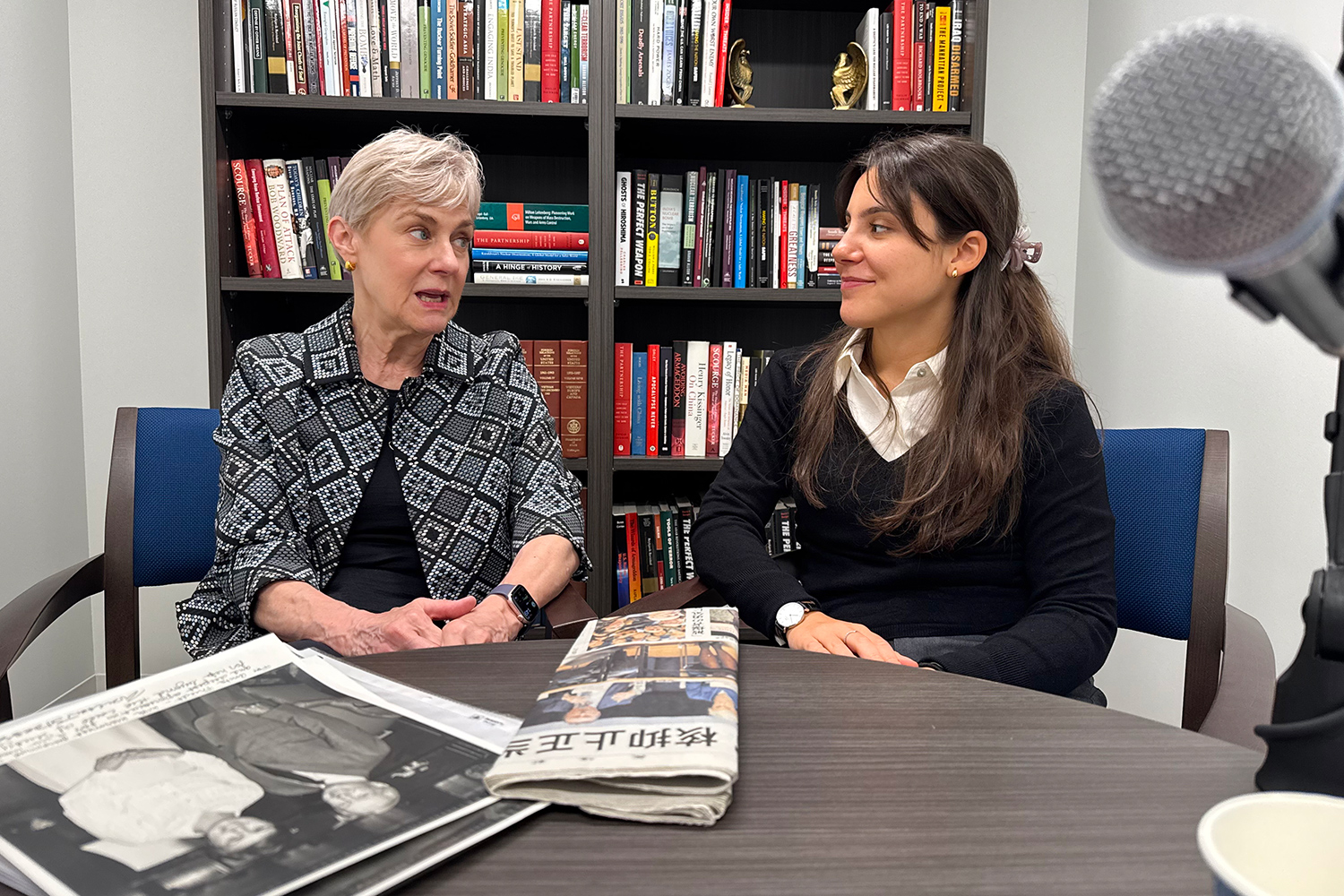
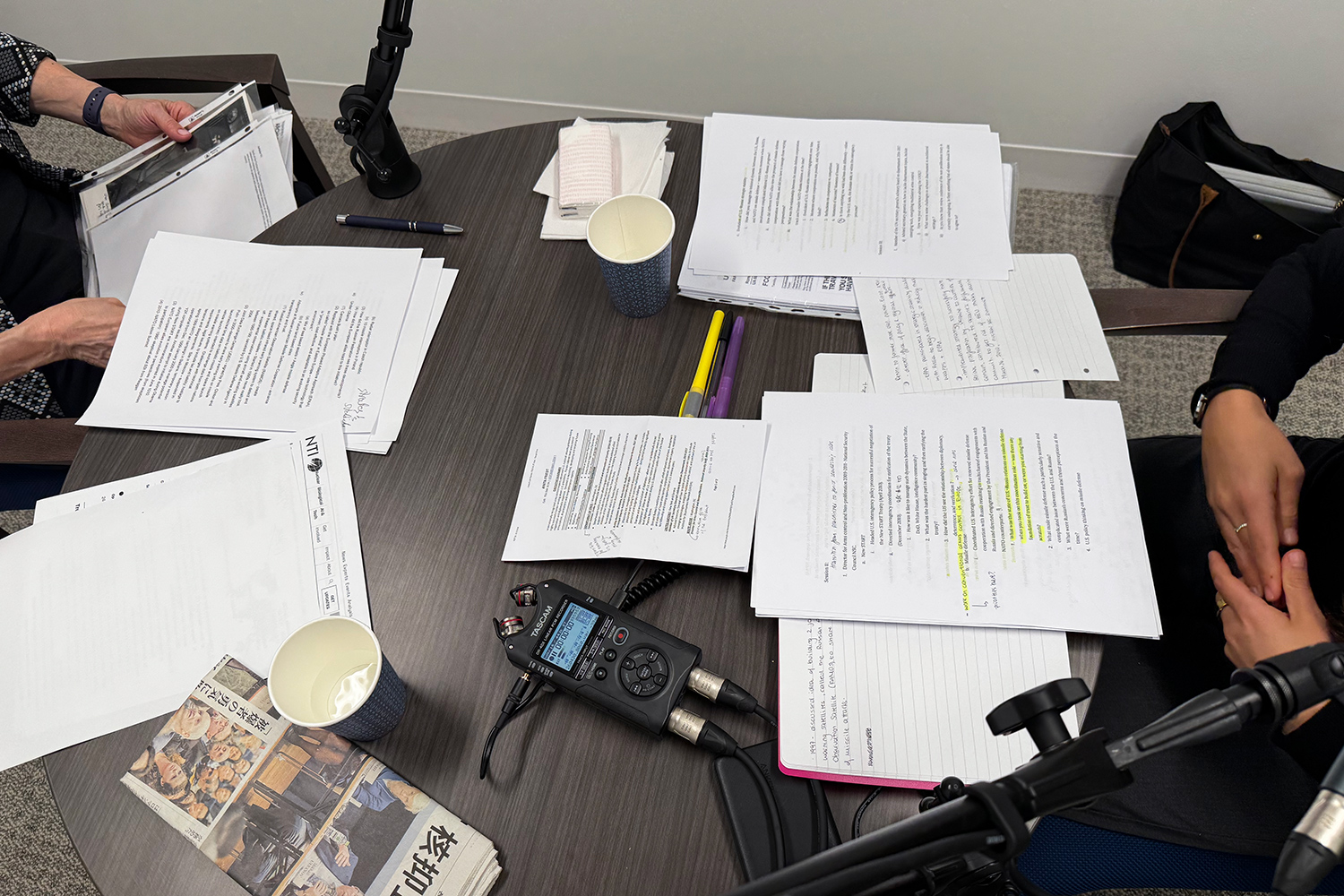
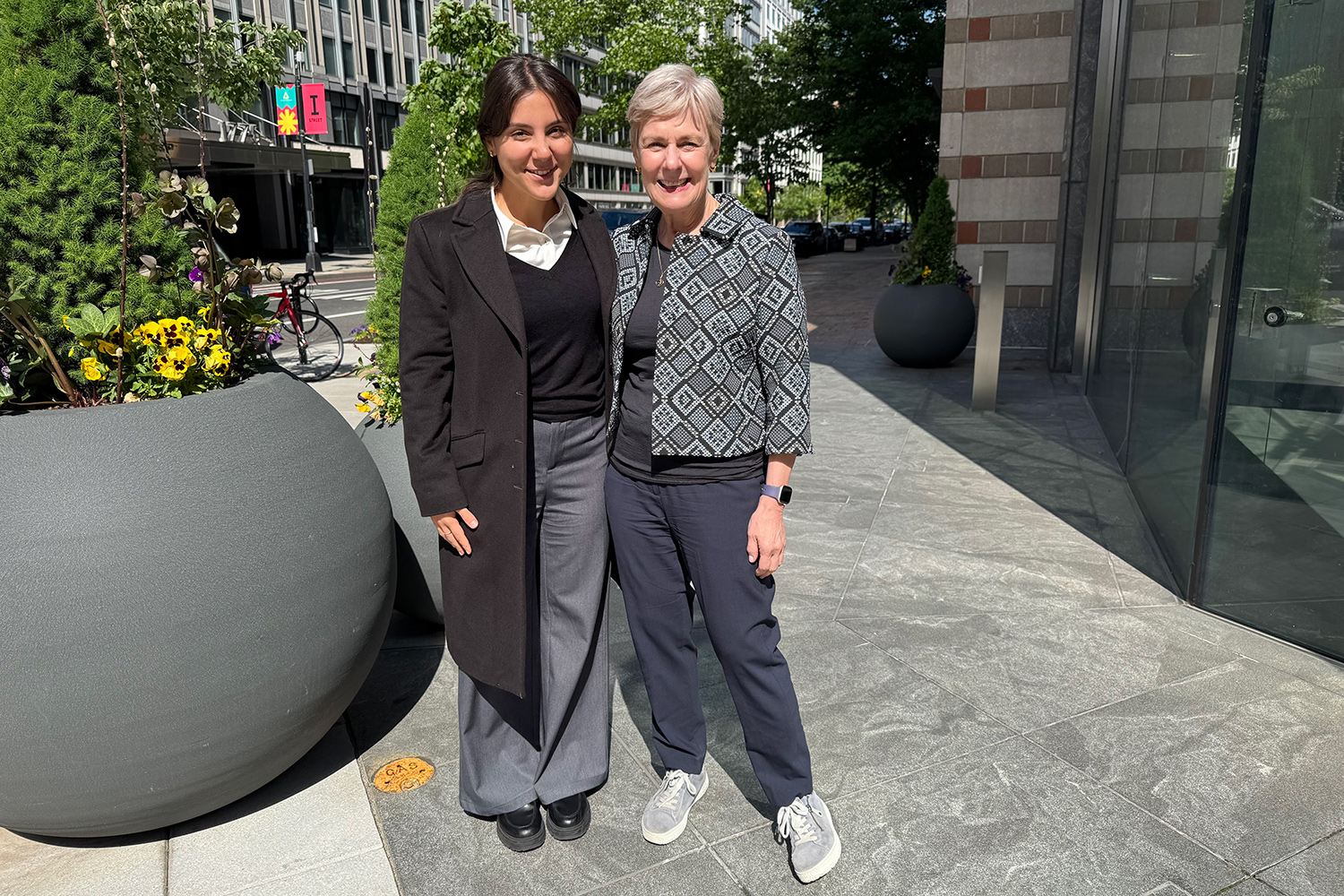
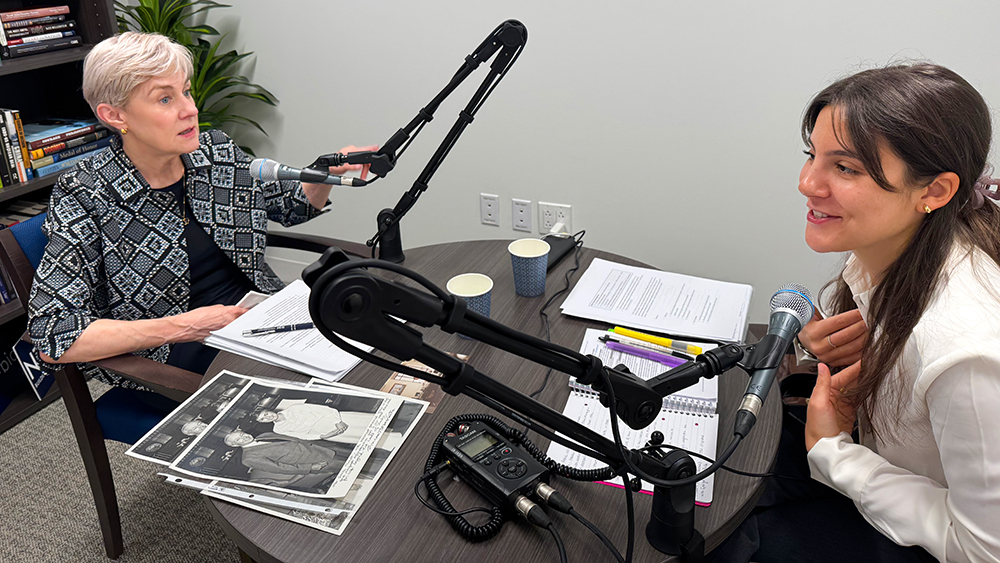
array(1) {
[0]=>
array(335) {
[0]=>
array(4) {
["speaker"]=>
string(15) "Chiara Fargnoli"
["timestamp"]=>
string(8) "00:00:03"
["seconds"]=>
int(3)
["text"]=>
string(806) "This is an interview with Anita Friedt conducted by Chiara Fargnoli for the Oral History Project, a project of the Stanley Center for Peace and Security and BASIC . The interview is taking place on April 30th in Washington DC, United States. This is session one of number three. This is session one of three. Anita, I want to begin by expressing my sincere gratitude for your willingness to participate in this project. Your years of experience in missile defense and nuclear policy represent a wealth of knowledge and insight that truly deserves to be preserved so that myself and future generations can learn from. It is a genuine privilege to be here today to learn about your journey both personal and professional that has defined your work in this field. Welcome and thank you so much for being here."
}
[1]=>
array(4) {
["speaker"]=>
string(12) "Anita Friedt"
["timestamp"]=>
string(8) "00:01:03"
["seconds"]=>
int(63)
["text"]=>
string(337) "Thank you. Thank you very much, Chiara. This is really a pleasure. I'm very honored to be able to do this for you, for the Stanley Center and Basic and I've enjoyed my career, very long career. And I look forward to having people like you follow in my footsteps and learn from what I've done, both the mistakes but also, the good things."
}
[2]=>
array(4) {
["speaker"]=>
string(15) "Chiara Fargnoli"
["timestamp"]=>
string(8) "00:01:30"
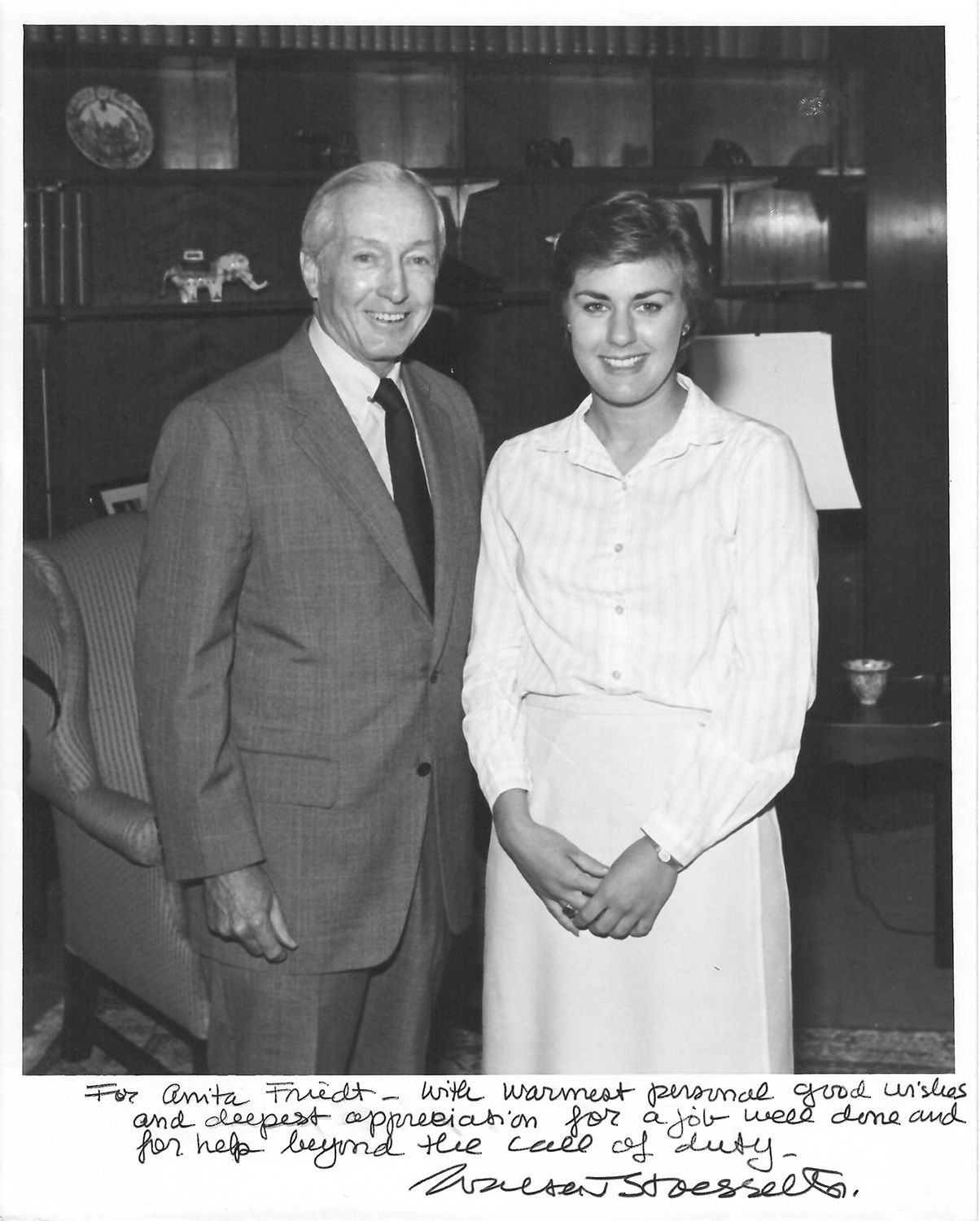
["seconds"]=>
int(90)
["text"]=>
string(155) "Perfect. Thanks so much, likewise. Let's start from your childhood. Can you tell me a little bit about where you grew up and what was your early life like?"
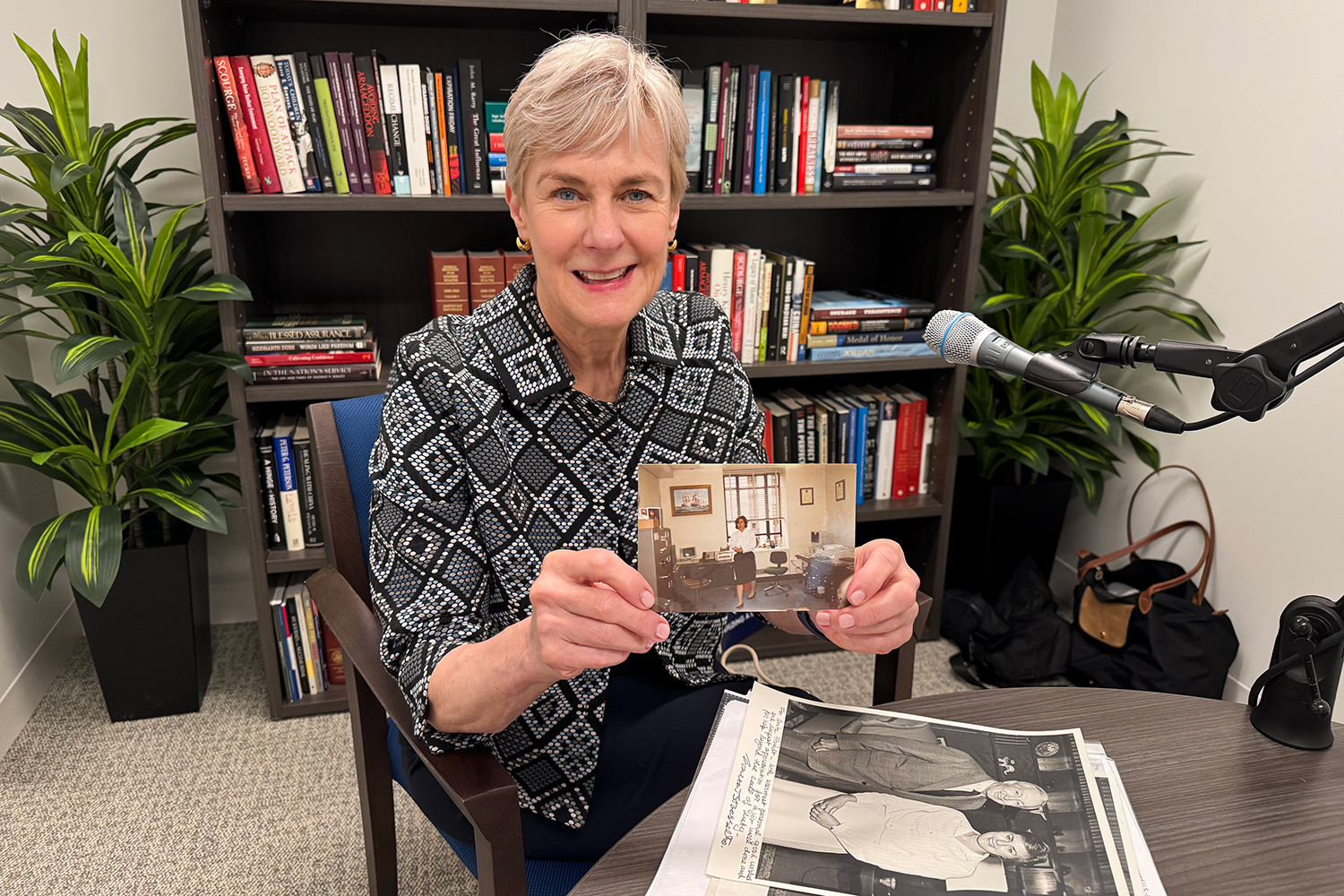
}
[3]=>
array(4) {
["speaker"]=>
string(12) "Anita Friedt"
["timestamp"]=>
string(8) "00:01:41"
["seconds"]=>
int(101)
["text"]=>
string(789) "Yes, happy to. I think one of the things that defined me is that my parents are emigrees. They emigrated to the United States in 1952 from Germany, from West Germany at the time. I was born in Washington, DC. They just ended up in Washington, DC. They came here with a very familiar story with really nothing, just a basic education, no English, no job, but they had sponsors who helped them and they just made it. It was a lot of fun, but I grew up in Washington. I was born in Washington DC and then my parents moved to Annandale, Virginia, which is not far away, maybe 10, 15 miles. We were there until I was probably in first [read: fifth] grade. Then we moved to Burke, Virginia, which is another suburb of the Washington, DC area, and that's where I grew up and went to high school."
}
[4]=>
array(4) {
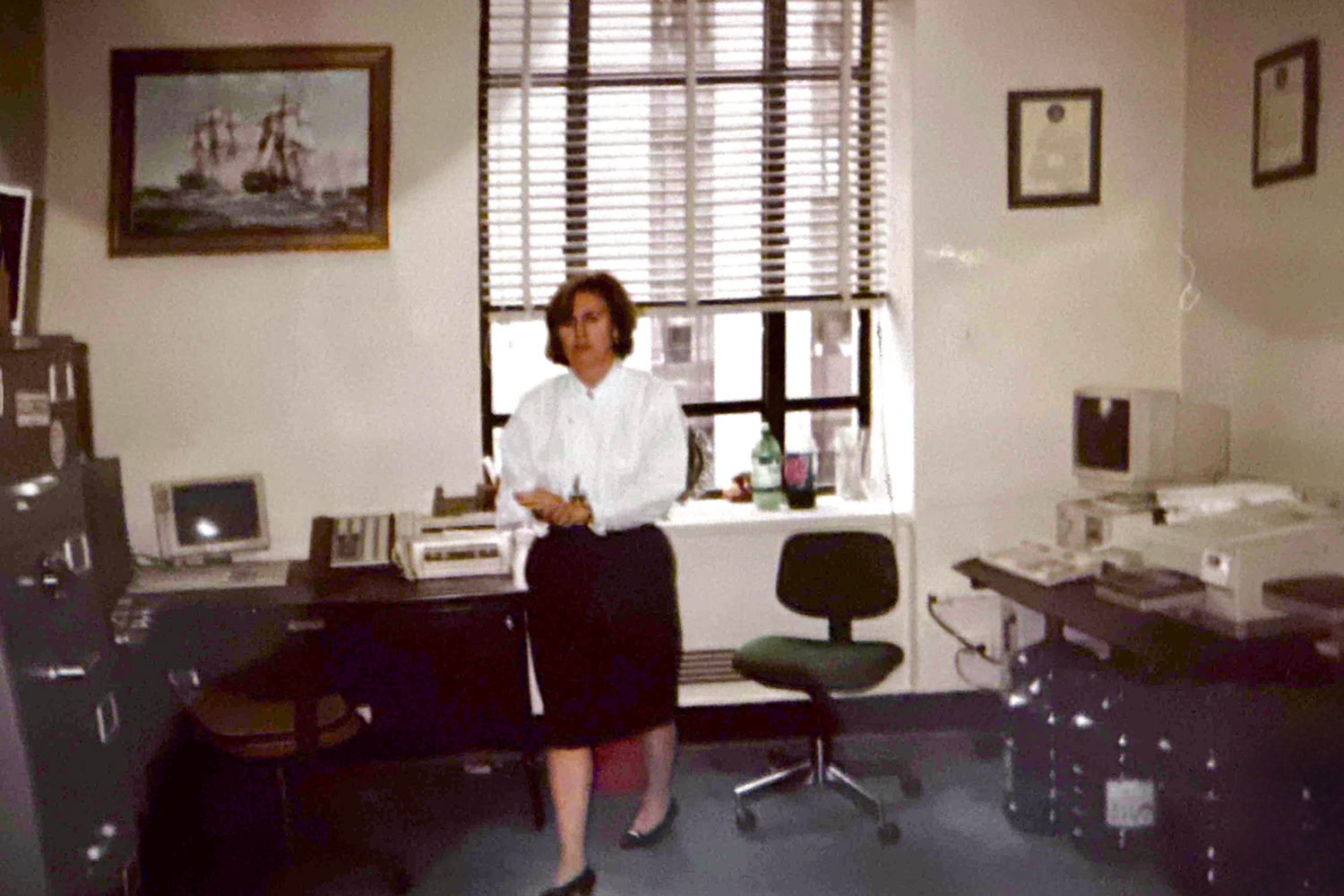
["speaker"]=>
string(12) "Anita Friedt"
["timestamp"]=>
string(8) "00:02:41"
["seconds"]=>
int(161)
["text"]=>
string(685) "I'm one of four girls. My parents have four girls. I'm the oldest. I had I think probably a particular ... Well, my parents were stricter with me perhaps than with my younger sisters, but they also insisted we learned German, which was unlike many of my friends at the time-- peers who grew up at the same time--their parents were very much intent on making sure that they spoke English only. But my parents insisted we speak German, which was really a gift to learn a language fluently from the start. And it was a...It focused my attention on what I wanted to do in my career, my interest in Germany, languages, and that followed on to international relations when I went to college."
}
[5]=>
array(4) {
["speaker"]=>
string(15) "Chiara Fargnoli"
["timestamp"]=>
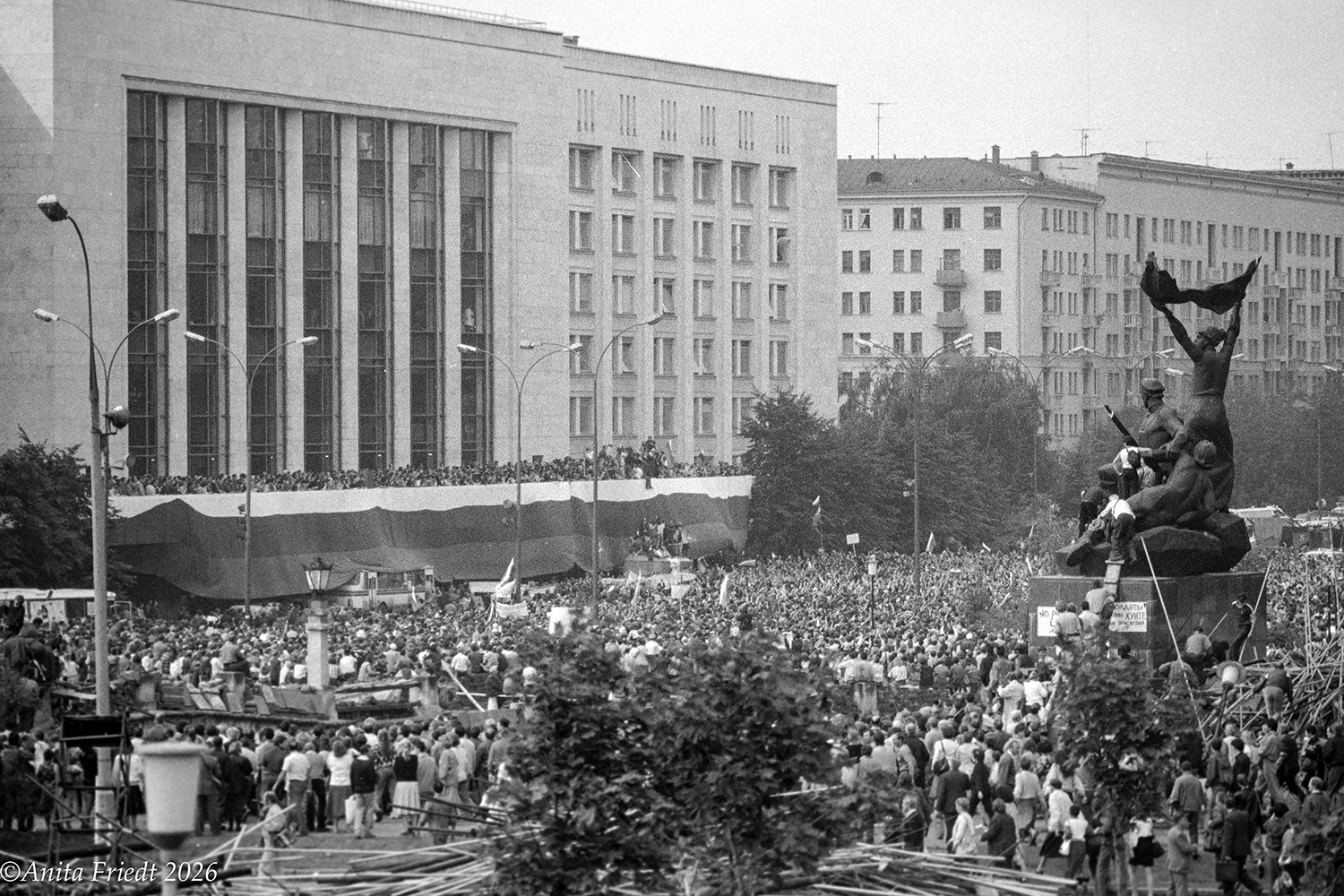
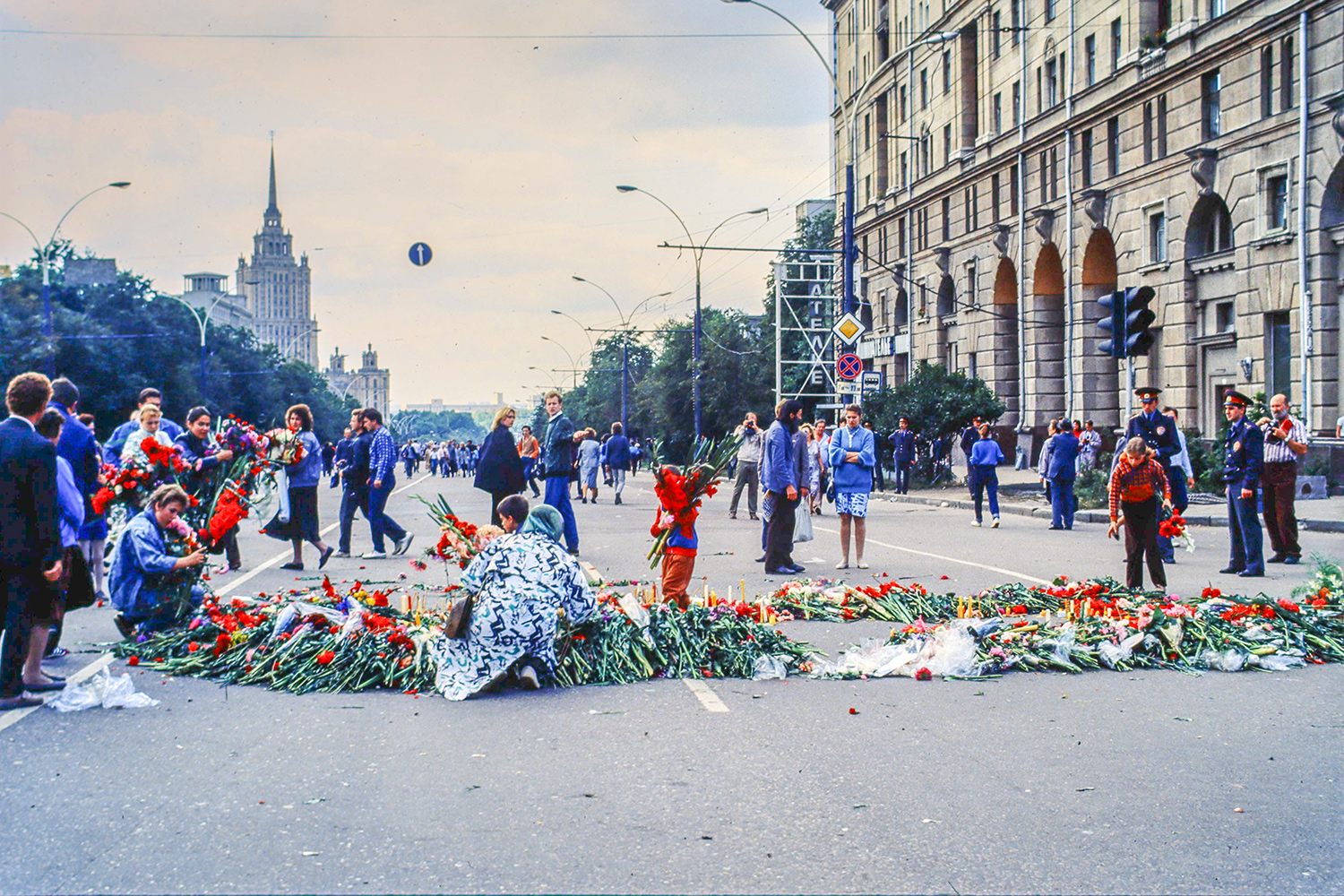
string(8) "00:03:33"
["seconds"]=>
int(213)
["text"]=>
string(241) "Thank you so much for sharing that. I'm sure that moving to a new country without having the language skills, it must have been hard for your parents to do so. Would you always speak German at home or sometimes you would mix English as well?"
}
[6]=>
array(4) {
["speaker"]=>
string(12) "Anita Friedt"
["timestamp"]=>
string(8) "00:03:55"
["seconds"]=>
int(235)
["text"]=>
string(731) "Yeah, that's a good question. I started off, I mean, at the time you were not required, children were not required to go to kindergarten, but my parents wanted me to go to kindergarten. At that time, my sister was only maybe two years old and I was five, but we only spoke German at home. Of course, there was television and going to the store and elsewhere. Like most children-- they pick up quickly. They pick up another language very quickly as did I and I remember my mother said she was very worried that I wouldn't pick up English so she enrolled me in kindergarten, but the teacher said after a week or two I was no different from the other children because you, once again, pick up languages very quickly when you're young."
}
[7]=>
array(4) {
["speaker"]=>
string(12) "Anita Friedt"
["timestamp"]=>
string(8) "00:04:40"
["seconds"]=>
int(280)
["text"]=>
string(654) "When my parents, yes, I still remember we often joke with my sisters and I joke, my father would hear us playing downstairs and we would switch to English and he'd say, “auf Deutsch--you have to speak in German." But then as we got older and we went to school and especially my younger sisters, my youngest sister is eight years younger than I am and we started to mix English in German and it's very very common. And so, I think now that my mother passed away in 2016 and by...in later years we still spoke German to her, but with a lot of English mixed in. And now I speak probably more--definitely more--English to my sisters, but natural evolution."
}
[8]=>
array(4) {
["speaker"]=>
string(15) "Chiara Fargnoli"
["timestamp"]=>
string(8) "00:05:29"
["seconds"]=>
int(329)
["text"]=>
string(70) "Thank you so much for sharing, but I'm sure your German is still good."
}
[9]=>
array(4) {
["speaker"]=>
string(12) "Anita Friedt"
["timestamp"]=>
string(8) "00:05:32"
["seconds"]=>
int(332)
["text"]=>
string(17) "It's good. I try."
}
[10]=>
array(4) {
["speaker"]=>
string(15) "Chiara Fargnoli"
["timestamp"]=>
string(8) "00:05:36"
["seconds"]=>
int(336)
["text"]=>
string(261) "You've mentioned that your interest in the languages, German language that kind of drive [read: drove] your interest in international relations. Can you tell me a little bit about that? How did that impact you and how did that lead to your start in this career?"
}
[11]=>
array(4) {
["speaker"]=>
string(12) "Anita Friedt"
["timestamp"]=>
string(8) "00:05:55"
["seconds"]=>
int(355)
["text"]=>
string(1022) "Okay. Yes, so my mother, I have to say when I started college, I went to James Madison University. I looked at a lot of colleges, but it’s a small--at that time--it was a very small school in Virginia. It had just become co-ed. It was an all-girls school, a teacher college. My mother really wanted me to be a teacher, a German teacher. I said..."Well, see, I'm again the oldest." I did what my parents wanted me to. And I said, "Okay, I'll be a German major. That should be easy or fun," so when I went to the university, they said, "Oh, you need a second language if you're going to major in German," I said, "well, I had taken some French in high school," and I said, "Oh, French is my favorite." I wanted to do that. My teachers or advisors said, “Why French? So many people take French. Why don't you take Russian? Russian is different." I said, "Why not? Something interesting."I took Russian and that really studying Russian more than anything else really took off. I really, well, I put so much time into it."
}
[12]=>
array(4) {
["speaker"]=>
string(12) "Anita Friedt"
["timestamp"]=>
string(8) "00:07:05"
["seconds"]=>
int(425)
["text"]=>
string(809) "Well, German was easy to learn, of course, because I grew up, although writing and reading was a little more challenging, but much easier when you are small, but Russian, I really had to work at it. I think there was no question that I spent more time in Russian than anything else. I had wonderful teachers, one native speaker and one professor at the time who was a graduate of DLI, the Defense Language Institute and he was also a tenor, he sang and he taught us songs and everything about Russia, the Soviet Union, history, poetry, the culture. I just really, I most fell in love with it. It was so interesting that I continued Russian all four years. Then I added, because of the whole history of the Soviet Union, I added political science and then I studied the core classes, Marxist, Leninist theory."
}
[13]=>
array(4) {
["speaker"]=>
string(12) "Anita Friedt"
["timestamp"]=>
string(8) "00:08:02"
["seconds"]=>
int(482)
["text"]=>
string(783) "I still remember I was fascinated by it--about communism in Europe, forgotten—Berlinguer...--at the time, but the Italian Communist Party--were all very big during, this was the mid '70s, so that was a big deal. I just was so interested that I continued to do that. Then when I came back home during summers, since I lived close to Washington DC, I applied to work at the State Department for summer. At the time, it was not an internship. I wanted to be paid. My parents did not make a lot of money. My father was a mechanic, an auto mechanic--or truck mechanic for the Washington Gas Light Company--but I went to the State Department and worked there during the summers and was trying to get a job on the German Desk or the Soviet Desk-- but I ended up in the Latin America desk."
}
[14]=>
array(4) {
["speaker"]=>
string(12) "Anita Friedt"
["timestamp"]=>
string(8) "00:08:57"
["seconds"]=>
int(537)
["text"]=>
string(453) "that, also, I really enjoyed working in the State Department, so that all contributed toward my interest. My goal was to get a job at the State Department. Then, of course, the other thing I did when I graduated from college in 1979, my Russian professor, the one who was a native speaker, took a group of us, the Russian students to the Soviet Union for two weeks, and so that was also fascinating. It all came together and I really enjoyed doing that."
}
[15]=>
array(4) {
["speaker"]=>
string(15) "Chiara Fargnoli"
["timestamp"]=>
string(8) "00:09:30"
["seconds"]=>
int(570)
["text"]=>
string(133) "How did you find experiencing the Soviet Union and then later on Moscow? Because you lived in Moscow for a few years, if I'm correct."
}
[16]=>
array(4) {
["speaker"]=>
string(12) "Anita Friedt"
["timestamp"]=>
string(8) "00:09:40"
["seconds"]=>
int(580)
["text"]=>
string(881) "I did, yes. The first trip, it was very interesting. I just told a story recently four years of Russian. Of course, I learned literature, all these things, but all book. We never really spoke to many native Russian speakers other than in classroom situations. I thought, "Wow, this is great. I'll go there. I'll understand everything," but of course, I got there and everyone spoke so quickly and it wasn't textbook Russian, and I was shocked at how difficult it was to understand. After two weeks it got better. It's like everything else. It was definitely a culture shock, because the Soviet Union at that time was very closed. I mean, Brezhnev was the General Secretary. The Russians... and everything was very choreographed. You had to go through Intourist, the state tourist agency, and [they] had people who were cleared to give you tours and such, so it was pretty scripted."
}
[17]=>
array(4) {
["speaker"]=>
string(12) "Anita Friedt"
["timestamp"]=>
string(8) "00:10:40"
["seconds"]=>
int(640)
["text"]=>
string(838) "Still, we met lots of interesting people. The young people, of course, were a lot of fun and interesting. I loved it. I thought it was really fascinating. Then after that, after I graduated from college, I went to Georgetown to get my Master's in international relations, but I still needed money. I applied for a part-time job at the State Department and started working on the Soviet Desk, which was my dream job, but as a clerk typist, at that time the State Department, well, I was obviously, I just had a very basic college education, no real expertise other than four years of classes and I could type, I could do all sorts... I could even take dictation. They hired me. It was hard to get professional jobs,non-foreign service professional jobs at the time, unless you were in public diplomacy or journalism or something like that."
}
[18]=>
array(4) {
["speaker"]=>
string(12) "Anita Friedt"
["timestamp"]=>
string(8) "00:11:43"
["seconds"]=>
int(703)
["text"]=>
string(1002) "Clerk typist was perfect. As I always told people, it was a foot in the door, an entry point so that “you can try to move up”. That's exactly what I did. I stayed 41 years because it was really --a long way up, but it all worked out. Then going back to Moscow, working at the State Department really brought everything together. Then I saw the professional side, our diplomacy toward the Soviet Union. I worked there part-time when, oh, the Soviet invasion of Afghanistan in 1979, over the holidays, Christmas, December of 1979. I still remember all the human rights cases, the reunification cases of Russian emigrees--Jewish emigration, reunification of people who were in the United States with those who were stuck in the Soviet Union, but really a great education. I met... one of the things I still ... Many of the people I met there, I was by far the youngest, maybe a couple of other people in the office, but all of the people that I met, I still, many of them I'm still friends with today."
}
[19]=>
array(4) {
["speaker"]=>
string(12) "Anita Friedt"
["timestamp"]=>
string(8) "00:13:02"
["seconds"]=>
int(782)
["text"]=>
string(337) "Laura Kennedy, who is a very good friend, I met her on the Soviet Desk in 1979. I met Avis Bohlen, Ambassador Bohlen, who was very [well known] “big.” [She and others] were working on the SALT Talks at the time --and many other people that I still remember and sometimes even run into today. It was a great education and way forward."
}
[20]=>
array(4) {
["speaker"]=>
string(15) "Chiara Fargnoli"
["timestamp"]=>
string(8) "00:13:27"
["seconds"]=>
int(807)
["text"]=>
string(168) "It seems like that really led the path for you to make the connections and gain the knowledge that you needed to really be in this field and manage US-Russia relations."
}
[21]=>
array(4) {
["speaker"]=>
string(12) "Anita Friedt"
["timestamp"]=>
string(8) "00:13:43"
["seconds"]=>
int(823)
["text"]=>
string(813) "Yes. Yes, absolutely. And there’s, you know, I think there are a lot of people I've met who have one of the people I've worked with too who are my age who had a career path. I have to do this, this and this to move up, but I never looked at it at that. I enjoyed what I did and I can honestly say that. I mean, I didn't have wonderful jobs every time--I had, like everyone else-- some were more challenging. I worked with more challenging people sometimes, but no regrets. I learned from every experience and I was not, I did not feel scripted. I didn't feel like I have to do this in order to move ahead. I enjoyed what I did and I have to say, I worked with some wonderful, wonderful people over the years who pointed me in the right directions and I was very fortunate to be offered opportunities to move up."
}
[22]=>
array(4) {
["speaker"]=>
string(12) "Anita Friedt"
["timestamp"]=>
string(8) "00:14:35"
["seconds"]=>
int(875)
["text"]=>
string(492) "It was often--someone would suggest, "Would you like to look at this job? I think you'd be very good at this." I'd say, "Oh, that sounds interesting," and move to the next level. It was more of that rather than saying, "Oh, I have to do this, this, and this in order to move ahead." That's just the way I ... And maybe that was also the way I was brought up --more to look for opportunities and take advantage of them and work with people rather than pushing, pushing, pushing [to get] ahead."
}
[23]=>
array(4) {
["speaker"]=>
string(15) "Chiara Fargnoli"
["timestamp"]=>
string(8) "00:15:09"
["seconds"]=>
int(909)
["text"]=>
string(82) "Did anyone in particular stand out to you that helped you throughout this process?"
}
[24]=>
array(4) {
["speaker"]=>
string(12) "Anita Friedt"
["timestamp"]=>
string(8) "00:15:15"
["seconds"]=>
int(915)
["text"]=>
string(882) "Yes. The people who were the directors and the working level people. I mean, I was really very junior, but people made sure in the office of Soviet Union Affairs is what it was called, the Soviet Desk. That was one of the premier offices at the State Department. Many people wanted to go to the Soviet office and the Soviet Desk, as it was called. Foreign service officers, everyone fought, many people fought to go to the Soviet Desk so that they could be posted for a diplomatic assignment in Moscow or Peters...or at that time it was Leningrad. It was very popular. Unfortunately, we can fast forward to today, that's definitely not the case. We live in a very different world, but at the time it was one of the most sought after jobs --to serve in the former Soviet Union. Yes, I said the office directors, everybody from the highest level, people were very and very nice to me."
}
[25]=>
array(4) {
["speaker"]=>
string(12) "Anita Friedt"
["timestamp"]=>
string(8) "00:16:13"
["seconds"]=>
int(973)
["text"]=>
string(913) "I remember, for example, they lent me, they asked me if I would go and work for Dr. Marshall Shulman. He was secretary, let me see--it was Secretary Vance at the time, Cyrus Vance, and this was during President Carter's term in office--but Marshall Shulman was the Secretary of State's advisor on Soviet issues and he was a very famous professor at Columbia. They asked if I wanted to go up and help him and so I helped catalog his papers and books, things like that, because I was still a student. People said, "Don't you want to be an advisor?" Well, sure, but you really can't advise someone who is a lifelong expert on things, but I had fun doing this and then one of the other little vignettes, the interesting stories I had-- and I always will remember this--it was the fall of 1979-- they asked me if I would help transcribe an interpreter's--the interpreter who sat in on Secretary of State Muskie’s...."
}
[26]=>
array(4) {
["speaker"]=>
string(12) "Anita Friedt"
["timestamp"]=>
string(8) "00:17:20"
["seconds"]=>
int(1040)
["text"]=>
string(372) "It was Secretary of State Muskie. I'll have to get them—confused.. forgotten. Maybe it was Muskie and then Vance, but it doesn't matter. It was the Muskie's talks, Secretary Muskie's conversations at the UN General Assembly with his Soviet counterpart, Gromyko, Foreign Minister Gromyko. I was just so excited to be able to sit and listen to this phenomenal interpreter."
}
[27]=>
array(4) {
["speaker"]=>
string(12) "Anita Friedt"
["timestamp"]=>
string(8) "00:17:47"
["seconds"]=>
int(1067)
["text"]=>
string(480) "For those who don't know, interpreters really memorize almost the entire conversation. They have a certain shorthand and they write what looks like two or three little scratches on the paper and then they can go on from memory and remember the entire conversation. It's really quite remarkable. He dictated this rather complex conversation and I typed it up, and I was just so happy. I was so excited to be able to work on something so important at the time--and it was important."
}
[28]=>
array(4) {
["speaker"]=>
string(15) "Chiara Fargnoli"
["timestamp"]=>
string(8) "00:18:21"
["seconds"]=>
int(1101)
["text"]=>
string(68) "Wow, so you were transcribing what was being said into English from-"
}
[29]=>
array(4) {
["speaker"]=>
string(12) "Anita Friedt"
["timestamp"]=>
string(8) "00:18:26"
["seconds"]=>
int(1106)
["text"]=>
string(281) "Well, he did it. He transcribed it into ... It was English. As our interpreter, as the interpreter for Secretary Muskie, he would listen to the Russian and transcribe. I mean, he would do it in his head and then he [read: dictated] to me in English so I didn't have to go do both."
}
[30]=>
array(4) {
["speaker"]=>
string(15) "Chiara Fargnoli"
["timestamp"]=>
string(8) "00:18:49"
["seconds"]=>
int(1129)
["text"]=>
string(13) "I see. I see."
}
[31]=>
array(4) {
["speaker"]=>
string(12) "Anita Friedt"
["timestamp"]=>
string(8) "00:18:50"
["seconds"]=>
int(1130)
["text"]=>
string(871) "Yes, but then after that, after President Carter lost his reelection in 1980, that's where my boss at the time on the Soviet Desk was asked to work for Under Secretary of State Stoessel, Walter J. Stoessel, and he asked, "Would you like to move up there with me and be a staff assistant on the Under Secretary's staff?" Obviously, I mean, I said, "Of course." And so I moved up there. They also gave me an advisory title as the Under Secretary's advisor on Soviet and West European issues, which was rather amusing since the Under Secretary had just returned from being ambassador to West Germany in Bonn. Then before that, he had been ambassador to Poland and he had also been ambassador to the Soviet Union. It was a little ironic that they named me an advisor to someone who had spent his entire career on these issues and was ambassador to these important countries."
}
[32]=>
array(4) {
["speaker"]=>
string(12) "Anita Friedt"
["timestamp"]=>
string(8) "00:20:01"
["seconds"]=>
int(1201)
["text"]=>
string(487) "Once again, it was a huge learning opportunity and I did whatever he wanted. Amazing opportunity to work with or to meet high level people because the Under Secretary is the number, let's see, you have the Deputy Secretary, who comes immediately after the Secretary of State, and then he was one of several Under Secretaries. He was the Under Secretary for Political Affairs. Then eventually, he moved up to be Deputy Secretary when Secretary Haig, Alexander Haig, at the time, resigned."
}
[33]=>
array(4) {
["speaker"]=>
string(12) "Anita Friedt"
["timestamp"]=>
string(8) "00:20:39"
["seconds"]=>
int(1239)
["text"]=>
string(189) "I was there for two years, but really very interesting. I was able to meet very important, famous dignitaries like Helmut Kohl, the former Chancellor of Germany and many, many other people."
}
[34]=>
array(4) {
["speaker"]=>
string(15) "Chiara Fargnoli"
["timestamp"]=>
string(8) "00:20:55"
["seconds"]=>
int(1255)
["text"]=>
string(72) "How did your relationship with him evolve? Was it strictly professional?"
}
[35]=>
array(4) {
["speaker"]=>
string(12) "Anita Friedt"
["timestamp"]=>
string(8) "00:21:01"
["seconds"]=>
int(1261)
["text"]=>
string(1561) "Oh yes, yes. At that time, he was a very senior diplomat, a very old school diplomat. This was a picture of him here. This was when I left in 1983, but he was very formal. At the time, they even had in the State Department on the Seventh Floor, that's where the Secretary of State and other senior officials work and still do work there today. But they even had a support staff of, you would call them, I mean, people who would serve coffee and things that we don't do today anymore, but it was a very formal relationship. We saw him-- in only a suit and tie and he rarely, I don't think I ever saw him with his suit jacket off. I mean, a very polished, very formal diplomat. His wife was a very gregarious, fun person. She would come...They would once in a while do something, but it was a professional relationship, very professional. He took me on one of his trips to Germany, which was a lot of fun and he treated me very, very well. I mean, he explained things. I was a very junior person. I mean, he must have been in his ... Well, he was my age He was in his 60s at the time. It was really interesting, but they treated me almost like a daughter, I would say, or a student in some ways, but also always with great respect and it was a huge learning experience. When he left, he retired and left in 1983. Then that was the end of my job up there because they had a new Under Secretary who wanted--which is common--a new staff, and so he was Under Secretary Stoessel and some of the other people who worked there --worked and --worked with the--Let's see.."
}
[36]=>
array(4) {
["speaker"]=>
string(12) "Anita Friedt"
["timestamp"]=>
string(8) "00:23:03"
["seconds"]=>
int(1383)
["text"]=>
string(438) "He was the Assistant Secretary for Intelligence and Research, Hugh Montgomery, a very famous person, who [read: had] worked at CIA, and at the time --he must have been in his 50s or 60s --also at the time, but they worked with him to get me a job in the Bureau of Intelligence and Research working in the Office of Soviet Analysis. That was really my first entree into a professional job. I was an analyst for Soviet Union Western Europe."
}
[37]=>
array(4) {
["speaker"]=>
string(12) "Anita Friedt"
["timestamp"]=>
string(8) "00:23:39"
["seconds"]=>
int(1419)
["text"]=>
string(395) "I will always be grateful. Ambassador Stoessel passed away, gosh, not long after he retired. It was very —a shame. He should have enjoyed a much longer retirement, but he died, --I believe he died of leukemia, always thought that something-- the microwaves in Moscow during his time as ambassador, he always thought that something could have led to his cancer from that, but it's hard to tell."
}
[38]=>
array(4) {
["speaker"]=>
string(15) "Chiara Fargnoli"
["timestamp"]=>
string(8) "00:24:16"
["seconds"]=>
int(1456)
["text"]=>
string(205) "Then you started working for the Bureau of Intelligence and Research where you authored daily intelligence analysis on Soviet European issues. What were the main issues that you were covering at that time?"
}
[39]=>
array(4) {
["speaker"]=>
string(12) "Anita Friedt"
["timestamp"]=>
string(8) "00:24:30"
["seconds"]=>
int(1470)
["text"]=>
string(871) "Okay, so yes, that's what I did that they had something called the, at the time, the Secretary's Morning Summary and it competed with a CIA publication that was also given to high levelofficials in the US government, including the Secretary of State. The Secretary's Morning Summary was just [read primarily] for the Secretary of State and it had little paragraph perhaps analyses and comments of major events. My job was Soviet Western Europe,--following Soviet activities in Western Europe. I did not do arms control at the time, although, of course, the INF decision...and someone else covered that, but of course, that also contributed to what I was looking atthe time. I remember, I mean, there were things, Soviet influence in Cyprus, for example. I mean, the classic Soviet efforts to divide Western Europe and—to--disinformation and to influence Western Europe."
}
[40]=>
array(4) {
["speaker"]=>
string(12) "Anita Friedt"
["timestamp"]=>
string(8) "00:25:34"
["seconds"]=>
int(1534)
["text"]=>
string(1018) "Interesting. It was my first real job. I learned how to write for the US government, which is very different from academic writing. At the time, I was probably the youngest person there. Everybody--I was in my mid 20s and everyone else was probably, I think most of the people were probably, well, some probably in the 30s and 40s, but most of them were 50s or older. The Office Director was Robert Baraz. His family originally came from the Soviet, emigrated, or were originally from the Soviet Union. He spoke Russian. He was an arms control expert. He had worked on the MBFR talks, which are the, what is it? I've forgotten the acronym, but they were the precursor to CFE, the conventional forces in Europe. Lowering the risk of conventional weapons in Europe. He'd worked on that. Then, Martha Mautner, worked for George Kennan in the Soviet Union in the embassy in the 1940s and helped transcribe or communicate George Kennan's famous letter on Russia on the Soviet Union and what it meant, what relations meant."
}
[41]=>
array(4) {
["speaker"]=>
string(12) "Anita Friedt"
["timestamp"]=>
string(8) "00:26:57"
["seconds"]=>
int(1617)
["text"]=>
string(868) "She was married to Carl Mautner, who was a retired foreign service officer, but she was an expert on West Berlin. Really interesting time to work there. I was an analyst on Western Europe, as I said, a great office with many people who were actually emigres or had lived in, for example, there were people who were from Hungary after the Budapest uprising in 1956, the director of the [East European Office] was originally from Prague or from somewhere in...Czechoslovakia. That's what it was called at the time. Really interesting people who were far older and very, very experienced. That's why it was a great lesson. I also, in addition to learning how to write, I mean, it was my first professional job also working with the interagency. Since the Bureau of Intelligence and Research is a small intelligence [entity] in the US government, CIA was obviously bigger."
}
[42]=>
array(4) {
["speaker"]=>
string(12) "Anita Friedt"
["timestamp"]=>
string(8) "00:28:06"
["seconds"]=>
int(1686)
["text"]=>
string(655) "There was also the Defense Intelligence Agency-- and then I participated in National Intelligence Estimates, which the Central Intelligence Agency coordinated. I would be a representative on some of the discussions at the lower level from the State Department as part of my job from Intelligence and Research. I learned to work with others in the intelligence community, other people in the US government. Again, I learned, to negotiate because we had to come up with a common estimate that everyone would approve. You had to negotiate because what you said was not necessarily the way others perceive things and compromise. It was really great education."
}
[43]=>
array(4) {
["speaker"]=>
string(15) "Chiara Fargnoli"
["timestamp"]=>
string(8) "00:29:02"
["seconds"]=>
int(1742)
["text"]=>
string(168) "Were there any strategies, negotiation strategies that you picked up on during this time when you had to interface so many different agencies with different priorities?"
}
[44]=>
array(4) {
["speaker"]=>
string(12) "Anita Friedt"
["timestamp"]=>
string(8) "00:29:15"
["seconds"]=>
int(1755)
["text"]=>
string(508) "Ah, that's a good question. I'd never thought about it, but yes, in hindsight, it really was negotiation, I mean, listening to other people. I mean, that's a huge one and I think everyone will agree. The first thing, if you argue with someone, it doesn't matter if it's your sister, your brother or friend, you need to listen to what the other people are saying and hear what they're saying and understand their point of view, and that's essential before any kind of compromise or way forward can come about."
}
[45]=>
array(4) {
["speaker"]=>
string(15) "Chiara Fargnoli"
["timestamp"]=>
string(8) "00:29:49"
["seconds"]=>
int(1789)
["text"]=>
string(187) "Was there ever a time that you had reached a deadlock that maybe agreement on an estimate couldn't be found? Was there anyone who had the, let's say, decision making authority in the end?"
}
[46]=>
array(4) {
["speaker"]=>
string(12) "Anita Friedt"
["timestamp"]=>
string(8) "00:30:04"
["seconds"]=>
int(1804)
["text"]=>
string(314) "Yes. At that time, again, I was very junior. Usually whatever the analysts at my level would work out, they would annotate it with questions where there was no agreement and then it would move up a level and then finally, the estimate would be blessed or approved at the more senior, the assistant secretary level."
}
[47]=>
array(4) {
["speaker"]=>
string(15) "Chiara Fargnoli"
["timestamp"]=>
string(8) "00:30:32"
["seconds"]=>
int(1832)
["text"]=>
string(148) "I see. Thank you. Then if we fast forward a little bit, you worked as the Foreign Service excursion tour. Could you tell me a little bit about that?"
}
[48]=>
array(4) {
["speaker"]=>
string(12) "Anita Friedt"
["timestamp"]=>
string(8) "00:30:49"
["seconds"]=>
int(1849)
["text"]=>
string(636) "Yes. So that's a technical term for someone who is ... I was a civil servant my entire career, not a foreign service officer, but I worked very closely with foreign service officers in the State Department. So an excursion tour is when a civil servant like myself is assigned to a foreign country. In order to go there and serve there as a diplomat, the personnel system has to give you the same sorts of protections that a foreign service officer has. So they temporarily convert you into a foreign service officer for the time that you are serving in the foreign diplomatic post, in my case Moscow. So it was called an excursion tour."
}
[49]=>
array(4) {
["speaker"]=>
string(12) "Anita Friedt"
["timestamp"]=>
string(8) "00:31:36"
["seconds"]=>
int(1896)
["text"]=>
string(797) "And the first one I did was, so I was in the Bureau of Intelligence and Research starting in 1983. And so 1989 they allowed me to go for two years, and I extended for three, to Moscow, as a foreign service officer. Before that, the previous summer I had been in Moscow. The Bureau of Intelligence and Research sent me to help out the embassy. Which is also very normal for civil servants to go to embassies during the summer, especially when regular diplomats-- regular foreign service officers often transfer out. There's often a gap during the summer months and it's an opportunity for civil servants to go and help out and use their expertise. And I had done that in the summer of 1988. So I came back though as a real “full-time person” in the Embassy in Moscow in 1989, September of 1989."
}
[50]=>
array(4) {
["speaker"]=>
string(12) "Anita Friedt"
["timestamp"]=>
string(8) "00:32:40"
["seconds"]=>
int(1960)
["text"]=>
string(568) "And my job there, now I was still junior. I was junior on the staff. I must have been a third secretary. But they charged me with an interesting job, which was the publications procurement officer. And also I covered press conferences, which the Russian foreign ministry had all the time. They had once or twice a week regular foreign ministry press conference. And I would go in person, take notes, write it up and send it back as a cable. But the publications procurement office was really interesting. It was a huge effort. I'd have to look at when it was started."
}
[51]=>
array(4) {
["speaker"]=>
string(12) "Anita Friedt"
["timestamp"]=>
string(8) "00:33:19"
["seconds"]=>
int(1999)
["text"]=>
string(602) "But it was organized and funded by the CIA, in part, to purchase books in the Soviet Union for use in the US government. Because you couldn't go to Amazon or wherever and just buy books, for example, on economics. I mean, lots of information that analysts in the entire intelligence community and the US government, not just intelligence analysts, wanted and needed to study the Soviet Union. So they would identify certain books that they wanted that they renew were available. And this small office in our embassy in Moscow would go out and purchase them. And they would go all over the Soviet Union."
}
[52]=>
array(4) {
["speaker"]=>
string(12) "Anita Friedt"
["timestamp"]=>
string(8) "00:34:03"
["seconds"]=>
int(2043)
["text"]=>
string(573) "We were lucky enough to have a Fulbright student who was the actual person who was in charge of traveling and picking up these books. And it was a great, that was a lot of fun. So I was able to supervise this Fulbright student who went throughout the Soviet Union and picked up and bought these books. And obviously had to do an accounting. And then he would pack them up and send them back via the diplomatic pouch to Washington for distribution. But really fascinating. It's obviously not used today because we can get these books, but it was really critical at the time."
}
[53]=>
array(4) {
["speaker"]=>
string(15) "Chiara Fargnoli"
["timestamp"]=>
string(8) "00:34:47"
["seconds"]=>
int(2087)
["text"]=>
string(72) "I'm sure, yes. But I wonder, these books were written in Russian, right?"
}
[54]=>
array(4) {
["speaker"]=>
string(12) "Anita Friedt"
["timestamp"]=>
string(8) "00:34:53"
["seconds"]=>
int(2093)
["text"]=>
string(11) "Absolutely."
}
[55]=>
array(4) {
["speaker"]=>
string(15) "Chiara Fargnoli"
["timestamp"]=>
string(8) "00:34:54"
["seconds"]=>
int(2094)
["text"]=>
string(70) "So who would take the role or the job to translate these into English?"
}
[56]=>
array(4) {
["speaker"]=>
string(12) "Anita Friedt"
["timestamp"]=>
string(8) "00:35:00"
["seconds"]=>
int(2100)
["text"]=>
string(736) "Well, many analysts in Washington were Russian speakers. I mean, I was a Russian speaker. My Russian was never ... Well, I could read and write. But they could be translated. But there were many experts, for example, in my office in the Office of Soviet Analysis, there were many people who had very native ability to read -- read Russian and understand it and transcribe it for purposes themselves. So there was no need to do any translation. But I did that. And then we did the foreign ministry press conferences and I did whatever else my bosses in the political section ... I was in the political external section, which was covering foreign policy. So that was another great learning experience. Let's see. I also ... Oh, go ahead."
}
[57]=>
array(4) {
["speaker"]=>
string(15) "Chiara Fargnoli"
["timestamp"]=>
string(8) "00:35:51"
["seconds"]=>
int(2151)
["text"]=>
string(84) "I just wonder what were some of the main issues that you were covering at that time?"
}
[58]=>
array(4) {
["speaker"]=>
string(12) "Anita Friedt"
["timestamp"]=>
string(8) "00:35:56"
["seconds"]=>
int(2156)
["text"]=>
string(711) "Well, the big was the let's see, Soviet nationalities as it were called. So all of the republics of the Soviet Union, then eventually independent states and now countries. But all of these countries, Kazakhstan, the Baltics, all of them, there was at a time where people were looking at how can we become independent. They were becoming increasingly independent. So those were issues that even though that was more of an internal issue, domestic issue for Soviet Union, it was also a foreign policy issue for us. I'm trying to— let me see— have to think, what was the other thing ... I mean there were always, we also,.. We also looked at other foreign policy issues. But that was the biggest, that was big."
}
[59]=>
array(4) {
["speaker"]=>
string(12) "Anita Friedt"
["timestamp"]=>
string(8) "00:36:47"
["seconds"]=>
int(2207)
["text"]=>
string(977) "And then it really, I mean, the Gorbachev and Reagan obviously, that was President Reagan, their arms control discussion. So there were always discussions at the foreign ministry. They commented on whatever issues of the day were there. Probably the most famous or the most memorable foreign press conference that I covered was in August of 1991 during the Soviet, the coup, the Gorbachev coup. They had a huge ... The coup, the people who instigated the coup had a press conference at the foreign ministry, press conference, and I was sent to cover it. I remember it was really, it was pouring down rain. It was summer. I still remember the blisters I got on my shoes..., my feet from my shoes and having to walk to the foreign ministry press center. And it was just fascinating because here were all of these people who had just started this coup against President Gorbachev, and here they all were giving their presentation. So that was very exciting. We had to write it up."
}
[60]=>
array(4) {
["speaker"]=>
string(15) "Chiara Fargnoli"
["timestamp"]=>
string(8) "00:38:03"
["seconds"]=>
int(2283)
["text"]=>
string(245) "Did you ever feel unsafe at that time? Even though, you know, they were celebrating breakup of the Soviet Union and the emergence of these new independent states, as a woman did you ever feel unsafe or wish that things had been done differently?"
}
[61]=>
array(4) {
["speaker"]=>
string(12) "Anita Friedt"
["timestamp"]=>
string(8) "00:38:23"
["seconds"]=>
int(2303)
["text"]=>
string(766) "Well, it's out of my control to do things differently because the Russians were doing these things, but it was really sobering. Yes, yes, I was definitely afraid. When the coup was announced, it was a classic Soviet ... In studies. When a Soviet leader died, the Russians always, the radio at the time, Russians had television also, but the radio and television, everything would go blank and they would play classical music. So I remember waking up on, and I can't remember now what day of the week it was, the coup, but you woke up in the morning and turn on the radio and there was this sober classical music and I said, "Oh my gosh, what happened? What happened?" Well, it was the coup. So they had, the regime, the people who were in control had turned that on."
}
[62]=>
array(4) {
["speaker"]=>
string(12) "Anita Friedt"
["timestamp"]=>
string(8) "00:39:15"
["seconds"]=>
int(2355)
["text"]=>
string(1007) "And then we went to the embassy. I lived on the compound so it wasn't far to go to the embassy. It was certainly more secure. I remember at the time we left the phone open all day to make sure there was a connection to the State Department Operations Center so that people could continue to talk to the Operations Center, the people who manned the 24-hour watch system at the State Department, to make sure that we had an open line so we could report what was happening from Moscow. And then so many people then, I thought they were tanks that came down the street, but they were actually armored personnel carriers. But still to see these large vehicles rolling down main streets, major streets in Moscow toward the White House, as they called it, was really something. And then of course there were some ... People were killed in some of the fighting, there’s street fighting. And we were evacuated to the ... In the new embassy complex we had a gymnasium basketball court. Everyone was evacuated there."
}
[63]=>
array(4) {
["speaker"]=>
string(12) "Anita Friedt"
["timestamp"]=>
string(8) "00:40:26"
["seconds"]=>
int(2426)
["text"]=>
string(842) "But after a while there were a few incidents. So yes, I was scared. And we had to take the most important papers and things and move them in case we had to be evacuated, but it never came to that. And I think the most important thing I learned certainly at the time was we thought that there was going to be an outbreak of major violence. There were people killed, no question. And I have some interesting pictures that I can show later on of some of the memorials and the flowers. But it was really amazing the number of people who came to demonstrate. And while they were pro-Yeltsin but anti-violent or anti-violence, people who came to demonstrate by the White House, which was very close to the new embassy complex, the compound where I lived. So you could see almost all of it. Thousands of people. But they were all very, very orderly."
}
[64]=>
array(4) {
["speaker"]=>
string(12) "Anita Friedt"
["timestamp"]=>
string(8) "00:41:23"
["seconds"]=>
int(2483)
["text"]=>
string(706) "I think back when I was growing up in the Washington DC area during the late '60s, there were so many protests for Vietnam. I was a child. But everything was a disaster. There were people who fought. It was messy. It was dirty. This was all so orderly [in Moscow]. They had little tea and stands where you could buy tea, where you could buy food. And it really was not dangerous. I did not spend much time there, but it really wasn't. It was surprisingly peaceful. So,I thought very interesting, very interesting observation. It's hard to predict, but the Russian people certainly have seen plenty of violence, including 1917 and many, many other occasions domestic. But it was really an eye-opener for me."
}
[65]=>
array(4) {
["speaker"]=>
string(12) "Anita Friedt"
["timestamp"]=>
string(8) "00:42:15"
["seconds"]=>
int(2535)
["text"]=>
string(1007) "So yes, I was afraid, but after a while it became clear that ... Well, they settled it. I mean, Gorbachev resigned, the coup plotters were eventually, well, prosecuted. Some of them committed suicide. Oh, an interesting aside, many of the coup plotters, including the minister of defense, were all at a White House dinner. It was during ... President Bush was there, George Bush, first President Bush, came for a state visit. And he had at Spaso House, the US Ambassador’s residence, he had a big dinner in honor of the Soviet government there in July. And many of the people who participated in the coup were there just the previous month, just weeks before that at this dinner. So it was really interesting. And I was also lucky enough when I worked there, I was able to go to many of the ambassador’s dinners, receptions. Because it was a working event you were expected as a diplomat to talk to people and then you know write back or report on things that you learned. So really, really interesting."
}
[66]=>
array(4) {
["speaker"]=>
string(15) "Chiara Fargnoli"
["timestamp"]=>
string(8) "00:43:31"
["seconds"]=>
int(2611)
["text"]=>
string(237) "Very, very interesting. I'm really much looking forward to looking at the pictures. I was wondering when you were attending these events, press conferences, was the field mainly dominated by men or did you sometimes encounter some women?"
}
[67]=>
array(4) {
["speaker"]=>
string(12) "Anita Friedt"
["timestamp"]=>
string(8) "00:43:50"
["seconds"]=>
int(2630)
["text"]=>
string(1013) "Some women, but overwhelmingly men. Certainly on the Soviet side, almost exclusively. I think ...It's hard to say, I mean, I noticed many more women, professional women, but I would say, well, relatively recently in my career. So,..but certainly not the first time I was there. When we get to my second tour, I was doing more from 1997 to '99, interesting, where I was working on military issues. I was responsible for looking at Russian military reform. I would go and interview military experts. And I remember one of them asking me, "Why is a woman working on these issues? We don't understand why you're doing this. Why is a woman ..." So you would get this. And I don't think people, people didn't really say as much when during my first tour from 1989 to '92. There were certainly plenty of women on the US side. I mean, many of my best friends and colleagues were women who were reporting officers in the embassy. But on the Soviet side, definitely---mostly almost exclusively men on the professional side."
}
[68]=>
array(4) {
["speaker"]=>
string(15) "Chiara Fargnoli"
["timestamp"]=>
string(8) "00:45:07"
["seconds"]=>
int(2707)
["text"]=>
string(353) "And I'm interested in this interaction, for example, that you had. What was your response or reaction? How did you feel and how did you manage this? I'm thinking about it from you know my perspective as well. This nuclear field is mainly dominated by men and I feel that sometimes there is different ways that people approach people based on the gender."
}
[69]=>
array(4) {
["speaker"]=>
string(12) "Anita Friedt"
["timestamp"]=>
string(8) "00:45:35"
["seconds"]=>
int(2735)
["text"]=>
string(868) "I completely agree. I think I certainly responded differently as I grew older. At the time I was much younger and so perhaps I was probably more defensive than I would want to be today. But at that time I remember I would just more or less ignore it and just keep going. And I think for me it was actually an advantage. People would tell me many more things than I think they may have told my male counterparts. I worked very closely, especially the second time I was in Embassy Moscow, with the defense attache's office. So those were the people who were military who were working at our embassy. And they followed very different rules. I mean, the Soviet government and even the Russian government had different rules for them in terms of interactions with ... They would have to ask permission to go to almost every place or meet with anyone but military officials."
}
[70]=>
array(4) {
["speaker"]=>
string(12) "Anita Friedt"
["timestamp"]=>
string(8) "00:46:37"
["seconds"]=>
int(2797)
["text"]=>
string(700) "I did not really meet with military officials unless it was part of something, another meeting. I would focus on non-military, like Russians had and still do have excellent reporters on military issues, really great journalists. And so it was very difficult for our defense attache's office to meet with those peoples, or more difficult than for me. They would have to get permission. So I would often work with them. And they would help me with questions to ask and I could bring them back. And people I think, many of the men were more open I think than they would have been with somebody that they recognized as an expert, or their perception of what an expert was on military or technical issues."
}
[71]=>
array(4) {
["speaker"]=>
string(15) "Chiara Fargnoli"
["timestamp"]=>
string(8) "00:47:27"
["seconds"]=>
int(2847)
["text"]=>
string(370) "Wow, that is very, very interesting. During your time as a political military reporting officer in Moscow, I believe you worked on the Cooperation [read: Cooperative] Threat Reduction Program, which was established to dismantle the weapons of mass destruction. Can you walk us through how that program go [read: went]? What was the relationship like and your experience?"
}
[72]=>
array(4) {
["speaker"]=>
string(12) "Anita Friedt"
["timestamp"]=>
string(8) "00:47:56"
["seconds"]=>
int(2876)
["text"]=>
string(1199) "Yeah, so that was my second tour from 1997 to 1999. And yes, that was ... we had, I've forgotten the date that we signed, it was after the breakup of the Soviet Union when we, quote-unquote, "denuclearized" or helped denuclearize the Soviet Union [read: dismantle nuclear warheads and secure weapons of mass destructions in the former Soviet Union]. And a very, very important program. We still have it today, although it's not with Russia, but it's taken on a different characteristic or different priorities, but still extremely important. And the work that the technical experts from both sides did was really eye-opening for me and for everyone. I didn't really understand it until I started working with the people who had come to Moscow. So as a political officer, whenever we had someone visit Moscow, they would have to have a control officer or someone [who] would work with them from the embassy to make sure that their visit for technical issues went well. And I was often assigned to these groups, so I was able to meet many of my future counterparts at the Department of Defense and, well, the White House National Security Council who came to Russia because I worked closely with them."
}
[73]=>
array(4) {
["speaker"]=>
string(12) "Anita Friedt"
["timestamp"]=>
string(8) "00:49:10"
["seconds"]=>
int(2950)
["text"]=>
string(670) "So it was very interesting work. But we would visit various facilities. Also many congressmen, Senator Lugar, Richard Lugar. He was really one of the most important people of the CTR...and Senator Nunn– [read: currently] here at Nuclear Threat Initiative, but that office is here and they both worked here... Senator Lugar's passed away, but Senator Nunn is still there. I mean, they were critical to the Cooperative Threat Reduction Program, to passing the necessary legislation while they were in Congress. And then also visiting with the technical staffs and the Department of Defense and the Defense Threat Reduction Agency to oversee what the Russians were doing."
}
[74]=>
array(4) {
["speaker"]=>
string(12) "Anita Friedt"
["timestamp"]=>
string(8) "00:49:56"
["seconds"]=>
int(2996)
["text"]=>
string(881) "I spent most of my time going to the visits in Moscow. I did not go to some of the further out places, but I helped coordinate their trips. So very interesting to go through these facilities--like biological weapons facilities--and then meet with their Russian counterparts and listen to what they were doing and try to ... I mean, it was a teaching, it was sharing information. But it was also, I must say, that our technical experts, we did things very differently. The safety, security, so many things that we worked on with the Russians, it was done in a very diplomatic way. Obviously, we were hoping and wanted the Russians to take on the lessons....that we had done and become more safe and secure. But it's hard to say, "Oh, what are you doing here? This is not the right way to do it." No one said things like that. It was very diplomatic and I think that worked out well."
}
[75]=>
array(4) {
["speaker"]=>
string(12) "Anita Friedt"
["timestamp"]=>
string(8) "00:51:03"
["seconds"]=>
int(3063)
["text"]=>
string(649) "Now, as theyears progressed and Russian leadership, especially President Putin felt that the United States had imposed its definition or its standards, for lack of a better word, on Russia --there became—definitely--steps back. I mean, which has brought us to where we are today in many ways. But where there was a feeling of “how dare you tell us what to do or why did you tell us to do things this way.” It's easy to say, but I think at the time I was impressed about how sensitive and diplomatic the technical experts were on our end, and the genuine appreciation and effort on the Russian side to learn lessons and to improve their system."
}
[76]=>
array(4) {
["speaker"]=>
string(15) "Chiara Fargnoli"
["timestamp"]=>
string(8) "00:52:05"
["seconds"]=>
int(3125)
["text"]=>
string(143) "So that seems that the CTR was very much a cooperative effort where both sides were willing to collaborate and be transparent with one another."
}
[77]=>
array(4) {
["speaker"]=>
string(12) "Anita Friedt"
["timestamp"]=>
string(8) "00:52:17"
["seconds"]=>
int(3137)
["text"]=>
string(35) "Yes, absolutely. At that time, yes."
}
[78]=>
array(4) {
["speaker"]=>
string(15) "Chiara Fargnoli"
["timestamp"]=>
string(8) "00:52:20"
["seconds"]=>
int(3140)
["text"]=>
string(10) "And along-"
}
[79]=>
array(4) {
["speaker"]=>
string(12) "Anita Friedt"
["timestamp"]=>
string(8) "00:52:22"
["seconds"]=>
int(3142)
["text"]=>
string(594) "I just want to say, yes, of course in terms of transparency is all in the eye of the beholder, the Russians ... I mean, in hindsight there were many things we learned afterwards. But that's always the case. But yes, to the extent possible, they were certainly transparent, and especially compared to where they had come from in the ... Sorry, because Cooperative Threat Reduction was, they were Russians at that time, or Kazakhstanis or whatever, not Soviets, but they were certainly more transparent because we had virtually no transparency during the Soviet era. So it was hugely transparent."
}
[80]=>
array(4) {
["speaker"]=>
string(15) "Chiara Fargnoli"
["timestamp"]=>
string(8) "00:53:01"
["seconds"]=>
int(3181)
["text"]=>
string(122) "But let me pick up on that. It seems like they were not as transparent as you would have hoped or as you've later learned?"
}
[81]=>
array(4) {
["speaker"]=>
string(12) "Anita Friedt"
["timestamp"]=>
string(8) "00:53:11"
["seconds"]=>
int(3191)
["text"]=>
string(830) "Yes, I think that's fair to say because, I mean, if you look at it from the Russian perspective, they were coming from an era where the US was the enemy and they tried to hide everything. I mean, it was clearly not ... I mean, other than of course during the arms control negotiations, there were efforts, and clearly more transparency as we moved on after the initial discussions, especially on the strategic arms in the late '60s. So there was more transparency. But still, I mean, the US was perceived as the enemy, so it was a little different. So it was much more transparent than during the Soviet era. But yes, as we learned [read: in] many cases during and maybe after we obviously learned things that were going on that we thought shouldn't have been or that we would've liked to have known about, but that's not unusual."
}
[82]=>
array(4) {
["speaker"]=>
string(15) "Chiara Fargnoli"
["timestamp"]=>
string(8) "00:54:14"
["seconds"]=>
int(3254)
["text"]=>
string(38) "Does anything in particular stand out?"
}
[83]=>
array(4) {
["speaker"]=>
string(12) "Anita Friedt"
["timestamp"]=>
string(8) "00:54:19"
["seconds"]=>
int(3259)
["text"]=>
string(942) "On those, I think nothing in particular on these. I think later on we can get to if we get to the INF violation, that was a big one, but that was many years later. That was something that was quite interesting, but that we discovered in hindsight, and it [led to] a lot of controversy. But that was probably one of the best examples that I can think of. But there were others. For example, during, I was not directly involved when we had ABM, the ABM Treaty. And while it was still in force, there was efforts by the Russians, there were many efforts during the arms control and during the implementation of arms control agreements where we found out the Russians were doing something that was not consistent with the treaty. But we always worked with them and it came around to maybe they never perhaps admitted to say, "We've done something we shouldn't have." But they backed out and we found a way to fix it. How's that for a way forward?"
}
[84]=>
array(4) {
["speaker"]=>
string(15) "Chiara Fargnoli"
["timestamp"]=>
string(8) "00:55:32"
["seconds"]=>
int(3332)
["text"]=>
string(237) "I see. Alongside the CTR, the US and Russia launched the RAMOS Initiative, the Russian American Observation Satellite, that this was made to share warnings of missile attacks. I was wondering if you were involved in any of these efforts?"
}
[85]=>
array(4) {
["speaker"]=>
string(12) "Anita Friedt"
["timestamp"]=>
string(8) "00:55:55"
["seconds"]=>
int(3355)
["text"]=>
string(472) "Oh, yes, the RAMOS, I have to say that I was not directly involved until it almost, until the very end of it. When it was, I mean shortly before it was canceled because it was a very technical cooperation project. But it was an effort, when we looked for ways to compromise with the Russians to cooperate on missile defense so that they would recognize that our missile defense efforts were not aimed at them, but rather at other targets. I mean, for example, North Korea-"
}
[86]=>
array(4) {
["speaker"]=>
string(15) "Chiara Fargnoli"
["timestamp"]=>
string(8) "00:56:33"
["seconds"]=>
int(3393)
["text"]=>
string(5) "Iran."
}
[87]=>
array(4) {
["speaker"]=>
string(12) "Anita Friedt"
["timestamp"]=>
string(8) "00:56:33"
["seconds"]=>
int(3393)
["text"]=>
string(537) "... we always talked about it in the Bush Administration, or Clinton Administration, or talked about threats from the Middle East. We never named the country. The countries were obviously Iran but the Russians always feared and suspected that we were looking for ways to also aim our missile defenses against them. So we looked for ways to cooperate with them and efforts so that there was more transparency, projects where we could work together so that they could gain confidence that we were not aiming missile defense against Russia."
}
[88]=>
array(4) {
["speaker"]=>
string(12) "Anita Friedt"
["timestamp"]=>
string(8) "00:57:16"
["seconds"]=>
int(3436)
["text"]=>
string(559) "And RAMOS was one of those very technical projects. I was in the Bureau of European Affairs at that time, so colleagues in the arms control and other defense department were working on them. But when we learned about this, when I learned about it, I'm not sure it really ... well, I have to look... it really took off. It never really took off. For mostly political reasons, but also because it never took off from the Russian side. It was canceled by then, I'm trying to look here, it was 2004 by the Missile Defense Agency because they had other priorities."
}
[89]=>
array(4) {
["speaker"]=>
string(15) "Chiara Fargnoli"
["timestamp"]=>
string(8) "00:58:02"
["seconds"]=>
int(3482)
["text"]=>
string(271) "Yes. And on this point, I think RAMOS was actually canceled without consulting the Russian side. So I wonder how did that affect their relationship at that time during the time that efforts were being made to enhance missile defense cooperation between the US and Russia?"
}
[90]=>
array(4) {
["speaker"]=>
string(12) "Anita Friedt"
["timestamp"]=>
string(8) "00:58:24"
["seconds"]=>
int(3504)
["text"]=>
string(849) "Well, that's a very good point and that's certainly probably the story of many of our relations with the Soviet Union and Russia, on both sides I would say. Things would happen, we wouldn't know about it. But on our side it was I mean clearly budget. It was also political. And yes, they were not very happy about it. Again, the people on the technical sides, on both the US and the Russian sides who were doing the technical work, were very much focused on making it work. I know there was disappointment on both sides. But that definitely over time ... And we can come up with countless things that we've done for political and other reasons, especially on the US side, but also on the Russian side that affected the confidence level. And that played into the bigger picture of strategic stability talks, which we can talk...whenever we get to it."
}
[91]=>
array(4) {
["speaker"]=>
string(12) "Anita Friedt"
["timestamp"]=>
string(8) "00:59:29"
["seconds"]=>
int(3569)
["text"]=>
string(684) "But that was an effort over many, many years ... It's become a buzzword recently, the last 20, 30 years. But strategic stability talks were an issue, I mean were something that we worked with with the Russians for decades. And the real goal was to try to improve understanding, transparency to get the other side to understand what we were doing more than anything else. There's a great, there’s a tendency politically on the US side and [read: by] opponents of trying to compromise or work with Russia who always looked at it as handing the Russians something. But from my perspective, I've always found it was amazing to be in these talks, especially when I was more senior level."
}
[92]=>
array(4) {
["speaker"]=>
string(12) "Anita Friedt"
["timestamp"]=>
string(8) "01:00:20"
["seconds"]=>
int(3620)
["text"]=>
string(857) "At first I just observed. But you could see it was often just explaining our point of view, explaining what we were doing, for example, on the nuclear posture review, explaining what we meant. Obviously the documents we had were fully available to the Russians and they could read them. But hearing it explained by a US official and being able to ask questions, you can tell where the person is coming from. And I think that more than anything else was very, very important. From the Russian side, when they explained to us what they were doing for or what their fears were about missile defense, it was so much easier to say, "Well, wait a minute, do you understand X or do you see that this is what we were really doing?" And you could see on the Russian side an understanding of, "Oh, I get it." They might not admit that they get it. We might not admit."
}
[93]=>
array(4) {
["speaker"]=>
string(12) "Anita Friedt"
["timestamp"]=>
string(8) "01:01:20"
["seconds"]=>
int(3680)
["text"]=>
string(961) "But it was really an amazing, a very “human” thing when you were having a conversation with someone ... And again, we started out at the beginning by saying when you listen to the other side to hear what the other person is saying, to understand where the other person is coming from, then you can come up with ideas or perhaps ways to cooperate or to compromise, dare I say. I had many friends, good friends from the Department of Defense and elsewhere who would say, "Oh, Anita, you're always taking the Russian side. Why do you take the Russian side?" And I said, "I'm not taking the Russian side. I'm trying to understand what the Russian side is, --where they're coming from, because when you understand what they're afraid of or what they want or what the problem is, then you might be able to come up with something of an avenue or something to do to compromise so that we can move forward and reach agreement." And that's really what it's all about."
}
[94]=>
array(4) {
["speaker"]=>
string(15) "Chiara Fargnoli"
["timestamp"]=>
string(8) "01:02:24"
["seconds"]=>
int(3744)
["text"]=>
string(169) "And were there any specific topics or anything in particular where you could see and understand the Russian side, but your colleagues didn't necessarily agree with that?"
}
[95]=>
array(4) {
["speaker"]=>
string(12) "Anita Friedt"
["timestamp"]=>
string(8) "01:02:37"
["seconds"]=>
int(3757)
["text"]=>
string(13) "Oh, yes. Yes."
}
[96]=>
array(4) {
["speaker"]=>
string(15) "Chiara Fargnoli"
["timestamp"]=>
string(8) "01:02:38"
["seconds"]=>
int(3758)
["text"]=>
string(69) "Could you give me an example and also tell me how you navigated that?"
}
[97]=>
array(4) {
["speaker"]=>
string(12) "Anita Friedt"
["timestamp"]=>
string(8) "01:02:43"
["seconds"]=>
int(3763)
["text"]=>
string(296) "Oh, and this is, well, that probably more so when I was in a more senior position. And again, politics played a huge, huge part of that. I would take the opportunity at this point to say that I was always ... I'm a lifelong civil servant. I worked for whoever the president was. It didn't matter-"
}
[98]=>
array(4) {
["speaker"]=>
string(12) "Anita Friedt"
["timestamp"]=>
string(8) "01:03:04"
["seconds"]=>
int(3784)
["text"]=>
string(824) "As I pointed out, I started out with Jimmy Carter. I mean, I didn't really know that much about him or about policies and went from President Reagan to President Bush to President Clinton. I mean, not in that order, and it didn't really matter. It never mattered what I thought. We really never talked about politics amongst ourselves in the state department. We just said, "Okay, the president wants to do this. How can adopt, how can we best move forward where we were?" For example, at the end of the Clinton Administration where there was a big change to George Bush, how can we move George W. Bush? How can we move forward and preserve our relationship with the Russians or with our allies and change policy? For me, that was always, as an expert and as a career civil servant, that was always the most important thing."
}
[99]=>
array(4) {
["speaker"]=>
string(12) "Anita Friedt"
["timestamp"]=>
string(8) "01:04:00"
["seconds"]=>
int(3840)
["text"]=>
string(845) "How can you move forward? How can you change as obviously the president wants to do it differently, that's my job to help him to move forward with the administration plans. But how do you do that and still preserve goodwill and actually help the president to change course and make it work? It wasn't about... So there were many people, for example, I would say in the George W. Bush Administration, that was probably the biggest one where we had, well, Secretary of Defense Rumsfeld and others and Vice President Cheney at the time who had a very, well, I would say they were definitely a very dim view of Russia and great skepticism about arms control. We had the SORT treaty, but they did not want to have a treaty. For example, the Russians, it's very hard to conclude an agreement with the Russians. The Russians, always their legal system."
}
[100]=>
array(4) {
["speaker"]=>
string(12) "Anita Friedt"
["timestamp"]=>
string(8) "01:05:07"
["seconds"]=>
int(3907)
["text"]=>
string(772) "They want a treaty. They want something legally binding. Now we've moved on to a different time now, so maybe that will be less... I mean, but before that was really... Many people say, "We can't have a treaty." But I would say, "Well, wait a minute, look at their system. They have to do this." So there were many times where there was disagreement. I can't say that I necessarily won, but I always tried to point out from the Russian perspective why it was important that they at least consider the Russian perspective because their system worked differently than ours. So that was important, but there were always political considerations, skepticism, and just for example, an unwillingness to really not to believe that the Russians were not serious about cooperation."
}
[101]=>
array(4) {
["speaker"]=>
string(12) "Anita Friedt"
["timestamp"]=>
string(8) "01:05:58"
["seconds"]=>
int(3958)
["text"]=>
string(516) "You can debate that. Maybe they weren't, but I would argue that it is still in the United States and our allies' interest to try to find ways to cooperate with countries regardless. I won't go into North Korea necessarily, but even there, I mean, dialogue, I think from my perspective, dialogue is really important. Exchanges, keeping an avenue open is really important. Communications open and very important with Russia because when we ignore Russia and it's time and time again, it just does not work out as well."
}
[102]=>
array(4) {
["speaker"]=>
string(15) "Chiara Fargnoli"
["timestamp"]=>
string(8) "01:06:43"
["seconds"]=>
int(4003)
["text"]=>
string(356) "When you had these strategic dialogues with Russia, were there main differences that you observed in the way they approached security vis-a-vis the US? One of these, for example, that you mentioned is the importance of treaties, that they wanted everything in writing, but anything else in terms of strategic stability, nuclear deterrence, missile defense?"
}
[103]=>
array(4) {
["speaker"]=>
string(12) "Anita Friedt"
["timestamp"]=>
string(8) "01:07:12"
["seconds"]=>
int(4032)
["text"]=>
string(936) "Yeah, I think missile defense has always been, that was always their first. ..They wanted to put something into every treaty, any arms reduction treaty, like the New START Treaty. Missile defense has to be in the treaty. There has to be something in there. We adamantly opposed that, but we were very fortunate to have Rose Gottemoeller and the team negotiating the New START treaty during President Obama's tenure. And I was lucky enough to be at the National Security Council at that time, but that was really... And Rose is somebody, Rose Gottemoeller, she is really someone who understands the Russians and where they're coming from and how to negotiate. There's no question about that. I don't need to go into great detail. She speaks for herself and she's written a wonderful book about negotiating with the Russians and definitely worth reading. But from the security perspective, we found a way to address both sides’interest."
}
[104]=>
array(4) {
["speaker"]=>
string(12) "Anita Friedt"
["timestamp"]=>
string(8) "01:08:14"
["seconds"]=>
int(4094)
["text"]=>
string(966) "I mean, we found a way to have a sentence or two in there that addresses that both sides were satisfied with. And I guess that was really a unique time in the Obama Administration and the New START negotiations because that was definitely a positive--no question about that--positive time in our relationship that was, well, you could argue short-lived; but it was also an example of both sides--and this is important--both sides really wanted a treaty. Both sides really wanted it. And so, if both sides really want something, you can find ways to compromise. I think during President George W. Bush's term, there was less of that. Both sides did not. The Russians-- perhaps they wanted something--but the US Administration was at a very different point. Now, we got closer near the end of President Bush's tenure and we started having more and more discussions. And it's always interesting at the very end of George W. Bush's Administration, we even put forward..."
}
[105]=>
array(4) {
["speaker"]=>
string(12) "Anita Friedt"
["timestamp"]=>
string(8) "01:09:22"
["seconds"]=>
int(4162)
["text"]=>
string(912) "Any administration often does put forward an effort to come up with a new treaty or the draft treaty. The Russians totally rejected it. Why? Of course, they knew a new president has been elected and this [read: currently] president wasn't going to be there. So why waste your time trying to negotiate or talk to this administration when you knew there was a new one coming in? But what did they do? As soon as the new administration came in, many of the proposals that were put down in a draft paper were taken up and used as a starting point, at least parts of them, for the new negotiations on New START. Why? Because you had a president who was willing--on both sides--the presidents were willing and wanted an agreement. So it's interesting, but when you look at it in hindsight, it's not really... Shouldn't be surprising, but if both sides want something, you are much more able to find ways to compromise."
}
[106]=>
array(4) {
["speaker"]=>
string(15) "Chiara Fargnoli"
["timestamp"]=>
string(8) "01:10:30"
["seconds"]=>
int(4230)
["text"]=>
string(457) "Before we get to the New START where I know you played a critical role in the ratification of the treaty as well, as well as the treaty itself, I want to talk a little bit about your time at the Bureau of European and New Regional Affairs [read: Eurasian Affairs]. How did you manage such a broad geographic political portfolio given the different histories, political trajectories of these countries? What were the main priorities for you during that time?"
}
[107]=>
array(4) {
["speaker"]=>
string(12) "Anita Friedt"
["timestamp"]=>
string(8) "01:11:04"
["seconds"]=>
int(4264)
["text"]=>
string(984) "Okay, that's good. And that was an interesting time. I was in the Bureau of European Affairs in the office... It was called Policy and Regional Affairs, which is a very bureaucratic, almost meaningless topic. And it covered ...I think so much duplication in the State Department. I think there's been an effort now recently, which I have to say is not all very big changes in the State Department, but there was a lot of duplication. So we were –falling all over ourselves sometimes and competition between the desk officers who followed the individual countries and my office that was supposed to follow it as a whole. So I think what happened was that we were, my office and I ended up with missile defense and it was interesting because there was a very poor understanding of missile defense and the administration's priorities... Maybe not poor, but certainly at the general level, this department was very much a Department of Defense priority and Department of Defense thing."
}
[108]=>
array(4) {
["speaker"]=>
string(12) "Anita Friedt"
["timestamp"]=>
string(8) "01:12:11"
["seconds"]=>
int(4331)
["text"]=>
string(883) "And State Department also had to work... to have a seat at the table just so that we could keep track of what the Department of Defense was doing and to try to say, "Hey, wait, you need to look at it from this perspective, from the geographic perspective." So missile defense became one of the most important things. Also, some of the CTR projects, the cooperative threat reduction projects with some of the countries non-proliferation, especially Ukraine. I worked quite a bit on Ukrainian issues in the early 2000s where Ukraine was, well, under previous president was doing some things that were not, definitely not good, like working with proliferating countries on technology ...and we put a stop to that or with working with them diplomatically. So that was quite interesting. But the missile defense became my little “niche, “I think in some ways a niche specialty for me."
}
[109]=>
array(4) {
["speaker"]=>
string(12) "Anita Friedt"
["timestamp"]=>
string(8) "01:13:15"
["seconds"]=>
int(4395)
["text"]=>
string(883) "So, I spent a lot of time with my colleagues at the Department of Defense and the Missile Defense Agency, which was responsible for the actual program, learning about it and asking or making sure that we were part, the State Department was part of the conversation and making sure near the end of the Bush Administration that the NSC was looped up. There was a poor understanding ...people were working in different areas ...and it didn't come together. One of the biggest jobs, I mean, the priority job at the National Security Council is to oversee, it's not to micromanage as it often tends to be, but it's to oversee and make sure that the entire government, to know what the entire government is doing on a specific issue, be it arms control or in this case, missile defense. And so I think it really is one of the proudest moments. was that I was able to spend so much time..."
}
[110]=>
array(4) {
["speaker"]=>
string(12) "Anita Friedt"
["timestamp"]=>
string(8) "01:14:16"
["seconds"]=>
int(4456)
["text"]=>
string(891) "I was able to travel with some of the delegations, the Department of Defense delegations to the countries, listen to what the technical experts were explaining about missile defense and where it was going and then coming back to report both to my offices, but also to help them with Europeans and also with the Russians to understand, to facilitate communication and perhaps transparency. So that was a lot of fun and huge, huge learning for me, learning curb for me because I really didn't understand many of the technical things ...but wonderful technical experts, of course, at the Missile Defense Agency and Department of Defense who were very helpful ...and it really was spending time at NATO to try to convince NATO ...and eventually we did convince to adopt missile defense. In the George Bush Administration it was... Let's see, I have to look. Oh yeah, I have to refresh my memory."
}
[111]=>
array(4) {
["speaker"]=>
string(12) "Anita Friedt"
["timestamp"]=>
string(8) "01:15:26"
["seconds"]=>
int(4526)
["text"]=>
string(796) "European...let's see, okay, that was EPAA. We had the famous, it was called the Third Site where we wanted to put interceptors in Poland and a radar in the Czech Republic. And so I spent many, many hours and trips to the Czech Republic and to Poland to try to convince to lay the groundwork and get the local parliaments to approve what the plan was. Then of course, when we got very close to it, the administration changed, and President Obama had a different view of things, but that's the way things, as I mentioned, that's the way things happen. And you have to look for a way of moving forward with the new priority and try to preserve your equities, which I think we did. We ended up negotiating some other things that we could do with the Czech Republic and well, also to help with Poland."
}
[112]=>
array(4) {
["speaker"]=>
string(15) "Chiara Fargnoli"
["timestamp"]=>
string(8) "01:16:29"
["seconds"]=>
int(4589)
["text"]=>
string(278) "I wonder if you could expand a little bit on how the European allies overall reacted to the Third Site plan and I also wonder if there was not a change in the administration. Do you think that the Czech Republic and Poland would have actually ended up accepting this initiative?"
}
[113]=>
array(4) {
["speaker"]=>
string(12) "Anita Friedt"
["timestamp"]=>
string(8) "01:16:50"
["seconds"]=>
int(4610)
["text"]=>
string(879) "Yes, I think they would. We were very close. We were very close and we worked very hard with both the foreign ministries and defense ministries of both countries and then also with their parliaments and such. It was a huge effort. But I think yes, we were very, very close and especially with, well, Poland, they agreed. Czech Republic, we were also, I can't remember exactly, but we would have done it. There's no question in my mind. And NATO too, it was also spending time and again, it was countless, countless sessions, both informal discussions at NATO to discuss, to explain what we were doing, why it was important, answer questions, but also in the back rooms informally to explain to people great doubts. I think Poland though was the easier of the two countries. Czech Republic, there were some issues. We also worked, they wanted help with foreign military financing."
}
[114]=>
array(4) {
["speaker"]=>
string(12) "Anita Friedt"
["timestamp"]=>
string(8) "01:17:59"
["seconds"]=>
int(4679)
["text"]=>
string(832) "This is one of the programs that the US government has to provide assistance with weapons and then also with like the Poland very much wanted patriot missile systems. So that was part of a big package in order to get them to accept the missile defense interceptors. And with Czech Republic, they also wanted something. So there were many things was not just you know here you accept these missile defense interceptors. They also, both countries as former Warsaw pact countries and now after 19...what was it? 1989 after the Berlin Wall fell and the Soviet Union fell apart, they were very sensitive and still are, I think, and people still are. Even people born after the breakup of the Soviet Union, there's still, I mean, a lot of recognition as to what that period of time meant to be occupied in some sense and be led by Moscow."
}
[115]=>
array(4) {
["speaker"]=>
string(12) "Anita Friedt"
["timestamp"]=>
string(8) "01:19:06"
["seconds"]=>
int(4746)
["text"]=>
string(870) "So those countries were certainly more interested in accepting that, but they were also NATO members, so they felt a degree of protection and security by virtue of that. The rest of NATO was interesting, of course. I mean, all of the NATO countries, everyone had a different, every country had a different perspective and we really worked hard to bring NATO on board, but we eventually did, but definitely would have done so, but then we turned...we changed the priority...and that also worked. And under the Obama Administration, it also worked because we were on a better footing with Russia and the New START Treaty. So, countries recognized the importance of the US negotiating another treaty, an arms control treaty with Russia and in terms of security, but also recognized the growing threat from Iran, from North Korea and elsewhere, and definitely came on board."
}
[116]=>
array(4) {
["speaker"]=>
string(15) "Chiara Fargnoli"
["timestamp"]=>
string(8) "01:20:12"
["seconds"]=>
int(4812)
["text"]=>
string(201) "I wonder, just to finish this part about the Bush Administration. Do you think that if the Third Site Plan were actually to be executed, it would have further fragmented their relationship with Russia?"
}
[117]=>
array(4) {
["speaker"]=>
string(12) "Anita Friedt"
["timestamp"]=>
string(8) "01:20:31"
["seconds"]=>
int(4831)
["text"]=>
string(1978) "It could. I'm trying to... So the Russians, we also worked very hard. We also had, we mentioned a cooperation on missile defense that we tried with Ramos, the observation satellite. We also had the Joint Data Exchange Center. We had ongoing talks as we were discussing things with Poland and the Czech Republic and NATO. We also simultaneously had talks with Russia, which I also participated. As I said, it was really fascinating, fascinating period of time for me, especially the honor of working with colleagues in the other agencies who are expert, but we had these strategic stability discussions and other talks about missile defense where we answered countless questions from the Russians and also worked on this “joint data exchange center” again, an opportunity to share, we were hoping to share early warning information on missile launches to show them that there was transparency. We actually made progress on the Joint Data Exchange Center (JDEC) under the Obama Administration, especially as we successfully had negotiated the New START Treaty while we were trying to ratify it, but well, then things fell apart again. Eventually, the Joint Data Exchange Center was a good idea and we used it very briefly during Y2K. I'd forgotten about this and thought about this yesterday. This was 1999 when we moved to the year 2000, everyone was afraid that the computer systems and technology would lead to a crash and we could have a nuclear incident because huge change in terms of computer technology and time and everything to go from 1999 to another...to 2000. And so, I remember leaving Moscow, everyone, huge preparations. People were really afraid it was going to be doomsday. But this was one of the efforts, the Joint Data Exchange Center, we actually worked at that time to try to make sure that there was ultimate transparency between the two countries so that we wouldn't have an accidental..whatever that could lead to, well, nuclear or whatever incident."
}
[118]=>
array(4) {
["speaker"]=>
string(12) "Anita Friedt"
["timestamp"]=>
string(8) "01:22:53"
["seconds"]=>
int(4973)
["text"]=>
string(994) "So, it was an interesting idea, but then as I looked here, there were so many other issues, technical issues and legal issues, taxes. We had, I remember--our embassy in Moscow--actually had an office set up for the Joint Data Exchange Center that was never really used and the site, the actual joint site was going to be in Moscow. We had identified a place that it would take place [read: be located] but then there was [read: were] taxes and liability and all sorts of other legal and technical issues that caused issues. In the end, I think they're...really on our side and definitely on our side--many people never really liked... I mean, administration officials did not like the idea of the Joint Data Exchange Center and I think the willingness to make it happen just really wasn't there. So, the agreement, which was signed by President Clinton and President Putin in 2000 expired in 2010, which was during the beginning of the Obama Administration, but it just fizzled out so to speak."
}
[119]=>
array(4) {
["speaker"]=>
string(15) "Chiara Fargnoli"
["timestamp"]=>
string(8) "01:24:03"
["seconds"]=>
int(5043)
["text"]=>
string(105) "Do you think anything could have been done differently to maybe achieve the actual execution of the JDEC?"
}
[120]=>
array(4) {
["speaker"]=>
string(12) "Anita Friedt"
["timestamp"]=>
string(8) "01:24:15"
["seconds"]=>
int(5055)
["text"]=>
string(494) "Perhaps, perhaps that. But on missile defense cooperation with Russia, we...invited them to come..and we had discussions at the NATO Russia Council, which we had at NATO until the Russians invaded Ukraine and started many other things. It was before Ukraine, I'm trying to remember now. But anyway, we no longer have the NATO Russia Council. But we made efforts, but the Russians always suspected that there was more to missile defense and that it was not in their interest to really cooperate."
}
[121]=>
array(4) {
["speaker"]=>
string(12) "Anita Friedt"
["timestamp"]=>
string(8) "01:24:54"
["seconds"]=>
int(5094)
["text"]=>
string(917) "They came close, I think, but I'm really not sure that we could ever have made it work, but I mean, there were so many political issues that got in the way and I think one of the biggest ones which really was really flagged when President Medvedev at the beginning of the Obama Administration and President Putin too, when he suspended participation in the CFE, the Conventional Forces of Europe Treaty at the end...during the President George W. Bush...it was clear we were at a different point. We were pushing a lot more in terms of democracy and Conventional Forces in Europe. I mean, we had the Georgia issue, the I mean North Ossetia and many other issues and we were working--I think perhaps we were trying too hard--to, and this is my perspective, working too hard to try to get the Russians to accept our way of doing things and that you could say that with the whole thing about in terms of democratization."
}
[122]=>
array(4) {
["speaker"]=>
string(12) "Anita Friedt"
["timestamp"]=>
string(8) "01:26:06"
["seconds"]=>
int(5166)
["text"]=>
string(755) "Do I regret any of it? No, no. It was also very important...the Russians really wanted to change and especially after the breakup of the Soviet Union. I can tell... One of my favorite things to mention is when we changed...the new ambassador, Ambassador Matlock, who was a lifelong Russia Soviet expert left and he was succeeded by Ambassador Robert Strauss and this was 1991, right after the coup ...and Robert Strauss was head of the Democratic Party, huge political figure and he and everyone said, I mean myself included, we said, "Oh my gosh, here we have this person." We had this amazing ambassador who was fluent in Russian, knew everything. And here we have somebody who doesn't speak a word who's from Texas and who really, what does he know?”"
}
[123]=>
array(4) {
["speaker"]=>
string(12) "Anita Friedt"
["timestamp"]=>
string(8) "01:27:03"
["seconds"]=>
int(5223)
["text"]=>
string(773) "The Russians loved him. Why? Because he actually went, sat down with, for example, the mayor of Moscow and the mayor of Moscow said, "Well, how do you do this in the US? How am I supposed to be a mayor? How do I do things better?" And Ambassador Strauss spent the time talking to him and said, "Well, here, this is what I do. If I'm a politician, this is how we do it." Could I have done that? No, because I'm not a politician. Could Ambassador Matlock? Ambassador Matlock would have done other things, but Ambassador Strauss was certainly the right person at the right time...and they wanted to learn. But I think at some point we probably, again, and this is perfect hindsight, we probably went a bit further in trying to make it to get the Russians to do what we wanted."
}
[124]=>
array(4) {
["speaker"]=>
string(12) "Anita Friedt"
["timestamp"]=>
string(8) "01:27:51"
["seconds"]=>
int(5271)
["text"]=>
string(1036) "I mean, they were violating human rights and they were violating the independency of other countries, which they never really, in many cases, never really recognized, like Ukraine. So definitely a problem there, but I don't know if we could ever have done things, but President Medvedev and President Putin always talked about how we needed to modernize CFE and change it because it no longer reflected Europe as it was during the era of the Cold War. And I think part of me, I think...I wish we would have found a way that we could have addressed some of those concerns and maybe we could have changed it...maybe addressed those concerns more positively, but we tried, I think in some ways. But it never really came together because the Russians had a very good point. The situation was certainly different. It was not the same as it was during the Cold War and we probably needed to make some changes---and we were ready to make some changes--but not the changes the Russians wanted and well, we were never able to compromise. Alas..."
}
[125]=>
array(4) {
["speaker"]=>
string(15) "Chiara Fargnoli"
["timestamp"]=>
string(8) "01:29:07"
["seconds"]=>
int(5347)
["text"]=>
string(611) "To wrap up session one, I want to go back to the year 2010 during the NATO Lisbon Summit and where we have the strategic concept of 2010 that ratifies missile defense as a core alliance mission and it says that it doesn't see Russia as a military threat to the alliance. Rather, it manifests this willingness to have a true strategic partnership between the two. And then we also have this idea of having a European Russian missile defense system. What do you think, out of everything that you've already mentioned, what do you think was the tip of the iceberg that never allowed this initiative to be concrete?"
}
[126]=>
array(4) {
["speaker"]=>
string(12) "Anita Friedt"
["timestamp"]=>
string(8) "01:30:08"
["seconds"]=>
int(5408)
["text"]=>
string(981) "I'm glad, Chiara, that you mentioned the 2010 Lisbon, that was definitely the high point. I mean, Russia was no longer really a threat. Why? Because we had signed the New START Treaty and that really rocketed, I mean, really helped and because both sides really wanted it...we were on good terms. Then I'll have to go back and look...but I think after that, President Medvedev was replaced by President Putin again...and President Putin had some other ideas and that's when we started to have some serious problems on the Russian side for sure. Here, I really do think it was more the Russian side. I mean, maybe we didn't address all of their concerns, as I said, to modernize and change the whole European security architecture. We were in some ways on the way, but I think politically more than anything else, it was when this power grab when President Putin came back, President Medvedev, certainly not now, but at that time he and President Obama had a very good relationship."
}
[127]=>
array(4) {
["speaker"]=>
string(12) "Anita Friedt"
["timestamp"]=>
string(8) "01:31:24"
["seconds"]=>
int(5484)
["text"]=>
string(960) "There was no question about it. He's younger...he was different than Putin. Putin definitely more so the old school and I'm sure that President Putin played a big role. I mean, his return to the presidency and firmer control and then the big things that started were, the Crimea. That was the one that really killed everything. I mean, we kept trying, we kept working on the strategic stability talks, which were not bad. I mean, we made progress, but the real killer was Crimea. And I remember I was at NGO discussions in Geneva right before I think it must have been maybe February or early 2013 [read: 2014] before they invaded Crimea. And we were there with some older Russian generals, retired Russian generals, whom I remembered from my time in Moscow. At that time it was... Well, let me see. Well, it wasn't that. It was 10 years ago, but I'd stayed in touch with all of them because I was always a regular participant in the strategic stability talks."
}
[128]=>
array(4) {
["speaker"]=>
string(12) "Anita Friedt"
["timestamp"]=>
string(8) "01:32:31"
["seconds"]=>
int(5551)
["text"]=>
string(699) "So all of these people, you would see them at least once, twice a year at various talks, always see the same people. So we knew each other. And some of these generals who had been there forever said, "Oh no, we're not going to invade Crimea." Well, the next week they invaded Crimea. So that was really a big, a big... That really changed everything from then on. And president... Even before that, I mean, President Obama had made his follow-up to New START looking for yet another... a further reduction past New START, but things started to unwind. I think I'll have to go back and look when President Putin returned on the scene, but I think that was a large factor and just a different climate."
}
[129]=>
array(4) {
["speaker"]=>
string(15) "Chiara Fargnoli"
["timestamp"]=>
string(8) "01:33:27"
["seconds"]=>
int(5607)
["text"]=>
string(80) "Thank you so much. I think we can wrap up session number one for now. Thank you."
}
[130]=>
array(4) {
["speaker"]=>
string(12) "Anita Friedt"
["timestamp"]=>
string(8) "01:33:32"
["seconds"]=>
int(5612)
["text"]=>
string(21) "You are very welcome."
}
[131]=>
array(4) {
["speaker"]=>
string(15) "Chiara Fargnoli"
["timestamp"]=>
string(8) "01:33:35"
["seconds"]=>
int(5615)
["text"]=>
string(60) "I don't remember which one was the... You think it was that?"
}
[132]=>
array(4) {
["speaker"]=>
string(15) "Chiara Fargnoli"
["timestamp"]=>
string(8) "01:33:42"
["seconds"]=>
int(5622)
["text"]=>
string(175) "This is session two of three. So Anita, could you tell me a little bit about your time as the Director for Arms Control and Non-Proliferation at the National Security Council?"
}
[133]=>
array(4) {
["speaker"]=>
string(12) "Anita Friedt"
["timestamp"]=>
string(8) "01:33:57"
["seconds"]=>
int(5637)
["text"]=>
string(1082) "I’d be happy to, Chiara. So I was working in the Bureau of European Affairs as the Office Director. I was First Deputy Office Director and then I moved up as Director of the Office in 2005. And as I mentioned before, we were working on missile defense, especially in trying to work with the NATO allies, but also with the Russians to try to bring them on board and demonstrate that missile defense was not a threat to Russia, that we were looking at other threats, those from the Middle East, i.e. specifically, Iran, and then also North Korea, which had a growing nuclear missile capability. So I was surprised when during the summer, a friend of mine who worked in the Arms Control Bureau, who was the Principal Deputy Assistant Secretary, Karin Look, she called me up and asked if I would consider working for her husband, George Look, at the National Security Council and to work under him or to work with him on the New START Treaty, which the Obama Administration had introduced when the president came into office in 2009 and we were already in the beginning stages of it."
}
[134]=>
array(4) {
["speaker"]=>
string(12) "Anita Friedt"
["timestamp"]=>
string(8) "01:35:19"
["seconds"]=>
int(5719)
["text"]=>
string(673) "So I had never thought of working at the NSC before, but once again, as I mentioned earlier, I was at the right place at the right time with the right friends in other places who saw something that could move my career ahead but would also help them and others. And so I thought, "Wow, well, that would be really interesting. I would like to do that." And so of course I had to consult with my bureau, my supervisors, and they immediately said yes because it's also a good thing for the State Department to have somebody at the National Security Council. So I went there and I moved to the National Security Council. It was a two-year assignment beginning in August of 2009"
}
[135]=>
array(4) {
["speaker"]=>
string(12) "Anita Friedt"
["timestamp"]=>
string(8) "01:36:04"
["seconds"]=>
int(5764)
["text"]=>
string(586) "...and it was really a culture shock. It was also, in many ways. I had a nice office, not huge office, but a very nice office in the Bureau of European Affairs. I walked into the National Security Council and here was a big... It was almost like a “newspaper office” [from the 1950s or a typing pool] with long desks, everybody together in a huge room. This was the Non-Proliferation Directorate, Non-Proliferation and Arms Control Directorate, I believe. Gary Samore headed it, and Gary Samore was the so called “czar “of non-proliferation and arms control for President Obama."
}
[136]=>
array(4) {
["speaker"]=>
string(12) "Anita Friedt"
["timestamp"]=>
string(8) "01:36:51"
["seconds"]=>
int(5811)
["text"]=>
string(538) "But it was this huge room and I thought, how on earth am I going to work here? There was no personal space. Everybody just sat at these long tables. This was for the first probably four or five months. And... people said, "Don't worry, you'll get used to it." And sure enough, I did. You just tune everyone else out and you do it. Then actually, within a couple of months, they renovated the office and gave everyone cubicles. It was still as noisy, but you had the illusion of personal space because you had a divider in between offices."
}
[137]=>
array(4) {
["speaker"]=>
string(12) "Anita Friedt"
["timestamp"]=>
string(8) "01:37:25"
["seconds"]=>
int(5845)
["text"]=>
string(775) "At any rate very interesting work environment. Of course, “you“ were working for the National Security Advisor, as the number one in the national security staff, but ultimately for president... and for President Obama. Things operated very differently from the State Department. Everything was quick, quick, quick. When I was working, I mentioned, in the Bureau of Intelligence and Research, you had to write small summaries, short summaries for the Secretary's Morning Summary. Well, for the president, when you gave him a briefing note, he wanted no more than two or three lines description and then two or three bullet talking points. And, I thought, “wow” “You did it. “ But one, the president was very, very smart and that's what they wanted, so you adapted."
}
[138]=>
array(4) {
["speaker"]=>
string(12) "Anita Friedt"
["timestamp"]=>
string(8) "01:38:18"
["seconds"]=>
int(5898)
["text"]=>
string(547) "I would say, though, with President Obama, he was exceptional,and we did get a bit more leeway when we worked on--especially the technical issues for New START. Because they were so technical, we were allowed a lot more space, and people who contributed to the talking points...Especially when he spoke with President Medvedev and consulted on New START, we had to give him more than a few talking points. That said, he instantly caught on to all of the technical issues--very quickly. As I said, an amazing, amazing person, really amazing person."
}
[139]=>
array(4) {
["speaker"]=>
string(12) "Anita Friedt"
["timestamp"]=>
string(8) "01:38:56"
["seconds"]=>
int(5936)
["text"]=>
string(1015) "My job, I was the director, so I worked for the senior director, and...George Look, my boss, was wonderful. He had spent his entire career in the Arms Control and Disarmament Agency, which was the precursor at the State Department to the Arms Control Bureaus and Non-Proliferation and Political Military Bureaus. It [the Arms Control and Disarmament Agency (ACDA)] was disbanded 2000, in the year 2000 and then broken up into smaller bureaus. But he had also worked his career in Department of Defense. Wonderful, wonderful man. Expert on all the technical issues on New START. I was a little worried when I went over there because I said to him, I said, "Well, I'm happy to do this, but you know I am not a technical issues person on START. I'm more of a political expert. I'm not really a technical person." He said, "Nope, that's not what we want. We have plenty of other people, including myself, who understand the technical parts. We want somebody who can get along with others and work with the interagency.""
}
[140]=>
array(4) {
["speaker"]=>
string(12) "Anita Friedt"
["timestamp"]=>
string(8) "01:40:02"
["seconds"]=>
int(6002)
["text"]=>
string(557) "That was, as I mentioned, the real job of the National Security Council is not to micromanage or to become a mini State Department, although there is a tendency there and over the years that has certainly happened, and I would say it happened in my tenure at the NSC, but your real job is to make sure that the entire interagency understands where the president is going and what he wants, and that everyone is coordinated and that you know and that the president knows what all of the different agencies and bureaus are doing, and that's not an easy thing."
}
[141]=>
array(4) {
["speaker"]=>
string(12) "Anita Friedt"
["timestamp"]=>
string(8) "01:40:38"
["seconds"]=>
int(6038)
["text"]=>
string(270) "Assistant Secretary for the Arms Control and Disarmament Bureau, and then her Russian counterpart was Anatoly Antonov, a well-known to us and to her, certainly to me, Ministry of Foreign Affairs expert. He was most recently ambassador to the US, but he's since moved on."
}
[142]=>
array(4) {
["speaker"]=>
string(12) "Anita Friedt"
["timestamp"]=>
string(8) "01:41:51"
["seconds"]=>
int(6111)
["text"]=>
string(898) "At any rate, I would have regular meetings and we would get amazing people from all over the entire interagency to work out the technical details, including how low should we go with the numbers. And It was really an eye-opener for me, it was really interesting. But my job was to make sure I could get along with everybody in the interagency and that I could work with them so that they would get along with each other. As I think I mentioned at the beginning, that was, once again, listening to people, listening to what they had to say, trying to negotiate compromises or whatever. The meetings would be moved at George Look’s level or Gary Samore's---up the chain---to, and then even the national security advisor, would move up the chain to, for the final approval. Then the actual approval of the... I mean, the ultimate approval was for the president if we needed it, if it were necessary."
}
[143]=>
array(4) {
["speaker"]=>
string(12) "Anita Friedt"
["timestamp"]=>
string(8) "01:42:58"
["seconds"]=>
int(6178)
["text"]=>
string(426) "But for the day-to-day negotiations, it stopped at probably the director or the Gary Samore level and people had confidence, president and his team had confidence in my superior, so it really wasn't a problem until we had an issue. Also, another person who was very important at the NSC was Mike McFaul. He was the Director for Russia in the geographic bureau [and Senior Director for Russian and Eurasian Affairs at the NSC]."
}
[144]=>
array(4) {
["speaker"]=>
string(12) "Anita Friedt"
["timestamp"]=>
string(8) "01:43:33"
["seconds"]=>
int(6213)
["text"]=>
string(599) "We started this---I'm trying to remember exactly the date of the negotiations that started, I'll have to go back and look, but it was shortly after I got there, because we really didn't have time. The treaty was negotiated in an amazingly quick period of time. Usually it takes years. We really finished in, it was a little over a year, but we started... Yeah, the negotiations started in the fall. I mean, the team who was over there, an interagency team in Geneva, they worked every single day. They worked through most holidays. I remember Rose Gottemoeller even, I think she hosted Thanksgiving."
}
[145]=>
array(4) {
["speaker"]=>
string(12) "Anita Friedt"
["timestamp"]=>
string(8) "01:44:15"
["seconds"]=>
int(6255)
["text"]=>
string(424) "But we worked night and day, literally. I'd worked hard before, but I've never worked so hard as I did in the National Security Council. I would typically come in 7:00, 7:30, or 8:00 in the morning and I often left at 11:00 at night or even after midnight if we had to get instructions to our delegation in Geneva. This went on, and we also had to come in on Saturdays, some Sundays, because it was a race against the clock."
}
[146]=>
array(4) {
["speaker"]=>
string(12) "Anita Friedt"
["timestamp"]=>
string(8) "01:44:47"
["seconds"]=>
int(6287)
["text"]=>
string(379) "As I said before, one of the great things about the New START Treaty negotiations was that both sides “wanted it”, and so it worked. We had issues. The Russians didn't like certain things. We didn't like certain things. We overcame almost all of the differences because there was a willingness to move forward and to approve the treaty or to sign the treaty and to ratify it."
}
[147]=>
array(4) {
["speaker"]=>
string(12) "Anita Friedt"
["timestamp"]=>
string(8) "01:45:15"
["seconds"]=>
int(6315)
["text"]=>
string(737) "Treaty was signed in April. Was it April 10th, I believe, 2010 in Prague. But really, really amazing. It took, I mean, others can go... I will leave it to Rose Gottemoeller and those who were actually at the negotiation table to help with some of the real details, but it was an amazing team. As I mentioned, the President was “hands on”. He would have periodic phone calls with President Medvedev. There was a summit where Medvedev was invited to the White House and then President Obama went to Russia. Oops, no more Soviet Union. To Moscow. And, it was really... As I said, it was one of the periods of my life where I worked nonstop and hard, but it was also one of the most rewarding and eye-opening times of my career for sure."
}
[148]=>
array(4) {
["speaker"]=>
string(15) "Chiara Fargnoli"
["timestamp"]=>
string(8) "01:46:33"
["seconds"]=>
int(6393)
["text"]=>
string(339) "Thank you so much for sharing all of this. I wonder when you were leading the interagency process if there were specific competing organs within the interagency that were constantly in conflict with one another. If that happened, did you have to have bilateral meetings with them or was there always a multi- [read: multilateral] dialogue?"
}
[149]=>
array(4) {
["speaker"]=>
string(12) "Anita Friedt"
["timestamp"]=>
string(8) "01:47:03"
["seconds"]=>
int(6423)
["text"]=>
string(1129) "That's an excellent question. Yes, there were the predictable differences, especially between the Department of Defense, which was obviously looking at maximizing the numbers of weapons to keep a strategic stock and it took a long time where...before they, the Pentagon, arrived at the number [numerical limit of strategic nuclear warheads and delivery systems] and it was agreed to. Of course, there was a little push from higher up in the National Security Council and from the president's staff to do it. But yes, there were often disagreements. Also, the Intelligence Community plays a huge role, because they're in charge of monitoring the implementation of the treaty and for inspections and such. And, so there were very decided views on how the specific language applied to, for example, for inspections. Obviously, the Intelligence Community wanted to make sure that we had maximum transparency and ability to see what was going on. Of course, the Russian side was not so interested in maximum transparency, but of course they were interested in maximum transparency in terms of what they could see on the American side."
}
[150]=>
array(4) {
["speaker"]=>
string(12) "Anita Friedt"
["timestamp"]=>
string(8) "01:48:12"
["seconds"]=>
int(6492)
["text"]=>
string(798) "So we worked at cross-purposes sometimes, and yes, we would have to do either one-on-one smaller groups. Sometimes we would call people in, move it up the chain to a higher level. Sometimes they would come to our office and we would discuss specific things. But yes, you would have to keep at it. Usually, it's not so easy to fix things in a larger group unless you get to the point where there's disagreement and you're at a very senior level, like the National Security Advisor, who would run the most senior meetings, or the president, who would run the ultimate senior meeting if necessary, in which case he would just make a decision and then there was... But usually, I mean, there was always an effort to work out the differences ahead of time, or try to, and bring people as close together."
}
[151]=>
array(4) {
["speaker"]=>
string(12) "Anita Friedt"
["timestamp"]=>
string(8) "01:49:11"
["seconds"]=>
int(6551)
["text"]=>
string(975) "So, that was very...again, important to listen to people, to hear what the other side wants and to try to come up with ways that might address the concerns. It was very clear the President wanted this treaty, and so I mean, everyone had marching orders that you need to negotiate this treaty and it needs to be done as quickly as possible. I believe our original goal was to finish it by the end of 2009, but that would have been almost impossible, but it was certainly completed. The negotiation was completed in record time. Many people, many, many critics, and we can get to that during the Senate ratification of this, many, many criticisms about how it was negotiated too quickly, we could have gotten a better deal, we gave away this, we did this or didn't like that. But it was one of these things...that it was the right thing to do. In my estimation, it was the right thing to do, the right time to do it. We had both sides willing to compromise and to get a treaty."
}
[152]=>
array(4) {
["speaker"]=>
string(12) "Anita Friedt"
["timestamp"]=>
string(8) "01:50:24"
["seconds"]=>
int(6624)
["text"]=>
string(589) "I mean, START had expired. That's right, the treaty expired in February, and I think we went over a bit, but we kept things going. There would have been no treaty, as there is now, no inspections, and it was a huge, huge deal to have on-site inspections, which as we all know stopped, after the invasion in Ukraine and other issues came up, but really amazing insight and it was the right thing to do at the right time. Was it perfect? No, never. It's impossible to get something that's perfect. Someone could always have improved something perhaps, but it was a very good treaty, I think."
}
[153]=>
array(4) {
["speaker"]=>
string(15) "Chiara Fargnoli"
["timestamp"]=>
string(8) "01:51:20"
["seconds"]=>
int(6680)
["text"]=>
string(173) "How was the process the hardest part in signing the treaty versus ratifying the treaty? If I'm not mistaken, I think the treaty was then ratified always in 2010 in December."
}
[154]=>
array(4) {
["speaker"]=>
string(12) "Anita Friedt"
["timestamp"]=>
string(8) "01:51:37"
["seconds"]=>
int(6697)
["text"]=>
string(675) "Yes, it was December. Yes, and I have a photo in my collection of photos where the president had hung in one of the White House entrances, the Situation Room entrance, but where the president invited the National Security Team, our offices to his the Oval Office to drink a champagne toast. He actually delayed his vacation, his Christmas vacation to Hawaii, to wait for the Senate to ratify it. But let me back up then. So the reaty was agreed to, it was signed on April 10th, I believe, 2010 in Prague and I was able to go. I went with...people who worked on it from the NSC all were able to go with the President. Not on the same plane, but the other plane. Is that okay?"
}
[155]=>
array(4) {
["speaker"]=>
string(15) "Chiara Fargnoli"
["timestamp"]=>
string(8) "01:52:28"
["seconds"]=>
int(6748)
["text"]=>
string(13) "Close enough."
}
[156]=>
array(4) {
["speaker"]=>
string(12) "Anita Friedt"
["timestamp"]=>
string(8) "01:52:29"
["seconds"]=>
int(6749)
["text"]=>
string(652) "Close enough, yes. So it was Air Force 2, I believe, but it was really amazing. We met the delegation, the negotiating delegation, which of course I knew because we worked so closely together. We would have regular video conferences, secure video conferences during the negotiation process to keep up. So we sent written instructions by cable to the delegation, but we would also have video conferences to discuss things with the delegation in Geneva, but they were very well-known. It was just a formal ceremony. The President signed with President Medvedev, all went well...and then we went to ratification [read: we turned to focus on ratification]."
}
[157]=>
array(4) {
["speaker"]=>
string(12) "Anita Friedt"
["timestamp"]=>
string(8) "01:53:11"
["seconds"]=>
int(6791)
["text"]=>
string(738) "The Russians talked about all their problems with ratification, but quite frankly, everyone knew it was a fait accompli. It would be ratified if Putin or Medvedev gave the word. On our side, not so easy. We had the Senate, and many senators were very skeptical how quickly the treaty was negotiated. I mean, you name it, they found things to pick apart. "Why do we really need a treaty?" It was in the era, I mean, President George W. Bush, when we negotiated the SORT Treaty, that was not a legally binding treaty. The Russians agreed to it, because once again, they wanted something...at the time and this was better than not to have a treaty. For the Russians it was very important we have legally binding, and our side also wanted it."
}
[158]=>
array(4) {
["speaker"]=>
string(12) "Anita Friedt"
["timestamp"]=>
string(8) "01:54:07"
["seconds"]=>
int(6847)
["text"]=>
string(670) "I remember people told me after it was signed, someone in the NSC came up to me and said, "You know, Anita, I don't want to disappoint you, you did a great job, it was signed, but this treaty will never be ratified. Don't get your hopes up. The Senate just will not do it." We have plenty of treaties in the US that were never ratified. Law of the Sea, the CTBT, many other, the SALT II, many treaties. And so there was a big force working against us in the Senate because many of these people, again, had served or were very much in favor of the approach that President George W. Bush took, "No need for a legally binding treaty, you gave away too much," this and that."
}
[159]=>
array(4) {
["speaker"]=>
string(12) "Anita Friedt"
["timestamp"]=>
string(8) "01:54:56"
["seconds"]=>
int(6896)
["text"]=>
string(847) "We resolved all the issues on missile defense. I mean, it wasn't perfect, but we had a mention but it was very small, of not even missile defense per se. I'll have to go back and look at the language, but it was enough to get the Russians on board. We looked at this, and unlike many other treaties that were not ratified, this was really an all out effort by the administration, and as I thought, the way to do a treaty. It was hard work. We worked just as hard or almost as hard as we did to negotiate it, but we were negotiating with ourselves. We worked, we recruited, and this was led by, let's see, someone on the Vice President's staff. Oh my God. Brian McKeon, that's right. He worked for the Vice President and he was, I believe, he was the legal counsel on the Senate Foreign Relations Office [read: Committee] Was it Foreign Relations?"
}
[160]=>
array(4) {
["speaker"]=>
string(12) "Anita Friedt"
["timestamp"]=>
string(8) "01:56:02"
["seconds"]=>
int(6962)
["text"]=>
string(668) "Anyway, while Vice President Biden, at the time, when he was Senator, Brian McKeon was the legal counsel for the staff when Biden was the head of the Senate Foreign Relations Committee The National Security Advisor appointed him to lead the overall effort...and we thought, "Oh, this is interesting." Amazing man, very organized. We went with teams...people from the National Security. Council...the entire government reached out, not just to senators, of course we had to go... We reached out to academics, we reached out to religious groups...reached out to former people who were not in favor of the treaty and told them why we thought it would need to be ratified."
}
[161]=>
array(4) {
["speaker"]=>
string(12) "Anita Friedt"
["timestamp"]=>
string(8) "01:56:59"
["seconds"]=>
int(7019)
["text"]=>
string(561) "It was an “all out” public relations ...and work to try to ratify this treaty. And If people say it can't be done, this proved that it could be done and you just need to put that work into it and do it. I'm not even sure the President, I never asked him, but I think everyone must have told the President too, that this is too hard to do, but it was ratified right before Christmas in December and that's when we had our “famous” champagne toast. It was very proud...I was very proud of that time of my career. That was really an amazing success story."
}
[162]=>
array(4) {
["speaker"]=>
string(15) "Chiara Fargnoli"
["timestamp"]=>
string(8) "01:57:43"
["seconds"]=>
int(7063)
["text"]=>
string(310) "You mentioned that throughout this process you were able to resolve the issue of missile defense with the Russian side. Could you talk a little bit about that? Was there anything specific about missile defense that was still an issue at the time and did missile defense impact the negotiation of the New START?"
}
[163]=>
array(4) {
["speaker"]=>
string(12) "Anita Friedt"
["timestamp"]=>
string(8) "01:58:06"
["seconds"]=>
int(7086)
["text"]=>
string(647) "Maybe I should correct myself if I said resolved. It was never resolved because the Russians never bought on, at least they always had suspicions, or maybe it may have just been an excuse for what they just did not want to have. I think that the Russians, because we were so much further advanced than they were in terms of our missile defense technology and capabilities and research, much more advanced than they were, and so I think there was that part of it that they didn't like. We never really resolved the issue, but we addressed the major concerns. We addressed them enough so that we were able to reach agreement on the New START Treaty."
}
[164]=>
array(4) {
["speaker"]=>
string(12) "Anita Friedt"
["timestamp"]=>
string(8) "01:58:47"
["seconds"]=>
int(7127)
["text"]=>
string(999) "What we did in parallel to the negotiations, and certainly after the treaty was signed, was to have the ongoing... We started with the strategic stability talks, but we had countless talks at interagency level with the Russians to try to get them to come to agreement on...to address missile defense issues. That was part of the agreement too; we told them we would engage in ongoing discussions. As I mentioned before, we tried to make JDEC, the Joint Data Exchange Center work. We tried to get them to cooperate more at NATO. We tried to do a number of things. We would have sessions, usually it was either in Geneva or at NATO sometimes, because the Russians were still at the NATO Russia Council, and we would meet with them there and we met with them in other places as well. It was interesting. Had delegations, interagency delegations on both sides that would address the questions that they had and try to persuade them to come to an agreement or to work together on missile defense issues."
}
[165]=>
array(4) {
["speaker"]=>
string(12) "Anita Friedt"
["timestamp"]=>
string(8) "01:59:57"
["seconds"]=>
int(7197)
["text"]=>
string(622) "One of the things that we did-was we had the Russian ambassador at the time to NATO was Rogozin, quite a colorful character, gregarious, very colorful, very close to President Putin and to the Russian leadership. I can't get the Soviet out. The Russian leadership. Excellent English speaker, as many of the foreign ministry people are, but Rogozin was not foreign ministry. He had much more of a technical background, and he worked...on weapon systems and other things as well, but he was... I've forgotten. He worked for... What was the name of their... I can't remember. Anyway, it doesn't matter, but he was very smart."
}
[166]=>
array(4) {
["speaker"]=>
string(12) "Anita Friedt"
["timestamp"]=>
string(8) "02:00:52"
["seconds"]=>
int(7252)
["text"]=>
string(852) "We invited him to come to Colorado Springs, where we had our Missile Defense Center, and view it, which was a huge deal. I mean, some people in the government said, "Why are we doing this to send a Russian over here?" But the NSC thought it was a good idea, my bosses thought it was a great idea, and the Joint Staff, more importantly, the Joint Staff, the general at the time led the joint staff, General Cartwright said, "okay." We came up with this idea and General Cartwright flew Ambassador Rogozin and a small team, to include myself, to Colorado Springs in his personal plane to view the Missile Defense Center there...and to try to persuade him, to show him what it was capable of and what we could see and what we were doing there and give him a VIP treatment, certainly with the plane ride out there and then the tour, to try to persuade him."
}
[167]=>
array(4) {
["speaker"]=>
string(12) "Anita Friedt"
["timestamp"]=>
string(8) "02:01:58"
["seconds"]=>
int(7318)
["text"]=>
string(566) "He was very, very, very interested. He brought a delegation...very interested, but as I said, I think it was not to be because...I'm not sure there was anything we could do to really overcome the differences because there was the issue that we were so much more advanced in terms of our missile defense capabilities and technology. The Russians were always suspicious, and I mean, I think they also really believed that we could, if we wanted to, we said we weren't going to aim it at them, but we could if we wanted to at a future date do so, and so it fizzled out."
}
[168]=>
array(4) {
["speaker"]=>
string(12) "Anita Friedt"
["timestamp"]=>
string(8) "02:02:41"
["seconds"]=>
int(7361)
["text"]=>
string(976) "The strategic stability talks, I mean, they were wider than just missile defense, but there was an intense period right after the negotiation of the New START to try to bring them more on board missile defense, but it [read: they] fizzled out. Then President Obama had his follow-up to the New START Treaty after it was ratified, he called for more reductions. Then as I mentioned before, we went into a bad era. Things went from a high point in terms of Russia not being a threat, no longer a threat, and everything being able to conclude the New START Treaty, we went from that to a period of decline, which just kept going further and further into a decline. The real problem was when the Russians invaded Crimea in 2013 [read: 2014] and as I mentioned that, we looked and saw that President Putin became president again in 2012, and I'm certain that was part of the whole reason that things started to move in a different direction. But who knows? May have done so anyway."
}
[169]=>
array(4) {
["speaker"]=>
string(15) "Chiara Fargnoli"
["timestamp"]=>
string(8) "02:04:02"
["seconds"]=>
int(7442)
["text"]=>
string(232) "When the Russians realized that the US was more advanced in terms of missile defense technologies and capabilities, did the US ever consider taking a step back and slow down its development? Is that something that ever occurred, or-"
}
[170]=>
array(4) {
["speaker"]=>
string(12) "Anita Friedt"
["timestamp"]=>
string(8) "02:04:23"
["seconds"]=>
int(7463)
["text"]=>
string(798) "It's a good question, Chiara. No. No, that's not where the US Department of Defense is or the defense industry. It has moved forward. I think I heard this morning on the radio that people have said that the US has never really looked for superiority, but we've always been, I would argue, the best in many areas, I won't say in every area. But no, there was always a move to go forward. There was never a thought to go back. In fact, that's why President George W. Bush, that's why we got out of the ABM Treaty, that's why we abrogated the treaty or we just left it, because we wanted to continue with advancing missile defense. That also, going back in time, that was 2004 [read: 2002], I believe, but that also was a big, in terms of the whole trust between the US and Russia, that was a big one."
}
[171]=>
array(4) {
["speaker"]=>
string(12) "Anita Friedt"
["timestamp"]=>
string(8) "02:05:27"
["seconds"]=>
int(7527)
["text"]=>
string(856) "That was the first time, I believe, that a major arms control treaty that we had, that the US backed out of it. No question, a big, big step. That's something maybe that's worth going back and looking at too, because that was probably the single issue that convinced the Russians, "Why should we think that the US wouldn't turn missile defense against us, at least at some"... I think during the early parts of the Obama Administration, when we were doing well and negotiating the New START Treaty, the Russians got to a point where they really didn't think that we saw them as an enemy and that we could work together. But getting out of the ABM Treaty in 2004 [read: 2002], that was a major step, a major step. And I think that made it easier, you could argue, for them to suspend implementation of the CFE Treaty later on and...it was just a major step."
}
[172]=>
array(4) {
["speaker"]=>
string(12) "Anita Friedt"
["timestamp"]=>
string(8) "02:06:36"
["seconds"]=>
int(7596)
["text"]=>
string(1032) "Now if you look at it, and this is one thing, we can talk about this in the next session, about lessons learned and looking back, but that's one of the things, the relationship between two countries and when you have legally binding agreements, you can always get out of a treaty. I mean, any treaty we sign, there's always a clause that says you can stop following or implementing the treaty. There's always that option, but to do so is a major step. And, unless you have a solid rationale for either, well, in case of the START treaty, for example, you have a new treaty that would replace it or something that would replace it, which we didn't with missile defense or with ABM, and we tried... I suppose you could argue that we used the negotiations with the Russians to bring them on board and to try to share certain elements or to try to get them to cooperate on missile defense. It was missile defense cooperation that we tried to use as an element of how to address the fact that the ABM treaty was not in existence anymore."
}
[173]=>
array(4) {
["speaker"]=>
string(12) "Anita Friedt"
["timestamp"]=>
string(8) "02:07:48"
["seconds"]=>
int(7668)
["text"]=>
string(1486) "But I think that the getting out of the treaty was huge because the real message we had was, "No, we want to advance. We don't want to be held back by these constraints." Of course, that was not a popular move for the NPT community as well, but that's another... also an interesting lesson...But the Russians, we really worked hard on convincing them, or trying to, especially in the Bush era, but also in the Obama era, to show them that missile defense was not a threat. We really did, I will say on our side, and especially the Department of Defense and the technical sides, we gave them a lot of insight into the actual system and the capability. We didn't give them ultimate insight, but we gave them a lot of insight so that their technical experts could understand that...the real capabilities of these systems, which I'm sure they knew in any case. We even went so far during the third site time--we even went so far as to consider having the Russians be able to view the missile defense, the interceptor sites in Poland and to go and view the radar, which was hugely, hugely controversial both within the administration and looking at it from these countries who used to be under the thumb of the Soviet Union--not a popular move--but we never got to that point, but we even looked at ways that we could have the Russians go and visit so that they could see that these sites were not a threat. But the fact that they were so close to Russia really didn't make a big difference."
}
[174]=>
array(4) {
["speaker"]=>
string(15) "Chiara Fargnoli"
["timestamp"]=>
string(8) "02:09:39"
["seconds"]=>
int(7779)
["text"]=>
string(208) "And when these efforts were being made, were offered to the Russians such as coming to the site, coming to Poland, did you perceive a sort of appreciation, a genuine gratitude on their behalf or none of that?"
}
[175]=>
array(4) {
["speaker"]=>
string(12) "Anita Friedt"
["timestamp"]=>
string(8) "02:09:58"
["seconds"]=>
int(7798)
["text"]=>
string(278) "Oh no. I mean, appreciation in some ways, but I would not say gratitude, but appreciation for sure and then they wanted more. But as we talked before, I think we could have come to an agreement. We just ran out of time because the administration, president... Wait a second now."
}
[176]=>
array(4) {
["speaker"]=>
string(15) "Chiara Fargnoli"
["timestamp"]=>
string(8) "02:10:18"
["seconds"]=>
int(7818)
["text"]=>
string(6) "Obama."
}
[177]=>
array(4) {
["speaker"]=>
string(12) "Anita Friedt"
["timestamp"]=>
string(8) "02:10:18"
["seconds"]=>
int(7818)
["text"]=>
string(1148) "Obama was elected, yes. So ,we ran out of time. We probably could have come up with something I'm sure ,because we started at a point where the Department of Defense and others were not interested--many elements in the US government were not interested in cooperation with Russia on missile defense--to a point where we really got along, and I think certainly defense officials and others who were skeptical saw the importance of actually talking to Russian generals. And there's nothing like Russian [read: American] generals talking to Russian generals, and then also their foreign ministry officials ...were very helpful in working with the Ministry of Defense officials to try to get them to understand. I mean, the conversations were positive and I would say even many of the people in the Department of Defense or the defense community who really had no experience talking to the Russians saw the value of explaining and trying to work out questions so that there was a better understanding about our capabilities. But unfortunately, we ran out of time and then we “switched” and we were doing well again, but until we didn't, we weren't-"
}
[178]=>
array(4) {
["speaker"]=>
string(15) "Chiara Fargnoli"
["timestamp"]=>
string(8) "02:11:37"
["seconds"]=>
int(7897)
["text"]=>
string(332) "On this point that you say we ran out of time due to the change in the administration, was there anything that could have been done more to communicate with the Obama Administration or I guess with the new presidency the importance of probably getting this agreement sorted rather than being replaced through, for example, the EPAA?"
}
[179]=>
array(4) {
["speaker"]=>
string(12) "Anita Friedt"
["timestamp"]=>
string(8) "02:12:06"
["seconds"]=>
int(7926)
["text"]=>
string(850) "EPAA. No, no. I think one, politically, no, but also in terms of our whole issue that President Obama really had an emphasis, he wanted... One of the biggest arguments, let me back up, one of the biggest arguments and challenges we always had with missile defense was the actual capability. Could it be counted on? I mean, many of the tests that we did were not successful and so there were questions on, certainly on the Hill and the Congress, people who funded missile defense and others that how serious is this? Is the technology really going to be able to intercept a missile in the initial flight stages and such? And quite frankly, some of the technology was never proven. And so we moved, I think the people in the Obama Administration decided to change the focus, also because the threat was somewhat different too. But it was... Let me see."
}
[180]=>
array(4) {
["speaker"]=>
string(12) "Anita Friedt"
["timestamp"]=>
string(8) "02:13:09"
["seconds"]=>
int(7989)
["text"]=>
string(964) "We looked at the, we had the ground based, yes, that we moved to the Aegis. That was another one, the Aegis, the naval ship that we had that we would deploy the missiles from. So, it was a totally different, not totally, but it was a different approach. And as the Obama Administration, as the President had said, and administration officials had said that they were, "Focused on technology that is proven and more cost-effective and adaptable to an evolving security environment." That's a quote from somebody... So proven, cost-effective, and adaptable to an evolving security environment. The Bush Administration was clearly focused on similar things, but then in our defense world, things get very complicated, especially with the systems here. But many of the tests, as I said, were not successful. So there were doubts. A lot of money was being put into systems where certain individuals in the new administration were not sure that this would actually work."
}
[181]=>
array(4) {
["speaker"]=>
string(12) "Anita Friedt"
["timestamp"]=>
string(8) "02:14:18"
["seconds"]=>
int(8058)
["text"]=>
string(893) "And so we went to the Aegis approach, which would be much more flexible than--you don't have a static site. The argument was the technology there was already proven. It would have been more cost-effective or so it was determined. And, also more adaptable because it was very clear, maybe not at the beginning of the Obama Administration, but as we moved through the administration, the threat certainly changed. Not just Russia, but the China threat became very important, and about halfway through the administration, where we changed our nuclear posture review to focus more on the Chinese threat...in terms of not just Russian capabilities, which also were moving forward and increasing I should say, but also the increased capability of Chinese systems. So this EPAA was focused on something that was more adaptable and the argument was more cost-effective. That's harder to prove perhaps."
}
[182]=>
array(4) {
["speaker"]=>
string(15) "Chiara Fargnoli"
["timestamp"]=>
string(8) "02:15:29"
["seconds"]=>
int(8129)
["text"]=>
string(88) "And how was the process of making sure that all the NATO European allies agreed to this?"
}
[183]=>
array(4) {
["speaker"]=>
string(12) "Anita Friedt"
["timestamp"]=>
string(8) "02:15:39"
["seconds"]=>
int(8139)
["text"]=>
string(468) "Well, this was, well, as usual, we had an about face. We changed administration and changed the approach. So was a massive amount of work at NATO to try to convince people. We had numerous meetings, interagency delegations going to NATO, reporting at various committees. We had many, many bilateral discussions at various levels and up to the presidential level. I'm sure there were talking points for that and there was certainly skepticism for sure at the beginning."
}
[184]=>
array(4) {
["speaker"]=>
string(15) "Chiara Fargnoli"
["timestamp"]=>
string(8) "02:16:17"
["seconds"]=>
int(8177)
["text"]=>
string(198) "When the change in administration happened and you had to have this interagency talk, multilateral dialogues with NATO representatives, would you always talk to the same people or would they change?"
}
[185]=>
array(4) {
["speaker"]=>
string(12) "Anita Friedt"
["timestamp"]=>
string(8) "02:16:35"
["seconds"]=>
int(8195)
["text"]=>
string(927) "They would change, but we also set up the same people. It was the same committees. I can't remember right now, but the same committees at NATO that would hold the sessions where the interagency delegations or officials from the United States would--go and talk. The other thing that we did was, well, we obviously had discussions with the individual countries. There was Romania, there was Poland and then we had ongoing discussions, despite everything, we had ongoing discussions with Russia. The one important thing, and that's something to very much emphasize and it also happened in the Bush Administration, it most likely happened during President Clinton's Administration, although I was not directly involved so I wouldn't know offhand. But the most important thing that we did in my estimation is every time we had a discussion with the Russians, someone would go and report to NATO. So, we would also have discussions."
}
[186]=>
array(4) {
["speaker"]=>
string(12) "Anita Friedt"
["timestamp"]=>
string(8) "02:17:33"
["seconds"]=>
int(8253)
["text"]=>
string(806) "We would certainly have bilateral discussions also with the countries where the sites would be, like Poland or with Czech Republic at the time or Romania or whatever, but then we would go to NATO. We would always, I was often part of the delegation from the strategic stability talks or missile defense talks who would go, along with colleagues from Department of Defense usually, to NATO immediately after we finished and then we would brief them on what we have done with the Russians. And that was critical, critical. And we had some follow up discussions, bilateral and at various levels and certainly briefed our embassies, our ambassadors and embassies also worked to brief various countries on issues. And it was not just NATO, it was messages for counterparts or diplomatic posts around the world."
}
[187]=>
array(4) {
["speaker"]=>
string(15) "Chiara Fargnoli"
["timestamp"]=>
string(8) "02:18:32"
["seconds"]=>
int(8312)
["text"]=>
string(196) "You mentioned that at the beginning there was sort of some skepticism from the European allies. Could you maybe talk about a specific example that comes to mind or what their skepticism was about?"
}
[188]=>
array(4) {
["speaker"]=>
string(12) "Anita Friedt"
["timestamp"]=>
string(8) "02:18:46"
["seconds"]=>
int(8326)
["text"]=>
string(1851) "Well, there are numerous...again, it was a new capability for NATO, which was not necessarily something that everybody--approved by everyone, but also, let me see...I think it's hard for a specific example there. It was the money, the money too, the money definitely because we had to increase capabilities at NATO to make sure everything was integrated. So there was technology, the integration, the money, whether this really was a capability that NATO needed, but in the end it was clear that everyone came around and we convinced them. But I would say, the most important was consistent briefings of NATO at formal meetings as well as informal meetings, and consistent briefings at every level whenever we had the chance to get the message out and to try to answer questions as honestly and completely as possible--not just on the Russian side, which was a big concern. Oh, that's actually very important. NATO was also concerned that the Russians, because the Russians were opposed to missile defense--that we would awaken problems with Russia. Russia was actually at a very good point because we had just concluded the New START Treaty. So, “why are we doing this with Russia to start problems where we don't have them? Do we really need this?” So, there was that too. But then as we moved forward, it became, well, one, people were convinced. Two, things started to happen in Russia that demonstrated that Russia was not a benign threat and that they needed to look at things. And so now we've come full circle, more or less. I was going to say, oh yeah, there's also Turkey. We had worked on Turkey too there for the THAAD radar, but I was not personally involved in that, but that was another challenge. Turkey certainly has very specific ideas on what it wants to do or doesn't want to do, but it's also a very important member of NATO."
}
[189]=>
array(4) {
["speaker"]=>
string(15) "Chiara Fargnoli"
["timestamp"]=>
string(8) "02:21:19"
["seconds"]=>
int(8479)
["text"]=>
string(53) "And how did the US navigate this process with Turkey?"
}
[190]=>
array(4) {
["speaker"]=>
string(12) "Anita Friedt"
["timestamp"]=>
string(8) "02:21:29"
["seconds"]=>
int(8489)
["text"]=>
string(643) "Again, it's the personal connection, the ambassadors, the discussions. There were also discussions and the Turks, of course, wanted things as many other countries I mentioned before that Poland wanted patriot and other foreign military financing, other weapons or other capabilities, I should say, based on our foreign military financing programs and the same with Turkey. Turkey also wanted certain things and so we worked with all of these governments to try to come up with something so that they would agree to the deployment and felt that it was the right thing to do, that they got enough in return. Perhaps that's one way of putting it."
}
[191]=>
array(4) {
["speaker"]=>
string(15) "Chiara Fargnoli"
["timestamp"]=>
string(8) "02:22:20"
["seconds"]=>
int(8540)
["text"]=>
string(340) "Before we get to the invasion of Crimea in 2013 [read: 2014] and from there, I guess a breakdown in the relationship between the US, Russia, and NATO as well, is there anything that the US could have done differently, whether it was through the, I don't know, within the interagency process, the communication with Russia, the transparency?"
}
[192]=>
array(4) {
["speaker"]=>
string(12) "Anita Friedt"
["timestamp"]=>
string(8) "02:22:50"
["seconds"]=>
int(8570)
["text"]=>
string(530) "It's hard to say. I don't think so at the time. I really believe that President Putin's appearance as the president again made a big difference and he at that point may have decided that we've achieved numerous things, but Russia still felt that they needed more after the Cold War, that we had not worked well enough--that the "West" quote un--quote “West”--had not addressed the new environment, the new post Cold War environment well enough. So I think there was that and numerous other things, but I really don't think so."
}
[193]=>
array(4) {
["speaker"]=>
string(15) "Chiara Fargnoli"
["timestamp"]=>
string(8) "02:23:38"
["seconds"]=>
int(8618)
["text"]=>
string(271) "Okay. Then I think we can quickly touch upon your experience as a member of the United Nations Secretary's General Advisory Board on Disarmament. In this role, you advised the Secretary General on how to tackle disarmament topics. So how was your experience in this role?"
}
[194]=>
array(4) {
["speaker"]=>
string(12) "Anita Friedt"
["timestamp"]=>
string(8) "02:24:05"
["seconds"]=>
int(8645)
["text"]=>
string(215) "Okay, that was very important. Let me see. I left the NSC in 2011, August 2011. I went back to the European Bureau for a year and a half or two and so I was not on the board until I moved to the Arms Control Bureau."
}
[195]=>
array(4) {
["speaker"]=>
string(15) "Chiara Fargnoli"
["timestamp"]=>
string(8) "02:24:19"
["seconds"]=>
int(8659)
["text"]=>
string(5) "2014."
}
[196]=>
array(4) {
["speaker"]=>
string(12) "Anita Friedt"
["timestamp"]=>
string(8) "02:24:20"
["seconds"]=>
int(8660)
["text"]=>
string(624) "2013, yes. So that was really a surprise. That was a whole new environment for me working in the Arms Control Bureau, looking at things from a subject perspective instead of--before I was looking at things or my job was more to look at relations with individual countries with European countries specifically. So, I had never heard of the Secretary General's Advisory Board on Disarmament, but it [the position] “became open,” because the person who was on there was my predecessor as the principal deputy assistant secretary and she moved on to be ambassador somewhere else, but she was no longer doing the same thing."
}
[197]=>
array(4) {
["speaker"]=>
string(12) "Anita Friedt"
["timestamp"]=>
string(8) "02:25:03"
["seconds"]=>
int(8703)
["text"]=>
string(944) "So they asked me to look at it and I said, "Sure, why not?" Interesting. So it was an interesting group of people from a number of countries. The Secretary General tried, and I don't know what it is like now, but always tried to have the...I'm just trying to think, do we have the P5? Well, I guess it is. Anyway, to have the US, China and Russia, someone from those countries on the board; and then they would scatter it with other countries, rotate them. Sometimes, and I've forgotten exactly how many people we had quite honestly, but it was really an interesting group. When I was serving on the board, at least except for the last year, the representatives from the US, China and Russia were all from the government. So I was obviously from the government. The Russians were at first, and then later on it was somebody else from one of their NGOs and non-governmental organizations, but the Chinese were always from the government as well."
}
[198]=>
array(4) {
["speaker"]=>
string(12) "Anita Friedt"
["timestamp"]=>
string(8) "02:26:13"
["seconds"]=>
int(8773)
["text"]=>
string(1011) "The other people on the board were often academics, former government, once--some were government--but most were not government officials. And it was one thing I think the UN would have preferred that everyone be non-governmental because this was supposed to be an interagency, well, the mandate was for the group to provide advice to the Secretary General based on consultations. So we tried to do that as best as possible, but it became an issue for me personally and I think for everyone who worked from the government because I couldn't do anything for my personal capability without...unless it coincided with where the US government position was because I was employed by the US government. But we worked through that. I think everybody understood that there were certain topics or certain things that we weren't able to discuss. And we actually covered many topics that were potentially divisive, or not that the US had different opinions on, but it worked out quite well. Very congenial group of people."
}
[199]=>
array(4) {
["speaker"]=>
string(12) "Anita Friedt"
["timestamp"]=>
string(8) "02:27:29"
["seconds"]=>
int(8849)
["text"]=>
string(710) "It's always a different chair from different countries while I was there, somebody was chair from Hungary and there was a chair, I can't even remember the different countries, but very interesting group. They made sure, a couple of people from Latin America. It was a great learning experience from, especially for me because I really didn't focus on relations with Latin America that much at the time, but totally different perspective and an opportunity, from my perspective, it was an opportunity for me to explain the US government's position or our thinking and then for me also to learn where they were coming from, what the perspective was from whether it was Argentina or whatever other country, Spain."
}
[200]=>
array(4) {
["speaker"]=>
string(12) "Anita Friedt"
["timestamp"]=>
string(8) "02:28:18"
["seconds"]=>
int(8898)
["text"]=>
string(561) "We had somebody from Spain. I can't remember Italy, but I'm sure they've had someone from Italy before, but really interesting discussions. Obviously we had to come up with a consensus, which wasn't perhaps the most exciting advice because it had to be consensus, but still it was useful. And I worked with two secretary generals. Ban Ki-moon was the first one, very, very, well, both certainly quite eloquent gentlemen. And the second one is the current Secretary General whose name [Antonio Guterres] is leaving my head, it'll come back to me, from Portugal."
}
[201]=>
array(4) {
["speaker"]=>
string(12) "Anita Friedt"
["timestamp"]=>
string(8) "02:29:02"
["seconds"]=>
int(8942)
["text"]=>
string(584) "Anyway, really interesting opportunity, fabulous opportunity to work with the UN staff, which in New York and then also in Geneva. We usually met in Geneva, but then also in New York, and just a very positive experience for me and I think for the government. And as I said, my own personal feeling is that it probably would be better to have non-governmental people, but I think we made the best of it by, as I said, I learned things from my colleagues and I was able to explain US positions on various issues better and made a lot of good new friends that I still stay in touch with."
}
[202]=>
array(4) {
["speaker"]=>
string(15) "Chiara Fargnoli"
["timestamp"]=>
string(8) "02:29:47"
["seconds"]=>
int(8987)
["text"]=>
string(127) "Do you think that the vision or the priorities of the US during that time that you were there have changed compared to today's?"
}
[203]=>
array(4) {
["speaker"]=>
string(12) "Anita Friedt"
["timestamp"]=>
string(8) "02:29:57"
["seconds"]=>
int(8997)
["text"]=>
string(950) "Oh yes, yes. Well, there were always issues, especially my... Let's see, the budget. There's always a big problem. I mean, the US is one of the biggest contributors, but of how the money is spent and the budget process and how the UN system is run. Which, I must say, I worked with our own UN staff in New York, our mission and I have to say it's a totally different world. I mean, the budgetary process, the personnel process, everything is just unique and it's very complex and like any big bureaucracy, which this is, there are some challenges, certainly plenty of challenges in the US bureaucracy and there are plenty of them. So there were always disagreements on various things. Now we're in a totally different era, clearly. My, I guess I can state, frankly, I am concerned that we are moving too far away from the UN. It is, regardless of the challenges and some of the problems of the UN bureaucracy, it still is, it's a unique organization."
}
[204]=>
array(4) {
["speaker"]=>
string(12) "Anita Friedt"
["timestamp"]=>
string(8) "02:31:20"
["seconds"]=>
int(9080)
["text"]=>
string(781) "Founded after or middle of World War II...t's something that we need to preserve. It's a unique opportunity for all--so many countries--to come together and to understand and to try to work through problems. Has the UN solved any problems in the recent past that you could point to? Perhaps not, but it's still important. There are very many, they're important programs. It's an important element and they can have, the UN can and does have a role. So I would say, oh, I guess the other problem, the biggest challenge with us in the UN, well, in the non-proliferation world, I'm talking big picture, there are many challenges in the multitude of programs they had, but in the non-proliferation and disarmament world, there's of course the NPT, the Nuclear Non-Proliferation Treaty."
}
[205]=>
array(4) {
["speaker"]=>
string(12) "Anita Friedt"
["timestamp"]=>
string(8) "02:32:15"
["seconds"]=>
int(9135)
["text"]=>
string(659) "We're having the review conference right now, but that was always, Article VI is the big hangup here and the commitment, I have to make sure I always write it down, so I keep it here, but that the nuclear powers that they commit to “pursue negotiations in good faith on effective measures relating to the cessation of “nuclear arms [race] at an early date and to nuclear disarmament, and on a treaty in [read: on] general, complete disarmament under strict and effective international control.” So, there's always the accusation, and something I took very seriously, “is the United States working toward a good faith effort to implement Article VI.”"
}
[206]=>
array(4) {
["speaker"]=>
string(12) "Anita Friedt"
["timestamp"]=>
string(8) "02:32:57"
["seconds"]=>
int(9177)
["text"]=>
string(796) "Are we working in good faith effort on effective measures relating to the cessation of nuclear arms in early date? Well, that is an interesting statement that was very carefully crafted and I mean, there are people who can look at this and say, "Of course the United States is not doing that. Of course, Russia's not doing that." And then you can turn it around and say, "Well, yes, we are. We had the New START Treaty that was something." But it's, "Cessation of nuclear arms race at an early date." Okay, I don't know, is that 50 years, 100 years? I always like what President Obama said in his campaign and when he became president and he looked toward the eventual end of a nuclear arms race and nuclear weapons, but “probably not in my lifetime.” I like that, and he's younger than I am."
}
[207]=>
array(4) {
["speaker"]=>
string(12) "Anita Friedt"
["timestamp"]=>
string(8) "02:33:51"
["seconds"]=>
int(9231)
["text"]=>
string(775) "I mean, you can't set an artificial goal--and it becomes even more difficult. Well, today when you look and you say, "Oh, is the United States serious about disarmament?" And you could say, "Well, no." But then you also look around and say, "Well, wait a minute, what about the threat? We have a much huger threat, a much bigger threat than we did say in 2008 or 2010." It's spread, we have many other issues. You can argue who started it or who is responsible for the threat, but there's no question that the security situation is different. We have the Chinese threat that has advanced. We have the Russian threat that has advanced and we have to address it. And what people forget sometimes is that the United States has a commitment to NATO allies, to defend NATO allies."
}
[208]=>
array(4) {
["speaker"]=>
string(12) "Anita Friedt"
["timestamp"]=>
string(8) "02:34:51"
["seconds"]=>
int(9291)
["text"]=>
string(610) "We have a commitment to help to address threats from nuclear powers to our allies, friends, and allies and you need capabilities to do that and you need increasingly powerful and capable systems to do that if you have an increased threat. We also, something that I learned firsthand and very interesting, but our extended deterrence commitments to Asia huge, absolutely huge--Japan, Korea, Taiwan, I mean, these are all potential areas that are threatened and that the United States has extended deterrence commitments to, that I take them very seriously and so we need to continue to advance our capabilities."
}
[209]=>
array(4) {
["speaker"]=>
string(15) "Chiara Fargnoli"
["timestamp"]=>
string(8) "02:35:45"
["seconds"]=>
int(9345)
["text"]=>
string(386) "To wrap up this chapter about the United Nations (UN), as you rightfully mentioned, the 2026 RevCon, the Review Conference of the NPT is currently ongoing. Do you think there's any hope that any sort of consensus could be achieved this time, given the critical time that we are in right now, whether it's on the use of AI in nuclear command and control, communication, or are we doomed?"
}
[210]=>
array(4) {
["speaker"]=>
string(12) "Anita Friedt"
["timestamp"]=>
string(8) "02:36:20"
["seconds"]=>
int(9380)
["text"]=>
string(915) "I don't think we're doomed, but I don't think there's much of a chance, quite honestly. I think we're too far away. One of the interesting things when I was working in the Arms Control Bureau and talks in Geneva, not with the UN necessarily, but UN elements, we talked about AI. And I remember this in 2013, because it was just the beginning of some of these things and everyone said, "We need to come up with something." And I know the United States said no. And many other countries said, "No, no, we don't want anything. We don't need a treaty." I don't think a treaty is the right thing, but I think what we could have done--in hindsight--is work on a code of conduct of some sort. That's what we did in the last administration, President Biden's Administration, looking at ways we could, a code of conduct or something that would try to reign or to fence in some of the capabilities or give additional thought."
}
[211]=>
array(4) {
["speaker"]=>
string(12) "Anita Friedt"
["timestamp"]=>
string(8) "02:37:13"
["seconds"]=>
int(9433)
["text"]=>
string(1139) "I don't think anyone expected things to advance as quickly as they did, but that's certainly a lesson for the future. And for the NPT process and the review conference, I think the most important thing--without question--is to have the conference and to have the discussion and to have the [read: an] honest discussion and exchange of opinions and perspectives. And it doesn't really matter if there's a consensus, quite frankly, if we continue to have it and it's important that we continue to participate. The other thing on the extended deterrence thing, an important point to make and the commitment to NATO allies is if we decide we no longer want to have extended deterrence commitments, well, guess what that means? That means these countries will want nuclear weapons because Korea, Japan, all of these countries, Europe, all of these countries have, certainly the scientific potential, to do this. So I mean, that is a constraint. So it's very important from my perspective that we continue to honor our extended deterrence commitments and our security commitments for NATO, something that should be emphasized to people in power."
}
[212]=>
array(4) {
["speaker"]=>
string(15) "Chiara Fargnoli"
["timestamp"]=>
string(8) "02:38:39"
["seconds"]=>
int(9519)
["text"]=>
string(131) "Do you think that something should be done to strengthen the United States' extended deterrents to European allies, to Asia allies?"
}
[213]=>
array(4) {
["speaker"]=>
string(12) "Anita Friedt"
["timestamp"]=>
string(8) "02:38:53"
["seconds"]=>
int(9533)
["text"]=>
string(602) "I think we're continuing to do that. I know we're doing it with Asia for sure. I know we have ongoing discussions and I was very lucky while I was in the Arms Control Bureau to be part of that. That was really one of my favorite new things because I had never really spent time in Asia, but to discuss this with Japan and with Korea and we had site visits and demonstrated our capabilities and briefed countries on what we could do for them and they in turn, we went and saw some of their capabilities. That was really, really important and that continues today and I think that's very, very important."
}
[214]=>
array(4) {
["speaker"]=>
string(15) "Chiara Fargnoli"
["timestamp"]=>
string(8) "02:39:37"
["seconds"]=>
int(9577)
["text"]=>
string(245) "Tell me a little bit about your work at the Arms Control, Verification and Compliance Bureau. You just mentioned dealing with Asian allies. What were their fears, their perspectives? How were they different from the European allies, for example?"
}
[215]=>
array(4) {
["speaker"]=>
string(12) "Anita Friedt"
["timestamp"]=>
string(8) "02:39:56"
["seconds"]=>
int(9596)
["text"]=>
string(945) "Well, I think in several different ways. Interestingly, they were very interested in how NATO worked. I won't name specific countries, but many of them looked to the NATO model as something that they wanted to perhaps emulate or copy elements of it for Asia. And many of them, well, NATO has a very rich relationship with countries around the world to include Asia and many of the Asian countries have come to NATO and been briefed. So they know exactly how NATO handles it. And I think that was very interesting to me, perhaps a little surprising, it probably shouldn't have been, but their biggest concerns were, would we be able to protect them in time? And I think the important lessons for me is we discussed this with many countries, not just Asia, I don't want to single out anyone here, but the understanding of what our capabilities are, do you really need to have nuclear weapons within a certain range to be able to protect a country?"
}
[216]=>
array(4) {
["speaker"]=>
string(12) "Anita Friedt"
["timestamp"]=>
string(8) "02:41:05"
["seconds"]=>
int(9665)
["text"]=>
string(566) "Do you really need to have the nuclear capabilities, like, you know 20 kilometers from country X or in that country? The conception or the misperception among some people including, well, myself too, I never thought of it before, is that the closer, well, I had thought about it, but not quite in that detail or from the perspective of the other countries is that you want the nuclear weapons to be closer to that country. Well, no, not exactly. I mean, actually you're making yourself a target or you're making the country a bigger target, you can argue. But these-"
}
[217]=>
array(4) {
["speaker"]=>
string(12) "Anita Friedt"
["timestamp"]=>
string(8) "02:41:45"
["seconds"]=>
int(9705)
["text"]=>
string(802) "... You can argue. But these capabilities that we have, whether they're certainly sea-based or wherever, they can reach a country in the ... Hopefully never happens, but if need be there and there are also many conventional systems, very powerful conventional systems that can address a threat before you need to go to a nuclear. I shouldn't say need, but before one would consider, I'll be careful. Before one would consider nuclear. Nuclear option is, I think some people think that everyone is, the U.S. is thinking about a nuclear option all the time, but that's not true. If you talk to the people who actually work on these systems and the operators, they don't want to use nuclear weapons. I mean, we're looking for alternatives that would address the situation without going to nuclear weapons."
}
[218]=>
array(4) {
["speaker"]=>
string(15) "Chiara Fargnoli"
["timestamp"]=>
string(8) "02:42:45"
["seconds"]=>
int(9765)
["text"]=>
string(69) "And you mentioned that these were conventional capabilities, correct?"
}
[219]=>
array(4) {
["speaker"]=>
string(12) "Anita Friedt"
["timestamp"]=>
string(8) "02:42:49"
["seconds"]=>
int(9769)
["text"]=>
string(67) "Some of them. Yes. They're very powerful conventional capabilities."
}
[220]=>
array(4) {
["speaker"]=>
string(15) "Chiara Fargnoli"
["timestamp"]=>
string(8) "02:42:52"
["seconds"]=>
int(9772)
["text"]=>
string(51) "Are we talking about missile defense systems again?"
}
[221]=>
array(4) {
["speaker"]=>
string(12) "Anita Friedt"
["timestamp"]=>
string(8) "02:42:54"
["seconds"]=>
int(9774)
["text"]=>
string(938) "Well, missile defenses, some, yes, but there are others, many others. But it doesn't mean that you have to have ... and of course you do need nuclear for deterrence value. That's obvious there. I mean, that's what served us well. But yeah, that was interesting. And I think we've come a long way with Japan and Korea for sure. I mean, since I started talking to them in 2013 and talks were ongoing well before I came on board. But really again, another very impressive opportunity to work with a totally different group of experts, interagency experts, and in particular, military experts on capabilities and being able to work together with them to show them the importance of diplomacy and listening to the other side and explaining it. So it was a huge eye-opener for me and again, a wonderful opportunity, at least certainly for me, to be able to participate in something like this and to help to increase understanding on both sides."
}
[222]=>
array(4) {
["speaker"]=>
string(15) "Chiara Fargnoli"
["timestamp"]=>
string(8) "02:44:00"
["seconds"]=>
int(9840)
["text"]=>
string(260) "I'm curious, when you were dealing with these multilateral dialogues with Asian allies and then European allies, were there any differences that struck you in the way of, for example, the countries were thinking about strategic stability, conventional weapons?"
}
[223]=>
array(4) {
["speaker"]=>
string(12) "Anita Friedt"
["timestamp"]=>
string(8) "02:44:20"
["seconds"]=>
int(9860)
["text"]=>
string(854) "There were many. I'd say there were more similarities. They obviously looked at things from a different perspective and quite obviously for Korea and Japan, North Korea is the big problem. Well, but then also China, very much so. Once again, we did things similarly when we talked to the Chinese or the Russians. We...well, certainly when we talked to the Chinese, we debriefed the Asian countries [read: allies]. We debriefed on what was done with Russia. They were very interested in what was done in Russia and our NATO allies were interested in extended deterrence in Asia because they were used to it. But I don't think there was no, other than, I mean, some of the geographic realities and differences, I don't think there were major differences. The Asian allies were, I would argue, just as sophisticated in terms of understanding as NATO allies."
}
[224]=>
array(4) {
["speaker"]=>
string(15) "Chiara Fargnoli"
["timestamp"]=>
string(8) "02:45:16"
["seconds"]=>
int(9916)
["text"]=>
string(78) "During your time at the Bureau, did you encounter any verification challenges?"
}
[225]=>
array(4) {
["speaker"]=>
string(12) "Anita Friedt"
["timestamp"]=>
string(8) "02:45:24"
["seconds"]=>
int(9924)
["text"]=>
string(735) "Oh, yes, many. Oh, we should talk about INF. The other thing I should also talk about is multilateral diplomacy. That's the one thing in terms ... Well, NATO, certainly I got into multilateral diplomacy. Early in my career, I spent a lot of it on bilateral with Russia or the Soviet Union and then with NATO. But then in the Arms Control Bureau, that opened up the entire world because of the UN and the NPT and Asia, et cetera. But the INF is probably for verification, that was really, for me, a case--there are many, many verification challenges, both in terms of arms control agreement, New START and others--but not really able to talk about... But the INF violation was probably the biggest one, biggest lesson learned there too."
}
[226]=>
array(4) {
["speaker"]=>
string(12) "Anita Friedt"
["timestamp"]=>
string(8) "02:46:10"
["seconds"]=>
int(9970)
["text"]=>
string(907) "This was when we determined that the Russians had violated the NPT, the INF Treaty, by building this new system, which I can't remember, but we'll come up with it later. And people to this day don't believe that we didn't know about this before New START was signed. And I think that that's been one of the biggest criticisms that we allowed our country to sign, the U.S. to sign the New START Treaty and we allegedly knew about the INF violation before the Treaty was signed--and we should have told the Senate. I just came across someone who told me this in December and I said, "Absolutely not. This is wrong." I was there. I was at the NSC. We had so much intelligence. Of course, we looked at everything, but there was never any conclusive evidence, either overt or covert or intelligence information that showed that the INF violation was in progress. That did not happen until after I ... Let me see."
}
[227]=>
array(4) {
["speaker"]=>
string(12) "Anita Friedt"
["timestamp"]=>
string(8) "02:47:21"
["seconds"]=>
int(10041)
["text"]=>
string(952) "I was still in the European Bureau, but it wasn't public yet, but it was definitely two years after [the New START Treaty was signed] and it was not until it became very public during the time I was in the Arms Control Bureau. And what we ended up doing...I mean this was very interesting. I can take a few steps forward and say we were not allowed ... Well, let me go start back. We were not allowed because it was very sensitive intelligence. You may have heard of “sources and methods,” you don't want to reveal your sources and methods because you can “blow them“ so to speak or compromise them. And this was very much the case for how we learned about the INF violation. And before we would brief anyone or we could certainly say anything publicly, everything would have to be cleared and/or declassified if it involved intelligence and the Intelligence Community would not give an inch on some of these things [read: on declassification]."
}
[228]=>
array(4) {
["speaker"]=>
string(12) "Anita Friedt"
["timestamp"]=>
string(8) "02:48:25"
["seconds"]=>
int(10105)
["text"]=>
string(607) "Now, if you fast-forward to the invasion of Ukraine--during President Biden's Administration--it was interesting to me. I'd already been retired, but it was very interesting to me that the Director of the Central Intelligence Agency, Ambassador Burns, started to declassify more and more. It was really amazing the amount of intelligence we declassified to show to Ukraine and to our allies that Russia was really seriously thinking or prepared to invade Ukraine. And that's probably an interesting ... I mean, that was definitely a turning point in terms of transparency in the U.S. Intelligence Community."
}
[229]=>
array(4) {
["speaker"]=>
string(12) "Anita Friedt"
["timestamp"]=>
string(8) "02:49:06"
["seconds"]=>
int(10146)
["text"]=>
string(800) "And during most of my career, it was the exact opposite. It was, like, very little information was declassified. And certainly, if it was sensitive, it was very rarely downgraded. We would often have intelligence downgraded to a certain point to be able to demonstrate to someone, to a country that say somebody in the country was selling illegal weapons or technology. We would sometimes get points declassified so that we would say to country X, "Hey, we know so-and-so is doing this and you need to look into it," because we knew that the government would stop it. So that would be a positive use of this. But for INF, we went for years without being able to say much of anything. We relied almost exclusively on unclassified press, which in the end actually had far more than we thought it would."
}
[230]=>
array(4) {
["speaker"]=>
string(12) "Anita Friedt"
["timestamp"]=>
string(8) "02:50:05"
["seconds"]=>
int(10205)
["text"]=>
string(456) "So we worked for years, I can't even remember now the dates, both with the Russians we discussed with the Russians who adamantly denied it, adamantly denied any knowledge of anything. And then we worked with our allies, especially NATO allies, to demonstrate to them that we had the intelligence to show it. But once again, we were hampered in many cases by what we were able to brief because the intelligence was not, declassified, and we couldn't use it."
}
[231]=>
array(4) {
["speaker"]=>
string(12) "Anita Friedt"
["timestamp"]=>
string(8) "02:50:37"
["seconds"]=>
int(10237)
["text"]=>
string(678) "So it was an interesting story, interesting lessons. But in the end, before we were able to convince NATO allies to state something in the NATO summits and such, I lost track of the time of when we did it. But we really did address things, we started to look with the Russians on where to go, but then ultimately in President Trump's first term, there was a strong opinion among the people of the Trump Administrations that we needed to get out of the treaty. It was not unlike the ABM Treaty. But one, the Russians were not violating the ABM treaty at the time we got out of it. We had other reasons, but the point was, why do we have a treaty when the country is violating it?"
}
[232]=>
array(4) {
["speaker"]=>
string(12) "Anita Friedt"
["timestamp"]=>
string(8) "02:51:25"
["seconds"]=>
int(10285)
["text"]=>
string(644) "Well, I can see that point and maybe that's why people say we should never have a treaty again because the Russians violated everything. Well, yes, but I mean for the time these treaties served a very important purpose and they were effective in reducing arms control threats and nuclear threats. There's no question about that. And perhaps we could have gotten to a point, I don't know if we could have gotten to a point, maybe we could have gotten to a point with the Russians, but in the end, the President's decision was to get out of the INF Treaty. So that happened in, when was that? 2018 [read: 2019], October 20th, I remember the date."
}
[233]=>
array(4) {
["speaker"]=>
string(15) "Chiara Fargnoli"
["timestamp"]=>
string(8) "02:52:11"
["seconds"]=>
int(10331)
["text"]=>
string(65) "What was your read on Russia's motivations for violating the INF?"
}
[234]=>
array(4) {
["speaker"]=>
string(12) "Anita Friedt"
["timestamp"]=>
string(8) "02:52:18"
["seconds"]=>
int(10338)
["text"]=>
string(851) "Oh, I think technological advance. They looked at what we were doing and again, there's always this, the Russians have very good insight into what we're doing, not everything in terms of development of systems and such. But I think, and President Putin, no question. I think they were at a point where they decided that they wanted a new capability and darn, if the U.S. could go forward with all of these new capabilities, why not try this? And obviously they thought that it wasn't important enough. I think that the fact that we had gotten out of the ABM Treaty and that we also, with CFE at that time was also at a point we hadn't quite gotten out of the CFE Treaty that happened during the Trump Administration. No, so it was before that, but I think that played a point. But I think it really was their priority to develop more advanced systems."
}
[235]=>
array(4) {
["speaker"]=>
string(15) "Chiara Fargnoli"
["timestamp"]=>
string(8) "02:53:24"
["seconds"]=>
int(10404)
["text"]=>
string(116) "You mentioned before coming to the INF, the multilateral diplomacy lessons. Could you talk a little bit about those?"
}
[236]=>
array(4) {
["speaker"]=>
string(12) "Anita Friedt"
["timestamp"]=>
string(8) "02:53:34"
["seconds"]=>
int(10414)
["text"]=>
string(1071) "Yes. And I think that was a great eye-opener for me, but also a wonderful opportunity to do things at the UN. I often went up at First Committee [of the UN, which deals with disarmament and international security], not so much for the NPT review conferences because those were my counterparts, had the lead there. But I went up for the UN First Committee and a wonderful group of people on my staff in the Arms Control Bureau, many of them who had been there for decade--and started of--and knew everybody. It was really amazing, knew everybody on the various delegations from 20, 30 years back. So they introduced me to everything [read: everyone] from ambassadors to now prime ministers and presidents and the chance to talk to these people from different countries and get their perspectives. I would say especially from Latin America because I'd never really dealt that much with Latin America. Europe, I was very comfortable with, Russia, the Russians we were always at odds during the UN sessions anyway, most of the time, but certainly some of the Asian countries."
}
[237]=>
array(4) {
["speaker"]=>
string(12) "Anita Friedt"
["timestamp"]=>
string(8) "02:54:44"
["seconds"]=>
int(10484)
["text"]=>
string(861) "But Latin America has a very distinct view and some of the most amazing diplomats, people who stay in the arms control area for their entire careers and that happens in Europe as well too. So that was really interesting because you have people who really work the same issues for 20, 30 years and to learn from them and to look at their perspective of how things are. And then many times it was interesting during the Obama Administration, which is when I was there, but I also served as the Acting Assistant Secretary in the Arms Control Bureau at the beginning of President Trump's first Administration when Secretary Tillerson was there and then a bit under Pompeo, Secretary of State Pompeo. But there was a tendency to look at Latin America as way too “liberal” and too, you know ,always looking at, what do you call...the nuclear-free zones and such."
}
[238]=>
array(4) {
["speaker"]=>
string(12) "Anita Friedt"
["timestamp"]=>
string(8) "02:55:51"
["seconds"]=>
int(10551)
["text"]=>
string(839) "But when you look at the countries--and we can have a totally different discussion on free zones and whether they're effective or not--but regardless, it was an effort of these countries to try to get together to work on a complicated problem and to prevent proliferation. I mean, the U.S. supports some nuclear free zones where we did, I'm not quite sure where we are right now, but it was really, really a learning experience for me and to look at the different perspective from different countries and how they viewed it. Very, very interesting and helpful. We did a lot of diplomacy, both non-proliferation but also arms control. It took several trips to Latin America, which is very interesting. Argentina, Chile, Brazil, very good talks on non-proliferation and arms control. Very important talks, very important allies, I would say."
}
[239]=>
array(4) {
["speaker"]=>
string(15) "Chiara Fargnoli"
["timestamp"]=>
string(8) "02:57:01"
["seconds"]=>
int(10621)
["text"]=>
string(649) "Okay. Thanks so much, Anita. This is the end of session number two. This is an interview with Anita Friedt conducted by Chiara Fargnoli for the Oral History Project, a project of the Stanley Center for Peace and Security and BASIC. This interview is taking place on May 1st in Washington, D.C., United States. This is session three of three. As a technical note, session 2 was also recorded with Anita Friedt in Washington, D.C., United States on April 30th. Anita, following the conversation that we were having yesterday, what do you think Western policymakers most consistently got wrong in their approach to Russia over the decades of your work?"
}
[240]=>
array(4) {
["speaker"]=>
string(12) "Anita Friedt"
["timestamp"]=>
string(8) "02:58:02"
["seconds"]=>
int(10682)
["text"]=>
string(962) "Okay. Thank you. Thank you very much, Chiara. That's a loaded question and it's also a very good question. I would argue that, well, first of all, we didn't get ... I mean, we certainly got many things right,I think, but as usual, I mean, hindsight is perfect. Looking back, you can always find ways that you could have done something, whatever it is, better, and you might want to do things differently in the future. With Russia, well, you could divide it up into different eras. I mean, for example, during the Cold War, I think we did get it right. For example, President Nixon's initiatives with Brezhnev to start the SALT Talks in the late 1960s really got arms control and the strategic nuclear reductions going. And in a time when we were really enemies and it was arguably not the height perhaps, but certainly in the middle of the Cold War, but that slowly led to more and more agreements, more and more discussions and such and so we did get it right."
}
[241]=>
array(4) {
["speaker"]=>
string(12) "Anita Friedt"
["timestamp"]=>
string(8) "02:59:08"
["seconds"]=>
int(10748)
["text"]=>
string(911) "Here I would highlight, and this is something that I can observe throughout our relations with Russia. Well, let's just say since I started working, which would have been the late 1970s, engagement with Russia, we got that right. When we didn't engage, that's where I would say we were wrong. Even if...certainly sanctions are fine, implementing our policies, political policies to react to Russian violations or Russian incursions, Russian invasions. As far as I'm concerned, our reactions were correct and we worked with allies and with the UN and other institutions to sanction to take measures to try to address Russian violations, incursions, invasions, whatever. But so often during my career, there was an attempt by some people in the administration to say, "No more talks with Russia. We will just ignore them for a while. No, we can't discuss anything with them." That I think is a mistake in the end."
}
[242]=>
array(4) {
["speaker"]=>
string(12) "Anita Friedt"
["timestamp"]=>
string(8) "03:00:19"
["seconds"]=>
int(10819)
["text"]=>
string(541) "And I think that is something that we've come to see even today when we are for the first time in a long time talking to Iran, for example, if there is an opportunity for engagement, I think that's usually a positive. I say usually because I can think of times when it's not, perhaps DPRK is one example. But usually it is better to have engagement, to have dialogue so that you continue to have understanding and there is some transparency to avoid conflict. So when we didn't engage, I think most times we did engage, so we got that right."
}
[243]=>
array(4) {
["speaker"]=>
string(12) "Anita Friedt"
["timestamp"]=>
string(8) "03:01:02"
["seconds"]=>
int(10862)
["text"]=>
string(863) "But other things I would say, after the breakup of the Soviet Union and when the new countries were established, I suppose in hindsight, we certainly aggressively supported the New Independent States as they were called at the time [New Independent States was a formal term used by the U.S. Government in the initial years after dissolution of the USSR to describe Soviet successor], in the beginning of the 1990s, but the Russians were very nervous about this and understandably so. And perhaps we went a little further in terms of trying to impose some of our ways, the ways that the United States, how the United States views democracy and human rights, imposed those views on Russia. Perhaps we went a little overboard sometimes to try to make them “more like we were,” when Russia is a unique country with a very unique culture. All countries are unique."
}
[244]=>
array(4) {
["speaker"]=>
string(12) "Anita Friedt"
["timestamp"]=>
string(8) "03:02:07"
["seconds"]=>
int(10927)
["text"]=>
string(210) "That said, in most cases, we work together with allies and with other countries and we're generally of a similar mind in our approaches and also through UN and international organizations. So that's a positive."
}
[245]=>
array(4) {
["speaker"]=>
string(12) "Anita Friedt"
["timestamp"]=>
string(8) "03:02:27"
["seconds"]=>
int(10947)
["text"]=>
string(699) "In arms control, I really can't, in terms of our arms control engagements with Russia, I would say again, we got it right most of the time. Different administrations have different priorities. There are different people in our Congress who have different views on whether we should do legally binding whatever. At this point, I think an agreement of any kind is better than no agreement to have an attempt to try to find commonality, whether it's a code of conduct, whether it's a loose agreement, whether it's a legally binding agreement, I think is still an important way to try to bring countries together and to prevent, collapse of international organizations and also...well, prevent conflict."
}
[246]=>
array(4) {
["speaker"]=>
string(15) "Chiara Fargnoli"
["timestamp"]=>
string(8) "03:03:24"
["seconds"]=>
int(11004)
["text"]=>
string(207) "How do you think we can build institutional trust with a country like Russia, for example, whose strategic culture is so different from our own? Where do you think we can start to combine some commonalities?"
}
[247]=>
array(4) {
["speaker"]=>
string(12) "Anita Friedt"
["timestamp"]=>
string(8) "03:03:42"
["seconds"]=>
int(11022)
["text"]=>
string(917) "That's a good question. I would say again, I go back to my time in President Obama the beginning of President Obama's Administration where we had, I've almost forgotten the word, very controversial reset of ... It was not really a reset, but it was a time when both sides agreed on what the priorities were. Both sides agreed on what the priorities were and were focused on cooperating. We both wanted a continuation of arms control agreement, so we wanted the New START agreement and so we worked not just on the New START agreement, it built trust in other areas and so we were able to cooperate. But trust is very difficult. I've also talked quite a bit about the ABM Treaty, the fact that the United States got out of the ABM Treaty in 2002 and what that did in terms of trust on the side of Russia and that there's no question that caused Russia to, well, lose confidence....perhaps that's one way of putting it."
}
[248]=>
array(4) {
["speaker"]=>
string(12) "Anita Friedt"
["timestamp"]=>
string(8) "03:04:58"
["seconds"]=>
int(11098)
["text"]=>
string(358) "But on the other side, the United States' priority at that time was to build a missile defense system to better protect the U.S. and its allies against limited long range missile strikes from countries such as Iran and North Korea and the ABM Treaty was in the way. So there were good reasons to get out of the ABM Treaty. So that certainly influenced trust."
}
[249]=>
array(4) {
["speaker"]=>
string(12) "Anita Friedt"
["timestamp"]=>
string(8) "03:05:33"
["seconds"]=>
int(11133)
["text"]=>
string(425) "Again, I guess I can go back to another point I made...is ...listening and hearing other countries---or paying attention to what the other country's culture is and how it might differ from the U.S. or from our perspectives. But that in general, taking other views into account to see what we could do to compromise, to allay concerns, to address issues that the other side has that might cause conflict or prevent agreements."
}
[250]=>
array(4) {
["speaker"]=>
string(15) "Chiara Fargnoli"
["timestamp"]=>
string(8) "03:06:10"
["seconds"]=>
int(11170)
["text"]=>
string(196) "I wonder if from your personal skills, for example, you knowing how to speak Russian, was that ever an additional plus? Did that create some sort of friendliness in the room or easier to approach?"
}
[251]=>
array(4) {
["speaker"]=>
string(12) "Anita Friedt"
["timestamp"]=>
string(8) "03:06:31"
["seconds"]=>
int(11191)
["text"]=>
string(850) "Oh, great. I'm so glad you asked that, Chiara. That's an excellent question. Yes. Languages are very, very important. As I mentioned at the start, the fact that I grew up speaking German has helped me throughout my life. It doesn't matter where I go, you always meet someone who can speak German or it's another language, something that I think this country, that the United States really needs to put a bigger emphasis on--learning languages. But yes, Russian helped tremendously. My Russian was never fluent so to speak, but while I was living in the Soviet Union and then in Russia, it did become much better and it made a huge difference. Russians are very, very welcoming and very much appreciated if you speak their language, even if they speak English and, oftentimes now better English than your Russian, but nevertheless, they appreciate it."
}
[252]=>
array(4) {
["speaker"]=>
string(12) "Anita Friedt"
["timestamp"]=>
string(8) "03:07:24"
["seconds"]=>
int(11244)
["text"]=>
string(724) "In terms of work, so yes, it certainly helped as an entree into maybe an icebreaker and certainly my trips and living in the former Soviet Union, that was definitely a positive. But then also in discussions, in negotiations, in the many strategic stability discussions and other discussions we had with the Russians, and these were mostly formal sessions when there was a formal interpreter and usually simultaneous interpretation. So for me--and my colleagues who speak Russian said the same thing--it gives you two times to listen to what the other person says. First, you can listen to the person in Russian and catch most of it and then you have another chance to hear it when the interpreter translates it into English."
}
[253]=>
array(4) {
["speaker"]=>
string(12) "Anita Friedt"
["timestamp"]=>
string(8) "03:08:16"
["seconds"]=>
int(11296)
["text"]=>
string(876) "Simultaneous, it's a little harder, but if you do consecutive interpretation, then you have the person speaking and then followed by the interpretation into, in this case it would be English for me. So you would have two chances to listen to what the person is saying and as a negotiator or a participant, so when you're replying, you have more chance to think about it. And sometimes the interpreters don't get it quite right. The interpreters, the U.S. interpreters at the State Department and other entities such as the Defense Threat Reduction Agency, excellent, excellent interpreters. But sometimes the technical terminology or even some of the political terminology is not ... I mean, there's a disconnect. So sometimes it's not exactly right, but understanding what the other person, what the counterpart has said in the original language, in Russian definitely helps."
}
[254]=>
array(4) {
["speaker"]=>
string(15) "Chiara Fargnoli"
["timestamp"]=>
string(8) "03:09:20"
["seconds"]=>
int(11360)
["text"]=>
string(248) "Going back to building institutional trust and given the changes in U.S. priorities through the different administrations that we've had and we will keep having in the future, how do you think that we can make that trust survive leadership changes?"
}
[255]=>
array(4) {
["speaker"]=>
string(12) "Anita Friedt"
["timestamp"]=>
string(8) "03:09:43"
["seconds"]=>
int(11383)
["text"]=>
string(701) "That's...another good question. All of them are good and a very tricky question that you're asking today at a time when, well, President Trump obviously has very different ideas about the NATO alliance, for example, and about longstanding alliances. He still supports them, but it's not quite the same as it was under President Biden and previous presidents, and I would even say during his first term. So the question is, I mean, I've thought of this myself, do countries say, "Well, okay, the United States says it's going to do X, but then how do I know that the next president won't just turn everything around and use executive orders or whatnot to just reverse what the administration has said?""
}
[256]=>
array(4) {
["speaker"]=>
string(12) "Anita Friedt"
["timestamp"]=>
string(8) "03:10:34"
["seconds"]=>
int(11434)
["text"]=>
string(938) "I really do think that we are at a turning point in history and it's hard. It's certainly hard for me to see when it's going on, but it's quite clear. I mean, the administration has said and done things very differently than in the past. The alliance has reactions, Russian reactions, very different. So it's definitely a turning point, but I don't think it necessarily has to be negative. I think people will question what ...will take this into consideration...what the President does and says and whether it can be reversed. I think it's very important that future presidents also take a close look at this and say, "Gee, do I really need to overturn everything domestically as well? It's the same thing. It causes...[a lack of] confidence, why is our government changing everything that was just agreed to a few years ago?" So I think that's something that needs to be taken into account by politicians, but also by allies and others."
}
[257]=>
array(4) {
["speaker"]=>
string(12) "Anita Friedt"
["timestamp"]=>
string(8) "03:11:47"
["seconds"]=>
int(11507)
["text"]=>
string(593) "I think as a positive, I would say it's good that the Europeans have said this and other allies have said that it's good that European takes a more independent stance perhaps than it had before and be less reliant on the United States. After all, yes, for me, World War II and the agreements after World War II are still paramount. They're very, very important. But do they have the same importance as they did say 10 years ago, let alone 70, 80 years ago? Well, maybe they do need to be modified. There's nothing wrong about taking a look at things and seeing if we can do things differently."
}
[258]=>
array(4) {
["speaker"]=>
string(12) "Anita Friedt"
["timestamp"]=>
string(8) "03:12:28"
["seconds"]=>
int(11548)
["text"]=>
string(498) "But we've had so many changes in the last decade or so that really have revolutionized. I mean, it's not just technological changes, but political changes, refugees around the world. I mean Syria, it's just-- countless issues that we have. And I think the world in general needs to take a closer look and see how we can deal with these in a better way. So I honestly believe that we are at a turning point here and we need to have a more or less of a ... Try to keep as steady a course as possible."
}
[259]=>
array(4) {
["speaker"]=>
string(15) "Chiara Fargnoli"
["timestamp"]=>
string(8) "03:13:12"
["seconds"]=>
int(11592)
["text"]=>
string(504) "As you rightfully mentioned, European states are right now thinking about what can they do to preserve and maintain their security from external threats. So we're seeing this emergence of domestic and national missile defense initiatives. Such one example is the European Sky Shield Initiative, which aims to create a ground-based missile defense shield for European states by acquiring as soon as possible short, medium, and long range capabilities. What do you think about this? What does this tell us?"
}
[260]=>
array(4) {
["speaker"]=>
string(12) "Anita Friedt"
["timestamp"]=>
string(8) "03:13:53"
["seconds"]=>
int(11633)
["text"]=>
string(711) "Oh, well, personally, I think it's a good idea. I'll start by saying I am not up on the very latest of things and certainly not on the technology, but I think it's a positive. And I think, depending on how it's done, for example, I think it would be ideal if it would be integrated in some fashion with NATO capabilities. But I think in itself it's good because then Europe will have additional assets. Missile defense is ... I've done some reading again to refresh my memory and missile defense is such a controversial topic, but it's also not really well known. Many people don't understand what missile defense is. It's more than just space-based systems and this and that. I mean, as we remember it, the ..."
}
[261]=>
array(4) {
["speaker"]=>
string(12) "Anita Friedt"
["timestamp"]=>
string(8) "03:14:45"
["seconds"]=>
int(11685)
["text"]=>
string(974) "... systems and this and that. I mean, as we remember it, the Patriot was one of our most useful weapons. I mean, that is a missile defense. That's obviously a lower level but very, very effective system. But it doesn't have to be the most sophisticated system, but to have the layered, that was always the priority, at least when I was working on missile defense during my career, was to create a layered system so that you could prevent attacks. And the issue was, also, well, for the United States, it was first to protect the United States of course, but then it was really to protect friends and allies, but you were looking at defending from a limited attack. It was not a major attack, not a major and certainly not a major nuclear attack. So the one issue that I didn't raise before but was very interesting and very controversial during President Bush, George W. Bush's tenure and getting the Europeans on board with missile defense was the technical understanding."
}
[262]=>
array(4) {
["speaker"]=>
string(12) "Anita Friedt"
["timestamp"]=>
string(8) "03:15:56"
["seconds"]=>
int(11756)
["text"]=>
string(845) "As I said, a very wonderful diplomatic effort in conjunction with experts from the Missile Defense Agency and also the Department of Defense to educate allies and myself. It was really wonderful. But boost phase, that was always the buzzword that people use that the United States was working on a capability that would allow the interception of a missile, especially the idea was ultimately--if it were a nuclear tipped missile and the initial phase--so at the launch, and so which would mean that the missile ideally, say a rogue state, we used the term rogue state at the time, but we were obviously looking at Iran or North Korea, that if it was launched, we would detect this and the missile would be intercepted in the initial phase and then it would fall on the country that launched it, which well, unfortunate, but that made more sense."
}
[263]=>
array(4) {
["speaker"]=>
string(12) "Anita Friedt"
["timestamp"]=>
string(8) "03:16:57"
["seconds"]=>
int(11817)
["text"]=>
string(787) "The Europeans were very worried that it would fail and that the missile would, if you would intercept it mid-course, which was easier, it would fall on Europe. Well, obviously that's not a very good point, but there were lots and lots of questions and concerns about that. But now I think the technical part of that was very important, but the layered defense was always the... And regardless of whether we're talking about President George W. Bush, President Obama, President Trump, President Biden, and now President Trump again with his golden dome, it's just an expansion. It's basically the same system. It's just looking at different, I should say, basic plan, but it just looks at different systems and how they could better intercept or better address the challenge of an attack."
}
[264]=>
array(4) {
["speaker"]=>
string(12) "Anita Friedt"
["timestamp"]=>
string(8) "03:18:01"
["seconds"]=>
int(11881)
["text"]=>
string(1062) "One thing I also wanted to mention, I mean, the controversy here is, as I mentioned, the boost phase and a lot of these tests failed repeatedly. So there were great questions. I mean, if the test fails so many times, is it really worth continuing to pursue this? And you could say, is it really worth looking at systems that can only deal with a limited response and spending so much money? Then the other question also that came up was, is it worth doing this? And when it risks complicating our relations with Russia, strategic stability and you can argue China, also the ASAT and other things. I mean, that's not an easy question, but I would argue, I mean, from what we have seen certainly in the last decade or more is an increased capability from other countries, specifically Russia and China. This was very clear in the Obama Nuclear Posture Review, President Trump's Nuclear Posture Review, which in [the first] President Trump Administration, President Biden and well, now it's a little different, but it's still the same priority, ...the same threats."
}
[265]=>
array(4) {
["speaker"]=>
string(12) "Anita Friedt"
["timestamp"]=>
string(8) "03:19:17"
["seconds"]=>
int(11957)
["text"]=>
string(378) "And Russia and China in particular have significant programs they're working on. I've lost track of all of them, but the Nudol, the Russian Nudol anti-satellite weapon, which would be a game changer in some ways. The United States needs to look at what we can do, we can look at discussions and arms control, but we also need to look at what we can do to address that challenge."
}
[266]=>
array(4) {
["speaker"]=>
string(15) "Chiara Fargnoli"
["timestamp"]=>
string(8) "03:19:45"
["seconds"]=>
int(11985)
["text"]=>
string(162) "So do you think missile defense has been ultimately more destabilizing rather than stabilizing on US, Russia, NATO relations? And has your view changed over time?"
}
[267]=>
array(4) {
["speaker"]=>
string(12) "Anita Friedt"
["timestamp"]=>
string(8) "03:20:04"
["seconds"]=>
int(12004)
["text"]=>
string(1927) "I would say certainly at the beginning it was when I first started dealing with this in the mid 2000s, it was very destabilizing, but if you look over time, we found ways to address the situation so that we were able to agree on the New Start Treaty and many other things. And the Russians, they may not like it, but it was a reality that they had to deal with. So I think in the end it was not... I don't think it was as big a threat. I think the Russians made it a bigger threat than it probably should have been, but you know they also had concerns. So I think it's good. I mean, it's good that we overcame these concerns, but now I have to say, the question is, had we not developed missile defense or continued on the development, would the Russians, for example, have said, "Oh gosh, we're not going to develop the Nudol or these other sophisticated space-based systems or China." I'm not so sure that they would have said, "Oh gee, this is always interesting. And this is one problem that I have personally with a world without nuclear weapons." Well, if everyone, if the United States says, "Gee, well..." I'm going to stop saying gee..." But if the United States says, "All right, we've spent way too much money on this. We're just going to eliminate nuclear weapons." Well, do you think that everyone else would follow course? I mean, that's obviously a radical thing that would not happen, but I think it's possible to get to that point someday, but it's very, very difficult. And you look at things that reminds me of another positive point in US-Russia relations, “nine eleven.”--9/11... [September 11, 2001 terrorist attack against the United States] I mean, that was a very... I mean, it was obviously not a positive in terms of what happened and the attack against the United States, but everyone came together. NATO, especially NATO was the first to come to assistance. The Russians came to our assistance."
}
[268]=>
array(4) {
["speaker"]=>
string(12) "Anita Friedt"
["timestamp"]=>
string(8) "03:22:19"
["seconds"]=>
int(12139)
["text"]=>
string(1052) "We worked “hand-in-glove" with the Russians on the threat. So unfortunately, let's hope that we don't need a tragedy, a similar tragedy that would end up with more positive relations. We certainly don't want to look for something like that, but I think there are opportunities and so I think it's very important that administrations, that politicians, that presidents pay attention to maintaining a good relationship with the other sides, with especially Russia and China. One of the most important things that I think that I always argued for and people I worked with argued for within various administrations is, for example, continuing conversation. So when Russia invaded Crimea, some people in the administration said, "Oh, we've got to stop implementing the Start Treaty. We should stop inspections." Well, no, not a good time to stop doing this. I mean, you can make the argument that, no, that's really the time that's important to maybe you need to take a pause for one inspection or for operational regions or security reasons or whatnot..."
}
[269]=>
array(4) {
["speaker"]=>
string(12) "Anita Friedt"
["timestamp"]=>
string(8) "03:23:39"
["seconds"]=>
int(12219)
["text"]=>
string(930) "But no, that's not the time to stop things, to stop implementing treaties or to stop doing something because that's exactly the time that you need those connections to try to work through the challenges and try to resolve issues. It may sound simplistic, but we ended up... And the Russians also looked at stopping implementation. But then in the end, I give great credit to the experts on both sides that argue that, no, this is too important. We need to continue to do this. The mil to mil context, military to military, very important that our chief of the general...the Russian Chief of the General Staff and our Joint Chiefs of Staff have some sort of discussion or have an open line so that they can call up or if there's a question something; you want to make sure that there's a connectivity that someone can call up and say, "Hey, what's going on here?" And not have it lead to a reaction that can make things much worse."
}
[270]=>
array(4) {
["speaker"]=>
string(15) "Chiara Fargnoli"
["timestamp"]=>
string(8) "03:24:53"
["seconds"]=>
int(12293)
["text"]=>
string(830) "As you mentioned, missile defense is complicated. It does have an impact on strategic stability. And so for these European states that are trying to create their own missile defense systems, they're trying to achieve what is known as strategic autonomy, but at the same time, they don't want to further de-escalate [read: escalate] the situation, the relationship with Russia, even though it's almost non-existent at this point. Would you see a scenario where missile defense is used as a bargaining chip maybe to create some sort of agreement because even Russia right now is modernizing its missile defense system? And I wonder if Europe or some European states should make a first step into approaching Russian in a bilateral consultation to see maybe what could be prevented to ensure that a further escalation doesn't happen."
}
[271]=>
array(4) {
["speaker"]=>
string(12) "Anita Friedt"
["timestamp"]=>
string(8) "03:25:59"
["seconds"]=>
int(12359)
["text"]=>
string(1000) "Oh, that's an interesting one. Absolutely. I mean, missile defense has been a bargaining chip. I mean, the Russians have certainly made it so and tried to make it so in arms control agreements, New STARTand others. And as I said, we have been able to move to work around it, successfully work around it. With the Europeans, that's interesting, not just with us, but the Europeans as well. I mean, there's so many different factors that enter into this, not only what Europe is doing in terms of building new systems, but also the energy. I mean, economic energy ties is huge and, I'm not the expert on this, but all of this plays into what the Russians would be looking at and looking for leverage or try to find things to deal with. My guess is that they would also put pressure on the Europeans then if there were an outreach of that type, and there's nothing wrong with... I mean, I don't see a problem with trying to approach it, if the situation is right. It's very hard for me to see right now."
}
[272]=>
array(4) {
["speaker"]=>
string(12) "Anita Friedt"
["timestamp"]=>
string(8) "03:27:05"
["seconds"]=>
int(12425)
["text"]=>
string(808) "But as I said, I would leave that up to people who are working the question and the personal relationship between individual leaders and President Putin and the regime. But I think, well, certainly the Russians would try to use it as a leverage point against the United States to say, "Oh, okay, well, that's great, but you need to get to the United States. The United States first has to do this." Or it's the same thing, for example, with when President Obama after the New START signature proposed further reductions with Russian systems. Russian's response was, "Okay, but you have to include France and UK systems." Can't be just two. And then we said, "Now we've included China, of course." So I think it would quite easily lead to something like that, but I would not rule...out anything, necessarily."
}
[273]=>
array(4) {
["speaker"]=>
string(12) "Anita Friedt"
["timestamp"]=>
string(8) "03:28:02"
["seconds"]=>
int(12482)
["text"]=>
string(92) "And I think under the right circumstances, it would be an interesting discussion, certainly."
}
[274]=>
array(4) {
["speaker"]=>
string(15) "Chiara Fargnoli"
["timestamp"]=>
string(8) "03:28:13"
["seconds"]=>
int(12493)
["text"]=>
string(333) "Looking more broadly at the arms control architecture that defined your career, such as the INF, New Start, Open Skies Treaty and so on, it has largely collapsed. Do you think that it can be rebuilt or are we fundamentally in a new area where new thinking, new approaches need to be developed? And if so, do you have any suggestions?"
}
[275]=>
array(4) {
["speaker"]=>
string(12) "Anita Friedt"
["timestamp"]=>
string(8) "03:28:44"
["seconds"]=>
int(12524)
["text"]=>
string(890) "We will be looking to you and your generation to fix this. I don't think we can go back. I don't think... I mean, Open Skies is something we didn't talk about, but that was another important treaty that we thought we found useful. That said, there was no question that while I was working in the Arms Control Bureau, it was very clear it was outdated and that there were... I mean, the benefits were not as great as when the treaty was first invented was first... Not invented, agreed to. And so looking back now, it certainly provided useful information and confidence building measures, insight into various things that we didn't have before, but you know do we have other systems, other methods to do that? Yes. So I can honestly say it was also a very good-will gesture and again, a good exchange and avenue of communication with Russia and the other countries in the Open Skies Treaty."
}
[276]=>
array(4) {
["speaker"]=>
string(12) "Anita Friedt"
["timestamp"]=>
string(8) "03:29:48"
["seconds"]=>
int(12588)
["text"]=>
string(828) "So those were positives, but in the greater scope of things, was it, perhaps time to look at something else? Yes. Would it have been better, for example, with CFE- too, would it have been better if we had proposed something new that could replace or modernize? We did look at modernization of the CFE treaty for quite some years. We were never able to agree on anything, but I wouldn't rule it out because I think we're at such a point where it may be too difficult to see something, but I think in the future, there's certainly a chance and I would hope there's a chance to come up with an agreement or agreement or something that would address confidence building measures and exchange of information similar. I don't have any great ideas right now, and I really do think it's not the right... I just I don't see it right now."
}
[277]=>
array(4) {
["speaker"]=>
string(12) "Anita Friedt"
["timestamp"]=>
string(8) "03:30:47"
["seconds"]=>
int(12647)
["text"]=>
string(860) "Maybe people who are in the administration could see it, but I think the most important thing is to keep looking for ways to, looking for opportunities, be open to that. And that's very, very hard to do while you're in an administration because I can see, I mean, I remember, especially when I worked for the president at the National Security Council; you are so wrapped up in implementing the president's policy and doing things that it's very hard to take a step back sometimes and say, "Can you do it better?" And that's why it really is important to keep an avenue open to the outside, to academics, to non-governmental experts and such. And I think those contacts are good. Look for people who have been in government, who might have ideas, who are working behind the scenes and we have many, many of them--around the world. So I think that is important."
}
[278]=>
array(4) {
["speaker"]=>
string(15) "Chiara Fargnoli"
["timestamp"]=>
string(8) "03:31:52"
["seconds"]=>
int(12712)
["text"]=>
string(409) "Looking at your career and everything that you've done, did you ever, or currently right now, is there something that you wish you had done differently? Maybe some of the priorities of the administration that you were working for didn't really seem efficient at that time or didn't resonate well with you or what you mentioned maybe could have been done better. Did you have many, if any, instances like that?"
}
[279]=>
array(4) {
["speaker"]=>
string(12) "Anita Friedt"
["timestamp"]=>
string(8) "03:32:26"
["seconds"]=>
int(12746)
["text"]=>
string(552) "Oh, sure, sure. Especially as I got to a more senior position and administrations changed. But I think first and foremost, I will say I was a United States government employee, a civil servant. My job was to implement policies that the President of the United States and the administration put forward. It was also my job to provide insight and to provide my expertise to the administration to say, "Hey, I mean, perhaps we've been doing this and you might want to consider this, but if the administration didn't want to consider that, that was not.. ""
}
[280]=>
array(4) {
["speaker"]=>
string(12) "Anita Friedt"
["timestamp"]=>
string(8) "03:33:08"
["seconds"]=>
int(12788)
["text"]=>
string(300) "Then I felt that my job was done to highlight these issues. And so while I might have disagreed, I was never, especially in my... I wouldn't have done it while I was a junior employee, but when I was in a senior position, I always had an opportunity to put my perspective forward and to raise issues."
}
[281]=>
array(4) {
["speaker"]=>
string(12) "Anita Friedt"
["timestamp"]=>
string(8) "03:33:34"
["seconds"]=>
int(12814)
["text"]=>
string(913) "And so I felt even if the administration didn't like what I had to say, I mean, I felt that it was important to take account of that. I also, that was one of the important lessons I learned while I was in the Intelligence Community and doing analysis and briefing people on it, because there you're looking at work, you don't give advice. I mean, you state the facts, this is what happened, this is what okay, this could happen, but you don't have a political... Or, well, not political, but you don't have a recommendation of what the way ahead is. That's for policymakers to decide. The current administration has taken a very different approach on policymakers and I would say with personnel decisions and such, but still I think people should, I mean experts, especially civil servants who have been serving for a long time and have looked at issues throughout the administrations, they should be listened to."
}
[282]=>
array(4) {
["speaker"]=>
string(12) "Anita Friedt"
["timestamp"]=>
string(8) "03:34:38"
["seconds"]=>
int(12878)
["text"]=>
string(1671) "Once again, the administration doesn't have to take the opinion or the recommendations, but it's important to listen and to be aware of what's said. I guess I would look at probably the most difficult or most challenging part of my career--was at the end of, was when President Trump won election for his first term and that was going from President Obama to President Trump. So it was a big, big change and many of the things were complete opposite. Many of the stands on issues were the complete opposite of what they were during the Obama Administration. But I would say in particular, for example, when Secretary Tillerson was Secretary of State, I was Acting Assistant Secretary for the Arms Control and Disarmament Bureau and I had the honor of attending his staff meetings, which took place regularly, at least once a week or so. He, and not everyone spoke, but all of the assistant secretaries reported on or talked about issues--and the INF violation was a centerpiece then--and what to do about it. And he would ask me questions. I would give him my... I would report to him what I knew and what had been done in the past and what I would recommend be done in the future if he was interested; and he was; and he listened. And so I have to say, he was really an amazing man. He took everything to heart. He studied everything. He went back after someone briefed him, he studied and then the next time he would have more information and ask more, very pointed questions. But that's the kind of exchange I really enjoyed. He was not there very long, but it's the kind of thoughtful secretary of state, thoughtful individual that this... I mean, it's a real leader."
}
[283]=>
array(4) {
["speaker"]=>
string(12) "Anita Friedt"
["timestamp"]=>
string(8) "03:36:40"
["seconds"]=>
int(13000)
["text"]=>
string(1207) "This is a characteristic of a real leader, how to listen, but then obviously he had to listen to what the national security advisor, the president, and others, and then decide how to go forward. But at least I felt that he had listened to me and that there was input. It wasn't just “do it this way” and not look--and not take into account of any other opinions. I'm trying to think. Oh, yes. Another point I wanted to make that was interesting in President Trump‘s--and other administrations. During my time, there were many people who were out of office and then came back during the next administration. One of those people tends to be a controversial person, John Bolton. John Bolton is certainly one of the most capable and smartest people I've ever worked with. He again, I mean, once again, we did not... And I worked in the Bureau of European Affairs and I worked in Moscow at the embassy in Moscow when I first met him and that was during... I can't remember. Let me see. It must have been during President George H. Bush's, the first President Bush's tenure. And he, I mean, very intelligent man. The Russians liked dealing with him intelligent, knew his stuff. He came very straightforward."
}
[284]=>
array(4) {
["speaker"]=>
string(12) "Anita Friedt"
["timestamp"]=>
string(8) "03:38:08"
["seconds"]=>
int(13088)
["text"]=>
string(832) "If he disagreed with you, disagreed with Russia, he did not... I mean, he didn't waste any time. He just told them and was very frank. And I think that they really enjoyed that. They enjoyed the back and forth. Did they agree with him necessarily? No, but I think it was always a frank and productive discussion. And he came back, of course, as national security advisor during President Trump's tenure. And once again, I mean, he had different views, very considered views and based on not just political ideas. That said, he was the president's national security advisor, so he had to obviously be in tune with what the president wanted and his priorities, but many such people and many such people who came back over various administrations--and it was important to have a good relationship with them and always prioritized that."
}
[285]=>
array(4) {
["speaker"]=>
string(15) "Chiara Fargnoli"
["timestamp"]=>
string(8) "03:39:12"
["seconds"]=>
int(13152)
["text"]=>
string(504) "Going back to the importance of engagement, as you mentioned before, the US is trying to build its golden dome, as they call it, which focuses on developing space-based missile interceptors. To what extent should the US engage with Russia on this project? Russia has clearly stated that this would alter strategic stability have an impact on nuclear deterrence. Should the US keep pursuing this project while in parallel trying to have some conversation with Russia? Or what are your suggestions on this?"
}
[286]=>
array(4) {
["speaker"]=>
string(12) "Anita Friedt"
["timestamp"]=>
string(8) "03:40:01"
["seconds"]=>
int(13201)
["text"]=>
string(1020) "Yes. I think again, I'm not up on the latest technical issues, but yes, just because the Russians have called it a threat to strategic stability, that's not a reason to stop. In fact, not at all. It's the threat that the United States needs to consider and how it affects United States, as we call it, the homeland or the territory of the United States, but also friends and allies where we have extended deterrence obligations. So that it is important. The Russians have countless times. I can't tell you how many discussions I've been... Strategic stability discussions in particular, where they have said that this... counter...strategic stability; there's always something, but you know what about--what the Russians are doing? How about their system, this anti-satellite system that they're developing? What about the... undersea nuclear device that they're building? They have many, many capabilities and many that I'm sure that have not even been publicized that we perhaps hopefully know about in other channels."
}
[287]=>
array(4) {
["speaker"]=>
string(12) "Anita Friedt"
["timestamp"]=>
string(8) "03:41:10"
["seconds"]=>
int(13270)
["text"]=>
string(238) "But I think maybe in the future we could look at, but it's not just Russia that we're building the system for. That's another question, where Russia and China, very interesting the relationship between Russia and China, how to treat that."
}
[288]=>
array(4) {
["speaker"]=>
string(12) "Anita Friedt"
["timestamp"]=>
string(8) "03:41:30"
["seconds"]=>
int(13290)
["text"]=>
string(990) "But no, I think the most important thing is to continue strategic stability discussions or something like that. Administrations and many people don't like the term strategic stability. It's fine. I mean, it's a set of words or term and call it something else, whatever it is, but have discussions. Have exchanges, brief--to the extent that you can. The United States is very lucky. We have almost everything. You pick up a paper or look at defense industry journals and you see everything is out there. The Russians read all of that. They know what we're doing. We are a very transparent country and so is our budget, our defense budget is very transparent. I mean, Secretary Hegseth just testified the last few days in front of the Senate about the defense budget request. Everything's out there on paper so the Russians can see what we have, and I can't tell you how important though,it is to brief these issues and have an opportunity to ask for them to ask specific questions in person."
}
[289]=>
array(4) {
["speaker"]=>
string(12) "Anita Friedt"
["timestamp"]=>
string(8) "03:42:40"
["seconds"]=>
int(13360)
["text"]=>
string(777) "It really makes a difference because then you have a chance to see where they're coming from or see... I mean, it's important for them to understand what we are doing and what is behind our thoughts and that we understand what their reaction is to it and what they might do. Will they tell you in such a discussion what they really think? Perhaps not. But I think the important thing is... if you have continued engagement and develop a relationship with people over the years and--it may not be the same person--but you will gain better understanding of the other side's insights and perhaps look for opportunities if they can present themselves--or do present themselves--for agreements or possible way forward. I'll leave it at that since we'll leave treaties out right now."
}
[290]=>
array(4) {
["speaker"]=>
string(15) "Chiara Fargnoli"
["timestamp"]=>
string(8) "03:43:48"
["seconds"]=>
int(13428)
["text"]=>
string(88) "What gives you hope, if anything, about the future of arms control and nuclear security?"
}
[291]=>
array(4) {
["speaker"]=>
string(12) "Anita Friedt"
["timestamp"]=>
string(8) "03:43:57"
["seconds"]=>
int(13437)
["text"]=>
string(800) "Okay, that's a very good question. So first of all, I think--I hope you can tell, I hope people listening to this or reading this can see that I am a positive person. I look for the best, I look for opportunities and I think that is one of the most important things to always look at the negative, but is not a good way of dealing with anything, but to try to look at both sides of the equation and try to look for ways forward. As I said, it's often very, very difficult if you're in the middle of something. If you are a senior official carrying out the president's policy or in the middle of a conflict or what, it's often very hard to do that, but it is important to do so. What gives me hope though is the wonderful group of people who are still interested in arms control and non-proliferation."
}
[292]=>
array(4) {
["speaker"]=>
string(12) "Anita Friedt"
["timestamp"]=>
string(8) "03:44:55"
["seconds"]=>
int(13495)
["text"]=>
string(1149) "I am astounded. I've been out, so I've retired in 2019--but I'm astounded at the number of people, young people, who continue to choose this as a career, especially the nuclear field and nuclear arms control. It really is important. When many people look and see and say that arms control--so many agreements, as you've just pointed out--have been abrogated or that we are no longer party to...It looks like arms control may be a thing of the past, but clearly it is something that interests a younger generation and I think it's critically important. That is important, and the fact that people still want to work in government, I think it's very, very important to continue to encourage education, to encourage mentoring people who are still in government, people who have retired to mentor and to do things like these oral interviews because there's nothing more important than people who have already worked on these issues in the past--and there's nothing more important than new generation who has different perspectives--and putting these together and looking for new avenues for future cooperation is really, that gives me great, great hope."
}
[293]=>
array(4) {
["speaker"]=>
string(12) "Anita Friedt"
["timestamp"]=>
string(8) "03:46:15"
["seconds"]=>
int(13575)
["text"]=>
string(974) "While I was the Acting Assistant Secretary in the Arms Control Bureau and also before that as the Principal Deputy Assistant Secretary, the biggest focus we had was--because three quarters of the bureau or a large majority of the bureau were at or close to retirement age. And so we had a real disparity. It's wonderful to have experts who've done it for so many years, but we recognized, and--this is the Assistant Secretary and the management team--recognized that we weren't doing enough to encourage new people; and to hire younger people, new people--and to make sure that these important, that they be mentored and learn from those people who are most experienced. And so, we did so--this was 2013 to about 2019. We really emphasized... This when I retired...but we emphasized hiring more younger people, making sure that they were mentored by people within the bureau or elsewhere and learned about what has been done so that they would be able to lead and take over."
}
[294]=>
array(4) {
["speaker"]=>
string(12) "Anita Friedt"
["timestamp"]=>
string(8) "03:47:32"
["seconds"]=>
int(13652)
["text"]=>
string(176) "And I think we did that. To some extent; it's very hard for some people who have been in a job for many years to give up the opportunity to be at the table at a negotiation or-"
}
[295]=>
array(4) {
["speaker"]=>
string(12) "Anita Friedt"
["timestamp"]=>
string(8) "03:47:45"
["seconds"]=>
int(13665)
["text"]=>
string(565) "To do something. I can say that too. You always want to be there at the negotiation, especially because “you” know everything, but it's also so important to make sure that the new generation, the younger people have an opportunity to do the same and to learn firsthand, because that's how I learned. I first learned by going to meetings--when I came back from Moscow in the year 2000, I still remember sitting in meetings, essentially strategic stability type discussions with Under Secretary John Holum, who was head of the Arms Control and Disarmament Agency."
}
[296]=>
array(4) {
["speaker"]=>
string(12) "Anita Friedt"
["timestamp"]=>
string(8) "03:48:21"
["seconds"]=>
int(13701)
["text"]=>
string(778) "I was a note taker, taking notes, sitting in the back. I mean, I understood Russian and I understood what was going on because I had served in Russia, but I was really very new to the actual negotiations. But you know, years later, I was leading some of these discussions. So it's the best way to learn. It's really hard to learn if you just come into something cold and don't have an opportunity to learn. So that is very important that we continue to prioritize, I would say a new civil servant--but also--new civil servants, but also a foreign service... We have really wonderful foreign service officers who specialized in Russia, Soviet Union and who still like me around. So that definitely gives me hope and it's, I think, one of the most important things that we can do."
}
[297]=>
array(4) {
["speaker"]=>
string(15) "Chiara Fargnoli"
["timestamp"]=>
string(8) "03:49:18"
["seconds"]=>
int(13758)
["text"]=>
string(144) "Thank you so much. What are some key lessons that you think policymakers should implement today from the arms control experience in your career?"
}
[298]=>
array(4) {
["speaker"]=>
string(12) "Anita Friedt"
["timestamp"]=>
string(8) "03:49:30"
["seconds"]=>
int(13770)
["text"]=>
string(788) "Okay. So again, looking for opportunities to... Well, I think this is something, looking for opportunities to modernize or to improve on agreements that have either lapsed or are about to lapse or looking for opportunities to engage to build confidence. As for example, we did in President Biden's term, very good effort to do, what was it? Let's see, with the space-based code of conduct or looking for simple ways, but getting countries together to agree on basic principles. I think that's something that would be wonderful if we could do in the AI world. Maybe too complicated right now, but well, I hope somebody is looking at that. I'm sure they are. We don't have to jump to a treaty. There's unfortunately a big... an attempt on the part of many--to look for treaties necessarily."
}
[299]=>
array(4) {
["speaker"]=>
string(12) "Anita Friedt"
["timestamp"]=>
string(8) "03:50:36"
["seconds"]=>
int(13836)
["text"]=>
string(750) "And I would also point to the UN, for example, the TPNW, the treaty, which I've now forgotten the, but anyway, the TPNW treaty on outlawing nuclear weapons. Okay. It's an important effort, but is a treaty really the right way to go? I personally question that, but is it, an important effort to get so many countries together, like-minded countries together to agree on a topic? Yes, absolutely. I think that's important, but perhaps you don't need a treaty. So I would look for opportunities--in terms of any kind of opportunity-- for codes of conduct or loose agreements that could bring countries together, even if it's just for a temporary period of time. I think that would be important. Perhaps it could be a stepping stone to something bigger."
}
[300]=>
array(4) {
["speaker"]=>
string(15) "Chiara Fargnoli"
["timestamp"]=>
string(8) "03:51:40"
["seconds"]=>
int(13900)
["text"]=>
string(188) "Do you think this could be done at a Track 1 level, at a government level, or more efforts should probably starting from you know the grassroots moment like Track 2, for example, dialogue?"
}
[301]=>
array(4) {
["speaker"]=>
string(12) "Anita Friedt"
["timestamp"]=>
string(8) "03:51:55"
["seconds"]=>
int(13915)
["text"]=>
string(675) "Ah, that's an interesting one. That's another topic I haven't really talked about. I was always, of course, because I was in government my entire life, I always looked at Track 1. That's the only way to get things done. But as I moved on in my career, I certainly saw the value of Track 2, Track 1.5. I mean, there are lots of many people who criticize as a waste of time. No. I think it's an important avenue to keep open. And as I became more senior, I really appreciated the opportunity. The debriefs that people who attended these sessions would come and debrief. I learned--and I will encourage short debriefs, short papers, not lengthy things--but interesting insights."
}
[302]=>
array(4) {
["speaker"]=>
string(12) "Anita Friedt"
["timestamp"]=>
string(8) "03:52:48"
["seconds"]=>
int(13968)
["text"]=>
string(757) "Did the debriefs include anything that were a shock to me? Probably not. Did they confirm things that I had seen? I think that's important if you see that and then you can also brief the people who are in these Track twos. I think that's important on US policy so that they can continue to foster better understanding on the other side. I think that they can be very helpful. So I would not...in this era, I would not rule out anything. I think given where we are today, I think it's more important than ever to try to look at any potential avenues. As I said, we have many people who have served in government who have very, very, and even those who have not served in government, who have very good connections with senior leaders such as President Putin."
}
[303]=>
array(4) {
["speaker"]=>
string(12) "Anita Friedt"
["timestamp"]=>
string(8) "03:53:44"
["seconds"]=>
int(14024)
["text"]=>
string(672) "I'm sure that the administration is listening to some of them and it's just quiet--and I think...that's very important...which leads me to another point, the internet and something that may not be obvious, but is certainly very obvious to me. I started in government at a time when there was no internet. There were no compute... Well, there were very basic computers, but there was no internet. We relied on written... You couldn't look things up as we did today. “Oh, wait a minute. Let me look at this up on Wikipedia” or whatever to see what the dates on this is. You would have to go and look at a book or find it somewhere else. So communication is so different."
}
[304]=>
array(4) {
["speaker"]=>
string(12) "Anita Friedt"
["timestamp"]=>
string(8) "03:54:31"
["seconds"]=>
int(14071)
["text"]=>
string(726) "You could actually look at a nine to five job when I first started, because when you went home--I worked in a classified environment. So when I went home, I couldn't do anything. Well now, you're on your phone—when...my last 10, 20 years on the job, I was on the phone...I was on call 24/7. I mean, there was no time I had, unless I went to a country where there was no internet or something like similar... You were always connected and that is a totally different environment. When I first started in the Intelligence and Research Bureau, we had the Foreign Broadcast Information Service, which was the unclassified arm of the CIA or analysts who translated various, well, in my case, I was looking at Soviet publications."
}
[305]=>
array(4) {
["speaker"]=>
string(12) "Anita Friedt"
["timestamp"]=>
string(8) "03:55:22"
["seconds"]=>
int(14122)
["text"]=>
string(948) "[inaudible 03:55:24] When General Secretary Brezhnev made a speech, we would all wait for it and then we would get an alert from the operation center, the INR Watch, and we would rush upstairs and it would come out--on this tissue-like paper--off of the ticker machine like it would in journalists in newspaper days many years ago. And you would take it off and you would copy it on the copier and hand out copies; and then you would sit and analyze it on paper and make notes and then write it up. There was no flash internet. Your phone is going off every minute saying, "Oh, something has just happened" and you looked at it. There was no such thing. So, communication is so different and certainly some downsides to that you could argue and ....I can find some, but there are also positives. There are many more opportunities to engage and to receive information, which makes it all the more important to listen to a variety of people, I think."
}
[306]=>
array(4) {
["speaker"]=>
string(15) "Chiara Fargnoli"
["timestamp"]=>
string(8) "03:56:40"
["seconds"]=>
int(14200)
["text"]=>
string(208) "I wonder if you could talk about what has been the most personally meaningful part of your career, not necessarily a policy outcome, but something that you achieved, did, or built, or even said that mattered."
}
[307]=>
array(4) {
["speaker"]=>
string(12) "Anita Friedt"
["timestamp"]=>
string(8) "03:57:01"
["seconds"]=>
int(14221)
["text"]=>
string(1022) "Oh, that's an interesting question. Let me see. Well, let's see. First of all, as I mentioned before, I think, well, one of the proudest times was certainly my time at the National Security Council because it was a unique opportunity to understand and to work with a president and an administration and to have first-hand knowledge of how policy was created and implemented. Also, the relationships that I built, very proud of the relationships that I built over my career. Again, you don't really see it as you're doing it, but the people, the number of people that I stayed in touch with, whether it was someone like Laura Kennedy, who I met in 1979 when I was just a graduate from college and a clerk typist, to people like John Bolton that I had the pleasure of working with in my later years, but people who were with me, many steps of the way, who I could count on [for] council, and if I asked a question or had a, recommendation, that they would listen to me and provide an honest opinion--and guidance if I asked."
}
[308]=>
array(4) {
["speaker"]=>
string(12) "Anita Friedt"
["timestamp"]=>
string(8) "03:58:28"
["seconds"]=>
int(14308)
["text"]=>
string(398) "So that is definitely, those are highlights. Also, the people really, the people...and then again against the entire world...I mean, the host of contacts that I established throughout the world and learned about different cultures and negotiations, and the importance of dealing with people and communicating properly in order to reach agreement or establish better rapport or better relationships."
}
[309]=>
array(4) {
["speaker"]=>
string(15) "Chiara Fargnoli"
["timestamp"]=>
string(8) "03:58:59"
["seconds"]=>
int(14339)
["text"]=>
string(107) "Is there a specific moment in time, a conversation or a meeting that comes to mind that stood out the most?"
}
[310]=>
array(4) {
["speaker"]=>
string(12) "Anita Friedt"
["timestamp"]=>
string(8) "03:59:13"
["seconds"]=>
int(14353)
["text"]=>
string(477) "I'm thinking, oh gosh, that's a tough one, a particular conversation. Well, I think, well, since it's my later years in the Arms Control Bureau, I think it was dealing, for example, with the INF, that was, as I pointed out, one of the most difficult issues I'd had to deal with because we had information that we weren't able to share. I was personally convinced and I still am based on the evidence of what happened and when it happened, but trying to convince others of that."
}
[311]=>
array(4) {
["speaker"]=>
string(12) "Anita Friedt"
["timestamp"]=>
string(8) "03:59:53"
["seconds"]=>
int(14393)
["text"]=>
string(422) "And so I would look to, in this case, I would look to my conversations with allies, NATO allies and working to convince them. And then when we finally did, well, that was a very important moment because without the allies backing, we would never have gotten where we... We would never have obtained the important statements that we had in the NATO communiques and such and we would never have received their “buy-in”."
}
[312]=>
array(4) {
["speaker"]=>
string(12) "Anita Friedt"
["timestamp"]=>
string(8) "04:00:22"
["seconds"]=>
int(14422)
["text"]=>
string(459) "Was it the most important thing? No, but I think it stood out because I was personally gratified that we had established rapport and trust, trust based on information that allowed us to move forward in a positive way on a very, very important and very potentially damaging issue for the future. I mean, certainly for US-Russia or allied Russia relations. And then also, I have to say with mentoring students and mentoring new, employees, that also stands out."
}
[313]=>
array(4) {
["speaker"]=>
string(12) "Anita Friedt"
["timestamp"]=>
string(8) "04:01:08"
["seconds"]=>
int(14468)
["text"]=>
string(651) "I can't think of one conversation, but as I said, I am really, I'm constantly amazed at people like you and others still are very much interested in nuclear issues and non-proliferation and arms control at a time when many have said the arms control era is over, and I certainly don't believe that. That's just not true. We're just in a different phase. We have to look at it in a different and more creative way. And Ihonestly believe that there is a new and better way to look at it. I haven't come up to it, but I know I have confidence that people who are following my footsteps and elsewhere in the government can and will come up with something."
}
[314]=>
array(4) {
["speaker"]=>
string(15) "Chiara Fargnoli"
["timestamp"]=>
string(8) "04:01:58"
["seconds"]=>
int(14518)
["text"]=>
string(128) "On the other side of the coin, is there something that you wanted to achieve and you couldn't? Something maybe stood in the way?"
}
[315]=>
array(4) {
["speaker"]=>
string(12) "Anita Friedt"
["timestamp"]=>
string(8) "04:02:11"
["seconds"]=>
int(14531)
["text"]=>
string(840) "Nothing major. I mean, certainly there were issues that I didn't agree with and didn't go my way, but in the end, I think it was... I mean, political decisions, policy decisions are decisions that are made and you have to live with them and learn from them, that is an important thing to keep in mind. Take a look, look, at history, could you do things better? I mean, there's no sense in going back and saying we shouldn't have done that. And one example is the Iran agreement, the JCPOA. And from my perspective, one of the most impressive, I was not personally involved in it, but one of the most important agreements we've ever worked on given the number of countries that were involved and the years it took to do this--and critically important was--did I agree that it should be canceled or that we should get out of it? No, I didn't."
}
[316]=>
array(4) {
["speaker"]=>
string(12) "Anita Friedt"
["timestamp"]=>
string(8) "04:03:21"
["seconds"]=>
int(14601)
["text"]=>
string(865) "Was it my decision? Of course, it wasn't my decision. I think we...everyone made... It was a decision, but I mean, we can't linger and say, "Oh, this is a bad decision. It shouldn't have been done. And oh my." It's done. We need to move on. We need to find something else. We need to look for another opportunity, another way forward, but we can learn from what was achieved during that agreement. And I'm sure the Iranian counterparts are looking at it from a totally different perspective for many reasons, but we need to look for an opportunity of how to move forward. So no, I can't really think of anything that was so disappointing because that's not... I mean, it wasn't my call, first of all. I may have been personally disappointed for a while, but then you look for an opportunity of how do you fix this? How do you move forward? How do you make progress?"
}
[317]=>
array(4) {
["speaker"]=>
string(15) "Chiara Fargnoli"
["timestamp"]=>
string(8) "04:04:17"
["seconds"]=>
int(14657)
["text"]=>
string(141) "I see. I wonder if you had the opportunity to sit with one world leader at this moment in time, who would it be and what would you tell them?"
}
[318]=>
array(4) {
["speaker"]=>
string(12) "Anita Friedt"
["timestamp"]=>
string(8) "04:04:37"
["seconds"]=>
int(14677)
["text"]=>
string(537) "Oh, that is really interesting. Wow. Well, let's see. I'm thinking of who I would not sit with. What would I tell them? Of course, given my past with the Soviet Union and Russia, I would think Putin, but no, I don't think that would really be a useful discussion and there would not be an opportunity to really to have him hear me--my perspectives. I don't think that would have been--would be useful. Who would I like to sit? Oh gosh, this is really... I'm tempted. I don't know. I suppose, and this is maybe very odd, but I don't know."
}
[319]=>
array(4) {
["speaker"]=>
string(12) "Anita Friedt"
["timestamp"]=>
string(8) "04:05:37"
["seconds"]=>
int(14737)
["text"]=>
string(588) "I would actually think of sitting with President Trump. I really would, even though people have said that he is... Well, difficult to and doesn't listen, and he clearly has made up his mind on various things, but I still wouldn't rule out the possibility that there was an opportunity to make an impression and point out some of the things that I have learned in my career. I don't know. But that's just one person that comes to mind. I can think of many more historical figures who are no longer around, but that's the one I think that would probably be the most important one right now."
}
[320]=>
array(4) {
["speaker"]=>
string(15) "Chiara Fargnoli"
["timestamp"]=>
string(8) "04:06:20"
["seconds"]=>
int(14780)
["text"]=>
string(75) "And is there in your mind a specific topic that you would address with him?"
}
[321]=>
array(4) {
["speaker"]=>
string(12) "Anita Friedt"
["timestamp"]=>
string(8) "04:06:27"
["seconds"]=>
int(14787)
["text"]=>
string(895) "I would look at, yes, I think based on our discussion here, it would be the longstanding US commitments to extended deterrence and the importance of allies and friends and allies. And again, it's not that I necessarily agree or disagree with his stance on things and can't see a potential for improvement of, as I said, I think it's excellent that NATO is doing things--that NATO countries are doing more on their own and that--spending more money, which no one likes to do,--but, I think it is important that countries, not just NATO, but our Asian allies also take responsibility and they are, and they are. They're also doing quite a bit in terms of improving their own defense capabilities and investing more. I think that's very important. And I think,the president does see that. There's no...and he recognizes it, but I think it would be an interesting opportunity for a discussion on it."
}
[322]=>
array(4) {
["speaker"]=>
string(15) "Chiara Fargnoli"
["timestamp"]=>
string(8) "04:07:39"
["seconds"]=>
int(14859)
["text"]=>
string(115) "If you could go back in time and give yourself a piece of advice at the beginning of your career, what would it be?"
}
[323]=>
array(4) {
["speaker"]=>
string(12) "Anita Friedt"
["timestamp"]=>
string(8) "04:07:50"
["seconds"]=>
int(14870)
["text"]=>
string(546) "Oh, let's see. Probably--I was very introverted and very cautious about everything I did, which is not necessarily bad if you're at an entry level position, but I probably should have been more... spoken up more for myself, but I did as I continued in my career. So maybe that I would say. The other thing I have said I would do, I spent most of my, well, all of my career really, working for the State Department, two years at the National Security Council and then five years working in Moscow, but I was still employed by the State Department."
}
[324]=>
array(4) {
["speaker"]=>
string(12) "Anita Friedt"
["timestamp"]=>
string(8) "04:08:32"
["seconds"]=>
int(14912)
["text"]=>
string(453) "I probably should have, if I look, I probably should've gone and done perhaps a tour in the Department of Defense or maybe somewhere else. I was very honored and I really appreciated the time in the Arms Control Bureau working with international organizations and before that, NATO, obviously as well, but also with the UN. I think I would have spent more time perhaps working... I would've enjoyed a tour at NATO or doing something more multilaterally."
}
[325]=>
array(4) {
["speaker"]=>
string(12) "Anita Friedt"
["timestamp"]=>
string(8) "04:09:08"
["seconds"]=>
int(14948)
["text"]=>
string(398) "I think I would have liked that and might have told myself to do more of that. But on the other hand, as I said at the outset, I was always very fortunate to have good relations with the people who were my mentors and with people I worked with and others and followed their advice and they helped lead me through my career. So I will always be grateful for that and I think that was very important."
}
[326]=>
array(4) {
["speaker"]=>
string(12) "Anita Friedt"
["timestamp"]=>
string(8) "04:09:39"
["seconds"]=>
int(14979)
["text"]=>
string(453) "I think it's very important that supervisors pay attention to their employees and to really mentor them and to try to look for opportunities for them to grow and to look for educational and other opportunities. I think that really is important and the older I became, and the more experienced I became, I thought... that was really very, very important. It's something I appreciated that people did for me, but also, very gratifying to work with others."
}
[327]=>
array(4) {
["speaker"]=>
string(15) "Chiara Fargnoli"
["timestamp"]=>
string(8) "04:10:15"
["seconds"]=>
int(15015)
["text"]=>
string(516) "For the future and next generations that are going to work in this field, you mentioned how knowing an additional language such Russian was an asset, do you have any suggestions in terms of what skills new generations should focus on mastering and developing? For example, right now with AI, you have ChatGPT or Claude that can write a whole essay for you and how do you think this is going to have an impact on people's ability to write in a short, concise manner like you've mentioned, to speak properly and so on?"
}
[328]=>
array(4) {
["speaker"]=>
string(12) "Anita Friedt"
["timestamp"]=>
string(8) "04:11:06"
["seconds"]=>
int(15066)
["text"]=>
string(821) "Yes, that's really something I've some friends who refuse to use ChatGPT or anything. I founded it, when I've used it to, for example, do a draft of something or a long article to have it summarized, I find it helpful. And if you're not a fast reader or you want something very quick, it's not bad. It's not bad. I do better writing first drafts, and then I go back and correct. I do much better editing things. So if you want to ask ChatGPT to, you know, do a letter, a friendly letter or a professional analysis of something and then use it to edit it, I don't see a problem with it. But I do think there's, I mean--to back up--and say writing, writing is very important, very important. After my college education, writing at the State Department was very difficult for me because you might write long papers and such."
}
[329]=>
array(4) {
["speaker"]=>
string(12) "Anita Friedt"
["timestamp"]=>
string(8) "04:12:08"
["seconds"]=>
int(15128)
["text"]=>
string(972) "So learning to write concisely--as I pointed out just for the Secretary's Morning Summary in the Bureau of Intelligence and Research was one thing, but then I still had to learn again how to be even more concise when I worked at the NSC for President Obama who wanted two bullets--and you know that was it, two or three bullets and sorry, no more. If they had questions, they'd come and ask. So that really makes you focus on things--and that you can ask ChatGPT to do that, but it's also important that you learn how to do that. So I think writing skills are important--composition and--critically important. Languages are important as I've pointed out before, I think the United States needs to emphasize languages more. I mean, certainly at the elementary, even the elementary school, and I think we are to some extent more, but it's not as--Europe and Latin America and other countries do a better job, I think, in many cases of emphasizing the importance of language."
}
[330]=>
array(4) {
["speaker"]=>
string(12) "Anita Friedt"
["timestamp"]=>
string(8) "04:13:13"
["seconds"]=>
int(15193)
["text"]=>
string(786) "Again, communication, you can have translation, that's fine, but there's no substitute for someone as you point out greeting you in Russian if you're in Russia or starting off a conversation in the native language and you go ahead and continue it in English if you must, but it really, it's not only a courtesy, but it shows an appreciation and an understanding of the other person's culture and country, which is an important entree to diplomacy and to achieving the results that you want. I think AI, it's fortunate [read: unfortunately] or fortunately , it's a reality, so we just need to deal with it. And I know university professors and high school teachers and whoever are really grappling with that, because it's not easy, but it is important. And what was I... See, let me see."
}
[331]=>
array(4) {
["speaker"]=>
string(12) "Anita Friedt"
["timestamp"]=>
string(8) "04:14:17"
["seconds"]=>
int(15257)
["text"]=>
string(752) "So communication skills. Also, I was never great, I never thought that I was a great public speaker so I could use more, but we're always hard on ourselves, maybe more opportunities to do that. But as I said, as I moved along that came to you. With more confidence that also comes to you. But I think that those are all very important things to look at. But I think the future generations will have, of course, wonderful opportunities, but some of the basics, I mean, even I'm amazed at elementary school children who don't learn how to write cursive anymore, I mean, handwriting. I mean, it's all either block letters or just using a computer or something, but I think we really do need to go back and try to preserve some of the old-fashioned basics."
}
[332]=>
array(4) {
["speaker"]=>
string(15) "Chiara Fargnoli"
["timestamp"]=>
string(8) "04:15:23"
["seconds"]=>
int(15323)
["text"]=>
string(153) "Thank you so much. As we have a few minutes left, I want to offer you the opportunity to share anything you'd like that I haven't addressed or asked you."
}
[333]=>
array(4) {
["speaker"]=>
string(12) "Anita Friedt"
["timestamp"]=>
string(8) "04:15:36"
["seconds"]=>
int(15336)
["text"]=>
string(1136) "Okay. Well, Chiara, thank you, thank you. I have to say, I think just in the last 10 or 20 minutes, I've thought of things that we hadn't discussed, but I think we've covered almost everything. I want to thank you, the Stanley Center, BASIC [inaudible 04:15:53] and everyone who was involved for this opportunity. I was a little hesitant, as you know, at the beginning of doing this, but the more I think about it and the more I look at it, my 40 some years in government and I have many colleagues who have equally, or even and certainly done amazing things in their career...but I think it is important to have this opportunity to put something down in writing that people can look at, that researchers, that students and that for history can look at and reflect and perhaps take away lessons or spur creative thoughts on how we can improve things and how we can advance diplomatic relations, advance better relations worldwide, arms control, non-proliferation, whatever it is. So I really thank you for this opportunity. It really was a pleasure. And while I had some misgivings at first, I really enjoyed it. So thank you very much."
}
[334]=>
array(4) {
["speaker"]=>
string(15) "Chiara Fargnoli"
["timestamp"]=>
string(8) "04:16:59"
["seconds"]=>
int(15419)
["text"]=>
string(503) "Thank you. It's been amazing to have done this with you. You have shared so much knowledge and insights that I think it's really going to benefit my research and missile defense and what Europe should do, but also all the future generations, the new experts that are going to grapple with issues related to nuclear nonproliferation, security, and I guess, just peace in the world. So thank you again so much for participating in this project. This is the end of session three of number three. Thank you."
}
}
}
Anita Friedt
Interviewed by Chiara Fargnoli
--:--/--:--
Facilitated by Luisa Kenausis
April 30 - May 1, 2026 | Washington, DC, United States
Anita Friedt at Secretary of State Alexander Haig's farewell in June 1982.
Anita Friedt, right, and Secretary Walter J. Stoessel in 1983.
Anita Friedt photographed this view of St. Basil's Cathedral and the Moscow Kremlin while she was working at the United States Embassy in Moscow, Summer 1988.
Demonstrators gather outside the Russian White House in Moscow in August 1991 to protest a coup attempt against President Mikhail Gorbachev. Photo courtesy of Anita Friedt.
A memorial in Moscow in August 1992 honors civilians killed while resisting the failed August 1991 coup attempt against Soviet President Mikhail Gorbachev. Photo courtesy of Anita Friedt.
Anita Friedt in 1995 at the Bureau of Intelligence and Research in the United States Department of State.
Search
Download Transcript
Anita Friedt | Oral History Project
This oral history interview traces the career of Anita Friedt, a former US State Department official whose life’s work centered on US-Russia-NATO relations, arms control, and missile defense. Born to West German immigrant parents and raised speaking German near Washington DC, she developed a fascination with Soviet culture at James Madison University, later pursuing international relations at Georgetown while beginning her State Department career on the “Soviet Desk.” Over four decades, she held postings in Moscow, worked on intelligence analysis, and became the point person on missile defense and strategic stability talks—from the Bush Administration’s Third Site negotiations with Poland and the Czech Republic to President Obama’s European Phased Adaptive Approach (EPAA), and the landmark New START treaty, which she helped negotiate and ratify. She later advised the UN Secretary-General’s Disarmament board and led the State Department’s Arms Control Bureau. Across her reflections, she stresses sustained engagement over disengagement, the value of trust-building with allies and adversaries alike, and the importance of mentoring the next generation entering arms control careers.
This is an interview with Anita Friedt conducted by Chiara Fargnoli for the Oral History Project, a project of the Stanley Center for Peace and Security and BASIC . The interview is taking place on April 30th in Washington DC, United States. This is session one of number three. This is session one of three. Anita, I want to begin by expressing my sincere gratitude for your willingness to participate in this project. Your years of experience in missile defense and nuclear policy represent a wealth of knowledge and insight that truly deserves to be preserved so that myself and future generations can learn from. It is a genuine privilege to be here today to learn about your journey both personal and professional that has defined your work in this field. Welcome and thank you so much for being here.
Thank you. Thank you very much, Chiara. This is really a pleasure. I'm very honored to be able to do this for you, for the Stanley Center and Basic and I've enjoyed my career, very long career. And I look forward to having people like you follow in my footsteps and learn from what I've done, both the mistakes but also, the good things.
Perfect. Thanks so much, likewise. Let's start from your childhood. Can you tell me a little bit about where you grew up and what was your early life like?
Yes, happy to. I think one of the things that defined me is that my parents are emigrees. They emigrated to the United States in 1952 from Germany, from West Germany at the time. I was born in Washington, DC. They just ended up in Washington, DC. They came here with a very familiar story with really nothing, just a basic education, no English, no job, but they had sponsors who helped them and they just made it. It was a lot of fun, but I grew up in Washington. I was born in Washington DC and then my parents moved to Annandale, Virginia, which is not far away, maybe 10, 15 miles. We were there until I was probably in first [read: fifth] grade. Then we moved to Burke, Virginia, which is another suburb of the Washington, DC area, and that's where I grew up and went to high school.
I'm one of four girls. My parents have four girls. I'm the oldest. I had I think probably a particular ... Well, my parents were stricter with me perhaps than with my younger sisters, but they also insisted we learned German, which was unlike many of my friends at the time-- peers who grew up at the same time--their parents were very much intent on making sure that they spoke English only. But my parents insisted we speak German, which was really a gift to learn a language fluently from the start. And it was a...It focused my attention on what I wanted to do in my career, my interest in Germany, languages, and that followed on to international relations when I went to college.
Thank you so much for sharing that. I'm sure that moving to a new country without having the language skills, it must have been hard for your parents to do so. Would you always speak German at home or sometimes you would mix English as well?
Yeah, that's a good question. I started off, I mean, at the time you were not required, children were not required to go to kindergarten, but my parents wanted me to go to kindergarten. At that time, my sister was only maybe two years old and I was five, but we only spoke German at home. Of course, there was television and going to the store and elsewhere. Like most children-- they pick up quickly. They pick up another language very quickly as did I and I remember my mother said she was very worried that I wouldn't pick up English so she enrolled me in kindergarten, but the teacher said after a week or two I was no different from the other children because you, once again, pick up languages very quickly when you're young.
When my parents, yes, I still remember we often joke with my sisters and I joke, my father would hear us playing downstairs and we would switch to English and he'd say, “auf Deutsch--you have to speak in German." But then as we got older and we went to school and especially my younger sisters, my youngest sister is eight years younger than I am and we started to mix English in German and it's very very common. And so, I think now that my mother passed away in 2016 and by...in later years we still spoke German to her, but with a lot of English mixed in. And now I speak probably more--definitely more--English to my sisters, but natural evolution.
Thank you so much for sharing, but I'm sure your German is still good.
It's good. I try.
You've mentioned that your interest in the languages, German language that kind of drive [read: drove] your interest in international relations. Can you tell me a little bit about that? How did that impact you and how did that lead to your start in this career?
Okay. Yes, so my mother, I have to say when I started college, I went to James Madison University. I looked at a lot of colleges, but it’s a small--at that time--it was a very small school in Virginia. It had just become co-ed. It was an all-girls school, a teacher college. My mother really wanted me to be a teacher, a German teacher. I said..."Well, see, I'm again the oldest." I did what my parents wanted me to. And I said, "Okay, I'll be a German major. That should be easy or fun," so when I went to the university, they said, "Oh, you need a second language if you're going to major in German," I said, "well, I had taken some French in high school," and I said, "Oh, French is my favorite." I wanted to do that. My teachers or advisors said, “Why French? So many people take French. Why don't you take Russian? Russian is different." I said, "Why not? Something interesting."I took Russian and that really studying Russian more than anything else really took off. I really, well, I put so much time into it.
Well, German was easy to learn, of course, because I grew up, although writing and reading was a little more challenging, but much easier when you are small, but Russian, I really had to work at it. I think there was no question that I spent more time in Russian than anything else. I had wonderful teachers, one native speaker and one professor at the time who was a graduate of DLI, the Defense Language Institute and he was also a tenor, he sang and he taught us songs and everything about Russia, the Soviet Union, history, poetry, the culture. I just really, I most fell in love with it. It was so interesting that I continued Russian all four years. Then I added, because of the whole history of the Soviet Union, I added political science and then I studied the core classes, Marxist, Leninist theory.
I still remember I was fascinated by it--about communism in Europe, forgotten—Berlinguer...--at the time, but the Italian Communist Party--were all very big during, this was the mid '70s, so that was a big deal. I just was so interested that I continued to do that. Then when I came back home during summers, since I lived close to Washington DC, I applied to work at the State Department for summer. At the time, it was not an internship. I wanted to be paid. My parents did not make a lot of money. My father was a mechanic, an auto mechanic--or truck mechanic for the Washington Gas Light Company--but I went to the State Department and worked there during the summers and was trying to get a job on the German Desk or the Soviet Desk-- but I ended up in the Latin America desk.
that, also, I really enjoyed working in the State Department, so that all contributed toward my interest. My goal was to get a job at the State Department. Then, of course, the other thing I did when I graduated from college in 1979, my Russian professor, the one who was a native speaker, took a group of us, the Russian students to the Soviet Union for two weeks, and so that was also fascinating. It all came together and I really enjoyed doing that.
How did you find experiencing the Soviet Union and then later on Moscow? Because you lived in Moscow for a few years, if I'm correct.
I did, yes. The first trip, it was very interesting. I just told a story recently four years of Russian. Of course, I learned literature, all these things, but all book. We never really spoke to many native Russian speakers other than in classroom situations. I thought, "Wow, this is great. I'll go there. I'll understand everything," but of course, I got there and everyone spoke so quickly and it wasn't textbook Russian, and I was shocked at how difficult it was to understand. After two weeks it got better. It's like everything else. It was definitely a culture shock, because the Soviet Union at that time was very closed. I mean, Brezhnev was the General Secretary. The Russians... and everything was very choreographed. You had to go through Intourist, the state tourist agency, and [they] had people who were cleared to give you tours and such, so it was pretty scripted.
Still, we met lots of interesting people. The young people, of course, were a lot of fun and interesting. I loved it. I thought it was really fascinating. Then after that, after I graduated from college, I went to Georgetown to get my Master's in international relations, but I still needed money. I applied for a part-time job at the State Department and started working on the Soviet Desk, which was my dream job, but as a clerk typist, at that time the State Department, well, I was obviously, I just had a very basic college education, no real expertise other than four years of classes and I could type, I could do all sorts... I could even take dictation. They hired me. It was hard to get professional jobs,non-foreign service professional jobs at the time, unless you were in public diplomacy or journalism or something like that.
Clerk typist was perfect. As I always told people, it was a foot in the door, an entry point so that “you can try to move up”. That's exactly what I did. I stayed 41 years because it was really --a long way up, but it all worked out. Then going back to Moscow, working at the State Department really brought everything together. Then I saw the professional side, our diplomacy toward the Soviet Union. I worked there part-time when, oh, the Soviet invasion of Afghanistan in 1979, over the holidays, Christmas, December of 1979. I still remember all the human rights cases, the reunification cases of Russian emigrees--Jewish emigration, reunification of people who were in the United States with those who were stuck in the Soviet Union, but really a great education. I met... one of the things I still ... Many of the people I met there, I was by far the youngest, maybe a couple of other people in the office, but all of the people that I met, I still, many of them I'm still friends with today.
Laura Kennedy, who is a very good friend, I met her on the Soviet Desk in 1979. I met Avis Bohlen, Ambassador Bohlen, who was very [well known] “big.” [She and others] were working on the SALT Talks at the time --and many other people that I still remember and sometimes even run into today. It was a great education and way forward.
It seems like that really led the path for you to make the connections and gain the knowledge that you needed to really be in this field and manage US-Russia relations.
Yes. Yes, absolutely. And there’s, you know, I think there are a lot of people I've met who have one of the people I've worked with too who are my age who had a career path. I have to do this, this and this to move up, but I never looked at it at that. I enjoyed what I did and I can honestly say that. I mean, I didn't have wonderful jobs every time--I had, like everyone else-- some were more challenging. I worked with more challenging people sometimes, but no regrets. I learned from every experience and I was not, I did not feel scripted. I didn't feel like I have to do this in order to move ahead. I enjoyed what I did and I have to say, I worked with some wonderful, wonderful people over the years who pointed me in the right directions and I was very fortunate to be offered opportunities to move up.
It was often--someone would suggest, "Would you like to look at this job? I think you'd be very good at this." I'd say, "Oh, that sounds interesting," and move to the next level. It was more of that rather than saying, "Oh, I have to do this, this, and this in order to move ahead." That's just the way I ... And maybe that was also the way I was brought up --more to look for opportunities and take advantage of them and work with people rather than pushing, pushing, pushing [to get] ahead.
Did anyone in particular stand out to you that helped you throughout this process?
Yes. The people who were the directors and the working level people. I mean, I was really very junior, but people made sure in the office of Soviet Union Affairs is what it was called, the Soviet Desk. That was one of the premier offices at the State Department. Many people wanted to go to the Soviet office and the Soviet Desk, as it was called. Foreign service officers, everyone fought, many people fought to go to the Soviet Desk so that they could be posted for a diplomatic assignment in Moscow or Peters...or at that time it was Leningrad. It was very popular. Unfortunately, we can fast forward to today, that's definitely not the case. We live in a very different world, but at the time it was one of the most sought after jobs --to serve in the former Soviet Union. Yes, I said the office directors, everybody from the highest level, people were very and very nice to me.
I remember, for example, they lent me, they asked me if I would go and work for Dr. Marshall Shulman. He was secretary, let me see--it was Secretary Vance at the time, Cyrus Vance, and this was during President Carter's term in office--but Marshall Shulman was the Secretary of State's advisor on Soviet issues and he was a very famous professor at Columbia. They asked if I wanted to go up and help him and so I helped catalog his papers and books, things like that, because I was still a student. People said, "Don't you want to be an advisor?" Well, sure, but you really can't advise someone who is a lifelong expert on things, but I had fun doing this and then one of the other little vignettes, the interesting stories I had-- and I always will remember this--it was the fall of 1979-- they asked me if I would help transcribe an interpreter's--the interpreter who sat in on Secretary of State Muskie’s....
It was Secretary of State Muskie. I'll have to get them—confused.. forgotten. Maybe it was Muskie and then Vance, but it doesn't matter. It was the Muskie's talks, Secretary Muskie's conversations at the UN General Assembly with his Soviet counterpart, Gromyko, Foreign Minister Gromyko. I was just so excited to be able to sit and listen to this phenomenal interpreter.
For those who don't know, interpreters really memorize almost the entire conversation. They have a certain shorthand and they write what looks like two or three little scratches on the paper and then they can go on from memory and remember the entire conversation. It's really quite remarkable. He dictated this rather complex conversation and I typed it up, and I was just so happy. I was so excited to be able to work on something so important at the time--and it was important.
Wow, so you were transcribing what was being said into English from-
Well, he did it. He transcribed it into ... It was English. As our interpreter, as the interpreter for Secretary Muskie, he would listen to the Russian and transcribe. I mean, he would do it in his head and then he [read: dictated] to me in English so I didn't have to go do both.
I see. I see.
Yes, but then after that, after President Carter lost his reelection in 1980, that's where my boss at the time on the Soviet Desk was asked to work for Under Secretary of State Stoessel, Walter J. Stoessel, and he asked, "Would you like to move up there with me and be a staff assistant on the Under Secretary's staff?" Obviously, I mean, I said, "Of course." And so I moved up there. They also gave me an advisory title as the Under Secretary's advisor on Soviet and West European issues, which was rather amusing since the Under Secretary had just returned from being ambassador to West Germany in Bonn. Then before that, he had been ambassador to Poland and he had also been ambassador to the Soviet Union. It was a little ironic that they named me an advisor to someone who had spent his entire career on these issues and was ambassador to these important countries.
Once again, it was a huge learning opportunity and I did whatever he wanted. Amazing opportunity to work with or to meet high level people because the Under Secretary is the number, let's see, you have the Deputy Secretary, who comes immediately after the Secretary of State, and then he was one of several Under Secretaries. He was the Under Secretary for Political Affairs. Then eventually, he moved up to be Deputy Secretary when Secretary Haig, Alexander Haig, at the time, resigned.
I was there for two years, but really very interesting. I was able to meet very important, famous dignitaries like Helmut Kohl, the former Chancellor of Germany and many, many other people.
How did your relationship with him evolve? Was it strictly professional?
Oh yes, yes. At that time, he was a very senior diplomat, a very old school diplomat. This was a picture of him here. This was when I left in 1983, but he was very formal. At the time, they even had in the State Department on the Seventh Floor, that's where the Secretary of State and other senior officials work and still do work there today. But they even had a support staff of, you would call them, I mean, people who would serve coffee and things that we don't do today anymore, but it was a very formal relationship. We saw him-- in only a suit and tie and he rarely, I don't think I ever saw him with his suit jacket off. I mean, a very polished, very formal diplomat. His wife was a very gregarious, fun person. She would come...They would once in a while do something, but it was a professional relationship, very professional. He took me on one of his trips to Germany, which was a lot of fun and he treated me very, very well. I mean, he explained things. I was a very junior person. I mean, he must have been in his ... Well, he was my age He was in his 60s at the time. It was really interesting, but they treated me almost like a daughter, I would say, or a student in some ways, but also always with great respect and it was a huge learning experience. When he left, he retired and left in 1983. Then that was the end of my job up there because they had a new Under Secretary who wanted--which is common--a new staff, and so he was Under Secretary Stoessel and some of the other people who worked there --worked and --worked with the--Let's see..
He was the Assistant Secretary for Intelligence and Research, Hugh Montgomery, a very famous person, who [read: had] worked at CIA, and at the time --he must have been in his 50s or 60s --also at the time, but they worked with him to get me a job in the Bureau of Intelligence and Research working in the Office of Soviet Analysis. That was really my first entree into a professional job. I was an analyst for Soviet Union Western Europe.
I will always be grateful. Ambassador Stoessel passed away, gosh, not long after he retired. It was very —a shame. He should have enjoyed a much longer retirement, but he died, --I believe he died of leukemia, always thought that something-- the microwaves in Moscow during his time as ambassador, he always thought that something could have led to his cancer from that, but it's hard to tell.
Then you started working for the Bureau of Intelligence and Research where you authored daily intelligence analysis on Soviet European issues. What were the main issues that you were covering at that time?
Okay, so yes, that's what I did that they had something called the, at the time, the Secretary's Morning Summary and it competed with a CIA publication that was also given to high levelofficials in the US government, including the Secretary of State. The Secretary's Morning Summary was just [read primarily] for the Secretary of State and it had little paragraph perhaps analyses and comments of major events. My job was Soviet Western Europe,--following Soviet activities in Western Europe. I did not do arms control at the time, although, of course, the INF decision...and someone else covered that, but of course, that also contributed to what I was looking atthe time. I remember, I mean, there were things, Soviet influence in Cyprus, for example. I mean, the classic Soviet efforts to divide Western Europe and—to--disinformation and to influence Western Europe.
Interesting. It was my first real job. I learned how to write for the US government, which is very different from academic writing. At the time, I was probably the youngest person there. Everybody--I was in my mid 20s and everyone else was probably, I think most of the people were probably, well, some probably in the 30s and 40s, but most of them were 50s or older. The Office Director was Robert Baraz. His family originally came from the Soviet, emigrated, or were originally from the Soviet Union. He spoke Russian. He was an arms control expert. He had worked on the MBFR talks, which are the, what is it? I've forgotten the acronym, but they were the precursor to CFE, the conventional forces in Europe. Lowering the risk of conventional weapons in Europe. He'd worked on that. Then, Martha Mautner, worked for George Kennan in the Soviet Union in the embassy in the 1940s and helped transcribe or communicate George Kennan's famous letter on Russia on the Soviet Union and what it meant, what relations meant.
She was married to Carl Mautner, who was a retired foreign service officer, but she was an expert on West Berlin. Really interesting time to work there. I was an analyst on Western Europe, as I said, a great office with many people who were actually emigres or had lived in, for example, there were people who were from Hungary after the Budapest uprising in 1956, the director of the [East European Office] was originally from Prague or from somewhere in...Czechoslovakia. That's what it was called at the time. Really interesting people who were far older and very, very experienced. That's why it was a great lesson. I also, in addition to learning how to write, I mean, it was my first professional job also working with the interagency. Since the Bureau of Intelligence and Research is a small intelligence [entity] in the US government, CIA was obviously bigger.
There was also the Defense Intelligence Agency-- and then I participated in National Intelligence Estimates, which the Central Intelligence Agency coordinated. I would be a representative on some of the discussions at the lower level from the State Department as part of my job from Intelligence and Research. I learned to work with others in the intelligence community, other people in the US government. Again, I learned, to negotiate because we had to come up with a common estimate that everyone would approve. You had to negotiate because what you said was not necessarily the way others perceive things and compromise. It was really great education.
Were there any strategies, negotiation strategies that you picked up on during this time when you had to interface so many different agencies with different priorities?
Ah, that's a good question. I'd never thought about it, but yes, in hindsight, it really was negotiation, I mean, listening to other people. I mean, that's a huge one and I think everyone will agree. The first thing, if you argue with someone, it doesn't matter if it's your sister, your brother or friend, you need to listen to what the other people are saying and hear what they're saying and understand their point of view, and that's essential before any kind of compromise or way forward can come about.
Was there ever a time that you had reached a deadlock that maybe agreement on an estimate couldn't be found? Was there anyone who had the, let's say, decision making authority in the end?
Yes. At that time, again, I was very junior. Usually whatever the analysts at my level would work out, they would annotate it with questions where there was no agreement and then it would move up a level and then finally, the estimate would be blessed or approved at the more senior, the assistant secretary level.
I see. Thank you. Then if we fast forward a little bit, you worked as the Foreign Service excursion tour. Could you tell me a little bit about that?
Yes. So that's a technical term for someone who is ... I was a civil servant my entire career, not a foreign service officer, but I worked very closely with foreign service officers in the State Department. So an excursion tour is when a civil servant like myself is assigned to a foreign country. In order to go there and serve there as a diplomat, the personnel system has to give you the same sorts of protections that a foreign service officer has. So they temporarily convert you into a foreign service officer for the time that you are serving in the foreign diplomatic post, in my case Moscow. So it was called an excursion tour.
And the first one I did was, so I was in the Bureau of Intelligence and Research starting in 1983. And so 1989 they allowed me to go for two years, and I extended for three, to Moscow, as a foreign service officer. Before that, the previous summer I had been in Moscow. The Bureau of Intelligence and Research sent me to help out the embassy. Which is also very normal for civil servants to go to embassies during the summer, especially when regular diplomats-- regular foreign service officers often transfer out. There's often a gap during the summer months and it's an opportunity for civil servants to go and help out and use their expertise. And I had done that in the summer of 1988. So I came back though as a real “full-time person” in the Embassy in Moscow in 1989, September of 1989.
And my job there, now I was still junior. I was junior on the staff. I must have been a third secretary. But they charged me with an interesting job, which was the publications procurement officer. And also I covered press conferences, which the Russian foreign ministry had all the time. They had once or twice a week regular foreign ministry press conference. And I would go in person, take notes, write it up and send it back as a cable. But the publications procurement office was really interesting. It was a huge effort. I'd have to look at when it was started.
But it was organized and funded by the CIA, in part, to purchase books in the Soviet Union for use in the US government. Because you couldn't go to Amazon or wherever and just buy books, for example, on economics. I mean, lots of information that analysts in the entire intelligence community and the US government, not just intelligence analysts, wanted and needed to study the Soviet Union. So they would identify certain books that they wanted that they renew were available. And this small office in our embassy in Moscow would go out and purchase them. And they would go all over the Soviet Union.
We were lucky enough to have a Fulbright student who was the actual person who was in charge of traveling and picking up these books. And it was a great, that was a lot of fun. So I was able to supervise this Fulbright student who went throughout the Soviet Union and picked up and bought these books. And obviously had to do an accounting. And then he would pack them up and send them back via the diplomatic pouch to Washington for distribution. But really fascinating. It's obviously not used today because we can get these books, but it was really critical at the time.
I'm sure, yes. But I wonder, these books were written in Russian, right?
Absolutely.
So who would take the role or the job to translate these into English?
Well, many analysts in Washington were Russian speakers. I mean, I was a Russian speaker. My Russian was never ... Well, I could read and write. But they could be translated. But there were many experts, for example, in my office in the Office of Soviet Analysis, there were many people who had very native ability to read -- read Russian and understand it and transcribe it for purposes themselves. So there was no need to do any translation. But I did that. And then we did the foreign ministry press conferences and I did whatever else my bosses in the political section ... I was in the political external section, which was covering foreign policy. So that was another great learning experience. Let's see. I also ... Oh, go ahead.
I just wonder what were some of the main issues that you were covering at that time?
Well, the big was the let's see, Soviet nationalities as it were called. So all of the republics of the Soviet Union, then eventually independent states and now countries. But all of these countries, Kazakhstan, the Baltics, all of them, there was at a time where people were looking at how can we become independent. They were becoming increasingly independent. So those were issues that even though that was more of an internal issue, domestic issue for Soviet Union, it was also a foreign policy issue for us. I'm trying to— let me see— have to think, what was the other thing ... I mean there were always, we also,.. We also looked at other foreign policy issues. But that was the biggest, that was big.
And then it really, I mean, the Gorbachev and Reagan obviously, that was President Reagan, their arms control discussion. So there were always discussions at the foreign ministry. They commented on whatever issues of the day were there. Probably the most famous or the most memorable foreign press conference that I covered was in August of 1991 during the Soviet, the coup, the Gorbachev coup. They had a huge ... The coup, the people who instigated the coup had a press conference at the foreign ministry, press conference, and I was sent to cover it. I remember it was really, it was pouring down rain. It was summer. I still remember the blisters I got on my shoes..., my feet from my shoes and having to walk to the foreign ministry press center. And it was just fascinating because here were all of these people who had just started this coup against President Gorbachev, and here they all were giving their presentation. So that was very exciting. We had to write it up.
Did you ever feel unsafe at that time? Even though, you know, they were celebrating breakup of the Soviet Union and the emergence of these new independent states, as a woman did you ever feel unsafe or wish that things had been done differently?
Well, it's out of my control to do things differently because the Russians were doing these things, but it was really sobering. Yes, yes, I was definitely afraid. When the coup was announced, it was a classic Soviet ... In studies. When a Soviet leader died, the Russians always, the radio at the time, Russians had television also, but the radio and television, everything would go blank and they would play classical music. So I remember waking up on, and I can't remember now what day of the week it was, the coup, but you woke up in the morning and turn on the radio and there was this sober classical music and I said, "Oh my gosh, what happened? What happened?" Well, it was the coup. So they had, the regime, the people who were in control had turned that on.
And then we went to the embassy. I lived on the compound so it wasn't far to go to the embassy. It was certainly more secure. I remember at the time we left the phone open all day to make sure there was a connection to the State Department Operations Center so that people could continue to talk to the Operations Center, the people who manned the 24-hour watch system at the State Department, to make sure that we had an open line so we could report what was happening from Moscow. And then so many people then, I thought they were tanks that came down the street, but they were actually armored personnel carriers. But still to see these large vehicles rolling down main streets, major streets in Moscow toward the White House, as they called it, was really something. And then of course there were some ... People were killed in some of the fighting, there’s street fighting. And we were evacuated to the ... In the new embassy complex we had a gymnasium basketball court. Everyone was evacuated there.
But after a while there were a few incidents. So yes, I was scared. And we had to take the most important papers and things and move them in case we had to be evacuated, but it never came to that. And I think the most important thing I learned certainly at the time was we thought that there was going to be an outbreak of major violence. There were people killed, no question. And I have some interesting pictures that I can show later on of some of the memorials and the flowers. But it was really amazing the number of people who came to demonstrate. And while they were pro-Yeltsin but anti-violent or anti-violence, people who came to demonstrate by the White House, which was very close to the new embassy complex, the compound where I lived. So you could see almost all of it. Thousands of people. But they were all very, very orderly.
I think back when I was growing up in the Washington DC area during the late '60s, there were so many protests for Vietnam. I was a child. But everything was a disaster. There were people who fought. It was messy. It was dirty. This was all so orderly [in Moscow]. They had little tea and stands where you could buy tea, where you could buy food. And it really was not dangerous. I did not spend much time there, but it really wasn't. It was surprisingly peaceful. So,I thought very interesting, very interesting observation. It's hard to predict, but the Russian people certainly have seen plenty of violence, including 1917 and many, many other occasions domestic. But it was really an eye-opener for me.
So yes, I was afraid, but after a while it became clear that ... Well, they settled it. I mean, Gorbachev resigned, the coup plotters were eventually, well, prosecuted. Some of them committed suicide. Oh, an interesting aside, many of the coup plotters, including the minister of defense, were all at a White House dinner. It was during ... President Bush was there, George Bush, first President Bush, came for a state visit. And he had at Spaso House, the US Ambassador’s residence, he had a big dinner in honor of the Soviet government there in July. And many of the people who participated in the coup were there just the previous month, just weeks before that at this dinner. So it was really interesting. And I was also lucky enough when I worked there, I was able to go to many of the ambassador’s dinners, receptions. Because it was a working event you were expected as a diplomat to talk to people and then you know write back or report on things that you learned. So really, really interesting.
Very, very interesting. I'm really much looking forward to looking at the pictures. I was wondering when you were attending these events, press conferences, was the field mainly dominated by men or did you sometimes encounter some women?
Some women, but overwhelmingly men. Certainly on the Soviet side, almost exclusively. I think ...It's hard to say, I mean, I noticed many more women, professional women, but I would say, well, relatively recently in my career. So,..but certainly not the first time I was there. When we get to my second tour, I was doing more from 1997 to '99, interesting, where I was working on military issues. I was responsible for looking at Russian military reform. I would go and interview military experts. And I remember one of them asking me, "Why is a woman working on these issues? We don't understand why you're doing this. Why is a woman ..." So you would get this. And I don't think people, people didn't really say as much when during my first tour from 1989 to '92. There were certainly plenty of women on the US side. I mean, many of my best friends and colleagues were women who were reporting officers in the embassy. But on the Soviet side, definitely---mostly almost exclusively men on the professional side.
And I'm interested in this interaction, for example, that you had. What was your response or reaction? How did you feel and how did you manage this? I'm thinking about it from you know my perspective as well. This nuclear field is mainly dominated by men and I feel that sometimes there is different ways that people approach people based on the gender.
I completely agree. I think I certainly responded differently as I grew older. At the time I was much younger and so perhaps I was probably more defensive than I would want to be today. But at that time I remember I would just more or less ignore it and just keep going. And I think for me it was actually an advantage. People would tell me many more things than I think they may have told my male counterparts. I worked very closely, especially the second time I was in Embassy Moscow, with the defense attache's office. So those were the people who were military who were working at our embassy. And they followed very different rules. I mean, the Soviet government and even the Russian government had different rules for them in terms of interactions with ... They would have to ask permission to go to almost every place or meet with anyone but military officials.
I did not really meet with military officials unless it was part of something, another meeting. I would focus on non-military, like Russians had and still do have excellent reporters on military issues, really great journalists. And so it was very difficult for our defense attache's office to meet with those peoples, or more difficult than for me. They would have to get permission. So I would often work with them. And they would help me with questions to ask and I could bring them back. And people I think, many of the men were more open I think than they would have been with somebody that they recognized as an expert, or their perception of what an expert was on military or technical issues.
Wow, that is very, very interesting. During your time as a political military reporting officer in Moscow, I believe you worked on the Cooperation [read: Cooperative] Threat Reduction Program, which was established to dismantle the weapons of mass destruction. Can you walk us through how that program go [read: went]? What was the relationship like and your experience?
Yeah, so that was my second tour from 1997 to 1999. And yes, that was ... we had, I've forgotten the date that we signed, it was after the breakup of the Soviet Union when we, quote-unquote, "denuclearized" or helped denuclearize the Soviet Union [read: dismantle nuclear warheads and secure weapons of mass destructions in the former Soviet Union]. And a very, very important program. We still have it today, although it's not with Russia, but it's taken on a different characteristic or different priorities, but still extremely important. And the work that the technical experts from both sides did was really eye-opening for me and for everyone. I didn't really understand it until I started working with the people who had come to Moscow. So as a political officer, whenever we had someone visit Moscow, they would have to have a control officer or someone [who] would work with them from the embassy to make sure that their visit for technical issues went well. And I was often assigned to these groups, so I was able to meet many of my future counterparts at the Department of Defense and, well, the White House National Security Council who came to Russia because I worked closely with them.
So it was very interesting work. But we would visit various facilities. Also many congressmen, Senator Lugar, Richard Lugar. He was really one of the most important people of the CTR...and Senator Nunn– [read: currently] here at Nuclear Threat Initiative, but that office is here and they both worked here... Senator Lugar's passed away, but Senator Nunn is still there. I mean, they were critical to the Cooperative Threat Reduction Program, to passing the necessary legislation while they were in Congress. And then also visiting with the technical staffs and the Department of Defense and the Defense Threat Reduction Agency to oversee what the Russians were doing.
I spent most of my time going to the visits in Moscow. I did not go to some of the further out places, but I helped coordinate their trips. So very interesting to go through these facilities--like biological weapons facilities--and then meet with their Russian counterparts and listen to what they were doing and try to ... I mean, it was a teaching, it was sharing information. But it was also, I must say, that our technical experts, we did things very differently. The safety, security, so many things that we worked on with the Russians, it was done in a very diplomatic way. Obviously, we were hoping and wanted the Russians to take on the lessons....that we had done and become more safe and secure. But it's hard to say, "Oh, what are you doing here? This is not the right way to do it." No one said things like that. It was very diplomatic and I think that worked out well.
Now, as theyears progressed and Russian leadership, especially President Putin felt that the United States had imposed its definition or its standards, for lack of a better word, on Russia --there became—definitely--steps back. I mean, which has brought us to where we are today in many ways. But where there was a feeling of “how dare you tell us what to do or why did you tell us to do things this way.” It's easy to say, but I think at the time I was impressed about how sensitive and diplomatic the technical experts were on our end, and the genuine appreciation and effort on the Russian side to learn lessons and to improve their system.
So that seems that the CTR was very much a cooperative effort where both sides were willing to collaborate and be transparent with one another.
Yes, absolutely. At that time, yes.
And along-
I just want to say, yes, of course in terms of transparency is all in the eye of the beholder, the Russians ... I mean, in hindsight there were many things we learned afterwards. But that's always the case. But yes, to the extent possible, they were certainly transparent, and especially compared to where they had come from in the ... Sorry, because Cooperative Threat Reduction was, they were Russians at that time, or Kazakhstanis or whatever, not Soviets, but they were certainly more transparent because we had virtually no transparency during the Soviet era. So it was hugely transparent.
But let me pick up on that. It seems like they were not as transparent as you would have hoped or as you've later learned?
Yes, I think that's fair to say because, I mean, if you look at it from the Russian perspective, they were coming from an era where the US was the enemy and they tried to hide everything. I mean, it was clearly not ... I mean, other than of course during the arms control negotiations, there were efforts, and clearly more transparency as we moved on after the initial discussions, especially on the strategic arms in the late '60s. So there was more transparency. But still, I mean, the US was perceived as the enemy, so it was a little different. So it was much more transparent than during the Soviet era. But yes, as we learned [read: in] many cases during and maybe after we obviously learned things that were going on that we thought shouldn't have been or that we would've liked to have known about, but that's not unusual.
Does anything in particular stand out?
On those, I think nothing in particular on these. I think later on we can get to if we get to the INF violation, that was a big one, but that was many years later. That was something that was quite interesting, but that we discovered in hindsight, and it [led to] a lot of controversy. But that was probably one of the best examples that I can think of. But there were others. For example, during, I was not directly involved when we had ABM, the ABM Treaty. And while it was still in force, there was efforts by the Russians, there were many efforts during the arms control and during the implementation of arms control agreements where we found out the Russians were doing something that was not consistent with the treaty. But we always worked with them and it came around to maybe they never perhaps admitted to say, "We've done something we shouldn't have." But they backed out and we found a way to fix it. How's that for a way forward?
I see. Alongside the CTR, the US and Russia launched the RAMOS Initiative, the Russian American Observation Satellite, that this was made to share warnings of missile attacks. I was wondering if you were involved in any of these efforts?
Oh, yes, the RAMOS, I have to say that I was not directly involved until it almost, until the very end of it. When it was, I mean shortly before it was canceled because it was a very technical cooperation project. But it was an effort, when we looked for ways to compromise with the Russians to cooperate on missile defense so that they would recognize that our missile defense efforts were not aimed at them, but rather at other targets. I mean, for example, North Korea-
Iran.
... we always talked about it in the Bush Administration, or Clinton Administration, or talked about threats from the Middle East. We never named the country. The countries were obviously Iran but the Russians always feared and suspected that we were looking for ways to also aim our missile defenses against them. So we looked for ways to cooperate with them and efforts so that there was more transparency, projects where we could work together so that they could gain confidence that we were not aiming missile defense against Russia.
And RAMOS was one of those very technical projects. I was in the Bureau of European Affairs at that time, so colleagues in the arms control and other defense department were working on them. But when we learned about this, when I learned about it, I'm not sure it really ... well, I have to look... it really took off. It never really took off. For mostly political reasons, but also because it never took off from the Russian side. It was canceled by then, I'm trying to look here, it was 2004 by the Missile Defense Agency because they had other priorities.
Yes. And on this point, I think RAMOS was actually canceled without consulting the Russian side. So I wonder how did that affect their relationship at that time during the time that efforts were being made to enhance missile defense cooperation between the US and Russia?
Well, that's a very good point and that's certainly probably the story of many of our relations with the Soviet Union and Russia, on both sides I would say. Things would happen, we wouldn't know about it. But on our side it was I mean clearly budget. It was also political. And yes, they were not very happy about it. Again, the people on the technical sides, on both the US and the Russian sides who were doing the technical work, were very much focused on making it work. I know there was disappointment on both sides. But that definitely over time ... And we can come up with countless things that we've done for political and other reasons, especially on the US side, but also on the Russian side that affected the confidence level. And that played into the bigger picture of strategic stability talks, which we can talk...whenever we get to it.
But that was an effort over many, many years ... It's become a buzzword recently, the last 20, 30 years. But strategic stability talks were an issue, I mean were something that we worked with with the Russians for decades. And the real goal was to try to improve understanding, transparency to get the other side to understand what we were doing more than anything else. There's a great, there’s a tendency politically on the US side and [read: by] opponents of trying to compromise or work with Russia who always looked at it as handing the Russians something. But from my perspective, I've always found it was amazing to be in these talks, especially when I was more senior level.
At first I just observed. But you could see it was often just explaining our point of view, explaining what we were doing, for example, on the nuclear posture review, explaining what we meant. Obviously the documents we had were fully available to the Russians and they could read them. But hearing it explained by a US official and being able to ask questions, you can tell where the person is coming from. And I think that more than anything else was very, very important. From the Russian side, when they explained to us what they were doing for or what their fears were about missile defense, it was so much easier to say, "Well, wait a minute, do you understand X or do you see that this is what we were really doing?" And you could see on the Russian side an understanding of, "Oh, I get it." They might not admit that they get it. We might not admit.
But it was really an amazing, a very “human” thing when you were having a conversation with someone ... And again, we started out at the beginning by saying when you listen to the other side to hear what the other person is saying, to understand where the other person is coming from, then you can come up with ideas or perhaps ways to cooperate or to compromise, dare I say. I had many friends, good friends from the Department of Defense and elsewhere who would say, "Oh, Anita, you're always taking the Russian side. Why do you take the Russian side?" And I said, "I'm not taking the Russian side. I'm trying to understand what the Russian side is, --where they're coming from, because when you understand what they're afraid of or what they want or what the problem is, then you might be able to come up with something of an avenue or something to do to compromise so that we can move forward and reach agreement." And that's really what it's all about.
And were there any specific topics or anything in particular where you could see and understand the Russian side, but your colleagues didn't necessarily agree with that?
Oh, yes. Yes.
Could you give me an example and also tell me how you navigated that?
Oh, and this is, well, that probably more so when I was in a more senior position. And again, politics played a huge, huge part of that. I would take the opportunity at this point to say that I was always ... I'm a lifelong civil servant. I worked for whoever the president was. It didn't matter-
As I pointed out, I started out with Jimmy Carter. I mean, I didn't really know that much about him or about policies and went from President Reagan to President Bush to President Clinton. I mean, not in that order, and it didn't really matter. It never mattered what I thought. We really never talked about politics amongst ourselves in the state department. We just said, "Okay, the president wants to do this. How can adopt, how can we best move forward where we were?" For example, at the end of the Clinton Administration where there was a big change to George Bush, how can we move George W. Bush? How can we move forward and preserve our relationship with the Russians or with our allies and change policy? For me, that was always, as an expert and as a career civil servant, that was always the most important thing.
How can you move forward? How can you change as obviously the president wants to do it differently, that's my job to help him to move forward with the administration plans. But how do you do that and still preserve goodwill and actually help the president to change course and make it work? It wasn't about... So there were many people, for example, I would say in the George W. Bush Administration, that was probably the biggest one where we had, well, Secretary of Defense Rumsfeld and others and Vice President Cheney at the time who had a very, well, I would say they were definitely a very dim view of Russia and great skepticism about arms control. We had the SORT treaty, but they did not want to have a treaty. For example, the Russians, it's very hard to conclude an agreement with the Russians. The Russians, always their legal system.
They want a treaty. They want something legally binding. Now we've moved on to a different time now, so maybe that will be less... I mean, but before that was really... Many people say, "We can't have a treaty." But I would say, "Well, wait a minute, look at their system. They have to do this." So there were many times where there was disagreement. I can't say that I necessarily won, but I always tried to point out from the Russian perspective why it was important that they at least consider the Russian perspective because their system worked differently than ours. So that was important, but there were always political considerations, skepticism, and just for example, an unwillingness to really not to believe that the Russians were not serious about cooperation.
You can debate that. Maybe they weren't, but I would argue that it is still in the United States and our allies' interest to try to find ways to cooperate with countries regardless. I won't go into North Korea necessarily, but even there, I mean, dialogue, I think from my perspective, dialogue is really important. Exchanges, keeping an avenue open is really important. Communications open and very important with Russia because when we ignore Russia and it's time and time again, it just does not work out as well.
When you had these strategic dialogues with Russia, were there main differences that you observed in the way they approached security vis-a-vis the US? One of these, for example, that you mentioned is the importance of treaties, that they wanted everything in writing, but anything else in terms of strategic stability, nuclear deterrence, missile defense?
Yeah, I think missile defense has always been, that was always their first. ..They wanted to put something into every treaty, any arms reduction treaty, like the New START Treaty. Missile defense has to be in the treaty. There has to be something in there. We adamantly opposed that, but we were very fortunate to have Rose Gottemoeller and the team negotiating the New START treaty during President Obama's tenure. And I was lucky enough to be at the National Security Council at that time, but that was really... And Rose is somebody, Rose Gottemoeller, she is really someone who understands the Russians and where they're coming from and how to negotiate. There's no question about that. I don't need to go into great detail. She speaks for herself and she's written a wonderful book about negotiating with the Russians and definitely worth reading. But from the security perspective, we found a way to address both sides’interest.
I mean, we found a way to have a sentence or two in there that addresses that both sides were satisfied with. And I guess that was really a unique time in the Obama Administration and the New START negotiations because that was definitely a positive--no question about that--positive time in our relationship that was, well, you could argue short-lived; but it was also an example of both sides--and this is important--both sides really wanted a treaty. Both sides really wanted it. And so, if both sides really want something, you can find ways to compromise. I think during President George W. Bush's term, there was less of that. Both sides did not. The Russians-- perhaps they wanted something--but the US Administration was at a very different point. Now, we got closer near the end of President Bush's tenure and we started having more and more discussions. And it's always interesting at the very end of George W. Bush's Administration, we even put forward...
Any administration often does put forward an effort to come up with a new treaty or the draft treaty. The Russians totally rejected it. Why? Of course, they knew a new president has been elected and this [read: currently] president wasn't going to be there. So why waste your time trying to negotiate or talk to this administration when you knew there was a new one coming in? But what did they do? As soon as the new administration came in, many of the proposals that were put down in a draft paper were taken up and used as a starting point, at least parts of them, for the new negotiations on New START. Why? Because you had a president who was willing--on both sides--the presidents were willing and wanted an agreement. So it's interesting, but when you look at it in hindsight, it's not really... Shouldn't be surprising, but if both sides want something, you are much more able to find ways to compromise.
Before we get to the New START where I know you played a critical role in the ratification of the treaty as well, as well as the treaty itself, I want to talk a little bit about your time at the Bureau of European and New Regional Affairs [read: Eurasian Affairs]. How did you manage such a broad geographic political portfolio given the different histories, political trajectories of these countries? What were the main priorities for you during that time?
Okay, that's good. And that was an interesting time. I was in the Bureau of European Affairs in the office... It was called Policy and Regional Affairs, which is a very bureaucratic, almost meaningless topic. And it covered ...I think so much duplication in the State Department. I think there's been an effort now recently, which I have to say is not all very big changes in the State Department, but there was a lot of duplication. So we were –falling all over ourselves sometimes and competition between the desk officers who followed the individual countries and my office that was supposed to follow it as a whole. So I think what happened was that we were, my office and I ended up with missile defense and it was interesting because there was a very poor understanding of missile defense and the administration's priorities... Maybe not poor, but certainly at the general level, this department was very much a Department of Defense priority and Department of Defense thing.
And State Department also had to work... to have a seat at the table just so that we could keep track of what the Department of Defense was doing and to try to say, "Hey, wait, you need to look at it from this perspective, from the geographic perspective." So missile defense became one of the most important things. Also, some of the CTR projects, the cooperative threat reduction projects with some of the countries non-proliferation, especially Ukraine. I worked quite a bit on Ukrainian issues in the early 2000s where Ukraine was, well, under previous president was doing some things that were not, definitely not good, like working with proliferating countries on technology ...and we put a stop to that or with working with them diplomatically. So that was quite interesting. But the missile defense became my little “niche, “I think in some ways a niche specialty for me.
So, I spent a lot of time with my colleagues at the Department of Defense and the Missile Defense Agency, which was responsible for the actual program, learning about it and asking or making sure that we were part, the State Department was part of the conversation and making sure near the end of the Bush Administration that the NSC was looped up. There was a poor understanding ...people were working in different areas ...and it didn't come together. One of the biggest jobs, I mean, the priority job at the National Security Council is to oversee, it's not to micromanage as it often tends to be, but it's to oversee and make sure that the entire government, to know what the entire government is doing on a specific issue, be it arms control or in this case, missile defense. And so I think it really is one of the proudest moments. was that I was able to spend so much time...
I was able to travel with some of the delegations, the Department of Defense delegations to the countries, listen to what the technical experts were explaining about missile defense and where it was going and then coming back to report both to my offices, but also to help them with Europeans and also with the Russians to understand, to facilitate communication and perhaps transparency. So that was a lot of fun and huge, huge learning for me, learning curb for me because I really didn't understand many of the technical things ...but wonderful technical experts, of course, at the Missile Defense Agency and Department of Defense who were very helpful ...and it really was spending time at NATO to try to convince NATO ...and eventually we did convince to adopt missile defense. In the George Bush Administration it was... Let's see, I have to look. Oh yeah, I have to refresh my memory.
European...let's see, okay, that was EPAA. We had the famous, it was called the Third Site where we wanted to put interceptors in Poland and a radar in the Czech Republic. And so I spent many, many hours and trips to the Czech Republic and to Poland to try to convince to lay the groundwork and get the local parliaments to approve what the plan was. Then of course, when we got very close to it, the administration changed, and President Obama had a different view of things, but that's the way things, as I mentioned, that's the way things happen. And you have to look for a way of moving forward with the new priority and try to preserve your equities, which I think we did. We ended up negotiating some other things that we could do with the Czech Republic and well, also to help with Poland.
I wonder if you could expand a little bit on how the European allies overall reacted to the Third Site plan and I also wonder if there was not a change in the administration. Do you think that the Czech Republic and Poland would have actually ended up accepting this initiative?
Yes, I think they would. We were very close. We were very close and we worked very hard with both the foreign ministries and defense ministries of both countries and then also with their parliaments and such. It was a huge effort. But I think yes, we were very, very close and especially with, well, Poland, they agreed. Czech Republic, we were also, I can't remember exactly, but we would have done it. There's no question in my mind. And NATO too, it was also spending time and again, it was countless, countless sessions, both informal discussions at NATO to discuss, to explain what we were doing, why it was important, answer questions, but also in the back rooms informally to explain to people great doubts. I think Poland though was the easier of the two countries. Czech Republic, there were some issues. We also worked, they wanted help with foreign military financing.
This is one of the programs that the US government has to provide assistance with weapons and then also with like the Poland very much wanted patriot missile systems. So that was part of a big package in order to get them to accept the missile defense interceptors. And with Czech Republic, they also wanted something. So there were many things was not just you know here you accept these missile defense interceptors. They also, both countries as former Warsaw pact countries and now after 19...what was it? 1989 after the Berlin Wall fell and the Soviet Union fell apart, they were very sensitive and still are, I think, and people still are. Even people born after the breakup of the Soviet Union, there's still, I mean, a lot of recognition as to what that period of time meant to be occupied in some sense and be led by Moscow.
So those countries were certainly more interested in accepting that, but they were also NATO members, so they felt a degree of protection and security by virtue of that. The rest of NATO was interesting, of course. I mean, all of the NATO countries, everyone had a different, every country had a different perspective and we really worked hard to bring NATO on board, but we eventually did, but definitely would have done so, but then we turned...we changed the priority...and that also worked. And under the Obama Administration, it also worked because we were on a better footing with Russia and the New START Treaty. So, countries recognized the importance of the US negotiating another treaty, an arms control treaty with Russia and in terms of security, but also recognized the growing threat from Iran, from North Korea and elsewhere, and definitely came on board.
I wonder, just to finish this part about the Bush Administration. Do you think that if the Third Site Plan were actually to be executed, it would have further fragmented their relationship with Russia?
It could. I'm trying to... So the Russians, we also worked very hard. We also had, we mentioned a cooperation on missile defense that we tried with Ramos, the observation satellite. We also had the Joint Data Exchange Center. We had ongoing talks as we were discussing things with Poland and the Czech Republic and NATO. We also simultaneously had talks with Russia, which I also participated. As I said, it was really fascinating, fascinating period of time for me, especially the honor of working with colleagues in the other agencies who are expert, but we had these strategic stability discussions and other talks about missile defense where we answered countless questions from the Russians and also worked on this “joint data exchange center” again, an opportunity to share, we were hoping to share early warning information on missile launches to show them that there was transparency. We actually made progress on the Joint Data Exchange Center (JDEC) under the Obama Administration, especially as we successfully had negotiated the New START Treaty while we were trying to ratify it, but well, then things fell apart again. Eventually, the Joint Data Exchange Center was a good idea and we used it very briefly during Y2K. I'd forgotten about this and thought about this yesterday. This was 1999 when we moved to the year 2000, everyone was afraid that the computer systems and technology would lead to a crash and we could have a nuclear incident because huge change in terms of computer technology and time and everything to go from 1999 to another...to 2000. And so, I remember leaving Moscow, everyone, huge preparations. People were really afraid it was going to be doomsday. But this was one of the efforts, the Joint Data Exchange Center, we actually worked at that time to try to make sure that there was ultimate transparency between the two countries so that we wouldn't have an accidental..whatever that could lead to, well, nuclear or whatever incident.
So, it was an interesting idea, but then as I looked here, there were so many other issues, technical issues and legal issues, taxes. We had, I remember--our embassy in Moscow--actually had an office set up for the Joint Data Exchange Center that was never really used and the site, the actual joint site was going to be in Moscow. We had identified a place that it would take place [read: be located] but then there was [read: were] taxes and liability and all sorts of other legal and technical issues that caused issues. In the end, I think they're...really on our side and definitely on our side--many people never really liked... I mean, administration officials did not like the idea of the Joint Data Exchange Center and I think the willingness to make it happen just really wasn't there. So, the agreement, which was signed by President Clinton and President Putin in 2000 expired in 2010, which was during the beginning of the Obama Administration, but it just fizzled out so to speak.
Do you think anything could have been done differently to maybe achieve the actual execution of the JDEC?
Perhaps, perhaps that. But on missile defense cooperation with Russia, we...invited them to come..and we had discussions at the NATO Russia Council, which we had at NATO until the Russians invaded Ukraine and started many other things. It was before Ukraine, I'm trying to remember now. But anyway, we no longer have the NATO Russia Council. But we made efforts, but the Russians always suspected that there was more to missile defense and that it was not in their interest to really cooperate.
They came close, I think, but I'm really not sure that we could ever have made it work, but I mean, there were so many political issues that got in the way and I think one of the biggest ones which really was really flagged when President Medvedev at the beginning of the Obama Administration and President Putin too, when he suspended participation in the CFE, the Conventional Forces of Europe Treaty at the end...during the President George W. Bush...it was clear we were at a different point. We were pushing a lot more in terms of democracy and Conventional Forces in Europe. I mean, we had the Georgia issue, the I mean North Ossetia and many other issues and we were working--I think perhaps we were trying too hard--to, and this is my perspective, working too hard to try to get the Russians to accept our way of doing things and that you could say that with the whole thing about in terms of democratization.
Do I regret any of it? No, no. It was also very important...the Russians really wanted to change and especially after the breakup of the Soviet Union. I can tell... One of my favorite things to mention is when we changed...the new ambassador, Ambassador Matlock, who was a lifelong Russia Soviet expert left and he was succeeded by Ambassador Robert Strauss and this was 1991, right after the coup ...and Robert Strauss was head of the Democratic Party, huge political figure and he and everyone said, I mean myself included, we said, "Oh my gosh, here we have this person." We had this amazing ambassador who was fluent in Russian, knew everything. And here we have somebody who doesn't speak a word who's from Texas and who really, what does he know?”
The Russians loved him. Why? Because he actually went, sat down with, for example, the mayor of Moscow and the mayor of Moscow said, "Well, how do you do this in the US? How am I supposed to be a mayor? How do I do things better?" And Ambassador Strauss spent the time talking to him and said, "Well, here, this is what I do. If I'm a politician, this is how we do it." Could I have done that? No, because I'm not a politician. Could Ambassador Matlock? Ambassador Matlock would have done other things, but Ambassador Strauss was certainly the right person at the right time...and they wanted to learn. But I think at some point we probably, again, and this is perfect hindsight, we probably went a bit further in trying to make it to get the Russians to do what we wanted.
I mean, they were violating human rights and they were violating the independency of other countries, which they never really, in many cases, never really recognized, like Ukraine. So definitely a problem there, but I don't know if we could ever have done things, but President Medvedev and President Putin always talked about how we needed to modernize CFE and change it because it no longer reflected Europe as it was during the era of the Cold War. And I think part of me, I think...I wish we would have found a way that we could have addressed some of those concerns and maybe we could have changed it...maybe addressed those concerns more positively, but we tried, I think in some ways. But it never really came together because the Russians had a very good point. The situation was certainly different. It was not the same as it was during the Cold War and we probably needed to make some changes---and we were ready to make some changes--but not the changes the Russians wanted and well, we were never able to compromise. Alas...
To wrap up session one, I want to go back to the year 2010 during the NATO Lisbon Summit and where we have the strategic concept of 2010 that ratifies missile defense as a core alliance mission and it says that it doesn't see Russia as a military threat to the alliance. Rather, it manifests this willingness to have a true strategic partnership between the two. And then we also have this idea of having a European Russian missile defense system. What do you think, out of everything that you've already mentioned, what do you think was the tip of the iceberg that never allowed this initiative to be concrete?
I'm glad, Chiara, that you mentioned the 2010 Lisbon, that was definitely the high point. I mean, Russia was no longer really a threat. Why? Because we had signed the New START Treaty and that really rocketed, I mean, really helped and because both sides really wanted it...we were on good terms. Then I'll have to go back and look...but I think after that, President Medvedev was replaced by President Putin again...and President Putin had some other ideas and that's when we started to have some serious problems on the Russian side for sure. Here, I really do think it was more the Russian side. I mean, maybe we didn't address all of their concerns, as I said, to modernize and change the whole European security architecture. We were in some ways on the way, but I think politically more than anything else, it was when this power grab when President Putin came back, President Medvedev, certainly not now, but at that time he and President Obama had a very good relationship.
There was no question about it. He's younger...he was different than Putin. Putin definitely more so the old school and I'm sure that President Putin played a big role. I mean, his return to the presidency and firmer control and then the big things that started were, the Crimea. That was the one that really killed everything. I mean, we kept trying, we kept working on the strategic stability talks, which were not bad. I mean, we made progress, but the real killer was Crimea. And I remember I was at NGO discussions in Geneva right before I think it must have been maybe February or early 2013 [read: 2014] before they invaded Crimea. And we were there with some older Russian generals, retired Russian generals, whom I remembered from my time in Moscow. At that time it was... Well, let me see. Well, it wasn't that. It was 10 years ago, but I'd stayed in touch with all of them because I was always a regular participant in the strategic stability talks.
So all of these people, you would see them at least once, twice a year at various talks, always see the same people. So we knew each other. And some of these generals who had been there forever said, "Oh no, we're not going to invade Crimea." Well, the next week they invaded Crimea. So that was really a big, a big... That really changed everything from then on. And president... Even before that, I mean, President Obama had made his follow-up to New START looking for yet another... a further reduction past New START, but things started to unwind. I think I'll have to go back and look when President Putin returned on the scene, but I think that was a large factor and just a different climate.
Thank you so much. I think we can wrap up session number one for now. Thank you.
You are very welcome.
I don't remember which one was the... You think it was that?
This is session two of three. So Anita, could you tell me a little bit about your time as the Director for Arms Control and Non-Proliferation at the National Security Council?
I’d be happy to, Chiara. So I was working in the Bureau of European Affairs as the Office Director. I was First Deputy Office Director and then I moved up as Director of the Office in 2005. And as I mentioned before, we were working on missile defense, especially in trying to work with the NATO allies, but also with the Russians to try to bring them on board and demonstrate that missile defense was not a threat to Russia, that we were looking at other threats, those from the Middle East, i.e. specifically, Iran, and then also North Korea, which had a growing nuclear missile capability. So I was surprised when during the summer, a friend of mine who worked in the Arms Control Bureau, who was the Principal Deputy Assistant Secretary, Karin Look, she called me up and asked if I would consider working for her husband, George Look, at the National Security Council and to work under him or to work with him on the New START Treaty, which the Obama Administration had introduced when the president came into office in 2009 and we were already in the beginning stages of it.
So I had never thought of working at the NSC before, but once again, as I mentioned earlier, I was at the right place at the right time with the right friends in other places who saw something that could move my career ahead but would also help them and others. And so I thought, "Wow, well, that would be really interesting. I would like to do that." And so of course I had to consult with my bureau, my supervisors, and they immediately said yes because it's also a good thing for the State Department to have somebody at the National Security Council. So I went there and I moved to the National Security Council. It was a two-year assignment beginning in August of 2009
...and it was really a culture shock. It was also, in many ways. I had a nice office, not huge office, but a very nice office in the Bureau of European Affairs. I walked into the National Security Council and here was a big... It was almost like a “newspaper office” [from the 1950s or a typing pool] with long desks, everybody together in a huge room. This was the Non-Proliferation Directorate, Non-Proliferation and Arms Control Directorate, I believe. Gary Samore headed it, and Gary Samore was the so called “czar “of non-proliferation and arms control for President Obama.
But it was this huge room and I thought, how on earth am I going to work here? There was no personal space. Everybody just sat at these long tables. This was for the first probably four or five months. And... people said, "Don't worry, you'll get used to it." And sure enough, I did. You just tune everyone else out and you do it. Then actually, within a couple of months, they renovated the office and gave everyone cubicles. It was still as noisy, but you had the illusion of personal space because you had a divider in between offices.
At any rate very interesting work environment. Of course, “you“ were working for the National Security Advisor, as the number one in the national security staff, but ultimately for president... and for President Obama. Things operated very differently from the State Department. Everything was quick, quick, quick. When I was working, I mentioned, in the Bureau of Intelligence and Research, you had to write small summaries, short summaries for the Secretary's Morning Summary. Well, for the president, when you gave him a briefing note, he wanted no more than two or three lines description and then two or three bullet talking points. And, I thought, “wow” “You did it. “ But one, the president was very, very smart and that's what they wanted, so you adapted.
I would say, though, with President Obama, he was exceptional,and we did get a bit more leeway when we worked on--especially the technical issues for New START. Because they were so technical, we were allowed a lot more space, and people who contributed to the talking points...Especially when he spoke with President Medvedev and consulted on New START, we had to give him more than a few talking points. That said, he instantly caught on to all of the technical issues--very quickly. As I said, an amazing, amazing person, really amazing person.
My job, I was the director, so I worked for the senior director, and...George Look, my boss, was wonderful. He had spent his entire career in the Arms Control and Disarmament Agency, which was the precursor at the State Department to the Arms Control Bureaus and Non-Proliferation and Political Military Bureaus. It [the Arms Control and Disarmament Agency (ACDA)] was disbanded 2000, in the year 2000 and then broken up into smaller bureaus. But he had also worked his career in Department of Defense. Wonderful, wonderful man. Expert on all the technical issues on New START. I was a little worried when I went over there because I said to him, I said, "Well, I'm happy to do this, but you know I am not a technical issues person on START. I'm more of a political expert. I'm not really a technical person." He said, "Nope, that's not what we want. We have plenty of other people, including myself, who understand the technical parts. We want somebody who can get along with others and work with the interagency."
That was, as I mentioned, the real job of the National Security Council is not to micromanage or to become a mini State Department, although there is a tendency there and over the years that has certainly happened, and I would say it happened in my tenure at the NSC, but your real job is to make sure that the entire interagency understands where the president is going and what he wants, and that everyone is coordinated and that you know and that the president knows what all of the different agencies and bureaus are doing, and that's not an easy thing.
Assistant Secretary for the Arms Control and Disarmament Bureau, and then her Russian counterpart was Anatoly Antonov, a well-known to us and to her, certainly to me, Ministry of Foreign Affairs expert. He was most recently ambassador to the US, but he's since moved on.
At any rate, I would have regular meetings and we would get amazing people from all over the entire interagency to work out the technical details, including how low should we go with the numbers. And It was really an eye-opener for me, it was really interesting. But my job was to make sure I could get along with everybody in the interagency and that I could work with them so that they would get along with each other. As I think I mentioned at the beginning, that was, once again, listening to people, listening to what they had to say, trying to negotiate compromises or whatever. The meetings would be moved at George Look’s level or Gary Samore's---up the chain---to, and then even the national security advisor, would move up the chain to, for the final approval. Then the actual approval of the... I mean, the ultimate approval was for the president if we needed it, if it were necessary.
But for the day-to-day negotiations, it stopped at probably the director or the Gary Samore level and people had confidence, president and his team had confidence in my superior, so it really wasn't a problem until we had an issue. Also, another person who was very important at the NSC was Mike McFaul. He was the Director for Russia in the geographic bureau [and Senior Director for Russian and Eurasian Affairs at the NSC].
We started this---I'm trying to remember exactly the date of the negotiations that started, I'll have to go back and look, but it was shortly after I got there, because we really didn't have time. The treaty was negotiated in an amazingly quick period of time. Usually it takes years. We really finished in, it was a little over a year, but we started... Yeah, the negotiations started in the fall. I mean, the team who was over there, an interagency team in Geneva, they worked every single day. They worked through most holidays. I remember Rose Gottemoeller even, I think she hosted Thanksgiving.
But we worked night and day, literally. I'd worked hard before, but I've never worked so hard as I did in the National Security Council. I would typically come in 7:00, 7:30, or 8:00 in the morning and I often left at 11:00 at night or even after midnight if we had to get instructions to our delegation in Geneva. This went on, and we also had to come in on Saturdays, some Sundays, because it was a race against the clock.
As I said before, one of the great things about the New START Treaty negotiations was that both sides “wanted it”, and so it worked. We had issues. The Russians didn't like certain things. We didn't like certain things. We overcame almost all of the differences because there was a willingness to move forward and to approve the treaty or to sign the treaty and to ratify it.
Treaty was signed in April. Was it April 10th, I believe, 2010 in Prague. But really, really amazing. It took, I mean, others can go... I will leave it to Rose Gottemoeller and those who were actually at the negotiation table to help with some of the real details, but it was an amazing team. As I mentioned, the President was “hands on”. He would have periodic phone calls with President Medvedev. There was a summit where Medvedev was invited to the White House and then President Obama went to Russia. Oops, no more Soviet Union. To Moscow. And, it was really... As I said, it was one of the periods of my life where I worked nonstop and hard, but it was also one of the most rewarding and eye-opening times of my career for sure.
Thank you so much for sharing all of this. I wonder when you were leading the interagency process if there were specific competing organs within the interagency that were constantly in conflict with one another. If that happened, did you have to have bilateral meetings with them or was there always a multi- [read: multilateral] dialogue?
That's an excellent question. Yes, there were the predictable differences, especially between the Department of Defense, which was obviously looking at maximizing the numbers of weapons to keep a strategic stock and it took a long time where...before they, the Pentagon, arrived at the number [numerical limit of strategic nuclear warheads and delivery systems] and it was agreed to. Of course, there was a little push from higher up in the National Security Council and from the president's staff to do it. But yes, there were often disagreements. Also, the Intelligence Community plays a huge role, because they're in charge of monitoring the implementation of the treaty and for inspections and such. And, so there were very decided views on how the specific language applied to, for example, for inspections. Obviously, the Intelligence Community wanted to make sure that we had maximum transparency and ability to see what was going on. Of course, the Russian side was not so interested in maximum transparency, but of course they were interested in maximum transparency in terms of what they could see on the American side.
So we worked at cross-purposes sometimes, and yes, we would have to do either one-on-one smaller groups. Sometimes we would call people in, move it up the chain to a higher level. Sometimes they would come to our office and we would discuss specific things. But yes, you would have to keep at it. Usually, it's not so easy to fix things in a larger group unless you get to the point where there's disagreement and you're at a very senior level, like the National Security Advisor, who would run the most senior meetings, or the president, who would run the ultimate senior meeting if necessary, in which case he would just make a decision and then there was... But usually, I mean, there was always an effort to work out the differences ahead of time, or try to, and bring people as close together.
So, that was very...again, important to listen to people, to hear what the other side wants and to try to come up with ways that might address the concerns. It was very clear the President wanted this treaty, and so I mean, everyone had marching orders that you need to negotiate this treaty and it needs to be done as quickly as possible. I believe our original goal was to finish it by the end of 2009, but that would have been almost impossible, but it was certainly completed. The negotiation was completed in record time. Many people, many, many critics, and we can get to that during the Senate ratification of this, many, many criticisms about how it was negotiated too quickly, we could have gotten a better deal, we gave away this, we did this or didn't like that. But it was one of these things...that it was the right thing to do. In my estimation, it was the right thing to do, the right time to do it. We had both sides willing to compromise and to get a treaty.
I mean, START had expired. That's right, the treaty expired in February, and I think we went over a bit, but we kept things going. There would have been no treaty, as there is now, no inspections, and it was a huge, huge deal to have on-site inspections, which as we all know stopped, after the invasion in Ukraine and other issues came up, but really amazing insight and it was the right thing to do at the right time. Was it perfect? No, never. It's impossible to get something that's perfect. Someone could always have improved something perhaps, but it was a very good treaty, I think.
How was the process the hardest part in signing the treaty versus ratifying the treaty? If I'm not mistaken, I think the treaty was then ratified always in 2010 in December.
Yes, it was December. Yes, and I have a photo in my collection of photos where the president had hung in one of the White House entrances, the Situation Room entrance, but where the president invited the National Security Team, our offices to his the Oval Office to drink a champagne toast. He actually delayed his vacation, his Christmas vacation to Hawaii, to wait for the Senate to ratify it. But let me back up then. So the reaty was agreed to, it was signed on April 10th, I believe, 2010 in Prague and I was able to go. I went with...people who worked on it from the NSC all were able to go with the President. Not on the same plane, but the other plane. Is that okay?
Close enough.
Close enough, yes. So it was Air Force 2, I believe, but it was really amazing. We met the delegation, the negotiating delegation, which of course I knew because we worked so closely together. We would have regular video conferences, secure video conferences during the negotiation process to keep up. So we sent written instructions by cable to the delegation, but we would also have video conferences to discuss things with the delegation in Geneva, but they were very well-known. It was just a formal ceremony. The President signed with President Medvedev, all went well...and then we went to ratification [read: we turned to focus on ratification].
The Russians talked about all their problems with ratification, but quite frankly, everyone knew it was a fait accompli. It would be ratified if Putin or Medvedev gave the word. On our side, not so easy. We had the Senate, and many senators were very skeptical how quickly the treaty was negotiated. I mean, you name it, they found things to pick apart. "Why do we really need a treaty?" It was in the era, I mean, President George W. Bush, when we negotiated the SORT Treaty, that was not a legally binding treaty. The Russians agreed to it, because once again, they wanted something...at the time and this was better than not to have a treaty. For the Russians it was very important we have legally binding, and our side also wanted it.
I remember people told me after it was signed, someone in the NSC came up to me and said, "You know, Anita, I don't want to disappoint you, you did a great job, it was signed, but this treaty will never be ratified. Don't get your hopes up. The Senate just will not do it." We have plenty of treaties in the US that were never ratified. Law of the Sea, the CTBT, many other, the SALT II, many treaties. And so there was a big force working against us in the Senate because many of these people, again, had served or were very much in favor of the approach that President George W. Bush took, "No need for a legally binding treaty, you gave away too much," this and that.
We resolved all the issues on missile defense. I mean, it wasn't perfect, but we had a mention but it was very small, of not even missile defense per se. I'll have to go back and look at the language, but it was enough to get the Russians on board. We looked at this, and unlike many other treaties that were not ratified, this was really an all out effort by the administration, and as I thought, the way to do a treaty. It was hard work. We worked just as hard or almost as hard as we did to negotiate it, but we were negotiating with ourselves. We worked, we recruited, and this was led by, let's see, someone on the Vice President's staff. Oh my God. Brian McKeon, that's right. He worked for the Vice President and he was, I believe, he was the legal counsel on the Senate Foreign Relations Office [read: Committee] Was it Foreign Relations?
Anyway, while Vice President Biden, at the time, when he was Senator, Brian McKeon was the legal counsel for the staff when Biden was the head of the Senate Foreign Relations Committee The National Security Advisor appointed him to lead the overall effort...and we thought, "Oh, this is interesting." Amazing man, very organized. We went with teams...people from the National Security. Council...the entire government reached out, not just to senators, of course we had to go... We reached out to academics, we reached out to religious groups...reached out to former people who were not in favor of the treaty and told them why we thought it would need to be ratified.
It was an “all out” public relations ...and work to try to ratify this treaty. And If people say it can't be done, this proved that it could be done and you just need to put that work into it and do it. I'm not even sure the President, I never asked him, but I think everyone must have told the President too, that this is too hard to do, but it was ratified right before Christmas in December and that's when we had our “famous” champagne toast. It was very proud...I was very proud of that time of my career. That was really an amazing success story.
You mentioned that throughout this process you were able to resolve the issue of missile defense with the Russian side. Could you talk a little bit about that? Was there anything specific about missile defense that was still an issue at the time and did missile defense impact the negotiation of the New START?
Maybe I should correct myself if I said resolved. It was never resolved because the Russians never bought on, at least they always had suspicions, or maybe it may have just been an excuse for what they just did not want to have. I think that the Russians, because we were so much further advanced than they were in terms of our missile defense technology and capabilities and research, much more advanced than they were, and so I think there was that part of it that they didn't like. We never really resolved the issue, but we addressed the major concerns. We addressed them enough so that we were able to reach agreement on the New START Treaty.
What we did in parallel to the negotiations, and certainly after the treaty was signed, was to have the ongoing... We started with the strategic stability talks, but we had countless talks at interagency level with the Russians to try to get them to come to agreement on...to address missile defense issues. That was part of the agreement too; we told them we would engage in ongoing discussions. As I mentioned before, we tried to make JDEC, the Joint Data Exchange Center work. We tried to get them to cooperate more at NATO. We tried to do a number of things. We would have sessions, usually it was either in Geneva or at NATO sometimes, because the Russians were still at the NATO Russia Council, and we would meet with them there and we met with them in other places as well. It was interesting. Had delegations, interagency delegations on both sides that would address the questions that they had and try to persuade them to come to an agreement or to work together on missile defense issues.
One of the things that we did-was we had the Russian ambassador at the time to NATO was Rogozin, quite a colorful character, gregarious, very colorful, very close to President Putin and to the Russian leadership. I can't get the Soviet out. The Russian leadership. Excellent English speaker, as many of the foreign ministry people are, but Rogozin was not foreign ministry. He had much more of a technical background, and he worked...on weapon systems and other things as well, but he was... I've forgotten. He worked for... What was the name of their... I can't remember. Anyway, it doesn't matter, but he was very smart.
We invited him to come to Colorado Springs, where we had our Missile Defense Center, and view it, which was a huge deal. I mean, some people in the government said, "Why are we doing this to send a Russian over here?" But the NSC thought it was a good idea, my bosses thought it was a great idea, and the Joint Staff, more importantly, the Joint Staff, the general at the time led the joint staff, General Cartwright said, "okay." We came up with this idea and General Cartwright flew Ambassador Rogozin and a small team, to include myself, to Colorado Springs in his personal plane to view the Missile Defense Center there...and to try to persuade him, to show him what it was capable of and what we could see and what we were doing there and give him a VIP treatment, certainly with the plane ride out there and then the tour, to try to persuade him.
He was very, very, very interested. He brought a delegation...very interested, but as I said, I think it was not to be because...I'm not sure there was anything we could do to really overcome the differences because there was the issue that we were so much more advanced in terms of our missile defense capabilities and technology. The Russians were always suspicious, and I mean, I think they also really believed that we could, if we wanted to, we said we weren't going to aim it at them, but we could if we wanted to at a future date do so, and so it fizzled out.
The strategic stability talks, I mean, they were wider than just missile defense, but there was an intense period right after the negotiation of the New START to try to bring them more on board missile defense, but it [read: they] fizzled out. Then President Obama had his follow-up to the New START Treaty after it was ratified, he called for more reductions. Then as I mentioned before, we went into a bad era. Things went from a high point in terms of Russia not being a threat, no longer a threat, and everything being able to conclude the New START Treaty, we went from that to a period of decline, which just kept going further and further into a decline. The real problem was when the Russians invaded Crimea in 2013 [read: 2014] and as I mentioned that, we looked and saw that President Putin became president again in 2012, and I'm certain that was part of the whole reason that things started to move in a different direction. But who knows? May have done so anyway.
When the Russians realized that the US was more advanced in terms of missile defense technologies and capabilities, did the US ever consider taking a step back and slow down its development? Is that something that ever occurred, or-
It's a good question, Chiara. No. No, that's not where the US Department of Defense is or the defense industry. It has moved forward. I think I heard this morning on the radio that people have said that the US has never really looked for superiority, but we've always been, I would argue, the best in many areas, I won't say in every area. But no, there was always a move to go forward. There was never a thought to go back. In fact, that's why President George W. Bush, that's why we got out of the ABM Treaty, that's why we abrogated the treaty or we just left it, because we wanted to continue with advancing missile defense. That also, going back in time, that was 2004 [read: 2002], I believe, but that also was a big, in terms of the whole trust between the US and Russia, that was a big one.
That was the first time, I believe, that a major arms control treaty that we had, that the US backed out of it. No question, a big, big step. That's something maybe that's worth going back and looking at too, because that was probably the single issue that convinced the Russians, "Why should we think that the US wouldn't turn missile defense against us, at least at some"... I think during the early parts of the Obama Administration, when we were doing well and negotiating the New START Treaty, the Russians got to a point where they really didn't think that we saw them as an enemy and that we could work together. But getting out of the ABM Treaty in 2004 [read: 2002], that was a major step, a major step. And I think that made it easier, you could argue, for them to suspend implementation of the CFE Treaty later on and...it was just a major step.
Now if you look at it, and this is one thing, we can talk about this in the next session, about lessons learned and looking back, but that's one of the things, the relationship between two countries and when you have legally binding agreements, you can always get out of a treaty. I mean, any treaty we sign, there's always a clause that says you can stop following or implementing the treaty. There's always that option, but to do so is a major step. And, unless you have a solid rationale for either, well, in case of the START treaty, for example, you have a new treaty that would replace it or something that would replace it, which we didn't with missile defense or with ABM, and we tried... I suppose you could argue that we used the negotiations with the Russians to bring them on board and to try to share certain elements or to try to get them to cooperate on missile defense. It was missile defense cooperation that we tried to use as an element of how to address the fact that the ABM treaty was not in existence anymore.
But I think that the getting out of the treaty was huge because the real message we had was, "No, we want to advance. We don't want to be held back by these constraints." Of course, that was not a popular move for the NPT community as well, but that's another... also an interesting lesson...But the Russians, we really worked hard on convincing them, or trying to, especially in the Bush era, but also in the Obama era, to show them that missile defense was not a threat. We really did, I will say on our side, and especially the Department of Defense and the technical sides, we gave them a lot of insight into the actual system and the capability. We didn't give them ultimate insight, but we gave them a lot of insight so that their technical experts could understand that...the real capabilities of these systems, which I'm sure they knew in any case. We even went so far during the third site time--we even went so far as to consider having the Russians be able to view the missile defense, the interceptor sites in Poland and to go and view the radar, which was hugely, hugely controversial both within the administration and looking at it from these countries who used to be under the thumb of the Soviet Union--not a popular move--but we never got to that point, but we even looked at ways that we could have the Russians go and visit so that they could see that these sites were not a threat. But the fact that they were so close to Russia really didn't make a big difference.
And when these efforts were being made, were offered to the Russians such as coming to the site, coming to Poland, did you perceive a sort of appreciation, a genuine gratitude on their behalf or none of that?
Oh no. I mean, appreciation in some ways, but I would not say gratitude, but appreciation for sure and then they wanted more. But as we talked before, I think we could have come to an agreement. We just ran out of time because the administration, president... Wait a second now.
Obama.
Obama was elected, yes. So ,we ran out of time. We probably could have come up with something I'm sure ,because we started at a point where the Department of Defense and others were not interested--many elements in the US government were not interested in cooperation with Russia on missile defense--to a point where we really got along, and I think certainly defense officials and others who were skeptical saw the importance of actually talking to Russian generals. And there's nothing like Russian [read: American] generals talking to Russian generals, and then also their foreign ministry officials ...were very helpful in working with the Ministry of Defense officials to try to get them to understand. I mean, the conversations were positive and I would say even many of the people in the Department of Defense or the defense community who really had no experience talking to the Russians saw the value of explaining and trying to work out questions so that there was a better understanding about our capabilities. But unfortunately, we ran out of time and then we “switched” and we were doing well again, but until we didn't, we weren't-
On this point that you say we ran out of time due to the change in the administration, was there anything that could have been done more to communicate with the Obama Administration or I guess with the new presidency the importance of probably getting this agreement sorted rather than being replaced through, for example, the EPAA?
EPAA. No, no. I think one, politically, no, but also in terms of our whole issue that President Obama really had an emphasis, he wanted... One of the biggest arguments, let me back up, one of the biggest arguments and challenges we always had with missile defense was the actual capability. Could it be counted on? I mean, many of the tests that we did were not successful and so there were questions on, certainly on the Hill and the Congress, people who funded missile defense and others that how serious is this? Is the technology really going to be able to intercept a missile in the initial flight stages and such? And quite frankly, some of the technology was never proven. And so we moved, I think the people in the Obama Administration decided to change the focus, also because the threat was somewhat different too. But it was... Let me see.
We looked at the, we had the ground based, yes, that we moved to the Aegis. That was another one, the Aegis, the naval ship that we had that we would deploy the missiles from. So, it was a totally different, not totally, but it was a different approach. And as the Obama Administration, as the President had said, and administration officials had said that they were, "Focused on technology that is proven and more cost-effective and adaptable to an evolving security environment." That's a quote from somebody... So proven, cost-effective, and adaptable to an evolving security environment. The Bush Administration was clearly focused on similar things, but then in our defense world, things get very complicated, especially with the systems here. But many of the tests, as I said, were not successful. So there were doubts. A lot of money was being put into systems where certain individuals in the new administration were not sure that this would actually work.
And so we went to the Aegis approach, which would be much more flexible than--you don't have a static site. The argument was the technology there was already proven. It would have been more cost-effective or so it was determined. And, also more adaptable because it was very clear, maybe not at the beginning of the Obama Administration, but as we moved through the administration, the threat certainly changed. Not just Russia, but the China threat became very important, and about halfway through the administration, where we changed our nuclear posture review to focus more on the Chinese threat...in terms of not just Russian capabilities, which also were moving forward and increasing I should say, but also the increased capability of Chinese systems. So this EPAA was focused on something that was more adaptable and the argument was more cost-effective. That's harder to prove perhaps.
And how was the process of making sure that all the NATO European allies agreed to this?
Well, this was, well, as usual, we had an about face. We changed administration and changed the approach. So was a massive amount of work at NATO to try to convince people. We had numerous meetings, interagency delegations going to NATO, reporting at various committees. We had many, many bilateral discussions at various levels and up to the presidential level. I'm sure there were talking points for that and there was certainly skepticism for sure at the beginning.
When the change in administration happened and you had to have this interagency talk, multilateral dialogues with NATO representatives, would you always talk to the same people or would they change?
They would change, but we also set up the same people. It was the same committees. I can't remember right now, but the same committees at NATO that would hold the sessions where the interagency delegations or officials from the United States would--go and talk. The other thing that we did was, well, we obviously had discussions with the individual countries. There was Romania, there was Poland and then we had ongoing discussions, despite everything, we had ongoing discussions with Russia. The one important thing, and that's something to very much emphasize and it also happened in the Bush Administration, it most likely happened during President Clinton's Administration, although I was not directly involved so I wouldn't know offhand. But the most important thing that we did in my estimation is every time we had a discussion with the Russians, someone would go and report to NATO. So, we would also have discussions.
We would certainly have bilateral discussions also with the countries where the sites would be, like Poland or with Czech Republic at the time or Romania or whatever, but then we would go to NATO. We would always, I was often part of the delegation from the strategic stability talks or missile defense talks who would go, along with colleagues from Department of Defense usually, to NATO immediately after we finished and then we would brief them on what we have done with the Russians. And that was critical, critical. And we had some follow up discussions, bilateral and at various levels and certainly briefed our embassies, our ambassadors and embassies also worked to brief various countries on issues. And it was not just NATO, it was messages for counterparts or diplomatic posts around the world.
You mentioned that at the beginning there was sort of some skepticism from the European allies. Could you maybe talk about a specific example that comes to mind or what their skepticism was about?
Well, there are numerous...again, it was a new capability for NATO, which was not necessarily something that everybody--approved by everyone, but also, let me see...I think it's hard for a specific example there. It was the money, the money too, the money definitely because we had to increase capabilities at NATO to make sure everything was integrated. So there was technology, the integration, the money, whether this really was a capability that NATO needed, but in the end it was clear that everyone came around and we convinced them. But I would say, the most important was consistent briefings of NATO at formal meetings as well as informal meetings, and consistent briefings at every level whenever we had the chance to get the message out and to try to answer questions as honestly and completely as possible--not just on the Russian side, which was a big concern. Oh, that's actually very important. NATO was also concerned that the Russians, because the Russians were opposed to missile defense--that we would awaken problems with Russia. Russia was actually at a very good point because we had just concluded the New START Treaty. So, “why are we doing this with Russia to start problems where we don't have them? Do we really need this?” So, there was that too. But then as we moved forward, it became, well, one, people were convinced. Two, things started to happen in Russia that demonstrated that Russia was not a benign threat and that they needed to look at things. And so now we've come full circle, more or less. I was going to say, oh yeah, there's also Turkey. We had worked on Turkey too there for the THAAD radar, but I was not personally involved in that, but that was another challenge. Turkey certainly has very specific ideas on what it wants to do or doesn't want to do, but it's also a very important member of NATO.
And how did the US navigate this process with Turkey?
Again, it's the personal connection, the ambassadors, the discussions. There were also discussions and the Turks, of course, wanted things as many other countries I mentioned before that Poland wanted patriot and other foreign military financing, other weapons or other capabilities, I should say, based on our foreign military financing programs and the same with Turkey. Turkey also wanted certain things and so we worked with all of these governments to try to come up with something so that they would agree to the deployment and felt that it was the right thing to do, that they got enough in return. Perhaps that's one way of putting it.
Before we get to the invasion of Crimea in 2013 [read: 2014] and from there, I guess a breakdown in the relationship between the US, Russia, and NATO as well, is there anything that the US could have done differently, whether it was through the, I don't know, within the interagency process, the communication with Russia, the transparency?
It's hard to say. I don't think so at the time. I really believe that President Putin's appearance as the president again made a big difference and he at that point may have decided that we've achieved numerous things, but Russia still felt that they needed more after the Cold War, that we had not worked well enough--that the "West" quote un--quote “West”--had not addressed the new environment, the new post Cold War environment well enough. So I think there was that and numerous other things, but I really don't think so.
Okay. Then I think we can quickly touch upon your experience as a member of the United Nations Secretary's General Advisory Board on Disarmament. In this role, you advised the Secretary General on how to tackle disarmament topics. So how was your experience in this role?
Okay, that was very important. Let me see. I left the NSC in 2011, August 2011. I went back to the European Bureau for a year and a half or two and so I was not on the board until I moved to the Arms Control Bureau.
2014.
2013, yes. So that was really a surprise. That was a whole new environment for me working in the Arms Control Bureau, looking at things from a subject perspective instead of--before I was looking at things or my job was more to look at relations with individual countries with European countries specifically. So, I had never heard of the Secretary General's Advisory Board on Disarmament, but it [the position] “became open,” because the person who was on there was my predecessor as the principal deputy assistant secretary and she moved on to be ambassador somewhere else, but she was no longer doing the same thing.
So they asked me to look at it and I said, "Sure, why not?" Interesting. So it was an interesting group of people from a number of countries. The Secretary General tried, and I don't know what it is like now, but always tried to have the...I'm just trying to think, do we have the P5? Well, I guess it is. Anyway, to have the US, China and Russia, someone from those countries on the board; and then they would scatter it with other countries, rotate them. Sometimes, and I've forgotten exactly how many people we had quite honestly, but it was really an interesting group. When I was serving on the board, at least except for the last year, the representatives from the US, China and Russia were all from the government. So I was obviously from the government. The Russians were at first, and then later on it was somebody else from one of their NGOs and non-governmental organizations, but the Chinese were always from the government as well.
The other people on the board were often academics, former government, once--some were government--but most were not government officials. And it was one thing I think the UN would have preferred that everyone be non-governmental because this was supposed to be an interagency, well, the mandate was for the group to provide advice to the Secretary General based on consultations. So we tried to do that as best as possible, but it became an issue for me personally and I think for everyone who worked from the government because I couldn't do anything for my personal capability without...unless it coincided with where the US government position was because I was employed by the US government. But we worked through that. I think everybody understood that there were certain topics or certain things that we weren't able to discuss. And we actually covered many topics that were potentially divisive, or not that the US had different opinions on, but it worked out quite well. Very congenial group of people.
It's always a different chair from different countries while I was there, somebody was chair from Hungary and there was a chair, I can't even remember the different countries, but very interesting group. They made sure, a couple of people from Latin America. It was a great learning experience from, especially for me because I really didn't focus on relations with Latin America that much at the time, but totally different perspective and an opportunity, from my perspective, it was an opportunity for me to explain the US government's position or our thinking and then for me also to learn where they were coming from, what the perspective was from whether it was Argentina or whatever other country, Spain.
We had somebody from Spain. I can't remember Italy, but I'm sure they've had someone from Italy before, but really interesting discussions. Obviously we had to come up with a consensus, which wasn't perhaps the most exciting advice because it had to be consensus, but still it was useful. And I worked with two secretary generals. Ban Ki-moon was the first one, very, very, well, both certainly quite eloquent gentlemen. And the second one is the current Secretary General whose name [Antonio Guterres] is leaving my head, it'll come back to me, from Portugal.
Anyway, really interesting opportunity, fabulous opportunity to work with the UN staff, which in New York and then also in Geneva. We usually met in Geneva, but then also in New York, and just a very positive experience for me and I think for the government. And as I said, my own personal feeling is that it probably would be better to have non-governmental people, but I think we made the best of it by, as I said, I learned things from my colleagues and I was able to explain US positions on various issues better and made a lot of good new friends that I still stay in touch with.
Do you think that the vision or the priorities of the US during that time that you were there have changed compared to today's?
Oh yes, yes. Well, there were always issues, especially my... Let's see, the budget. There's always a big problem. I mean, the US is one of the biggest contributors, but of how the money is spent and the budget process and how the UN system is run. Which, I must say, I worked with our own UN staff in New York, our mission and I have to say it's a totally different world. I mean, the budgetary process, the personnel process, everything is just unique and it's very complex and like any big bureaucracy, which this is, there are some challenges, certainly plenty of challenges in the US bureaucracy and there are plenty of them. So there were always disagreements on various things. Now we're in a totally different era, clearly. My, I guess I can state, frankly, I am concerned that we are moving too far away from the UN. It is, regardless of the challenges and some of the problems of the UN bureaucracy, it still is, it's a unique organization.
Founded after or middle of World War II...t's something that we need to preserve. It's a unique opportunity for all--so many countries--to come together and to understand and to try to work through problems. Has the UN solved any problems in the recent past that you could point to? Perhaps not, but it's still important. There are very many, they're important programs. It's an important element and they can have, the UN can and does have a role. So I would say, oh, I guess the other problem, the biggest challenge with us in the UN, well, in the non-proliferation world, I'm talking big picture, there are many challenges in the multitude of programs they had, but in the non-proliferation and disarmament world, there's of course the NPT, the Nuclear Non-Proliferation Treaty.
We're having the review conference right now, but that was always, Article VI is the big hangup here and the commitment, I have to make sure I always write it down, so I keep it here, but that the nuclear powers that they commit to “pursue negotiations in good faith on effective measures relating to the cessation of “nuclear arms [race] at an early date and to nuclear disarmament, and on a treaty in [read: on] general, complete disarmament under strict and effective international control.” So, there's always the accusation, and something I took very seriously, “is the United States working toward a good faith effort to implement Article VI.”
Are we working in good faith effort on effective measures relating to the cessation of nuclear arms in early date? Well, that is an interesting statement that was very carefully crafted and I mean, there are people who can look at this and say, "Of course the United States is not doing that. Of course, Russia's not doing that." And then you can turn it around and say, "Well, yes, we are. We had the New START Treaty that was something." But it's, "Cessation of nuclear arms race at an early date." Okay, I don't know, is that 50 years, 100 years? I always like what President Obama said in his campaign and when he became president and he looked toward the eventual end of a nuclear arms race and nuclear weapons, but “probably not in my lifetime.” I like that, and he's younger than I am.
I mean, you can't set an artificial goal--and it becomes even more difficult. Well, today when you look and you say, "Oh, is the United States serious about disarmament?" And you could say, "Well, no." But then you also look around and say, "Well, wait a minute, what about the threat? We have a much huger threat, a much bigger threat than we did say in 2008 or 2010." It's spread, we have many other issues. You can argue who started it or who is responsible for the threat, but there's no question that the security situation is different. We have the Chinese threat that has advanced. We have the Russian threat that has advanced and we have to address it. And what people forget sometimes is that the United States has a commitment to NATO allies, to defend NATO allies.
We have a commitment to help to address threats from nuclear powers to our allies, friends, and allies and you need capabilities to do that and you need increasingly powerful and capable systems to do that if you have an increased threat. We also, something that I learned firsthand and very interesting, but our extended deterrence commitments to Asia huge, absolutely huge--Japan, Korea, Taiwan, I mean, these are all potential areas that are threatened and that the United States has extended deterrence commitments to, that I take them very seriously and so we need to continue to advance our capabilities.
To wrap up this chapter about the United Nations (UN), as you rightfully mentioned, the 2026 RevCon, the Review Conference of the NPT is currently ongoing. Do you think there's any hope that any sort of consensus could be achieved this time, given the critical time that we are in right now, whether it's on the use of AI in nuclear command and control, communication, or are we doomed?
I don't think we're doomed, but I don't think there's much of a chance, quite honestly. I think we're too far away. One of the interesting things when I was working in the Arms Control Bureau and talks in Geneva, not with the UN necessarily, but UN elements, we talked about AI. And I remember this in 2013, because it was just the beginning of some of these things and everyone said, "We need to come up with something." And I know the United States said no. And many other countries said, "No, no, we don't want anything. We don't need a treaty." I don't think a treaty is the right thing, but I think what we could have done--in hindsight--is work on a code of conduct of some sort. That's what we did in the last administration, President Biden's Administration, looking at ways we could, a code of conduct or something that would try to reign or to fence in some of the capabilities or give additional thought.
I don't think anyone expected things to advance as quickly as they did, but that's certainly a lesson for the future. And for the NPT process and the review conference, I think the most important thing--without question--is to have the conference and to have the discussion and to have the [read: an] honest discussion and exchange of opinions and perspectives. And it doesn't really matter if there's a consensus, quite frankly, if we continue to have it and it's important that we continue to participate. The other thing on the extended deterrence thing, an important point to make and the commitment to NATO allies is if we decide we no longer want to have extended deterrence commitments, well, guess what that means? That means these countries will want nuclear weapons because Korea, Japan, all of these countries, Europe, all of these countries have, certainly the scientific potential, to do this. So I mean, that is a constraint. So it's very important from my perspective that we continue to honor our extended deterrence commitments and our security commitments for NATO, something that should be emphasized to people in power.
Do you think that something should be done to strengthen the United States' extended deterrents to European allies, to Asia allies?
I think we're continuing to do that. I know we're doing it with Asia for sure. I know we have ongoing discussions and I was very lucky while I was in the Arms Control Bureau to be part of that. That was really one of my favorite new things because I had never really spent time in Asia, but to discuss this with Japan and with Korea and we had site visits and demonstrated our capabilities and briefed countries on what we could do for them and they in turn, we went and saw some of their capabilities. That was really, really important and that continues today and I think that's very, very important.
Tell me a little bit about your work at the Arms Control, Verification and Compliance Bureau. You just mentioned dealing with Asian allies. What were their fears, their perspectives? How were they different from the European allies, for example?
Well, I think in several different ways. Interestingly, they were very interested in how NATO worked. I won't name specific countries, but many of them looked to the NATO model as something that they wanted to perhaps emulate or copy elements of it for Asia. And many of them, well, NATO has a very rich relationship with countries around the world to include Asia and many of the Asian countries have come to NATO and been briefed. So they know exactly how NATO handles it. And I think that was very interesting to me, perhaps a little surprising, it probably shouldn't have been, but their biggest concerns were, would we be able to protect them in time? And I think the important lessons for me is we discussed this with many countries, not just Asia, I don't want to single out anyone here, but the understanding of what our capabilities are, do you really need to have nuclear weapons within a certain range to be able to protect a country?
Do you really need to have the nuclear capabilities, like, you know 20 kilometers from country X or in that country? The conception or the misperception among some people including, well, myself too, I never thought of it before, is that the closer, well, I had thought about it, but not quite in that detail or from the perspective of the other countries is that you want the nuclear weapons to be closer to that country. Well, no, not exactly. I mean, actually you're making yourself a target or you're making the country a bigger target, you can argue. But these-
... You can argue. But these capabilities that we have, whether they're certainly sea-based or wherever, they can reach a country in the ... Hopefully never happens, but if need be there and there are also many conventional systems, very powerful conventional systems that can address a threat before you need to go to a nuclear. I shouldn't say need, but before one would consider, I'll be careful. Before one would consider nuclear. Nuclear option is, I think some people think that everyone is, the U.S. is thinking about a nuclear option all the time, but that's not true. If you talk to the people who actually work on these systems and the operators, they don't want to use nuclear weapons. I mean, we're looking for alternatives that would address the situation without going to nuclear weapons.
And you mentioned that these were conventional capabilities, correct?
Some of them. Yes. They're very powerful conventional capabilities.
Are we talking about missile defense systems again?
Well, missile defenses, some, yes, but there are others, many others. But it doesn't mean that you have to have ... and of course you do need nuclear for deterrence value. That's obvious there. I mean, that's what served us well. But yeah, that was interesting. And I think we've come a long way with Japan and Korea for sure. I mean, since I started talking to them in 2013 and talks were ongoing well before I came on board. But really again, another very impressive opportunity to work with a totally different group of experts, interagency experts, and in particular, military experts on capabilities and being able to work together with them to show them the importance of diplomacy and listening to the other side and explaining it. So it was a huge eye-opener for me and again, a wonderful opportunity, at least certainly for me, to be able to participate in something like this and to help to increase understanding on both sides.
I'm curious, when you were dealing with these multilateral dialogues with Asian allies and then European allies, were there any differences that struck you in the way of, for example, the countries were thinking about strategic stability, conventional weapons?
There were many. I'd say there were more similarities. They obviously looked at things from a different perspective and quite obviously for Korea and Japan, North Korea is the big problem. Well, but then also China, very much so. Once again, we did things similarly when we talked to the Chinese or the Russians. We...well, certainly when we talked to the Chinese, we debriefed the Asian countries [read: allies]. We debriefed on what was done with Russia. They were very interested in what was done in Russia and our NATO allies were interested in extended deterrence in Asia because they were used to it. But I don't think there was no, other than, I mean, some of the geographic realities and differences, I don't think there were major differences. The Asian allies were, I would argue, just as sophisticated in terms of understanding as NATO allies.
During your time at the Bureau, did you encounter any verification challenges?
Oh, yes, many. Oh, we should talk about INF. The other thing I should also talk about is multilateral diplomacy. That's the one thing in terms ... Well, NATO, certainly I got into multilateral diplomacy. Early in my career, I spent a lot of it on bilateral with Russia or the Soviet Union and then with NATO. But then in the Arms Control Bureau, that opened up the entire world because of the UN and the NPT and Asia, et cetera. But the INF is probably for verification, that was really, for me, a case--there are many, many verification challenges, both in terms of arms control agreement, New START and others--but not really able to talk about... But the INF violation was probably the biggest one, biggest lesson learned there too.
This was when we determined that the Russians had violated the NPT, the INF Treaty, by building this new system, which I can't remember, but we'll come up with it later. And people to this day don't believe that we didn't know about this before New START was signed. And I think that that's been one of the biggest criticisms that we allowed our country to sign, the U.S. to sign the New START Treaty and we allegedly knew about the INF violation before the Treaty was signed--and we should have told the Senate. I just came across someone who told me this in December and I said, "Absolutely not. This is wrong." I was there. I was at the NSC. We had so much intelligence. Of course, we looked at everything, but there was never any conclusive evidence, either overt or covert or intelligence information that showed that the INF violation was in progress. That did not happen until after I ... Let me see.
I was still in the European Bureau, but it wasn't public yet, but it was definitely two years after [the New START Treaty was signed] and it was not until it became very public during the time I was in the Arms Control Bureau. And what we ended up doing...I mean this was very interesting. I can take a few steps forward and say we were not allowed ... Well, let me go start back. We were not allowed because it was very sensitive intelligence. You may have heard of “sources and methods,” you don't want to reveal your sources and methods because you can “blow them“ so to speak or compromise them. And this was very much the case for how we learned about the INF violation. And before we would brief anyone or we could certainly say anything publicly, everything would have to be cleared and/or declassified if it involved intelligence and the Intelligence Community would not give an inch on some of these things [read: on declassification].
Now, if you fast-forward to the invasion of Ukraine--during President Biden's Administration--it was interesting to me. I'd already been retired, but it was very interesting to me that the Director of the Central Intelligence Agency, Ambassador Burns, started to declassify more and more. It was really amazing the amount of intelligence we declassified to show to Ukraine and to our allies that Russia was really seriously thinking or prepared to invade Ukraine. And that's probably an interesting ... I mean, that was definitely a turning point in terms of transparency in the U.S. Intelligence Community.
And during most of my career, it was the exact opposite. It was, like, very little information was declassified. And certainly, if it was sensitive, it was very rarely downgraded. We would often have intelligence downgraded to a certain point to be able to demonstrate to someone, to a country that say somebody in the country was selling illegal weapons or technology. We would sometimes get points declassified so that we would say to country X, "Hey, we know so-and-so is doing this and you need to look into it," because we knew that the government would stop it. So that would be a positive use of this. But for INF, we went for years without being able to say much of anything. We relied almost exclusively on unclassified press, which in the end actually had far more than we thought it would.
So we worked for years, I can't even remember now the dates, both with the Russians we discussed with the Russians who adamantly denied it, adamantly denied any knowledge of anything. And then we worked with our allies, especially NATO allies, to demonstrate to them that we had the intelligence to show it. But once again, we were hampered in many cases by what we were able to brief because the intelligence was not, declassified, and we couldn't use it.
So it was an interesting story, interesting lessons. But in the end, before we were able to convince NATO allies to state something in the NATO summits and such, I lost track of the time of when we did it. But we really did address things, we started to look with the Russians on where to go, but then ultimately in President Trump's first term, there was a strong opinion among the people of the Trump Administrations that we needed to get out of the treaty. It was not unlike the ABM Treaty. But one, the Russians were not violating the ABM treaty at the time we got out of it. We had other reasons, but the point was, why do we have a treaty when the country is violating it?
Well, I can see that point and maybe that's why people say we should never have a treaty again because the Russians violated everything. Well, yes, but I mean for the time these treaties served a very important purpose and they were effective in reducing arms control threats and nuclear threats. There's no question about that. And perhaps we could have gotten to a point, I don't know if we could have gotten to a point, maybe we could have gotten to a point with the Russians, but in the end, the President's decision was to get out of the INF Treaty. So that happened in, when was that? 2018 [read: 2019], October 20th, I remember the date.
What was your read on Russia's motivations for violating the INF?
Oh, I think technological advance. They looked at what we were doing and again, there's always this, the Russians have very good insight into what we're doing, not everything in terms of development of systems and such. But I think, and President Putin, no question. I think they were at a point where they decided that they wanted a new capability and darn, if the U.S. could go forward with all of these new capabilities, why not try this? And obviously they thought that it wasn't important enough. I think that the fact that we had gotten out of the ABM Treaty and that we also, with CFE at that time was also at a point we hadn't quite gotten out of the CFE Treaty that happened during the Trump Administration. No, so it was before that, but I think that played a point. But I think it really was their priority to develop more advanced systems.
You mentioned before coming to the INF, the multilateral diplomacy lessons. Could you talk a little bit about those?
Yes. And I think that was a great eye-opener for me, but also a wonderful opportunity to do things at the UN. I often went up at First Committee [of the UN, which deals with disarmament and international security], not so much for the NPT review conferences because those were my counterparts, had the lead there. But I went up for the UN First Committee and a wonderful group of people on my staff in the Arms Control Bureau, many of them who had been there for decade--and started of--and knew everybody. It was really amazing, knew everybody on the various delegations from 20, 30 years back. So they introduced me to everything [read: everyone] from ambassadors to now prime ministers and presidents and the chance to talk to these people from different countries and get their perspectives. I would say especially from Latin America because I'd never really dealt that much with Latin America. Europe, I was very comfortable with, Russia, the Russians we were always at odds during the UN sessions anyway, most of the time, but certainly some of the Asian countries.
But Latin America has a very distinct view and some of the most amazing diplomats, people who stay in the arms control area for their entire careers and that happens in Europe as well too. So that was really interesting because you have people who really work the same issues for 20, 30 years and to learn from them and to look at their perspective of how things are. And then many times it was interesting during the Obama Administration, which is when I was there, but I also served as the Acting Assistant Secretary in the Arms Control Bureau at the beginning of President Trump's first Administration when Secretary Tillerson was there and then a bit under Pompeo, Secretary of State Pompeo. But there was a tendency to look at Latin America as way too “liberal” and too, you know ,always looking at, what do you call...the nuclear-free zones and such.
But when you look at the countries--and we can have a totally different discussion on free zones and whether they're effective or not--but regardless, it was an effort of these countries to try to get together to work on a complicated problem and to prevent proliferation. I mean, the U.S. supports some nuclear free zones where we did, I'm not quite sure where we are right now, but it was really, really a learning experience for me and to look at the different perspective from different countries and how they viewed it. Very, very interesting and helpful. We did a lot of diplomacy, both non-proliferation but also arms control. It took several trips to Latin America, which is very interesting. Argentina, Chile, Brazil, very good talks on non-proliferation and arms control. Very important talks, very important allies, I would say.
Okay. Thanks so much, Anita. This is the end of session number two. This is an interview with Anita Friedt conducted by Chiara Fargnoli for the Oral History Project, a project of the Stanley Center for Peace and Security and BASIC. This interview is taking place on May 1st in Washington, D.C., United States. This is session three of three. As a technical note, session 2 was also recorded with Anita Friedt in Washington, D.C., United States on April 30th. Anita, following the conversation that we were having yesterday, what do you think Western policymakers most consistently got wrong in their approach to Russia over the decades of your work?
Okay. Thank you. Thank you very much, Chiara. That's a loaded question and it's also a very good question. I would argue that, well, first of all, we didn't get ... I mean, we certainly got many things right,I think, but as usual, I mean, hindsight is perfect. Looking back, you can always find ways that you could have done something, whatever it is, better, and you might want to do things differently in the future. With Russia, well, you could divide it up into different eras. I mean, for example, during the Cold War, I think we did get it right. For example, President Nixon's initiatives with Brezhnev to start the SALT Talks in the late 1960s really got arms control and the strategic nuclear reductions going. And in a time when we were really enemies and it was arguably not the height perhaps, but certainly in the middle of the Cold War, but that slowly led to more and more agreements, more and more discussions and such and so we did get it right.
Here I would highlight, and this is something that I can observe throughout our relations with Russia. Well, let's just say since I started working, which would have been the late 1970s, engagement with Russia, we got that right. When we didn't engage, that's where I would say we were wrong. Even if...certainly sanctions are fine, implementing our policies, political policies to react to Russian violations or Russian incursions, Russian invasions. As far as I'm concerned, our reactions were correct and we worked with allies and with the UN and other institutions to sanction to take measures to try to address Russian violations, incursions, invasions, whatever. But so often during my career, there was an attempt by some people in the administration to say, "No more talks with Russia. We will just ignore them for a while. No, we can't discuss anything with them." That I think is a mistake in the end.
And I think that is something that we've come to see even today when we are for the first time in a long time talking to Iran, for example, if there is an opportunity for engagement, I think that's usually a positive. I say usually because I can think of times when it's not, perhaps DPRK is one example. But usually it is better to have engagement, to have dialogue so that you continue to have understanding and there is some transparency to avoid conflict. So when we didn't engage, I think most times we did engage, so we got that right.
But other things I would say, after the breakup of the Soviet Union and when the new countries were established, I suppose in hindsight, we certainly aggressively supported the New Independent States as they were called at the time [New Independent States was a formal term used by the U.S. Government in the initial years after dissolution of the USSR to describe Soviet successor], in the beginning of the 1990s, but the Russians were very nervous about this and understandably so. And perhaps we went a little further in terms of trying to impose some of our ways, the ways that the United States, how the United States views democracy and human rights, imposed those views on Russia. Perhaps we went a little overboard sometimes to try to make them “more like we were,” when Russia is a unique country with a very unique culture. All countries are unique.
That said, in most cases, we work together with allies and with other countries and we're generally of a similar mind in our approaches and also through UN and international organizations. So that's a positive.
In arms control, I really can't, in terms of our arms control engagements with Russia, I would say again, we got it right most of the time. Different administrations have different priorities. There are different people in our Congress who have different views on whether we should do legally binding whatever. At this point, I think an agreement of any kind is better than no agreement to have an attempt to try to find commonality, whether it's a code of conduct, whether it's a loose agreement, whether it's a legally binding agreement, I think is still an important way to try to bring countries together and to prevent, collapse of international organizations and also...well, prevent conflict.
How do you think we can build institutional trust with a country like Russia, for example, whose strategic culture is so different from our own? Where do you think we can start to combine some commonalities?
That's a good question. I would say again, I go back to my time in President Obama the beginning of President Obama's Administration where we had, I've almost forgotten the word, very controversial reset of ... It was not really a reset, but it was a time when both sides agreed on what the priorities were. Both sides agreed on what the priorities were and were focused on cooperating. We both wanted a continuation of arms control agreement, so we wanted the New START agreement and so we worked not just on the New START agreement, it built trust in other areas and so we were able to cooperate. But trust is very difficult. I've also talked quite a bit about the ABM Treaty, the fact that the United States got out of the ABM Treaty in 2002 and what that did in terms of trust on the side of Russia and that there's no question that caused Russia to, well, lose confidence....perhaps that's one way of putting it.
But on the other side, the United States' priority at that time was to build a missile defense system to better protect the U.S. and its allies against limited long range missile strikes from countries such as Iran and North Korea and the ABM Treaty was in the way. So there were good reasons to get out of the ABM Treaty. So that certainly influenced trust.
Again, I guess I can go back to another point I made...is ...listening and hearing other countries---or paying attention to what the other country's culture is and how it might differ from the U.S. or from our perspectives. But that in general, taking other views into account to see what we could do to compromise, to allay concerns, to address issues that the other side has that might cause conflict or prevent agreements.
I wonder if from your personal skills, for example, you knowing how to speak Russian, was that ever an additional plus? Did that create some sort of friendliness in the room or easier to approach?
Oh, great. I'm so glad you asked that, Chiara. That's an excellent question. Yes. Languages are very, very important. As I mentioned at the start, the fact that I grew up speaking German has helped me throughout my life. It doesn't matter where I go, you always meet someone who can speak German or it's another language, something that I think this country, that the United States really needs to put a bigger emphasis on--learning languages. But yes, Russian helped tremendously. My Russian was never fluent so to speak, but while I was living in the Soviet Union and then in Russia, it did become much better and it made a huge difference. Russians are very, very welcoming and very much appreciated if you speak their language, even if they speak English and, oftentimes now better English than your Russian, but nevertheless, they appreciate it.
In terms of work, so yes, it certainly helped as an entree into maybe an icebreaker and certainly my trips and living in the former Soviet Union, that was definitely a positive. But then also in discussions, in negotiations, in the many strategic stability discussions and other discussions we had with the Russians, and these were mostly formal sessions when there was a formal interpreter and usually simultaneous interpretation. So for me--and my colleagues who speak Russian said the same thing--it gives you two times to listen to what the other person says. First, you can listen to the person in Russian and catch most of it and then you have another chance to hear it when the interpreter translates it into English.
Simultaneous, it's a little harder, but if you do consecutive interpretation, then you have the person speaking and then followed by the interpretation into, in this case it would be English for me. So you would have two chances to listen to what the person is saying and as a negotiator or a participant, so when you're replying, you have more chance to think about it. And sometimes the interpreters don't get it quite right. The interpreters, the U.S. interpreters at the State Department and other entities such as the Defense Threat Reduction Agency, excellent, excellent interpreters. But sometimes the technical terminology or even some of the political terminology is not ... I mean, there's a disconnect. So sometimes it's not exactly right, but understanding what the other person, what the counterpart has said in the original language, in Russian definitely helps.
Going back to building institutional trust and given the changes in U.S. priorities through the different administrations that we've had and we will keep having in the future, how do you think that we can make that trust survive leadership changes?
That's...another good question. All of them are good and a very tricky question that you're asking today at a time when, well, President Trump obviously has very different ideas about the NATO alliance, for example, and about longstanding alliances. He still supports them, but it's not quite the same as it was under President Biden and previous presidents, and I would even say during his first term. So the question is, I mean, I've thought of this myself, do countries say, "Well, okay, the United States says it's going to do X, but then how do I know that the next president won't just turn everything around and use executive orders or whatnot to just reverse what the administration has said?"
I really do think that we are at a turning point in history and it's hard. It's certainly hard for me to see when it's going on, but it's quite clear. I mean, the administration has said and done things very differently than in the past. The alliance has reactions, Russian reactions, very different. So it's definitely a turning point, but I don't think it necessarily has to be negative. I think people will question what ...will take this into consideration...what the President does and says and whether it can be reversed. I think it's very important that future presidents also take a close look at this and say, "Gee, do I really need to overturn everything domestically as well? It's the same thing. It causes...[a lack of] confidence, why is our government changing everything that was just agreed to a few years ago?" So I think that's something that needs to be taken into account by politicians, but also by allies and others.
I think as a positive, I would say it's good that the Europeans have said this and other allies have said that it's good that European takes a more independent stance perhaps than it had before and be less reliant on the United States. After all, yes, for me, World War II and the agreements after World War II are still paramount. They're very, very important. But do they have the same importance as they did say 10 years ago, let alone 70, 80 years ago? Well, maybe they do need to be modified. There's nothing wrong about taking a look at things and seeing if we can do things differently.
But we've had so many changes in the last decade or so that really have revolutionized. I mean, it's not just technological changes, but political changes, refugees around the world. I mean Syria, it's just-- countless issues that we have. And I think the world in general needs to take a closer look and see how we can deal with these in a better way. So I honestly believe that we are at a turning point here and we need to have a more or less of a ... Try to keep as steady a course as possible.
As you rightfully mentioned, European states are right now thinking about what can they do to preserve and maintain their security from external threats. So we're seeing this emergence of domestic and national missile defense initiatives. Such one example is the European Sky Shield Initiative, which aims to create a ground-based missile defense shield for European states by acquiring as soon as possible short, medium, and long range capabilities. What do you think about this? What does this tell us?
Oh, well, personally, I think it's a good idea. I'll start by saying I am not up on the very latest of things and certainly not on the technology, but I think it's a positive. And I think, depending on how it's done, for example, I think it would be ideal if it would be integrated in some fashion with NATO capabilities. But I think in itself it's good because then Europe will have additional assets. Missile defense is ... I've done some reading again to refresh my memory and missile defense is such a controversial topic, but it's also not really well known. Many people don't understand what missile defense is. It's more than just space-based systems and this and that. I mean, as we remember it, the ...
... systems and this and that. I mean, as we remember it, the Patriot was one of our most useful weapons. I mean, that is a missile defense. That's obviously a lower level but very, very effective system. But it doesn't have to be the most sophisticated system, but to have the layered, that was always the priority, at least when I was working on missile defense during my career, was to create a layered system so that you could prevent attacks. And the issue was, also, well, for the United States, it was first to protect the United States of course, but then it was really to protect friends and allies, but you were looking at defending from a limited attack. It was not a major attack, not a major and certainly not a major nuclear attack. So the one issue that I didn't raise before but was very interesting and very controversial during President Bush, George W. Bush's tenure and getting the Europeans on board with missile defense was the technical understanding.
As I said, a very wonderful diplomatic effort in conjunction with experts from the Missile Defense Agency and also the Department of Defense to educate allies and myself. It was really wonderful. But boost phase, that was always the buzzword that people use that the United States was working on a capability that would allow the interception of a missile, especially the idea was ultimately--if it were a nuclear tipped missile and the initial phase--so at the launch, and so which would mean that the missile ideally, say a rogue state, we used the term rogue state at the time, but we were obviously looking at Iran or North Korea, that if it was launched, we would detect this and the missile would be intercepted in the initial phase and then it would fall on the country that launched it, which well, unfortunate, but that made more sense.
The Europeans were very worried that it would fail and that the missile would, if you would intercept it mid-course, which was easier, it would fall on Europe. Well, obviously that's not a very good point, but there were lots and lots of questions and concerns about that. But now I think the technical part of that was very important, but the layered defense was always the... And regardless of whether we're talking about President George W. Bush, President Obama, President Trump, President Biden, and now President Trump again with his golden dome, it's just an expansion. It's basically the same system. It's just looking at different, I should say, basic plan, but it just looks at different systems and how they could better intercept or better address the challenge of an attack.
One thing I also wanted to mention, I mean, the controversy here is, as I mentioned, the boost phase and a lot of these tests failed repeatedly. So there were great questions. I mean, if the test fails so many times, is it really worth continuing to pursue this? And you could say, is it really worth looking at systems that can only deal with a limited response and spending so much money? Then the other question also that came up was, is it worth doing this? And when it risks complicating our relations with Russia, strategic stability and you can argue China, also the ASAT and other things. I mean, that's not an easy question, but I would argue, I mean, from what we have seen certainly in the last decade or more is an increased capability from other countries, specifically Russia and China. This was very clear in the Obama Nuclear Posture Review, President Trump's Nuclear Posture Review, which in [the first] President Trump Administration, President Biden and well, now it's a little different, but it's still the same priority, ...the same threats.
And Russia and China in particular have significant programs they're working on. I've lost track of all of them, but the Nudol, the Russian Nudol anti-satellite weapon, which would be a game changer in some ways. The United States needs to look at what we can do, we can look at discussions and arms control, but we also need to look at what we can do to address that challenge.
So do you think missile defense has been ultimately more destabilizing rather than stabilizing on US, Russia, NATO relations? And has your view changed over time?
I would say certainly at the beginning it was when I first started dealing with this in the mid 2000s, it was very destabilizing, but if you look over time, we found ways to address the situation so that we were able to agree on the New Start Treaty and many other things. And the Russians, they may not like it, but it was a reality that they had to deal with. So I think in the end it was not... I don't think it was as big a threat. I think the Russians made it a bigger threat than it probably should have been, but you know they also had concerns. So I think it's good. I mean, it's good that we overcame these concerns, but now I have to say, the question is, had we not developed missile defense or continued on the development, would the Russians, for example, have said, "Oh gosh, we're not going to develop the Nudol or these other sophisticated space-based systems or China." I'm not so sure that they would have said, "Oh gee, this is always interesting. And this is one problem that I have personally with a world without nuclear weapons." Well, if everyone, if the United States says, "Gee, well..." I'm going to stop saying gee..." But if the United States says, "All right, we've spent way too much money on this. We're just going to eliminate nuclear weapons." Well, do you think that everyone else would follow course? I mean, that's obviously a radical thing that would not happen, but I think it's possible to get to that point someday, but it's very, very difficult. And you look at things that reminds me of another positive point in US-Russia relations, “nine eleven.”--9/11... [September 11, 2001 terrorist attack against the United States] I mean, that was a very... I mean, it was obviously not a positive in terms of what happened and the attack against the United States, but everyone came together. NATO, especially NATO was the first to come to assistance. The Russians came to our assistance.
We worked “hand-in-glove" with the Russians on the threat. So unfortunately, let's hope that we don't need a tragedy, a similar tragedy that would end up with more positive relations. We certainly don't want to look for something like that, but I think there are opportunities and so I think it's very important that administrations, that politicians, that presidents pay attention to maintaining a good relationship with the other sides, with especially Russia and China. One of the most important things that I think that I always argued for and people I worked with argued for within various administrations is, for example, continuing conversation. So when Russia invaded Crimea, some people in the administration said, "Oh, we've got to stop implementing the Start Treaty. We should stop inspections." Well, no, not a good time to stop doing this. I mean, you can make the argument that, no, that's really the time that's important to maybe you need to take a pause for one inspection or for operational regions or security reasons or whatnot...
But no, that's not the time to stop things, to stop implementing treaties or to stop doing something because that's exactly the time that you need those connections to try to work through the challenges and try to resolve issues. It may sound simplistic, but we ended up... And the Russians also looked at stopping implementation. But then in the end, I give great credit to the experts on both sides that argue that, no, this is too important. We need to continue to do this. The mil to mil context, military to military, very important that our chief of the general...the Russian Chief of the General Staff and our Joint Chiefs of Staff have some sort of discussion or have an open line so that they can call up or if there's a question something; you want to make sure that there's a connectivity that someone can call up and say, "Hey, what's going on here?" And not have it lead to a reaction that can make things much worse.
As you mentioned, missile defense is complicated. It does have an impact on strategic stability. And so for these European states that are trying to create their own missile defense systems, they're trying to achieve what is known as strategic autonomy, but at the same time, they don't want to further de-escalate [read: escalate] the situation, the relationship with Russia, even though it's almost non-existent at this point. Would you see a scenario where missile defense is used as a bargaining chip maybe to create some sort of agreement because even Russia right now is modernizing its missile defense system? And I wonder if Europe or some European states should make a first step into approaching Russian in a bilateral consultation to see maybe what could be prevented to ensure that a further escalation doesn't happen.
Oh, that's an interesting one. Absolutely. I mean, missile defense has been a bargaining chip. I mean, the Russians have certainly made it so and tried to make it so in arms control agreements, New STARTand others. And as I said, we have been able to move to work around it, successfully work around it. With the Europeans, that's interesting, not just with us, but the Europeans as well. I mean, there's so many different factors that enter into this, not only what Europe is doing in terms of building new systems, but also the energy. I mean, economic energy ties is huge and, I'm not the expert on this, but all of this plays into what the Russians would be looking at and looking for leverage or try to find things to deal with. My guess is that they would also put pressure on the Europeans then if there were an outreach of that type, and there's nothing wrong with... I mean, I don't see a problem with trying to approach it, if the situation is right. It's very hard for me to see right now.
But as I said, I would leave that up to people who are working the question and the personal relationship between individual leaders and President Putin and the regime. But I think, well, certainly the Russians would try to use it as a leverage point against the United States to say, "Oh, okay, well, that's great, but you need to get to the United States. The United States first has to do this." Or it's the same thing, for example, with when President Obama after the New START signature proposed further reductions with Russian systems. Russian's response was, "Okay, but you have to include France and UK systems." Can't be just two. And then we said, "Now we've included China, of course." So I think it would quite easily lead to something like that, but I would not rule...out anything, necessarily.
And I think under the right circumstances, it would be an interesting discussion, certainly.
Looking more broadly at the arms control architecture that defined your career, such as the INF, New Start, Open Skies Treaty and so on, it has largely collapsed. Do you think that it can be rebuilt or are we fundamentally in a new area where new thinking, new approaches need to be developed? And if so, do you have any suggestions?
We will be looking to you and your generation to fix this. I don't think we can go back. I don't think... I mean, Open Skies is something we didn't talk about, but that was another important treaty that we thought we found useful. That said, there was no question that while I was working in the Arms Control Bureau, it was very clear it was outdated and that there were... I mean, the benefits were not as great as when the treaty was first invented was first... Not invented, agreed to. And so looking back now, it certainly provided useful information and confidence building measures, insight into various things that we didn't have before, but you know do we have other systems, other methods to do that? Yes. So I can honestly say it was also a very good-will gesture and again, a good exchange and avenue of communication with Russia and the other countries in the Open Skies Treaty.
So those were positives, but in the greater scope of things, was it, perhaps time to look at something else? Yes. Would it have been better, for example, with CFE- too, would it have been better if we had proposed something new that could replace or modernize? We did look at modernization of the CFE treaty for quite some years. We were never able to agree on anything, but I wouldn't rule it out because I think we're at such a point where it may be too difficult to see something, but I think in the future, there's certainly a chance and I would hope there's a chance to come up with an agreement or agreement or something that would address confidence building measures and exchange of information similar. I don't have any great ideas right now, and I really do think it's not the right... I just I don't see it right now.
Maybe people who are in the administration could see it, but I think the most important thing is to keep looking for ways to, looking for opportunities, be open to that. And that's very, very hard to do while you're in an administration because I can see, I mean, I remember, especially when I worked for the president at the National Security Council; you are so wrapped up in implementing the president's policy and doing things that it's very hard to take a step back sometimes and say, "Can you do it better?" And that's why it really is important to keep an avenue open to the outside, to academics, to non-governmental experts and such. And I think those contacts are good. Look for people who have been in government, who might have ideas, who are working behind the scenes and we have many, many of them--around the world. So I think that is important.
Looking at your career and everything that you've done, did you ever, or currently right now, is there something that you wish you had done differently? Maybe some of the priorities of the administration that you were working for didn't really seem efficient at that time or didn't resonate well with you or what you mentioned maybe could have been done better. Did you have many, if any, instances like that?
Oh, sure, sure. Especially as I got to a more senior position and administrations changed. But I think first and foremost, I will say I was a United States government employee, a civil servant. My job was to implement policies that the President of the United States and the administration put forward. It was also my job to provide insight and to provide my expertise to the administration to say, "Hey, I mean, perhaps we've been doing this and you might want to consider this, but if the administration didn't want to consider that, that was not.. "
Then I felt that my job was done to highlight these issues. And so while I might have disagreed, I was never, especially in my... I wouldn't have done it while I was a junior employee, but when I was in a senior position, I always had an opportunity to put my perspective forward and to raise issues.
And so I felt even if the administration didn't like what I had to say, I mean, I felt that it was important to take account of that. I also, that was one of the important lessons I learned while I was in the Intelligence Community and doing analysis and briefing people on it, because there you're looking at work, you don't give advice. I mean, you state the facts, this is what happened, this is what okay, this could happen, but you don't have a political... Or, well, not political, but you don't have a recommendation of what the way ahead is. That's for policymakers to decide. The current administration has taken a very different approach on policymakers and I would say with personnel decisions and such, but still I think people should, I mean experts, especially civil servants who have been serving for a long time and have looked at issues throughout the administrations, they should be listened to.
Once again, the administration doesn't have to take the opinion or the recommendations, but it's important to listen and to be aware of what's said. I guess I would look at probably the most difficult or most challenging part of my career--was at the end of, was when President Trump won election for his first term and that was going from President Obama to President Trump. So it was a big, big change and many of the things were complete opposite. Many of the stands on issues were the complete opposite of what they were during the Obama Administration. But I would say in particular, for example, when Secretary Tillerson was Secretary of State, I was Acting Assistant Secretary for the Arms Control and Disarmament Bureau and I had the honor of attending his staff meetings, which took place regularly, at least once a week or so. He, and not everyone spoke, but all of the assistant secretaries reported on or talked about issues--and the INF violation was a centerpiece then--and what to do about it. And he would ask me questions. I would give him my... I would report to him what I knew and what had been done in the past and what I would recommend be done in the future if he was interested; and he was; and he listened. And so I have to say, he was really an amazing man. He took everything to heart. He studied everything. He went back after someone briefed him, he studied and then the next time he would have more information and ask more, very pointed questions. But that's the kind of exchange I really enjoyed. He was not there very long, but it's the kind of thoughtful secretary of state, thoughtful individual that this... I mean, it's a real leader.
This is a characteristic of a real leader, how to listen, but then obviously he had to listen to what the national security advisor, the president, and others, and then decide how to go forward. But at least I felt that he had listened to me and that there was input. It wasn't just “do it this way” and not look--and not take into account of any other opinions. I'm trying to think. Oh, yes. Another point I wanted to make that was interesting in President Trump‘s--and other administrations. During my time, there were many people who were out of office and then came back during the next administration. One of those people tends to be a controversial person, John Bolton. John Bolton is certainly one of the most capable and smartest people I've ever worked with. He again, I mean, once again, we did not... And I worked in the Bureau of European Affairs and I worked in Moscow at the embassy in Moscow when I first met him and that was during... I can't remember. Let me see. It must have been during President George H. Bush's, the first President Bush's tenure. And he, I mean, very intelligent man. The Russians liked dealing with him intelligent, knew his stuff. He came very straightforward.
If he disagreed with you, disagreed with Russia, he did not... I mean, he didn't waste any time. He just told them and was very frank. And I think that they really enjoyed that. They enjoyed the back and forth. Did they agree with him necessarily? No, but I think it was always a frank and productive discussion. And he came back, of course, as national security advisor during President Trump's tenure. And once again, I mean, he had different views, very considered views and based on not just political ideas. That said, he was the president's national security advisor, so he had to obviously be in tune with what the president wanted and his priorities, but many such people and many such people who came back over various administrations--and it was important to have a good relationship with them and always prioritized that.
Going back to the importance of engagement, as you mentioned before, the US is trying to build its golden dome, as they call it, which focuses on developing space-based missile interceptors. To what extent should the US engage with Russia on this project? Russia has clearly stated that this would alter strategic stability have an impact on nuclear deterrence. Should the US keep pursuing this project while in parallel trying to have some conversation with Russia? Or what are your suggestions on this?
Yes. I think again, I'm not up on the latest technical issues, but yes, just because the Russians have called it a threat to strategic stability, that's not a reason to stop. In fact, not at all. It's the threat that the United States needs to consider and how it affects United States, as we call it, the homeland or the territory of the United States, but also friends and allies where we have extended deterrence obligations. So that it is important. The Russians have countless times. I can't tell you how many discussions I've been... Strategic stability discussions in particular, where they have said that this... counter...strategic stability; there's always something, but you know what about--what the Russians are doing? How about their system, this anti-satellite system that they're developing? What about the... undersea nuclear device that they're building? They have many, many capabilities and many that I'm sure that have not even been publicized that we perhaps hopefully know about in other channels.
But I think maybe in the future we could look at, but it's not just Russia that we're building the system for. That's another question, where Russia and China, very interesting the relationship between Russia and China, how to treat that.
But no, I think the most important thing is to continue strategic stability discussions or something like that. Administrations and many people don't like the term strategic stability. It's fine. I mean, it's a set of words or term and call it something else, whatever it is, but have discussions. Have exchanges, brief--to the extent that you can. The United States is very lucky. We have almost everything. You pick up a paper or look at defense industry journals and you see everything is out there. The Russians read all of that. They know what we're doing. We are a very transparent country and so is our budget, our defense budget is very transparent. I mean, Secretary Hegseth just testified the last few days in front of the Senate about the defense budget request. Everything's out there on paper so the Russians can see what we have, and I can't tell you how important though,it is to brief these issues and have an opportunity to ask for them to ask specific questions in person.
It really makes a difference because then you have a chance to see where they're coming from or see... I mean, it's important for them to understand what we are doing and what is behind our thoughts and that we understand what their reaction is to it and what they might do. Will they tell you in such a discussion what they really think? Perhaps not. But I think the important thing is... if you have continued engagement and develop a relationship with people over the years and--it may not be the same person--but you will gain better understanding of the other side's insights and perhaps look for opportunities if they can present themselves--or do present themselves--for agreements or possible way forward. I'll leave it at that since we'll leave treaties out right now.
What gives you hope, if anything, about the future of arms control and nuclear security?
Okay, that's a very good question. So first of all, I think--I hope you can tell, I hope people listening to this or reading this can see that I am a positive person. I look for the best, I look for opportunities and I think that is one of the most important things to always look at the negative, but is not a good way of dealing with anything, but to try to look at both sides of the equation and try to look for ways forward. As I said, it's often very, very difficult if you're in the middle of something. If you are a senior official carrying out the president's policy or in the middle of a conflict or what, it's often very hard to do that, but it is important to do so. What gives me hope though is the wonderful group of people who are still interested in arms control and non-proliferation.
I am astounded. I've been out, so I've retired in 2019--but I'm astounded at the number of people, young people, who continue to choose this as a career, especially the nuclear field and nuclear arms control. It really is important. When many people look and see and say that arms control--so many agreements, as you've just pointed out--have been abrogated or that we are no longer party to...It looks like arms control may be a thing of the past, but clearly it is something that interests a younger generation and I think it's critically important. That is important, and the fact that people still want to work in government, I think it's very, very important to continue to encourage education, to encourage mentoring people who are still in government, people who have retired to mentor and to do things like these oral interviews because there's nothing more important than people who have already worked on these issues in the past--and there's nothing more important than new generation who has different perspectives--and putting these together and looking for new avenues for future cooperation is really, that gives me great, great hope.
While I was the Acting Assistant Secretary in the Arms Control Bureau and also before that as the Principal Deputy Assistant Secretary, the biggest focus we had was--because three quarters of the bureau or a large majority of the bureau were at or close to retirement age. And so we had a real disparity. It's wonderful to have experts who've done it for so many years, but we recognized, and--this is the Assistant Secretary and the management team--recognized that we weren't doing enough to encourage new people; and to hire younger people, new people--and to make sure that these important, that they be mentored and learn from those people who are most experienced. And so, we did so--this was 2013 to about 2019. We really emphasized... This when I retired...but we emphasized hiring more younger people, making sure that they were mentored by people within the bureau or elsewhere and learned about what has been done so that they would be able to lead and take over.
And I think we did that. To some extent; it's very hard for some people who have been in a job for many years to give up the opportunity to be at the table at a negotiation or-
To do something. I can say that too. You always want to be there at the negotiation, especially because “you” know everything, but it's also so important to make sure that the new generation, the younger people have an opportunity to do the same and to learn firsthand, because that's how I learned. I first learned by going to meetings--when I came back from Moscow in the year 2000, I still remember sitting in meetings, essentially strategic stability type discussions with Under Secretary John Holum, who was head of the Arms Control and Disarmament Agency.
I was a note taker, taking notes, sitting in the back. I mean, I understood Russian and I understood what was going on because I had served in Russia, but I was really very new to the actual negotiations. But you know, years later, I was leading some of these discussions. So it's the best way to learn. It's really hard to learn if you just come into something cold and don't have an opportunity to learn. So that is very important that we continue to prioritize, I would say a new civil servant--but also--new civil servants, but also a foreign service... We have really wonderful foreign service officers who specialized in Russia, Soviet Union and who still like me around. So that definitely gives me hope and it's, I think, one of the most important things that we can do.
Thank you so much. What are some key lessons that you think policymakers should implement today from the arms control experience in your career?
Okay. So again, looking for opportunities to... Well, I think this is something, looking for opportunities to modernize or to improve on agreements that have either lapsed or are about to lapse or looking for opportunities to engage to build confidence. As for example, we did in President Biden's term, very good effort to do, what was it? Let's see, with the space-based code of conduct or looking for simple ways, but getting countries together to agree on basic principles. I think that's something that would be wonderful if we could do in the AI world. Maybe too complicated right now, but well, I hope somebody is looking at that. I'm sure they are. We don't have to jump to a treaty. There's unfortunately a big... an attempt on the part of many--to look for treaties necessarily.
And I would also point to the UN, for example, the TPNW, the treaty, which I've now forgotten the, but anyway, the TPNW treaty on outlawing nuclear weapons. Okay. It's an important effort, but is a treaty really the right way to go? I personally question that, but is it, an important effort to get so many countries together, like-minded countries together to agree on a topic? Yes, absolutely. I think that's important, but perhaps you don't need a treaty. So I would look for opportunities--in terms of any kind of opportunity-- for codes of conduct or loose agreements that could bring countries together, even if it's just for a temporary period of time. I think that would be important. Perhaps it could be a stepping stone to something bigger.
Do you think this could be done at a Track 1 level, at a government level, or more efforts should probably starting from you know the grassroots moment like Track 2, for example, dialogue?
Ah, that's an interesting one. That's another topic I haven't really talked about. I was always, of course, because I was in government my entire life, I always looked at Track 1. That's the only way to get things done. But as I moved on in my career, I certainly saw the value of Track 2, Track 1.5. I mean, there are lots of many people who criticize as a waste of time. No. I think it's an important avenue to keep open. And as I became more senior, I really appreciated the opportunity. The debriefs that people who attended these sessions would come and debrief. I learned--and I will encourage short debriefs, short papers, not lengthy things--but interesting insights.
Did the debriefs include anything that were a shock to me? Probably not. Did they confirm things that I had seen? I think that's important if you see that and then you can also brief the people who are in these Track twos. I think that's important on US policy so that they can continue to foster better understanding on the other side. I think that they can be very helpful. So I would not...in this era, I would not rule out anything. I think given where we are today, I think it's more important than ever to try to look at any potential avenues. As I said, we have many people who have served in government who have very, very, and even those who have not served in government, who have very good connections with senior leaders such as President Putin.
I'm sure that the administration is listening to some of them and it's just quiet--and I think...that's very important...which leads me to another point, the internet and something that may not be obvious, but is certainly very obvious to me. I started in government at a time when there was no internet. There were no compute... Well, there were very basic computers, but there was no internet. We relied on written... You couldn't look things up as we did today. “Oh, wait a minute. Let me look at this up on Wikipedia” or whatever to see what the dates on this is. You would have to go and look at a book or find it somewhere else. So communication is so different.
You could actually look at a nine to five job when I first started, because when you went home--I worked in a classified environment. So when I went home, I couldn't do anything. Well now, you're on your phone—when...my last 10, 20 years on the job, I was on the phone...I was on call 24/7. I mean, there was no time I had, unless I went to a country where there was no internet or something like similar... You were always connected and that is a totally different environment. When I first started in the Intelligence and Research Bureau, we had the Foreign Broadcast Information Service, which was the unclassified arm of the CIA or analysts who translated various, well, in my case, I was looking at Soviet publications.
[inaudible 03:55:24] When General Secretary Brezhnev made a speech, we would all wait for it and then we would get an alert from the operation center, the INR Watch, and we would rush upstairs and it would come out--on this tissue-like paper--off of the ticker machine like it would in journalists in newspaper days many years ago. And you would take it off and you would copy it on the copier and hand out copies; and then you would sit and analyze it on paper and make notes and then write it up. There was no flash internet. Your phone is going off every minute saying, "Oh, something has just happened" and you looked at it. There was no such thing. So, communication is so different and certainly some downsides to that you could argue and ....I can find some, but there are also positives. There are many more opportunities to engage and to receive information, which makes it all the more important to listen to a variety of people, I think.
I wonder if you could talk about what has been the most personally meaningful part of your career, not necessarily a policy outcome, but something that you achieved, did, or built, or even said that mattered.
Oh, that's an interesting question. Let me see. Well, let's see. First of all, as I mentioned before, I think, well, one of the proudest times was certainly my time at the National Security Council because it was a unique opportunity to understand and to work with a president and an administration and to have first-hand knowledge of how policy was created and implemented. Also, the relationships that I built, very proud of the relationships that I built over my career. Again, you don't really see it as you're doing it, but the people, the number of people that I stayed in touch with, whether it was someone like Laura Kennedy, who I met in 1979 when I was just a graduate from college and a clerk typist, to people like John Bolton that I had the pleasure of working with in my later years, but people who were with me, many steps of the way, who I could count on [for] council, and if I asked a question or had a, recommendation, that they would listen to me and provide an honest opinion--and guidance if I asked.
So that is definitely, those are highlights. Also, the people really, the people...and then again against the entire world...I mean, the host of contacts that I established throughout the world and learned about different cultures and negotiations, and the importance of dealing with people and communicating properly in order to reach agreement or establish better rapport or better relationships.
Is there a specific moment in time, a conversation or a meeting that comes to mind that stood out the most?
I'm thinking, oh gosh, that's a tough one, a particular conversation. Well, I think, well, since it's my later years in the Arms Control Bureau, I think it was dealing, for example, with the INF, that was, as I pointed out, one of the most difficult issues I'd had to deal with because we had information that we weren't able to share. I was personally convinced and I still am based on the evidence of what happened and when it happened, but trying to convince others of that.
And so I would look to, in this case, I would look to my conversations with allies, NATO allies and working to convince them. And then when we finally did, well, that was a very important moment because without the allies backing, we would never have gotten where we... We would never have obtained the important statements that we had in the NATO communiques and such and we would never have received their “buy-in”.
Was it the most important thing? No, but I think it stood out because I was personally gratified that we had established rapport and trust, trust based on information that allowed us to move forward in a positive way on a very, very important and very potentially damaging issue for the future. I mean, certainly for US-Russia or allied Russia relations. And then also, I have to say with mentoring students and mentoring new, employees, that also stands out.
I can't think of one conversation, but as I said, I am really, I'm constantly amazed at people like you and others still are very much interested in nuclear issues and non-proliferation and arms control at a time when many have said the arms control era is over, and I certainly don't believe that. That's just not true. We're just in a different phase. We have to look at it in a different and more creative way. And Ihonestly believe that there is a new and better way to look at it. I haven't come up to it, but I know I have confidence that people who are following my footsteps and elsewhere in the government can and will come up with something.
On the other side of the coin, is there something that you wanted to achieve and you couldn't? Something maybe stood in the way?
Nothing major. I mean, certainly there were issues that I didn't agree with and didn't go my way, but in the end, I think it was... I mean, political decisions, policy decisions are decisions that are made and you have to live with them and learn from them, that is an important thing to keep in mind. Take a look, look, at history, could you do things better? I mean, there's no sense in going back and saying we shouldn't have done that. And one example is the Iran agreement, the JCPOA. And from my perspective, one of the most impressive, I was not personally involved in it, but one of the most important agreements we've ever worked on given the number of countries that were involved and the years it took to do this--and critically important was--did I agree that it should be canceled or that we should get out of it? No, I didn't.
Was it my decision? Of course, it wasn't my decision. I think we...everyone made... It was a decision, but I mean, we can't linger and say, "Oh, this is a bad decision. It shouldn't have been done. And oh my." It's done. We need to move on. We need to find something else. We need to look for another opportunity, another way forward, but we can learn from what was achieved during that agreement. And I'm sure the Iranian counterparts are looking at it from a totally different perspective for many reasons, but we need to look for an opportunity of how to move forward. So no, I can't really think of anything that was so disappointing because that's not... I mean, it wasn't my call, first of all. I may have been personally disappointed for a while, but then you look for an opportunity of how do you fix this? How do you move forward? How do you make progress?
I see. I wonder if you had the opportunity to sit with one world leader at this moment in time, who would it be and what would you tell them?
Oh, that is really interesting. Wow. Well, let's see. I'm thinking of who I would not sit with. What would I tell them? Of course, given my past with the Soviet Union and Russia, I would think Putin, but no, I don't think that would really be a useful discussion and there would not be an opportunity to really to have him hear me--my perspectives. I don't think that would have been--would be useful. Who would I like to sit? Oh gosh, this is really... I'm tempted. I don't know. I suppose, and this is maybe very odd, but I don't know.
I would actually think of sitting with President Trump. I really would, even though people have said that he is... Well, difficult to and doesn't listen, and he clearly has made up his mind on various things, but I still wouldn't rule out the possibility that there was an opportunity to make an impression and point out some of the things that I have learned in my career. I don't know. But that's just one person that comes to mind. I can think of many more historical figures who are no longer around, but that's the one I think that would probably be the most important one right now.
And is there in your mind a specific topic that you would address with him?
I would look at, yes, I think based on our discussion here, it would be the longstanding US commitments to extended deterrence and the importance of allies and friends and allies. And again, it's not that I necessarily agree or disagree with his stance on things and can't see a potential for improvement of, as I said, I think it's excellent that NATO is doing things--that NATO countries are doing more on their own and that--spending more money, which no one likes to do,--but, I think it is important that countries, not just NATO, but our Asian allies also take responsibility and they are, and they are. They're also doing quite a bit in terms of improving their own defense capabilities and investing more. I think that's very important. And I think,the president does see that. There's no...and he recognizes it, but I think it would be an interesting opportunity for a discussion on it.
If you could go back in time and give yourself a piece of advice at the beginning of your career, what would it be?
Oh, let's see. Probably--I was very introverted and very cautious about everything I did, which is not necessarily bad if you're at an entry level position, but I probably should have been more... spoken up more for myself, but I did as I continued in my career. So maybe that I would say. The other thing I have said I would do, I spent most of my, well, all of my career really, working for the State Department, two years at the National Security Council and then five years working in Moscow, but I was still employed by the State Department.
I probably should have, if I look, I probably should've gone and done perhaps a tour in the Department of Defense or maybe somewhere else. I was very honored and I really appreciated the time in the Arms Control Bureau working with international organizations and before that, NATO, obviously as well, but also with the UN. I think I would have spent more time perhaps working... I would've enjoyed a tour at NATO or doing something more multilaterally.
I think I would have liked that and might have told myself to do more of that. But on the other hand, as I said at the outset, I was always very fortunate to have good relations with the people who were my mentors and with people I worked with and others and followed their advice and they helped lead me through my career. So I will always be grateful for that and I think that was very important.
I think it's very important that supervisors pay attention to their employees and to really mentor them and to try to look for opportunities for them to grow and to look for educational and other opportunities. I think that really is important and the older I became, and the more experienced I became, I thought... that was really very, very important. It's something I appreciated that people did for me, but also, very gratifying to work with others.
For the future and next generations that are going to work in this field, you mentioned how knowing an additional language such Russian was an asset, do you have any suggestions in terms of what skills new generations should focus on mastering and developing? For example, right now with AI, you have ChatGPT or Claude that can write a whole essay for you and how do you think this is going to have an impact on people's ability to write in a short, concise manner like you've mentioned, to speak properly and so on?
Yes, that's really something I've some friends who refuse to use ChatGPT or anything. I founded it, when I've used it to, for example, do a draft of something or a long article to have it summarized, I find it helpful. And if you're not a fast reader or you want something very quick, it's not bad. It's not bad. I do better writing first drafts, and then I go back and correct. I do much better editing things. So if you want to ask ChatGPT to, you know, do a letter, a friendly letter or a professional analysis of something and then use it to edit it, I don't see a problem with it. But I do think there's, I mean--to back up--and say writing, writing is very important, very important. After my college education, writing at the State Department was very difficult for me because you might write long papers and such.
So learning to write concisely--as I pointed out just for the Secretary's Morning Summary in the Bureau of Intelligence and Research was one thing, but then I still had to learn again how to be even more concise when I worked at the NSC for President Obama who wanted two bullets--and you know that was it, two or three bullets and sorry, no more. If they had questions, they'd come and ask. So that really makes you focus on things--and that you can ask ChatGPT to do that, but it's also important that you learn how to do that. So I think writing skills are important--composition and--critically important. Languages are important as I've pointed out before, I think the United States needs to emphasize languages more. I mean, certainly at the elementary, even the elementary school, and I think we are to some extent more, but it's not as--Europe and Latin America and other countries do a better job, I think, in many cases of emphasizing the importance of language.
Again, communication, you can have translation, that's fine, but there's no substitute for someone as you point out greeting you in Russian if you're in Russia or starting off a conversation in the native language and you go ahead and continue it in English if you must, but it really, it's not only a courtesy, but it shows an appreciation and an understanding of the other person's culture and country, which is an important entree to diplomacy and to achieving the results that you want. I think AI, it's fortunate [read: unfortunately] or fortunately , it's a reality, so we just need to deal with it. And I know university professors and high school teachers and whoever are really grappling with that, because it's not easy, but it is important. And what was I... See, let me see.
So communication skills. Also, I was never great, I never thought that I was a great public speaker so I could use more, but we're always hard on ourselves, maybe more opportunities to do that. But as I said, as I moved along that came to you. With more confidence that also comes to you. But I think that those are all very important things to look at. But I think the future generations will have, of course, wonderful opportunities, but some of the basics, I mean, even I'm amazed at elementary school children who don't learn how to write cursive anymore, I mean, handwriting. I mean, it's all either block letters or just using a computer or something, but I think we really do need to go back and try to preserve some of the old-fashioned basics.
Thank you so much. As we have a few minutes left, I want to offer you the opportunity to share anything you'd like that I haven't addressed or asked you.
Okay. Well, Chiara, thank you, thank you. I have to say, I think just in the last 10 or 20 minutes, I've thought of things that we hadn't discussed, but I think we've covered almost everything. I want to thank you, the Stanley Center, BASIC [inaudible 04:15:53] and everyone who was involved for this opportunity. I was a little hesitant, as you know, at the beginning of doing this, but the more I think about it and the more I look at it, my 40 some years in government and I have many colleagues who have equally, or even and certainly done amazing things in their career...but I think it is important to have this opportunity to put something down in writing that people can look at, that researchers, that students and that for history can look at and reflect and perhaps take away lessons or spur creative thoughts on how we can improve things and how we can advance diplomatic relations, advance better relations worldwide, arms control, non-proliferation, whatever it is. So I really thank you for this opportunity. It really was a pleasure. And while I had some misgivings at first, I really enjoyed it. So thank you very much.
Thank you. It's been amazing to have done this with you. You have shared so much knowledge and insights that I think it's really going to benefit my research and missile defense and what Europe should do, but also all the future generations, the new experts that are going to grapple with issues related to nuclear nonproliferation, security, and I guess, just peace in the world. So thank you again so much for participating in this project. This is the end of session three of number three. Thank you.
Anita Friedt
Anita Friedt enjoyed a lengthy career at the Department of State working on national security and nonproliferation, with a focus on Russia, European, and NATO security issues and global US extended deterrence commitments. She began her career during President Reagan’s Administration as an advisor to Under Secretary of State and later Deputy Secretary of State for Political Affairs Walter Stoessel. She then worked as a Soviet and Russian foreign policy analyst in the State Department’s Bureau of Intelligence and Research and completed two tours in the Political Section at the US Embassy in Moscow, from 1989 -1992 and 1997-1999.
After nearly a decade in the State Department’s European Bureau, she served as the Director for Arms Control and Nonproliferation at the National Security Council from 2009 to 2011. She concluded her government career as Principal Deputy Assistant Secretary in the Bureau of Arms Control, Verification and Compliance from 2013 to 2018 and then senior advisor to the Under Secretary for Arms Control and International Security from 2018 to 2019.
Ms. Friedt is a strong advocate for “next-generation” training in the area of arms control and diplomacy. She holds a BA from James Madison University and an MA from Georgetown University, and is proficient in German and Russian.
Chiara Fargnoli
Chiara Fargnoli holds a master’s degree from the Fletcher School at Tufts University, with a specialization in conflict resolution and technology policy, and completed her mediation training through the Harvard Mediation Program. Chiara’s interests lie in missile defense in the European theater and the impacts of AI and disinformation on nuclear escalation dynamics. Chiara is a policy fellow in the Emerging Voices Network Program at BASIC and program coordinator of the Pugwash Conferences on Science and World Affairs. She is currently a PhD candidate in communication studies at the Catholic University of Portugal.
Co-hosted by BASIC and the Stanley Center for Peace and Security, the Oral History Project provides professional training on oral history methodology for policy researchers who seek to develop their research skillsets, add to the historical record, elevate the role of storytelling in policy discourse, and expand their professional networks.
Participants in the project are applying their training to prepare, conduct, publish, and archive oral history interviews with risk reduction practitioners.
Anita Friedt at Secretary of State Alexander Haig's farewell in June 1982.
Anita Friedt, right, and Secretary Walter J. Stoessel in 1983.
Anita Friedt photographed this view of St. Basil's Cathedral and the Moscow Kremlin while she was working at the United States Embassy in Moscow, Summer 1988.
Demonstrators gather outside the Russian White House in Moscow in August 1991 to protest a coup attempt against President Mikhail Gorbachev. Photo courtesy of Anita Friedt.
A memorial in Moscow in August 1992 honors civilians killed while resisting the failed August 1991 coup attempt against Soviet President Mikhail Gorbachev. Photo courtesy of Anita Friedt.
Anita Friedt in 1995 at the Bureau of Intelligence and Research in the United States Department of State.