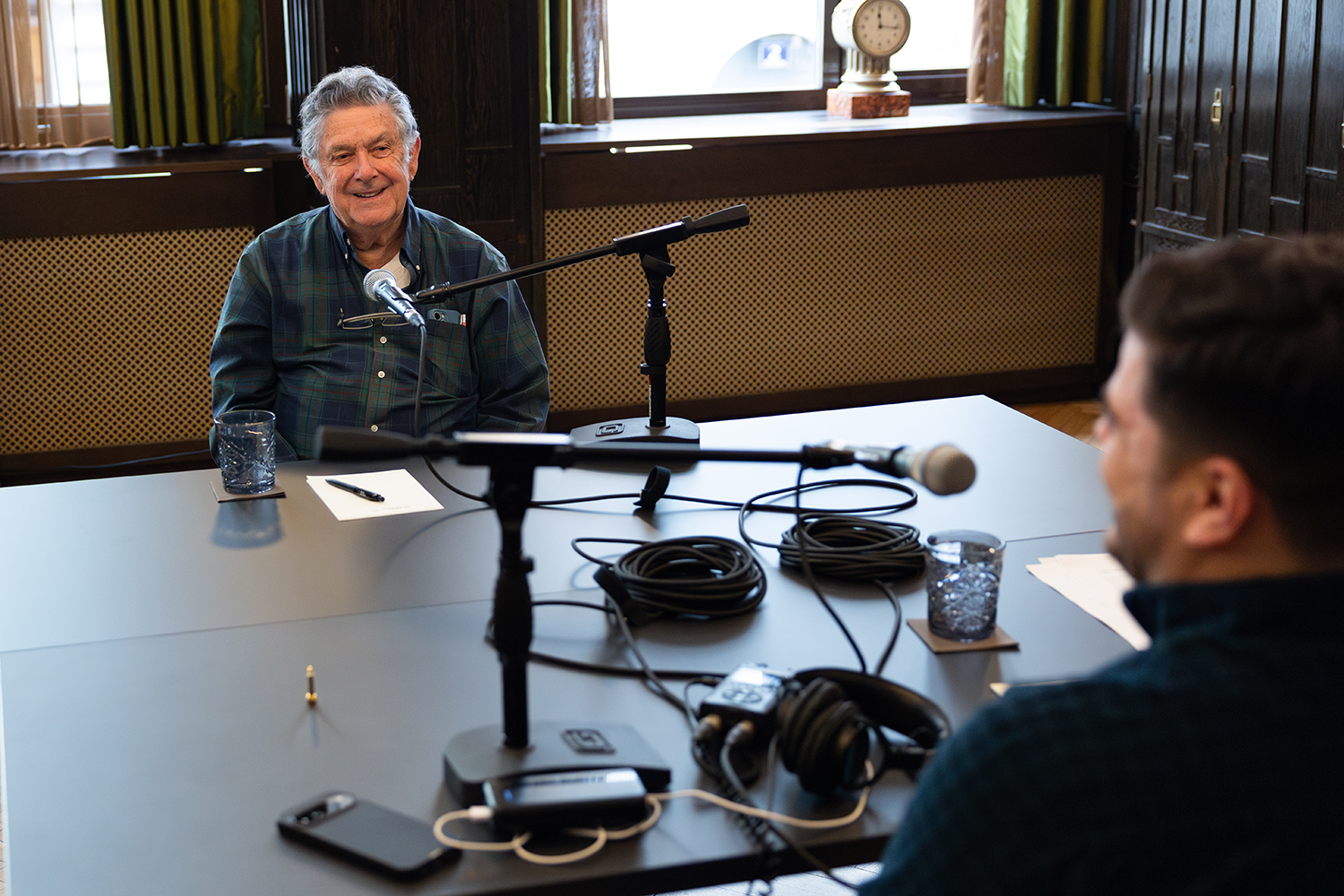
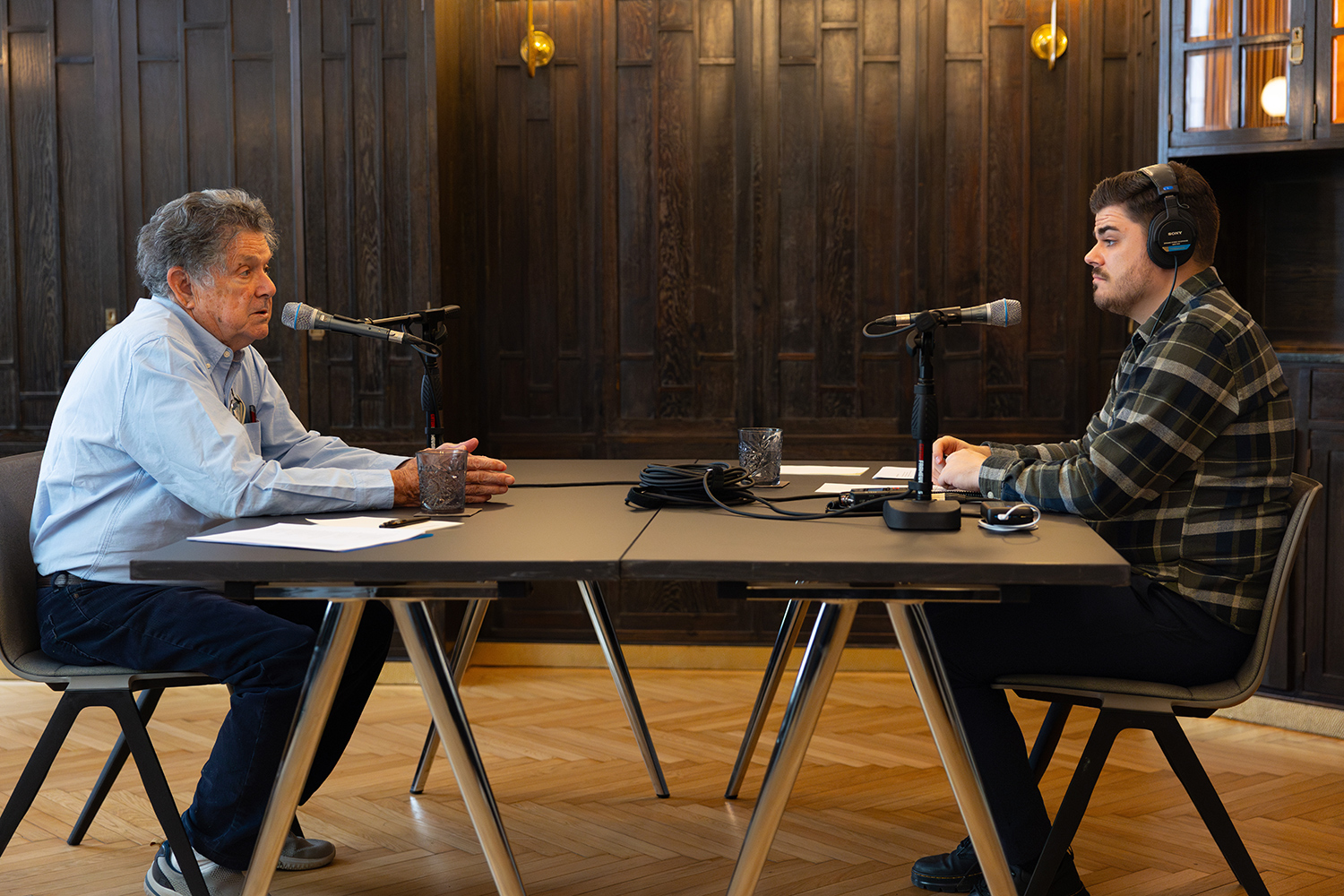
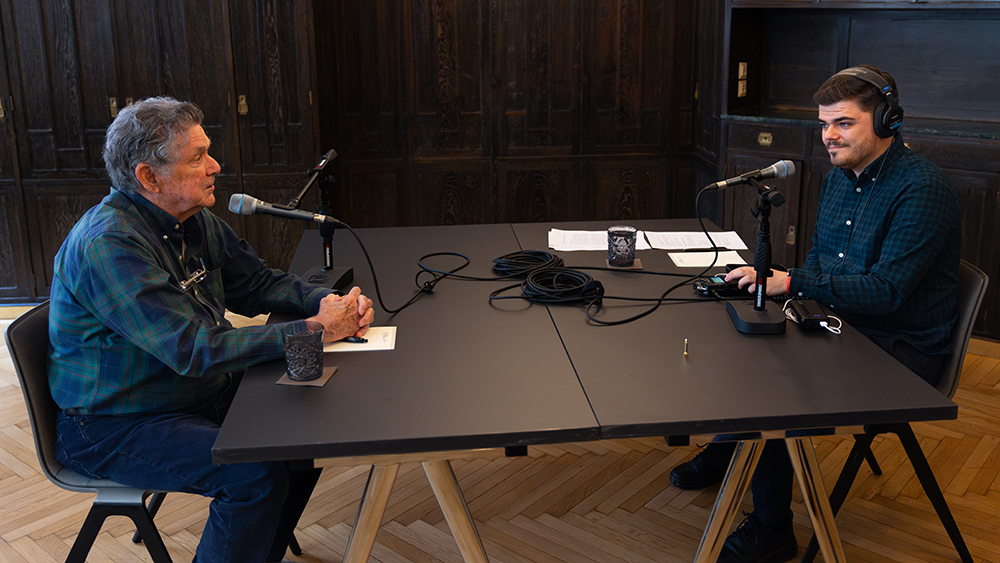
array(1) {
[0]=>
array(426) {
[0]=>
array(4) {
["speaker"]=>
string(14) "Declan Penrose"
["timestamp"]=>
string(8) "00:00:02"
["seconds"]=>
int(2)
["text"]=>
string(479) "This is an interview with Robert Kelley conducted by Declan Penrose for the Oral History Project, a project for the Stanley Center for Peace and Security and BASIC. The interview is taking place on April the 13th, 2026 in Vienna, Austria. And this is session one of three. So thank you very much for agreeing to do this, Robert. And I'm just going to get us going with the first question immediately about your background. And the question first of all is, where did you grow up?"
}
[1]=>
array(4) {
["speaker"]=>
string(13) "Robert Kelley"
["timestamp"]=>
string(8) "00:00:43"
["seconds"]=>
int(43)
["text"]=>
string(615) "My earliest memories are from Hawaii, and it was not the state of Hawaii. It was the Territory of Hawaii. I've never been in the state of Hawaii. And then mostly after that it was California, Southern California for schools, went to Northern California to San Jose for high school and then back to Southern California for my college education at Harvey Mudd. And after that, mostly I've been a Westerner. I guess the farthest east I ever lived was in Missouri when I went to graduate school. But other than that, it's been Nevada, New Mexico, and California are my main places. Hawaii, I wish I could remember more."
}
[2]=>
array(4) {
["speaker"]=>
string(14) "Declan Penrose"
["timestamp"]=>
string(8) "00:01:26"
["seconds"]=>
int(86)
["text"]=>
string(195) "And I guess getting into your career, do you remember any point that sparked your interest in nuclear technology or maybe the first time you maybe took an interest in general in the subject area?"
}
[3]=>
array(4) {
["speaker"]=>
string(13) "Robert Kelley"
["timestamp"]=>
string(8) "00:01:41"
["seconds"]=>
int(101)
["text"]=>
string(895) "I always liked science. I liked engineering. In school, of course, you think it's science. You haven't learned yet that you can apply it as engineering. In the time I was growing up, nuclear weapons were a pretty big topic. I remember in Los Angeles getting up in the morning before dawn to see a flash in the sky from Nevada. So you knew that nuclear weapons were there. They were exciting. And in those days, we were duck and cover and worried. And then as I moved to college, I liked physics and chemistry as topics. And son of a gun, is I finished my bachelor's degree in physics, I discovered there were courses in nuclear engineering. And I thought that was great. We were going to make electricity. Didn't have to meter it. It was going to be free. And we'd give everybody all this clean, safe nuclear electricity. And that's what I went to graduate school in, and that's where I started."
}
[4]=>
array(4) {
["speaker"]=>
string(14) "Declan Penrose"
["timestamp"]=>
string(8) "00:02:38"
["seconds"]=>
int(158)
["text"]=>
string(326) "Brilliant. So once you pursued that educational course, when you finished that course in nuclear energy, nuclear technology, what were your career aspirations at that point? Were they the same as they were when you started the course or had your idea of what you might want to do change once you finished that graduate course?"
}
[5]=>
array(4) {
["speaker"]=>
string(13) "Robert Kelley"
["timestamp"]=>
string(8) "00:03:05"
["seconds"]=>
int(185)
["text"]=>
string(777) "There was a very interesting or odd thing that happened to me in graduate school. As you reach graduation time, all these companies come to the campus and interview you and offer you jobs or at least look you over. And I remember one day I was looking at Los Alamos and General Electric and Westinghouse and all those people. And there was a company on the schedule called the Lawrence Radiator Company. That seemed very odd, a radiator company is interviewing people. So I went to that stand to see what he was interviewing for. It turned out it was the Lawrence Radiation Laboratory of the University of California, the development of nuclear weapons, which I suspected might be the case. And he was very lonely because nobody came to interview the Lawrence Radiator Company."
}
[6]=>
array(4) {
["speaker"]=>
string(13) "Robert Kelley"
["timestamp"]=>
string(8) "00:03:51"
["seconds"]=>
int(231)
["text"]=>
string(402) "And so as a result of that interview, maybe I was the only person who got interviewed that day, I was invited to Livermore, California, and then to the Nevada Test Site. That's where I made the switch from nuclear technology into nuclear weapons. And of course it was an exciting idea to go into that field because they were so powerful and pervasive and they were still being tested when I went there."
}
[7]=>
array(4) {
["speaker"]=>
string(13) "Robert Kelley"
["timestamp"]=>
string(8) "00:04:18"
["seconds"]=>
int(258)
["text"]=>
string(473) "I got an invitation from a man who was really young. He was about 30. For me, that was an old man. And he took me and showed me the biggest pulsed reactor in the world and said, "This is where you'd be working." And it was so hands-on for an interview. Most of the time you sat in an office somewhere and they asked you dumb questions, but this was I got to touch it and see it. No idea what it was used for, but that got me to say, "If I get this job offer, I'll take it.""
}
[8]=>
array(4) {
["speaker"]=>
string(14) "Declan Penrose"
["timestamp"]=>
string(8) "00:04:51"
["seconds"]=>
int(291)
["text"]=>
string(283) "So that then takes me onto that stage of your career when... So you began your career very much focused then on research and engineering initially. And what did that generally entail for you in terms of the research and engineering before you made the switch to information analysis?"
}
[9]=>
array(4) {
["speaker"]=>
string(13) "Robert Kelley"
["timestamp"]=>
string(8) "00:05:19"
["seconds"]=>
int(319)
["text"]=>
string(846) "I worked in a lot of different areas and that's what was fun. I always thought that it was important to move around. And so I learned a lot about criticality and pulsed reactors, which is an arcane field. It was very exciting. We were testing nuclear weapons for their survivability in a Soviet ABM interception. That got me interested in metallurgy, got me very interested in plutonium as a metal. Plutonium is a very complex metal. Most complex thing in the periodic chart. Has terrible properties and lots of different phases and it's highly toxic and pyrophoric. There's nothing good about plutonium except it's really exciting. And that led me to an offer to go to Livermore to the home campus after five years. And so I moved to California, started working in plutonium metallurgy, and then along came a position to work on gas centrifuges."
}
[10]=>
array(4) {
["speaker"]=>
string(13) "Robert Kelley"
["timestamp"]=>
string(8) "00:06:16"
["seconds"]=>
int(376)
["text"]=>
string(540) "So I was the program manager for uranium gas centrifuges at Livermore, and we did all kinds of development kinds of activities, which is why I have my own centrifuge at home, although the ones we were working on there were much more advanced than the one I have at home. And that led me into other aspects, such as we went into the isotope separation of plutonium using lasers, which was a tremendous failure, but you learned a lot in the process of doing it. Got a few publications out of that, worked on Americium as a metal, for example."
}
[11]=>
array(4) {
["speaker"]=>
string(13) "Robert Kelley"
["timestamp"]=>
string(8) "00:06:52"
["seconds"]=>
int(412)
["text"]=>
string(627) "But then it looked like it was time for another move, and I'd always wanted to move to the mountains where there were pine trees and streams and California's a bit dry, and then moved to Los Alamos and was working on their laser separation program and got an offer to move into the intelligence shop. One of my oldest comrades from way back in my Nevada days asked me to join. And what happens is the national laboratories do the intelligence work for the CIA and the DIA in many areas. People don't realize the Atomic Energy Act prohibits the CIA from modeling and developing nuclear weapons, so they turn to the laboratories."
}
[12]=>
array(4) {
["speaker"]=>
string(13) "Robert Kelley"
["timestamp"]=>
string(8) "00:07:34"
["seconds"]=>
int(454)
["text"]=>
string(319) "And so we did a lot of analysis and things for them, and it was fascinating. The intelligence shop looked around the laboratory and tried to recruit a small number of people who were skilled in many different areas and gave them problems to work on. And my problems were primarily, if not entirely, in the Soviet Union."
}
[13]=>
array(4) {
["speaker"]=>
string(14) "Declan Penrose"
["timestamp"]=>
string(8) "00:07:58"
["seconds"]=>
int(478)
["text"]=>
string(315) "Okay. So would that entail them gathering intelligence on the Soviet projects and for example, what technologies they might suspect that they were using, or would they come to you with things that they maybe suspected and ask you to research that or verify that? If that's not the case, how did that generally work?"
}
[14]=>
array(4) {
["speaker"]=>
string(13) "Robert Kelley"
["timestamp"]=>
string(8) "00:08:22"
["seconds"]=>
int(502)
["text"]=>
string(882) "For the most part, we didn't do collection. Okay, we were not out in the field collecting, although many people in the laboratories develop hardware for measuring radiation in the field and flashes in the sky from satellites and all. The job of our shop was primarily intelligence analysis. So people would feed us all sorts of things from satellite imagery, from human sources, from literature, things they could find. You have to remember that this was in the period, say, 1980 until maybe... I'll skip through my career. But satellite imagery was actually top secret. The fact that the US had satellites that could take images was top secret. It was a silly secret because everybody knew it. But when you first got your security clearance for top secret intelligence, you said, "This is what we use." And you're like, "That's what I've been waiting for a security clearance for?""
}
[15]=>
array(4) {
["speaker"]=>
string(13) "Robert Kelley"
["timestamp"]=>
string(8) "00:09:17"
["seconds"]=>
int(557)
["text"]=>
string(544) "But we used all that information and tried to produce assessments of what the Soviets were doing. It could be technology, it could be locating facilities, it could be estimating the output of a facility, for example. Remember too, that in that timeframe, Google Earth didn't exist. Google didn't exist. I have written down somewhere, but I think the first Google was in the late 1990s. So you have to remember, we were working with a much different environment, index cards and going to the library and digging out reports and things like that."
}
[16]=>
array(4) {
["speaker"]=>
string(13) "Robert Kelley"
["timestamp"]=>
string(8) "00:09:55"
["seconds"]=>
int(595)
["text"]=>
string(271) "And it was a different way of doing things, but on the other hand, as I look at what people are doing today in the open source world, like ‘Belling the Cat, ‘those kind of people, they're doing what we were doing then and they have much better sources of information."
}
[17]=>
array(4) {
["speaker"]=>
string(14) "Declan Penrose"
["timestamp"]=>
string(8) "00:10:12"
["seconds"]=>
int(612)
["text"]=>
string(158) "And in that time doing that research, was there like maybe one, for example, particularly shocking or surprising discovery that you'd made from your research?"
}
[18]=>
array(4) {
["speaker"]=>
string(13) "Robert Kelley"
["timestamp"]=>
string(8) "00:10:28"
["seconds"]=>
int(628)
["text"]=>
string(975) "I think we were methodically working through problems. And the kinds of problems that we would solve, some of them stick in my mind I'm proud of, but I don't think they're appropriate here. You come across a report, maybe it's based upon some intercepted communications intelligence, and you wonder why they're doing that. And then you start digging in and figuring out why the people at these locations are talking to people at other locations, what things have they published? I don't remember something that I think was something I really want to mention here, but somewhere... Where I think you're going to be going is I remember before I went to Los Alamos, being invited to a meeting at what's called Z-Division at Livermore. And just got this phone call, "Come to Z-Division." The rest of the laboratory knew Z-Division was something special. Sure as hell didn't know what they did. We suspected all sorts of things and like making space foods for monkeys or whatever."
}
[19]=>
array(4) {
["speaker"]=>
string(13) "Robert Kelley"
["timestamp"]=>
string(8) "00:11:31"
["seconds"]=>
int(691)
["text"]=>
string(794) "But got in there and they said, "We want to tell you something. You can't talk to anybody about it, but we know that a Soviet satellite is going to crash in the next few days somewhere in the world and we want everything that you can do about this satellite. First, we want you to go to the literature and tell us what's in this satellite, tell us what's on board. We know it's got a nuclear reactor. We don't know what that nuclear reactor looks like. How is it going to behave when it comes to the atmosphere? You guys tell us." And one of the questions we had to ask was, "Where's it going to land?" And the answer was, "Nobody knows" because an object that is so irregular in size and shape, like a satellite that's out of control, it tumbles and it bounces and it skips off the atmosphere."
}
[20]=>
array(4) {
["speaker"]=>
string(13) "Robert Kelley"
["timestamp"]=>
string(8) "00:12:17"
["seconds"]=>
int(737)
["text"]=>
string(594) "And it ended up landing in Northern Canada in January, in the middle of the winter. It was my first introduction to what is called NEST, the Nuclear Emergency Search Team. And so my first association then, that was in 1978 with NEST was we were interested then in the cleanup. First, the detection where this thing had gone in the wilds of Northern Canada. And then once we found it, and when I say we, I mean a large group of people with all kinds of resources, how do you clean it up and how do you make measurements? And then how do you go backwards and figure out what was in the satellite?"
}
[21]=>
array(4) {
["speaker"]=>
string(14) "Declan Penrose"
["timestamp"]=>
string(8) "00:13:01"
["seconds"]=>
int(781)
["text"]=>
string(420) "Wow, that's fascinating. In terms of that then information analysis roles, but you've also mentioned that you ended up quite quickly, it seems, in management positions. Is there anything that you felt about yourself or about your skillset or about your personality that you felt helped you rise to management positions quickly and to seemingly pretty much stay in management positions throughout the rest of your career?"
}
[22]=>
array(4) {
["speaker"]=>
string(13) "Robert Kelley"
["timestamp"]=>
string(8) "00:13:34"
["seconds"]=>
int(814)
["text"]=>
string(534) "I'm going to jump back to undergraduate school. Harvey Mudd is a very exceptional science school. They offered, when I was there, only four degrees, math, chemistry, physics, and engineering, but we were required every semester to take humanities and social sciences. So every semester, if I was taking physics classes, two of my classes had to be in music, arts, literature, just go through the entire scheme of social sciences. And it left us when we graduated being reasonably articulate and sensitive to things outside of science."
}
[23]=>
array(4) {
["speaker"]=>
string(13) "Robert Kelley"
["timestamp"]=>
string(8) "00:14:12"
["seconds"]=>
int(852)
["text"]=>
string(306) "And I think that has stayed with me my entire career and has been an important part of becoming a manager and a leader. In fact, I think back to some of my later adventures in Nevada and the people when I had left and I came into it again and said, "He wasn't the last manager here, he's the last leader.""
}
[24]=>
array(4) {
["speaker"]=>
string(14) "Declan Penrose"
["timestamp"]=>
string(8) "00:14:34"
["seconds"]=>
int(874)
["text"]=>
string(63) "That's a very interesting response. I'm very glad I asked that."
}
[25]=>
array(4) {
["speaker"]=>
string(13) "Robert Kelley"
["timestamp"]=>
string(8) "00:14:38"
["seconds"]=>
int(878)
["text"]=>
string(622) "So that's how getting into management, you are people-oriented, you're oriented toward information, you're oriented toward words, you're oriented toward trying to look at the bigger picture. Many of the people I've met in engineering and science over the years only took engineering and science classes and didn't have that broadening. And if I may add, we also were a little bit snooty in that we noted that an awful lot of people who graduate in law have never managed to make it through a physics class. So we felt that we were maybe a little better. You're smiling and I can't put that on the tape, but you're smiling."
}
[26]=>
array(4) {
["speaker"]=>
string(14) "Declan Penrose"
["timestamp"]=>
string(8) "00:15:17"
["seconds"]=>
int(917)
["text"]=>
string(60) "Yeah, I will admit that I was smiling. So just double-check-"
}
[27]=>
array(4) {
["speaker"]=>
string(13) "Robert Kelley"
["timestamp"]=>
string(8) "00:15:25"
["seconds"]=>
int(925)
["text"]=>
string(72) "Maybe I should change that we were smarter too. We're more well-rounded."
}
[28]=>
array(4) {
["speaker"]=>
string(14) "Declan Penrose"
["timestamp"]=>
string(8) "00:15:30"
["seconds"]=>
int(930)
["text"]=>
string(378) "Yes. We definitely keep that correction in the recording. You had obviously the management roles at the centrifuge and plutonium metallurgy programs at Lawrence Livermore National Laboratory, and you had a role as director of the Department of Energy Remote Sensing Laboratory. How similar or different were those two roles and what did the transition between the two look like?"
}
[29]=>
array(4) {
["speaker"]=>
string(13) "Robert Kelley"
["timestamp"]=>
string(8) "00:16:12"
["seconds"]=>
int(972)
["text"]=>
string(915) "I'll start with being the reactor supervisor at Super Kukla in Nevada, and that was walking from graduate school where you didn't really know anything, you had all this book learning, into working with a crew of people who were older than you were and who were to some extent subject to your supervision. So by the time I was 22 or 23, I was a reactor supervisor telling a team of people what to do. I think the biggest thing I learned there is you don't tell people who are older than you are and who know a lot more about the topic than you do what to do. You learn how to follow them, to understand what it is they're doing to learn from them. And in the process, you have to manage resources and things. But I learned very quickly that I didn't tell the older guys, "Why don't you go do this?" You'd say, "What do you think we should do next? I think we need to accomplish this end." And that worked quite well."
}
[30]=>
array(4) {
["speaker"]=>
string(13) "Robert Kelley"
["timestamp"]=>
string(8) "00:17:08"
["seconds"]=>
int(1028)
["text"]=>
string(799) "Then when I got to Livermore, fairly soon after I got there, there was an opening for the section leader, I think you call it section leader in those days, for the Plutonium Metallurgy Research Program, which is half a dozen or a dozen programs that we were trying to make metallurgical advances. And then on top of that, be the manager of a building that we were licensed, if you will, to handle about 200 kilograms of plutonium metal in the Livermore Valley, which is an agricultural part of California near San Francisco. There's a lot of responsibility in that. And so those three things kept me very busy. I learned about budgets. I learned about managing people. I learned how to get our programs funded and things like that. And I had to also learn how to safely take care of those materials."
}
[31]=>
array(4) {
["speaker"]=>
string(13) "Robert Kelley"
["timestamp"]=>
string(8) "00:18:07"
["seconds"]=>
int(1087)
["text"]=>
string(781) "Those were wonderful experiences. I really enjoyed them all. I've enjoyed, I think, program management in directing people to do research more than I did some of the line responsibilities, writing evaluations, and doing budgets. Walking over here this morning, I was chatting with my wife and I remember we had to do all these lists, lists of this, list of that. Who's going to retire this year? How much helium are we going to use in our jobs? And one day, the list that I always expected, we got a request from the department to give them a list of all the lists that we were working on. That was not my favorite part. But research I liked because suddenly I could work on 6 or 8 or 10 projects that I was interested in and leverage other people to do things I was excited about."
}
[32]=>
array(4) {
["speaker"]=>
string(14) "Declan Penrose"
["timestamp"]=>
string(8) "00:19:01"
["seconds"]=>
int(1141)
["text"]=>
string(594) "Obviously in these roles, you have, for example, the CIA asking you to solve problems and obviously you're working for the government. How did you find translating the information that you had to government officials who, for example, might not be experts in the subject matter? First of all, how did you find the process in terms of, was it difficult, for example, to translate your findings in a way that might be comprehensible to somebody who isn't a subject expert? And also, how listened to did you feel with your advice or your findings from the government officials that you dealt with?"
}
[33]=>
array(4) {
["speaker"]=>
string(13) "Robert Kelley"
["timestamp"]=>
string(8) "00:19:45"
["seconds"]=>
int(1185)
["text"]=>
string(671) "The first thing I would mention is that I, because of that education and involved a lot of words in science, social science, I was a nut and actually still am about getting people to document things. And so our programs, I think we, in the plutonium area, we had bimonthly reports and a lot of the scientists hated doing that. They just didn't want to be writing reports. They wanted to be in the laboratory doing something. And I insisted that they do those reports and that they show progress in what they've been doing since the last time. And that I think is a way of communicating. Then we would pass that on to masters above us in the lLaboratory and to Washington."
}
[34]=>
array(4) {
["speaker"]=>
string(13) "Robert Kelley"
["timestamp"]=>
string(8) "00:20:29"
["seconds"]=>
int(1229)
["text"]=>
string(332) "The results are often mixed. We dealt with people in Washington who very often would ask Livermore and Los Alamos the same question about what's going on in intelligence issue in the Soviet Union, and they would get two different answers back. And that often bothered them a great deal and they had a very hard time dealing with it."
}
[35]=>
array(4) {
["speaker"]=>
string(13) "Robert Kelley"
["timestamp"]=>
string(8) "00:20:52"
["seconds"]=>
int(1252)
["text"]=>
string(521) "One of the problems that I ended up understanding was they asked the same question, but they asked it in different ways. So I can remember once they asked Livermore, "What do you think is the worst case?" No, "What is the most likely case of a particular Soviet system? How many of they're going to build? What does it look like?" So Livermore took all the information available to them and went back and said, "They're going to build so many. They're going to be this type. This is how they'll allocate their resources.""
}
[36]=>
array(4) {
["speaker"]=>
string(13) "Robert Kelley"
["timestamp"]=>
string(8) "00:21:24"
["seconds"]=>
int(1284)
["text"]=>
string(786) "They asked Los Alamos, the DIA almost the same question, but they asked it in a different way. They said, "What is the worst possible case for this Soviet system against us?" You don't ask the question the same way and you don't get the same answer because there, if it's the worst possible case, somebody is going to say, "Build a missile silo that has to withstand a strike from a Soviet weapon, and it has to be strong enough to withstand the worst case." Whereas the answer that Livermore gave, which is a perfectly good answer, but it was asked in a different way was, "How many weapons do you think they're going to build?" They're going to build three times what Los Alamos says, but they're going to be a third of the yield because they looked at the problem in a different way."
}
[37]=>
array(4) {
["speaker"]=>
string(13) "Robert Kelley"
["timestamp"]=>
string(8) "00:22:11"
["seconds"]=>
int(1331)
["text"]=>
string(705) "So we had that kind of problem with Washington on occasion, but we also had a lot of good events with them. I served at time as a representative on the JAEIC, which is Joint Atomic Energy Intelligence Committee, and we were all of the intelligence organizations in Washington, and we would come together to work on a given problem. It's relevant to what you hear today when you hear people talk about, let's say, intelligence on Iran. Today is 2026, but we're in the middle of a lot of things with Iran. You think that maybe they're asking the questions the wrong way on occasion and not realizing that when they ask the questions the wrong way, they get answers that really not the answer that they need."
}
[38]=>
array(4) {
["speaker"]=>
string(14) "Declan Penrose"
["timestamp"]=>
string(8) "00:23:06"
["seconds"]=>
int(1386)
["text"]=>
string(382) "That is fascinating. And also reminds me of, for example, the kind of stories that people write about, if you make a request to a genie and you don't phrase it properly, you get something you don't expect. I think that's a really interesting finding from your experiences with them. And obviously the knowledge to ask the right questions and how you frame them being very important."
}
[39]=>
array(4) {
["speaker"]=>
string(14) "Declan Penrose"
["timestamp"]=>
string(8) "00:23:37"
["seconds"]=>
int(1417)
["text"]=>
string(313) "So also throughout your time in these labs, obviously this is quite different to say working in academia. Did you get time, for example, to still go to academic conferences or interact with other scientists often and still able to collaborate or because of the nature of your work, were you isolated in some ways?"
}
[40]=>
array(4) {
["speaker"]=>
string(13) "Robert Kelley"
["timestamp"]=>
string(8) "00:24:01"
["seconds"]=>
int(1441)
["text"]=>
string(899) "We lived in a small community, let's put it that way. Going to meetings, professional meetings, I probably did a lot fewer of those than maybe other peers who were in less classified work. I went to a few, but we... For example, in the intelligence area, we had a group of laboratories that got together three or four times a year and had what amounted to a professional conference. People were asked to write papers, to bring them to that meeting, to present them, to argue over them. And so while we were talking sometimes at the top secret level, we were still interacting with other laboratories, and that led to scientific disputes. It also led to a lot of the kind of disputes that you see in science where people are sometimes not behaving well with respect to each other, and attempt sometimes to undermine the other party instead of do a better job of convincing the party of what you know."
}
[41]=>
array(4) {
["speaker"]=>
string(14) "Declan Penrose"
["timestamp"]=>
string(8) "00:25:07"
["seconds"]=>
int(1507)
["text"]=>
string(359) "Something else I wanted to ask about was working in these laboratories, first of all, from when you started, but then also over time, how did you find adapting and learning all of, for example, the safety procedures and the safety measures in place? And did they change a lot during your time in these laboratories, or did practices generally stay consistent?"
}
[42]=>
array(4) {
["speaker"]=>
string(13) "Robert Kelley"
["timestamp"]=>
string(8) "00:25:34"
["seconds"]=>
int(1534)
["text"]=>
string(705) "I go back to my very first job, which is actually a summer job that you haven't referred back to at the Lockheed Propulsion Company in California where we were making escape motors for the Apollo capsule. Okay, this was a summer job. Believe me, I was at the very bottom of the pecking order, but one thing I learned very quickly there, working around high explosives and propellants, the older guys, and then now I'm talking about really old guys, 50 or so, they said, "The safety department here is to inhibit us. That's their job, is to make sure that we can't get things done. So whatever you do, make sure that you don't let the safety people know what you're doing, and you try to get the job done.""
}
[43]=>
array(4) {
["speaker"]=>
string(13) "Robert Kelley"
["timestamp"]=>
string(8) "00:26:16"
["seconds"]=>
int(1576)
["text"]=>
string(548) "So as a young guy, just coming out of school, that was the first advice I got. Okay, really bad advice. And as I worked my way up the line, 10 years later, I was the manager of a plutonium facility where we were handling... Licensed to handle 200 kilograms of material, and I suddenly became quite strict in my interpretations of safety and that down to... For example, I would walk into our machine shop that was just doing ordinary machining of steel parts or whatever, and I would ride people about why they weren't wearing their safety glasses."
}
[44]=>
array(4) {
["speaker"]=>
string(13) "Robert Kelley"
["timestamp"]=>
string(8) "00:26:52"
["seconds"]=>
int(1612)
["text"]=>
string(544) "And anything in the facility that involved fire, anything that involved electricity, energy that could cause a fire, that's the worst thing in a plutonium facility because you break down the containment of things. And so by then, I had changed completely and had become really a nut on safety. I remember one occasion where we had an over five magnitude Richter magnitude earthquake in the plutonium facility in Livermore, and our facility rode out that earthquake better than any other building on the Laboratory site, because we were hounded."
}
[45]=>
array(4) {
["speaker"]=>
string(13) "Robert Kelley"
["timestamp"]=>
string(8) "00:27:32"
["seconds"]=>
int(1652)
["text"]=>
string(439) "Because of the danger of what we were doing, we were hounded by the safety people. Sometimes reluctantly, I would go along with their requests. Say you had a cart on wheels that you move things around on. It had to have a chain on it and be chained to the wall if we weren't using it. And the people would forget to do that. But when the earthquake came, those carts didn't roll all over the room and break things, so safety was important."
}
[46]=>
array(4) {
["speaker"]=>
string(13) "Robert Kelley"
["timestamp"]=>
string(8) "00:27:56"
["seconds"]=>
int(1676)
["text"]=>
string(563) "How did it change then? The Department of Energy, particularly as you got into the 80s and 90s, started to get very interested in safety. There were things happening around the country, particularly in the University of California laboratories that were viewed as unsafe to the public, unsafe to the employees, and their regulations started to become onerous. It wasn't the old thing of the safety department is there to inhibit you, but it started to feel a little bit that way, except they really were inhibiting you and making it very difficult to do your job."
}
[47]=>
array(4) {
["speaker"]=>
string(13) "Robert Kelley"
["timestamp"]=>
string(8) "00:28:34"
["seconds"]=>
int(1714)
["text"]=>
string(646) "And that led me to one other event, which we'll, I'm sure, talk about later, which was going to the IAEA and it was a shock to discover that the IAEA working with nuclear materials in the nuclear facilities had no safety department at all. And so I was suddenly thrust back into an environment where I had been very, very hard over in safety for most of my career and suddenly ended up in Vienna and discovered that the employees would come back and describe terrible things in facilities they'd visited and the management's attitude was, "That's what life is about." Fortunately, I think they've only killed two employees at IAEA over the years."
}
[48]=>
array(4) {
["speaker"]=>
string(14) "Declan Penrose"
["timestamp"]=>
string(8) "00:29:19"
["seconds"]=>
int(1759)
["text"]=>
string(589) "Wow. Yeah. I think what that leads me on to... Because I was glad that you mentioned earthquakes because it's something I tried to keep in mind with nuclear safety in the US because you don't really get them in the UK. So it's something you have to factor in obviously in Japan and other countries like the US. But I was also wondering, linking onto safety, was there a reaction regarding nuclear safety or in general attitudes maybe in the Department of Energy or in your facilities to the Chernobyl disaster, for example, and how was that perceived when it happened and in the aftermath?"
}
[49]=>
array(4) {
["speaker"]=>
string(13) "Robert Kelley"
["timestamp"]=>
string(8) "00:30:04"
["seconds"]=>
int(1804)
["text"]=>
string(625) "I think Chernobyl was actually fairly irrelevant to what we were doing in the laboratories. That was a big reactor. You might learn administrative things about what wrong, that someone there didn't follow procedures, invented an experiment on his own that went bad, that kind of thing. But it didn't have much effect on us down at the working level. That wasn't a major thing. It's a maturing of the program. In the early program, people took very high radiation doses. I took high radiation doses at the reactor and didn't think much of it. We had a job to do, and as long as I stayed within the legal limits, that was fine."
}
[50]=>
array(4) {
["speaker"]=>
string(13) "Robert Kelley"
["timestamp"]=>
string(8) "00:30:52"
["seconds"]=>
int(1852)
["text"]=>
string(741) "But as the years went on, I would say there was both a reaction to that and also a responsible reaction. And that is, you don't let people just go and do something that's dangerous because you think that'll get the job done more quickly. I think that was the reaction in the Department of Energy was, "We need to start doing things more responsibly." I remember one group at Livermore was working a different facility working at very high radiation levels. They used to joke that they only wore their film badges one day a week because if they wore their film badges every day, they would exceed the limits that they were allowed to receive and therefore they wouldn't be able to go into the laboratories and work. And that was the attitude."
}
[51]=>
array(4) {
["speaker"]=>
string(13) "Robert Kelley"
["timestamp"]=>
string(8) "00:31:39"
["seconds"]=>
int(1899)
["text"]=>
string(465) "I remember at the reactor, we had a board posted on the wall with the radiation doses that each member of the staff had received for the month. And it was almost a feeling that if you didn't have a high dose, you weren't doing a job kind of thing. Today, that would be not the way people would approach it. And the other is, for reasons of personal information, medical information, you can't see the doses that other people are getting. That's private information."
}
[52]=>
array(4) {
["speaker"]=>
string(13) "Robert Kelley"
["timestamp"]=>
string(8) "00:32:10"
["seconds"]=>
int(1930)
["text"]=>
string(137) "Can I go off script here for a moment? You can ask about safety, asked about safety in nuclear weapons, okay? But that's not on the tape."
}
[53]=>
array(4) {
["speaker"]=>
string(14) "Declan Penrose"
["timestamp"]=>
string(8) "00:32:17"
["seconds"]=>
int(1937)
["text"]=>
string(47) "Yeah. So you want to go off strip for a second?"
}
[54]=>
array(4) {
["speaker"]=>
string(13) "Robert Kelley"
["timestamp"]=>
string(8) "00:32:19"
["seconds"]=>
int(1939)
["text"]=>
string(91) "No, no. I just want to make sure you ask the question because we're on the topic of safety."
}
[55]=>
array(4) {
["speaker"]=>
string(14) "Declan Penrose"
["timestamp"]=>
string(8) "00:32:23"
["seconds"]=>
int(1943)
["text"]=>
string(668) "Yes. As I was going to move on then to safety, because I wasn't sure if Chernobyl, for example, if it was going to be relevant or not, but I thought I'd mentioned that because of the time period and then I then segue onto nuclear weapon safety essentially and ask about your general sense of your learnings about nuclear weapon safety and if there was similarities with what you were doing in the lab in terms of that research. You're also free to direct the conversation if you wanted to talk about that as well. Say, for example, you want to talk about something and I haven't got a question on it. For example, now you're absolutely free to talk about that subject."
}
[56]=>
array(4) {
["speaker"]=>
string(13) "Robert Kelley"
["timestamp"]=>
string(8) "00:33:15"
["seconds"]=>
int(1995)
["text"]=>
string(429) "You're talking about safety in general, and I thought it might be interesting to look at what we did in those first, say, 15 years of my career where I was in the laboratory and doing things. One of the biggest things about developing nuclear weapons is developing safe nuclear weapons, weapons that will not go off when you don't want them to do, weapons that can't be used by somebody who doesn't have the authority to do them."
}
[57]=>
array(4) {
["speaker"]=>
string(13) "Robert Kelley"
["timestamp"]=>
string(8) "00:33:38"
["seconds"]=>
int(2018)
["text"]=>
string(386) "When I mentioned that plutonium metallurgy research program that I was managing in my mid-career, awful lot of the projects we had there were related to coming up with means of making sure the bomb didn't work, or making sure that the bomb was compatible with the design that the physicists were doing, that it could be disabled, that kind of thing. An awful lot of it goes into safety."
}
[58]=>
array(4) {
["speaker"]=>
string(13) "Robert Kelley"
["timestamp"]=>
string(8) "00:34:03"
["seconds"]=>
int(2043)
["text"]=>
string(564) "One place where you can see that is people... Now that yields of nuclear tests have been largely declassified, and you can suddenly find lists, you find all these tests where the yield was zero or very, very small, and people go, "Wow, they must be really bad at developing weapons." When in fact, the purpose of those tests was to make sure the weapon wouldn't go off, but you still have to bury it in the ground, you still have to put it deep in the earth, and then you set it off. And if you've made a mistake and it does work, then it's contained in the earth."
}
[59]=>
array(4) {
["speaker"]=>
string(13) "Robert Kelley"
["timestamp"]=>
string(8) "00:34:38"
["seconds"]=>
int(2078)
["text"]=>
string(362) "So people, I think, are surprised sometimes to see how much of the program was around zero and low yield weapons. That comes back to bite you because the place we can most easily see it is in Kazakhstan. The Russians did a lot of tests there, what were called one-point safety tests that if the weapon was only detonated at one point, it wouldn't give any yield."
}
[60]=>
array(4) {
["speaker"]=>
string(13) "Robert Kelley"
["timestamp"]=>
string(8) "00:35:03"
["seconds"]=>
int(2103)
["text"]=>
string(1000) "The weapon was only detonated at one point. It wouldn't give any yield. And they believed that they knew what they were doing, so they buried the weapon in say 10 or 20 feet deep in the earth and set it off and nothing happened. Well, that means that all the plutonium that was in that weapon, let's say a few kilograms, is in the hole and it's in a very small area because the high explosive that was involved in it has only made a hole two or three feet in diameter. And what those things ended up being referred to was ‘plutonium mines.’ Of course, plutonium can't be mined in nature because it doesn't exist in nature. But if you have these holes with plutonium in them where the bomb didn't go off, you have bombs worth of plutonium in each hole. So that cropped up as a major problem after the wall came down, the test ban came into force, and the US did an awful lot of work with the Soviets or by then the Russians to go back and secure those places to mine out the plutonium in the dirt."
}
[61]=>
array(4) {
["speaker"]=>
string(13) "Robert Kelley"
["timestamp"]=>
string(8) "00:36:02"
["seconds"]=>
int(2162)
["text"]=>
string(527) "Not to recover it for use, but just mine it out to make sure that someone who came along in future years, because by then it was the territory of Kazakhstan, would not be able to recover that. And that turns out to be true also in Algeria. Because in Algeria, the French did exactly the same thing. They tested in shallow holes to make sure the bomb didn't go off. And that means that when the French retreated from Algeria and from their test program there, a lot of plutonium was left behind. I think that's all been secured."
}
[62]=>
array(4) {
["speaker"]=>
string(14) "Declan Penrose"
["timestamp"]=>
string(8) "00:36:36"
["seconds"]=>
int(2196)
["text"]=>
string(542) "So I've been told by some people that the, apparently, I believe the nuclear waste from the tests, apparently somebody's told me it's buried in the desert and the French government won't tell the Algerians where it is still, apparently. But I don't know if that... They used the term nuclear waste to me, and I'm not sure if they're referring to used spent material or whether they obviously talking about the plutonium, but that was just something somebody had mentioned to me. So is that your understanding that's probably not correct or..."
}
[63]=>
array(4) {
["speaker"]=>
string(13) "Robert Kelley"
["timestamp"]=>
string(8) "00:37:15"
["seconds"]=>
int(2235)
["text"]=>
string(529) "The French didn't do that many tests in Algeria. They tested above ground. That material is not available. But when they tested underground, if it was a complete nuclear explosion, I think one could reasonably argue that there's no way to recover what is there. And I think all locations where there was an underground test that was explosive would be well known to the Algerians even today. The problem would be how many of these other tests did they do that didn't go off on purpose and then has all that material been secured?"
}
[64]=>
array(4) {
["speaker"]=>
string(14) "Declan Penrose"
["timestamp"]=>
string(8) "00:37:50"
["seconds"]=>
int(2270)
["text"]=>
string(260) "So in the US, with your programs, these similar tests, so when these tests would be conducted in the US, was the practice to then immediately extract the plutonium and not leave those deposits if such tests were done to make sure that the bomb wouldn't go off?"
}
[65]=>
array(4) {
["speaker"]=>
string(13) "Robert Kelley"
["timestamp"]=>
string(8) "00:38:14"
["seconds"]=>
int(2294)
["text"]=>
string(139) "I don't really know. I think those tests were usually done in tunnels where the material was probably left in place. I don't know for sure."
}
[66]=>
array(4) {
["speaker"]=>
string(14) "Declan Penrose"
["timestamp"]=>
string(8) "00:38:23"
["seconds"]=>
int(2303)
["text"]=>
string(433) "No, that's great. And that's fascinating as well, which I think is an important point to raise about how many of these tests were about the bomb not going off. So for example, when you see these published numbers of how many nuclear tests there are, did you just have any sense of proportionately how often you were testing to make sure the bomb didn't go off compared to tests that were deliberately achieving a nuclear destination?"
}
[67]=>
array(4) {
["speaker"]=>
string(13) "Robert Kelley"
["timestamp"]=>
string(8) "00:38:53"
["seconds"]=>
int(2333)
["text"]=>
string(395) "No, I can't be quantitative. I can be qualitative that it was a large number, but that's purely qualitative. And as I said, we devoted a pretty fair fraction of our work in plutonium metallurgy to helping the physicists design things that wouldn't work, or could be made to not work, or made to not work if there was not proper control. If someone stole a thing, they wouldn't be able to use it."
}
[68]=>
array(4) {
["speaker"]=>
string(14) "Declan Penrose"
["timestamp"]=>
string(8) "00:39:22"
["seconds"]=>
int(2362)
["text"]=>
string(645) "Yeah. I was about to ask for the kind of circumstances you'd be designing that for then would be, for example, theft. There's also, I'm forgetting the date of the case where I believe a warhead fell out of a plane over US soil and it didn't go off, but are there any... I'm guessing the range of circumstances that you had, you have to imagine many, many potential cases where it could be of risk, whether it's in transit, theft. And I assume, for example, preparing if there was like, I don't know, some kind of sabotage as well, were you having to consider all of these potential scenarios when you were thinking of this nuclear weapon safety?"
}
[69]=>
array(4) {
["speaker"]=>
string(13) "Robert Kelley"
["timestamp"]=>
string(8) "00:40:09"
["seconds"]=>
int(2409)
["text"]=>
string(917) "I have spent a lot of time on nuclear weapon safety and there have been many incidents where a weapon was lost or dropped and recovered or dropped and did a partial explosion. So there are many cases that one could come up with. There's one in South Carolina that some people claimed they found a few years ago, but they didn't. So that is an issue. And I'll jump ahead of your questions and say, this is something that I've tried to point out for the TPNW. When you start looking at weapons around the world, how many weapons are there that no one either knows the condition they're in or where they are or goodness knows has somebody gone in and gotten them clandestinely? Remember Howard Hughes tried to recover weapons. The Z-Division was involved in that from Livermore way back in the late '70s. So when one begins to say, "Have we recovered all the weapons in the world? Have we taken them out of circulation?""
}
[70]=>
array(4) {
["speaker"]=>
string(13) "Robert Kelley"
["timestamp"]=>
string(8) "00:41:13"
["seconds"]=>
int(2473)
["text"]=>
string(746) "That's a problem that people have to deal with. And I make the analogy there that there are chemical weapons all over the world. They still find them in Belgium to this day. They dig them up and who did they belong to? They belong to the Belgians, the Germans? It's hard to assign responsibility. It's also hard to come up with an accurate count of how many are still out there. There are fewer in the weapons world, but there are a couple of submarines we know about that had weapons on board or some that a plane fell off an aircraft carrier in the Pacific. I think there are indications that maybe somebody came back and actually got them again, but who knows? I'm not an expert in that area. I just know there is a question there to be asked."
}
[71]=>
array(4) {
["speaker"]=>
string(14) "Declan Penrose"
["timestamp"]=>
string(8) "00:41:59"
["seconds"]=>
int(2519)
["text"]=>
string(1043) "Yeah, absolutely. I'm glad you spoke about that because that's something I was going to mention as well. It was kind of an open thing that maybe in the second or third session, but probably the third session on that. But yeah, I think that's fascinating as somebody from a disarmament kind of research background where you don't necessarily know how many... So I guess in general, when you see, for example, you work with SIPRI now, just obviously this has end up jumping ahead quite briefly, but in general, when you see estimates of warhead numbers and different arsenals, first, is there any sense of how many potential warheads might be outside of anyone, technically outside of anyone's arsenals at any one time and over your work over the years or with the IAEA, has it ever come up, for example, every now and again that somebody might either stumble upon or find a warhead they might have suspected had been lost or is there any way to have a sense of how many might be lying around outside of anybody's technical control at that time?"
}
[72]=>
array(4) {
["speaker"]=>
string(13) "Robert Kelley"
["timestamp"]=>
string(8) "00:43:16"
["seconds"]=>
int(2596)
["text"]=>
string(946) "I'll remove IAEA from that question because they really don't have anything to do with weapons. If they can't inspect weapons, I mean, they would inspect weapons, but if they were inspecting weapons, it would be because they failed at their job in the first place. But no, if you look, for example, at South Africa, which I think we're going to cover, you have a situation there where there were many weapons, some weapons that were in the middle stages of being built, there was lots of scrap, there was uranium had been enriched partially, but wasn't up to weapons grade yet. And there were many mock-ups. They built a number of weapons mock-ups using depleted or natural uranium. And so those, from a design standpoint, I mean, they're just as dangerous if you lose one of those, somebody can copy it. On the other hand, they couldn't be exploded, but if you have a weapon that's halfway through its fabrication process, how do you count that?"
}
[73]=>
array(4) {
["speaker"]=>
string(13) "Robert Kelley"
["timestamp"]=>
string(8) "00:44:16"
["seconds"]=>
int(2656)
["text"]=>
string(478) "And again, I'm trying to pull the IAEA out of that equation because IAEA wouldn't be involved at those stages. I mean, well, DPRK, for example, IAEA is not going to get in there, I think, and be looking at what weapons are under construction, but if it's the nuclear materials in them, as it was in South Africa, there were nuclear materials associated with things that weren't finished yet. So your spreadsheet that you're producing on nuclear materials is not black and white."
}
[74]=>
array(4) {
["speaker"]=>
string(14) "Declan Penrose"
["timestamp"]=>
string(8) "00:44:51"
["seconds"]=>
int(2691)
["text"]=>
string(664) "Absolutely. And just to, so I think we've got a good coverage just talking about nuclear safety in that context now, and I'm sure it will come up over the sessions with the different cases that you were working on. As you kind of go through this career for your time, as you get later in the '80s and the early '90s, before you were sent out to work with the IAEA, had you already had any kind of involvement with them or work with them? Because I'm very interested in how did it come about that you ended up being almost loaned out to them, essentially. How did that kind of, I guess, come about? Was there a relationship beforehand or did it just kind of happen?"
}
[75]=>
array(4) {
["speaker"]=>
string(13) "Robert Kelley"
["timestamp"]=>
string(8) "00:45:40"
["seconds"]=>
int(2740)
["text"]=>
string(827) "There's an aside to that, and that was when I was at Livermore, I got very involved in dealing with the public about the safety of our plutonium facility. As you can imagine, the Bay Area and we happened to be in the same congressional district as Berkeley, which is a very liberal enclave. We got a lot of pressure about the safety of the facility. So I was put into a class for dealing with the public and dealing with the media. So there I was getting all this training for that. And one of the things we had to do in that class was say, "Where do you want to be in 10 years?" And I, having not the slightest idea what the IAEA did, but having to answer this question in the class said, "Oh, I'd like to be an IAEA inspector." So that was something I did 15, 20 years before I actually had the opportunity to go and do that."
}
[76]=>
array(4) {
["speaker"]=>
string(13) "Robert Kelley"
["timestamp"]=>
string(8) "00:46:30"
["seconds"]=>
int(2790)
["text"]=>
string(525) "Other than that, anything that I had to do with safeguards and IAEA was very peripheral to my job in a different way because I was responsible for a 5,000 kilogram nuclear reactor in Nevada. I knew a lot about our own safeguards procedures and about safety and security, which was very primitive at the time. And then running a plutonium facility, you really have to know the rules, but we were not involved with the IAEA because the United States is an exempt member of the NPT. And so IAEA safeguards never really intruded."
}
[77]=>
array(4) {
["speaker"]=>
string(14) "Declan Penrose"
["timestamp"]=>
string(8) "00:47:14"
["seconds"]=>
int(2834)
["text"]=>
string(684) "And so when it came about initially, I'm going to, because we've managed to get through the questions for session one, I think I'm going to then use the rest of this time to kind of set up session two here and kind of get a sense of, so as you get toward... So basically when it comes time to... How did the process actually go of you being loaned out to the IAEA? For example, did they perhaps approach the US government or did US government go, "We have somebody we think would be great for this"? How did that process look and how was your experience of that process? And importantly, how did you feel about that going from a lab environment then being asked to go to do that work?"
}
[78]=>
array(4) {
["speaker"]=>
string(13) "Robert Kelley"
["timestamp"]=>
string(8) "00:48:09"
["seconds"]=>
int(2889)
["text"]=>
string(828) "I, on purpose, mentioned to you the experience in 1978 where it got me into NEST and NEST was always in my portfolio from that time on. First, I was asked sort of an informal way to be part of it, finding a Soviet satellite in Northern Canada, but then moving to Los Alamos, it was just logical that they would come to me as a NEST person at Livermore and join into the program there. So NEST was always something that you took time out to do and make sure a NEST program matured. It was maturing greatly. There was a new sheriff in town, a woman named Lisa Gordon-Hagerty who really, really revamped that program and made it strong. But as I, late in my career in the intelligence work, I was getting bored with that and I wanted to do something different. So I moved to the staff of the associate director for nuclear weapons."
}
[79]=>
array(4) {
["speaker"]=>
string(13) "Robert Kelley"
["timestamp"]=>
string(8) "00:49:10"
["seconds"]=>
int(2950)
["text"]=>
string(839) "So I was on his staff helping with planning nuclear tests and all sorts of interesting things. And in that process, I lost some of my contact with my old friends in intelligence. And what happened at that time was pretty awful. The wall came down and suddenly everybody who was anybody with a briefcase was going to the Soviet Union, going through facilities that we'd only identified at the top secret level, talking to the Russian counterparts and all this stuff that we'd worked so hard to do was suddenly everybody was doing it. And it really annoyed me because if I'd stayed in intelligence for a few more years, I would have gotten to go and see what happened. Well, then along came 1991 and Saddam invaded Kuwait and there was a big flap about nuclear weapons in Kuwait and they started looking for people to help the US government."
}
[80]=>
array(4) {
["speaker"]=>
string(13) "Robert Kelley"
["timestamp"]=>
string(8) "00:50:07"
["seconds"]=>
int(3007)
["text"]=>
string(858) "Well, the really obvious thing to do was to send NEST. Well, NEST at that point, the US came up with a plan for the United Nations for UNSCOM, the United Nations Special Commission on Monitoring Iraq, and they came up with a plan that involved taking like a hundred people from NEST, airplanes, helicopters, and whatever, and people said, "Well, this is way too expensive, way too expensive. There's no way we can do this. If you would like to help us insert some people into UNSCOM teams, that's fine, but we're not going to allow you to bring NEST in." Nevertheless, some of us who were in NEST were the right people then to be singled out and sent. So I was actually sent to New York to work on Iraq. I mean, I volunteered. I was so upset about missing the chance to go back and see the Soviet Union as it was unclothed that I really wanted to go to Iraq."
}
[81]=>
array(4) {
["speaker"]=>
string(13) "Robert Kelley"
["timestamp"]=>
string(8) "00:51:05"
["seconds"]=>
int(3065)
["text"]=>
string(883) "And I was selected, went to New York, was working for UNSCOM, and they were the sworn enemy of the IAEA in Vienna. They didn't get along at all, but somehow in the process, I was asked if I would go on an inspection in Iraq as an UNSCOM member on an IAEA team. So that's a long way of saying that's how I originally got to it. Then when I went on this team, the IAEA said, "Hey, we like this guy." And they started inviting me on their own, not through UNSCOM in New York, but invited me themselves. And so after two of those trips in the late part of 1991, rumors went around that I was going to replace David Kay as the deputy of the Action Team, the team that was inspecting Iraq. I was surprised to hear those rumors. I wasn't planning to move to Vienna, and the next thing I knew, Hans Blix asked me if I would move to Vienna. And so I became the deputy of the Iraq Action Team."
}
[82]=>
array(4) {
["speaker"]=>
string(14) "Declan Penrose"
["timestamp"]=>
string(8) "00:52:10"
["seconds"]=>
int(3130)
["text"]=>
string(189) "Wow. And in those, so in terms of that role, obviously moving to Vienna, first of all, how often did you need to go to Iraq, for example, for inspections? How much time did you spend there?"
}
[83]=>
array(4) {
["speaker"]=>
string(13) "Robert Kelley"
["timestamp"]=>
string(8) "00:52:30"
["seconds"]=>
int(3150)
["text"]=>
string(323) "I must have gone on 10 or 12 inspections. I did three before I joined the IAEA. I was only working with them, and after that, went on most of the inspections up through inspection 23, I think. So at least a dozen, at least a dozen. You didn't always go because you had to do some work at home to get ready for the next one."
}
[84]=>
array(4) {
["speaker"]=>
string(14) "Declan Penrose"
["timestamp"]=>
string(8) "00:52:52"
["seconds"]=>
int(3172)
["text"]=>
string(505) "And how much... So before you went on each trip, how much planning was needed? Did you go in, for example, with a clear plan of, "This is exactly what I want to look at. This is what I want to test"? And is that even possible, for example, how much information before you go on these trips, how much of a sense of... Do you have a clear sense of what you think you're going to see? Or is this very much a, you get there and you have to deal with what's there if the information isn't available beforehand?"
}
[85]=>
array(4) {
["speaker"]=>
string(13) "Robert Kelley"
["timestamp"]=>
string(8) "00:53:27"
["seconds"]=>
int(3207)
["text"]=>
string(875) "In the earlier inspections, we were reaching out and trying to find things, trying to learn things. We had very good cooperation, which people don't understand with CIA, BND, MI6, French intelligence, and people say, "Oh, you can't talk to those people if you're IAEA." Well, forget that. We were not IAEA. The Action Team was not a part of the IAEA. It was a contracted organization to UNSCOM. Now, we acted as if we were IAEA. We said we were IAEA, but the rules that we followed were UNSCOM rules, which meant you can go any place you want, anytime, ask any question, and if you don't like something, you can break it. The rules that we operated under where we were to go to Iraq, discover, quantify, and render harmless anything we found. That's not the IAEA's instructions under safeguards It's very, very different. So when we went, there were usually the two deputies."
}
[86]=>
array(4) {
["speaker"]=>
string(13) "Robert Kelley"
["timestamp"]=>
string(8) "00:54:32"
["seconds"]=>
int(3272)
["text"]=>
string(908) "One deputy was always an American. David Kay, who you may know, hope people will know, was the first American deputy. He was an IAEA employee, and he was a tough guy. He made a lot of mistakes, but he got a lot of things done. He's as brave a guy as you can imagine. He, for example, was in charge of stealing all the documents that we knew were in a building in Iraq. So there's a case of, to come back to your question, did we know what we were doing? Well, we knew what we wanted and we got what we got. Other inspections became more and more focused on, we've been going to a place less and so, so, and so, and we're going to go back and do more there and try to understand more and document it better and that kind of thing. So my focus as the American on the team running half the team was to bring in people from the United States and France and the UK, and we concentrated on weapons and centrifuges."
}
[87]=>
array(4) {
["speaker"]=>
string(13) "Robert Kelley"
["timestamp"]=>
string(8) "00:55:31"
["seconds"]=>
int(3331)
["text"]=>
string(1041) "And the people who were on the team who worked under the other deputy who was an IAEA employee in Safeguards, although this was not a Safeguards operation, this was still under UNSCOM, went into and mapped out all of the reactor fuel that had been in the country prior to the war and things like that. And then they discovered on the order of 400 tons of material that the Iraqis had never declared. So that team that had an IAEA safeguards focus, worked on materials, accountability, and they did a really good job, but it was pretty much routine along the lines of what IAEA normally does. And the rest of us were going to places and looking for weapons. And we brought in three people from Urenco, which is the Uranium Consortium in the UK, Netherlands, and Germany, and they do commercial enrichment of uranium, but many of the people from Urenco were in the intelligence committees of their country, and they knew a lot about what was going on in Iraq, and they knew a lot about the generation of centrifuges that Iraq was trying to do."
}
[88]=>
array(4) {
["speaker"]=>
string(13) "Robert Kelley"
["timestamp"]=>
string(8) "00:56:43"
["seconds"]=>
int(3403)
["text"]=>
string(370) "So we tended to be a intelligence driven, outsized force that was under American supervision, if you will. One of the deputies in the UN organization is usually an American, I think if you look. And I was replaced by two other Americans when I left and then when I was invited back years later, it was an American again. There was never anybody except an American there."
}
[89]=>
array(4) {
["speaker"]=>
string(14) "Declan Penrose"
["timestamp"]=>
string(8) "00:57:12"
["seconds"]=>
int(3432)
["text"]=>
string(300) "Okay. And in terms of the... So you go out there, you have this kind of ability to go and actually find and, for example, destroy certain materials. In general, between finding something, for example, and destroying it, is that a long process or was there an urgency to get these materials destroyed?"
}
[90]=>
array(4) {
["speaker"]=>
string(13) "Robert Kelley"
["timestamp"]=>
string(8) "00:57:47"
["seconds"]=>
int(3467)
["text"]=>
string(984) "Yes. So there was an urgency and the urgency comes, looking back on it 30 years later, people in the policy community and government thought that maybe these inspections of missiles, nuclear, chemical weapons would take 90 days or something. Well, they didn't get started for 90 days. In fact, I'm not sure the biological people ever really got started. So after... Well, I remember it was October and November of '91 that we realized we'd been doing these inspections for over half a year, and we still were sort of just still collecting information. And my boss, Maurizio Zifferrero, who was an Italian, who had plenty of experience working with Iraq when he was in Italy, decided that maybe we should start destroying some of these centrifuges and things. And so we were crushing centrifuges in presses. Iraqis were doing it for us, but we go into a factory and say, "Here are these 10 centrifuges, put them in this press, we'll watch you squeeze them so they're no longer usable.""
}
[91]=>
array(4) {
["speaker"]=>
string(13) "Robert Kelley"
["timestamp"]=>
string(8) "00:58:52"
["seconds"]=>
int(3532)
["text"]=>
string(506) "And that process was a bit haphazard because later we realized that as soon as we destroyed something, they threw it away and we didn't have an analytical focus that said, "Now that they've broken it, let's take them back to the United States or somewhere and analyze them really carefully." You notice in the Libyan case in 2004, all those Libyan centrifuges went to Oak Ridge. So it was not a mistake that the US was very, very knowledgeable when it came to getting rid of centrifuges in other countries."
}
[92]=>
array(4) {
["speaker"]=>
string(13) "Robert Kelley"
["timestamp"]=>
string(8) "00:59:28"
["seconds"]=>
int(3568)
["text"]=>
string(938) "So we did a lot of that destruction. And then in, it was in March, I believe, of '92, the Iraqis came to Vienna. It was a cold day, and they sat there and lied to us. And by then, I knew exactly what they were doing at their weapons plant at Al Atheer, which was unfinished, but you could clearly see what they were doing. And we said, "This is a weapons plant." And by then we had some of those documents that had been stolen. And the Iraqis said, "No, it was for civil purposes." And my boss told them, "Go away and come back." And they came back on Sunday morning and they walked in and they said, "It's a civil plant." And Maurizio said, "That's it. We're going to blow up all those buildings and we're going to do them next week." And we went into Iraq and the Iraqi army was given to us to blow them up and we did it. You'll find lots of pictures on the internet of buildings blowing up. And I was standing there saying, "That one.""
}
[93]=>
array(4) {
["speaker"]=>
string(14) "Declan Penrose"
["timestamp"]=>
string(8) "01:00:24"
["seconds"]=>
int(3624)
["text"]=>
string(283) "So essentially you had officials trying to deny obviously what you had found, but in general, when it came to enforcing, when you decided something was to be destroyed, there was full compliance with that respect. Did you ever have any issues having something destroyed, for example?"
}
[94]=>
array(4) {
["speaker"]=>
string(13) "Robert Kelley"
["timestamp"]=>
string(8) "01:00:46"
["seconds"]=>
int(3646)
["text"]=>
string(740) "Not really. They did what we asked. There was a brigadier, I remember, who was assigned to me and we talked and said, "This building first, that building next." We went through and said, "These are things that you can salvage. You can salvage furniture from the buildings and things like that." I remember we said, "You can have the doors and window frames." And they actually came with trucks and hooked chains to windows and pulled them out of the building, ruining them completely, but they said, "Well, okay, fine." And we said, "None of the scientific equipment can be retained." And then we got bulldozers and ran over scientific equipment, oscilloscopes, whatever, destroyed machine tools, things like that. So we were pretty brutal."
}
[95]=>
array(4) {
["speaker"]=>
string(13) "Robert Kelley"
["timestamp"]=>
string(8) "01:01:33"
["seconds"]=>
int(3693)
["text"]=>
string(799) "I remember I told them I had to make the decision. I said, "Nothing in this building that's made of stainless steel can be kept," because it was all stuff that would have been used for chemical processing and therefore I just made an arbitrary decision. It was up to me and it was fine. One thing that we did that was probably kind of unusual is there was a very large bunker that people were inside with instrumentation to watch conventional high explosive tests and we couldn't blow a bunker up. I mean, it was way, way too solid because it was made to hold people next to an explosive test. And so we got 30 truckloads of concrete and came and dumped the concrete into the building until the building is a very large concrete block that will be there for archaeologists a thousand years from now."
}
[96]=>
array(4) {
["speaker"]=>
string(14) "Declan Penrose"
["timestamp"]=>
string(8) "01:02:21"
["seconds"]=>
int(3741)
["text"]=>
string(521) "Right. So in general, in these cases, it's obviously, you're generally getting full access to look around. So in terms of, I guess, resistance to that process, it is just the occasional... Was it just generally government officials occasionally trying to tell you that something wasn't what you suspected? Was there a lot of that going on or was it just the odd occasional case where they might say, where they might not want you to destroy something? But did a lot of that go on or was it only the odd case, for example?"
}
[97]=>
array(4) {
["speaker"]=>
string(13) "Robert Kelley"
["timestamp"]=>
string(8) "01:02:53"
["seconds"]=>
int(3773)
["text"]=>
string(948) "We have to jump back to the first IAEA inspection, which was in May, if I'm not mistaken, '91. And the team went in, which included some people already from the US Intelligence Community and the labs. And the Iraqis took them to the places where fuel had been moved to protect it from bombing that was fuel that IAEA knew about. And they provided a one-page declaration that said, "Here's all the stuff you're looking for. That's all there is. We're really glad you came. Goodbye." And unfortunately, people knew there were other places to look at and the teams started going there. The Iraqis lied through their teeth, they moved equipment, they hid things. By the end of the third inspection in July, they'd been pretty well unmasked in three inspections. But that happened because of US satellite imagery and the fact that the teams were largely populated by people from the national labs and some other countries’ equivalent to national labs."
}
[98]=>
array(4) {
["speaker"]=>
string(13) "Robert Kelley"
["timestamp"]=>
string(8) "01:03:54"
["seconds"]=>
int(3834)
["text"]=>
string(627) "I was thinking back on it, we had two series of inspections. The later ones were in 2002 and 2003. And I think I can say without any question, every single US member on the teams, and I had about half the team was them, had a top secrets intelligence clearance from the United States, was a member of the intelligence community by law, and had experience in nuclear weapons. These were not blue hat people from some office in the UN in New York. We took the very best. One of the guys I took ended up being the associate director of Sandia later on, the nuclear weapons electronics lab in the United States. We had good people."
}
[99]=>
array(4) {
["speaker"]=>
string(14) "Declan Penrose"
["timestamp"]=>
string(8) "01:04:41"
["seconds"]=>
int(3881)
["text"]=>
string(439) "So those attempts to evade were quite quickly, but basically rendered useless. Did they, on the Iraqi side, did they kind of quickly realize that after those kind of two to three inspections in particular, did they eventually get to a point where they realized, for example, that they could not, or did they continue to at least try to lie, for example, even though you pretty confidently felt they'd been unmasked after a few inspections?"
}
[100]=>
array(4) {
["speaker"]=>
string(13) "Robert Kelley"
["timestamp"]=>
string(8) "01:05:12"
["seconds"]=>
int(3912)
["text"]=>
string(788) "I'm going to preempt your question because I didn't quite finish on the other one. The people who didn't listen and didn't understand and who impeded were primarily Americans in the George Bush administration who didn't listen to what we had to say, didn't want to hear what we had to say in our occasional engagements with Americans in the US Mission Vienna, we were told on occasion, "They don't want to hear what you have to say. They know that there are nuclear weapons there and we want a war, so don't worry about it." But then to return to the question you asked, the process, by the time we blew up those buildings in early '92, they were still lying, but it didn't make much difference anymore because we were getting rid of what we were quite sure was the extent of the program."
}
[101]=>
array(4) {
["speaker"]=>
string(13) "Robert Kelley"
["timestamp"]=>
string(8) "01:06:03"
["seconds"]=>
int(3963)
["text"]=>
string(892) "I think because you're trying to do this this way, I'll throw in an anecdote, one of the most important people and discoveries that I found in the program was there was a guy in safety in the Iraqi program and he liked to write reports and he liked to say what he's been doing. And one of the reports that we captured in the document cache was his safety report. And he very carefully listed, "We have put fire extinguishers in all of the buildings of the program, namely one, two, three." He named all the places. And so we knew from the fire extinguisher count that we were looking at the right places. Now you can say, "Did he leave something out?" Well, of course, but the fire extinguisher count was actually a pretty important thing, so that was there. But as the year went on, I think by the time I left at the end of '93, they were still lying a bit, but it was of a half-hearted lie."
}
[102]=>
array(4) {
["speaker"]=>
string(13) "Robert Kelley"
["timestamp"]=>
string(8) "01:06:59"
["seconds"]=>
int(4019)
["text"]=>
string(862) "It was sort of, "Well, we know you've gotten rid of everything, so we really don't care to answer your questions." And I had an embarrassing thing too, that by the time we blew up some buildings and we got more documents and we had more time to sit down and study the documents, I would come up with questions, "What were they doing in this building that was this, this, and that?" And I'd go back to the Iraqis and say, "What were you doing in building 6600 in this area?" And they said, "You blew it up, don't you know?" And it was very hard to come back on that because they, at that point, didn't really care what I thought. And so we had that cat and mouse game. Another thing they did was we had building numbers assigned to all their buildings from CIA NPIC and so we knew National Photographic Interpretation Center, which managed all the satellite data."
}
[103]=>
array(4) {
["speaker"]=>
string(13) "Robert Kelley"
["timestamp"]=>
string(8) "01:07:53"
["seconds"]=>
int(4073)
["text"]=>
string(646) "And so they had assigned building numbers in the building one, two, three, four, five. Well, they weren't the Iraqi building numbers. And so by the time we had been working with them for a while, people had leaked the US number to them. "Well, this is building one. What are you doing in there?" And they quickly adopted our numbering system, which was good for them because their numbering system was in the documents we'd stolen. So building 6600 I was very interested in is their number, but our document was it was building 13. And they said, "Oh, you mean building 13? No, we don't know about that." So that was a way of being uncooperative."
}
[104]=>
array(4) {
["speaker"]=>
string(13) "Robert Kelley"
["timestamp"]=>
string(8) "01:08:34"
["seconds"]=>
int(4114)
["text"]=>
string(716) "And when that finally broke down, I had actually left Vienna and gone back to Los Alamos, Hussein Kamel, who was the son-in-law of Saddam Hussein, defected to Jordan. And when he defected to Jordan, he started telling a lot of things about the program and the people we were working with in Baghdad suddenly said, "Oh, we can tell you everything now because he's gone. He was the guy who was keeping us from telling you things. And he was the one that was managing security and as long as he was there, we couldn't answer your questions." It's probably true to a large extent. And so they started answering questions then. But by then, you're two, three years into this process, it's starting to be not so important."
}
[105]=>
array(4) {
["speaker"]=>
string(14) "Declan Penrose"
["timestamp"]=>
string(8) "01:09:22"
["seconds"]=>
int(4162)
["text"]=>
string(4) "Yes."
}
[106]=>
array(4) {
["speaker"]=>
string(13) "Robert Kelley"
["timestamp"]=>
string(8) "01:09:24"
["seconds"]=>
int(4164)
["text"]=>
string(197) "Hussein Kamel was executed shortly thereafter. He decided he could go back to Iraq safely because he didn't think they'd bother him and he was killed along with some of his family a few days later."
}
[107]=>
array(4) {
["speaker"]=>
string(14) "Declan Penrose"
["timestamp"]=>
string(8) "01:09:36"
["seconds"]=>
int(4176)
["text"]=>
string(365) "Wow. I think that kind of pulls me into, I think, quite well onto what I wanted to ask about next, because the sense I'm getting from this is that it's a new process and particularly, for example, realizing that you're destroying these buildings and then realizing you didn't know everything before they were destroyed at times. Was this kind of a learning process-"
}
[108]=>
array(4) {
["speaker"]=>
string(14) "Declan Penrose"
["timestamp"]=>
string(8) "01:10:03"
["seconds"]=>
int(4203)
["text"]=>
string(207) "... Were destroyed at times. Was this kind of a learning process that shaped practices of the later inspections? Was this kind of what a lot of them were then based on after this experience and this process?"
}
[109]=>
array(4) {
["speaker"]=>
string(13) "Robert Kelley"
["timestamp"]=>
string(8) "01:10:14"
["seconds"]=>
int(4214)
["text"]=>
string(684) "By the time we were done blowing up buildings and other things, the interest on the part of our masters higher up in this structure and particularly the United States was waning, they didn't care anymore. And so, if we were saying, I didn't understand if they were developing a polonium-beryllium initiator or whether they were working on deuterium and tritium, you'd sort of go, "This is interesting to me. It's interesting to the development of weapons. It comes back to AQ Khan and what he was selling to North Korea, Iran and Libya. All of these things do fit together, but actually nobody cared anymore. I found myself more and more talking to myself and writing notes to myself."
}
[110]=>
array(4) {
["speaker"]=>
string(13) "Robert Kelley"
["timestamp"]=>
string(8) "01:11:03"
["seconds"]=>
int(4263)
["text"]=>
string(835) "In fact, when I left the agency in the end of '93, I produced a roughly 15-page report summarizing the weapons program. Not the other stuff, because I didn't have anything to do really with the nuclear material accounting. Sure, I knew it was part of my job, but I didn't care. And in the weapons area I wrote it down. And the other deputy came to my office and he said, "Well, what is this?" And I said, "Well, I just spent taxpayer money for two years to do all these things, and I want to summarize what I've done." And he said, "Well, why'd you do that?" And I said, "Because that's what you do when you do research and all." So, you didn't have a scientific background or anything. He said, "Well, what if you're wrong in some of your conclusions?" I said, "Well, so what if I am? We'll correct it." "Well, you shouldn't do that.""
}
[111]=>
array(4) {
["speaker"]=>
string(13) "Robert Kelley"
["timestamp"]=>
string(8) "01:11:50"
["seconds"]=>
int(4310)
["text"]=>
string(137) "And that was kind of an IAEA attitude is, the less you write down and the less you document, the less you're likely to be second guessed."
}
[112]=>
array(4) {
["speaker"]=>
string(14) "Declan Penrose"
["timestamp"]=>
string(8) "01:12:01"
["seconds"]=>
int(4321)
["text"]=>
string(124) "I see. And so, over time, obviously you're doing this and you're experiencing initially a very engaged U.S. government, but-"
}
[113]=>
array(4) {
["speaker"]=>
string(13) "Robert Kelley"
["timestamp"]=>
string(8) "01:12:10"
["seconds"]=>
int(4330)
["text"]=>
string(9) "Oh, yeah."
}
[114]=>
array(4) {
["speaker"]=>
string(14) "Declan Penrose"
["timestamp"]=>
string(8) "01:12:10"
["seconds"]=>
int(4330)
["text"]=>
string(305) "... in the sense you've given this that they had their idea of what they wanted to find and wanted to hear. Can you speak a bit more about how your experience of working with them and maybe the challenges of initially perhaps the motivations of that administration compared to what you were doing in Iraq?"
}
[115]=>
array(4) {
["speaker"]=>
string(13) "Robert Kelley"
["timestamp"]=>
string(8) "01:12:33"
["seconds"]=>
int(4353)
["text"]=>
string(716) "When we first went in, it was great, great excitement in terms of getting into this program. I went to a meeting in the Igloo at the CIA a month before we went, and we got a briefing at the TS level on everything that they thought they knew and the things that we were going to have to look into. And there was an awful lot of uncertainty. By the time we got to the middle of ... To the end for sure of '91 and we'd stolen all these documents, it was kind of, "Yeah, we got a pretty good handle on what they were and weren't doing. We know how much material they had. We know where the material is. We know their centrifuges didn't work. We know their bomb design was poor and very preliminary, and so we can relax.""
}
[116]=>
array(4) {
["speaker"]=>
string(13) "Robert Kelley"
["timestamp"]=>
string(8) "01:13:21"
["seconds"]=>
int(4401)
["text"]=>
string(831) "And so, by that time it wasn't very interesting to the people who wanted a quick resolution. And I'll come to that when we come to the second inspections in 2002 and '03, but okay, now I'm a young guy who goes back to Los Alamos, and I need a job. And so, I'm working in non-proliferation and NEST and I have to go to Washington and see if I can drum up money to do things. So, I head off to Washington with my portfolio and say, "Boy, we know everything about the Iraqi program now and we need to do a summary, give me some millions of dollars and I'll get a group of people together. We'll write your reports." The answer was, "We don't care." I was really surprised. That was the attitude in CIA and the Department of Energy was, "We know everything we need to know. That was good enough. If you want money, try something else.""
}
[117]=>
array(4) {
["speaker"]=>
string(13) "Robert Kelley"
["timestamp"]=>
string(8) "01:14:17"
["seconds"]=>
int(4457)
["text"]=>
string(796) "And so, I had to go and try something else. This does come back then in 2002 when they're suddenly an interest in going back into Iraq and closing the deal for sure the last time. And there, suddenly there were new people in CIA in particular who had come in and everybody else had gone off to work on something else, Iran or DPRK or whatever. And those people started coming to us in Vienna, because I had come back to Vienna, and they were bringing us reports and saying, "Oh, here's a human source that says this, this, this." And we said, "We solved that problem in 1992. Why are you bringing it up again?" And so, the fact that we never did really document it comes back to bite you. What did I say a little while ago? I like to document things. If you don't write it down, it doesn't exist."
}
[118]=>
array(4) {
["speaker"]=>
string(14) "Declan Penrose"
["timestamp"]=>
string(8) "01:15:11"
["seconds"]=>
int(4511)
["text"]=>
string(181) "So, you had all of this documentation and you had kept, or did you not have quite ... So, did you just kind of have your own records that you had kept, or you were just mentally ..."
}
[119]=>
array(4) {
["speaker"]=>
string(13) "Robert Kelley"
["timestamp"]=>
string(8) "01:15:25"
["seconds"]=>
int(4525)
["text"]=>
string(876) "Yeah, because when you leave Vienna, one of the things you have to do is you have to turn over all your files. You can't take them with you. I suffer from that today, because I'm very interested in Iran and things that are going on, and I don't have the information I had when I left, when I retired. So, no. No, it was a lot of starting over, but fortunately it had only been 10 years. And I had gone back to Iraq a couple of times as a civilian. And so, an awful lot of what I knew was still there and all. And when you got to Vienna, they had been monitoring Iraq's industrial activities for those years that I was gone. And so, there was a lot of data on the table, but by the time we got fired up to go back in 2002, we sure knew a lot more than the CIA knew, because they were telling us what they knew 10 years earlier. And it was stuff that had been completely solved."
}
[120]=>
array(4) {
["speaker"]=>
string(14) "Declan Penrose"
["timestamp"]=>
string(8) "01:16:26"
["seconds"]=>
int(4586)
["text"]=>
string(377) "Wow. And so, in terms of these trips then to Iraq and these inspections, when you would, just a quick kind of detail on, when you arrived at these inspections, for example, you mentioned, for example, you were with the Army and Brigadiers. Was there a team of Iraqi people, for example, kind of your guides who would take you around everywhere and who kind of looked after you?"
}
[121]=>
array(4) {
["speaker"]=>
string(13) "Robert Kelley"
["timestamp"]=>
string(8) "01:16:57"
["seconds"]=>
int(4617)
["text"]=>
string(659) "There was a man who had lived in the United States for years. I think he was in Michigan for 17 years working at a nuclear power plant there. And he had gone back to Iraq, and he became what we called our chief minder, and he was the person who interacted with us face-to-face on a daily basis. If we said we want to go someplace, he was the guy we talked to. There were occasions, of course, where we said, "We're going to go out tomorrow in our convoy and we're going somewhere." "I mean, where are you going?" "Well, we're not going to tell you. We're going to go someplace if you want to follow us," which of course they did, but we had this minder group."
}
[122]=>
array(4) {
["speaker"]=>
string(13) "Robert Kelley"
["timestamp"]=>
string(8) "01:17:33"
["seconds"]=>
int(4653)
["text"]=>
string(598) "We had some interactions with Jafar Jafar, who was the head of the program in the pre-war period. He was very high level, kind of aristocratic, kind of came to us and said, "Look guys, this is everything we're doing. I don't know why you're here. You don't have the right to harass us, and get out of here." And then after I had left in '93 the Iraqis went even more formal. They created something called the National Monitoring Directorate, a good-sized organization with offices and people, and they interacted with UNSCOM and with the people for the chemical ,nuclear and missile investigations."
}
[123]=>
array(4) {
["speaker"]=>
string(13) "Robert Kelley"
["timestamp"]=>
string(8) "01:18:16"
["seconds"]=>
int(4696)
["text"]=>
string(1358) "And I want to chime into something I said a minute ago. I mentioned several times, the CIA said this, the CIA said that. And people are critical. They say, "You're talking to the CIA? Wait a minute. What's going on here? You're not supposed to do that. IAEA, you signed these papers and all." No, no, this wasn't IAEA. CIA was a unofficial part of the team. They came and provided information. They showed us satellite imagery. We shared everything we got with them, and that was perfectly legal and expected under the circumstances, but some people do want to come back and say, "You were working with them?" Of course we were. They provided information. BND in Germany provided good stuff. The Bundesnachrichtendienst, and the British had lots of good information. When we went looking for machine tools that were involved in the centrifuge program to make very specialized parts, we weren't looking for machine tools. We were looking for machine tools with a serial number, dah, dah, dah, dah, dah. We knew the machine tools that had been bought in the UK and sent to Iraq and we knew that they'd been diverted to this program, because they were specially made for this program, which kind of comes back and says, "Why wasn't this program better known prior to the first Gulf War?" But the people who came from the UK in particular were very well briefed."
}
[124]=>
array(4) {
["speaker"]=>
string(14) "Declan Penrose"
["timestamp"]=>
string(8) "01:19:46"
["seconds"]=>
int(4786)
["text"]=>
string(400) "So, essentially without these intelligence services were absolutely critical in shaping your inspections and giving you ... That was basically the basis of the information you then used then go and conduct the searches, for example, would you say that the inspections would, and the amount you were able to find maybe would not have been possible without these intelligence services working with you?"
}
[125]=>
array(4) {
["speaker"]=>
string(13) "Robert Kelley"
["timestamp"]=>
string(8) "01:20:10"
["seconds"]=>
int(4810)
["text"]=>
string(635) "Absolutely. I think the intelligence services pointed us to every single facility that proved to be important, with the exception of Al Furat, which funny, the Iraqis disclosed it. I was there when Jafar Jafar told David Kay in front of me, "Oh, you haven't been to Al Furat yet." That was a place where they were going to manufacture centrifuge parts. Everything else we went to, we were clued to it. We were clued to it. And you're going to ask me later in these interviews about Libya, and I'm going to tell you they told us nothing. Nobody helped us at all. We did our Libya inspections based on seat of the pants and shoe leather."
}
[126]=>
array(4) {
["speaker"]=>
string(14) "Declan Penrose"
["timestamp"]=>
string(8) "01:20:52"
["seconds"]=>
int(4852)
["text"]=>
string(260) "So, across these different inspections at different times, you have, I guess, a totally different role, if any, of intelligence agencies, but also the state in question in terms of whether they interact with you or whether they give you any information or not?"
}
[127]=>
array(4) {
["speaker"]=>
string(13) "Robert Kelley"
["timestamp"]=>
string(8) "01:21:12"
["seconds"]=>
int(4872)
["text"]=>
string(887) "Well, people being interviewed like I am today always plug their books, right? Well, I don't have a book, but I have a couple of good papers published at SIPRI and one of them is a comparison of the help we got and the tools we needed and the mandates we had to look at South Africa, Iraq and Libya. And I would refer people to that SIPRI paper, because in there we go into great detail, like, "What interpreters did you need?" And how did you deal with their translating documents? And how did you get around? How did you drive?" Well, you don't drive in Libya unless you are a very, very brave person. But in South Africa we rented cars, stayed in nice hotels and had nice evenings. So, it really depends on the circumstances you're in. All of them spoke English. In Baghdad, we had big UN Jeeps and we drove like crazy people, and we learned, for example, that red lights were advice."
}
[128]=>
array(4) {
["speaker"]=>
string(14) "Declan Penrose"
["timestamp"]=>
string(8) "01:22:14"
["seconds"]=>
int(4934)
["text"]=>
string(272) "So with, I guess with these inspections as well, as you were kind of ... I guess I was about to ask. So, was Jafar Jafar, for example, was he perhaps maybe the highest level person that you probably dealt with personally, and in general, what was he like to interact with?"
}
[129]=>
array(4) {
["speaker"]=>
string(13) "Robert Kelley"
["timestamp"]=>
string(8) "01:22:50"
["seconds"]=>
int(4970)
["text"]=>
string(907) "Jafar Jafar was one of the two highest level, also dealt with Tariq Aziz. Very nice story there, if you like, Tariq Aziz on a few occasions, but he was a deputy minister and some other things on occasions. Jafar was very arrogant. Jafar was an educated man, wore suits to meetings, and ties, and kind of acted as if, "Well, I know why you're here and I've been told I have to cooperate with you. I don't like you. I wish you weren't here, but I'll do what they ask." And so, he certainly didn't go into things that they would have considered classified that they didn't want us to know, but he did a lot of explaining of things, did a lot of explaining of things. I had a really nice session with him once, and at the time we were very involved in the U.S., and how do you establish the confidence in your weapons, confidence in weapons in the absence of testing, because we stopped testing in '92, I think."
}
[130]=>
array(4) {
["speaker"]=>
string(13) "Robert Kelley"
["timestamp"]=>
string(8) "01:23:54"
["seconds"]=>
int(5034)
["text"]=>
string(748) "Okay. And so here I'm asking him in '93, "How do you establish confidence in your weapons?" "Well, I'm confident in my weapon. I know what I'm doing. If I design it's going to work." "Well, yeah, but how do you know that?" If Saddam Hussein says, "Show me that this thing's going to work, how do you know that?" "Well, I know what I'm doing." And I said, "Okay, so if you push the button, it's going to work?" "Yeah. ""How do you know that?" "Oh." He got really upset and he said, "Come back tomorrow." So, we came back the next day and he said, "Look, if I have a firing set and it works 99% of the time, that's my confidence. And if the detonators, enough of them work every time, 98% multiply the two numbers together, and that's my confidence.""
}
[131]=>
array(4) {
["speaker"]=>
string(13) "Robert Kelley"
["timestamp"]=>
string(8) "01:24:39"
["seconds"]=>
int(5079)
["text"]=>
string(634) "And some of his scientists were sitting behind me and they were laughing. They were listening to this and going, "He really doesn't get it, because he didn't understand that this was statistics, this was quality control, confidence is, 'I've just built something that no one has ever built before in this region of the world, and I don't know all the things that go into it. I don't know all the problems. I don't know what the percentages are on something else in the system.'" And he couldn't answer that question. And he was very, very annoyed at me for trying to drag it out of him, and never successfully did I get it out of him."
}
[132]=>
array(4) {
["speaker"]=>
string(14) "Declan Penrose"
["timestamp"]=>
string(8) "01:25:17"
["seconds"]=>
int(5117)
["text"]=>
string(182) "And over your time there with these higher ranking officials, did your relationship ever change with them, or did they generally stay consistent and I guess unhappy at your presence?"
}
[133]=>
array(4) {
["speaker"]=>
string(13) "Robert Kelley"
["timestamp"]=>
string(8) "01:25:30"
["seconds"]=>
int(5130)
["text"]=>
string(634) "Well, Jafar disappeared. He didn't think we were worth his time. He went and did something else. I don't know what it was. I think he may have been largely responsible for the reconstitution of the electrical power grid, because they took us to a number of electrical power stations that had been bombed in the first Gulf War and because the electromagnetic separation program for uranium isotope separation involved high voltages, high currents, magnetic fields and things, they had put the team that had been doing EMIS, electromagnetic separation, onto rebuilding the power stations. And I think that's what he had put his team to."
}
[134]=>
array(4) {
["speaker"]=>
string(13) "Robert Kelley"
["timestamp"]=>
string(8) "01:26:10"
["seconds"]=>
int(5170)
["text"]=>
string(432) "I had a very sad occasion at the end of 2003, it was on one of my last days, I found a guy who, he was great. And I'd been looking for him, because he wrote a document too. Like the fire extinguishers, he wrote a document, said, "I've set up a secure telephone system in the program, and here are all the people who have a secure telephone." Okay, if I know everybody who's got a secure telephone, then I'm way up the ladder, right?"
}
[135]=>
array(4) {
["speaker"]=>
string(13) "Robert Kelley"
["timestamp"]=>
string(8) "01:26:41"
["seconds"]=>
int(5201)
["text"]=>
string(670) "And so, I tried very hard to get to this guy. And I finally got to him, I got him into a restaurant that I chose, a table I chose, nobody around us, and he talked freely. And he told me the two places, by the way, one was the Ramadi glass plant, because they were making special insulators for the separation. And another was a bank, and it turned out the bank, we couldn't figure out why the bank was on the net. They had the same model of computer that the nuclear weapons people had, and so it was the backup computer. If they had problems with their computer or whatever, need to double the thing or check something, it was this computer. So, we got the system down."
}
[136]=>
array(4) {
["speaker"]=>
string(13) "Robert Kelley"
["timestamp"]=>
string(8) "01:27:21"
["seconds"]=>
int(5241)
["text"]=>
string(430) "And then I said, "Well, I would really like to see what you're doing today." "Oh, please come tomorrow." "And he explained to me what he was doing and what Jafar was doing. And I said, "Boy, I want to get back to Jafar, because nobody's talked to him in 10 years." And he said, "I can arrange it. It'llbe the day after tomorrow." And that night we were told you're going home, Americans started bombing. So, never got back to him."
}
[137]=>
array(4) {
["speaker"]=>
string(14) "Declan Penrose"
["timestamp"]=>
string(8) "01:27:46"
["seconds"]=>
int(5266)
["text"]=>
string(4) "Wow."
}
[138]=>
array(4) {
["speaker"]=>
string(13) "Robert Kelley"
["timestamp"]=>
string(8) "01:27:47"
["seconds"]=>
int(5267)
["text"]=>
string(114) "The story about Tariq Aziz is totally anecdotal and totally off the technical. Do you want to record that, or not?"
}
[139]=>
array(4) {
["speaker"]=>
string(14) "Declan Penrose"
["timestamp"]=>
string(8) "01:27:56"
["seconds"]=>
int(5276)
["text"]=>
string(263) "I'm fine with recording that. Yeah. Yeah, if you would like to talk about that as well. I think with a lot of these things I also, I'm happy with your judgment as to whether you would like it included, but I certainly think it would be of interest to some people."
}
[140]=>
array(4) {
["speaker"]=>
string(13) "Robert Kelley"
["timestamp"]=>
string(8) "01:28:10"
["seconds"]=>
int(5290)
["text"]=>
string(697) "It's what life is like, and it's totally anecdotal, as you'll see, but it tells you the situations one finds himself in, who is not a diplomat necessarily and who has to make a decision. And it was in '93 that Maurizio Zifferero and I were asked to go to Baghdad on a diplomatic mission to solve some diplomatic problems. And so, suddenly instead of being inspectors and put up in a dirty hotel and treated badly, we were put up in the Al-Rasheed Hotel, which is where everybody, who was anybody got put up, and it was a nice place. And we were taken around in Mercedes cars and we had some meetings, I remember with Tariq Aziz and Rolf Ekéus, who was the Swedish man who was in charge of UNSCOM."
}
[141]=>
array(4) {
["speaker"]=>
string(13) "Robert Kelley"
["timestamp"]=>
string(8) "01:28:58"
["seconds"]=>
int(5338)
["text"]=>
string(605) "And so, we went back to a hotel and after two days of this my boss said, "We're going back to Vienna." I'll tell you why in a minute. He said, "We got to go back." I said, "Well, we're not done here." He said, "We're not making any progress on this. The meetings are going poorly, and you and I know we have to go back." And so I said, "Okay, fine. You're the boss. We're going back." And we're in our hotel rooms in the evening, get a call, "Please come across the street to the Ministry of State, Tariq Aziz wants to talk to you." So, we came across, and he said, "I understand you guys are going home.""
}
[142]=>
array(4) {
["speaker"]=>
string(13) "Robert Kelley"
["timestamp"]=>
string(8) "01:29:33"
["seconds"]=>
int(5373)
["text"]=>
string(356) "And Maurizio said, "Yeah, we have to go back. We have urgent business in Vienna, we can't stay here. Nothing's happening." And Tariq Aziz said, "No, no, you guys have to stop. If IAEA pulls out of these meetings, then the whole thing's going to collapse, and we can't afford that." Maurizio said, "We have important business in Vienna. We have to go back.""
}
[143]=>
array(4) {
["speaker"]=>
string(13) "Robert Kelley"
["timestamp"]=>
string(8) "01:29:51"
["seconds"]=>
int(5391)
["text"]=>
string(604) "And Tariq said, "Well, I understand that you're going to the wedding of Jacques Baute and Anne Wiles," Anne was our secretary and Jacques was one of our consultants. And Maurizio looked kind of funny and said, "Yeah. "And Tariq Aziz said, "Well, that's not really a very urgent reason for you guys to go back and scuttle these talks and cause these problems." Well, Maurizio was a pretty high-level diplomat in his own sphere and he looked at me, I had no opinion that I was going to express. So, we ended up going to reception a few days later for Anne and Jacques, but we didn't make it to the wedding."
}
[144]=>
array(4) {
["speaker"]=>
string(14) "Declan Penrose"
["timestamp"]=>
string(8) "01:30:36"
["seconds"]=>
int(5436)
["text"]=>
string(333) "And I guess we're pretty close to the end of this first session, but I just wanted to kind of finish this then asking how, that's an example of the diplomatic role involved in this job. Just, did you feel like over time you had to develop diplomatic skills, even though that was not in your training in general for these inspections?"
}
[145]=>
array(4) {
["speaker"]=>
string(13) "Robert Kelley"
["timestamp"]=>
string(8) "01:31:05"
["seconds"]=>
int(5465)
["text"]=>
string(845) "I suppose I got a few diplomatic skills and I had a couple of occasions. I once made a public statement in a press conference that we were doing very well on our inspections. And when I got back to Vienna, I remember Hans Blix saying to me very well, "Bob, you need to be careful what you say to the press." And that was as much of a reprimand as I ever got. And I knew it was a reprimand, but he delivered it with a smile, because he knew that I had intended it. When I was leaving in '93 at my going away party, I said, "Well, that was fun being a diplomat for two years." And Maurizio said, "Didn't really take, did it?" So, I think I was a diplomat, but I certainly approached it differently. American in those situations, as you'll see when we talk about IAEA, tends to do what needs to be done as opposed to what somebody tells them to do."
}
[146]=>
array(4) {
["speaker"]=>
string(14) "Declan Penrose"
["timestamp"]=>
string(8) "01:32:01"
["seconds"]=>
int(5521)
["text"]=>
string(143) "Okay. That gets us, so we are at about the one hour 30 mark. So, that closes up for session one, so I'm just going to stop the recording there."
}
[147]=>
array(4) {
["speaker"]=>
string(14) "Declan Penrose"
["timestamp"]=>
string(8) "01:32:19"
["seconds"]=>
int(5539)
["text"]=>
string(235) "This is an interview with Robert Kelley conducted by Declan Penrose for the Oral History Project, a project of the Stanley Center for Peace and Security and Basic. The interview is taking place on the ... I've immediately forgotten ..."
}
[148]=>
array(4) {
["speaker"]=>
string(13) "Robert Kelley"
["timestamp"]=>
string(8) "01:32:36"
["seconds"]=>
int(5556)
["text"]=>
string(5) "13th."
}
[149]=>
array(4) {
["speaker"]=>
string(14) "Declan Penrose"
["timestamp"]=>
string(8) "01:32:37"
["seconds"]=>
int(5557)
["text"]=>
string(739) "The 13th of April 2026 in Vienna, Austria. This is session two of three. So, in the last session we were quite deep talking about most of your first trip to Iraq and talking about your experiences with the inspections there and destroying the nuclear weapons program that you had found. And in this section now I will start by trying to wrap up that conversation really to move on to the next part. So, for those inspections, you mentioned earlier that you felt that the program was not particularly advanced in a lot of ways. Did you have, from your feeling a sense of how far away they would have been from having functional weapons in terms of, did you have any sense of a ... Or a feeling of a timescale of how far away that they were?"
}
[150]=>
array(4) {
["speaker"]=>
string(13) "Robert Kelley"
["timestamp"]=>
string(8) "01:33:42"
["seconds"]=>
int(5622)
["text"]=>
string(780) "You get asked that question all the time, and I think I'm among the most conservative of people. There were people who had no experience in weapons whatsoever, and they came up with six months, which was absolutely ridiculous. There were two things that they had to do. One would be to produce the material, which in this case would be highly enriched uranium, and they were nowhere near that point. They had given up ... Well, they were giving up on electromagnetic separation. They were trying some other things, and now they were beginning to go into the centrifuge area, which people don't understand that they never successfully spun a single centrifuge rotor with UF6 in it. And in fact, the one that they spun didn't have a baffle in it, so it wasn't even a complete rotor."
}
[151]=>
array(4) {
["speaker"]=>
string(13) "Robert Kelley"
["timestamp"]=>
string(8) "01:34:31"
["seconds"]=>
int(5671)
["text"]=>
string(480) "The rotors themselves were manufactured in Augsburg, Germany. And in those days there was still an East Germany and a West Germany. And so, they smuggled the rotors, which are carbon fiber, into East Germany, and from East Germany it was easy to ship them to Iraq. So, that was an interesting part of that. But they were far, far away from having the ability to have a working centrifuge program. Didn't really have anything going to make UF6 either, the uranium hexafluoride gas."
}
[152]=>
array(4) {
["speaker"]=>
string(13) "Robert Kelley"
["timestamp"]=>
string(8) "01:35:04"
["seconds"]=>
int(5704)
["text"]=>
string(612) "In the weapons area they'd done a lot of experiments of very, very primitive nature. They were working on trying to develop a neutron initiator, which is absolutely critical to the functioning of an implosion weapon. I mentioned earlier building 6600, for example, which is where I knew they were doing that work, but I couldn't squeeze out of them the particular designs that they were using. They're high-explosive experiments. I remember one experiment, we found the guy's notebook, and they'd fired off an explosion, and his diagnostic was ‘sounded good.’ They weren't making any scientific measurements."
}
[153]=>
array(4) {
["speaker"]=>
string(13) "Robert Kelley"
["timestamp"]=>
string(8) "01:35:44"
["seconds"]=>
int(5744)
["text"]=>
string(543) "And people get excited about the so-called designs that the Iraqis had done. They weren't really designs. They were circles, concentric circles on a piece of paper that we think they'll be this high explosive, there'd be this much uranium. I think they were solid uranium spheres in the middle, and they said, "Oh, this will be 10 kilotons if it achieves the following things." They have no way of knowing that it was going to be squeezed the right amount to the right density. They were all assumptions. So, five years, five years, I thought."
}
[154]=>
array(4) {
["speaker"]=>
string(13) "Robert Kelley"
["timestamp"]=>
string(8) "01:36:20"
["seconds"]=>
int(5780)
["text"]=>
string(522) "Hussein Kamel had taken over the program from Jafar for the most part, and Hussein Kamel was a little more focused on a successful program. Jafar was an academic. He approached things in an academic way. He was excited about EMIS, the electromagnetic program. He wasn't excited about centrifuges, and he seemed to approach things in a serial way. If he could make the uranium, then he'd stop and think, How am I going to make the bomb?" Whereas Hussein Kamel thought it was pretty important to do those things in parallel."
}
[155]=>
array(4) {
["speaker"]=>
string(14) "Declan Penrose"
["timestamp"]=>
string(8) "01:36:56"
["seconds"]=>
int(5816)
["text"]=>
string(557) "Yeah, that's fascinating. And in general, with those estimates, and we see, for example, just to, I guess, contextualize this with today where we see certain numbers of time away being said about Iran and different nations, and obviously you'll then experience talking to the government. In these, kind of situations, how difficult is it to get states or members of the public to understand the complexities of this and how far along states may be from these programs? And do you think there is a tendency to almost overestimate how close these weapons are?"
}
[156]=>
array(4) {
["speaker"]=>
string(13) "Robert Kelley"
["timestamp"]=>
string(8) "01:37:43"
["seconds"]=>
int(5863)
["text"]=>
string(577) "Oh, absolutely. That's what we see in so many of these programs, you look, for example, at Libya, which we're going to talk about, Libya hadn't done anything, and yet you'll find people, I won't even name a very, very prominent person who's written a book about this, who says, "If Libya hadn't given up their nuclear weapons, they'd be blah, blah, better off today." They didn't have any nuclear weapons, didn't have a nuclear weapons program. So, I think you see that there are an awful lot of people out there making estimates and making conclusions that haven't got a clue."
}
[157]=>
array(4) {
["speaker"]=>
string(14) "Declan Penrose"
["timestamp"]=>
string(8) "01:38:19"
["seconds"]=>
int(5899)
["text"]=>
string(400) "When you're making these findings, obviously throughout your time in Iraq the government is becoming less interested. Did you find difficulty in getting the government perhaps to believe or to take seriously what you were saying to them in terms of the timescales, or were they just generally becoming less interested as the project went on and you probably got a clearer sense of where they were at?"
}
[158]=>
array(4) {
["speaker"]=>
string(13) "Robert Kelley"
["timestamp"]=>
string(8) "01:38:44"
["seconds"]=>
int(5924)
["text"]=>
string(886) "I'm listening to your question, and I guess maybe it's, the disconnect is the government didn't listen. The government didn't ask questions for the most part. Like I said, in the first Iraq invasion there was a lot of hullabaloo. People didn't know what they had. People were excited. They wanted the inspections. The inspections came. They got the big picture very quickly that they didn't have the material in Iraq, they didn't have the bomb design, and then they just kind of lost interest. And then the NGO world does what it seems to do well, and that is, it doesn't learn anything from what actually happened. They just go back to what they said before it happened. And so, we very quickly started hearing people make estimates and making conclusions about what Iraq was doing, not based on what we'd found in the field, but based on what they thought before we went to the field."
}
[159]=>
array(4) {
["speaker"]=>
string(13) "Robert Kelley"
["timestamp"]=>
string(8) "01:39:45"
["seconds"]=>
int(5985)
["text"]=>
string(526) "And the government didn't come very far down the page. The U.S. government, which I think we're kind of leaning toward talking about here, they had their own people. They made their own conclusions pretty quickly. And they didn't, for example, come to me and say, "What do you think?" And when it came to my boss, who was the interface, he was an Italian and there were people who thought badly of him because he had worked with Iraq in the past and all. And so, it wasn't as if our conclusions in great detail were in demand."
}
[160]=>
array(4) {
["speaker"]=>
string(14) "Declan Penrose"
["timestamp"]=>
string(8) "01:40:23"
["seconds"]=>
int(6023)
["text"]=>
string(469) "And in terms of speaking, I guess with other governments, obviously you had dealt with intelligence from several countries involved in this. As well as the U.S. governments, were other governments perhaps other than the U.S. who were involved in this, maybe taking more of an interest than others? Were there other states who were maybe asking more questions, who took more of an active interest long term? Or was it mostly the U.S. that you dealt with in that respect?"
}
[161]=>
array(4) {
["speaker"]=>
string(13) "Robert Kelley"
["timestamp"]=>
string(8) "01:40:53"
["seconds"]=>
int(6053)
["text"]=>
string(604) "When it came to hard intelligence, it was mostly the U.S. They brought us things, for example, like interviews with human sources, which was pretty unprecedented for them to divulge that kind of information. We treated that information very carefully, but for example, there was a source who told us enough to get us looking at a site called Al Atheer, which ended up being kind of the site associated with me, because it was the weapons fabrication plant, not finished of course, but was a very important part. And just the fact that there was a facility there was enough to get me on a bus to go there."
}
[162]=>
array(4) {
["speaker"]=>
string(13) "Robert Kelley"
["timestamp"]=>
string(8) "01:41:34"
["seconds"]=>
int(6094)
["text"]=>
string(717) "And I remember when I walked into the place, I kind of sniffed with my nose a couple of times and said, "I know exactly what this place is." It looked, to a very high degree, it looked like Rocky Flats in the U.S. And you could see just from the buildings and the way they were built and the ventilation and all, you could make some of those determinations in a few minutes. So, it was very important that we got that data. And the U.S. was to an extent giving us information on all the programs. The Germans were very, very interested in the centrifuge program, because it turned out they had a very large role in supplying the centrifuge program with parts and materials, and they were kind of embarrassed about it."
}
[163]=>
array(4) {
["speaker"]=>
string(13) "Robert Kelley"
["timestamp"]=>
string(8) "01:42:21"
["seconds"]=>
int(6141)
["text"]=>
string(460) "And then the British were also pretty interested in the centrifuges because of the Urenco connection, and because again, a lot of materials were sold to Iraq because of a company called Matrix Churchill. And Matrix Churchill eventually was bought out by the Iraqis so they could get the things they needed more quickly. Some of those machine tools we mentioned earlier that had serial numbers that we were looking for the exact machine were coming from the UK."
}
[164]=>
array(4) {
["speaker"]=>
string(13) "Robert Kelley"
["timestamp"]=>
string(8) "01:42:53"
["seconds"]=>
int(6173)
["text"]=>
string(1066) "The French were very, very focused on plutonium and plutonium and a reactor were not a major part. I would be tempted to say they were not a part at all of the Iraqi program. They had fiddled with it, but after Iraq bombed their reactor in '81, they went in a different direction and there was just a trickle of activity in plutonium. But the French, because they had supplied the reactor who was suspected they were going to do plutonium, that Iran had bombed, never kind of gave up on the idea there was a reactor somewhere in Iraq. And well, we just, after a long period of time, a couple of years, there was just nothing to point to that being true. It's the old business of proving a negative. I've been challenged on that many times, but there's a time when you as a professional person with lots of information have to say, "Look, I know the answer." And I went through this with someone recently in an interview, and I said, "For example, in the case of South Africa, we're 100% sure of the findings. In Iraq, we're 95% or higher. In Libya, more half, half.""
}
[165]=>
array(4) {
["speaker"]=>
string(14) "Declan Penrose"
["timestamp"]=>
string(8) "01:44:13"
["seconds"]=>
int(6253)
["text"]=>
string(527) "That's fascinating to hear on there. And as we will soon be moving over to South Africa, I guess one thing definitely before we move on as well is just to ask, of this first trip to Iraq, is there anything that, for example, that I haven't asked about that comes to mind that you think might be important to the conversation or to contextualize? Is there anything that perhaps you've been maybe surprised I haven't asked about or something that you feel relates well to what you've spoken about that you think needs mentioning?"
}
[166]=>
array(4) {
["speaker"]=>
string(13) "Robert Kelley"
["timestamp"]=>
string(8) "01:44:43"
["seconds"]=>
int(6283)
["text"]=>
string(342) "I'm not sure where your questions are going, but of course there were two sets of inspections, the ones in '91 and beyond, and then there was 2002 and '03. And there’re two different wars, two different situations, and we haven't spoken much about the second ones. Do you want to do that now, or do you want to do it later in the interview?"
}
[167]=>
array(4) {
["speaker"]=>
string(14) "Declan Penrose"
["timestamp"]=>
string(8) "01:45:01"
["seconds"]=>
int(6301)
["text"]=>
string(39) "The second one I was planning to go ..."
}
[168]=>
array(4) {
["speaker"]=>
string(13) "Robert Kelley"
["timestamp"]=>
string(8) "01:45:03"
["seconds"]=>
int(6303)
["text"]=>
string(47) "Or do you want to do it later in the interview?"
}
[169]=>
array(4) {
["speaker"]=>
string(14) "Declan Penrose"
["timestamp"]=>
string(8) "01:45:03"
["seconds"]=>
int(6303)
["text"]=>
string(166) "The second one I was planning to go in chronological order. So the second one I was going to ask about. Well, some of it might come in today, but definitely tomorrow."
}
[170]=>
array(4) {
["speaker"]=>
string(13) "Robert Kelley"
["timestamp"]=>
string(8) "01:45:12"
["seconds"]=>
int(6312)
["text"]=>
string(621) "I think we can leave that alone then. You asked an important question earlier, which is why did we start destroying things and what was the timescale? And that's something that people don't seem to recognize is that we suddenly discovered that we thought the clock might run out and that countries would lose interest and that we would suddenly be thrown out without having done the render harmless part of our mandate. It turned out that the US was never willing to let go of the original Iraq inspections starting in 1991. And for the subsequent 10 years, we were always encouraged to find something to cause a problem."
}
[171]=>
array(4) {
["speaker"]=>
string(13) "Robert Kelley"
["timestamp"]=>
string(8) "01:45:56"
["seconds"]=>
int(6356)
["text"]=>
string(832) "We were given information on a constant basis and we were told, "You need to keep the file open." In fact, one of the strong things that took place during that time, people don't realize, is that the Action Team, again, was part of UNSCOM in New York. It was a contracted organization. It was not an IAEA organization, even though many of us got our salaries from IAEA, but it was a separate organization. And a lot of times people said, "Look, this thing has gone on for years now. Why don't we merge the Action Team into IAEA Safeguards?" And the US always objected strenuously because they knew if it went into IAEAS, it would become just another problem and it would be treated as just another problem, and it would just disappear. It would disappear. So they wanted the Action Team to be separate, and that was true until 2003."
}
[172]=>
array(4) {
["speaker"]=>
string(14) "Declan Penrose"
["timestamp"]=>
string(8) "01:46:58"
["seconds"]=>
int(6418)
["text"]=>
string(176) "Yeah. So essentially the US government was keen to, if there was any chance to go back, they were very keen to investigate again if there was ever enough evidence, essentially."
}
[173]=>
array(4) {
["speaker"]=>
string(13) "Robert Kelley"
["timestamp"]=>
string(8) "01:47:15"
["seconds"]=>
int(6435)
["text"]=>
string(422) "Well, that has two sides. One is the US government really didn't care up until the attacks of 9/11. Then it was just a, "We solved that problem. We don't need to know any more about it." And then when 9/11 came along, suddenly there was this desire to go to war with Iraq, therefore Iraq had to have weapons. Therefore, we have to go and find those weapons even if they don't exist. So that was a good part of the problem."
}
[174]=>
array(4) {
["speaker"]=>
string(13) "Robert Kelley"
["timestamp"]=>
string(8) "01:47:42"
["seconds"]=>
int(6462)
["text"]=>
string(261) "The other reason that they wanted the problem to continue and continue is they wanted to keep sanctions on Iraq. And as long as Iraq could be seen as not having satisfactorily produced things that people thought they should produce, then sanctions would remain."
}
[175]=>
array(4) {
["speaker"]=>
string(14) "Declan Penrose"
["timestamp"]=>
string(8) "01:47:59"
["seconds"]=>
int(6479)
["text"]=>
string(270) "I see. So as we kind of wrap up this first Iraq inspection, so you finished this trip and then you go back to the US briefly after that. So you go back to the laboratory role. How long was it between returning and getting a sense that you might be going to South Africa?"
}
[176]=>
array(4) {
["speaker"]=>
string(13) "Robert Kelley"
["timestamp"]=>
string(8) "01:48:28"
["seconds"]=>
int(6508)
["text"]=>
string(48) "Oh, I went to South Africa before I left in '93."
}
[177]=>
array(4) {
["speaker"]=>
string(14) "Declan Penrose"
["timestamp"]=>
string(8) "01:48:32"
["seconds"]=>
int(6512)
["text"]=>
string(10) "Ah, I see."
}
[178]=>
array(4) {
["speaker"]=>
string(13) "Robert Kelley"
["timestamp"]=>
string(8) "01:48:33"
["seconds"]=>
int(6513)
["text"]=>
string(639) "I was still at the agency in 1993. In March, we were in Washington for a meeting with the State Department on Iraq and the news came over the wire that South Africa had revealed a weapons program and that they were getting rid of it. Two years earlier, 1991, South Africa had revealed that they had a whole bunch of very highly enriched uranium, 90% roughly. I won't come up with a number, but it was hundreds of kilograms. And they just suddenly gave it to the IAEA and said, "Gosh, here's this material we'd like to declare," which under the rules and regulations they were under at the time was a perfectly legal and proper thing to do."
}
[179]=>
array(4) {
["speaker"]=>
string(13) "Robert Kelley"
["timestamp"]=>
string(8) "01:49:18"
["seconds"]=>
int(6558)
["text"]=>
string(533) "So they turned that over and for two years, the IAEA was trying to resolve where this material had come from and their big enrichment plant, had to look at waste and material in process and material that was half enriched. And it was a really big bookkeeping problem, but the weapons program was not revealed until, I believe it was March of '93. And within weeks, I went to South Africa. I was the only person from IAEA who had any weapons experience or clearances in my home country. And so I did the weapons inspections on my own."
}
[180]=>
array(4) {
["speaker"]=>
string(14) "Declan Penrose"
["timestamp"]=>
string(8) "01:49:59"
["seconds"]=>
int(6599)
["text"]=>
string(246) "So in terms of doing those inspections on your own, was it literally just you with whoever was kind of your, I guess, handler or whoever was showing you around on your own, or did any of the IAEA people come with you just to observe, for example?"
}
[181]=>
array(4) {
["speaker"]=>
string(13) "Robert Kelley"
["timestamp"]=>
string(8) "01:50:16"
["seconds"]=>
int(6616)
["text"]=>
string(633) "IAEA has a policy. I think they enforce it pretty much. And this was IAEA inspection now. We're not UNSCOM, so we're working under the Non-Proliferation Treaty and the agreement of the time. And they have a policy of not having people go alone. So I don't think I went anywhere in South Africa except into private meetings where people explained nuclear design things to me that they were doing. But for going around the country, visiting facilities, looking at things, there was always another IAEA person with me. One of them eventually became the deputy director general of the IAEA. But yeah, there was always someone else there."
}
[182]=>
array(4) {
["speaker"]=>
string(13) "Robert Kelley"
["timestamp"]=>
string(8) "01:51:03"
["seconds"]=>
int(6663)
["text"]=>
string(415) "Now from the South African side, the people who were tasked to take us around, be our minders and tell us things were actually from more of the military side, from the Armscor company. Armscor is a sort of a quasi government public organization, it stands for Arms Corporation of South Africa. And we had a couple of people from there and they were very anxious to talk. They were proud of what they'd done and all."
}
[183]=>
array(4) {
["speaker"]=>
string(13) "Robert Kelley"
["timestamp"]=>
string(8) "01:51:39"
["seconds"]=>
int(6699)
["text"]=>
string(753) "The Atomic Energy Commission of South Africa was very involved with the rest of the IAEA team that was doing nuclear materials accounting. So they were working hard together days and days at a time to resolve that. And it turned out that the South African Atomic Energy Commission really hadn't been involved in the nuclear weapons program since approximately 1980. They designed the first bomb. The first bomb was built under their supervision. They turned over the design and the instructions on how to do it to Armscor and kind of walked away. So people at the South African Atomic Energy Commission actually knew very little about the bomb. I mean, they'd built it. They'd built one and they designed it, and then they left it up to these engineers."
}
[184]=>
array(4) {
["speaker"]=>
string(13) "Robert Kelley"
["timestamp"]=>
string(8) "01:52:35"
["seconds"]=>
int(6755)
["text"]=>
string(541) "And so the engineers were the people that we really wanted to deal with. For me in the weapons area, the only interactions we had with the Atomic Energy Commission were mostly related to their idea that they could build a boosted bomb, make tritium, they're going to have lithium separation, all of the things that go down that path. They had the idea that they would build a plutonium production reactor at Goriqua on the south coast near the town of George. We went and visited that. There was nothing there except some geological studies."
}
[185]=>
array(4) {
["speaker"]=>
string(13) "Robert Kelley"
["timestamp"]=>
string(8) "01:53:15"
["seconds"]=>
int(6795)
["text"]=>
string(185) "They had done some work on the neutron initiator, which was interesting. It was a dead end for them and for us, but the Atomic Energy Commission wasn't important in the weapons program."
}
[186]=>
array(4) {
["speaker"]=>
string(14) "Declan Penrose"
["timestamp"]=>
string(8) "01:53:26"
["seconds"]=>
int(6806)
["text"]=>
string(137) "Was it ever explained to you why they designed that first bomb and then stepped away? Was there ever described like a logic to that move?"
}
[187]=>
array(4) {
["speaker"]=>
string(13) "Robert Kelley"
["timestamp"]=>
string(8) "01:53:39"
["seconds"]=>
int(6819)
["text"]=>
string(889) "I think it was not intellectually stimulating to the people in the Atomic Energy Commission. They gave it to these engineers. I'm an engineer, but they gave it to engineers who kind of had a formula for putting these things together. And over the next course of the next few years, I think they successfully built five more devices that could explode. They made a lot more devices that were made of natural uranium for other kinds of testing, for drop testing from airplanes and things. But for the most part, it was an intellectually dead end program. And we found in trying to find people to talk to that the majority of people who had been associated with the weapons program washed their hands of it. They didn't want any more to do with it. There was this idea they were going to build an implosion bomb, and that I think also kind of stuck in the minds of the engineers from Armscor."
}
[188]=>
array(4) {
["speaker"]=>
string(13) "Robert Kelley"
["timestamp"]=>
string(8) "01:54:39"
["seconds"]=>
int(6879)
["text"]=>
string(743) "And that program is interesting as a sidelight in that they built a special facility to build the bombs, a place called Circle near Pretoria. I don't think it's worth going into all the details there, because you can read it in my other book that I'm plugging. But at Circle, they built a building that was for making the gun type bombs, the ones that were assembled linearly with propellants and a gun barrel. And they also wanted to build an implosion bomb. And when they designed and built the building for doing that, one whole end of it was devoted to tasks that would be related to implosion. They had testing, they had high explosive formulation, they had high explosive machining, things like that, that were only related to implosion."
}
[189]=>
array(4) {
["speaker"]=>
string(13) "Robert Kelley"
["timestamp"]=>
string(8) "01:55:29"
["seconds"]=>
int(6929)
["text"]=>
string(474) "And so that showed that somebody, when the building was built in 1979, had an idea that they would go down that direction. But again, the nuclear people from the Atomic Energy Commission didn't stay involved. And I don't think there was anybody in the engineering group from Armscor that would have been capable of doing the nuclear part of the design of an implosion bomb. So there was experimentation that went on with explosives and things that was at a pretty low level."
}
[190]=>
array(4) {
["speaker"]=>
string(13) "Robert Kelley"
["timestamp"]=>
string(8) "01:56:02"
["seconds"]=>
int(6962)
["text"]=>
string(455) "There was also a problem that in the early '80s, they did a drop test with one of their gun type bombs, and the bomb had safety systems that made it impossible for the bomb to assemble and therefore have a nuclear explosion if you dropped it by accident or an airplane were to crash on takeoff, something like that. The only problem is it didn't work. And so they had a model bomb with natural uranium in it and they dropped it and it would have exploded."
}
[191]=>
array(4) {
["speaker"]=>
string(13) "Robert Kelley"
["timestamp"]=>
string(8) "01:56:32"
["seconds"]=>
int(6992)
["text"]=>
string(696) "And so now they had to go back and redo all the safety systems. And so for the middle '80s, they were just doing safety experiments and re-engineering the thing, which they could do without changing the physics of it. And eventually they got that done and they were then building the working models using enriched uranium in the late '80s. They made a statement that they built approximately one bomb per year in the 1980s, and that's true and false. Yes, at the end of the decade, they had produced roughly six bombs. They were working on the seventh one. And so if you take that seven years, seven bombs, but they were all built in the last two years, so the average really isn't very accurate."
}
[192]=>
array(4) {
["speaker"]=>
string(14) "Declan Penrose"
["timestamp"]=>
string(8) "01:57:21"
["seconds"]=>
int(7041)
["text"]=>
string(484) "Wow. And as part of, obviously, when you're going for these inspections as well, so were you also sent into the testing facilities, and did you find similar things? For example, you've mentioned what was found in places like Kazakhstan with their tests, were there, for example, nuclear materials kind of remaining after some of these tests, if they were done in similar ways? Or was looking at their kind of test sites, was that something that you did much of during this inspection?"
}
[193]=>
array(4) {
["speaker"]=>
string(13) "Robert Kelley"
["timestamp"]=>
string(8) "01:57:55"
["seconds"]=>
int(7075)
["text"]=>
string(655) "There was a nuclear test site with two drilled holes out in the Kalahari Desert. They had not been used. They were detected by a Soviet satellite. The Soviets leaked that information to the Americans because the Americans had a closer relationship despite sanctions. And the South Africans, of course, we asked them about that and they said a message came from Pretoria one day, "Pack it up and come home tonight." And so the people we talked to, I think who were reliable people, said they packed it up, packed up all the instrumentation and things, and left the holes, probably covered them, and came back and did not attempt again to do a nuclear test."
}
[194]=>
array(4) {
["speaker"]=>
string(13) "Robert Kelley"
["timestamp"]=>
string(8) "01:58:38"
["seconds"]=>
int(7118)
["text"]=>
string(697) "The other kind of testing they did was, for the most part, in cells and in tanks inside the building. When I say cell, I mean, a thick-walled room, or a tank for explosive testing. And the guy who was in charge of that was a bright young guy. I would have hired him. He was good. And he explained to me what he thought his problems were and what he would have to do to build an implosion bomb. And he quickly said, "We know everything we need to know about uranium metallurgy. That's not a problem. Once we know how thick the pit has to be and how big it has to be, we can do that. No problem. The problem is the simultaneous detonation of a number of detonators around the high explosive sphere.""
}
[195]=>
array(4) {
["speaker"]=>
string(13) "Robert Kelley"
["timestamp"]=>
string(8) "01:59:23"
["seconds"]=>
int(7163)
["text"]=>
string(353) "And he was determined to do that. And I said, "Well, how would you have gone about doing that?" He said, "Diagnostics." This kid was, well, 30-ish, I'm sure, was quite capable of designing diagnostics to look at the multiple detonators and see if they were firing at the same time. I think the most they ever got to was six detonators around the sphere."
}
[196]=>
array(4) {
["speaker"]=>
string(14) "Declan Penrose"
["timestamp"]=>
string(8) "01:59:46"
["seconds"]=>
int(7186)
["text"]=>
string(453) "So if you, for example, if they hadn't surrendered their nuclear program, do you think that they would have developed a more sophisticated arsenal reasonably quickly and would they have gone down... Could you see viable pathways in their different experimentations? For example, these implosion bombs, do you think that they could have potentially got what they wanted from that in a reasonable period of time from when they decided to stop the program?"
}
[197]=>
array(4) {
["speaker"]=>
string(13) "Robert Kelley"
["timestamp"]=>
string(8) "02:00:19"
["seconds"]=>
int(7219)
["text"]=>
string(635) "There was no fire in the belly. I didn't see that there was much emphasis on it. You asked if they hadn't stopped the program, but the political instruction to stop the program didn't really allow them to go forward aggressively on an implosion bomb. They did build a new facility close to Circle called Advena. Advena had the kinds of things that I would have designed into a building to do the job they had. There were six or eight big cells, and then there was one big explosion chamber where they could do experiments, but it didn't seem to be anybody who was really in charge of it or excited about it or wanted to make it happen."
}
[198]=>
array(4) {
["speaker"]=>
string(14) "Declan Penrose"
["timestamp"]=>
string(8) "02:01:01"
["seconds"]=>
int(7261)
["text"]=>
string(481) "And also, in terms of the political decision to stop developing the program, are you aware of there being potentially a gap in time of internally the program being told to stop and then them kind of surrendering the program? May have the order have come earlier, for example, and were they basically up until the point when they surrendered their program, were they still working on these developments or had that maybe already stopped by the time they had surrendered the program?"
}
[199]=>
array(4) {
["speaker"]=>
string(13) "Robert Kelley"
["timestamp"]=>
string(8) "02:01:38"
["seconds"]=>
int(7298)
["text"]=>
string(524) "Well, by 1991, when they suddenly declared all of this enriched uranium, that enriched uranium had already been taken out of the active stockpile bombs. It was taken out of the bombs. It was in shapes that were consistent with a bomb and melted down into slugs and put into storage, which is how the IAEA found it. So the IAEA was not able to do anything more than say, "There are X number of slugs of material in a vault. They're all shaped as little cylinders and we don't know what they looked like before they got here.""
}
[200]=>
array(4) {
["speaker"]=>
string(13) "Robert Kelley"
["timestamp"]=>
string(8) "02:02:11"
["seconds"]=>
int(7331)
["text"]=>
string(504) "So that by 1991 had already been done and this Advena facility was built probably right before they did all of that. There's a case certainly in R&D where facilities and activities are what keeps your money flowing in, keeps your people employed and all. So the people who were running the program had gone to the government and gotten the government to give the money to build Advena, but actually there was going to be no push behind that to actually use Advena to build what they're supposed to build."
}
[201]=>
array(4) {
["speaker"]=>
string(13) "Robert Kelley"
["timestamp"]=>
string(8) "02:02:49"
["seconds"]=>
int(7369)
["text"]=>
string(444) "So that's not an unusual thing. I think you'll find, particularly if you look at the programs in the United States, there are all kinds of ideas to build something new when something new wasn't needed because if you didn't build something new, then you didn't need the people and the facilities you had. So you end up in a situation like the US is in today where all they're doing is maintenance, very, very little thinking about something new."
}
[202]=>
array(4) {
["speaker"]=>
string(13) "Robert Kelley"
["timestamp"]=>
string(8) "02:03:19"
["seconds"]=>
int(7399)
["text"]=>
string(392) "So the idea that the South African people in Armscor, separate again from the Atomic Energy Commission, had gone to the government, gotten the money to build this new facility for a purpose that was never going to be found. It was just a way of keeping your people employed and bringing in money. And the government, you get your compensation and your value is on how much money you bring in."
}
[203]=>
array(4) {
["speaker"]=>
string(14) "Declan Penrose"
["timestamp"]=>
string(8) "02:03:42"
["seconds"]=>
int(7422)
["text"]=>
string(578) "And so obviously that main motivation there to try and keep the money coming in and keep people employed. Is there also a logic, maybe the government motivation even, do you think that they perhaps if we keep funding these projects and building some things, it's easier to change direction if we decide not to give this up, for example? Because if you let everybody go, you then have to start again or rehire people. Or not fully start again, but do you think that was potentially any of the thinking or was it mostly just about keeping people employed, keeping money coming in?"
}
[204]=>
array(4) {
["speaker"]=>
string(13) "Robert Kelley"
["timestamp"]=>
string(8) "02:04:23"
["seconds"]=>
int(7463)
["text"]=>
string(565) "Well, it was largely keep people employed because the people who were capable of, say, calculating the critical mass and doing the nuclear part of how you build an implosion bomb would have been in Atomic Energy Commission and they weren't interested. They knew it was a dead end program. I remember the guy who was doing the neutron initiator work there just seemed to think it was an interesting project to be assigned to. And so it was one of the very rare things that were happening at the Atomic Energy Commission that had anything to do with the bomb program."
}
[205]=>
array(4) {
["speaker"]=>
string(13) "Robert Kelley"
["timestamp"]=>
string(8) "02:04:57"
["seconds"]=>
int(7497)
["text"]=>
string(844) "The guys who were going to build a reactor, that was a dead end. The guys who were going to separate lithium isotopes, that was a dead end. They got some tritium from Israel. That's hard to find documentation of that, but it's out there, 28 grams of tritium, and that tritium was going to be used for a boosted bomb, except they had no prospect of a boosted bomb. And they ended up turning the tritium into lighted things to light, for example, end of a row of seats in a movie theater, lights that didn't require electricity because they just glowed. And you're going to have watches with tritium dials and all things like that. So no, I don't think it was to protect people who were in the Atomic Energy Commission, and I don't think the engineers really had the capability. If they'd gone down that road, there would be a big hiring program."
}
[206]=>
array(4) {
["speaker"]=>
string(14) "Declan Penrose"
["timestamp"]=>
string(8) "02:05:55"
["seconds"]=>
int(7555)
["text"]=>
string(319) "Just one quick side note, because you've mentioned tritium a few times. Just a quick kind of general question about that. Was that something more exclusive to say South Africa in your inspections to find evidence of that material, or did you find that involved in other nuclear weapons or inspections that you had done?"
}
[207]=>
array(4) {
["speaker"]=>
string(13) "Robert Kelley"
["timestamp"]=>
string(8) "02:06:20"
["seconds"]=>
int(7580)
["text"]=>
string(647) "Tritium is not a nuclear material and it's not covered by the non-proliferation treaty and the 153 agreements. So there's very little attention in the IAEA given to finding it. Iraq, I can't think... Oh, there was something about Saddam buying lights for remote airfields that had tritium and then they could then get the tritium out of them, but they didn't really have any use for it. Libya was nowhere near that point. And other countries, when I think of Pakistan, we kind of dug into that, but most of the tritium I found there was just contamination from tritium production and heavy water, which was a good reason not to go into some rooms."
}
[208]=>
array(4) {
["speaker"]=>
string(14) "Declan Penrose"
["timestamp"]=>
string(8) "02:07:11"
["seconds"]=>
int(7631)
["text"]=>
string(298) "And obviously during these inspections, was it ever explained to you specifically why the South Africans had decided to hand over their program? And did the South Africans themselves speak to you about this, or was there kind of a main government line you were told as to why that they had done it?"
}
[209]=>
array(4) {
["speaker"]=>
string(13) "Robert Kelley"
["timestamp"]=>
string(8) "02:07:34"
["seconds"]=>
int(7654)
["text"]=>
string(932) "The people who were my minders from Armscor were quite open about the program, and they obviously had worked with the government. They were the kind of people that would have said, "Well, where should we be in 10 years? Well, we should have so many missiles of this size with this range." They were those kinds of people not involved in the nuts and bolts. And I think they mostly, in working with the national government, had come to the conclusion that the government didn't care very much. The war in Angola was winding down. That was a war against Cuban troops in Angola supported by the Soviet Union. That was what the weapon was kind of vaguely intended to be used against. So the incentives for it weren't there and they were kind of ending. And it was my impression that the military itself was not particularly interested in the nuclear bomb. It was diverting resources that they would have rather diverted to other things."
}
[210]=>
array(4) {
["speaker"]=>
string(13) "Robert Kelley"
["timestamp"]=>
string(8) "02:08:36"
["seconds"]=>
int(7716)
["text"]=>
string(561) "So the military, this was a civilian program. I think you could say that. Armscor is sort of a quasi government private organization working on military things, kind of like DARPA in the US. But no. No, I don't think that... Like I say, there was no fire in the belly. Obviously every country that builds its first bomb then decides to build another one that's better, lighter, whatever, let's boost it, let's go thermonuclear. There's this path of evolution that we think is there, and there was some path of evolution in the 1980s that never came to fruition."
}
[211]=>
array(4) {
["speaker"]=>
string(14) "Declan Penrose"
["timestamp"]=>
string(8) "02:09:24"
["seconds"]=>
int(7764)
["text"]=>
string(345) "So in general, throughout this process, you found... So because of the desire to verify that they had disarmed, was it a totally smooth process in terms of the South Africans were quite literally completely open with you on everything? Was there ever any point where there may have been at least a little bit of difficulty in accessing anything?"
}
[212]=>
array(4) {
["speaker"]=>
string(13) "Robert Kelley"
["timestamp"]=>
string(8) "02:09:50"
["seconds"]=>
int(7790)
["text"]=>
string(853) "Yeah, I kind of hate to bring it up, but there was an agreement between Director General Blix and the South Africans that we would not dig into how these things were employed in the military because they were still kind of at war with Angola and we would not dig into foreign sources of supply and that was because many of the people who were involved in the South African program were actually under personal sanctions. They were sanctioned because of export activities that they had been engaged in, and they didn't want these people to be drawn before international bodies. And so as a result of that, there were a couple of cases where we said, "Oh, where'd you get this?" And they looked around and said, "We can't answer that. We don't have to answer that. It's part of the agreement." I remember they had a very modern, interesting computer code."
}
[213]=>
array(4) {
["speaker"]=>
string(13) "Robert Kelley"
["timestamp"]=>
string(8) "02:10:45"
["seconds"]=>
int(7845)
["text"]=>
string(27) ""Oh, where'd you get that?""
}
[214]=>
array(4) {
["speaker"]=>
string(13) "Robert Kelley"
["timestamp"]=>
string(8) "02:10:46"
["seconds"]=>
int(7846)
["text"]=>
string(35) ""Oh, we don't want to answer that.""
}
[215]=>
array(4) {
["speaker"]=>
string(13) "Robert Kelley"
["timestamp"]=>
string(8) "02:10:50"
["seconds"]=>
int(7850)
["text"]=>
string(188) "There was another major piece of hardware, a big isostatic press that they didn't want to tell us where they got it. Of course, I could read the nameplate, but they didn't do much of that."
}
[216]=>
array(4) {
["speaker"]=>
string(13) "Robert Kelley"
["timestamp"]=>
string(8) "02:11:01"
["seconds"]=>
int(7861)
["text"]=>
string(564) "And then there was a time when we wanted to go to Somchem, which is a Somerset chemical company down near Cape Town. They're a very big, very big explosives plant currently owned by a German company, but at the time it was South African. And that was where we knew that the program had started. The original gun type program had come, there was some testing going on down there. So we went down to see what they were doing, and I think I'd written about this elsewhere, but we were put into a conference room, and in the conference room, they weren't ready for us."
}
[217]=>
array(4) {
["speaker"]=>
string(13) "Robert Kelley"
["timestamp"]=>
string(8) "02:11:41"
["seconds"]=>
int(7901)
["text"]=>
string(916) "So we'll show you this video of all the things we do here. It was great video. They showed manufacturing, this and that. And then suddenly up pops on the screen, they're winding cylindrical rotors out of carbon fiber, and that's how you make centrifuge tubes. So I got quite interested in that. And when the movie was over and all they came in and said, "Well, I want to go see this winding of carbon fiber centrifuge tubes," carbon fiber tubes, not centrifuge tubes necessarily. And there was kind of a stunned reaction to that. And they said, "Well, stay here." And they went away and they came back and said, "That's not part of your investigation. You're investigating the past program, the enrichment program, weapons program. This is none of your business." And that surprised me, and particularly since the other channels I've since learned that's where they were making their centrifuge tubes was at Somchem."
}
[218]=>
array(4) {
["speaker"]=>
string(13) "Robert Kelley"
["timestamp"]=>
string(8) "02:12:35"
["seconds"]=>
int(7955)
["text"]=>
string(768) "And the other thing was Somchem was doing work with penetrating munitions where they were trying to drive metal things through other metal plates. And so their shape charges, and they had some rather advanced shape charge designs. So we went to look at their facility, at their fast cameras, flash x-ray cameras and things. And while we were looking at those, there was a guy running this facility, very shipshape, modern facility for looking at penetrators. And I said, "Well, have you ever used anything besides copper?" And he said, "Well, yeah." I said, "Would you use other heavy metals, maybe tantalum?" "Yeah," and there's some sweat going on his forehead. I said, "Well, what about uranium?" And they were told to answer all our questions. And he said, "Yeah.""
}
[219]=>
array(4) {
["speaker"]=>
string(13) "Robert Kelley"
["timestamp"]=>
string(8) "02:13:32"
["seconds"]=>
int(8012)
["text"]=>
string(288) "And the guy from the foreign ministry, his eyes popped out. There was somebody else there from, I guess it was from the Atomic Energy Commission. And they were all, "What? Where did you get that stuff?" I said, "Well, we got it from Pelindaba, from the main facility there near Pretoria.""
}
[220]=>
array(4) {
["speaker"]=>
string(13) "Robert Kelley"
["timestamp"]=>
string(8) "02:13:50"
["seconds"]=>
int(8030)
["text"]=>
string(56) ""We didn't know that. You know it's a nuclear material?""
}
[221]=>
array(4) {
["speaker"]=>
string(13) "Robert Kelley"
["timestamp"]=>
string(8) "02:13:53"
["seconds"]=>
int(8033)
["text"]=>
string(283) ""Oh yeah, we asked them to make us some penetrators out of uranium, and they complied," and that was a really big shock. And as a result of that, we had to go to their testing area at Alkantpan and look for traces of uranium to see if they'd done the testing they said they would do."
}
[222]=>
array(4) {
["speaker"]=>
string(13) "Robert Kelley"
["timestamp"]=>
string(8) "02:14:12"
["seconds"]=>
int(8052)
["text"]=>
string(305) "So that was one of those interesting moments that we weren't expecting. And they were forthcoming about it, but I'm sure there were a lot of people running around behind the scenes saying," How in the hell did that happen? We didn't know that you guys were making these things and giving them to Somchem.""
}
[223]=>
array(4) {
["speaker"]=>
string(13) "Robert Kelley"
["timestamp"]=>
string(8) "02:14:29"
["seconds"]=>
int(8069)
["text"]=>
string(649) "The other interesting thing at Somchem that was really fun is we were talking to some of their better engineers, and because they were doing things like shape charges, they know how to model hydrodynamic behavior. They know how to see what happens when you squeeze a metal with high explosives and try to push it through another piece of metal. And so we were just talking to them and they said, "Well, we knew what they were doing up in Pretoria. It was pretty obvious. We've seen the people. They came to some meetings and it was obvious what they were doing, and they said, " We went to the government and said we want to take over this program.""
}
[224]=>
array(4) {
["speaker"]=>
string(13) "Robert Kelley"
["timestamp"]=>
string(8) "02:15:02"
["seconds"]=>
int(8102)
["text"]=>
string(517) ""Really?" And apparently they had made a pitch to the government. “We know what those guys are doing and we're better than they are and you should give the program to us at Somchem.” And they didn't get the program, but they were quite cocky about it. And my impression is if they'd gotten the program, they would have built an implosion bomb because these guys knew how to do it. And I've always said to people, if you ever go back to South Africa with any kind of concerns or suspicions, that's where I'd start."
}
[225]=>
array(4) {
["speaker"]=>
string(14) "Declan Penrose"
["timestamp"]=>
string(8) "02:15:37"
["seconds"]=>
int(8137)
["text"]=>
string(811) "So essentially with these, obviously there was some level of difficulty sometimes in getting certain information. But I guess going into this case, how did you find navigating your quite different, coming as IAEA rather than with the previous setup in Iraq, how did you find navigating that kind of different agreements or your different jurisdictions perhaps with that? And obviously you're not there to destroy, but how did you find the differences of how that worked? And did you find that you needed to make changes to the way you were doing things and some of your practices. Or even I guess the diplomatic aspects, did you find that you had to behave differently as well to kind of navigate this different kind of task that you had and different set of circumstances and agreements that you were there on?"
}
[226]=>
array(4) {
["speaker"]=>
string(13) "Robert Kelley"
["timestamp"]=>
string(8) "02:16:42"
["seconds"]=>
int(8202)
["text"]=>
string(734) "I'll put it this way. Myself, working as a deputy of the ActionTeam, I was very used to working with very uncooperative and sometimes lying people in Iraq. And so I think almost everybody else on our team, and they were doing nuclear materials, felt the same way. And so we came into South Africa with the attitude, these people are going to lie to us and it's going to be a problem. I think within 48 hours we were working cooperatively. We just decided that they were good folks. The people who were responsible to us, for us to look at the weapons activities in the Pretoria area were cooperative, helpful. Oh, I can't think of a single thing that we asked to see or wanted to see or asked that wasn't done rather quickly and well."
}
[227]=>
array(4) {
["speaker"]=>
string(13) "Robert Kelley"
["timestamp"]=>
string(8) "02:17:32"
["seconds"]=>
int(8252)
["text"]=>
string(557) "Then we had these other facilities and these were identified to us by the Americans like Somchem, like NASCAM, which is another part of the country and a few other places. And when we identified those places and said, "Well, these are places we think could have contributed to a program that you haven't admitted, the implosion program." They said, "Well, we've told you everything we did." We said, "Well, can we go these places and see that they weren't cooperating, that they weren't collaborating with you to build an implosion bomb?" They said, "Okay.""
}
[228]=>
array(4) {
["speaker"]=>
string(13) "Robert Kelley"
["timestamp"]=>
string(8) "02:18:08"
["seconds"]=>
int(8288)
["text"]=>
string(224) "And we drove places, long distances. We took a few internal airplane flights and went to the places of interest and they were cooperative. I think in some cases they were fairly flattered that this team had come to see them."
}
[229]=>
array(4) {
["speaker"]=>
string(13) "Robert Kelley"
["timestamp"]=>
string(8) "02:18:24"
["seconds"]=>
int(8304)
["text"]=>
string(435) "And I do want to mention something, I've been thinking about this between questions. There was an occasion on my second weapons inspection where somebody said, "Well, Kelley's all alone and we're depending on him for everything. Can't we find somebody else?" And they didn't want an American because they were sick and tired of the Americans pushing them around in Iraq. And of course, I was the American, so that wouldn't really help."
}
[230]=>
array(4) {
["speaker"]=>
string(13) "Robert Kelley"
["timestamp"]=>
string(8) "02:18:49"
["seconds"]=>
int(8329)
["text"]=>
string(875) "And so went to the Russians and the Russians sent us two people, and one of them was a very skilled weapon scientist from Siberia from Snezhinsk. Got the second weapons lab there, and the other one was a minder. He even admitted that when he graduated from school, foreign ministry told him you're going to just go out and be a checker on security kinds of things. So he was there, but we all got along quite well. And we spent four days where I took this other fellow around and we looked at what I'd been doing, what I'd been seeing, what I'd been saying. And to a large extent, he just said, "Yeah, you're right, you're right." Because I think one of the most important things, he'd never been out of the Soviet Union in his life. The wall had just come down, this is really heady time. And so he was excited to be there. He spoke pretty good English and we went together."
}
[231]=>
array(4) {
["speaker"]=>
string(13) "Robert Kelley"
["timestamp"]=>
string(8) "02:19:49"
["seconds"]=>
int(8389)
["text"]=>
string(291) "So when I say I was the only person doing it, it's really true. I was the only person, but I did have someone who came and did a crosscheck on me, but he was never involved, for example, in even writing up what we found or what we saw. So it was just kind of a, he went around with me and..."
}
[232]=>
array(4) {
["speaker"]=>
string(13) "Robert Kelley"
["timestamp"]=>
string(8) "02:20:03"
["seconds"]=>
int(8403)
["text"]=>
string(269) "...found, or what we saw. So, it was just kind of he went around with me, and said, "You're doing a good job." And we're still now, 30 years later, still correspondents, and friends, although the current situation in Russia, Ukraine makes it hard for us to communicate."
}
[233]=>
array(4) {
["speaker"]=>
string(14) "Declan Penrose"
["timestamp"]=>
string(8) "02:20:16"
["seconds"]=>
int(8416)
["text"]=>
string(62) "Yeah. So, I assume that this friend is living in Russia still?"
}
[234]=>
array(4) {
["speaker"]=>
string(13) "Robert Kelley"
["timestamp"]=>
string(8) "02:20:20"
["seconds"]=>
int(8420)
["text"]=>
string(226) "Oh yeah. Yeah. He's a retired guy who was a very serious, important player in the weapons program. Achinsk was the second nuclear weapons lab near Yekaterinburg. He's a good guy. He's a good guy. We exchange birthday messages."
}
[235]=>
array(4) {
["speaker"]=>
string(14) "Declan Penrose"
["timestamp"]=>
string(8) "02:20:38"
["seconds"]=>
int(8438)
["text"]=>
string(581) "So, I guess I'll take this moment because it was something I was going to ask at some point anyway, but I suppose to get a tangent off that about over these years with other people you've worked with from across the world, or even people who you've had to interact with on the state you're inspecting side of things, are there many people that you've befriended, and kept in touch with over the years from that? Not just in terms of those joining you with inspections, but possibly even people who you've maybe seen, or spoke to later who you were part of what you were inspecting?"
}
[236]=>
array(4) {
["speaker"]=>
string(13) "Robert Kelley"
["timestamp"]=>
string(8) "02:21:11"
["seconds"]=>
int(8471)
["text"]=>
string(650) "I think the short answer is no. Very few communications with the people who knew in the weapons programs because for various reasons. I mean, they were trusted people in their own countries about things. And even after they were told to tell us everything they knew, they still probably felt bad about it because they were telling secrets to foreigners, and particularly to an American. So, no, there wasn't too much basis for doing that. And in the normal safeguards area, it's just kind of routine work, and I can't think of anything offhand. I have lots of friends with foreign nationality from the agency, but not from the countries we inspected."
}
[237]=>
array(4) {
["speaker"]=>
string(14) "Declan Penrose"
["timestamp"]=>
string(8) "02:21:55"
["seconds"]=>
int(8515)
["text"]=>
string(240) "Yes. And so I guess from that trip, essentially, you've obviously, with your findings, you said before that you had about 100% confidence, am I right in your findings in the end in South Africa, you were fully confident in your conclusions?"
}
[238]=>
array(4) {
["speaker"]=>
string(13) "Robert Kelley"
["timestamp"]=>
string(8) "02:22:26"
["seconds"]=>
int(8546)
["text"]=>
string(1010) "Yes. And that's kind of a fun question to answer in a way, because if you're an engineer, you always have uncertainties, and whatever. And so people say, "How can you possibly be 100% sure?" And the answer is, "Look, I'm a professional person. I know what I'm doing. There are no unresolved questions there. All the information we need was presented, and damn it, if you've got something that you want to say, something that you believe that I've missed, please tell me, but don't sit there, and tell me that, well, yes, but yes, but." And I think even in the case of Iraq, I would say that we probably are very sure of what we saw, and found. And maybe there are details that I would have loved to explore as an analyst, but we have very high probability there. I think we're going to go to Libya. You'll see that we conducted our inspections within the range of probably a hundred kilometers of Tripoli, and nowhere else. And so you kind of say, "Is something else out there?" And I say, "Yeah, it could be.""
}
[239]=>
array(4) {
["speaker"]=>
string(14) "Declan Penrose"
["timestamp"]=>
string(8) "02:23:32"
["seconds"]=>
int(8612)
["text"]=>
string(1042) "And with this case, and one reason I really want to talk about this case is that this is the only case of a state having its own nuclear arsenal, and giving it up, and dismantling it. And obviously then you were sent to inspect this quite a lot of the debate in, and around the TPNW that I've seen over the years, one of the bigger concerns with the treaty is how would a verification process look like? Do you have, I guess, any insights, or have you ever even been asked, for example, for insights about South Africa in terms of what lessons could be learned from what is admittedly quite a specific set of circumstances of disarmament, but are there lessons do you think to be learned from this case, and how this verification was done, for example, that would help, I guess, ensure the kind of legitimacy, and trustworthy of a nuclear disarmament? Or do you even think, for example, it's feasible that other states under different circumstances to South Africa would agree to that level of inspections that would be, I guess, trustworthy?"
}
[240]=>
array(4) {
["speaker"]=>
string(13) "Robert Kelley"
["timestamp"]=>
string(8) "02:24:44"
["seconds"]=>
int(8684)
["text"]=>
string(1165) "South Africa needed to show its innocence. I don't want to say proof, to show its innocence, and show that they were being totally cooperative. And so if you have a state that's in that position of being desperate to be given a clean bill of health, then I think you could do that. TPNW... In TPNW, you have a bunch of states that don't have anything, and you don't really think they do. You have a pretty good idea that they don't. So, those states are states that you can probably work with just like you did in the Chemical Weapons Convention. You've got a whole bunch of states that never had chemical weapons, and everybody knows they didn't. And then you have the states that did, and they all made a declaration. So, if you got a declaration from the have states in the TPNW, and they really wanted to be cooperative, that would help, but they won't have quite the same pressure on them, I don't think, as South Africa did, which is to say, "You know I had it, you know I didn't want them, and you know I gave them up." And there might be states out there that would definitely hold a hedge. So, I'm not sure that South Africa is the complete model for that."
}
[241]=>
array(4) {
["speaker"]=>
string(14) "Declan Penrose"
["timestamp"]=>
string(8) "02:26:06"
["seconds"]=>
int(8766)
["text"]=>
string(11) "Yes, yes..."
}
[242]=>
array(4) {
["speaker"]=>
string(13) "Robert Kelley"
["timestamp"]=>
string(8) "02:26:07"
["seconds"]=>
int(8767)
["text"]=>
string(977) "I like to compare TPNW to the CWC whenever I can because it is an awful lot to be learned there. I'll give you an example. In the CWC, what was the first thing they got rid of after the Chemical Weapons Convention? What was the first thing that they got rid of when they finally had agreement, and ratification? They got rid of the bombs that hadn't been filled yet. They got rid of bombs that didn't have any chemical weapon material in them, and they got rid of those first. Really easy to verify, really easy to make lists, really easy to have spreadsheets, and really safe. And you can go to the world within six months, and say, "Look at all of what we done." And I think you might start down that path, for example, in a TPNW by saying, " Let's stop tritium production." Well, that's going to kill a huge fraction of the weapons within a few years. So, sometimes it's maybe the easiest thing, and doesn't look like the most important, but gives you good public relations."
}
[243]=>
array(4) {
["speaker"]=>
string(14) "Declan Penrose"
["timestamp"]=>
string(8) "02:27:21"
["seconds"]=>
int(8841)
["text"]=>
string(927) "And I guess within that treaty, these obviously these circumstances that have come about, and obviously with this case study being quite a specific example, obviously being here in this inspection as representing the IAEA, just also wanted to ask quickly whether you felt, could the IAEA as it is, for example, just if the hypothetical of the nuclear haves do sign the TPNW at some point, do you think that the IAEA either would be capable of verifying that would, or if big changes would be needed, or do you think a different body would, for example, to be needed to kind of move this organization that's focused on nonproliferation to then obviously in this case it was used for disarmament as a one-off case, but do you think at a very open, I guess, case of disarmament, but do you think that the IAEA would be able to fulfill that role? And if so, how would it be able to fulfill that role in this hypothetical situation?"
}
[244]=>
array(4) {
["speaker"]=>
string(13) "Robert Kelley"
["timestamp"]=>
string(8) "02:28:30"
["seconds"]=>
int(8910)
["text"]=>
string(824) "Absolutely not. I think the IAEA is the wrong organization to give that to, unless you have a huge change in their mandate, and a huge change in their management. For example, you have a case of, I guess it's over 20 years ago now, but you have the CTBT at least signed by a lot of countries, and they wanted an organization to look at that. And the IAEA was standing there, and said, "Well, obviously they're going to give this to us." And no, they created CTBTO, and the reason they did that is because they knew if the IAEA got their hands on another task, they would immediately turn it into spreadsheets, and safeguards kinds of things. So, I think you really don't want the IAEA with its mindset of making lists, and then verifying lists. That's the kind of thing they do. So, that's one example why you don't want it."
}
[245]=>
array(4) {
["speaker"]=>
string(13) "Robert Kelley"
["timestamp"]=>
string(8) "02:29:26"
["seconds"]=>
int(8966)
["text"]=>
string(839) "They don't hire the right people. By the time they've hired people from all over the world who have no nuclear weapons experience whatsoever... in South Africa was the only person in the agency who had any weapons experience, and maybe they could do a little more of that now. They've hired a few for Iran, but you just don't have the culture there to support this. And one thing I found over, and over was the management that's promoted from within has a safeguards background. And so they work up their way up the ladder. For example, take a really easy one, satellite imagery. Satellite imagery is good for all of the safeguards tasks that you need. And it's good for other parts of IAEA, too, like when you did Fukushima, to know what's going on. Well, the people in the satellite imagery unit are considered to be not mainline people."
}
[246]=>
array(4) {
["speaker"]=>
string(13) "Robert Kelley"
["timestamp"]=>
string(8) "02:30:25"
["seconds"]=>
int(9025)
["text"]=>
string(1002) "What's the term they use for that? They're not essential. Whereas safeguards inspectors who go to the field, and make spreadsheets are essential, and they don't have any broad knowledge of the nuclear non-proliferation issues in the country. Whereas the people who do satellite imagery maybe are looking at 10, or 20 countries that are in their portfolio, and know something about nuclear programs. The safeguards managers I talked to considered the people in imagery to be rotatable. You could rotate them out of the agency after they'd served their seven years of maximum time in the agency. So, it's not the right culture. It's not the right people. And I think to do that, you need another organization. You'd lead me down a path that I don't think you want to go to. If you were going to do that with the IAEA, then you'd have to make it a matrix organization where the management of the agency did not see the Safeguards program as its primary enforcement program, but it would be one of several."
}
[247]=>
array(4) {
["speaker"]=>
string(13) "Robert Kelley"
["timestamp"]=>
string(8) "02:31:37"
["seconds"]=>
int(9097)
["text"]=>
string(283) "And in a situation like that, you could have TPNW, you could have had CTBT, but now that's probably out of the question. The Fissile Material Cutoff Treaty, FMCT, could be under IAEA, but only if it were a matrix organization where it was equivalent, and separate to say, safeguards."
}
[248]=>
array(4) {
["speaker"]=>
string(14) "Declan Penrose"
["timestamp"]=>
string(8) "02:32:00"
["seconds"]=>
int(9120)
["text"]=>
string(215) "Yeah. Yeah. Thank you for that. That is very interesting. So, with South Africa, as you kind of get through your time there, so how long did you spend, and how many trips did you have to South Africa over your time?"
}
[249]=>
array(4) {
["speaker"]=>
string(13) "Robert Kelley"
["timestamp"]=>
string(8) "02:32:19"
["seconds"]=>
int(9139)
["text"]=>
string(802) "During that inspection period, there were three. They were over the course of no more than six months. And I did one inspection trip in 2004, long afterwards, I was tasked to go back, and go every place we'd ever been before, and just kind of ensure that things were the way we left them, or things were the way we found them, and they were very much the way we found them. And it was an interesting trip. One of the things that was a problem with that was that for some reason, all of the records relating to South Africa were put into one, or two filing cabinets. They were no longer... People changed at the IAEA pretty frequently. Inspectors are sent to different jobs. They moved from one division to another, one country to another, one region to another. And these file cabinets had gotten lost."
}
[250]=>
array(4) {
["speaker"]=>
string(13) "Robert Kelley"
["timestamp"]=>
string(8) "02:33:19"
["seconds"]=>
int(9199)
["text"]=>
string(910) "So, in 2003, I was tasked to help the guy who was writing the annual report on South Africa, and they said, "Well, let's find all the old records, and do a good job." There were none. Couldn't find them. Found one guy’s safe. We found one handwritten report kind of thing, and it was all gone. We had taken hundreds of pictures in South Africa, nowhere to be found. And so it was a matter... I actually went with this young German guy who was the country officer, and we recreated everything that I had done, and the others had done out of my head, and did a pretty good job of bringing it all up to date, so someone else who followed in our tracks should be able to find that. Well, the real sad thing was just as I was about to retire, someone came in, and they had a bunch of color pictures, and they said, "We have all these color pictures. Does anybody know where they're from? We think you might know.""
}
[251]=>
array(4) {
["speaker"]=>
string(13) "Robert Kelley"
["timestamp"]=>
string(8) "02:34:15"
["seconds"]=>
int(9255)
["text"]=>
string(884) ""Yeah, those are South Africa. Those are the pictures we've been looking for." "Oh my God, what else have you got?" "Well, we have a shopping cart from the commissary at the IAEA, regular shopping cart, a grocery store, filled to the brim with papers, pictures, all kinds of things." And they had brought in somebody from the outside to go through old records, and decide to throw them away. And he had found this missing file cabinet that we had looked for for a long time, ripped all of these folders apart, thrown everything in the shopping cart, and it was just by accident that all of the South Africa files, and another critical file from another unusual country were all in the shopping cart. I said," Well, this is criminal. We have to do something with this." And the guy who was in charge of the operation said, "I don't have the manpower to put it back together, shred it.""
}
[252]=>
array(4) {
["speaker"]=>
string(13) "Robert Kelley"
["timestamp"]=>
string(8) "02:35:08"
["seconds"]=>
int(9308)
["text"]=>
string(709) "So, this is one reason why I wouldn't give a job to the IAEA is because they didn't even keep the records. So, if you say, "Well, all those people who participated in South Africa, why don't we use them again, or at least use their knowledge?" Not very many still alive, and all of the records were shredded. The safeguards records weren't shredded. They know how to take care of that stuff. They know how to take care of these nuclear material numbers, and those things were stored away because that's what they worry about, spreadsheets, and all. But when it came to things that are hard to quantify, hard to put into a database like a color photograph of something interesting, it just didn't make the cut."
}
[253]=>
array(4) {
["speaker"]=>
string(14) "Declan Penrose"
["timestamp"]=>
string(8) "02:35:58"
["seconds"]=>
int(9358)
["text"]=>
string(260) "That is incredibly interesting, and disturbing as well. After all that work, it sounds like on both the Iraq, and South Africa, these records basically for the first trip perhaps weren't... For different reasons, there were records then not kept essentially..."
}
[254]=>
array(4) {
["speaker"]=>
string(13) "Robert Kelley"
["timestamp"]=>
string(8) "02:36:20"
["seconds"]=>
int(9380)
["text"]=>
string(794) "In the case of Iraq, I won't go that far, although there is a caveat, but the paper records were to a large extent kept. And we're sitting here now in a room, what's this, a 50 square meter room? Something like that. There's at least twice this space in a part of the IAEA last I knew where all of the paper records from Iraq were kept, and I know there was some discussion about getting rid of them, but it's been many years now since I've had a chance to ask anybody if it did. The other thing is all of those records, to the extent that they could be digitized, and all, were put into a standalone computer system because of the sensitivity, and that computer system, but I think it was based on IBM 286. And so we're talking about something that probably was prominent before you were born."
}
[255]=>
array(4) {
["speaker"]=>
string(13) "Robert Kelley"
["timestamp"]=>
string(8) "02:37:18"
["seconds"]=>
int(9438)
["text"]=>
string(487) "And so is there anybody left who can turn on that computer, make it run, and then figure out all of the different databases that are in it? So, they kept a lot of stuff on Iraq. I can't tell you that it's still there today. There were some sensitive things there because the Iraqis were thinking about things that you don't want to disseminate to the world, but not that it was a successful program, but they were thinking. And so those documents certainly ought have been accounted for."
}
[256]=>
array(4) {
["speaker"]=>
string(14) "Declan Penrose"
["timestamp"]=>
string(8) "02:37:51"
["seconds"]=>
int(9471)
["text"]=>
string(416) "It was interesting you brought up the digitization, because I was going to ask over your time, as you get later on, was there attempts, I guess, to digitize this information, but essentially it all ended up on this. What was digitized, went onto this older system? And so as far as you're aware, there is a computer somewhere that would be very difficult to operate these days with at least some of these records on?"
}
[257]=>
array(4) {
["speaker"]=>
string(13) "Robert Kelley"
["timestamp"]=>
string(8) "02:38:19"
["seconds"]=>
int(9499)
["text"]=>
string(665) "That computer existed when I left, but I've been retired now for over 10 years, so I really couldn't say what was there. The last time I talked to somebody who had knowledge of that, they said, "Yeah, it's all still there." I think I could name one person at IAEA today who was involved in the Action Team. I think everybody else has left, including the director who was part of the effort, and who oversaw those things. He was very good with computers. He loved computers. He believed in computer databases, and all. He didn't believe in analysis, but his attitude was, if you keep all the data, you can always analyze it later, which is to some extent true. Yeah."
}
[258]=>
array(4) {
["speaker"]=>
string(14) "Declan Penrose"
["timestamp"]=>
string(8) "02:39:00"
["seconds"]=>
int(9540)
["text"]=>
string(635) "And so I guess another issue here that you've been mentioning is a high turnover at the IAEA. First of all, is that an intentional thing? Because I think you mentioned some people have seven year postings, for example. Is this an intentional thing where people are only supposed to be there for a short amount of time, or are there other issues in terms of keeping hold of people, or people generally moving around? And how do you feel that that impacts the IAEA's ability to do their work, and also to have, I guess, institutional memory of instances, particularly with some of these complicated paperwork issues that we've discussed?"
}
[259]=>
array(4) {
["speaker"]=>
string(13) "Robert Kelley"
["timestamp"]=>
string(8) "02:39:38"
["seconds"]=>
int(9578)
["text"]=>
string(1045) "Give me a one minute digression. The IAEA, I speak of it all the time as if it's one organization. It's at least three, maybe four. There's a part that gives money to countries to help them do nuclear activities. There's a part that produces databases, and manuals, and things for countries that don't have their own resources, and then there's safeguards. And I always talk about the IAEA from the point of safeguards, which is actually not the biggest part of the agency, but by far the best known. Okay. And the board of governors, if I'm not mistaken, decades ago said we should have a limit on employment of seven years. And for example, CTBTO has seven years, and they enforce it even more strictly than the IAEA. They let good people go at seven years because they want to follow their own rule. IAEA makes exceptions, and I understand from my friends since I've been away that those exceptions are to some extent evaporating, but safeguards inspectors for the most part, if they're doing a good job, could be extended beyond seven years."
}
[260]=>
array(4) {
["speaker"]=>
string(13) "Robert Kelley"
["timestamp"]=>
string(8) "02:40:48"
["seconds"]=>
int(9648)
["text"]=>
string(901) "If they were extended beyond seven years, it was basically tenure. You couldn't fire them after that time. So, you find anybody who has been in the system for more than seven years as a compliant person. They are somebody who knew that they better play ball for seven years, and then they had a lifetime of being paid on the dollar, and getting their retirement checks in the dollar. If you live in the Third World, that's a really big incentive. There are a few other places in the agency, one I know personally is a translation. Somebody decided, well, translators don't need to be up-to-date on the newest things. They get this in the process of their jobs, and why would you fire a translator, and hire somebody else to replace them who just has to learn the jargon, and the process? But other people within the agency, like those satellite imagery analysts at seven years are encouraged to leave."
}
[261]=>
array(4) {
["speaker"]=>
string(13) "Robert Kelley"
["timestamp"]=>
string(8) "02:41:46"
["seconds"]=>
int(9706)
["text"]=>
string(297) "I can remember, for example, a guy who they wanted to keep, he was a good guy. Everybody liked him, was a good part of it. He had his seven years, and they told him, "Well, if you go away for a year, we'll hire you back in a year." That doesn't really meet the spirit of what they're trying to do."
}
[262]=>
array(4) {
["speaker"]=>
string(14) "Declan Penrose"
["timestamp"]=>
string(8) "02:42:06"
["seconds"]=>
int(9726)
["text"]=>
string(468) "Yeah. And just to kind of be clear, so the logic behind that rule in general is they want people to not get, I guess, is it too opinionated in these roles, or to get too involved? Because it's my understanding it's a very similar logic, for example, in a lot of the civil service in the UK where they move people around a lot because they don't want people becoming too opinionated, or too involved in what they're doing. Is that kind of generally the same logic here?"
}
[263]=>
array(4) {
["speaker"]=>
string(13) "Robert Kelley"
["timestamp"]=>
string(8) "02:42:32"
["seconds"]=>
int(9752)
["text"]=>
string(628) "I suppose it's that, and I suppose it's a technical organization. If you look at something like IT, do you want to keep people in IT who've been there for 20 years? You want IT people to be turning over all the time so that they're up-to-date on the latest things. What's the half-life of IT information, two years? So, those kind of people turn over a lot, and of course a lot of them turn over because they can find better jobs, and they don't want to get stuck. But a seven-year thing, if you go over to the Comprehensive Test Ban Treaty Organization, you'll find out that they are very rigid about keeping their seven years."
}
[264]=>
array(4) {
["speaker"]=>
string(14) "Declan Penrose"
["timestamp"]=>
string(8) "02:43:10"
["seconds"]=>
int(9790)
["text"]=>
string(473) "Wow. So, as we get towards the last 20 minutes of this session, I'd like to kind of use this time we've got to maybe talk about the time between, briefly talk about the time between you left South Africa, and then your second kind of your return to Iraq. You'd be able to just kind of list through what you did in between, and what other places you were sent in that gap as well, and what time you were kind of maybe back in the US, and what time were you out in the field?"
}
[265]=>
array(4) {
["speaker"]=>
string(13) "Robert Kelley"
["timestamp"]=>
string(8) "02:43:46"
["seconds"]=>
int(9826)
["text"]=>
string(832) "In '93, I went back to Los Alamos. They were having a big reorganization as organizations do. And I became the program manager for counter-proliferation. So, again, I was on the staff of the associate director for nuclear weapons, and we were doing counter-proliferation from there. And I also had two other associate directors as my boss. This is one of the stupidest things you can do in life is to have three bosses at that level because they all think you work for them, and they all think the other guys are paying your wages. But I did counter-proliferation. I was in charge of NEST, other emergency responses. The people who may, or may not go to Iran in the next few weeks to get that uranium back, we were training those people, and some of our people were part of it. We did those kind of activities at a much lower level."
}
[266]=>
array(4) {
["speaker"]=>
string(13) "Robert Kelley"
["timestamp"]=>
string(8) "02:44:44"
["seconds"]=>
int(9884)
["text"]=>
string(909) "I had counter-proliferation for chemical weapons, counter-proliferation for biological weapons because Los Alamos has all kinds of exciting people. The 7,000 people there, a lot of very smart scientists. So, we were coming up with things, but then I got recruited by a headhunter from the Bechtel Company, the very large construction company. Bechtel was making a big move to take over as many Department of Energy contracts as they could. And they've been successful at that over the years. And one of the contracts they wanted to take over was the Nevada Test Site, and Nevada Test Site is where I started my career, and they wanted me back to be the manager for NEST, and for the counter-proliferation programs there. You wonder why is NEST in Las Vegas? Well, it was originally on the McCarran Airport because that's where they based all the aircraft, and things that were going against atmospheric tests."
}
[267]=>
array(4) {
["speaker"]=>
string(13) "Robert Kelley"
["timestamp"]=>
string(8) "02:45:46"
["seconds"]=>
int(9946)
["text"]=>
string(903) "And so they had the instrumentation, and things, and it had the history of the EG&G company from Massachusetts, which was very high speed measurements, cameras/x-ray, things like that. And they decided to build a new runway at Las Vegas to bring in more gamblers. And so this facility that was the Remote Sensing Laboratory had to move. And so they got moved to Nellis Air Force Base at the north end of the valley in Las Vegas, and a great location, built this beautiful facility for NEST, and several hundred people worked there who were in charge of everything that NEST, and other programs like it have to do. I mean, NEST responds to nuclear power plant accents, lost sources. If a nuclear weapon in an airplane crashes, they go, and look at the plutonium, lots of instruments, lots of communication. It's a very, very well run organization, and I was asked to take it over because EG&G wanted out."
}
[268]=>
array(4) {
["speaker"]=>
string(13) "Robert Kelley"
["timestamp"]=>
string(8) "02:46:52"
["seconds"]=>
int(10012)
["text"]=>
string(838) "They didn't want to run it anymore. We had some other programs as well. So, I went there for several years, and we operated usually five aircraft out of Las Vegas, and then we operated four out of hangar B at Andrews Air Force Base. And so when you see the president getting on, and off the airplanes, I can see our hangar right there in the background. And we were there for the national capital region because having a NEST asset in Washington where you'll expect there to be an emergency was a very valuable thing. So, I had a wonderful time there. We measured... We were remote sensing for radiation. We were ground sensing for radiation. We were remote sensing for multi-spectral imagery. It was just really a toy store for somebody like me. And there I had several hundred people working for me who were doing things I wanted to do."
}
[269]=>
array(4) {
["speaker"]=>
string(13) "Robert Kelley"
["timestamp"]=>
string(8) "02:47:50"
["seconds"]=>
int(10070)
["text"]=>
string(814) "Great job, great job. But after a while, I decided to go back to Los Alamos because I was getting to the end of career, wanted to retire in a town that I liked, and all that. And there again, I got headhunted. I was in my office one day back in intelligence, doing wonderful things, great things, and enjoying them. And son of a gun, I got a phone call from the State Department, "Would you like to go back to Vienna, and take your old job?" And it was just the right day for me to do that because I had enough time to retire in Los Alamos, and I could finish my career in a very quiet, nice place called Vienna, and it really worked out for the first month that I was back. And then a bunch of crazy guys flew some airplanes into the World Trade Center, and the Pentagon, and suddenly Iraq came back on the table."
}
[270]=>
array(4) {
["speaker"]=>
string(14) "Declan Penrose"
["timestamp"]=>
string(8) "02:48:46"
["seconds"]=>
int(10126)
["text"]=>
string(427) "Wow. And when, I guess, from your perspective, when those events happened, I mean, I'm old enough to even remember it happening, but when it happened, did you anticipate what might happen in terms of your work? Did you anticipate in the aftermath, okay, how quickly did it become apparent to you that you might have to go, well, anywhere in the Middle East, or specifically Iraq, or did that take a bit of time to become clear?"
}
[271]=>
array(4) {
["speaker"]=>
string(13) "Robert Kelley"
["timestamp"]=>
string(8) "02:49:20"
["seconds"]=>
int(10160)
["text"]=>
string(854) "About 12 hours, I guess. No, the way it happened is funny. I was in Paris to give a presentation, and the day before the presentation, I was touring around being a tourist, and I heard some funny stuff on the radio, and went back, and started watching TV. And so the next day here, I'm giving a presentation on Iraq, and their nuclear weapons program, which I thought was such a dead topic that nobody would be interested in. I had standing room only because everybody who knew that something had happened associated it with the Middle East, and if they associate with the Middle East, they associate with Iraq. And by the time I got back to my office later, I flew on that day. I flew on 9/11 because in Europe you could fly, and took commercial flight back, and the office was buzzing. I figured they're going to be coming looking for us, and they did."
}
[272]=>
array(4) {
["speaker"]=>
string(14) "Declan Penrose"
["timestamp"]=>
string(8) "02:50:19"
["seconds"]=>
int(10219)
["text"]=>
string(322) "And I guess at the time when they come to you for this, was your assessment that it was worth going back? Did you think that it was worth going back a second time for this? Or did you feel that from your previous trip that you'd kind of done that work? Were you kind of confident in what you would find when you went back?"
}
[273]=>
array(4) {
["speaker"]=>
string(13) "Robert Kelley"
["timestamp"]=>
string(8) "02:50:47"
["seconds"]=>
int(10247)
["text"]=>
string(1024) "Your interview is mostly technical, and I shouldn't get too political, but from a political point of view, I doubted very much what I was hearing. I really didn't think there was a nuclear program in Iraq. And as quickly as things started to emerge about why the US government thought there was a program, it was pretty clearly very poorly sourced. And a couple of things that occurred there. And well, one of the most important is something called the aluminum tubes. There was a case where somebody very cleverly in the US intelligence community discovered that Iraq was buying a bunch of aluminum tubes, and aluminum tubes can be used for crude centrifuge rotors. And this person correctly said, "This is something we ought to investigate. Maybe they're buying these and they’re building centrifuges." And the number of people who looked at those tubes looked at them, and said, "No, that was a good catch. They have the right materials, but they're wrong size, and there are a lot of things about them that are wrong.""
}
[274]=>
array(4) {
["speaker"]=>
string(13) "Robert Kelley"
["timestamp"]=>
string(8) "02:51:55"
["seconds"]=>
int(10315)
["text"]=>
string(964) "And I remember I was at CIA, and saw those tubes when it was still a very highly secured question. It hadn't made the public means by any amount. So, I went on my way to Vienna, and shortly after I got to Vienna, I found foreigners, not Americans, talking about these tubes in the office. And I go, "Wait a minute. What is going on here?" "Oh no, it's been revealed to the Ateam, and the Action Team's supposed to look at it." A couple of our guys went to Jordan, saw the tubes that were being bought, came back, and said," No way. These are not for centrifuges. It's a good idea." But we actually knew there were 50,000 of those tubes before we left Iraq, in Iraq, and they were used for small missiles, small rockets. So, no, I wasn't very excited about going back, and looking for real things. There was supposedly uranium from Niger that we knew wasn't important because Iraq had more uranium than they supposedly were importing, and they had no reason for it."
}
[275]=>
array(4) {
["speaker"]=>
string(13) "Robert Kelley"
["timestamp"]=>
string(8) "02:53:03"
["seconds"]=>
int(10383)
["text"]=>
string(791) "On the other hand, as an analyst, when people put things on your desk, and they say," Look at this satellite imagery that we've got. "And by then, Google Earth was starting to become available. It wasn't the first time. Some imagery came in from the US government, and other information was piling up. We said, "Well, what about this, and this, and this? And here are all these questions the US proposing, but we already solved those 10 years ago. Let's go back to Iraq, and do some really aggressive looking." And we went back to Iraq, and did aggressive looking. First thing I did, first day was go out, and look at aluminum tubes. And they were being made at what used to be. They were being manufactured into rockets at one of the plants that used to have some nuclear weapon connection."
}
[276]=>
array(4) {
["speaker"]=>
string(13) "Robert Kelley"
["timestamp"]=>
string(8) "02:53:48"
["seconds"]=>
int(10428)
["text"]=>
string(304) "So, we went through all of that, and we very, very thoroughly, and carefully showed they were for small rockets, and it wouldn't have been so embarrassing except they were modeled on a NATO rocket. It went on like that, just on, and on that everything we looked into, there was a much better explanation."
}
[277]=>
array(4) {
["speaker"]=>
string(14) "Declan Penrose"
["timestamp"]=>
string(8) "02:54:11"
["seconds"]=>
int(10451)
["text"]=>
string(181) "And this is, I guess, a case of when you're making these findings, reporting back these findings, was there a sense then that you just weren't being listened to with these findings?"
}
[278]=>
array(4) {
["speaker"]=>
string(13) "Robert Kelley"
["timestamp"]=>
string(8) "02:54:25"
["seconds"]=>
int(10465)
["text"]=>
string(643) "Oh, absolutely. Yeah. There was no interest whatsoever in the US when we said these aluminum tubes are not for centrifuges, they're for small rockets. They sent the proponent for this, guy from the CIA. He came to us, he briefed us on what he'd found. We told him why we were quite sure he was wrong, explained things in great detail. We said, "These are not for centrifuges." He went back to Washington, and told them we agreed with him that they were for centrifuges. And he got a gold medal from the head of the CIA. I won't use his name here. His name is probably pretty well known in some places, but we're not supposed to name people. We"
}
[279]=>
array(4) {
["speaker"]=>
string(13) "Robert Kelley"
["timestamp"]=>
string(8) "02:55:03"
["seconds"]=>
int(10503)
["text"]=>
string(781) "... probably pretty well known in some places, but we're not supposed to name people we know at the CIA. And he was involved also in the uranium from Niger, pushing the idea that they were importing yellow cake from the country of Niger when in fact they weren't. There's a whole story about that. It was done in Rome by some people in Rome who were journalists and who invented the story, came up with documents and some stuff. They stole some letterhead from the Vatican, from the Niger mission to the Vatican and typed letters on there and did all sorts of things. And the Italian intelligence laughed at it. CIA loved it. And you go back and see George Bush's speech in Ohio that year, he said, "We have firm evidence from the UK that Iraq is importing yellow cake from Niger.""
}
[280]=>
array(4) {
["speaker"]=>
string(14) "Declan Penrose"
["timestamp"]=>
string(8) "02:55:57"
["seconds"]=>
int(10557)
["text"]=>
string(517) "And in those cases, working obviously for this international organization, how difficult is it to operate or to ... Obviously you're able to express, I guess, state your findings, but throughout this period, did you just have a sense from the beginning, they know what they want to see and they're not going ... Did you feel like they were going to make their own conclusions regardless of your work? Or was there a point when it became clear to you after that that, okay, then we're not going to be listened to here?"
}
[281]=>
array(4) {
["speaker"]=>
string(13) "Robert Kelley"
["timestamp"]=>
string(8) "02:56:40"
["seconds"]=>
int(10600)
["text"]=>
string(878) "Well, more of the second. I mean, you start off thinking that somebody knows something and maybe the US government wouldn't lie to you. But after a time, there came a point when there were so many indicators, like a friend, somebody somewhere, who got some drawings from the CIA and gave them to me, that friend noticed that the fax number, when you used to fax something, the fax number of the sending organization was on the document. The fax number was CIA, and they had faxed drawings of the small rockets that were in the NATO inventory to someone to evaluate. And when I got those, I knew that the CIA knew that they weren't rockets. And we know how they made that mistake. They went to the ground intelligence center in Charlottesville, Virginia and said, "What do you think about these rockets? Would these make sense for a ground-to-ground a small rocket in a barrage?""
}
[282]=>
array(4) {
["speaker"]=>
string(13) "Robert Kelley"
["timestamp"]=>
string(8) "02:57:42"
["seconds"]=>
int(10662)
["text"]=>
string(864) "And the ground intelligence center looked at them and said, "No, these are too expensive. They're too fancy. Nobody would do this." But they were air-to -ground rockets. And if they'd gone to Wright-Patterson in Ohio and asked them, "Have you ever seen a rocket like this?" "Yeah, we have the same one. We use it." So there's a certain amount of incompetence there and then a certain amount of willful misleading because if the CIA had the drawings and they were from SNIA Avia, I saw them, that's an Italian company and they knew that they were being used for that. And then they went to the government when we spoke of this and said, "Well, they cannot be used for small rockets." Not that they aren't, but they can't be. It's a very deep story and it certainly doesn't need to be solved in this interview, but I can tell you that there are a lot of information."
}
[283]=>
array(4) {
["speaker"]=>
string(14) "Declan Penrose"
["timestamp"]=>
string(8) "02:58:44"
["seconds"]=>
int(10724)
["text"]=>
string(688) "When obviously at the IAEA as an organization, obviously you're leading that team and obviously you're making your findings and you're clearly kind of seeing information from the CIA end, which you know is at best not incorrect. As an organization, when you are reporting back, does the IAEA have any ability to kind of really say to the US, would they vocalize as an organization to the US, we completely disagree with what you're finding or did the kind of political limitations of the organization mean they kind of just, here's the findings to do with them what you will. Is there much room to kind of try to speak to the US about this and try to get to the bottom of it a bit better?"
}
[284]=>
array(4) {
["speaker"]=>
string(13) "Robert Kelley"
["timestamp"]=>
string(8) "02:59:45"
["seconds"]=>
int(10785)
["text"]=>
string(885) "Well, I need to back up then because you remember this is not the IAEA. Even in 2003, we were part of UNSCOM, which had become UNMOVIC at that time, UN Monitoring and Inspection Verification something. And so we were UNMOVIC and my boss was Jacques Baute and his boss was nominally Mohamed ElBaradei, who was the director general of IAEA, but not in the line loop. We were still reporting to New York. By then, ElBaradei had taken a larger role than Blix did in managing the team. So he was called to Washington and he said to the Security Council in the briefing he gave the briefing ... How do you put it? When it came to the documents regarding the uranium from Niger, he said, "My inspectors have determined that these documents are not genuine." And we were really hoping that he would say they were forgeries and he also had informed ... I remember there was ... I was not there."
}
[285]=>
array(4) {
["speaker"]=>
string(13) "Robert Kelley"
["timestamp"]=>
string(8) "03:00:59"
["seconds"]=>
int(10859)
["text"]=>
string(473) "I heard that he and Jacques were in a meeting with Colin Powell and Colin Powell says, "Baradei, they tell me what is going on here? Are these two centrifuges or not?" And ElBaradei, he said they are not centrifuges. And Colin Powell said, "But I'm sorry, my people tell me that they're centrifuges and not rockets." Well, Colin Powell went with his guys, but the people who were the experts and actually seen them and handled them and all were giving him good information."
}
[286]=>
array(4) {
["speaker"]=>
string(14) "Declan Penrose"
["timestamp"]=>
string(8) "03:01:31"
["seconds"]=>
int(10891)
["text"]=>
string(442) "And do you feel that that in general was a willing full ... Was that at times a trust of the people that he knew better or was it kind of a willing ... Do you feel like it was, I guess, a willing full ... Basically, do you think that regardless after that point it was clear that you were not going to get listened to if it didn't match what they wanted essentially? Was there a point where it just felt it didn't matter what you showed them?"
}
[287]=>
array(4) {
["speaker"]=>
string(13) "Robert Kelley"
["timestamp"]=>
string(8) "03:02:02"
["seconds"]=>
int(10922)
["text"]=>
string(528) "It didn't matter what we showed them, and to a large extent, they didn't even listen. They didn't ask. They gave us some locations, for example, to go to, and they were locations that we knew that we'd already been to in the past, and we knew there was nothing there, but we went to them just because if people are feeding you information and you say, "I'm not going to act on it," so you go and you act on it, and then you come back and say," I wasn't there, and they're not even there to listen to you. They really don't care."
}
[288]=>
array(4) {
["speaker"]=>
string(13) "Robert Kelley"
["timestamp"]=>
string(8) "03:02:31"
["seconds"]=>
int(10951)
["text"]=>
string(733) "So in that situation, yeah, it was frustrating, and the question you're not asking is, "Well, why didn't you do something?" My wife asked me that sometimes, and you say, "Well, look, there's a chain of command. I have a boss and his boss is the Director General of the IAEA and the Director General of the IAEA is not able to make this point." And of course, Hans Blix at that time was the head of UNMOVIC doing chemical and missile stuff, and they're all saying, "This isn't true. Why does some guy from Vienna go and say I'm a whistleblower?" Well, I today, well, I'm older and I have less to lose. So that's a brave statement. I'm not sure that I could ever actually do it. I've spoken out on Iran pretty strongly, in fact, later."
}
[289]=>
array(4) {
["speaker"]=>
string(14) "Declan Penrose"
["timestamp"]=>
string(8) "03:03:27"
["seconds"]=>
int(11007)
["text"]=>
string(407) "Yeah. Well, fortunately that has us, we have just hit time anyway, so I will hit the pause button there now and slate??the interview. So this is an interview with Robert Kelley conducted by Declan Penrose for the Oral History Project, a project of the Stanley Center for Peace and Security and Basic. The interview is taking place on the 14th of April in Vienna, Austria, and this is session three of three."
}
[290]=>
array(4) {
["speaker"]=>
string(14) "Declan Penrose"
["timestamp"]=>
string(8) "03:04:02"
["seconds"]=>
int(11042)
["text"]=>
string(902) "So thank you again for joining me, Robert. I really enjoyed our conversations yesterday, and we finished off talking about the second trip to Iraq. We went into quite some detail with that. So I think today we can focus a lot on a lot of the other trips as Iraq is perhaps what you're best known for, but there's also plenty of other important work that you've done, important visits that you've done. Now, I think some of the themes we got yesterday was at times, perhaps some of the frustrations you had with ... Whether it was the processes you were involved in itself or the IAEA, for example, or maybe some of the critiques of what maybe doesn't work so well, sometimes with the IAEA, but do you have a case working with the IAEA where you felt you had a great success and the process worked really well and had a great impact in many of the visits that you've done and inspections over the years?"
}
[291]=>
array(4) {
["speaker"]=>
string(13) "Robert Kelley"
["timestamp"]=>
string(8) "03:05:01"
["seconds"]=>
int(11101)
["text"]=>
string(800) "There's one success I remember I feel really good about, and that was Egypt, somewhere around probably around 2005, I'm not positive, I was asked to look into Egypt and one of the inspectors had been working there, said, "Oh, I've got all these problems and nobody will listen to me and you're new. Let's try you." And so I started working with him and what I found was what I would consider some rather simple accounting errors and things that could be easily straightened out and weren't terribly significant. But when I started looking into the literature of Egypt and things that they were publishing in the literature, I was shocked. They were doing things that were clearly outside of safeguards and not reported, worked with plutonium, worked with the uranium. And so I became quite concerned."
}
[292]=>
array(4) {
["speaker"]=>
string(13) "Robert Kelley"
["timestamp"]=>
string(8) "03:05:48"
["seconds"]=>
int(11148)
["text"]=>
string(750) "We took this to the Egyptians. The initial reaction was pushback that we haven't done anything wrong. We're not doing anything wrong. These are research activities. They're not under safeguards. And I went to the chairman of the Atomic Energy Commission in Cairo Egypt and we talked and he was negative with me. And a few months later, he invited me to Cairo and he had all of his division leaders there and the division leaders were told, "Tell Kelley anything he asks. Tell him what you've been doing. Answer his questions. We do have some problems here with accounting and whatever." And they did. I asked them questions about work they were doing with all sorts of things involving reprocessing, for example, and chemistry work for the most part."
}
[293]=>
array(4) {
["speaker"]=>
string(13) "Robert Kelley"
["timestamp"]=>
string(8) "03:06:38"
["seconds"]=>
int(11198)
["text"]=>
string(709) "And after that, we went out to their main center, which was being inspected all the time, went into some facilities that I wanted to see that were not under safeguards because they'd never been declared, but I had found them in the literature and said, "This one I want to see." And I was shocked to discover a small plutonium reprocessing plant that had never been completely used, but was clearly contaminated with nuclear materials and should be declared. Well, we in Egypt came to the conclusion that the IAEA had not been paying attention to things that were in the open and open literature and had let these things go. And at the same time (we?)hadn't advised Egypt, then (what)they should be declaring."
}
[294]=>
array(4) {
["speaker"]=>
string(13) "Robert Kelley"
["timestamp"]=>
string(8) "03:07:23"
["seconds"]=>
int(11243)
["text"]=>
string(838) "It was all a very good outcome. We helped them with lots of things and most of the issues that were raised in the course of that investigation of maybe, it might have gone three years when you think about it, but within the first year or two, we got it pretty well done. I mean, one of the things we found was their national accounting organization that looked out for nuclear materials and where they were in the country was only verifying itself. And I said, "Well, who's verifying some of these other organizations like the Nuclear Materials Authority?" They said, "Oh, we don't do that. That's their business." Well, if you have a national accounting system and it only looks at some of the small parts of itself, it didn't work well. So that was a real good outcome. There are new things in Egypt today, but that's a different topic."
}
[295]=>
array(4) {
["speaker"]=>
string(14) "Declan Penrose"
["timestamp"]=>
string(8) "03:08:14"
["seconds"]=>
int(11294)
["text"]=>
string(550) "And so with these safeguard issues in general in Egypt, do you feel a lot of these issues that they had were a case of they hadn't been looked at, so they hadn't developed safeguard practices through a lack of awareness of safeguard practices? Or was this essentially ... Is that the sense you've got that it was due to them not really having these safeguard checks, not learning how to do these checks for more of a position of ignorance or was there anything that you felt maybe that they had maybe been at least trying to hide up until that point?"
}
[296]=>
array(4) {
["speaker"]=>
string(13) "Robert Kelley"
["timestamp"]=>
string(8) "03:08:52"
["seconds"]=>
int(11332)
["text"]=>
string(881) "No, they weren't trying to hide anything. That was the thing. We found the things that we were interested in, in open literature. So papers that they had been writing and work that they were reporting on, we read those papers finally and said, "Hey, wait a minute, what's this stuff we've never seen this? You're working with plutonium and all." And they said, "Yeah, it's just research. We don't have to report that." “Well, no, read the regulations more carefully. You have to report it if it's in certain categories, no matter the size of the activity.” And so it was both sides were just negligent. In the case of IAEA, it showed very clearly that the agency is only interested in material accounting. So when Egypt declared, "I have a drum over here with a hundred kilograms of yellow cake in it," the agency would go and measure it and say, "We agree it's 100 kilograms.""
}
[297]=>
array(4) {
["speaker"]=>
string(13) "Robert Kelley"
["timestamp"]=>
string(8) "03:09:41"
["seconds"]=>
int(11381)
["text"]=>
string(829) "But it didn't go further and say, "What else do you have? What more should we do?" Because under the ,INFCIRC/153 the agency only verifies the information that the state provides. So if the state is providing incomplete information, even if it's done kind of in a naïve way, the agency wasn't digging in. I was the first person to read these papers and say, "Hey, what gives?" In fact, one of the people that I ended up interviewing in the process was an IAEA employee who'd been involved in activities there and that required an exception because I couldn't normally interview an IAEA employee because there was a real conflict of interest there, but the Egyptianssaid, "Oh yeah, we know this guy, we know what he's done, and we give you permission to talk to him and we give him permission to talk to you." He was very scared."
}
[298]=>
array(4) {
["speaker"]=>
string(14) "Declan Penrose"
["timestamp"]=>
string(8) "03:10:39"
["seconds"]=>
int(11439)
["text"]=>
string(525) "Yeah, I can imagine with that, do you feel from that experience and these findings you'd made, but do you feel that there were lessons, did the organization learn some lessons from that? Were they able to at least adapt their practice a little bit? And perhaps as you've mentioned a few times, have they maybe slightly reduced the emphasis on materials with their checks and looked a little bit wider, or do you think it's still possible that perhaps these things could be missed today in the same way that they were in 2005?"
}
[299]=>
array(4) {
["speaker"]=>
string(13) "Robert Kelley"
["timestamp"]=>
string(8) "03:11:17"
["seconds"]=>
int(11477)
["text"]=>
string(909) "I don't think very much was learned. For example, we found a whole new organization in Egypt that was called the Nuclear Materials Authority. That should be kind of a clue that we were missing something important. One of the things we found in that process was another part of the agency, the part that gives out money to countries to increase their nuclear activities, was funding this organization that Safeguards had never heard of. And Safeguards was not interested in it because they didn't have materials that were declarable, despite the fact they were producing precursors for other activities. Now, the agency has claimed that they're going into this state level accounting process ... State level evaluation process where they're looking at everything going on in the state, which means you read open literature and you solicit intelligence from member states and things. They give that lip service."
}
[300]=>
array(4) {
["speaker"]=>
string(14) "Declan Penrose"
["timestamp"]=>
string(8) "03:12:13"
["seconds"]=>
int(11533)
["text"]=>
string(477) "Okay. And with the other inspections that you've done, obviously the ones that perhaps gain the most attention to do with states where they are suspected of nuclear weapons, but were there other cases like Egypt where it was perhaps often just kind of a lack of ignorance and also a lack of surveillance that led to some kind of surprising findings with a state not maybe realizing fully what it had to declare in the IAEA, maybe not knowing to look or having not looked fully?"
}
[301]=>
array(4) {
["speaker"]=>
string(13) "Robert Kelley"
["timestamp"]=>
string(8) "03:12:50"
["seconds"]=>
int(11570)
["text"]=>
string(968) "There are a couple of cases that were small and were resolved to some satisfaction. I would say Republic of Korea has been accused of doing some experiments. I looked into what they were doing. It wasn't terribly significant, but again, if you want to be complete, you should do it right. Taiwan, which is not actually a country, but is treated as a country, definitely was doing some things, but that was pretty well revealed in intelligence and the US came in and really heavily stopped them from what they were doing, which was plutonium separation way, way back in the '70s or '80s. I don't remember now. Probably the biggest one, of course, is Iran and at this exact moment today, you and I facing each other, Iran is not a resolved issue. Certainly there were things in Iran that should have been reported and there's been a kabuki dance between the two countries, between IAEA and the country for some time now. It is not resolved as of 10 o'clock this morning."
}
[302]=>
array(4) {
["speaker"]=>
string(14) "Declan Penrose"
["timestamp"]=>
string(8) "03:13:57"
["seconds"]=>
int(11637)
["text"]=>
string(843) "No, it is definitely not. Obviously this case was in 2005 and around a similar time, you also went into Libya and I'd be interested to know about what was kind of, first of all, the mission in Libya. And also in the previous session yesterday, I remember you talking about your different confidence levels and what you had found in other states. And certainly the Iraq and South Africa, you declared a very high amount of confidence. And I believe yesterday you indicated that you had much less confidence in what you had out of Libya. So I'd be interested to hear about what was kind of the aim of the mission and the experience of that investigation, how kind of compliant were they, were there surprises and was there a lot that you weren't able to see that you maybe would've liked to, which has impacted your confidence in the inspection?"
}
[303]=>
array(4) {
["speaker"]=>
string(13) "Robert Kelley"
["timestamp"]=>
string(8) "03:15:02"
["seconds"]=>
int(11702)
["text"]=>
string(951) "The Libyan case was brought to us by the British and the Americans who had been following export violations into Libya for years. They knew that Libya was receiving centrifuge related enrichment components from AQ Khan to Pakistan. And in late 2003, that was disclosed, a ship was stopped there. There was quite a bit of information was revealed to the public that I think the intelligence people knew. It was around the same time that the US was invading Iraq and tearing up a non-existent nuclear weapons program, but making a lot of noise about what they were doing. And I guess Gaddafi decided this was probably a good time to just get out of this business. And he wanted sanctions relief, so he wanted to be able to sell oil. We came in as IAEA much as we did in South Africa. In South Africa, there was one person doing weapons, and that was me, and a team of a dozen who were doing nuclear materials accountancy, and they did a really good job."
}
[304]=>
array(4) {
["speaker"]=>
string(13) "Robert Kelley"
["timestamp"]=>
string(8) "03:16:05"
["seconds"]=>
int(11765)
["text"]=>
string(1067) "And in Libya, it was the same thing, except there were two people doing weapons, me and Jacques Baute from France, and Jacques is a very experienced weapon designer with all the clearances in France. We have similar backgrounds in many ways, and the agency decided to send the two of us, he was the head of the Action Team at the time, to Libya to see what we could resolve. The difference in what we saw, for example, in Iraq was we got tremendous amount of support from the Americans and other European countries, satellite imagery, source reports, just all kinds of things you would only know from intelligence. In South Africa, we got a little bit of that, not nearly as much, but South Africa was actually pretty open too. In Libya, we got no help whatsoever. We had a meeting over at the US Mission where John ... I'm sorry, Mohamed ElBaradei, our Director General and the Deputy Ambassador told me and Jacques what you're going to do, and you're going to go to Libya and you're going to find out what they were doing, document it, see if there's anything left."
}
[305]=>
array(4) {
["speaker"]=>
string(13) "Robert Kelley"
["timestamp"]=>
string(8) "03:17:13"
["seconds"]=>
int(11833)
["text"]=>
string(930) "And what I always remember was John Bolton sitting across the table from me and looking very, very angry because he really didn't like the idea that the United Nations was going to go and resolve this issue, but it wasn't his call at that time. He was a Deputy Secretary of State or something like that. And so we went and we went around the country. We saw lots of things. The organization that was really doing a weapons-like program was not part of the nuclear energy establishment. So it's another case where if you have a really good safeguards program from IAEA and you're looking at declared nuclear activities, you'll completely miss the part that isn't related. And why did I say that we didn't have a tremendous amount of confidence? Because we had no external information, our best source of information and it was pretty good was the New York Times, and so we knew where a lot of things that we wanted to resolve were."
}
[306]=>
array(4) {
["speaker"]=>
string(13) "Robert Kelley"
["timestamp"]=>
string(8) "03:18:15"
["seconds"]=>
int(11895)
["text"]=>
string(903) "The US Intelligence Community, no other intelligence community gave us anything. And they did give stuff to the people who were doing the nuclear materials centrifuged stuff because they knew what had been shipped from Pakistan. But on the weapons side, we just went about it looking at industrial facilities, places that made high explosives, electronics, things like that, and just tried to eliminate any of the organizations that might have helped. And we had something very important there, and that was in the process of helping with the centrifuges, Pakistan had delivered a set of drawings, a stack about what, 10 centimeters high, drawings of a nuclear bomb, allegedly, and other instructions on how to produce it. I say allegedly because we can't confirm that, but sure looked like one. And so we used those drawings that we saw on our first day then to plan our expeditions around the country."
}
[307]=>
array(4) {
["speaker"]=>
string(13) "Robert Kelley"
["timestamp"]=>
string(8) "03:19:15"
["seconds"]=>
int(11955)
["text"]=>
string(491) "And so if we went into a machine tool factory and they didn't have the capability of making the parts we were looking for, we could cross them off. And when we went in, primarily when we went through the missile industry, we found some pretty sophisticated machining and production capabilities and flagged those as being the places where it could happen, but we were quite sure that there was actually no cooperation between the missile people and the nuclear weapons drawings, if you will."
}
[308]=>
array(4) {
["speaker"]=>
string(14) "Declan Penrose"
["timestamp"]=>
string(8) "03:19:46"
["seconds"]=>
int(11986)
["text"]=>
string(606) "So what I find quite interesting about that as well is that it seems like the level of, and the sense I'm getting from a lot of these inspections is that in general, your confidence in the level of how much you were able to see and how much information that you got didn't necessarily come from specifically the level of compliance from the state being inspected, but a lot of it was more ... Am I right in saying that a lot of your confidence came from the intelligence you received from the United States and European allies? Was that at least as important as how compliant the state being inspected was?"
}
[309]=>
array(4) {
["speaker"]=>
string(13) "Robert Kelley"
["timestamp"]=>
string(8) "03:20:26"
["seconds"]=>
int(12026)
["text"]=>
string(922) "The intelligence that we got were primarily like a roadmap. We were looking at this country with satellite imagery, we're talking to sources. Here are the places where we see something going on. Maybe in the case of Iraq, they even were able to say, "This is what's going on, go look at it." Or, "Here's a suspicious place we know it's related or we think it's related, you're on your own to go check it." In the case of Iraq, we were reporting back to the United Nations and the members and to the intelligence community what we're finding. That was part of the resolution. We weren't doing anything wrong. In the case of South Africa, I would say we reported nothing back to the outside world because it was a safeguards trip. Because they hadn't violated any safeguards regulations in their weapons program because they weren't under an INFCIRC/153 agreement, we were in a position there to go places and ask questions."
}
[310]=>
array(4) {
["speaker"]=>
string(13) "Robert Kelley"
["timestamp"]=>
string(8) "03:21:27"
["seconds"]=>
int(12087)
["text"]=>
string(925) "And while it wasn't a safeguards inspection, we treated it like it from a confidentiality point of view. Then when you move on to Libya, there was no outside help. And so since there was no outside help, we were sort of free to do what we could. We also were geographically and time limited in Libya. We would agree that we never went more than 50 or 100 kilometers from Tripoli, and that's a big country, a Benghazi side of the country we never went to, but we didn't see any indication whatsoever there was anything going on over there. And in fact, as we looked at information, it appeared that everything was pretty much in Gaddafi's neighborhood around Tripoli. I mean, some of the land that they built things on were on his property kind of thing, this kind of ... And I don't get much criticism for the things I'm just saying for the simple reason that this was never reported publicly, was never given to the public."
}
[311]=>
array(4) {
["speaker"]=>
string(13) "Robert Kelley"
["timestamp"]=>
string(8) "03:22:27"
["seconds"]=>
int(12147)
["text"]=>
string(964) "Our findings were never really given to the public. There was never any detailed assessment given to the public. You can find two or three sentences in one of the IAEA reports say, "We looked into the weapons thing and there's nothing there." So it's hard for people to criticize because we didn't tell people what we did. And that's one of the things I think I’ve emphasized in this interview is the IAEA doesn't write things down. They don't write things down. They call it confidentiality, but it's also, in some cases, just a way to avoid any criticism. If I look at UNSCOM, our overriding organization in Iraq, many of the key people in UNSCOM have published books. They've gone to the literature and published books about what they did. And if you go out and look at what IAEA or the Action Team, which is actually part of UNSCOM, did in Iraq, I think you'll find nothing. You'll find nothing with the name or signature of somebody who's actually involved."
}
[312]=>
array(4) {
["speaker"]=>
string(14) "Declan Penrose"
["timestamp"]=>
string(8) "03:23:30"
["seconds"]=>
int(12210)
["text"]=>
string(724) "And in terms of the way that the public and maybe the media as well, in general kind of knowledge about these instance or these different inspections, so there is basically, you feel like a black hole of knowledge on this that leaves a lot of questions not asked on certain cases where because IAEA was not writing, obviously you've said that you feel like it's led to less criticism, but does it also harm public ability to learn lessons as well from these cases or to at least understand what is going on in these countries? For example, the lessons that you have from Iraq, but also these other cases, do you feel that's led to then a significant lack of general knowledge about these cases that could be quite important?"
}
[313]=>
array(4) {
["speaker"]=>
string(13) "Robert Kelley"
["timestamp"]=>
string(8) "03:24:29"
["seconds"]=>
int(12269)
["text"]=>
string(917) "I think the IAEA treats itself as its own customer. And so the IAEA goes forward and does some kind of an activity, maybe doesn't even do too detailed an in-house assessment of it, puts the information on the shelf and moves on. The public is usually given something like, "We did the job, we did it well." And once a year they publish a sSafeguards Implementation Report that talks about all the things they did in the year. It's primarily to Statistics. We did so many days of inspection at this facility, so many at that, and so many of the things we did went right. There were a couple of problems here. We took care of them. So since it doesn't have a customer and there's no information going out, it's very hard to criticize and very hard to really assess. And if we talk about Syria, you'll see there is a case where information that was publicly released was very misleading and led to the wrong conclusions."
}
[314]=>
array(4) {
["speaker"]=>
string(13) "Robert Kelley"
["timestamp"]=>
string(8) "03:25:31"
["seconds"]=>
int(12331)
["text"]=>
string(837) "I find many of the conclusions that one sees today, let's take Libya. Libya, you'll find a lot of people who say, "Well, if Gaddafi hadn't given up his nuclear weapons, he would be able to do this or that." Well, it's not true because he didn't give up any nuclear weapons because he didn't have any nuclear weapons and he didn't even have a real program for it. If you look at Ukraine, people in Ukraine say if they hadn't given their weapons back to Russia, then they would have been able to deal with this war that they've been now engaged in for several years with Russia. And yet the fact there is that the weapons they gave back to Russia depended on tritium and a lot of other high maintenance items. And by the five years that had gone by, I think it was before the Budapest memorandum, those weapons wouldn't have worked anyway."
}
[315]=>
array(4) {
["speaker"]=>
string(13) "Robert Kelley"
["timestamp"]=>
string(8) "03:26:21"
["seconds"]=>
int(12381)
["text"]=>
string(336) "And they didn't have anything in place to keep those weapons active. So a lot of those kind of assessments don't make it to the public eye. You'll hear all kinds of people talk about, "Oh, Ukraine would be able to hold off Russia these days," but the weapons wouldn't have worked after a few years and they had no way to make them work."
}
[316]=>
array(4) {
["speaker"]=>
string(14) "Declan Penrose"
["timestamp"]=>
string(8) "03:26:43"
["seconds"]=>
int(12403)
["text"]=>
string(697) "Yeah. I think that's important that you bring that up because I've also heard similar points being brought up recently with comparisons being made between, with also including Gaddafi, but also Kim Jong Un and Iran at the moment as well. And I've seen people drawing the conclusion that North Korea doesn't have this happen to them because they have nuclear weapons. And if Iran had developed them, this wouldn't be happening either. And seeing it tie into, I think it's a very important point to raise that there's far more nuanced this, "Oh, they should have or they shouldn't have, or they could have, or they couldn't have had" when it's quite a black and white, I guess, sense of these cases."
}
[317]=>
array(4) {
["speaker"]=>
string(13) "Robert Kelley"
["timestamp"]=>
string(8) "03:27:24"
["seconds"]=>
int(12444)
["text"]=>
string(662) "Well, I'd like to resist going into the politics of Iran. That's a deep hole we don't want to go into right now, but with respect to DPRK, the fact that they were allowed to breach a threshold, if you will, and reach a point where they were becoming untouchable has allowed them to really, really expand. I believe from work I've done that they've switched their program from plutonium to highly enriched uranium because they have lots of centrifuges they got from Pakistan, the ideas. They got centrifuges and then they got the designs and improved them. And so now you have a country that arguably has between 50 and a 100 nuclear weapons. They're untouchable."
}
[318]=>
array(4) {
["speaker"]=>
string(14) "Declan Penrose"
["timestamp"]=>
string(8) "03:28:04"
["seconds"]=>
int(12484)
["text"]=>
string(226) "And in these, I guess in these cases, Pakistan has been mentioned a few times in relation to other programs regarding kind of inspections done and what experiences do you have working with or investigating in general Pakistan?"
}
[319]=>
array(4) {
["speaker"]=>
string(13) "Robert Kelley"
["timestamp"]=>
string(8) "03:28:30"
["seconds"]=>
int(12510)
["text"]=>
string(805) "Pakistan is this funny case because as you may or may not know, they have an INFCIRC type 66 agreement, which allows them to declare what they want to declare and not declare things that are even well known to the public and are out there and are very visible, but they don't have to declare them. And so that meant the agency had a very, very low interest in Pakistan. There were some few activities that were being inspected in kind of a proforma way because we also knew that there ... A lot of us knew that there was enrichment going on. Anybody who could pick up a newspaper knew it, but the agency, I was actually reprimanded for saying that they had an enrichment program and here's where it is because they said they haven't declared it. And so you can't say that. It puts you in a funny position."
}
[320]=>
array(4) {
["speaker"]=>
string(13) "Robert Kelley"
["timestamp"]=>
string(8) "03:29:21"
["seconds"]=>
int(12561)
["text"]=>
string(648) "It's like people who say Israel has nuclear weapons and okay, they can say that. But if I say that in the IAEA, you'll be reprimanded because they don't declare nuclear weapons, they don't declare the materials. It's a very legalistic kind of thing. In the case of Pakistan, Pakistan was diverting, I'm quite sure, plutonium from their Canadian supplied research reactor in Karachi, and that plutonium, some of it was diverted to their first nuclear test. Well, that's a funny thing. If you dig into it, I went into the archives where you come out sneezing because there's so much dust. And I read actual reports of people who I knew who'd been ..."
}
[321]=>
array(4) {
["speaker"]=>
string(13) "Robert Kelley"
["timestamp"]=>
string(8) "03:30:03"
["seconds"]=>
int(12603)
["text"]=>
string(418) "And I read actual reports of people who I knew who'd been to Pakistan and who knew things that were happening that were very suspicious, regarding plutonium for the most part, and just said, "Well, that's not really our problem." Then I dug into other things where the agency has this group again that provides resources and assistance to small countries, I'll say developing countries, to increase nuclear activities."
}
[322]=>
array(4) {
["speaker"]=>
string(13) "Robert Kelley"
["timestamp"]=>
string(8) "03:30:29"
["seconds"]=>
int(12629)
["text"]=>
string(547) "Well, the agency was paying Pakistan to find uranium and process it and make yellowcake. Safeguards didn't know that. This was a different part of the agency, then that group that was giving money to Pakistan helped them to build a large factory in the northwest of Pakistan, which produced uranium metal and UF6, which would be going into enrichment that Pakistan didn't nominally have. Nobody in the agency that I talked to even knew of the existence of that factory, even though it was known to anybody who was an analyst who followed Pakistan."
}
[323]=>
array(4) {
["speaker"]=>
string(13) "Robert Kelley"
["timestamp"]=>
string(8) "03:31:07"
["seconds"]=>
int(12667)
["text"]=>
string(365) "So I produced the first real, serious evaluation of Pakistan showing all of the facilities, all of the flow of materials, and how it affected the weapons program, and how the IAEA had actually assisted them to produce all of the HEU they had for weapons and all of the plutonium they had in weapons, and that report was poorly received. It was very poorly received."
}
[324]=>
array(4) {
["speaker"]=>
string(13) "Robert Kelley"
["timestamp"]=>
string(8) "03:31:32"
["seconds"]=>
int(12692)
["text"]=>
string(313) "It'd be interesting if you could go back to the agency today to find if a copy even exists, because that was something I found in these cases. It was South Africa, I told you yesterday. We produced a massive report on what had happened way back in 1993. And when I went looking for that report later, it was gone."
}
[325]=>
array(4) {
["speaker"]=>
string(14) "Declan Penrose"
["timestamp"]=>
string(8) "03:31:54"
["seconds"]=>
int(12714)
["text"]=>
string(459) "And in general, for example, for reports already done, do you have a sense of, in general, why they have no interest in keeping these reports and why they... Is it more of a sense of just negligence of these records, or is it a similar case to what you mentioned earlier with perhaps not wanting criticism or just not feeling the need to keep these records? Is there any sense as to why you think that those are their practices with these reports and records?"
}
[326]=>
array(4) {
["speaker"]=>
string(13) "Robert Kelley"
["timestamp"]=>
string(8) "03:32:28"
["seconds"]=>
int(12748)
["text"]=>
string(1066) "A lot of turnover, lack of a filing system, maintenance. If you have information on how much material was produced in the country at a given time, that information is very carefully preserved and goes into normal safeguards files and whatever. But if you have information that is more amorphous, let's say, for example, I would ask inspectors, "Who took you around on this last inspection that you went on?, "Well, yeah, it was so-and-so." "Well, is he always the same guy?" "Oh, I don't remember." That kind of information is very perishable, and it isn't easily filed in the spreadsheet. And so, that kind of stuff gets lost. Another thing I found in terms of... We did a state report every year or two on most states, and what would happen is the new state report would go into the file, and the old one would be thrown away. And there was also an issue of classification that people would have what was called highly confidential, which is something like secret or top secret in other countries, and they left stuff lying around. They didn't pay attention to it."
}
[327]=>
array(4) {
["speaker"]=>
string(13) "Robert Kelley"
["timestamp"]=>
string(8) "03:33:36"
["seconds"]=>
int(12816)
["text"]=>
string(893) "And when I went back and looked for some things, I remember one of the clerks said to me, "You're the only person who returns a highly confidential document when you're done with it. Other people, they take stuff, and we've never seen it again." Just a real culture of not really knowing how to handle classified material, and a lot of turnover. And then look at inspectors. You hire inspectors from developing countries that have maybe no military programs to speak of and whatever. They come in with no culture. And if you have no culture of security and classification and confidentiality, after a time, the people who are passing on the culture don't have any culture. So it doesn't go that way. When I first started working in Nevada, boy, was it drilled into me by the older people there, "This is how we do business. This is the right way to do business, and you don't break the rules.""
}
[328]=>
array(4) {
["speaker"]=>
string(14) "Declan Penrose"
["timestamp"]=>
string(8) "03:34:39"
["seconds"]=>
int(12879)
["text"]=>
string(343) "With these cases, obviously, you've had so many trips and inspections over the years. One more I definitely wanted to touch on directly was Syria and your inspections of Syria. And again, just to ask in general, what was the mission, the timings, and your findings and general experience of that inspection and the outcomes of that inspection?"
}
[329]=>
array(4) {
["speaker"]=>
string(13) "Robert Kelley"
["timestamp"]=>
string(8) "03:35:05"
["seconds"]=>
int(12905)
["text"]=>
string(905) "In the case of Syria, I had a very unusual inspection, and I think it's the way things can and should be done in some cases. A person in the U.S. government named John Bolton accused the IAEA of assisting Syria in developing nuclear weapons, and we couldn't find out what was on his mind. He didn't make an exact accusation. He just said, "We were helping." So I was asked to go to Syria by my boss and see what we could do. It was not a normal safeguards inspection. It would be maybe what we call a transparency inspection or maybe just a completely ad hoc activity where two people, the head of IAEA Safeguards and somebody high up in Syria, say, "Yeah. Send your guy. We'll talk about it. We'll resolve this quietly. We'll never tell anybody we did it. We'll just make sure that you, IAEA, can go away saying, 'Okay. That problem's been resolved.'" Doesn't make it into any formal reports or anything."
}
[330]=>
array(4) {
["speaker"]=>
string(13) "Robert Kelley"
["timestamp"]=>
string(8) "03:36:07"
["seconds"]=>
int(12967)
["text"]=>
string(561) "So I went to Syria. I didn't even have a visa. I was met at the airport by someone who just picked me up and took me around, and we resolved questions that we thought were a problem. So that was a good outcome, and I liked those transparency inspections if they're done in a professional way. But later on, there was a news report, you'll remember, in 2007 where in the news report, there was an accusation that Israel had bombed a reactor under construction in Syria, and Syria at first denied that anything had happened. Israel, as usual, didn't say anything."
}
[331]=>
array(4) {
["speaker"]=>
string(13) "Robert Kelley"
["timestamp"]=>
string(8) "03:36:45"
["seconds"]=>
int(13005)
["text"]=>
string(434) "And so, the agency looked at this and said, "Well, if a reactor was bombed, this is our business, and you have never declared a reactor. So therefore, we take on the issue of trying to resolve this," which was absolutely the wrong thing to do. There was no mandate from the Security Council to look into this. Nobody else said, "Look into this," or if they did, it was at some very confidential level in the Director General's Office."
}
[332]=>
array(4) {
["speaker"]=>
string(13) "Robert Kelley"
["timestamp"]=>
string(8) "03:37:14"
["seconds"]=>
int(13034)
["text"]=>
string(401) "And so, the agency took it on. They didn't go, for example, to the Organization for Prevention of Chemical Weapons, which would have been a pretty logical thing to do in Syria, because Syria is known to be very active in chemical weapon area, and lots of accusations and things have happened. No, they just took it on. It was a reactor. They kept begging Syria for information. Syria provided nothing."
}
[333]=>
array(4) {
["speaker"]=>
string(13) "Robert Kelley"
["timestamp"]=>
string(8) "03:37:41"
["seconds"]=>
int(13061)
["text"]=>
string(514) "And so, the agency relied on open-source information, which was newspaper articles. They didn't succeed in getting satellite imagery of the place, because they didn't know it. An NGO in Washington, D.C., found the place. We worked together on that. I worked on that informally with them, and they did a good job on that. And so, the agency looked at the satellite imagery, which, once it was revealed by the NGO in Washington, made it to The New York Times. And it became quite a story, but it was lacking in meat."
}
[334]=>
array(4) {
["speaker"]=>
string(13) "Robert Kelley"
["timestamp"]=>
string(8) "03:38:18"
["seconds"]=>
int(13098)
["text"]=>
string(419) "And then what happened was the U.S. decided, in a very unusual way, to produce a video, and the video was provided to Congress, and it was released from the Congress, I think, within a day, and it had all of these accusations about a reactor. There were ground photographs, which had come obviously from Israel, but they weren't sourced in any way, and they showed pictures that this was a reactor like the one in DPRK."
}
[335]=>
array(4) {
["speaker"]=>
string(13) "Robert Kelley"
["timestamp"]=>
string(8) "03:38:48"
["seconds"]=>
int(13128)
["text"]=>
string(964) "Therefore, the DPRK reactor was being built, albeit on a smaller scale, in Syria. None of it made sense. It didn't make sense. It wasn't a whole story. When you looked at the satellite imagery, you wonder why there's a building in the middle of nowhere with no security fences and anything if it's a reactor. And so, we went through that. But the really bad thing was, at the final point, Syria allowed a one day, one visit for two inspectors to go into the site that has since been bulldozed completely, cleaned up, and do some examination. There was nothing to see. So they depended on environmental sampling. The environmental sampling apparently was taken in a toilet, restroom when the inspector went in there to relieve himself, and quickly took a sample illicitly, put it in his pocket. Well, putting a paper sample in your pocket is the equivalent of destroying it, because pockets are full... If you're a safeguards inspector, you're contaminated already."
}
[336]=>
array(4) {
["speaker"]=>
string(13) "Robert Kelley"
["timestamp"]=>
string(8) "03:39:58"
["seconds"]=>
int(13198)
["text"]=>
string(353) "And yet, they reported that out as being proof that there was uranium at the site, and it was man-made uranium, blah, blah, blah. All of the scientific basis for that was missing. And then more shockingly, they reported that they found graphite particles at the site, and that since it was supposedly going to be a graphite reactor, this was more proof."
}
[337]=>
array(4) {
["speaker"]=>
string(13) "Robert Kelley"
["timestamp"]=>
string(8) "03:40:21"
["seconds"]=>
int(13221)
["text"]=>
string(452) "Well, how that ended up turning out was I discovered that several years later, I managed to get my hands on the sample analysis, and the samples were coal, and it said right at the bottom of the analysis, "These are anthracite coal, not graphite." They passed on the anthracite coal to the Board of Governors. Someone in the chain of that turned the coal dust into graphite, which then was proof that there was a DPRK-type reactor being produced there."
}
[338]=>
array(4) {
["speaker"]=>
string(13) "Robert Kelley"
["timestamp"]=>
string(8) "03:40:54"
["seconds"]=>
int(13254)
["text"]=>
string(493) "So this is the most dishonest and questionable thing I ever saw at the agency. It was a lie. It was a total lie, and that, coupled with the uranium, just leads you, if you're going to make a statement, "I don't have enough information to tell you what this was or was not." That's the right answer, and the answer that was given to the public was it was a reactor under construction. That's the kind of thing that can go wrong. Probably one or two individuals might have caused that to happen."
}
[339]=>
array(4) {
["speaker"]=>
string(14) "Declan Penrose"
["timestamp"]=>
string(8) "03:41:26"
["seconds"]=>
int(13286)
["text"]=>
string(632) "And with cases like this, and I guess with Iraq and other examples at times when you're trying to find proper scientific proof, but then the narrative comes out differently, does this sometimes leave you with a sense of powerlessness, or did you find yourself at times questioning with all the effort that's going on with the inspections and all the practices that you have, and obviously, the scientific kind of background that you have in terms of trying to determine this and trying to have a certainty and an answer? Did you find this at times kind of frustrating, and did it ever make you question the work that you were doing?"
}
[340]=>
array(4) {
["speaker"]=>
string(13) "Robert Kelley"
["timestamp"]=>
string(8) "03:42:13"
["seconds"]=>
int(13333)
["text"]=>
string(468) "Well, certainly in the case of Syria, where, by the way, I was not one of the inspectors in the second part of this. I was analyzing myself and watching it go on and watched it long after I retired, but there was a feeling that if you were doing nuclear materials accountancy, they wanted the answer to be as precise as possible. On the other hand, if it was something that was less in the range of quantitative nuclear material accountancy, then there'd be a problem."
}
[341]=>
array(4) {
["speaker"]=>
string(13) "Robert Kelley"
["timestamp"]=>
string(8) "03:42:42"
["seconds"]=>
int(13362)
["text"]=>
string(366) "But I went on a lot of inspections with inspectors from my division at the end. I was not interested in safeguards inspections. To me, it was extremely boring. I don't want to be a spreadsheet guy. But going on those inspections, I don't think I went on a single inspection where there wasn't some kind of violation of rules or twisting of information kind of thing."
}
[342]=>
array(4) {
["speaker"]=>
string(13) "Robert Kelley"
["timestamp"]=>
string(8) "03:43:06"
["seconds"]=>
int(13386)
["text"]=>
string(636) "I remember we were analyzing a sample in Egypt, for example, and the first instrument they had didn't work, and they couldn't make it work. It looked to me like they didn't know what they were doing. And so, they got another similar instrument and tried to make it work, and it didn't work either. So they just reported the results as negative. Well, that's bad, or a time we did a startup on a research reactor. The inspector had no idea what he was supposed to be doing. The instruments stopped working, and yet he went back and reported, "Yeah. We did a startup on the reactor, and we followed the procedures, and yeah, it was okay.""
}
[343]=>
array(4) {
["speaker"]=>
string(13) "Robert Kelley"
["timestamp"]=>
string(8) "03:43:44"
["seconds"]=>
int(13424)
["text"]=>
string(392) "That and then cheating on expense accounts and things like that. I mean, it's quite a culture, let's put it that way. I remember one case in the Congo where I was hit up by the guy who was running our operations in the Congo, the Congolese guy, and he wanted me to start paying for vehicles and things, and I couldn't pay for vehicles and things. But finally, he presented me with an invoice."
}
[344]=>
array(4) {
["speaker"]=>
string(13) "Robert Kelley"
["timestamp"]=>
string(8) "03:44:08"
["seconds"]=>
int(13448)
["text"]=>
string(501) "So I paid it and went back to Vienna, and I said, "Hey, I had to pay this money. It was a couple hundred dollars. I need to be paid back." "Well, we have no procedure for that. You shouldn't have paid for it." Well, I wanted to leave the Congo, thank you. And what they ended up doing was say, "Why don't you just invent a bunch of taxi rides you didn't take? And you get $38 per taxi ride. And if you invent 10 of those, you can get your money back." Well, that doesn't leave you with a good feeling."
}
[345]=>
array(4) {
["speaker"]=>
string(14) "Declan Penrose"
["timestamp"]=>
string(8) "03:44:38"
["seconds"]=>
int(13478)
["text"]=>
string(436) "And obviously, now, you've mentioned the Congo as well. In this part of the interview, I'd like to talk about, in general, your experiences of traveling to different countries, and also the preparations that go in specifically to going into these different countries. Some places you go into may not be stable. Some places, you're dealing with different kind of climates. Some, I guess you're getting more time than others, for example."
}
[346]=>
array(4) {
["speaker"]=>
string(14) "Declan Penrose"
["timestamp"]=>
string(8) "03:45:06"
["seconds"]=>
int(13506)
["text"]=>
string(336) "How different would the preparation be, for example, for traveling to different countries? How much advice would you get beforehand? How much of a sense do you have as to what you're walking into on these countries? Do you feel like you were well-prepared going in by, for example, whether you were with UNSCOM or the IAEA, for example?"
}
[347]=>
array(4) {
["speaker"]=>
string(14) "Declan Penrose"
["timestamp"]=>
string(8) "03:45:31"
["seconds"]=>
int(13531)
["text"]=>
string(437) "Do you feel that they prepared you well, for example, and you had a good sense of even just general safety, for example, or practices, or what were the different state practices like for looking after you when you were there, for example? Because, I'm sure, over the years, there were many quite different experiences in different countries whilst you were there, I guess, under their protection or at their mercy almost as an inspector."
}
[348]=>
array(4) {
["speaker"]=>
string(13) "Robert Kelley"
["timestamp"]=>
string(8) "03:46:02"
["seconds"]=>
int(13562)
["text"]=>
string(476) "The answer has to come in two parts. The IAEA does hundreds of inspections per year under safeguards agreements, which are primarily focused on nuclear material accountancy and a few other small things that inspectors are supposed to do on a trip. I was in a group where I observed those kind of things daily. We had a weekly or biweekly meeting with the staff. And so, you heard a lot of scary stories about going to those countries, but it was all routine for the most part."
}
[349]=>
array(4) {
["speaker"]=>
string(13) "Robert Kelley"
["timestamp"]=>
string(8) "03:46:33"
["seconds"]=>
int(13593)
["text"]=>
string(380) "I mean, I remember guys who had to climb up a very tall ladder that if you fell off, you'd be in a spent fuel pond, and the ladder was shaky kind of thing. I saw a guy standing on a 55-gallon drum once to change the chip in a camera, and if he fell off, he was going to be in the fuel channel. That kind of thing, we would not have put up with the United States for just a second."
}
[350]=>
array(4) {
["speaker"]=>
string(13) "Robert Kelley"
["timestamp"]=>
string(8) "03:46:58"
["seconds"]=>
int(13618)
["text"]=>
string(897) "In fact, the last person who was killed from IAEA in the field was an inspector who was not wearing a seat belt in Iran, and the car turned over, and there were two of them. The guy with the seat belt survived fine. The other one died. But when it comes to the other inspections, let's say I did a dozen or more unusual inspections, starting with Iraq, South Africa, Libya, Korea, Taiwan, Syria. We can kind of go through all those places. On those, they weren't done under normal preparations. They weren't done under normal getting-ready. You got ready on your own. You got anybody who could help you to help you, but it didn't have anything to do with the Safeguards Department or how they went about doing things. You're getting ready to go to Libya. There’s nobody in the safeguards department that knows anything about Libya other than they have a small reactor and some material in drums."
}
[351]=>
array(4) {
["speaker"]=>
string(13) "Robert Kelley"
["timestamp"]=>
string(8) "03:47:57"
["seconds"]=>
int(13677)
["text"]=>
string(416) "And so, I had a lady in the Action Team who was always willing to do things, and I said, "Please give me everything you can on missiles that Libya has so that we would at least know what kind of a world we're working in." But that's ad hoc. That's just using your brain and trying to figure out what you need to do. So I've told you, in Iraq, we had tremendous support from intelligence community in the first years."
}
[352]=>
array(4) {
["speaker"]=>
string(13) "Robert Kelley"
["timestamp"]=>
string(8) "03:48:25"
["seconds"]=>
int(13705)
["text"]=>
string(367) "In the second inspections in 2002 and '03, we got almost no help from the U.S. And in fact, they told us to go places that we already knew there was nothing, but we went there anyway, because if you reject information from someone who's giving you tips, they won't give you tips anymore. So, "Okay. I'll go there, and I'll tell you what they found," which is nothing."
}
[353]=>
array(4) {
["speaker"]=>
string(13) "Robert Kelley"
["timestamp"]=>
string(8) "03:48:47"
["seconds"]=>
int(13727)
["text"]=>
string(380) "But no, those special inspections are very much on your own initiative and the things that you can develop. And I just used the term, by the way, special inspection. I shouldn't have used it, because it has a legal meaning, and legal meaning is, it's written into, I think it's the 153, which the agency is allowed to call for special inspection if everything else has gone wrong."
}
[354]=>
array(4) {
["speaker"]=>
string(13) "Robert Kelley"
["timestamp"]=>
string(8) "03:49:13"
["seconds"]=>
int(13753)
["text"]=>
string(435) "It's only happened twice. Once was when Ceaușescu was killed and overthrown in Romania. The Romanians came to the agency and said, "The guy who was bottling this up is dead. We want to tell you we did something wrong. Please come and investigate." And that was called a special inspection. The other one was when things were going really bad in North Korea. The agency asked to go and do a special inspection, and North Korea said no."
}
[355]=>
array(4) {
["speaker"]=>
string(13) "Robert Kelley"
["timestamp"]=>
string(8) "03:49:43"
["seconds"]=>
int(13783)
["text"]=>
string(444) "Well, IAEA inspectors are not likely to get on an airplane and fly to a foreign country that doesn't want them there and then say, "We're going to go out and do this or that." So if the country says no, then you're unlikely to do anything. And then the six or seven decades now of the IAEA doing these kinds of things, since they've kind of given up on special inspections and haven't exercised that right, I would say that right doesn't exist."
}
[356]=>
array(4) {
["speaker"]=>
string(14) "Declan Penrose"
["timestamp"]=>
string(8) "03:50:13"
["seconds"]=>
int(13813)
["text"]=>
string(643) "And on these different trips to different countries, particularly when it comes to, I guess just in general, living there or a general feeling of safety, would there be differences in how you would go about your trips and investigations? For example, would there be some countries where you would go and you'd be comfortable to say, if you were there for several weeks, you would just stay in the country for several weeks in one go and then come back where there are other countries where perhaps you wouldn't be comfortable, for example, or inspectors generally don't stay for more than a day or two, and they do, for example, shorter trips?"
}
[357]=>
array(4) {
["speaker"]=>
string(14) "Declan Penrose"
["timestamp"]=>
string(8) "03:50:52"
["seconds"]=>
int(13852)
["text"]=>
string(237) "Are there differences in how they go about these trips, and how does that impact how the inspections go and the ability to conduct inspections in countries where perhaps inspectors may not feel as safe or as comfortable to do their work?"
}
[358]=>
array(4) {
["speaker"]=>
string(13) "Robert Kelley"
["timestamp"]=>
string(8) "03:51:09"
["seconds"]=>
int(13869)
["text"]=>
string(516) "Again, you have the two kinds of inspections. The normal safeguards inspections, probably, the amount of time spent in each facility doesn't vary from time to time. I remember some of the inspectors who would go to Japan, if you go to an operating nuclear power plant, there's really very little to do. You don't go into the nuclear power plant. So you just look at the records and books in the office, and you leave. And so, it's a one-day event, and you go to another reactor and another reactor one day at a time."
}
[359]=>
array(4) {
["speaker"]=>
string(13) "Robert Kelley"
["timestamp"]=>
string(8) "03:51:37"
["seconds"]=>
int(13897)
["text"]=>
string(329) "That's why the agency has an office in Tokyo, is to save on travel back and forth. When you go on these other inspections in unusual places, again, it's very ad hoc. I think we always would stay in a commercial hotel-like activity. There were a few times when people got out in the field and had to sleep in a jeep kind of thing."
}
[360]=>
array(4) {
["speaker"]=>
string(13) "Robert Kelley"
["timestamp"]=>
string(8) "03:52:03"
["seconds"]=>
int(13923)
["text"]=>
string(752) "Food was sometimes a problem, sometimes not. In Iraq, the military gave us MREs, Meals, Ready-to-Eat, that we would eat at least at noontime. But very often, the host country will stop at lunchtime and say, "Oh, we're going to have a lunch for you, and here's what it is." So there's variation there, whether or not you rented a car or depended on them, depended on the safety of the country. In Iraq, we started off usually riding around in buses, but that didn't give us the flexibility we wanted. You couldn't tell the driver, "Take me to the reactor." So we got our own jeeps and things, and the driving conditions were dangerous. South Africa is a nice country. You'd be very happy to go there and rent a car and drive around. So it really varied."
}
[361]=>
array(4) {
["speaker"]=>
string(14) "Declan Penrose"
["timestamp"]=>
string(8) "03:52:56"
["seconds"]=>
int(13976)
["text"]=>
string(447) "And throughout these travels, just in terms of your own life as well, are there any of these countries that you've really liked and just in your own time decided, where you've done inspections, where you've just gone back and visited yourself, for example? Have you ever had gone to one of these countries perhaps for the first time on an inspection and decided just to go back for yourself just to visit with all these places that you've gone to?"
}
[362]=>
array(4) {
["speaker"]=>
string(13) "Robert Kelley"
["timestamp"]=>
string(8) "03:53:25"
["seconds"]=>
int(14005)
["text"]=>
string(394) "I don't think I have gone back except maybe to go visit the pyramids in Egypt, and that was 15 years after I left. No, I guess that wasn't the case. You do sometimes get lucky and take some vacation while you're there. On one of my South African trips, I was able to work in a week of vacation, I think. I've seen inspectors go out of their way to make sure that they have a good vacation time."
}
[363]=>
array(4) {
["speaker"]=>
string(13) "Robert Kelley"
["timestamp"]=>
string(8) "03:53:54"
["seconds"]=>
int(14034)
["text"]=>
string(254) "In fact, if you're doing inspections in Japan from Vienna, there's a reasonable expectation that you can just continue around the world and maybe stop off in the U.S. or something. I saw that happen. No. I can't think of a case where I've ever gone back."
}
[364]=>
array(4) {
["speaker"]=>
string(14) "Declan Penrose"
["timestamp"]=>
string(8) "03:54:14"
["seconds"]=>
int(14054)
["text"]=>
string(580) "Yeah. So I think this, I guess, takes me up to this point in terms of your general inspections work in your time with the IAEA. I just want to ask, first of all, is there anything from this period that you think is quite important to document, or perhaps, for example, things that don't get talked about as often perhaps because they aren't recorded, they aren't public knowledge? Is there anything that hasn't come up, for example, for this period that you think is important to bring up as well in this period in this oral history record that you would like to be added to this?"
}
[365]=>
array(4) {
["speaker"]=>
string(13) "Robert Kelley"
["timestamp"]=>
string(8) "03:55:02"
["seconds"]=>
int(14102)
["text"]=>
string(360) "Yes. I definitely want to point out that I've been away from the agency for a while. Therefore, I don't know in detail how things are being done these days. People that I talk to say it's kind of the way it always was. And in any organization, I think you find that the older you get, the more you complain about the organization, the longer you've been there."
}
[366]=>
array(4) {
["speaker"]=>
string(13) "Robert Kelley"
["timestamp"]=>
string(8) "03:55:22"
["seconds"]=>
int(14122)
["text"]=>
string(466) "So I try to take that into account. I think young people coming in are probably much more enthusiastic than older people who are approaching retirement age. I think one thing that's really missing in the IAEA is the fact that it's stovepiped into these different organizations, one giving money to states to encourage them to do nuclear activities, another doing nuclear data, putting out manuals of how you do things, radiation limits, and how you do this and that."
}
[367]=>
array(4) {
["speaker"]=>
string(13) "Robert Kelley"
["timestamp"]=>
string(8) "03:55:55"
["seconds"]=>
int(14155)
["text"]=>
string(445) "And there's nuclear security now, which I'm not quite sure where it fits into all of that, and then there's safeguards, and these organizations don't talk to each other much. And I would advocate, as I have elsewhere, that if you had a more matrixed organization where all of those things I just described were a program, and they had money, and they had a mission, but they drew on people who had skills that could work in any one of the areas."
}
[368]=>
array(4) {
["speaker"]=>
string(13) "Robert Kelley"
["timestamp"]=>
string(8) "03:56:25"
["seconds"]=>
int(14185)
["text"]=>
string(444) "Let's say you have an issue with isotope separation and centrifuges, and you have somebody over in the nuclear data area who really knows something about centrifuges. He won't be called on. They won't go looking for him. They probably don't know he exists. He won't be designated as a safeguards inspector, because he hasn't gone through the training. And so, you completely lose that skill that maybe could make the organization much stronger."
}
[369]=>
array(4) {
["speaker"]=>
string(13) "Robert Kelley"
["timestamp"]=>
string(8) "03:56:53"
["seconds"]=>
int(14213)
["text"]=>
string(361) "I used that example in satellite imagery. Your satellite imagery analysts should be available to the whole agency. There's a little question about who pays for them and who pays for the equipment they have. It's been Safeguards up until now. But gosh, the satellite imagery people should be happy to jump on another problem if something comes to your attention."
}
[370]=>
array(4) {
["speaker"]=>
string(13) "Robert Kelley"
["timestamp"]=>
string(8) "03:57:15"
["seconds"]=>
int(14235)
["text"]=>
string(370) "When Fukushima came to everybody's attention, the satellite imagery people were saying, "That's not our problem." And they had to be kind of corralled into accepting that they could support that activity. So I think that breaking down those barriers between the organizations is something people probably don't understand very well, and it's an obscure management thing."
}
[371]=>
array(4) {
["speaker"]=>
string(13) "Robert Kelley"
["timestamp"]=>
string(8) "03:57:39"
["seconds"]=>
int(14259)
["text"]=>
string(526) "The next thing I'd say is we have a board of governors, and the Board of Governors is appointed. There are 35 of them. The formula is quite difficult. It was developed way back, probably in the '60s, and that board of governors is made up of some... There are some permanent seats, if you will. A country that has major nuclear activities in a given geographical region will always be on the board. The U.S. and Canada are going to be on the board. Japan is always going to be on the board. France is going to be on the board."
}
[372]=>
array(4) {
["speaker"]=>
string(13) "Robert Kelley"
["timestamp"]=>
string(8) "03:58:12"
["seconds"]=>
int(14292)
["text"]=>
string(350) "And then there are other seats within the region that are kind of rotating. It's not quite the same as the Security Council, but to a small extent, you could do that. Well, I found that the members of the Board of Governors, and they'll probably kill me if they ever listened to this, but are mostly ambassadors from the bilateral missions in Vienna."
}
[373]=>
array(4) {
["speaker"]=>
string(13) "Robert Kelley"
["timestamp"]=>
string(8) "03:58:33"
["seconds"]=>
int(14313)
["text"]=>
string(550) "So if it's some developing country from Africa or something, and they get a seat on the board, the guy that they appoint to the Board of Governors is unlikely to be deeply steeped in nuclear technology. In fact, he might think it's ‘nukuler,’ and he doesn't know anything about these things. And so, they tend to vote the way their national government tells them to vote. And so, they go to a meeting, and if they are allied with one of the major blocs, they just wait, and their home government says, "Vote with so-and-so." And it goes that way."
}
[374]=>
array(4) {
["speaker"]=>
string(13) "Robert Kelley"
["timestamp"]=>
string(8) "03:59:10"
["seconds"]=>
int(14350)
["text"]=>
string(522) "So what you see is there's no quality control system. If you took, for example, the argument I gave about Syria, if someone on the board said, "Gosh, show me the data. I'd like to see the data. This is interesting. How did you analyze it? What was your conclusion? What was the certainty of your conclusion?" And they saw that data and said, "Well, actually, it says anthracite coal." And that's the conclusion I would come to if I saw that data for more than 10 seconds. "What's going on here? Why don't we revisit this?""
}
[375]=>
array(4) {
["speaker"]=>
string(13) "Robert Kelley"
["timestamp"]=>
string(8) "03:59:44"
["seconds"]=>
int(14384)
["text"]=>
string(398) "So it seems to me there should be some kind of a technical board, whether you're talking about a board of governors versus, say, a board of directors. I think there's a difference, and the board of directors might be more technical, might say, "How did you do that? Why did you do that? How sure are you about that?" That doesn't happen. It's very much a political thing, even on a technical issue."
}
[376]=>
array(4) {
["speaker"]=>
string(13) "Robert Kelley"
["timestamp"]=>
string(8) "04:00:14"
["seconds"]=>
int(14414)
["text"]=>
string(538) "Okay. I'm going to just say this. I had a good friend in one of the embassies. He was a NATO country. I'll leave it at that, and his ambassador was very happy to be in Vienna, because that's where his mistress was, and his wife was back home in the capital. Okay. Does that go into this interview and people listen to it, or do people say, "Hmm"? Well, in fact, that is the kind of person that they had on the board. He wasn't interested in the board at all, according to my friend, who was the advisor to the ambassador who had that job."
}
[377]=>
array(4) {
["speaker"]=>
string(14) "Declan Penrose"
["timestamp"]=>
string(8) "04:00:50"
["seconds"]=>
int(14450)
["text"]=>
string(298) "So I guess with these many factors of the organization in line and in mind and all of the work that you've done, how did the decision for you to step away from the IAEA again come about, and what was behind that decision, and what did you then want to do after you left your position with the IAEA?"
}
[378]=>
array(4) {
["speaker"]=>
string(13) "Robert Kelley"
["timestamp"]=>
string(8) "04:01:20"
["seconds"]=>
int(14480)
["text"]=>
string(412) "The decision was very simple. It was made for you. If you had been employed before a certain date, the retirement age of 60 is mandatory. In my case, it was 62. It was mandatory. They make some exceptions from time to time, but they're really hard to get. A lot of people look for an exemption. I remember somebody recently who got an exemption, and then after he got it, turned it down. But I think it's 65 now."
}
[379]=>
array(4) {
["speaker"]=>
string(13) "Robert Kelley"
["timestamp"]=>
string(8) "04:01:46"
["seconds"]=>
int(14506)
["text"]=>
string(407) "So when that time came, I had to leave. And as an American, I was a little bit peeved, because I thought I'd work a few more years. 67 is the kind of target you might have in America. And looking back, I'm really glad they made me retire, because life is a lot more interesting now. Through connections, I got association with the Stockholm International Peace Research Institute. That was one of the first."
}
[380]=>
array(4) {
["speaker"]=>
string(13) "Robert Kelley"
["timestamp"]=>
string(8) "04:02:15"
["seconds"]=>
int(14535)
["text"]=>
string(1248) "I'm still a Distinguished Fellow there. I do a lot of telecommuting. I'm not an employee. I answer questions that they pose. And most of the time, it's pro bono. They just ask a question or write a short paper. Very occasionally, I get something where they actually pay me for something. That led to an association with the Swedish Radiation Protection Authority. We went a lot of different places, did a lot of lecturing to young people, either undergraduate, or many of them, early graduate students in Russia, in Georgia, in Ukraine, and a lot of trips to Ukraine, including a couple after the Crimean event, but then that went bad. And, well, I work for Jane’s. I write articles for Jane’s Defence and Jane’s Intelligence magazines, and that's rewarding. If I had any complaint there, it's that Jane’s is a subscription magazine with a very high price. And so, very often, when I tell people, "Have you read this article?" they say, "I can't afford it." But, of course, you use your author's privilege to give it to people you want, but you really can't disseminate it, and other organizations. I just did some work from VERTIC recently. Yeah. There are lots of things out there to do. It's very rewarding to be talking to young people."
}
[381]=>
array(4) {
["speaker"]=>
string(14) "Declan Penrose"
["timestamp"]=>
string(8) "04:03:42"
["seconds"]=>
int(14622)
["text"]=>
string(423) "I was going to ask about in terms of your career, because it's a conversation that comes up in my PhD office, for example, when people talk about impact, and they talk about how they... Do they feel that they're having impact, for example, whether through their writing or through their teaching, for example? With that kind of rewarding thing that you've spoken about with students, how different do you feel that that is?"
}
[382]=>
array(4) {
["speaker"]=>
string(14) "Declan Penrose"
["timestamp"]=>
string(8) "04:04:14"
["seconds"]=>
int(14654)
["text"]=>
string(356) "And in terms of the impact you then have that is compared to either your lab management jobs in the past or your IAEA, being chief inspector or leading inspections in general, does it feel like a completely different maybe type of impact or completely different type of reward, for example, for doing that work in comparison to what you've done previously?"
}
[383]=>
array(4) {
["speaker"]=>
string(13) "Robert Kelley"
["timestamp"]=>
string(8) "04:04:45"
["seconds"]=>
int(14685)
["text"]=>
string(257) "I think it's good when you look out at a sea of faces and they're looking back, and they're asking questions. I really try to encourage questions with... Oh, I would say, at this point, at least a dozen times, I've gotten the host of the meetings to have a-"
}
[384]=>
array(4) {
["speaker"]=>
string(13) "Robert Kelley"
["timestamp"]=>
string(8) "04:05:03"
["seconds"]=>
int(14703)
["text"]=>
string(825) "I've gotten the host of the meetings to have an icebreaker the first night before we start. Hopefully I'm going up to Sweden again in a few weeks and we'll start off the night before in a pub and we'll sit around and drink beer and talk. And it breaks down a lot of barriers. And it's interesting the next day when classes start, you see the ones who were there the night before and they're kind of jolly and they already know me. They call me Bob. And that's good. And some of the others are, "Gee, why are these guys on such a good term?" So yeah, you feel that. I'll tell one anecdote if you like. And that is, I know one of my briefings, I talk about how it isn't that hard to design a fission weapon, an implosion weapon for that matter. And I say, the first ones were designed 1945 with adding machines and slide rules."
}
[385]=>
array(4) {
["speaker"]=>
string(13) "Robert Kelley"
["timestamp"]=>
string(8) "04:05:54"
["seconds"]=>
int(14754)
["text"]=>
string(812) "And I've given that talk so many times. And finally, recently I looked in the eyes of the students and slide rules, what is a slide rule? And they are unaware that you can take two sticks of bamboo and slide them against each other and add the logarithms and get a multiplication number to three digits. So now I take my slide rules, which are left over from the 1960s and I pass it around the room and they're fascinated. They move the slide rule back and forth and multiply numbers and take square roots and go, "You can actually do arithmetic with this?" Yeah, it's one step above an abacus. So that has made me very, very aware of the fact that many students I'm talking to now were born at the time of, or after the second Gulf War. So when I talk about the first Gulf War, it's like World War II and that."
}
[386]=>
array(4) {
["speaker"]=>
string(13) "Robert Kelley"
["timestamp"]=>
string(8) "04:06:48"
["seconds"]=>
int(14808)
["text"]=>
string(655) "So, well, it's good because you do feel like you're making a difference. I have two kinds of lectures I give. Some are semi-technical. I talk about the metallurgy of plutonium. I can only give that to certain groups, the others don't care. And then others are how the safeguards work. One of the questions I often get is, "How do I get a job at the IAEA?" And when I'm talking particularly to international relations students and people in the soft sciences, I say, "You won't. You really don't have the qualifications they're asking for. You'd like to be in policy or something." There's a handful of people. Most of those jobs are probably wired anyway."
}
[387]=>
array(4) {
["speaker"]=>
string(13) "Robert Kelley"
["timestamp"]=>
string(8) "04:07:31"
["seconds"]=>
int(14851)
["text"]=>
string(833) "Wait until you're 45, 50. The benefits are really good. The pay is really good. It's tax-free. People see these salaries and they go, "I can make that much somewhere else." No, you can't if you're paying 40 or 50% income tax. It's much better and you get lots of benefits. It's a great environment. Your kids can go to these international schools. So there, I'm trying to tell them to hold off a little bit. And maybe some of the professors I work with are a little more inclined to listen to that because they're getting up to mid-career. I also want to point out that a few years ago I was asked to join the Alva Myrdal Center for Nuclear Disarmament and there as a consultant. I was one of the first people in the door on that. And I'm in Working Group Four, which is physical methods to aid in the disarmament of nuclear weapons."
}
[388]=>
array(4) {
["speaker"]=>
string(13) "Robert Kelley"
["timestamp"]=>
string(8) "04:08:28"
["seconds"]=>
int(14908)
["text"]=>
string(486) "And since I joined that group and it was formed, I think we put out five peer reviewed publications. That ain't bad in three years. And so I've got people there who I find are interested. Many of the people I'm working with are nuclear engineers or physicists, which is different from what I've seen for these last few years is mostly social sciences. And so working with them is great. And I'm going to put out a really interesting paper at the next meeting in six weeks. It'll be fun."
}
[389]=>
array(4) {
["speaker"]=>
string(14) "Declan Penrose"
["timestamp"]=>
string(8) "04:09:03"
["seconds"]=>
int(14943)
["text"]=>
string(555) "And how have you found, obviously on the SIPRI website, you've plugged yesterday, one or two of your papers on there, but you have quite a bit of a substantial amount of writing now available online and obviously contributing to these peer reviewed papers. Looking back, especially in relation to what you've mentioned with the IAEA before with sometimes the lack of reporting, how do you find writing these papers and these reports? And again, thinking about impact, but also just the kind of process, how have you found doing that in these recent years?"
}
[390]=>
array(4) {
["speaker"]=>
string(13) "Robert Kelley"
["timestamp"]=>
string(8) "04:09:41"
["seconds"]=>
int(14981)
["text"]=>
string(873) "In the physics papers I mentioned, the people I'm working with are truly quantitative people. When I asked them to tell me what the isotopic composition of the fuel and the reactors that are going to Australia and the AUKUS scheme, they went out and designed nuclear reactors that they thought would fit in those submarines and fit it and came up with the isotopic composition. That was a lot of calculation, a lot of work, and a lot of precision that they went into to the extent they could. So we're the ones who are saying when that fuel comes out of those reactors after 30 years in Australia, it probably isn't very dangerous from a proliferation point of view. And other papers are along those lines. They're very quantitative. The world of publications is a bit of a nuisance because I don't have the personal resources or the personal interest in going to journals."
}
[391]=>
array(4) {
["speaker"]=>
string(13) "Robert Kelley"
["timestamp"]=>
string(8) "04:10:32"
["seconds"]=>
int(15032)
["text"]=>
string(868) "I'm trying to get things through completely on my own. I'm just too lazy for that. I am retired. And so it's nice to work with people like SIPRI or with VERTIC or with Jane’s to get someone who is in the publication business and will save me the problems of having to do this myself. Therefore, even if it's fairly much a social science position I'm taking, it's good that I have someone else to work with. And I would say that at SIPRI, I'm a bit of a square peg in a round whole and that SIPRI is very much oriented toward peace and most of the people they hire come from a background where they've studied peace. In some way or another, I'm not against peace, I'm for it. I think nuclear weapons are really dangerous, but at the same time, I look at nuclear weapons as a topic that I know extremely well and I can qualitatively deal with anything you throw at me."
}
[392]=>
array(4) {
["speaker"]=>
string(13) "Robert Kelley"
["timestamp"]=>
string(8) "04:11:33"
["seconds"]=>
int(15093)
["text"]=>
string(878) "Quantitatively, I don't necessarily have the tools, but I was the one who knew that the submarine reactor fuel wasn't going to be a problem. I just had to get it calculated. So at SIPRI, very often I'm kind of on the fence about how I can help them, and generally they will throw a problem at me that no one else there wants to take on and feels comfortable with taking on. And so sometimes when I make a proposal to work on something that's semi-technical, I don't have a critical mass that I can go to and say, "Let's do this together." We actually made more progress, I think, with SIPRI’s invitation and help to this European non-proliferation disarmament group, was it EUNPDC? I think it is. And I do lecturing for them and we've written a number of publications that are semi-technical, such as looking at the impact of phosphate fertilizer mining on uranium production."
}
[393]=>
array(4) {
["speaker"]=>
string(13) "Robert Kelley"
["timestamp"]=>
string(8) "04:12:34"
["seconds"]=>
int(15154)
["text"]=>
string(301) "Okay, that's actually a little more technical than SIPRI normally goes into. And so having the EUNPDC as a place to publish was very, very useful. There was that. We looked at India, we looked at the production of uranium 233, for example, in India and how one would go about doing isotope separation."
}
[394]=>
array(4) {
["speaker"]=>
string(14) "Declan Penrose"
["timestamp"]=>
string(8) "04:12:57"
["seconds"]=>
int(15177)
["text"]=>
string(975) "And in these experiences you've had now stepping out of these fields, obviously you've mentioned before, for example, talking to some of the students you speak to are more kind of international relations, and I imagine that people more policy oriented and you've had some work now working with policy groups and researchers. Coming from a research background and a STEM science background, but also as you mentioned at the beginning of the first interview with your... You've had some humanities education as well alongside that. How have you found trying to work with more international relations focused people or people using, I guess, also who generally more used to qualitative, for example, research compared to your quantitative, how have you found that? And also how have you found with your knowledge and your background that in general, the policy spaces or those kind of researchers, how have you found their understanding of say these issues compared to your own?"
}
[395]=>
array(4) {
["speaker"]=>
string(13) "Robert Kelley"
["timestamp"]=>
string(8) "04:14:04"
["seconds"]=>
int(15244)
["text"]=>
string(952) "It's not always rewarding. For example, the Alva Myrdal Center had their first conference three years ago, I think, and I was asked to be the keynote speaker. And I went in and proposed that we limit the production of tritium for military purposes and that would stop weapons from working and here's why it would stop them from working. Obviously there are lots of caveats about ways to get around that, but the bottom line is, it would totally mess up the nuclear weapons structure of the major states as the way they are. And then I said to the people there who were policy oriented, "You need to figure out how to go to governments and get such legislation imposed or something." No reaction. All right. I was told, "Oh yeah, we'll make this a major initiative of the group." But as it turned out, there was no follow-through whatsoever. And if you're telecommuting like I do and you're pushing, but you are a guy from the outside, not much happens."
}
[396]=>
array(4) {
["speaker"]=>
string(14) "Declan Penrose"
["timestamp"]=>
string(8) "04:15:05"
["seconds"]=>
int(15305)
["text"]=>
string(232) "So in that case in particular, did you get the sense that there was a lack of interest in what you had to say in that point or did you feel, or did you know of them trying to have an impact on policy and not succeeding, for example?"
}
[397]=>
array(4) {
["speaker"]=>
string(13) "Robert Kelley"
["timestamp"]=>
string(8) "04:15:21"
["seconds"]=>
int(15321)
["text"]=>
string(303) "Oh, I didn't think they tried. Yeah, I don't think they tried. One thing you find in dealing with folks out there is many of them have their funding, they have their resources, and if someone comes along and says, "Well, why don't you do this instead or do this in addition?" There's a lack of interest."
}
[398]=>
array(4) {
["speaker"]=>
string(14) "Declan Penrose"
["timestamp"]=>
string(8) "04:15:41"
["seconds"]=>
int(15341)
["text"]=>
string(839) "I think just speaking of somebody who works in the policy space now, one issue in this space, for example, is the space has become very heavily project-based rather than core funded based. So organizations are constantly applying for funding that is very strictly kind of guidelines or you have to have set deliverables. So there's kind of an interesting kind of lack of maneuverability that can happen in the field compared to say maybe 20, 30 years ago, and there's more philanthropic core funding in those groups. This is something that has been coming up in a lot of conversations I've been having the last couple of years with colleagues, it's a concern. Have you found policy groups, I guess, quite rigid in terms of their interests or difficult to kind of get to focus on things in general, even beyond that conference, for example?"
}
[399]=>
array(4) {
["speaker"]=>
string(13) "Robert Kelley"
["timestamp"]=>
string(8) "04:16:38"
["seconds"]=>
int(15398)
["text"]=>
string(865) "Yes. Yeah. I think that people very often are... They've carved out a niche for themselves, I'll suggest one, there are people who've worked their entire career on sanctions, and so they're interested in sanctions and they want to build their reports and their papers around sanctions. And you walk in and you say, "Well, why don't we get legislation to stop producing these materials?" "Well, I don't do that." And so can I find anybody who's interested in actually doing that? No. Do they think that what I'm proposing will work? No. Did they understand what I'm proposing? No. So you kind of find yourself looking for some kind of an off-ramp to see if you can make it work. Again, I've mentioned in the technical context a while back that the Ukrainians had to give up the weapons, not because they were giving them up, but because they knew they wouldn't work."
}
[400]=>
array(4) {
["speaker"]=>
string(13) "Robert Kelley"
["timestamp"]=>
string(8) "04:17:40"
["seconds"]=>
int(15460)
["text"]=>
string(953) "I actually know somebody who talked to the president of Ukraine and he said, "Hey, we can't make these things work anymore. There are a lot of reasons." One of them being tritium, and when I point out that Ukraine gave up their weapons because they didn't have tritium, I get a lot of blank stares. Now, I could go further with that. I would say, "Well, what the Ukrainians should have done is take them apart, melt them down, and make some that work without tritium." But I'm not going there because I don't think that's a helpful suggestion, and it's already passed. But if you look at the overall picture of nuclear materials, everybody says nuclear materials are the bar from building nuclear weapons. They had a real resource there, and they gave that resource of raw material back that they can never reproduce. Well, maybe the Russians would have invaded earlier if they had said, "We're going to melt these down and take the plutonium out." But."
}
[401]=>
array(4) {
["speaker"]=>
string(14) "Declan Penrose"
["timestamp"]=>
string(8) "04:18:32"
["seconds"]=>
int(15512)
["text"]=>
string(562) "So with all of your experience and knowledge in the field and now the experience you've had working with or trying to work with policy organizations since, is there any one kind of major bit of advice that you would have for people, particularly early career people maybe who have gone down the policy route, maybe for the next generation of them, is there any advice you would have for people that you see that you think could really help that field, that if they could enact that change, what would you advise them to do or how they had to go about their work?"
}
[402]=>
array(4) {
["speaker"]=>
string(13) "Robert Kelley"
["timestamp"]=>
string(8) "04:19:15"
["seconds"]=>
int(15555)
["text"]=>
string(837) "Well, if you are in the dismantlement and then de-nuclearization idea that we're going to get rid of all nuclear weapons, it might be useful to try to become a little better informed as to how nuclear weapons work and where the choke points are, for example, in their production. It's one thing to say, "I want to get rid of them." It's another to say that "I don't know how they're made or where the choke point might be." If I point out that for strategic weapons, the choke point might actually be tritium and that half the weapons would stop working in five years. That should be a very interesting thing, but they don't get much resonance. And I'll give an example too there. There was a meeting I went to in Rome a couple of years ago. It was a Pugwash and we were looking at the getting rid of nuclear weapons. How could we do it?"
}
[403]=>
array(4) {
["speaker"]=>
string(13) "Robert Kelley"
["timestamp"]=>
string(8) "04:20:14"
["seconds"]=>
int(15614)
["text"]=>
string(811) "And I gave my proposal and when I got done, I said, "Oh, by the way, if I take all the tritium out of this weapon, the primary will probably continue to work. It will work without its boosted yield, but it might give one kiloton." There was a lady in the room, she was from Japan, she went nuts. I was saying, "Well, I got rid of a 200 kiloton nuclear weapon that only gives one kiloton now." That was not enough. That was sort of like, why did you waste our time on this? Because a one kiloton weapon is still a one kiloton weapon and she could see no advantage. And then she doesn't go further and say, "Well, now how are weapons used?" Well they're put on a big missile and they're flown somewhere and if it only has one kiloton on it, does it still do anything that a military organization would want to do?"
}
[404]=>
array(4) {
["speaker"]=>
string(13) "Robert Kelley"
["timestamp"]=>
string(8) "04:21:04"
["seconds"]=>
int(15664)
["text"]=>
string(954) "So it isn't just the weapon itself. It isn't just the weapon doesn't work well anymore. It's the military probably doesn't want to bother with it. Like the military in South Africa didn't care if they built a nuclear weapon because they were fighting a war against dispersed troops all over the veld in Southern Africa. And if you popped a few kilotons in the middle of them, you'd kill the people in the middle, but not the ones on the edge. And so it seemed to me that you ought to understand the whole picture of what's going on. Yeah, maybe it also would come back to limiting the production of missiles like we're seeing in the Iran discussions at this very moment. If you get rid of the missiles and you get rid of the weapons, you may not be completely successful in either one, but if you don't have enough missiles and enough nuclear weapons, maybe you've accomplished something. We do have the problem with nuclear weapons that one is too many."
}
[405]=>
array(4) {
["speaker"]=>
string(14) "Declan Penrose"
["timestamp"]=>
string(8) "04:22:04"
["seconds"]=>
int(15724)
["text"]=>
string(185) "Yes. And in general, with this kind of advice you've taken, I guess, just to kind of quickly ask, do you pay attention, for example, to NPT proceedings or TPNW proceedings, for example?"
}
[406]=>
array(4) {
["speaker"]=>
string(13) "Robert Kelley"
["timestamp"]=>
string(8) "04:22:19"
["seconds"]=>
int(15739)
["text"]=>
string(531) "NPT, not at all. What I've managed to discern from that is I'll leave it to other people. It's not an area where I see anything that I could be willing to sit there for a long time. I went to the first TPNW conference that was held at IAEA, what? About two years ago. And I was interested in that. I've read the TPNW, I look at many things in it that I find to be extremely naïve and not useful, and so I'm not too involved in it. I guess what I've seen is the TPNW is a cry for help. It's a cry for help more than it is a treaty."
}
[407]=>
array(4) {
["speaker"]=>
string(14) "Declan Penrose"
["timestamp"]=>
string(8) "04:23:09"
["seconds"]=>
int(15789)
["text"]=>
string(629) "And in terms of this, in general work and your impact, I also wanted to ask in general, something that has come up a tiny bit, but not very much is the public as well. Obviously, you've worked in the policy space, you've done some education with young people, but in general, the IAEA, I guess it's not their job, for example, to speak to the wider public in the report in that way. Obviously, in the last few years, you've also, you get called regularly to contribute to news for interviews, for example. How have you found attempting to engage with the public in your later career? And do you feel that that has an impact also?"
}
[408]=>
array(4) {
["speaker"]=>
string(13) "Robert Kelley"
["timestamp"]=>
string(8) "04:23:57"
["seconds"]=>
int(15837)
["text"]=>
string(759) "For everything I do, I think one of the concerns I have is lack of feedback. You don't know how effective you've been. And I've never been in a position where a whole bunch of people stood up and said, "That was a great editorial or op-ed and whatever." It's rare that I get feedback from people other than those I know. Which is part of what makes me wonder what it is everybody's doing out there. I think we're all doing our own thing and hoping from time to time that someone is actually reading it. So maybe that's a sign of failure, but in the sense of the public, the public doesn't look what I do in these semi-technical things. I still have separation of U-233 in India. I think I understand very well what's going on there and can make the arguments."
}
[409]=>
array(4) {
["speaker"]=>
string(13) "Robert Kelley"
["timestamp"]=>
string(8) "04:24:45"
["seconds"]=>
int(15885)
["text"]=>
string(562) "Now you have to say, "Well, who cares? Who is my audience?" And I have a hard time identifying the audience and the audience is not calling me up and saying, "That was really interesting. Let's go further." An example of working for Jane’s, for example, Jane’s wants current events. They don't want history. They don't want me to tell them what happened in this case at this time. They want something that interests their readers who are building airplanes and radar systems and things, and if it in any way predicts the future for them, then they like that."
}
[410]=>
array(4) {
["speaker"]=>
string(14) "Declan Penrose"
["timestamp"]=>
string(8) "04:25:20"
["seconds"]=>
int(15920)
["text"]=>
string(595) "So in general, do you find the news to be generally, with these interviews, quite reactive, for example? And do you sometimes, particularly when you're on these news stations, do you think that maybe they ask the questions that you would like to talk about or that you... Do you find that they ask what you think is important about the topic that they're asking you about? Or sometimes how do you generally find that process with these interviews? Or do you generally, I guess, feel that they ask the right things and are interested in the right things to draw conclusions from what's happening?"
}
[411]=>
array(4) {
["speaker"]=>
string(13) "Robert Kelley"
["timestamp"]=>
string(8) "04:26:03"
["seconds"]=>
int(15963)
["text"]=>
string(866) "It really helps if you have enough time before the interview to feed questions to them. And there are a couple of organizations I work with that have been very good about that. CNN was very good when we were looking at damage assessments from the first bombings back in June of 2025. They wanted to know what do you want to be asked and how do you want to answer it? I like that. ABC in Australia is wonderful. They really come to you and they ask you a question and it's very often the question you wanted them to ask and you're allowed to go to it. The main problem with most of these is there isn't much time. You get a call to do something and you are seat of the pants, maybe you get a few other articles from open source, but of late, it tends to be damage to the world from Bushehr reactor blowing up or Ukraine blowing up Zaporizhzhia, those sorts of things."
}
[412]=>
array(4) {
["speaker"]=>
string(13) "Robert Kelley"
["timestamp"]=>
string(8) "04:27:05"
["seconds"]=>
int(16025)
["text"]=>
string(623) "And you have to be careful because they'll take you off-topic really quickly and then suddenly you're getting into policy, which I don't mind having opinions on policy, but my opinion's no better than yours. And so where are we going with this? I prefer to stick to things like if there was a meltdown at Zaporizhzhia, it would look nothing like Chernobyl. And don't you know what happened at Chernobyl? Chernobyl was an intentional experiment that went bad and Zaporizhzhia's not going to do that. And it's hard because in a lot of cases, people don't want to hear, "Oh, I thought it was going to be a world ending event.""
}
[413]=>
array(4) {
["speaker"]=>
string(14) "Declan Penrose"
["timestamp"]=>
string(8) "04:27:45"
["seconds"]=>
int(16065)
["text"]=>
string(210) "Yeah, I think that's very interesting and kind of reminds me of some of the headlines that I see sometimes that I think probably just cause people anxiety rather than make them interested in the subject matter."
}
[414]=>
array(4) {
["speaker"]=>
string(13) "Robert Kelley"
["timestamp"]=>
string(8) "04:27:58"
["seconds"]=>
int(16078)
["text"]=>
string(471) "I had one last week, it was about the Bushehr reactor and I tried to make a very good statement about what the damage would be in other Gulf countries and that the headline writer, that gets you every time. Headline writers and caption writers are the worst in the world. They don't get reviewed like the other stuff, you've got to justify everything. And it was something about disaster in the Gulf, radioactive disaster in the Gulf War. I don't think I quite said that."
}
[415]=>
array(4) {
["speaker"]=>
string(14) "Declan Penrose"
["timestamp"]=>
string(8) "04:28:26"
["seconds"]=>
int(16106)
["text"]=>
string(631) "That is definitely a potential frustration in getting engaged with that space and the kind of power of headlines. In today's, just kind of the last thing I wanted to mention, we're getting in and around the last five minutes, but I just wanted to ask you as well, now that you're involved in media as well, but also some educational practices, how do you feel about this current information age and how information is dispersed and spread? And do you have any concerns about that in today's age, in terms of what the public's consuming, but also what people in policy or people in government are consuming information wise as well?"
}
[416]=>
array(4) {
["speaker"]=>
string(13) "Robert Kelley"
["timestamp"]=>
string(8) "04:29:06"
["seconds"]=>
int(16146)
["text"]=>
string(671) "Yeah. Now you're asking me for my opinion, an area where I'm no expert and I'm really worried about AI because to me, AI is out of control. AI is going to introduce information into the system that will be picked up by another AI and repeated. So I would think that in time here, we're never going to know what's true, never going to know what's accurate. I am beginning to question myself when I read something much more, even if in the past I would have checked something to see if it was accurate. Now I look at it even more and wonder how can I verify that something is accurate if the verification is also AI? So you're asking me as a personal question really there."
}
[417]=>
array(4) {
["speaker"]=>
string(13) "Robert Kelley"
["timestamp"]=>
string(8) "04:29:57"
["seconds"]=>
int(16197)
["text"]=>
string(363) "When it comes to the public at large, when it comes to policy makers and all, I find very often that they are extremely poorly informed. "Oh, I guess I can't go there on what's happening this week, but this week, people will read this interview maybe years later; right now we're involved in a war in Iran and the things that I'm hearing really, really bother me."
}
[418]=>
array(4) {
["speaker"]=>
string(14) "Declan Penrose"
["timestamp"]=>
string(8) "04:30:26"
["seconds"]=>
int(16226)
["text"]=>
string(758) "Yeah. And now that we're in the last few minutes, this kind of last main question I just wanted to ask you is, over these interviews, all these different stages of your career, is there anything first of all that you would like to talk about that we haven't talked about? And if that's kind of not the case, is there anything you'd kind of... And also just to tag onto that, if all of the things that we've discussed, all the lessons you've learned in the career, is there kind of one thing that really stands out to you that you hope, for example, that maybe your work is remembered for, or lessons that you've learned that you would really think that you would like to emphasize as kind of a key point that you would think important for people to focus on?"
}
[419]=>
array(4) {
["speaker"]=>
string(13) "Robert Kelley"
["timestamp"]=>
string(8) "04:31:14"
["seconds"]=>
int(16274)
["text"]=>
string(765) "You and I discussed this at lunch, I think, and talked about just a moment ago. Something I say to people in plain terms is never pass up a tour. For example, don't pass up an interview with Basic, because you'll learn something talking to Basic. But more than that, when you go to the field and you go through facilities and you see things for yourself, they all will weld together. And if you're lucky, they will stay in your memory and it will make you a much wiser person. I think of some of the places I went that I had no particular reason to go, other than I wanted to be better informed. And I mean that in the nuclear industry, in the military industry, and I can think of some things that I saw that I didn't appreciate what they might mean in the future."
}
[420]=>
array(4) {
["speaker"]=>
string(13) "Robert Kelley"
["timestamp"]=>
string(8) "04:32:03"
["seconds"]=>
int(16323)
["text"]=>
string(430) "So get out there whenever you can. If somebody says," Would you like to go and see this?" You should do it. You should always do that. It comes back to the idea that if you particularly... Well, it can go both ways, but if you're in the social sciences and you've never seen a reactor, you got to get out there and see one. I'm sure that for those of us who've seen a reactor, maybe we should become more aware of social sciences."
}
[421]=>
array(4) {
["speaker"]=>
string(14) "Declan Penrose"
["timestamp"]=>
string(8) "04:32:30"
["seconds"]=>
int(16350)
["text"]=>
string(832) "Thank you. And I guess, we now have one minute left, but in this, so I think we can wrap that up. But just one kind of, I guess last thing I would also ask that in your career, just to, if you'd like, is there anybody who you've worked with or maybe like a mentor, somebody who maybe hasn't come up who is quite important that you just think maybe somebody listening to this, if they're really interested in what you've done as well, is there another name that they could maybe look up and also maybe research or to point people in the direction of something that you think is worth reading or investigating. Just say after somebody's listened to this and been really invigorated and go, "What could..." Is there anything that you might want to point somebody to as a follow on from this that this has really sparked their interest?"
}
[422]=>
array(4) {
["speaker"]=>
string(13) "Robert Kelley"
["timestamp"]=>
string(8) "04:33:22"
["seconds"]=>
int(16402)
["text"]=>
string(1004) "No, I go back to individuals I've worked with and can't really name on the spot like this where I had some really good bosses and some people who really understood me and some people who weren't as good. I have to say, while I'm not in favor of the military as necessarily where you want to be, some of the best bosses I had or the best people I ever worked with were people who had a military background, not that there was a political background, they were just very organized, they were very team-oriented, they really knew what they wanted to accomplish and they worked with other people to get it done. And the people who have over the years, when I did something wrong, told me I'd done something wrong, were often military people and they did it in a way that I remembered and respected. I remember being told once, "You shouldn't have done that." Okay. But it wasn't like, "Now I'm going to tan your hide." It was, if you're really paying attention, you know that person is telling you something."
}
[423]=>
array(4) {
["speaker"]=>
string(14) "Declan Penrose"
["timestamp"]=>
string(8) "04:34:22"
["seconds"]=>
int(16462)
["text"]=>
string(312) "I think that's a really interesting point to end this on. So thank you very much, Bob, for all of this, for this interview. I'm going to finish the recording now, but I just wanted to say thank you very much for giving your time to this and for speaking to me and for agreeing to be part of this project as well."
}
[424]=>
array(4) {
["speaker"]=>
string(13) "Robert Kelley"
["timestamp"]=>
string(8) "04:34:43"
["seconds"]=>
int(16483)
["text"]=>
string(84) "Thank you. And anytime you do something like this, it makes you think and I'm happy."
}
[425]=>
array(4) {
["speaker"]=>
string(14) "Declan Penrose"
["timestamp"]=>
string(8) "04:34:48"
["seconds"]=>
int(16488)
["text"]=>
string(10) "Thank you."
}
}
}
Robert E. Kelley
Interviewed by Declan Penrose
--:--/--:--
Facilitated by Ben Loehrke
April 13-14, 2026 | Vienna, Austria
Search
Download Transcript
Robert E. Kelley | Oral History Project
Robert Kelley tells Declan Penrose about his career path from nuclear engineering at Los Alamos and Lawrence Livermore National Laboratory, into intelligence analysis for the CIA. He then recounts his work for the IAEA from 1991 to 1993 and again from 2001 to 2009, where he twice led nuclear inspections in Iraq. He discusses the first inspection as a “search and destroy” mission to eradicate any potential infrastructure for a nuclear weapons program, and then in the second inspection after 9/11 assessing if any progress had been made on an Iraqi weapons program producing a functional device. He also describes being sent to run inspections to verify the complete nuclear disarmament of South Africa in 1993 and later leading more improvisational inspections in Libya in 2004 largely alone.
Kelley reflects candidly on successes, such as uncovering undeclared plutonium reprocessing activity in Egypt, alongside the frustrations and institutional limits he encountered working within the IAEA. He finishes by describing his life post-IAEA, becoming a lecturer and consultant for the Alva Myrdal Centre for Nuclear Disarmament at Uppsala University in Sweden and a Distinguished Associate Fellow at SIPRI living in Vienna.
This is an interview with Robert Kelley conducted by Declan Penrose for the Oral History Project, a project for the Stanley Center for Peace and Security and BASIC. The interview is taking place on April the 13th, 2026 in Vienna, Austria. And this is session one of three. So thank you very much for agreeing to do this, Robert. And I'm just going to get us going with the first question immediately about your background. And the question first of all is, where did you grow up?
My earliest memories are from Hawaii, and it was not the state of Hawaii. It was the Territory of Hawaii. I've never been in the state of Hawaii. And then mostly after that it was California, Southern California for schools, went to Northern California to San Jose for high school and then back to Southern California for my college education at Harvey Mudd. And after that, mostly I've been a Westerner. I guess the farthest east I ever lived was in Missouri when I went to graduate school. But other than that, it's been Nevada, New Mexico, and California are my main places. Hawaii, I wish I could remember more.
And I guess getting into your career, do you remember any point that sparked your interest in nuclear technology or maybe the first time you maybe took an interest in general in the subject area?
I always liked science. I liked engineering. In school, of course, you think it's science. You haven't learned yet that you can apply it as engineering. In the time I was growing up, nuclear weapons were a pretty big topic. I remember in Los Angeles getting up in the morning before dawn to see a flash in the sky from Nevada. So you knew that nuclear weapons were there. They were exciting. And in those days, we were duck and cover and worried. And then as I moved to college, I liked physics and chemistry as topics. And son of a gun, is I finished my bachelor's degree in physics, I discovered there were courses in nuclear engineering. And I thought that was great. We were going to make electricity. Didn't have to meter it. It was going to be free. And we'd give everybody all this clean, safe nuclear electricity. And that's what I went to graduate school in, and that's where I started.
Brilliant. So once you pursued that educational course, when you finished that course in nuclear energy, nuclear technology, what were your career aspirations at that point? Were they the same as they were when you started the course or had your idea of what you might want to do change once you finished that graduate course?
There was a very interesting or odd thing that happened to me in graduate school. As you reach graduation time, all these companies come to the campus and interview you and offer you jobs or at least look you over. And I remember one day I was looking at Los Alamos and General Electric and Westinghouse and all those people. And there was a company on the schedule called the Lawrence Radiator Company. That seemed very odd, a radiator company is interviewing people. So I went to that stand to see what he was interviewing for. It turned out it was the Lawrence Radiation Laboratory of the University of California, the development of nuclear weapons, which I suspected might be the case. And he was very lonely because nobody came to interview the Lawrence Radiator Company.
And so as a result of that interview, maybe I was the only person who got interviewed that day, I was invited to Livermore, California, and then to the Nevada Test Site. That's where I made the switch from nuclear technology into nuclear weapons. And of course it was an exciting idea to go into that field because they were so powerful and pervasive and they were still being tested when I went there.
I got an invitation from a man who was really young. He was about 30. For me, that was an old man. And he took me and showed me the biggest pulsed reactor in the world and said, "This is where you'd be working." And it was so hands-on for an interview. Most of the time you sat in an office somewhere and they asked you dumb questions, but this was I got to touch it and see it. No idea what it was used for, but that got me to say, "If I get this job offer, I'll take it."
So that then takes me onto that stage of your career when... So you began your career very much focused then on research and engineering initially. And what did that generally entail for you in terms of the research and engineering before you made the switch to information analysis?
I worked in a lot of different areas and that's what was fun. I always thought that it was important to move around. And so I learned a lot about criticality and pulsed reactors, which is an arcane field. It was very exciting. We were testing nuclear weapons for their survivability in a Soviet ABM interception. That got me interested in metallurgy, got me very interested in plutonium as a metal. Plutonium is a very complex metal. Most complex thing in the periodic chart. Has terrible properties and lots of different phases and it's highly toxic and pyrophoric. There's nothing good about plutonium except it's really exciting. And that led me to an offer to go to Livermore to the home campus after five years. And so I moved to California, started working in plutonium metallurgy, and then along came a position to work on gas centrifuges.
So I was the program manager for uranium gas centrifuges at Livermore, and we did all kinds of development kinds of activities, which is why I have my own centrifuge at home, although the ones we were working on there were much more advanced than the one I have at home. And that led me into other aspects, such as we went into the isotope separation of plutonium using lasers, which was a tremendous failure, but you learned a lot in the process of doing it. Got a few publications out of that, worked on Americium as a metal, for example.
But then it looked like it was time for another move, and I'd always wanted to move to the mountains where there were pine trees and streams and California's a bit dry, and then moved to Los Alamos and was working on their laser separation program and got an offer to move into the intelligence shop. One of my oldest comrades from way back in my Nevada days asked me to join. And what happens is the national laboratories do the intelligence work for the CIA and the DIA in many areas. People don't realize the Atomic Energy Act prohibits the CIA from modeling and developing nuclear weapons, so they turn to the laboratories.
And so we did a lot of analysis and things for them, and it was fascinating. The intelligence shop looked around the laboratory and tried to recruit a small number of people who were skilled in many different areas and gave them problems to work on. And my problems were primarily, if not entirely, in the Soviet Union.
Okay. So would that entail them gathering intelligence on the Soviet projects and for example, what technologies they might suspect that they were using, or would they come to you with things that they maybe suspected and ask you to research that or verify that? If that's not the case, how did that generally work?
For the most part, we didn't do collection. Okay, we were not out in the field collecting, although many people in the laboratories develop hardware for measuring radiation in the field and flashes in the sky from satellites and all. The job of our shop was primarily intelligence analysis. So people would feed us all sorts of things from satellite imagery, from human sources, from literature, things they could find. You have to remember that this was in the period, say, 1980 until maybe... I'll skip through my career. But satellite imagery was actually top secret. The fact that the US had satellites that could take images was top secret. It was a silly secret because everybody knew it. But when you first got your security clearance for top secret intelligence, you said, "This is what we use." And you're like, "That's what I've been waiting for a security clearance for?"
But we used all that information and tried to produce assessments of what the Soviets were doing. It could be technology, it could be locating facilities, it could be estimating the output of a facility, for example. Remember too, that in that timeframe, Google Earth didn't exist. Google didn't exist. I have written down somewhere, but I think the first Google was in the late 1990s. So you have to remember, we were working with a much different environment, index cards and going to the library and digging out reports and things like that.
And it was a different way of doing things, but on the other hand, as I look at what people are doing today in the open source world, like ‘Belling the Cat, ‘those kind of people, they're doing what we were doing then and they have much better sources of information.
And in that time doing that research, was there like maybe one, for example, particularly shocking or surprising discovery that you'd made from your research?
I think we were methodically working through problems. And the kinds of problems that we would solve, some of them stick in my mind I'm proud of, but I don't think they're appropriate here. You come across a report, maybe it's based upon some intercepted communications intelligence, and you wonder why they're doing that. And then you start digging in and figuring out why the people at these locations are talking to people at other locations, what things have they published? I don't remember something that I think was something I really want to mention here, but somewhere... Where I think you're going to be going is I remember before I went to Los Alamos, being invited to a meeting at what's called Z-Division at Livermore. And just got this phone call, "Come to Z-Division." The rest of the laboratory knew Z-Division was something special. Sure as hell didn't know what they did. We suspected all sorts of things and like making space foods for monkeys or whatever.
But got in there and they said, "We want to tell you something. You can't talk to anybody about it, but we know that a Soviet satellite is going to crash in the next few days somewhere in the world and we want everything that you can do about this satellite. First, we want you to go to the literature and tell us what's in this satellite, tell us what's on board. We know it's got a nuclear reactor. We don't know what that nuclear reactor looks like. How is it going to behave when it comes to the atmosphere? You guys tell us." And one of the questions we had to ask was, "Where's it going to land?" And the answer was, "Nobody knows" because an object that is so irregular in size and shape, like a satellite that's out of control, it tumbles and it bounces and it skips off the atmosphere.
And it ended up landing in Northern Canada in January, in the middle of the winter. It was my first introduction to what is called NEST, the Nuclear Emergency Search Team. And so my first association then, that was in 1978 with NEST was we were interested then in the cleanup. First, the detection where this thing had gone in the wilds of Northern Canada. And then once we found it, and when I say we, I mean a large group of people with all kinds of resources, how do you clean it up and how do you make measurements? And then how do you go backwards and figure out what was in the satellite?
Wow, that's fascinating. In terms of that then information analysis roles, but you've also mentioned that you ended up quite quickly, it seems, in management positions. Is there anything that you felt about yourself or about your skillset or about your personality that you felt helped you rise to management positions quickly and to seemingly pretty much stay in management positions throughout the rest of your career?
I'm going to jump back to undergraduate school. Harvey Mudd is a very exceptional science school. They offered, when I was there, only four degrees, math, chemistry, physics, and engineering, but we were required every semester to take humanities and social sciences. So every semester, if I was taking physics classes, two of my classes had to be in music, arts, literature, just go through the entire scheme of social sciences. And it left us when we graduated being reasonably articulate and sensitive to things outside of science.
And I think that has stayed with me my entire career and has been an important part of becoming a manager and a leader. In fact, I think back to some of my later adventures in Nevada and the people when I had left and I came into it again and said, "He wasn't the last manager here, he's the last leader."
That's a very interesting response. I'm very glad I asked that.
So that's how getting into management, you are people-oriented, you're oriented toward information, you're oriented toward words, you're oriented toward trying to look at the bigger picture. Many of the people I've met in engineering and science over the years only took engineering and science classes and didn't have that broadening. And if I may add, we also were a little bit snooty in that we noted that an awful lot of people who graduate in law have never managed to make it through a physics class. So we felt that we were maybe a little better. You're smiling and I can't put that on the tape, but you're smiling.
Yeah, I will admit that I was smiling. So just double-check-
Maybe I should change that we were smarter too. We're more well-rounded.
Yes. We definitely keep that correction in the recording. You had obviously the management roles at the centrifuge and plutonium metallurgy programs at Lawrence Livermore National Laboratory, and you had a role as director of the Department of Energy Remote Sensing Laboratory. How similar or different were those two roles and what did the transition between the two look like?
I'll start with being the reactor supervisor at Super Kukla in Nevada, and that was walking from graduate school where you didn't really know anything, you had all this book learning, into working with a crew of people who were older than you were and who were to some extent subject to your supervision. So by the time I was 22 or 23, I was a reactor supervisor telling a team of people what to do. I think the biggest thing I learned there is you don't tell people who are older than you are and who know a lot more about the topic than you do what to do. You learn how to follow them, to understand what it is they're doing to learn from them. And in the process, you have to manage resources and things. But I learned very quickly that I didn't tell the older guys, "Why don't you go do this?" You'd say, "What do you think we should do next? I think we need to accomplish this end." And that worked quite well.
Then when I got to Livermore, fairly soon after I got there, there was an opening for the section leader, I think you call it section leader in those days, for the Plutonium Metallurgy Research Program, which is half a dozen or a dozen programs that we were trying to make metallurgical advances. And then on top of that, be the manager of a building that we were licensed, if you will, to handle about 200 kilograms of plutonium metal in the Livermore Valley, which is an agricultural part of California near San Francisco. There's a lot of responsibility in that. And so those three things kept me very busy. I learned about budgets. I learned about managing people. I learned how to get our programs funded and things like that. And I had to also learn how to safely take care of those materials.
Those were wonderful experiences. I really enjoyed them all. I've enjoyed, I think, program management in directing people to do research more than I did some of the line responsibilities, writing evaluations, and doing budgets. Walking over here this morning, I was chatting with my wife and I remember we had to do all these lists, lists of this, list of that. Who's going to retire this year? How much helium are we going to use in our jobs? And one day, the list that I always expected, we got a request from the department to give them a list of all the lists that we were working on. That was not my favorite part. But research I liked because suddenly I could work on 6 or 8 or 10 projects that I was interested in and leverage other people to do things I was excited about.
Obviously in these roles, you have, for example, the CIA asking you to solve problems and obviously you're working for the government. How did you find translating the information that you had to government officials who, for example, might not be experts in the subject matter? First of all, how did you find the process in terms of, was it difficult, for example, to translate your findings in a way that might be comprehensible to somebody who isn't a subject expert? And also, how listened to did you feel with your advice or your findings from the government officials that you dealt with?
The first thing I would mention is that I, because of that education and involved a lot of words in science, social science, I was a nut and actually still am about getting people to document things. And so our programs, I think we, in the plutonium area, we had bimonthly reports and a lot of the scientists hated doing that. They just didn't want to be writing reports. They wanted to be in the laboratory doing something. And I insisted that they do those reports and that they show progress in what they've been doing since the last time. And that I think is a way of communicating. Then we would pass that on to masters above us in the lLaboratory and to Washington.
The results are often mixed. We dealt with people in Washington who very often would ask Livermore and Los Alamos the same question about what's going on in intelligence issue in the Soviet Union, and they would get two different answers back. And that often bothered them a great deal and they had a very hard time dealing with it.
One of the problems that I ended up understanding was they asked the same question, but they asked it in different ways. So I can remember once they asked Livermore, "What do you think is the worst case?" No, "What is the most likely case of a particular Soviet system? How many of they're going to build? What does it look like?" So Livermore took all the information available to them and went back and said, "They're going to build so many. They're going to be this type. This is how they'll allocate their resources."
They asked Los Alamos, the DIA almost the same question, but they asked it in a different way. They said, "What is the worst possible case for this Soviet system against us?" You don't ask the question the same way and you don't get the same answer because there, if it's the worst possible case, somebody is going to say, "Build a missile silo that has to withstand a strike from a Soviet weapon, and it has to be strong enough to withstand the worst case." Whereas the answer that Livermore gave, which is a perfectly good answer, but it was asked in a different way was, "How many weapons do you think they're going to build?" They're going to build three times what Los Alamos says, but they're going to be a third of the yield because they looked at the problem in a different way.
So we had that kind of problem with Washington on occasion, but we also had a lot of good events with them. I served at time as a representative on the JAEIC, which is Joint Atomic Energy Intelligence Committee, and we were all of the intelligence organizations in Washington, and we would come together to work on a given problem. It's relevant to what you hear today when you hear people talk about, let's say, intelligence on Iran. Today is 2026, but we're in the middle of a lot of things with Iran. You think that maybe they're asking the questions the wrong way on occasion and not realizing that when they ask the questions the wrong way, they get answers that really not the answer that they need.
That is fascinating. And also reminds me of, for example, the kind of stories that people write about, if you make a request to a genie and you don't phrase it properly, you get something you don't expect. I think that's a really interesting finding from your experiences with them. And obviously the knowledge to ask the right questions and how you frame them being very important.
So also throughout your time in these labs, obviously this is quite different to say working in academia. Did you get time, for example, to still go to academic conferences or interact with other scientists often and still able to collaborate or because of the nature of your work, were you isolated in some ways?
We lived in a small community, let's put it that way. Going to meetings, professional meetings, I probably did a lot fewer of those than maybe other peers who were in less classified work. I went to a few, but we... For example, in the intelligence area, we had a group of laboratories that got together three or four times a year and had what amounted to a professional conference. People were asked to write papers, to bring them to that meeting, to present them, to argue over them. And so while we were talking sometimes at the top secret level, we were still interacting with other laboratories, and that led to scientific disputes. It also led to a lot of the kind of disputes that you see in science where people are sometimes not behaving well with respect to each other, and attempt sometimes to undermine the other party instead of do a better job of convincing the party of what you know.
Something else I wanted to ask about was working in these laboratories, first of all, from when you started, but then also over time, how did you find adapting and learning all of, for example, the safety procedures and the safety measures in place? And did they change a lot during your time in these laboratories, or did practices generally stay consistent?
I go back to my very first job, which is actually a summer job that you haven't referred back to at the Lockheed Propulsion Company in California where we were making escape motors for the Apollo capsule. Okay, this was a summer job. Believe me, I was at the very bottom of the pecking order, but one thing I learned very quickly there, working around high explosives and propellants, the older guys, and then now I'm talking about really old guys, 50 or so, they said, "The safety department here is to inhibit us. That's their job, is to make sure that we can't get things done. So whatever you do, make sure that you don't let the safety people know what you're doing, and you try to get the job done."
So as a young guy, just coming out of school, that was the first advice I got. Okay, really bad advice. And as I worked my way up the line, 10 years later, I was the manager of a plutonium facility where we were handling... Licensed to handle 200 kilograms of material, and I suddenly became quite strict in my interpretations of safety and that down to... For example, I would walk into our machine shop that was just doing ordinary machining of steel parts or whatever, and I would ride people about why they weren't wearing their safety glasses.
And anything in the facility that involved fire, anything that involved electricity, energy that could cause a fire, that's the worst thing in a plutonium facility because you break down the containment of things. And so by then, I had changed completely and had become really a nut on safety. I remember one occasion where we had an over five magnitude Richter magnitude earthquake in the plutonium facility in Livermore, and our facility rode out that earthquake better than any other building on the Laboratory site, because we were hounded.
Because of the danger of what we were doing, we were hounded by the safety people. Sometimes reluctantly, I would go along with their requests. Say you had a cart on wheels that you move things around on. It had to have a chain on it and be chained to the wall if we weren't using it. And the people would forget to do that. But when the earthquake came, those carts didn't roll all over the room and break things, so safety was important.
How did it change then? The Department of Energy, particularly as you got into the 80s and 90s, started to get very interested in safety. There were things happening around the country, particularly in the University of California laboratories that were viewed as unsafe to the public, unsafe to the employees, and their regulations started to become onerous. It wasn't the old thing of the safety department is there to inhibit you, but it started to feel a little bit that way, except they really were inhibiting you and making it very difficult to do your job.
And that led me to one other event, which we'll, I'm sure, talk about later, which was going to the IAEA and it was a shock to discover that the IAEA working with nuclear materials in the nuclear facilities had no safety department at all. And so I was suddenly thrust back into an environment where I had been very, very hard over in safety for most of my career and suddenly ended up in Vienna and discovered that the employees would come back and describe terrible things in facilities they'd visited and the management's attitude was, "That's what life is about." Fortunately, I think they've only killed two employees at IAEA over the years.
Wow. Yeah. I think what that leads me on to... Because I was glad that you mentioned earthquakes because it's something I tried to keep in mind with nuclear safety in the US because you don't really get them in the UK. So it's something you have to factor in obviously in Japan and other countries like the US. But I was also wondering, linking onto safety, was there a reaction regarding nuclear safety or in general attitudes maybe in the Department of Energy or in your facilities to the Chernobyl disaster, for example, and how was that perceived when it happened and in the aftermath?
I think Chernobyl was actually fairly irrelevant to what we were doing in the laboratories. That was a big reactor. You might learn administrative things about what wrong, that someone there didn't follow procedures, invented an experiment on his own that went bad, that kind of thing. But it didn't have much effect on us down at the working level. That wasn't a major thing. It's a maturing of the program. In the early program, people took very high radiation doses. I took high radiation doses at the reactor and didn't think much of it. We had a job to do, and as long as I stayed within the legal limits, that was fine.
But as the years went on, I would say there was both a reaction to that and also a responsible reaction. And that is, you don't let people just go and do something that's dangerous because you think that'll get the job done more quickly. I think that was the reaction in the Department of Energy was, "We need to start doing things more responsibly." I remember one group at Livermore was working a different facility working at very high radiation levels. They used to joke that they only wore their film badges one day a week because if they wore their film badges every day, they would exceed the limits that they were allowed to receive and therefore they wouldn't be able to go into the laboratories and work. And that was the attitude.
I remember at the reactor, we had a board posted on the wall with the radiation doses that each member of the staff had received for the month. And it was almost a feeling that if you didn't have a high dose, you weren't doing a job kind of thing. Today, that would be not the way people would approach it. And the other is, for reasons of personal information, medical information, you can't see the doses that other people are getting. That's private information.
Can I go off script here for a moment? You can ask about safety, asked about safety in nuclear weapons, okay? But that's not on the tape.
Yeah. So you want to go off strip for a second?
No, no. I just want to make sure you ask the question because we're on the topic of safety.
Yes. As I was going to move on then to safety, because I wasn't sure if Chernobyl, for example, if it was going to be relevant or not, but I thought I'd mentioned that because of the time period and then I then segue onto nuclear weapon safety essentially and ask about your general sense of your learnings about nuclear weapon safety and if there was similarities with what you were doing in the lab in terms of that research. You're also free to direct the conversation if you wanted to talk about that as well. Say, for example, you want to talk about something and I haven't got a question on it. For example, now you're absolutely free to talk about that subject.
You're talking about safety in general, and I thought it might be interesting to look at what we did in those first, say, 15 years of my career where I was in the laboratory and doing things. One of the biggest things about developing nuclear weapons is developing safe nuclear weapons, weapons that will not go off when you don't want them to do, weapons that can't be used by somebody who doesn't have the authority to do them.
When I mentioned that plutonium metallurgy research program that I was managing in my mid-career, awful lot of the projects we had there were related to coming up with means of making sure the bomb didn't work, or making sure that the bomb was compatible with the design that the physicists were doing, that it could be disabled, that kind of thing. An awful lot of it goes into safety.
One place where you can see that is people... Now that yields of nuclear tests have been largely declassified, and you can suddenly find lists, you find all these tests where the yield was zero or very, very small, and people go, "Wow, they must be really bad at developing weapons." When in fact, the purpose of those tests was to make sure the weapon wouldn't go off, but you still have to bury it in the ground, you still have to put it deep in the earth, and then you set it off. And if you've made a mistake and it does work, then it's contained in the earth.
So people, I think, are surprised sometimes to see how much of the program was around zero and low yield weapons. That comes back to bite you because the place we can most easily see it is in Kazakhstan. The Russians did a lot of tests there, what were called one-point safety tests that if the weapon was only detonated at one point, it wouldn't give any yield.
The weapon was only detonated at one point. It wouldn't give any yield. And they believed that they knew what they were doing, so they buried the weapon in say 10 or 20 feet deep in the earth and set it off and nothing happened. Well, that means that all the plutonium that was in that weapon, let's say a few kilograms, is in the hole and it's in a very small area because the high explosive that was involved in it has only made a hole two or three feet in diameter. And what those things ended up being referred to was ‘plutonium mines.’ Of course, plutonium can't be mined in nature because it doesn't exist in nature. But if you have these holes with plutonium in them where the bomb didn't go off, you have bombs worth of plutonium in each hole. So that cropped up as a major problem after the wall came down, the test ban came into force, and the US did an awful lot of work with the Soviets or by then the Russians to go back and secure those places to mine out the plutonium in the dirt.
Not to recover it for use, but just mine it out to make sure that someone who came along in future years, because by then it was the territory of Kazakhstan, would not be able to recover that. And that turns out to be true also in Algeria. Because in Algeria, the French did exactly the same thing. They tested in shallow holes to make sure the bomb didn't go off. And that means that when the French retreated from Algeria and from their test program there, a lot of plutonium was left behind. I think that's all been secured.
So I've been told by some people that the, apparently, I believe the nuclear waste from the tests, apparently somebody's told me it's buried in the desert and the French government won't tell the Algerians where it is still, apparently. But I don't know if that... They used the term nuclear waste to me, and I'm not sure if they're referring to used spent material or whether they obviously talking about the plutonium, but that was just something somebody had mentioned to me. So is that your understanding that's probably not correct or...
The French didn't do that many tests in Algeria. They tested above ground. That material is not available. But when they tested underground, if it was a complete nuclear explosion, I think one could reasonably argue that there's no way to recover what is there. And I think all locations where there was an underground test that was explosive would be well known to the Algerians even today. The problem would be how many of these other tests did they do that didn't go off on purpose and then has all that material been secured?
So in the US, with your programs, these similar tests, so when these tests would be conducted in the US, was the practice to then immediately extract the plutonium and not leave those deposits if such tests were done to make sure that the bomb wouldn't go off?
I don't really know. I think those tests were usually done in tunnels where the material was probably left in place. I don't know for sure.
No, that's great. And that's fascinating as well, which I think is an important point to raise about how many of these tests were about the bomb not going off. So for example, when you see these published numbers of how many nuclear tests there are, did you just have any sense of proportionately how often you were testing to make sure the bomb didn't go off compared to tests that were deliberately achieving a nuclear destination?
No, I can't be quantitative. I can be qualitative that it was a large number, but that's purely qualitative. And as I said, we devoted a pretty fair fraction of our work in plutonium metallurgy to helping the physicists design things that wouldn't work, or could be made to not work, or made to not work if there was not proper control. If someone stole a thing, they wouldn't be able to use it.
Yeah. I was about to ask for the kind of circumstances you'd be designing that for then would be, for example, theft. There's also, I'm forgetting the date of the case where I believe a warhead fell out of a plane over US soil and it didn't go off, but are there any... I'm guessing the range of circumstances that you had, you have to imagine many, many potential cases where it could be of risk, whether it's in transit, theft. And I assume, for example, preparing if there was like, I don't know, some kind of sabotage as well, were you having to consider all of these potential scenarios when you were thinking of this nuclear weapon safety?
I have spent a lot of time on nuclear weapon safety and there have been many incidents where a weapon was lost or dropped and recovered or dropped and did a partial explosion. So there are many cases that one could come up with. There's one in South Carolina that some people claimed they found a few years ago, but they didn't. So that is an issue. And I'll jump ahead of your questions and say, this is something that I've tried to point out for the TPNW. When you start looking at weapons around the world, how many weapons are there that no one either knows the condition they're in or where they are or goodness knows has somebody gone in and gotten them clandestinely? Remember Howard Hughes tried to recover weapons. The Z-Division was involved in that from Livermore way back in the late '70s. So when one begins to say, "Have we recovered all the weapons in the world? Have we taken them out of circulation?"
That's a problem that people have to deal with. And I make the analogy there that there are chemical weapons all over the world. They still find them in Belgium to this day. They dig them up and who did they belong to? They belong to the Belgians, the Germans? It's hard to assign responsibility. It's also hard to come up with an accurate count of how many are still out there. There are fewer in the weapons world, but there are a couple of submarines we know about that had weapons on board or some that a plane fell off an aircraft carrier in the Pacific. I think there are indications that maybe somebody came back and actually got them again, but who knows? I'm not an expert in that area. I just know there is a question there to be asked.
Yeah, absolutely. I'm glad you spoke about that because that's something I was going to mention as well. It was kind of an open thing that maybe in the second or third session, but probably the third session on that. But yeah, I think that's fascinating as somebody from a disarmament kind of research background where you don't necessarily know how many... So I guess in general, when you see, for example, you work with SIPRI now, just obviously this has end up jumping ahead quite briefly, but in general, when you see estimates of warhead numbers and different arsenals, first, is there any sense of how many potential warheads might be outside of anyone, technically outside of anyone's arsenals at any one time and over your work over the years or with the IAEA, has it ever come up, for example, every now and again that somebody might either stumble upon or find a warhead they might have suspected had been lost or is there any way to have a sense of how many might be lying around outside of anybody's technical control at that time?
I'll remove IAEA from that question because they really don't have anything to do with weapons. If they can't inspect weapons, I mean, they would inspect weapons, but if they were inspecting weapons, it would be because they failed at their job in the first place. But no, if you look, for example, at South Africa, which I think we're going to cover, you have a situation there where there were many weapons, some weapons that were in the middle stages of being built, there was lots of scrap, there was uranium had been enriched partially, but wasn't up to weapons grade yet. And there were many mock-ups. They built a number of weapons mock-ups using depleted or natural uranium. And so those, from a design standpoint, I mean, they're just as dangerous if you lose one of those, somebody can copy it. On the other hand, they couldn't be exploded, but if you have a weapon that's halfway through its fabrication process, how do you count that?
And again, I'm trying to pull the IAEA out of that equation because IAEA wouldn't be involved at those stages. I mean, well, DPRK, for example, IAEA is not going to get in there, I think, and be looking at what weapons are under construction, but if it's the nuclear materials in them, as it was in South Africa, there were nuclear materials associated with things that weren't finished yet. So your spreadsheet that you're producing on nuclear materials is not black and white.
Absolutely. And just to, so I think we've got a good coverage just talking about nuclear safety in that context now, and I'm sure it will come up over the sessions with the different cases that you were working on. As you kind of go through this career for your time, as you get later in the '80s and the early '90s, before you were sent out to work with the IAEA, had you already had any kind of involvement with them or work with them? Because I'm very interested in how did it come about that you ended up being almost loaned out to them, essentially. How did that kind of, I guess, come about? Was there a relationship beforehand or did it just kind of happen?
There's an aside to that, and that was when I was at Livermore, I got very involved in dealing with the public about the safety of our plutonium facility. As you can imagine, the Bay Area and we happened to be in the same congressional district as Berkeley, which is a very liberal enclave. We got a lot of pressure about the safety of the facility. So I was put into a class for dealing with the public and dealing with the media. So there I was getting all this training for that. And one of the things we had to do in that class was say, "Where do you want to be in 10 years?" And I, having not the slightest idea what the IAEA did, but having to answer this question in the class said, "Oh, I'd like to be an IAEA inspector." So that was something I did 15, 20 years before I actually had the opportunity to go and do that.
Other than that, anything that I had to do with safeguards and IAEA was very peripheral to my job in a different way because I was responsible for a 5,000 kilogram nuclear reactor in Nevada. I knew a lot about our own safeguards procedures and about safety and security, which was very primitive at the time. And then running a plutonium facility, you really have to know the rules, but we were not involved with the IAEA because the United States is an exempt member of the NPT. And so IAEA safeguards never really intruded.
And so when it came about initially, I'm going to, because we've managed to get through the questions for session one, I think I'm going to then use the rest of this time to kind of set up session two here and kind of get a sense of, so as you get toward... So basically when it comes time to... How did the process actually go of you being loaned out to the IAEA? For example, did they perhaps approach the US government or did US government go, "We have somebody we think would be great for this"? How did that process look and how was your experience of that process? And importantly, how did you feel about that going from a lab environment then being asked to go to do that work?
I, on purpose, mentioned to you the experience in 1978 where it got me into NEST and NEST was always in my portfolio from that time on. First, I was asked sort of an informal way to be part of it, finding a Soviet satellite in Northern Canada, but then moving to Los Alamos, it was just logical that they would come to me as a NEST person at Livermore and join into the program there. So NEST was always something that you took time out to do and make sure a NEST program matured. It was maturing greatly. There was a new sheriff in town, a woman named Lisa Gordon-Hagerty who really, really revamped that program and made it strong. But as I, late in my career in the intelligence work, I was getting bored with that and I wanted to do something different. So I moved to the staff of the associate director for nuclear weapons.
So I was on his staff helping with planning nuclear tests and all sorts of interesting things. And in that process, I lost some of my contact with my old friends in intelligence. And what happened at that time was pretty awful. The wall came down and suddenly everybody who was anybody with a briefcase was going to the Soviet Union, going through facilities that we'd only identified at the top secret level, talking to the Russian counterparts and all this stuff that we'd worked so hard to do was suddenly everybody was doing it. And it really annoyed me because if I'd stayed in intelligence for a few more years, I would have gotten to go and see what happened. Well, then along came 1991 and Saddam invaded Kuwait and there was a big flap about nuclear weapons in Kuwait and they started looking for people to help the US government.
Well, the really obvious thing to do was to send NEST. Well, NEST at that point, the US came up with a plan for the United Nations for UNSCOM, the United Nations Special Commission on Monitoring Iraq, and they came up with a plan that involved taking like a hundred people from NEST, airplanes, helicopters, and whatever, and people said, "Well, this is way too expensive, way too expensive. There's no way we can do this. If you would like to help us insert some people into UNSCOM teams, that's fine, but we're not going to allow you to bring NEST in." Nevertheless, some of us who were in NEST were the right people then to be singled out and sent. So I was actually sent to New York to work on Iraq. I mean, I volunteered. I was so upset about missing the chance to go back and see the Soviet Union as it was unclothed that I really wanted to go to Iraq.
And I was selected, went to New York, was working for UNSCOM, and they were the sworn enemy of the IAEA in Vienna. They didn't get along at all, but somehow in the process, I was asked if I would go on an inspection in Iraq as an UNSCOM member on an IAEA team. So that's a long way of saying that's how I originally got to it. Then when I went on this team, the IAEA said, "Hey, we like this guy." And they started inviting me on their own, not through UNSCOM in New York, but invited me themselves. And so after two of those trips in the late part of 1991, rumors went around that I was going to replace David Kay as the deputy of the Action Team, the team that was inspecting Iraq. I was surprised to hear those rumors. I wasn't planning to move to Vienna, and the next thing I knew, Hans Blix asked me if I would move to Vienna. And so I became the deputy of the Iraq Action Team.
Wow. And in those, so in terms of that role, obviously moving to Vienna, first of all, how often did you need to go to Iraq, for example, for inspections? How much time did you spend there?
I must have gone on 10 or 12 inspections. I did three before I joined the IAEA. I was only working with them, and after that, went on most of the inspections up through inspection 23, I think. So at least a dozen, at least a dozen. You didn't always go because you had to do some work at home to get ready for the next one.
And how much... So before you went on each trip, how much planning was needed? Did you go in, for example, with a clear plan of, "This is exactly what I want to look at. This is what I want to test"? And is that even possible, for example, how much information before you go on these trips, how much of a sense of... Do you have a clear sense of what you think you're going to see? Or is this very much a, you get there and you have to deal with what's there if the information isn't available beforehand?
In the earlier inspections, we were reaching out and trying to find things, trying to learn things. We had very good cooperation, which people don't understand with CIA, BND, MI6, French intelligence, and people say, "Oh, you can't talk to those people if you're IAEA." Well, forget that. We were not IAEA. The Action Team was not a part of the IAEA. It was a contracted organization to UNSCOM. Now, we acted as if we were IAEA. We said we were IAEA, but the rules that we followed were UNSCOM rules, which meant you can go any place you want, anytime, ask any question, and if you don't like something, you can break it. The rules that we operated under where we were to go to Iraq, discover, quantify, and render harmless anything we found. That's not the IAEA's instructions under safeguards It's very, very different. So when we went, there were usually the two deputies.
One deputy was always an American. David Kay, who you may know, hope people will know, was the first American deputy. He was an IAEA employee, and he was a tough guy. He made a lot of mistakes, but he got a lot of things done. He's as brave a guy as you can imagine. He, for example, was in charge of stealing all the documents that we knew were in a building in Iraq. So there's a case of, to come back to your question, did we know what we were doing? Well, we knew what we wanted and we got what we got. Other inspections became more and more focused on, we've been going to a place less and so, so, and so, and we're going to go back and do more there and try to understand more and document it better and that kind of thing. So my focus as the American on the team running half the team was to bring in people from the United States and France and the UK, and we concentrated on weapons and centrifuges.
And the people who were on the team who worked under the other deputy who was an IAEA employee in Safeguards, although this was not a Safeguards operation, this was still under UNSCOM, went into and mapped out all of the reactor fuel that had been in the country prior to the war and things like that. And then they discovered on the order of 400 tons of material that the Iraqis had never declared. So that team that had an IAEA safeguards focus, worked on materials, accountability, and they did a really good job, but it was pretty much routine along the lines of what IAEA normally does. And the rest of us were going to places and looking for weapons. And we brought in three people from Urenco, which is the Uranium Consortium in the UK, Netherlands, and Germany, and they do commercial enrichment of uranium, but many of the people from Urenco were in the intelligence committees of their country, and they knew a lot about what was going on in Iraq, and they knew a lot about the generation of centrifuges that Iraq was trying to do.
So we tended to be a intelligence driven, outsized force that was under American supervision, if you will. One of the deputies in the UN organization is usually an American, I think if you look. And I was replaced by two other Americans when I left and then when I was invited back years later, it was an American again. There was never anybody except an American there.
Okay. And in terms of the... So you go out there, you have this kind of ability to go and actually find and, for example, destroy certain materials. In general, between finding something, for example, and destroying it, is that a long process or was there an urgency to get these materials destroyed?
Yes. So there was an urgency and the urgency comes, looking back on it 30 years later, people in the policy community and government thought that maybe these inspections of missiles, nuclear, chemical weapons would take 90 days or something. Well, they didn't get started for 90 days. In fact, I'm not sure the biological people ever really got started. So after... Well, I remember it was October and November of '91 that we realized we'd been doing these inspections for over half a year, and we still were sort of just still collecting information. And my boss, Maurizio Zifferrero, who was an Italian, who had plenty of experience working with Iraq when he was in Italy, decided that maybe we should start destroying some of these centrifuges and things. And so we were crushing centrifuges in presses. Iraqis were doing it for us, but we go into a factory and say, "Here are these 10 centrifuges, put them in this press, we'll watch you squeeze them so they're no longer usable."
And that process was a bit haphazard because later we realized that as soon as we destroyed something, they threw it away and we didn't have an analytical focus that said, "Now that they've broken it, let's take them back to the United States or somewhere and analyze them really carefully." You notice in the Libyan case in 2004, all those Libyan centrifuges went to Oak Ridge. So it was not a mistake that the US was very, very knowledgeable when it came to getting rid of centrifuges in other countries.
So we did a lot of that destruction. And then in, it was in March, I believe, of '92, the Iraqis came to Vienna. It was a cold day, and they sat there and lied to us. And by then, I knew exactly what they were doing at their weapons plant at Al Atheer, which was unfinished, but you could clearly see what they were doing. And we said, "This is a weapons plant." And by then we had some of those documents that had been stolen. And the Iraqis said, "No, it was for civil purposes." And my boss told them, "Go away and come back." And they came back on Sunday morning and they walked in and they said, "It's a civil plant." And Maurizio said, "That's it. We're going to blow up all those buildings and we're going to do them next week." And we went into Iraq and the Iraqi army was given to us to blow them up and we did it. You'll find lots of pictures on the internet of buildings blowing up. And I was standing there saying, "That one."
So essentially you had officials trying to deny obviously what you had found, but in general, when it came to enforcing, when you decided something was to be destroyed, there was full compliance with that respect. Did you ever have any issues having something destroyed, for example?
Not really. They did what we asked. There was a brigadier, I remember, who was assigned to me and we talked and said, "This building first, that building next." We went through and said, "These are things that you can salvage. You can salvage furniture from the buildings and things like that." I remember we said, "You can have the doors and window frames." And they actually came with trucks and hooked chains to windows and pulled them out of the building, ruining them completely, but they said, "Well, okay, fine." And we said, "None of the scientific equipment can be retained." And then we got bulldozers and ran over scientific equipment, oscilloscopes, whatever, destroyed machine tools, things like that. So we were pretty brutal.
I remember I told them I had to make the decision. I said, "Nothing in this building that's made of stainless steel can be kept," because it was all stuff that would have been used for chemical processing and therefore I just made an arbitrary decision. It was up to me and it was fine. One thing that we did that was probably kind of unusual is there was a very large bunker that people were inside with instrumentation to watch conventional high explosive tests and we couldn't blow a bunker up. I mean, it was way, way too solid because it was made to hold people next to an explosive test. And so we got 30 truckloads of concrete and came and dumped the concrete into the building until the building is a very large concrete block that will be there for archaeologists a thousand years from now.
Right. So in general, in these cases, it's obviously, you're generally getting full access to look around. So in terms of, I guess, resistance to that process, it is just the occasional... Was it just generally government officials occasionally trying to tell you that something wasn't what you suspected? Was there a lot of that going on or was it just the odd occasional case where they might say, where they might not want you to destroy something? But did a lot of that go on or was it only the odd case, for example?
We have to jump back to the first IAEA inspection, which was in May, if I'm not mistaken, '91. And the team went in, which included some people already from the US Intelligence Community and the labs. And the Iraqis took them to the places where fuel had been moved to protect it from bombing that was fuel that IAEA knew about. And they provided a one-page declaration that said, "Here's all the stuff you're looking for. That's all there is. We're really glad you came. Goodbye." And unfortunately, people knew there were other places to look at and the teams started going there. The Iraqis lied through their teeth, they moved equipment, they hid things. By the end of the third inspection in July, they'd been pretty well unmasked in three inspections. But that happened because of US satellite imagery and the fact that the teams were largely populated by people from the national labs and some other countries’ equivalent to national labs.
I was thinking back on it, we had two series of inspections. The later ones were in 2002 and 2003. And I think I can say without any question, every single US member on the teams, and I had about half the team was them, had a top secrets intelligence clearance from the United States, was a member of the intelligence community by law, and had experience in nuclear weapons. These were not blue hat people from some office in the UN in New York. We took the very best. One of the guys I took ended up being the associate director of Sandia later on, the nuclear weapons electronics lab in the United States. We had good people.
So those attempts to evade were quite quickly, but basically rendered useless. Did they, on the Iraqi side, did they kind of quickly realize that after those kind of two to three inspections in particular, did they eventually get to a point where they realized, for example, that they could not, or did they continue to at least try to lie, for example, even though you pretty confidently felt they'd been unmasked after a few inspections?
I'm going to preempt your question because I didn't quite finish on the other one. The people who didn't listen and didn't understand and who impeded were primarily Americans in the George Bush administration who didn't listen to what we had to say, didn't want to hear what we had to say in our occasional engagements with Americans in the US Mission Vienna, we were told on occasion, "They don't want to hear what you have to say. They know that there are nuclear weapons there and we want a war, so don't worry about it." But then to return to the question you asked, the process, by the time we blew up those buildings in early '92, they were still lying, but it didn't make much difference anymore because we were getting rid of what we were quite sure was the extent of the program.
I think because you're trying to do this this way, I'll throw in an anecdote, one of the most important people and discoveries that I found in the program was there was a guy in safety in the Iraqi program and he liked to write reports and he liked to say what he's been doing. And one of the reports that we captured in the document cache was his safety report. And he very carefully listed, "We have put fire extinguishers in all of the buildings of the program, namely one, two, three." He named all the places. And so we knew from the fire extinguisher count that we were looking at the right places. Now you can say, "Did he leave something out?" Well, of course, but the fire extinguisher count was actually a pretty important thing, so that was there. But as the year went on, I think by the time I left at the end of '93, they were still lying a bit, but it was of a half-hearted lie.
It was sort of, "Well, we know you've gotten rid of everything, so we really don't care to answer your questions." And I had an embarrassing thing too, that by the time we blew up some buildings and we got more documents and we had more time to sit down and study the documents, I would come up with questions, "What were they doing in this building that was this, this, and that?" And I'd go back to the Iraqis and say, "What were you doing in building 6600 in this area?" And they said, "You blew it up, don't you know?" And it was very hard to come back on that because they, at that point, didn't really care what I thought. And so we had that cat and mouse game. Another thing they did was we had building numbers assigned to all their buildings from CIA NPIC and so we knew National Photographic Interpretation Center, which managed all the satellite data.
And so they had assigned building numbers in the building one, two, three, four, five. Well, they weren't the Iraqi building numbers. And so by the time we had been working with them for a while, people had leaked the US number to them. "Well, this is building one. What are you doing in there?" And they quickly adopted our numbering system, which was good for them because their numbering system was in the documents we'd stolen. So building 6600 I was very interested in is their number, but our document was it was building 13. And they said, "Oh, you mean building 13? No, we don't know about that." So that was a way of being uncooperative.
And when that finally broke down, I had actually left Vienna and gone back to Los Alamos, Hussein Kamel, who was the son-in-law of Saddam Hussein, defected to Jordan. And when he defected to Jordan, he started telling a lot of things about the program and the people we were working with in Baghdad suddenly said, "Oh, we can tell you everything now because he's gone. He was the guy who was keeping us from telling you things. And he was the one that was managing security and as long as he was there, we couldn't answer your questions." It's probably true to a large extent. And so they started answering questions then. But by then, you're two, three years into this process, it's starting to be not so important.
Yes.
Hussein Kamel was executed shortly thereafter. He decided he could go back to Iraq safely because he didn't think they'd bother him and he was killed along with some of his family a few days later.
Wow. I think that kind of pulls me into, I think, quite well onto what I wanted to ask about next, because the sense I'm getting from this is that it's a new process and particularly, for example, realizing that you're destroying these buildings and then realizing you didn't know everything before they were destroyed at times. Was this kind of a learning process-
... Were destroyed at times. Was this kind of a learning process that shaped practices of the later inspections? Was this kind of what a lot of them were then based on after this experience and this process?
By the time we were done blowing up buildings and other things, the interest on the part of our masters higher up in this structure and particularly the United States was waning, they didn't care anymore. And so, if we were saying, I didn't understand if they were developing a polonium-beryllium initiator or whether they were working on deuterium and tritium, you'd sort of go, "This is interesting to me. It's interesting to the development of weapons. It comes back to AQ Khan and what he was selling to North Korea, Iran and Libya. All of these things do fit together, but actually nobody cared anymore. I found myself more and more talking to myself and writing notes to myself.
In fact, when I left the agency in the end of '93, I produced a roughly 15-page report summarizing the weapons program. Not the other stuff, because I didn't have anything to do really with the nuclear material accounting. Sure, I knew it was part of my job, but I didn't care. And in the weapons area I wrote it down. And the other deputy came to my office and he said, "Well, what is this?" And I said, "Well, I just spent taxpayer money for two years to do all these things, and I want to summarize what I've done." And he said, "Well, why'd you do that?" And I said, "Because that's what you do when you do research and all." So, you didn't have a scientific background or anything. He said, "Well, what if you're wrong in some of your conclusions?" I said, "Well, so what if I am? We'll correct it." "Well, you shouldn't do that."
And that was kind of an IAEA attitude is, the less you write down and the less you document, the less you're likely to be second guessed.
I see. And so, over time, obviously you're doing this and you're experiencing initially a very engaged U.S. government, but-
Oh, yeah.
... in the sense you've given this that they had their idea of what they wanted to find and wanted to hear. Can you speak a bit more about how your experience of working with them and maybe the challenges of initially perhaps the motivations of that administration compared to what you were doing in Iraq?
When we first went in, it was great, great excitement in terms of getting into this program. I went to a meeting in the Igloo at the CIA a month before we went, and we got a briefing at the TS level on everything that they thought they knew and the things that we were going to have to look into. And there was an awful lot of uncertainty. By the time we got to the middle of ... To the end for sure of '91 and we'd stolen all these documents, it was kind of, "Yeah, we got a pretty good handle on what they were and weren't doing. We know how much material they had. We know where the material is. We know their centrifuges didn't work. We know their bomb design was poor and very preliminary, and so we can relax."
And so, by that time it wasn't very interesting to the people who wanted a quick resolution. And I'll come to that when we come to the second inspections in 2002 and '03, but okay, now I'm a young guy who goes back to Los Alamos, and I need a job. And so, I'm working in non-proliferation and NEST and I have to go to Washington and see if I can drum up money to do things. So, I head off to Washington with my portfolio and say, "Boy, we know everything about the Iraqi program now and we need to do a summary, give me some millions of dollars and I'll get a group of people together. We'll write your reports." The answer was, "We don't care." I was really surprised. That was the attitude in CIA and the Department of Energy was, "We know everything we need to know. That was good enough. If you want money, try something else."
And so, I had to go and try something else. This does come back then in 2002 when they're suddenly an interest in going back into Iraq and closing the deal for sure the last time. And there, suddenly there were new people in CIA in particular who had come in and everybody else had gone off to work on something else, Iran or DPRK or whatever. And those people started coming to us in Vienna, because I had come back to Vienna, and they were bringing us reports and saying, "Oh, here's a human source that says this, this, this." And we said, "We solved that problem in 1992. Why are you bringing it up again?" And so, the fact that we never did really document it comes back to bite you. What did I say a little while ago? I like to document things. If you don't write it down, it doesn't exist.
So, you had all of this documentation and you had kept, or did you not have quite ... So, did you just kind of have your own records that you had kept, or you were just mentally ...
Yeah, because when you leave Vienna, one of the things you have to do is you have to turn over all your files. You can't take them with you. I suffer from that today, because I'm very interested in Iran and things that are going on, and I don't have the information I had when I left, when I retired. So, no. No, it was a lot of starting over, but fortunately it had only been 10 years. And I had gone back to Iraq a couple of times as a civilian. And so, an awful lot of what I knew was still there and all. And when you got to Vienna, they had been monitoring Iraq's industrial activities for those years that I was gone. And so, there was a lot of data on the table, but by the time we got fired up to go back in 2002, we sure knew a lot more than the CIA knew, because they were telling us what they knew 10 years earlier. And it was stuff that had been completely solved.
Wow. And so, in terms of these trips then to Iraq and these inspections, when you would, just a quick kind of detail on, when you arrived at these inspections, for example, you mentioned, for example, you were with the Army and Brigadiers. Was there a team of Iraqi people, for example, kind of your guides who would take you around everywhere and who kind of looked after you?
There was a man who had lived in the United States for years. I think he was in Michigan for 17 years working at a nuclear power plant there. And he had gone back to Iraq, and he became what we called our chief minder, and he was the person who interacted with us face-to-face on a daily basis. If we said we want to go someplace, he was the guy we talked to. There were occasions, of course, where we said, "We're going to go out tomorrow in our convoy and we're going somewhere." "I mean, where are you going?" "Well, we're not going to tell you. We're going to go someplace if you want to follow us," which of course they did, but we had this minder group.
We had some interactions with Jafar Jafar, who was the head of the program in the pre-war period. He was very high level, kind of aristocratic, kind of came to us and said, "Look guys, this is everything we're doing. I don't know why you're here. You don't have the right to harass us, and get out of here." And then after I had left in '93 the Iraqis went even more formal. They created something called the National Monitoring Directorate, a good-sized organization with offices and people, and they interacted with UNSCOM and with the people for the chemical ,nuclear and missile investigations.
And I want to chime into something I said a minute ago. I mentioned several times, the CIA said this, the CIA said that. And people are critical. They say, "You're talking to the CIA? Wait a minute. What's going on here? You're not supposed to do that. IAEA, you signed these papers and all." No, no, this wasn't IAEA. CIA was a unofficial part of the team. They came and provided information. They showed us satellite imagery. We shared everything we got with them, and that was perfectly legal and expected under the circumstances, but some people do want to come back and say, "You were working with them?" Of course we were. They provided information. BND in Germany provided good stuff. The Bundesnachrichtendienst, and the British had lots of good information. When we went looking for machine tools that were involved in the centrifuge program to make very specialized parts, we weren't looking for machine tools. We were looking for machine tools with a serial number, dah, dah, dah, dah, dah. We knew the machine tools that had been bought in the UK and sent to Iraq and we knew that they'd been diverted to this program, because they were specially made for this program, which kind of comes back and says, "Why wasn't this program better known prior to the first Gulf War?" But the people who came from the UK in particular were very well briefed.
So, essentially without these intelligence services were absolutely critical in shaping your inspections and giving you ... That was basically the basis of the information you then used then go and conduct the searches, for example, would you say that the inspections would, and the amount you were able to find maybe would not have been possible without these intelligence services working with you?
Absolutely. I think the intelligence services pointed us to every single facility that proved to be important, with the exception of Al Furat, which funny, the Iraqis disclosed it. I was there when Jafar Jafar told David Kay in front of me, "Oh, you haven't been to Al Furat yet." That was a place where they were going to manufacture centrifuge parts. Everything else we went to, we were clued to it. We were clued to it. And you're going to ask me later in these interviews about Libya, and I'm going to tell you they told us nothing. Nobody helped us at all. We did our Libya inspections based on seat of the pants and shoe leather.
So, across these different inspections at different times, you have, I guess, a totally different role, if any, of intelligence agencies, but also the state in question in terms of whether they interact with you or whether they give you any information or not?
Well, people being interviewed like I am today always plug their books, right? Well, I don't have a book, but I have a couple of good papers published at SIPRI and one of them is a comparison of the help we got and the tools we needed and the mandates we had to look at South Africa, Iraq and Libya. And I would refer people to that SIPRI paper, because in there we go into great detail, like, "What interpreters did you need?" And how did you deal with their translating documents? And how did you get around? How did you drive?" Well, you don't drive in Libya unless you are a very, very brave person. But in South Africa we rented cars, stayed in nice hotels and had nice evenings. So, it really depends on the circumstances you're in. All of them spoke English. In Baghdad, we had big UN Jeeps and we drove like crazy people, and we learned, for example, that red lights were advice.
So with, I guess with these inspections as well, as you were kind of ... I guess I was about to ask. So, was Jafar Jafar, for example, was he perhaps maybe the highest level person that you probably dealt with personally, and in general, what was he like to interact with?
Jafar Jafar was one of the two highest level, also dealt with Tariq Aziz. Very nice story there, if you like, Tariq Aziz on a few occasions, but he was a deputy minister and some other things on occasions. Jafar was very arrogant. Jafar was an educated man, wore suits to meetings, and ties, and kind of acted as if, "Well, I know why you're here and I've been told I have to cooperate with you. I don't like you. I wish you weren't here, but I'll do what they ask." And so, he certainly didn't go into things that they would have considered classified that they didn't want us to know, but he did a lot of explaining of things, did a lot of explaining of things. I had a really nice session with him once, and at the time we were very involved in the U.S., and how do you establish the confidence in your weapons, confidence in weapons in the absence of testing, because we stopped testing in '92, I think.
Okay. And so here I'm asking him in '93, "How do you establish confidence in your weapons?" "Well, I'm confident in my weapon. I know what I'm doing. If I design it's going to work." "Well, yeah, but how do you know that?" If Saddam Hussein says, "Show me that this thing's going to work, how do you know that?" "Well, I know what I'm doing." And I said, "Okay, so if you push the button, it's going to work?" "Yeah. ""How do you know that?" "Oh." He got really upset and he said, "Come back tomorrow." So, we came back the next day and he said, "Look, if I have a firing set and it works 99% of the time, that's my confidence. And if the detonators, enough of them work every time, 98% multiply the two numbers together, and that's my confidence."
And some of his scientists were sitting behind me and they were laughing. They were listening to this and going, "He really doesn't get it, because he didn't understand that this was statistics, this was quality control, confidence is, 'I've just built something that no one has ever built before in this region of the world, and I don't know all the things that go into it. I don't know all the problems. I don't know what the percentages are on something else in the system.'" And he couldn't answer that question. And he was very, very annoyed at me for trying to drag it out of him, and never successfully did I get it out of him.
And over your time there with these higher ranking officials, did your relationship ever change with them, or did they generally stay consistent and I guess unhappy at your presence?
Well, Jafar disappeared. He didn't think we were worth his time. He went and did something else. I don't know what it was. I think he may have been largely responsible for the reconstitution of the electrical power grid, because they took us to a number of electrical power stations that had been bombed in the first Gulf War and because the electromagnetic separation program for uranium isotope separation involved high voltages, high currents, magnetic fields and things, they had put the team that had been doing EMIS, electromagnetic separation, onto rebuilding the power stations. And I think that's what he had put his team to.
I had a very sad occasion at the end of 2003, it was on one of my last days, I found a guy who, he was great. And I'd been looking for him, because he wrote a document too. Like the fire extinguishers, he wrote a document, said, "I've set up a secure telephone system in the program, and here are all the people who have a secure telephone." Okay, if I know everybody who's got a secure telephone, then I'm way up the ladder, right?
And so, I tried very hard to get to this guy. And I finally got to him, I got him into a restaurant that I chose, a table I chose, nobody around us, and he talked freely. And he told me the two places, by the way, one was the Ramadi glass plant, because they were making special insulators for the separation. And another was a bank, and it turned out the bank, we couldn't figure out why the bank was on the net. They had the same model of computer that the nuclear weapons people had, and so it was the backup computer. If they had problems with their computer or whatever, need to double the thing or check something, it was this computer. So, we got the system down.
And then I said, "Well, I would really like to see what you're doing today." "Oh, please come tomorrow." "And he explained to me what he was doing and what Jafar was doing. And I said, "Boy, I want to get back to Jafar, because nobody's talked to him in 10 years." And he said, "I can arrange it. It'llbe the day after tomorrow." And that night we were told you're going home, Americans started bombing. So, never got back to him.
Wow.
The story about Tariq Aziz is totally anecdotal and totally off the technical. Do you want to record that, or not?
I'm fine with recording that. Yeah. Yeah, if you would like to talk about that as well. I think with a lot of these things I also, I'm happy with your judgment as to whether you would like it included, but I certainly think it would be of interest to some people.
It's what life is like, and it's totally anecdotal, as you'll see, but it tells you the situations one finds himself in, who is not a diplomat necessarily and who has to make a decision. And it was in '93 that Maurizio Zifferero and I were asked to go to Baghdad on a diplomatic mission to solve some diplomatic problems. And so, suddenly instead of being inspectors and put up in a dirty hotel and treated badly, we were put up in the Al-Rasheed Hotel, which is where everybody, who was anybody got put up, and it was a nice place. And we were taken around in Mercedes cars and we had some meetings, I remember with Tariq Aziz and Rolf Ekéus, who was the Swedish man who was in charge of UNSCOM.
And so, we went back to a hotel and after two days of this my boss said, "We're going back to Vienna." I'll tell you why in a minute. He said, "We got to go back." I said, "Well, we're not done here." He said, "We're not making any progress on this. The meetings are going poorly, and you and I know we have to go back." And so I said, "Okay, fine. You're the boss. We're going back." And we're in our hotel rooms in the evening, get a call, "Please come across the street to the Ministry of State, Tariq Aziz wants to talk to you." So, we came across, and he said, "I understand you guys are going home."
And Maurizio said, "Yeah, we have to go back. We have urgent business in Vienna, we can't stay here. Nothing's happening." And Tariq Aziz said, "No, no, you guys have to stop. If IAEA pulls out of these meetings, then the whole thing's going to collapse, and we can't afford that." Maurizio said, "We have important business in Vienna. We have to go back."
And Tariq said, "Well, I understand that you're going to the wedding of Jacques Baute and Anne Wiles," Anne was our secretary and Jacques was one of our consultants. And Maurizio looked kind of funny and said, "Yeah. "And Tariq Aziz said, "Well, that's not really a very urgent reason for you guys to go back and scuttle these talks and cause these problems." Well, Maurizio was a pretty high-level diplomat in his own sphere and he looked at me, I had no opinion that I was going to express. So, we ended up going to reception a few days later for Anne and Jacques, but we didn't make it to the wedding.
And I guess we're pretty close to the end of this first session, but I just wanted to kind of finish this then asking how, that's an example of the diplomatic role involved in this job. Just, did you feel like over time you had to develop diplomatic skills, even though that was not in your training in general for these inspections?
I suppose I got a few diplomatic skills and I had a couple of occasions. I once made a public statement in a press conference that we were doing very well on our inspections. And when I got back to Vienna, I remember Hans Blix saying to me very well, "Bob, you need to be careful what you say to the press." And that was as much of a reprimand as I ever got. And I knew it was a reprimand, but he delivered it with a smile, because he knew that I had intended it. When I was leaving in '93 at my going away party, I said, "Well, that was fun being a diplomat for two years." And Maurizio said, "Didn't really take, did it?" So, I think I was a diplomat, but I certainly approached it differently. American in those situations, as you'll see when we talk about IAEA, tends to do what needs to be done as opposed to what somebody tells them to do.
Okay. That gets us, so we are at about the one hour 30 mark. So, that closes up for session one, so I'm just going to stop the recording there.
This is an interview with Robert Kelley conducted by Declan Penrose for the Oral History Project, a project of the Stanley Center for Peace and Security and Basic. The interview is taking place on the ... I've immediately forgotten ...
13th.
The 13th of April 2026 in Vienna, Austria. This is session two of three. So, in the last session we were quite deep talking about most of your first trip to Iraq and talking about your experiences with the inspections there and destroying the nuclear weapons program that you had found. And in this section now I will start by trying to wrap up that conversation really to move on to the next part. So, for those inspections, you mentioned earlier that you felt that the program was not particularly advanced in a lot of ways. Did you have, from your feeling a sense of how far away they would have been from having functional weapons in terms of, did you have any sense of a ... Or a feeling of a timescale of how far away that they were?
You get asked that question all the time, and I think I'm among the most conservative of people. There were people who had no experience in weapons whatsoever, and they came up with six months, which was absolutely ridiculous. There were two things that they had to do. One would be to produce the material, which in this case would be highly enriched uranium, and they were nowhere near that point. They had given up ... Well, they were giving up on electromagnetic separation. They were trying some other things, and now they were beginning to go into the centrifuge area, which people don't understand that they never successfully spun a single centrifuge rotor with UF6 in it. And in fact, the one that they spun didn't have a baffle in it, so it wasn't even a complete rotor.
The rotors themselves were manufactured in Augsburg, Germany. And in those days there was still an East Germany and a West Germany. And so, they smuggled the rotors, which are carbon fiber, into East Germany, and from East Germany it was easy to ship them to Iraq. So, that was an interesting part of that. But they were far, far away from having the ability to have a working centrifuge program. Didn't really have anything going to make UF6 either, the uranium hexafluoride gas.
In the weapons area they'd done a lot of experiments of very, very primitive nature. They were working on trying to develop a neutron initiator, which is absolutely critical to the functioning of an implosion weapon. I mentioned earlier building 6600, for example, which is where I knew they were doing that work, but I couldn't squeeze out of them the particular designs that they were using. They're high-explosive experiments. I remember one experiment, we found the guy's notebook, and they'd fired off an explosion, and his diagnostic was ‘sounded good.’ They weren't making any scientific measurements.
And people get excited about the so-called designs that the Iraqis had done. They weren't really designs. They were circles, concentric circles on a piece of paper that we think they'll be this high explosive, there'd be this much uranium. I think they were solid uranium spheres in the middle, and they said, "Oh, this will be 10 kilotons if it achieves the following things." They have no way of knowing that it was going to be squeezed the right amount to the right density. They were all assumptions. So, five years, five years, I thought.
Hussein Kamel had taken over the program from Jafar for the most part, and Hussein Kamel was a little more focused on a successful program. Jafar was an academic. He approached things in an academic way. He was excited about EMIS, the electromagnetic program. He wasn't excited about centrifuges, and he seemed to approach things in a serial way. If he could make the uranium, then he'd stop and think, How am I going to make the bomb?" Whereas Hussein Kamel thought it was pretty important to do those things in parallel.
Yeah, that's fascinating. And in general, with those estimates, and we see, for example, just to, I guess, contextualize this with today where we see certain numbers of time away being said about Iran and different nations, and obviously you'll then experience talking to the government. In these, kind of situations, how difficult is it to get states or members of the public to understand the complexities of this and how far along states may be from these programs? And do you think there is a tendency to almost overestimate how close these weapons are?
Oh, absolutely. That's what we see in so many of these programs, you look, for example, at Libya, which we're going to talk about, Libya hadn't done anything, and yet you'll find people, I won't even name a very, very prominent person who's written a book about this, who says, "If Libya hadn't given up their nuclear weapons, they'd be blah, blah, better off today." They didn't have any nuclear weapons, didn't have a nuclear weapons program. So, I think you see that there are an awful lot of people out there making estimates and making conclusions that haven't got a clue.
When you're making these findings, obviously throughout your time in Iraq the government is becoming less interested. Did you find difficulty in getting the government perhaps to believe or to take seriously what you were saying to them in terms of the timescales, or were they just generally becoming less interested as the project went on and you probably got a clearer sense of where they were at?
I'm listening to your question, and I guess maybe it's, the disconnect is the government didn't listen. The government didn't ask questions for the most part. Like I said, in the first Iraq invasion there was a lot of hullabaloo. People didn't know what they had. People were excited. They wanted the inspections. The inspections came. They got the big picture very quickly that they didn't have the material in Iraq, they didn't have the bomb design, and then they just kind of lost interest. And then the NGO world does what it seems to do well, and that is, it doesn't learn anything from what actually happened. They just go back to what they said before it happened. And so, we very quickly started hearing people make estimates and making conclusions about what Iraq was doing, not based on what we'd found in the field, but based on what they thought before we went to the field.
And the government didn't come very far down the page. The U.S. government, which I think we're kind of leaning toward talking about here, they had their own people. They made their own conclusions pretty quickly. And they didn't, for example, come to me and say, "What do you think?" And when it came to my boss, who was the interface, he was an Italian and there were people who thought badly of him because he had worked with Iraq in the past and all. And so, it wasn't as if our conclusions in great detail were in demand.
And in terms of speaking, I guess with other governments, obviously you had dealt with intelligence from several countries involved in this. As well as the U.S. governments, were other governments perhaps other than the U.S. who were involved in this, maybe taking more of an interest than others? Were there other states who were maybe asking more questions, who took more of an active interest long term? Or was it mostly the U.S. that you dealt with in that respect?
When it came to hard intelligence, it was mostly the U.S. They brought us things, for example, like interviews with human sources, which was pretty unprecedented for them to divulge that kind of information. We treated that information very carefully, but for example, there was a source who told us enough to get us looking at a site called Al Atheer, which ended up being kind of the site associated with me, because it was the weapons fabrication plant, not finished of course, but was a very important part. And just the fact that there was a facility there was enough to get me on a bus to go there.
And I remember when I walked into the place, I kind of sniffed with my nose a couple of times and said, "I know exactly what this place is." It looked, to a very high degree, it looked like Rocky Flats in the U.S. And you could see just from the buildings and the way they were built and the ventilation and all, you could make some of those determinations in a few minutes. So, it was very important that we got that data. And the U.S. was to an extent giving us information on all the programs. The Germans were very, very interested in the centrifuge program, because it turned out they had a very large role in supplying the centrifuge program with parts and materials, and they were kind of embarrassed about it.
And then the British were also pretty interested in the centrifuges because of the Urenco connection, and because again, a lot of materials were sold to Iraq because of a company called Matrix Churchill. And Matrix Churchill eventually was bought out by the Iraqis so they could get the things they needed more quickly. Some of those machine tools we mentioned earlier that had serial numbers that we were looking for the exact machine were coming from the UK.
The French were very, very focused on plutonium and plutonium and a reactor were not a major part. I would be tempted to say they were not a part at all of the Iraqi program. They had fiddled with it, but after Iraq bombed their reactor in '81, they went in a different direction and there was just a trickle of activity in plutonium. But the French, because they had supplied the reactor who was suspected they were going to do plutonium, that Iran had bombed, never kind of gave up on the idea there was a reactor somewhere in Iraq. And well, we just, after a long period of time, a couple of years, there was just nothing to point to that being true. It's the old business of proving a negative. I've been challenged on that many times, but there's a time when you as a professional person with lots of information have to say, "Look, I know the answer." And I went through this with someone recently in an interview, and I said, "For example, in the case of South Africa, we're 100% sure of the findings. In Iraq, we're 95% or higher. In Libya, more half, half."
That's fascinating to hear on there. And as we will soon be moving over to South Africa, I guess one thing definitely before we move on as well is just to ask, of this first trip to Iraq, is there anything that, for example, that I haven't asked about that comes to mind that you think might be important to the conversation or to contextualize? Is there anything that perhaps you've been maybe surprised I haven't asked about or something that you feel relates well to what you've spoken about that you think needs mentioning?
I'm not sure where your questions are going, but of course there were two sets of inspections, the ones in '91 and beyond, and then there was 2002 and '03. And there’re two different wars, two different situations, and we haven't spoken much about the second ones. Do you want to do that now, or do you want to do it later in the interview?
The second one I was planning to go ...
Or do you want to do it later in the interview?
The second one I was planning to go in chronological order. So the second one I was going to ask about. Well, some of it might come in today, but definitely tomorrow.
I think we can leave that alone then. You asked an important question earlier, which is why did we start destroying things and what was the timescale? And that's something that people don't seem to recognize is that we suddenly discovered that we thought the clock might run out and that countries would lose interest and that we would suddenly be thrown out without having done the render harmless part of our mandate. It turned out that the US was never willing to let go of the original Iraq inspections starting in 1991. And for the subsequent 10 years, we were always encouraged to find something to cause a problem.
We were given information on a constant basis and we were told, "You need to keep the file open." In fact, one of the strong things that took place during that time, people don't realize, is that the Action Team, again, was part of UNSCOM in New York. It was a contracted organization. It was not an IAEA organization, even though many of us got our salaries from IAEA, but it was a separate organization. And a lot of times people said, "Look, this thing has gone on for years now. Why don't we merge the Action Team into IAEA Safeguards?" And the US always objected strenuously because they knew if it went into IAEAS, it would become just another problem and it would be treated as just another problem, and it would just disappear. It would disappear. So they wanted the Action Team to be separate, and that was true until 2003.
Yeah. So essentially the US government was keen to, if there was any chance to go back, they were very keen to investigate again if there was ever enough evidence, essentially.
Well, that has two sides. One is the US government really didn't care up until the attacks of 9/11. Then it was just a, "We solved that problem. We don't need to know any more about it." And then when 9/11 came along, suddenly there was this desire to go to war with Iraq, therefore Iraq had to have weapons. Therefore, we have to go and find those weapons even if they don't exist. So that was a good part of the problem.
The other reason that they wanted the problem to continue and continue is they wanted to keep sanctions on Iraq. And as long as Iraq could be seen as not having satisfactorily produced things that people thought they should produce, then sanctions would remain.
I see. So as we kind of wrap up this first Iraq inspection, so you finished this trip and then you go back to the US briefly after that. So you go back to the laboratory role. How long was it between returning and getting a sense that you might be going to South Africa?
Oh, I went to South Africa before I left in '93.
Ah, I see.
I was still at the agency in 1993. In March, we were in Washington for a meeting with the State Department on Iraq and the news came over the wire that South Africa had revealed a weapons program and that they were getting rid of it. Two years earlier, 1991, South Africa had revealed that they had a whole bunch of very highly enriched uranium, 90% roughly. I won't come up with a number, but it was hundreds of kilograms. And they just suddenly gave it to the IAEA and said, "Gosh, here's this material we'd like to declare," which under the rules and regulations they were under at the time was a perfectly legal and proper thing to do.
So they turned that over and for two years, the IAEA was trying to resolve where this material had come from and their big enrichment plant, had to look at waste and material in process and material that was half enriched. And it was a really big bookkeeping problem, but the weapons program was not revealed until, I believe it was March of '93. And within weeks, I went to South Africa. I was the only person from IAEA who had any weapons experience or clearances in my home country. And so I did the weapons inspections on my own.
So in terms of doing those inspections on your own, was it literally just you with whoever was kind of your, I guess, handler or whoever was showing you around on your own, or did any of the IAEA people come with you just to observe, for example?
IAEA has a policy. I think they enforce it pretty much. And this was IAEA inspection now. We're not UNSCOM, so we're working under the Non-Proliferation Treaty and the agreement of the time. And they have a policy of not having people go alone. So I don't think I went anywhere in South Africa except into private meetings where people explained nuclear design things to me that they were doing. But for going around the country, visiting facilities, looking at things, there was always another IAEA person with me. One of them eventually became the deputy director general of the IAEA. But yeah, there was always someone else there.
Now from the South African side, the people who were tasked to take us around, be our minders and tell us things were actually from more of the military side, from the Armscor company. Armscor is a sort of a quasi government public organization, it stands for Arms Corporation of South Africa. And we had a couple of people from there and they were very anxious to talk. They were proud of what they'd done and all.
The Atomic Energy Commission of South Africa was very involved with the rest of the IAEA team that was doing nuclear materials accounting. So they were working hard together days and days at a time to resolve that. And it turned out that the South African Atomic Energy Commission really hadn't been involved in the nuclear weapons program since approximately 1980. They designed the first bomb. The first bomb was built under their supervision. They turned over the design and the instructions on how to do it to Armscor and kind of walked away. So people at the South African Atomic Energy Commission actually knew very little about the bomb. I mean, they'd built it. They'd built one and they designed it, and then they left it up to these engineers.
And so the engineers were the people that we really wanted to deal with. For me in the weapons area, the only interactions we had with the Atomic Energy Commission were mostly related to their idea that they could build a boosted bomb, make tritium, they're going to have lithium separation, all of the things that go down that path. They had the idea that they would build a plutonium production reactor at Goriqua on the south coast near the town of George. We went and visited that. There was nothing there except some geological studies.
They had done some work on the neutron initiator, which was interesting. It was a dead end for them and for us, but the Atomic Energy Commission wasn't important in the weapons program.
Was it ever explained to you why they designed that first bomb and then stepped away? Was there ever described like a logic to that move?
I think it was not intellectually stimulating to the people in the Atomic Energy Commission. They gave it to these engineers. I'm an engineer, but they gave it to engineers who kind of had a formula for putting these things together. And over the next course of the next few years, I think they successfully built five more devices that could explode. They made a lot more devices that were made of natural uranium for other kinds of testing, for drop testing from airplanes and things. But for the most part, it was an intellectually dead end program. And we found in trying to find people to talk to that the majority of people who had been associated with the weapons program washed their hands of it. They didn't want any more to do with it. There was this idea they were going to build an implosion bomb, and that I think also kind of stuck in the minds of the engineers from Armscor.
And that program is interesting as a sidelight in that they built a special facility to build the bombs, a place called Circle near Pretoria. I don't think it's worth going into all the details there, because you can read it in my other book that I'm plugging. But at Circle, they built a building that was for making the gun type bombs, the ones that were assembled linearly with propellants and a gun barrel. And they also wanted to build an implosion bomb. And when they designed and built the building for doing that, one whole end of it was devoted to tasks that would be related to implosion. They had testing, they had high explosive formulation, they had high explosive machining, things like that, that were only related to implosion.
And so that showed that somebody, when the building was built in 1979, had an idea that they would go down that direction. But again, the nuclear people from the Atomic Energy Commission didn't stay involved. And I don't think there was anybody in the engineering group from Armscor that would have been capable of doing the nuclear part of the design of an implosion bomb. So there was experimentation that went on with explosives and things that was at a pretty low level.
There was also a problem that in the early '80s, they did a drop test with one of their gun type bombs, and the bomb had safety systems that made it impossible for the bomb to assemble and therefore have a nuclear explosion if you dropped it by accident or an airplane were to crash on takeoff, something like that. The only problem is it didn't work. And so they had a model bomb with natural uranium in it and they dropped it and it would have exploded.
And so now they had to go back and redo all the safety systems. And so for the middle '80s, they were just doing safety experiments and re-engineering the thing, which they could do without changing the physics of it. And eventually they got that done and they were then building the working models using enriched uranium in the late '80s. They made a statement that they built approximately one bomb per year in the 1980s, and that's true and false. Yes, at the end of the decade, they had produced roughly six bombs. They were working on the seventh one. And so if you take that seven years, seven bombs, but they were all built in the last two years, so the average really isn't very accurate.
Wow. And as part of, obviously, when you're going for these inspections as well, so were you also sent into the testing facilities, and did you find similar things? For example, you've mentioned what was found in places like Kazakhstan with their tests, were there, for example, nuclear materials kind of remaining after some of these tests, if they were done in similar ways? Or was looking at their kind of test sites, was that something that you did much of during this inspection?
There was a nuclear test site with two drilled holes out in the Kalahari Desert. They had not been used. They were detected by a Soviet satellite. The Soviets leaked that information to the Americans because the Americans had a closer relationship despite sanctions. And the South Africans, of course, we asked them about that and they said a message came from Pretoria one day, "Pack it up and come home tonight." And so the people we talked to, I think who were reliable people, said they packed it up, packed up all the instrumentation and things, and left the holes, probably covered them, and came back and did not attempt again to do a nuclear test.
The other kind of testing they did was, for the most part, in cells and in tanks inside the building. When I say cell, I mean, a thick-walled room, or a tank for explosive testing. And the guy who was in charge of that was a bright young guy. I would have hired him. He was good. And he explained to me what he thought his problems were and what he would have to do to build an implosion bomb. And he quickly said, "We know everything we need to know about uranium metallurgy. That's not a problem. Once we know how thick the pit has to be and how big it has to be, we can do that. No problem. The problem is the simultaneous detonation of a number of detonators around the high explosive sphere."
And he was determined to do that. And I said, "Well, how would you have gone about doing that?" He said, "Diagnostics." This kid was, well, 30-ish, I'm sure, was quite capable of designing diagnostics to look at the multiple detonators and see if they were firing at the same time. I think the most they ever got to was six detonators around the sphere.
So if you, for example, if they hadn't surrendered their nuclear program, do you think that they would have developed a more sophisticated arsenal reasonably quickly and would they have gone down... Could you see viable pathways in their different experimentations? For example, these implosion bombs, do you think that they could have potentially got what they wanted from that in a reasonable period of time from when they decided to stop the program?
There was no fire in the belly. I didn't see that there was much emphasis on it. You asked if they hadn't stopped the program, but the political instruction to stop the program didn't really allow them to go forward aggressively on an implosion bomb. They did build a new facility close to Circle called Advena. Advena had the kinds of things that I would have designed into a building to do the job they had. There were six or eight big cells, and then there was one big explosion chamber where they could do experiments, but it didn't seem to be anybody who was really in charge of it or excited about it or wanted to make it happen.
And also, in terms of the political decision to stop developing the program, are you aware of there being potentially a gap in time of internally the program being told to stop and then them kind of surrendering the program? May have the order have come earlier, for example, and were they basically up until the point when they surrendered their program, were they still working on these developments or had that maybe already stopped by the time they had surrendered the program?
Well, by 1991, when they suddenly declared all of this enriched uranium, that enriched uranium had already been taken out of the active stockpile bombs. It was taken out of the bombs. It was in shapes that were consistent with a bomb and melted down into slugs and put into storage, which is how the IAEA found it. So the IAEA was not able to do anything more than say, "There are X number of slugs of material in a vault. They're all shaped as little cylinders and we don't know what they looked like before they got here."
So that by 1991 had already been done and this Advena facility was built probably right before they did all of that. There's a case certainly in R&D where facilities and activities are what keeps your money flowing in, keeps your people employed and all. So the people who were running the program had gone to the government and gotten the government to give the money to build Advena, but actually there was going to be no push behind that to actually use Advena to build what they're supposed to build.
So that's not an unusual thing. I think you'll find, particularly if you look at the programs in the United States, there are all kinds of ideas to build something new when something new wasn't needed because if you didn't build something new, then you didn't need the people and the facilities you had. So you end up in a situation like the US is in today where all they're doing is maintenance, very, very little thinking about something new.
So the idea that the South African people in Armscor, separate again from the Atomic Energy Commission, had gone to the government, gotten the money to build this new facility for a purpose that was never going to be found. It was just a way of keeping your people employed and bringing in money. And the government, you get your compensation and your value is on how much money you bring in.
And so obviously that main motivation there to try and keep the money coming in and keep people employed. Is there also a logic, maybe the government motivation even, do you think that they perhaps if we keep funding these projects and building some things, it's easier to change direction if we decide not to give this up, for example? Because if you let everybody go, you then have to start again or rehire people. Or not fully start again, but do you think that was potentially any of the thinking or was it mostly just about keeping people employed, keeping money coming in?
Well, it was largely keep people employed because the people who were capable of, say, calculating the critical mass and doing the nuclear part of how you build an implosion bomb would have been in Atomic Energy Commission and they weren't interested. They knew it was a dead end program. I remember the guy who was doing the neutron initiator work there just seemed to think it was an interesting project to be assigned to. And so it was one of the very rare things that were happening at the Atomic Energy Commission that had anything to do with the bomb program.
The guys who were going to build a reactor, that was a dead end. The guys who were going to separate lithium isotopes, that was a dead end. They got some tritium from Israel. That's hard to find documentation of that, but it's out there, 28 grams of tritium, and that tritium was going to be used for a boosted bomb, except they had no prospect of a boosted bomb. And they ended up turning the tritium into lighted things to light, for example, end of a row of seats in a movie theater, lights that didn't require electricity because they just glowed. And you're going to have watches with tritium dials and all things like that. So no, I don't think it was to protect people who were in the Atomic Energy Commission, and I don't think the engineers really had the capability. If they'd gone down that road, there would be a big hiring program.
Just one quick side note, because you've mentioned tritium a few times. Just a quick kind of general question about that. Was that something more exclusive to say South Africa in your inspections to find evidence of that material, or did you find that involved in other nuclear weapons or inspections that you had done?
Tritium is not a nuclear material and it's not covered by the non-proliferation treaty and the 153 agreements. So there's very little attention in the IAEA given to finding it. Iraq, I can't think... Oh, there was something about Saddam buying lights for remote airfields that had tritium and then they could then get the tritium out of them, but they didn't really have any use for it. Libya was nowhere near that point. And other countries, when I think of Pakistan, we kind of dug into that, but most of the tritium I found there was just contamination from tritium production and heavy water, which was a good reason not to go into some rooms.
And obviously during these inspections, was it ever explained to you specifically why the South Africans had decided to hand over their program? And did the South Africans themselves speak to you about this, or was there kind of a main government line you were told as to why that they had done it?
The people who were my minders from Armscor were quite open about the program, and they obviously had worked with the government. They were the kind of people that would have said, "Well, where should we be in 10 years? Well, we should have so many missiles of this size with this range." They were those kinds of people not involved in the nuts and bolts. And I think they mostly, in working with the national government, had come to the conclusion that the government didn't care very much. The war in Angola was winding down. That was a war against Cuban troops in Angola supported by the Soviet Union. That was what the weapon was kind of vaguely intended to be used against. So the incentives for it weren't there and they were kind of ending. And it was my impression that the military itself was not particularly interested in the nuclear bomb. It was diverting resources that they would have rather diverted to other things.
So the military, this was a civilian program. I think you could say that. Armscor is sort of a quasi government private organization working on military things, kind of like DARPA in the US. But no. No, I don't think that... Like I say, there was no fire in the belly. Obviously every country that builds its first bomb then decides to build another one that's better, lighter, whatever, let's boost it, let's go thermonuclear. There's this path of evolution that we think is there, and there was some path of evolution in the 1980s that never came to fruition.
So in general, throughout this process, you found... So because of the desire to verify that they had disarmed, was it a totally smooth process in terms of the South Africans were quite literally completely open with you on everything? Was there ever any point where there may have been at least a little bit of difficulty in accessing anything?
Yeah, I kind of hate to bring it up, but there was an agreement between Director General Blix and the South Africans that we would not dig into how these things were employed in the military because they were still kind of at war with Angola and we would not dig into foreign sources of supply and that was because many of the people who were involved in the South African program were actually under personal sanctions. They were sanctioned because of export activities that they had been engaged in, and they didn't want these people to be drawn before international bodies. And so as a result of that, there were a couple of cases where we said, "Oh, where'd you get this?" And they looked around and said, "We can't answer that. We don't have to answer that. It's part of the agreement." I remember they had a very modern, interesting computer code.
"Oh, where'd you get that?"
"Oh, we don't want to answer that."
There was another major piece of hardware, a big isostatic press that they didn't want to tell us where they got it. Of course, I could read the nameplate, but they didn't do much of that.
And then there was a time when we wanted to go to Somchem, which is a Somerset chemical company down near Cape Town. They're a very big, very big explosives plant currently owned by a German company, but at the time it was South African. And that was where we knew that the program had started. The original gun type program had come, there was some testing going on down there. So we went down to see what they were doing, and I think I'd written about this elsewhere, but we were put into a conference room, and in the conference room, they weren't ready for us.
So we'll show you this video of all the things we do here. It was great video. They showed manufacturing, this and that. And then suddenly up pops on the screen, they're winding cylindrical rotors out of carbon fiber, and that's how you make centrifuge tubes. So I got quite interested in that. And when the movie was over and all they came in and said, "Well, I want to go see this winding of carbon fiber centrifuge tubes," carbon fiber tubes, not centrifuge tubes necessarily. And there was kind of a stunned reaction to that. And they said, "Well, stay here." And they went away and they came back and said, "That's not part of your investigation. You're investigating the past program, the enrichment program, weapons program. This is none of your business." And that surprised me, and particularly since the other channels I've since learned that's where they were making their centrifuge tubes was at Somchem.
And the other thing was Somchem was doing work with penetrating munitions where they were trying to drive metal things through other metal plates. And so their shape charges, and they had some rather advanced shape charge designs. So we went to look at their facility, at their fast cameras, flash x-ray cameras and things. And while we were looking at those, there was a guy running this facility, very shipshape, modern facility for looking at penetrators. And I said, "Well, have you ever used anything besides copper?" And he said, "Well, yeah." I said, "Would you use other heavy metals, maybe tantalum?" "Yeah," and there's some sweat going on his forehead. I said, "Well, what about uranium?" And they were told to answer all our questions. And he said, "Yeah."
And the guy from the foreign ministry, his eyes popped out. There was somebody else there from, I guess it was from the Atomic Energy Commission. And they were all, "What? Where did you get that stuff?" I said, "Well, we got it from Pelindaba, from the main facility there near Pretoria."
"We didn't know that. You know it's a nuclear material?"
"Oh yeah, we asked them to make us some penetrators out of uranium, and they complied," and that was a really big shock. And as a result of that, we had to go to their testing area at Alkantpan and look for traces of uranium to see if they'd done the testing they said they would do.
So that was one of those interesting moments that we weren't expecting. And they were forthcoming about it, but I'm sure there were a lot of people running around behind the scenes saying," How in the hell did that happen? We didn't know that you guys were making these things and giving them to Somchem."
The other interesting thing at Somchem that was really fun is we were talking to some of their better engineers, and because they were doing things like shape charges, they know how to model hydrodynamic behavior. They know how to see what happens when you squeeze a metal with high explosives and try to push it through another piece of metal. And so we were just talking to them and they said, "Well, we knew what they were doing up in Pretoria. It was pretty obvious. We've seen the people. They came to some meetings and it was obvious what they were doing, and they said, " We went to the government and said we want to take over this program."
"Really?" And apparently they had made a pitch to the government. “We know what those guys are doing and we're better than they are and you should give the program to us at Somchem.” And they didn't get the program, but they were quite cocky about it. And my impression is if they'd gotten the program, they would have built an implosion bomb because these guys knew how to do it. And I've always said to people, if you ever go back to South Africa with any kind of concerns or suspicions, that's where I'd start.
So essentially with these, obviously there was some level of difficulty sometimes in getting certain information. But I guess going into this case, how did you find navigating your quite different, coming as IAEA rather than with the previous setup in Iraq, how did you find navigating that kind of different agreements or your different jurisdictions perhaps with that? And obviously you're not there to destroy, but how did you find the differences of how that worked? And did you find that you needed to make changes to the way you were doing things and some of your practices. Or even I guess the diplomatic aspects, did you find that you had to behave differently as well to kind of navigate this different kind of task that you had and different set of circumstances and agreements that you were there on?
I'll put it this way. Myself, working as a deputy of the ActionTeam, I was very used to working with very uncooperative and sometimes lying people in Iraq. And so I think almost everybody else on our team, and they were doing nuclear materials, felt the same way. And so we came into South Africa with the attitude, these people are going to lie to us and it's going to be a problem. I think within 48 hours we were working cooperatively. We just decided that they were good folks. The people who were responsible to us, for us to look at the weapons activities in the Pretoria area were cooperative, helpful. Oh, I can't think of a single thing that we asked to see or wanted to see or asked that wasn't done rather quickly and well.
Then we had these other facilities and these were identified to us by the Americans like Somchem, like NASCAM, which is another part of the country and a few other places. And when we identified those places and said, "Well, these are places we think could have contributed to a program that you haven't admitted, the implosion program." They said, "Well, we've told you everything we did." We said, "Well, can we go these places and see that they weren't cooperating, that they weren't collaborating with you to build an implosion bomb?" They said, "Okay."
And we drove places, long distances. We took a few internal airplane flights and went to the places of interest and they were cooperative. I think in some cases they were fairly flattered that this team had come to see them.
And I do want to mention something, I've been thinking about this between questions. There was an occasion on my second weapons inspection where somebody said, "Well, Kelley's all alone and we're depending on him for everything. Can't we find somebody else?" And they didn't want an American because they were sick and tired of the Americans pushing them around in Iraq. And of course, I was the American, so that wouldn't really help.
And so went to the Russians and the Russians sent us two people, and one of them was a very skilled weapon scientist from Siberia from Snezhinsk. Got the second weapons lab there, and the other one was a minder. He even admitted that when he graduated from school, foreign ministry told him you're going to just go out and be a checker on security kinds of things. So he was there, but we all got along quite well. And we spent four days where I took this other fellow around and we looked at what I'd been doing, what I'd been seeing, what I'd been saying. And to a large extent, he just said, "Yeah, you're right, you're right." Because I think one of the most important things, he'd never been out of the Soviet Union in his life. The wall had just come down, this is really heady time. And so he was excited to be there. He spoke pretty good English and we went together.
So when I say I was the only person doing it, it's really true. I was the only person, but I did have someone who came and did a crosscheck on me, but he was never involved, for example, in even writing up what we found or what we saw. So it was just kind of a, he went around with me and...
...found, or what we saw. So, it was just kind of he went around with me, and said, "You're doing a good job." And we're still now, 30 years later, still correspondents, and friends, although the current situation in Russia, Ukraine makes it hard for us to communicate.
Yeah. So, I assume that this friend is living in Russia still?
Oh yeah. Yeah. He's a retired guy who was a very serious, important player in the weapons program. Achinsk was the second nuclear weapons lab near Yekaterinburg. He's a good guy. He's a good guy. We exchange birthday messages.
So, I guess I'll take this moment because it was something I was going to ask at some point anyway, but I suppose to get a tangent off that about over these years with other people you've worked with from across the world, or even people who you've had to interact with on the state you're inspecting side of things, are there many people that you've befriended, and kept in touch with over the years from that? Not just in terms of those joining you with inspections, but possibly even people who you've maybe seen, or spoke to later who you were part of what you were inspecting?
I think the short answer is no. Very few communications with the people who knew in the weapons programs because for various reasons. I mean, they were trusted people in their own countries about things. And even after they were told to tell us everything they knew, they still probably felt bad about it because they were telling secrets to foreigners, and particularly to an American. So, no, there wasn't too much basis for doing that. And in the normal safeguards area, it's just kind of routine work, and I can't think of anything offhand. I have lots of friends with foreign nationality from the agency, but not from the countries we inspected.
Yes. And so I guess from that trip, essentially, you've obviously, with your findings, you said before that you had about 100% confidence, am I right in your findings in the end in South Africa, you were fully confident in your conclusions?
Yes. And that's kind of a fun question to answer in a way, because if you're an engineer, you always have uncertainties, and whatever. And so people say, "How can you possibly be 100% sure?" And the answer is, "Look, I'm a professional person. I know what I'm doing. There are no unresolved questions there. All the information we need was presented, and damn it, if you've got something that you want to say, something that you believe that I've missed, please tell me, but don't sit there, and tell me that, well, yes, but yes, but." And I think even in the case of Iraq, I would say that we probably are very sure of what we saw, and found. And maybe there are details that I would have loved to explore as an analyst, but we have very high probability there. I think we're going to go to Libya. You'll see that we conducted our inspections within the range of probably a hundred kilometers of Tripoli, and nowhere else. And so you kind of say, "Is something else out there?" And I say, "Yeah, it could be."
And with this case, and one reason I really want to talk about this case is that this is the only case of a state having its own nuclear arsenal, and giving it up, and dismantling it. And obviously then you were sent to inspect this quite a lot of the debate in, and around the TPNW that I've seen over the years, one of the bigger concerns with the treaty is how would a verification process look like? Do you have, I guess, any insights, or have you ever even been asked, for example, for insights about South Africa in terms of what lessons could be learned from what is admittedly quite a specific set of circumstances of disarmament, but are there lessons do you think to be learned from this case, and how this verification was done, for example, that would help, I guess, ensure the kind of legitimacy, and trustworthy of a nuclear disarmament? Or do you even think, for example, it's feasible that other states under different circumstances to South Africa would agree to that level of inspections that would be, I guess, trustworthy?
South Africa needed to show its innocence. I don't want to say proof, to show its innocence, and show that they were being totally cooperative. And so if you have a state that's in that position of being desperate to be given a clean bill of health, then I think you could do that. TPNW... In TPNW, you have a bunch of states that don't have anything, and you don't really think they do. You have a pretty good idea that they don't. So, those states are states that you can probably work with just like you did in the Chemical Weapons Convention. You've got a whole bunch of states that never had chemical weapons, and everybody knows they didn't. And then you have the states that did, and they all made a declaration. So, if you got a declaration from the have states in the TPNW, and they really wanted to be cooperative, that would help, but they won't have quite the same pressure on them, I don't think, as South Africa did, which is to say, "You know I had it, you know I didn't want them, and you know I gave them up." And there might be states out there that would definitely hold a hedge. So, I'm not sure that South Africa is the complete model for that.
Yes, yes...
I like to compare TPNW to the CWC whenever I can because it is an awful lot to be learned there. I'll give you an example. In the CWC, what was the first thing they got rid of after the Chemical Weapons Convention? What was the first thing that they got rid of when they finally had agreement, and ratification? They got rid of the bombs that hadn't been filled yet. They got rid of bombs that didn't have any chemical weapon material in them, and they got rid of those first. Really easy to verify, really easy to make lists, really easy to have spreadsheets, and really safe. And you can go to the world within six months, and say, "Look at all of what we done." And I think you might start down that path, for example, in a TPNW by saying, " Let's stop tritium production." Well, that's going to kill a huge fraction of the weapons within a few years. So, sometimes it's maybe the easiest thing, and doesn't look like the most important, but gives you good public relations.
And I guess within that treaty, these obviously these circumstances that have come about, and obviously with this case study being quite a specific example, obviously being here in this inspection as representing the IAEA, just also wanted to ask quickly whether you felt, could the IAEA as it is, for example, just if the hypothetical of the nuclear haves do sign the TPNW at some point, do you think that the IAEA either would be capable of verifying that would, or if big changes would be needed, or do you think a different body would, for example, to be needed to kind of move this organization that's focused on nonproliferation to then obviously in this case it was used for disarmament as a one-off case, but do you think at a very open, I guess, case of disarmament, but do you think that the IAEA would be able to fulfill that role? And if so, how would it be able to fulfill that role in this hypothetical situation?
Absolutely not. I think the IAEA is the wrong organization to give that to, unless you have a huge change in their mandate, and a huge change in their management. For example, you have a case of, I guess it's over 20 years ago now, but you have the CTBT at least signed by a lot of countries, and they wanted an organization to look at that. And the IAEA was standing there, and said, "Well, obviously they're going to give this to us." And no, they created CTBTO, and the reason they did that is because they knew if the IAEA got their hands on another task, they would immediately turn it into spreadsheets, and safeguards kinds of things. So, I think you really don't want the IAEA with its mindset of making lists, and then verifying lists. That's the kind of thing they do. So, that's one example why you don't want it.
They don't hire the right people. By the time they've hired people from all over the world who have no nuclear weapons experience whatsoever... in South Africa was the only person in the agency who had any weapons experience, and maybe they could do a little more of that now. They've hired a few for Iran, but you just don't have the culture there to support this. And one thing I found over, and over was the management that's promoted from within has a safeguards background. And so they work up their way up the ladder. For example, take a really easy one, satellite imagery. Satellite imagery is good for all of the safeguards tasks that you need. And it's good for other parts of IAEA, too, like when you did Fukushima, to know what's going on. Well, the people in the satellite imagery unit are considered to be not mainline people.
What's the term they use for that? They're not essential. Whereas safeguards inspectors who go to the field, and make spreadsheets are essential, and they don't have any broad knowledge of the nuclear non-proliferation issues in the country. Whereas the people who do satellite imagery maybe are looking at 10, or 20 countries that are in their portfolio, and know something about nuclear programs. The safeguards managers I talked to considered the people in imagery to be rotatable. You could rotate them out of the agency after they'd served their seven years of maximum time in the agency. So, it's not the right culture. It's not the right people. And I think to do that, you need another organization. You'd lead me down a path that I don't think you want to go to. If you were going to do that with the IAEA, then you'd have to make it a matrix organization where the management of the agency did not see the Safeguards program as its primary enforcement program, but it would be one of several.
And in a situation like that, you could have TPNW, you could have had CTBT, but now that's probably out of the question. The Fissile Material Cutoff Treaty, FMCT, could be under IAEA, but only if it were a matrix organization where it was equivalent, and separate to say, safeguards.
Yeah. Yeah. Thank you for that. That is very interesting. So, with South Africa, as you kind of get through your time there, so how long did you spend, and how many trips did you have to South Africa over your time?
During that inspection period, there were three. They were over the course of no more than six months. And I did one inspection trip in 2004, long afterwards, I was tasked to go back, and go every place we'd ever been before, and just kind of ensure that things were the way we left them, or things were the way we found them, and they were very much the way we found them. And it was an interesting trip. One of the things that was a problem with that was that for some reason, all of the records relating to South Africa were put into one, or two filing cabinets. They were no longer... People changed at the IAEA pretty frequently. Inspectors are sent to different jobs. They moved from one division to another, one country to another, one region to another. And these file cabinets had gotten lost.
So, in 2003, I was tasked to help the guy who was writing the annual report on South Africa, and they said, "Well, let's find all the old records, and do a good job." There were none. Couldn't find them. Found one guy’s safe. We found one handwritten report kind of thing, and it was all gone. We had taken hundreds of pictures in South Africa, nowhere to be found. And so it was a matter... I actually went with this young German guy who was the country officer, and we recreated everything that I had done, and the others had done out of my head, and did a pretty good job of bringing it all up to date, so someone else who followed in our tracks should be able to find that. Well, the real sad thing was just as I was about to retire, someone came in, and they had a bunch of color pictures, and they said, "We have all these color pictures. Does anybody know where they're from? We think you might know."
"Yeah, those are South Africa. Those are the pictures we've been looking for." "Oh my God, what else have you got?" "Well, we have a shopping cart from the commissary at the IAEA, regular shopping cart, a grocery store, filled to the brim with papers, pictures, all kinds of things." And they had brought in somebody from the outside to go through old records, and decide to throw them away. And he had found this missing file cabinet that we had looked for for a long time, ripped all of these folders apart, thrown everything in the shopping cart, and it was just by accident that all of the South Africa files, and another critical file from another unusual country were all in the shopping cart. I said," Well, this is criminal. We have to do something with this." And the guy who was in charge of the operation said, "I don't have the manpower to put it back together, shred it."
So, this is one reason why I wouldn't give a job to the IAEA is because they didn't even keep the records. So, if you say, "Well, all those people who participated in South Africa, why don't we use them again, or at least use their knowledge?" Not very many still alive, and all of the records were shredded. The safeguards records weren't shredded. They know how to take care of that stuff. They know how to take care of these nuclear material numbers, and those things were stored away because that's what they worry about, spreadsheets, and all. But when it came to things that are hard to quantify, hard to put into a database like a color photograph of something interesting, it just didn't make the cut.
That is incredibly interesting, and disturbing as well. After all that work, it sounds like on both the Iraq, and South Africa, these records basically for the first trip perhaps weren't... For different reasons, there were records then not kept essentially...
In the case of Iraq, I won't go that far, although there is a caveat, but the paper records were to a large extent kept. And we're sitting here now in a room, what's this, a 50 square meter room? Something like that. There's at least twice this space in a part of the IAEA last I knew where all of the paper records from Iraq were kept, and I know there was some discussion about getting rid of them, but it's been many years now since I've had a chance to ask anybody if it did. The other thing is all of those records, to the extent that they could be digitized, and all, were put into a standalone computer system because of the sensitivity, and that computer system, but I think it was based on IBM 286. And so we're talking about something that probably was prominent before you were born.
And so is there anybody left who can turn on that computer, make it run, and then figure out all of the different databases that are in it? So, they kept a lot of stuff on Iraq. I can't tell you that it's still there today. There were some sensitive things there because the Iraqis were thinking about things that you don't want to disseminate to the world, but not that it was a successful program, but they were thinking. And so those documents certainly ought have been accounted for.
It was interesting you brought up the digitization, because I was going to ask over your time, as you get later on, was there attempts, I guess, to digitize this information, but essentially it all ended up on this. What was digitized, went onto this older system? And so as far as you're aware, there is a computer somewhere that would be very difficult to operate these days with at least some of these records on?
That computer existed when I left, but I've been retired now for over 10 years, so I really couldn't say what was there. The last time I talked to somebody who had knowledge of that, they said, "Yeah, it's all still there." I think I could name one person at IAEA today who was involved in the Action Team. I think everybody else has left, including the director who was part of the effort, and who oversaw those things. He was very good with computers. He loved computers. He believed in computer databases, and all. He didn't believe in analysis, but his attitude was, if you keep all the data, you can always analyze it later, which is to some extent true. Yeah.
And so I guess another issue here that you've been mentioning is a high turnover at the IAEA. First of all, is that an intentional thing? Because I think you mentioned some people have seven year postings, for example. Is this an intentional thing where people are only supposed to be there for a short amount of time, or are there other issues in terms of keeping hold of people, or people generally moving around? And how do you feel that that impacts the IAEA's ability to do their work, and also to have, I guess, institutional memory of instances, particularly with some of these complicated paperwork issues that we've discussed?
Give me a one minute digression. The IAEA, I speak of it all the time as if it's one organization. It's at least three, maybe four. There's a part that gives money to countries to help them do nuclear activities. There's a part that produces databases, and manuals, and things for countries that don't have their own resources, and then there's safeguards. And I always talk about the IAEA from the point of safeguards, which is actually not the biggest part of the agency, but by far the best known. Okay. And the board of governors, if I'm not mistaken, decades ago said we should have a limit on employment of seven years. And for example, CTBTO has seven years, and they enforce it even more strictly than the IAEA. They let good people go at seven years because they want to follow their own rule. IAEA makes exceptions, and I understand from my friends since I've been away that those exceptions are to some extent evaporating, but safeguards inspectors for the most part, if they're doing a good job, could be extended beyond seven years.
If they were extended beyond seven years, it was basically tenure. You couldn't fire them after that time. So, you find anybody who has been in the system for more than seven years as a compliant person. They are somebody who knew that they better play ball for seven years, and then they had a lifetime of being paid on the dollar, and getting their retirement checks in the dollar. If you live in the Third World, that's a really big incentive. There are a few other places in the agency, one I know personally is a translation. Somebody decided, well, translators don't need to be up-to-date on the newest things. They get this in the process of their jobs, and why would you fire a translator, and hire somebody else to replace them who just has to learn the jargon, and the process? But other people within the agency, like those satellite imagery analysts at seven years are encouraged to leave.
I can remember, for example, a guy who they wanted to keep, he was a good guy. Everybody liked him, was a good part of it. He had his seven years, and they told him, "Well, if you go away for a year, we'll hire you back in a year." That doesn't really meet the spirit of what they're trying to do.
Yeah. And just to kind of be clear, so the logic behind that rule in general is they want people to not get, I guess, is it too opinionated in these roles, or to get too involved? Because it's my understanding it's a very similar logic, for example, in a lot of the civil service in the UK where they move people around a lot because they don't want people becoming too opinionated, or too involved in what they're doing. Is that kind of generally the same logic here?
I suppose it's that, and I suppose it's a technical organization. If you look at something like IT, do you want to keep people in IT who've been there for 20 years? You want IT people to be turning over all the time so that they're up-to-date on the latest things. What's the half-life of IT information, two years? So, those kind of people turn over a lot, and of course a lot of them turn over because they can find better jobs, and they don't want to get stuck. But a seven-year thing, if you go over to the Comprehensive Test Ban Treaty Organization, you'll find out that they are very rigid about keeping their seven years.
Wow. So, as we get towards the last 20 minutes of this session, I'd like to kind of use this time we've got to maybe talk about the time between, briefly talk about the time between you left South Africa, and then your second kind of your return to Iraq. You'd be able to just kind of list through what you did in between, and what other places you were sent in that gap as well, and what time you were kind of maybe back in the US, and what time were you out in the field?
In '93, I went back to Los Alamos. They were having a big reorganization as organizations do. And I became the program manager for counter-proliferation. So, again, I was on the staff of the associate director for nuclear weapons, and we were doing counter-proliferation from there. And I also had two other associate directors as my boss. This is one of the stupidest things you can do in life is to have three bosses at that level because they all think you work for them, and they all think the other guys are paying your wages. But I did counter-proliferation. I was in charge of NEST, other emergency responses. The people who may, or may not go to Iran in the next few weeks to get that uranium back, we were training those people, and some of our people were part of it. We did those kind of activities at a much lower level.
I had counter-proliferation for chemical weapons, counter-proliferation for biological weapons because Los Alamos has all kinds of exciting people. The 7,000 people there, a lot of very smart scientists. So, we were coming up with things, but then I got recruited by a headhunter from the Bechtel Company, the very large construction company. Bechtel was making a big move to take over as many Department of Energy contracts as they could. And they've been successful at that over the years. And one of the contracts they wanted to take over was the Nevada Test Site, and Nevada Test Site is where I started my career, and they wanted me back to be the manager for NEST, and for the counter-proliferation programs there. You wonder why is NEST in Las Vegas? Well, it was originally on the McCarran Airport because that's where they based all the aircraft, and things that were going against atmospheric tests.
And so they had the instrumentation, and things, and it had the history of the EG&G company from Massachusetts, which was very high speed measurements, cameras/x-ray, things like that. And they decided to build a new runway at Las Vegas to bring in more gamblers. And so this facility that was the Remote Sensing Laboratory had to move. And so they got moved to Nellis Air Force Base at the north end of the valley in Las Vegas, and a great location, built this beautiful facility for NEST, and several hundred people worked there who were in charge of everything that NEST, and other programs like it have to do. I mean, NEST responds to nuclear power plant accents, lost sources. If a nuclear weapon in an airplane crashes, they go, and look at the plutonium, lots of instruments, lots of communication. It's a very, very well run organization, and I was asked to take it over because EG&G wanted out.
They didn't want to run it anymore. We had some other programs as well. So, I went there for several years, and we operated usually five aircraft out of Las Vegas, and then we operated four out of hangar B at Andrews Air Force Base. And so when you see the president getting on, and off the airplanes, I can see our hangar right there in the background. And we were there for the national capital region because having a NEST asset in Washington where you'll expect there to be an emergency was a very valuable thing. So, I had a wonderful time there. We measured... We were remote sensing for radiation. We were ground sensing for radiation. We were remote sensing for multi-spectral imagery. It was just really a toy store for somebody like me. And there I had several hundred people working for me who were doing things I wanted to do.
Great job, great job. But after a while, I decided to go back to Los Alamos because I was getting to the end of career, wanted to retire in a town that I liked, and all that. And there again, I got headhunted. I was in my office one day back in intelligence, doing wonderful things, great things, and enjoying them. And son of a gun, I got a phone call from the State Department, "Would you like to go back to Vienna, and take your old job?" And it was just the right day for me to do that because I had enough time to retire in Los Alamos, and I could finish my career in a very quiet, nice place called Vienna, and it really worked out for the first month that I was back. And then a bunch of crazy guys flew some airplanes into the World Trade Center, and the Pentagon, and suddenly Iraq came back on the table.
Wow. And when, I guess, from your perspective, when those events happened, I mean, I'm old enough to even remember it happening, but when it happened, did you anticipate what might happen in terms of your work? Did you anticipate in the aftermath, okay, how quickly did it become apparent to you that you might have to go, well, anywhere in the Middle East, or specifically Iraq, or did that take a bit of time to become clear?
About 12 hours, I guess. No, the way it happened is funny. I was in Paris to give a presentation, and the day before the presentation, I was touring around being a tourist, and I heard some funny stuff on the radio, and went back, and started watching TV. And so the next day here, I'm giving a presentation on Iraq, and their nuclear weapons program, which I thought was such a dead topic that nobody would be interested in. I had standing room only because everybody who knew that something had happened associated it with the Middle East, and if they associate with the Middle East, they associate with Iraq. And by the time I got back to my office later, I flew on that day. I flew on 9/11 because in Europe you could fly, and took commercial flight back, and the office was buzzing. I figured they're going to be coming looking for us, and they did.
And I guess at the time when they come to you for this, was your assessment that it was worth going back? Did you think that it was worth going back a second time for this? Or did you feel that from your previous trip that you'd kind of done that work? Were you kind of confident in what you would find when you went back?
Your interview is mostly technical, and I shouldn't get too political, but from a political point of view, I doubted very much what I was hearing. I really didn't think there was a nuclear program in Iraq. And as quickly as things started to emerge about why the US government thought there was a program, it was pretty clearly very poorly sourced. And a couple of things that occurred there. And well, one of the most important is something called the aluminum tubes. There was a case where somebody very cleverly in the US intelligence community discovered that Iraq was buying a bunch of aluminum tubes, and aluminum tubes can be used for crude centrifuge rotors. And this person correctly said, "This is something we ought to investigate. Maybe they're buying these and they’re building centrifuges." And the number of people who looked at those tubes looked at them, and said, "No, that was a good catch. They have the right materials, but they're wrong size, and there are a lot of things about them that are wrong."
And I remember I was at CIA, and saw those tubes when it was still a very highly secured question. It hadn't made the public means by any amount. So, I went on my way to Vienna, and shortly after I got to Vienna, I found foreigners, not Americans, talking about these tubes in the office. And I go, "Wait a minute. What is going on here?" "Oh no, it's been revealed to the Ateam, and the Action Team's supposed to look at it." A couple of our guys went to Jordan, saw the tubes that were being bought, came back, and said," No way. These are not for centrifuges. It's a good idea." But we actually knew there were 50,000 of those tubes before we left Iraq, in Iraq, and they were used for small missiles, small rockets. So, no, I wasn't very excited about going back, and looking for real things. There was supposedly uranium from Niger that we knew wasn't important because Iraq had more uranium than they supposedly were importing, and they had no reason for it.
On the other hand, as an analyst, when people put things on your desk, and they say," Look at this satellite imagery that we've got. "And by then, Google Earth was starting to become available. It wasn't the first time. Some imagery came in from the US government, and other information was piling up. We said, "Well, what about this, and this, and this? And here are all these questions the US proposing, but we already solved those 10 years ago. Let's go back to Iraq, and do some really aggressive looking." And we went back to Iraq, and did aggressive looking. First thing I did, first day was go out, and look at aluminum tubes. And they were being made at what used to be. They were being manufactured into rockets at one of the plants that used to have some nuclear weapon connection.
So, we went through all of that, and we very, very thoroughly, and carefully showed they were for small rockets, and it wouldn't have been so embarrassing except they were modeled on a NATO rocket. It went on like that, just on, and on that everything we looked into, there was a much better explanation.
And this is, I guess, a case of when you're making these findings, reporting back these findings, was there a sense then that you just weren't being listened to with these findings?
Oh, absolutely. Yeah. There was no interest whatsoever in the US when we said these aluminum tubes are not for centrifuges, they're for small rockets. They sent the proponent for this, guy from the CIA. He came to us, he briefed us on what he'd found. We told him why we were quite sure he was wrong, explained things in great detail. We said, "These are not for centrifuges." He went back to Washington, and told them we agreed with him that they were for centrifuges. And he got a gold medal from the head of the CIA. I won't use his name here. His name is probably pretty well known in some places, but we're not supposed to name people. We
... probably pretty well known in some places, but we're not supposed to name people we know at the CIA. And he was involved also in the uranium from Niger, pushing the idea that they were importing yellow cake from the country of Niger when in fact they weren't. There's a whole story about that. It was done in Rome by some people in Rome who were journalists and who invented the story, came up with documents and some stuff. They stole some letterhead from the Vatican, from the Niger mission to the Vatican and typed letters on there and did all sorts of things. And the Italian intelligence laughed at it. CIA loved it. And you go back and see George Bush's speech in Ohio that year, he said, "We have firm evidence from the UK that Iraq is importing yellow cake from Niger."
And in those cases, working obviously for this international organization, how difficult is it to operate or to ... Obviously you're able to express, I guess, state your findings, but throughout this period, did you just have a sense from the beginning, they know what they want to see and they're not going ... Did you feel like they were going to make their own conclusions regardless of your work? Or was there a point when it became clear to you after that that, okay, then we're not going to be listened to here?
Well, more of the second. I mean, you start off thinking that somebody knows something and maybe the US government wouldn't lie to you. But after a time, there came a point when there were so many indicators, like a friend, somebody somewhere, who got some drawings from the CIA and gave them to me, that friend noticed that the fax number, when you used to fax something, the fax number of the sending organization was on the document. The fax number was CIA, and they had faxed drawings of the small rockets that were in the NATO inventory to someone to evaluate. And when I got those, I knew that the CIA knew that they weren't rockets. And we know how they made that mistake. They went to the ground intelligence center in Charlottesville, Virginia and said, "What do you think about these rockets? Would these make sense for a ground-to-ground a small rocket in a barrage?"
And the ground intelligence center looked at them and said, "No, these are too expensive. They're too fancy. Nobody would do this." But they were air-to -ground rockets. And if they'd gone to Wright-Patterson in Ohio and asked them, "Have you ever seen a rocket like this?" "Yeah, we have the same one. We use it." So there's a certain amount of incompetence there and then a certain amount of willful misleading because if the CIA had the drawings and they were from SNIA Avia, I saw them, that's an Italian company and they knew that they were being used for that. And then they went to the government when we spoke of this and said, "Well, they cannot be used for small rockets." Not that they aren't, but they can't be. It's a very deep story and it certainly doesn't need to be solved in this interview, but I can tell you that there are a lot of information.
When obviously at the IAEA as an organization, obviously you're leading that team and obviously you're making your findings and you're clearly kind of seeing information from the CIA end, which you know is at best not incorrect. As an organization, when you are reporting back, does the IAEA have any ability to kind of really say to the US, would they vocalize as an organization to the US, we completely disagree with what you're finding or did the kind of political limitations of the organization mean they kind of just, here's the findings to do with them what you will. Is there much room to kind of try to speak to the US about this and try to get to the bottom of it a bit better?
Well, I need to back up then because you remember this is not the IAEA. Even in 2003, we were part of UNSCOM, which had become UNMOVIC at that time, UN Monitoring and Inspection Verification something. And so we were UNMOVIC and my boss was Jacques Baute and his boss was nominally Mohamed ElBaradei, who was the director general of IAEA, but not in the line loop. We were still reporting to New York. By then, ElBaradei had taken a larger role than Blix did in managing the team. So he was called to Washington and he said to the Security Council in the briefing he gave the briefing ... How do you put it? When it came to the documents regarding the uranium from Niger, he said, "My inspectors have determined that these documents are not genuine." And we were really hoping that he would say they were forgeries and he also had informed ... I remember there was ... I was not there.
I heard that he and Jacques were in a meeting with Colin Powell and Colin Powell says, "Baradei, they tell me what is going on here? Are these two centrifuges or not?" And ElBaradei, he said they are not centrifuges. And Colin Powell said, "But I'm sorry, my people tell me that they're centrifuges and not rockets." Well, Colin Powell went with his guys, but the people who were the experts and actually seen them and handled them and all were giving him good information.
And do you feel that that in general was a willing full ... Was that at times a trust of the people that he knew better or was it kind of a willing ... Do you feel like it was, I guess, a willing full ... Basically, do you think that regardless after that point it was clear that you were not going to get listened to if it didn't match what they wanted essentially? Was there a point where it just felt it didn't matter what you showed them?
It didn't matter what we showed them, and to a large extent, they didn't even listen. They didn't ask. They gave us some locations, for example, to go to, and they were locations that we knew that we'd already been to in the past, and we knew there was nothing there, but we went to them just because if people are feeding you information and you say, "I'm not going to act on it," so you go and you act on it, and then you come back and say," I wasn't there, and they're not even there to listen to you. They really don't care.
So in that situation, yeah, it was frustrating, and the question you're not asking is, "Well, why didn't you do something?" My wife asked me that sometimes, and you say, "Well, look, there's a chain of command. I have a boss and his boss is the Director General of the IAEA and the Director General of the IAEA is not able to make this point." And of course, Hans Blix at that time was the head of UNMOVIC doing chemical and missile stuff, and they're all saying, "This isn't true. Why does some guy from Vienna go and say I'm a whistleblower?" Well, I today, well, I'm older and I have less to lose. So that's a brave statement. I'm not sure that I could ever actually do it. I've spoken out on Iran pretty strongly, in fact, later.
Yeah. Well, fortunately that has us, we have just hit time anyway, so I will hit the pause button there now and slate??the interview. So this is an interview with Robert Kelley conducted by Declan Penrose for the Oral History Project, a project of the Stanley Center for Peace and Security and Basic. The interview is taking place on the 14th of April in Vienna, Austria, and this is session three of three.
So thank you again for joining me, Robert. I really enjoyed our conversations yesterday, and we finished off talking about the second trip to Iraq. We went into quite some detail with that. So I think today we can focus a lot on a lot of the other trips as Iraq is perhaps what you're best known for, but there's also plenty of other important work that you've done, important visits that you've done. Now, I think some of the themes we got yesterday was at times, perhaps some of the frustrations you had with ... Whether it was the processes you were involved in itself or the IAEA, for example, or maybe some of the critiques of what maybe doesn't work so well, sometimes with the IAEA, but do you have a case working with the IAEA where you felt you had a great success and the process worked really well and had a great impact in many of the visits that you've done and inspections over the years?
There's one success I remember I feel really good about, and that was Egypt, somewhere around probably around 2005, I'm not positive, I was asked to look into Egypt and one of the inspectors had been working there, said, "Oh, I've got all these problems and nobody will listen to me and you're new. Let's try you." And so I started working with him and what I found was what I would consider some rather simple accounting errors and things that could be easily straightened out and weren't terribly significant. But when I started looking into the literature of Egypt and things that they were publishing in the literature, I was shocked. They were doing things that were clearly outside of safeguards and not reported, worked with plutonium, worked with the uranium. And so I became quite concerned.
We took this to the Egyptians. The initial reaction was pushback that we haven't done anything wrong. We're not doing anything wrong. These are research activities. They're not under safeguards. And I went to the chairman of the Atomic Energy Commission in Cairo Egypt and we talked and he was negative with me. And a few months later, he invited me to Cairo and he had all of his division leaders there and the division leaders were told, "Tell Kelley anything he asks. Tell him what you've been doing. Answer his questions. We do have some problems here with accounting and whatever." And they did. I asked them questions about work they were doing with all sorts of things involving reprocessing, for example, and chemistry work for the most part.
And after that, we went out to their main center, which was being inspected all the time, went into some facilities that I wanted to see that were not under safeguards because they'd never been declared, but I had found them in the literature and said, "This one I want to see." And I was shocked to discover a small plutonium reprocessing plant that had never been completely used, but was clearly contaminated with nuclear materials and should be declared. Well, we in Egypt came to the conclusion that the IAEA had not been paying attention to things that were in the open and open literature and had let these things go. And at the same time (we?)hadn't advised Egypt, then (what)they should be declaring.
It was all a very good outcome. We helped them with lots of things and most of the issues that were raised in the course of that investigation of maybe, it might have gone three years when you think about it, but within the first year or two, we got it pretty well done. I mean, one of the things we found was their national accounting organization that looked out for nuclear materials and where they were in the country was only verifying itself. And I said, "Well, who's verifying some of these other organizations like the Nuclear Materials Authority?" They said, "Oh, we don't do that. That's their business." Well, if you have a national accounting system and it only looks at some of the small parts of itself, it didn't work well. So that was a real good outcome. There are new things in Egypt today, but that's a different topic.
And so with these safeguard issues in general in Egypt, do you feel a lot of these issues that they had were a case of they hadn't been looked at, so they hadn't developed safeguard practices through a lack of awareness of safeguard practices? Or was this essentially ... Is that the sense you've got that it was due to them not really having these safeguard checks, not learning how to do these checks for more of a position of ignorance or was there anything that you felt maybe that they had maybe been at least trying to hide up until that point?
No, they weren't trying to hide anything. That was the thing. We found the things that we were interested in, in open literature. So papers that they had been writing and work that they were reporting on, we read those papers finally and said, "Hey, wait a minute, what's this stuff we've never seen this? You're working with plutonium and all." And they said, "Yeah, it's just research. We don't have to report that." “Well, no, read the regulations more carefully. You have to report it if it's in certain categories, no matter the size of the activity.” And so it was both sides were just negligent. In the case of IAEA, it showed very clearly that the agency is only interested in material accounting. So when Egypt declared, "I have a drum over here with a hundred kilograms of yellow cake in it," the agency would go and measure it and say, "We agree it's 100 kilograms."
But it didn't go further and say, "What else do you have? What more should we do?" Because under the ,INFCIRC/153 the agency only verifies the information that the state provides. So if the state is providing incomplete information, even if it's done kind of in a naïve way, the agency wasn't digging in. I was the first person to read these papers and say, "Hey, what gives?" In fact, one of the people that I ended up interviewing in the process was an IAEA employee who'd been involved in activities there and that required an exception because I couldn't normally interview an IAEA employee because there was a real conflict of interest there, but the Egyptianssaid, "Oh yeah, we know this guy, we know what he's done, and we give you permission to talk to him and we give him permission to talk to you." He was very scared.
Yeah, I can imagine with that, do you feel from that experience and these findings you'd made, but do you feel that there were lessons, did the organization learn some lessons from that? Were they able to at least adapt their practice a little bit? And perhaps as you've mentioned a few times, have they maybe slightly reduced the emphasis on materials with their checks and looked a little bit wider, or do you think it's still possible that perhaps these things could be missed today in the same way that they were in 2005?
I don't think very much was learned. For example, we found a whole new organization in Egypt that was called the Nuclear Materials Authority. That should be kind of a clue that we were missing something important. One of the things we found in that process was another part of the agency, the part that gives out money to countries to increase their nuclear activities, was funding this organization that Safeguards had never heard of. And Safeguards was not interested in it because they didn't have materials that were declarable, despite the fact they were producing precursors for other activities. Now, the agency has claimed that they're going into this state level accounting process ... State level evaluation process where they're looking at everything going on in the state, which means you read open literature and you solicit intelligence from member states and things. They give that lip service.
Okay. And with the other inspections that you've done, obviously the ones that perhaps gain the most attention to do with states where they are suspected of nuclear weapons, but were there other cases like Egypt where it was perhaps often just kind of a lack of ignorance and also a lack of surveillance that led to some kind of surprising findings with a state not maybe realizing fully what it had to declare in the IAEA, maybe not knowing to look or having not looked fully?
There are a couple of cases that were small and were resolved to some satisfaction. I would say Republic of Korea has been accused of doing some experiments. I looked into what they were doing. It wasn't terribly significant, but again, if you want to be complete, you should do it right. Taiwan, which is not actually a country, but is treated as a country, definitely was doing some things, but that was pretty well revealed in intelligence and the US came in and really heavily stopped them from what they were doing, which was plutonium separation way, way back in the '70s or '80s. I don't remember now. Probably the biggest one, of course, is Iran and at this exact moment today, you and I facing each other, Iran is not a resolved issue. Certainly there were things in Iran that should have been reported and there's been a kabuki dance between the two countries, between IAEA and the country for some time now. It is not resolved as of 10 o'clock this morning.
No, it is definitely not. Obviously this case was in 2005 and around a similar time, you also went into Libya and I'd be interested to know about what was kind of, first of all, the mission in Libya. And also in the previous session yesterday, I remember you talking about your different confidence levels and what you had found in other states. And certainly the Iraq and South Africa, you declared a very high amount of confidence. And I believe yesterday you indicated that you had much less confidence in what you had out of Libya. So I'd be interested to hear about what was kind of the aim of the mission and the experience of that investigation, how kind of compliant were they, were there surprises and was there a lot that you weren't able to see that you maybe would've liked to, which has impacted your confidence in the inspection?
The Libyan case was brought to us by the British and the Americans who had been following export violations into Libya for years. They knew that Libya was receiving centrifuge related enrichment components from AQ Khan to Pakistan. And in late 2003, that was disclosed, a ship was stopped there. There was quite a bit of information was revealed to the public that I think the intelligence people knew. It was around the same time that the US was invading Iraq and tearing up a non-existent nuclear weapons program, but making a lot of noise about what they were doing. And I guess Gaddafi decided this was probably a good time to just get out of this business. And he wanted sanctions relief, so he wanted to be able to sell oil. We came in as IAEA much as we did in South Africa. In South Africa, there was one person doing weapons, and that was me, and a team of a dozen who were doing nuclear materials accountancy, and they did a really good job.
And in Libya, it was the same thing, except there were two people doing weapons, me and Jacques Baute from France, and Jacques is a very experienced weapon designer with all the clearances in France. We have similar backgrounds in many ways, and the agency decided to send the two of us, he was the head of the Action Team at the time, to Libya to see what we could resolve. The difference in what we saw, for example, in Iraq was we got tremendous amount of support from the Americans and other European countries, satellite imagery, source reports, just all kinds of things you would only know from intelligence. In South Africa, we got a little bit of that, not nearly as much, but South Africa was actually pretty open too. In Libya, we got no help whatsoever. We had a meeting over at the US Mission where John ... I'm sorry, Mohamed ElBaradei, our Director General and the Deputy Ambassador told me and Jacques what you're going to do, and you're going to go to Libya and you're going to find out what they were doing, document it, see if there's anything left.
And what I always remember was John Bolton sitting across the table from me and looking very, very angry because he really didn't like the idea that the United Nations was going to go and resolve this issue, but it wasn't his call at that time. He was a Deputy Secretary of State or something like that. And so we went and we went around the country. We saw lots of things. The organization that was really doing a weapons-like program was not part of the nuclear energy establishment. So it's another case where if you have a really good safeguards program from IAEA and you're looking at declared nuclear activities, you'll completely miss the part that isn't related. And why did I say that we didn't have a tremendous amount of confidence? Because we had no external information, our best source of information and it was pretty good was the New York Times, and so we knew where a lot of things that we wanted to resolve were.
The US Intelligence Community, no other intelligence community gave us anything. And they did give stuff to the people who were doing the nuclear materials centrifuged stuff because they knew what had been shipped from Pakistan. But on the weapons side, we just went about it looking at industrial facilities, places that made high explosives, electronics, things like that, and just tried to eliminate any of the organizations that might have helped. And we had something very important there, and that was in the process of helping with the centrifuges, Pakistan had delivered a set of drawings, a stack about what, 10 centimeters high, drawings of a nuclear bomb, allegedly, and other instructions on how to produce it. I say allegedly because we can't confirm that, but sure looked like one. And so we used those drawings that we saw on our first day then to plan our expeditions around the country.
And so if we went into a machine tool factory and they didn't have the capability of making the parts we were looking for, we could cross them off. And when we went in, primarily when we went through the missile industry, we found some pretty sophisticated machining and production capabilities and flagged those as being the places where it could happen, but we were quite sure that there was actually no cooperation between the missile people and the nuclear weapons drawings, if you will.
So what I find quite interesting about that as well is that it seems like the level of, and the sense I'm getting from a lot of these inspections is that in general, your confidence in the level of how much you were able to see and how much information that you got didn't necessarily come from specifically the level of compliance from the state being inspected, but a lot of it was more ... Am I right in saying that a lot of your confidence came from the intelligence you received from the United States and European allies? Was that at least as important as how compliant the state being inspected was?
The intelligence that we got were primarily like a roadmap. We were looking at this country with satellite imagery, we're talking to sources. Here are the places where we see something going on. Maybe in the case of Iraq, they even were able to say, "This is what's going on, go look at it." Or, "Here's a suspicious place we know it's related or we think it's related, you're on your own to go check it." In the case of Iraq, we were reporting back to the United Nations and the members and to the intelligence community what we're finding. That was part of the resolution. We weren't doing anything wrong. In the case of South Africa, I would say we reported nothing back to the outside world because it was a safeguards trip. Because they hadn't violated any safeguards regulations in their weapons program because they weren't under an INFCIRC/153 agreement, we were in a position there to go places and ask questions.
And while it wasn't a safeguards inspection, we treated it like it from a confidentiality point of view. Then when you move on to Libya, there was no outside help. And so since there was no outside help, we were sort of free to do what we could. We also were geographically and time limited in Libya. We would agree that we never went more than 50 or 100 kilometers from Tripoli, and that's a big country, a Benghazi side of the country we never went to, but we didn't see any indication whatsoever there was anything going on over there. And in fact, as we looked at information, it appeared that everything was pretty much in Gaddafi's neighborhood around Tripoli. I mean, some of the land that they built things on were on his property kind of thing, this kind of ... And I don't get much criticism for the things I'm just saying for the simple reason that this was never reported publicly, was never given to the public.
Our findings were never really given to the public. There was never any detailed assessment given to the public. You can find two or three sentences in one of the IAEA reports say, "We looked into the weapons thing and there's nothing there." So it's hard for people to criticize because we didn't tell people what we did. And that's one of the things I think I’ve emphasized in this interview is the IAEA doesn't write things down. They don't write things down. They call it confidentiality, but it's also, in some cases, just a way to avoid any criticism. If I look at UNSCOM, our overriding organization in Iraq, many of the key people in UNSCOM have published books. They've gone to the literature and published books about what they did. And if you go out and look at what IAEA or the Action Team, which is actually part of UNSCOM, did in Iraq, I think you'll find nothing. You'll find nothing with the name or signature of somebody who's actually involved.
And in terms of the way that the public and maybe the media as well, in general kind of knowledge about these instance or these different inspections, so there is basically, you feel like a black hole of knowledge on this that leaves a lot of questions not asked on certain cases where because IAEA was not writing, obviously you've said that you feel like it's led to less criticism, but does it also harm public ability to learn lessons as well from these cases or to at least understand what is going on in these countries? For example, the lessons that you have from Iraq, but also these other cases, do you feel that's led to then a significant lack of general knowledge about these cases that could be quite important?
I think the IAEA treats itself as its own customer. And so the IAEA goes forward and does some kind of an activity, maybe doesn't even do too detailed an in-house assessment of it, puts the information on the shelf and moves on. The public is usually given something like, "We did the job, we did it well." And once a year they publish a sSafeguards Implementation Report that talks about all the things they did in the year. It's primarily to Statistics. We did so many days of inspection at this facility, so many at that, and so many of the things we did went right. There were a couple of problems here. We took care of them. So since it doesn't have a customer and there's no information going out, it's very hard to criticize and very hard to really assess. And if we talk about Syria, you'll see there is a case where information that was publicly released was very misleading and led to the wrong conclusions.
I find many of the conclusions that one sees today, let's take Libya. Libya, you'll find a lot of people who say, "Well, if Gaddafi hadn't given up his nuclear weapons, he would be able to do this or that." Well, it's not true because he didn't give up any nuclear weapons because he didn't have any nuclear weapons and he didn't even have a real program for it. If you look at Ukraine, people in Ukraine say if they hadn't given their weapons back to Russia, then they would have been able to deal with this war that they've been now engaged in for several years with Russia. And yet the fact there is that the weapons they gave back to Russia depended on tritium and a lot of other high maintenance items. And by the five years that had gone by, I think it was before the Budapest memorandum, those weapons wouldn't have worked anyway.
And they didn't have anything in place to keep those weapons active. So a lot of those kind of assessments don't make it to the public eye. You'll hear all kinds of people talk about, "Oh, Ukraine would be able to hold off Russia these days," but the weapons wouldn't have worked after a few years and they had no way to make them work.
Yeah. I think that's important that you bring that up because I've also heard similar points being brought up recently with comparisons being made between, with also including Gaddafi, but also Kim Jong Un and Iran at the moment as well. And I've seen people drawing the conclusion that North Korea doesn't have this happen to them because they have nuclear weapons. And if Iran had developed them, this wouldn't be happening either. And seeing it tie into, I think it's a very important point to raise that there's far more nuanced this, "Oh, they should have or they shouldn't have, or they could have, or they couldn't have had" when it's quite a black and white, I guess, sense of these cases.
Well, I'd like to resist going into the politics of Iran. That's a deep hole we don't want to go into right now, but with respect to DPRK, the fact that they were allowed to breach a threshold, if you will, and reach a point where they were becoming untouchable has allowed them to really, really expand. I believe from work I've done that they've switched their program from plutonium to highly enriched uranium because they have lots of centrifuges they got from Pakistan, the ideas. They got centrifuges and then they got the designs and improved them. And so now you have a country that arguably has between 50 and a 100 nuclear weapons. They're untouchable.
And in these, I guess in these cases, Pakistan has been mentioned a few times in relation to other programs regarding kind of inspections done and what experiences do you have working with or investigating in general Pakistan?
Pakistan is this funny case because as you may or may not know, they have an INFCIRC type 66 agreement, which allows them to declare what they want to declare and not declare things that are even well known to the public and are out there and are very visible, but they don't have to declare them. And so that meant the agency had a very, very low interest in Pakistan. There were some few activities that were being inspected in kind of a proforma way because we also knew that there ... A lot of us knew that there was enrichment going on. Anybody who could pick up a newspaper knew it, but the agency, I was actually reprimanded for saying that they had an enrichment program and here's where it is because they said they haven't declared it. And so you can't say that. It puts you in a funny position.
It's like people who say Israel has nuclear weapons and okay, they can say that. But if I say that in the IAEA, you'll be reprimanded because they don't declare nuclear weapons, they don't declare the materials. It's a very legalistic kind of thing. In the case of Pakistan, Pakistan was diverting, I'm quite sure, plutonium from their Canadian supplied research reactor in Karachi, and that plutonium, some of it was diverted to their first nuclear test. Well, that's a funny thing. If you dig into it, I went into the archives where you come out sneezing because there's so much dust. And I read actual reports of people who I knew who'd been ...
And I read actual reports of people who I knew who'd been to Pakistan and who knew things that were happening that were very suspicious, regarding plutonium for the most part, and just said, "Well, that's not really our problem." Then I dug into other things where the agency has this group again that provides resources and assistance to small countries, I'll say developing countries, to increase nuclear activities.
Well, the agency was paying Pakistan to find uranium and process it and make yellowcake. Safeguards didn't know that. This was a different part of the agency, then that group that was giving money to Pakistan helped them to build a large factory in the northwest of Pakistan, which produced uranium metal and UF6, which would be going into enrichment that Pakistan didn't nominally have. Nobody in the agency that I talked to even knew of the existence of that factory, even though it was known to anybody who was an analyst who followed Pakistan.
So I produced the first real, serious evaluation of Pakistan showing all of the facilities, all of the flow of materials, and how it affected the weapons program, and how the IAEA had actually assisted them to produce all of the HEU they had for weapons and all of the plutonium they had in weapons, and that report was poorly received. It was very poorly received.
It'd be interesting if you could go back to the agency today to find if a copy even exists, because that was something I found in these cases. It was South Africa, I told you yesterday. We produced a massive report on what had happened way back in 1993. And when I went looking for that report later, it was gone.
And in general, for example, for reports already done, do you have a sense of, in general, why they have no interest in keeping these reports and why they... Is it more of a sense of just negligence of these records, or is it a similar case to what you mentioned earlier with perhaps not wanting criticism or just not feeling the need to keep these records? Is there any sense as to why you think that those are their practices with these reports and records?
A lot of turnover, lack of a filing system, maintenance. If you have information on how much material was produced in the country at a given time, that information is very carefully preserved and goes into normal safeguards files and whatever. But if you have information that is more amorphous, let's say, for example, I would ask inspectors, "Who took you around on this last inspection that you went on?, "Well, yeah, it was so-and-so." "Well, is he always the same guy?" "Oh, I don't remember." That kind of information is very perishable, and it isn't easily filed in the spreadsheet. And so, that kind of stuff gets lost. Another thing I found in terms of... We did a state report every year or two on most states, and what would happen is the new state report would go into the file, and the old one would be thrown away. And there was also an issue of classification that people would have what was called highly confidential, which is something like secret or top secret in other countries, and they left stuff lying around. They didn't pay attention to it.
And when I went back and looked for some things, I remember one of the clerks said to me, "You're the only person who returns a highly confidential document when you're done with it. Other people, they take stuff, and we've never seen it again." Just a real culture of not really knowing how to handle classified material, and a lot of turnover. And then look at inspectors. You hire inspectors from developing countries that have maybe no military programs to speak of and whatever. They come in with no culture. And if you have no culture of security and classification and confidentiality, after a time, the people who are passing on the culture don't have any culture. So it doesn't go that way. When I first started working in Nevada, boy, was it drilled into me by the older people there, "This is how we do business. This is the right way to do business, and you don't break the rules."
With these cases, obviously, you've had so many trips and inspections over the years. One more I definitely wanted to touch on directly was Syria and your inspections of Syria. And again, just to ask in general, what was the mission, the timings, and your findings and general experience of that inspection and the outcomes of that inspection?
In the case of Syria, I had a very unusual inspection, and I think it's the way things can and should be done in some cases. A person in the U.S. government named John Bolton accused the IAEA of assisting Syria in developing nuclear weapons, and we couldn't find out what was on his mind. He didn't make an exact accusation. He just said, "We were helping." So I was asked to go to Syria by my boss and see what we could do. It was not a normal safeguards inspection. It would be maybe what we call a transparency inspection or maybe just a completely ad hoc activity where two people, the head of IAEA Safeguards and somebody high up in Syria, say, "Yeah. Send your guy. We'll talk about it. We'll resolve this quietly. We'll never tell anybody we did it. We'll just make sure that you, IAEA, can go away saying, 'Okay. That problem's been resolved.'" Doesn't make it into any formal reports or anything.
So I went to Syria. I didn't even have a visa. I was met at the airport by someone who just picked me up and took me around, and we resolved questions that we thought were a problem. So that was a good outcome, and I liked those transparency inspections if they're done in a professional way. But later on, there was a news report, you'll remember, in 2007 where in the news report, there was an accusation that Israel had bombed a reactor under construction in Syria, and Syria at first denied that anything had happened. Israel, as usual, didn't say anything.
And so, the agency looked at this and said, "Well, if a reactor was bombed, this is our business, and you have never declared a reactor. So therefore, we take on the issue of trying to resolve this," which was absolutely the wrong thing to do. There was no mandate from the Security Council to look into this. Nobody else said, "Look into this," or if they did, it was at some very confidential level in the Director General's Office.
And so, the agency took it on. They didn't go, for example, to the Organization for Prevention of Chemical Weapons, which would have been a pretty logical thing to do in Syria, because Syria is known to be very active in chemical weapon area, and lots of accusations and things have happened. No, they just took it on. It was a reactor. They kept begging Syria for information. Syria provided nothing.
And so, the agency relied on open-source information, which was newspaper articles. They didn't succeed in getting satellite imagery of the place, because they didn't know it. An NGO in Washington, D.C., found the place. We worked together on that. I worked on that informally with them, and they did a good job on that. And so, the agency looked at the satellite imagery, which, once it was revealed by the NGO in Washington, made it to The New York Times. And it became quite a story, but it was lacking in meat.
And then what happened was the U.S. decided, in a very unusual way, to produce a video, and the video was provided to Congress, and it was released from the Congress, I think, within a day, and it had all of these accusations about a reactor. There were ground photographs, which had come obviously from Israel, but they weren't sourced in any way, and they showed pictures that this was a reactor like the one in DPRK.
Therefore, the DPRK reactor was being built, albeit on a smaller scale, in Syria. None of it made sense. It didn't make sense. It wasn't a whole story. When you looked at the satellite imagery, you wonder why there's a building in the middle of nowhere with no security fences and anything if it's a reactor. And so, we went through that. But the really bad thing was, at the final point, Syria allowed a one day, one visit for two inspectors to go into the site that has since been bulldozed completely, cleaned up, and do some examination. There was nothing to see. So they depended on environmental sampling. The environmental sampling apparently was taken in a toilet, restroom when the inspector went in there to relieve himself, and quickly took a sample illicitly, put it in his pocket. Well, putting a paper sample in your pocket is the equivalent of destroying it, because pockets are full... If you're a safeguards inspector, you're contaminated already.
And yet, they reported that out as being proof that there was uranium at the site, and it was man-made uranium, blah, blah, blah. All of the scientific basis for that was missing. And then more shockingly, they reported that they found graphite particles at the site, and that since it was supposedly going to be a graphite reactor, this was more proof.
Well, how that ended up turning out was I discovered that several years later, I managed to get my hands on the sample analysis, and the samples were coal, and it said right at the bottom of the analysis, "These are anthracite coal, not graphite." They passed on the anthracite coal to the Board of Governors. Someone in the chain of that turned the coal dust into graphite, which then was proof that there was a DPRK-type reactor being produced there.
So this is the most dishonest and questionable thing I ever saw at the agency. It was a lie. It was a total lie, and that, coupled with the uranium, just leads you, if you're going to make a statement, "I don't have enough information to tell you what this was or was not." That's the right answer, and the answer that was given to the public was it was a reactor under construction. That's the kind of thing that can go wrong. Probably one or two individuals might have caused that to happen.
And with cases like this, and I guess with Iraq and other examples at times when you're trying to find proper scientific proof, but then the narrative comes out differently, does this sometimes leave you with a sense of powerlessness, or did you find yourself at times questioning with all the effort that's going on with the inspections and all the practices that you have, and obviously, the scientific kind of background that you have in terms of trying to determine this and trying to have a certainty and an answer? Did you find this at times kind of frustrating, and did it ever make you question the work that you were doing?
Well, certainly in the case of Syria, where, by the way, I was not one of the inspectors in the second part of this. I was analyzing myself and watching it go on and watched it long after I retired, but there was a feeling that if you were doing nuclear materials accountancy, they wanted the answer to be as precise as possible. On the other hand, if it was something that was less in the range of quantitative nuclear material accountancy, then there'd be a problem.
But I went on a lot of inspections with inspectors from my division at the end. I was not interested in safeguards inspections. To me, it was extremely boring. I don't want to be a spreadsheet guy. But going on those inspections, I don't think I went on a single inspection where there wasn't some kind of violation of rules or twisting of information kind of thing.
I remember we were analyzing a sample in Egypt, for example, and the first instrument they had didn't work, and they couldn't make it work. It looked to me like they didn't know what they were doing. And so, they got another similar instrument and tried to make it work, and it didn't work either. So they just reported the results as negative. Well, that's bad, or a time we did a startup on a research reactor. The inspector had no idea what he was supposed to be doing. The instruments stopped working, and yet he went back and reported, "Yeah. We did a startup on the reactor, and we followed the procedures, and yeah, it was okay."
That and then cheating on expense accounts and things like that. I mean, it's quite a culture, let's put it that way. I remember one case in the Congo where I was hit up by the guy who was running our operations in the Congo, the Congolese guy, and he wanted me to start paying for vehicles and things, and I couldn't pay for vehicles and things. But finally, he presented me with an invoice.
So I paid it and went back to Vienna, and I said, "Hey, I had to pay this money. It was a couple hundred dollars. I need to be paid back." "Well, we have no procedure for that. You shouldn't have paid for it." Well, I wanted to leave the Congo, thank you. And what they ended up doing was say, "Why don't you just invent a bunch of taxi rides you didn't take? And you get $38 per taxi ride. And if you invent 10 of those, you can get your money back." Well, that doesn't leave you with a good feeling.
And obviously, now, you've mentioned the Congo as well. In this part of the interview, I'd like to talk about, in general, your experiences of traveling to different countries, and also the preparations that go in specifically to going into these different countries. Some places you go into may not be stable. Some places, you're dealing with different kind of climates. Some, I guess you're getting more time than others, for example.
How different would the preparation be, for example, for traveling to different countries? How much advice would you get beforehand? How much of a sense do you have as to what you're walking into on these countries? Do you feel like you were well-prepared going in by, for example, whether you were with UNSCOM or the IAEA, for example?
Do you feel that they prepared you well, for example, and you had a good sense of even just general safety, for example, or practices, or what were the different state practices like for looking after you when you were there, for example? Because, I'm sure, over the years, there were many quite different experiences in different countries whilst you were there, I guess, under their protection or at their mercy almost as an inspector.
The answer has to come in two parts. The IAEA does hundreds of inspections per year under safeguards agreements, which are primarily focused on nuclear material accountancy and a few other small things that inspectors are supposed to do on a trip. I was in a group where I observed those kind of things daily. We had a weekly or biweekly meeting with the staff. And so, you heard a lot of scary stories about going to those countries, but it was all routine for the most part.
I mean, I remember guys who had to climb up a very tall ladder that if you fell off, you'd be in a spent fuel pond, and the ladder was shaky kind of thing. I saw a guy standing on a 55-gallon drum once to change the chip in a camera, and if he fell off, he was going to be in the fuel channel. That kind of thing, we would not have put up with the United States for just a second.
In fact, the last person who was killed from IAEA in the field was an inspector who was not wearing a seat belt in Iran, and the car turned over, and there were two of them. The guy with the seat belt survived fine. The other one died. But when it comes to the other inspections, let's say I did a dozen or more unusual inspections, starting with Iraq, South Africa, Libya, Korea, Taiwan, Syria. We can kind of go through all those places. On those, they weren't done under normal preparations. They weren't done under normal getting-ready. You got ready on your own. You got anybody who could help you to help you, but it didn't have anything to do with the Safeguards Department or how they went about doing things. You're getting ready to go to Libya. There’s nobody in the safeguards department that knows anything about Libya other than they have a small reactor and some material in drums.
And so, I had a lady in the Action Team who was always willing to do things, and I said, "Please give me everything you can on missiles that Libya has so that we would at least know what kind of a world we're working in." But that's ad hoc. That's just using your brain and trying to figure out what you need to do. So I've told you, in Iraq, we had tremendous support from intelligence community in the first years.
In the second inspections in 2002 and '03, we got almost no help from the U.S. And in fact, they told us to go places that we already knew there was nothing, but we went there anyway, because if you reject information from someone who's giving you tips, they won't give you tips anymore. So, "Okay. I'll go there, and I'll tell you what they found," which is nothing.
But no, those special inspections are very much on your own initiative and the things that you can develop. And I just used the term, by the way, special inspection. I shouldn't have used it, because it has a legal meaning, and legal meaning is, it's written into, I think it's the 153, which the agency is allowed to call for special inspection if everything else has gone wrong.
It's only happened twice. Once was when Ceaușescu was killed and overthrown in Romania. The Romanians came to the agency and said, "The guy who was bottling this up is dead. We want to tell you we did something wrong. Please come and investigate." And that was called a special inspection. The other one was when things were going really bad in North Korea. The agency asked to go and do a special inspection, and North Korea said no.
Well, IAEA inspectors are not likely to get on an airplane and fly to a foreign country that doesn't want them there and then say, "We're going to go out and do this or that." So if the country says no, then you're unlikely to do anything. And then the six or seven decades now of the IAEA doing these kinds of things, since they've kind of given up on special inspections and haven't exercised that right, I would say that right doesn't exist.
And on these different trips to different countries, particularly when it comes to, I guess just in general, living there or a general feeling of safety, would there be differences in how you would go about your trips and investigations? For example, would there be some countries where you would go and you'd be comfortable to say, if you were there for several weeks, you would just stay in the country for several weeks in one go and then come back where there are other countries where perhaps you wouldn't be comfortable, for example, or inspectors generally don't stay for more than a day or two, and they do, for example, shorter trips?
Are there differences in how they go about these trips, and how does that impact how the inspections go and the ability to conduct inspections in countries where perhaps inspectors may not feel as safe or as comfortable to do their work?
Again, you have the two kinds of inspections. The normal safeguards inspections, probably, the amount of time spent in each facility doesn't vary from time to time. I remember some of the inspectors who would go to Japan, if you go to an operating nuclear power plant, there's really very little to do. You don't go into the nuclear power plant. So you just look at the records and books in the office, and you leave. And so, it's a one-day event, and you go to another reactor and another reactor one day at a time.
That's why the agency has an office in Tokyo, is to save on travel back and forth. When you go on these other inspections in unusual places, again, it's very ad hoc. I think we always would stay in a commercial hotel-like activity. There were a few times when people got out in the field and had to sleep in a jeep kind of thing.
Food was sometimes a problem, sometimes not. In Iraq, the military gave us MREs, Meals, Ready-to-Eat, that we would eat at least at noontime. But very often, the host country will stop at lunchtime and say, "Oh, we're going to have a lunch for you, and here's what it is." So there's variation there, whether or not you rented a car or depended on them, depended on the safety of the country. In Iraq, we started off usually riding around in buses, but that didn't give us the flexibility we wanted. You couldn't tell the driver, "Take me to the reactor." So we got our own jeeps and things, and the driving conditions were dangerous. South Africa is a nice country. You'd be very happy to go there and rent a car and drive around. So it really varied.
And throughout these travels, just in terms of your own life as well, are there any of these countries that you've really liked and just in your own time decided, where you've done inspections, where you've just gone back and visited yourself, for example? Have you ever had gone to one of these countries perhaps for the first time on an inspection and decided just to go back for yourself just to visit with all these places that you've gone to?
I don't think I have gone back except maybe to go visit the pyramids in Egypt, and that was 15 years after I left. No, I guess that wasn't the case. You do sometimes get lucky and take some vacation while you're there. On one of my South African trips, I was able to work in a week of vacation, I think. I've seen inspectors go out of their way to make sure that they have a good vacation time.
In fact, if you're doing inspections in Japan from Vienna, there's a reasonable expectation that you can just continue around the world and maybe stop off in the U.S. or something. I saw that happen. No. I can't think of a case where I've ever gone back.
Yeah. So I think this, I guess, takes me up to this point in terms of your general inspections work in your time with the IAEA. I just want to ask, first of all, is there anything from this period that you think is quite important to document, or perhaps, for example, things that don't get talked about as often perhaps because they aren't recorded, they aren't public knowledge? Is there anything that hasn't come up, for example, for this period that you think is important to bring up as well in this period in this oral history record that you would like to be added to this?
Yes. I definitely want to point out that I've been away from the agency for a while. Therefore, I don't know in detail how things are being done these days. People that I talk to say it's kind of the way it always was. And in any organization, I think you find that the older you get, the more you complain about the organization, the longer you've been there.
So I try to take that into account. I think young people coming in are probably much more enthusiastic than older people who are approaching retirement age. I think one thing that's really missing in the IAEA is the fact that it's stovepiped into these different organizations, one giving money to states to encourage them to do nuclear activities, another doing nuclear data, putting out manuals of how you do things, radiation limits, and how you do this and that.
And there's nuclear security now, which I'm not quite sure where it fits into all of that, and then there's safeguards, and these organizations don't talk to each other much. And I would advocate, as I have elsewhere, that if you had a more matrixed organization where all of those things I just described were a program, and they had money, and they had a mission, but they drew on people who had skills that could work in any one of the areas.
Let's say you have an issue with isotope separation and centrifuges, and you have somebody over in the nuclear data area who really knows something about centrifuges. He won't be called on. They won't go looking for him. They probably don't know he exists. He won't be designated as a safeguards inspector, because he hasn't gone through the training. And so, you completely lose that skill that maybe could make the organization much stronger.
I used that example in satellite imagery. Your satellite imagery analysts should be available to the whole agency. There's a little question about who pays for them and who pays for the equipment they have. It's been Safeguards up until now. But gosh, the satellite imagery people should be happy to jump on another problem if something comes to your attention.
When Fukushima came to everybody's attention, the satellite imagery people were saying, "That's not our problem." And they had to be kind of corralled into accepting that they could support that activity. So I think that breaking down those barriers between the organizations is something people probably don't understand very well, and it's an obscure management thing.
The next thing I'd say is we have a board of governors, and the Board of Governors is appointed. There are 35 of them. The formula is quite difficult. It was developed way back, probably in the '60s, and that board of governors is made up of some... There are some permanent seats, if you will. A country that has major nuclear activities in a given geographical region will always be on the board. The U.S. and Canada are going to be on the board. Japan is always going to be on the board. France is going to be on the board.
And then there are other seats within the region that are kind of rotating. It's not quite the same as the Security Council, but to a small extent, you could do that. Well, I found that the members of the Board of Governors, and they'll probably kill me if they ever listened to this, but are mostly ambassadors from the bilateral missions in Vienna.
So if it's some developing country from Africa or something, and they get a seat on the board, the guy that they appoint to the Board of Governors is unlikely to be deeply steeped in nuclear technology. In fact, he might think it's ‘nukuler,’ and he doesn't know anything about these things. And so, they tend to vote the way their national government tells them to vote. And so, they go to a meeting, and if they are allied with one of the major blocs, they just wait, and their home government says, "Vote with so-and-so." And it goes that way.
So what you see is there's no quality control system. If you took, for example, the argument I gave about Syria, if someone on the board said, "Gosh, show me the data. I'd like to see the data. This is interesting. How did you analyze it? What was your conclusion? What was the certainty of your conclusion?" And they saw that data and said, "Well, actually, it says anthracite coal." And that's the conclusion I would come to if I saw that data for more than 10 seconds. "What's going on here? Why don't we revisit this?"
So it seems to me there should be some kind of a technical board, whether you're talking about a board of governors versus, say, a board of directors. I think there's a difference, and the board of directors might be more technical, might say, "How did you do that? Why did you do that? How sure are you about that?" That doesn't happen. It's very much a political thing, even on a technical issue.
Okay. I'm going to just say this. I had a good friend in one of the embassies. He was a NATO country. I'll leave it at that, and his ambassador was very happy to be in Vienna, because that's where his mistress was, and his wife was back home in the capital. Okay. Does that go into this interview and people listen to it, or do people say, "Hmm"? Well, in fact, that is the kind of person that they had on the board. He wasn't interested in the board at all, according to my friend, who was the advisor to the ambassador who had that job.
So I guess with these many factors of the organization in line and in mind and all of the work that you've done, how did the decision for you to step away from the IAEA again come about, and what was behind that decision, and what did you then want to do after you left your position with the IAEA?
The decision was very simple. It was made for you. If you had been employed before a certain date, the retirement age of 60 is mandatory. In my case, it was 62. It was mandatory. They make some exceptions from time to time, but they're really hard to get. A lot of people look for an exemption. I remember somebody recently who got an exemption, and then after he got it, turned it down. But I think it's 65 now.
So when that time came, I had to leave. And as an American, I was a little bit peeved, because I thought I'd work a few more years. 67 is the kind of target you might have in America. And looking back, I'm really glad they made me retire, because life is a lot more interesting now. Through connections, I got association with the Stockholm International Peace Research Institute. That was one of the first.
I'm still a Distinguished Fellow there. I do a lot of telecommuting. I'm not an employee. I answer questions that they pose. And most of the time, it's pro bono. They just ask a question or write a short paper. Very occasionally, I get something where they actually pay me for something. That led to an association with the Swedish Radiation Protection Authority. We went a lot of different places, did a lot of lecturing to young people, either undergraduate, or many of them, early graduate students in Russia, in Georgia, in Ukraine, and a lot of trips to Ukraine, including a couple after the Crimean event, but then that went bad. And, well, I work for Jane’s. I write articles for Jane’s Defence and Jane’s Intelligence magazines, and that's rewarding. If I had any complaint there, it's that Jane’s is a subscription magazine with a very high price. And so, very often, when I tell people, "Have you read this article?" they say, "I can't afford it." But, of course, you use your author's privilege to give it to people you want, but you really can't disseminate it, and other organizations. I just did some work from VERTIC recently. Yeah. There are lots of things out there to do. It's very rewarding to be talking to young people.
I was going to ask about in terms of your career, because it's a conversation that comes up in my PhD office, for example, when people talk about impact, and they talk about how they... Do they feel that they're having impact, for example, whether through their writing or through their teaching, for example? With that kind of rewarding thing that you've spoken about with students, how different do you feel that that is?
And in terms of the impact you then have that is compared to either your lab management jobs in the past or your IAEA, being chief inspector or leading inspections in general, does it feel like a completely different maybe type of impact or completely different type of reward, for example, for doing that work in comparison to what you've done previously?
I think it's good when you look out at a sea of faces and they're looking back, and they're asking questions. I really try to encourage questions with... Oh, I would say, at this point, at least a dozen times, I've gotten the host of the meetings to have a-
I've gotten the host of the meetings to have an icebreaker the first night before we start. Hopefully I'm going up to Sweden again in a few weeks and we'll start off the night before in a pub and we'll sit around and drink beer and talk. And it breaks down a lot of barriers. And it's interesting the next day when classes start, you see the ones who were there the night before and they're kind of jolly and they already know me. They call me Bob. And that's good. And some of the others are, "Gee, why are these guys on such a good term?" So yeah, you feel that. I'll tell one anecdote if you like. And that is, I know one of my briefings, I talk about how it isn't that hard to design a fission weapon, an implosion weapon for that matter. And I say, the first ones were designed 1945 with adding machines and slide rules.
And I've given that talk so many times. And finally, recently I looked in the eyes of the students and slide rules, what is a slide rule? And they are unaware that you can take two sticks of bamboo and slide them against each other and add the logarithms and get a multiplication number to three digits. So now I take my slide rules, which are left over from the 1960s and I pass it around the room and they're fascinated. They move the slide rule back and forth and multiply numbers and take square roots and go, "You can actually do arithmetic with this?" Yeah, it's one step above an abacus. So that has made me very, very aware of the fact that many students I'm talking to now were born at the time of, or after the second Gulf War. So when I talk about the first Gulf War, it's like World War II and that.
So, well, it's good because you do feel like you're making a difference. I have two kinds of lectures I give. Some are semi-technical. I talk about the metallurgy of plutonium. I can only give that to certain groups, the others don't care. And then others are how the safeguards work. One of the questions I often get is, "How do I get a job at the IAEA?" And when I'm talking particularly to international relations students and people in the soft sciences, I say, "You won't. You really don't have the qualifications they're asking for. You'd like to be in policy or something." There's a handful of people. Most of those jobs are probably wired anyway.
Wait until you're 45, 50. The benefits are really good. The pay is really good. It's tax-free. People see these salaries and they go, "I can make that much somewhere else." No, you can't if you're paying 40 or 50% income tax. It's much better and you get lots of benefits. It's a great environment. Your kids can go to these international schools. So there, I'm trying to tell them to hold off a little bit. And maybe some of the professors I work with are a little more inclined to listen to that because they're getting up to mid-career. I also want to point out that a few years ago I was asked to join the Alva Myrdal Center for Nuclear Disarmament and there as a consultant. I was one of the first people in the door on that. And I'm in Working Group Four, which is physical methods to aid in the disarmament of nuclear weapons.
And since I joined that group and it was formed, I think we put out five peer reviewed publications. That ain't bad in three years. And so I've got people there who I find are interested. Many of the people I'm working with are nuclear engineers or physicists, which is different from what I've seen for these last few years is mostly social sciences. And so working with them is great. And I'm going to put out a really interesting paper at the next meeting in six weeks. It'll be fun.
And how have you found, obviously on the SIPRI website, you've plugged yesterday, one or two of your papers on there, but you have quite a bit of a substantial amount of writing now available online and obviously contributing to these peer reviewed papers. Looking back, especially in relation to what you've mentioned with the IAEA before with sometimes the lack of reporting, how do you find writing these papers and these reports? And again, thinking about impact, but also just the kind of process, how have you found doing that in these recent years?
In the physics papers I mentioned, the people I'm working with are truly quantitative people. When I asked them to tell me what the isotopic composition of the fuel and the reactors that are going to Australia and the AUKUS scheme, they went out and designed nuclear reactors that they thought would fit in those submarines and fit it and came up with the isotopic composition. That was a lot of calculation, a lot of work, and a lot of precision that they went into to the extent they could. So we're the ones who are saying when that fuel comes out of those reactors after 30 years in Australia, it probably isn't very dangerous from a proliferation point of view. And other papers are along those lines. They're very quantitative. The world of publications is a bit of a nuisance because I don't have the personal resources or the personal interest in going to journals.
I'm trying to get things through completely on my own. I'm just too lazy for that. I am retired. And so it's nice to work with people like SIPRI or with VERTIC or with Jane’s to get someone who is in the publication business and will save me the problems of having to do this myself. Therefore, even if it's fairly much a social science position I'm taking, it's good that I have someone else to work with. And I would say that at SIPRI, I'm a bit of a square peg in a round whole and that SIPRI is very much oriented toward peace and most of the people they hire come from a background where they've studied peace. In some way or another, I'm not against peace, I'm for it. I think nuclear weapons are really dangerous, but at the same time, I look at nuclear weapons as a topic that I know extremely well and I can qualitatively deal with anything you throw at me.
Quantitatively, I don't necessarily have the tools, but I was the one who knew that the submarine reactor fuel wasn't going to be a problem. I just had to get it calculated. So at SIPRI, very often I'm kind of on the fence about how I can help them, and generally they will throw a problem at me that no one else there wants to take on and feels comfortable with taking on. And so sometimes when I make a proposal to work on something that's semi-technical, I don't have a critical mass that I can go to and say, "Let's do this together." We actually made more progress, I think, with SIPRI’s invitation and help to this European non-proliferation disarmament group, was it EUNPDC? I think it is. And I do lecturing for them and we've written a number of publications that are semi-technical, such as looking at the impact of phosphate fertilizer mining on uranium production.
Okay, that's actually a little more technical than SIPRI normally goes into. And so having the EUNPDC as a place to publish was very, very useful. There was that. We looked at India, we looked at the production of uranium 233, for example, in India and how one would go about doing isotope separation.
And in these experiences you've had now stepping out of these fields, obviously you've mentioned before, for example, talking to some of the students you speak to are more kind of international relations, and I imagine that people more policy oriented and you've had some work now working with policy groups and researchers. Coming from a research background and a STEM science background, but also as you mentioned at the beginning of the first interview with your... You've had some humanities education as well alongside that. How have you found trying to work with more international relations focused people or people using, I guess, also who generally more used to qualitative, for example, research compared to your quantitative, how have you found that? And also how have you found with your knowledge and your background that in general, the policy spaces or those kind of researchers, how have you found their understanding of say these issues compared to your own?
It's not always rewarding. For example, the Alva Myrdal Center had their first conference three years ago, I think, and I was asked to be the keynote speaker. And I went in and proposed that we limit the production of tritium for military purposes and that would stop weapons from working and here's why it would stop them from working. Obviously there are lots of caveats about ways to get around that, but the bottom line is, it would totally mess up the nuclear weapons structure of the major states as the way they are. And then I said to the people there who were policy oriented, "You need to figure out how to go to governments and get such legislation imposed or something." No reaction. All right. I was told, "Oh yeah, we'll make this a major initiative of the group." But as it turned out, there was no follow-through whatsoever. And if you're telecommuting like I do and you're pushing, but you are a guy from the outside, not much happens.
So in that case in particular, did you get the sense that there was a lack of interest in what you had to say in that point or did you feel, or did you know of them trying to have an impact on policy and not succeeding, for example?
Oh, I didn't think they tried. Yeah, I don't think they tried. One thing you find in dealing with folks out there is many of them have their funding, they have their resources, and if someone comes along and says, "Well, why don't you do this instead or do this in addition?" There's a lack of interest.
I think just speaking of somebody who works in the policy space now, one issue in this space, for example, is the space has become very heavily project-based rather than core funded based. So organizations are constantly applying for funding that is very strictly kind of guidelines or you have to have set deliverables. So there's kind of an interesting kind of lack of maneuverability that can happen in the field compared to say maybe 20, 30 years ago, and there's more philanthropic core funding in those groups. This is something that has been coming up in a lot of conversations I've been having the last couple of years with colleagues, it's a concern. Have you found policy groups, I guess, quite rigid in terms of their interests or difficult to kind of get to focus on things in general, even beyond that conference, for example?
Yes. Yeah. I think that people very often are... They've carved out a niche for themselves, I'll suggest one, there are people who've worked their entire career on sanctions, and so they're interested in sanctions and they want to build their reports and their papers around sanctions. And you walk in and you say, "Well, why don't we get legislation to stop producing these materials?" "Well, I don't do that." And so can I find anybody who's interested in actually doing that? No. Do they think that what I'm proposing will work? No. Did they understand what I'm proposing? No. So you kind of find yourself looking for some kind of an off-ramp to see if you can make it work. Again, I've mentioned in the technical context a while back that the Ukrainians had to give up the weapons, not because they were giving them up, but because they knew they wouldn't work.
I actually know somebody who talked to the president of Ukraine and he said, "Hey, we can't make these things work anymore. There are a lot of reasons." One of them being tritium, and when I point out that Ukraine gave up their weapons because they didn't have tritium, I get a lot of blank stares. Now, I could go further with that. I would say, "Well, what the Ukrainians should have done is take them apart, melt them down, and make some that work without tritium." But I'm not going there because I don't think that's a helpful suggestion, and it's already passed. But if you look at the overall picture of nuclear materials, everybody says nuclear materials are the bar from building nuclear weapons. They had a real resource there, and they gave that resource of raw material back that they can never reproduce. Well, maybe the Russians would have invaded earlier if they had said, "We're going to melt these down and take the plutonium out." But.
So with all of your experience and knowledge in the field and now the experience you've had working with or trying to work with policy organizations since, is there any one kind of major bit of advice that you would have for people, particularly early career people maybe who have gone down the policy route, maybe for the next generation of them, is there any advice you would have for people that you see that you think could really help that field, that if they could enact that change, what would you advise them to do or how they had to go about their work?
Well, if you are in the dismantlement and then de-nuclearization idea that we're going to get rid of all nuclear weapons, it might be useful to try to become a little better informed as to how nuclear weapons work and where the choke points are, for example, in their production. It's one thing to say, "I want to get rid of them." It's another to say that "I don't know how they're made or where the choke point might be." If I point out that for strategic weapons, the choke point might actually be tritium and that half the weapons would stop working in five years. That should be a very interesting thing, but they don't get much resonance. And I'll give an example too there. There was a meeting I went to in Rome a couple of years ago. It was a Pugwash and we were looking at the getting rid of nuclear weapons. How could we do it?
And I gave my proposal and when I got done, I said, "Oh, by the way, if I take all the tritium out of this weapon, the primary will probably continue to work. It will work without its boosted yield, but it might give one kiloton." There was a lady in the room, she was from Japan, she went nuts. I was saying, "Well, I got rid of a 200 kiloton nuclear weapon that only gives one kiloton now." That was not enough. That was sort of like, why did you waste our time on this? Because a one kiloton weapon is still a one kiloton weapon and she could see no advantage. And then she doesn't go further and say, "Well, now how are weapons used?" Well they're put on a big missile and they're flown somewhere and if it only has one kiloton on it, does it still do anything that a military organization would want to do?
So it isn't just the weapon itself. It isn't just the weapon doesn't work well anymore. It's the military probably doesn't want to bother with it. Like the military in South Africa didn't care if they built a nuclear weapon because they were fighting a war against dispersed troops all over the veld in Southern Africa. And if you popped a few kilotons in the middle of them, you'd kill the people in the middle, but not the ones on the edge. And so it seemed to me that you ought to understand the whole picture of what's going on. Yeah, maybe it also would come back to limiting the production of missiles like we're seeing in the Iran discussions at this very moment. If you get rid of the missiles and you get rid of the weapons, you may not be completely successful in either one, but if you don't have enough missiles and enough nuclear weapons, maybe you've accomplished something. We do have the problem with nuclear weapons that one is too many.
Yes. And in general, with this kind of advice you've taken, I guess, just to kind of quickly ask, do you pay attention, for example, to NPT proceedings or TPNW proceedings, for example?
NPT, not at all. What I've managed to discern from that is I'll leave it to other people. It's not an area where I see anything that I could be willing to sit there for a long time. I went to the first TPNW conference that was held at IAEA, what? About two years ago. And I was interested in that. I've read the TPNW, I look at many things in it that I find to be extremely naïve and not useful, and so I'm not too involved in it. I guess what I've seen is the TPNW is a cry for help. It's a cry for help more than it is a treaty.
And in terms of this, in general work and your impact, I also wanted to ask in general, something that has come up a tiny bit, but not very much is the public as well. Obviously, you've worked in the policy space, you've done some education with young people, but in general, the IAEA, I guess it's not their job, for example, to speak to the wider public in the report in that way. Obviously, in the last few years, you've also, you get called regularly to contribute to news for interviews, for example. How have you found attempting to engage with the public in your later career? And do you feel that that has an impact also?
For everything I do, I think one of the concerns I have is lack of feedback. You don't know how effective you've been. And I've never been in a position where a whole bunch of people stood up and said, "That was a great editorial or op-ed and whatever." It's rare that I get feedback from people other than those I know. Which is part of what makes me wonder what it is everybody's doing out there. I think we're all doing our own thing and hoping from time to time that someone is actually reading it. So maybe that's a sign of failure, but in the sense of the public, the public doesn't look what I do in these semi-technical things. I still have separation of U-233 in India. I think I understand very well what's going on there and can make the arguments.
Now you have to say, "Well, who cares? Who is my audience?" And I have a hard time identifying the audience and the audience is not calling me up and saying, "That was really interesting. Let's go further." An example of working for Jane’s, for example, Jane’s wants current events. They don't want history. They don't want me to tell them what happened in this case at this time. They want something that interests their readers who are building airplanes and radar systems and things, and if it in any way predicts the future for them, then they like that.
So in general, do you find the news to be generally, with these interviews, quite reactive, for example? And do you sometimes, particularly when you're on these news stations, do you think that maybe they ask the questions that you would like to talk about or that you... Do you find that they ask what you think is important about the topic that they're asking you about? Or sometimes how do you generally find that process with these interviews? Or do you generally, I guess, feel that they ask the right things and are interested in the right things to draw conclusions from what's happening?
It really helps if you have enough time before the interview to feed questions to them. And there are a couple of organizations I work with that have been very good about that. CNN was very good when we were looking at damage assessments from the first bombings back in June of 2025. They wanted to know what do you want to be asked and how do you want to answer it? I like that. ABC in Australia is wonderful. They really come to you and they ask you a question and it's very often the question you wanted them to ask and you're allowed to go to it. The main problem with most of these is there isn't much time. You get a call to do something and you are seat of the pants, maybe you get a few other articles from open source, but of late, it tends to be damage to the world from Bushehr reactor blowing up or Ukraine blowing up Zaporizhzhia, those sorts of things.
And you have to be careful because they'll take you off-topic really quickly and then suddenly you're getting into policy, which I don't mind having opinions on policy, but my opinion's no better than yours. And so where are we going with this? I prefer to stick to things like if there was a meltdown at Zaporizhzhia, it would look nothing like Chernobyl. And don't you know what happened at Chernobyl? Chernobyl was an intentional experiment that went bad and Zaporizhzhia's not going to do that. And it's hard because in a lot of cases, people don't want to hear, "Oh, I thought it was going to be a world ending event."
Yeah, I think that's very interesting and kind of reminds me of some of the headlines that I see sometimes that I think probably just cause people anxiety rather than make them interested in the subject matter.
I had one last week, it was about the Bushehr reactor and I tried to make a very good statement about what the damage would be in other Gulf countries and that the headline writer, that gets you every time. Headline writers and caption writers are the worst in the world. They don't get reviewed like the other stuff, you've got to justify everything. And it was something about disaster in the Gulf, radioactive disaster in the Gulf War. I don't think I quite said that.
That is definitely a potential frustration in getting engaged with that space and the kind of power of headlines. In today's, just kind of the last thing I wanted to mention, we're getting in and around the last five minutes, but I just wanted to ask you as well, now that you're involved in media as well, but also some educational practices, how do you feel about this current information age and how information is dispersed and spread? And do you have any concerns about that in today's age, in terms of what the public's consuming, but also what people in policy or people in government are consuming information wise as well?
Yeah. Now you're asking me for my opinion, an area where I'm no expert and I'm really worried about AI because to me, AI is out of control. AI is going to introduce information into the system that will be picked up by another AI and repeated. So I would think that in time here, we're never going to know what's true, never going to know what's accurate. I am beginning to question myself when I read something much more, even if in the past I would have checked something to see if it was accurate. Now I look at it even more and wonder how can I verify that something is accurate if the verification is also AI? So you're asking me as a personal question really there.
When it comes to the public at large, when it comes to policy makers and all, I find very often that they are extremely poorly informed. "Oh, I guess I can't go there on what's happening this week, but this week, people will read this interview maybe years later; right now we're involved in a war in Iran and the things that I'm hearing really, really bother me.
Yeah. And now that we're in the last few minutes, this kind of last main question I just wanted to ask you is, over these interviews, all these different stages of your career, is there anything first of all that you would like to talk about that we haven't talked about? And if that's kind of not the case, is there anything you'd kind of... And also just to tag onto that, if all of the things that we've discussed, all the lessons you've learned in the career, is there kind of one thing that really stands out to you that you hope, for example, that maybe your work is remembered for, or lessons that you've learned that you would really think that you would like to emphasize as kind of a key point that you would think important for people to focus on?
You and I discussed this at lunch, I think, and talked about just a moment ago. Something I say to people in plain terms is never pass up a tour. For example, don't pass up an interview with Basic, because you'll learn something talking to Basic. But more than that, when you go to the field and you go through facilities and you see things for yourself, they all will weld together. And if you're lucky, they will stay in your memory and it will make you a much wiser person. I think of some of the places I went that I had no particular reason to go, other than I wanted to be better informed. And I mean that in the nuclear industry, in the military industry, and I can think of some things that I saw that I didn't appreciate what they might mean in the future.
So get out there whenever you can. If somebody says," Would you like to go and see this?" You should do it. You should always do that. It comes back to the idea that if you particularly... Well, it can go both ways, but if you're in the social sciences and you've never seen a reactor, you got to get out there and see one. I'm sure that for those of us who've seen a reactor, maybe we should become more aware of social sciences.
Thank you. And I guess, we now have one minute left, but in this, so I think we can wrap that up. But just one kind of, I guess last thing I would also ask that in your career, just to, if you'd like, is there anybody who you've worked with or maybe like a mentor, somebody who maybe hasn't come up who is quite important that you just think maybe somebody listening to this, if they're really interested in what you've done as well, is there another name that they could maybe look up and also maybe research or to point people in the direction of something that you think is worth reading or investigating. Just say after somebody's listened to this and been really invigorated and go, "What could..." Is there anything that you might want to point somebody to as a follow on from this that this has really sparked their interest?
No, I go back to individuals I've worked with and can't really name on the spot like this where I had some really good bosses and some people who really understood me and some people who weren't as good. I have to say, while I'm not in favor of the military as necessarily where you want to be, some of the best bosses I had or the best people I ever worked with were people who had a military background, not that there was a political background, they were just very organized, they were very team-oriented, they really knew what they wanted to accomplish and they worked with other people to get it done. And the people who have over the years, when I did something wrong, told me I'd done something wrong, were often military people and they did it in a way that I remembered and respected. I remember being told once, "You shouldn't have done that." Okay. But it wasn't like, "Now I'm going to tan your hide." It was, if you're really paying attention, you know that person is telling you something.
I think that's a really interesting point to end this on. So thank you very much, Bob, for all of this, for this interview. I'm going to finish the recording now, but I just wanted to say thank you very much for giving your time to this and for speaking to me and for agreeing to be part of this project as well.
Thank you. And anytime you do something like this, it makes you think and I'm happy.
Thank you.
Robert E. Kelley
Robert E. Kelley is a nuclear engineer with over 35 years of experience in the US Department of Energy’s nuclear weapons complex, most recently at Los Alamos National Laboratory. Early in his career he worked in research and engineering before shifting to intelligence and information analysis during the 1980s. At Lawrence Livermore National Laboratory, he managed the centrifuge and plutonium metallurgy programs, and he later served as Director of the Department of Energy’s (DOE) Remote Sensing Laboratory, based at Bechtel Nevada.
Kelley was twice seconded by the US DOE to the International Atomic Energy Agency (IAEA), serving as director of nuclear inspections in Iraq in 1992-1993 and again in 2002-2003. Beyond Iraq, he was chief inspector evaluating South Africa’s dismantled nuclear weapons program in 1993 and inspecting the remnants of Libya’s nuclear weapons program in 2004, and over the course of his career carried out inspections in countries including Egypt, Turkey, South Korea, Taiwan, Syria, Tanzania, Pakistan, India, and the Democratic Republic of Congo.
Since leaving government service, Kelley has become a prominent independent voice on nuclear non-proliferation issues. He has served since 2010 as a Distinguished Associate Fellow and Associated Senior Research Fellow at the Stockholm International Peace Research Institute (SIPRI) and has contributed analysis to Jane’s Intelligence Review/IHS and the International Verification Consultants Network at VERTIC. His public commentary has addressed topics such as Iran’s uranium enrichment and the disputed “Parchin” allegations, North Korea’s nuclear and thermonuclear programs, and evidence of a nuclear-related program in Burma, which he published with the Democratic Voice of Burma.
Kelley is currently based in Vienna, Austria, His combination of hands-on weapons-complex experience and IAEA inspection leadership has made him a widely cited source on nuclear proliferation questions in outlets ranging from academic and policy journals to major broadcast and print media.
Declan Penrose
Declan Penrose is a researcher and policy professional working at the intersection of academia and practice in nuclear disarmament. He is currently a PhD candidate in the Politics Department at the University of Manchester, where he studies the affective economies of nuclear disarmament discourse. Alongside his doctoral research, Declan works as a Policy Fellow at BASIC on the Emerging Voices Network (EVN) program.
Since joining BASIC he has coordinated EVN policy cycles on topics such as de-siloing nuclear politics and the Nuclear Non-Proliferation Treaty. He has also contributed to workshop initiatives, including a collaboration between BASIC and the Research Centre for Nuclear Weapons Abolition (RECNA) at Nagasaki University. He has represented BASIC at major international forums, including the NPT Review Conference and the TPNW Meeting of States Parties.
Before BASIC, Penrose worked as a Policy Writer and Online Coordinator for Youth for the Treaty TPNW, contributing to opening proposals for the Treaty on the Prohibition of Nuclear Weapons and coordinating online participation in the Youth Meeting of States Parties in 2022.
Declan holds a Master of Arts in International Politics from Aberystwyth University, an MRes in Gender Studies from the University of Chester, and a Bachelor of Arts in Human Geography with International Politics, also from Aberystwyth. His recognitions include the Early Career Disarmament Award (University of Bradford, 2024), selection for the Horizon 2045 Nuclear Futures Fellowship in 2024 and the Atomic Anxieties Fellowship at the University of Glasgow in 2026.
Co-hosted by BASIC and the Stanley Center for Peace and Security, the Oral History Project provides professional training on oral history methodology for policy researchers who seek to develop their research skillsets, add to the historical record, elevate the role of storytelling in policy discourse, and expand their professional networks.
Participants in the project are applying their training to prepare, conduct, publish, and archive oral history interviews with risk reduction practitioners.