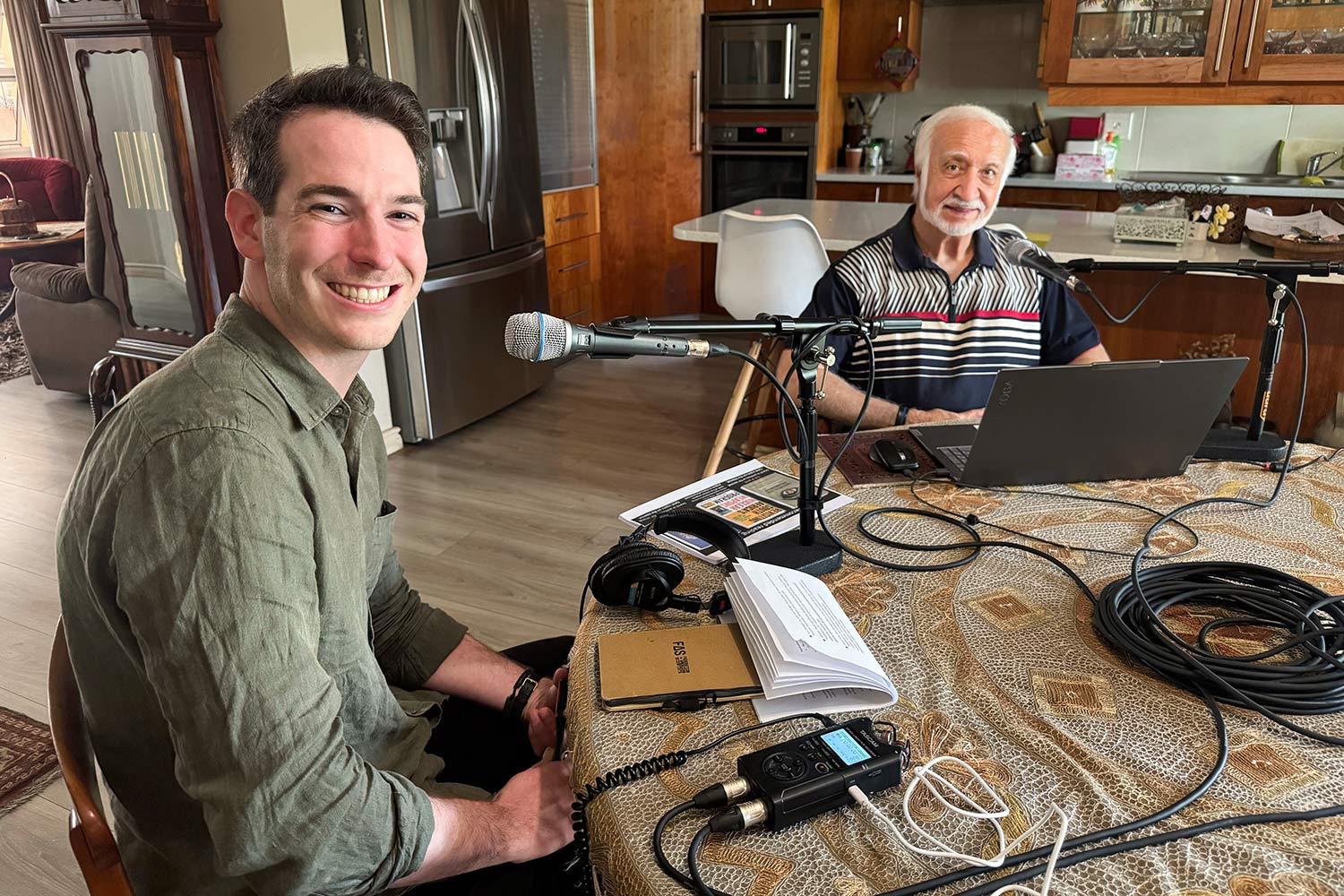
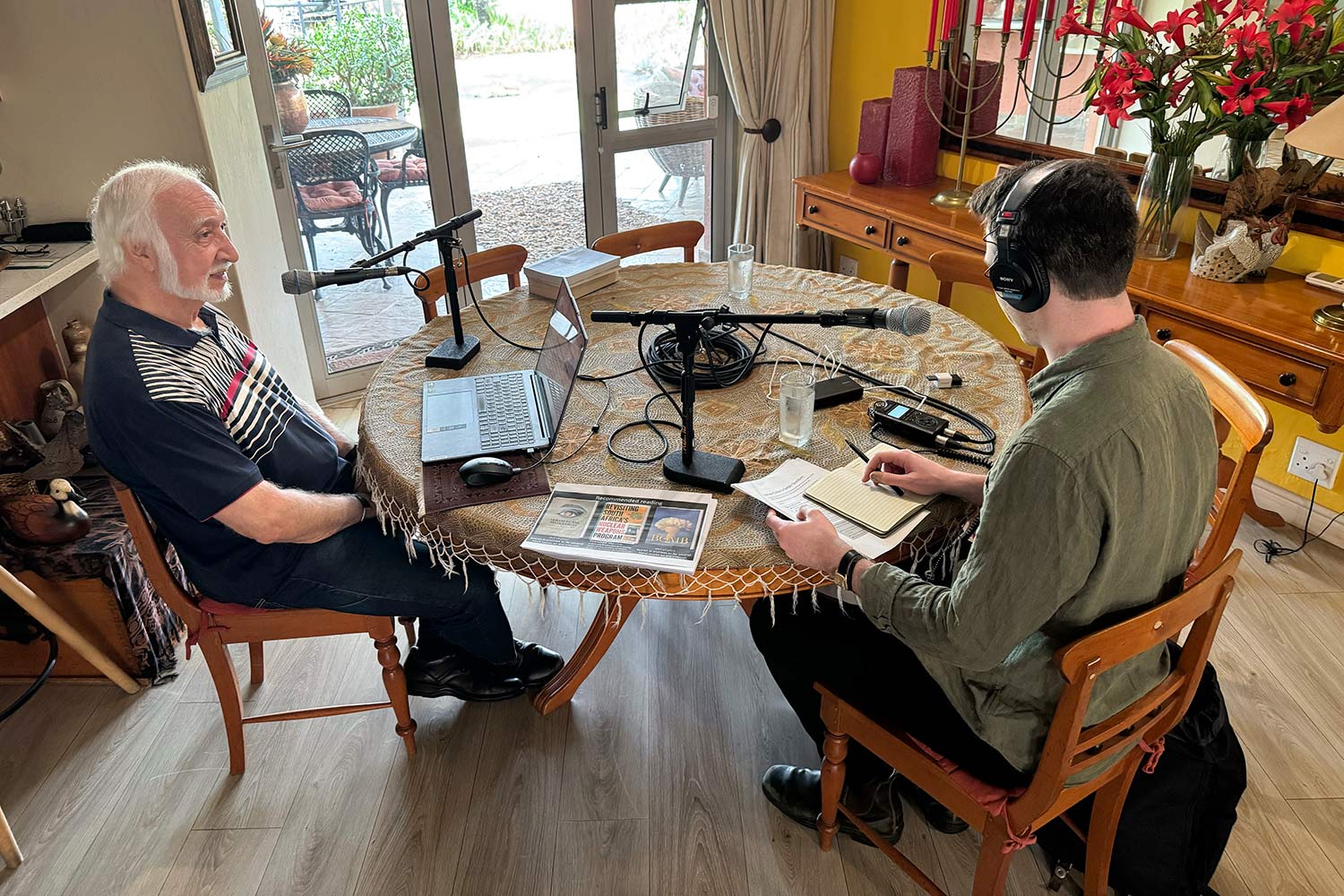
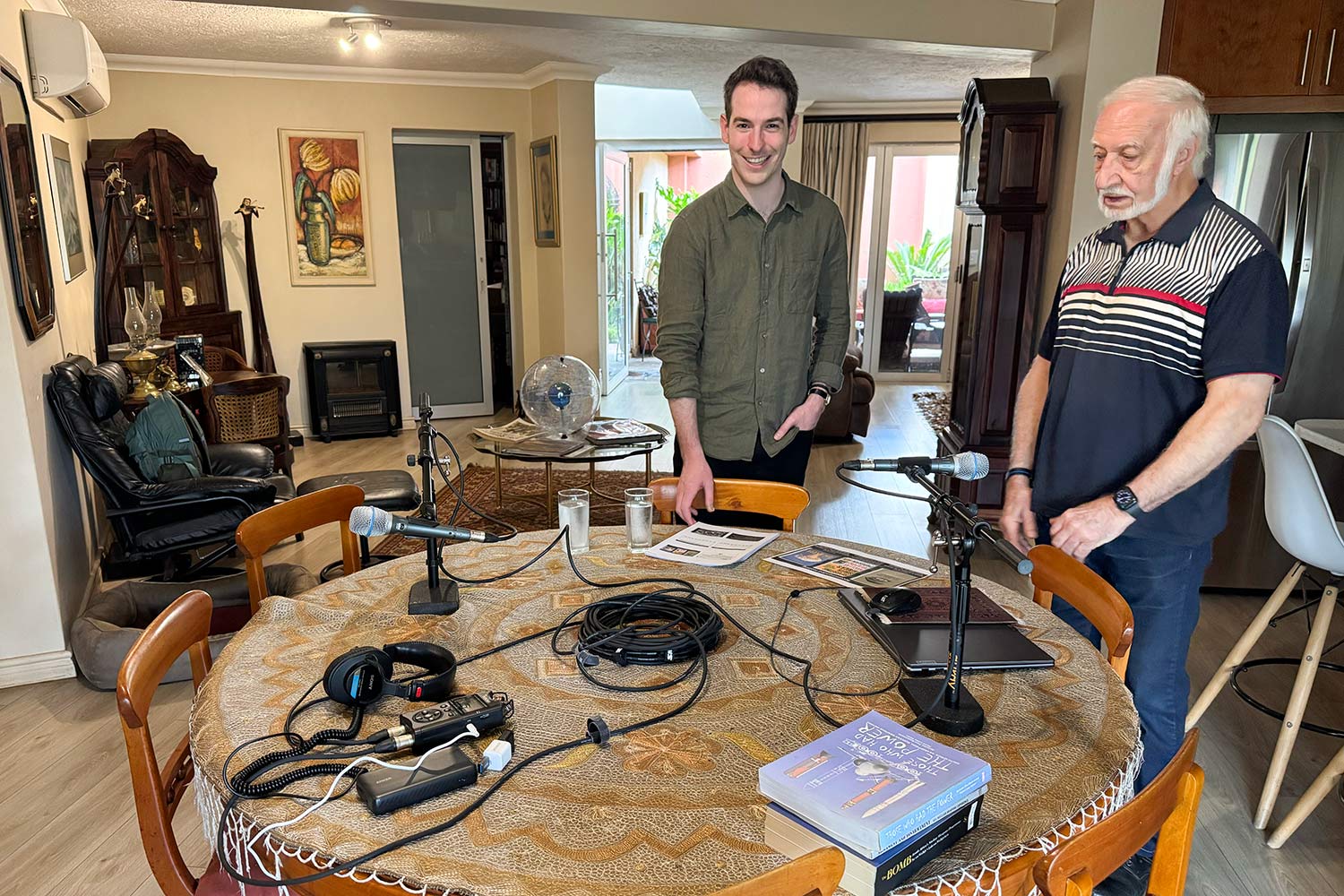
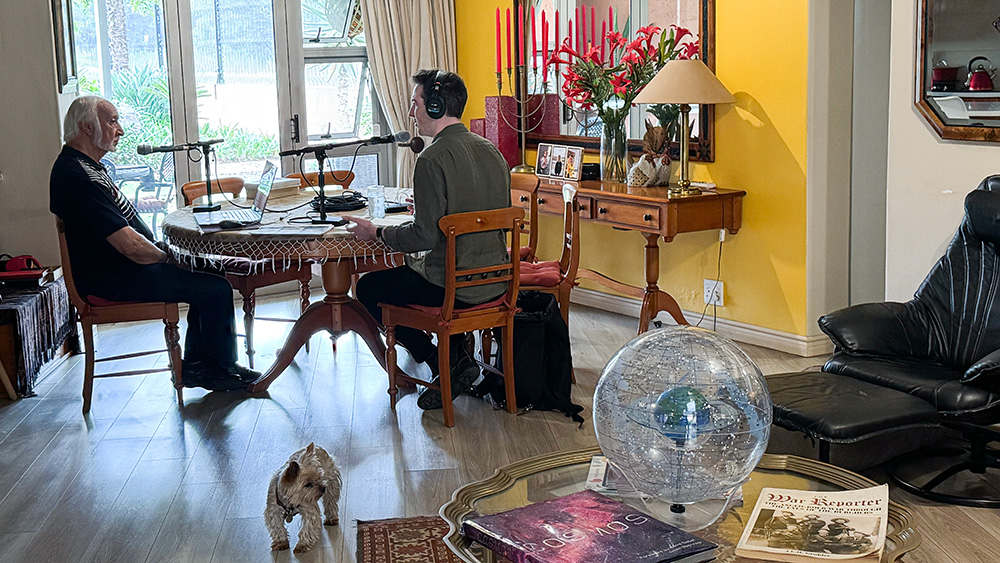
array(1) {
[0]=>
array(458) {
[0]=>
array(4) {
["speaker"]=>
string(10) "Matt Korda"
["timestamp"]=>
string(8) "00:00:02"
["seconds"]=>
int(2)
["text"]=>
string(435) "Okay. This is an interview with André Buys conducted by Matt Korda for the Oral History Project, a project of the Stanley Center for Peace and Security and BASIC. The interview is taking place on Wednesday, March 18, 2026 in Pretoria, South Africa. This is session one of three. André, thank you so much for being willing to take the time and share your story. It's a real honour to be here and a real pleasure to meet you in person."
}
[1]=>
array(4) {
["speaker"]=>
string(11) "André Buys"
["timestamp"]=>
string(8) "00:00:34"
["seconds"]=>
int(34)
["text"]=>
string(10) "Thank you."
}
[2]=>
array(4) {
["speaker"]=>
string(10) "Matt Korda"
["timestamp"]=>
string(8) "00:00:36"
["seconds"]=>
int(36)
["text"]=>
string(171) "I'd love to start just by talking a little bit about your early life, and if you can say a little bit about where you grew up and about what your early childhood was like."
}
[3]=>
array(4) {
["speaker"]=>
string(11) "André Buys"
["timestamp"]=>
string(8) "00:00:50"
["seconds"]=>
int(50)
["text"]=>
string(409) "Yes. I was born in Pretoria and I grew up here in Pretoria and went to school and university. So I'm really a Pretoria child. But at that time in the 1950s, it was very pleasant. It was still in some sense rather rural because the area where my parents stayed was on the outskirts of the city. So there were still lots of open spaces, trees, grass fields, wonderful for a young boy to grow up in such an area."
}
[4]=>
array(4) {
["speaker"]=>
string(10) "Matt Korda"
["timestamp"]=>
string(8) "00:01:41"
["seconds"]=>
int(101)
["text"]=>
string(109) "When did you realize that you had this inclination or passion towards engineering, science, things like that?"
}
[5]=>
array(4) {
["speaker"]=>
string(11) "André Buys"
["timestamp"]=>
string(8) "00:01:52"
["seconds"]=>
int(112)
["text"]=>
string(1592) "I think it started when we had a new neighbor that moved in when I was just about going into high school. In other words, I would say I was at that time 14, – 15 years old. And this was a Mr. Alan Lawrence and he had many hobbies. And he had a son which was my age, so we were friends. And he involved us in his hobbies, model building. He built model aircraft. He built yachts. We went yachting with him. And I think that triggered my interest in technology. And when I was in high school and I was finishing my school career, I was still very uncertain as to what I'd want to study. So I had an interview with a person that came around that would advise us on this. And I had an interview with him and he looked at my marks that I got [in] my different subjects. And I said to him, "I don't know what I must study." And he said, "But do you have any hobbies?" I said, "Yeah, for sure." And so I told him about all this model building and adventures we had. And he looked at me and he said to me, "But why are you unsure what you must study? You must study engineering." I wasn't too sure what that was. I went home and said to my parents, "I don't know if I'm so interested in that because I don't want to repair motorcars for the rest of my life." My father said, "You clearly don't know what engineering is." So he took me to a friend of his who explained to me exactly, when then I realized, "Yes, this is what I want to do." And so that's why I registered then as an engineering student, Pretoria University. And I've been very grateful for that intervention in my career in that way."
}
[6]=>
array(4) {
["speaker"]=>
string(10) "Matt Korda"
["timestamp"]=>
string(8) "00:04:16"
["seconds"]=>
int(256)
["text"]=>
string(225) "Did they ask you in university to pick a particular specialty in terms of engineering? Eventually you went into the nuclear field, but did you always know that that was an interest of yours or did you try out different types?"
}
[7]=>
array(4) {
["speaker"]=>
string(11) "André Buys"
["timestamp"]=>
string(8) "00:04:31"
["seconds"]=>
int(271)
["text"]=>
string(362) "So let me explain that. In my final year as mechanical engineering student, that was 1969, I was a bursar of the South African railways. And as a bursar, we had to do vacation work at their plants. And then I realized that they did operating and maintenance work, but no research and technology development. So I became very disillusioned and unhappy about that."
}
[8]=>
array(4) {
["speaker"]=>
string(11) "André Buys"
["timestamp"]=>
string(8) "00:05:16"
["seconds"]=>
int(316)
["text"]=>
string(706) "But I was a bursar, so I were under contract to work for them when I complete my studies. But I was very unsure about this. And then again, something unusual happened. This Dr. Lawrence that lived next to me sold his house and a young couple moved in, Mr. Johan Slabber and his wife, and they had a young child, a boy, and we became friends. And I said to him, I learned from him that he's also an engineer. And then I said to him, "I've got this, I'm a bursar of the railways, but I don't know if I would like to go and work for them." And he said, "I'm working at the Atomic Energy Corporation and we do a lot of research and technology development, so wouldn't that be something you'd be interested in?""
}
[9]=>
array(4) {
["speaker"]=>
string(11) "André Buys"
["timestamp"]=>
string(8) "00:06:19"
["seconds"]=>
int(379)
["text"]=>
string(379) "I said, "Yeah, it sounds much better." So he took me there and I were impressed. And I said, "Yeah, this is wonderful." He says, "Okay, what we can do is, we can see if we can take over the bursary from the railways, then you become a bursar of the Atomic Energy Corporation." And so I agreed to that and that happened. So I became then a bursar of the Atomic Energy Corporation."
}
[10]=>
array(4) {
["speaker"]=>
string(11) "André Buys"
["timestamp"]=>
string(8) "00:06:46"
["seconds"]=>
int(406)
["text"]=>
string(450) "What was also fascinating at that time, just to illustrate how this set my career; in your final year, you have to do what's known as a final year project, a research or some project that you had to undertake and then submitted as part of the curriculum of the degree. And when you were a bursar, they encouraged you to speak to the organization that you're going to work for and ask them if there's any project there that you can become involved in."
}
[11]=>
array(4) {
["speaker"]=>
string(11) "André Buys"
["timestamp"]=>
string(8) "00:07:21"
["seconds"]=>
int(441)
["text"]=>
string(852) "So clearly I then spoke to Mr. Slabber and he said, "Yeah, we have got a project right now. Come, I'll tell you." So I went with him to Pelindaba and he was working at the SAFARI-1 research reactor and he said to me, "We have to measure the gamma-ray flux in the core of the reactor. We need a piece of equipment with which we can actually measure it in different positions in the core. And maybe you can help us design that and then we can do the measurements." And so that became then my final year project. I designed a probe that absorbed the gamma rays and then we measured the heat transfer because it heats up. And from that you can calculate what the gamma-ray flux was. And I thought, "Wow, that's fantastic." So I submitted that and I’ve got top marks for that and everything. So yes, so that's how my career in nuclear engineering started."
}
[12]=>
array(4) {
["speaker"]=>
string(10) "Matt Korda"
["timestamp"]=>
string(8) "00:08:37"
["seconds"]=>
int(517)
["text"]=>
string(125) "Wow. It sounds like something that really drew you to this field was the ability to be quite creative and do problem solving."
}
[13]=>
array(4) {
["speaker"]=>
string(11) "André Buys"
["timestamp"]=>
string(8) "00:08:48"
["seconds"]=>
int(528)
["text"]=>
string(70) "Yes. Research, technology development, innovation, that fascinated me."
}
[14]=>
array(4) {
["speaker"]=>
string(10) "Matt Korda"
["timestamp"]=>
string(8) "00:08:57"
["seconds"]=>
int(537)
["text"]=>
string(85) "Is that something that kept you in the program the entire time that you worked there?"
}
[15]=>
array(4) {
["speaker"]=>
string(11) "André Buys"
["timestamp"]=>
string(8) "00:09:01"
["seconds"]=>
int(541)
["text"]=>
string(11) "Absolutely."
}
[16]=>
array(4) {
["speaker"]=>
string(10) "Matt Korda"
["timestamp"]=>
string(8) "00:09:01"
["seconds"]=>
int(541)
["text"]=>
string(4) "Wow."
}
[17]=>
array(4) {
["speaker"]=>
string(11) "André Buys"
["timestamp"]=>
string(8) "00:09:02"
["seconds"]=>
int(542)
["text"]=>
string(4) "Yes."
}
[18]=>
array(4) {
["speaker"]=>
string(10) "Matt Korda"
["timestamp"]=>
string(8) "00:09:03"
["seconds"]=>
int(543)
["text"]=>
string(275) "So when you first started working for the Atomic Energy Board, you mentioned this first project was this probe. Was that something that was directly connected with the mission of the AEB, researching peaceful nuclear explosions, that sort of thing, or was it its own project?"
}
[19]=>
array(4) {
["speaker"]=>
string(11) "André Buys"
["timestamp"]=>
string(8) "00:09:30"
["seconds"]=>
int(570)
["text"]=>
string(811) "It had nothing to do with explosives. It was just to measure the gamma-ray flux in the core of the reactor. And that was required for if they want to do experiments in the reactor, they must know what is the intensity of the gamma-ray flux in different positions. So that was all that was about. But your question about how that progressed and changed as I became involved. Now the first thing that happened is I graduated at the end of '69. So then 1970, I must now start. So I went to Pelindaba, low and behold, they said to me, "Fine, you are now an employee, but you're going to study nuclear engineering full time. We're going to send you to Cape Town University to do your master's degree in nuclear engineering." So off I went to Cape Town. So 1970, I studied nuclear engineering at Cape Town University."
}
[20]=>
array(4) {
["speaker"]=>
string(11) "André Buys"
["timestamp"]=>
string(8) "00:10:44"
["seconds"]=>
int(644)
["text"]=>
string(378) "And what is interesting there as well is that as part of the master's degree program, again, we had to do a thesis, a project, and it should be more research orientated. And I thought, "Gee, what can I do?" And then this idea came up, "What about a nuclear rocket propulsion engine?" So I tackled that and I designed one and submitted that. And again, I got good marks for that."
}
[21]=>
array(4) {
["speaker"]=>
string(11) "André Buys"
["timestamp"]=>
string(8) "00:11:33"
["seconds"]=>
int(693)
["text"]=>
string(479) "So it illustrates again, my attitude, my interests, innovation, technology development. So that's what I did in 1970. But then my career really started in 1971. I returned from Cape Town, I graduated now, I have a master's degree in nuclear engineering. Now I'm going to start. Another surprise. When I walk in there, I get called in and they say to me, "You're going to work on a classified program, so you have to sign a security agreement that you’re going to work on this.""
}
[22]=>
array(4) {
["speaker"]=>
string(11) "André Buys"
["timestamp"]=>
string(8) "00:12:24"
["seconds"]=>
int(744)
["text"]=>
string(819) "I was very unsure what this is going to be. But curiosity. I signed it off and there we go. First of all, I was now appointed there in what was known as the Reactor Development Department of the Atomic Energy Board. And they said to me, "Our department had been working now for a number of years on the design and development of a natural uranium power reactor." This was known as the Pelinduna Project. But parallel to that, there was also a group there at Pelindaba working on uranium enrichment. And now eventually both programs were progressing to the point where they were actually in the laboratory working well. “We've sorted out most of the research issues, the technology development. Now we have to start looking at a pilot plant, either for the reactor or for the uranium enrichment. But this is expensive."
}
[23]=>
array(4) {
["speaker"]=>
string(11) "André Buys"
["timestamp"]=>
string(8) "00:13:57"
["seconds"]=>
int(837)
["text"]=>
string(762) "“Now we've got to build this facility. And so with our budget, we can't really afford both. So we had to make a choice. And the choice has gone in favor of the uranium enrichment program. And so now this natural uranium reactor program has been terminated. But now we have this Reactor Development Department without a project. So we've been searching for a research and technology development project for our department. And we've been in contact with the international nuclear technology community worldwide, looking at what is the latest developments. And what we've discovered is that there seems to be a lot of interest in peaceful nuclear explosives. The Americans have got a project they call the Plowshares Project and the Russians are very interested."
}
[24]=>
array(4) {
["speaker"]=>
string(11) "André Buys"
["timestamp"]=>
string(8) "00:15:09"
["seconds"]=>
int(909)
["text"]=>
string(496) "“They're starting to do experiments. And South Africa, as a mining country, might have a lot of potential that we could utilize that if this is going to be successful, but the technology still has to be developed. There's many questions about what we're going to do. How it's going to work, especially the main concern was the radioactive contamination. If that's going to be something that's going to be of value to us in South Africa, there's a lot of research that we're going to have to do."
}
[25]=>
array(4) {
["speaker"]=>
string(11) "André Buys"
["timestamp"]=>
string(8) "00:15:49"
["seconds"]=>
int(949)
["text"]=>
string(893) "“So we have decided, okay, let's look at that.” At that stage, it wasn't totally secret that we were interested in it. There were already people talking to people overseas and we sent people to conferences. And so the world was aware that we had an interest in this topic. But in the meantime, politics was getting a bit of an issue. And so the decision was; if we announce now that we're going to embark on a peaceful nuclear explosives program, then there's going to be a political reaction. People are going to say, "No, South Africa, come on, you're more interested in nuclear weapons." And so we don't want that sort of a debate going on about this now. So we decided, let's rather just look at the technology if it's going to be of any value for us, but let's do it and be quiet about it. So we've decided to classify this as a secret project.” And that's the reason, nothing else."
}
[26]=>
array(4) {
["speaker"]=>
string(11) "André Buys"
["timestamp"]=>
string(8) "00:17:12"
["seconds"]=>
int(1032)
["text"]=>
string(567) "Okay. So I became then involved in that. That was 1971. It was brand new. It was a new project. So in that year, we sat there with the nuclear scientists. We started looking at the science behind nuclear explosives, how they work. We looked at different types of nuclear explosives: gun-type, implosion-type, even what we call the boosted-type. We have some fusion material involved as well, even thermonuclear. That year, it was just theoretical work. We looked at the science, started doing calculations, started developing computer programs to do the calculations."
}
[27]=>
array(4) {
["speaker"]=>
string(11) "André Buys"
["timestamp"]=>
string(8) "00:18:06"
["seconds"]=>
int(1086)
["text"]=>
string(424) "But in the course of this work, it became clear to us that, yes, there is now this uranium enrichment project. And it was announced. It was not a secret project. It was well established, in fact, a state corporation called the Uranium Enrichment Corporation. So everybody knew about that. Eventually we should have enriched uranium. And the simplest type of nuclear explosive with enriched uranium is the so-called gun-type."
}
[28]=>
array(4) {
["speaker"]=>
string(11) "André Buys"
["timestamp"]=>
string(8) "00:18:41"
["seconds"]=>
int(1121)
["text"]=>
string(842) "“So maybe we should put a little bit more priority on that. It's the simplest way to go for now.” And so with that in mind, we then had a look at what was required in terms of this research and development project. And it soon became clear to us in that year that we'll have to build facilities for working with guns. We'll have to fire [them] off. But there was no technology in internal ballistics of a gun and propellants – all of that technology was totally foreign to the Atomic Energy Board. But we were aware that this is the sort of technology that's used in the defence industry. It's used in other industries as well, but not in the nuclear industry. So now the question was; should we get people that’s familiar with this onto our team? Or alternatively, should we do that work at a facility that's already working on that?"
}
[29]=>
array(4) {
["speaker"]=>
string(11) "André Buys"
["timestamp"]=>
string(8) "00:20:13"
["seconds"]=>
int(1213)
["text"]=>
string(320) "And so we started looking at the possibilities. We were a little concerned about moving to the defence industry because we were known as people from the Atomic Energy Board and that could raise suspicion. Why are people from the Atomic Energy Board working at a defence industry set-up? So that worried us, the security."
}
[30]=>
array(4) {
["speaker"]=>
string(10) "Matt Korda"
["timestamp"]=>
string(8) "00:20:43"
["seconds"]=>
int(1243)
["text"]=>
string(45) "Was there tension between the two industries?"
}
[31]=>
array(4) {
["speaker"]=>
string(11) "André Buys"
["timestamp"]=>
string(8) "00:20:46"
["seconds"]=>
int(1246)
["text"]=>
string(546) "We spoke to some of the senior people to just find out or get more information. But what eventually we decided on, is that there is a more, almost neutral alternative that we could utilize. Here in Pretoria, we had the head office of an organization called the Council for Scientific and Industrial Research. It was a state-owned institution, and they did research and technology development for industry, this is their main task. But one of the industries that they assisted with research work was the defence industry. So they did that as well."
}
[32]=>
array(4) {
["speaker"]=>
string(11) "André Buys"
["timestamp"]=>
string(8) "00:21:41"
["seconds"]=>
int(1301)
["text"]=>
string(515) "And in fact, they had an institute at this... This place was called the CSIR, Council for Scientific and Industrial [Research]. So at the CSIR, they had what was known as the National Institute for Defence Research, where they got research projects from the defence industry to look at matters that they could investigate. And this institute at the CSIR had what was known as a propulsion laboratory where they did ballistics -, internal ballistics, and terminal ballistics. R – research for the defence industry."
}
[33]=>
array(4) {
["speaker"]=>
string(11) "André Buys"
["timestamp"]=>
string(8) "00:22:28"
["seconds"]=>
int(1348)
["text"]=>
string(352) "If there was a project where they wanted to develop a new gun or cannon or something like that, and the defence industry struggled with something, there, I'm sure then they could task the CSIR with this to do research on that. So they had this facility. And this propulsion laboratory was in the Cape at a place called Somerset West, near to Cape Town."
}
[34]=>
array(4) {
["speaker"]=>
string(11) "André Buys"
["timestamp"]=>
string(8) "00:22:54"
["seconds"]=>
int(1374)
["text"]=>
string(887) "And we thought this is perhaps a better option than going directly to the defence industry itself. This is a research institution which fits our need perfectly, and they have this propulsion laboratory there, which are doing research both on rocket propulsion and ballistics, of guns. So then we decided, okay, let a small group of us, we were only three, myself and two of my colleagues, let the three of us go and do this work at this propulsion laboratory in the Cape. And so that was then agreed upon. Now, we were actually still employees of the Atomic Energy Board, but for the security of the whole thing, we went through the whole process of applying for a job at the CSIR. We went through all the processes. So on paper, we were now employed by the CSIR. But in reality, we were still employees of the Atomic Energy Board. It was a scheme set up between the two [organizations]."
}
[35]=>
array(4) {
["speaker"]=>
string(10) "Matt Korda"
["timestamp"]=>
string(8) "00:24:23"
["seconds"]=>
int(1463)
["text"]=>
string(52) "Did the CSIR, did they know about your affiliations?"
}
[36]=>
array(4) {
["speaker"]=>
string(11) "André Buys"
["timestamp"]=>
string(8) "00:24:29"
["seconds"]=>
int(1469)
["text"]=>
string(916) "Just a few people there. Yeah. Just a few people. They were informed who we were really and what we're interested in. And so in 1972, off we went to Somerset West. And I worked there for four years until '76. And what we did there was the research and development of the gun type nuclear explosive, but particularly the mechanical parts, the gun, the propellant, and also the terminal ballistics. Remember you fire off the one half of the core, but you've got to catch it and stop it so that you have the supercritical mass. So there's also that so-called “terminal ballistics.” And two of us worked on that, myself and one of my colleagues. My third colleague that also went down there, he looked at the research or the technology of implosion-type nuclear explosives. So he started working on that, which is where there were high explosives involved and that. So that's the three of us, just three individuals."
}
[37]=>
array(4) {
["speaker"]=>
string(10) "Matt Korda"
["timestamp"]=>
string(8) "00:25:51"
["seconds"]=>
int(1551)
["text"]=>
string(99) "Did it ever raise any alarm bells at CSIR with any of the other colleagues that were working there?"
}
[38]=>
array(4) {
["speaker"]=>
string(11) "André Buys"
["timestamp"]=>
string(8) "00:25:59"
["seconds"]=>
int(1559)
["text"]=>
string(449) "There were people now at this propulsion laboratory that were informed. So they knew who we were and what we were interested in. They assisted, but a small team. And they assisted us. But we had to build a facility to do the tests. So we built this ballistics test facility. That was constructed there. We had to get gun barrels that we could do the experiments with, so that was secondhand or old ones were obtained from the Navy there in the Cape."
}
[39]=>
array(4) {
["speaker"]=>
string(11) "André Buys"
["timestamp"]=>
string(8) "00:26:42"
["seconds"]=>
int(1602)
["text"]=>
string(480) "We modified them, of course, and built this thing. And we did these experiments there. So that was what we did. We built the facility, then we did the experiments. And it was successful. We could show it, test it, measure, and then we looked also at the terminal ballistics. So the first step was to build a model-scale gun-type explosive with just, of course, natural uranium, not enriched uranium. But the first one was just a model just to see if everything worked as designed."
}
[40]=>
array(4) {
["speaker"]=>
string(11) "André Buys"
["timestamp"]=>
string(8) "00:27:24"
["seconds"]=>
int(1644)
["text"]=>
string(267) "It was perfect. Then we built a full-scale one, tested that. Perfect. And so we could build a gun-type nuclear explosive. The only thing that was still required was the enriched uranium. So we finished off that project there in '76, and then we returned to Pelindaba."
}
[41]=>
array(4) {
["speaker"]=>
string(11) "André Buys"
["timestamp"]=>
string(8) "00:27:47"
["seconds"]=>
int(1667)
["text"]=>
string(843) "Okay. So after that work, I then returned to Pelindaba in '76, I was then appointed as head of the engineering subdivision of this Reactor Development Division. So I became now in a more senior position there. Prior to that, I was just a research engineer. Okay. And now at that point, there were lots of nuclear physics experiments taking place at Pelindaba. For example, criticality, et cetera. So they had a critical [assembly]. We even had what is known as a pulse reactor to do nuclear physics measurements on the design. But when we started this project back in '71, it was from the start clear that there was some information on both the nuclear physics, but also on the properties of materials at extreme temperatures and pressures that were classified. We couldn't get it in the open literature. So we started off by researching that."
}
[42]=>
array(4) {
["speaker"]=>
string(11) "André Buys"
["timestamp"]=>
string(8) "00:29:28"
["seconds"]=>
int(1768)
["text"]=>
string(919) "We had the nuclear physicists working on that side. We had ourselves as mechanical engineers and physicists working on the mechanical properties. But these were all theoretical calculations and there were uncertainties. You could get a figure, plus or minus, but quite a wide spectrum. The result is if you then design the nuclear explosive and you take these values and you say, okay, this is the average value we think for this property. But if we go to the extremes, to the highest or the lowest value, then oh my goodness, you get a completely different result. So that's quite useless if you want to use a peaceful nuclear explosive, say in a mining application where you want an explosion of a very particular specific value. You want maybe a five kiloton explosion. But you can't go and say, "Well, okay, it's designed for five kilotons, but it could be anything between one and 10 or something." That's useless."
}
[43]=>
array(4) {
["speaker"]=>
string(11) "André Buys"
["timestamp"]=>
string(8) "00:30:52"
["seconds"]=>
int(1852)
["text"]=>
string(592) "So, right from the start, particularly when we started off, the view was, okay, we'll do all this theoretical work. We'll take as many measurements and things as we can, but eventually, as the saying goes, the proof of the pudding is in the eating. We're going to have to test the final design. And we'll have to do an underground nuclear explosion to check that all our calculations and values are correct. So right from the start there was this plan, we're going to have to do a scientific measurement explosion to check all these uncertainties we have. So that was the plan from the start."
}
[44]=>
array(4) {
["speaker"]=>
string(10) "Matt Korda"
["timestamp"]=>
string(8) "00:31:44"
["seconds"]=>
int(1904)
["text"]=>
string(132) "At this point in 1976, was there any thinking or perhaps even a suspicion that the program was more than a peaceful nuclear program?"
}
[45]=>
array(4) {
["speaker"]=>
string(11) "André Buys"
["timestamp"]=>
string(8) "00:31:57"
["seconds"]=>
int(1917)
["text"]=>
string(46) "I'll get to that now. Let me just finish this."
}
[46]=>
array(4) {
["speaker"]=>
string(10) "Matt Korda"
["timestamp"]=>
string(8) "00:31:57"
["seconds"]=>
int(1917)
["text"]=>
string(9) "Oh, sure."
}
[47]=>
array(4) {
["speaker"]=>
string(11) "André Buys"
["timestamp"]=>
string(8) "00:31:58"
["seconds"]=>
int(1918)
["text"]=>
string(478) "Okay. We'll come to that now. The short answer to that is “no”, but I'll expand a bit on it just now. Okay. So that was the plan. We're going to have to do an underground test to check on our calculations. But as time progressed in that period, from '72 to '76/'77, with these other laboratory experiments, the criticality facility, the pulse reactor, and other measurements that was taken in the SAFARI reactor and so, many of those uncertainties were now being cleared up."
}
[48]=>
array(4) {
["speaker"]=>
string(11) "André Buys"
["timestamp"]=>
string(8) "00:32:43"
["seconds"]=>
int(1963)
["text"]=>
string(380) "We were confirming it experimentally: “that is the value.” And so by 1976/'77, I became doubtful whether we should continue with this planned underground explosion. I felt it's not really necessary because the original reason for it was this uncertainty. But we've cleared up the uncertainty in the laboratory experiments and measurements. So why go ahead with the experiment?"
}
[49]=>
array(4) {
["speaker"]=>
string(11) "André Buys"
["timestamp"]=>
string(8) "00:33:20"
["seconds"]=>
int(2000)
["text"]=>
string(401) "The dilemma was that there was a whole team that's been working now for a number of years on preparing for this test. The test site was developed. The placement holes were drilled. All the instrumentation was set up. The whole design of all these measuring sensors that must go into the explosive and in the environment, everything has now been developed and built, and they've spent years doing this."
}
[50]=>
array(4) {
["speaker"]=>
string(11) "André Buys"
["timestamp"]=>
string(8) "00:33:58"
["seconds"]=>
int(2038)
["text"]=>
string(636) "To now stop them was not that easy. But I had doubts about this. I was getting a little worried because as this progressed, the political climate was changing all the time. And I started anticipating that if we now go and do an underground test, there’s going to be serious implications. I was a little worried. They were working on it full time. Fortunately, what happened was at the pilot plant for uranium enrichment, there was a technical problem which resulted in a delay. So although initially the plan was that the first batch of highly enriched uranium should be ready by 1977, it now is conveyed to us that there's a hold-up."
}
[51]=>
array(4) {
["speaker"]=>
string(11) "André Buys"
["timestamp"]=>
string(8) "00:35:02"
["seconds"]=>
int(2102)
["text"]=>
string(549) "We're probably going to be a year or two late. “So unfortunately, you're not going to be able to test in '77.” But all the preparation of the test site had been done. And so what now? So what they then decided is, okay, let's do a cold run. Let's go to the test site, set up everything, and see if everything is in place, if it's going to work. So it was just a test exercise to see if all the preparation is in place. So they decided, let's do that then. We can't do the actual test, but let's do a dummy test. and go through the whole process."
}
[52]=>
array(4) {
["speaker"]=>
string(10) "Matt Korda"
["timestamp"]=>
string(8) "00:36:02"
["seconds"]=>
int(2162)
["text"]=>
string(52) "Did you agree with the idea of doing the dummy test?"
}
[53]=>
array(4) {
["speaker"]=>
string(11) "André Buys"
["timestamp"]=>
string(8) "00:36:07"
["seconds"]=>
int(2167)
["text"]=>
string(272) "Yes. I thought, okay, there shouldn't be a problem with that. My worry was just about the actual one, but that was now two years off. So it wasn't that acute at that moment in time. So this whole team went off to the test site and they started preparing for this cold run."
}
[54]=>
array(4) {
["speaker"]=>
string(11) "André Buys"
["timestamp"]=>
string(8) "00:36:28"
["seconds"]=>
int(2188)
["text"]=>
string(425) "And you know what happened. First, the Soviets discovered it. Then they communicated with the United States. Then Americans sent a satellite to take photographs. There's a whole story about all the things that happened, but then there was this political upheaval now. And that changed the whole thing because now the government became aware of the political consequences of this scientific experiment that was supposed to be."
}
[55]=>
array(4) {
["speaker"]=>
string(11) "André Buys"
["timestamp"]=>
string(8) "00:37:07"
["seconds"]=>
int(2227)
["text"]=>
string(359) "They were not, prior to that, too concerned about that. But now, they woke up and they realized, oh my goodness, this is something which… [has political consequences]. And so the first decision that was made, okay, let's stop. And they gave immediate instructions: “clean up the test site, get everything off there, and in fact, terminate this program.”"
}
[56]=>
array(4) {
["speaker"]=>
string(11) "André Buys"
["timestamp"]=>
string(8) "00:37:40"
["seconds"]=>
int(2260)
["text"]=>
string(207) "So there we sat, I remember very clearly how I was very unsure what's going to happen now. Is it the end of it? I wonder what am I going to do next. What other project are we going to become involved in now?"
}
[57]=>
array(4) {
["speaker"]=>
string(10) "Matt Korda"
["timestamp"]=>
string(8) "00:37:57"
["seconds"]=>
int(2277)
["text"]=>
string(89) "Did people think that they would be let go from the program entirely or just didn't know?"
}
[58]=>
array(4) {
["speaker"]=>
string(11) "André Buys"
["timestamp"]=>
string(8) "00:38:01"
["seconds"]=>
int(2281)
["text"]=>
string(359) "No. We sat there, just unsure. Everything has been stopped. It was just this “stop.” And there we sat. And then after a week or three, I can't remember exactly how long thereafter, the message came back. And the message was the following, the government said: "We think it might be useful to retain this capability because we could use it as a deterrent.""
}
[59]=>
array(4) {
["speaker"]=>
string(11) "André Buys"
["timestamp"]=>
string(8) "00:38:49"
["seconds"]=>
int(2329)
["text"]=>
string(318) "So the message was; the nuclear explosives capability should be retained as a deterrent. Now, that started off quite a debate amongst ourselves because first of all, we said, "Okay, we've got the capability. So what now? What are we going to do? It's there. So here we are. What are we expected to do now? Nothing?”."
}
[60]=>
array(4) {
["speaker"]=>
string(10) "Matt Korda"
["timestamp"]=>
string(8) "00:39:32"
["seconds"]=>
int(2372)
["text"]=>
string(91) "Who received that message? Was it just the senior leadership or did everyone know about it?"
}
[61]=>
array(4) {
["speaker"]=>
string(11) "André Buys"
["timestamp"]=>
string(8) "00:39:37"
["seconds"]=>
int(2377)
["text"]=>
string(834) "It was conveyed to us from the seniors, our seniors conveyed it to us. Okay, so what now? I think our uncertainty was communicated back to the government and it said: "But okay, what is meant by this; “retain the capability”?" And then so again, after a week or two, the answer came back. "What we think you should do is establish a nuclear weapons capability as a deterrent." So that was now a totally new thing. What now? Nuclear weapon? Now there was a number of dilemmas with that. The first one was, for the Atomic Energy Board to do a nuclear weapons program would have been illegal. Why? Because in the Atomic Energy Act, which established this organization, it was clearly stated in the Act that this Atomic Energy Board is to do research and development on peaceful application of nuclear technology, it's clearly stated."
}
[62]=>
array(4) {
["speaker"]=>
string(11) "André Buys"
["timestamp"]=>
string(8) "00:41:22"
["seconds"]=>
int(2482)
["text"]=>
string(400) "So that was the first dilemma, it cannot be done at the Atomic Energy Board. So now we started debating nuclear weapons. The only people that can legally design and develop and manufacture military weapons is the defence industry. So should we go to the defence industry with this? What should we do? And so there was a period of uncertainty. Then we started saying, "But we need to speak to people.""
}
[63]=>
array(4) {
["speaker"]=>
string(11) "André Buys"
["timestamp"]=>
string(8) "00:42:02"
["seconds"]=>
int(2522)
["text"]=>
string(269) "So a few individuals in the defence industry was now informed and we started very secret discussions with them. We started discussing this matter. "Okay, so we're going to do a nuclear weapons program and we'll have to decide where and how." So that was the next stage."
}
[64]=>
array(4) {
["speaker"]=>
string(11) "André Buys"
["timestamp"]=>
string(8) "00:42:38"
["seconds"]=>
int(2558)
["text"]=>
string(318) "In that discussions, the first question that I asked as an engineer… It’s the first time I had direct contact now with people in the defence industry. Yes, I were familiar because as I've said, I worked at that propulsion laboratory, which was looking at military equipment, but they were just doing pure research."
}
[65]=>
array(4) {
["speaker"]=>
string(11) "André Buys"
["timestamp"]=>
string(8) "00:43:06"
["seconds"]=>
int(2586)
["text"]=>
string(528) "Now, obviously, it was not just research and technology development, but actual product development, and probably manufacturing. So this was a whole new industry, but we had a very competent defence industry. And so these people were now informed and we sat down with them and we said to them, "Okay, how do we go about designing and developing a weapon system? What's the procedure? What's the process? You're familiar with it. You do it every day. You've been doing it for years. Please tell us. We're not familiar with that.""
}
[66]=>
array(4) {
["speaker"]=>
string(11) "André Buys"
["timestamp"]=>
string(8) "00:43:49"
["seconds"]=>
int(2629)
["text"]=>
string(372) "And how interesting what happened: the first answer we got is they said, "You have to start off with a so-called weapon system specification." I said, "Okay, but how do we design that? We have no knowledge. How do you design a weapon system specification?" And they said, "No, we get that from the user requirement specification." We said, "Okay, so how's that generated?""
}
[67]=>
array(4) {
["speaker"]=>
string(11) "André Buys"
["timestamp"]=>
string(8) "00:44:28"
["seconds"]=>
int(2668)
["text"]=>
string(913) "“So now we go to the user that has the requirement, we sit down with this user, be it Air Force, Army, or whoever, and we ask them, "What is your need? What do you need? What do you want?" And we have a look at the technology and what can be done. And then we come to some consensus between us and we draft a user requirement specification and then from that you can set up your weapon system specification.” And we said, "But you know, who's the user of the nuclear weapons?" They said, "Where does the requirement come from? Who asked you for this?" We said, "The government." So we said, "But do we have to now go to the prime minister and say, let's draft a user requirement specification? It's technical, he wouldn't know." "So your users, Air Force, whoever, how do they get their requirements? Where do their requirements come from?" “Oh,” they said, "oh, that comes from the defence force design.""
}
[68]=>
array(4) {
["speaker"]=>
string(11) "André Buys"
["timestamp"]=>
string(8) "00:45:46"
["seconds"]=>
int(2746)
["text"]=>
string(402) "“They have a defence force design that they set up and then the Air Force will, from that, see what weapons they need, aircraft, whatever, from the force design.” We said, "Okay, but there's no force design for nuclear weapons. It's just this request from the government. So where does that defence force design come from?” And they said, "Oh, that is derived from the national defence strategy.""
}
[69]=>
array(4) {
["speaker"]=>
string(11) "André Buys"
["timestamp"]=>
string(8) "00:46:28"
["seconds"]=>
int(2788)
["text"]=>
string(408) "We said, "But there's nothing in the national defence strategy about nuclear weapons." And then they said, "Well, then that's where you'll have to start. If you have to design a nuclear weapon, start with a national nuclear weapons strategy. And then from that, you can go down, derive a force design, requirement specification, and then the system specification, but you'll have to start with the strategy.""
}
[70]=>
array(4) {
["speaker"]=>
string(11) "André Buys"
["timestamp"]=>
string(8) "00:47:01"
["seconds"]=>
int(2821)
["text"]=>
string(19) "So you want to ask?"
}
[71]=>
array(4) {
["speaker"]=>
string(10) "Matt Korda"
["timestamp"]=>
string(8) "00:47:27"
["seconds"]=>
int(2847)
["text"]=>
string(203) "Yes. I'd love to ask, were there any reservations amongst any of your colleagues about how the program transitioned from a PNE program to suddenly a nuclear weapons program? Did people react differently?"
}
[72]=>
array(4) {
["speaker"]=>
string(11) "André Buys"
["timestamp"]=>
string(8) "00:47:42"
["seconds"]=>
int(2862)
["text"]=>
string(392) "In general, people were comfortable, my colleagues. As I say, we were in this situation that we suddenly had no job. So now this is the new requirement. And of course, as technical people, and all my seniors were technical people, they were engineers, scientists. We were not, up to that point, really required to work on political or strategic issues like that. We had a technical job to do."
}
[73]=>
array(4) {
["speaker"]=>
string(11) "André Buys"
["timestamp"]=>
string(8) "00:48:18"
["seconds"]=>
int(2898)
["text"]=>
string(404) "So this was only the first time that this now came up. We can't do the job unless the government has a strategy because from that, we can then derive what to develop. Okay, so how do you start that? And that brought us into contact with now a new organization, and that was in the defence force. They have what's known as the “chief of staff planning,” which is a division there in the defence force."
}
[74]=>
array(4) {
["speaker"]=>
string(11) "André Buys"
["timestamp"]=>
string(8) "00:48:59"
["seconds"]=>
int(2939)
["text"]=>
string(375) "And the chief of staff planning’s work is exactly this: defence strategy, force design, that type of work. They do that. So we contacted them and one or two of the senior people there were informed what this is all about, and we could now start talking to them. So the first discussion was now, we need a national nuclear weapons strategy. How do we go about drafting that?"
}
[75]=>
array(4) {
["speaker"]=>
string(11) "André Buys"
["timestamp"]=>
string(8) "00:49:38"
["seconds"]=>
int(2978)
["text"]=>
string(344) "And then an interesting thing happened. The person that we spoke to, he was one of the senior officers there, a brigadier, and he said to us, "Oh, that's a simple thing. I'll write it." We said, "Yeah?" "Yeah." And at the next meeting that we had with him, he walks in there and he puts a paper on the table and he says: "There's the strategy.""
}
[76]=>
array(4) {
["speaker"]=>
string(11) "André Buys"
["timestamp"]=>
string(8) "00:50:09"
["seconds"]=>
int(3009)
["text"]=>
string(490) "We said, "Where did you get that?" He said, "I wrote it and there, you can see it's approved by the prime minister." We then discovered that this character had a very private relationship with the prime minister and what he actually did is he wrote out the so-called strategy, got in his car, went to the prime minister's house, discussed it with him, showed it to him, prime minister signed it off, and there it was, virtually in a day's time, there's the national nuclear weapon strategy."
}
[77]=>
array(4) {
["speaker"]=>
string(11) "André Buys"
["timestamp"]=>
string(8) "00:50:47"
["seconds"]=>
int(3047)
["text"]=>
string(387) "Okay. What did it say? Well, basically, what it said, it said that there are a number of options that the government can look at. The first one is just to keep the secret, just to develop it, but don't say anything about it. Don't admit it, neither deny it, just be quiet about it. It's the strategy that Israel has been following all the time. That was the first option in his strategy."
}
[78]=>
array(4) {
["speaker"]=>
string(11) "André Buys"
["timestamp"]=>
string(8) "00:51:26"
["seconds"]=>
int(3086)
["text"]=>
string(277) "The second option was called covert announcement or covert disclosure to so-called Western countries like the United States or the United Kingdom in an effort to get their support if our security situation becomes too acute... That was the second one, this covert announcement."
}
[79]=>
array(4) {
["speaker"]=>
string(11) "André Buys"
["timestamp"]=>
string(8) "00:52:04"
["seconds"]=>
int(3124)
["text"]=>
string(362) "The third option in his strategy was then what was called the overt announcement, which says, "Let's do an underground test explosion, a nuclear explosion. We can even, if required, do an above ground one, we announce it, we display it, we take the nuclear weapons on parades and we tell the world “we're a nuclear power”. Overt disclosure. The third option."
}
[80]=>
array(4) {
["speaker"]=>
string(11) "André Buys"
["timestamp"]=>
string(8) "00:52:38"
["seconds"]=>
int(3158)
["text"]=>
string(457) "His recommendation was the third option. And the prime minister, which at that time was PW Botha, the prime minister signed it, but in his own handwriting, below his signature, he wrote, "We must just wait until we are ready." So now we got this from this brigadier. And of course, our first question is, what does that mean? “Wait until we are ready.” And there was the first disagreement we had with him. We said to him… [“What does that mean?”]"
}
[81]=>
array(4) {
["speaker"]=>
string(11) "André Buys"
["timestamp"]=>
string(8) "00:53:22"
["seconds"]=>
int(3202)
["text"]=>
string(583) "He said, "Well, develop the weapon." We said, "Are you sure the prime minister is not saying [to wait] until circumstances are ready?" "Well, don't worry about that. Just carry on, make a bomb." We said, "But this strategy is not going to assist us in going through this process of the force design, requirement specification, weapon system specification. That's what we want. What type of bomb must be built? Must it be a ballistic bomb that you drop with the aircraft? Must it be a missile warhead? What is the requirement? But what you've given us here doesn't help us with that.""
}
[82]=>
array(4) {
["speaker"]=>
string(11) "André Buys"
["timestamp"]=>
string(8) "00:54:20"
["seconds"]=>
int(3260)
["text"]=>
string(521) "He lost his temper and he said to us, "Look, make a simple bomb." We said, "For what?" He said, " To drop with an aircraft." We said, "Which aircraft?" He said, "Doesn't matter. I'll kick it out of the back of a transport aircraft." Okay, so we were in a dilemma, but that's what happened. So because what we could, from that document, derive from is, yes, we must develop a nuclear weapon, but there was also stated in there, that this overt announcement or disclosure, could be done by means of a underground explosion."
}
[83]=>
array(4) {
["speaker"]=>
string(11) "André Buys"
["timestamp"]=>
string(8) "00:55:23"
["seconds"]=>
int(3323)
["text"]=>
string(437) "And we were virtually ready for that, except that what we had developed up till that stage was a scientific experiment. It was designed to be filled with sensors and there was no requirement that it must be compact and small, anything like that. So the whole device with all the equipment and the measuring sensors, everything, was huge. It was almost a meter in diameter and about four meters long. So it was a large piece of equipment."
}
[84]=>
array(4) {
["speaker"]=>
string(11) "André Buys"
["timestamp"]=>
string(8) "00:56:14"
["seconds"]=>
int(3374)
["text"]=>
string(311) "But now, if the strategy is that in that sort of a situation, you want to use it as a deterrent and, as the so-called strategy now says, do a demonstration underground explosion, then we might have to look at a different design there. First of all, we were now very sure that the test site were being monitored."
}
[85]=>
array(4) {
["speaker"]=>
string(11) "André Buys"
["timestamp"]=>
string(8) "00:56:50"
["seconds"]=>
int(3410)
["text"]=>
string(365) "We cleaned it up, but we're sure that the Russians and the Americans were keeping their eye on what's [happening there], if there's any suspicious activity at the test site. However, the placement holes were still there, yes, they were just closed off at the top, but it was very easy to open it up. So they were still there, but everything else was now taken away."
}
[86]=>
array(4) {
["speaker"]=>
string(11) "André Buys"
["timestamp"]=>
string(8) "00:57:23"
["seconds"]=>
int(3443)
["text"]=>
string(371) "So what we said then, okay, for a demonstration test as required now by this strategy, what we can do is we can build what we called a rapid deployment underground test explosive – very small and compact with no instruments, nothing in, just the explosive, and all we need is when we get the instruction, do a test. We can transport it to the test site maybe overnight."
}
[87]=>
array(4) {
["speaker"]=>
string(11) "André Buys"
["timestamp"]=>
string(8) "00:58:14"
["seconds"]=>
int(3494)
["text"]=>
string(754) "Next morning, we open up one of the holes, we lower it down and within an hour or two, we can detonate it. It will be a dirty explosion because you'll have radioactive discharge from the open hole, but we could virtually do within hours notice an explosion. We're almost ready for that. It's simple. And so when we discussed that, the approval came, yes, that's the first thing. Build one like that. And so in that period, from about '78 to '81 to two, three years, the only technical development that we did was we designed and built that small – what we called rapid deployment – explosive. So we did that. We did design work on a so-called gun type nuclear warhead, but we were still very unsure for what weapon system this should be designed for."
}
[88]=>
array(4) {
["speaker"]=>
string(11) "André Buys"
["timestamp"]=>
string(8) "00:59:54"
["seconds"]=>
int(3594)
["text"]=>
string(487) "But the main priority now was [that] this project had to shift from the Atomic Energy Board to somewhere else. This rapid deployment one was still legal. It's not a weapon. So we did that work at Pelindaba, but we couldn't do any real work on the weapons at Pelindaba. So we had to look at a new facility and that's where we then did the planning, the design and the erection of the Kentron Circle nuclear weapons plant, which is close to Pelindaba, it's on the western side of Pretoria."
}
[89]=>
array(4) {
["speaker"]=>
string(11) "André Buys"
["timestamp"]=>
string(8) "01:00:35"
["seconds"]=>
int(3635)
["text"]=>
string(348) "So that just was really the main work that I was occupied in at that stage, apart from this rapid deployment one. I worked on that – it was really my design. I had a whole team, but I was head of the department subgroup that did it. So that was our job at that stage. So then we moved when this facility was now completed in 1981, we moved there."
}
[90]=>
array(4) {
["speaker"]=>
string(11) "André Buys"
["timestamp"]=>
string(8) "01:01:07"
["seconds"]=>
int(3667)
["text"]=>
string(378) "So now then we properly resigned from the Atomic Energy Board. We're no longer now at all employees of the Atomic Energy Board. I became an employee of the Armaments Corporation (Armscor) of South Africa, was now working for Armscor, and in this case, the affiliated company was called Kentron, and this plant was called the Kentron Circle plant, and I became head of the plant."
}
[91]=>
array(4) {
["speaker"]=>
string(10) "Matt Korda"
["timestamp"]=>
string(8) "01:01:42"
["seconds"]=>
int(3702)
["text"]=>
string(36) "How many people worked at the plant?"
}
[92]=>
array(4) {
["speaker"]=>
string(11) "André Buys"
["timestamp"]=>
string(8) "01:01:45"
["seconds"]=>
int(3705)
["text"]=>
string(358) "Initially, we were a fairly small group. There is a publication on the numbers where you can check it up. So I'm just from memory now, but it was not hundreds of people. We started off with 40, 50 maybe. Over time, the numbers did increase, but it never got more than 140 people round about there, not at the Circle plant. So it was a small group of people."
}
[93]=>
array(4) {
["speaker"]=>
string(11) "André Buys"
["timestamp"]=>
string(8) "01:02:18"
["seconds"]=>
int(3738)
["text"]=>
string(457) "But now I remember there were people in the... There was a library, so we had a librarian, there were all the security personnel, there were different departments, e.g. the personnel department, we'd had a personnel manager and people. So not everybody were technical people. It was administrative. Yes, of course, we had the technical people also, the engineers, the scientists, and the technicians, workshop people, et cetera. Okay. So then we went there."
}
[94]=>
array(4) {
["speaker"]=>
string(10) "Matt Korda"
["timestamp"]=>
string(8) "01:02:55"
["seconds"]=>
int(3775)
["text"]=>
string(112) "Can I ask you one quick question? How was the secrecy culture different between the AEB and Kentron and Armscor?"
}
[95]=>
array(4) {
["speaker"]=>
string(11) "André Buys"
["timestamp"]=>
string(8) "01:03:04"
["seconds"]=>
int(3784)
["text"]=>
string(119) "Okay. A huge difference, but I'm going to come to that. Let me just finish the history quickly, then we'll get to that."
}
[96]=>
array(4) {
["speaker"]=>
string(10) "Matt Korda"
["timestamp"]=>
string(8) "01:03:12"
["seconds"]=>
int(3792)
["text"]=>
string(5) "Okay."
}
[97]=>
array(4) {
["speaker"]=>
string(11) "André Buys"
["timestamp"]=>
string(8) "01:03:12"
["seconds"]=>
int(3792)
["text"]=>
string(522) "So then we moved there to Circle. We now immediately started with the design and manufacture of the first nuclear weapon. Still with that, that strategy, which was really not very useful, but the simplest nuclear weapon to make is just a ballistic bomb. Not quite that one that he wanted to kick out of the transport aircraft. You will release it from a bomber aircraft, but it's just this simple ballistic bomb, equivalent to the Little Boy bomb that was dropped on Hiroshima. So, that was the first simplest thing to do."
}
[98]=>
array(4) {
["speaker"]=>
string(11) "André Buys"
["timestamp"]=>
string(8) "01:03:59"
["seconds"]=>
int(3839)
["text"]=>
string(458) "We, from the start, said, "This is just an interim thing. This is not the final product. This is just to have something available." So the first bomb was then designed and built within one year. That first year at Circle, we designed it, we built it, finished it. So that first bomb was then completed in 1982, but we also started off with what was then required, and that would be a proper weapon system. That was seen as a sort of interim thing, temporary."
}
[99]=>
array(4) {
["speaker"]=>
string(11) "André Buys"
["timestamp"]=>
string(8) "01:04:44"
["seconds"]=>
int(3884)
["text"]=>
string(324) "And as soon as the proper weapon systems become available, we're going to dismantle that first bomb. So that was from the start, the intention. So we started working on that, and I was then appointed as systems engineer for the weapon systems. But there was a dire need for revision of the national nuclear weapons strategy."
}
[100]=>
array(4) {
["speaker"]=>
string(11) "André Buys"
["timestamp"]=>
string(8) "01:05:12"
["seconds"]=>
int(3912)
["text"]=>
string(395) "We were very unhappy with that document that that brigadier had written and what was approved by the prime minister. So we pressured for more development on the strategy side. That was then approved. And so at that point, '82, a nuclear strategy work group was established. The first year, this brigadier was the chair and it didn't progress as we wanted. He was a militarist. He was aggressive."
}
[101]=>
array(4) {
["speaker"]=>
string(11) "André Buys"
["timestamp"]=>
string(8) "01:05:56"
["seconds"]=>
int(3956)
["text"]=>
string(433) "He was not, in my view, a politician or a strategist, he just wanted to get this thing in place and he was militaristic about it. So we started complaining about this and eventually he was taken off and I became the chairperson of the strategy work group. We had people from the Atomic Energy Board on the work group. We had people from the armaments' industry. We had people from our Department of Foreign Affairs on the work group."
}
[102]=>
array(4) {
["speaker"]=>
string(11) "André Buys"
["timestamp"]=>
string(8) "01:06:38"
["seconds"]=>
int(3998)
["text"]=>
string(457) "So we sat around the table and we started working on what we called a proper national nuclear weapons strategy. That took a while. Eventually, in about two years time, 1984, we completed the strategy document, submitted it to the government. And in September of 1984, this strategy was signed off by Prime Minister Botha with no note about anything because the strategy spelled out exactly how to go about this thing. It was called the three-phase strategy."
}
[103]=>
array(4) {
["speaker"]=>
string(11) "André Buys"
["timestamp"]=>
string(8) "01:07:26"
["seconds"]=>
int(4046)
["text"]=>
string(822) "What we basically did was we took those three options that the brigadier originally suggested. And we said, no, it's not a question of a choice between this one or that one. It's a question of phases. Let's start off with the first option as phase one. If the security threat is manageable, then we just stay in this strategy of uncertainty. We don't say much about it. We don't admit or deny it, it's just uncertain. If there's an escalation in the threat and it becomes a more serious military security threat, then we can move to phase two, which is covert announcement to Western powers to ask them to intervene. If that's not successful and the threat becomes serious, then we go to phase three. We announce that we have nuclear weapons. We can test, demonstrate our nuclear arsenal. That would be the third strategy."
}
[104]=>
array(4) {
["speaker"]=>
string(11) "André Buys"
["timestamp"]=>
string(8) "01:08:50"
["seconds"]=>
int(4130)
["text"]=>
string(422) "But what was very important, it was actually already in that original document of the brigadier, where it was clearly stated that the intention should never be to use a nuclear weapon. And in our three-phase strategy, we emphasized that again: “not for military use.” You can go through those phases, you can demonstrate, you can have discussions with [Western powers], but not to actually use it as a military weapon."
}
[105]=>
array(4) {
["speaker"]=>
string(11) "André Buys"
["timestamp"]=>
string(8) "01:09:31"
["seconds"]=>
int(4171)
["text"]=>
string(361) "So that was clearly stated, signed off by the prime minister, and now we had a new strategy. Now the advantage of this strategy was that this assisted us to come up with specific requirements for the weapon systems, because now we went to the defence force and we said to them, "What type of weapon systems do you have that we can equip with a nuclear warhead?""
}
[106]=>
array(4) {
["speaker"]=>
string(11) "André Buys"
["timestamp"]=>
string(8) "01:10:03"
["seconds"]=>
int(4203)
["text"]=>
string(235) "And this is the size of the nuclear warhead, so we'll have to look at “will it fit”? And so let's have a look at that. And now, we could sit down with people from the defence force and come up with a user requirement specification."
}
[107]=>
array(4) {
["speaker"]=>
string(10) "Matt Korda"
["timestamp"]=>
string(8) "01:10:29"
["seconds"]=>
int(4229)
["text"]=>
string(197) "Do you recall any of the people that you spoke with or the things that you read, or consultations that you had or war games that you played in order to assist with the development of that strategy?"
}
[108]=>
array(4) {
["speaker"]=>
string(11) "André Buys"
["timestamp"]=>
string(8) "01:10:47"
["seconds"]=>
int(4247)
["text"]=>
string(16) "What about them?"
}
[109]=>
array(4) {
["speaker"]=>
string(10) "Matt Korda"
["timestamp"]=>
string(8) "01:10:48"
["seconds"]=>
int(4248)
["text"]=>
string(183) "Do you recall any of the nature of how the strategy was developed? How was dissent treated? Did some people want the weapons to be used in a military context and other people said no?"
}
[110]=>
array(4) {
["speaker"]=>
string(11) "André Buys"
["timestamp"]=>
string(8) "01:11:04"
["seconds"]=>
int(4264)
["text"]=>
string(249) "No, I think we were actually in consensus about virtually everything. It was not a difficult debate. There were not different points of view, do this or that. We presented it, discussed it, and we got consensus relatively easy, so no, that was easy."
}
[111]=>
array(4) {
["speaker"]=>
string(11) "André Buys"
["timestamp"]=>
string(8) "01:11:29"
["seconds"]=>
int(4289)
["text"]=>
string(761) "Okay, let me just finish with the history. So then we had this new strategy. Then in 1985, I was still working on the strategy, because even with that strategy in place, there were a number of dilemmas. One of the questions which people sometimes ask is, they said, "Okay, there's the three-phase strategy. So we go to the third phase, which says we announce and we show and we display that we got nuclear weapons. What do we do if that strategy fails? In other words, the escalation in the threat actually becomes a war and an invasion, and the enemy attacks us and we're losing the war. What do we do then? What's the strategy then? Your strategy doesn't say anything about that scenario." And so I was now starting to work on that. How do we answer that one?"
}
[112]=>
array(4) {
["speaker"]=>
string(11) "André Buys"
["timestamp"]=>
string(8) "01:12:58"
["seconds"]=>
int(4378)
["text"]=>
string(403) "And then in that year, it was 1985, I became a little frustrated with my job there at Kentron Circle. Why? Because 90% of my time now went into managing the plant, ordinary things, personnel problems, maintenance problems, people struggling with transport or this or that. And as plant manager, I had to attend to all these matters, whereas the most important thing I wanted to work on was the strategy."
}
[113]=>
array(4) {
["speaker"]=>
string(11) "André Buys"
["timestamp"]=>
string(8) "01:13:41"
["seconds"]=>
int(4421)
["text"]=>
string(727) "So what I then did is I went to my boss who was then the head of the Kentron company, and I said to him, "Look, why don't you appoint a competent general manager to manage the plant, and set me free so that I can spend my time on these strategic issues, because I think it's more important for me and I'd rather do that than sort out all these other little problems." And he said, "Okay, we'll do that." So I was then appointed as member of the top management of the company, but my formal title was consulting engineer. I was transferred from Circle. I went to the Kentron head office. I had an office there. I just had an office with my secretary. It was just the two of us there, and now my task was to look at the strategy."
}
[114]=>
array(4) {
["speaker"]=>
string(11) "André Buys"
["timestamp"]=>
string(8) "01:14:45"
["seconds"]=>
int(4485)
["text"]=>
string(699) "So that was my work from '85 to '87. I now started working on this revision and that's the time when we started with the war games and discussions with the military and so forth, and then we came up with what is called a four-stage strategy. We now inserted a fourth stage, and what that said is if the previous three failed and we are now in an existential danger, remember, we were fighting at that time in Angola, but they had Soviet support and we were in an arms race there. They were bringing in more advanced weapons all the time from the Soviet Union, aircraft and missiles and whatever, and our defence industry was working day and night just to try and keep up with this escalating threat."
}
[115]=>
array(4) {
["speaker"]=>
string(11) "André Buys"
["timestamp"]=>
string(8) "01:16:06"
["seconds"]=>
int(4566)
["text"]=>
string(386) "And so the question is [what if] we start losing the war? And that's when we added the fourth stage. And the fourth stage says we will use nuclear weapons tactically within South Africa's borders if the enemy enters South Africa. Not strategically. We won't fire it at them anywhere else outside our borders, but if they enter South Africa, we will use it tactically within our borders."
}
[116]=>
array(4) {
["speaker"]=>
string(11) "André Buys"
["timestamp"]=>
string(8) "01:16:51"
["seconds"]=>
int(4611)
["text"]=>
string(359) "So I added that fourth strategy, and we took it to the Minister of Defence, who was at that time, General Magnus Malan. He looked at it and he said he agrees and he signed it off, but he did not take it to cabinet. I don't know why, I still don't know why, but we now had what we called a military strategy, and that was signed off by the Minister of Defence."
}
[117]=>
array(4) {
["speaker"]=>
string(11) "André Buys"
["timestamp"]=>
string(8) "01:17:24"
["seconds"]=>
int(4644)
["text"]=>
string(454) "Now in this book, The Bomb , if you look at it, you will see there is a minutes of a meeting where they also mention the strategy. You can have a look, it's there in the appendices at the back, and there, it specifically says this strategy that was approved by the Minister of Defence, and it even gave the date there. He signed it on the 24th of November, 1986, and in that, you will see this tactical use is stated, so now we had a four-stage strategy."
}
[118]=>
array(4) {
["speaker"]=>
string(11) "André Buys"
["timestamp"]=>
string(8) "01:18:02"
["seconds"]=>
int(4682)
["text"]=>
string(561) "Okay, that was 1986. … He signed it off in November ‘86. I at that stage felt my job had been done. What I set out to do, I've now achieved, so I then spoke to my seniors about my future, and then I got a offer. They said, "You've been very active in this system analysis and operational research type work. We've got a few research groups here in the armaments industry doing that type of work. Why don't you establish a new affiliated company of the Armaments Corporation, and we incorporate all those groups into this company?" So I was asked to do that."
}
[119]=>
array(4) {
["speaker"]=>
string(11) "André Buys"
["timestamp"]=>
string(8) "01:19:01"
["seconds"]=>
int(4741)
["text"]=>
string(482) "So I established this company, which was called Milistan, which was an abbreviation for military systems analysis. So I established the company, Milistan, and I was then the managing director of the company, and we incorporated all these groups, and what we basically did was systems analysis and operations research for the whole defence family. The defence force and the industry could task us to do research work and development work of this nature, systems analysis, operations."
}
[120]=>
array(4) {
["speaker"]=>
string(11) "André Buys"
["timestamp"]=>
string(8) "01:19:43"
["seconds"]=>
int(4783)
["text"]=>
string(555) "So the Air Force, for example, would come to us and say, "We have a problem with this weapon system. When we used it there in the war in Angola, this is a problem that we had with it. Can you have a look at what... Why didn't it work as we expected?" And then my team would sit down and they'll do the research and come up with recommendations. Maybe their operating procedure was not correct or maybe there was a problem with the weapon system. Then we went back to the defence entity and say, "Fix this, do that." So that's the sort of work we then did."
}
[121]=>
array(4) {
["speaker"]=>
string(11) "André Buys"
["timestamp"]=>
string(8) "01:20:19"
["seconds"]=>
int(4819)
["text"]=>
string(496) "However, as part of this system analysis and operations research, I was still involved with the nuclear weapons program because it was part of the defence project, the defence work that we did. So it's not that I was no longer involved anymore. There were times when we were asked to [participate]. We're still playing the war games, by the way, because this company also designed war games for the defence force for conventional warfare, war games, but we also did one where the nuclear came in."
}
[122]=>
array(4) {
["speaker"]=>
string(11) "André Buys"
["timestamp"]=>
string(8) "01:21:03"
["seconds"]=>
int(4863)
["text"]=>
string(728) "So that was my work then at Milistan. Then after that – I just want to finish the history – from '89, I became then Assistant General Manager: Planning of Armscor, the Armaments Corporation. So I moved to their head office. I was now a member of the senior management of the Armaments Corporation, and my job was planning. And so I was in that position as head of planning of the armaments industry when in November '89, the termination of the nuclear weapons program took place. And so you can imagine, I was very much involved in that, and the whole dismantlement planning. My job was not physical involvement, but the broad planning. I was consulted and gave advice and was kept up to date on the progress, so I did that."
}
[123]=>
array(4) {
["speaker"]=>
string(11) "André Buys"
["timestamp"]=>
string(8) "01:22:17"
["seconds"]=>
int(4937)
["text"]=>
string(1575) "What was more important of my job was that at that stage, the end of the 1980s, globally, there was this new era. The Cold War was coming to an end, the Soviet Union was collapsing, and the result of this is that globally, defence spending was being cut. Cut back on defence spending everywhere, including in South Africa, and it was very acute here because the war was over. We were no longer fighting, and the whole situation had changed. So there was a rapid drop in defence expenditure, and so my primary job as Head of Planning was the conversion of our defence industry to also be involved in civilian products and services. So that was almost my full-time job to do that. Okay. So that's basically the history. I think I've touched on most of the other points. I'm going to run through the list here. You asked me in your questions that you sent me that this transition from the peaceful nuclear explosive to the nuclear weapons, what were my views and responsibilities under this new mission? I think I've touched on it again, so I'll just very briefly say that the decision to acquire nuclear weapons were based on basically really just three, but you can expand it into maybe four factors. The primary one was the military threat. The war in Angola, the Soviet intervention, that was number one. The second one was the international isolation, but that had to do with the political tension in South Africa. The protests, the armed uprisings, the repression that was taking place at that era, that led to the international isolation, the sanctions, the arms embargo."
}
[124]=>
array(4) {
["speaker"]=>
string(11) "André Buys"
["timestamp"]=>
string(8) "01:24:39"
["seconds"]=>
int(5079)
["text"]=>
string(274) "Just imagine, we're at war with a superpower, the Soviet Union, and we have a United Nations mandatory arms embargo against South Africa. How do you defend yourself against the superpower? You can't buy a weapon anywhere. That's when you start looking at the nuclear weapon."
}
[125]=>
array(4) {
["speaker"]=>
string(11) "André Buys"
["timestamp"]=>
string(8) "01:25:02"
["seconds"]=>
int(5102)
["text"]=>
string(461) "Okay, so that was in place, and then of course the third one was the technological competence. We had now enriched uranium, we had the peaceful nuclear explosives, we had all the know-how and we had the armaments industry, so this combination then led to the acquisition of the nuclear weapons. But it was triggered, as I've said before, by the discovery of the test site, the Vastrap test site in August 1977, and what happened after that, I've explained that."
}
[126]=>
array(4) {
["speaker"]=>
string(11) "André Buys"
["timestamp"]=>
string(8) "01:25:41"
["seconds"]=>
int(5141)
["text"]=>
string(778) "By the way, just a personal thing, is at that point when the government's initial instruction was to retain the nuclear explosives capability as a deterrent, there was a debate then, as I've said before, between myself and my colleagues. What is meant by that, retain the capability? And I said, "If you want to use it as a deterrent, it's got to be a credible deterrent." And I used this thing. I said to them, if there's a burglar trying to break into your house and you see this person is trying to break into the house, and you run up and you shout at him, "Get away. Don't come here because I can actually develop a weapon." Will that deter him? No, you've got to have a credible deterrent. And so I said we should develop a nuclear weapon. That was my view at that moment."
}
[127]=>
array(4) {
["speaker"]=>
string(11) "André Buys"
["timestamp"]=>
string(8) "01:27:05"
["seconds"]=>
int(5225)
["text"]=>
string(337) "Not everybody was so comfortable with that, but then when we questioned the government about it, the reply came back, "Yes, nuclear weapons." And I think my position prior to that probably resulted in myself being given the instruction, "Well, okay, you wanted it. Go ahead, it's your job now." But that is just sort of .. (speculation)."
}
[128]=>
array(4) {
["speaker"]=>
string(11) "André Buys"
["timestamp"]=>
string(8) "01:27:31"
["seconds"]=>
int(5251)
["text"]=>
string(405) "Okay. Then as I've said, what happened then was that whole interaction with this brigadier and his first strategy and so forth. I explained all of that. And then as I've said, I became the systems engineer. We at that stage actually, right from the beginning, looked at a number of options for the weapon system. As I've said, the first one was just that basic ballistic bomb, but that was just temporary."
}
[129]=>
array(4) {
["speaker"]=>
string(11) "André Buys"
["timestamp"]=>
string(8) "01:28:07"
["seconds"]=>
int(5287)
["text"]=>
string(725) "What we had in mind for a proper weapons system, the two main options that we looked at, was first a guided weapon, and eventually, the easiest option was what was known as a glide bomb, and that was the one. And then the other one was the ballistic missile, because already at that stage, there was discussions about a satellite program, and if you can launch a satellite, you can modify the missile to equip it with a warhead. So those were the options, and we already, right from the start, considered it. Eventually, we worked on both. It was parallel. The one that was first materialized was the glide bomb. At the end of the program, we were still working on the ballistic missile but we had not completed that one yet."
}
[130]=>
array(4) {
["speaker"]=>
string(11) "André Buys"
["timestamp"]=>
string(8) "01:29:18"
["seconds"]=>
int(5358)
["text"]=>
string(900) "Okay. Then there was that whole era, as I explained, with the strategy work group, which we came up with new strategies. Then, let's see, you say developing South Africa's nuclear strategy, how decisions were made, what influenced ... I think I've discussed that already, how we went about that. Okay. Then how participants understood their work professionally, morally in terms of identity. There, I would say this international isolation we were in created a narrative of self-reliance and technological exceptionalism, and just to illustrate that, when the United Nations Mandatory Arms Embargo, that's Resolution 418 of 1977, was put in place, there was a meeting at the Armscor head office where the chairperson of the board of directors of the Armscor Corporation, Mr. Piet Marais, was in the meeting, and there was a lot of discussions on what are we going to do now? This is a serious threat."
}
[131]=>
array(4) {
["speaker"]=>
string(11) "André Buys"
["timestamp"]=>
string(8) "01:30:45"
["seconds"]=>
int(5445)
["text"]=>
string(575) "And then he stood up and he said to the people there, "Look, it's very simple. Just frighten closer." Now, what do you mean by “frighten closer?” He said, If you're frightened, jump in and do the job." And so those words, actually, he said it in Afrikaans, “Skrik nader,” but translated, it says “frighten closer… to the job.” And the people were so inspired by that, there was a total change in their attitude. They said, "No, we're going to show them what we can do," and they jumped in and they did very well. So that is what was the atmosphere at that time."
}
[132]=>
array(4) {
["speaker"]=>
string(11) "André Buys"
["timestamp"]=>
string(8) "01:31:37"
["seconds"]=>
int(5497)
["text"]=>
string(710) "We saw ourselves first as problem solvers and innovators working on a demanding national project. I was involved with the strategy, but 90% of the people were just the technical people doing a technical job. So their whole attitude was, "This is a challenge. Come up with a new ..." So the programs of technical complexity, the enriched uranium, nuclear explosive design, it reinforced the culture of elite engineering competence. We really had excellent people and they really performed so well. It was amazing to see how people worked. Nothing was beyond their ability, and they would work day and night if you asked them to do that. People were so motivated to do the job, and it was absolutely fascinating."
}
[133]=>
array(4) {
["speaker"]=>
string(11) "André Buys"
["timestamp"]=>
string(8) "01:32:44"
["seconds"]=>
int(5564)
["text"]=>
string(35) "[Both parties agree to end session]"
}
[134]=>
array(4) {
["speaker"]=>
string(10) "Matt Korda"
["timestamp"]=>
string(8) "01:33:51"
["seconds"]=>
int(5631)
["text"]=>
string(364) "This is an interview with André Buys conducted by Matt Korda for the Oral History Project, a project of the Stanley Center for Peace and Security and BASIC. This interview is taking place on March 18th in Pretoria, South Africa. This is session two of three, and we'll continue from where we left off at the end of session one. André, please, the floor is yours."
}
[135]=>
array(4) {
["speaker"]=>
string(11) "André Buys"
["timestamp"]=>
string(8) "01:34:16"
["seconds"]=>
int(5656)
["text"]=>
string(657) "Okay. Thank you. The last question was how participants understood their work professionally, morally, and in terms of identity. So I've already said something about the self-reliance and technological exceptionalism, and that they saw themselves as problem solvers and innovators. I could add to that that we framed our work as protecting South Africa from a perceived existential threat. So because the weapons were seen as bargaining tools rather than military weapons, we could distance ourselves from the moral implications of nuclear violence. We were comfortable with, okay, they're going to be used for a negotiation. It's okay, not for warfighting."
}
[136]=>
array(4) {
["speaker"]=>
string(11) "André Buys"
["timestamp"]=>
string(8) "01:35:17"
["seconds"]=>
int(5717)
["text"]=>
string(1201) "Because the program operated under very intense security and was tightly tied to the state, we internalized a sense of loyalty to the state and its survival. We thought it was almost a responsibility now on our shoulders. This identity was reinforced by the security clearances, the closed networks, and the sense of being part of a select inner circle trusted with national secrets, so you did feel a sense of being special. Now, the strict need-to-know rules meant individuals often saw only fragments of the program. It surely had advantages in terms of security, there's no doubt about that. It did have a little bit of a disadvantage in motivation because people felt, "I'm curious about that, but I'm not allowed to know, so you distrust me. Why can't ..." So there was a little bit of a (discomfort)... Let me share with you an example. It might surprise you. I never visited the uranium enrichment plant. I was never told exactly how the process works. I never saw the separation units or exactly the configuration, et cetera. Why not? Because it was considered, "There's no need for you to know. Your job is to make a nuclear weapon. Why do you want to know how we make the enriched uranium?""
}
[137]=>
array(4) {
["speaker"]=>
string(10) "Matt Korda"
["timestamp"]=>
string(8) "01:37:19"
["seconds"]=>
int(5839)
["text"]=>
string(21) "Did you want to know?"
}
[138]=>
array(4) {
["speaker"]=>
string(11) "André Buys"
["timestamp"]=>
string(8) "01:37:21"
["seconds"]=>
int(5841)
["text"]=>
string(450) "It's human to be curious, but okay, I accepted it. I never complained about it or something like that, but just as an illustration of the two sides of the coin, necessary but you're curious, but you can't find out exactly, which sometimes led to misunderstandings. There were sometimes somebody that made their own deductions of what they're supposed to now do, and then you had to correct them and say, "No, no, no, no, no, no, that's not the case.""
}
[139]=>
array(4) {
["speaker"]=>
string(10) "Matt Korda"
["timestamp"]=>
string(8) "01:38:02"
["seconds"]=>
int(5882)
["text"]=>
string(26) "Do you have an example of-"
}
[140]=>
array(4) {
["speaker"]=>
string(11) "André Buys"
["timestamp"]=>
string(8) "01:38:03"
["seconds"]=>
int(5883)
["text"]=>
string(176) ""We could have told you beforehand, but we didn't think it was necessary for you to know. Now, I'm telling you because I can see that you're making the wrong conclusions here.""
}
[141]=>
array(4) {
["speaker"]=>
string(10) "Matt Korda"
["timestamp"]=>
string(8) "01:38:15"
["seconds"]=>
int(5895)
["text"]=>
string(48) "Do you have an example of a situation like that?"
}
[142]=>
array(4) {
["speaker"]=>
string(11) "André Buys"
["timestamp"]=>
string(8) "01:38:19"
["seconds"]=>
int(5899)
["text"]=>
string(872) "I'll have to think of one now. All right. Maybe one that I can think of was at the time when the program was canceled, the instruction we got was that it's not going to be made public. We're not going to announce it. We're going to dismantle the weapons and it'll be kept secret. And then there were people that came up with this idea, that sometime in the future, it's going to become known. And then they started debating, and then there was this, but if it becomes known that we had a nuclear weapons program, somebody said to them, "Well, then the government's going to tell you that you did this without any authorization," and then the people were very upset. Then we had to quieten this down. We said, "No, no, no, no, that's nonsense. There's nothing like that. It's just for security at this stage and the government will decide on when it's an appropriate time.""
}
[143]=>
array(4) {
["speaker"]=>
string(11) "André Buys"
["timestamp"]=>
string(8) "01:39:41"
["seconds"]=>
int(5981)
["text"]=>
string(241) "That's human. People try and come up with why don't they tell the world about it? They say destroy it, but nobody ... They should make it known, then they come up with all sorts of wrong conclusions. So that happened, but we dealt with that."
}
[144]=>
array(4) {
["speaker"]=>
string(11) "André Buys"
["timestamp"]=>
string(8) "01:40:04"
["seconds"]=>
int(6004)
["text"]=>
string(723) "What was also fascinating at that time, and I share that view, is that we understood our work as placing South Africa technologically amongst the most advanced nations, which is very complimentary, but we felt proud about that. Gee, we're good at ... So we saw our ability to design, build, and later dismantle nuclear weapons as proof of scientific maturity and national capability. This helped us to reconcile our work with broader aspirations for South Africa's global standing, because particularly later on, and even nowadays, I'm often in the company of people, very specialized international people, and we feel comfortable because we achieved it on our own as a tiny small group of people, so that is also the case."
}
[145]=>
array(4) {
["speaker"]=>
string(11) "André Buys"
["timestamp"]=>
string(8) "01:41:22"
["seconds"]=>
int(6082)
["text"]=>
string(421) "Then in the post-1990 reinterpretation, this allowed many of us to shift from identifying as weapons developers to contributors to a unique disarmament achievement. This status we have as the only state that have developed and built its own nuclear weapons and then voluntarily dismantled it, we feel proud about that, and that's a motivation we still have today and why I'm still very much involved in this type of work."
}
[146]=>
array(4) {
["speaker"]=>
string(11) "André Buys"
["timestamp"]=>
string(8) "01:42:05"
["seconds"]=>
int(6125)
["text"]=>
string(651) "You also asked about the internal debates, in other words, competing objectives, adaptations or perceived needs of the program. Well, one of the things that was difficult to do is, as I've said, in the beginning, it wasn't very clear exactly what was required. And there are many options, not only in terms of the weapon system, but even of the explosive itself. As I've mentioned, fission type or fusion, or thermonuclear, even further. And it is known today but perhaps not very well-known that with this in mind, we kept all the options open. And by that, practically what that meant was apart from the enriched uranium, we had a look at plutonium."
}
[147]=>
array(4) {
["speaker"]=>
string(11) "André Buys"
["timestamp"]=>
string(8) "01:43:24"
["seconds"]=>
int(6204)
["text"]=>
string(606) "Now for plutonium, you need a breeder reactor, so at one stage, we even went so far as to purchase the land for the construction of a breeder reactor, at a place called Gouriqua, on the southern coast of Africa, there right down in the Cape. They purchased the land and they started designing the breeder reactor for plutonium production. Then for the thermonuclear, we actually started on laboratory scale, and even a little bit later, production of deuterium, tritium, even lithium-6. That already started in the 1970s, so we tried to keep all the options open and we looked at them all, we worked on it."
}
[148]=>
array(4) {
["speaker"]=>
string(11) "André Buys"
["timestamp"]=>
string(8) "01:44:16"
["seconds"]=>
int(6256)
["text"]=>
string(357) "Okay. So that was an uncertainty which later converged on the enriched uranium gun-type [device], so on. One of the big uncertainties, something that for many years, we couldn't really come to a conclusion, was how many weapons should be manufactured? If you want to use it as a deterrent, particularly in the sense of a political tool for negotiations, ..."
}
[149]=>
array(4) {
["speaker"]=>
string(11) "André Buys"
["timestamp"]=>
string(8) "01:45:02"
["seconds"]=>
int(6302)
["text"]=>
string(315) "you need actual weapons, as I've said before, this credible deterrent. It doesn't help if you just say, "I've got the capability." No, you must have them, but how many? One? Ten? 100? 1000? How many do you need for that purpose? Not for warfighting. Very difficult to decide. So this was, for a long time, a debate."
}
[150]=>
array(4) {
["speaker"]=>
string(11) "André Buys"
["timestamp"]=>
string(8) "01:45:36"
["seconds"]=>
int(6336)
["text"]=>
string(303) "Now you can understand, the technical people saw the technical challenge. So they said, "No, let's make more. Let's make different types," but it costs money, and is it necessary? That's the other question, because you've got to budget for it. Government must approve the budget. How do you motivate it?"
}
[151]=>
array(4) {
["speaker"]=>
string(11) "André Buys"
["timestamp"]=>
string(8) "01:46:03"
["seconds"]=>
int(6363)
["text"]=>
string(649) "This was a very, very difficult one. We spent hours and hours, year after year, just debating how many. Eventually, in 1985, the cabinet committee … Not all cabinet members was informed about the nuclear weapons program. The prime minister had a select group of, four or five members of cabinet that was informed, and they were called the cabinet committee on this issue. It was like the Minister of Defence, the Minister of Finance, the Minister of Mineral and Energy Affairs, to whom the Atomic Energy Corporation reported, and himself, of course. So it was a small group, and they had to make the final decision. This was the highest authority."
}
[152]=>
array(4) {
["speaker"]=>
string(11) "André Buys"
["timestamp"]=>
string(8) "01:47:08"
["seconds"]=>
int(6428)
["text"]=>
string(743) "So this debate went on and on in proposals for this and for that, and eventually, on the 3rd of September ‘85, the final approval was given for seven weapons, only seven, but even that number was a thumb suck, if you want to call it that. There was simply no formal way to arrive at the number. It was just a feeling, just the subject of, "I think that should be enough." Also, what did play a role there, I must add, though, is that the uranium enrichment plant was actually an experimental plant. It was not a fully commercial plant. It was a demonstration plant, and the technique or the technology that was used there [was kept secret]. At that time, I wasn't told the detail, but it's become known, and I know now exactly how it worked."
}
[153]=>
array(4) {
["speaker"]=>
string(11) "André Buys"
["timestamp"]=>
string(8) "01:48:31"
["seconds"]=>
int(6511)
["text"]=>
string(810) "But the technology they used, the so-called gas centrifuge type system, but not with the modern centrifuges. It was actually quite energy[‑intensive]. It consumed a lot of energy, and the result was that it was relatively expensive because of the high cost for the electricity to run the plant, and in time – as I said, this was just an experimental model – the Uranium Enrichment Corporation started investigating alternative enrichment methods like gas centrifuges. There’s others as well, laser beams et cetera. They started doing these experiments, and they were also, of course, following what was happening internationally, and it became clear internationally that, well, the old gas diffusion plants that was used during the Manhattan Project, they had already by that time become too expensive."
}
[154]=>
array(4) {
["speaker"]=>
string(11) "André Buys"
["timestamp"]=>
string(8) "01:50:04"
["seconds"]=>
int(6604)
["text"]=>
string(857) "But now what was becoming clear was that these gas centrifuges was now becoming the more modern technique, and when they did the development and experimental work, they discovered that it's much less energy dependent. It's cheaper to run, and because they were aiming really at a commercial plant, because South Africa is a major uranium producer, so this was seen as an opportunity for us to not necessarily now make highly enriched uranium, but low enriched uranium for civilian applications, but this was an opportunity, and so this uranium enrichment corporation now looked at this, and they saw that this, the old plant, particularly that first one, the one that we used for the highly enriched uranium, was outdated. The technology was now expensive to run, and it was small. It was only producing enough enriched uranium for one weapon once per year."
}
[155]=>
array(4) {
["speaker"]=>
string(11) "André Buys"
["timestamp"]=>
string(8) "01:51:25"
["seconds"]=>
int(6685)
["text"]=>
string(462) "So they were getting sort of keen to terminate that plant, shut it down. So there was pressure from their side. They kept on saying, "How much more enriched uranium do you need? We want to close down this plant now. We can't afford it anymore. It's old technology. We want to carry on with more modern stuff, and so have you got enough now? Stop it." So we had that pressure from that side, and that played a role in this decision. "Okay, seven is enough. Okay.""
}
[156]=>
array(4) {
["speaker"]=>
string(11) "André Buys"
["timestamp"]=>
string(8) "01:52:07"
["seconds"]=>
int(6727)
["text"]=>
string(519) "Then the other debate was about, of course, the weapon system, and as I've said, the first option was this glide bomb, but the glide bomb that we used at that time, that we built the nuclear warheads for, at that stage, the code name for the weapon system was the H2, but later they changed the name to Raptor I, but that was the first sort of stage in what was envisaged as a ongoing project for more sophisticated weapons based on that principle. So what they had in mind at that stage already [was a cruise missile]."
}
[157]=>
array(4) {
["speaker"]=>
string(11) "André Buys"
["timestamp"]=>
string(8) "01:52:55"
["seconds"]=>
int(6775)
["text"]=>
string(570) "Okay, this first one is a glide bomb. The bomber aircraft releases it, it opens its wings, and then it glides approximately 40 kilometers to the target, and it's guided, it's got an optical guidance system, everything, and then it can detect the target and attack the target. Okay. That was the glide bomb, but the plan was that we will develop it further and equip it with either a rocket engine or a jet engine, small, but now it becomes self-propelled. It's no longer a glide bomb. So you could call it a cruise missile. Nowadays, they'll probably say it was a drone."
}
[158]=>
array(4) {
["speaker"]=>
string(11) "André Buys"
["timestamp"]=>
string(8) "01:53:48"
["seconds"]=>
int(6828)
["text"]=>
string(470) "So a self-propelled small thing. That was in the planning at that stage already, and later, after the termination of the project, they carried on and they did actually then produce them, those powered models. Then they were called the Raptor II and the Raptor III models. So that was on its way. So although we made the nuclear warhead for the first one, the glide bomb, it was already in the plan that eventually it's going to become the nuclear warhead for the others."
}
[159]=>
array(4) {
["speaker"]=>
string(11) "André Buys"
["timestamp"]=>
string(8) "01:54:34"
["seconds"]=>
int(6874)
["text"]=>
string(493) "Then, of course, there was the question of the ballistic missile, and there was lots of discussions around that, because, okay, we've decided on the air launched glide bomb, but there was the satellite project, and the [launcher] could be a ballistic missile. It could be equipped with a conventional warhead, and that project was running, and it's known that that was done in cooperation with Israel. So there's no secret about that. That's what the one book I showed you there was all about."
}
[160]=>
array(4) {
["speaker"]=>
string(11) "André Buys"
["timestamp"]=>
string(8) "01:55:18"
["seconds"]=>
int(6918)
["text"]=>
string(869) "But let me be very clear about this, because people often ask me this question. There was no cooperation – zero cooperation – between ourselves and Israel regarding the nuclear warhead that could have been fitted to that missile. There was, I would almost say, a gentleman's agreement: Don't even mention the word. Neither side, they never asked us about it, spoke about it, nothing, and vice versa, and we gave very clear and strict instructions to all our personnel, because when we started working on this ballistic missile as an option, we were developing a warhead for it, that's so true, there were questions about the specifications of the missile, and working with them, they're involved now. So what we had to do is we had to frame this always as the satellite or a conventional warhead, but never mentioned the word nuclear. Neither side, not us nor they."
}
[161]=>
array(4) {
["speaker"]=>
string(10) "Matt Korda"
["timestamp"]=>
string(8) "01:56:47"
["seconds"]=>
int(7007)
["text"]=>
string(165) "Why do you think that there are so many competing narratives around that level of cooperation or perceived level of cooperation relating to the warhead specifically?"
}
[162]=>
array(4) {
["speaker"]=>
string(11) "André Buys"
["timestamp"]=>
string(8) "01:56:59"
["seconds"]=>
int(7019)
["text"]=>
string(47) "You want to know more detail about the program?"
}
[163]=>
array(4) {
["speaker"]=>
string(10) "Matt Korda"
["timestamp"]=>
string(8) "01:57:02"
["seconds"]=>
int(7022)
["text"]=>
string(94) "More about just why do you think that there's so much speculation about potential cooperation?"
}
[164]=>
array(4) {
["speaker"]=>
string(11) "André Buys"
["timestamp"]=>
string(8) "01:57:10"
["seconds"]=>
int(7030)
["text"]=>
string(402) "Well, it's an obvious thing that we know today, most nuclear weapons are ballistic missiles, major ones, the top of the range, if you want to call it that, and so the fact that we cooperated with them ... And look, let me be honest, we suspected that they were developing it for use as a nuclear weapon. I assume they made the same speculation about us, but we didn't talk about it. That was the thing."
}
[165]=>
array(4) {
["speaker"]=>
string(11) "André Buys"
["timestamp"]=>
string(8) "01:57:47"
["seconds"]=>
int(7067)
["text"]=>
string(642) "I was a little hesitant about this thing because it was an expensive program. Now, it was dual-use. It had different applications, actually three. It could be used for launching a satellite, for a conventional warhead weapon – ballistic missile, or then as a nuclear ballistic missile. So there was the three possible uses of it. The missile also had different configurations we looked at. You could use it as a one stage missile, just the first stage. That would be sort of a very short-range tactical missile, which you could use, but for a short-range, say maybe a couple of hundred kilometers, just the first stage, with the warhead on."
}
[166]=>
array(4) {
["speaker"]=>
string(11) "André Buys"
["timestamp"]=>
string(8) "01:58:58"
["seconds"]=>
int(7138)
["text"]=>
string(240) "The second option… We named them; that one was called the RSA-1. RSA stood for Republic of South Africa. RSA-1 was that one stage tactical missile. The RSA-2 had two stages. So that one became what we call a short-range ballistic missile."
}
[167]=>
array(4) {
["speaker"]=>
string(11) "André Buys"
["timestamp"]=>
string(8) "01:59:24"
["seconds"]=>
int(7164)
["text"]=>
string(516) "Then there was the RSA-3 with three stages. That was an intermediate-range ballistic missile. And then there was also basically the three stages, but with some further ... It was enlarged. It just simply became physically bigger, and that was the RSA-4, which could have been used as an intercontinental ballistic missile. So those were the options, and so this discussion about where to go, we looked at them all as possibilities, but it's expensive. This was a very, very expensive program. Why was that a dilemma?"
}
[168]=>
array(4) {
["speaker"]=>
string(11) "André Buys"
["timestamp"]=>
string(8) "02:00:14"
["seconds"]=>
int(7214)
["text"]=>
string(1320) "In the 1980s, while we were at war in Angola, the South African Defence Force was in dire need for more and more sophisticated weapon systems, more aircraft, better fighter aircraft, more all sorts of weapon systems, and now we've come up with this ballistic missile, which, the main use for them would be for launching a satellite for surveillance, but it's expensive, and we did have surveillance aircraft, which was still usable, but we had pressure on us from the defence force, particularly from the Air Force: “Don't spend this millions of dollars on this very expensive program, rather equip us with aircraft and weapon systems we can use in the war. So there was that debate going on as well, which was difficult, but it did carry on, and it became quite a big project, so that was one of the things, but as I say, this satellite ballistic missile versus aircraft priority, that was an important debate going on at the time. Okay. So those were the sort of internal debates where there were different competing objectives, et cetera. If we look at the security and secrecy culture, you ask how it was maintained and you ask if there were any potential near-misses. I think we managed to put in place an exceptionally secure … Whatever you want to call it … set-up – physically and the way it was managed."
}
[169]=>
array(4) {
["speaker"]=>
string(11) "André Buys"
["timestamp"]=>
string(8) "02:02:41"
["seconds"]=>
int(7361)
["text"]=>
string(515) "For example, we had these very well-hidden and unobtrusive facilities, like for example, the Kenton Circle facility. I mean, when we designed the [facility] originally, we sat and considered all the options, and then at that stage, there was this vehicle test range being constructed there, not too far from Pelindaba, and somebody said to us, "You know what would be the most unlikely place to put the nuclear weapons facility? In the middle of those tracks where the vehicles will be driving around it every day.""
}
[170]=>
array(4) {
["speaker"]=>
string(11) "André Buys"
["timestamp"]=>
string(8) "02:03:32"
["seconds"]=>
int(7412)
["text"]=>
string(705) "The security intelligence people said, “That would probably be the last place where they would suspect a facility like this.” Well, we had a look at it, and we went there, we spoke to the people, and we said, "It's possible, maybe that's quite a clever idea," and it worked. It actually worked so well that eventually, when we announced that we had a nuclear weapons program, and the inspectors came and we said to them, "Okay, now we can go and show you where we built the nuclear weapons," and when we took them there, apart from the IAEA inspectors, they also had, at that point now, people that were brought in from the nuclear weapon states. There was a Russian, there was an American, et cetera."
}
[171]=>
array(4) {
["speaker"]=>
string(11) "André Buys"
["timestamp"]=>
string(8) "02:04:26"
["seconds"]=>
int(7466)
["text"]=>
string(434) "They came in, and we were aware of the fact that this inspection team had been receiving information from overseas, from intelligence [services], and when we took them to Kenton Circle, they couldn't believe their eyes. They said to each other, "Why didn't we know about this place?" So it was an absolute surprise to them, so it had worked. So that was the first thing, as I said, this hidden and unobtrusive facilities. That worked."
}
[172]=>
array(4) {
["speaker"]=>
string(11) "André Buys"
["timestamp"]=>
string(8) "02:04:58"
["seconds"]=>
int(7498)
["text"]=>
string(389) "The second one was, in the facility, like Kenton Circle, we had what was known as concentric controlled zones. So you couldn't just enter the facility and then go anywhere. There was the entry zone where people would come in. Then those that have special permits, et cetera, clearances could then go into the inner zone, the next zone, and there were actually two or three zones like that."
}
[173]=>
array(4) {
["speaker"]=>
string(11) "André Buys"
["timestamp"]=>
string(8) "02:05:36"
["seconds"]=>
int(7536)
["text"]=>
string(308) "So there was this control, and many people, like I said before, were [administrators], like the library. The library was in the first zone, and the librarian was just a lady dishing out books and [keeping] records, and she couldn't get any further than that, because she was only allowed to work in zone one."
}
[174]=>
array(4) {
["speaker"]=>
string(10) "Matt Korda"
["timestamp"]=>
string(8) "02:06:02"
["seconds"]=>
int(7562)
["text"]=>
string(64) "Did she know the nature of the facility that she was working in?"
}
[175]=>
array(4) {
["speaker"]=>
string(11) "André Buys"
["timestamp"]=>
string(8) "02:06:05"
["seconds"]=>
int(7565)
["text"]=>
string(26) "Very, very basically, yes."
}
[176]=>
array(4) {
["speaker"]=>
string(10) "Matt Korda"
["timestamp"]=>
string(8) "02:06:07"
["seconds"]=>
int(7567)
["text"]=>
string(12) "Interesting."
}
[177]=>
array(4) {
["speaker"]=>
string(11) "André Buys"
["timestamp"]=>
string(8) "02:06:08"
["seconds"]=>
int(7568)
["text"]=>
string(366) "But no further details, but physically, she couldn't get into the next zone, et cetera, and one zone after another. So that worked well. Then we had, as I've mentioned before, this very strict “need to know” policy, and I must say, we were very consistent with that, and as I've mentioned, it did sometimes irritate us a bit, but it worked. So that was in place."
}
[178]=>
array(4) {
["speaker"]=>
string(11) "André Buys"
["timestamp"]=>
string(8) "02:06:36"
["seconds"]=>
int(7596)
["text"]=>
string(528) "Then we had very strict security clearances. This is a major difference from what we had previously at the Atomic Energy Corporation. That was a civilian organization. In fact, I afterwards used the term, when I thought about our work there and the whole culture there, I said, "The Atomic Energy Corporation is the kingdom of science." It's where the people would discuss their work with each other. We had foreign visitors there regularly. The people working there would attend international conferences and training programs."
}
[179]=>
array(4) {
["speaker"]=>
string(11) "André Buys"
["timestamp"]=>
string(8) "02:07:23"
["seconds"]=>
int(7643)
["text"]=>
string(587) "I was [a member of] the first generation of nuclear engineers, scientists, really, that was educated in South Africa. The [previous] generation, my bosses, they all had their education overseas, mostly in the United States, a few in the United Kingdom and other European countries. So it was this “Kingdom of Science”. They loved it to discuss their work and to be in science conferences and talk about all the stuff. That was science. It was difficult for us when we started working on that peaceful nuclear explosives program, because it was so contrary to the whole culture there."
}
[180]=>
array(4) {
["speaker"]=>
string(11) "André Buys"
["timestamp"]=>
string(8) "02:08:13"
["seconds"]=>
int(7693)
["text"]=>
string(691) "Let me tell you something about it, just to illustrate it. The facilities at Pelindaba at that time, I'm talking now about the early 1970s –– end of the '60s, early '70s –– were virtually open. I could go and visit my friend working in another department, in another building. I just walked across, walked in there, got to his office, sit and chat to him. That was the culture. As I say, “kingdom of science”. It's all that matters. We talked to each other, we looked and shared. Now we had to do this, and this was the first secret, really secret, program that they had to do. So it was a challenge for them. The whole culture was ... The whole system was not designed for this."
}
[181]=>
array(4) {
["speaker"]=>
string(11) "André Buys"
["timestamp"]=>
string(8) "02:09:08"
["seconds"]=>
int(7748)
["text"]=>
string(198) "The first challenge was, “Where do we work?” Where's our offices going to be? So we looked around, and everything was just these open office buildings. Where do we go? Do you know where we went?"
}
[182]=>
array(4) {
["speaker"]=>
string(11) "André Buys"
["timestamp"]=>
string(8) "02:09:34"
["seconds"]=>
int(7774)
["text"]=>
string(917) "As I've said, as a student I did a project at the SAFARI-I research reactor, and why I did it there is because this neighbor of mine that I told you about, he worked there. He then later became the head of this Reactor Engineering [Group]. He knew that building offhand because he worked there for a long time, exactly how it was laid out, what is there. Then he came up with the plan. He said, “Underground, one level down, there are vaults where we could store things like radioactive waste and fuel elements and things like that. Very secure, because for safety reasons, it's vaults with double locks, and there's control on how you can get into the area, because of that reason, but I know they're not all fully utilized. I suggest we re-equip one or two of those vaults as offices, and then you go and work there.” So in 1971, my first year [on the nuclear explosives project], we went literally underground."
}
[183]=>
array(4) {
["speaker"]=>
string(10) "Matt Korda"
["timestamp"]=>
string(8) "02:11:13"
["seconds"]=>
int(7873)
["text"]=>
string(4) "Wow."
}
[184]=>
array(4) {
["speaker"]=>
string(11) "André Buys"
["timestamp"]=>
string(8) "02:11:16"
["seconds"]=>
int(7876)
["text"]=>
string(324) "That's where my office was, and nobody could get in there and nobody knew about it, but there were no windows... There was air conditioning, but there was no windows, nothing. We went in with security checks and cards as if we are going to these vaults where radioactive waste and things were kept, but that was our offices."
}
[185]=>
array(4) {
["speaker"]=>
string(10) "Matt Korda"
["timestamp"]=>
string(8) "02:11:44"
["seconds"]=>
int(7904)
["text"]=>
string(142) "Did you find that when you started working underground, your, I guess, level of happiness with the program or your morale or anything changed?"
}
[186]=>
array(4) {
["speaker"]=>
string(11) "André Buys"
["timestamp"]=>
string(8) "02:11:56"
["seconds"]=>
int(7916)
["text"]=>
string(18) "No, we understood."
}
[187]=>
array(4) {
["speaker"]=>
string(10) "Matt Korda"
["timestamp"]=>
string(8) "02:11:57"
["seconds"]=>
int(7917)
["text"]=>
string(24) "Why you were down there?"
}
[188]=>
array(4) {
["speaker"]=>
string(11) "André Buys"
["timestamp"]=>
string(8) "02:11:58"
["seconds"]=>
int(7918)
["text"]=>
string(580) "Look, I could go out and walk around elsewhere, but my office, where all my documents and my everything, computer, et cetera, was down there. So no, it wasn't pleasant, but I understood the reason and so did my colleagues. We were only a few that worked there at that time, but that was that first year when we started looking at the technology and what was required. It was just one year really, and after [that] we went down to Somerset West, we moved out, and then while we were working in Somerset West, they built a completely new facility outside the Pelindaba main complex."
}
[189]=>
array(4) {
["speaker"]=>
string(11) "André Buys"
["timestamp"]=>
string(8) "02:12:52"
["seconds"]=>
int(7972)
["text"]=>
string(690) "So when I returned later, then there was a completely new facility where we worked, but it was just really that one year, but that illustrates basically this sort of... precautions we took. Regarding the security clearances; at the Atomic Energy Corporation they were rather basic. In fact, we only had secret clearances, and for that, the only real requirement was no criminal record. So they basically requested from the police if there's any records, and based on that, you could get your secret clearance. That changed completely when we moved to the armaments industry, particularly this top secret facility. Now that changed from Secret to Top Secret when it became a weapons program."
}
[190]=>
array(4) {
["speaker"]=>
string(11) "André Buys"
["timestamp"]=>
string(8) "02:14:09"
["seconds"]=>
int(8049)
["text"]=>
string(749) "The Top Secret security clearances were requalified almost yearly, so it expired. You only had a temporary clearance for a period, then it expired and it had to be requalified, and that requalification was a very thorough process, and it was not just a question of checking police records. They had people that actually interviewed family and friends asking them about your behavior, about your interests, what do you talk about and … You had to give a name list of people that you regularly have contact with outside, and then they pick some of them and they make an appointment, they can speak to that person, and they inquire about your personal behavior, and based on all of that information, you could have a requalification for a Top Secret."
}
[191]=>
array(4) {
["speaker"]=>
string(11) "André Buys"
["timestamp"]=>
string(8) "02:15:16"
["seconds"]=>
int(8116)
["text"]=>
string(776) "So that was very, very thoroughly done. Then we had very strict, what I would call configuration control on documents, software, materials, components. It was extremely carefully recorded, et cetera, and there were a very, very formal system for all of that, access to materials, but also documents and things like that. There was what we called a buddy system. That meant that you couldn't, on your own, go and get it. If I want to look at a certain report, I can go there to where this was in a vault and request it, but then I had to have somebody else come and check. What do I want? Why do I want to have this document? Sign it off, and then we had this double signature, mine and my buddy that signed it off, before it can be issued to me. So that was consistently done."
}
[192]=>
array(4) {
["speaker"]=>
string(10) "Matt Korda"
["timestamp"]=>
string(8) "02:16:39"
["seconds"]=>
int(8199)
["text"]=>
string(92) "Were people allowed to take documents home with them, or everything was kept very centrally?"
}
[193]=>
array(4) {
["speaker"]=>
string(11) "André Buys"
["timestamp"]=>
string(8) "02:16:45"
["seconds"]=>
int(8205)
["text"]=>
string(385) "No [People were not allowed to take documents home with them. Everything was kept very centrally]. I did have some documents with me, because I had a vault in my office, but most of the people did not. I was in a senior position there. So I had some of it in my own personal [vault]. I'll come a little bit later to that, because there's some interesting detail regarding that as well."
}
[194]=>
array(4) {
["speaker"]=>
string(11) "André Buys"
["timestamp"]=>
string(8) "02:17:08"
["seconds"]=>
int(8228)
["text"]=>
string(518) "Okay. So that was that, and then there were checklists and so-called work-in-progress movement that was logged, signed, and audited all along. So anything that takes place had to go through this process. For example, if they want to, say, machine some of the uranium, now we receive the uranium from the Uranium Enrichment Corporation. Now it is put in a vault. Now it has to be released from the vault, taken to the production facility, and then there, they're going to machine it. No person could do that on his own."
}
[195]=>
array(4) {
["speaker"]=>
string(11) "André Buys"
["timestamp"]=>
string(8) "02:18:10"
["seconds"]=>
int(8290)
["text"]=>
string(450) "There was a formal system where you had to apply [for permission], clearly stating what's going to happen, when, by whom, detail, this gets signed off again by somebody. Then it's released. When it arrives at the workshop, then somebody again has to sign off that it has been received, and when it's completed and it goes back to the vault again... So a very, very consistent checklist, and this movement, log, sign, audit it, all along. We did that."
}
[196]=>
array(4) {
["speaker"]=>
string(11) "André Buys"
["timestamp"]=>
string(8) "02:18:54"
["seconds"]=>
int(8334)
["text"]=>
string(780) "Then of course, the transport of materials, documents, equipment, components, was conducted almost as military operations. For example, when we receive a batch of highly enriched uranium from the enrichment plant, it's now got to be taken… The enrichment plant is next to Pelindaba, at a plant called Valindaba. So from there, it's now got to be transported to Kenton Circle. Now that transport, it's not far, it's about 15 kilometers. That, just that, was like a military exercise. There was armed escorts, surveillance in the area, communication between everybody was on the whole time, and there were standby units available and ready to interact if there's anything that needs attention. So it was done in that way, and most of this took place at night, middle of the night."
}
[197]=>
array(4) {
["speaker"]=>
string(11) "André Buys"
["timestamp"]=>
string(8) "02:20:04"
["seconds"]=>
int(8404)
["text"]=>
string(601) "As far as I know, I cannot recall any security breach during the period when I was directly involved. And there were very few potential incidents, what you called near-misses, very, very few. I can recall one incident. What basically happened was there was a document that had to be delivered. I can't remember to whom, but the security personnel had to take it to this person somewhere in Pretoria. And so there were two security officers and the document was now issued to them and they had to go and deliver it. It was probably a Top Secret document, but it was just a document they had to deliver."
}
[198]=>
array(4) {
["speaker"]=>
string(11) "André Buys"
["timestamp"]=>
string(8) "02:21:20"
["seconds"]=>
int(8480)
["text"]=>
string(833) "On their way there, the one guy said to the other, "I would really like to just drop off here at one of my friend's premises because I'm urgently in need of something that he's promised he'll be able to give me. Can we just stop there? Let me just go in and collect this." So they decided, "Okay, let's do it." So while they were now on their way, they turned off, stopped at this person's house. And now the instruction was that under all circumstances, you have to have optical view of the sensitive parcel. So that was in our envelope. They didn't know exactly what was inside. It was issued to them to go and deliver. So they had the envelope. So now to keep it in sight, the guy actually took the envelope and while he stood next to the vehicle talking to his friend, he put the envelope on the car's roof so that he can see it."
}
[199]=>
array(4) {
["speaker"]=>
string(11) "André Buys"
["timestamp"]=>
string(8) "02:22:33"
["seconds"]=>
int(8553)
["text"]=>
string(219) "And then, they had a chat and his friend was sitting inside the car, waiting now. And then, when the chat was finished, for that split second, he forgot about the document, got in the car, closed the door and drove off."
}
[200]=>
array(4) {
["speaker"]=>
string(11) "André Buys"
["timestamp"]=>
string(8) "02:22:52"
["seconds"]=>
int(8572)
["text"]=>
string(700) "And they weren't very far away when his friend said to him, "Where's the document?” “Oh my goodness. Turn around, go back.” They arrive there. They don't see it anywhere there, where they were parked. They go into the house with this guy. They said, "Did you perhaps see an envelope here?" "No." Emergency, immediate call. So the whole security team rushes out there, close off the whole area, block the streets. They go from house to house, ask people, "Did you perhaps see an envelope?" In one of the houses, an old lady says, "Oh, I saw some envelope lying here on the pavement." They said, "Can we see it?" "Yeah. She takes it out. There it is, still closed. Wow. So that was a close shave."
}
[201]=>
array(4) {
["speaker"]=>
string(10) "Matt Korda"
["timestamp"]=>
string(8) "02:23:50"
["seconds"]=>
int(8630)
["text"]=>
string(18) "That's incredible."
}
[202]=>
array(4) {
["speaker"]=>
string(11) "André Buys"
["timestamp"]=>
string(8) "02:23:50"
["seconds"]=>
int(8630)
["text"]=>
string(52) "Okay. That's about the only one I really know about."
}
[203]=>
array(4) {
["speaker"]=>
string(10) "Matt Korda"
["timestamp"]=>
string(8) "02:23:55"
["seconds"]=>
int(8635)
["text"]=>
string(4) "Wow."
}
[204]=>
array(4) {
["speaker"]=>
string(11) "André Buys"
["timestamp"]=>
string(8) "02:23:55"
["seconds"]=>
int(8635)
["text"]=>
string(38) "That is the only one I did know about."
}
[205]=>
array(4) {
["speaker"]=>
string(10) "Matt Korda"
["timestamp"]=>
string(8) "02:23:56"
["seconds"]=>
int(8636)
["text"]=>
string(21) "That's a great story."
}
[206]=>
array(4) {
["speaker"]=>
string(11) "André Buys"
["timestamp"]=>
string(8) "02:23:58"
["seconds"]=>
int(8638)
["text"]=>
string(658) "Then you asked about the expansion of the program, exploring the political and technical motivations behind the decision. Now, I assume what you meant by “expansion of the program” is that it expanded from just this peaceful nuclear explosive then to the first nuclear weapon. The first one was just that very basic ballistic bomb. Then the development of the guided missile or guided bomb warheads, and then came the missile project. So that was really, I think, the expansion. So the political and technical motivations about that, and what it resulted in was that eventually it expanded to the extent that the Kentron Circle facility became too small."
}
[207]=>
array(4) {
["speaker"]=>
string(11) "André Buys"
["timestamp"]=>
string(8) "02:25:06"
["seconds"]=>
int(8706)
["text"]=>
string(577) "It was too small, for example, for the ballistic missile program. The space inside was too small to bring the ballistic missile into the building physically. And then there was, of course, the research and development of the more advanced warheads like implosion, boosted, thermal nuclear, and the facilities at the original Kentron Circle facility was inadequate for that expansion. So they needed more test facilities, explosives storage areas, et cetera. And the result of that expansion was that they then eventually had to decide, well, we'll have to build a new facility."
}
[208]=>
array(4) {
["speaker"]=>
string(11) "André Buys"
["timestamp"]=>
string(8) "02:26:02"
["seconds"]=>
int(8762)
["text"]=>
string(753) "And so in 1988, the so-called Advena facility was completed. It was built in the previous two years, a year or two. And so that is, I think, the expansion. And the technical motivation for that was that the old facility just became too small. It still had the vaults, the warheads were still kept there, but for this other work, it was just not adequate. So that was the expansion. I don't think there was a political reason for this expansion. The politics stayed more or less the same, just to deterrent use as a negotiations tool. The expansion came really because of the technical ambition for more sophisticated [weapon systems]. And as engineers, people want to go into more advanced technologies. So that was really the technical drive behind it."
}
[209]=>
array(4) {
["speaker"]=>
string(10) "Matt Korda"
["timestamp"]=>
string(8) "02:27:12"
["seconds"]=>
int(8832)
["text"]=>
string(324) "Were the things that were happening outside of South Africa at that point, the war in Angola and different things, de Klerk coming onto the scene, were those registering with people inside the program? Did it have a day-to-day effect on people's jobs or how they sort of thought about things, or was everyone very insulated?"
}
[210]=>
array(4) {
["speaker"]=>
string(11) "André Buys"
["timestamp"]=>
string(8) "02:27:34"
["seconds"]=>
int(8854)
["text"]=>
string(634) "Yes, we started debating the different phases of the strategy, and it was what we called a threat dependent strategy. In fact, in the document, the original one, there was sort of a column, the threat situation, and then the phase, and then the sort of technical requirements to be able to execute that phase. And these threats scenarios like “very modest” security threat, then an “expanding” one, then a “serious” one, and then almost a “existential” one. The debate over the 1980s started going about, “but gee, aren't we progressing on that?” Because the war in Angola was becoming far more a conventional war."
}
[211]=>
array(4) {
["speaker"]=>
string(11) "André Buys"
["timestamp"]=>
string(8) "02:28:41"
["seconds"]=>
int(8921)
["text"]=>
string(608) "Initially, it was just the counterinsurgency operations, but then the Cubans came in and eventually they had 40,000 troops there, then all the Soviet weaponry came in, so it was expanding into a conventional war. And from our side, we had to react to that. So originally, when it started off, it was just small military units that tried to curtail the insurgents, not with serious equipment. There were almost ground troops. But as the war progressed and the Cubans were equipped with tanks, with fighter aircraft, anti-aircraft systems, guns, and et cetera, as that escalated, so did we react from our side."
}
[212]=>
array(4) {
["speaker"]=>
string(11) "André Buys"
["timestamp"]=>
string(8) "02:29:57"
["seconds"]=>
int(8997)
["text"]=>
string(595) "So we also started introducing more conventional warfare systems. Eventually, we also had tanks there. We had fighter aircraft, whatever, and so that escalation was going on. And so our debate was, "But isn't this thing moving down now?" In other words, shouldn't we perhaps now get to the point where the government should start this covert announcement. In retrospect, some of that actually did happen, but not exactly as foreseen in the strategy. Let me illustrate, basically, the first phase, this strategy, we called it the strategy of uncertainty, and that already was in the early phases."
}
[213]=>
array(4) {
["speaker"]=>
string(11) "André Buys"
["timestamp"]=>
string(8) "02:31:02"
["seconds"]=>
int(9062)
["text"]=>
string(879) "In other words, 1980, '81, '82, around about there, we had, for example, one of our cabinet ministers, Minister of Finance at the time, who made a speech where he said, "South Africa can develop nuclear weapons if we want to, and we will do it if it's necessary." We were a little worried about that, but we said, "Okay, that's still in line with this Strategy of Uncertainty." So that was actually being, in that sense, executed. Then if we come to the Covert Announcement, I can't remember the year now exactly, but it was in the '80s, the United States had a contract with a deal where we purchased the Koeberg power reactor from Framatome in France. But we had a contract that they will supply us with a reactor, but in terms of the fuel, we can supply natural uranium, but it has to be enriched for the Koeberg reactor. It's lowly enriched, but it still has to be enriched."
}
[214]=>
array(4) {
["speaker"]=>
string(11) "André Buys"
["timestamp"]=>
string(8) "02:32:37"
["seconds"]=>
int(9157)
["text"]=>
string(1340) "And at that time, our plant was still sort of experimental. So we said, "Well, maybe put in the contract that they will enrich the uranium." There was a discussion and eventually the outcome was that, okay, we can send the natural uranium, then they will have it enriched in America. Americans will enrich it, send it to France, they'll produce the fuel elements that will be sent to South Africa. So now this contract was signed. Then they're in the middle of the '80s with this escalation of political tension, the American government announced that they no longer are going to enrich this uranium. Now, we probably, with some effort, could have started doing that, but we were still in the early stages, experimental stages. So this was a bit of a dilemma now because we've just purchased this power reactor and now there's this sanction that the fuel cannot be produced because America doesn't want to enrich it. So our Minister of Foreign Affairs at the time, Mr. –– his so-called nickname was Pik Botha, you might know that –– Pik Botha went to America and he had a discussion with President Reagan about some other issue. And then during the discussion , and I heard this firsthand from the minister, told me this, during the discussion, President Reagan said to him, "Mr. Botha, are there anything else you want to discuss?""
}
[215]=>
array(4) {
["speaker"]=>
string(11) "André Buys"
["timestamp"]=>
string(8) "02:34:32"
["seconds"]=>
int(9272)
["text"]=>
string(714) "After they discussed another matter, I think it was about Namibia, and Pik Botha said to him, "Yes, Mr. President, we wanted to talk to you about this uranium enrichment because we've purchased this reactor from France. We had an agreement with you that you will enrich it. Now you don't want to enrich it. And this is a problem now." Then the Secretary of State Haig, who was present, intervened and said, "No, this is not on the agenda. We can't discuss this." President Reagan said to him, "No, it's okay. Let's hear what it's about." So Botha carried on. Botha said, "Please, can't you reconsider this decision because now we've got this white elephant. We purchased this reactor and we can't get fuel for it.""
}
[216]=>
array(4) {
["speaker"]=>
string(11) "André Buys"
["timestamp"]=>
string(8) "02:35:33"
["seconds"]=>
int(9333)
["text"]=>
string(663) "And then Haig said, "Mr. President, be careful. The whole world suspects them of having a nuclear weapon." And Reagan said to Botha, "Mr. Botha, do you have a nuclear weapon?" And Botha answered him and said, "Mr. Reagan, President Reagan, we can manufacture nuclear weapons, so please don't remove this deterrent from us because we are being confronted by the Soviet Union." And Reagan said to Haig, "That's reasonable." And they started enriching the uranium for the power reactor again. So there's an example of this covert, not quite as envisaged in the [strategy]… it was not saying intervene in the war, but it was a covert disclosure. So that took place."
}
[217]=>
array(4) {
["speaker"]=>
string(11) "André Buys"
["timestamp"]=>
string(8) "02:36:59"
["seconds"]=>
int(9419)
["text"]=>
string(605) "If we go the third stage, the overt disclosure, again, as stated in the strategy it was never executed as such. We never did a demonstration or announce it, later on, yes, after the dismantlement, but at that stage, no announcement, no display, nothing like that. We didn't do it as spelled out in the strategy. Did deterrence in some way or another actually work in practice? And that were only discovered later on. After the war stopped, after the transition in South Africa, later in the 1990s, Fidel Castro, the former President of Cuba, was on a visit in the United States. He visited a church there."
}
[218]=>
array(4) {
["speaker"]=>
string(11) "André Buys"
["timestamp"]=>
string(8) "02:38:11"
["seconds"]=>
int(9491)
["text"]=>
string(1117) "And then he made this surprising announcement there. He said, "We knew the South Africans had nuclear weapons, and so we were very careful in the war in Angola that we never concentrated our forces in one area. We kept them dispersed so that if they use a nuclear weapon, we won't lose all our forces at the same time. We would also not cross the border into what's now Namibia, because we suspected they would use a nuclear weapon to deter us." So it actually worked. And I spoke to people from our defence force later on, and I said to them, "Did you experience that, that they never concentrated?" They said, "You know what? We never had more than 4,000 troops in Angola. That was the maximum number of troops South Africa had in Angola, 4,000. The Cubans at one stage had 50,000, and yet they never won a conflict, never won one of the battles, because they just wouldn't concentrate their troops, which in warfare is the simplest thing to do.” And if you've got an overwhelming force like that, it's the easiest thing in the world. You just concentrate them and they never would do that. So it actually worked."
}
[219]=>
array(4) {
["speaker"]=>
string(10) "Matt Korda"
["timestamp"]=>
string(8) "02:40:03"
["seconds"]=>
int(9603)
["text"]=>
string(4) "Wow."
}
[220]=>
array(4) {
["speaker"]=>
string(11) "André Buys"
["timestamp"]=>
string(8) "02:40:07"
["seconds"]=>
int(9607)
["text"]=>
string(143) "So your next question then, or the next thing, I don't know if we can go to that, is on the decision to dismantle. Should I carry on with that?"
}
[221]=>
array(4) {
["speaker"]=>
string(10) "Matt Korda"
["timestamp"]=>
string(8) "02:40:18"
["seconds"]=>
int(9618)
["text"]=>
string(7) "Please."
}
[222]=>
array(4) {
["speaker"]=>
string(11) "André Buys"
["timestamp"]=>
string(8) "02:40:19"
["seconds"]=>
int(9619)
["text"]=>
string(631) "Okay. So as I've said before, the shifting strategic environment that resulted in this. You specifically asked how the events in '89 registered inside the program – Namibia, the Cuban withdrawal, the fall of the Berlin War, and also the prospect of political transition, whether it was widely understood what it would mean for the nuclear program. So I'll try and answer you on that. I think you're aware now that the strategy was built on, or shall we rather say, that the decision to acquire nuclear weapons was those factors that I spelled out before, this military threat, the international isolation, particularly those two."
}
[223]=>
array(4) {
["speaker"]=>
string(11) "André Buys"
["timestamp"]=>
string(8) "02:41:17"
["seconds"]=>
int(9677)
["text"]=>
string(1376) "So what had happened now at the end of the 1980s is all of this started disappearing. There were suddenly peace in Southern Africa and the collapse of the Soviet Union. So that military threat disappeared. Then there was this democratic transition in South Africa. The opposition parties like the ANC, PAC, and others were unbanned. Nelson Mandela was released and they started what was known as the Convention for a Democratic South Africa, abbreviated as CODESA. And so they started with that. And as a result of that, the international isolation was lifting. There was more acceptance now. Sanctions were lifted. It took some time, but gradually they started lifting the sanctions and we started receiving international support for what we were doing. So if you look at the reasons for why we acquired the nuclear weapons, they literally all disappeared now. So we were now aware of this, and we debated it. And we said to each other … At that stage, I was now Head of Planning at Armscor, but this was part of my work, planning for the future. And we had this discussion and we said, "Do we still need nuclear weapons?" Because every reason that we originally acquired it for is gone. So since this termination of the nuclear weapons program was now anticipated, it didn't come as a total surprise. We sort of anticipated that it's possible, it's likely it could happen."
}
[224]=>
array(4) {
["speaker"]=>
string(10) "Matt Korda"
["timestamp"]=>
string(8) "02:43:28"
["seconds"]=>
int(9808)
["text"]=>
string(84) "Was it anticipated by everyone working on the program or just the senior leadership?"
}
[225]=>
array(4) {
["speaker"]=>
string(11) "André Buys"
["timestamp"]=>
string(8) "02:43:35"
["seconds"]=>
int(9815)
["text"]=>
string(642) "It was a small group of people. I mean, I didn't go to the nuclear weapons plant and talk to the people there on the floor about this. That was not the practice. I'm talking now about senior people at the Armscor head office. My colleagues, I was a member of the top management of the corporation. We discussed it in confidence, but there was a talk about this is likely to happen because look how things have changed. So you ask about the internal debate, whether it was an open debate. As I've just answered, there was certainly no open debate that I'm aware of. Look, I can't speak on behalf of people that I wasn't talking to at the time."
}
[226]=>
array(4) {
["speaker"]=>
string(11) "André Buys"
["timestamp"]=>
string(8) "02:44:24"
["seconds"]=>
int(9864)
["text"]=>
string(647) "So I don't know down there on the floor in the weapons plant what the people were saying to each other there. I simply don't know, but we were not aware of it. It didn't come up that we had to sort of take note of it, talk to them about it. But I think it's fair to say that there was definitely a degree of uncertainty everywhere, at all levels, from top to bottom. People were uncertain about what's going to happen. And so as I've said, this determination was probably now everywhere sort of anticipated. So it's a likely thing that could happen now. And I think that's about as much as I could really say about that. This is all I really know."
}
[227]=>
array(4) {
["speaker"]=>
string(11) "André Buys"
["timestamp"]=>
string(8) "02:45:16"
["seconds"]=>
int(9916)
["text"]=>
string(820) "Then you ask about my reaction to the decision, when and how I learned about it, and my view at the time on whether it was the right course of action. Now, this decision, it started off with the new prime minister, FW de Klerk. He took over from PW Botha, and this was towards the end of 1989. And very soon after he was now the new head of state, he called in some of the people involved, the head of the Atomic Energy [Board], at that time it was now the [Atomic] Energy Corporation. The Uranium Enrichment Corporation and the Atomic Energy Board was consolidated into a new state corporation, the Atomic Energy Corporation. So he called him and senior people from Armscor, and he said to them that he thinks the time has arrived for us to terminate this nuclear weapons program. And that was in November of that year."
}
[228]=>
array(4) {
["speaker"]=>
string(11) "André Buys"
["timestamp"]=>
string(8) "02:46:40"
["seconds"]=>
int(10000)
["text"]=>
string(583) "And within a day or two after that discussion, my senior informed me about this. He said there was this discussion with the prime minister and he seems to be in favor of the termination. So I received that information and for me, the decision to end this program was logical, given the change in the national security and geopolitical situation. So I was definitely not shocked, surprised, really. I had anticipated it. And when I was informed, I thought; I think it's logical. It's the right thing to do. So my view at the time was definitely that it was the right course of action."
}
[229]=>
array(4) {
["speaker"]=>
string(10) "Matt Korda"
["timestamp"]=>
string(8) "02:47:36"
["seconds"]=>
int(10056)
["text"]=>
string(111) "Did you have people working underneath you that then you had to inform? Did you have to have that conversation?"
}
[230]=>
array(4) {
["speaker"]=>
string(11) "André Buys"
["timestamp"]=>
string(8) "02:47:42"
["seconds"]=>
int(10062)
["text"]=>
string(806) "I'll come up with that later. There was a bit of a delay. Some of us, like myself, was informed almost immediately. Then the prime minister appointed a steering committee and one of the members was my senior. By the way, this Dr. Steyn that authored this book , he was a member of that steering committee. He was now from the Armscor side. So they started meeting, having meetings and discussing it, how to go about it. And from time to time, they consulted with me, and so I was sort of kept informed on that. Okay, so that was then at the end of that period. Further down, there was a point, I can't say exactly the month, probably, I suspect maybe in December that year or January of 1990, when it was decided to inform everybody involved in the nuclear weapons program that it's going to be terminated."
}
[231]=>
array(4) {
["speaker"]=>
string(11) "André Buys"
["timestamp"]=>
string(8) "02:49:07"
["seconds"]=>
int(10147)
["text"]=>
string(563) "So that message was communicated down through the ranks and so everybody right through was informed it's going to be terminated. But then there was a request to the prime minister, "Wouldn't you please come and inform the people about this decision?" Because by that time the decision was now sort of finalized, it's definitely going to be terminated. And so I think I'll come to that now, but that was the official sort of communication when the prime minister informed us. I was myself present at that information session, but I'll tell you more about that now."
}
[232]=>
array(4) {
["speaker"]=>
string(11) "André Buys"
["timestamp"]=>
string(8) "02:50:00"
["seconds"]=>
int(10200)
["text"]=>
string(850) "Okay, so you asked, also part of that, the decision about what to reveal to the International Atomic Energy Agency and what not to reveal. So what happened is this whole dismantlement, planning and execution, then took place. And the first information that went out was when South Africa acceded to the Non-Proliferation Treaty in July 1991. So it was sort of a year later. So that was the first time that there was communication outside. And then in September, in that same year, we signed the Comprehensive Safeguards Agreement with the International Atomic Energy Agency. But the decision at that point was that the past nuclear weapons program will not be disclosed. And it was not a requirement. It's not required by the Non-Proliferation Treaty nor of the safeguards system. If the noise becomes too much from the rain, we can close the window."
}
[233]=>
array(4) {
["speaker"]=>
string(10) "Matt Korda"
["timestamp"]=>
string(8) "02:51:33"
["seconds"]=>
int(10293)
["text"]=>
string(14) "No, it's okay."
}
[234]=>
array(4) {
["speaker"]=>
string(11) "André Buys"
["timestamp"]=>
string(8) "02:51:34"
["seconds"]=>
int(10294)
["text"]=>
string(563) "So that happened. And then in October of that year, South Africa submitted its initial inventory of nuclear materials and facilities. And that was a bit of a hasty one because the people that had to prepare it virtually had almost a month. And it turned out that it was a much bigger task. So they did their level best, but they had to make small corrections later. It was not deliberately done. It was just that they were in a haste to get this inventory out. So as I say, July was NPT, September safeguards agreement, October, the next month, initial inventory."
}
[235]=>
array(4) {
["speaker"]=>
string(10) "Matt Korda"
["timestamp"]=>
string(8) "02:52:30"
["seconds"]=>
int(10350)
["text"]=>
string(4) "Wow."
}
[236]=>
array(4) {
["speaker"]=>
string(11) "André Buys"
["timestamp"]=>
string(8) "02:52:30"
["seconds"]=>
int(10350)
["text"]=>
string(590) "Just imagine how actually that was done. Okay. Now, in terms of the communication now, the wider reaction when and how our colleagues were informed of the decision and how they reacted. As I've said, I was informed virtually a day or two after the Prime Minister made the small group announcement. But then in early 1990, I unfortunately can't remember exactly the date, but it was January – February, very early in the year, there was this meeting with... There was also a change from Prime Minister who was now the President. So they changed the title, so he was now President de Klerk."
}
[237]=>
array(4) {
["speaker"]=>
string(11) "André Buys"
["timestamp"]=>
string(8) "02:53:25"
["seconds"]=>
int(10405)
["text"]=>
string(605) "It was held here in Pretoria at the Armscor head office and all the senior people from the program and so on were all invited. So we were there and then President de Klerk came. It was quite a strange meeting, sort of almost an uncomfortable meeting. And why do I say that? It was very clear when he arrived there that he was very tense and he tried to do it as quick as possible. We were sort of unsure why. Was he worried that we're going to be unhappy about what he's going to announce or what was troubling him? We were just comfortable that he's going to explain to us exactly what's going to happen."
}
[238]=>
array(4) {
["speaker"]=>
string(10) "Matt Korda"
["timestamp"]=>
string(8) "02:54:24"
["seconds"]=>
int(10464)
["text"]=>
string(59) "Did people know before he arrived what he was going to say?"
}
[239]=>
array(4) {
["speaker"]=>
string(11) "André Buys"
["timestamp"]=>
string(8) "02:54:27"
["seconds"]=>
int(10467)
["text"]=>
string(480) "Yeah. No, we were there in expectation. Wonderful. He's going to come and tell us exactly why they took the decision and what's going to happen now. So we were awaiting that. He just essentially repeated what we already knew. It's going to be terminated. He has a steering committee appointed, they're going to draw up the whole dismantlement program. And that's almost all he said. And after he said that, he excused himself. We hadn't the opportunity to even ask him a question."
}
[240]=>
array(4) {
["speaker"]=>
string(11) "André Buys"
["timestamp"]=>
string(8) "02:55:03"
["seconds"]=>
int(10503)
["text"]=>
string(63) "And out he went. He was literally there for about half an hour."
}
[241]=>
array(4) {
["speaker"]=>
string(10) "Matt Korda"
["timestamp"]=>
string(8) "02:55:08"
["seconds"]=>
int(10508)
["text"]=>
string(4) "Wow."
}
[242]=>
array(4) {
["speaker"]=>
string(11) "André Buys"
["timestamp"]=>
string(8) "02:55:10"
["seconds"]=>
int(10510)
["text"]=>
string(169) "I don't know. I still don't know why? It was unnecessary because we were not going to challenge him on it or anything. But that was the formal announcement to everybody."
}
[243]=>
array(4) {
["speaker"]=>
string(10) "Matt Korda"
["timestamp"]=>
string(8) "02:55:29"
["seconds"]=>
int(10529)
["text"]=>
string(60) "Were there sort of grumblings about it afterwards and about-"
}
[244]=>
array(4) {
["speaker"]=>
string(11) "André Buys"
["timestamp"]=>
string(8) "02:55:32"
["seconds"]=>
int(10532)
["text"]=>
string(27) "No, we were just surprised."
}
[245]=>
array(4) {
["speaker"]=>
string(10) "Matt Korda"
["timestamp"]=>
string(8) "02:55:33"
["seconds"]=>
int(10533)
["text"]=>
string(15) "Just surprised."
}
[246]=>
array(4) {
["speaker"]=>
string(11) "André Buys"
["timestamp"]=>
string(8) "02:55:34"
["seconds"]=>
int(10534)
["text"]=>
string(349) "So the discussion afterwards was in such a rush. Why he seemed to be so tense and nervous. Why? We couldn't quite figure out. But the worst thing was that he did not explain the reason for the termination. It was not clearly stated. He announced it, but he didn't try and explain why he's come up with the decision. So we speculated then about that."
}
[247]=>
array(4) {
["speaker"]=>
string(10) "Matt Korda"
["timestamp"]=>
string(8) "02:56:13"
["seconds"]=>
int(10573)
["text"]=>
string(70) "Did he offer an appreciation for people who had worked on the program?"
}
[248]=>
array(4) {
["speaker"]=>
string(11) "André Buys"
["timestamp"]=>
string(8) "02:56:19"
["seconds"]=>
int(10579)
["text"]=>
string(89) "He said, thank you. No, he did. He said to us, "Thanks for your effort." But that was it."
}
[249]=>
array(4) {
["speaker"]=>
string(10) "Matt Korda"
["timestamp"]=>
string(8) "02:56:25"
["seconds"]=>
int(10585)
["text"]=>
string(80) "So it didn't feel like there was a sense of closure for people who were working?"
}
[250]=>
array(4) {
["speaker"]=>
string(11) "André Buys"
["timestamp"]=>
string(8) "02:56:29"
["seconds"]=>
int(10589)
["text"]=>
string(830) "It was more like just an announcement. I still today don't know exactly what the reason... There were speculation. People say that they saw that he was apparently in sort of call it, a nervous state before that. There was somebody that said he drove behind his car and he saw him stretching his neck and he was clearly uncomfortable. We don't know. Probably we'll never know. However, we understood the announcement and we accepted it as necessary. There was no argument against it. There was no debate about this is really... It was understood and accepted. We all agreed that South Africa was in the midst of the most profound political, social and constitutional transition in its modern history. So we were ad idem with what was taking place. You ask about was there resistance within the program or the defence establishment?"
}
[251]=>
array(4) {
["speaker"]=>
string(11) "André Buys"
["timestamp"]=>
string(8) "02:57:43"
["seconds"]=>
int(10663)
["text"]=>
string(864) "So exploring potential spoilers and how they were managed to overcome. The simple answer to that one is there was no resistance within the program or defence establishment. I can't recall at any situation or any individual saying that he doesn't agree. There was that type of just acceptance. We said, "Okay, we understand it's going to happen. We'll do that." But there were some questions. This non-disclosure of the previous nuclear weapons program created some concerns. That was discussed because the first... He, in his speech, didn't expand on that, that evening. We already knew, we've already been informed that it's not going to be announced publicly that we had nuclear weapons. We're going to dismantle now, but it's going to be in secret. But there was still this question of why and is it practical and so forth. So there was a debate, some concerns."
}
[252]=>
array(4) {
["speaker"]=>
string(11) "André Buys"
["timestamp"]=>
string(8) "02:59:08"
["seconds"]=>
int(10748)
["text"]=>
string(617) "Some of my colleagues were of the opinion that it must be made known as soon as possible because it will not be possible to keep it secret forever. The argument was that it would be an embarrassment if it was later discovered that South Africa had nuclear weapons, but kept it secret. The argument was, we should rather announce it and tell the world we had nuclear weapons than wait for them to discover it, and then we're embarrassed. The only explanation that I think that I can give for that is that de Klerk didn't want to put this topic on the negotiations table at that stage. It would have been a red herring."
}
[253]=>
array(4) {
["speaker"]=>
string(11) "André Buys"
["timestamp"]=>
string(8) "03:00:09"
["seconds"]=>
int(10809)
["text"]=>
string(521) "The discussions was about the new dispensation. That is what he wanted to discuss and not nuclear weapons. That is my view. I never spoke to him about it and asked him if that was the reason, but from his actions and the way we went about it, I'm reasonably confident that that was the main motivation for the initial secrecy. He just, at that point during the negotiations, did not want to have this topic now on the table because it would have derailed the whole thing in the wrong direction where it was not important."
}
[254]=>
array(4) {
["speaker"]=>
string(10) "Matt Korda"
["timestamp"]=>
string(8) "03:01:01"
["seconds"]=>
int(10861)
["text"]=>
string(111) "Did you agree with that logic or were you preferring that there was this initial disclosure from the beginning?"
}
[255]=>
array(4) {
["speaker"]=>
string(11) "André Buys"
["timestamp"]=>
string(8) "03:01:10"
["seconds"]=>
int(10870)
["text"]=>
string(69) "Let's look at the dismantlement process. Should I carry on with that?"
}
[256]=>
array(4) {
["speaker"]=>
string(10) "Matt Korda"
["timestamp"]=>
string(8) "03:02:16"
["seconds"]=>
int(10936)
["text"]=>
string(44) "Yes. We're at one hour and a half right now."
}
[257]=>
array(4) {
["speaker"]=>
string(11) "André Buys"
["timestamp"]=>
string(8) "03:02:20"
["seconds"]=>
int(10940)
["text"]=>
string(38) "We can go on for another half an hour."
}
[258]=>
array(4) {
["speaker"]=>
string(10) "Matt Korda"
["timestamp"]=>
string(8) "03:02:27"
["seconds"]=>
int(10947)
["text"]=>
string(21) "If you're open to it."
}
[259]=>
array(4) {
["speaker"]=>
string(11) "André Buys"
["timestamp"]=>
string(8) "03:02:29"
["seconds"]=>
int(10949)
["text"]=>
string(15) "It's up to you."
}
[260]=>
array(4) {
["speaker"]=>
string(10) "Matt Korda"
["timestamp"]=>
string(8) "03:02:30"
["seconds"]=>
int(10950)
["text"]=>
string(71) "No, that would be lovely. I'd hate to pause in the middle of something."
}
[261]=>
array(4) {
["speaker"]=>
string(11) "André Buys"
["timestamp"]=>
string(8) "03:02:37"
["seconds"]=>
int(10957)
["text"]=>
string(27) "Let's go till four o'clock."
}
[262]=>
array(4) {
["speaker"]=>
string(10) "Matt Korda"
["timestamp"]=>
string(8) "03:02:38"
["seconds"]=>
int(10958)
["text"]=>
string(24) "Sure. That sounds great."
}
[263]=>
array(4) {
["speaker"]=>
string(11) "André Buys"
["timestamp"]=>
string(8) "03:02:41"
["seconds"]=>
int(10961)
["text"]=>
string(973) "Let's talk about the dismantlement process. You asked me about managing the information and the secrecy trade-offs, preserving the historical legacy of the program versus the non-proliferation commitments. Now, I would say the following on that, that the non-disclosure, the secrecy, and the non-proliferation commitments had a priority, so that was seen as important. Preserving the historical legacy of the program was not a priority at that stage. Today it is, but at that stage, that initial … that was not an important consideration. However, I anticipated that somewhere in the future, this will come up. Now, at that stage, there was a very basic instruction. I'll get to the details later, that all the documentation should be destroyed, that the weapons, of course, dismantled, that the facilities be decontaminated and converted so that it's not easy to recognize it as a nuclear weapons facility anymore. That was the initial [view] of this steering committee."
}
[264]=>
array(4) {
["speaker"]=>
string(11) "André Buys"
["timestamp"]=>
string(8) "03:04:26"
["seconds"]=>
int(11066)
["text"]=>
string(953) "I don't think it originated from the President as such. The steering committee looked at what should be done, dismantled, and it's going to be kept secret. To prevent proliferation and the spread of sensitive information there was a clear instruction that all documentation should be collected and destroyed. There was a list of records that should be maintained. I can quickly run through them. The instruction were to keep only the following: the health records of the radiation workers, all operating and production records for the enrichment plants, so their records to be kept. Then what was framed as the build histories of the weapons, but no technical documentation, design plan, software, all of that must be destroyed. So just sort of “This weapon was the first one that was completed at that date, This one was the second one”. Now that build history was to be maintained, but no other technical information. That all has to be destroyed."
}
[265]=>
array(4) {
["speaker"]=>
string(11) "André Buys"
["timestamp"]=>
string(8) "03:05:57"
["seconds"]=>
int(11157)
["text"]=>
string(774) "Then the dismantlement records of the nuclear weapons to be retained, when were they destroyed, et cetera. When was the material transferred back to the Atomic Energy Corporation and so forth. So those records to be maintained. And then documentation on the transfer – I've mentioned that of the nuclear materials from Armscor to the Atomic Energy Corporation. That was the instruction that was given. The security personnel now started with collecting all the documentation with the purpose that it's all now to be destroyed. Now, as I've said before, I had a vault in my office, and in my vault I had quite a collection of Top Secret documents of the nuclear weapons program. They were all recorded as being in my possession, so the security people had that information."
}
[266]=>
array(4) {
["speaker"]=>
string(11) "André Buys"
["timestamp"]=>
string(8) "03:07:10"
["seconds"]=>
int(11230)
["text"]=>
string(1034) "Shortly after this instruction was given that they must collect all the documents and destroy it, two of them arrived at my office, at the Armscor head office, with the instruction. They had the list of all the documents in my possession. I was now requested to hand over the documents. So I had to open the vault, take it out, they'll check them all out, mark them off, and remove it. At that stage, at that moment, when they were there, I said to them, "You know what? I understand, I fully understand and agree with the instruction. I have no problem with that, but I have some historical documents in my possession, which I don't think we should destroy them." For example, those strategy documents, I had the originals with the prime minister's signature on in his own handwriting. I had those originals in my vault, the first one of the brigadier, the second one of three-phase strategy, and the one that the Minister of Defence signed of the four-stages. I had those strategy documents, the full documents, original ones there."
}
[267]=>
array(4) {
["speaker"]=>
string(11) "André Buys"
["timestamp"]=>
string(8) "03:08:39"
["seconds"]=>
int(11319)
["text"]=>
string(624) "And I said to the security guys, "These documents have historical legacy implications. They should not be destroyed." They said, "Well, we can't do anything about it. We just have to collect it now." So I had to hand it over to them. They got it. I immediately contacted my boss and I said to him, "They collected all my documents, but they've also taken these documents." And he said, "Okay, I'll have a look at it." As far as I know today, they were destroyed. I have inquired from different people, asked them, "Do you know if any of that survived?" I've simply not had a positive response from anyone, which is very sad."
}
[268]=>
array(4) {
["speaker"]=>
string(10) "Matt Korda"
["timestamp"]=>
string(8) "03:09:37"
["seconds"]=>
int(11377)
["text"]=>
string(174) "What do you think accounts for the decision to destroy even the strategy documents? Was it just, "We're just taking everything and we're not paying attention to what's what?""
}
[269]=>
array(4) {
["speaker"]=>
string(11) "André Buys"
["timestamp"]=>
string(8) "03:09:48"
["seconds"]=>
int(11388)
["text"]=>
string(162) "I think it was just the process. That's all I can guess. That was the instruction. They got all the documents and they put it into the furnaces where it perished."
}
[270]=>
array(4) {
["speaker"]=>
string(10) "Matt Korda"
["timestamp"]=>
string(8) "03:09:59"
["seconds"]=>
int(11399)
["text"]=>
string(13) "It's a shame."
}
[271]=>
array(4) {
["speaker"]=>
string(11) "André Buys"
["timestamp"]=>
string(8) "03:10:07"
["seconds"]=>
int(11407)
["text"]=>
string(1028) "All the records were supposed to have been destroyed by the security personnel, but then there was a bit of a surprise, and that is when this Bomb book2 occurred, because there were apparently some Top Secret documents in the possession of the Atomic Energy Corporation that were not collected and destroyed. I'm not sure why not, because I think this instruction of collect all the documents and destroy it was for the Armscor security personnel that worked with that. They went into the Armscor records. I'm not sure if they had the full records of what was at the Atomic Energy Corporation. Apparently, some of the documents that was there at the Atomic Energy Corporation was not destroyed. Why do I say that? Because if you look in the book, in the appendices, there's a number of Top Secret documents there. I've spoken to the author and his daughter, and I asked them, they said, no, they got it from the Atomic Energy Corporation. It was there. So apparently some survived. I would almost say fortunately, some survived."
}
[272]=>
array(4) {
["speaker"]=>
string(10) "Matt Korda"
["timestamp"]=>
string(8) "03:11:41"
["seconds"]=>
int(11501)
["text"]=>
string(4) "Wow."
}
[273]=>
array(4) {
["speaker"]=>
string(11) "André Buys"
["timestamp"]=>
string(8) "03:11:43"
["seconds"]=>
int(11503)
["text"]=>
string(578) "The impact on verification, the extent to which the amount of destroyed documents complicated subsequent Atomic Energy Agency engagement? As far as I know, the destroyed documents did not complicate their engagement. They were quite happy, even after we had announced that we did have the nuclear weapons program because then we were very open and we shared with them everything, and so on. But I think they understood it and they supported the basic principle that you destroy it because you don't want it to be a proliferation risk. So they were happy and they supported that."
}
[274]=>
array(4) {
["speaker"]=>
string(11) "André Buys"
["timestamp"]=>
string(8) "03:12:34"
["seconds"]=>
int(11554)
["text"]=>
string(768) "However, sufficient documentation, as I've just mentioned, or the records of them that was retained and made available. Where they were not immediately available, we were able to recover some more, and that enabled the Atomic Energy Agency to successfully complete the verification process. So we were lucky in that regard that we could obtain all the required documents for the purpose of the verification. In this case, I say we were lucky, because some of the stuff that was recovered there were stories about, for example, some of the production operating records at the enrichment plant. And then the enrichment plant had been run for then 10 – 15 years. So they wanted to go through all of them right from the start, and some of them was not readily available."
}
[275]=>
array(4) {
["speaker"]=>
string(11) "André Buys"
["timestamp"]=>
string(8) "03:13:57"
["seconds"]=>
int(11637)
["text"]=>
string(691) "So they spoke to the people at the plant and even previous employees that had worked there initially and said to them, "Can you recall those production records that you had to complete? What we did with them, because we were missing some of them.” There was the story that one guy said, “Do you know, over the time that they piled up in the offices and we were running out of space, we thought, this is just a waste of space. So we actually took some of them to the waste area.” They asked him, "Where is this area?" He said, "It's there on the terrain where all waste materials is buried underground." So they went there, they dug it out, and, lo and behold, they found the documents."
}
[276]=>
array(4) {
["speaker"]=>
string(10) "Matt Korda"
["timestamp"]=>
string(8) "03:14:54"
["seconds"]=>
int(11694)
["text"]=>
string(4) "Wow."
}
[277]=>
array(4) {
["speaker"]=>
string(11) "André Buys"
["timestamp"]=>
string(8) "03:14:58"
["seconds"]=>
int(11698)
["text"]=>
string(504) "That's what I mean by we were lucky that we retrieved that all. What’s the time now, 10 minutes left. Let's do one more. How the workforce was communicated with through this period. Well, this is simply the answer; The workforce was continuously kept up to date and informed about the process of the dismantlement process. There was no secrecy in the sense that communication to the people that was doing the job, they were fully informed what they had to do, that’s how it was... That was well done."
}
[278]=>
array(4) {
["speaker"]=>
string(10) "Matt Korda"
["timestamp"]=>
string(8) "03:15:43"
["seconds"]=>
int(11743)
["text"]=>
string(211) "Was that done with the intention of understanding that a lot of these people had very sensitive technical knowledge, and there was an interest in making sure that they were bought into the dismantlement process?"
}
[279]=>
array(4) {
["speaker"]=>
string(11) "André Buys"
["timestamp"]=>
string(8) "03:15:57"
["seconds"]=>
int(11757)
["text"]=>
string(645) "Remember, all of these people had Top Secret security clearances, and for years now, we've been working with this need-to-know principle. The people were absolutely experienced and trained in how you communicate, what you communicate, with whom you communicate, and how the whole process worked. There was no problem with that. They just simply continued with that. They complied with all the requirements. As far as my knowledge … At that stage, as I've said, I was at the head office. I wasn't there in the plant, but I never got a message or information saying that there was a problem. So to the best of my knowledge, there was no problem."
}
[280]=>
array(4) {
["speaker"]=>
string(11) "André Buys"
["timestamp"]=>
string(8) "03:16:54"
["seconds"]=>
int(11814)
["text"]=>
string(817) "Let's take this last one. Oh, this is quite a long one – 10 minutes. The futures of the nuclear capable individuals with sensitive technical knowledge and the steps taken to prevent proliferation of the knowledge. Let me quickly go through that. The first thing to keep in mind is when you get a Top Secret security clearance, you are formally informed that this is in terms of the Protection of Information Act. It was Act number 84 of 1982, and that if you should make a mistake or even by accident share information, you're in trouble. It's illegal. Legal action can be taken against you because of this act. After this dismantlement started, that was still in place. Everybody was aware that “what I know about the history, what we've done, everything, is still top secret, and I'm still bound by this act”."
}
[281]=>
array(4) {
["speaker"]=>
string(11) "André Buys"
["timestamp"]=>
string(8) "03:18:23"
["seconds"]=>
int(11903)
["text"]=>
string(566) "That was the first thing that prevented people speaking about it. The weapons-related design documents were collected and destroyed, so that was gone. The enrichment records were provided to the International Atomic Energy Agency, but some that was not required for that was destroyed. For example, the technical stuff and how the process worked. Or they were permanently secured under state custody records. Then following the wide consultation with staff and the detailed analysis, market evaluation, the Advena facility undertook a variety of commercial projects."
}
[282]=>
array(4) {
["speaker"]=>
string(11) "André Buys"
["timestamp"]=>
string(8) "03:19:17"
["seconds"]=>
int(11957)
["text"]=>
string(798) "They knew their project is now terminated. So what's next? Yeah, we have this whole facility, all the people here, from engineers and technicians, what now? “We're all just going to be retrenched or what?” The first initiative was to see; can we commercialize some of the knowledge and skills we have? So they looked at a number of projects and we supported them. I was very much involved in this type of thing because, as I said before, as head of planning, now we had a crisis with the whole defence industry and defence budget dropping, the defence force had more weapons now than what they were in need of because they got all the weapons for the war. The war was over and they sat with surplus weapons, so they don't want to order them anymore. So the industry hasn't got a client anymore."
}
[283]=>
array(4) {
["speaker"]=>
string(11) "André Buys"
["timestamp"]=>
string(8) "03:20:31"
["seconds"]=>
int(12031)
["text"]=>
string(1050) "The client doesn't want to buy anymore. It was a major crisis. This was my main job in the 1990s to try and save as much as possible of that industrial capability. This commercialization was one of our strategies. We tried it at Advena as well. So things that they were looking at was explosive cladding of materials, looking at commercial explosives for use in mining and so on, rare earth magnets, manufacturer of that, tungsten alloys, hot isostatic pressing of all sorts of materials. They could assist with pyrotechnics, people that had a need for that, and even the development of a medical ventilator is one of the things they looked at. They had a number of these projects that they wanted to pursue, and so the staff, as they became... They were initially occupied with the actual dismantlement, but once that was now done, then they could move over, and they started looking at these things. The challenge was –– and this was not just for this facility, it was across the whole defence industry –– was that it was a cultural change."
}
[284]=>
array(4) {
["speaker"]=>
string(11) "André Buys"
["timestamp"]=>
string(8) "03:22:11"
["seconds"]=>
int(12131)
["text"]=>
string(840) "You see, a defence industry is what we call a client-driven industry. You have a client, the defence force, they ask for a product. So the client comes to the industry and say, "Can you please develop and make me this, manufacture this for me, or modify this." They come with their requirements and their needs to the industry. That's why I say that, a client-driven industry. But when you move to the commercial market, then the client doesn't come and ask you for a product. You develop the product, you market it, and then hopefully there's clients that purchase it. This is a major cultural shift. The people there in the whole defence industry were totally inexperienced in this whole new world of commercial business. The result of that is that it wasn't all that successful in the long term. Even Advena eventually had to close down."
}
[285]=>
array(4) {
["speaker"]=>
string(10) "Matt Korda"
["timestamp"]=>
string(8) "03:23:39"
["seconds"]=>
int(12219)
["text"]=>
string(240) "This sort of commercial push, was there an acknowledgement or a recognition that a secondary benefit could be about these nuclear-capable individuals and finding them something else to do, or was it primarily about saving the defence force?"
}
[286]=>
array(4) {
["speaker"]=>
string(11) "André Buys"
["timestamp"]=>
string(8) "03:23:59"
["seconds"]=>
int(12239)
["text"]=>
string(26) "Can you speak loud enough?"
}
[287]=>
array(4) {
["speaker"]=>
string(10) "Matt Korda"
["timestamp"]=>
string(8) "03:24:17"
["seconds"]=>
int(12257)
["text"]=>
string(33) "Yes. It's really coming down now."
}
[288]=>
array(4) {
["speaker"]=>
string(11) "André Buys"
["timestamp"]=>
string(8) "03:24:24"
["seconds"]=>
int(12264)
["text"]=>
string(19) "Ask that one again."
}
[289]=>
array(4) {
["speaker"]=>
string(10) "Matt Korda"
["timestamp"]=>
string(8) "03:24:25"
["seconds"]=>
int(12265)
["text"]=>
string(416) "Sure. The interest in commercializing some of these different sectors, was it primarily driven by these aspects that you spoke about, about wanting to make sure that so many of these different technical capabilities could be maintained into the future? Or was there a secondary understanding that there are these people that are going to be out of a job unless we give them something to do and we should continue to-"
}
[290]=>
array(4) {
["speaker"]=>
string(11) "André Buys"
["timestamp"]=>
string(8) "03:25:02"
["seconds"]=>
int(12302)
["text"]=>
string(23) "Well, I would say both."
}
[291]=>
array(4) {
["speaker"]=>
string(10) "Matt Korda"
["timestamp"]=>
string(8) "03:25:02"
["seconds"]=>
int(12302)
["text"]=>
string(5) "Both?"
}
[292]=>
array(4) {
["speaker"]=>
string(11) "André Buys"
["timestamp"]=>
string(8) "03:25:02"
["seconds"]=>
int(12302)
["text"]=>
string(276) "Yeah, it was both. We wanted to maintain the defence industry for defence purposes in the longer term. We didn't want to just lose the industry. That was one argument. On the other hand, now for the short term, we had to find work for the people. It was a combination of both."
}
[293]=>
array(4) {
["speaker"]=>
string(10) "Matt Korda"
["timestamp"]=>
string(8) "03:25:29"
["seconds"]=>
int(12329)
["text"]=>
string(102) "Were you getting the sense that there was a lot of stress coming from the workforce about future jobs?"
}
[294]=>
array(4) {
["speaker"]=>
string(11) "André Buys"
["timestamp"]=>
string(8) "03:25:36"
["seconds"]=>
int(12336)
["text"]=>
string(528) "Oh, yeah. There was concern because they realized that they were almost now in a crisis situation. So they were unsure of what we're going to do next. It came at a time when it was almost a national problem. All the defence companies was in the same crisis. It was a difficult period. As I say, I spent... that was my main job at that time to try and see what we could do. We, I think, went through it, but still, in the end it was traumatic. Thousands of people eventually lost their jobs, thousands. So yeah, it was difficult."
}
[295]=>
array(4) {
["speaker"]=>
string(10) "Matt Korda"
["timestamp"]=>
string(8) "03:26:28"
["seconds"]=>
int(12388)
["text"]=>
string(39) "That must have been really challenging."
}
[296]=>
array(4) {
["speaker"]=>
string(11) "André Buys"
["timestamp"]=>
string(8) "03:26:30"
["seconds"]=>
int(12390)
["text"]=>
string(320) "Yeah. Let me just finish that bit first, as I said, that was... Lastly, in 1993, the Non-Proliferation of Weapons of Mass Destruction Act was passed through Parliament. Interestingly about that act, the draft act was actually drafted by Armscor personnel that had previously been involved in the nuclear weapons program."
}
[297]=>
array(4) {
["speaker"]=>
string(10) "Matt Korda"
["timestamp"]=>
string(8) "03:27:08"
["seconds"]=>
int(12428)
["text"]=>
string(34) "Were you involved in that process?"
}
[298]=>
array(4) {
["speaker"]=>
string(11) "André Buys"
["timestamp"]=>
string(8) "03:27:10"
["seconds"]=>
int(12430)
["text"]=>
string(671) "I wasn't involved, but it was my colleagues that worked with me in that program, and I were very proud of them. Even today, the act is still seen globally as one of the best in the world. The act was put in place and then the act established the so-called Non-Proliferation Council that controls weapons of mass destruction related technology and knowledge. I'm grateful that I've been involved with them. I am still at the moment currently a member of one of their work-groups on so-called dual-use technology for particularly nuclear and missile technology. This was the next development that came in now. I think maybe that's a good point where we could call it a day."
}
[299]=>
array(4) {
["speaker"]=>
string(10) "Matt Korda"
["timestamp"]=>
string(8) "03:28:17"
["seconds"]=>
int(12497)
["text"]=>
string(96) "I think that sounds great. Thank you so much. We can pause for today. We'll pick it up tomorrow."
}
[300]=>
array(4) {
["speaker"]=>
string(11) "André Buys"
["timestamp"]=>
string(8) "03:28:22"
["seconds"]=>
int(12502)
["text"]=>
string(4) "Yes."
}
[301]=>
array(4) {
["speaker"]=>
string(10) "Matt Korda"
["timestamp"]=>
string(8) "03:28:23"
["seconds"]=>
int(12503)
["text"]=>
string(6) "Great."
}
[302]=>
array(4) {
["speaker"]=>
string(11) "André Buys"
["timestamp"]=>
string(8) "03:28:25"
["seconds"]=>
int(12505)
["text"]=>
string(44) "I can offer you a cup of coffee if you're..."
}
[303]=>
array(4) {
["speaker"]=>
string(10) "Matt Korda"
["timestamp"]=>
string(8) "03:28:30"
["seconds"]=>
int(12510)
["text"]=>
string(544) "This is an interview with André Buys conducted by Matt Korda for the Oral History Project, a project of the Stanley Center for Peace and Security and BASIC. The interview is taking place on March 19th, 2026 in Pretoria, South Africa. This is session three of three. André, we finished off our discussion yesterday by starting to talk about nuclear capable individuals. I'd love to pick that topic back up with you. When did you realize that this was a topic that first demanded your attention and the attention of the international community?"
}
[304]=>
array(4) {
["speaker"]=>
string(11) "André Buys"
["timestamp"]=>
string(8) "03:29:23"
["seconds"]=>
int(12563)
["text"]=>
string(57) "Just clarify a little bit, which individual specifically?"
}
[305]=>
array(4) {
["speaker"]=>
string(10) "Matt Korda"
["timestamp"]=>
string(8) "03:29:28"
["seconds"]=>
int(12568)
["text"]=>
string(238) "Just the idea in the abstract of people with extensive technical knowledge where there was a concern about potentially proliferating sensitive information. When did you realize this was something to start writing about and thinking about?"
}
[306]=>
array(4) {
["speaker"]=>
string(11) "André Buys"
["timestamp"]=>
string(8) "03:29:47"
["seconds"]=>
int(12587)
["text"]=>
string(108) "I actually became aware of that in probably around about 2002/2003. So it was more than 10 years after this."
}
[307]=>
array(4) {
["speaker"]=>
string(11) "André Buys"
["timestamp"]=>
string(8) "03:30:03"
["seconds"]=>
int(12603)
["text"]=>
string(634) "And at that stage, I was, for the first time, involved in non-proliferation activities internationally outside South Africa. And I was involved in the United States with the Institute for Safety and International Security in Washington. And they invited me to do presentations for them and et cetera. And it was at that stage that this matter came up about the non-proliferation risk that such people potentially has. And then I suggested to them that ... I still had contact with many of my former colleagues, that I'm prepared to do an investigation, sort of a research study on how they dealt with it, and what their situation was."
}
[308]=>
array(4) {
["speaker"]=>
string(11) "André Buys"
["timestamp"]=>
string(8) "03:31:17"
["seconds"]=>
int(12677)
["text"]=>
string(547) "And then there was also the Ploughshares organization, they then subsidized the research study. So I was still at the university then, and then I undertook that project. It was a survey. So I drew up a survey questionnaire, and I then sent it out to all the members that I was still in contact with that worked on the project. And I had quite a good response; [most] completed the survey questionnaire and returned it. I analyzed it, and then I published it as an academic research paper. So that is how I became involved, and that's what I found."
}
[309]=>
array(4) {
["speaker"]=>
string(11) "André Buys"
["timestamp"]=>
string(8) "03:32:18"
["seconds"]=>
int(12738)
["text"]=>
string(635) "Fortunately, the result was quite positive, in the sense that I couldn't find a single case where anybody was even subjected to some sort of approach by an outside body to try and obtain information or cooperation. And none of them became involved in any such activities. But the report has been published, so you could have a look at that. So that was actually very positive. The one thing that did come up, and it's also in your questionnaire, you said that the security incidents or concerns after the dismantlement, and you particularly referred to the Wisser case. And so that happened at that time. And that was a major concern."
}
[310]=>
array(4) {
["speaker"]=>
string(11) "André Buys"
["timestamp"]=>
string(8) "03:33:20"
["seconds"]=>
int(12800)
["text"]=>
string(281) "So I also investigated that also from my side. There was, of course, a formal investigation in South Africa. There was a court case and et cetera, but I also involved myself to try and find out what exactly happened. So I can give you a very quick sort of overview of what I found."
}
[311]=>
array(4) {
["speaker"]=>
string(11) "André Buys"
["timestamp"]=>
string(8) "03:33:45"
["seconds"]=>
int(12825)
["text"]=>
string(668) "In terms of incidents that had sort of proliferation concern, this Wisser case is up till even now the only incident that I'm aware of. I'm really not aware of any other incidents. It's the sole incident that we know of. Basically, or briefly, what happened is that there were three people involved. Two of them, Gerhard Wisser and Daniel Geiges were not native South Africans. Wisser was a German and Geiges is of Swiss descent. There was one South African, Johan Meyer, and he was one of the directors of this firm Krisch Engineering. None of them were employees of the Atomic Energy Corporation or Armscor or even involved in South Africa's nuclear weapons program."
}
[312]=>
array(4) {
["speaker"]=>
string(11) "André Buys"
["timestamp"]=>
string(8) "03:34:57"
["seconds"]=>
int(12897)
["text"]=>
string(702) "This company, this Krisch Engineering, was a private company that was subcontracted by the Atomic Energy Corporation after the termination of the nuclear weapons program, to participate or support them at the time when they were then looking at other enrichment technologies like centrifuges. So this happened after the program, but this company were involved in the AQ Khan network, and they manufactured and attempted to export centrifuge plant systems to Libya. I think this case demonstrated South Africa's commitment to enforce its Non-proliferation of Weapons of Mass Destruction Act and also its obligation under the NPT. So it's unfortunate that it happened, but I think that is the background."
}
[313]=>
array(4) {
["speaker"]=>
string(10) "Matt Korda"
["timestamp"]=>
string(8) "03:36:08"
["seconds"]=>
int(12968)
["text"]=>
string(96) "Are you surprised that there weren't more instances of proliferation risk or anything like that?"
}
[314]=>
array(4) {
["speaker"]=>
string(11) "André Buys"
["timestamp"]=>
string(8) "03:36:18"
["seconds"]=>
int(12978)
["text"]=>
string(402) "I'm not sure if one can say you were surprised that there's not more incidences. I think on the one hand, if this Khan network was not exposed, it's possible that they might have continued and tried to involve more people in the network. So I would say that that was likely, if this case didn't bring that out, but I don't think I was surprised that there were no other cases. I were grateful [laughs]."
}
[315]=>
array(4) {
["speaker"]=>
string(10) "Matt Korda"
["timestamp"]=>
string(8) "03:37:01"
["seconds"]=>
int(13021)
["text"]=>
string(787) "A question that I had, so I read your 2004 survey report, and it's fantastic, it's really interesting. One of the things that I was particularly struck by in the report were you gave people the option to tick these different boxes about how they felt about the dismantlement of the program. And there were options to indicate that there was a real sense of loss, right? That they were finding it difficult to do ordinary work again, or that they were glad that the program was terminated, the belief that South Africa should have maintained nuclear weapons, or that, really, this program was just a job, and they were ready to go and find a different job. And I'd love to hear your thoughts as to, just from your own perspective, does one of those resonate most with your own experience?"
}
[316]=>
array(4) {
["speaker"]=>
string(11) "André Buys"
["timestamp"]=>
string(8) "03:38:02"
["seconds"]=>
int(13082)
["text"]=>
string(639) "Personally, I was, as I've actually said before, I expected it to happen. I understood exactly why it was done, and therefore, I actually supported it, and that's why I subsequently became involved in non-proliferation activities. So I would have ticked that box which says I was comfortable with the decision, I was happy with it. I was fortunate that at that time, I wasn't working just on that project, so it didn't affect me. I were not retrenched or anything like that. I had lots of sympathy, as you saw in my report, with many of the people that suffered that sort of job loss that they had to deal with. That was a bit unfortunate."
}
[317]=>
array(4) {
["speaker"]=>
string(10) "Matt Korda"
["timestamp"]=>
string(8) "03:39:04"
["seconds"]=>
int(13144)
["text"]=>
string(313) "On the part of the people who ticked some of those other boxes about believing that South Africa should have maintained nuclear weapons or this kind of feeling that it was just a job, do you have a sense as to the sort of deeper feelings behind some of those different things when people were ticking their boxes?"
}
[318]=>
array(4) {
["speaker"]=>
string(11) "André Buys"
["timestamp"]=>
string(8) "03:39:27"
["seconds"]=>
int(13167)
["text"]=>
string(58) "If I recall correctly, very few people ticked those boxes."
}
[319]=>
array(4) {
["speaker"]=>
string(10) "Matt Korda"
["timestamp"]=>
string(8) "03:39:30"
["seconds"]=>
int(13170)
["text"]=>
string(85) "Really? Interesting. Yeah. I remember in the report, it was the vast majority that–"
}
[320]=>
array(4) {
["speaker"]=>
string(11) "André Buys"
["timestamp"]=>
string(8) "03:39:34"
["seconds"]=>
int(13174)
["text"]=>
string(446) "No. No, I don't think so. I think every ... There might have been ... I don't know. We'll have to look at the report again. I can't recall offhand. I mean, that was done more than 20 years ago. But as far as I can recall, there were very few people that ticked those boxes. So there were certainly not sort of unhappiness about the fact that it was canceled or that anybody thought we should have maintained the project. No, I don't think so. No."
}
[321]=>
array(4) {
["speaker"]=>
string(10) "Matt Korda"
["timestamp"]=>
string(8) "03:40:07"
["seconds"]=>
int(13207)
["text"]=>
string(312) "In your recent contribution to the new monograph from VERTIC, you mentioned this case where there were more than a dozen individuals who had been retrenched, who were sort of asking the government for, I think it was maybe like $1 million in retirement benefits. Can you say a little more just about that story?"
}
[322]=>
array(4) {
["speaker"]=>
string(11) "André Buys"
["timestamp"]=>
string(8) "03:40:33"
["seconds"]=>
int(13233)
["text"]=>
string(759) "When this became known, and it appeared in the newspapers, that … people expressed that they were dissatisfied, and that they're going to ... I immediately contacted the main guy that actually said that, because I was immediately very upset when I read it, I thought, "What on Earth is this?" So I had contact with him, I contacted him, and I said to him, "What is all of this about?" And he sort of said to me, "No, we're just trying to make the government aware of the fact that we are suffering financial losses, and that they should support us because this is a crisis we're in. We've been retrenched. I'm struggling to find another job. And so we're not serious. We're not really going to do this, but this is just to make it known that we're unhappy.""
}
[323]=>
array(4) {
["speaker"]=>
string(11) "André Buys"
["timestamp"]=>
string(8) "03:41:51"
["seconds"]=>
int(13311)
["text"]=>
string(418) "So I said to them, "Okay, but you know that it would be illegal." Yeah, of course they kneow it'd be illegal. They're not going to do that. They just want to try and get a better compensation, which I actually later supported, as you would see in my report. I think we made somewhat of a mistake there. We should have given them restraint-of-trade contracts, where we should have given them some compensation for that."
}
[324]=>
array(4) {
["speaker"]=>
string(10) "Matt Korda"
["timestamp"]=>
string(8) "03:42:26"
["seconds"]=>
int(13346)
["text"]=>
string(242) "I'd love to hear a little more about that, and I know you've written about this in your new chapter as well. But I'd love to just hear your thinking about what worked, and what didn't work, or what you think should have been done differently."
}
[325]=>
array(4) {
["speaker"]=>
string(11) "André Buys"
["timestamp"]=>
string(8) "03:42:41"
["seconds"]=>
int(13361)
["text"]=>
string(875) "As I just said, my recommendation was somewhat too late then. It was ten years later. So that was very unfortunate. But in retrospect, I think we made a mistake. They should have supported the people better. As I said in my report as well, the big problem is if you had a career in developing nuclear weapons, and that's your expertise, now the project is terminated. Say for example, you were in the armaments industry working on aircraft, and the project is canceled, and you're retrenched, then there's civilian aircraft companies where you can go and you can tell them, "Look, I used to work for the armaments industry on military aircraft. I'm very experienced in aircraft technology," and you'll actually be in demand. They'd be very happy to have you employed. But what do you do if your background was in nuclear weapons? Where do you go? Which industry do you go to?"
}
[326]=>
array(4) {
["speaker"]=>
string(11) "André Buys"
["timestamp"]=>
string(8) "03:44:06"
["seconds"]=>
int(13446)
["text"]=>
string(680) "So that's why many of them actually then had to find almost another career. And although they are very experienced, but not in this new business, this new career. And so they have to start all from the scratch bottom again, which means that their income, their seniority, their position is not equivalent to what it was before when they were involved in this program. And that's where the financial losses … the salaries are less. And that was where the unhappiness came from. Some of them struggled to find a job at all. They were unemployed for some time, which was quite a lot of income loss. So that was the problem, and that's why I said we should have managed that better."
}
[327]=>
array(4) {
["speaker"]=>
string(11) "André Buys"
["timestamp"]=>
string(8) "03:45:07"
["seconds"]=>
int(13507)
["text"]=>
string(420) "Now, some of the people that worked on the nuclear weapons program were transferred within the armaments industry. There were a group that was transferred. Then there were this effort that I explained yesterday, to commercialize the business. It didn't really, in the longer term, work out, but it was an effort to assist the people to keep them in the job. But there was a substantial fraction that was just retrenched."
}
[328]=>
array(4) {
["speaker"]=>
string(11) "André Buys"
["timestamp"]=>
string(8) "03:45:41"
["seconds"]=>
int(13541)
["text"]=>
string(554) "The sad thing is that it was at a time when there were retrenchments across the whole defence industry. But as I've just explained, people that was working on, shall we call it the conventional defence industry, arms industry, they could use that experience to sell themselves for a new employer in a related industry. But the nuclear weapons people could not do that. So that was the big difference and the big problem. And that's why I said those people should have been treated … there should have been a special dispensation, compensation for them."
}
[329]=>
array(4) {
["speaker"]=>
string(10) "Matt Korda"
["timestamp"]=>
string(8) "03:46:34"
["seconds"]=>
int(13594)
["text"]=>
string(224) "When you started writing about this topic of these nuclear-capable individuals, were there folks in the international community, the IAEA, other nuclear weapons states who took an interest in that work? Did you want them to-"
}
[330]=>
array(4) {
["speaker"]=>
string(11) "André Buys"
["timestamp"]=>
string(8) "03:46:52"
["seconds"]=>
int(13612)
["text"]=>
string(219) "As I said, it was sponsored by the Ploughshares organization. And of course, the first report that I submitted to them, I'm trying to think now. I think there was even an article published in the Bulletin on it as well."
}
[331]=>
array(4) {
["speaker"]=>
string(11) "André Buys"
["timestamp"]=>
string(8) "03:47:12"
["seconds"]=>
int(13632)
["text"]=>
string(422) "So yes, there was interest, and I think the message is still valid today. So if there's going to be somewhere disarmament, there should be considered that we must be careful what's going to happen to the people that were involved in this program before. And so that's what I tried to contribute. Yes, I think there was international interest in this. And we set, in this case, as a bad example of how it shouldn't be done."
}
[332]=>
array(4) {
["speaker"]=>
string(10) "Matt Korda"
["timestamp"]=>
string(8) "03:47:50"
["seconds"]=>
int(13670)
["text"]=>
string(85) "Right. Do you think the awareness around it has evolved since the South African case?"
}
[333]=>
array(4) {
["speaker"]=>
string(11) "André Buys"
["timestamp"]=>
string(8) "03:47:56"
["seconds"]=>
int(13676)
["text"]=>
string(215) "Not in a big way ... I do get questions about it, like your question right now. So there's still interest in it, but it hasn't sort of escalated into a major debate anywhere that I'm aware of. No, unfortunately not."
}
[334]=>
array(4) {
["speaker"]=>
string(10) "Matt Korda"
["timestamp"]=>
string(8) "03:48:20"
["seconds"]=>
int(13700)
["text"]=>
string(476) "Okay. A question that I wanted to ask, I know it's going back in time a little bit, but just one thing I wanted to clarify from our discussion yesterday was during the political transition that was happening in the early 90s, and when de Klerk made his announcement to everyone about the nuclear weapons program, "We had this capability," was that the same time that the ANC and these other groups, did they find out in that moment or had they been sort of briefed in advance?"
}
[335]=>
array(4) {
["speaker"]=>
string(11) "André Buys"
["timestamp"]=>
string(8) "03:49:00"
["seconds"]=>
int(13740)
["text"]=>
string(383) "Okay. I think it was one of the questions, in fact, that you asked here. Let me just try and get that ... Okay. All right, let me answer to you offhand. I wasn't formally informed on how exactly and if and when the other political groupings and parties in South Africa were informed. So I can't say, from my personal experiences of that, this happened. But I'm sure that it happened."
}
[336]=>
array(4) {
["speaker"]=>
string(11) "André Buys"
["timestamp"]=>
string(8) "03:49:51"
["seconds"]=>
int(13791)
["text"]=>
string(843) "Now, I suspect, this is just my own view, but I suspect that before that formal announcement by the president, he informed the other parties that he's going to make this announcement. He made the announcement in the South African parliament, in a parliamentary meeting, where they were present. But I'm sure he sort of informed them before the meeting. It's standard practice, I think, in most political situations or things, that if there's going to be a major new announcement made by the government, that they sort of, shall we say, warn the other parties of what's coming. And it's normally a short notice. In other words, not weeks or months ahead, but a day or two before the meeting, they would just be told, "This is what he's going to say." So I suspect that's what happened, but as I say, I haven't got firsthand information on that."
}
[337]=>
array(4) {
["speaker"]=>
string(11) "André Buys"
["timestamp"]=>
string(8) "03:51:11"
["seconds"]=>
int(13871)
["text"]=>
string(1253) "The reaction of the other political parties were, as far as I can recall, almost neutral. There wasn't public announcements that they agreed, disagreed, congratulated, there was a sort of a quiet acceptance. That's how I recall it. But there were then, of course, afterwards, reporters, media people that approached politicians and the other political parties, and particularly Mr. Nelson Mandela, because this happened before he became head of state. And as far as I can recall, the reports then was that they sort of said, "Yeah, they agree." Nelson Mandela, I think, was quite in support of the decision. So in general, I would say the ANC accepted it, but there was not a lot of this debate and outspoken ... It was almost a quiet acceptance. "Okay, this has happened, we agree," and so on. But what is interesting is then after the transition in ‘94, when the new government, the new dispensation came in force, the ANC was the political party now in power, then they started appointing people in government positions. They had a policy of what they called “cadre deployment.” Cadre is a supporter, a political supporter, a member of our party that we deploy in the public service or wherever. So this is the word they used, cadre deployment."
}
[338]=>
array(4) {
["speaker"]=>
string(11) "André Buys"
["timestamp"]=>
string(8) "03:53:42"
["seconds"]=>
int(14022)
["text"]=>
string(369) "The dilemma with that, we experienced it at Armscor, I was a member of the top management there, is that these people that they now, so-called deployed, were not experienced. And so they were politically-accepted people, but in terms of the job they now got, they had no experience, and some of them didn't even have appropriate training or education or qualifications."
}
[339]=>
array(4) {
["speaker"]=>
string(11) "André Buys"
["timestamp"]=>
string(8) "03:54:23"
["seconds"]=>
int(14063)
["text"]=>
string(340) "So their only qualification was that they were a senior members of the political party. That was rather disturbing at that stage. We got such people on our board of directors, because the Minister of Defence appoints the … directors. I was at Armscor, and so we got new directors, and some of them were very difficult people to work with."
}
[340]=>
array(4) {
["speaker"]=>
string(11) "André Buys"
["timestamp"]=>
string(8) "03:54:59"
["seconds"]=>
int(14099)
["text"]=>
string(767) "The minister himself, the new Minister of Defence was also a bit of a uncomfortable situation. The reason for that is the new Minister of Defence that was appointed now was Minister Joe Modise. Now, his background was that, at the time of what they called the armed struggle, he was head of the ANC's military wing, uMkhonto weSizwe was their name. He was head of that. And I first met him around about '92, '93. That was still a year or more before the transfer happened. And what happened was the negotiations were going on. We could see the direction it's going. We anticipated that they're going to become involved, and going to be probably the party in control. And we decided, "Well, maybe it's appropriate for us now to start communicating with their people.""
}
[341]=>
array(4) {
["speaker"]=>
string(11) "André Buys"
["timestamp"]=>
string(8) "03:56:32"
["seconds"]=>
int(14192)
["text"]=>
string(860) "So, a meeting was set up with Mr. Modise, who was then still head of their military wing. It was sort of sensitive, but it was set up, and there was this meeting between our management board and Mr. Modise. It was quite a fascinating meeting because what happened at the meeting was [that] he questioned us about the work we do, and the projects that we're working on, and so forth. And then he said, "Okay, you've always been loyal to the previous government. Now if this transfer happens, it's going to be a new government. Are you prepared to still be involved? I mean, you won't be loyal to the new government." And we said to him, "Look, we are civil servants. We are not political appointments. We were not appointed by the previous government because of our political views." In fact, it was never even asked … [what your political affiliations were]."
}
[342]=>
array(4) {
["speaker"]=>
string(11) "André Buys"
["timestamp"]=>
string(8) "03:57:56"
["seconds"]=>
int(14276)
["text"]=>
string(563) "Of course, I must just clarify that a little bit. The parties originally, the ANC, PAC, those, were … They were declared sort of illegal. So yes, if you were a member of them, then you couldn't get a Top Secret classification. So that was the case. But I mean, there were many other political parties. The National Party was in control, but there were others. There were quite a few other parties in parliament as well. And there was never a discussion, or you were never even asked about your participation or loyalty or whatever to any of these other parties."
}
[343]=>
array(4) {
["speaker"]=>
string(11) "André Buys"
["timestamp"]=>
string(8) "03:58:52"
["seconds"]=>
int(14332)
["text"]=>
string(452) "So as civil servants, we were appointed because of our ability to do the job and it's nothing to do with politics, it's to do with the technical work, administration. So we explained that to Mr. Modise. We said to him, "We are civil servants. We are working here because the government has a need for a Department of Defence. They have a need for weapon systems. We do the design, the development, the manufacturer. So we are not political appointees.""
}
[344]=>
array(4) {
["speaker"]=>
string(11) "André Buys"
["timestamp"]=>
string(8) "03:59:34"
["seconds"]=>
int(14374)
["text"]=>
string(917) "He was surprised. And I remember his words. We afterwards found it quite funny, actually. He looked at us and he said, "You're telling me you're actually patriots!" [laughs] Okay. But then he became Minister of Defence. And so after '94, when Mr. Modise was Minister of Defence, I dealt with him on a regular basis. And the reason for that was I was Head of Planning, and one of my responsibilities was to provide the Minister of Defence monthly with a report on our activities, sort of a monthly report to the minister. And my department, I had a team of people working on this, would then prepare this report. And then when it's finished ... The way it worked is they would get reports from all the divisions inside the corporation. Then they would take it and condense it so that it's manageable for the minister, which was a tricky thing because you had to decide, "How much should we include about this or that?""
}
[345]=>
array(4) {
["speaker"]=>
string(11) "André Buys"
["timestamp"]=>
string(8) "04:01:00"
["seconds"]=>
int(14460)
["text"]=>
string(643) "And so it took us a while to condense all the reports we received and then set up the report. And on many occasions, not every month, but on a number of occasions, I personally took that report, and handed it to the Minister. I went to this office, and handed it to Mr. Modise. And on one of these occasions, apparently he had, from somewhere, heard that I were involved in the nuclear weapons program before. So on one of these occasions when I handed him the monthly report, the minister said to me, "Dr. Buys, I believe you were in charge of the nuclear weapons program back then in the 1980s." I said, "Yes, Mr. Minister, that's the case.""
}
[346]=>
array(4) {
["speaker"]=>
string(11) "André Buys"
["timestamp"]=>
string(8) "04:01:45"
["seconds"]=>
int(14505)
["text"]=>
string(440) "And he said to me, "Why did you dismantle it?" I said, "No, it was a government decision." And I explained to him the reasons as I've just done here. And he was clearly unhappy about that. And he said to me, "No, it's stupid. You shouldn't have done that." And I said, "No, Mr. Minister, I think it was the right thing to do." "No," he said. "Just think of it. We could have been a world– a nuclear power if we had those nuclear weapons.""
}
[347]=>
array(4) {
["speaker"]=>
string(11) "André Buys"
["timestamp"]=>
string(8) "04:02:17"
["seconds"]=>
int(14537)
["text"]=>
string(354) "So I was very surprised by his attitude. But on the other hand, he was the only ANC person that I ever heard that sentiment from. All the others I spoke to were in support of the decision that had been taken. So he was the only exception. It was probably just his own personal view. It was not the view of the [ANC] party. But that was interesting to me."
}
[348]=>
array(4) {
["speaker"]=>
string(10) "Matt Korda"
["timestamp"]=>
string(8) "04:02:50"
["seconds"]=>
int(14570)
["text"]=>
string(282) "That really is interesting. You mentioned earlier about the different sort of political parties and things. Did people talk about politics at work, or did people sort of consider that, "We're here to do a job, we're here to do our technical work, and we leave politics at the door.""
}
[349]=>
array(4) {
["speaker"]=>
string(11) "André Buys"
["timestamp"]=>
string(8) "04:03:09"
["seconds"]=>
int(14589)
["text"]=>
string(755) "Absolutely, that is exactly what was the case. Well, let me share [something] just to illustrate what happened. After this transfer of power, and the ANC is now in government, and now we get these new directors. As I say, they were now these so-called cadre deployment people, they come in. And one of the first things they said to us was, "We have to change the racial composition of the people in the organization." And this was then framed as a transition situation where we must look at the racial composition of people at different levels of the organization. And then we said to them, "Okay, what should be the goal?" And they said, "The racial composition of the people should reflect the racial composition of the broad population of the country.""
}
[350]=>
array(4) {
["speaker"]=>
string(11) "André Buys"
["timestamp"]=>
string(8) "04:04:36"
["seconds"]=>
int(14676)
["text"]=>
string(282) "Now, at that stage, the, shall we call it, the Black population were in the order of 80% of the national population. The others, the whites, people from India, Asians, and what we called the coloured people, people of mixed origin, all of them together was approximately 20 percent."
}
[351]=>
array(4) {
["speaker"]=>
string(11) "André Buys"
["timestamp"]=>
string(8) "04:05:03"
["seconds"]=>
int(14703)
["text"]=>
string(914) "So that was their guideline. We must aim for getting that racial composition at all levels. There was quite a interesting situation there because I was Head of Planning. This fell on my shoulders. They said, "Okay, can you look at this and how we should go about it?" And the first thing they asked was a report. They wanted to see exactly how many people of the different racial groups there are at all the different levels in the Armaments Corporation. So the first step was to compile the statistics. So I went to our Personnel Department who kept all the personnel records and I said to them, "We'll have to draw all the personnel records and then set up the statistics." First problem, they say, "We never recorded the people's race in our personnel records. What's their names, their age, their positions, their qualifications. We never asked them what race they belong to. So we haven't got that statistic.""
}
[352]=>
array(4) {
["speaker"]=>
string(11) "André Buys"
["timestamp"]=>
string(8) "04:06:38"
["seconds"]=>
int(14798)
["text"]=>
string(725) "Then I said, "Well, now we better get that. So we'll have to go back to everybody and ask them of what racial group do you belong to?" That was quite a upset because when they now sent out this sort of questionnaire which all the employees had to complete, which asked them of what racial group are you, we had a lot of complaints. Many people phoned and there was … they said, "What rubbish is this? Why do you want to know what race?" And there were even some people who was obstinate and deliberately marked the wrong one. So this was quite a struggle to get this statistic, but eventually we got it, we compiled the report and now, as I said, the instruction was that it must reflect the composition from top to bottom."
}
[353]=>
array(4) {
["speaker"]=>
string(10) "Matt Korda"
["timestamp"]=>
string(8) "04:07:54"
["seconds"]=>
int(14874)
["text"]=>
string(42) "What was the statistic when you first got-"
}
[354]=>
array(4) {
["speaker"]=>
string(11) "André Buys"
["timestamp"]=>
string(8) "04:07:57"
["seconds"]=>
int(14877)
["text"]=>
string(32) "I’m going to come to that now."
}
[355]=>
array(4) {
["speaker"]=>
string(10) "Matt Korda"
["timestamp"]=>
string(8) "04:07:57"
["seconds"]=>
int(14877)
["text"]=>
string(12) "Oh, amazing."
}
[356]=>
array(4) {
["speaker"]=>
string(11) "André Buys"
["timestamp"]=>
string(8) "04:07:59"
["seconds"]=>
int(14879)
["text"]=>
string(874) "It must reflect it at all the different levels. Now the very top level is the board of directors. Then it's the top management team. Then it's the senior managers, et cetera, going down the ranks to people cleaning the buildings, the gardeners, whatever. So at every level, we now calculated the statistic. We found, as we'd expected, that at the more senior levels, there were, shall we call it, too many whites, too few blacks. But as you move down, the ratio changes. And at the lower levels, it was actually the opposite. Far more people from the black community employed, which meant that if you want to get to that national ratio, then at the top, we have to appoint more blacks. At the bottom, we have to appoint more whites and fire the blacks. And if you look at the total, if you add them all up, then the total was wrong. We had too many black employees in total."
}
[357]=>
array(4) {
["speaker"]=>
string(10) "Matt Korda"
["timestamp"]=>
string(8) "04:09:24"
["seconds"]=>
int(14964)
["text"]=>
string(4) "Wow."
}
[358]=>
array(4) {
["speaker"]=>
string(11) "André Buys"
["timestamp"]=>
string(8) "04:09:25"
["seconds"]=>
int(14965)
["text"]=>
string(268) "Now what do we do? So I drew up the report. I took it to the management team. They looked at it and they said, "Oh my goodness, we can't give this to the board of directors." So we had to take out some of the things to not get into trouble, but that was the statistic."
}
[359]=>
array(4) {
["speaker"]=>
string(10) "Matt Korda"
["timestamp"]=>
string(8) "04:09:52"
["seconds"]=>
int(14992)
["text"]=>
string(4) "Wow."
}
[360]=>
array(4) {
["speaker"]=>
string(11) "André Buys"
["timestamp"]=>
string(8) "04:09:52"
["seconds"]=>
int(14992)
["text"]=>
string(775) "Okay. So they edited the report, but okay. So it was clear that the action they want would be at the top level. So they kept in the report then the statistics of the senior levels. And then we had the meeting with the board of directors. Now, at that time, this appointing people to correct the racial composition was called affirmative action policy. That was the national … the ANC’s policy was called affirmative action. And that is to they call correct the racial composition. And then there was what they called then an affirmative action appointment. So for example, if we had too few blacks at say the management team, then we have to get rid of some of the whites and then get a black person to come in, and that would be called an affirmative action appointment."
}
[361]=>
array(4) {
["speaker"]=>
string(11) "André Buys"
["timestamp"]=>
string(8) "04:11:09"
["seconds"]=>
int(15069)
["text"]=>
string(1009) "And so at that time, when we had this request from the board, we had already made a number of such appointments. There were already quite a few new appointments on the senior level that we had previously [made] in the previous months, in fact, almost the previous year or two, we had already started doing that. So what we did in the report, we then indicated at each level how many affirmative action appointments we had made. So that was now also in the table of the statistics, affirmative action appointments, and then we listed the numbers down there. Now, the funny thing that happened was the people that was appointed on the board of directors were exactly affirmative action appointments because they were cadre deployment ANC members that was appointed on the board of directors, not because of their background, their skills, their knowledge, their experience, just because they were loyal members of the ANC and that was typically now an affirmative action appointment. And they were black people."
}
[362]=>
array(4) {
["speaker"]=>
string(11) "André Buys"
["timestamp"]=>
string(8) "04:12:36"
["seconds"]=>
int(15156)
["text"]=>
string(638) "So what we had in the table is … the different levels we started off with. The first one was the board of directors, then the management board, the senior managers, and the last column, affirmative action appointments, and the numbers were put in there. And at the meeting with the board, I was present and I was asked to now present this report., I handed over copies to all the members. They had to look at it and they looked through the things. and then one of the members of the board said, "I see here in this table, at the top level here, board of directors, you say there are [two] affirmative action appointments. Who are they?""
}
[363]=>
array(4) {
["speaker"]=>
string(11) "André Buys"
["timestamp"]=>
string(8) "04:13:29"
["seconds"]=>
int(15209)
["text"]=>
string(428) "And we said, "Sir, it's yourself and it's that person." And was he upset! "I'm not an affirmative action appointment. No, I'm appointed because I have these skills to operate and to manage this corporation." There was a big upheaval and we had to apologize. We had to take that off the table. So yeah, I'm just telling this to illustrate that in this political transfer, there were many of these sort of incidents that occurred."
}
[364]=>
array(4) {
["speaker"]=>
string(10) "Matt Korda"
["timestamp"]=>
string(8) "04:14:06"
["seconds"]=>
int(15246)
["text"]=>
string(4) "Wow."
}
[365]=>
array(4) {
["speaker"]=>
string(11) "André Buys"
["timestamp"]=>
string(8) "04:14:07"
["seconds"]=>
int(15247)
["text"]=>
string(261) "It was understandable that it happened. We came from a previous disposition where we viewed things differently. They come now from a completely different background. They see it differently. So yeah, it was a fascinating time to go through. Yeah, we managed it."
}
[366]=>
array(4) {
["speaker"]=>
string(10) "Matt Korda"
["timestamp"]=>
string(8) "04:14:28"
["seconds"]=>
int(15268)
["text"]=>
string(174) "So at the time that this was happening, there were interactions happening with the IAEA and things like that. Did it ever complicate that process knowing that there was this-"
}
[367]=>
array(4) {
["speaker"]=>
string(11) "André Buys"
["timestamp"]=>
string(8) "04:14:42"
["seconds"]=>
int(15282)
["text"]=>
string(376) "Not that I'm aware of, not that I'm aware of. The people like Johan Slabber that was appointed, they were obviously from the white community because they were previously working on this program. No, we didn't … I think they understood, that the IAEA wanted people that has experience and that it was not a political appointment. So there was no cadre deployment to the IAEA."
}
[368]=>
array(4) {
["speaker"]=>
string(10) "Matt Korda"
["timestamp"]=>
string(8) "04:15:20"
["seconds"]=>
int(15320)
["text"]=>
string(448) "A question that I wanted to ask as well relates to, I guess to some extent, everything that's happened since the end of the program and even into the present day, do you see any strong parallels between the South African case and any other country that is interested in nuclear weapons or a potential proliferator or ... There are so many different aspects of the program that we've spoken about that sometimes certain countries might come to mind."
}
[369]=>
array(4) {
["speaker"]=>
string(11) "André Buys"
["timestamp"]=>
string(8) "04:15:56"
["seconds"]=>
int(15356)
["text"]=>
string(759) "Okay. It has to do with what lessons we learned and whether they're applicable or not. So, if we look at, say, the implications for non-proliferation, you asked me previously [about] the key factors that made voluntary verifiable dismantlement possible. I've already answered that, but I think the lessons there, or the key factors that one can highlight is; the first was, of course, the strategic reassessment after the Cold War. So, I think for non-proliferation and for particularly disarmament, that is a key factor and we experienced it. So, as I've said, the government's original doctrine was political leverage, not warfighting, but with the Cold War ending and the Soviet-backed threat in Southern Africa receding, the strategic rationale collapsed."
}
[370]=>
array(4) {
["speaker"]=>
string(11) "André Buys"
["timestamp"]=>
string(8) "04:17:04"
["seconds"]=>
int(15424)
["text"]=>
string(763) "The other one was the imminent political transformation. The Government anticipated the transformation to be an all-inclusive democratic system and wanted to eliminate the program before the transition. Then, I think what also was somewhat unique about South Africa, and what one has to keep in mind, is that we had a very small nuclear weapons program, only six completed warheads, it was very centralized, highly documented. So the infrastructure was well-documented and under tight control, small, simple, so it was all there. This made dismantlement and verification technically relatively easy, I would almost say straightforward. It was not a big, complicated, diverse project like you have in the big powers. This was one very concentrated, simple project."
}
[371]=>
array(4) {
["speaker"]=>
string(10) "Matt Korda"
["timestamp"]=>
string(8) "04:18:14"
["seconds"]=>
int(15494)
["text"]=>
string(251) "Can I just jump in with one question there? Is there anything that during that process kept you up at night? You say it was a straightforward process. Was there anything that you were particularly worried about or something you found very challenging?"
}
[372]=>
array(4) {
["speaker"]=>
string(11) "André Buys"
["timestamp"]=>
string(8) "04:18:30"
["seconds"]=>
int(15510)
["text"]=>
string(22) "Not that I can recall."
}
[373]=>
array(4) {
["speaker"]=>
string(10) "Matt Korda"
["timestamp"]=>
string(8) "04:18:31"
["seconds"]=>
int(15511)
["text"]=>
string(3) "No."
}
[374]=>
array(4) {
["speaker"]=>
string(11) "André Buys"
["timestamp"]=>
string(8) "04:18:34"
["seconds"]=>
int(15514)
["text"]=>
string(75) "I was quite relaxed and I knew that it should be simple and it should work."
}
[375]=>
array(4) {
["speaker"]=>
string(10) "Matt Korda"
["timestamp"]=>
string(8) "04:18:44"
["seconds"]=>
int(15524)
["text"]=>
string(5) "Okay."
}
[376]=>
array(4) {
["speaker"]=>
string(11) "André Buys"
["timestamp"]=>
string(8) "04:18:44"
["seconds"]=>
int(15524)
["text"]=>
string(1033) "Nothing that really worried me. I learned afterwards about a minor detail like I told you yesterday, that when they were looking for the records of the enrichment plant, then some of them were missing and they had to search for them and they were fortunate to find it on the waste area. But I only learned about that later on, so I wasn't worried. But I think another factor that one should add here was that the desire for international recognition, that was important. The government sought to end sanctions and rejoin the global community, and there was different pressures from different sides on that. I've told you before that, for example, at the Atomic Energy Corporation, I used to call it the “kingdom of science,” and the culture there was to be part of the international nuclear research community, and then when this happened, this political conflict, and the world started isolating South Africa, many of the scientists were upset about this, that they were no longer invited to participate in international things."
}
[377]=>
array(4) {
["speaker"]=>
string(11) "André Buys"
["timestamp"]=>
string(8) "04:20:18"
["seconds"]=>
int(15618)
["text"]=>
string(497) "We were one of the founding members of the International Atomic Energy Agency, and then we were kicked off the board of directors. So this isolation was completely contrary to the whole culture there. And so the people at the Atomic Energy Corporation were very anxious to become part of the international scientific community again. So they so welcomed this new era because now we're part of the global nuclear research and technology and academic environment. So that is the case. That was true."
}
[378]=>
array(4) {
["speaker"]=>
string(11) "André Buys"
["timestamp"]=>
string(8) "04:21:09"
["seconds"]=>
int(15669)
["text"]=>
string(617) "Okay. I've mentioned the cooperation with the Atomic Energy Corp- Agency. I think we set a very good example of, I would almost say, unprecedented access to facilities, personnel, and historical records, which I'm quite proud of that we were able to do that. And so the Agency was able to verify not only the dismantlement, but also the completeness of the historical inventory and dismantlement. The sad thing about all these factors is that no nuclear-armed or threshold state does currently share this combination. So, although we are this example, this particular combination is not currently present in any case."
}
[379]=>
array(4) {
["speaker"]=>
string(11) "André Buys"
["timestamp"]=>
string(8) "04:22:22"
["seconds"]=>
int(15742)
["text"]=>
string(380) "I did a study on that. I've seen other more recent ones as well, where you try and work out, say, "Okay, if you take all these factors, we apply it to India, Pakistan, North Korea, Israel, et cetera, et cetera, then you can't tick off every one. This one is not there, this one is." So that is sad, but I still think they're all valid, but okay, so that is unfortunately the case."
}
[380]=>
array(4) {
["speaker"]=>
string(10) "Matt Korda"
["timestamp"]=>
string(8) "04:22:52"
["seconds"]=>
int(15772)
["text"]=>
string(628) "Yeah. Is there a country that ... Let me rephrase that question. There are a lot of countries out there that people have concerns over potential proliferation in the future, right? Like South Korea, Japan, Poland is talking about nuclear weapons. Do you think it's possible for any countries, any of those countries or really any country to build a program in the way that South Africa did today in complete secret? Or do you think that surveillance technology has become too impressive, right? Satellite imagery has gotten better. Do you think it's just not possible to do that again, or do you think a country could replicate?"
}
[381]=>
array(4) {
["speaker"]=>
string(11) "André Buys"
["timestamp"]=>
string(8) "04:23:43"
["seconds"]=>
int(15823)
["text"]=>
string(814) "It's a difficult question because on the one hand, we were able to do it, but circumstances were different, as you've just indicated. So I'm hesitant to say I think it's possible or I think it's impossible. That old saying is “the most difficult thing to predict is the future”. I am worried, but hopeful that the situation is such that it's definitely more difficult. At that time, there were not all these things that you've mentioned, now it has advanced a lot in the meantime, so that has changed. But I think there is still this, unfortunately, this view, and as you know at the moment, it's actually a bit of getting in some ways more difficult and more problematic that I do really think there are people that would say, "If it's possible, we should try it,", unfortunately, but I don't want to predict."
}
[382]=>
array(4) {
["speaker"]=>
string(10) "Matt Korda"
["timestamp"]=>
string(8) "04:25:22"
["seconds"]=>
int(15922)
["text"]=>
string(276) "I think I could be misremembering, but I think I remember reading somewhere that at one point you met with a North Korean delegation and were giving them recommendations about how to preserve documents or things like that. Would you be able to speak a little bit more to that?"
}
[383]=>
array(4) {
["speaker"]=>
string(11) "André Buys"
["timestamp"]=>
string(8) "04:25:47"
["seconds"]=>
int(15947)
["text"]=>
string(431) "Yes, that was the time when I worked with the Institute for Safety and International Security in 2005, around about that era. They were looking at the North Korean situation at that time and they invited me to some of the meetings. We had meetings in South Korea and China and so on, but the North Koreans were not present at those meetings, but then eventually we had a meeting in Berlin in Germany with a North Korean delegation."
}
[384]=>
array(4) {
["speaker"]=>
string(11) "André Buys"
["timestamp"]=>
string(8) "04:26:31"
["seconds"]=>
int(15991)
["text"]=>
string(862) "And at that meeting, I was asked to essentially share what we've just been talking about. So I did a presentation on South Africa's nuclear weapons program, the history, and also these lessons learned. And I specifically referred to that matter of finding the documents, the proof of the production record of uranium enrichment, et cetera. And I explained to them that we were fortunate that we were able to get hold of it again, even though we had, as I've just said, that story about the waste that we had to recover. And so I shared that with them. And then I said to them, the lesson that I would suggest you keep in mind is [to] preserve all your records carefully because if ever in the future there is going to be disarmament and you would participate in that, then there's going to be this verification and it's going to be very dependent on the records."
}
[385]=>
array(4) {
["speaker"]=>
string(11) "André Buys"
["timestamp"]=>
string(8) "04:27:57"
["seconds"]=>
int(16077)
["text"]=>
string(591) "And we were fortunate that we could obtain them and that helped a lot. So I would advise, just be very consistent, very careful that you keep all your records. Unfortunately, what then happened after my presentation, the North Koreans reacted or responded to what [I had said] ... I was not the only presenter. David Albright and others also made presentations, but in the end when they responded to our presentations, the one person said, "As far as South Africa's presentation is concerned, I just want to make it very clear that North Korea is not South Africa." And that was all he said."
}
[386]=>
array(4) {
["speaker"]=>
string(10) "Matt Korda"
["timestamp"]=>
string(8) "04:28:56"
["seconds"]=>
int(16136)
["text"]=>
string(37) "What do you think they meant by that?"
}
[387]=>
array(4) {
["speaker"]=>
string(11) "André Buys"
["timestamp"]=>
string(8) "04:28:58"
["seconds"]=>
int(16138)
["text"]=>
string(318) "He said, "North Korea is not South Africa." Full stop. I think what they had in mind was that they're never going to disarm. So North Korea is not South Africa. They don't care about keeping records of things, my [previous] implication, because they're never going to disarm. It was just a sort of aggressive response."
}
[388]=>
array(4) {
["speaker"]=>
string(10) "Matt Korda"
["timestamp"]=>
string(8) "04:29:26"
["seconds"]=>
int(16166)
["text"]=>
string(99) "Yeah. Did you ever have any engagements with other countries or other delegations on similar lines?"
}
[389]=>
array(4) {
["speaker"]=>
string(11) "André Buys"
["timestamp"]=>
string(8) "04:29:37"
["seconds"]=>
int(16177)
["text"]=>
string(1024) "No, not really. As I say, the only nuclear weapons country that I was dealing with very directly was the United States. I can share with you one unfortunate incident there as well, because it's a fact. In one of these meetings, I think it was our visit … could have been the visit to South Korea. I accompanied them on a number of these [visits]. The evening when we were in the hotel, this was now after hours, after our formal meetings, we were sitting there in an informal gathering and a number of the people there then sort of complimented me for South Africa and the country for setting this example. They were very complimentary: "Thank you for doing your presentation. It's excellent that you set this example. You're such a wonderful example for the world to disarm and to get rid of nuclear weapons. Really, you should be so ...". They were carrying on like that, and I got a little bit irritated. And then at one point I sort of lost my temper, and I said to them, "Thank you, but when are you going to disarm?""
}
[390]=>
array(4) {
["speaker"]=>
string(11) "André Buys"
["timestamp"]=>
string(8) "04:31:16"
["seconds"]=>
int(16276)
["text"]=>
string(187) "And suddenly there was the silence. They looked at each other, nobody answers me. And then the one guy said to me, "Dr. Buys, you disarm the criminals – you don't disarm the policeman.""
}
[391]=>
array(4) {
["speaker"]=>
string(10) "Matt Korda"
["timestamp"]=>
string(8) "04:31:48"
["seconds"]=>
int(16308)
["text"]=>
string(152) "Wow. Has your thinking about the lessons behind this program and the different sort of takeaways that people should have, has it changed over the years?"
}
[392]=>
array(4) {
["speaker"]=>
string(11) "André Buys"
["timestamp"]=>
string(8) "04:32:19"
["seconds"]=>
int(16339)
["text"]=>
string(768) "I think what has recently happened is I'm much more worried now about the global situation than I was 10 or 20 years ago. After the end of the Cold War, there was all these international efforts to cut back, the strategic arms, limitation talks and all of that. And there was progress because as you must surely be very well aware of, you're even more expert in this than I am. There was a long period of cutbacks, particularly amongst the two major powers, the United States and Russia. And this continued for almost 20 years, or more than 20 years. And that gave one a degree of confidence, if this momentum continues, particularly if you would extrapolate those curves, then they would get to the zero point. So I was sort of positive that we're on the right track."
}
[393]=>
array(4) {
["speaker"]=>
string(11) "André Buys"
["timestamp"]=>
string(8) "04:33:42"
["seconds"]=>
int(16422)
["text"]=>
string(601) "I mean, the Non-Proliferation Treaty, that's put an obligation on the nuclear weapon states to disarm, and there was this disarmament over all these years. And so what has upset me recently is that a couple of years back, that trend has leveled off and now we're worried [that] it's going up again. So that is sad. We were becoming hopeful that the prospect of total international disarmament might be possible. Now, I'm not that sure anymore. So I think that has changed my whole mood and about that is becoming a bit more desperate and negative. So that's unfortunate. That's all I can really offer."
}
[394]=>
array(4) {
["speaker"]=>
string(10) "Matt Korda"
["timestamp"]=>
string(8) "04:34:56"
["seconds"]=>
int(16496)
["text"]=>
string(176) "Is South Africa's nuclear history widely understood within South Africa? Do people learn it in school? Do kids know about it? Or is it something that isn't really talked about?"
}
[395]=>
array(4) {
["speaker"]=>
string(11) "André Buys"
["timestamp"]=>
string(8) "04:35:10"
["seconds"]=>
int(16510)
["text"]=>
string(950) "Okay, here’s one of your questions. We get to that. The short answer is “not really”. It's an underappreciated truth to some extent. For example, I find that when I say to people that we are the first and only country that has voluntarily disarmed, then people say, "Oh, I didn't really realize that was the case." If I talk to the ordinary public, they know we disarmed, but if I say we are the first and only one that voluntarily disarmed, they respond “oh, amazing”. , they didn't really realize it. So there is that maybe misunderstanding, or just lack a of awareness. But I would say because South Africa saw its nuclear weapons as political tools and not as military weapons and they were never operationally deployed, that also changes the picture a bit. People sort of know there was a nuclear weapons program, but they say, "Did the military have the weapons ready to use?" I say, "No." They say, "Oh." They're not sure. "Why not?""
}
[396]=>
array(4) {
["speaker"]=>
string(11) "André Buys"
["timestamp"]=>
string(8) "04:37:00"
["seconds"]=>
int(16620)
["text"]=>
string(848) "So there's a lot of uncertainty about that. In fact, let me just quickly run through it – the warheads were kept in vaults at the Kenton Circle production plant and not at any military base or ammunition depot. So even in the military, the majority of people in the military were not aware that there were nuclear weapons because they were not … [operationally deployed] ... I recently, about a year ago, did a presentation here at a sort of old man's club, retired people, military people. And they asked me to come and talk on this topic. And I spoke to many of them at that meeting. Many were officers in the defence force and so on. And they all said to me, "We were never informed. We didn't know about it. We only learned about it when the prime minister announced that we had nuclear weapons. [That] was the first time I heard about it.""
}
[397]=>
array(4) {
["speaker"]=>
string(11) "André Buys"
["timestamp"]=>
string(8) "04:38:12"
["seconds"]=>
int(16692)
["text"]=>
string(979) "So there was that total ignorance about the program at the time. What's also not so well known is that the nuclear warheads were consistently under civilian supervision. That's in the armaments industry, not the military. They were under the supervision of the armaments industry, and they could only be withdrawn from the vaults with double authorization codes through two parallel channels, namely the civilian channel, which was, in fact, the Department of Mineral and Energy Affairs going through the Atomic Energy Corporation. That was the one channel. Those are all civilians. That's the civilian channel. And then there was the military channel through the Department of Defence. So that was quite unique. Then, yeah, maybe I don't know if you want me to say anything more about that, but the other question that I see you asked about was this so-called counterfactual reflection. What I believe might have happened to the weapons program without the political transition."
}
[398]=>
array(4) {
["speaker"]=>
string(11) "André Buys"
["timestamp"]=>
string(8) "04:39:46"
["seconds"]=>
int(16786)
["text"]=>
string(165) "Of course, this is just speculation because it obviously didn't happen, but I think without this transition, the weapons program would probably have lingered longer."
}
[399]=>
array(4) {
["speaker"]=>
string(11) "André Buys"
["timestamp"]=>
string(8) "04:40:03"
["seconds"]=>
int(16803)
["text"]=>
string(389) "It might have been modest modification or modernization, maybe a small increase to perhaps up to 20 devices. Improved delivery systems, the ballistic missiles program could have progressed to the point where warheads were made for them. Maybe a more explicit but still undeclared deterrence role maybe. So South Africa could have become a small, stubborn, regionally focused nuclear power."
}
[400]=>
array(4) {
["speaker"]=>
string(10) "Matt Korda"
["timestamp"]=>
string(8) "04:40:52"
["seconds"]=>
int(16852)
["text"]=>
string(25) "Sort of like North Korea?"
}
[401]=>
array(4) {
["speaker"]=>
string(11) "André Buys"
["timestamp"]=>
string(8) "04:40:54"
["seconds"]=>
int(16854)
["text"]=>
string(320) "Maybe more like a minimalist Israel-style opacity than a rollback success story. It would probably have been dismantled later and perhaps more messily, losing the symbolic clarity and verification elegance that made the real case so attractive as a model today. So I think it is positive that it happened as it happened."
}
[402]=>
array(4) {
["speaker"]=>
string(10) "Matt Korda"
["timestamp"]=>
string(8) "04:41:28"
["seconds"]=>
int(16888)
["text"]=>
string(6) "Right."
}
[403]=>
array(4) {
["speaker"]=>
string(11) "André Buys"
["timestamp"]=>
string(8) "04:41:29"
["seconds"]=>
int(16889)
["text"]=>
string(5) "Yeah."
}
[404]=>
array(4) {
["speaker"]=>
string(10) "Matt Korda"
["timestamp"]=>
string(8) "04:41:30"
["seconds"]=>
int(16890)
["text"]=>
string(101) "I've heard that you're interested in creating some kind of museum or site of remembrance around this."
}
[405]=>
array(4) {
["speaker"]=>
string(11) "André Buys"
["timestamp"]=>
string(8) "04:41:39"
["seconds"]=>
int(16899)
["text"]=>
string(5) "Yeah."
}
[406]=>
array(4) {
["speaker"]=>
string(10) "Matt Korda"
["timestamp"]=>
string(8) "04:41:39"
["seconds"]=>
int(16899)
["text"]=>
string(48) "Can you tell me a little bit about that process?"
}
[407]=>
array(4) {
["speaker"]=>
string(11) "André Buys"
["timestamp"]=>
string(8) "04:41:42"
["seconds"]=>
int(16902)
["text"]=>
string(546) "Okay. Let me go to that one as well. That is how it's understood, but what can be done to improve it and that's part of it. So I think the current public understanding is that South Africa's weapons history is widely celebrated diplomatically, but poorly understood publicly. Even now when I speak to the diplomatic corps, they understand it. People at our Department of Foreign Affairs, as I've said, they nominated me for these positions I'm in. So that's well understood there. But when I speak to the general public, it's not well understood."
}
[408]=>
array(4) {
["speaker"]=>
string(11) "André Buys"
["timestamp"]=>
string(8) "04:42:29"
["seconds"]=>
int(16949)
["text"]=>
string(251) "South Africa is internationally praised as the only state to have built and involuntary dismantled it. But domestically, it's often framed as a sort of a principal model choice aligned with the post-1994 state's identity, which is not really the case."
}
[409]=>
array(4) {
["speaker"]=>
string(11) "André Buys"
["timestamp"]=>
string(8) "04:42:54"
["seconds"]=>
int(16974)
["text"]=>
string(515) "The weapons program grew out of uranium supply politics. As I have in some of my reports mentioned, it started in the early 20th century when we discovered uranium in our gold mines. And there was this interest in it during the Second World War with the Manhattan Project. There was interest in obtaining uranium. And after the war, the 1950s, South Africa became one of the major suppliers of uranium for both the United States and the United Kingdom's nuclear weapons programs. We were one of the major suppliers."
}
[410]=>
array(4) {
["speaker"]=>
string(11) "André Buys"
["timestamp"]=>
string(8) "04:43:37"
["seconds"]=>
int(17017)
["text"]=>
string(446) "Then there was the era of nuclear science and technology development where we became an accepted partner. As I said, we were one of the founding members of the International Atomic Energy Agency, et cetera. But then there was also the Cold War geopolitics. And at that stage, we were on the Western side with the United States and the UK. But right through all of this, the program's origins are still not widely known amongst the general public."
}
[411]=>
array(4) {
["speaker"]=>
string(11) "André Buys"
["timestamp"]=>
string(8) "04:44:19"
["seconds"]=>
int(17059)
["text"]=>
string(303) "I've spoken about this. I've done presentations. And every time when I do a presentation, people in the audience come and they say to me, "I thank you very much. Now for the first time, I understand. I know." So there's this element of almost surprise. And I think that's a pity. We should work on that."
}
[412]=>
array(4) {
["speaker"]=>
string(11) "André Buys"
["timestamp"]=>
string(8) "04:44:43"
["seconds"]=>
int(17083)
["text"]=>
string(461) "So I think that the dismantlement is better known than the development phase. The public memory focuses on the end of the program and not on the why and how of its existence. And South Africa has no dedicated museum, memorial, or public interpretive space explaining the nuclear weapons program. And as a result, the history is preserved mainly in academic work, archives, diplomatic rhetoric, but not in the public consciousness. And so we should work on that."
}
[413]=>
array(4) {
["speaker"]=>
string(11) "André Buys"
["timestamp"]=>
string(8) "04:45:26"
["seconds"]=>
int(17126)
["text"]=>
string(136) "Even the school curricula barely mentions the nuclear program and even university coverage is scarce. So there's still a lot to be done."
}
[414]=>
array(4) {
["speaker"]=>
string(10) "Matt Korda"
["timestamp"]=>
string(8) "04:45:41"
["seconds"]=>
int(17141)
["text"]=>
string(114) "Do you think that's a deliberate thing or do you think it's just no one is really paying attention to the program?"
}
[415]=>
array(4) {
["speaker"]=>
string(11) "André Buys"
["timestamp"]=>
string(8) "04:45:51"
["seconds"]=>
int(17151)
["text"]=>
string(277) "I don't think it's deliberate. Maybe a little. I think that maybe to some degree, I would say the interest of the current political situation or of the governing party and that is not much focused on this. This is past history. This is the history of the previous dispensation."
}
[416]=>
array(4) {
["speaker"]=>
string(11) "André Buys"
["timestamp"]=>
string(8) "04:46:24"
["seconds"]=>
int(17184)
["text"]=>
string(306) "Even the school curricula has completely changed. They've brought in the whole history of the armed struggle and apartheid and all of that. That's now the important topics to be taught at school and university. This history that the old government had nuclear weapons, no, leave it out. It's not important."
}
[417]=>
array(4) {
["speaker"]=>
string(10) "Matt Korda"
["timestamp"]=>
string(8) "04:46:48"
["seconds"]=>
int(17208)
["text"]=>
string(17) "Wow. Interesting."
}
[418]=>
array(4) {
["speaker"]=>
string(11) "André Buys"
["timestamp"]=>
string(8) "04:46:48"
["seconds"]=>
int(17208)
["text"]=>
string(93) "And I think that's a sort of a misunderstanding because it's not necessary to do it that way."
}
[419]=>
array(4) {
["speaker"]=>
string(11) "André Buys"
["timestamp"]=>
string(8) "04:46:59"
["seconds"]=>
int(17219)
["text"]=>
string(281) "I believe that we can improve this by, first of all, creating a public museum or interpretive center. So I started this initiative last year. I have support for this. What I have in mind is that we convert the Kentron Circle facility and develop it as a nuclear disarmament museum."
}
[420]=>
array(4) {
["speaker"]=>
string(11) "André Buys"
["timestamp"]=>
string(8) "04:47:36"
["seconds"]=>
int(17256)
["text"]=>
string(307) "I have support from the Department of Foreign Affairs. I also have the support from our Non-Proliferation Council. The only hold-back at the moment is that the premises there is owned by the Department of Defence. It's part of my old employee, Armscor's, current possessions. So they own the premises there."
}
[421]=>
array(4) {
["speaker"]=>
string(11) "André Buys"
["timestamp"]=>
string(8) "04:48:08"
["seconds"]=>
int(17288)
["text"]=>
string(306) "And I approached them. I've spoken to people in the Department of Defence. The people I spoke to were positive, but at the moment, the momentum is very slow. It's not making real progress. But we're still working on it. So I'm hopeful that this could progress. So yeah, it's work in progress at the moment."
}
[422]=>
array(4) {
["speaker"]=>
string(10) "Matt Korda"
["timestamp"]=>
string(8) "04:48:39"
["seconds"]=>
int(17319)
["text"]=>
string(76) "What types of exhibits would you hope to have at this museum if it happened?"
}
[423]=>
array(4) {
["speaker"]=>
string(11) "André Buys"
["timestamp"]=>
string(8) "04:48:43"
["seconds"]=>
int(17323)
["text"]=>
string(393) "Yeah. What I have in mind is that first of all, the building be restored to some extent. So there's a little bit of cost there. And this could be one of the hold-ups now is because we are under financial pressure. Our Department of Defence’s is under ... what do we call it? The budget is very limited. So I think what we would probably have to look at is international sponsorship for this."
}
[424]=>
array(4) {
["speaker"]=>
string(11) "André Buys"
["timestamp"]=>
string(8) "04:49:26"
["seconds"]=>
int(17366)
["text"]=>
string(205) "But we can only do that once we sort of have approval to go ahead. I can't go and talk to people, say, "Would you be prepared to … [sponsor this?] ..." It's too early for that. So we're waiting for that."
}
[425]=>
array(4) {
["speaker"]=>
string(11) "André Buys"
["timestamp"]=>
string(8) "04:49:37"
["seconds"]=>
int(17377)
["text"]=>
string(497) "But what we have in mind is that the building will be restored and then that we have basically educational material in it. In other words, exhibits showing the history, the nuclear weapons program, even the run-up to that, the disarmament, the verification, the whole story in exhibits, the vaults where the nuclear warheads were stored. It would be one of the central exhibits. People would go there and have a look. They are all empty now, but the empty vaults also almost speaks for themselves."
}
[426]=>
array(4) {
["speaker"]=>
string(10) "Matt Korda"
["timestamp"]=>
string(8) "04:50:26"
["seconds"]=>
int(17426)
["text"]=>
string(14) "Very powerful."
}
[427]=>
array(4) {
["speaker"]=>
string(11) "André Buys"
["timestamp"]=>
string(8) "04:50:27"
["seconds"]=>
int(17427)
["text"]=>
string(373) "Yeah. As a voice. And maybe if we can find sufficient finances, perhaps a small conference facility inside the building where we could have this type of interaction. There are, from time-to-time, meetings of local [groups], with international people participating, like the VERTIC group, that we could hold there. I mean, it would be a very appropriate facility to do that."
}
[428]=>
array(4) {
["speaker"]=>
string(11) "André Buys"
["timestamp"]=>
string(8) "04:51:04"
["seconds"]=>
int(17464)
["text"]=>
string(339) "But it would be open for the public to visit. It is inside this vehicle test range, so there is access control. It's not a question of just driving in. But we could arrange that the public can have access … and also for international visitors. So it could be a very interesting place for tourists. Tourism could benefit from it as well."
}
[429]=>
array(4) {
["speaker"]=>
string(11) "André Buys"
["timestamp"]=>
string(8) "04:51:41"
["seconds"]=>
int(17501)
["text"]=>
string(167) "So I think there's merit in this whole thing. And as I say, I have some support for it, but we are still trying to get everybody on board, so we're busy with that one."
}
[430]=>
array(4) {
["speaker"]=>
string(11) "André Buys"
["timestamp"]=>
string(8) "04:51:54"
["seconds"]=>
int(17514)
["text"]=>
string(197) "But apart from the museum, I think there are other things we could do. We could integrate the history into school and university curricula, and we must encourage public dialogue and debate on this."
}
[431]=>
array(4) {
["speaker"]=>
string(11) "André Buys"
["timestamp"]=>
string(8) "04:52:09"
["seconds"]=>
int(17529)
["text"]=>
string(422) "Now, I've tried my best. I've done quite a number of presentations, but we should try and do all of that. I am getting a bit old now, so time is sort of slowly but surely running out, but there are younger people that we could start involving, and fortunately there's some academics, younger people that's been working on this that can come in and assist with that. So we could do that, and I think that's important. Okay."
}
[432]=>
array(4) {
["speaker"]=>
string(10) "Matt Korda"
["timestamp"]=>
string(8) "04:52:50"
["seconds"]=>
int(17570)
["text"]=>
string(157) "I think that's actually perhaps a great place to leave off, unless there's anything that we haven't spoken about that you'd like to mention or to talk about."
}
[433]=>
array(4) {
["speaker"]=>
string(11) "André Buys"
["timestamp"]=>
string(8) "04:53:03"
["seconds"]=>
int(17583)
["text"]=>
string(59) "I mean one incident that I can share with you that I don't-"
}
[434]=>
array(4) {
["speaker"]=>
string(10) "Matt Korda"
["timestamp"]=>
string(8) "04:53:03"
["seconds"]=>
int(17583)
["text"]=>
string(7) "Please-"
}
[435]=>
array(4) {
["speaker"]=>
string(11) "André Buys"
["timestamp"]=>
string(8) "04:53:04"
["seconds"]=>
int(17584)
["text"]=>
string(31) "... think I've already covered."
}
[436]=>
array(4) {
["speaker"]=>
string(11) "André Buys"
["timestamp"]=>
string(8) "04:53:06"
["seconds"]=>
int(17586)
["text"]=>
string(573) "Going back in the history, when this Kentron Circle building was opened, when it was completed, and then we had the formal inauguration, that was then done by, at that time Prime Minister PW Botha, and he was invited to do the formal inauguration of the facility with a few of the cabinet ministers that were informed, that small group, the panel. So the Minister of Mineral and Energy Affairs were there because the Atomic Energy Corporation reports to him. And at that time, the Minister of Mineral and Energy Affairs was FW de Klerk. He was present at that inauguration."
}
[437]=>
array(4) {
["speaker"]=>
string(11) "André Buys"
["timestamp"]=>
string(8) "04:54:05"
["seconds"]=>
int(17645)
["text"]=>
string(504) "It took place in 1982 or ... Yeah, I think I'm right. And the Minister of Defence was there, Magnus Malan. And I can't recall so much all the others, maybe the Minister of Finance, but I'm not sure about him, but it could have been. And then senior people from the different organizations, Armscor and the others, they were there. And then all our personnel, people from the Atomic Energy Corporation, selected, not many, but a few, and then all the people now working at the facility, we were all there."
}
[438]=>
array(4) {
["speaker"]=>
string(11) "André Buys"
["timestamp"]=>
string(8) "04:54:53"
["seconds"]=>
int(17693)
["text"]=>
string(486) "At that occasion, Prime Minister Botha made the speech, the inaugural speech. Now, before the occasion took place, we were asked to assist in preparing his speech. And I told you before about the brigadier at the defence force’s planning department. He was the main author writing the draft speech for the prime minister, and he shared it with us to just have a look if we have anything to add or change or anything. So I saw the speech before the prime minister presented the speech."
}
[439]=>
array(4) {
["speaker"]=>
string(11) "André Buys"
["timestamp"]=>
string(8) "04:55:50"
["seconds"]=>
int(17750)
["text"]=>
string(263) "When I read through the speech, 90% was okay, 99% probably, but there was one or two references to the survival of the white community. And by the way, in this The Bomb book2, the speech is in the back in one of those appendices. You can go and have a look there."
}
[440]=>
array(4) {
["speaker"]=>
string(11) "André Buys"
["timestamp"]=>
string(8) "04:56:25"
["seconds"]=>
int(17785)
["text"]=>
string(506) "At that time, '81, this was a whole [decade] still before the transition, but I was already at that stage convinced that we were going to have to get all the different cultural groups together, that we'll have to [find] a new dispensation where everybody is represented. I don't want to go into the detail of the politics of that. You see, I grew up in the era, it's now commonly known as the apartheid era. You might not know this, but the word apartheid was not [so commonly] used in South Africa [then]."
}
[441]=>
array(4) {
["speaker"]=>
string(11) "André Buys"
["timestamp"]=>
string(8) "04:57:14"
["seconds"]=>
int(17834)
["text"]=>
string(1120) "The first time it was used is when in 1948, the National Party came in power. Then the first prime minister, Malan, used the word. Shortly after that, they decided that … they don't want to use this word. So they were no longer using it. The words that was used for the policy was the “Homelands” policy. So every cultural group has the right to have its own homeland, and it can eventually become an independent country based on the model of say Lesotho and Botswana, those countries. So that was the Homelands policy. But because the European cultural group was more, shall we say, advanced than the indigenous people, there was a major difference between the level of development of everything, science, technology, industry, everything was far more advanced because it came from Europe. And the indigenous people, I mean, a few people know this, but the indigenous people didn't [originally] even have a written language. And I mean, the whole Western knowledge base is based on language and written language. So you can understand why there was virtually no science, nothing in the indigenous [communities]..."
}
[442]=>
array(4) {
["speaker"]=>
string(11) "André Buys"
["timestamp"]=>
string(8) "04:59:03"
["seconds"]=>
int(17943)
["text"]=>
string(617) "So with this major difference between the different cultural groups, there was still a big gap in the development. And the policy, as I grew up, was explained that, yes, they have to catch up, but it will take some time for them to catch up. And so for the time being, we'll have to have this sort of separate development where we will try and be part of the Western world's development stage where we could fit in because we have the background to that, but they will have to sort of start from the bottom and we'll have to help them accelerate so that they can also get up to that stage, but it will take some time."
}
[443]=>
array(4) {
["speaker"]=>
string(11) "André Buys"
["timestamp"]=>
string(8) "04:59:55"
["seconds"]=>
int(17995)
["text"]=>
string(433) "So that was the policy I grew up with, separate development and Homelands policy, not a word about apartheid. Let me share with you an incident. It was so unfamiliar to me that the first time I went to the United Kingdom, to Britain, that was in the 1980s. I walk in London and there at Trafalgar Square, there's a protest and I have a look. I was there with my first wife. I have a look at this protest that's about “apartheid”."
}
[444]=>
array(4) {
["speaker"]=>
string(11) "André Buys"
["timestamp"]=>
string(8) "05:00:31"
["seconds"]=>
int(18031)
["text"]=>
string(562) "And I walk up to the protestors, and I say to one of them, "What is apartheid?" "Oh," they say, "that is this racial policy in South Africa." I say, "I'm not familiar with that. I'm a South African." They said, "No, that's your policy. It's racial discrimination!" I said, "Where does the word come from, apartheid?" He said, "You call it apartheid." I said, "Why?" The guy says to me, "It’s two words, to be “apart” because you “hate” the other people, it's “apart-hate”. That's your policy. That's what you call it." I said, "Absolutely rubbish.""
}
[445]=>
array(4) {
["speaker"]=>
string(11) "André Buys"
["timestamp"]=>
string(8) "05:01:20"
["seconds"]=>
int(18080)
["text"]=>
string(789) "Okay, but that was the situation. Okay. So in time, as I [grew up] ... It started already at school because we studied this thing, and gradually I realized that this Homelands policy might not work for the simple reason that we're too integrated already, that the people of the different cultural groups are not geographically so separated. Over the years, from the 17th century when the first Europeans arrived, right from the start, there was integration. They started working together. The Europeans started farming, the farm workers were from the indigenous people, and they lived together. So this idea of a total separate homeland for each cultural group, I became very doubtful about that. I thought, "No, it will be much better if we start finding another sort of inclusive thing.""
}
[446]=>
array(4) {
["speaker"]=>
string(11) "André Buys"
["timestamp"]=>
string(8) "05:02:40"
["seconds"]=>
int(18160)
["text"]=>
string(206) "So at that time, when Botha gave this inaugural speech, and this wording appeared in the speech about white– preservation of the white culture, something like that, whatever it was, I was upset with that."
}
[447]=>
array(4) {
["speaker"]=>
string(11) "André Buys"
["timestamp"]=>
string(8) "05:03:08"
["seconds"]=>
int(18188)
["text"]=>
string(713) "Then I was asked at the inaugural meeting, [to] do a presentation to these people, the prime minister and ministers and so on, on what we had already achieved. And what we had on display there that evening was the old big underground nuclear explosive device, that one four meters long. We had that on display. Then we had developed this rapid deployment one already, so the smaller one was also on display. We haven't developed a weapon yet because we just started then. So we had those devices there. So they were on display and I was asked then as Head of the Engineering Department at Kentron Circle to explain to our guests what they see and how it was developed, et cetera. And I was comfortable to do that."
}
[448]=>
array(4) {
["speaker"]=>
string(11) "André Buys"
["timestamp"]=>
string(8) "05:04:18"
["seconds"]=>
int(18258)
["text"]=>
string(741) "But that evening when we stood there and I spoke to them and I explained it, when I finished my explanation, my speech, I said to the prime minister, "Mr. Prime Minister, if you would allow me, I would like to share something personal with you." And he nodded, I can go ahead. And I said to him, "Mr. Prime Minister, we who are working here, myself and my personnel, are very aware of the extreme, dangerous and destructive potential that these things that I've shown you here have. But I want to assure you that we pray that you and the government will have the wisdom and the insight to use this to the benefit of South Africa and all its people, and I emphasize, and all its people." And Prime Minister Botha was not so impressed with me."
}
[449]=>
array(4) {
["speaker"]=>
string(11) "André Buys"
["timestamp"]=>
string(8) "05:05:52"
["seconds"]=>
int(18352)
["text"]=>
string(540) "So after the presentations, we had a cocktail there and he sort of walked around, chatted to everybody. He ignores me. But who walks up to me? FW de Klerk. He takes me aside and he says to me, "Dr. Buys, I absolutely appreciate what you've said. Thank you very much," and shook my [hand]. And then for the first time I realized there's a difference, there's a difference of view between Botha and de Klerk and that materialized almost 10 years later when de Klerk became prime minister and he decided to dismantle and terminate the program."
}
[450]=>
array(4) {
["speaker"]=>
string(10) "Matt Korda"
["timestamp"]=>
string(8) "05:06:57"
["seconds"]=>
int(18417)
["text"]=>
string(78) "Wow. Could you see in that moment, like a glimpse of the future? Was there ..."
}
[451]=>
array(4) {
["speaker"]=>
string(11) "André Buys"
["timestamp"]=>
string(8) "05:07:04"
["seconds"]=>
int(18424)
["text"]=>
string(284) "In retrospect, of course, one thinks about it. I mean, I didn't know what ... It was just on that moment that I said that, because that's how I felt at that moment. I didn't anticipate really anything. Then, after that, we developed the nuclear weapons, we headed on with the program."
}
[452]=>
array(4) {
["speaker"]=>
string(11) "André Buys"
["timestamp"]=>
string(8) "05:07:27"
["seconds"]=>
int(18447)
["text"]=>
string(359) "And by the way, there's a reference to that presentation and what I said, my name is not in it, but in that book [reference] that I've now given you, the one by Steyn and the others3, you can have a look in there. There is a reference to this. They refer to it as “the prayer.” It's because I said, "We pray that you get this wisdom." So they refer to it."
}
[453]=>
array(4) {
["speaker"]=>
string(11) "André Buys"
["timestamp"]=>
string(8) "05:07:57"
["seconds"]=>
int(18477)
["text"]=>
string(213) "It's not so explicit in the book on that last bit. It just says I said that we pray for the government to have the wisdom to use it properly, but that very last [bit is not mentioned]. Okay. I think that's enough."
}
[454]=>
array(4) {
["speaker"]=>
string(10) "Matt Korda"
["timestamp"]=>
string(8) "05:08:16"
["seconds"]=>
int(18496)
["text"]=>
string(246) "I think that's a great note to end on. Thank you so much, André. I want to just thank you on behalf of certainly myself and everyone that's listening and reading this. I think your story is just incredible and I want to thank you for sharing it."
}
[455]=>
array(4) {
["speaker"]=>
string(11) "André Buys"
["timestamp"]=>
string(8) "05:08:35"
["seconds"]=>
int(18515)
["text"]=>
string(340) "Thank you. And good luck with the rest of your work. And as I've said before, I really appreciate the work you're doing. We're very much aware of it, and it's extremely useful and necessary for us in the work we are still doing. So just my best wishes for you and good luck and it's really been a pleasure to meet you and be with you. Yeah."
}
[456]=>
array(4) {
["speaker"]=>
string(11) "André Buys"
["timestamp"]=>
string(8) "05:09:00"
["seconds"]=>
int(18540)
["text"]=>
string(23) "I really appreciate it."
}
[457]=>
array(4) {
["speaker"]=>
string(10) "Matt Korda"
["timestamp"]=>
string(8) "05:09:01"
["seconds"]=>
int(18541)
["text"]=>
string(28) "Thank you so much. Likewise."
}
}
}
André Buys
Interviewed by Matt Korda
--:--/--:--
Facilitated by Ben Loehrke
March 18-19, 2026 | Pretoria, South Africa
Search
Download Transcript
André Buys | Oral History Project
Dr. André Buys, a mechanical and nuclear engineer born in Pretoria in 1948, was a central figure in South Africa’s nuclear weapons program from its inception to its termination. Beginning his career at the Atomic Energy Board in 1971, Dr. Buys worked on South Africa’s research into peaceful nuclear explosives before the program transitioned into a full weapons program following the discovery of the Vastrap test site in 1977. He led engineering at the Kentron Circle weapons facility, chaired the national nuclear weapons strategy work group, and later served as Head of Planning at Armscor during dismantlement. In this interview, Dr. Buys describes in detail the technical development of South Africa’s nuclear devices, the evolution of a three- and then four-phase deterrence strategy, the security and secrecy culture of the program, the decision to terminate and dismantle, and the challenges faced by nuclear-capable personnel afterwards. He also reflects on present-day lessons for nonproliferation and his current initiative to establish a nuclear disarmament museum at the Kentron Circle site.
This transcript has been lightly edited for readability and accuracy while preserving the narrator's spoken voice, in keeping with oral history best practices. Grammatical features such as the nonstandard use of was and were have been intentionally retained. These reflect the influence of Afrikaans, the narrator's first language, in which verbs carry no number or person distinctions; for example, both "I was" and "we were" are rendered identically in Afrikaans. This feature commonly surfaces in the English speech of native Afrikaans speakers and is considered linguistically significant rather than an error to be corrected.
Afrikaans is highly unusual among Indo-European languages, and particularly among its fellow Germanic languages, in having completely invariant verbs. Whereas English, German, and Dutch all inflect verbs to reflect person and number, Afrikaans shed these distinctions entirely over the course of its development from seventeenth-century Dutch. The result is a grammatical system in which a single verb form serves all subjects and contexts. When speakers whose linguistic intuitions were formed in Afrikaans move between the two languages, this pattern can naturally carry over.
Hesitations, filler phrases, tense shifts, and other natural features of spoken language have likewise been preserved where possible, in accordance with the principle that the spoken word—with all its texture and idiosyncrasy—is itself part of the historical record.
Okay. This is an interview with André Buys conducted by Matt Korda for the Oral History Project, a project of the Stanley Center for Peace and Security and BASIC. The interview is taking place on Wednesday, March 18, 2026 in Pretoria, South Africa. This is session one of three. André, thank you so much for being willing to take the time and share your story. It's a real honour to be here and a real pleasure to meet you in person.
Thank you.
I'd love to start just by talking a little bit about your early life, and if you can say a little bit about where you grew up and about what your early childhood was like.
Yes. I was born in Pretoria and I grew up here in Pretoria and went to school and university. So I'm really a Pretoria child. But at that time in the 1950s, it was very pleasant. It was still in some sense rather rural because the area where my parents stayed was on the outskirts of the city. So there were still lots of open spaces, trees, grass fields, wonderful for a young boy to grow up in such an area.
When did you realize that you had this inclination or passion towards engineering, science, things like that?
I think it started when we had a new neighbor that moved in when I was just about going into high school. In other words, I would say I was at that time 14, – 15 years old. And this was a Mr. Alan Lawrence and he had many hobbies. And he had a son which was my age, so we were friends. And he involved us in his hobbies, model building. He built model aircraft. He built yachts. We went yachting with him. And I think that triggered my interest in technology. And when I was in high school and I was finishing my school career, I was still very uncertain as to what I'd want to study. So I had an interview with a person that came around that would advise us on this. And I had an interview with him and he looked at my marks that I got [in] my different subjects. And I said to him, "I don't know what I must study." And he said, "But do you have any hobbies?" I said, "Yeah, for sure." And so I told him about all this model building and adventures we had. And he looked at me and he said to me, "But why are you unsure what you must study? You must study engineering." I wasn't too sure what that was. I went home and said to my parents, "I don't know if I'm so interested in that because I don't want to repair motorcars for the rest of my life." My father said, "You clearly don't know what engineering is." So he took me to a friend of his who explained to me exactly, when then I realized, "Yes, this is what I want to do." And so that's why I registered then as an engineering student, Pretoria University. And I've been very grateful for that intervention in my career in that way.
Did they ask you in university to pick a particular specialty in terms of engineering? Eventually you went into the nuclear field, but did you always know that that was an interest of yours or did you try out different types?
So let me explain that. In my final year as mechanical engineering student, that was 1969, I was a bursar of the South African railways. And as a bursar, we had to do vacation work at their plants. And then I realized that they did operating and maintenance work, but no research and technology development. So I became very disillusioned and unhappy about that.
But I was a bursar, so I were under contract to work for them when I complete my studies. But I was very unsure about this. And then again, something unusual happened. This Dr. Lawrence that lived next to me sold his house and a young couple moved in, Mr. Johan Slabber and his wife, and they had a young child, a boy, and we became friends. And I said to him, I learned from him that he's also an engineer. And then I said to him, "I've got this, I'm a bursar of the railways, but I don't know if I would like to go and work for them." And he said, "I'm working at the Atomic Energy Corporation and we do a lot of research and technology development, so wouldn't that be something you'd be interested in?"
I said, "Yeah, it sounds much better." So he took me there and I were impressed. And I said, "Yeah, this is wonderful." He says, "Okay, what we can do is, we can see if we can take over the bursary from the railways, then you become a bursar of the Atomic Energy Corporation." And so I agreed to that and that happened. So I became then a bursar of the Atomic Energy Corporation.
What was also fascinating at that time, just to illustrate how this set my career; in your final year, you have to do what's known as a final year project, a research or some project that you had to undertake and then submitted as part of the curriculum of the degree. And when you were a bursar, they encouraged you to speak to the organization that you're going to work for and ask them if there's any project there that you can become involved in.
So clearly I then spoke to Mr. Slabber and he said, "Yeah, we have got a project right now. Come, I'll tell you." So I went with him to Pelindaba and he was working at the SAFARI-1 research reactor and he said to me, "We have to measure the gamma-ray flux in the core of the reactor. We need a piece of equipment with which we can actually measure it in different positions in the core. And maybe you can help us design that and then we can do the measurements." And so that became then my final year project. I designed a probe that absorbed the gamma rays and then we measured the heat transfer because it heats up. And from that you can calculate what the gamma-ray flux was. And I thought, "Wow, that's fantastic." So I submitted that and I’ve got top marks for that and everything. So yes, so that's how my career in nuclear engineering started.
Wow. It sounds like something that really drew you to this field was the ability to be quite creative and do problem solving.
Yes. Research, technology development, innovation, that fascinated me.
Is that something that kept you in the program the entire time that you worked there?
Absolutely.
Wow.
Yes.
So when you first started working for the Atomic Energy Board, you mentioned this first project was this probe. Was that something that was directly connected with the mission of the AEB, researching peaceful nuclear explosions, that sort of thing, or was it its own project?
It had nothing to do with explosives. It was just to measure the gamma-ray flux in the core of the reactor. And that was required for if they want to do experiments in the reactor, they must know what is the intensity of the gamma-ray flux in different positions. So that was all that was about. But your question about how that progressed and changed as I became involved. Now the first thing that happened is I graduated at the end of '69. So then 1970, I must now start. So I went to Pelindaba, low and behold, they said to me, "Fine, you are now an employee, but you're going to study nuclear engineering full time. We're going to send you to Cape Town University to do your master's degree in nuclear engineering." So off I went to Cape Town. So 1970, I studied nuclear engineering at Cape Town University.
And what is interesting there as well is that as part of the master's degree program, again, we had to do a thesis, a project, and it should be more research orientated. And I thought, "Gee, what can I do?" And then this idea came up, "What about a nuclear rocket propulsion engine?" So I tackled that and I designed one and submitted that. And again, I got good marks for that.
So it illustrates again, my attitude, my interests, innovation, technology development. So that's what I did in 1970. But then my career really started in 1971. I returned from Cape Town, I graduated now, I have a master's degree in nuclear engineering. Now I'm going to start. Another surprise. When I walk in there, I get called in and they say to me, "You're going to work on a classified program, so you have to sign a security agreement that you’re going to work on this."
I was very unsure what this is going to be. But curiosity. I signed it off and there we go. First of all, I was now appointed there in what was known as the Reactor Development Department of the Atomic Energy Board. And they said to me, "Our department had been working now for a number of years on the design and development of a natural uranium power reactor." This was known as the Pelinduna Project. But parallel to that, there was also a group there at Pelindaba working on uranium enrichment. And now eventually both programs were progressing to the point where they were actually in the laboratory working well. “We've sorted out most of the research issues, the technology development. Now we have to start looking at a pilot plant, either for the reactor or for the uranium enrichment. But this is expensive.
“Now we've got to build this facility. And so with our budget, we can't really afford both. So we had to make a choice. And the choice has gone in favor of the uranium enrichment program. And so now this natural uranium reactor program has been terminated. But now we have this Reactor Development Department without a project. So we've been searching for a research and technology development project for our department. And we've been in contact with the international nuclear technology community worldwide, looking at what is the latest developments. And what we've discovered is that there seems to be a lot of interest in peaceful nuclear explosives. The Americans have got a project they call the Plowshares Project and the Russians are very interested.
“They're starting to do experiments. And South Africa, as a mining country, might have a lot of potential that we could utilize that if this is going to be successful, but the technology still has to be developed. There's many questions about what we're going to do. How it's going to work, especially the main concern was the radioactive contamination. If that's going to be something that's going to be of value to us in South Africa, there's a lot of research that we're going to have to do.
“So we have decided, okay, let's look at that.” At that stage, it wasn't totally secret that we were interested in it. There were already people talking to people overseas and we sent people to conferences. And so the world was aware that we had an interest in this topic. But in the meantime, politics was getting a bit of an issue. And so the decision was; if we announce now that we're going to embark on a peaceful nuclear explosives program, then there's going to be a political reaction. People are going to say, "No, South Africa, come on, you're more interested in nuclear weapons." And so we don't want that sort of a debate going on about this now. So we decided, let's rather just look at the technology if it's going to be of any value for us, but let's do it and be quiet about it. So we've decided to classify this as a secret project.” And that's the reason, nothing else.
Okay. So I became then involved in that. That was 1971. It was brand new. It was a new project. So in that year, we sat there with the nuclear scientists. We started looking at the science behind nuclear explosives, how they work. We looked at different types of nuclear explosives: gun-type, implosion-type, even what we call the boosted-type. We have some fusion material involved as well, even thermonuclear. That year, it was just theoretical work. We looked at the science, started doing calculations, started developing computer programs to do the calculations.
But in the course of this work, it became clear to us that, yes, there is now this uranium enrichment project. And it was announced. It was not a secret project. It was well established, in fact, a state corporation called the Uranium Enrichment Corporation. So everybody knew about that. Eventually we should have enriched uranium. And the simplest type of nuclear explosive with enriched uranium is the so-called gun-type.
“So maybe we should put a little bit more priority on that. It's the simplest way to go for now.” And so with that in mind, we then had a look at what was required in terms of this research and development project. And it soon became clear to us in that year that we'll have to build facilities for working with guns. We'll have to fire [them] off. But there was no technology in internal ballistics of a gun and propellants – all of that technology was totally foreign to the Atomic Energy Board. But we were aware that this is the sort of technology that's used in the defence industry. It's used in other industries as well, but not in the nuclear industry. So now the question was; should we get people that’s familiar with this onto our team? Or alternatively, should we do that work at a facility that's already working on that?
And so we started looking at the possibilities. We were a little concerned about moving to the defence industry because we were known as people from the Atomic Energy Board and that could raise suspicion. Why are people from the Atomic Energy Board working at a defence industry set-up? So that worried us, the security.
Was there tension between the two industries?
We spoke to some of the senior people to just find out or get more information. But what eventually we decided on, is that there is a more, almost neutral alternative that we could utilize. Here in Pretoria, we had the head office of an organization called the Council for Scientific and Industrial Research. It was a state-owned institution, and they did research and technology development for industry, this is their main task. But one of the industries that they assisted with research work was the defence industry. So they did that as well.
And in fact, they had an institute at this... This place was called the CSIR, Council for Scientific and Industrial [Research]. So at the CSIR, they had what was known as the National Institute for Defence Research, where they got research projects from the defence industry to look at matters that they could investigate. And this institute at the CSIR had what was known as a propulsion laboratory where they did ballistics -, internal ballistics, and terminal ballistics. R – research for the defence industry.
If there was a project where they wanted to develop a new gun or cannon or something like that, and the defence industry struggled with something, there, I'm sure then they could task the CSIR with this to do research on that. So they had this facility. And this propulsion laboratory was in the Cape at a place called Somerset West, near to Cape Town.
And we thought this is perhaps a better option than going directly to the defence industry itself. This is a research institution which fits our need perfectly, and they have this propulsion laboratory there, which are doing research both on rocket propulsion and ballistics, of guns. So then we decided, okay, let a small group of us, we were only three, myself and two of my colleagues, let the three of us go and do this work at this propulsion laboratory in the Cape. And so that was then agreed upon. Now, we were actually still employees of the Atomic Energy Board, but for the security of the whole thing, we went through the whole process of applying for a job at the CSIR. We went through all the processes. So on paper, we were now employed by the CSIR. But in reality, we were still employees of the Atomic Energy Board. It was a scheme set up between the two [organizations].
Did the CSIR, did they know about your affiliations?
Just a few people there. Yeah. Just a few people. They were informed who we were really and what we're interested in. And so in 1972, off we went to Somerset West. And I worked there for four years until '76. And what we did there was the research and development of the gun type nuclear explosive, but particularly the mechanical parts, the gun, the propellant, and also the terminal ballistics. Remember you fire off the one half of the core, but you've got to catch it and stop it so that you have the supercritical mass. So there's also that so-called “terminal ballistics.” And two of us worked on that, myself and one of my colleagues. My third colleague that also went down there, he looked at the research or the technology of implosion-type nuclear explosives. So he started working on that, which is where there were high explosives involved and that. So that's the three of us, just three individuals.
Did it ever raise any alarm bells at CSIR with any of the other colleagues that were working there?
There were people now at this propulsion laboratory that were informed. So they knew who we were and what we were interested in. They assisted, but a small team. And they assisted us. But we had to build a facility to do the tests. So we built this ballistics test facility. That was constructed there. We had to get gun barrels that we could do the experiments with, so that was secondhand or old ones were obtained from the Navy there in the Cape.
We modified them, of course, and built this thing. And we did these experiments there. So that was what we did. We built the facility, then we did the experiments. And it was successful. We could show it, test it, measure, and then we looked also at the terminal ballistics. So the first step was to build a model-scale gun-type explosive with just, of course, natural uranium, not enriched uranium. But the first one was just a model just to see if everything worked as designed.
It was perfect. Then we built a full-scale one, tested that. Perfect. And so we could build a gun-type nuclear explosive. The only thing that was still required was the enriched uranium. So we finished off that project there in '76, and then we returned to Pelindaba.
Okay. So after that work, I then returned to Pelindaba in '76, I was then appointed as head of the engineering subdivision of this Reactor Development Division. So I became now in a more senior position there. Prior to that, I was just a research engineer. Okay. And now at that point, there were lots of nuclear physics experiments taking place at Pelindaba. For example, criticality, et cetera. So they had a critical [assembly]. We even had what is known as a pulse reactor to do nuclear physics measurements on the design. But when we started this project back in '71, it was from the start clear that there was some information on both the nuclear physics, but also on the properties of materials at extreme temperatures and pressures that were classified. We couldn't get it in the open literature. So we started off by researching that.
We had the nuclear physicists working on that side. We had ourselves as mechanical engineers and physicists working on the mechanical properties. But these were all theoretical calculations and there were uncertainties. You could get a figure, plus or minus, but quite a wide spectrum. The result is if you then design the nuclear explosive and you take these values and you say, okay, this is the average value we think for this property. But if we go to the extremes, to the highest or the lowest value, then oh my goodness, you get a completely different result. So that's quite useless if you want to use a peaceful nuclear explosive, say in a mining application where you want an explosion of a very particular specific value. You want maybe a five kiloton explosion. But you can't go and say, "Well, okay, it's designed for five kilotons, but it could be anything between one and 10 or something." That's useless.
So, right from the start, particularly when we started off, the view was, okay, we'll do all this theoretical work. We'll take as many measurements and things as we can, but eventually, as the saying goes, the proof of the pudding is in the eating. We're going to have to test the final design. And we'll have to do an underground nuclear explosion to check that all our calculations and values are correct. So right from the start there was this plan, we're going to have to do a scientific measurement explosion to check all these uncertainties we have. So that was the plan from the start.
At this point in 1976, was there any thinking or perhaps even a suspicion that the program was more than a peaceful nuclear program?
I'll get to that now. Let me just finish this.
Oh, sure.
Okay. We'll come to that now. The short answer to that is “no”, but I'll expand a bit on it just now. Okay. So that was the plan. We're going to have to do an underground test to check on our calculations. But as time progressed in that period, from '72 to '76/'77, with these other laboratory experiments, the criticality facility, the pulse reactor, and other measurements that was taken in the SAFARI reactor and so, many of those uncertainties were now being cleared up.
We were confirming it experimentally: “that is the value.” And so by 1976/'77, I became doubtful whether we should continue with this planned underground explosion. I felt it's not really necessary because the original reason for it was this uncertainty. But we've cleared up the uncertainty in the laboratory experiments and measurements. So why go ahead with the experiment?
The dilemma was that there was a whole team that's been working now for a number of years on preparing for this test. The test site was developed. The placement holes were drilled. All the instrumentation was set up. The whole design of all these measuring sensors that must go into the explosive and in the environment, everything has now been developed and built, and they've spent years doing this.
To now stop them was not that easy. But I had doubts about this. I was getting a little worried because as this progressed, the political climate was changing all the time. And I started anticipating that if we now go and do an underground test, there’s going to be serious implications. I was a little worried. They were working on it full time. Fortunately, what happened was at the pilot plant for uranium enrichment, there was a technical problem which resulted in a delay. So although initially the plan was that the first batch of highly enriched uranium should be ready by 1977, it now is conveyed to us that there's a hold-up.
We're probably going to be a year or two late. “So unfortunately, you're not going to be able to test in '77.” But all the preparation of the test site had been done. And so what now? So what they then decided is, okay, let's do a cold run. Let's go to the test site, set up everything, and see if everything is in place, if it's going to work. So it was just a test exercise to see if all the preparation is in place. So they decided, let's do that then. We can't do the actual test, but let's do a dummy test. and go through the whole process.
Did you agree with the idea of doing the dummy test?
Yes. I thought, okay, there shouldn't be a problem with that. My worry was just about the actual one, but that was now two years off. So it wasn't that acute at that moment in time. So this whole team went off to the test site and they started preparing for this cold run.
And you know what happened. First, the Soviets discovered it. Then they communicated with the United States. Then Americans sent a satellite to take photographs. There's a whole story about all the things that happened, but then there was this political upheaval now. And that changed the whole thing because now the government became aware of the political consequences of this scientific experiment that was supposed to be.
They were not, prior to that, too concerned about that. But now, they woke up and they realized, oh my goodness, this is something which… [has political consequences]. And so the first decision that was made, okay, let's stop. And they gave immediate instructions: “clean up the test site, get everything off there, and in fact, terminate this program.”
So there we sat, I remember very clearly how I was very unsure what's going to happen now. Is it the end of it? I wonder what am I going to do next. What other project are we going to become involved in now?
Did people think that they would be let go from the program entirely or just didn't know?
No. We sat there, just unsure. Everything has been stopped. It was just this “stop.” And there we sat. And then after a week or three, I can't remember exactly how long thereafter, the message came back. And the message was the following, the government said: "We think it might be useful to retain this capability because we could use it as a deterrent."
So the message was; the nuclear explosives capability should be retained as a deterrent. Now, that started off quite a debate amongst ourselves because first of all, we said, "Okay, we've got the capability. So what now? What are we going to do? It's there. So here we are. What are we expected to do now? Nothing?”.
Who received that message? Was it just the senior leadership or did everyone know about it?
It was conveyed to us from the seniors, our seniors conveyed it to us. Okay, so what now? I think our uncertainty was communicated back to the government and it said: "But okay, what is meant by this; “retain the capability”?" And then so again, after a week or two, the answer came back. "What we think you should do is establish a nuclear weapons capability as a deterrent." So that was now a totally new thing. What now? Nuclear weapon? Now there was a number of dilemmas with that. The first one was, for the Atomic Energy Board to do a nuclear weapons program would have been illegal. Why? Because in the Atomic Energy Act, which established this organization, it was clearly stated in the Act that this Atomic Energy Board is to do research and development on peaceful application of nuclear technology, it's clearly stated.
So that was the first dilemma, it cannot be done at the Atomic Energy Board. So now we started debating nuclear weapons. The only people that can legally design and develop and manufacture military weapons is the defence industry. So should we go to the defence industry with this? What should we do? And so there was a period of uncertainty. Then we started saying, "But we need to speak to people."
So a few individuals in the defence industry was now informed and we started very secret discussions with them. We started discussing this matter. "Okay, so we're going to do a nuclear weapons program and we'll have to decide where and how." So that was the next stage.
In that discussions, the first question that I asked as an engineer… It’s the first time I had direct contact now with people in the defence industry. Yes, I were familiar because as I've said, I worked at that propulsion laboratory, which was looking at military equipment, but they were just doing pure research.
Now, obviously, it was not just research and technology development, but actual product development, and probably manufacturing. So this was a whole new industry, but we had a very competent defence industry. And so these people were now informed and we sat down with them and we said to them, "Okay, how do we go about designing and developing a weapon system? What's the procedure? What's the process? You're familiar with it. You do it every day. You've been doing it for years. Please tell us. We're not familiar with that."
And how interesting what happened: the first answer we got is they said, "You have to start off with a so-called weapon system specification." I said, "Okay, but how do we design that? We have no knowledge. How do you design a weapon system specification?" And they said, "No, we get that from the user requirement specification." We said, "Okay, so how's that generated?"
“So now we go to the user that has the requirement, we sit down with this user, be it Air Force, Army, or whoever, and we ask them, "What is your need? What do you need? What do you want?" And we have a look at the technology and what can be done. And then we come to some consensus between us and we draft a user requirement specification and then from that you can set up your weapon system specification.” And we said, "But you know, who's the user of the nuclear weapons?" They said, "Where does the requirement come from? Who asked you for this?" We said, "The government." So we said, "But do we have to now go to the prime minister and say, let's draft a user requirement specification? It's technical, he wouldn't know." "So your users, Air Force, whoever, how do they get their requirements? Where do their requirements come from?" “Oh,” they said, "oh, that comes from the defence force design."
“They have a defence force design that they set up and then the Air Force will, from that, see what weapons they need, aircraft, whatever, from the force design.” We said, "Okay, but there's no force design for nuclear weapons. It's just this request from the government. So where does that defence force design come from?” And they said, "Oh, that is derived from the national defence strategy."
We said, "But there's nothing in the national defence strategy about nuclear weapons." And then they said, "Well, then that's where you'll have to start. If you have to design a nuclear weapon, start with a national nuclear weapons strategy. And then from that, you can go down, derive a force design, requirement specification, and then the system specification, but you'll have to start with the strategy."
So you want to ask?
Yes. I'd love to ask, were there any reservations amongst any of your colleagues about how the program transitioned from a PNE program to suddenly a nuclear weapons program? Did people react differently?
In general, people were comfortable, my colleagues. As I say, we were in this situation that we suddenly had no job. So now this is the new requirement. And of course, as technical people, and all my seniors were technical people, they were engineers, scientists. We were not, up to that point, really required to work on political or strategic issues like that. We had a technical job to do.
So this was only the first time that this now came up. We can't do the job unless the government has a strategy because from that, we can then derive what to develop. Okay, so how do you start that? And that brought us into contact with now a new organization, and that was in the defence force. They have what's known as the “chief of staff planning,” which is a division there in the defence force.
And the chief of staff planning’s work is exactly this: defence strategy, force design, that type of work. They do that. So we contacted them and one or two of the senior people there were informed what this is all about, and we could now start talking to them. So the first discussion was now, we need a national nuclear weapons strategy. How do we go about drafting that?
And then an interesting thing happened. The person that we spoke to, he was one of the senior officers there, a brigadier, and he said to us, "Oh, that's a simple thing. I'll write it." We said, "Yeah?" "Yeah." And at the next meeting that we had with him, he walks in there and he puts a paper on the table and he says: "There's the strategy."
We said, "Where did you get that?" He said, "I wrote it and there, you can see it's approved by the prime minister." We then discovered that this character had a very private relationship with the prime minister and what he actually did is he wrote out the so-called strategy, got in his car, went to the prime minister's house, discussed it with him, showed it to him, prime minister signed it off, and there it was, virtually in a day's time, there's the national nuclear weapon strategy.
Okay. What did it say? Well, basically, what it said, it said that there are a number of options that the government can look at. The first one is just to keep the secret, just to develop it, but don't say anything about it. Don't admit it, neither deny it, just be quiet about it. It's the strategy that Israel has been following all the time. That was the first option in his strategy.
The second option was called covert announcement or covert disclosure to so-called Western countries like the United States or the United Kingdom in an effort to get their support if our security situation becomes too acute... That was the second one, this covert announcement.
The third option in his strategy was then what was called the overt announcement, which says, "Let's do an underground test explosion, a nuclear explosion. We can even, if required, do an above ground one, we announce it, we display it, we take the nuclear weapons on parades and we tell the world “we're a nuclear power”. Overt disclosure. The third option.
His recommendation was the third option. And the prime minister, which at that time was PW Botha, the prime minister signed it, but in his own handwriting, below his signature, he wrote, "We must just wait until we are ready." So now we got this from this brigadier. And of course, our first question is, what does that mean? “Wait until we are ready.” And there was the first disagreement we had with him. We said to him… [“What does that mean?”]
He said, "Well, develop the weapon." We said, "Are you sure the prime minister is not saying [to wait] until circumstances are ready?" "Well, don't worry about that. Just carry on, make a bomb." We said, "But this strategy is not going to assist us in going through this process of the force design, requirement specification, weapon system specification. That's what we want. What type of bomb must be built? Must it be a ballistic bomb that you drop with the aircraft? Must it be a missile warhead? What is the requirement? But what you've given us here doesn't help us with that."
He lost his temper and he said to us, "Look, make a simple bomb." We said, "For what?" He said, " To drop with an aircraft." We said, "Which aircraft?" He said, "Doesn't matter. I'll kick it out of the back of a transport aircraft." Okay, so we were in a dilemma, but that's what happened. So because what we could, from that document, derive from is, yes, we must develop a nuclear weapon, but there was also stated in there, that this overt announcement or disclosure, could be done by means of a underground explosion.
And we were virtually ready for that, except that what we had developed up till that stage was a scientific experiment. It was designed to be filled with sensors and there was no requirement that it must be compact and small, anything like that. So the whole device with all the equipment and the measuring sensors, everything, was huge. It was almost a meter in diameter and about four meters long. So it was a large piece of equipment.
But now, if the strategy is that in that sort of a situation, you want to use it as a deterrent and, as the so-called strategy now says, do a demonstration underground explosion, then we might have to look at a different design there. First of all, we were now very sure that the test site were being monitored.
We cleaned it up, but we're sure that the Russians and the Americans were keeping their eye on what's [happening there], if there's any suspicious activity at the test site. However, the placement holes were still there, yes, they were just closed off at the top, but it was very easy to open it up. So they were still there, but everything else was now taken away.
So what we said then, okay, for a demonstration test as required now by this strategy, what we can do is we can build what we called a rapid deployment underground test explosive – very small and compact with no instruments, nothing in, just the explosive, and all we need is when we get the instruction, do a test. We can transport it to the test site maybe overnight.
Next morning, we open up one of the holes, we lower it down and within an hour or two, we can detonate it. It will be a dirty explosion because you'll have radioactive discharge from the open hole, but we could virtually do within hours notice an explosion. We're almost ready for that. It's simple. And so when we discussed that, the approval came, yes, that's the first thing. Build one like that. And so in that period, from about '78 to '81 to two, three years, the only technical development that we did was we designed and built that small – what we called rapid deployment – explosive. So we did that. We did design work on a so-called gun type nuclear warhead, but we were still very unsure for what weapon system this should be designed for.
But the main priority now was [that] this project had to shift from the Atomic Energy Board to somewhere else. This rapid deployment one was still legal. It's not a weapon. So we did that work at Pelindaba, but we couldn't do any real work on the weapons at Pelindaba. So we had to look at a new facility and that's where we then did the planning, the design and the erection of the Kentron Circle nuclear weapons plant, which is close to Pelindaba, it's on the western side of Pretoria.
So that just was really the main work that I was occupied in at that stage, apart from this rapid deployment one. I worked on that – it was really my design. I had a whole team, but I was head of the department subgroup that did it. So that was our job at that stage. So then we moved when this facility was now completed in 1981, we moved there.
So now then we properly resigned from the Atomic Energy Board. We're no longer now at all employees of the Atomic Energy Board. I became an employee of the Armaments Corporation (Armscor) of South Africa, was now working for Armscor, and in this case, the affiliated company was called Kentron, and this plant was called the Kentron Circle plant, and I became head of the plant.
How many people worked at the plant?
Initially, we were a fairly small group. There is a publication on the numbers where you can check it up. So I'm just from memory now, but it was not hundreds of people. We started off with 40, 50 maybe. Over time, the numbers did increase, but it never got more than 140 people round about there, not at the Circle plant. So it was a small group of people.
But now I remember there were people in the... There was a library, so we had a librarian, there were all the security personnel, there were different departments, e.g. the personnel department, we'd had a personnel manager and people. So not everybody were technical people. It was administrative. Yes, of course, we had the technical people also, the engineers, the scientists, and the technicians, workshop people, et cetera. Okay. So then we went there.
Can I ask you one quick question? How was the secrecy culture different between the AEB and Kentron and Armscor?
Okay. A huge difference, but I'm going to come to that. Let me just finish the history quickly, then we'll get to that.
Okay.
So then we moved there to Circle. We now immediately started with the design and manufacture of the first nuclear weapon. Still with that, that strategy, which was really not very useful, but the simplest nuclear weapon to make is just a ballistic bomb. Not quite that one that he wanted to kick out of the transport aircraft. You will release it from a bomber aircraft, but it's just this simple ballistic bomb, equivalent to the Little Boy bomb that was dropped on Hiroshima. So, that was the first simplest thing to do.
We, from the start, said, "This is just an interim thing. This is not the final product. This is just to have something available." So the first bomb was then designed and built within one year. That first year at Circle, we designed it, we built it, finished it. So that first bomb was then completed in 1982, but we also started off with what was then required, and that would be a proper weapon system. That was seen as a sort of interim thing, temporary.
And as soon as the proper weapon systems become available, we're going to dismantle that first bomb. So that was from the start, the intention. So we started working on that, and I was then appointed as systems engineer for the weapon systems. But there was a dire need for revision of the national nuclear weapons strategy.
We were very unhappy with that document that that brigadier had written and what was approved by the prime minister. So we pressured for more development on the strategy side. That was then approved. And so at that point, '82, a nuclear strategy work group was established. The first year, this brigadier was the chair and it didn't progress as we wanted. He was a militarist. He was aggressive.
He was not, in my view, a politician or a strategist, he just wanted to get this thing in place and he was militaristic about it. So we started complaining about this and eventually he was taken off and I became the chairperson of the strategy work group. We had people from the Atomic Energy Board on the work group. We had people from the armaments' industry. We had people from our Department of Foreign Affairs on the work group.
So we sat around the table and we started working on what we called a proper national nuclear weapons strategy. That took a while. Eventually, in about two years time, 1984, we completed the strategy document, submitted it to the government. And in September of 1984, this strategy was signed off by Prime Minister Botha with no note about anything because the strategy spelled out exactly how to go about this thing. It was called the three-phase strategy.
What we basically did was we took those three options that the brigadier originally suggested. And we said, no, it's not a question of a choice between this one or that one. It's a question of phases. Let's start off with the first option as phase one. If the security threat is manageable, then we just stay in this strategy of uncertainty. We don't say much about it. We don't admit or deny it, it's just uncertain. If there's an escalation in the threat and it becomes a more serious military security threat, then we can move to phase two, which is covert announcement to Western powers to ask them to intervene. If that's not successful and the threat becomes serious, then we go to phase three. We announce that we have nuclear weapons. We can test, demonstrate our nuclear arsenal. That would be the third strategy.
But what was very important, it was actually already in that original document of the brigadier, where it was clearly stated that the intention should never be to use a nuclear weapon. And in our three-phase strategy, we emphasized that again: “not for military use.” You can go through those phases, you can demonstrate, you can have discussions with [Western powers], but not to actually use it as a military weapon.
So that was clearly stated, signed off by the prime minister, and now we had a new strategy. Now the advantage of this strategy was that this assisted us to come up with specific requirements for the weapon systems, because now we went to the defence force and we said to them, "What type of weapon systems do you have that we can equip with a nuclear warhead?"
And this is the size of the nuclear warhead, so we'll have to look at “will it fit”? And so let's have a look at that. And now, we could sit down with people from the defence force and come up with a user requirement specification.
Do you recall any of the people that you spoke with or the things that you read, or consultations that you had or war games that you played in order to assist with the development of that strategy?
What about them?
Do you recall any of the nature of how the strategy was developed? How was dissent treated? Did some people want the weapons to be used in a military context and other people said no?
No, I think we were actually in consensus about virtually everything. It was not a difficult debate. There were not different points of view, do this or that. We presented it, discussed it, and we got consensus relatively easy, so no, that was easy.
Okay, let me just finish with the history. So then we had this new strategy. Then in 1985, I was still working on the strategy, because even with that strategy in place, there were a number of dilemmas. One of the questions which people sometimes ask is, they said, "Okay, there's the three-phase strategy. So we go to the third phase, which says we announce and we show and we display that we got nuclear weapons. What do we do if that strategy fails? In other words, the escalation in the threat actually becomes a war and an invasion, and the enemy attacks us and we're losing the war. What do we do then? What's the strategy then? Your strategy doesn't say anything about that scenario." And so I was now starting to work on that. How do we answer that one?
And then in that year, it was 1985, I became a little frustrated with my job there at Kentron Circle. Why? Because 90% of my time now went into managing the plant, ordinary things, personnel problems, maintenance problems, people struggling with transport or this or that. And as plant manager, I had to attend to all these matters, whereas the most important thing I wanted to work on was the strategy.
So what I then did is I went to my boss who was then the head of the Kentron company, and I said to him, "Look, why don't you appoint a competent general manager to manage the plant, and set me free so that I can spend my time on these strategic issues, because I think it's more important for me and I'd rather do that than sort out all these other little problems." And he said, "Okay, we'll do that." So I was then appointed as member of the top management of the company, but my formal title was consulting engineer. I was transferred from Circle. I went to the Kentron head office. I had an office there. I just had an office with my secretary. It was just the two of us there, and now my task was to look at the strategy.
So that was my work from '85 to '87. I now started working on this revision and that's the time when we started with the war games and discussions with the military and so forth, and then we came up with what is called a four-stage strategy. We now inserted a fourth stage, and what that said is if the previous three failed and we are now in an existential danger, remember, we were fighting at that time in Angola, but they had Soviet support and we were in an arms race there. They were bringing in more advanced weapons all the time from the Soviet Union, aircraft and missiles and whatever, and our defence industry was working day and night just to try and keep up with this escalating threat.
And so the question is [what if] we start losing the war? And that's when we added the fourth stage. And the fourth stage says we will use nuclear weapons tactically within South Africa's borders if the enemy enters South Africa. Not strategically. We won't fire it at them anywhere else outside our borders, but if they enter South Africa, we will use it tactically within our borders.
So I added that fourth strategy, and we took it to the Minister of Defence, who was at that time, General Magnus Malan. He looked at it and he said he agrees and he signed it off, but he did not take it to cabinet. I don't know why, I still don't know why, but we now had what we called a military strategy, and that was signed off by the Minister of Defence.
Now in this book, The Bomb , if you look at it, you will see there is a minutes of a meeting where they also mention the strategy. You can have a look, it's there in the appendices at the back, and there, it specifically says this strategy that was approved by the Minister of Defence, and it even gave the date there. He signed it on the 24th of November, 1986, and in that, you will see this tactical use is stated, so now we had a four-stage strategy.
Okay, that was 1986. … He signed it off in November ‘86. I at that stage felt my job had been done. What I set out to do, I've now achieved, so I then spoke to my seniors about my future, and then I got a offer. They said, "You've been very active in this system analysis and operational research type work. We've got a few research groups here in the armaments industry doing that type of work. Why don't you establish a new affiliated company of the Armaments Corporation, and we incorporate all those groups into this company?" So I was asked to do that.
So I established this company, which was called Milistan, which was an abbreviation for military systems analysis. So I established the company, Milistan, and I was then the managing director of the company, and we incorporated all these groups, and what we basically did was systems analysis and operations research for the whole defence family. The defence force and the industry could task us to do research work and development work of this nature, systems analysis, operations.
So the Air Force, for example, would come to us and say, "We have a problem with this weapon system. When we used it there in the war in Angola, this is a problem that we had with it. Can you have a look at what... Why didn't it work as we expected?" And then my team would sit down and they'll do the research and come up with recommendations. Maybe their operating procedure was not correct or maybe there was a problem with the weapon system. Then we went back to the defence entity and say, "Fix this, do that." So that's the sort of work we then did.
However, as part of this system analysis and operations research, I was still involved with the nuclear weapons program because it was part of the defence project, the defence work that we did. So it's not that I was no longer involved anymore. There were times when we were asked to [participate]. We're still playing the war games, by the way, because this company also designed war games for the defence force for conventional warfare, war games, but we also did one where the nuclear came in.
So that was my work then at Milistan. Then after that – I just want to finish the history – from '89, I became then Assistant General Manager: Planning of Armscor, the Armaments Corporation. So I moved to their head office. I was now a member of the senior management of the Armaments Corporation, and my job was planning. And so I was in that position as head of planning of the armaments industry when in November '89, the termination of the nuclear weapons program took place. And so you can imagine, I was very much involved in that, and the whole dismantlement planning. My job was not physical involvement, but the broad planning. I was consulted and gave advice and was kept up to date on the progress, so I did that.
What was more important of my job was that at that stage, the end of the 1980s, globally, there was this new era. The Cold War was coming to an end, the Soviet Union was collapsing, and the result of this is that globally, defence spending was being cut. Cut back on defence spending everywhere, including in South Africa, and it was very acute here because the war was over. We were no longer fighting, and the whole situation had changed. So there was a rapid drop in defence expenditure, and so my primary job as Head of Planning was the conversion of our defence industry to also be involved in civilian products and services. So that was almost my full-time job to do that. Okay. So that's basically the history. I think I've touched on most of the other points. I'm going to run through the list here. You asked me in your questions that you sent me that this transition from the peaceful nuclear explosive to the nuclear weapons, what were my views and responsibilities under this new mission? I think I've touched on it again, so I'll just very briefly say that the decision to acquire nuclear weapons were based on basically really just three, but you can expand it into maybe four factors. The primary one was the military threat. The war in Angola, the Soviet intervention, that was number one. The second one was the international isolation, but that had to do with the political tension in South Africa. The protests, the armed uprisings, the repression that was taking place at that era, that led to the international isolation, the sanctions, the arms embargo.
Just imagine, we're at war with a superpower, the Soviet Union, and we have a United Nations mandatory arms embargo against South Africa. How do you defend yourself against the superpower? You can't buy a weapon anywhere. That's when you start looking at the nuclear weapon.
Okay, so that was in place, and then of course the third one was the technological competence. We had now enriched uranium, we had the peaceful nuclear explosives, we had all the know-how and we had the armaments industry, so this combination then led to the acquisition of the nuclear weapons. But it was triggered, as I've said before, by the discovery of the test site, the Vastrap test site in August 1977, and what happened after that, I've explained that.
By the way, just a personal thing, is at that point when the government's initial instruction was to retain the nuclear explosives capability as a deterrent, there was a debate then, as I've said before, between myself and my colleagues. What is meant by that, retain the capability? And I said, "If you want to use it as a deterrent, it's got to be a credible deterrent." And I used this thing. I said to them, if there's a burglar trying to break into your house and you see this person is trying to break into the house, and you run up and you shout at him, "Get away. Don't come here because I can actually develop a weapon." Will that deter him? No, you've got to have a credible deterrent. And so I said we should develop a nuclear weapon. That was my view at that moment.
Not everybody was so comfortable with that, but then when we questioned the government about it, the reply came back, "Yes, nuclear weapons." And I think my position prior to that probably resulted in myself being given the instruction, "Well, okay, you wanted it. Go ahead, it's your job now." But that is just sort of .. (speculation).
Okay. Then as I've said, what happened then was that whole interaction with this brigadier and his first strategy and so forth. I explained all of that. And then as I've said, I became the systems engineer. We at that stage actually, right from the beginning, looked at a number of options for the weapon system. As I've said, the first one was just that basic ballistic bomb, but that was just temporary.
What we had in mind for a proper weapons system, the two main options that we looked at, was first a guided weapon, and eventually, the easiest option was what was known as a glide bomb, and that was the one. And then the other one was the ballistic missile, because already at that stage, there was discussions about a satellite program, and if you can launch a satellite, you can modify the missile to equip it with a warhead. So those were the options, and we already, right from the start, considered it. Eventually, we worked on both. It was parallel. The one that was first materialized was the glide bomb. At the end of the program, we were still working on the ballistic missile but we had not completed that one yet.
Okay. Then there was that whole era, as I explained, with the strategy work group, which we came up with new strategies. Then, let's see, you say developing South Africa's nuclear strategy, how decisions were made, what influenced ... I think I've discussed that already, how we went about that. Okay. Then how participants understood their work professionally, morally in terms of identity. There, I would say this international isolation we were in created a narrative of self-reliance and technological exceptionalism, and just to illustrate that, when the United Nations Mandatory Arms Embargo, that's Resolution 418 of 1977, was put in place, there was a meeting at the Armscor head office where the chairperson of the board of directors of the Armscor Corporation, Mr. Piet Marais, was in the meeting, and there was a lot of discussions on what are we going to do now? This is a serious threat.
And then he stood up and he said to the people there, "Look, it's very simple. Just frighten closer." Now, what do you mean by “frighten closer?” He said, If you're frightened, jump in and do the job." And so those words, actually, he said it in Afrikaans, “Skrik nader,” but translated, it says “frighten closer… to the job.” And the people were so inspired by that, there was a total change in their attitude. They said, "No, we're going to show them what we can do," and they jumped in and they did very well. So that is what was the atmosphere at that time.
We saw ourselves first as problem solvers and innovators working on a demanding national project. I was involved with the strategy, but 90% of the people were just the technical people doing a technical job. So their whole attitude was, "This is a challenge. Come up with a new ..." So the programs of technical complexity, the enriched uranium, nuclear explosive design, it reinforced the culture of elite engineering competence. We really had excellent people and they really performed so well. It was amazing to see how people worked. Nothing was beyond their ability, and they would work day and night if you asked them to do that. People were so motivated to do the job, and it was absolutely fascinating.
[Both parties agree to end session]
This is an interview with André Buys conducted by Matt Korda for the Oral History Project, a project of the Stanley Center for Peace and Security and BASIC. This interview is taking place on March 18th in Pretoria, South Africa. This is session two of three, and we'll continue from where we left off at the end of session one. André, please, the floor is yours.
Okay. Thank you. The last question was how participants understood their work professionally, morally, and in terms of identity. So I've already said something about the self-reliance and technological exceptionalism, and that they saw themselves as problem solvers and innovators. I could add to that that we framed our work as protecting South Africa from a perceived existential threat. So because the weapons were seen as bargaining tools rather than military weapons, we could distance ourselves from the moral implications of nuclear violence. We were comfortable with, okay, they're going to be used for a negotiation. It's okay, not for warfighting.
Because the program operated under very intense security and was tightly tied to the state, we internalized a sense of loyalty to the state and its survival. We thought it was almost a responsibility now on our shoulders. This identity was reinforced by the security clearances, the closed networks, and the sense of being part of a select inner circle trusted with national secrets, so you did feel a sense of being special. Now, the strict need-to-know rules meant individuals often saw only fragments of the program. It surely had advantages in terms of security, there's no doubt about that. It did have a little bit of a disadvantage in motivation because people felt, "I'm curious about that, but I'm not allowed to know, so you distrust me. Why can't ..." So there was a little bit of a (discomfort)... Let me share with you an example. It might surprise you. I never visited the uranium enrichment plant. I was never told exactly how the process works. I never saw the separation units or exactly the configuration, et cetera. Why not? Because it was considered, "There's no need for you to know. Your job is to make a nuclear weapon. Why do you want to know how we make the enriched uranium?"
Did you want to know?
It's human to be curious, but okay, I accepted it. I never complained about it or something like that, but just as an illustration of the two sides of the coin, necessary but you're curious, but you can't find out exactly, which sometimes led to misunderstandings. There were sometimes somebody that made their own deductions of what they're supposed to now do, and then you had to correct them and say, "No, no, no, no, no, no, that's not the case."
Do you have an example of-
"We could have told you beforehand, but we didn't think it was necessary for you to know. Now, I'm telling you because I can see that you're making the wrong conclusions here."
Do you have an example of a situation like that?
I'll have to think of one now. All right. Maybe one that I can think of was at the time when the program was canceled, the instruction we got was that it's not going to be made public. We're not going to announce it. We're going to dismantle the weapons and it'll be kept secret. And then there were people that came up with this idea, that sometime in the future, it's going to become known. And then they started debating, and then there was this, but if it becomes known that we had a nuclear weapons program, somebody said to them, "Well, then the government's going to tell you that you did this without any authorization," and then the people were very upset. Then we had to quieten this down. We said, "No, no, no, no, that's nonsense. There's nothing like that. It's just for security at this stage and the government will decide on when it's an appropriate time."
That's human. People try and come up with why don't they tell the world about it? They say destroy it, but nobody ... They should make it known, then they come up with all sorts of wrong conclusions. So that happened, but we dealt with that.
What was also fascinating at that time, and I share that view, is that we understood our work as placing South Africa technologically amongst the most advanced nations, which is very complimentary, but we felt proud about that. Gee, we're good at ... So we saw our ability to design, build, and later dismantle nuclear weapons as proof of scientific maturity and national capability. This helped us to reconcile our work with broader aspirations for South Africa's global standing, because particularly later on, and even nowadays, I'm often in the company of people, very specialized international people, and we feel comfortable because we achieved it on our own as a tiny small group of people, so that is also the case.
Then in the post-1990 reinterpretation, this allowed many of us to shift from identifying as weapons developers to contributors to a unique disarmament achievement. This status we have as the only state that have developed and built its own nuclear weapons and then voluntarily dismantled it, we feel proud about that, and that's a motivation we still have today and why I'm still very much involved in this type of work.
You also asked about the internal debates, in other words, competing objectives, adaptations or perceived needs of the program. Well, one of the things that was difficult to do is, as I've said, in the beginning, it wasn't very clear exactly what was required. And there are many options, not only in terms of the weapon system, but even of the explosive itself. As I've mentioned, fission type or fusion, or thermonuclear, even further. And it is known today but perhaps not very well-known that with this in mind, we kept all the options open. And by that, practically what that meant was apart from the enriched uranium, we had a look at plutonium.
Now for plutonium, you need a breeder reactor, so at one stage, we even went so far as to purchase the land for the construction of a breeder reactor, at a place called Gouriqua, on the southern coast of Africa, there right down in the Cape. They purchased the land and they started designing the breeder reactor for plutonium production. Then for the thermonuclear, we actually started on laboratory scale, and even a little bit later, production of deuterium, tritium, even lithium-6. That already started in the 1970s, so we tried to keep all the options open and we looked at them all, we worked on it.
Okay. So that was an uncertainty which later converged on the enriched uranium gun-type [device], so on. One of the big uncertainties, something that for many years, we couldn't really come to a conclusion, was how many weapons should be manufactured? If you want to use it as a deterrent, particularly in the sense of a political tool for negotiations, ...
you need actual weapons, as I've said before, this credible deterrent. It doesn't help if you just say, "I've got the capability." No, you must have them, but how many? One? Ten? 100? 1000? How many do you need for that purpose? Not for warfighting. Very difficult to decide. So this was, for a long time, a debate.
Now you can understand, the technical people saw the technical challenge. So they said, "No, let's make more. Let's make different types," but it costs money, and is it necessary? That's the other question, because you've got to budget for it. Government must approve the budget. How do you motivate it?
This was a very, very difficult one. We spent hours and hours, year after year, just debating how many. Eventually, in 1985, the cabinet committee … Not all cabinet members was informed about the nuclear weapons program. The prime minister had a select group of, four or five members of cabinet that was informed, and they were called the cabinet committee on this issue. It was like the Minister of Defence, the Minister of Finance, the Minister of Mineral and Energy Affairs, to whom the Atomic Energy Corporation reported, and himself, of course. So it was a small group, and they had to make the final decision. This was the highest authority.
So this debate went on and on in proposals for this and for that, and eventually, on the 3rd of September ‘85, the final approval was given for seven weapons, only seven, but even that number was a thumb suck, if you want to call it that. There was simply no formal way to arrive at the number. It was just a feeling, just the subject of, "I think that should be enough." Also, what did play a role there, I must add, though, is that the uranium enrichment plant was actually an experimental plant. It was not a fully commercial plant. It was a demonstration plant, and the technique or the technology that was used there [was kept secret]. At that time, I wasn't told the detail, but it's become known, and I know now exactly how it worked.
But the technology they used, the so-called gas centrifuge type system, but not with the modern centrifuges. It was actually quite energy[‑intensive]. It consumed a lot of energy, and the result was that it was relatively expensive because of the high cost for the electricity to run the plant, and in time – as I said, this was just an experimental model – the Uranium Enrichment Corporation started investigating alternative enrichment methods like gas centrifuges. There’s others as well, laser beams et cetera. They started doing these experiments, and they were also, of course, following what was happening internationally, and it became clear internationally that, well, the old gas diffusion plants that was used during the Manhattan Project, they had already by that time become too expensive.
But now what was becoming clear was that these gas centrifuges was now becoming the more modern technique, and when they did the development and experimental work, they discovered that it's much less energy dependent. It's cheaper to run, and because they were aiming really at a commercial plant, because South Africa is a major uranium producer, so this was seen as an opportunity for us to not necessarily now make highly enriched uranium, but low enriched uranium for civilian applications, but this was an opportunity, and so this uranium enrichment corporation now looked at this, and they saw that this, the old plant, particularly that first one, the one that we used for the highly enriched uranium, was outdated. The technology was now expensive to run, and it was small. It was only producing enough enriched uranium for one weapon once per year.
So they were getting sort of keen to terminate that plant, shut it down. So there was pressure from their side. They kept on saying, "How much more enriched uranium do you need? We want to close down this plant now. We can't afford it anymore. It's old technology. We want to carry on with more modern stuff, and so have you got enough now? Stop it." So we had that pressure from that side, and that played a role in this decision. "Okay, seven is enough. Okay."
Then the other debate was about, of course, the weapon system, and as I've said, the first option was this glide bomb, but the glide bomb that we used at that time, that we built the nuclear warheads for, at that stage, the code name for the weapon system was the H2, but later they changed the name to Raptor I, but that was the first sort of stage in what was envisaged as a ongoing project for more sophisticated weapons based on that principle. So what they had in mind at that stage already [was a cruise missile].
Okay, this first one is a glide bomb. The bomber aircraft releases it, it opens its wings, and then it glides approximately 40 kilometers to the target, and it's guided, it's got an optical guidance system, everything, and then it can detect the target and attack the target. Okay. That was the glide bomb, but the plan was that we will develop it further and equip it with either a rocket engine or a jet engine, small, but now it becomes self-propelled. It's no longer a glide bomb. So you could call it a cruise missile. Nowadays, they'll probably say it was a drone.
So a self-propelled small thing. That was in the planning at that stage already, and later, after the termination of the project, they carried on and they did actually then produce them, those powered models. Then they were called the Raptor II and the Raptor III models. So that was on its way. So although we made the nuclear warhead for the first one, the glide bomb, it was already in the plan that eventually it's going to become the nuclear warhead for the others.
Then, of course, there was the question of the ballistic missile, and there was lots of discussions around that, because, okay, we've decided on the air launched glide bomb, but there was the satellite project, and the [launcher] could be a ballistic missile. It could be equipped with a conventional warhead, and that project was running, and it's known that that was done in cooperation with Israel. So there's no secret about that. That's what the one book I showed you there was all about.
But let me be very clear about this, because people often ask me this question. There was no cooperation – zero cooperation – between ourselves and Israel regarding the nuclear warhead that could have been fitted to that missile. There was, I would almost say, a gentleman's agreement: Don't even mention the word. Neither side, they never asked us about it, spoke about it, nothing, and vice versa, and we gave very clear and strict instructions to all our personnel, because when we started working on this ballistic missile as an option, we were developing a warhead for it, that's so true, there were questions about the specifications of the missile, and working with them, they're involved now. So what we had to do is we had to frame this always as the satellite or a conventional warhead, but never mentioned the word nuclear. Neither side, not us nor they.
Why do you think that there are so many competing narratives around that level of cooperation or perceived level of cooperation relating to the warhead specifically?
You want to know more detail about the program?
More about just why do you think that there's so much speculation about potential cooperation?
Well, it's an obvious thing that we know today, most nuclear weapons are ballistic missiles, major ones, the top of the range, if you want to call it that, and so the fact that we cooperated with them ... And look, let me be honest, we suspected that they were developing it for use as a nuclear weapon. I assume they made the same speculation about us, but we didn't talk about it. That was the thing.
I was a little hesitant about this thing because it was an expensive program. Now, it was dual-use. It had different applications, actually three. It could be used for launching a satellite, for a conventional warhead weapon – ballistic missile, or then as a nuclear ballistic missile. So there was the three possible uses of it. The missile also had different configurations we looked at. You could use it as a one stage missile, just the first stage. That would be sort of a very short-range tactical missile, which you could use, but for a short-range, say maybe a couple of hundred kilometers, just the first stage, with the warhead on.
The second option… We named them; that one was called the RSA-1. RSA stood for Republic of South Africa. RSA-1 was that one stage tactical missile. The RSA-2 had two stages. So that one became what we call a short-range ballistic missile.
Then there was the RSA-3 with three stages. That was an intermediate-range ballistic missile. And then there was also basically the three stages, but with some further ... It was enlarged. It just simply became physically bigger, and that was the RSA-4, which could have been used as an intercontinental ballistic missile. So those were the options, and so this discussion about where to go, we looked at them all as possibilities, but it's expensive. This was a very, very expensive program. Why was that a dilemma?
In the 1980s, while we were at war in Angola, the South African Defence Force was in dire need for more and more sophisticated weapon systems, more aircraft, better fighter aircraft, more all sorts of weapon systems, and now we've come up with this ballistic missile, which, the main use for them would be for launching a satellite for surveillance, but it's expensive, and we did have surveillance aircraft, which was still usable, but we had pressure on us from the defence force, particularly from the Air Force: “Don't spend this millions of dollars on this very expensive program, rather equip us with aircraft and weapon systems we can use in the war. So there was that debate going on as well, which was difficult, but it did carry on, and it became quite a big project, so that was one of the things, but as I say, this satellite ballistic missile versus aircraft priority, that was an important debate going on at the time. Okay. So those were the sort of internal debates where there were different competing objectives, et cetera. If we look at the security and secrecy culture, you ask how it was maintained and you ask if there were any potential near-misses. I think we managed to put in place an exceptionally secure … Whatever you want to call it … set-up – physically and the way it was managed.
For example, we had these very well-hidden and unobtrusive facilities, like for example, the Kenton Circle facility. I mean, when we designed the [facility] originally, we sat and considered all the options, and then at that stage, there was this vehicle test range being constructed there, not too far from Pelindaba, and somebody said to us, "You know what would be the most unlikely place to put the nuclear weapons facility? In the middle of those tracks where the vehicles will be driving around it every day."
The security intelligence people said, “That would probably be the last place where they would suspect a facility like this.” Well, we had a look at it, and we went there, we spoke to the people, and we said, "It's possible, maybe that's quite a clever idea," and it worked. It actually worked so well that eventually, when we announced that we had a nuclear weapons program, and the inspectors came and we said to them, "Okay, now we can go and show you where we built the nuclear weapons," and when we took them there, apart from the IAEA inspectors, they also had, at that point now, people that were brought in from the nuclear weapon states. There was a Russian, there was an American, et cetera.
They came in, and we were aware of the fact that this inspection team had been receiving information from overseas, from intelligence [services], and when we took them to Kenton Circle, they couldn't believe their eyes. They said to each other, "Why didn't we know about this place?" So it was an absolute surprise to them, so it had worked. So that was the first thing, as I said, this hidden and unobtrusive facilities. That worked.
The second one was, in the facility, like Kenton Circle, we had what was known as concentric controlled zones. So you couldn't just enter the facility and then go anywhere. There was the entry zone where people would come in. Then those that have special permits, et cetera, clearances could then go into the inner zone, the next zone, and there were actually two or three zones like that.
So there was this control, and many people, like I said before, were [administrators], like the library. The library was in the first zone, and the librarian was just a lady dishing out books and [keeping] records, and she couldn't get any further than that, because she was only allowed to work in zone one.
Did she know the nature of the facility that she was working in?
Very, very basically, yes.
Interesting.
But no further details, but physically, she couldn't get into the next zone, et cetera, and one zone after another. So that worked well. Then we had, as I've mentioned before, this very strict “need to know” policy, and I must say, we were very consistent with that, and as I've mentioned, it did sometimes irritate us a bit, but it worked. So that was in place.
Then we had very strict security clearances. This is a major difference from what we had previously at the Atomic Energy Corporation. That was a civilian organization. In fact, I afterwards used the term, when I thought about our work there and the whole culture there, I said, "The Atomic Energy Corporation is the kingdom of science." It's where the people would discuss their work with each other. We had foreign visitors there regularly. The people working there would attend international conferences and training programs.
I was [a member of] the first generation of nuclear engineers, scientists, really, that was educated in South Africa. The [previous] generation, my bosses, they all had their education overseas, mostly in the United States, a few in the United Kingdom and other European countries. So it was this “Kingdom of Science”. They loved it to discuss their work and to be in science conferences and talk about all the stuff. That was science. It was difficult for us when we started working on that peaceful nuclear explosives program, because it was so contrary to the whole culture there.
Let me tell you something about it, just to illustrate it. The facilities at Pelindaba at that time, I'm talking now about the early 1970s –– end of the '60s, early '70s –– were virtually open. I could go and visit my friend working in another department, in another building. I just walked across, walked in there, got to his office, sit and chat to him. That was the culture. As I say, “kingdom of science”. It's all that matters. We talked to each other, we looked and shared. Now we had to do this, and this was the first secret, really secret, program that they had to do. So it was a challenge for them. The whole culture was ... The whole system was not designed for this.
The first challenge was, “Where do we work?” Where's our offices going to be? So we looked around, and everything was just these open office buildings. Where do we go? Do you know where we went?
As I've said, as a student I did a project at the SAFARI-I research reactor, and why I did it there is because this neighbor of mine that I told you about, he worked there. He then later became the head of this Reactor Engineering [Group]. He knew that building offhand because he worked there for a long time, exactly how it was laid out, what is there. Then he came up with the plan. He said, “Underground, one level down, there are vaults where we could store things like radioactive waste and fuel elements and things like that. Very secure, because for safety reasons, it's vaults with double locks, and there's control on how you can get into the area, because of that reason, but I know they're not all fully utilized. I suggest we re-equip one or two of those vaults as offices, and then you go and work there.” So in 1971, my first year [on the nuclear explosives project], we went literally underground.
Wow.
That's where my office was, and nobody could get in there and nobody knew about it, but there were no windows... There was air conditioning, but there was no windows, nothing. We went in with security checks and cards as if we are going to these vaults where radioactive waste and things were kept, but that was our offices.
Did you find that when you started working underground, your, I guess, level of happiness with the program or your morale or anything changed?
No, we understood.
Why you were down there?
Look, I could go out and walk around elsewhere, but my office, where all my documents and my everything, computer, et cetera, was down there. So no, it wasn't pleasant, but I understood the reason and so did my colleagues. We were only a few that worked there at that time, but that was that first year when we started looking at the technology and what was required. It was just one year really, and after [that] we went down to Somerset West, we moved out, and then while we were working in Somerset West, they built a completely new facility outside the Pelindaba main complex.
So when I returned later, then there was a completely new facility where we worked, but it was just really that one year, but that illustrates basically this sort of... precautions we took. Regarding the security clearances; at the Atomic Energy Corporation they were rather basic. In fact, we only had secret clearances, and for that, the only real requirement was no criminal record. So they basically requested from the police if there's any records, and based on that, you could get your secret clearance. That changed completely when we moved to the armaments industry, particularly this top secret facility. Now that changed from Secret to Top Secret when it became a weapons program.
The Top Secret security clearances were requalified almost yearly, so it expired. You only had a temporary clearance for a period, then it expired and it had to be requalified, and that requalification was a very thorough process, and it was not just a question of checking police records. They had people that actually interviewed family and friends asking them about your behavior, about your interests, what do you talk about and … You had to give a name list of people that you regularly have contact with outside, and then they pick some of them and they make an appointment, they can speak to that person, and they inquire about your personal behavior, and based on all of that information, you could have a requalification for a Top Secret.
So that was very, very thoroughly done. Then we had very strict, what I would call configuration control on documents, software, materials, components. It was extremely carefully recorded, et cetera, and there were a very, very formal system for all of that, access to materials, but also documents and things like that. There was what we called a buddy system. That meant that you couldn't, on your own, go and get it. If I want to look at a certain report, I can go there to where this was in a vault and request it, but then I had to have somebody else come and check. What do I want? Why do I want to have this document? Sign it off, and then we had this double signature, mine and my buddy that signed it off, before it can be issued to me. So that was consistently done.
Were people allowed to take documents home with them, or everything was kept very centrally?
No [People were not allowed to take documents home with them. Everything was kept very centrally]. I did have some documents with me, because I had a vault in my office, but most of the people did not. I was in a senior position there. So I had some of it in my own personal [vault]. I'll come a little bit later to that, because there's some interesting detail regarding that as well.
Okay. So that was that, and then there were checklists and so-called work-in-progress movement that was logged, signed, and audited all along. So anything that takes place had to go through this process. For example, if they want to, say, machine some of the uranium, now we receive the uranium from the Uranium Enrichment Corporation. Now it is put in a vault. Now it has to be released from the vault, taken to the production facility, and then there, they're going to machine it. No person could do that on his own.
There was a formal system where you had to apply [for permission], clearly stating what's going to happen, when, by whom, detail, this gets signed off again by somebody. Then it's released. When it arrives at the workshop, then somebody again has to sign off that it has been received, and when it's completed and it goes back to the vault again... So a very, very consistent checklist, and this movement, log, sign, audit it, all along. We did that.
Then of course, the transport of materials, documents, equipment, components, was conducted almost as military operations. For example, when we receive a batch of highly enriched uranium from the enrichment plant, it's now got to be taken… The enrichment plant is next to Pelindaba, at a plant called Valindaba. So from there, it's now got to be transported to Kenton Circle. Now that transport, it's not far, it's about 15 kilometers. That, just that, was like a military exercise. There was armed escorts, surveillance in the area, communication between everybody was on the whole time, and there were standby units available and ready to interact if there's anything that needs attention. So it was done in that way, and most of this took place at night, middle of the night.
As far as I know, I cannot recall any security breach during the period when I was directly involved. And there were very few potential incidents, what you called near-misses, very, very few. I can recall one incident. What basically happened was there was a document that had to be delivered. I can't remember to whom, but the security personnel had to take it to this person somewhere in Pretoria. And so there were two security officers and the document was now issued to them and they had to go and deliver it. It was probably a Top Secret document, but it was just a document they had to deliver.
On their way there, the one guy said to the other, "I would really like to just drop off here at one of my friend's premises because I'm urgently in need of something that he's promised he'll be able to give me. Can we just stop there? Let me just go in and collect this." So they decided, "Okay, let's do it." So while they were now on their way, they turned off, stopped at this person's house. And now the instruction was that under all circumstances, you have to have optical view of the sensitive parcel. So that was in our envelope. They didn't know exactly what was inside. It was issued to them to go and deliver. So they had the envelope. So now to keep it in sight, the guy actually took the envelope and while he stood next to the vehicle talking to his friend, he put the envelope on the car's roof so that he can see it.
And then, they had a chat and his friend was sitting inside the car, waiting now. And then, when the chat was finished, for that split second, he forgot about the document, got in the car, closed the door and drove off.
And they weren't very far away when his friend said to him, "Where's the document?” “Oh my goodness. Turn around, go back.” They arrive there. They don't see it anywhere there, where they were parked. They go into the house with this guy. They said, "Did you perhaps see an envelope here?" "No." Emergency, immediate call. So the whole security team rushes out there, close off the whole area, block the streets. They go from house to house, ask people, "Did you perhaps see an envelope?" In one of the houses, an old lady says, "Oh, I saw some envelope lying here on the pavement." They said, "Can we see it?" "Yeah. She takes it out. There it is, still closed. Wow. So that was a close shave.
That's incredible.
Okay. That's about the only one I really know about.
Wow.
That is the only one I did know about.
That's a great story.
Then you asked about the expansion of the program, exploring the political and technical motivations behind the decision. Now, I assume what you meant by “expansion of the program” is that it expanded from just this peaceful nuclear explosive then to the first nuclear weapon. The first one was just that very basic ballistic bomb. Then the development of the guided missile or guided bomb warheads, and then came the missile project. So that was really, I think, the expansion. So the political and technical motivations about that, and what it resulted in was that eventually it expanded to the extent that the Kentron Circle facility became too small.
It was too small, for example, for the ballistic missile program. The space inside was too small to bring the ballistic missile into the building physically. And then there was, of course, the research and development of the more advanced warheads like implosion, boosted, thermal nuclear, and the facilities at the original Kentron Circle facility was inadequate for that expansion. So they needed more test facilities, explosives storage areas, et cetera. And the result of that expansion was that they then eventually had to decide, well, we'll have to build a new facility.
And so in 1988, the so-called Advena facility was completed. It was built in the previous two years, a year or two. And so that is, I think, the expansion. And the technical motivation for that was that the old facility just became too small. It still had the vaults, the warheads were still kept there, but for this other work, it was just not adequate. So that was the expansion. I don't think there was a political reason for this expansion. The politics stayed more or less the same, just to deterrent use as a negotiations tool. The expansion came really because of the technical ambition for more sophisticated [weapon systems]. And as engineers, people want to go into more advanced technologies. So that was really the technical drive behind it.
Were the things that were happening outside of South Africa at that point, the war in Angola and different things, de Klerk coming onto the scene, were those registering with people inside the program? Did it have a day-to-day effect on people's jobs or how they sort of thought about things, or was everyone very insulated?
Yes, we started debating the different phases of the strategy, and it was what we called a threat dependent strategy. In fact, in the document, the original one, there was sort of a column, the threat situation, and then the phase, and then the sort of technical requirements to be able to execute that phase. And these threats scenarios like “very modest” security threat, then an “expanding” one, then a “serious” one, and then almost a “existential” one. The debate over the 1980s started going about, “but gee, aren't we progressing on that?” Because the war in Angola was becoming far more a conventional war.
Initially, it was just the counterinsurgency operations, but then the Cubans came in and eventually they had 40,000 troops there, then all the Soviet weaponry came in, so it was expanding into a conventional war. And from our side, we had to react to that. So originally, when it started off, it was just small military units that tried to curtail the insurgents, not with serious equipment. There were almost ground troops. But as the war progressed and the Cubans were equipped with tanks, with fighter aircraft, anti-aircraft systems, guns, and et cetera, as that escalated, so did we react from our side.
So we also started introducing more conventional warfare systems. Eventually, we also had tanks there. We had fighter aircraft, whatever, and so that escalation was going on. And so our debate was, "But isn't this thing moving down now?" In other words, shouldn't we perhaps now get to the point where the government should start this covert announcement. In retrospect, some of that actually did happen, but not exactly as foreseen in the strategy. Let me illustrate, basically, the first phase, this strategy, we called it the strategy of uncertainty, and that already was in the early phases.
In other words, 1980, '81, '82, around about there, we had, for example, one of our cabinet ministers, Minister of Finance at the time, who made a speech where he said, "South Africa can develop nuclear weapons if we want to, and we will do it if it's necessary." We were a little worried about that, but we said, "Okay, that's still in line with this Strategy of Uncertainty." So that was actually being, in that sense, executed. Then if we come to the Covert Announcement, I can't remember the year now exactly, but it was in the '80s, the United States had a contract with a deal where we purchased the Koeberg power reactor from Framatome in France. But we had a contract that they will supply us with a reactor, but in terms of the fuel, we can supply natural uranium, but it has to be enriched for the Koeberg reactor. It's lowly enriched, but it still has to be enriched.
And at that time, our plant was still sort of experimental. So we said, "Well, maybe put in the contract that they will enrich the uranium." There was a discussion and eventually the outcome was that, okay, we can send the natural uranium, then they will have it enriched in America. Americans will enrich it, send it to France, they'll produce the fuel elements that will be sent to South Africa. So now this contract was signed. Then they're in the middle of the '80s with this escalation of political tension, the American government announced that they no longer are going to enrich this uranium. Now, we probably, with some effort, could have started doing that, but we were still in the early stages, experimental stages. So this was a bit of a dilemma now because we've just purchased this power reactor and now there's this sanction that the fuel cannot be produced because America doesn't want to enrich it. So our Minister of Foreign Affairs at the time, Mr. –– his so-called nickname was Pik Botha, you might know that –– Pik Botha went to America and he had a discussion with President Reagan about some other issue. And then during the discussion , and I heard this firsthand from the minister, told me this, during the discussion, President Reagan said to him, "Mr. Botha, are there anything else you want to discuss?"
After they discussed another matter, I think it was about Namibia, and Pik Botha said to him, "Yes, Mr. President, we wanted to talk to you about this uranium enrichment because we've purchased this reactor from France. We had an agreement with you that you will enrich it. Now you don't want to enrich it. And this is a problem now." Then the Secretary of State Haig, who was present, intervened and said, "No, this is not on the agenda. We can't discuss this." President Reagan said to him, "No, it's okay. Let's hear what it's about." So Botha carried on. Botha said, "Please, can't you reconsider this decision because now we've got this white elephant. We purchased this reactor and we can't get fuel for it."
And then Haig said, "Mr. President, be careful. The whole world suspects them of having a nuclear weapon." And Reagan said to Botha, "Mr. Botha, do you have a nuclear weapon?" And Botha answered him and said, "Mr. Reagan, President Reagan, we can manufacture nuclear weapons, so please don't remove this deterrent from us because we are being confronted by the Soviet Union." And Reagan said to Haig, "That's reasonable." And they started enriching the uranium for the power reactor again. So there's an example of this covert, not quite as envisaged in the [strategy]… it was not saying intervene in the war, but it was a covert disclosure. So that took place.
If we go the third stage, the overt disclosure, again, as stated in the strategy it was never executed as such. We never did a demonstration or announce it, later on, yes, after the dismantlement, but at that stage, no announcement, no display, nothing like that. We didn't do it as spelled out in the strategy. Did deterrence in some way or another actually work in practice? And that were only discovered later on. After the war stopped, after the transition in South Africa, later in the 1990s, Fidel Castro, the former President of Cuba, was on a visit in the United States. He visited a church there.
And then he made this surprising announcement there. He said, "We knew the South Africans had nuclear weapons, and so we were very careful in the war in Angola that we never concentrated our forces in one area. We kept them dispersed so that if they use a nuclear weapon, we won't lose all our forces at the same time. We would also not cross the border into what's now Namibia, because we suspected they would use a nuclear weapon to deter us." So it actually worked. And I spoke to people from our defence force later on, and I said to them, "Did you experience that, that they never concentrated?" They said, "You know what? We never had more than 4,000 troops in Angola. That was the maximum number of troops South Africa had in Angola, 4,000. The Cubans at one stage had 50,000, and yet they never won a conflict, never won one of the battles, because they just wouldn't concentrate their troops, which in warfare is the simplest thing to do.” And if you've got an overwhelming force like that, it's the easiest thing in the world. You just concentrate them and they never would do that. So it actually worked.
Wow.
So your next question then, or the next thing, I don't know if we can go to that, is on the decision to dismantle. Should I carry on with that?
Please.
Okay. So as I've said before, the shifting strategic environment that resulted in this. You specifically asked how the events in '89 registered inside the program – Namibia, the Cuban withdrawal, the fall of the Berlin War, and also the prospect of political transition, whether it was widely understood what it would mean for the nuclear program. So I'll try and answer you on that. I think you're aware now that the strategy was built on, or shall we rather say, that the decision to acquire nuclear weapons was those factors that I spelled out before, this military threat, the international isolation, particularly those two.
So what had happened now at the end of the 1980s is all of this started disappearing. There were suddenly peace in Southern Africa and the collapse of the Soviet Union. So that military threat disappeared. Then there was this democratic transition in South Africa. The opposition parties like the ANC, PAC, and others were unbanned. Nelson Mandela was released and they started what was known as the Convention for a Democratic South Africa, abbreviated as CODESA. And so they started with that. And as a result of that, the international isolation was lifting. There was more acceptance now. Sanctions were lifted. It took some time, but gradually they started lifting the sanctions and we started receiving international support for what we were doing. So if you look at the reasons for why we acquired the nuclear weapons, they literally all disappeared now. So we were now aware of this, and we debated it. And we said to each other … At that stage, I was now Head of Planning at Armscor, but this was part of my work, planning for the future. And we had this discussion and we said, "Do we still need nuclear weapons?" Because every reason that we originally acquired it for is gone. So since this termination of the nuclear weapons program was now anticipated, it didn't come as a total surprise. We sort of anticipated that it's possible, it's likely it could happen.
Was it anticipated by everyone working on the program or just the senior leadership?
It was a small group of people. I mean, I didn't go to the nuclear weapons plant and talk to the people there on the floor about this. That was not the practice. I'm talking now about senior people at the Armscor head office. My colleagues, I was a member of the top management of the corporation. We discussed it in confidence, but there was a talk about this is likely to happen because look how things have changed. So you ask about the internal debate, whether it was an open debate. As I've just answered, there was certainly no open debate that I'm aware of. Look, I can't speak on behalf of people that I wasn't talking to at the time.
So I don't know down there on the floor in the weapons plant what the people were saying to each other there. I simply don't know, but we were not aware of it. It didn't come up that we had to sort of take note of it, talk to them about it. But I think it's fair to say that there was definitely a degree of uncertainty everywhere, at all levels, from top to bottom. People were uncertain about what's going to happen. And so as I've said, this determination was probably now everywhere sort of anticipated. So it's a likely thing that could happen now. And I think that's about as much as I could really say about that. This is all I really know.
Then you ask about my reaction to the decision, when and how I learned about it, and my view at the time on whether it was the right course of action. Now, this decision, it started off with the new prime minister, FW de Klerk. He took over from PW Botha, and this was towards the end of 1989. And very soon after he was now the new head of state, he called in some of the people involved, the head of the Atomic Energy [Board], at that time it was now the [Atomic] Energy Corporation. The Uranium Enrichment Corporation and the Atomic Energy Board was consolidated into a new state corporation, the Atomic Energy Corporation. So he called him and senior people from Armscor, and he said to them that he thinks the time has arrived for us to terminate this nuclear weapons program. And that was in November of that year.
And within a day or two after that discussion, my senior informed me about this. He said there was this discussion with the prime minister and he seems to be in favor of the termination. So I received that information and for me, the decision to end this program was logical, given the change in the national security and geopolitical situation. So I was definitely not shocked, surprised, really. I had anticipated it. And when I was informed, I thought; I think it's logical. It's the right thing to do. So my view at the time was definitely that it was the right course of action.
Did you have people working underneath you that then you had to inform? Did you have to have that conversation?
I'll come up with that later. There was a bit of a delay. Some of us, like myself, was informed almost immediately. Then the prime minister appointed a steering committee and one of the members was my senior. By the way, this Dr. Steyn that authored this book , he was a member of that steering committee. He was now from the Armscor side. So they started meeting, having meetings and discussing it, how to go about it. And from time to time, they consulted with me, and so I was sort of kept informed on that. Okay, so that was then at the end of that period. Further down, there was a point, I can't say exactly the month, probably, I suspect maybe in December that year or January of 1990, when it was decided to inform everybody involved in the nuclear weapons program that it's going to be terminated.
So that message was communicated down through the ranks and so everybody right through was informed it's going to be terminated. But then there was a request to the prime minister, "Wouldn't you please come and inform the people about this decision?" Because by that time the decision was now sort of finalized, it's definitely going to be terminated. And so I think I'll come to that now, but that was the official sort of communication when the prime minister informed us. I was myself present at that information session, but I'll tell you more about that now.
Okay, so you asked, also part of that, the decision about what to reveal to the International Atomic Energy Agency and what not to reveal. So what happened is this whole dismantlement, planning and execution, then took place. And the first information that went out was when South Africa acceded to the Non-Proliferation Treaty in July 1991. So it was sort of a year later. So that was the first time that there was communication outside. And then in September, in that same year, we signed the Comprehensive Safeguards Agreement with the International Atomic Energy Agency. But the decision at that point was that the past nuclear weapons program will not be disclosed. And it was not a requirement. It's not required by the Non-Proliferation Treaty nor of the safeguards system. If the noise becomes too much from the rain, we can close the window.
No, it's okay.
So that happened. And then in October of that year, South Africa submitted its initial inventory of nuclear materials and facilities. And that was a bit of a hasty one because the people that had to prepare it virtually had almost a month. And it turned out that it was a much bigger task. So they did their level best, but they had to make small corrections later. It was not deliberately done. It was just that they were in a haste to get this inventory out. So as I say, July was NPT, September safeguards agreement, October, the next month, initial inventory.
Wow.
Just imagine how actually that was done. Okay. Now, in terms of the communication now, the wider reaction when and how our colleagues were informed of the decision and how they reacted. As I've said, I was informed virtually a day or two after the Prime Minister made the small group announcement. But then in early 1990, I unfortunately can't remember exactly the date, but it was January – February, very early in the year, there was this meeting with... There was also a change from Prime Minister who was now the President. So they changed the title, so he was now President de Klerk.
It was held here in Pretoria at the Armscor head office and all the senior people from the program and so on were all invited. So we were there and then President de Klerk came. It was quite a strange meeting, sort of almost an uncomfortable meeting. And why do I say that? It was very clear when he arrived there that he was very tense and he tried to do it as quick as possible. We were sort of unsure why. Was he worried that we're going to be unhappy about what he's going to announce or what was troubling him? We were just comfortable that he's going to explain to us exactly what's going to happen.
Did people know before he arrived what he was going to say?
Yeah. No, we were there in expectation. Wonderful. He's going to come and tell us exactly why they took the decision and what's going to happen now. So we were awaiting that. He just essentially repeated what we already knew. It's going to be terminated. He has a steering committee appointed, they're going to draw up the whole dismantlement program. And that's almost all he said. And after he said that, he excused himself. We hadn't the opportunity to even ask him a question.
And out he went. He was literally there for about half an hour.
Wow.
I don't know. I still don't know why? It was unnecessary because we were not going to challenge him on it or anything. But that was the formal announcement to everybody.
Were there sort of grumblings about it afterwards and about-
No, we were just surprised.
Just surprised.
So the discussion afterwards was in such a rush. Why he seemed to be so tense and nervous. Why? We couldn't quite figure out. But the worst thing was that he did not explain the reason for the termination. It was not clearly stated. He announced it, but he didn't try and explain why he's come up with the decision. So we speculated then about that.
Did he offer an appreciation for people who had worked on the program?
He said, thank you. No, he did. He said to us, "Thanks for your effort." But that was it.
So it didn't feel like there was a sense of closure for people who were working?
It was more like just an announcement. I still today don't know exactly what the reason... There were speculation. People say that they saw that he was apparently in sort of call it, a nervous state before that. There was somebody that said he drove behind his car and he saw him stretching his neck and he was clearly uncomfortable. We don't know. Probably we'll never know. However, we understood the announcement and we accepted it as necessary. There was no argument against it. There was no debate about this is really... It was understood and accepted. We all agreed that South Africa was in the midst of the most profound political, social and constitutional transition in its modern history. So we were ad idem with what was taking place. You ask about was there resistance within the program or the defence establishment?
So exploring potential spoilers and how they were managed to overcome. The simple answer to that one is there was no resistance within the program or defence establishment. I can't recall at any situation or any individual saying that he doesn't agree. There was that type of just acceptance. We said, "Okay, we understand it's going to happen. We'll do that." But there were some questions. This non-disclosure of the previous nuclear weapons program created some concerns. That was discussed because the first... He, in his speech, didn't expand on that, that evening. We already knew, we've already been informed that it's not going to be announced publicly that we had nuclear weapons. We're going to dismantle now, but it's going to be in secret. But there was still this question of why and is it practical and so forth. So there was a debate, some concerns.
Some of my colleagues were of the opinion that it must be made known as soon as possible because it will not be possible to keep it secret forever. The argument was that it would be an embarrassment if it was later discovered that South Africa had nuclear weapons, but kept it secret. The argument was, we should rather announce it and tell the world we had nuclear weapons than wait for them to discover it, and then we're embarrassed. The only explanation that I think that I can give for that is that de Klerk didn't want to put this topic on the negotiations table at that stage. It would have been a red herring.
The discussions was about the new dispensation. That is what he wanted to discuss and not nuclear weapons. That is my view. I never spoke to him about it and asked him if that was the reason, but from his actions and the way we went about it, I'm reasonably confident that that was the main motivation for the initial secrecy. He just, at that point during the negotiations, did not want to have this topic now on the table because it would have derailed the whole thing in the wrong direction where it was not important.
Did you agree with that logic or were you preferring that there was this initial disclosure from the beginning?
Let's look at the dismantlement process. Should I carry on with that?
Yes. We're at one hour and a half right now.
We can go on for another half an hour.
If you're open to it.
It's up to you.
No, that would be lovely. I'd hate to pause in the middle of something.
Let's go till four o'clock.
Sure. That sounds great.
Let's talk about the dismantlement process. You asked me about managing the information and the secrecy trade-offs, preserving the historical legacy of the program versus the non-proliferation commitments. Now, I would say the following on that, that the non-disclosure, the secrecy, and the non-proliferation commitments had a priority, so that was seen as important. Preserving the historical legacy of the program was not a priority at that stage. Today it is, but at that stage, that initial … that was not an important consideration. However, I anticipated that somewhere in the future, this will come up. Now, at that stage, there was a very basic instruction. I'll get to the details later, that all the documentation should be destroyed, that the weapons, of course, dismantled, that the facilities be decontaminated and converted so that it's not easy to recognize it as a nuclear weapons facility anymore. That was the initial [view] of this steering committee.
I don't think it originated from the President as such. The steering committee looked at what should be done, dismantled, and it's going to be kept secret. To prevent proliferation and the spread of sensitive information there was a clear instruction that all documentation should be collected and destroyed. There was a list of records that should be maintained. I can quickly run through them. The instruction were to keep only the following: the health records of the radiation workers, all operating and production records for the enrichment plants, so their records to be kept. Then what was framed as the build histories of the weapons, but no technical documentation, design plan, software, all of that must be destroyed. So just sort of “This weapon was the first one that was completed at that date, This one was the second one”. Now that build history was to be maintained, but no other technical information. That all has to be destroyed.
Then the dismantlement records of the nuclear weapons to be retained, when were they destroyed, et cetera. When was the material transferred back to the Atomic Energy Corporation and so forth. So those records to be maintained. And then documentation on the transfer – I've mentioned that of the nuclear materials from Armscor to the Atomic Energy Corporation. That was the instruction that was given. The security personnel now started with collecting all the documentation with the purpose that it's all now to be destroyed. Now, as I've said before, I had a vault in my office, and in my vault I had quite a collection of Top Secret documents of the nuclear weapons program. They were all recorded as being in my possession, so the security people had that information.
Shortly after this instruction was given that they must collect all the documents and destroy it, two of them arrived at my office, at the Armscor head office, with the instruction. They had the list of all the documents in my possession. I was now requested to hand over the documents. So I had to open the vault, take it out, they'll check them all out, mark them off, and remove it. At that stage, at that moment, when they were there, I said to them, "You know what? I understand, I fully understand and agree with the instruction. I have no problem with that, but I have some historical documents in my possession, which I don't think we should destroy them." For example, those strategy documents, I had the originals with the prime minister's signature on in his own handwriting. I had those originals in my vault, the first one of the brigadier, the second one of three-phase strategy, and the one that the Minister of Defence signed of the four-stages. I had those strategy documents, the full documents, original ones there.
And I said to the security guys, "These documents have historical legacy implications. They should not be destroyed." They said, "Well, we can't do anything about it. We just have to collect it now." So I had to hand it over to them. They got it. I immediately contacted my boss and I said to him, "They collected all my documents, but they've also taken these documents." And he said, "Okay, I'll have a look at it." As far as I know today, they were destroyed. I have inquired from different people, asked them, "Do you know if any of that survived?" I've simply not had a positive response from anyone, which is very sad.
What do you think accounts for the decision to destroy even the strategy documents? Was it just, "We're just taking everything and we're not paying attention to what's what?"
I think it was just the process. That's all I can guess. That was the instruction. They got all the documents and they put it into the furnaces where it perished.
It's a shame.
All the records were supposed to have been destroyed by the security personnel, but then there was a bit of a surprise, and that is when this Bomb book2 occurred, because there were apparently some Top Secret documents in the possession of the Atomic Energy Corporation that were not collected and destroyed. I'm not sure why not, because I think this instruction of collect all the documents and destroy it was for the Armscor security personnel that worked with that. They went into the Armscor records. I'm not sure if they had the full records of what was at the Atomic Energy Corporation. Apparently, some of the documents that was there at the Atomic Energy Corporation was not destroyed. Why do I say that? Because if you look in the book, in the appendices, there's a number of Top Secret documents there. I've spoken to the author and his daughter, and I asked them, they said, no, they got it from the Atomic Energy Corporation. It was there. So apparently some survived. I would almost say fortunately, some survived.
Wow.
The impact on verification, the extent to which the amount of destroyed documents complicated subsequent Atomic Energy Agency engagement? As far as I know, the destroyed documents did not complicate their engagement. They were quite happy, even after we had announced that we did have the nuclear weapons program because then we were very open and we shared with them everything, and so on. But I think they understood it and they supported the basic principle that you destroy it because you don't want it to be a proliferation risk. So they were happy and they supported that.
However, sufficient documentation, as I've just mentioned, or the records of them that was retained and made available. Where they were not immediately available, we were able to recover some more, and that enabled the Atomic Energy Agency to successfully complete the verification process. So we were lucky in that regard that we could obtain all the required documents for the purpose of the verification. In this case, I say we were lucky, because some of the stuff that was recovered there were stories about, for example, some of the production operating records at the enrichment plant. And then the enrichment plant had been run for then 10 – 15 years. So they wanted to go through all of them right from the start, and some of them was not readily available.
So they spoke to the people at the plant and even previous employees that had worked there initially and said to them, "Can you recall those production records that you had to complete? What we did with them, because we were missing some of them.” There was the story that one guy said, “Do you know, over the time that they piled up in the offices and we were running out of space, we thought, this is just a waste of space. So we actually took some of them to the waste area.” They asked him, "Where is this area?" He said, "It's there on the terrain where all waste materials is buried underground." So they went there, they dug it out, and, lo and behold, they found the documents.
Wow.
That's what I mean by we were lucky that we retrieved that all. What’s the time now, 10 minutes left. Let's do one more. How the workforce was communicated with through this period. Well, this is simply the answer; The workforce was continuously kept up to date and informed about the process of the dismantlement process. There was no secrecy in the sense that communication to the people that was doing the job, they were fully informed what they had to do, that’s how it was... That was well done.
Was that done with the intention of understanding that a lot of these people had very sensitive technical knowledge, and there was an interest in making sure that they were bought into the dismantlement process?
Remember, all of these people had Top Secret security clearances, and for years now, we've been working with this need-to-know principle. The people were absolutely experienced and trained in how you communicate, what you communicate, with whom you communicate, and how the whole process worked. There was no problem with that. They just simply continued with that. They complied with all the requirements. As far as my knowledge … At that stage, as I've said, I was at the head office. I wasn't there in the plant, but I never got a message or information saying that there was a problem. So to the best of my knowledge, there was no problem.
Let's take this last one. Oh, this is quite a long one – 10 minutes. The futures of the nuclear capable individuals with sensitive technical knowledge and the steps taken to prevent proliferation of the knowledge. Let me quickly go through that. The first thing to keep in mind is when you get a Top Secret security clearance, you are formally informed that this is in terms of the Protection of Information Act. It was Act number 84 of 1982, and that if you should make a mistake or even by accident share information, you're in trouble. It's illegal. Legal action can be taken against you because of this act. After this dismantlement started, that was still in place. Everybody was aware that “what I know about the history, what we've done, everything, is still top secret, and I'm still bound by this act”.
That was the first thing that prevented people speaking about it. The weapons-related design documents were collected and destroyed, so that was gone. The enrichment records were provided to the International Atomic Energy Agency, but some that was not required for that was destroyed. For example, the technical stuff and how the process worked. Or they were permanently secured under state custody records. Then following the wide consultation with staff and the detailed analysis, market evaluation, the Advena facility undertook a variety of commercial projects.
They knew their project is now terminated. So what's next? Yeah, we have this whole facility, all the people here, from engineers and technicians, what now? “We're all just going to be retrenched or what?” The first initiative was to see; can we commercialize some of the knowledge and skills we have? So they looked at a number of projects and we supported them. I was very much involved in this type of thing because, as I said before, as head of planning, now we had a crisis with the whole defence industry and defence budget dropping, the defence force had more weapons now than what they were in need of because they got all the weapons for the war. The war was over and they sat with surplus weapons, so they don't want to order them anymore. So the industry hasn't got a client anymore.
The client doesn't want to buy anymore. It was a major crisis. This was my main job in the 1990s to try and save as much as possible of that industrial capability. This commercialization was one of our strategies. We tried it at Advena as well. So things that they were looking at was explosive cladding of materials, looking at commercial explosives for use in mining and so on, rare earth magnets, manufacturer of that, tungsten alloys, hot isostatic pressing of all sorts of materials. They could assist with pyrotechnics, people that had a need for that, and even the development of a medical ventilator is one of the things they looked at. They had a number of these projects that they wanted to pursue, and so the staff, as they became... They were initially occupied with the actual dismantlement, but once that was now done, then they could move over, and they started looking at these things. The challenge was –– and this was not just for this facility, it was across the whole defence industry –– was that it was a cultural change.
You see, a defence industry is what we call a client-driven industry. You have a client, the defence force, they ask for a product. So the client comes to the industry and say, "Can you please develop and make me this, manufacture this for me, or modify this." They come with their requirements and their needs to the industry. That's why I say that, a client-driven industry. But when you move to the commercial market, then the client doesn't come and ask you for a product. You develop the product, you market it, and then hopefully there's clients that purchase it. This is a major cultural shift. The people there in the whole defence industry were totally inexperienced in this whole new world of commercial business. The result of that is that it wasn't all that successful in the long term. Even Advena eventually had to close down.
This sort of commercial push, was there an acknowledgement or a recognition that a secondary benefit could be about these nuclear-capable individuals and finding them something else to do, or was it primarily about saving the defence force?
Can you speak loud enough?
Yes. It's really coming down now.
Ask that one again.
Sure. The interest in commercializing some of these different sectors, was it primarily driven by these aspects that you spoke about, about wanting to make sure that so many of these different technical capabilities could be maintained into the future? Or was there a secondary understanding that there are these people that are going to be out of a job unless we give them something to do and we should continue to-
Well, I would say both.
Both?
Yeah, it was both. We wanted to maintain the defence industry for defence purposes in the longer term. We didn't want to just lose the industry. That was one argument. On the other hand, now for the short term, we had to find work for the people. It was a combination of both.
Were you getting the sense that there was a lot of stress coming from the workforce about future jobs?
Oh, yeah. There was concern because they realized that they were almost now in a crisis situation. So they were unsure of what we're going to do next. It came at a time when it was almost a national problem. All the defence companies was in the same crisis. It was a difficult period. As I say, I spent... that was my main job at that time to try and see what we could do. We, I think, went through it, but still, in the end it was traumatic. Thousands of people eventually lost their jobs, thousands. So yeah, it was difficult.
That must have been really challenging.
Yeah. Let me just finish that bit first, as I said, that was... Lastly, in 1993, the Non-Proliferation of Weapons of Mass Destruction Act was passed through Parliament. Interestingly about that act, the draft act was actually drafted by Armscor personnel that had previously been involved in the nuclear weapons program.
Were you involved in that process?
I wasn't involved, but it was my colleagues that worked with me in that program, and I were very proud of them. Even today, the act is still seen globally as one of the best in the world. The act was put in place and then the act established the so-called Non-Proliferation Council that controls weapons of mass destruction related technology and knowledge. I'm grateful that I've been involved with them. I am still at the moment currently a member of one of their work-groups on so-called dual-use technology for particularly nuclear and missile technology. This was the next development that came in now. I think maybe that's a good point where we could call it a day.
I think that sounds great. Thank you so much. We can pause for today. We'll pick it up tomorrow.
Yes.
Great.
I can offer you a cup of coffee if you're...
This is an interview with André Buys conducted by Matt Korda for the Oral History Project, a project of the Stanley Center for Peace and Security and BASIC. The interview is taking place on March 19th, 2026 in Pretoria, South Africa. This is session three of three. André, we finished off our discussion yesterday by starting to talk about nuclear capable individuals. I'd love to pick that topic back up with you. When did you realize that this was a topic that first demanded your attention and the attention of the international community?
Just clarify a little bit, which individual specifically?
Just the idea in the abstract of people with extensive technical knowledge where there was a concern about potentially proliferating sensitive information. When did you realize this was something to start writing about and thinking about?
I actually became aware of that in probably around about 2002/2003. So it was more than 10 years after this.
And at that stage, I was, for the first time, involved in non-proliferation activities internationally outside South Africa. And I was involved in the United States with the Institute for Safety and International Security in Washington. And they invited me to do presentations for them and et cetera. And it was at that stage that this matter came up about the non-proliferation risk that such people potentially has. And then I suggested to them that ... I still had contact with many of my former colleagues, that I'm prepared to do an investigation, sort of a research study on how they dealt with it, and what their situation was.
And then there was also the Ploughshares organization, they then subsidized the research study. So I was still at the university then, and then I undertook that project. It was a survey. So I drew up a survey questionnaire, and I then sent it out to all the members that I was still in contact with that worked on the project. And I had quite a good response; [most] completed the survey questionnaire and returned it. I analyzed it, and then I published it as an academic research paper. So that is how I became involved, and that's what I found.
Fortunately, the result was quite positive, in the sense that I couldn't find a single case where anybody was even subjected to some sort of approach by an outside body to try and obtain information or cooperation. And none of them became involved in any such activities. But the report has been published, so you could have a look at that. So that was actually very positive. The one thing that did come up, and it's also in your questionnaire, you said that the security incidents or concerns after the dismantlement, and you particularly referred to the Wisser case. And so that happened at that time. And that was a major concern.
So I also investigated that also from my side. There was, of course, a formal investigation in South Africa. There was a court case and et cetera, but I also involved myself to try and find out what exactly happened. So I can give you a very quick sort of overview of what I found.
In terms of incidents that had sort of proliferation concern, this Wisser case is up till even now the only incident that I'm aware of. I'm really not aware of any other incidents. It's the sole incident that we know of. Basically, or briefly, what happened is that there were three people involved. Two of them, Gerhard Wisser and Daniel Geiges were not native South Africans. Wisser was a German and Geiges is of Swiss descent. There was one South African, Johan Meyer, and he was one of the directors of this firm Krisch Engineering. None of them were employees of the Atomic Energy Corporation or Armscor or even involved in South Africa's nuclear weapons program.
This company, this Krisch Engineering, was a private company that was subcontracted by the Atomic Energy Corporation after the termination of the nuclear weapons program, to participate or support them at the time when they were then looking at other enrichment technologies like centrifuges. So this happened after the program, but this company were involved in the AQ Khan network, and they manufactured and attempted to export centrifuge plant systems to Libya. I think this case demonstrated South Africa's commitment to enforce its Non-proliferation of Weapons of Mass Destruction Act and also its obligation under the NPT. So it's unfortunate that it happened, but I think that is the background.
Are you surprised that there weren't more instances of proliferation risk or anything like that?
I'm not sure if one can say you were surprised that there's not more incidences. I think on the one hand, if this Khan network was not exposed, it's possible that they might have continued and tried to involve more people in the network. So I would say that that was likely, if this case didn't bring that out, but I don't think I was surprised that there were no other cases. I were grateful [laughs].
A question that I had, so I read your 2004 survey report, and it's fantastic, it's really interesting. One of the things that I was particularly struck by in the report were you gave people the option to tick these different boxes about how they felt about the dismantlement of the program. And there were options to indicate that there was a real sense of loss, right? That they were finding it difficult to do ordinary work again, or that they were glad that the program was terminated, the belief that South Africa should have maintained nuclear weapons, or that, really, this program was just a job, and they were ready to go and find a different job. And I'd love to hear your thoughts as to, just from your own perspective, does one of those resonate most with your own experience?
Personally, I was, as I've actually said before, I expected it to happen. I understood exactly why it was done, and therefore, I actually supported it, and that's why I subsequently became involved in non-proliferation activities. So I would have ticked that box which says I was comfortable with the decision, I was happy with it. I was fortunate that at that time, I wasn't working just on that project, so it didn't affect me. I were not retrenched or anything like that. I had lots of sympathy, as you saw in my report, with many of the people that suffered that sort of job loss that they had to deal with. That was a bit unfortunate.
On the part of the people who ticked some of those other boxes about believing that South Africa should have maintained nuclear weapons or this kind of feeling that it was just a job, do you have a sense as to the sort of deeper feelings behind some of those different things when people were ticking their boxes?
If I recall correctly, very few people ticked those boxes.
Really? Interesting. Yeah. I remember in the report, it was the vast majority that–
No. No, I don't think so. I think every ... There might have been ... I don't know. We'll have to look at the report again. I can't recall offhand. I mean, that was done more than 20 years ago. But as far as I can recall, there were very few people that ticked those boxes. So there were certainly not sort of unhappiness about the fact that it was canceled or that anybody thought we should have maintained the project. No, I don't think so. No.
In your recent contribution to the new monograph from VERTIC, you mentioned this case where there were more than a dozen individuals who had been retrenched, who were sort of asking the government for, I think it was maybe like $1 million in retirement benefits. Can you say a little more just about that story?
When this became known, and it appeared in the newspapers, that … people expressed that they were dissatisfied, and that they're going to ... I immediately contacted the main guy that actually said that, because I was immediately very upset when I read it, I thought, "What on Earth is this?" So I had contact with him, I contacted him, and I said to him, "What is all of this about?" And he sort of said to me, "No, we're just trying to make the government aware of the fact that we are suffering financial losses, and that they should support us because this is a crisis we're in. We've been retrenched. I'm struggling to find another job. And so we're not serious. We're not really going to do this, but this is just to make it known that we're unhappy."
So I said to them, "Okay, but you know that it would be illegal." Yeah, of course they kneow it'd be illegal. They're not going to do that. They just want to try and get a better compensation, which I actually later supported, as you would see in my report. I think we made somewhat of a mistake there. We should have given them restraint-of-trade contracts, where we should have given them some compensation for that.
I'd love to hear a little more about that, and I know you've written about this in your new chapter as well. But I'd love to just hear your thinking about what worked, and what didn't work, or what you think should have been done differently.
As I just said, my recommendation was somewhat too late then. It was ten years later. So that was very unfortunate. But in retrospect, I think we made a mistake. They should have supported the people better. As I said in my report as well, the big problem is if you had a career in developing nuclear weapons, and that's your expertise, now the project is terminated. Say for example, you were in the armaments industry working on aircraft, and the project is canceled, and you're retrenched, then there's civilian aircraft companies where you can go and you can tell them, "Look, I used to work for the armaments industry on military aircraft. I'm very experienced in aircraft technology," and you'll actually be in demand. They'd be very happy to have you employed. But what do you do if your background was in nuclear weapons? Where do you go? Which industry do you go to?
So that's why many of them actually then had to find almost another career. And although they are very experienced, but not in this new business, this new career. And so they have to start all from the scratch bottom again, which means that their income, their seniority, their position is not equivalent to what it was before when they were involved in this program. And that's where the financial losses … the salaries are less. And that was where the unhappiness came from. Some of them struggled to find a job at all. They were unemployed for some time, which was quite a lot of income loss. So that was the problem, and that's why I said we should have managed that better.
Now, some of the people that worked on the nuclear weapons program were transferred within the armaments industry. There were a group that was transferred. Then there were this effort that I explained yesterday, to commercialize the business. It didn't really, in the longer term, work out, but it was an effort to assist the people to keep them in the job. But there was a substantial fraction that was just retrenched.
The sad thing is that it was at a time when there were retrenchments across the whole defence industry. But as I've just explained, people that was working on, shall we call it the conventional defence industry, arms industry, they could use that experience to sell themselves for a new employer in a related industry. But the nuclear weapons people could not do that. So that was the big difference and the big problem. And that's why I said those people should have been treated … there should have been a special dispensation, compensation for them.
When you started writing about this topic of these nuclear-capable individuals, were there folks in the international community, the IAEA, other nuclear weapons states who took an interest in that work? Did you want them to-
As I said, it was sponsored by the Ploughshares organization. And of course, the first report that I submitted to them, I'm trying to think now. I think there was even an article published in the Bulletin on it as well.
So yes, there was interest, and I think the message is still valid today. So if there's going to be somewhere disarmament, there should be considered that we must be careful what's going to happen to the people that were involved in this program before. And so that's what I tried to contribute. Yes, I think there was international interest in this. And we set, in this case, as a bad example of how it shouldn't be done.
Right. Do you think the awareness around it has evolved since the South African case?
Not in a big way ... I do get questions about it, like your question right now. So there's still interest in it, but it hasn't sort of escalated into a major debate anywhere that I'm aware of. No, unfortunately not.
Okay. A question that I wanted to ask, I know it's going back in time a little bit, but just one thing I wanted to clarify from our discussion yesterday was during the political transition that was happening in the early 90s, and when de Klerk made his announcement to everyone about the nuclear weapons program, "We had this capability," was that the same time that the ANC and these other groups, did they find out in that moment or had they been sort of briefed in advance?
Okay. I think it was one of the questions, in fact, that you asked here. Let me just try and get that ... Okay. All right, let me answer to you offhand. I wasn't formally informed on how exactly and if and when the other political groupings and parties in South Africa were informed. So I can't say, from my personal experiences of that, this happened. But I'm sure that it happened.
Now, I suspect, this is just my own view, but I suspect that before that formal announcement by the president, he informed the other parties that he's going to make this announcement. He made the announcement in the South African parliament, in a parliamentary meeting, where they were present. But I'm sure he sort of informed them before the meeting. It's standard practice, I think, in most political situations or things, that if there's going to be a major new announcement made by the government, that they sort of, shall we say, warn the other parties of what's coming. And it's normally a short notice. In other words, not weeks or months ahead, but a day or two before the meeting, they would just be told, "This is what he's going to say." So I suspect that's what happened, but as I say, I haven't got firsthand information on that.
The reaction of the other political parties were, as far as I can recall, almost neutral. There wasn't public announcements that they agreed, disagreed, congratulated, there was a sort of a quiet acceptance. That's how I recall it. But there were then, of course, afterwards, reporters, media people that approached politicians and the other political parties, and particularly Mr. Nelson Mandela, because this happened before he became head of state. And as far as I can recall, the reports then was that they sort of said, "Yeah, they agree." Nelson Mandela, I think, was quite in support of the decision. So in general, I would say the ANC accepted it, but there was not a lot of this debate and outspoken ... It was almost a quiet acceptance. "Okay, this has happened, we agree," and so on. But what is interesting is then after the transition in ‘94, when the new government, the new dispensation came in force, the ANC was the political party now in power, then they started appointing people in government positions. They had a policy of what they called “cadre deployment.” Cadre is a supporter, a political supporter, a member of our party that we deploy in the public service or wherever. So this is the word they used, cadre deployment.
The dilemma with that, we experienced it at Armscor, I was a member of the top management there, is that these people that they now, so-called deployed, were not experienced. And so they were politically-accepted people, but in terms of the job they now got, they had no experience, and some of them didn't even have appropriate training or education or qualifications.
So their only qualification was that they were a senior members of the political party. That was rather disturbing at that stage. We got such people on our board of directors, because the Minister of Defence appoints the … directors. I was at Armscor, and so we got new directors, and some of them were very difficult people to work with.
The minister himself, the new Minister of Defence was also a bit of a uncomfortable situation. The reason for that is the new Minister of Defence that was appointed now was Minister Joe Modise. Now, his background was that, at the time of what they called the armed struggle, he was head of the ANC's military wing, uMkhonto weSizwe was their name. He was head of that. And I first met him around about '92, '93. That was still a year or more before the transfer happened. And what happened was the negotiations were going on. We could see the direction it's going. We anticipated that they're going to become involved, and going to be probably the party in control. And we decided, "Well, maybe it's appropriate for us now to start communicating with their people."
So, a meeting was set up with Mr. Modise, who was then still head of their military wing. It was sort of sensitive, but it was set up, and there was this meeting between our management board and Mr. Modise. It was quite a fascinating meeting because what happened at the meeting was [that] he questioned us about the work we do, and the projects that we're working on, and so forth. And then he said, "Okay, you've always been loyal to the previous government. Now if this transfer happens, it's going to be a new government. Are you prepared to still be involved? I mean, you won't be loyal to the new government." And we said to him, "Look, we are civil servants. We are not political appointments. We were not appointed by the previous government because of our political views." In fact, it was never even asked … [what your political affiliations were].
Of course, I must just clarify that a little bit. The parties originally, the ANC, PAC, those, were … They were declared sort of illegal. So yes, if you were a member of them, then you couldn't get a Top Secret classification. So that was the case. But I mean, there were many other political parties. The National Party was in control, but there were others. There were quite a few other parties in parliament as well. And there was never a discussion, or you were never even asked about your participation or loyalty or whatever to any of these other parties.
So as civil servants, we were appointed because of our ability to do the job and it's nothing to do with politics, it's to do with the technical work, administration. So we explained that to Mr. Modise. We said to him, "We are civil servants. We are working here because the government has a need for a Department of Defence. They have a need for weapon systems. We do the design, the development, the manufacturer. So we are not political appointees."
He was surprised. And I remember his words. We afterwards found it quite funny, actually. He looked at us and he said, "You're telling me you're actually patriots!" [laughs] Okay. But then he became Minister of Defence. And so after '94, when Mr. Modise was Minister of Defence, I dealt with him on a regular basis. And the reason for that was I was Head of Planning, and one of my responsibilities was to provide the Minister of Defence monthly with a report on our activities, sort of a monthly report to the minister. And my department, I had a team of people working on this, would then prepare this report. And then when it's finished ... The way it worked is they would get reports from all the divisions inside the corporation. Then they would take it and condense it so that it's manageable for the minister, which was a tricky thing because you had to decide, "How much should we include about this or that?"
And so it took us a while to condense all the reports we received and then set up the report. And on many occasions, not every month, but on a number of occasions, I personally took that report, and handed it to the Minister. I went to this office, and handed it to Mr. Modise. And on one of these occasions, apparently he had, from somewhere, heard that I were involved in the nuclear weapons program before. So on one of these occasions when I handed him the monthly report, the minister said to me, "Dr. Buys, I believe you were in charge of the nuclear weapons program back then in the 1980s." I said, "Yes, Mr. Minister, that's the case."
And he said to me, "Why did you dismantle it?" I said, "No, it was a government decision." And I explained to him the reasons as I've just done here. And he was clearly unhappy about that. And he said to me, "No, it's stupid. You shouldn't have done that." And I said, "No, Mr. Minister, I think it was the right thing to do." "No," he said. "Just think of it. We could have been a world– a nuclear power if we had those nuclear weapons."
So I was very surprised by his attitude. But on the other hand, he was the only ANC person that I ever heard that sentiment from. All the others I spoke to were in support of the decision that had been taken. So he was the only exception. It was probably just his own personal view. It was not the view of the [ANC] party. But that was interesting to me.
That really is interesting. You mentioned earlier about the different sort of political parties and things. Did people talk about politics at work, or did people sort of consider that, "We're here to do a job, we're here to do our technical work, and we leave politics at the door."
Absolutely, that is exactly what was the case. Well, let me share [something] just to illustrate what happened. After this transfer of power, and the ANC is now in government, and now we get these new directors. As I say, they were now these so-called cadre deployment people, they come in. And one of the first things they said to us was, "We have to change the racial composition of the people in the organization." And this was then framed as a transition situation where we must look at the racial composition of people at different levels of the organization. And then we said to them, "Okay, what should be the goal?" And they said, "The racial composition of the people should reflect the racial composition of the broad population of the country."
Now, at that stage, the, shall we call it, the Black population were in the order of 80% of the national population. The others, the whites, people from India, Asians, and what we called the coloured people, people of mixed origin, all of them together was approximately 20 percent.
So that was their guideline. We must aim for getting that racial composition at all levels. There was quite a interesting situation there because I was Head of Planning. This fell on my shoulders. They said, "Okay, can you look at this and how we should go about it?" And the first thing they asked was a report. They wanted to see exactly how many people of the different racial groups there are at all the different levels in the Armaments Corporation. So the first step was to compile the statistics. So I went to our Personnel Department who kept all the personnel records and I said to them, "We'll have to draw all the personnel records and then set up the statistics." First problem, they say, "We never recorded the people's race in our personnel records. What's their names, their age, their positions, their qualifications. We never asked them what race they belong to. So we haven't got that statistic."
Then I said, "Well, now we better get that. So we'll have to go back to everybody and ask them of what racial group do you belong to?" That was quite a upset because when they now sent out this sort of questionnaire which all the employees had to complete, which asked them of what racial group are you, we had a lot of complaints. Many people phoned and there was … they said, "What rubbish is this? Why do you want to know what race?" And there were even some people who was obstinate and deliberately marked the wrong one. So this was quite a struggle to get this statistic, but eventually we got it, we compiled the report and now, as I said, the instruction was that it must reflect the composition from top to bottom.
What was the statistic when you first got-
I’m going to come to that now.
Oh, amazing.
It must reflect it at all the different levels. Now the very top level is the board of directors. Then it's the top management team. Then it's the senior managers, et cetera, going down the ranks to people cleaning the buildings, the gardeners, whatever. So at every level, we now calculated the statistic. We found, as we'd expected, that at the more senior levels, there were, shall we call it, too many whites, too few blacks. But as you move down, the ratio changes. And at the lower levels, it was actually the opposite. Far more people from the black community employed, which meant that if you want to get to that national ratio, then at the top, we have to appoint more blacks. At the bottom, we have to appoint more whites and fire the blacks. And if you look at the total, if you add them all up, then the total was wrong. We had too many black employees in total.
Wow.
Now what do we do? So I drew up the report. I took it to the management team. They looked at it and they said, "Oh my goodness, we can't give this to the board of directors." So we had to take out some of the things to not get into trouble, but that was the statistic.
Wow.
Okay. So they edited the report, but okay. So it was clear that the action they want would be at the top level. So they kept in the report then the statistics of the senior levels. And then we had the meeting with the board of directors. Now, at that time, this appointing people to correct the racial composition was called affirmative action policy. That was the national … the ANC’s policy was called affirmative action. And that is to they call correct the racial composition. And then there was what they called then an affirmative action appointment. So for example, if we had too few blacks at say the management team, then we have to get rid of some of the whites and then get a black person to come in, and that would be called an affirmative action appointment.
And so at that time, when we had this request from the board, we had already made a number of such appointments. There were already quite a few new appointments on the senior level that we had previously [made] in the previous months, in fact, almost the previous year or two, we had already started doing that. So what we did in the report, we then indicated at each level how many affirmative action appointments we had made. So that was now also in the table of the statistics, affirmative action appointments, and then we listed the numbers down there. Now, the funny thing that happened was the people that was appointed on the board of directors were exactly affirmative action appointments because they were cadre deployment ANC members that was appointed on the board of directors, not because of their background, their skills, their knowledge, their experience, just because they were loyal members of the ANC and that was typically now an affirmative action appointment. And they were black people.
So what we had in the table is … the different levels we started off with. The first one was the board of directors, then the management board, the senior managers, and the last column, affirmative action appointments, and the numbers were put in there. And at the meeting with the board, I was present and I was asked to now present this report., I handed over copies to all the members. They had to look at it and they looked through the things. and then one of the members of the board said, "I see here in this table, at the top level here, board of directors, you say there are [two] affirmative action appointments. Who are they?"
And we said, "Sir, it's yourself and it's that person." And was he upset! "I'm not an affirmative action appointment. No, I'm appointed because I have these skills to operate and to manage this corporation." There was a big upheaval and we had to apologize. We had to take that off the table. So yeah, I'm just telling this to illustrate that in this political transfer, there were many of these sort of incidents that occurred.
Wow.
It was understandable that it happened. We came from a previous disposition where we viewed things differently. They come now from a completely different background. They see it differently. So yeah, it was a fascinating time to go through. Yeah, we managed it.
So at the time that this was happening, there were interactions happening with the IAEA and things like that. Did it ever complicate that process knowing that there was this-
Not that I'm aware of, not that I'm aware of. The people like Johan Slabber that was appointed, they were obviously from the white community because they were previously working on this program. No, we didn't … I think they understood, that the IAEA wanted people that has experience and that it was not a political appointment. So there was no cadre deployment to the IAEA.
A question that I wanted to ask as well relates to, I guess to some extent, everything that's happened since the end of the program and even into the present day, do you see any strong parallels between the South African case and any other country that is interested in nuclear weapons or a potential proliferator or ... There are so many different aspects of the program that we've spoken about that sometimes certain countries might come to mind.
Okay. It has to do with what lessons we learned and whether they're applicable or not. So, if we look at, say, the implications for non-proliferation, you asked me previously [about] the key factors that made voluntary verifiable dismantlement possible. I've already answered that, but I think the lessons there, or the key factors that one can highlight is; the first was, of course, the strategic reassessment after the Cold War. So, I think for non-proliferation and for particularly disarmament, that is a key factor and we experienced it. So, as I've said, the government's original doctrine was political leverage, not warfighting, but with the Cold War ending and the Soviet-backed threat in Southern Africa receding, the strategic rationale collapsed.
The other one was the imminent political transformation. The Government anticipated the transformation to be an all-inclusive democratic system and wanted to eliminate the program before the transition. Then, I think what also was somewhat unique about South Africa, and what one has to keep in mind, is that we had a very small nuclear weapons program, only six completed warheads, it was very centralized, highly documented. So the infrastructure was well-documented and under tight control, small, simple, so it was all there. This made dismantlement and verification technically relatively easy, I would almost say straightforward. It was not a big, complicated, diverse project like you have in the big powers. This was one very concentrated, simple project.
Can I just jump in with one question there? Is there anything that during that process kept you up at night? You say it was a straightforward process. Was there anything that you were particularly worried about or something you found very challenging?
Not that I can recall.
No.
I was quite relaxed and I knew that it should be simple and it should work.
Okay.
Nothing that really worried me. I learned afterwards about a minor detail like I told you yesterday, that when they were looking for the records of the enrichment plant, then some of them were missing and they had to search for them and they were fortunate to find it on the waste area. But I only learned about that later on, so I wasn't worried. But I think another factor that one should add here was that the desire for international recognition, that was important. The government sought to end sanctions and rejoin the global community, and there was different pressures from different sides on that. I've told you before that, for example, at the Atomic Energy Corporation, I used to call it the “kingdom of science,” and the culture there was to be part of the international nuclear research community, and then when this happened, this political conflict, and the world started isolating South Africa, many of the scientists were upset about this, that they were no longer invited to participate in international things.
We were one of the founding members of the International Atomic Energy Agency, and then we were kicked off the board of directors. So this isolation was completely contrary to the whole culture there. And so the people at the Atomic Energy Corporation were very anxious to become part of the international scientific community again. So they so welcomed this new era because now we're part of the global nuclear research and technology and academic environment. So that is the case. That was true.
Okay. I've mentioned the cooperation with the Atomic Energy Corp- Agency. I think we set a very good example of, I would almost say, unprecedented access to facilities, personnel, and historical records, which I'm quite proud of that we were able to do that. And so the Agency was able to verify not only the dismantlement, but also the completeness of the historical inventory and dismantlement. The sad thing about all these factors is that no nuclear-armed or threshold state does currently share this combination. So, although we are this example, this particular combination is not currently present in any case.
I did a study on that. I've seen other more recent ones as well, where you try and work out, say, "Okay, if you take all these factors, we apply it to India, Pakistan, North Korea, Israel, et cetera, et cetera, then you can't tick off every one. This one is not there, this one is." So that is sad, but I still think they're all valid, but okay, so that is unfortunately the case.
Yeah. Is there a country that ... Let me rephrase that question. There are a lot of countries out there that people have concerns over potential proliferation in the future, right? Like South Korea, Japan, Poland is talking about nuclear weapons. Do you think it's possible for any countries, any of those countries or really any country to build a program in the way that South Africa did today in complete secret? Or do you think that surveillance technology has become too impressive, right? Satellite imagery has gotten better. Do you think it's just not possible to do that again, or do you think a country could replicate?
It's a difficult question because on the one hand, we were able to do it, but circumstances were different, as you've just indicated. So I'm hesitant to say I think it's possible or I think it's impossible. That old saying is “the most difficult thing to predict is the future”. I am worried, but hopeful that the situation is such that it's definitely more difficult. At that time, there were not all these things that you've mentioned, now it has advanced a lot in the meantime, so that has changed. But I think there is still this, unfortunately, this view, and as you know at the moment, it's actually a bit of getting in some ways more difficult and more problematic that I do really think there are people that would say, "If it's possible, we should try it,", unfortunately, but I don't want to predict.
I think I could be misremembering, but I think I remember reading somewhere that at one point you met with a North Korean delegation and were giving them recommendations about how to preserve documents or things like that. Would you be able to speak a little bit more to that?
Yes, that was the time when I worked with the Institute for Safety and International Security in 2005, around about that era. They were looking at the North Korean situation at that time and they invited me to some of the meetings. We had meetings in South Korea and China and so on, but the North Koreans were not present at those meetings, but then eventually we had a meeting in Berlin in Germany with a North Korean delegation.
And at that meeting, I was asked to essentially share what we've just been talking about. So I did a presentation on South Africa's nuclear weapons program, the history, and also these lessons learned. And I specifically referred to that matter of finding the documents, the proof of the production record of uranium enrichment, et cetera. And I explained to them that we were fortunate that we were able to get hold of it again, even though we had, as I've just said, that story about the waste that we had to recover. And so I shared that with them. And then I said to them, the lesson that I would suggest you keep in mind is [to] preserve all your records carefully because if ever in the future there is going to be disarmament and you would participate in that, then there's going to be this verification and it's going to be very dependent on the records.
And we were fortunate that we could obtain them and that helped a lot. So I would advise, just be very consistent, very careful that you keep all your records. Unfortunately, what then happened after my presentation, the North Koreans reacted or responded to what [I had said] ... I was not the only presenter. David Albright and others also made presentations, but in the end when they responded to our presentations, the one person said, "As far as South Africa's presentation is concerned, I just want to make it very clear that North Korea is not South Africa." And that was all he said.
What do you think they meant by that?
He said, "North Korea is not South Africa." Full stop. I think what they had in mind was that they're never going to disarm. So North Korea is not South Africa. They don't care about keeping records of things, my [previous] implication, because they're never going to disarm. It was just a sort of aggressive response.
Yeah. Did you ever have any engagements with other countries or other delegations on similar lines?
No, not really. As I say, the only nuclear weapons country that I was dealing with very directly was the United States. I can share with you one unfortunate incident there as well, because it's a fact. In one of these meetings, I think it was our visit … could have been the visit to South Korea. I accompanied them on a number of these [visits]. The evening when we were in the hotel, this was now after hours, after our formal meetings, we were sitting there in an informal gathering and a number of the people there then sort of complimented me for South Africa and the country for setting this example. They were very complimentary: "Thank you for doing your presentation. It's excellent that you set this example. You're such a wonderful example for the world to disarm and to get rid of nuclear weapons. Really, you should be so ...". They were carrying on like that, and I got a little bit irritated. And then at one point I sort of lost my temper, and I said to them, "Thank you, but when are you going to disarm?"
And suddenly there was the silence. They looked at each other, nobody answers me. And then the one guy said to me, "Dr. Buys, you disarm the criminals – you don't disarm the policeman."
Wow. Has your thinking about the lessons behind this program and the different sort of takeaways that people should have, has it changed over the years?
I think what has recently happened is I'm much more worried now about the global situation than I was 10 or 20 years ago. After the end of the Cold War, there was all these international efforts to cut back, the strategic arms, limitation talks and all of that. And there was progress because as you must surely be very well aware of, you're even more expert in this than I am. There was a long period of cutbacks, particularly amongst the two major powers, the United States and Russia. And this continued for almost 20 years, or more than 20 years. And that gave one a degree of confidence, if this momentum continues, particularly if you would extrapolate those curves, then they would get to the zero point. So I was sort of positive that we're on the right track.
I mean, the Non-Proliferation Treaty, that's put an obligation on the nuclear weapon states to disarm, and there was this disarmament over all these years. And so what has upset me recently is that a couple of years back, that trend has leveled off and now we're worried [that] it's going up again. So that is sad. We were becoming hopeful that the prospect of total international disarmament might be possible. Now, I'm not that sure anymore. So I think that has changed my whole mood and about that is becoming a bit more desperate and negative. So that's unfortunate. That's all I can really offer.
Is South Africa's nuclear history widely understood within South Africa? Do people learn it in school? Do kids know about it? Or is it something that isn't really talked about?
Okay, here’s one of your questions. We get to that. The short answer is “not really”. It's an underappreciated truth to some extent. For example, I find that when I say to people that we are the first and only country that has voluntarily disarmed, then people say, "Oh, I didn't really realize that was the case." If I talk to the ordinary public, they know we disarmed, but if I say we are the first and only one that voluntarily disarmed, they respond “oh, amazing”. , they didn't really realize it. So there is that maybe misunderstanding, or just lack a of awareness. But I would say because South Africa saw its nuclear weapons as political tools and not as military weapons and they were never operationally deployed, that also changes the picture a bit. People sort of know there was a nuclear weapons program, but they say, "Did the military have the weapons ready to use?" I say, "No." They say, "Oh." They're not sure. "Why not?"
So there's a lot of uncertainty about that. In fact, let me just quickly run through it – the warheads were kept in vaults at the Kenton Circle production plant and not at any military base or ammunition depot. So even in the military, the majority of people in the military were not aware that there were nuclear weapons because they were not … [operationally deployed] ... I recently, about a year ago, did a presentation here at a sort of old man's club, retired people, military people. And they asked me to come and talk on this topic. And I spoke to many of them at that meeting. Many were officers in the defence force and so on. And they all said to me, "We were never informed. We didn't know about it. We only learned about it when the prime minister announced that we had nuclear weapons. [That] was the first time I heard about it."
So there was that total ignorance about the program at the time. What's also not so well known is that the nuclear warheads were consistently under civilian supervision. That's in the armaments industry, not the military. They were under the supervision of the armaments industry, and they could only be withdrawn from the vaults with double authorization codes through two parallel channels, namely the civilian channel, which was, in fact, the Department of Mineral and Energy Affairs going through the Atomic Energy Corporation. That was the one channel. Those are all civilians. That's the civilian channel. And then there was the military channel through the Department of Defence. So that was quite unique. Then, yeah, maybe I don't know if you want me to say anything more about that, but the other question that I see you asked about was this so-called counterfactual reflection. What I believe might have happened to the weapons program without the political transition.
Of course, this is just speculation because it obviously didn't happen, but I think without this transition, the weapons program would probably have lingered longer.
It might have been modest modification or modernization, maybe a small increase to perhaps up to 20 devices. Improved delivery systems, the ballistic missiles program could have progressed to the point where warheads were made for them. Maybe a more explicit but still undeclared deterrence role maybe. So South Africa could have become a small, stubborn, regionally focused nuclear power.
Sort of like North Korea?
Maybe more like a minimalist Israel-style opacity than a rollback success story. It would probably have been dismantled later and perhaps more messily, losing the symbolic clarity and verification elegance that made the real case so attractive as a model today. So I think it is positive that it happened as it happened.
Right.
Yeah.
I've heard that you're interested in creating some kind of museum or site of remembrance around this.
Yeah.
Can you tell me a little bit about that process?
Okay. Let me go to that one as well. That is how it's understood, but what can be done to improve it and that's part of it. So I think the current public understanding is that South Africa's weapons history is widely celebrated diplomatically, but poorly understood publicly. Even now when I speak to the diplomatic corps, they understand it. People at our Department of Foreign Affairs, as I've said, they nominated me for these positions I'm in. So that's well understood there. But when I speak to the general public, it's not well understood.
South Africa is internationally praised as the only state to have built and involuntary dismantled it. But domestically, it's often framed as a sort of a principal model choice aligned with the post-1994 state's identity, which is not really the case.
The weapons program grew out of uranium supply politics. As I have in some of my reports mentioned, it started in the early 20th century when we discovered uranium in our gold mines. And there was this interest in it during the Second World War with the Manhattan Project. There was interest in obtaining uranium. And after the war, the 1950s, South Africa became one of the major suppliers of uranium for both the United States and the United Kingdom's nuclear weapons programs. We were one of the major suppliers.
Then there was the era of nuclear science and technology development where we became an accepted partner. As I said, we were one of the founding members of the International Atomic Energy Agency, et cetera. But then there was also the Cold War geopolitics. And at that stage, we were on the Western side with the United States and the UK. But right through all of this, the program's origins are still not widely known amongst the general public.
I've spoken about this. I've done presentations. And every time when I do a presentation, people in the audience come and they say to me, "I thank you very much. Now for the first time, I understand. I know." So there's this element of almost surprise. And I think that's a pity. We should work on that.
So I think that the dismantlement is better known than the development phase. The public memory focuses on the end of the program and not on the why and how of its existence. And South Africa has no dedicated museum, memorial, or public interpretive space explaining the nuclear weapons program. And as a result, the history is preserved mainly in academic work, archives, diplomatic rhetoric, but not in the public consciousness. And so we should work on that.
Even the school curricula barely mentions the nuclear program and even university coverage is scarce. So there's still a lot to be done.
Do you think that's a deliberate thing or do you think it's just no one is really paying attention to the program?
I don't think it's deliberate. Maybe a little. I think that maybe to some degree, I would say the interest of the current political situation or of the governing party and that is not much focused on this. This is past history. This is the history of the previous dispensation.
Even the school curricula has completely changed. They've brought in the whole history of the armed struggle and apartheid and all of that. That's now the important topics to be taught at school and university. This history that the old government had nuclear weapons, no, leave it out. It's not important.
Wow. Interesting.
And I think that's a sort of a misunderstanding because it's not necessary to do it that way.
I believe that we can improve this by, first of all, creating a public museum or interpretive center. So I started this initiative last year. I have support for this. What I have in mind is that we convert the Kentron Circle facility and develop it as a nuclear disarmament museum.
I have support from the Department of Foreign Affairs. I also have the support from our Non-Proliferation Council. The only hold-back at the moment is that the premises there is owned by the Department of Defence. It's part of my old employee, Armscor's, current possessions. So they own the premises there.
And I approached them. I've spoken to people in the Department of Defence. The people I spoke to were positive, but at the moment, the momentum is very slow. It's not making real progress. But we're still working on it. So I'm hopeful that this could progress. So yeah, it's work in progress at the moment.
What types of exhibits would you hope to have at this museum if it happened?
Yeah. What I have in mind is that first of all, the building be restored to some extent. So there's a little bit of cost there. And this could be one of the hold-ups now is because we are under financial pressure. Our Department of Defence’s is under ... what do we call it? The budget is very limited. So I think what we would probably have to look at is international sponsorship for this.
But we can only do that once we sort of have approval to go ahead. I can't go and talk to people, say, "Would you be prepared to … [sponsor this?] ..." It's too early for that. So we're waiting for that.
But what we have in mind is that the building will be restored and then that we have basically educational material in it. In other words, exhibits showing the history, the nuclear weapons program, even the run-up to that, the disarmament, the verification, the whole story in exhibits, the vaults where the nuclear warheads were stored. It would be one of the central exhibits. People would go there and have a look. They are all empty now, but the empty vaults also almost speaks for themselves.
Very powerful.
Yeah. As a voice. And maybe if we can find sufficient finances, perhaps a small conference facility inside the building where we could have this type of interaction. There are, from time-to-time, meetings of local [groups], with international people participating, like the VERTIC group, that we could hold there. I mean, it would be a very appropriate facility to do that.
But it would be open for the public to visit. It is inside this vehicle test range, so there is access control. It's not a question of just driving in. But we could arrange that the public can have access … and also for international visitors. So it could be a very interesting place for tourists. Tourism could benefit from it as well.
So I think there's merit in this whole thing. And as I say, I have some support for it, but we are still trying to get everybody on board, so we're busy with that one.
But apart from the museum, I think there are other things we could do. We could integrate the history into school and university curricula, and we must encourage public dialogue and debate on this.
Now, I've tried my best. I've done quite a number of presentations, but we should try and do all of that. I am getting a bit old now, so time is sort of slowly but surely running out, but there are younger people that we could start involving, and fortunately there's some academics, younger people that's been working on this that can come in and assist with that. So we could do that, and I think that's important. Okay.
I think that's actually perhaps a great place to leave off, unless there's anything that we haven't spoken about that you'd like to mention or to talk about.
I mean one incident that I can share with you that I don't-
Please-
... think I've already covered.
Going back in the history, when this Kentron Circle building was opened, when it was completed, and then we had the formal inauguration, that was then done by, at that time Prime Minister PW Botha, and he was invited to do the formal inauguration of the facility with a few of the cabinet ministers that were informed, that small group, the panel. So the Minister of Mineral and Energy Affairs were there because the Atomic Energy Corporation reports to him. And at that time, the Minister of Mineral and Energy Affairs was FW de Klerk. He was present at that inauguration.
It took place in 1982 or ... Yeah, I think I'm right. And the Minister of Defence was there, Magnus Malan. And I can't recall so much all the others, maybe the Minister of Finance, but I'm not sure about him, but it could have been. And then senior people from the different organizations, Armscor and the others, they were there. And then all our personnel, people from the Atomic Energy Corporation, selected, not many, but a few, and then all the people now working at the facility, we were all there.
At that occasion, Prime Minister Botha made the speech, the inaugural speech. Now, before the occasion took place, we were asked to assist in preparing his speech. And I told you before about the brigadier at the defence force’s planning department. He was the main author writing the draft speech for the prime minister, and he shared it with us to just have a look if we have anything to add or change or anything. So I saw the speech before the prime minister presented the speech.
When I read through the speech, 90% was okay, 99% probably, but there was one or two references to the survival of the white community. And by the way, in this The Bomb book2, the speech is in the back in one of those appendices. You can go and have a look there.
At that time, '81, this was a whole [decade] still before the transition, but I was already at that stage convinced that we were going to have to get all the different cultural groups together, that we'll have to [find] a new dispensation where everybody is represented. I don't want to go into the detail of the politics of that. You see, I grew up in the era, it's now commonly known as the apartheid era. You might not know this, but the word apartheid was not [so commonly] used in South Africa [then].
The first time it was used is when in 1948, the National Party came in power. Then the first prime minister, Malan, used the word. Shortly after that, they decided that … they don't want to use this word. So they were no longer using it. The words that was used for the policy was the “Homelands” policy. So every cultural group has the right to have its own homeland, and it can eventually become an independent country based on the model of say Lesotho and Botswana, those countries. So that was the Homelands policy. But because the European cultural group was more, shall we say, advanced than the indigenous people, there was a major difference between the level of development of everything, science, technology, industry, everything was far more advanced because it came from Europe. And the indigenous people, I mean, a few people know this, but the indigenous people didn't [originally] even have a written language. And I mean, the whole Western knowledge base is based on language and written language. So you can understand why there was virtually no science, nothing in the indigenous [communities]...
So with this major difference between the different cultural groups, there was still a big gap in the development. And the policy, as I grew up, was explained that, yes, they have to catch up, but it will take some time for them to catch up. And so for the time being, we'll have to have this sort of separate development where we will try and be part of the Western world's development stage where we could fit in because we have the background to that, but they will have to sort of start from the bottom and we'll have to help them accelerate so that they can also get up to that stage, but it will take some time.
So that was the policy I grew up with, separate development and Homelands policy, not a word about apartheid. Let me share with you an incident. It was so unfamiliar to me that the first time I went to the United Kingdom, to Britain, that was in the 1980s. I walk in London and there at Trafalgar Square, there's a protest and I have a look. I was there with my first wife. I have a look at this protest that's about “apartheid”.
And I walk up to the protestors, and I say to one of them, "What is apartheid?" "Oh," they say, "that is this racial policy in South Africa." I say, "I'm not familiar with that. I'm a South African." They said, "No, that's your policy. It's racial discrimination!" I said, "Where does the word come from, apartheid?" He said, "You call it apartheid." I said, "Why?" The guy says to me, "It’s two words, to be “apart” because you “hate” the other people, it's “apart-hate”. That's your policy. That's what you call it." I said, "Absolutely rubbish."
Okay, but that was the situation. Okay. So in time, as I [grew up] ... It started already at school because we studied this thing, and gradually I realized that this Homelands policy might not work for the simple reason that we're too integrated already, that the people of the different cultural groups are not geographically so separated. Over the years, from the 17th century when the first Europeans arrived, right from the start, there was integration. They started working together. The Europeans started farming, the farm workers were from the indigenous people, and they lived together. So this idea of a total separate homeland for each cultural group, I became very doubtful about that. I thought, "No, it will be much better if we start finding another sort of inclusive thing."
So at that time, when Botha gave this inaugural speech, and this wording appeared in the speech about white– preservation of the white culture, something like that, whatever it was, I was upset with that.
Then I was asked at the inaugural meeting, [to] do a presentation to these people, the prime minister and ministers and so on, on what we had already achieved. And what we had on display there that evening was the old big underground nuclear explosive device, that one four meters long. We had that on display. Then we had developed this rapid deployment one already, so the smaller one was also on display. We haven't developed a weapon yet because we just started then. So we had those devices there. So they were on display and I was asked then as Head of the Engineering Department at Kentron Circle to explain to our guests what they see and how it was developed, et cetera. And I was comfortable to do that.
But that evening when we stood there and I spoke to them and I explained it, when I finished my explanation, my speech, I said to the prime minister, "Mr. Prime Minister, if you would allow me, I would like to share something personal with you." And he nodded, I can go ahead. And I said to him, "Mr. Prime Minister, we who are working here, myself and my personnel, are very aware of the extreme, dangerous and destructive potential that these things that I've shown you here have. But I want to assure you that we pray that you and the government will have the wisdom and the insight to use this to the benefit of South Africa and all its people, and I emphasize, and all its people." And Prime Minister Botha was not so impressed with me.
So after the presentations, we had a cocktail there and he sort of walked around, chatted to everybody. He ignores me. But who walks up to me? FW de Klerk. He takes me aside and he says to me, "Dr. Buys, I absolutely appreciate what you've said. Thank you very much," and shook my [hand]. And then for the first time I realized there's a difference, there's a difference of view between Botha and de Klerk and that materialized almost 10 years later when de Klerk became prime minister and he decided to dismantle and terminate the program.
Wow. Could you see in that moment, like a glimpse of the future? Was there ...
In retrospect, of course, one thinks about it. I mean, I didn't know what ... It was just on that moment that I said that, because that's how I felt at that moment. I didn't anticipate really anything. Then, after that, we developed the nuclear weapons, we headed on with the program.
And by the way, there's a reference to that presentation and what I said, my name is not in it, but in that book that I've now given you, the one by Steyn and the others3, you can have a look in there. There is a reference to this. They refer to it as “the prayer.” It's because I said, "We pray that you get this wisdom." So they refer to it.
It's not so explicit in the book on that last bit. It just says I said that we pray for the government to have the wisdom to use it properly, but that very last [bit is not mentioned]. Okay. I think that's enough.
I think that's a great note to end on. Thank you so much, André. I want to just thank you on behalf of certainly myself and everyone that's listening and reading this. I think your story is just incredible and I want to thank you for sharing it.
Thank you. And good luck with the rest of your work. And as I've said before, I really appreciate the work you're doing. We're very much aware of it, and it's extremely useful and necessary for us in the work we are still doing. So just my best wishes for you and good luck and it's really been a pleasure to meet you and be with you. Yeah.
I really appreciate it.
Thank you so much. Likewise.
André Buys
André Buys entered the service of the Atomic Energy Board (AEB) (now NECSA) in January 1971 as a research engineer in the Reactor Development Division to conduct research and development of Peaceful Nuclear Explosives (PNEs). In 1972 he was seconded to the National Institute for Defence Research and worked at their Propulsion Laboratory in Somerset West, conducting research and development of the mechanical and pyrotechnic subsystems of PNEs.
In 1976 he was appointed Head of the Nuclear Engineering Sub-Division at the AEB, which was responsible for the design and manufacture of PNEs. When this program was terminated in 1977 after the discovery of the Vastrap Nuclear Test Site, the government decided to retain the nuclear explosives technology as a deterrence and launched the Nuclear Weapons Programme.
After the establishment of the Nuclear Weapons Programme and the Kentron Circle nuclear weapons facility, Dr. Buys became Head of the Engineering Department of Kentron Circle, responsible for the design and manufacture of nuclear weapons and was systems engineer for nuclear weapons systems. He became Plant Manager of Kentron Circle in 1983, and in 1985 he was appointed as Consulting Engineer within Kentron and acted as advisor to government on nuclear weapons strategy.
In 1987 Dr. Buys established the company Milistan, a Armscor company that provided Operations Research and Systems Analysis services for the defense community and was Managing Director of the company. In 1990 he was appointed as Head of Planning in the Acquisition Department of Armscor and in 1992, when the armaments procurement agency (Armscor) was separated from the manufacturing divisions (Denel), he became the General Manager: Planning of Armscor. As head of planning he played a prominent role in the workgroups responsible for the planning and reconstruction of the national armaments acquisition and production system.
He joined the University of Pretoria as Director of the Institute for Technological Innovation in 1998, and in 2002 he was appointed professor in the Graduate School of Technology Management. He retired as full-time professor from the University of Pretoria in 2014 but was contracted as lecturer on a part-time basis thereafter.
He is currently (since February 2023) a member of the Scientific Advisory Group for the UN Treaty on the Prohibition of Nuclear Weapons. He is also an active participant in the African Nuclear Disarmament Verification Research and Innovation Hub since 2022 and a member of its steering committee since July 2025. Dr. Buys has authored more than 250 scientific and academic publications on technology management, including nuclear weapons technology, nuclear disarmament, nonproliferation, and verification.
Matt Korda
Matt Korda is the Associate Director for the Nuclear Information Project at the Federation of American Scientists, where he co-authors the Nuclear Notebook—an authoritative open-source estimate of global nuclear forces and trends. Matt is also an Associate Senior Researcher with the Weapons of Mass Destruction Programme at the Stockholm International Peace Research Institute (SIPRI), and co-authors the nuclear weapons chapters for the annual SIPRI Yearbook. Matt’s research and open-source discoveries about nuclear weapons have made headlines across the globe, and his work is regularly used by governments, policymakers, academics, journalists, and the broader public in order to challenge assumptions and improve accountability about nuclear arsenals and trends. Matt received his MA in International Peace & Security from the Department of War Studies at King’s College London, and an honours BA in European Studies from Victoria College at the University of Toronto.
Co-hosted by BASIC and the Stanley Center for Peace and Security, the Oral History Project provides professional training on oral history methodology for policy researchers who seek to develop their research skillsets, add to the historical record, elevate the role of storytelling in policy discourse, and expand their professional networks.
Participants in the project are applying their training to prepare, conduct, publish, and archive oral history interviews with risk reduction practitioners.