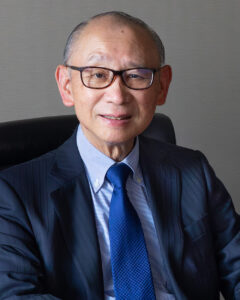
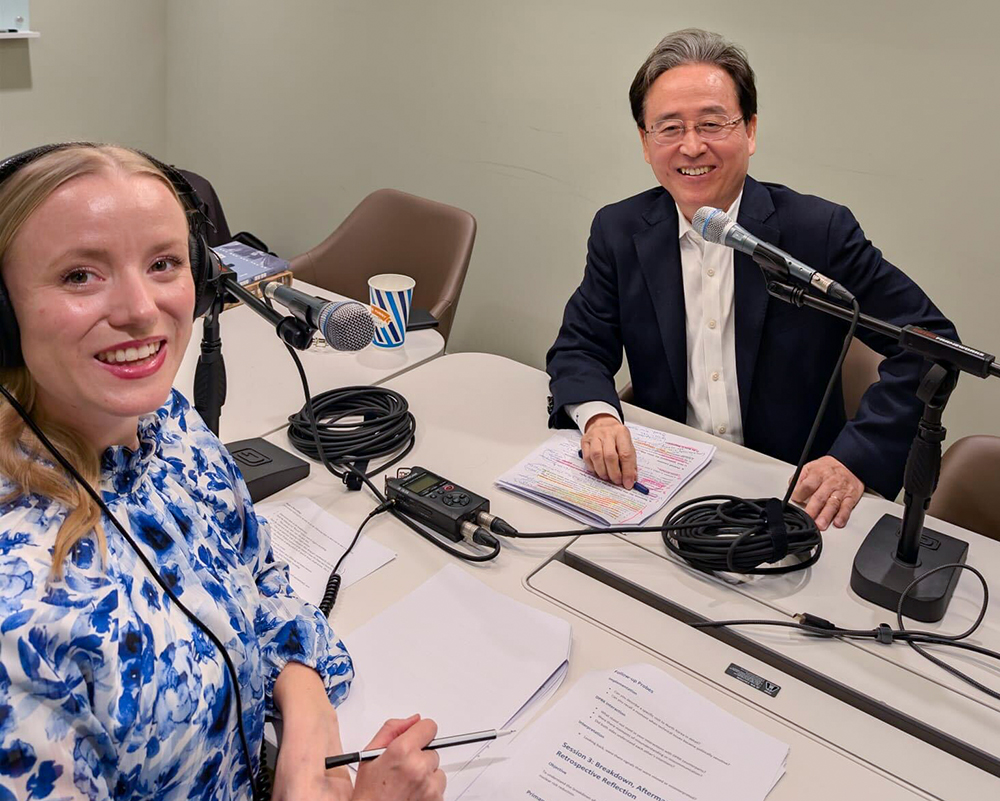
array(1) {
[0]=>
array(643) {
[0]=>
array(4) {
["speaker"]=>
string(12) "Rayna Rogers"
["timestamp"]=>
string(8) "00:00:02"
["seconds"]=>
int(2)
["text"]=>
string(474) "Okay. So I'm going to do what we call mandatory slating, which is kind of like setting up the intro portion, so as they're going back and listening to the recording, they'll know what sections we're on. This is an interview with Ambassador Nobuyasu Abe conducted by Rayna Rogers for the Oral History Project, a project for the Stanley Center for Peace and Security, and BASIC. This interview is taking place on July 20th, 2026, in Tokyo, Japan. This is session one of three."
}
[1]=>
array(4) {
["speaker"]=>
string(12) "Rayna Rogers"
["timestamp"]=>
string(8) "00:00:33"
["seconds"]=>
int(33)
["text"]=>
string(412) "Ambassador Abe, before we formally begin, I want to express my deepest appreciation for your willingness to share your time and your experiences with us. It is a great privilege and honor to record this conversation. So I'd like to start at the beginning. Could you please begin by telling me a little bit about where you grew up? I know we spoke a little earlier off mic, and then what your early life was like."
}
[2]=>
array(4) {
["speaker"]=>
string(17) "Amb. Nobuyasu Abe"
["timestamp"]=>
string(8) "00:01:01"
["seconds"]=>
int(61)
["text"]=>
string(294) "Well, I was born in Akita, the northern part of Japan, and stayed there until I entered college. So some 18 years I lived there. It is cold part of Japan, a lot of snow, and, but the autumn foliage is beautiful. So I grew up there. And if I may, I may talk about my experience when I was young."
}
[3]=>
array(4) {
["speaker"]=>
string(12) "Rayna Rogers"
["timestamp"]=>
string(8) "00:01:35"
["seconds"]=>
int(95)
["text"]=>
string(19) "Absolutely, please."
}
[4]=>
array(4) {
["speaker"]=>
string(17) "Amb. Nobuyasu Abe"
["timestamp"]=>
string(8) "00:01:36"
["seconds"]=>
int(96)
["text"]=>
string(762) "One thing I should talk about is when I entered junior high, I started learning world history. I didn't like very much East Asian history because that's mainly Chinese history where one dynasty after another rises and falls. It's a repetition. Some great man appears, starts a new dynasty. Eventually it gets corrupted and falls. It's a repetition. It's rather boring. But in comparison, Western history, particularly European history, was quite interesting. There were nations rising, falling, and then there was Renaissance, democracy and so on and so. It's quite interesting history. So I became interested in Western European history. And as a side reading, I read small books written by André Maurois. It's a French writer. I can give you a spelling later."
}
[5]=>
array(4) {
["speaker"]=>
string(12) "Rayna Rogers"
["timestamp"]=>
string(8) "00:03:00"
["seconds"]=>
int(180)
["text"]=>
string(10) "All right."
}
[6]=>
array(4) {
["speaker"]=>
string(17) "Amb. Nobuyasu Abe"
["timestamp"]=>
string(8) "00:03:00"
["seconds"]=>
int(180)
["text"]=>
string(322) "But he later became a minister of culture of France. So he's quite an accomplished writer and person. He wrote English history and French history. I read them and it was quite interesting because usually history is just a layout of all the facts, events. That's rather boring. But he wrote the history in the first person."
}
[7]=>
array(4) {
["speaker"]=>
string(12) "Rayna Rogers"
["timestamp"]=>
string(8) "00:03:32"
["seconds"]=>
int(212)
["text"]=>
string(5) "Cool."
}
[8]=>
array(4) {
["speaker"]=>
string(17) "Amb. Nobuyasu Abe"
["timestamp"]=>
string(8) "00:03:34"
["seconds"]=>
int(214)
["text"]=>
string(250) "France faced this situation, thought this way, and made this decision and went that way. Britain or England faced this situation, thought this way, that way, and they did that. Quite an interesting way to learn history. And I was very much impressed."
}
[9]=>
array(4) {
["speaker"]=>
string(12) "Rayna Rogers"
["timestamp"]=>
string(8) "00:03:55"
["seconds"]=>
int(235)
["text"]=>
string(89) "Wow. That is an interesting way to write history because usually it's very chronological-"
}
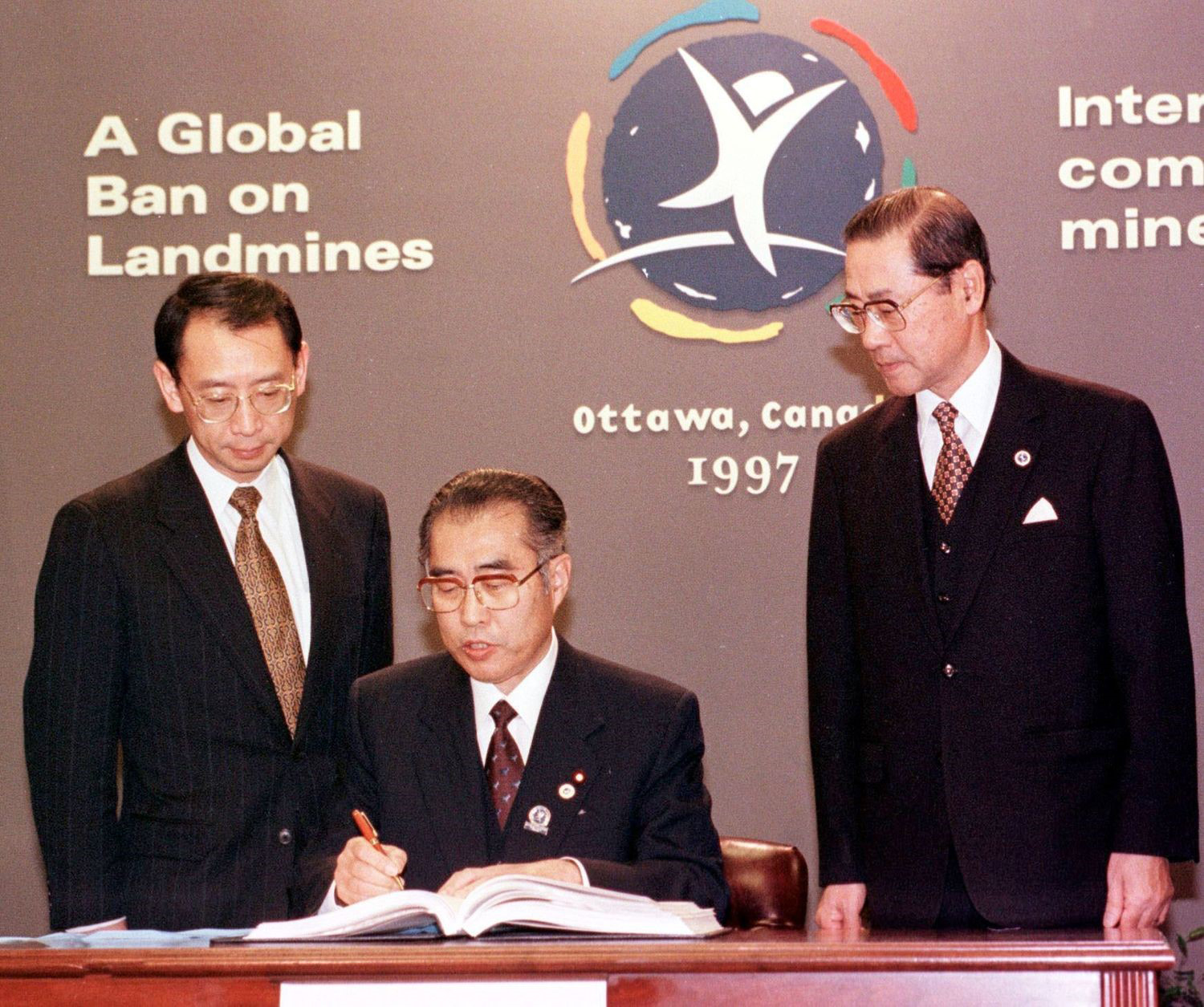
[10]=>
array(4) {
["speaker"]=>
string(17) "Amb. Nobuyasu Abe"
["timestamp"]=>
string(8) "00:04:02"
["seconds"]=>
int(242)
["text"]=>
string(13) "Just factual-"
}
[11]=>
array(4) {
["speaker"]=>
string(12) "Rayna Rogers"
["timestamp"]=>
string(8) "00:04:04"
["seconds"]=>
int(244)
["text"]=>
string(49) "... and it's told from an external point of view."
}
[12]=>
array(4) {
["speaker"]=>
string(17) "Amb. Nobuyasu Abe"
["timestamp"]=>
string(8) "00:04:05"
["seconds"]=>
int(245)
["text"]=>
string(424) "Yeah. Yeah. But after reading his books, I came to a conclusion. The rise and fall of nations, the welfare of the people there very much depended on the fact if they won a war or lost a war. If they win a war, they get new territories, sometimes reparation, and people become happier. But if you lose, you fall into misery. So at that time, I came to think I should go into the military to make Japan strong and to win wars."
}
[13]=>
array(4) {
["speaker"]=>
string(12) "Rayna Rogers"
["timestamp"]=>
string(8) "00:04:51"
["seconds"]=>
int(291)
["text"]=>
string(8) "Exactly."
}
[14]=>
array(4) {
["speaker"]=>
string(17) "Amb. Nobuyasu Abe"
["timestamp"]=>
string(8) "00:04:53"
["seconds"]=>
int(293)
["text"]=>
string(544) "But later, as I grew up, I realized Japan had such thing as a peace constitution, which was adopted in 1945. Has very peaceful clauses which said stated Japan renounces war as a means to settle international disputes. It's sort of derived from the peace movement in the early 20th century, the same philosophy. And it went on to say, for that reason, Japan will not possess war potentials, the military. But later on, they interpreted the constitution, even those clauses were there, no one can force Japan to give up its right of self-defense."
}
[15]=>
array(4) {
["speaker"]=>
string(12) "Rayna Rogers"
["timestamp"]=>
string(8) "00:05:54"
["seconds"]=>
int(354)
["text"]=>
string(8) "Exactly."
}
[16]=>
array(4) {
["speaker"]=>
string(17) "Amb. Nobuyasu Abe"
["timestamp"]=>
string(8) "00:05:55"
["seconds"]=>
int(355)
["text"]=>
string(602) "So self-defense is okay. And for that strict purposes, Japan can maintain self-defense forces. But the time I was in schools, there were still some disputes if that interpretation was permissible or not. The opposition was against. And Japan started to possess what we call self-defense forces. Not the Army or Air Force or Navy, but it calls Ground Self-Defense Forces, Naval Self-Defense Force, Air Self-Defense Forces. And for that reason and for the disputes, they were kept very small and weak. So I realized it's no good for myself to go into the military, which is very small, weak, and limited."
}
[17]=>
array(4) {
["speaker"]=>
string(17) "Amb. Nobuyasu Abe"
["timestamp"]=>
string(8) "00:06:58"
["seconds"]=>
int(418)
["text"]=>
string(166) "So I came to think next to the military power, what may keep your country safe and happy? Maybe diplomacy. So I came to think I should go into the world of diplomacy."
}
[18]=>
array(4) {
["speaker"]=>
string(12) "Rayna Rogers"
["timestamp"]=>
string(8) "00:07:16"
["seconds"]=>
int(436)
["text"]=>
string(5) "Okay."
}
[19]=>
array(4) {
["speaker"]=>
string(17) "Amb. Nobuyasu Abe"
["timestamp"]=>
string(8) "00:07:16"
["seconds"]=>
int(436)
["text"]=>
string(116) "That's how I came to this conclusion. And by the time I went into college, I was thinking about becoming a diplomat."
}
[20]=>
array(4) {
["speaker"]=>
string(12) "Rayna Rogers"
["timestamp"]=>
string(8) "00:07:25"
["seconds"]=>
int(445)
["text"]=>
string(5) "Okay."
}
[21]=>
array(4) {
["speaker"]=>
string(17) "Amb. Nobuyasu Abe"
["timestamp"]=>
string(8) "00:07:26"
["seconds"]=>
int(446)
["text"]=>
string(18) "That's my history."
}
[22]=>
array(4) {
["speaker"]=>
string(12) "Rayna Rogers"
["timestamp"]=>
string(8) "00:07:27"
["seconds"]=>
int(447)
["text"]=>
string(647) "That's an interesting one, especially given where you started and realizing that where you thought you wanted to go wasn't necessarily going to make the change that you wanted it to based on the size of it. And so your next one was diplomacy. So thinking about diplomacy, when you first joined the Ministry of Foreign Affairs, did you know that you wanted to focus on nuclear WMD work? Or was it that you started in a very general track and then you happened upon either a mentor or an individual working within either MOFA or outside in a different country where it helped you solidify your belief that this is the field that you want to work on?"
}
[23]=>
array(4) {
["speaker"]=>
string(17) "Amb. Nobuyasu Abe"
["timestamp"]=>
string(8) "00:08:23"
["seconds"]=>
int(503)
["text"]=>
string(85) "Well, before I go into that question, there are a couple of things I want to mention."
}
[24]=>
array(4) {
["speaker"]=>
string(12) "Rayna Rogers"
["timestamp"]=>
string(8) "00:08:27"
["seconds"]=>
int(507)
["text"]=>
string(15) "Sure. Go ahead."
}
[25]=>
array(4) {
["speaker"]=>
string(17) "Amb. Nobuyasu Abe"
["timestamp"]=>
string(8) "00:08:29"
["seconds"]=>
int(509)
["text"]=>
string(396) "When I entered the college, I thought I need to learn English well so that I can speak and use English well if I become a diplomat. So I joined the extracurricular activity named English Speaking Society. There are many ESS in the Japanese colleges and I joined them. And I spoke with my colleagues in English. Lunchtime, we got together on campus and we started talking to each other in English."
}
[26]=>
array(4) {
["speaker"]=>
string(12) "Rayna Rogers"
["timestamp"]=>
string(8) "00:09:11"
["seconds"]=>
int(551)
["text"]=>
string(7) "Oh wow."
}
[27]=>
array(4) {
["speaker"]=>
string(17) "Amb. Nobuyasu Abe"
["timestamp"]=>
string(8) "00:09:12"
["seconds"]=>
int(552)
["text"]=>
string(111) "The students passing around may looked at us as a strange guys, not Japanese speaking in English to each other."
}
[28]=>
array(4) {
["speaker"]=>
string(12) "Rayna Rogers"
["timestamp"]=>
string(8) "00:09:19"
["seconds"]=>
int(559)
["text"]=>
string(17) "What's happening?"
}
[29]=>
array(4) {
["speaker"]=>
string(17) "Amb. Nobuyasu Abe"
["timestamp"]=>
string(8) "00:09:21"
["seconds"]=>
int(561)
["text"]=>
string(183) "But that was good for me. And by the time I entered the foreign ministry, I was seen as good at English. So that's in a way somehow determined my future course in the foreign service."
}
[30]=>
array(4) {
["speaker"]=>
string(12) "Rayna Rogers"
["timestamp"]=>
string(8) "00:09:38"
["seconds"]=>
int(578)
["text"]=>
string(5) "Okay."
}
[31]=>
array(4) {
["speaker"]=>
string(17) "Amb. Nobuyasu Abe"
["timestamp"]=>
string(8) "00:09:40"
["seconds"]=>
int(580)
["text"]=>
string(73) "But before I talk about foreign service, I want to mention another thing."
}
[32]=>
array(4) {
["speaker"]=>
string(12) "Rayna Rogers"
["timestamp"]=>
string(8) "00:09:45"
["seconds"]=>
int(585)
["text"]=>
string(11) "Absolutely."
}
[33]=>
array(4) {
["speaker"]=>
string(17) "Amb. Nobuyasu Abe"
["timestamp"]=>
string(8) "00:09:46"
["seconds"]=>
int(586)
["text"]=>
string(465) "When I was a junior student in college, I was invited by the US State Department for a student exchange program called Multilateral Project. Perhaps it meant multilateral. Several countries involved. In fact, there were about a little more than 20 students from around the world. It was student leaders group. So I was seen to be one of the leaders. Then the US was quite rich and generous that time. The State Department took us six weeks around the United States."
}
[34]=>
array(4) {
["speaker"]=>
string(12) "Rayna Rogers"
["timestamp"]=>
string(8) "00:10:38"
["seconds"]=>
int(638)
["text"]=>
string(4) "Wow."
}
[35]=>
array(4) {
["speaker"]=>
string(17) "Amb. Nobuyasu Abe"
["timestamp"]=>
string(8) "00:10:38"
["seconds"]=>
int(638)
["text"]=>
string(395) "With two escorts. I visited the schools around the US. I went to Harvard, MIT, Amherst College, University of Minnesota, University of California, also down to Louisiana, so-and-so, exchanging views with the American students. Also, we met many American civil leaders, and again, exchanged views. That time, there was a very strong civil rights movement to seek equality for non-white Americans."
}
[36]=>
array(4) {
["speaker"]=>
string(12) "Rayna Rogers"
["timestamp"]=>
string(8) "00:11:24"
["seconds"]=>
int(684)
["text"]=>
string(8) "Correct."
}
[37]=>
array(4) {
["speaker"]=>
string(17) "Amb. Nobuyasu Abe"
["timestamp"]=>
string(8) "00:11:24"
["seconds"]=>
int(684)
["text"]=>
string(243) "And I was quite impressed to have an exchange of views with them. I think we also met some people in NAACP in New York. So that was quite interesting. Then also they took us, good enough, generous, to Mount Rushmore, Yellowstone, Grand Canyon-"
}
[38]=>
array(4) {
["speaker"]=>
string(12) "Rayna Rogers"
["timestamp"]=>
string(8) "00:11:49"
["seconds"]=>
int(709)
["text"]=>
string(18) "To see the beauty?"
}
[39]=>
array(4) {
["speaker"]=>
string(17) "Amb. Nobuyasu Abe"
["timestamp"]=>
string(8) "00:11:50"
["seconds"]=>
int(710)
["text"]=>
string(31) "... Salt Lake, even Disneyland."
}
[40]=>
array(4) {
["speaker"]=>
string(12) "Rayna Rogers"
["timestamp"]=>
string(8) "00:11:51"
["seconds"]=>
int(711)
["text"]=>
string(8) "Oh, wow."
}
[41]=>
array(4) {
["speaker"]=>
string(17) "Amb. Nobuyasu Abe"
["timestamp"]=>
string(8) "00:11:52"
["seconds"]=>
int(712)
["text"]=>
string(10) "Wonderful."
}
[42]=>
array(4) {
["speaker"]=>
string(12) "Rayna Rogers"
["timestamp"]=>
string(8) "00:11:52"
["seconds"]=>
int(712)
["text"]=>
string(21) "That was a nice trip."
}
[43]=>
array(4) {
["speaker"]=>
string(17) "Amb. Nobuyasu Abe"
["timestamp"]=>
string(8) "00:11:53"
["seconds"]=>
int(713)
["text"]=>
string(77) "So it was a wonderful trip. And I'm very grateful to the American government."
}
[44]=>
array(4) {
["speaker"]=>
string(12) "Rayna Rogers"
["timestamp"]=>
string(8) "00:12:00"
["seconds"]=>
int(720)
["text"]=>
string(77) "So is that how you found out about Amherst College? Because I was interested."
}
[45]=>
array(4) {
["speaker"]=>
string(17) "Amb. Nobuyasu Abe"
["timestamp"]=>
string(8) "00:12:04"
["seconds"]=>
int(724)
["text"]=>
string(45) "Yes. That time, I stopped at Amherst College."
}
[46]=>
array(4) {
["speaker"]=>
string(12) "Rayna Rogers"
["timestamp"]=>
string(8) "00:12:07"
["seconds"]=>
int(727)
["text"]=>
string(5) "Okay."
}
[47]=>
array(4) {
["speaker"]=>
string(17) "Amb. Nobuyasu Abe"
["timestamp"]=>
string(8) "00:12:08"
["seconds"]=>
int(728)
["text"]=>
string(151) "And I found it a very good school. I think it still is. And one another secret reason, I found it's an advantage. There are two girls' colleges nearby."
}
[48]=>
array(4) {
["speaker"]=>
string(12) "Rayna Rogers"
["timestamp"]=>
string(8) "00:12:25"
["seconds"]=>
int(745)
["text"]=>
string(10) "Oh. Smart."
}
[49]=>
array(4) {
["speaker"]=>
string(17) "Amb. Nobuyasu Abe"
["timestamp"]=>
string(8) "00:12:28"
["seconds"]=>
int(748)
["text"]=>
string(68) "So if you think about weekend dating, you have two to one advantage."
}
[50]=>
array(4) {
["speaker"]=>
string(12) "Rayna Rogers"
["timestamp"]=>
string(8) "00:12:32"
["seconds"]=>
int(752)
["text"]=>
string(17) "Oh, there you go."
}
[51]=>
array(4) {
["speaker"]=>
string(17) "Amb. Nobuyasu Abe"
["timestamp"]=>
string(8) "00:12:34"
["seconds"]=>
int(754)
["text"]=>
string(445) "So, when I joined the foreign service, they send us abroad to learn, basically, languages. So we all asked to choose which language you want to specialize. I first asked to specialize in French because French, you may get a chance to go to Paris. But there were so many people who wanted to go into French, so I didn't get it. I was asked to go into English. And so English, you have a choice to go to England or US. I was asked to go to the US."
}
[52]=>
array(4) {
["speaker"]=>
string(12) "Rayna Rogers"
["timestamp"]=>
string(8) "00:13:18"
["seconds"]=>
int(798)
["text"]=>
string(5) "Okay."
}
[53]=>
array(4) {
["speaker"]=>
string(17) "Amb. Nobuyasu Abe"
["timestamp"]=>
string(8) "00:13:19"
["seconds"]=>
int(799)
["text"]=>
string(132) "So at that time I asked them to send me to Amherst College, specifically. And I succeeded. And that's why I went to Amherst College."
}
[54]=>
array(4) {
["speaker"]=>
string(12) "Rayna Rogers"
["timestamp"]=>
string(8) "00:13:29"
["seconds"]=>
int(809)
["text"]=>
string(263) "Yes, because I was wondering. I was like, you went to the University of Tokyo and then Amherst College just kind of seemed out of nowhere, but now understanding it was part of this trip that you went on and seeing the school, liking the demographics. And then ..."
}
[55]=>
array(4) {
["speaker"]=>
string(17) "Amb. Nobuyasu Abe"
["timestamp"]=>
string(8) "00:13:46"
["seconds"]=>
int(826)
["text"]=>
string(85) "But later on, I found out that Amherst College has a special relationship with Japan."
}
[56]=>
array(4) {
["speaker"]=>
string(12) "Rayna Rogers"
["timestamp"]=>
string(8) "00:13:52"
["seconds"]=>
int(832)
["text"]=>
string(7) "Really?"
}
[57]=>
array(4) {
["speaker"]=>
string(17) "Amb. Nobuyasu Abe"
["timestamp"]=>
string(8) "00:13:53"
["seconds"]=>
int(833)
["text"]=>
string(312) "In the early days of a modern Japan, mid-19th century, a guy named Jo Neesima (Niijima Jo) went to Amherst College and came back to Japan and thought the college was wonderful. He started an English school in Kyoto. Later it became a college. And it is Doshisha University today. And they are sister schools now."
}
[58]=>
array(4) {
["speaker"]=>
string(12) "Rayna Rogers"
["timestamp"]=>
string(8) "00:14:23"
["seconds"]=>
int(863)
["text"]=>
string(3) "Oh."
}
[59]=>
array(4) {
["speaker"]=>
string(17) "Amb. Nobuyasu Abe"
["timestamp"]=>
string(8) "00:14:24"
["seconds"]=>
int(864)
["text"]=>
string(139) "Yeah. And on the campus of Doshisha University in Kyoto, there's a house called Amherst House where visitors from Amherst College can stay."
}
[60]=>
array(4) {
["speaker"]=>
string(12) "Rayna Rogers"
["timestamp"]=>
string(8) "00:14:37"
["seconds"]=>
int(877)
["text"]=>
string(21) "Oh, that's very nice."
}
[61]=>
array(4) {
["speaker"]=>
string(17) "Amb. Nobuyasu Abe"
["timestamp"]=>
string(8) "00:14:38"
["seconds"]=>
int(878)
["text"]=>
string(253) "In fact, there are one or two exchange students every year. And they also invite one professor from Amherst College. So it's a nice place and it's good to have that relationship. So I enjoyed Amherst College very much. I spent wonderful two years there."
}
[62]=>
array(4) {
["speaker"]=>
string(12) "Rayna Rogers"
["timestamp"]=>
string(8) "00:14:56"
["seconds"]=>
int(896)
["text"]=>
string(16) "Oh, that's nice."
}
[63]=>
array(4) {
["speaker"]=>
string(17) "Amb. Nobuyasu Abe"
["timestamp"]=>
string(8) "00:14:57"
["seconds"]=>
int(897)
["text"]=>
string(30) "Thanks to the foreign service."
}
[64]=>
array(4) {
["speaker"]=>
string(12) "Rayna Rogers"
["timestamp"]=>
string(8) "00:15:00"
["seconds"]=>
int(900)
["text"]=>
string(107) "So Amherst College was part of your language training and then your degree is from the University of Tokyo?"
}
[65]=>
array(4) {
["speaker"]=>
string(17) "Amb. Nobuyasu Abe"
["timestamp"]=>
string(8) "00:15:08"
["seconds"]=>
int(908)
["text"]=>
string(327) "Mm-hmm. But then about foreign service. I started working in the foreign service. They thought I'm good at English and I know the United States well, so they gave me the tasks to work on US-Japan trade relationship. Because in those days, there were serious trade disputes almost every year between Japan and the United States."
}
[66]=>
array(4) {
["speaker"]=>
string(12) "Rayna Rogers"
["timestamp"]=>
string(8) "00:15:38"
["seconds"]=>
int(938)
["text"]=>
string(7) "Really?"
}
[67]=>
array(4) {
["speaker"]=>
string(17) "Amb. Nobuyasu Abe"
["timestamp"]=>
string(8) "00:15:39"
["seconds"]=>
int(939)
["text"]=>
string(110) "First, there were textile exports to the United States. Japan exported cheap textile products. Americans said-"
}
[68]=>
array(4) {
["speaker"]=>
string(12) "Rayna Rogers"
["timestamp"]=>
string(8) "00:15:48"
["seconds"]=>
int(948)
["text"]=>
string(11) "Were upset."
}
[69]=>
array(4) {
["speaker"]=>
string(17) "Amb. Nobuyasu Abe"
["timestamp"]=>
string(8) "00:15:49"
["seconds"]=>
int(949)
["text"]=>
string(423) "... "This is threatening American textile industry." So they had to negotiate. So the first half of foreign service, I spent most of the time working on economic affairs. I did it. I had to. But I didn't like it very much because trade negotiations, basically what you do is to raise tariffs or impose quotas to prevent foreign cheap products coming into Japanese markets. That goes exactly against the theory of economics."
}
[70]=>
array(4) {
["speaker"]=>
string(12) "Rayna Rogers"
["timestamp"]=>
string(8) "00:16:31"
["seconds"]=>
int(991)
["text"]=>
string(5) "Okay."
}
[71]=>
array(4) {
["speaker"]=>
string(17) "Amb. Nobuyasu Abe"
["timestamp"]=>
string(8) "00:16:33"
["seconds"]=>
int(993)
["text"]=>
string(302) "Introductory economic theory, Economics 101, you learn theory of comparative advantage, which means if you have a good product produced cheaper here by exporting them to the other country and importing cheaper, better products from abroad, people become happier. They spend less for good things. Right?"
}
[72]=>
array(4) {
["speaker"]=>
string(12) "Rayna Rogers"
["timestamp"]=>
string(8) "00:17:00"
["seconds"]=>
int(1020)
["text"]=>
string(6) "Right."
}
[73]=>
array(4) {
["speaker"]=>
string(17) "Amb. Nobuyasu Abe"
["timestamp"]=>
string(8) "00:17:01"
["seconds"]=>
int(1021)
["text"]=>
string(386) "That's a theory in international economics. But what I did was do exactly against it. So I didn't like it very much. So I looked for some chance to work on security issues. And then about halfway my career, the chance appeared and I got a chance to work on foreign policy in general, which indeed focuses on the security, peace and security issues. So I started working on those issues."
}
[74]=>
array(4) {
["speaker"]=>
string(12) "Rayna Rogers"
["timestamp"]=>
string(8) "00:17:42"
["seconds"]=>
int(1062)
["text"]=>
string(709) "All right. And so security issues can be a very broad one, especially when it comes to ... A lot of people think of security, you think of military, arms. And so there's like an area where you could have gone more so in conventional weapons. But it feels as though, at least having read what I've read about you, though it was interesting to learn about the Ottawa Treaty, that a lot of your work has been in WMD, but specifically within the nuclear field. But then I know you spent time at the IAEA. And so there's probably some overlap with maybe some chem, some bio. You were in Geneva, or actually you were in Switzerland. So I'm not sure if you were at Conference on Disarmament. So how did you focus on-"
}
[75]=>
array(4) {
["speaker"]=>
string(17) "Amb. Nobuyasu Abe"
["timestamp"]=>
string(8) "00:18:44"
["seconds"]=>
int(1124)
["text"]=>
string(69) "About the time I moved into policy, security issues, it was in 1980s."
}
[76]=>
array(4) {
["speaker"]=>
string(12) "Rayna Rogers"
["timestamp"]=>
string(8) "00:18:51"
["seconds"]=>
int(1131)
["text"]=>
string(5) "Okay."
}
[77]=>
array(4) {
["speaker"]=>
string(17) "Amb. Nobuyasu Abe"
["timestamp"]=>
string(8) "00:18:53"
["seconds"]=>
int(1133)
["text"]=>
string(511) "When Japan was fast-growing and sometimes Americans felt they may be threatened by a growing, fast-growing Japan. That was a time Professor Ezra Vogel of Harvard University wrote a book called Japan as Number One, meaning Japan may get number one one day. So in 1985, around 1985, I started working on this question. And then '86, I had a chance to be at Harvard University at the Center for International Affairs. Now today it's called Weatherhead Center for International Affairs, but the center was where ..."
}
[78]=>
array(4) {
["speaker"]=>
string(12) "Rayna Rogers"
["timestamp"]=>
string(8) "00:20:01"
["seconds"]=>
int(1201)
["text"]=>
string(15) "Take your time."
}
[79]=>
array(4) {
["speaker"]=>
string(17) "Amb. Nobuyasu Abe"
["timestamp"]=>
string(8) "00:20:02"
["seconds"]=>
int(1202)
["text"]=>
string(44) "Yeah. Such famous guys as Samuel Huntington."
}
[80]=>
array(4) {
["speaker"]=>
string(12) "Rayna Rogers"
["timestamp"]=>
string(8) "00:20:10"
["seconds"]=>
int(1210)
["text"]=>
string(5) "Okay."
}
[81]=>
array(4) {
["speaker"]=>
string(17) "Amb. Nobuyasu Abe"
["timestamp"]=>
string(8) "00:20:15"
["seconds"]=>
int(1215)
["text"]=>
string(26) "Famous Secretary of State."
}
[82]=>
array(4) {
["speaker"]=>
string(12) "Rayna Rogers"
["timestamp"]=>
string(8) "00:20:21"
["seconds"]=>
int(1221)
["text"]=>
string(68) "I should probably know this. I used to work at the State Department."
}
[83]=>
array(4) {
["speaker"]=>
string(17) "Amb. Nobuyasu Abe"
["timestamp"]=>
string(8) "00:20:29"
["seconds"]=>
int(1229)
["text"]=>
string(361) "So then there I wrote a piece of paper. Japan may keep on growing and may one day come close to the United States in economic size and consequently the spending for the military as well. And so under that circumstances, what Japan should be doing and how the US may react. Well, paper was written in that was the summer of 1987. It was only one-year fellowship."
}
[84]=>
array(4) {
["speaker"]=>
string(12) "Rayna Rogers"
["timestamp"]=>
string(8) "00:21:09"
["seconds"]=>
int(1269)
["text"]=>
string(5) "Okay."
}
[85]=>
array(4) {
["speaker"]=>
string(17) "Amb. Nobuyasu Abe"
["timestamp"]=>
string(8) "00:21:13"
["seconds"]=>
int(1273)
["text"]=>
string(79) "Turned out to be totally wrong. Japan stopped growing towards the end of 1980s."
}
[86]=>
array(4) {
["speaker"]=>
string(12) "Rayna Rogers"
["timestamp"]=>
string(8) "00:21:22"
["seconds"]=>
int(1282)
["text"]=>
string(19) "Is that the bubble?"
}
[87]=>
array(4) {
["speaker"]=>
string(17) "Amb. Nobuyasu Abe"
["timestamp"]=>
string(8) "00:21:24"
["seconds"]=>
int(1284)
["text"]=>
string(640) "This is what they call about the time population dividends stopped. Population dividends means when your population has a smaller, older generation, great portion of working generation, and a sizable young growing generation, then your economy grows well because you have a little need to support older generation. You can have a big size working population. This is called population dividends. As your population gets older, you have a greater number of older generation, so your burden becomes bigger. And the younger generation starts shrinking, which means you have a shrinking working population to support the bigger aged population."
}
[88]=>
array(4) {
["speaker"]=>
string(12) "Rayna Rogers"
["timestamp"]=>
string(8) "00:22:27"
["seconds"]=>
int(1347)
["text"]=>
string(17) "Aging population."
}
[89]=>
array(4) {
["speaker"]=>
string(17) "Amb. Nobuyasu Abe"
["timestamp"]=>
string(8) "00:22:28"
["seconds"]=>
int(1348)
["text"]=>
string(67) "That becomes a burden on the economy and the economy stops growing."
}
[90]=>
array(4) {
["speaker"]=>
string(12) "Rayna Rogers"
["timestamp"]=>
string(8) "00:22:32"
["seconds"]=>
int(1352)
["text"]=>
string(37) "And that's what happened in the '80s?"
}
[91]=>
array(4) {
["speaker"]=>
string(17) "Amb. Nobuyasu Abe"
["timestamp"]=>
string(8) "00:22:33"
["seconds"]=>
int(1353)
["text"]=>
string(114) "That's what happened around the turn of '80s to '90s in Japan. Economy stopped growing. So my dream didn't happen."
}
[92]=>
array(4) {
["speaker"]=>
string(12) "Rayna Rogers"
["timestamp"]=>
string(8) "00:22:43"
["seconds"]=>
int(1363)
["text"]=>
string(594) "Right. Understood. But at least by then it seems like you were starting to shift from trade into security. And so that allowed your career within MOFA to continue to expand. So once you started working in the security side of the MFA, was there a mentor or an individual that helped shape kind of your thoughts or helped you kind of with your career trajectory? Saying, "Okay, based on what your interests are, this is I think a good posting that you should go for. I know you're really good at English." So was there anyone that helped you along the way as you were progressing in your career?"
}
[93]=>
array(4) {
["speaker"]=>
string(17) "Amb. Nobuyasu Abe"
["timestamp"]=>
string(8) "00:23:41"
["seconds"]=>
int(1421)
["text"]=>
string(100) "Yes. I had a mentor to speak about, to talk about, at that time. Again, I have to remember the name."
}
[94]=>
array(4) {
["speaker"]=>
string(12) "Rayna Rogers"
["timestamp"]=>
string(8) "00:23:53"
["seconds"]=>
int(1433)
["text"]=>
string(16) "No, that's fine."
}
[95]=>
array(4) {
["speaker"]=>
string(17) "Amb. Nobuyasu Abe"
["timestamp"]=>
string(8) "00:23:54"
["seconds"]=>
int(1434)
["text"]=>
string(23) "Perhaps I can do later."
}
[96]=>
array(4) {
["speaker"]=>
string(12) "Rayna Rogers"
["timestamp"]=>
string(8) "00:23:56"
["seconds"]=>
int(1436)
["text"]=>
string(13) "Yes, you can."
}
[97]=>
array(4) {
["speaker"]=>
string(17) "Amb. Nobuyasu Abe"
["timestamp"]=>
string(8) "00:23:58"
["seconds"]=>
int(1438)
["text"]=>
string(272) "Yeah. He analyzed Japanese history under which Japan had a war with Russia, Russo-Japanese war in 2004/5, that time. Japan won the war. That time Japan was allied with the Britain. Later on, Japan went into war with the US, UK, and other countries, lost the war miserably."
}
[98]=>
array(4) {
["speaker"]=>
string(12) "Rayna Rogers"
["timestamp"]=>
string(8) "00:24:36"
["seconds"]=>
int(1476)
["text"]=>
string(4) "Yes."
}
[99]=>
array(4) {
["speaker"]=>
string(17) "Amb. Nobuyasu Abe"
["timestamp"]=>
string(8) "00:24:38"
["seconds"]=>
int(1478)
["text"]=>
string(175) "So this mentor thought Japan went well when it's allied with Anglo-Saxon allies. That was his conclusion and I mainly agreed with him. So I think Japan is still on that track."
}
[100]=>
array(4) {
["speaker"]=>
string(12) "Rayna Rogers"
["timestamp"]=>
string(8) "00:25:06"
["seconds"]=>
int(1506)
["text"]=>
string(8) "I agree."
}
[101]=>
array(4) {
["speaker"]=>
string(17) "Amb. Nobuyasu Abe"
["timestamp"]=>
string(8) "00:25:09"
["seconds"]=>
int(1509)
["text"]=>
string(20) "His name is Okazaki."
}
[102]=>
array(4) {
["speaker"]=>
string(12) "Rayna Rogers"
["timestamp"]=>
string(8) "00:25:10"
["seconds"]=>
int(1510)
["text"]=>
string(8) "Okazaki?"
}
[103]=>
array(4) {
["speaker"]=>
string(17) "Amb. Nobuyasu Abe"
["timestamp"]=>
string(8) "00:25:11"
["seconds"]=>
int(1511)
["text"]=>
string(7) "Mm-hmm."
}
[104]=>
array(4) {
["speaker"]=>
string(12) "Rayna Rogers"
["timestamp"]=>
string(8) "00:25:13"
["seconds"]=>
int(1513)
["text"]=>
string(743) "Okay. Thank you. So we've gone through the '80s and now into the '90s. And that's around the time where you were sent to Vienna and you worked as Japan's ambassador to the UN and other international organizations. So thinking about your time then, I feel like it had to be an interesting one. So it was right after the Iraq's nuclear weapons program was discovered and the IAEA was working on getting countries to sign onto the additional protocol. You also had the push for the entry into force of the Comprehensive Nuclear Test Ban Treaty. So could you tell me a little bit about your time then and what it was like to work in a multilateral way as opposed to maybe in previous years where you worked mainly bilaterally with other countries?"
}
[105]=>
array(4) {
["speaker"]=>
string(17) "Amb. Nobuyasu Abe"
["timestamp"]=>
string(8) "00:26:19"
["seconds"]=>
int(1579)
["text"]=>
string(112) "Well, before that, into 1990s, in the mid-1990s, I was sent to Boston, Massachusetts, as a consul general there."
}
[106]=>
array(4) {
["speaker"]=>
string(12) "Rayna Rogers"
["timestamp"]=>
string(8) "00:26:39"
["seconds"]=>
int(1599)
["text"]=>
string(5) "Okay."
}
[107]=>
array(4) {
["speaker"]=>
string(17) "Amb. Nobuyasu Abe"
["timestamp"]=>
string(8) "00:26:41"
["seconds"]=>
int(1601)
["text"]=>
string(584) "It was a wonderful time to renew the friend's friendship from the time when I stayed at Harvard in 1986/7. And I enjoyed inviting those professors and the people from Harvard and other places to my consul general's residence. Nice that foreign ministry gave me a lot of money to spend organizing dinners. So I enjoyed the time. But only after a year and a few months, Ambassador Owada, famous ambassador of Japan, who was at that time ambassador to the United Nations, who later become the justice on the International Court of Justice. And he's also the father of the Empress Masako."
}
[108]=>
array(4) {
["speaker"]=>
string(12) "Rayna Rogers"
["timestamp"]=>
string(8) "00:27:46"
["seconds"]=>
int(1666)
["text"]=>
string(4) "Wow."
}
[109]=>
array(4) {
["speaker"]=>
string(17) "Amb. Nobuyasu Abe"
["timestamp"]=>
string(8) "00:27:47"
["seconds"]=>
int(1667)
["text"]=>
string(428) "Yeah. So that time, around that time, Japan was running for membership on the Security Council. And what I remember, that in the previous election, I worked on the election there as well and we made it a great success, so he wanted me to come to New York to help the campaign. I didn't want to go. And I asked him, "How about commuting from Boston?" He said, "No." So, I finally had to move to New York, and we won the election."
}
[110]=>
array(4) {
["speaker"]=>
string(12) "Rayna Rogers"
["timestamp"]=>
string(8) "00:28:31"
["seconds"]=>
int(1711)
["text"]=>
string(19) "Well, there you go."
}
[111]=>
array(4) {
["speaker"]=>
string(17) "Amb. Nobuyasu Abe"
["timestamp"]=>
string(8) "00:28:34"
["seconds"]=>
int(1714)
["text"]=>
string(318) "So, I started working under him. That time, then I stayed only one year or so, then he told me I was going back to Tokyo to become a senior officer in the foreign ministry. And he told me I would be in charge of arms control and disarmament. I was very pleased because that was exactly the subject I wanted to work on."
}
[112]=>
array(4) {
["speaker"]=>
string(12) "Rayna Rogers"
["timestamp"]=>
string(8) "00:29:11"
["seconds"]=>
int(1751)
["text"]=>
string(50) "Okay. And that's when you became director general?"
}
[113]=>
array(4) {
["speaker"]=>
string(17) "Amb. Nobuyasu Abe"
["timestamp"]=>
string(8) "00:29:14"
["seconds"]=>
int(1754)
["text"]=>
string(669) "So I went back there. I became a director general in 1997. And I was there until 1999. It was quite an interesting time. Initially, my first task was to sign Anti-Personnel Landmines Convention, Ottawa Convention. It so happened, there was an American lady who campaigned on Ottawa Treaty. She worked solely for that purpose. No other. Because, I think, she and many other Americans realized that there were many landmines left in Vietnam and Cambodia from the time of war in Vietnam. And they remained there and caused accidents to farmers and the common people. And so people realized that the landmines caused more harm to the common people rather than the military."
}
[114]=>
array(4) {
["speaker"]=>
string(17) "Amb. Nobuyasu Abe"
["timestamp"]=>
string(8) "00:30:39"
["seconds"]=>
int(1839)
["text"]=>
string(1076) "There was a great movement to stop using antipersonnel landmines. That was Ottawa Convention. It so happened, the foreign minister that time was Obuchi, Keizo Obuchi, later become prime minister, but at that time he was a foreign minister. He came into the office. Initially, Japanese government's position was against anti-personal landmines convention because from the Japanese point of view, it was a perfect weapon for self-defense. You're not going to attack with landmines in the enemy. You only use them for defense, perfect for Japanese Self-Defense Forces. And Japan has a long shoreline. You just can't put soldiers everywhere. Landmines are very useful to prevent enemy forces landing on the coast. So Japanese Self-Defense Forces were very strongly against the convention. So initial position was that. But for Minister Obuchi, he is a very unique conservative politician. He befriended Japanese NGOs and among them was AAR in Japan, of Japan. AAR, Association to Assist Refugees. There were many refugees in Cambodia and other places and they were suffering from-"
}
[115]=>
array(4) {
["speaker"]=>
string(12) "Rayna Rogers"
["timestamp"]=>
string(8) "00:32:41"
["seconds"]=>
int(1961)
["text"]=>
string(29) "The effects of the landmines."
}
[116]=>
array(4) {
["speaker"]=>
string(17) "Amb. Nobuyasu Abe"
["timestamp"]=>
string(8) "00:32:42"
["seconds"]=>
int(1962)
["text"]=>
string(318) "... Loss of economic support. Not only that, many of them are working on the fields and suffered from the landmines. So this AAR also campaigned against landmines. So Obuchi, having friendship with those people, learned about the evil of the landmines and came into the foreign office saying this had to be prohibited."
}
[117]=>
array(4) {
["speaker"]=>
string(12) "Rayna Rogers"
["timestamp"]=>
string(8) "00:33:12"
["seconds"]=>
int(1992)
["text"]=>
string(7) "Oh wow."
}
[118]=>
array(4) {
["speaker"]=>
string(17) "Amb. Nobuyasu Abe"
["timestamp"]=>
string(8) "00:33:13"
["seconds"]=>
int(1993)
["text"]=>
string(486) "So, he started working on changing Japanese policy. And finally, I, myself and represent senior officer of the Ministry of Defense were invited to Prime Minister Hashimoto's office. And Hashimoto told the defense people, "The Soviet Union went down. Who would invade Japan? Who would invade the landing on the Japanese shores? None. So why do you need the landmines?" So by that argument, he told them we better sign the convention. So he changed the policy. He made the final decision."
}
[119]=>
array(4) {
["speaker"]=>
string(12) "Rayna Rogers"
["timestamp"]=>
string(8) "00:34:04"
["seconds"]=>
int(2044)
["text"]=>
string(8) "Oh, wow."
}
[120]=>
array(4) {
["speaker"]=>
string(17) "Amb. Nobuyasu Abe"
["timestamp"]=>
string(8) "00:34:05"
["seconds"]=>
int(2045)
["text"]=>
string(162) "That's how we went to Ottawa to sign the convention as pictured. And later on, I had to work on winning the ratification of the treaty in the Japanese parliament."
}
[121]=>
array(4) {
["speaker"]=>
string(12) "Rayna Rogers"
["timestamp"]=>
string(8) "00:34:25"
["seconds"]=>
int(2065)
["text"]=>
string(16) "Oh, on the Diet?"
}
[122]=>
array(4) {
["speaker"]=>
string(17) "Amb. Nobuyasu Abe"
["timestamp"]=>
string(8) "00:34:26"
["seconds"]=>
int(2066)
["text"]=>
string(24) "Yeah. That was not easy."
}
[123]=>
array(4) {
["speaker"]=>
string(12) "Rayna Rogers"
["timestamp"]=>
string(8) "00:34:28"
["seconds"]=>
int(2068)
["text"]=>
string(15) "I'm sure. Yeah."
}
[124]=>
array(4) {
["speaker"]=>
string(17) "Amb. Nobuyasu Abe"
["timestamp"]=>
string(8) "00:34:29"
["seconds"]=>
int(2069)
["text"]=>
string(39) "There were some friends of the defense."
}
[125]=>
array(4) {
["speaker"]=>
string(12) "Rayna Rogers"
["timestamp"]=>
string(8) "00:34:33"
["seconds"]=>
int(2073)
["text"]=>
string(15) "Oh, understood."
}
[126]=>
array(4) {
["speaker"]=>
string(17) "Amb. Nobuyasu Abe"
["timestamp"]=>
string(8) "00:34:34"
["seconds"]=>
int(2074)
["text"]=>
string(89) "So I had to work hard. And also that time, the United States did not sign the convention."
}
[127]=>
array(4) {
["speaker"]=>
string(12) "Rayna Rogers"
["timestamp"]=>
string(8) "00:34:44"
["seconds"]=>
int(2084)
["text"]=>
string(16) "It still hasn't."
}
[128]=>
array(4) {
["speaker"]=>
string(17) "Amb. Nobuyasu Abe"
["timestamp"]=>
string(8) "00:34:46"
["seconds"]=>
int(2086)
["text"]=>
string(61) "Their argument is that they had to defend Korea, for example."
}
[129]=>
array(4) {
["speaker"]=>
string(12) "Rayna Rogers"
["timestamp"]=>
string(8) "00:34:51"
["seconds"]=>
int(2091)
["text"]=>
string(15) "Right. The DMZ."
}
[130]=>
array(4) {
["speaker"]=>
string(17) "Amb. Nobuyasu Abe"
["timestamp"]=>
string(8) "00:34:52"
["seconds"]=>
int(2092)
["text"]=>
string(60) "For that purpose, you have to keep landmines around the DMZ."
}
[131]=>
array(4) {
["speaker"]=>
string(12) "Rayna Rogers"
["timestamp"]=>
string(8) "00:34:55"
["seconds"]=>
int(2095)
["text"]=>
string(8) "Correct."
}
[132]=>
array(4) {
["speaker"]=>
string(17) "Amb. Nobuyasu Abe"
["timestamp"]=>
string(8) "00:34:56"
["seconds"]=>
int(2096)
["text"]=>
string(241) "So, for that reason, they said they cannot sign the treaty. So, I had to seek understanding of the United States that Japan will go ahead with the signing and ratifying treaty. So that took some time and the ratification process was delayed."
}
[133]=>
array(4) {
["speaker"]=>
string(12) "Rayna Rogers"
["timestamp"]=>
string(8) "00:35:24"
["seconds"]=>
int(2124)
["text"]=>
string(9) "Oh, okay."
}
[134]=>
array(4) {
["speaker"]=>
string(17) "Amb. Nobuyasu Abe"
["timestamp"]=>
string(8) "00:35:27"
["seconds"]=>
int(2127)
["text"]=>
string(174) "That time, Deputy Chief Cabinet’s secretary who was responsible for the management of parliamentary procedure called me up, "Why is this being delayed? You're responsible.""
}
[135]=>
array(4) {
["speaker"]=>
string(12) "Rayna Rogers"
["timestamp"]=>
string(8) "00:35:41"
["seconds"]=>
int(2141)
["text"]=>
string(42) "Like they have to have more conversations."
}
[136]=>
array(4) {
["speaker"]=>
string(17) "Amb. Nobuyasu Abe"
["timestamp"]=>
string(8) "00:35:43"
["seconds"]=>
int(2143)
["text"]=>
string(134) "Yeah. So I knew that I had to spend my time on working, talking with Americans. So I told him, "Yes, I'm responsible. Please fire me.""
}
[137]=>
array(4) {
["speaker"]=>
string(12) "Rayna Rogers"
["timestamp"]=>
string(8) "00:35:58"
["seconds"]=>
int(2158)
["text"]=>
string(36) "I don't think so. He decided against"
}
[138]=>
array(4) {
["speaker"]=>
string(17) "Amb. Nobuyasu Abe"
["timestamp"]=>
string(8) "00:36:00"
["seconds"]=>
int(2160)
["text"]=>
string(60) "But this is a little bit like President Trump. You're fired."
}
[139]=>
array(4) {
["speaker"]=>
string(12) "Rayna Rogers"
["timestamp"]=>
string(8) "00:36:06"
["seconds"]=>
int(2166)
["text"]=>
string(3) "Oh."
}
[140]=>
array(4) {
["speaker"]=>
string(17) "Amb. Nobuyasu Abe"
["timestamp"]=>
string(8) "00:36:08"
["seconds"]=>
int(2168)
["text"]=>
string(57) "He grasped his power by telling bureaucrats you're fired."
}
[141]=>
array(4) {
["speaker"]=>
string(12) "Rayna Rogers"
["timestamp"]=>
string(8) "00:36:14"
["seconds"]=>
int(2174)
["text"]=>
string(48) "Oh, wow. Okay. Well, I'm glad he didn't mean it."
}
[142]=>
array(4) {
["speaker"]=>
string(17) "Amb. Nobuyasu Abe"
["timestamp"]=>
string(8) "00:36:17"
["seconds"]=>
int(2177)
["text"]=>
string(535) "Yeah. Then he told me, "No, no, no. I'm the one to fire you. You're not going to resign yourself." So, after that, he did not fire me. And later on, I came back to the office and I was told by my boss, "You're a good man." Very often under such a situation, they say, "No, I'm not responsible. My deputy failed to do this and that." And they run away from the responsibility. "Mr. Abe, you're good. You accepted your responsibility." So perhaps the deputy cabinet secretary may have told that to my boss and he should not be, keep him."
}
[143]=>
array(4) {
["speaker"]=>
string(12) "Rayna Rogers"
["timestamp"]=>
string(8) "00:37:09"
["seconds"]=>
int(2229)
["text"]=>
string(18) "Yeah, he accepted."
}
[144]=>
array(4) {
["speaker"]=>
string(17) "Amb. Nobuyasu Abe"
["timestamp"]=>
string(8) "00:37:10"
["seconds"]=>
int(2230)
["text"]=>
string(31) "So that was a successful story."
}
[145]=>
array(4) {
["speaker"]=>
string(12) "Rayna Rogers"
["timestamp"]=>
string(8) "00:37:15"
["seconds"]=>
int(2235)
["text"]=>
string(874) "So going on to that success and having had to negotiate not only outside of the country and understanding what people were going through, but then having to do the same thing where you're explaining it to the legislature. Were any of those lessons helpful for you once you went into a more multilateral setting where you had to not only deal with, say, country A in a one-on-one setting, but then you're in this large body where you have to get consensus? So can you tell me about what life was like working on a treaty specifically like the CTBT and trying to get it to enter into force, understanding that some countries were absolutely against nuclear weapons existing. Some were saying they have to exist, but we don't need to do the testing. And then others saying, "Well, we still think that testing should be done." So, could you elaborate on what life was like then?"
}
[146]=>
array(4) {
["speaker"]=>
string(17) "Amb. Nobuyasu Abe"
["timestamp"]=>
string(8) "00:38:32"
["seconds"]=>
int(2312)
["text"]=>
string(256) "Well, then after finishing my work as Director of Arms Control and Disarmament, I moved on to Vienna as ambassador there. Oh, before that, perhaps I should mention the later work in my position as arms control disarmament was to work on India and Pakistan."
}
[147]=>
array(4) {
["speaker"]=>
string(12) "Rayna Rogers"
["timestamp"]=>
string(8) "00:39:03"
["seconds"]=>
int(2343)
["text"]=>
string(5) "Okay."
}
[148]=>
array(4) {
["speaker"]=>
string(17) "Amb. Nobuyasu Abe"
["timestamp"]=>
string(8) "00:39:06"
["seconds"]=>
int(2346)
["text"]=>
string(27) "They had the nuclear tests."
}
[149]=>
array(4) {
["speaker"]=>
string(12) "Rayna Rogers"
["timestamp"]=>
string(8) "00:39:08"
["seconds"]=>
int(2348)
["text"]=>
string(6) "Right."
}
[150]=>
array(4) {
["speaker"]=>
string(17) "Amb. Nobuyasu Abe"
["timestamp"]=>
string(8) "00:39:08"
["seconds"]=>
int(2348)
["text"]=>
string(13) "On that time."
}
[151]=>
array(4) {
["speaker"]=>
string(12) "Rayna Rogers"
["timestamp"]=>
string(8) "00:39:09"
["seconds"]=>
int(2349)
["text"]=>
string(28) "They had the smiling Buddha."
}
[152]=>
array(4) {
["speaker"]=>
string(17) "Amb. Nobuyasu Abe"
["timestamp"]=>
string(8) "00:39:10"
["seconds"]=>
int(2350)
["text"]=>
string(166) "Yeah. We got a news report that they're thinking of conducting nuclear tests. I was asked by Prime Minister Hashimoto, "You go there and try to persuade them not to.""
}
[153]=>
array(4) {
["speaker"]=>
string(12) "Rayna Rogers"
["timestamp"]=>
string(8) "00:39:26"
["seconds"]=>
int(2366)
["text"]=>
string(23) "Oh wow. He trusted you."
}
[154]=>
array(4) {
["speaker"]=>
string(17) "Amb. Nobuyasu Abe"
["timestamp"]=>
string(8) "00:39:29"
["seconds"]=>
int(2369)
["text"]=>
string(9) "I failed."
}
[155]=>
array(4) {
["speaker"]=>
string(12) "Rayna Rogers"
["timestamp"]=>
string(8) "00:39:29"
["seconds"]=>
int(2369)
["text"]=>
string(14) "But you tried."
}
[156]=>
array(4) {
["speaker"]=>
string(17) "Amb. Nobuyasu Abe"
["timestamp"]=>
string(8) "00:39:35"
["seconds"]=>
int(2375)
["text"]=>
string(217) "But I first went to New Delhi, spoke to the foreign ministry colleague, and they told me this is already in the hands of the prime minister who wanted to show the strengths of India. And sorry, but we have no control."
}
[157]=>
array(4) {
["speaker"]=>
string(12) "Rayna Rogers"
["timestamp"]=>
string(8) "00:39:59"
["seconds"]=>
int(2399)
["text"]=>
string(6) "Right."
}
[158]=>
array(4) {
["speaker"]=>
string(17) "Amb. Nobuyasu Abe"
["timestamp"]=>
string(8) "00:40:00"
["seconds"]=>
int(2400)
["text"]=>
string(108) "Okay. Then I went on to Islamabad to talk to the Pakistanis. I said, "Indians already have nuclear weapons.""
}
[159]=>
array(4) {
["speaker"]=>
string(12) "Rayna Rogers"
["timestamp"]=>
string(8) "00:40:12"
["seconds"]=>
int(2412)
["text"]=>
string(6) "Right."
}
[160]=>
array(4) {
["speaker"]=>
string(17) "Amb. Nobuyasu Abe"
["timestamp"]=>
string(8) "00:40:13"
["seconds"]=>
int(2413)
["text"]=>
string(89) "Yeah. They said they had the peaceful explosion years ago, but the explosion, same thing."
}
[161]=>
array(4) {
["speaker"]=>
string(12) "Rayna Rogers"
["timestamp"]=>
string(8) "00:40:21"
["seconds"]=>
int(2421)
["text"]=>
string(41) "Yes, it is. An explosion is an explosion."
}
[162]=>
array(4) {
["speaker"]=>
string(17) "Amb. Nobuyasu Abe"
["timestamp"]=>
string(8) "00:40:26"
["seconds"]=>
int(2426)
["text"]=>
string(275) "Pakistan, which is already always under threat from India, has to get the nuclear weapons so that we can defend ourselves. That's their argument. And unfortunately I did not succeed persuading them. So they went ahead with the nuclear tests data. So that's my failed history."
}
[163]=>
array(4) {
["speaker"]=>
string(12) "Rayna Rogers"
["timestamp"]=>
string(8) "00:40:48"
["seconds"]=>
int(2448)
["text"]=>
string(72) "Well, I don't know if you have to see it as a failure in the sense that-"
}
[164]=>
array(4) {
["speaker"]=>
string(17) "Amb. Nobuyasu Abe"
["timestamp"]=>
string(8) "00:40:55"
["seconds"]=>
int(2455)
["text"]=>
string(89) "Well, somehow I could nurture some friendship with those guys in New Delhi and Islamabad."
}
[165]=>
array(4) {
["speaker"]=>
string(12) "Rayna Rogers"
["timestamp"]=>
string(8) "00:41:02"
["seconds"]=>
int(2462)
["text"]=>
string(407) "And then that's something that you can carry on as you move forward. So you've had these two experiences where your boss said, "Okay, go to India, go to Pakistan, tell them not to test." And then you go to the UN and you're working on a treaty specifically designed to prevent countries from testing. How do you think those two experiences early on helped you as you were pushing for the entry into a force?"
}
[166]=>
array(4) {
["speaker"]=>
string(17) "Amb. Nobuyasu Abe"
["timestamp"]=>
string(8) "00:41:36"
["seconds"]=>
int(2496)
["text"]=>
string(91) "We went into Vienna. They soon started negotiating a Comprehensive Nuclear-Test-Ban Treaty."
}
[167]=>
array(4) {
["speaker"]=>
string(12) "Rayna Rogers"
["timestamp"]=>
string(8) "00:41:45"
["seconds"]=>
int(2505)
["text"]=>
string(8) "Correct."
}
[168]=>
array(4) {
["speaker"]=>
string(17) "Amb. Nobuyasu Abe"
["timestamp"]=>
string(8) "00:41:51"
["seconds"]=>
int(2511)
["text"]=>
string(332) "Initially, I think China was against. Japan was very much in favor. Japan, even before that, every time any country conducts a nuclear test, Japan lodged a protest. This is not a good idea. You should not be testing it. Interesting. Japan even protested against the United States, our friendly country. We lodged every time protest."
}
[169]=>
array(4) {
["speaker"]=>
string(12) "Rayna Rogers"
["timestamp"]=>
string(8) "00:42:26"
["seconds"]=>
int(2546)
["text"]=>
string(26) "Every time there's a test."
}
[170]=>
array(4) {
["speaker"]=>
string(17) "Amb. Nobuyasu Abe"
["timestamp"]=>
string(8) "00:42:28"
["seconds"]=>
int(2548)
["text"]=>
string(178) "Which continued until the time of Foreign Minister Kono, very recent. I'm not sure they are still continuing. Well, Americans stopped testing, but they conduct subcritical tests."
}
[171]=>
array(4) {
["speaker"]=>
string(12) "Rayna Rogers"
["timestamp"]=>
string(8) "00:42:45"
["seconds"]=>
int(2565)
["text"]=>
string(26) "Correct. They're chemical."
}
[172]=>
array(4) {
["speaker"]=>
string(17) "Amb. Nobuyasu Abe"
["timestamp"]=>
string(8) "00:42:49"
["seconds"]=>
int(2569)
["text"]=>
string(25) "Even then Japan protests."
}
[173]=>
array(4) {
["speaker"]=>
string(12) "Rayna Rogers"
["timestamp"]=>
string(8) "00:42:51"
["seconds"]=>
int(2571)
["text"]=>
string(5) "Okay."
}
[174]=>
array(4) {
["speaker"]=>
string(17) "Amb. Nobuyasu Abe"
["timestamp"]=>
string(8) "00:42:52"
["seconds"]=>
int(2572)
["text"]=>
string(109) "But there's no way we know that they are having subcritical tests because there's no shock waves or anything."
}
[175]=>
array(4) {
["speaker"]=>
string(12) "Rayna Rogers"
["timestamp"]=>
string(8) "00:43:00"
["seconds"]=>
int(2580)
["text"]=>
string(8) "Correct."
}
[176]=>
array(4) {
["speaker"]=>
string(17) "Amb. Nobuyasu Abe"
["timestamp"]=>
string(8) "00:43:01"
["seconds"]=>
int(2581)
["text"]=>
string(840) "So we only know if they announce honestly. But anyway, somehow my understanding is that Americans indeed don't like the countries make a protest, but they understand Japan does it. Japan is a country that experienced Hiroshima and Nagasaki nuclear bombings and people are very much strongly against the nuclear. So they understand the Japanese position. So we did that. So for that reason, Japan was very much in favor of a Test-Ban Treaty. But that time, China was, I think, against. And so in the process of negotiating, I remember I chaired the meeting to negotiate the treaty. So I felt I have to work on winning the support. So I bothered to go to Beijing and spoke to my counterpart. Somehow I think he became understanding my position. And later they changed the position that they support the treaty, or at least they did not block-"
}
[177]=>
array(4) {
["speaker"]=>
string(12) "Rayna Rogers"
["timestamp"]=>
string(8) "00:44:42"
["seconds"]=>
int(2682)
["text"]=>
string(16) "Didn't block it."
}
[178]=>
array(4) {
["speaker"]=>
string(17) "Amb. Nobuyasu Abe"
["timestamp"]=>
string(8) "00:44:42"
["seconds"]=>
int(2682)
["text"]=>
string(62) "... Adoption of the treaty in the, what was it? IAEA Assembly."
}
[179]=>
array(4) {
["speaker"]=>
string(12) "Rayna Rogers"
["timestamp"]=>
string(8) "00:44:49"
["seconds"]=>
int(2689)
["text"]=>
string(22) "Okay. Within the body."
}
[180]=>
array(4) {
["speaker"]=>
string(17) "Amb. Nobuyasu Abe"
["timestamp"]=>
string(8) "00:44:52"
["seconds"]=>
int(2692)
["text"]=>
string(46) "But indeed, they have not ratified the treaty."
}
[181]=>
array(4) {
["speaker"]=>
string(12) "Rayna Rogers"
["timestamp"]=>
string(8) "00:44:57"
["seconds"]=>
int(2697)
["text"]=>
string(6) "Right."
}
[182]=>
array(4) {
["speaker"]=>
string(17) "Amb. Nobuyasu Abe"
["timestamp"]=>
string(8) "00:44:58"
["seconds"]=>
int(2698)
["text"]=>
string(51) "Up until today, you don't have the treaty enforced."
}
[183]=>
array(4) {
["speaker"]=>
string(12) "Rayna Rogers"
["timestamp"]=>
string(8) "00:45:03"
["seconds"]=>
int(2703)
["text"]=>
string(51) "Right. Was it the annex? There's like 44 countries."
}
[184]=>
array(4) {
["speaker"]=>
string(17) "Amb. Nobuyasu Abe"
["timestamp"]=>
string(8) "00:45:07"
["seconds"]=>
int(2707)
["text"]=>
string(102) "Annex countries, those who have nuclear facilities, I mean, the potentiality to conduct nuclear tests."
}
[185]=>
array(4) {
["speaker"]=>
string(12) "Rayna Rogers"
["timestamp"]=>
string(8) "00:45:15"
["seconds"]=>
int(2715)
["text"]=>
string(8) "Correct."
}
[186]=>
array(4) {
["speaker"]=>
string(17) "Amb. Nobuyasu Abe"
["timestamp"]=>
string(8) "00:45:16"
["seconds"]=>
int(2716)
["text"]=>
string(241) "They all have to sign and ratify for the treaty come into force. I think that was inserted at the insistence of India. Because they did not want to put in a disadvantage by other countries conducting, but you're not prohibited by the treaty."
}
[187]=>
array(4) {
["speaker"]=>
string(12) "Rayna Rogers"
["timestamp"]=>
string(8) "00:45:41"
["seconds"]=>
int(2741)
["text"]=>
string(7) "Gotchu."
}
[188]=>
array(4) {
["speaker"]=>
string(17) "Amb. Nobuyasu Abe"
["timestamp"]=>
string(8) "00:45:42"
["seconds"]=>
int(2742)
["text"]=>
string(55) "So that was a very difficult clause. So far, US, China."
}
[189]=>
array(4) {
["speaker"]=>
string(12) "Rayna Rogers"
["timestamp"]=>
string(8) "00:45:51"
["seconds"]=>
int(2751)
["text"]=>
string(7) "Russia."
}
[190]=>
array(4) {
["speaker"]=>
string(17) "Amb. Nobuyasu Abe"
["timestamp"]=>
string(8) "00:45:52"
["seconds"]=>
int(2752)
["text"]=>
string(7) "Russia-"
}
[191]=>
array(4) {
["speaker"]=>
string(12) "Rayna Rogers"
["timestamp"]=>
string(8) "00:45:53"
["seconds"]=>
int(2753)
["text"]=>
string(22) "Russia rescinded it's-"
}
[192]=>
array(4) {
["speaker"]=>
string(17) "Amb. Nobuyasu Abe"
["timestamp"]=>
string(8) "00:45:54"
["seconds"]=>
int(2754)
["text"]=>
string(33) "Has ratified, but rescinded also."
}
[193]=>
array(4) {
["speaker"]=>
string(12) "Rayna Rogers"
["timestamp"]=>
string(8) "00:45:56"
["seconds"]=>
int(2756)
["text"]=>
string(18) "Rescinded it. Yes."
}
[194]=>
array(4) {
["speaker"]=>
string(17) "Amb. Nobuyasu Abe"
["timestamp"]=>
string(8) "00:45:57"
["seconds"]=>
int(2757)
["text"]=>
string(7) "Israel."
}
[195]=>
array(4) {
["speaker"]=>
string(12) "Rayna Rogers"
["timestamp"]=>
string(8) "00:45:59"
["seconds"]=>
int(2759)
["text"]=>
string(12) "North Korea."
}
[196]=>
array(4) {
["speaker"]=>
string(17) "Amb. Nobuyasu Abe"
["timestamp"]=>
string(8) "00:46:00"
["seconds"]=>
int(2760)
["text"]=>
string(208) "Iran, North Korea. Yeah. A few countries remaining and a very strong stubborn countries remaining. So there's a little chance. But we have organized a volunteers group to promote entry into force of the CTBT."
}
[197]=>
array(4) {
["speaker"]=>
string(12) "Rayna Rogers"
["timestamp"]=>
string(8) "00:46:21"
["seconds"]=>
int(2781)
["text"]=>
string(55) "Oh, is it the... I might be thinking of another treaty."
}
[198]=>
array(4) {
["speaker"]=>
string(17) "Amb. Nobuyasu Abe"
["timestamp"]=>
string(8) "00:46:26"
["seconds"]=>
int(2786)
["text"]=>
string(105) "And we used to meet regularly and reported what we have done and what should be doing next and so-and-so."
}
[199]=>
array(4) {
["speaker"]=>
string(12) "Rayna Rogers"
["timestamp"]=>
string(8) "00:46:38"
["seconds"]=>
int(2798)
["text"]=>
string(78) "And this was during the early days of the entry trying to bring it into force?"
}
[200]=>
array(4) {
["speaker"]=>
string(17) "Amb. Nobuyasu Abe"
["timestamp"]=>
string(8) "00:46:42"
["seconds"]=>
int(2802)
["text"]=>
string(110) "Yeah. Thanks to that group working, I had a chance to visit Kazakhstan to see the site of their nuclear tests."
}
[201]=>
array(4) {
["speaker"]=>
string(12) "Rayna Rogers"
["timestamp"]=>
string(8) "00:46:52"
["seconds"]=>
int(2812)
["text"]=>
string(19) "Oh, on the Steppes?"
}
[202]=>
array(4) {
["speaker"]=>
string(17) "Amb. Nobuyasu Abe"
["timestamp"]=>
string(8) "00:46:53"
["seconds"]=>
int(2813)
["text"]=>
string(92) "Soviet Union tested the nuclear bombs many times, but they didn't do it in Russia, but they-"
}
[203]=>
array(4) {
["speaker"]=>
string(12) "Rayna Rogers"
["timestamp"]=>
string(8) "00:46:58"
["seconds"]=>
int(2818)
["text"]=>
string(23) "They did in Kazakhstan."
}
[204]=>
array(4) {
["speaker"]=>
string(17) "Amb. Nobuyasu Abe"
["timestamp"]=>
string(8) "00:46:59"
["seconds"]=>
int(2819)
["text"]=>
string(11) "Kazakhstan."
}
[205]=>
array(4) {
["speaker"]=>
string(12) "Rayna Rogers"
["timestamp"]=>
string(8) "00:46:59"
["seconds"]=>
int(2819)
["text"]=>
string(5) "Yeah."
}
[206]=>
array(4) {
["speaker"]=>
string(17) "Amb. Nobuyasu Abe"
["timestamp"]=>
string(8) "00:47:00"
["seconds"]=>
int(2820)
["text"]=>
string(248) "And some people in neighboring villages suffered from a radiation exposure. We also had a chance to be in Jordan for some reason. I don't know. Let me see. Somehow we went there to have a discussion because yes, indeed CTBT has a monitoring system."
}
[207]=>
array(4) {
["speaker"]=>
string(12) "Rayna Rogers"
["timestamp"]=>
string(8) "00:47:39"
["seconds"]=>
int(2859)
["text"]=>
string(45) "The IMS, the International Monitoring System."
}
[208]=>
array(4) {
["speaker"]=>
string(17) "Amb. Nobuyasu Abe"
["timestamp"]=>
string(8) "00:47:41"
["seconds"]=>
int(2861)
["text"]=>
string(72) "International monitoring system to check the earth movement, atmosphere."
}
[209]=>
array(4) {
["speaker"]=>
string(12) "Rayna Rogers"
["timestamp"]=>
string(8) "00:47:51"
["seconds"]=>
int(2871)
["text"]=>
string(21) "Was it radionuclides?"
}
[210]=>
array(4) {
["speaker"]=>
string(17) "Amb. Nobuyasu Abe"
["timestamp"]=>
string(8) "00:47:53"
["seconds"]=>
int(2873)
["text"]=>
string(68) "Radionuclides. For one of those reasons, we had a meeting in Jordan."
}
[211]=>
array(4) {
["speaker"]=>
string(12) "Rayna Rogers"
["timestamp"]=>
string(8) "00:48:01"
["seconds"]=>
int(2881)
["text"]=>
string(5) "Okay."
}
[212]=>
array(4) {
["speaker"]=>
string(17) "Amb. Nobuyasu Abe"
["timestamp"]=>
string(8) "00:48:03"
["seconds"]=>
int(2883)
["text"]=>
string(47) "That gave us a wonderful chance to visit Petra."
}
[213]=>
array(4) {
["speaker"]=>
string(12) "Rayna Rogers"
["timestamp"]=>
string(8) "00:48:06"
["seconds"]=>
int(2886)
["text"]=>
string(16) "Oh, that's nice."
}
[214]=>
array(4) {
["speaker"]=>
string(17) "Amb. Nobuyasu Abe"
["timestamp"]=>
string(8) "00:48:08"
["seconds"]=>
int(2888)
["text"]=>
string(18) "It's a nice place."
}
[215]=>
array(4) {
["speaker"]=>
string(12) "Rayna Rogers"
["timestamp"]=>
string(8) "00:48:09"
["seconds"]=>
int(2889)
["text"]=>
string(21) "I have not been, yet."
}
[216]=>
array(4) {
["speaker"]=>
string(17) "Amb. Nobuyasu Abe"
["timestamp"]=>
string(8) "00:48:14"
["seconds"]=>
int(2894)
["text"]=>
string(48) "But recently, I haven't heard of any activities."
}
[217]=>
array(4) {
["speaker"]=>
string(12) "Rayna Rogers"
["timestamp"]=>
string(8) "00:48:18"
["seconds"]=>
int(2898)
["text"]=>
string(14) "With the CTBT?"
}
[218]=>
array(4) {
["speaker"]=>
string(17) "Amb. Nobuyasu Abe"
["timestamp"]=>
string(8) "00:48:21"
["seconds"]=>
int(2901)
["text"]=>
string(213) "Japan organizes also a government level group to promote the entering to force. And every time they have a UN General Assembly, they have a gathering. But unfortunately, not any chance to have a entering to force."
}
[219]=>
array(4) {
["speaker"]=>
string(12) "Rayna Rogers"
["timestamp"]=>
string(8) "00:48:47"
["seconds"]=>
int(2927)
["text"]=>
string(33) "All right. No movement on it yet."
}
[220]=>
array(4) {
["speaker"]=>
string(17) "Amb. Nobuyasu Abe"
["timestamp"]=>
string(8) "00:48:50"
["seconds"]=>
int(2930)
["text"]=>
string(36) "Unless the US change their position."
}
[221]=>
array(4) {
["speaker"]=>
string(12) "Rayna Rogers"
["timestamp"]=>
string(8) "00:48:54"
["seconds"]=>
int(2934)
["text"]=>
string(127) "It'll be interesting if the US does change its position on it and sign. Well, I guess they've already signed, but to ratify it."
}
[222]=>
array(4) {
["speaker"]=>
string(17) "Amb. Nobuyasu Abe"
["timestamp"]=>
string(8) "00:49:03"
["seconds"]=>
int(2943)
["text"]=>
string(39) "If you think rationally, the US should."
}
[223]=>
array(4) {
["speaker"]=>
string(12) "Rayna Rogers"
["timestamp"]=>
string(8) "00:49:08"
["seconds"]=>
int(2948)
["text"]=>
string(24) "If you can tell me more?"
}
[224]=>
array(4) {
["speaker"]=>
string(17) "Amb. Nobuyasu Abe"
["timestamp"]=>
string(8) "00:49:09"
["seconds"]=>
int(2949)
["text"]=>
string(46) "I read some of the articles by the US experts."
}
[225]=>
array(4) {
["speaker"]=>
string(12) "Rayna Rogers"
["timestamp"]=>
string(8) "00:49:12"
["seconds"]=>
int(2952)
["text"]=>
string(5) "Okay."
}
[226]=>
array(4) {
["speaker"]=>
string(17) "Amb. Nobuyasu Abe"
["timestamp"]=>
string(8) "00:49:13"
["seconds"]=>
int(2953)
["text"]=>
string(79) "US has had something like 1000 tests. The greatest number of tests anybody had."
}
[227]=>
array(4) {
["speaker"]=>
string(12) "Rayna Rogers"
["timestamp"]=>
string(8) "00:49:22"
["seconds"]=>
int(2962)
["text"]=>
string(4) "Wow."
}
[228]=>
array(4) {
["speaker"]=>
string(17) "Amb. Nobuyasu Abe"
["timestamp"]=>
string(8) "00:49:23"
["seconds"]=>
int(2963)
["text"]=>
string(365) "And the US has collected all kinds of information about the nuclear explosions more than anyone else. So if you stop all the tests, US can maintain their advantage. And for that reason, US doesn't need to test anymore. And if they need, they can have subcritical tests, computer simulation, no need. But by imposing other ones not to test, they can keep them there."
}
[229]=>
array(4) {
["speaker"]=>
string(12) "Rayna Rogers"
["timestamp"]=>
string(8) "00:49:57"
["seconds"]=>
int(2997)
["text"]=>
string(56) "Right. Keep everybody where they were when they stopped."
}
[230]=>
array(4) {
["speaker"]=>
string(17) "Amb. Nobuyasu Abe"
["timestamp"]=>
string(8) "00:50:00"
["seconds"]=>
int(3000)
["text"]=>
string(289) "If you think rationally, that's a better position for the United States. But apparently there are some people who have some emotional attachment to testing. And also those professionals who have been working on testing, if it is permanent to stop, they lose their jobs. That's the problem."
}
[231]=>
array(4) {
["speaker"]=>
string(12) "Rayna Rogers"
["timestamp"]=>
string(8) "00:50:21"
["seconds"]=>
int(3021)
["text"]=>
string(54) "Yeah. Trying to find where that expertise can move to."
}
[232]=>
array(4) {
["speaker"]=>
string(17) "Amb. Nobuyasu Abe"
["timestamp"]=>
string(8) "00:50:27"
["seconds"]=>
int(3027)
["text"]=>
string(17) "So that's a CTBT."
}
[233]=>
array(4) {
["speaker"]=>
string(12) "Rayna Rogers"
["timestamp"]=>
string(8) "00:50:32"
["seconds"]=>
int(3032)
["text"]=>
string(897) "Yeah. It's an interesting treaty. And I wonder if there'll come a time where countries will say, "We've done enough testing." Or at least the countries who haven't signed on, who are annex countries who haven't signed on, who will come to say that it's been enough. So while also at the CTBT, I know you also had to work with the International Atomic Energy Agency, the IAEA. And understanding that that is a very technical group of people, how were you able to make the shift from working on a treaty that the verification portions of it, of course, would require technical means, but to working with the IAEA where so much of their work required science, engineering and technology in order to achieve its mission. So what was life like then? Especially because it was around the time where countries were starting to sign onto the additional protocol to the comprehensive safeguards agreements."
}
[234]=>
array(4) {
["speaker"]=>
string(17) "Amb. Nobuyasu Abe"
["timestamp"]=>
string(8) "00:51:48"
["seconds"]=>
int(3108)
["text"]=>
string(45) "Yes. It was after the Iraqi affairs, I think."
}
[235]=>
array(4) {
["speaker"]=>
string(12) "Rayna Rogers"
["timestamp"]=>
string(8) "00:51:58"
["seconds"]=>
int(3118)
["text"]=>
string(12) "It was, yes."
}
[236]=>
array(4) {
["speaker"]=>
string(17) "Amb. Nobuyasu Abe"
["timestamp"]=>
string(8) "00:52:01"
["seconds"]=>
int(3121)
["text"]=>
string(424) "Which US and other intelligence failed to detect or determine. So after that experience, they came to think they had to do something more to safeguards and that as well as additional protocol. We have been working to make all the countries accept additional protocol, but there's a strong resistance in UN General Assembly and IAEA. I think they are totally wrong, but they still argue additional protocol is voluntary. But-"
}
[237]=>
array(4) {
["speaker"]=>
string(12) "Rayna Rogers"
["timestamp"]=>
string(8) "00:52:49"
["seconds"]=>
int(3169)
["text"]=>
string(41) "You see it as part and parcel of the CSA?"
}
[238]=>
array(4) {
["speaker"]=>
string(17) "Amb. Nobuyasu Abe"
["timestamp"]=>
string(8) "00:52:52"
["seconds"]=>
int(3172)
["text"]=>
string(263) "As we make an argument. We realized the current safeguards is not good enough. Therefore, we decided to have additional protocol. So if you have to accept the safeguards under the NPT, that should be including the additional protocol. That's a logical conclusion."
}
[239]=>
array(4) {
["speaker"]=>
string(12) "Rayna Rogers"
["timestamp"]=>
string(8) "00:53:17"
["seconds"]=>
int(3197)
["text"]=>
string(15) "It makes sense."
}
[240]=>
array(4) {
["speaker"]=>
string(17) "Amb. Nobuyasu Abe"
["timestamp"]=>
string(8) "00:53:18"
["seconds"]=>
int(3198)
["text"]=>
string(177) "But those people argue, no, no, no, that still remains voluntary. We continue making arguments in the UN General Assembly, other places, but apparently they are not coming down."
}
[241]=>
array(4) {
["speaker"]=>
string(12) "Rayna Rogers"
["timestamp"]=>
string(8) "00:53:34"
["seconds"]=>
int(3214)
["text"]=>
string(119) "Yeah. But there are a number of countries who, I think Saudi Arabia might have signed the additional protocol recently."
}
[242]=>
array(4) {
["speaker"]=>
string(17) "Amb. Nobuyasu Abe"
["timestamp"]=>
string(8) "00:53:42"
["seconds"]=>
int(3222)
["text"]=>
string(31) "Minor countries are doing, but-"
}
[243]=>
array(4) {
["speaker"]=>
string(12) "Rayna Rogers"
["timestamp"]=>
string(8) "00:53:44"
["seconds"]=>
int(3224)
["text"]=>
string(27) "Right, but the bigger ones."
}
[244]=>
array(4) {
["speaker"]=>
string(17) "Amb. Nobuyasu Abe"
["timestamp"]=>
string(8) "00:53:46"
["seconds"]=>
int(3226)
["text"]=>
string(36) "... Major problem countries are not."
}
[245]=>
array(4) {
["speaker"]=>
string(12) "Rayna Rogers"
["timestamp"]=>
string(8) "00:53:47"
["seconds"]=>
int(3227)
["text"]=>
string(10) "All right."
}
[246]=>
array(4) {
["speaker"]=>
string(17) "Amb. Nobuyasu Abe"
["timestamp"]=>
string(8) "00:53:49"
["seconds"]=>
int(3229)
["text"]=>
string(116) "Indeed, we are trying with other means like making it conditional for Japan to proceed with any nuclear cooperation."
}
[247]=>
array(4) {
["speaker"]=>
string(12) "Rayna Rogers"
["timestamp"]=>
string(8) "00:54:00"
["seconds"]=>
int(3240)
["text"]=>
string(9) "Oh, okay."
}
[248]=>
array(4) {
["speaker"]=>
string(17) "Amb. Nobuyasu Abe"
["timestamp"]=>
string(8) "00:54:00"
["seconds"]=>
int(3240)
["text"]=>
string(84) "Your country has to sign up to additional protocol. Otherwise, we are not corporate."
}
[249]=>
array(4) {
["speaker"]=>
string(12) "Rayna Rogers"
["timestamp"]=>
string(8) "00:54:05"
["seconds"]=>
int(3245)
["text"]=>
string(5) "Okay."
}
[250]=>
array(4) {
["speaker"]=>
string(17) "Amb. Nobuyasu Abe"
["timestamp"]=>
string(8) "00:54:07"
["seconds"]=>
int(3247)
["text"]=>
string(67) "So using that kind of pressure, you may promote some ratifications."
}
[251]=>
array(4) {
["speaker"]=>
string(12) "Rayna Rogers"
["timestamp"]=>
string(8) "00:54:15"
["seconds"]=>
int(3255)
["text"]=>
string(799) "Right. A little bit of diplomatic pressure, a little bit of economic pressure, calling on both of your backgrounds. Was there a particular relationship that you built, especially while in Vienna, that you think helped shape how you approach your work previously? And how you still think about your time there because you were there during a time where there was so much going on. You've got the CTBT, you've got the additional protocol, and the work though connected are not the same. So was there a relationship that you developed there where you guys could go back and forth about what you're thinking? And then also helping to pull other countries in to understand not only Japan's mission behind your support for these two things, but also to understand where they are feeling a little hesitant."
}
[252]=>
array(4) {
["speaker"]=>
string(17) "Amb. Nobuyasu Abe"
["timestamp"]=>
string(8) "00:55:34"
["seconds"]=>
int(3334)
["text"]=>
string(478) "Well, Vienna has many issues to deal with. Arms control, nuclear energy. And not only that, they also deal with the crimes, you name it. But ambassadors appoint there, have to work on all those issues and insist on your own government's position. But still, somehow there we had a very good collegiate relationship. Even though you may differ on issues, but you still maintain good friendly relationship. That was a good part in the diplomatic corps in Vienna and we enjoyed it."
}
[253]=>
array(4) {
["speaker"]=>
string(12) "Rayna Rogers"
["timestamp"]=>
string(8) "00:56:28"
["seconds"]=>
int(3388)
["text"]=>
string(279) "Did you find it helpful when you had a good collegial relationship with a country whose position was opposite of yours, did that help with negotiating either agreement on treaties or on language for say either a report or a memo that would need to go out that requires consensus?"
}
[254]=>
array(4) {
["speaker"]=>
string(17) "Amb. Nobuyasu Abe"
["timestamp"]=>
string(8) "00:56:59"
["seconds"]=>
int(3419)
["text"]=>
string(626) "Yes. I think we used outside the conference room context to work out compromises and negotiate. Vienna is such a good place as a diplomatic assignment. It is a old capital of the Austrian Empire. It has good music. It has opera, dances. Wine is good. Dinner is wonderful. So you can enjoy the place. And through those things, you can have very often good gatherings. And through that you can build up your friendship with the guys. And that I think is helping. Iranian ambassador, we always had a difficult relationship, but he was good enough to send us a caviar every December. Caspian Sea, it's Russian, but also Iran gets-"
}
[255]=>
array(4) {
["speaker"]=>
string(12) "Rayna Rogers"
["timestamp"]=>
string(8) "00:58:12"
["seconds"]=>
int(3492)
["text"]=>
string(31) "Really? Yeah, that makes sense."
}
[256]=>
array(4) {
["speaker"]=>
string(17) "Amb. Nobuyasu Abe"
["timestamp"]=>
string(8) "00:58:12"
["seconds"]=>
int(3492)
["text"]=>
string(27) "So they get caviar as well."
}
[257]=>
array(4) {
["speaker"]=>
string(12) "Rayna Rogers"
["timestamp"]=>
string(8) "00:58:14"
["seconds"]=>
int(3494)
["text"]=>
string(3) "Oh."
}
[258]=>
array(4) {
["speaker"]=>
string(17) "Amb. Nobuyasu Abe"
["timestamp"]=>
string(8) "00:58:14"
["seconds"]=>
int(3494)
["text"]=>
string(27) "It's not only the Russians."
}
[259]=>
array(4) {
["speaker"]=>
string(12) "Rayna Rogers"
["timestamp"]=>
string(8) "00:58:16"
["seconds"]=>
int(3496)
["text"]=>
string(62) "Yeah, because usually when you think caviar, you think Russia."
}
[260]=>
array(4) {
["speaker"]=>
string(17) "Amb. Nobuyasu Abe"
["timestamp"]=>
string(8) "00:58:18"
["seconds"]=>
int(3498)
["text"]=>
string(31) "They gave us bottles of caviar."
}
[261]=>
array(4) {
["speaker"]=>
string(12) "Rayna Rogers"
["timestamp"]=>
string(8) "00:58:22"
["seconds"]=>
int(3502)
["text"]=>
string(16) "Oh, that's nice."
}
[262]=>
array(4) {
["speaker"]=>
string(17) "Amb. Nobuyasu Abe"
["timestamp"]=>
string(8) "00:58:22"
["seconds"]=>
int(3502)
["text"]=>
string(201) "We very much appreciate it. Once I told him, "Thank you very much for the wonderful bottles of caviar. We enjoyed it with champagne." I thought I said something wrong. They’re not supposed to drink?"
}
[263]=>
array(4) {
["speaker"]=>
string(12) "Rayna Rogers"
["timestamp"]=>
string(8) "00:58:44"
["seconds"]=>
int(3524)
["text"]=>
string(52) "Well, it was you and you are not them, so it's fine."
}
[264]=>
array(4) {
["speaker"]=>
string(17) "Amb. Nobuyasu Abe"
["timestamp"]=>
string(8) "00:58:46"
["seconds"]=>
int(3526)
["text"]=>
string(117) "Oh, sorry. By the way, what drink when you have a caviar in Iran? He told me, "Oh, Coca-Cola." I didn't believe that."
}
[265]=>
array(4) {
["speaker"]=>
string(12) "Rayna Rogers"
["timestamp"]=>
string(8) "00:58:58"
["seconds"]=>
int(3538)
["text"]=>
string(34) "That's a very interesting pairing."
}
[266]=>
array(4) {
["speaker"]=>
string(17) "Amb. Nobuyasu Abe"
["timestamp"]=>
string(8) "00:59:04"
["seconds"]=>
int(3544)
["text"]=>
string(325) "So even though issues are issues, but we maintained a good relationship. Yeah. In Vienna, I think we also negotiated Organized Crime Convention. It's not arms control, but we negotiate all kinds of things. And Organized Crime Convention is how to stop those organized crimes. And we succeeded in getting an agreement on this."
}
[267]=>
array(4) {
["speaker"]=>
string(12) "Rayna Rogers"
["timestamp"]=>
string(8) "00:59:52"
["seconds"]=>
int(3592)
["text"]=>
string(21) "So you had some wins?"
}
[268]=>
array(4) {
["speaker"]=>
string(17) "Amb. Nobuyasu Abe"
["timestamp"]=>
string(8) "00:59:55"
["seconds"]=>
int(3595)
["text"]=>
string(57) "The signing ceremony was sponsored by Italian government."
}
[269]=>
array(4) {
["speaker"]=>
string(12) "Rayna Rogers"
["timestamp"]=>
string(8) "01:00:00"
["seconds"]=>
int(3600)
["text"]=>
string(5) "Okay."
}
[270]=>
array(4) {
["speaker"]=>
string(17) "Amb. Nobuyasu Abe"
["timestamp"]=>
string(8) "01:00:01"
["seconds"]=>
int(3601)
["text"]=>
string(30) "And they invited us to Sicily."
}
[271]=>
array(4) {
["speaker"]=>
string(12) "Rayna Rogers"
["timestamp"]=>
string(8) "01:00:04"
["seconds"]=>
int(3604)
["text"]=>
string(9) "Oh, nice."
}
[272]=>
array(4) {
["speaker"]=>
string(17) "Amb. Nobuyasu Abe"
["timestamp"]=>
string(8) "01:00:05"
["seconds"]=>
int(3605)
["text"]=>
string(31) "Capital of the organized crime."
}
[273]=>
array(4) {
["speaker"]=>
string(12) "Rayna Rogers"
["timestamp"]=>
string(8) "01:00:07"
["seconds"]=>
int(3607)
["text"]=>
string(4) "Yes."
}
[274]=>
array(4) {
["speaker"]=>
string(17) "Amb. Nobuyasu Abe"
["timestamp"]=>
string(8) "01:00:09"
["seconds"]=>
int(3609)
["text"]=>
string(134) "But they did not let that those people threatened the delegations. They sent a bunch of military to the island to suppress those guys."
}
[275]=>
array(4) {
["speaker"]=>
string(12) "Rayna Rogers"
["timestamp"]=>
string(8) "01:00:25"
["seconds"]=>
int(3625)
["text"]=>
string(7) "Gotcha."
}
[276]=>
array(4) {
["speaker"]=>
string(17) "Amb. Nobuyasu Abe"
["timestamp"]=>
string(8) "01:00:25"
["seconds"]=>
int(3625)
["text"]=>
string(16) "And they helped."
}
[277]=>
array(4) {
["speaker"]=>
string(12) "Rayna Rogers"
["timestamp"]=>
string(8) "01:00:27"
["seconds"]=>
int(3627)
["text"]=>
string(777) "Well, that's always great to hear. So by then, you've spent time as both diplomats at bilateral postings, at multilateral postings. In your opinion, which one do you think helped, I guess, helped organize how you approached your work in this field? Because oftentimes, especially when it comes to nuclear arms control, you've got the broader world. So you have to work multilaterally, but then a lot of times you will have to rely on your bilateral relationships with countries. So was there any moments in either that you were able to draw on to help with any negotiations or just meetings with colleagues where initially you couldn't get agreement on things related to nuclear arms control or nuclear risk reduction? I'd like to hear any stories that you have to share there."
}
[278]=>
array(4) {
["speaker"]=>
string(17) "Amb. Nobuyasu Abe"
["timestamp"]=>
string(8) "01:01:48"
["seconds"]=>
int(3708)
["text"]=>
string(686) "I think, for example, working as undersecretary general in the United Nations, I think I was helped by the Japanese government's economic strength behind me because the delegations not only see the senior officials of the secretariat as such a person, but also they see him or her as representing that country. So they can see the Japanese economic strengths there. And so they, I think hear better what I told them. So my predecessor was Jayantha Dhanapala from Sri Lanka, small country. So he may have had a harder time than I did. And eventually when time comes, I can ask Japanese mission there to also speak to them, to consider some issues. So in that sense, I think I was helped."
}
[279]=>
array(4) {
["speaker"]=>
string(12) "Rayna Rogers"
["timestamp"]=>
string(8) "01:03:03"
["seconds"]=>
int(3783)
["text"]=>
string(14) "And since you-"
}
[280]=>
array(4) {
["speaker"]=>
string(17) "Amb. Nobuyasu Abe"
["timestamp"]=>
string(8) "01:03:06"
["seconds"]=>
int(3786)
["text"]=>
string(297) "They see them not only as just an absolute concept of a UN secretariat official, but they see them as say this guy's from Russia, this guy's from the US and so-and-so. And they think of the United States government when they see some undersecretary general from the United States, Russian-Russian."
}
[281]=>
array(4) {
["speaker"]=>
string(12) "Rayna Rogers"
["timestamp"]=>
string(8) "01:03:35"
["seconds"]=>
int(3815)
["text"]=>
string(494) "That was going to lead me to my next question. How was it going from representing Japan in Vienna to being an international civil servant as the UN undersecretary general for disarmament affairs where your goal of course is to ensure that the mission of your undersecretariat is fulfilled. But also figuring out that balance with being like, you're a Japanese diplomat, but in this current role, you are an international civil servant. So, could you talk a little more about what that was like?"
}
[282]=>
array(4) {
["speaker"]=>
string(17) "Amb. Nobuyasu Abe"
["timestamp"]=>
string(8) "01:04:18"
["seconds"]=>
int(3858)
["text"]=>
string(986) "Well, first of all, Japan sent UN under-secretary-general for disarmament a number of times. It seems when a secretary-general comes in, he has to appoint his deputy secretary-general under-secretary-generals, about 10 or 20 of them. He appoints at least one from each of the permanent members of Security Council. He knows that because to become a secretary-general or to be reelected, you have to win the recommendation of the Security Council where the permanent members have veto powers. So, if you make them an enemy, you don't have a chance. And so, he or she knows it. So, they get at least one under-secretary-general. Usually, the US gets one for a general administration, including the budget. Britain gets one for political affairs. France gets... Well, so on. Then secretary-general think he may also give someone something to Japan, which is one of the big contributors. But all the major positions are taken. So, disarmament is good for Japan. It's not a small department."
}
[283]=>
array(4) {
["speaker"]=>
string(12) "Rayna Rogers"
["timestamp"]=>
string(8) "01:06:04"
["seconds"]=>
int(3964)
["text"]=>
string(13) "No, it's not."
}
[284]=>
array(4) {
["speaker"]=>
string(17) "Amb. Nobuyasu Abe"
["timestamp"]=>
string(8) "01:06:07"
["seconds"]=>
int(3967)
["text"]=>
string(191) "And not all the countries are interested in disarmament, but Japan is. So, it's a good position to give to Japan. And consequently, many under-secretary-general for disarmament is from Japan."
}
[285]=>
array(4) {
["speaker"]=>
string(12) "Rayna Rogers"
["timestamp"]=>
string(8) "01:06:19"
["seconds"]=>
int(3979)
["text"]=>
string(39) "Yeah. The current one, Izumi Nakamitsu."
}
[286]=>
array(4) {
["speaker"]=>
string(17) "Amb. Nobuyasu Abe"
["timestamp"]=>
string(8) "01:06:23"
["seconds"]=>
int(3983)
["text"]=>
string(32) "Yeah, right. I was also the one."
}
[287]=>
array(4) {
["speaker"]=>
string(12) "Rayna Rogers"
["timestamp"]=>
string(8) "01:06:24"
["seconds"]=>
int(3984)
["text"]=>
string(8) "Exactly."
}
[288]=>
array(4) {
["speaker"]=>
string(17) "Amb. Nobuyasu Abe"
["timestamp"]=>
string(8) "01:06:28"
["seconds"]=>
int(3988)
["text"]=>
string(610) "My time as under-secretary-general was difficult time. I went in there 2003 and right after US invasion of Iraq, which Secretary General Kofi Annan opposed, he was very critical. Well, even within the US, there were some views saying that US should try more on inspection to find out what exactly Iraqis are doing. So, Kofi Annan said, "No, no, no. We should still continue inspecting it, find out what they're doing exactly." But US went ahead with attacking Iraq. So, after that, the US became very hostile to the Secretary General. And they started doing all kinds of things, revealing his son's wrongdoing."
}
[289]=>
array(4) {
["speaker"]=>
string(17) "Amb. Nobuyasu Abe"
["timestamp"]=>
string(8) "01:07:47"
["seconds"]=>
int(4067)
["text"]=>
string(233) "His son was working on a food for aid project or something in Geneva. And there were some rumors of corruption. So, Washington started pointing that that he was doing that, all that. And Kofi Annan was also involved. He was not, but-"
}
[290]=>
array(4) {
["speaker"]=>
string(12) "Rayna Rogers"
["timestamp"]=>
string(8) "01:08:09"
["seconds"]=>
int(4089)
["text"]=>
string(45) "But by association, there was the assumption?"
}
[291]=>
array(4) {
["speaker"]=>
string(17) "Amb. Nobuyasu Abe"
["timestamp"]=>
string(8) "01:08:11"
["seconds"]=>
int(4091)
["text"]=>
string(59) "So, that started souring the atmosphere in the Secretariat."
}
[292]=>
array(4) {
["speaker"]=>
string(12) "Rayna Rogers"
["timestamp"]=>
string(8) "01:08:15"
["seconds"]=>
int(4095)
["text"]=>
string(5) "Okay."
}
[293]=>
array(4) {
["speaker"]=>
string(17) "Amb. Nobuyasu Abe"
["timestamp"]=>
string(8) "01:08:16"
["seconds"]=>
int(4096)
["text"]=>
string(186) "They started also thinking about this guy's doing this or that or this guy do that. All the rumors and the accusations are starting in the Secretariat. Very sour time in the Secretariat."
}
[294]=>
array(4) {
["speaker"]=>
string(12) "Rayna Rogers"
["timestamp"]=>
string(8) "01:08:28"
["seconds"]=>
int(4108)
["text"]=>
string(28) "So, that's when you came in?"
}
[295]=>
array(4) {
["speaker"]=>
string(17) "Amb. Nobuyasu Abe"
["timestamp"]=>
string(8) "01:08:31"
["seconds"]=>
int(4111)
["text"]=>
string(312) "Then what I learned is that you have all the people from more than a hundred countries working in the Secretariat. Definition of the corruption is different from country to country. Russians told me receiving a rebate is not a crime in Russia. But Japan is also parties of the convention for anti-corruption too."
}
[296]=>
array(4) {
["speaker"]=>
string(12) "Rayna Rogers"
["timestamp"]=>
string(8) "01:09:01"
["seconds"]=>
int(4141)
["text"]=>
string(28) "So, you were like, I cannot?"
}
[297]=>
array(4) {
["speaker"]=>
string(17) "Amb. Nobuyasu Abe"
["timestamp"]=>
string(8) "01:09:04"
["seconds"]=>
int(4144)
["text"]=>
string(190) "So, standards are different from country to country. So, it's very difficult to maintain order and moral in the Secretariat. And that was that time in Secretariat. So, a very difficult time."
}
[298]=>
array(4) {
["speaker"]=>
string(12) "Rayna Rogers"
["timestamp"]=>
string(8) "01:09:20"
["seconds"]=>
int(4160)
["text"]=>
string(31) "So, thinking back to that time-"
}
[299]=>
array(4) {
["speaker"]=>
string(17) "Amb. Nobuyasu Abe"
["timestamp"]=>
string(8) "01:09:24"
["seconds"]=>
int(4164)
["text"]=>
string(130) "John Bolton became ambassador of the US to the United Nations. And he declared, we don't need above 30th floor of the Secretariat."
}
[300]=>
array(4) {
["speaker"]=>
string(12) "Rayna Rogers"
["timestamp"]=>
string(8) "01:09:35"
["seconds"]=>
int(4175)
["text"]=>
string(16) "Oh, for the UNO-"
}
[301]=>
array(4) {
["speaker"]=>
string(17) "Amb. Nobuyasu Abe"
["timestamp"]=>
string(8) "01:09:35"
["seconds"]=>
int(4175)
["text"]=>
string(35) "All the senior officials are there."
}
[302]=>
array(4) {
["speaker"]=>
string(17) "Amb. Nobuyasu Abe"
["timestamp"]=>
string(8) "01:09:38"
["seconds"]=>
int(4178)
["text"]=>
string(167) "In his view, Secretariat should be just a pure Secretariat, only doing clerical works to run the meetings, the conferences. Don't think about policy recommendation or-"
}
[303]=>
array(4) {
["speaker"]=>
string(12) "Rayna Rogers"
["timestamp"]=>
string(8) "01:09:55"
["seconds"]=>
int(4195)
["text"]=>
string(566) "So, what was it like to work during that time given that, especially because in 2005 you have the NPT review conference where the US had a very different style, we'll put it that way, of approaching the review conference. And while you weren't the NPT president, you went under-secretary-general for disarmament. So, if you could elaborate on what were your thoughts during that time as you were trying to get, at least trying to support the review conference, even if you weren't the president of the review conference. What was it like in your office at that time?"
}
[304]=>
array(4) {
["speaker"]=>
string(17) "Amb. Nobuyasu Abe"
["timestamp"]=>
string(8) "01:10:39"
["seconds"]=>
int(4239)
["text"]=>
string(76) "The president of the review conference is some ambassador from some country."
}
[305]=>
array(4) {
["speaker"]=>
string(12) "Rayna Rogers"
["timestamp"]=>
string(8) "01:10:45"
["seconds"]=>
int(4245)
["text"]=>
string(16) "Mm-hmm. Exactly."
}
[306]=>
array(4) {
["speaker"]=>
string(17) "Amb. Nobuyasu Abe"
["timestamp"]=>
string(8) "01:10:46"
["seconds"]=>
int(4246)
["text"]=>
string(611) "And the secretary's task is to sit next to him as sort of his assistant and pass the information to him. But I realized sitting there, you can see how the things are moving in the conference room. But that conference in 2005 did not succeed in the adopting document. So, we could see how it's going and how it's difficult and maybe failing. This year, they failed again. And I have some different view from the chairman president of the conference this year. His way was to give an initial draft and get to everybody and get the reaction. And gradually, there was shrunk and all the parts of poses were dropped."
}
[307]=>
array(4) {
["speaker"]=>
string(12) "Rayna Rogers"
["timestamp"]=>
string(8) "01:12:10"
["seconds"]=>
int(4330)
["text"]=>
string(5) "Okay."
}
[308]=>
array(4) {
["speaker"]=>
string(17) "Amb. Nobuyasu Abe"
["timestamp"]=>
string(8) "01:12:11"
["seconds"]=>
int(4331)
["text"]=>
string(657) "Yeah. So, eventually, even though not adopted, it became almost nothing. There were very little substance there. Usually, what they do is they have committee one, committee two, committee three. They discuss separate issues. And there, the chair makes summaries, which somehow summarizes the discussion, which becomes a sort of part of the draft, final document. Through that process, you can discourage someones to continue opposing. You see, you get symbol hundred some countries. All right. And if you continue resisting alone, you'd be isolated and there'll be pressure. Somehow, you can decrease the number of oppositions and go close to the consensus."
}
[309]=>
array(4) {
["speaker"]=>
string(17) "Amb. Nobuyasu Abe"
["timestamp"]=>
string(8) "01:13:26"
["seconds"]=>
int(4406)
["text"]=>
string(125) "Through that process, I think you could get the better sort of base drafts. Then towards the end of conference, you assemble."
}
[310]=>
array(4) {
["speaker"]=>
string(12) "Rayna Rogers"
["timestamp"]=>
string(8) "01:13:37"
["seconds"]=>
int(4417)
["text"]=>
string(19) "Pull them together."
}
[311]=>
array(4) {
["speaker"]=>
string(17) "Amb. Nobuyasu Abe"
["timestamp"]=>
string(8) "01:13:38"
["seconds"]=>
int(4418)
["text"]=>
string(125) "Put them together to make one final document. I think that process works better than throwing out a draft from the beginning."
}
[312]=>
array(4) {
["speaker"]=>
string(12) "Rayna Rogers"
["timestamp"]=>
string(8) "01:13:49"
["seconds"]=>
int(4429)
["text"]=>
string(426) "And given that, is it, because I'm not up-to-date on the 2005 one, but is that the process that the president at the 2005 review conference did where the documents were created and committee came together? Understanding still that you didn't reach a final document, but if you could speak more to the process then and if you found that it was a more helpful way, like there was more left in the document than in this last one."
}
[313]=>
array(4) {
["speaker"]=>
string(17) "Amb. Nobuyasu Abe"
["timestamp"]=>
string(8) "01:14:27"
["seconds"]=>
int(4467)
["text"]=>
string(17) "I think so, yeah."
}
[314]=>
array(4) {
["speaker"]=>
string(12) "Rayna Rogers"
["timestamp"]=>
string(8) "01:14:33"
["seconds"]=>
int(4473)
["text"]=>
string(644) "Okay. For the majority of your career within, I guess actually maybe half of your career within the Ministry of Foreign Affairs, you made a conscious decision to focus in on nuclear arms control, WMD work. How do you think that decision has kind of worked for you? It feels as though you went from, I guess, a diplomat who was given something or you were given the trade portfolio and you were like, "This is not for me." And then you found your way. I guess if you can talk to what was it like when you had that aha moment where you were like, "This is the work that I want to do," as opposed to, "This is the work that I've been given to do.""
}
[315]=>
array(4) {
["speaker"]=>
string(17) "Amb. Nobuyasu Abe"
["timestamp"]=>
string(8) "01:15:36"
["seconds"]=>
int(4536)
["text"]=>
string(584) "Well, one of the biggest issue in the Japanese foreign policy and nuclear issues concerned is that Japan relies on the US extended deterrence, nuclear deterrence. But in the meantime, Japan advocates nuclear disarmament, ultimately reaching abolition. There's a self-contradiction. And it's been pointed out by many foreigners and Japanese. Indians say this is self-contradiction. But we say this is a necessity reflecting the reality. For the time being, we have to rely on the extended nuclear deterrence. But in the meantime, we work for ultimate nuclear abolition, the government."
}
[316]=>
array(4) {
["speaker"]=>
string(12) "Rayna Rogers"
["timestamp"]=>
string(8) "01:16:42"
["seconds"]=>
int(4602)
["text"]=>
string(7) "Gotcha."
}
[317]=>
array(4) {
["speaker"]=>
string(17) "Amb. Nobuyasu Abe"
["timestamp"]=>
string(8) "01:16:46"
["seconds"]=>
int(4606)
["text"]=>
string(216) "We know that there's some conflicts, but still we think we can work on both. That's our position. And I think I worked on that basis. Indeed, today there are arguments that we should change our position on a nuclear-"
}
[318]=>
array(4) {
["speaker"]=>
string(12) "Rayna Rogers"
["timestamp"]=>
string(8) "01:17:11"
["seconds"]=>
int(4631)
["text"]=>
string(30) "On the next three nuclear nos?"
}
[319]=>
array(4) {
["speaker"]=>
string(17) "Amb. Nobuyasu Abe"
["timestamp"]=>
string(8) "01:17:13"
["seconds"]=>
int(4633)
["text"]=>
string(698) "- on the extended nuclear deterrence. Some people are now conservatives arguing that Japan should ask US to station nuclear forces in Japan. On top of that, just having theoretical extended deterrence. I don't agree with it, but that's what it is. And it's interesting to work on this issue. One time I talked to American diplomat and every time new prime minister comes in Japan, he goes to Washington and ask American president, "Please confirm that the US extends nuclear deterrence over Japan." The US replies, "The US will try to protect Japan with all the means." Doesn't say nuclear, but all the means naturally should include everything including nuclear. But they keep on saying that way."
}
[320]=>
array(4) {
["speaker"]=>
string(17) "Amb. Nobuyasu Abe"
["timestamp"]=>
string(8) "01:18:28"
["seconds"]=>
int(4708)
["text"]=>
string(549) "In fact, they don't like Japan to (be) keep on pressing this. One time, I asked the American diplomat and he told me, "Look, ultimately it is up to the president to decide these nuclear weapons or not. Therefore, the government cannot issue beforehand that we use nuclear weapons to defend you." And that's a situation. And I think that's true. So, I think Japan should not be pushing that too much. In fact, this is a general theory about extended nuclear deterrence. Those who are protected wants to have absolute guarantee that this will be done."
}
[321]=>
array(4) {
["speaker"]=>
string(17) "Amb. Nobuyasu Abe"
["timestamp"]=>
string(8) "01:19:32"
["seconds"]=>
int(4772)
["text"]=>
string(196) "But for those on the other side, if this country may use nuclear weapons to protect this country, if there's some chance this country will not attack this country. So, there's a gap between those-"
}
[322]=>
array(4) {
["speaker"]=>
string(12) "Rayna Rogers"
["timestamp"]=>
string(8) "01:19:51"
["seconds"]=>
int(4791)
["text"]=>
string(17) "The two thoughts?"
}
[323]=>
array(4) {
["speaker"]=>
string(17) "Amb. Nobuyasu Abe"
["timestamp"]=>
string(8) "01:19:52"
["seconds"]=>
int(4792)
["text"]=>
string(186) "... those who protected think and those who may consider attacking think. So, there's a gap and that's quite natural. And for that reason, I think we should not be worried about so much."
}
[324]=>
array(4) {
["speaker"]=>
string(12) "Rayna Rogers"
["timestamp"]=>
string(8) "01:20:03"
["seconds"]=>
int(4803)
["text"]=>
string(622) "Right. Well, that's good to hear. Understanding that you know you've worked in nuclear arms control for many years. You essentially became the top person when it comes to all forms of arms control. As you went under-secretary-general for disarmament affairs, was there a moment where you sat down and you realized that. I guess the best way to put it using American colloquial language is like you made it. Was it always your plan that you wanted to continue on to higher and higher levels? Or did you make a decision that you will see where your career takes you? Or did you plan to end up as the under-secretary-general?"
}
[325]=>
array(4) {
["speaker"]=>
string(17) "Amb. Nobuyasu Abe"
["timestamp"]=>
string(8) "01:21:09"
["seconds"]=>
int(4869)
["text"]=>
string(51) "It's interesting. Arms control disarmament matters."
}
[326]=>
array(4) {
["speaker"]=>
string(12) "Rayna Rogers"
["timestamp"]=>
string(8) "01:21:15"
["seconds"]=>
int(4875)
["text"]=>
string(8) "Exactly."
}
[327]=>
array(4) {
["speaker"]=>
string(17) "Amb. Nobuyasu Abe"
["timestamp"]=>
string(8) "01:21:17"
["seconds"]=>
int(4877)
["text"]=>
string(710) "As a part of overall political issues, right? So, in every office virtually, disarmament branch is part of the overall political department or junior department next to political department. It is so in the Japanese foreign office. It also is so in the UN Secretariat. It comes next to the Department for Political Affairs, strongest department in the UN. Next to it is disarmament. And they also always think this is junior brother. And so, we take care of it. You don't bother. This happened once when I was there. Secretary-general was going to Korea. And I insisted I should go with him because nuclear issue is a key issue in South Korea. Political department said, "Don't bother. We can take care of it.""
}
[328]=>
array(4) {
["speaker"]=>
string(17) "Amb. Nobuyasu Abe"
["timestamp"]=>
string(8) "01:22:36"
["seconds"]=>
int(4956)
["text"]=>
string(335) "But I insisted and I accompanied (the) Kofi Annan to Korea. So, I think it's the same way in Moscow. It's always there. So, in Moscow, there are some people who are working on arms control disarmament who are eager to work on them. But they are always suppressed by the political department. That's what the situation around the world."
}
[329]=>
array(4) {
["speaker"]=>
string(12) "Rayna Rogers"
["timestamp"]=>
string(8) "01:23:05"
["seconds"]=>
int(4985)
["text"]=>
string(596) "Yeah. Yeah. I understand completely. Given that there is that dynamic, but the work that you do is so important, how were you able to push the political affairs portions of either the UN or MOFA to understand that no, what I'm working on is just as important as what you're working on because it will have knock-on effects. So, can you tell me about a time where you had to essentially push back on any disagreement? When you were pushing back on any other times where you had to push back on your colleagues who didn't really see maybe the need to have disarmament or arms control conversations?"
}
[330]=>
array(4) {
["speaker"]=>
string(17) "Amb. Nobuyasu Abe"
["timestamp"]=>
string(8) "01:24:01"
["seconds"]=>
int(5041)
["text"]=>
string(349) "Yes. You have to insist. That's a point. And also, I think we are in luckier position in Japan because people in Japan are very much interested in disarmament, nuclear disarmament. So, there's a general support for it. So, ultimately, we can call upon them. Look, we have to make strong arguments on this point within the government. Please help us."
}
[331]=>
array(4) {
["speaker"]=>
string(12) "Rayna Rogers"
["timestamp"]=>
string(8) "01:24:33"
["seconds"]=>
int(5073)
["text"]=>
string(5) "Okay."
}
[332]=>
array(4) {
["speaker"]=>
string(17) "Amb. Nobuyasu Abe"
["timestamp"]=>
string(8) "01:24:33"
["seconds"]=>
int(5073)
["text"]=>
string(242) "Yeah, that we can do. Other countries are not like that. Some countries, people are not interested at all. So, they may be in a difficult position. Some government don't even have a disarmament branch. In that sense, I'm working on Hiroshima."
}
[333]=>
array(4) {
["speaker"]=>
string(12) "Rayna Rogers"
["timestamp"]=>
string(8) "01:24:54"
["seconds"]=>
int(5094)
["text"]=>
string(18) "Mm-hmm. Currently?"
}
[334]=>
array(4) {
["speaker"]=>
string(17) "Amb. Nobuyasu Abe"
["timestamp"]=>
string(8) "01:24:56"
["seconds"]=>
int(5096)
["text"]=>
string(4) "Yes."
}
[335]=>
array(4) {
["speaker"]=>
string(12) "Rayna Rogers"
["timestamp"]=>
string(8) "01:24:57"
["seconds"]=>
int(5097)
["text"]=>
string(5) "Okay."
}
[336]=>
array(4) {
["speaker"]=>
string(17) "Amb. Nobuyasu Abe"
["timestamp"]=>
string(8) "01:24:58"
["seconds"]=>
int(5098)
["text"]=>
string(347) "My name card shows. I'm a chairperson of a Hiroshima Organization for Global Peace. This is a group established by Hiroshima Prefecture. Former Hiroshima governor, Yuzaki was eager to work on nuclear issues. And so, before that, it was mainly city of Hiroshima who was eager to work on nuclear abolition because the city was the first city bombed."
}
[337]=>
array(4) {
["speaker"]=>
string(12) "Rayna Rogers"
["timestamp"]=>
string(8) "01:25:33"
["seconds"]=>
int(5133)
["text"]=>
string(8) "Exactly."
}
[338]=>
array(4) {
["speaker"]=>
string(17) "Amb. Nobuyasu Abe"
["timestamp"]=>
string(8) "01:25:34"
["seconds"]=>
int(5134)
["text"]=>
string(386) "And they are strong support and call for abolition. So, always a mayor works for it. But when the governor came in, he thought that there must be something that also prefecture can do about this issue. And he started working on more practical ways to get close to nuclear disablement. So, under this organization is supported by the prefecture. In fact, all the budgets come from there."
}
[339]=>
array(4) {
["speaker"]=>
string(12) "Rayna Rogers"
["timestamp"]=>
string(8) "01:26:12"
["seconds"]=>
int(5172)
["text"]=>
string(4) "Wow."
}
[340]=>
array(4) {
["speaker"]=>
string(17) "Amb. Nobuyasu Abe"
["timestamp"]=>
string(8) "01:26:14"
["seconds"]=>
int(5174)
["text"]=>
string(595) "So, for example, we ask SPRI now this next time, I think BASIC, to work on theories to stop depending on the nuclear deterrence. So, practically a way to move away from nuclear forces. So, that kind of thing. And also, we are working on educating next generation because hibakusha, those who suffered from a bomb are fast passing away. It's 80 years after the war. So, we have to start generating next generation to work on the issue. So, they have some educating discussion sessions to help youngsters to become interested and consider thinking. So, they can help us, this kind of organization."
}
[341]=>
array(4) {
["speaker"]=>
string(12) "Rayna Rogers"
["timestamp"]=>
string(8) "01:27:27"
["seconds"]=>
int(5247)
["text"]=>
string(277) "Okay. It can also be used, especially when... So, did you find, thinking back to the IAEA, oftentimes NGOs are also very ,NGOs and think tanks, will also be very active at the IAEA. Were you able to use NGOs from across the world to help you achieve your mission in that space?"
}
[342]=>
array(4) {
["speaker"]=>
string(17) "Amb. Nobuyasu Abe"
["timestamp"]=>
string(8) "01:27:54"
["seconds"]=>
int(5274)
["text"]=>
string(34) "NGOs in Vienna, I didn't find any-"
}
[343]=>
array(4) {
["speaker"]=>
string(12) "Rayna Rogers"
["timestamp"]=>
string(8) "01:28:01"
["seconds"]=>
int(5281)
["text"]=>
string(13) "At that time?"
}
[344]=>
array(4) {
["speaker"]=>
string(17) "Amb. Nobuyasu Abe"
["timestamp"]=>
string(8) "01:28:02"
["seconds"]=>
int(5282)
["text"]=>
string(232) "... strong one. In New York, there are some. And they are about strongly pacifist groups. I have a good friends working on them, but they're sort of idealists and goal meet absolute abolitions. There's one group associated with the-"
}
[345]=>
array(4) {
["speaker"]=>
string(12) "Rayna Rogers"
["timestamp"]=>
string(8) "01:28:46"
["seconds"]=>
int(5326)
["text"]=>
string(12) "Is it ICONS?"
}
[346]=>
array(4) {
["speaker"]=>
string(17) "Amb. Nobuyasu Abe"
["timestamp"]=>
string(8) "01:28:50"
["seconds"]=>
int(5330)
["text"]=>
string(22) "ICAN is another group."
}
[347]=>
array(4) {
["speaker"]=>
string(12) "Rayna Rogers"
["timestamp"]=>
string(8) "01:28:52"
["seconds"]=>
int(5332)
["text"]=>
string(11) "Yeah, ICAN."
}
[348]=>
array(4) {
["speaker"]=>
string(17) "Amb. Nobuyasu Abe"
["timestamp"]=>
string(8) "01:28:52"
["seconds"]=>
int(5332)
["text"]=>
string(285) "It's an international group. ICAN is a rather new, unique group. They try to encompass all kinds of NGOs. They're doing a good job. Some other group. Anyway. So, we work sometimes with them, but sometimes when we think about the more practical, realistic approach, they're not with us."
}
[349]=>
array(4) {
["speaker"]=>
string(12) "Rayna Rogers"
["timestamp"]=>
string(8) "01:29:35"
["seconds"]=>
int(5375)
["text"]=>
string(642) "Gotcha. Alrighty. Well, we've hit our time for today, so I'm just going to go ahead and pause the recording here. This is an interview with Ambassador Nobuyasu Abe conducted by Rayna Rogers for the Oral History Project, a project of the Stanley Center for Peace and Security and BASIC. This interview is taking place on July 21st, 2026 in Tokyo, Japan. This is session two of three. So, Ambassador, when we left off yesterday, you were talking about your time as undersecretary-general for UNODA. But before we move forward, is there anything from that period that has stayed on your mind since we last spoke or any other periods before then?"
}
[350]=>
array(4) {
["speaker"]=>
string(17) "Amb. Nobuyasu Abe"
["timestamp"]=>
string(8) "01:30:23"
["seconds"]=>
int(5423)
["text"]=>
string(691) "One big event that happened during my time is adoption of Security Council Resolution 1540, which talked about the prohibition of transfers of weapons of mass destruction, the equipment for them, and the technology. It is the only time the United States came positive about the role of the Security Council because it fits the American policy that time, because people were very much worried that those terrorists next time get hold of weapons of mass destruction and may use them. So, this resolution obliges states to establish a law prohibiting transfer of those things. And also, good thing is it also required establishment of permanent committee for it under the Security Council 1540."
}
[351]=>
array(4) {
["speaker"]=>
string(17) "Amb. Nobuyasu Abe"
["timestamp"]=>
string(8) "01:31:29"
["seconds"]=>
int(5489)
["text"]=>
string(603) "And they also have annual reporting requirements, which the committee examines. So, it's a very good system to make all the countries aware of this problem and adopt laws and regulations. And mind you, if you have laws and regulations prohibiting transfer of weapons of mass destruction to non-state actors, do you willfully allow them to go to state actors? No. So, as far as there's a law that can also check any transfer to unwanted states to be transferred. So, it's a good resolution and I think it's still working well. Yes. But mind you, I talked about the bureaucratic strife in the Secretariat."
}
[352]=>
array(4) {
["speaker"]=>
string(17) "Amb. Nobuyasu Abe"
["timestamp"]=>
string(8) "01:32:24"
["seconds"]=>
int(5544)
["text"]=>
string(626) "Initially, the Department for Political Affairs, they should have been in charge of this committee because the business of the Security Council comes under the Department for Political Affairs. So, any committee established under it should be their business. I told them, "No, no, no. This is exactly arms control disarmament issue and that should be our task." So, I campaigned to the senior officers in the secretariat and I finally won. So, beside the things appearing on surface, we have all kinds of bureaucratic fighting underground underneath. I was also known to have achieved another accomplishment in the department."
}
[353]=>
array(4) {
["speaker"]=>
string(17) "Amb. Nobuyasu Abe"
["timestamp"]=>
string(8) "01:33:15"
["seconds"]=>
int(5595)
["text"]=>
string(237) "At that time, when I came in, they did not have enough space in the UN building. So, they have some offices outside in separate buildings. I succeeded in getting all them back to on one floor. So, made it one bureau as combined together."
}
[354]=>
array(4) {
["speaker"]=>
string(12) "Rayna Rogers"
["timestamp"]=>
string(8) "01:33:41"
["seconds"]=>
int(5621)
["text"]=>
string(9) "Probably-"
}
[355]=>
array(4) {
["speaker"]=>
string(17) "Amb. Nobuyasu Abe"
["timestamp"]=>
string(8) "01:33:41"
["seconds"]=>
int(5621)
["text"]=>
string(49) "So, that was another my bureaucratic achievement."
}
[356]=>
array(4) {
["speaker"]=>
string(12) "Rayna Rogers"
["timestamp"]=>
string(8) "01:33:44"
["seconds"]=>
int(5624)
["text"]=>
string(367) "No, very helpful so that everybody's in the same space. That's amazing. I didn't realize that you were there during the time for the adoption of 1540. So, thinking back on that time, how did you feel the role as undersecretary-general differed from your role as say the ambassador to either Switzerland or Saudi Arabia? How did those two roles differ from each other?"
}
[357]=>
array(4) {
["speaker"]=>
string(17) "Amb. Nobuyasu Abe"
["timestamp"]=>
string(8) "01:34:20"
["seconds"]=>
int(5660)
["text"]=>
string(623) "Indeed, the basic function of the secretariat is to look after the conferences, committee meetings and thoughts, sort of pure secretarial works. But on top of that, secretariat, particularly the secretary-general and senior officials have advocacy roles, advocate the need to work on disarmament, tighten arms control, so-and-so. That's sort of a advocacy role of the secretariat. Some countries don't like it, US included, but we do. And I didn't have much trouble doing this work because the Japanese government's policy on disarmament, nonproliferation, arms control are very much the same as ones of the United Nations."
}
[358]=>
array(4) {
["speaker"]=>
string(17) "Amb. Nobuyasu Abe"
["timestamp"]=>
string(8) "01:35:23"
["seconds"]=>
int(5723)
["text"]=>
string(218) "So, I didn't have much trouble. I think it's not always for all the countries. Some countries may have difficulty working as a secretariat bureaucrat because sometimes, they come into conflict on government's position."
}
[359]=>
array(4) {
["speaker"]=>
string(12) "Rayna Rogers"
["timestamp"]=>
string(8) "01:35:43"
["seconds"]=>
int(5743)
["text"]=>
string(21) "No, that makes sense."
}
[360]=>
array(4) {
["speaker"]=>
string(17) "Amb. Nobuyasu Abe"
["timestamp"]=>
string(8) "01:35:45"
["seconds"]=>
int(5745)
["text"]=>
string(154) "But my task was in that sense, easier. And perhaps that's good part that Japan gets a position of the head of the Department for Arms Control Disarmament."
}
[361]=>
array(4) {
["speaker"]=>
string(12) "Rayna Rogers"
["timestamp"]=>
string(8) "01:35:57"
["seconds"]=>
int(5757)
["text"]=>
string(531) "Yeah, that makes sense. You don't have to worry about a conflict of interest in the sense where your country's mission might differ from that of the undersecretariat. So could you tell me what it was like to lead an international staff? Because, like you said, the staff is not just where it was back in your embassy or the consular general, where they're all Japanese staff. Maybe you would have some national staff for things like security or drivers, but now you're leading a wholly international staff. What was that work like?"
}
[362]=>
array(4) {
["speaker"]=>
string(17) "Amb. Nobuyasu Abe"
["timestamp"]=>
string(8) "01:36:36"
["seconds"]=>
int(5796)
["text"]=>
string(558) "Well, soon after I assumed the position, I realized that some of the people in the department work purely as an international civil servant and think about the task of the United Nations. But there are some who are not, who look toward their own government. And even when we have some internal discussions, more or less deflect their government's position and sometimes insist. So I had to somehow overrule them in internal discussions. That's a little difficult part of it. And a few of them were really insistent. So that made their job a little difficult."
}
[363]=>
array(4) {
["speaker"]=>
string(17) "Amb. Nobuyasu Abe"
["timestamp"]=>
string(8) "01:37:46"
["seconds"]=>
int(5866)
["text"]=>
string(87) "But anyway, there was a very good deputy to me, sort of deputy chief of the department."
}
[364]=>
array(4) {
["speaker"]=>
string(12) "Rayna Rogers"
["timestamp"]=>
string(8) "01:37:58"
["seconds"]=>
int(5878)
["text"]=>
string(5) "Okay."
}
[365]=>
array(4) {
["speaker"]=>
string(17) "Amb. Nobuyasu Abe"
["timestamp"]=>
string(8) "01:37:59"
["seconds"]=>
int(5879)
["text"]=>
string(592) "Was an American lady, but really good. And ... So she helped me a lot. And sometimes she became even tougher than I was. And so she was quite helpful. Afterwards, I heard that some of the officers under her didn't like her very much because she sometimes became really tough. And so that was it. But a few of them, particularly my assistants, were very good and very helpful. There was one guy from Japan and another from the United States. And they were really dedicated to the issue of disarmament arms control. So they were quite helpful and still get in touch with them from time to time."
}
[366]=>
array(4) {
["speaker"]=>
string(12) "Rayna Rogers"
["timestamp"]=>
string(8) "01:39:12"
["seconds"]=>
int(5952)
["text"]=>
string(186) "That's nice. I was just going to ask if you've kept in touch with any of the staff you worked with. That's great. Have they remained in the field or have they gone on to do other things?"
}
[367]=>
array(4) {
["speaker"]=>
string(17) "Amb. Nobuyasu Abe"
["timestamp"]=>
string(8) "01:39:26"
["seconds"]=>
int(5966)
["text"]=>
string(168) "They reached their retirement age. And so they retired, and they're doing some other things, but still get something close to the United Nations Disarmament Department."
}
[368]=>
array(4) {
["speaker"]=>
string(12) "Rayna Rogers"
["timestamp"]=>
string(8) "01:39:41"
["seconds"]=>
int(5981)
["text"]=>
string(5) "Okay."
}
[369]=>
array(4) {
["speaker"]=>
string(17) "Amb. Nobuyasu Abe"
["timestamp"]=>
string(8) "01:39:42"
["seconds"]=>
int(5982)
["text"]=>
string(312) "The UN is different from the United States, where retirement age is unconstitutional. The Supreme Court passed a sentence some time ago that retirement age is discrimination based on the age. So in the US, you cannot enforce retirement because of the age, unless you find him or her incapable of conducting jobs."
}
[370]=>
array(4) {
["speaker"]=>
string(12) "Rayna Rogers"
["timestamp"]=>
string(8) "01:40:14"
["seconds"]=>
int(6014)
["text"]=>
string(5) "Okay."
}
[371]=>
array(4) {
["speaker"]=>
string(17) "Amb. Nobuyasu Abe"
["timestamp"]=>
string(8) "01:40:16"
["seconds"]=>
int(6016)
["text"]=>
string(89) "So that's what it is. It's not so in many other countries. And the UN secretariat is not."
}
[372]=>
array(4) {
["speaker"]=>
string(12) "Rayna Rogers"
["timestamp"]=>
string(8) "01:40:24"
["seconds"]=>
int(6024)
["text"]=>
string(57) "Okay. Is there a retirement age at the UN undersecretiat?"
}
[373]=>
array(4) {
["speaker"]=>
string(17) "Amb. Nobuyasu Abe"
["timestamp"]=>
string(8) "01:40:28"
["seconds"]=>
int(6028)
["text"]=>
string(29) "My time, it was 60 something."
}
[374]=>
array(4) {
["speaker"]=>
string(12) "Rayna Rogers"
["timestamp"]=>
string(8) "01:40:34"
["seconds"]=>
int(6034)
["text"]=>
string(20) "Around 60 something."
}
[375]=>
array(4) {
["speaker"]=>
string(17) "Amb. Nobuyasu Abe"
["timestamp"]=>
string(8) "01:40:36"
["seconds"]=>
int(6036)
["text"]=>
string(13) "Rather early."
}
[376]=>
array(4) {
["speaker"]=>
string(12) "Rayna Rogers"
["timestamp"]=>
string(8) "01:40:37"
["seconds"]=>
int(6037)
["text"]=>
string(5) "Okay."
}
[377]=>
array(4) {
["speaker"]=>
string(17) "Amb. Nobuyasu Abe"
["timestamp"]=>
string(8) "01:40:41"
["seconds"]=>
int(6041)
["text"]=>
string(65) "Oh, by the way, those senior officials don't have retirement age."
}
[378]=>
array(4) {
["speaker"]=>
string(12) "Rayna Rogers"
["timestamp"]=>
string(8) "01:40:48"
["seconds"]=>
int(6048)
["text"]=>
string(5) "Okay."
}
[379]=>
array(4) {
["speaker"]=>
string(17) "Amb. Nobuyasu Abe"
["timestamp"]=>
string(8) "01:40:49"
["seconds"]=>
int(6049)
["text"]=>
string(137) "Because senior officials cannot have age limits. But we had a practice that we tried to retire at the age other people guys are retiring."
}
[380]=>
array(4) {
["speaker"]=>
string(12) "Rayna Rogers"
["timestamp"]=>
string(8) "01:41:07"
["seconds"]=>
int(6067)
["text"]=>
string(24) "Understood. Makes sense."
}
[381]=>
array(4) {
["speaker"]=>
string(17) "Amb. Nobuyasu Abe"
["timestamp"]=>
string(8) "01:41:09"
["seconds"]=>
int(6069)
["text"]=>
string(378) "I so asked for retirement as I knew Secretary General Kofi Annan didn't have any chance to be reappointed because he had made the US his enemy. So I knew that. So before his term ends, I asked them to allow me to retire. And that time, I asked the senior deputy minister in Tokyo, who I knew very well, to give me another ambassadorial post. Somewhere in a good place in Europe."
}
[382]=>
array(4) {
["speaker"]=>
string(12) "Rayna Rogers"
["timestamp"]=>
string(8) "01:41:55"
["seconds"]=>
int(6115)
["text"]=>
string(39) "That's how you ended up in Switzerland?"
}
[383]=>
array(4) {
["speaker"]=>
string(17) "Amb. Nobuyasu Abe"
["timestamp"]=>
string(8) "01:41:56"
["seconds"]=>
int(6116)
["text"]=>
string(30) "That's when I got Switzerland."
}
[384]=>
array(4) {
["speaker"]=>
string(12) "Rayna Rogers"
["timestamp"]=>
string(8) "01:41:59"
["seconds"]=>
int(6119)
["text"]=>
string(36) "Nice. What was your time like there?"
}
[385]=>
array(4) {
["speaker"]=>
string(17) "Amb. Nobuyasu Abe"
["timestamp"]=>
string(8) "01:42:03"
["seconds"]=>
int(6123)
["text"]=>
string(15) "In Switzerland?"
}
[386]=>
array(4) {
["speaker"]=>
string(12) "Rayna Rogers"
["timestamp"]=>
string(8) "01:42:03"
["seconds"]=>
int(6123)
["text"]=>
string(4) "Yes."
}
[387]=>
array(4) {
["speaker"]=>
string(17) "Amb. Nobuyasu Abe"
["timestamp"]=>
string(8) "01:42:04"
["seconds"]=>
int(6124)
["text"]=>
string(151) "Switzerland is a wonderful place. Nice weather. You can enjoy skiing in wintertime, golfing in summer. There's a little job to do in Bern, Switzerland."
}
[388]=>
array(4) {
["speaker"]=>
string(12) "Rayna Rogers"
["timestamp"]=>
string(8) "01:42:18"
["seconds"]=>
int(6138)
["text"]=>
string(10) "Very true."
}
[389]=>
array(4) {
["speaker"]=>
string(17) "Amb. Nobuyasu Abe"
["timestamp"]=>
string(8) "01:42:18"
["seconds"]=>
int(6138)
["text"]=>
string(401) "Geneva, there are many international organizations. If you're the ambassador there, you have to look after all of those businesses. You're kept very busy. Bern, there's only one or two international organizations. Universal Postal Office. That's one of the earliest international organization. You don't have much business to do with them. So good place. Lots things to enjoy, not much business to do."
}
[390]=>
array(4) {
["speaker"]=>
string(17) "Amb. Nobuyasu Abe"
["timestamp"]=>
string(8) "01:42:50"
["seconds"]=>
int(6170)
["text"]=>
string(502) "I did only one big job, which is asking the Swiss government to confiscate the funds from the illegal group in Japan. There was Japanese loan sharks connected with the Yakuza, the sort of gangsters. They charged high interest rates. People could not return. They confiscated the money. They put the money and created Swiss bank branch in Hong Kong, which sent money back to Switzerland. And I, according to the order from Tokyo, asked Swiss government to confiscate the fund at Credit Suisse. They did."
}
[391]=>
array(4) {
["speaker"]=>
string(17) "Amb. Nobuyasu Abe"
["timestamp"]=>
string(8) "01:43:51"
["seconds"]=>
int(6231)
["text"]=>
string(540) "Swiss government says they are the only government in the world which does this, to confiscate the funds illegally obtained and which is in your country, deposited in your country. They agreed to do it. They confiscated funds, for example, of the Marcoses, the Philippines, some dictator in Nigeria, so and so. They do. And they are proud of it. Then I got an order from Tokyo. Please ask to give that money to Japan. I went to the Swiss foreign office. Yes, indeed we give it back money, but we charge 30% for the works we have to conduct."
}
[392]=>
array(4) {
["speaker"]=>
string(17) "Amb. Nobuyasu Abe"
["timestamp"]=>
string(8) "01:44:50"
["seconds"]=>
int(6290)
["text"]=>
string(595) "Well, I said, "Well, indeed you have some works to do, but 30% is too much." And they said, "We are only doing it in accordance with the established international practice." But it's only the Swiss government which is doing it. They've been saying 30%. So I did some negotiations back and forth. Finally, I came to a conclusion, unless I agreed to the 30%, I'll never get the money back. So I got the money. I sent it to Tokyo. It was deposited in the Ministry of Justice. They made the publication. Those who think lost the money to the loan sharks, please come forward. We give you back money."
}
[393]=>
array(4) {
["speaker"]=>
string(17) "Amb. Nobuyasu Abe"
["timestamp"]=>
string(8) "01:45:49"
["seconds"]=>
int(6349)
["text"]=>
string(493) "But unfortunately, they, I think, refunded something like 40% of the money they got. Why? Because of the loan sharks are loan sharks. They don't leave any paperworks. So they have a problem proving that they have money taken by the loan sharks. So it's not easy for them. And because it's something, some shady things they had, some of them hesitated to come forward. So consequently, 60% of the money left in the Ministry of Justice, ultimately it went to the national coffer. Sorry for this."
}
[394]=>
array(4) {
["speaker"]=>
string(12) "Rayna Rogers"
["timestamp"]=>
string(8) "01:46:41"
["seconds"]=>
int(6401)
["text"]=>
string(7) "No, no."
}
[395]=>
array(4) {
["speaker"]=>
string(17) "Amb. Nobuyasu Abe"
["timestamp"]=>
string(8) "01:46:43"
["seconds"]=>
int(6403)
["text"]=>
string(46) "But that was one big job I did in Switzerland."
}
[396]=>
array(4) {
["speaker"]=>
string(12) "Rayna Rogers"
["timestamp"]=>
string(8) "01:46:47"
["seconds"]=>
int(6407)
["text"]=>
string(246) "No, that's amazing work. Because I remember yesterday, we were talking and you were discussing that during your time in Vienna, you worked on, it was the anti-organized crime. Is that treaty related to the work you were able to do in Switzerland?"
}
[397]=>
array(4) {
["speaker"]=>
string(17) "Amb. Nobuyasu Abe"
["timestamp"]=>
string(8) "01:47:07"
["seconds"]=>
int(6427)
["text"]=>
string(11) "Not really."
}
[398]=>
array(4) {
["speaker"]=>
string(12) "Rayna Rogers"
["timestamp"]=>
string(8) "01:47:07"
["seconds"]=>
int(6427)
["text"]=>
string(17) "Okay. All righty."
}
[399]=>
array(4) {
["speaker"]=>
string(17) "Amb. Nobuyasu Abe"
["timestamp"]=>
string(8) "01:47:10"
["seconds"]=>
int(6430)
["text"]=>
string(203) "Yeah. A few other things I did in Switzerland. There are many tourists come from Japan and sometimes skiers come and sometimes they fall. And then we have to work on rescuing them. It's counsular a duty."
}
[400]=>
array(4) {
["speaker"]=>
string(12) "Rayna Rogers"
["timestamp"]=>
string(8) "01:47:35"
["seconds"]=>
int(6455)
["text"]=>
string(6) "Right."
}
[401]=>
array(4) {
["speaker"]=>
string(17) "Amb. Nobuyasu Abe"
["timestamp"]=>
string(8) "01:47:36"
["seconds"]=>
int(6456)
["text"]=>
string(381) "So we sometimes send rescuers, and when they find the victim, we have to ask helicopter company to send a helicopter to pick him or her up. You have to pay for them. In Japan, amazing, those rescues works have to be paid by the local government. Somehow there's a law in Japan that is a duty of local communities. So they pay for everything. Ambulance, helicopters, rescue workers."
}
[402]=>
array(4) {
["speaker"]=>
string(17) "Amb. Nobuyasu Abe"
["timestamp"]=>
string(8) "01:48:16"
["seconds"]=>
int(6496)
["text"]=>
string(324) "In Switzerland, it's not so. They charge you. So I came to ... Some of them could afford to pay, but some of them couldn't. So I came to a conclusion that we should post advisory to any tourists coming to the Switzerland, please buy insurance policy before you come. By the way, Switzerland is a country known for insurance."
}
[403]=>
array(4) {
["speaker"]=>
string(12) "Rayna Rogers"
["timestamp"]=>
string(8) "01:48:47"
["seconds"]=>
int(6527)
["text"]=>
string(19) "I didn't know that."
}
[404]=>
array(4) {
["speaker"]=>
string(17) "Amb. Nobuyasu Abe"
["timestamp"]=>
string(8) "01:48:48"
["seconds"]=>
int(6528)
["text"]=>
string(435) "Switzerland is a small country. Agriculture is not good. It's too cold. First, they made a business in tourism. Then they did banking. There are good banks in Switzerland and a lot of people deposit money in Swiss banks. Also, they do insurance business. There are lots of insurance in Switzerland. Swiss people also like insurances themselves, so they buy a lot of insurance policies. But also, Switzerland has a reinsurance business."
}
[405]=>
array(4) {
["speaker"]=>
string(12) "Rayna Rogers"
["timestamp"]=>
string(8) "01:49:28"
["seconds"]=>
int(6568)
["text"]=>
string(17) "What's that mean?"
}
[406]=>
array(4) {
["speaker"]=>
string(17) "Amb. Nobuyasu Abe"
["timestamp"]=>
string(8) "01:49:30"
["seconds"]=>
int(6570)
["text"]=>
string(213) "It's a business for the insurance companies. Insurance companies, when any big accident happens, cannot afford to pay all the insurance payments. So there's an insurance company's insurance. They call it Swiss Re."
}
[407]=>
array(4) {
["speaker"]=>
string(12) "Rayna Rogers"
["timestamp"]=>
string(8) "01:49:47"
["seconds"]=>
int(6587)
["text"]=>
string(8) "Oh, wow."
}
[408]=>
array(4) {
["speaker"]=>
string(17) "Amb. Nobuyasu Abe"
["timestamp"]=>
string(8) "01:49:48"
["seconds"]=>
int(6588)
["text"]=>
string(329) "There's another one, famous one is Munich Re. I think it's in London also, Lloyd's do. So those companies just sign a paper and get money for insurance, good business. So Switzerland, there's not many factories, not much good farming, but they're very wealthy. Why? They have a banking, insurance, all those things. Smart people."
}
[409]=>
array(4) {
["speaker"]=>
string(12) "Rayna Rogers"
["timestamp"]=>
string(8) "01:50:18"
["seconds"]=>
int(6618)
["text"]=>
string(315) "Yeah. They were planning for their future. So after you've left Switzerland, you go on to be the director for the Center of Promotion of Disarmament and Non-Proliferation at JIIA. Could you tell me what it was like to lead the JIIA after spending so many years in the government and then international institutions?"
}
[410]=>
array(4) {
["speaker"]=>
string(17) "Amb. Nobuyasu Abe"
["timestamp"]=>
string(8) "01:50:49"
["seconds"]=>
int(6649)
["text"]=>
string(326) "Well, basically our work is to do research for the promotion of disarmament and non-proliferation, but also to organize conferences or symposia to consider those issues. So that was quite interesting. And by doing so, you can come to know some of the experts abroad, inside Japan and also outside Japan. So I enjoyed the work."
}
[411]=>
array(4) {
["speaker"]=>
string(12) "Rayna Rogers"
["timestamp"]=>
string(8) "01:51:27"
["seconds"]=>
int(6687)
["text"]=>
string(5) "Okay."
}
[412]=>
array(4) {
["speaker"]=>
string(17) "Amb. Nobuyasu Abe"
["timestamp"]=>
string(8) "01:51:28"
["seconds"]=>
int(6688)
["text"]=>
string(469) "One time, we had a conference with the Koreans and Americans at CSIS. And it was quite an interesting meeting and discussion was interesting. We needed some funding for it. And it's not easy to get funding in Japan. I may have told you already. There are very few philanthropical or those funds. In the US, there are lots of them, Carnegie, Ford, you name it. So they are glad to give you money. But in Japan, there are very few. So I had to try hard to get some money."
}
[413]=>
array(4) {
["speaker"]=>
string(12) "Rayna Rogers"
["timestamp"]=>
string(8) "01:52:27"
["seconds"]=>
int(6747)
["text"]=>
string(111) "How do many of the NGOs here then support themselves if you don't have those large philanthropic organizations?"
}
[414]=>
array(4) {
["speaker"]=>
string(17) "Amb. Nobuyasu Abe"
["timestamp"]=>
string(8) "01:52:38"
["seconds"]=>
int(6758)
["text"]=>
string(84) "Well, basically, my disarmament center was basically funded by the foreign ministry."
}
[415]=>
array(4) {
["speaker"]=>
string(12) "Rayna Rogers"
["timestamp"]=>
string(8) "01:52:47"
["seconds"]=>
int(6767)
["text"]=>
string(5) "Okay."
}
[416]=>
array(4) {
["speaker"]=>
string(17) "Amb. Nobuyasu Abe"
["timestamp"]=>
string(8) "01:52:48"
["seconds"]=>
int(6768)
["text"]=>
string(422) "So they gave me some substantial amount of money. Also, the center took up the task of following up through CTBT monitoring implementation. The CTBT requires every country to establish monitoring stations, atmospheric, naval, and seismological. So you have to keep running them and keep them in order. And for that purpose, there's a national committee to do that job under the guidance of the CTBTO secretariat in Vienna."
}
[417]=>
array(4) {
["speaker"]=>
string(17) "Amb. Nobuyasu Abe"
["timestamp"]=>
string(8) "01:53:44"
["seconds"]=>
int(6824)
["text"]=>
string(195) "So we got that task in the center. And for that purpose, we also get paid by the foreign ministry. So we have had those sources. We tried to solicit private donations, but not so very successful."
}
[418]=>
array(4) {
["speaker"]=>
string(12) "Rayna Rogers"
["timestamp"]=>
string(8) "01:54:07"
["seconds"]=>
int(6847)
["text"]=>
string(51) "Where are the monitoring stations at here in Japan?"
}
[419]=>
array(4) {
["speaker"]=>
string(17) "Amb. Nobuyasu Abe"
["timestamp"]=>
string(8) "01:54:13"
["seconds"]=>
int(6853)
["text"]=>
string(88) "Quite a number of them. Seismology is in Matsumoto, near Matsumoto in Nagano Prefecture."
}
[420]=>
array(4) {
["speaker"]=>
string(12) "Rayna Rogers"
["timestamp"]=>
string(8) "01:54:22"
["seconds"]=>
int(6862)
["text"]=>
string(5) "Okay."
}
[421]=>
array(4) {
["speaker"]=>
string(17) "Amb. Nobuyasu Abe"
["timestamp"]=>
string(8) "01:54:25"
["seconds"]=>
int(6865)
["text"]=>
string(111) "It's interesting. It was space deep under the very hard rocks. And it was originally built during the last war."
}
[422]=>
array(4) {
["speaker"]=>
string(12) "Rayna Rogers"
["timestamp"]=>
string(8) "01:54:44"
["seconds"]=>
int(6884)
["text"]=>
string(5) "Okay."
}
[423]=>
array(4) {
["speaker"]=>
string(17) "Amb. Nobuyasu Abe"
["timestamp"]=>
string(8) "01:54:44"
["seconds"]=>
int(6884)
["text"]=>
string(398) "As Japan was losing the war and started being bombed by the American bombers, they thought that they have to have a secure place or to move the headquarters and the Imperial family. So they made this underground space. Ultimately, they didn't have a chance to use it. But later on, we made it a CTBTO seismological monitoring station because that monitoring station has to be in a very quiet place."
}
[424]=>
array(4) {
["speaker"]=>
string(12) "Rayna Rogers"
["timestamp"]=>
string(8) "01:55:22"
["seconds"]=>
int(6922)
["text"]=>
string(5) "Okay."
}
[425]=>
array(4) {
["speaker"]=>
string(17) "Amb. Nobuyasu Abe"
["timestamp"]=>
string(8) "01:55:24"
["seconds"]=>
int(6924)
["text"]=>
string(394) "Unfortunately, there's some highway running by it, so sometimes they make noises. But anyway, it was good. It's in a very solid hard rocks. So good for a seismological station. Otherwise, atmospheric monitoring stations, we have in the northern part of Japan and southern part of Japan. And we monitor the waves from North Korea, the seismology as well. And we detect some of the motions there."
}
[426]=>
array(4) {
["speaker"]=>
string(12) "Rayna Rogers"
["timestamp"]=>
string(8) "01:55:58"
["seconds"]=>
int(6958)
["text"]=>
string(31) "Oh, from their nuclear testing?"
}
[427]=>
array(4) {
["speaker"]=>
string(17) "Amb. Nobuyasu Abe"
["timestamp"]=>
string(8) "01:56:00"
["seconds"]=>
int(6960)
["text"]=>
string(7) "Mm-hmm."
}
[428]=>
array(4) {
["speaker"]=>
string(12) "Rayna Rogers"
["timestamp"]=>
string(8) "01:56:00"
["seconds"]=>
int(6960)
["text"]=>
string(8) "Oh, wow."
}
[429]=>
array(4) {
["speaker"]=>
string(17) "Amb. Nobuyasu Abe"
["timestamp"]=>
string(8) "01:56:01"
["seconds"]=>
int(6961)
["text"]=>
string(54) "North Koreans test from time to time the bombs. So ..."
}
[430]=>
array(4) {
["speaker"]=>
string(12) "Rayna Rogers"
["timestamp"]=>
string(8) "01:56:04"
["seconds"]=>
int(6964)
["text"]=>
string(13) "Yes, they do."
}
[431]=>
array(4) {
["speaker"]=>
string(17) "Amb. Nobuyasu Abe"
["timestamp"]=>
string(8) "01:56:07"
["seconds"]=>
int(6967)
["text"]=>
string(33) "... it's very useful to find out."
}
[432]=>
array(4) {
["speaker"]=>
string(12) "Rayna Rogers"
["timestamp"]=>
string(8) "01:56:11"
["seconds"]=>
int(6971)
["text"]=>
string(19) "It's amazing, work."
}
[433]=>
array(4) {
["speaker"]=>
string(17) "Amb. Nobuyasu Abe"
["timestamp"]=>
string(8) "01:56:12"
["seconds"]=>
int(6972)
["text"]=>
string(121) "And you know that the kind of seismological waves are different from natural earthquakes and also the atmospheric noises."
}
[434]=>
array(4) {
["speaker"]=>
string(12) "Rayna Rogers"
["timestamp"]=>
string(8) "01:56:26"
["seconds"]=>
int(6986)
["text"]=>
string(6) "Right."
}
[435]=>
array(4) {
["speaker"]=>
string(17) "Amb. Nobuyasu Abe"
["timestamp"]=>
string(8) "01:56:28"
["seconds"]=>
int(6988)
["text"]=>
string(251) "And also nuclear particles. We fly balloons and collect air samples, and you collect the samples, and you analyze their radioisotope composition. Thereby you can find out whether there was a uranium bomb or a plutonium bomb, or any natural occurrence."
}
[436]=>
array(4) {
["speaker"]=>
string(12) "Rayna Rogers"
["timestamp"]=>
string(8) "01:56:57"
["seconds"]=>
int(7017)
["text"]=>
string(5) "Okay."
}
[437]=>
array(4) {
["speaker"]=>
string(17) "Amb. Nobuyasu Abe"
["timestamp"]=>
string(8) "01:56:58"
["seconds"]=>
int(7018)
["text"]=>
string(65) "So we have all those experts, and that way, we help be in office."
}
[438]=>
array(4) {
["speaker"]=>
string(12) "Rayna Rogers"
["timestamp"]=>
string(8) "01:57:07"
["seconds"]=>
int(7027)
["text"]=>
string(48) "And this was work that was happening under JIIA?"
}
[439]=>
array(4) {
["speaker"]=>
string(17) "Amb. Nobuyasu Abe"
["timestamp"]=>
string(8) "01:57:13"
["seconds"]=>
int(7033)
["text"]=>
string(101) "Well, the experts are there, stations there, but JIIA's task was keep them in order and control them."
}
[440]=>
array(4) {
["speaker"]=>
string(12) "Rayna Rogers"
["timestamp"]=>
string(8) "01:57:20"
["seconds"]=>
int(7040)
["text"]=>
string(50) "Okay, understood. Got you. Understood, understood."
}
[441]=>
array(4) {
["speaker"]=>
string(17) "Amb. Nobuyasu Abe"
["timestamp"]=>
string(8) "01:57:23"
["seconds"]=>
int(7043)
["text"]=>
string(108) "So, in fact, we had the one expert from a meteorological agency who can do works on this weather monitoring."
}
[442]=>
array(4) {
["speaker"]=>
string(12) "Rayna Rogers"
["timestamp"]=>
string(8) "01:57:38"
["seconds"]=>
int(7058)
["text"]=>
string(69) "It's an amazing group of folks and the type of work that they do. So-"
}
[443]=>
array(4) {
["speaker"]=>
string(17) "Amb. Nobuyasu Abe"
["timestamp"]=>
string(8) "01:57:42"
["seconds"]=>
int(7062)
["text"]=>
string(113) "We also had an expert from JAEA, Japan Atomic Energy Agency Research Center, who works on radionuclides analysis."
}
[444]=>
array(4) {
["speaker"]=>
string(12) "Rayna Rogers"
["timestamp"]=>
string(8) "01:58:05"
["seconds"]=>
int(7085)
["text"]=>
string(91) "So they're able to pull people from all over different science backgrounds to work on this?"
}
[445]=>
array(4) {
["speaker"]=>
string(17) "Amb. Nobuyasu Abe"
["timestamp"]=>
string(8) "01:58:13"
["seconds"]=>
int(7093)
["text"]=>
string(7) "Mm-hmm."
}
[446]=>
array(4) {
["speaker"]=>
string(12) "Rayna Rogers"
["timestamp"]=>
string(8) "01:58:14"
["seconds"]=>
int(7094)
["text"]=>
string(319) "Amazing. How do you think your prior diplomatic experience changed the king of like research? Because like you were saying, with JIIA, it was more research and policy oriented. So how did your diplomatic experience change the kind of research or advocacy you wanted to do that you wanted to pursue while you were there?"
}
[447]=>
array(4) {
["speaker"]=>
string(17) "Amb. Nobuyasu Abe"
["timestamp"]=>
string(8) "01:58:39"
["seconds"]=>
int(7119)
["text"]=>
string(365) "Well, I liked writing papers, thinking some ideas when I was in the service, foreign service. Many other guys just work on daily works and so on and so, but I realized that leaves very little to myself. So from time to time, I wrote paper. So I very much liked engaged in research and writing papers. And that, I think, is something I liked in this research center."
}
[448]=>
array(4) {
["speaker"]=>
string(12) "Rayna Rogers"
["timestamp"]=>
string(8) "01:59:32"
["seconds"]=>
int(7172)
["text"]=>
string(90) "Was there a particular paper that you wrote there that you found most helpful for shaping?"
}
[449]=>
array(4) {
["speaker"]=>
string(17) "Amb. Nobuyasu Abe"
["timestamp"]=>
string(8) "01:59:44"
["seconds"]=>
int(7184)
["text"]=>
string(32) "I don't immediately remember ..."
}
[450]=>
array(4) {
["speaker"]=>
string(12) "Rayna Rogers"
["timestamp"]=>
string(8) "01:59:46"
["seconds"]=>
int(7186)
["text"]=>
string(12) "That's fine."
}
[451]=>
array(4) {
["speaker"]=>
string(17) "Amb. Nobuyasu Abe"
["timestamp"]=>
string(8) "01:59:47"
["seconds"]=>
int(7187)
["text"]=>
string(34) "... what I wrote 20, 30 years ago."
}
[452]=>
array(4) {
["speaker"]=>
string(12) "Rayna Rogers"
["timestamp"]=>
string(8) "01:59:51"
["seconds"]=>
int(7191)
["text"]=>
string(54) "I don't remember what I wrote last week, so it's fine."
}
[453]=>
array(4) {
["speaker"]=>
string(17) "Amb. Nobuyasu Abe"
["timestamp"]=>
string(8) "01:59:54"
["seconds"]=>
int(7194)
["text"]=>
string(66) "The most recent paper I wrote is about leaving nuclear deterrence."
}
[454]=>
array(4) {
["speaker"]=>
string(12) "Rayna Rogers"
["timestamp"]=>
string(8) "02:00:02"
["seconds"]=>
int(7202)
["text"]=>
string(5) "Okay."
}
[455]=>
array(4) {
["speaker"]=>
string(17) "Amb. Nobuyasu Abe"
["timestamp"]=>
string(8) "02:00:03"
["seconds"]=>
int(7203)
["text"]=>
string(122) "Yeah. And my idea was if you can find better non-nuclear deterrence, you can replace dependence on the nuclear deterrence."
}
[456]=>
array(4) {
["speaker"]=>
string(12) "Rayna Rogers"
["timestamp"]=>
string(8) "02:00:20"
["seconds"]=>
int(7220)
["text"]=>
string(56) "Is this related to the work that you're currently doing?"
}
[457]=>
array(4) {
["speaker"]=>
string(17) "Amb. Nobuyasu Abe"
["timestamp"]=>
string(8) "02:00:24"
["seconds"]=>
int(7224)
["text"]=>
string(41) "Well, no, that's what I finished already."
}
[458]=>
array(4) {
["speaker"]=>
string(12) "Rayna Rogers"
["timestamp"]=>
string(8) "02:00:26"
["seconds"]=>
int(7226)
["text"]=>
string(5) "Okay."
}
[459]=>
array(4) {
["speaker"]=>
string(17) "Amb. Nobuyasu Abe"
["timestamp"]=>
string(8) "02:00:26"
["seconds"]=>
int(7226)
["text"]=>
string(33) "So it's, I think, in the library."
}
[460]=>
array(4) {
["speaker"]=>
string(12) "Rayna Rogers"
["timestamp"]=>
string(8) "02:00:34"
["seconds"]=>
int(7234)
["text"]=>
string(147) "I have to look for it. So after you finished your tenure as the director there, you went on to be commissioner at Japan's Atomic Energy Commission."
}
[461]=>
array(4) {
["speaker"]=>
string(17) "Amb. Nobuyasu Abe"
["timestamp"]=>
string(8) "02:00:47"
["seconds"]=>
int(7247)
["text"]=>
string(7) "Mm-hmm."
}
[462]=>
array(4) {
["speaker"]=>
string(12) "Rayna Rogers"
["timestamp"]=>
string(8) "02:00:48"
["seconds"]=>
int(7248)
["text"]=>
string(111) "So could you tell me what that was like to take on that role in 2014, just three years after Fukushima Daiichi?"
}
[463]=>
array(4) {
["speaker"]=>
string(17) "Amb. Nobuyasu Abe"
["timestamp"]=>
string(8) "02:00:57"
["seconds"]=>
int(7257)
["text"]=>
string(501) "Yes. It was a difficult time when I joined the Atomic Energy Commission. Just after the Fukushima accident in 2011, great majority of Japanese said, "We don't want no more nuclear reactors in Japan. But if we keep them, we should have a very strong, neutral, independent, regulatory agency." Before that, Japan had a Nuclear Safety Commission under the Ministry of Economy, Trade and Industry, which looks after a nuclear industry as well. So that commission, in a way, failed to prevent the accident."
}
[464]=>
array(4) {
["speaker"]=>
string(17) "Amb. Nobuyasu Abe"
["timestamp"]=>
string(8) "02:01:55"
["seconds"]=>
int(7315)
["text"]=>
string(534) "So they were severely criticized because there was a conflict of interest. It is under the Ministry of Economy, Trade and Industry, which looks after nuclear power industry as well. So they cannot be hard on the side of a regulation. And the commission had a limited power. It had only recommendatory power. So it's a recommendation. So if a power company says, "No, I don't think so," that's the end of it. So after that, they had established a new nuclear regulatory commission, very much after US nuclear, NRC. But it was not easy."
}
[465]=>
array(4) {
["speaker"]=>
string(17) "Amb. Nobuyasu Abe"
["timestamp"]=>
string(8) "02:02:46"
["seconds"]=>
int(7366)
["text"]=>
string(535) "In the US, NRC recruits experts from the Navy, which is not an industry. So they can overlook nuclear industry from objective point of view. But in Japan, we don't have nuclear submarines. We don't have naval nuclear experts. No. So we have to recruit from either JAEA, it's a research center, or industry. So it's very difficult to keep the commission neutral independent. So initially, they made a requirement that those who come to the commission cannot go back. Very tough rule. They recently softened it, but initially, it was so."
}
[466]=>
array(4) {
["speaker"]=>
string(17) "Amb. Nobuyasu Abe"
["timestamp"]=>
string(8) "02:03:43"
["seconds"]=>
int(7423)
["text"]=>
string(463) "So they have a very strong independent power to look after the nuclear industry, and people wanted it, and they did it. After that, people said, "So we no longer need the Nuclear Energy Commission." Because originally, the Nuclear Energy Commission was started in the 1950s when Japan was thinking starting a nuclear power generation. And the task of the commissioner was to promote the use of nuclear energy. People said, "We don't need that kind of commission.""
}
[467]=>
array(4) {
["speaker"]=>
string(17) "Amb. Nobuyasu Abe"
["timestamp"]=>
string(8) "02:04:25"
["seconds"]=>
int(7465)
["text"]=>
string(605) "But after some discussion, they came to the conclusion that, well, but still there may be some works left for the commission to do. And commissioner was reestablished for that purpose alone. So the tasks exclude the works of the regulatory commission. And the size was downsized from five members to three members. So we had only three of us. So remaining works was, for one thing, work on a nuclear nonproliforation is kind of work we should do. And for that purpose, we required a reporting of the amount of enriched uranium, processed plutonium kept by the power companies or research agency and so on."
}
[468]=>
array(4) {
["speaker"]=>
string(17) "Amb. Nobuyasu Abe"
["timestamp"]=>
string(8) "02:05:44"
["seconds"]=>
int(7544)
["text"]=>
string(64) "In fact, Japan has a lot of big amount of reprocessed plutonium."
}
[469]=>
array(4) {
["speaker"]=>
string(12) "Rayna Rogers"
["timestamp"]=>
string(8) "02:05:51"
["seconds"]=>
int(7551)
["text"]=>
string(9) "Rokkasho?"
}
[470]=>
array(4) {
["speaker"]=>
string(17) "Amb. Nobuyasu Abe"
["timestamp"]=>
string(8) "02:05:53"
["seconds"]=>
int(7553)
["text"]=>
string(4) "Hmm?"
}
[471]=>
array(4) {
["speaker"]=>
string(12) "Rayna Rogers"
["timestamp"]=>
string(8) "02:05:53"
["seconds"]=>
int(7553)
["text"]=>
string(105) "Is it the ... What's that? Rokkasho? I can't think of the name of the place where the spent fuel is kept?"
}
[472]=>
array(4) {
["speaker"]=>
string(17) "Amb. Nobuyasu Abe"
["timestamp"]=>
string(8) "02:06:04"
["seconds"]=>
int(7564)
["text"]=>
string(15) "It is Rokkasho."
}
[473]=>
array(4) {
["speaker"]=>
string(12) "Rayna Rogers"
["timestamp"]=>
string(8) "02:06:06"
["seconds"]=>
int(7566)
["text"]=>
string(20) "Rokkasho, thank you."
}
[474]=>
array(4) {
["speaker"]=>
string(17) "Amb. Nobuyasu Abe"
["timestamp"]=>
string(8) "02:06:10"
["seconds"]=>
int(7570)
["text"]=>
string(437) "We, experts, thought, and the commissioner whom very often I had different views, but agreed on this point. Japan no longer needs separated plutonium. Japan started reprocessing spent fuel to produce plutonium decades ago because, in those days, it was thought that uranium is very limited around the world. So we need to recover plutonium to use it as a fuel again. But later on, we found out there's plenty of uranium around the world."
}
[475]=>
array(4) {
["speaker"]=>
string(17) "Amb. Nobuyasu Abe"
["timestamp"]=>
string(8) "02:07:01"
["seconds"]=>
int(7621)
["text"]=>
string(421) "So, in fact, today, we don't need to use plutonium. Spending a lot of money to do so. You don't need it. You can get uranium cheap from Australia or Canada. But once Japanese start something, they have hard time giving up. Same way with the war against the United States. They started to lose. They knew that they were losing. They didn't give up. This people is very difficult people to give up things once they started."
}
[476]=>
array(4) {
["speaker"]=>
string(17) "Amb. Nobuyasu Abe"
["timestamp"]=>
string(8) "02:07:43"
["seconds"]=>
int(7663)
["text"]=>
string(199) "Nuclear spent fuel separation is the same thing. There are indeed some experts who work on it. If you stop it, they lose their jobs. So even though we say we no longer need them, they still do. And-"
}
[477]=>
array(4) {
["speaker"]=>
string(17) "Amb. Nobuyasu Abe"
["timestamp"]=>
string(8) "02:08:03"
["seconds"]=>
int(7683)
["text"]=>
string(173) "... we don't no longer need them, they still do. And they are finishing the huge reprocessing plant at Rokkasho. It's been delayed and delayed but it may soon start working."
}
[478]=>
array(4) {
["speaker"]=>
string(12) "Rayna Rogers"
["timestamp"]=>
string(8) "02:08:15"
["seconds"]=>
int(7695)
["text"]=>
string(33) "Was some of the delay due to the-"
}
[479]=>
array(4) {
["speaker"]=>
string(17) "Amb. Nobuyasu Abe"
["timestamp"]=>
string(8) "02:08:19"
["seconds"]=>
int(7699)
["text"]=>
string(24) "Technological questions."
}
[480]=>
array(4) {
["speaker"]=>
string(12) "Rayna Rogers"
["timestamp"]=>
string(8) "02:08:23"
["seconds"]=>
int(7703)
["text"]=>
string(5) "Okay."
}
[481]=>
array(4) {
["speaker"]=>
string(17) "Amb. Nobuyasu Abe"
["timestamp"]=>
string(8) "02:08:23"
["seconds"]=>
int(7703)
["text"]=>
string(749) "For example, when you dissolve spent fuel, you mix it with sodium or something and then, after processing it, it's a little difficult to separate sodium and technological difficulty to do so. French has their own huge reprocessing plants and they know and they told Japanese that, well, simply, you just throw them away and so. Japanese had difficult time so, like that, it has been delayed and delayed. I think they finally will be starting soon, hopefully. But they have something like 40 tons of separated plutonium in Japan, the huge amount. And the Chinese, for example, blame that Japan has some secret purpose to do so, so and so. But, according to American scientists, separated plutonium from spent fuel is not good plutonium to make bombs."
}
[482]=>
array(4) {
["speaker"]=>
string(12) "Rayna Rogers"
["timestamp"]=>
string(8) "02:10:00"
["seconds"]=>
int(7800)
["text"]=>
string(18) "Oh, I didn't know."
}
[483]=>
array(4) {
["speaker"]=>
string(17) "Amb. Nobuyasu Abe"
["timestamp"]=>
string(8) "02:10:02"
["seconds"]=>
int(7802)
["text"]=>
string(601) "The fissile plutonium is those ones with the odd numbers, plutonium 139 and 141 or so and so but the plutonium contained in the spent fuel has a very high percentage of even number of plutonium so not good for bombs. Some scientists say you cannot make a bomb, the bomb doesn't explode. Maybe so but, still, because of all the international doubts and criticism, Japan tries to keep the amount not to increase or even decrease. Some of the power plants in Japan use those fuel as MOX fuel. Plutonium mixed with the enriched uranium, they call it MOX fuel so there are some consumption but not so much."
}
[484]=>
array(4) {
["speaker"]=>
string(17) "Amb. Nobuyasu Abe"
["timestamp"]=>
string(8) "02:11:10"
["seconds"]=>
int(7870)
["text"]=>
string(309) "So, our commission established a policy, the amount of separated plutonium should not increase. And for that reason, even the Rokkasho reprocessing plant starts their work, it should not produce more plutonium than consumed in Japan that year. So, even they start operating, their work should be very limited."
}
[485]=>
array(4) {
["speaker"]=>
string(12) "Rayna Rogers"
["timestamp"]=>
string(8) "02:11:44"
["seconds"]=>
int(7904)
["text"]=>
string(103) "Has that policy remained the same where the amount that is created can exceed the amount that was used?"
}
[486]=>
array(4) {
["speaker"]=>
string(17) "Amb. Nobuyasu Abe"
["timestamp"]=>
string(8) "02:11:52"
["seconds"]=>
int(7912)
["text"]=>
string(7) "Mm-hmm."
}
[487]=>
array(4) {
["speaker"]=>
string(12) "Rayna Rogers"
["timestamp"]=>
string(8) "02:11:53"
["seconds"]=>
int(7913)
["text"]=>
string(21) "Okay, that's amazing."
}
[488]=>
array(4) {
["speaker"]=>
string(17) "Amb. Nobuyasu Abe"
["timestamp"]=>
string(8) "02:11:54"
["seconds"]=>
int(7914)
["text"]=>
string(5) "Yeah."
}
[489]=>
array(4) {
["speaker"]=>
string(12) "Rayna Rogers"
["timestamp"]=>
string(8) "02:11:57"
["seconds"]=>
int(7917)
["text"]=>
string(553) "How do you think your background in international arms control and nonproliferation informed the way you were approaching nuclear policy when you were in this position? Especially given that you've got, like you said, you have the large amount of spent fuel, you mentioned that China was saying that Japan is keeping this fuel for maybe not great reasons. And so, how were you able to rely on your experience as a diplomat to help explain at least to both the people that you had to report to but also to the Japanese people what exactly you were doing?"
}
[490]=>
array(4) {
["speaker"]=>
string(17) "Amb. Nobuyasu Abe"
["timestamp"]=>
string(8) "02:12:48"
["seconds"]=>
int(7968)
["text"]=>
string(687) "Well, one thing, Japan accept the IAEA safeguards monitoring and Japan is sort of a model student in that respect. So, IAEA experts say Japan is perfect, it's okay, there's no doubt, no, nothing to suspect. And, also, Japan very carefully implements Additional Protocol, they can go around picking up samples, soil samples and so and so. Iran always say, " Why Iran can't enrich? Why Iran can't have nuclear power stations? Why Japan is having nuclear power stations, enrichment, reprocessing, everything? Why Japan can do it and Iran can't?" Well, Japan is perfectly conducting safeguards, inspections, following Additional Protocol. Iran, are you doing it? No. So, that's a difference."
}
[491]=>
array(4) {
["speaker"]=>
string(12) "Rayna Rogers"
["timestamp"]=>
string(8) "02:14:05"
["seconds"]=>
int(8045)
["text"]=>
string(6) "Right."
}
[492]=>
array(4) {
["speaker"]=>
string(17) "Amb. Nobuyasu Abe"
["timestamp"]=>
string(8) "02:14:06"
["seconds"]=>
int(8046)
["text"]=>
string(56) "And I think that should help explain that Japan is okay."
}
[493]=>
array(4) {
["speaker"]=>
string(12) "Rayna Rogers"
["timestamp"]=>
string(8) "02:14:13"
["seconds"]=>
int(8053)
["text"]=>
string(759) "Well, the Additional Protocol came about for a reason and so it's good that so many countries have signed onto it and it'd be nice if it could be universal. So, I know you talked about how, in the US, we have the naval nuclear propulsion which a lot of the NRC will pull from and you don't really have that here in Japan. How were you able to deal with the tension where, like you said, they're going to either have to come from industry or maybe from academia? How do you deal with the balance or how did you deal with the balance of trying to get the experts in but trying to maintain the neutrality of it? Because, like you said, if you were essentially reporting to yourself, then you might allow things to slide instead of if it was an independent agent."
}
[494]=>
array(4) {
["speaker"]=>
string(17) "Amb. Nobuyasu Abe"
["timestamp"]=>
string(8) "02:15:21"
["seconds"]=>
int(8121)
["text"]=>
string(101) "Well, as I said, they had a policy not to allow those who worked there go back to the original place."
}
[495]=>
array(4) {
["speaker"]=>
string(12) "Rayna Rogers"
["timestamp"]=>
string(8) "02:15:36"
["seconds"]=>
int(8136)
["text"]=>
string(36) "Oh, okay. So, they couldn't go back."
}
[496]=>
array(4) {
["speaker"]=>
string(17) "Amb. Nobuyasu Abe"
["timestamp"]=>
string(8) "02:15:39"
["seconds"]=>
int(8139)
["text"]=>
string(183) "So, they get people from power companies, they also get people from Ministry Economy, Industry and Trade but they basically cannot go back there because that would affect their works."
}
[497]=>
array(4) {
["speaker"]=>
string(12) "Rayna Rogers"
["timestamp"]=>
string(8) "02:15:57"
["seconds"]=>
int(8157)
["text"]=>
string(81) "Then what do they do after? I know you said they've relaxed it now so before the-"
}
[498]=>
array(4) {
["speaker"]=>
string(17) "Amb. Nobuyasu Abe"
["timestamp"]=>
string(8) "02:16:01"
["seconds"]=>
int(8161)
["text"]=>
string(67) "They may have ... My impression is that they have relaxed a little."
}
[499]=>
array(4) {
["speaker"]=>
string(12) "Rayna Rogers"
["timestamp"]=>
string(8) "02:16:06"
["seconds"]=>
int(8166)
["text"]=>
string(5) "Okay."
}
[500]=>
array(4) {
["speaker"]=>
string(17) "Amb. Nobuyasu Abe"
["timestamp"]=>
string(8) "02:16:06"
["seconds"]=>
int(8166)
["text"]=>
string(4) "but-"
}
[501]=>
array(4) {
["speaker"]=>
string(12) "Rayna Rogers"
["timestamp"]=>
string(8) "02:16:07"
["seconds"]=>
int(8167)
["text"]=>
string(107) "What were people doing then instead if they couldn't go back to ... Did they stay there through retirement?"
}
[502]=>
array(4) {
["speaker"]=>
string(17) "Amb. Nobuyasu Abe"
["timestamp"]=>
string(8) "02:16:13"
["seconds"]=>
int(8173)
["text"]=>
string(587) "They stay there long or they may go into, say, academia, they can start working on educating the next generation engineers and experts. In fact, Japan has a problem getting enough younger growing generation experts and engineers because of that accident experience. If a college student says, "I want to go into a nuclear department and become an engineer in the future," the family members, the relatives say don't, there's no good future for you. So, that is a problem in this country and we are trying to encourage them to recruit and educate next generation but it's still difficult."
}
[503]=>
array(4) {
["speaker"]=>
string(12) "Rayna Rogers"
["timestamp"]=>
string(8) "02:17:18"
["seconds"]=>
int(8238)
["text"]=>
string(13) "Well, I hope-"
}
[504]=>
array(4) {
["speaker"]=>
string(17) "Amb. Nobuyasu Abe"
["timestamp"]=>
string(8) "02:17:18"
["seconds"]=>
int(8238)
["text"]=>
string(502) "And even in the Ministry Economy, Industry and Trade, in our commission, we had some deputy in the secretariat came from that ministry. Once when he had some casual conversation, he said, "METI is awful ministry, they sent me here." Well, he shouldn't have said that but he'd said it and so it seems even, within the ministry, the nuclear business is not regarded as a bright future. I think they are now looking forward to renewable energy, they are going to that field so that's a way it is in Japan."
}
[505]=>
array(4) {
["speaker"]=>
string(17) "Amb. Nobuyasu Abe"
["timestamp"]=>
string(8) "02:18:15"
["seconds"]=>
int(8295)
["text"]=>
string(647) "But, honestly, I think Japan should maintain some degree of nuclear energy use because you have to think about climate change and, you see, you just can't continue burning oil and gas. Japan imports a lot of natural gas to generate electricity which is a little cleaner than the oil burning but, still, it produces a lot of carbon dioxides. So, I think Japan should continue using some nuclear energy and also help other countries, particularly developing countries, start and maintain nuclear power generation and, also in that process, teach and tell them you have to think about the safety as well and we can tell you our experience from Japan."
}
[506]=>
array(4) {
["speaker"]=>
string(12) "Rayna Rogers"
["timestamp"]=>
string(8) "02:19:28"
["seconds"]=>
int(8368)
["text"]=>
string(478) "Do you think that things might shift in Japan? Because you talked about climate change so, with COP28, there was the understanding that, in order to reach our, I guess, the standards laid out, that nuclear power would need to help supplement some of the additional renewable energy sources. Do you think, given that decision, that more Japanese people will start to feel comfortable with the idea of nuclear power here or do you think that, after 2011, that the concerns remain?"
}
[507]=>
array(4) {
["speaker"]=>
string(17) "Amb. Nobuyasu Abe"
["timestamp"]=>
string(8) "02:20:13"
["seconds"]=>
int(8413)
["text"]=>
string(604) "Yes, this may take a little more time. The US had the Three Mile Island accidents and I heard the US did not build any new (nuclear) power plant for 30 years after that. That's the way it is. People become very hesitant to build a new one, they're debating whether they should continue the older ones operating not building new ones but, still, a number of reactors are reaching their age. Regulatory commission tries to establish some rules to continue to allow continue the use for initial limit but there should be certain limits and so, eventually, they have to come to think about building new ones."
}
[508]=>
array(4) {
["speaker"]=>
string(17) "Amb. Nobuyasu Abe"
["timestamp"]=>
string(8) "02:21:28"
["seconds"]=>
int(8488)
["text"]=>
string(592) "Personally, I'm advocating building small, medium reactors. In fact, power companies have lost a great amount of their revenues because nuclear power stations, once built, is very cheap to operate and it's a very good source of money for them, power companies, but they have lost many of them so they have a financial limits so not many of them can afford to build a big, super nuclear power stations. Smaller one, they may be able to build and smaller ones are safer. Even if you have an accident, the damages are limited so I think it's better to start thinking about building smaller ones."
}
[509]=>
array(4) {
["speaker"]=>
string(17) "Amb. Nobuyasu Abe"
["timestamp"]=>
string(8) "02:22:25"
["seconds"]=>
int(8545)
["text"]=>
string(379) "There are a couple of American companies who work on the small, medium size reactors but the problem is there's no one that built one for practical use. And they go to developing countries and other places to encourage them to build ones but they say, "Have you built one already?" "No." So, I think people need to see at least one small, medium reactor built and operating well."
}
[510]=>
array(4) {
["speaker"]=>
string(12) "Rayna Rogers"
["timestamp"]=>
string(8) "02:23:04"
["seconds"]=>
int(8584)
["text"]=>
string(390) "All right. Well, as SMRs relate to nuclear safeguards because of their size, like you say, it is a very good idea for places that need energy, power, energy to have that as an option. So, after being commissioner for the JAEC, you went on to be a senior fellow out at Belfer. So, can you tell me what drew you to Belfer Center and the managing the atom project at this point in your career?"
}
[511]=>
array(4) {
["speaker"]=>
string(17) "Amb. Nobuyasu Abe"
["timestamp"]=>
string(8) "02:23:50"
["seconds"]=>
int(8630)
["text"]=>
string(744) "It was quite an enjoyable time I had at the Belfer Center, it was a wonderful place and I was among some 20 some fellows and there were some few senior fellows as well like myself. So, we had weekly discussions and we could attend and listen to whatever lecture course they have and so I listened to what the Joe Nye's saying, other guys are saying so it's quite enjoyable. We also had a discussion about nuclear policy, how to promote nuclear disarmament things. And also there's one senior expert who was an Iranian-American from USC and who is expert on nuclear safety so we could learn a lot from him about the problem of maintaining nuclear business safe so I still am in touch with him from time to time so it was quite a good experience."
}
[512]=>
array(4) {
["speaker"]=>
string(17) "Amb. Nobuyasu Abe"
["timestamp"]=>
string(8) "02:25:25"
["seconds"]=>
int(8725)
["text"]=>
string(819) "And the leader of the program managing the atom was a man called Professor Matthew Bunn and he also gave me many ideas. One idea he gave me and I agreed with him is now you have to think about engaging China in arms control. The US thinks so and the Russians also saying it but the Chinese say, "Well, indeed we will but only after US and Russia reduces their nuclear warheads substantially," close to their level which will not happen so soon. And some people advocate that we should negotiate with China and agree on some different quota for US and Russia, equal but smaller size quota for China, I don't think it's a good idea. That reminds me of the Washington Naval Treaty from 1930s or around that time which is an agreement among the US, Britain, Japan, Italy and so to limit the total tonnage of major warships."
}
[513]=>
array(4) {
["speaker"]=>
string(12) "Rayna Rogers"
["timestamp"]=>
string(8) "02:27:25"
["seconds"]=>
int(8845)
["text"]=>
string(8) "I don't-"
}
[514]=>
array(4) {
["speaker"]=>
string(17) "Amb. Nobuyasu Abe"
["timestamp"]=>
string(8) "02:27:25"
["seconds"]=>
int(8845)
["text"]=>
string(15) "You don't know?"
}
[515]=>
array(4) {
["speaker"]=>
string(12) "Rayna Rogers"
["timestamp"]=>
string(8) "02:27:26"
["seconds"]=>
int(8846)
["text"]=>
string(33) "No, I don't. Never heard of this."
}
[516]=>
array(4) {
["speaker"]=>
string(17) "Amb. Nobuyasu Abe"
["timestamp"]=>
string(8) "02:27:27"
["seconds"]=>
int(8847)
["text"]=>
string(710) "It was famous treaty, at least it's very well known in Japan and it limited the total tonnage to five US, five Britain, three for Japan, famous five, five, three portion. Italy is something like 1.75 or something. But this made Japanese Navy very unhappy, we are placed in an inferior position vis-a- vis the US and the UK. That eventually led to the overthrow of civilian government in Japan and the start of military government. So, that is a bad precedent and China perhaps will not accept any inferior position vis-a-vis US or Russia. So, what can we do? Matthew Bunn's idea and I also agree is agree between the US and Russia to reduce from current 1,550 for deployed nuclear warheads, say, down to 1,300."
}
[517]=>
array(4) {
["speaker"]=>
string(12) "Rayna Rogers"
["timestamp"]=>
string(8) "02:28:55"
["seconds"]=>
int(8935)
["text"]=>
string(20) "And that's deployed?"
}
[518]=>
array(4) {
["speaker"]=>
string(17) "Amb. Nobuyasu Abe"
["timestamp"]=>
string(8) "02:28:57"
["seconds"]=>
int(8937)
["text"]=>
string(547) "Yeah, with the safeguard provision in it which would say US and Russia will no longer be bound by this agreement if China comes close to the US or Russia, you may give some number, say, 800 or 700, not as much as 1,000 which is close to US, Russia, no. And China does not have to sign this agreement. But having this clause in the US-Russia agreement, you can impose indirect pressure on China. China, you should not come close to this level we mentioned. So, that's an indirect way to impose limits on China, maybe only idea that may be workable."
}
[519]=>
array(4) {
["speaker"]=>
string(12) "Rayna Rogers"
["timestamp"]=>
string(8) "02:30:07"
["seconds"]=>
int(9007)
["text"]=>
string(41) "That's a very interesting one, I'd never-"
}
[520]=>
array(4) {
["speaker"]=>
string(17) "Amb. Nobuyasu Abe"
["timestamp"]=>
string(8) "02:30:09"
["seconds"]=>
int(9009)
["text"]=>
string(12) "Heard of it?"
}
[521]=>
array(4) {
["speaker"]=>
string(12) "Rayna Rogers"
["timestamp"]=>
string(8) "02:30:10"
["seconds"]=>
int(9010)
["text"]=>
string(6) "Mm-mm."
}
[522]=>
array(4) {
["speaker"]=>
string(17) "Amb. Nobuyasu Abe"
["timestamp"]=>
string(8) "02:30:11"
["seconds"]=>
int(9011)
["text"]=>
string(19) "Ask Professor Bunn."
}
[523]=>
array(4) {
["speaker"]=>
string(12) "Rayna Rogers"
["timestamp"]=>
string(8) "02:30:14"
["seconds"]=>
int(9014)
["text"]=>
string(204) "I'll have to reach out to him. How did being situated in an academic research center outside of government change the kind of questions you were able to pursue and the audiences you were able to speak to?"
}
[524]=>
array(4) {
["speaker"]=>
string(17) "Amb. Nobuyasu Abe"
["timestamp"]=>
string(8) "02:30:33"
["seconds"]=>
int(9033)
["text"]=>
string(16) "Beg your pardon?"
}
[525]=>
array(4) {
["speaker"]=>
string(12) "Rayna Rogers"
["timestamp"]=>
string(8) "02:30:34"
["seconds"]=>
int(9034)
["text"]=>
string(625) "So, since you're out of government now ... Oh, you were out of government then. So, having understood people who work in government, you have to be careful about the kind of questions you ask. But being that you were a senior fellow at that time, you were able to ask ... I assume you were able to ask more broader questions and then you also had a different audience so, as opposed to speaking to diplomats or bureaucrats, you're now speaking to academia and think tanks and NGOs. So, how did you find that shift where you could ask different questions, you were speaking to different people maybe getting different answers?"
}
[526]=>
array(4) {
["speaker"]=>
string(17) "Amb. Nobuyasu Abe"
["timestamp"]=>
string(8) "02:31:29"
["seconds"]=>
int(9089)
["text"]=>
string(896) "Well, I have my own thinking, I think rather independently not always same with the Japanese government's position. And today they know it and so they don't usually come to me to tell what I should think or say and now don't bother to ask what they think or they advise. For example, there's TPNW, Treaty to Prohibit Nuclear Weapons, Japanese government takes position to oppose it because Japan depends on the US nuclear umbrella. I say that may be so but at least Japan should attend their meetings as an observer, the government says they don't even want to attend as an observer. There was one conference, plenary session a couple of years ago, they didn't, there's another one coming up soon. I say Japan has this special national strong opinion about nuclear weapons so at least Japan should attend as an observer and be friendly to them. That's my view, the foreign ministry doesn't agree."
}
[527]=>
array(4) {
["speaker"]=>
string(17) "Amb. Nobuyasu Abe"
["timestamp"]=>
string(8) "02:33:26"
["seconds"]=>
int(9206)
["text"]=>
string(754) "And, also, they're working on two working groups, one on victims assistance and another one on environmental remediation. On those things, Japan has quite expertise because Japan suffered bombs. In Hiroshima and Nagasaki, there are hospitals to look after those people so Japan has an expertise. Also, Japan happened to have expertise on the environmental remediation because they have accident in Fukushima, they're still working on cleaning the grounds and looking after the radiation level in the plants and the sea water, so and so. So, we have expertise, unfortunately. So, on those subjects, Japan can work together with the working groups of the TPNW, government says no, unfortunately. So, I've been advocating this but they have different views."
}
[528]=>
array(4) {
["speaker"]=>
string(12) "Rayna Rogers"
["timestamp"]=>
string(8) "02:34:56"
["seconds"]=>
int(9296)
["text"]=>
string(236) "Was there a time when you were still a diplomat where you had to push forward on a policy that, personally, you might not have agreed with but, excuse me, but it was the policy of your government and how were you able to walk that line?"
}
[529]=>
array(4) {
["speaker"]=>
string(17) "Amb. Nobuyasu Abe"
["timestamp"]=>
string(8) "02:35:18"
["seconds"]=>
int(9318)
["text"]=>
string(379) "Mm-hmm. Well, indeed, Japanese government explicitly says Japan depends on the American nuclear extended deterrence and, from time to time, goes to Washington to ask to confirm it. I would say we don't have to say it so explicitly and repeating and we don't have to bother to go to Washington asking for reconfirmation. I think the Japanese government is, in a way, overdoing it."
}
[530]=>
array(4) {
["speaker"]=>
string(12) "Rayna Rogers"
["timestamp"]=>
string(8) "02:36:07"
["seconds"]=>
int(9367)
["text"]=>
string(268) "Understood. So, thinking back to your time at Belfer, was there a piece of research or writing or a particular exchange from your time either with colleagues there or with maybe a student who had an interesting thought that helped shape your thinking in a lasting way?"
}
[531]=>
array(4) {
["speaker"]=>
string(17) "Amb. Nobuyasu Abe"
["timestamp"]=>
string(8) "02:36:33"
["seconds"]=>
int(9393)
["text"]=>
string(308) "It was not required to write a paper at Belfer Center as a fellow but I tried to write one. But, unfortunately, toward the end of the semester, when I was working it and I had a USB memory for it, somehow I lost the USB memory, may have gone into the wastebasket and so, that moment, I stopped working on it."
}
[532]=>
array(4) {
["speaker"]=>
string(12) "Rayna Rogers"
["timestamp"]=>
string(8) "02:37:06"
["seconds"]=>
int(9426)
["text"]=>
string(3) "Oh."
}
[533]=>
array(4) {
["speaker"]=>
string(17) "Amb. Nobuyasu Abe"
["timestamp"]=>
string(8) "02:37:07"
["seconds"]=>
int(9427)
["text"]=>
string(765) "But later on, some fellow fellow started a working group called Beyond the Nuclear Deterrence Working Group sponsored by the Kennedy School, I think it's funded by Kennedy School but it's independently. And she recruited a number of experts around the world and I volunteered to join and we had a number of discussions among us and then, finally, every one of us started writing a paper on their own topics. So, I think it's now published and mine is also published and it's quite an enjoyable gathering. And, once, I asked the governor of Hiroshima whom I was working with to invite the group to Hiroshima and he did and that was quite successful. They were given a chance to visit the Hiroshima Memorial Museum where there are all the photos and some of the, say-"
}
[534]=>
array(4) {
["speaker"]=>
string(12) "Rayna Rogers"
["timestamp"]=>
string(8) "02:38:35"
["seconds"]=>
int(9515)
["text"]=>
string(10) "Artifacts?"
}
[535]=>
array(4) {
["speaker"]=>
string(17) "Amb. Nobuyasu Abe"
["timestamp"]=>
string(8) "02:38:36"
["seconds"]=>
int(9516)
["text"]=>
string(379) "... bricks or artifacts are exposed to radiation, so and so. So, it gave them a good opportunity to have a direct look at it. And they also organized some dialogue with the hibakusha, the victims, and they have one or two guys who are good at speaking English so they had some exchange, good, and I think that was quite successful. So, that way, we had very interesting sessions."
}
[536]=>
array(4) {
["speaker"]=>
string(12) "Rayna Rogers"
["timestamp"]=>
string(8) "02:39:13"
["seconds"]=>
int(9553)
["text"]=>
string(10) "You led a-"
}
[537]=>
array(4) {
["speaker"]=>
string(17) "Amb. Nobuyasu Abe"
["timestamp"]=>
string(8) "02:39:17"
["seconds"]=>
int(9557)
["text"]=>
string(411) "But then, that last meeting, they organized to meet in Mexico City and I said, "Yes, I would join," and that was a time when the COVID-19 was still going on. And towards the end of the COVID season, I had a very light COVID but, towards the end of it, I had my immunity built up and I think virus was getting weak. So, it just went away in a few days so I said, "Okay, I will go to Mexico City," my wife vetoed."
}
[538]=>
array(4) {
["speaker"]=>
string(12) "Rayna Rogers"
["timestamp"]=>
string(8) "02:40:07"
["seconds"]=>
int(9607)
["text"]=>
string(34) "It's like the UN Security Council."
}
[539]=>
array(4) {
["speaker"]=>
string(17) "Amb. Nobuyasu Abe"
["timestamp"]=>
string(8) "02:40:08"
["seconds"]=>
int(9608)
["text"]=>
string(170) "Traveling long distance, you may get some recurrence or she's not sure how good hospitals in Mexico City is, so she vetoed it. I could not go. Well, many things happened."
}
[540]=>
array(4) {
["speaker"]=>
string(12) "Rayna Rogers"
["timestamp"]=>
string(8) "02:40:26"
["seconds"]=>
int(9626)
["text"]=>
string(319) "So thinking about your time outside of government and international institutions, actually taking together all of those things, how do you see your roles connecting from one to another? Do you think of them as a single continuous thread, or are they distinct chapters that demand something different from you each time?"
}
[541]=>
array(4) {
["speaker"]=>
string(17) "Amb. Nobuyasu Abe"
["timestamp"]=>
string(8) "02:40:58"
["seconds"]=>
int(9658)
["text"]=>
string(442) "Well, perhaps in different capacity, I kept pursuing the same objective to find a safer world without nuclear weapons. But indeed, there are many ways to think about it. Indeed, some American scholars say if you abolish all nuclear weapons, the nations will start fighting against each other, they don't have to worry about being attacked by nuclear weapons. That may be so. And so they say for that purpose, you need to keep nuclear weapons."
}
[542]=>
array(4) {
["speaker"]=>
string(17) "Amb. Nobuyasu Abe"
["timestamp"]=>
string(8) "02:41:41"
["seconds"]=>
int(9701)
["text"]=>
string(186) "Well, some say if that is so or for that purpose, you should, say, keep 50 bombs left and ask UN Secretary General to keep them. That kind of idea is there. You may not have heard of it."
}
[543]=>
array(4) {
["speaker"]=>
string(12) "Rayna Rogers"
["timestamp"]=>
string(8) "02:42:01"
["seconds"]=>
int(9721)
["text"]=>
string(10) "I haven't."
}
[544]=>
array(4) {
["speaker"]=>
string(17) "Amb. Nobuyasu Abe"
["timestamp"]=>
string(8) "02:42:03"
["seconds"]=>
int(9723)
["text"]=>
string(559) "Or US may keep 25, Russia may keep 25, but under the control of the Secretary General or so-and-so. Many ideas. So for that purpose, my current job to work for Hiroshima Group is interesting and useful. Among many activities, I help organize what we call Hiroshima round table. We get experts from the US, Europe, China, Korea, Australia to discuss some specific nuclear issues. The main focus is how to succeed in reducing nuclear weapons, prevent proliferation. But there are many ways to do so. So every year we pick up some certain aspects and we discuss."
}
[545]=>
array(4) {
["speaker"]=>
string(17) "Amb. Nobuyasu Abe"
["timestamp"]=>
string(8) "02:43:12"
["seconds"]=>
int(9792)
["text"]=>
string(290) "It's quite interesting. And they all are supposed to talk separate from their government positions, even the Chinese. It's not easy to get anyone from China who can speak different from the government position. But depending on some experts, some of them are more independent, so we can do."
}
[546]=>
array(4) {
["speaker"]=>
string(17) "Amb. Nobuyasu Abe"
["timestamp"]=>
string(8) "02:43:39"
["seconds"]=>
int(9819)
["text"]=>
string(224) "One guy is called Shen Dingli. You may know him now. He is from Fudan University in Shanghai. Shanghai is a little more independent in atmosphere than Beijing, and it's good for them. Or more recently, we invite Tong Zhao..."
}
[547]=>
array(4) {
["speaker"]=>
string(12) "Rayna Rogers"
["timestamp"]=>
string(8) "02:44:08"
["seconds"]=>
int(9848)
["text"]=>
string(26) "That name sounds familiar."
}
[548]=>
array(4) {
["speaker"]=>
string(17) "Amb. Nobuyasu Abe"
["timestamp"]=>
string(8) "02:44:08"
["seconds"]=>
int(9848)
["text"]=>
string(85) "... who's a Carnegie Foundation in Washington. He also speaks somewhat independently."
}
[549]=>
array(4) {
["speaker"]=>
string(12) "Rayna Rogers"
["timestamp"]=>
string(8) "02:44:23"
["seconds"]=>
int(9863)
["text"]=>
string(119) "What's the topic that the working group is focusing on right now? Or an interesting topic that they covered previously?"
}
[550]=>
array(4) {
["speaker"]=>
string(17) "Amb. Nobuyasu Abe"
["timestamp"]=>
string(8) "02:44:40"
["seconds"]=>
int(9880)
["text"]=>
string(189) "Well, one continuing focus is how we can leave nuclear deterrence so that we don't have justification to have nuclear weapons. It's not an easy subject, but we still continue discussing it."
}
[551]=>
array(4) {
["speaker"]=>
string(17) "Amb. Nobuyasu Abe"
["timestamp"]=>
string(8) "02:45:04"
["seconds"]=>
int(9904)
["text"]=>
string(545) "Otherwise, depending on the timing, we discuss a number of different aspects. What should we think about the war in Ukraine, for example. How we can stop President Putin even to use nuclear weapons there. I've been having independent views about this war in Ukraine and the nuclear aspects. In fact, war in Ukraine proved that there's a limit to the utility of nuclear deterrence. Even though Russia has a massive nuclear arsenal, it could not defeat Ukraine in conventional warfare. So that is not useful to defeat in the conventional fighting."
}
[552]=>
array(4) {
["speaker"]=>
string(17) "Amb. Nobuyasu Abe"
["timestamp"]=>
string(8) "02:46:10"
["seconds"]=>
int(9970)
["text"]=>
string(488) "And you may threaten to use nuclear weapons, but, in fact, it's very difficult to use nuclear weapons. Putin hasn't done so yet. The Soviet Union, even they virtually lost war in Afghanistan, didn't use it. The United States also virtually lost the war in Vietnam, they didn't use it. In Korean War, General MacArthur wanted to use it. President Truman stopped it. So practically, it's not easy and not always useful, particularly in conventional wars or when guerrilla wars are involved."
}
[553]=>
array(4) {
["speaker"]=>
string(17) "Amb. Nobuyasu Abe"
["timestamp"]=>
string(8) "02:47:05"
["seconds"]=>
int(10025)
["text"]=>
string(392) "So in a way, this may have made people realize that nuclear weapons, you may try to get them hard, but it not always useful. I would tell them, "Would you spend a lot of money to get nuclear weapons, which has this limited utility? On top of spending money for nuclear weapons, you have to spend quite amount of money for conventional forces. Otherwise, you lose a war as you see in Ukraine.""
}
[554]=>
array(4) {
["speaker"]=>
string(12) "Rayna Rogers"
["timestamp"]=>
string(8) "02:47:51"
["seconds"]=>
int(10071)
["text"]=>
string(83) "What has been most people's response when you say... well, when you tell them that?"
}
[555]=>
array(4) {
["speaker"]=>
string(17) "Amb. Nobuyasu Abe"
["timestamp"]=>
string(8) "02:48:00"
["seconds"]=>
int(10080)
["text"]=>
string(38) "I haven't so far gotten much reaction."
}
[556]=>
array(4) {
["speaker"]=>
string(12) "Rayna Rogers"
["timestamp"]=>
string(8) "02:48:05"
["seconds"]=>
int(10085)
["text"]=>
string(196) "No problem. Well, is there anything that we haven't covered from your time both starting as a diplomat up until your time working with the Hiroshima government that you'd like to talk about today?"
}
[557]=>
array(4) {
["speaker"]=>
string(17) "Amb. Nobuyasu Abe"
["timestamp"]=>
string(8) "02:48:34"
["seconds"]=>
int(10114)
["text"]=>
string(353) "One small thing I accomplished in Vienna is that CTBTO, provisional secretariat. It's a provisional because it's not coming into force, has a lot work to do because they have to maintain international monitoring stations and information networks, which requires quite an amount of money. So CTBTO has a budget and every country is due to pay their dues."
}
[558]=>
array(4) {
["speaker"]=>
string(17) "Amb. Nobuyasu Abe"
["timestamp"]=>
string(8) "02:49:16"
["seconds"]=>
int(10156)
["text"]=>
string(716) "It's good that the US, even though not ratified, pays money, but they have constant financial difficulty because not many countries pay as scheduled or not the amount of money they are supposed to pay. So in Vienna, I offered the idea of rate of attainment. Say your country has, say, only achieved 50% of the payment in due time. So that's, say, your score is 50 this year. You try to improve that rate of attainment, say, 60% next year, even though you don't have to go 100% quickly. And I advocated that thinking and gave other rate attainment to each country. By that, I thought I could encourage countries to achieve better attainment. So that way I may have helped CTBTO to get a little more funding coming in."
}
[559]=>
array(4) {
["speaker"]=>
string(12) "Rayna Rogers"
["timestamp"]=>
string(8) "02:50:42"
["seconds"]=>
int(10242)
["text"]=>
string(276) "Well, they do good work. And that's an interesting way of helping to fund the CTBTO. It's like you said, it hasn't entered into force, and so it's provisional and giving countries a benchmark for themselves as opposed to a benchmark that everybody else has to line up against."
}
[560]=>
array(4) {
["speaker"]=>
string(12) "Rayna Rogers"
["timestamp"]=>
string(8) "02:51:07"
["seconds"]=>
int(10267)
["text"]=>
string(419) "Well, I've had a very enjoyable conversation with you today. Looking forward to our next one. Hoping that in our last conversation, we can talk about what it is that you're looking forward to doing either in the future or how you want your work to be seen for future researchers and any advice you might want to give to people who are currently in the field or who will join the field. So pausing the recording for now."
}
[561]=>
array(4) {
["speaker"]=>
string(12) "Rayna Rogers"
["timestamp"]=>
string(8) "02:51:48"
["seconds"]=>
int(10308)
["text"]=>
string(278) "Okay. This is an interview with Ambassador Nobuyasu Abe conducted by Rayna Rogers for the Oral History Project, a project for the Stanley Center for Peace and Security and BASIC. This interview is taking place on July 22nd, 2026, in Tokyo, Japan. This is session three of three."
}
[562]=>
array(4) {
["speaker"]=>
string(12) "Rayna Rogers"
["timestamp"]=>
string(8) "02:52:09"
["seconds"]=>
int(10329)
["text"]=>
string(342) "So we've had a good couple of conversations talking about your work, both as a government official working in multilateral institutions, working for NGOs or for national institutions all related to nuclear arms control, nuclear risk reduction. So I'd like to take time today to talk about your current work and how you reflect on your legacy."
}
[563]=>
array(4) {
["speaker"]=>
string(12) "Rayna Rogers"
["timestamp"]=>
string(8) "02:52:43"
["seconds"]=>
int(10363)
["text"]=>
string(420) "So in today's climate, nuclear arms control and disarmament diplomacy has gone through very different eras. We've had gone from the Cold War to post-Cold War optimism into a current time of renewed tensions where there's a tension between defense and arms control. And so I'd like to know, how do you personally make sense of the current period compared to some of the earlier ones where you were working professionally?"
}
[564]=>
array(4) {
["speaker"]=>
string(17) "Amb. Nobuyasu Abe"
["timestamp"]=>
string(8) "02:53:13"
["seconds"]=>
int(10393)
["text"]=>
string(131) "Well, currently, there's no arms control agreement at work around the world. New START had expired. There's no successor to it yet."
}
[565]=>
array(4) {
["speaker"]=>
string(17) "Amb. Nobuyasu Abe"
["timestamp"]=>
string(8) "02:53:28"
["seconds"]=>
int(10408)
["text"]=>
string(441) "But I tend to be optimistic. Even though it has expired, the US and Russia should negotiate a successor agreement between them. In fact, the New START treaty that had expired, before that, there was another START treaty, and that had also expired, and there was some time lag between the two. So it's not always unusual and wrong to have some interval. So US-Russia should get onto talks as soon as possible to negotiate successor agreement."
}
[566]=>
array(4) {
["speaker"]=>
string(17) "Amb. Nobuyasu Abe"
["timestamp"]=>
string(8) "02:54:16"
["seconds"]=>
int(10456)
["text"]=>
string(536) "And there's one reason why I'm optimistic. Russia, after the Soviet Union was dismantled, became a small, weak country. And the size of the economy is not so different from South Korea. The only strength that Russians can be proud of, it's nuclear forces, the fact that it's a permanent member of the Security Council with a veto power and nuclear power stations. They are operating a lot of nuclear power stations. They're still producing them and exporting. Japan stopped because of the Fukushima accident. So not so much competition."
}
[567]=>
array(4) {
["speaker"]=>
string(17) "Amb. Nobuyasu Abe"
["timestamp"]=>
string(8) "02:55:14"
["seconds"]=>
int(10514)
["text"]=>
string(594) "They are the three few things that Russians can be proud of. And for that matter, Russians do want to have parity with the United States. That is one of the very few areas where the Russians can say we are at par with Americans. Otherwise, economic strength is very different, military spending is different, so and so. The only thing they can say we are at parity with the United States is nuclear arms control. So I think at the bottom of their heart, they do want to have agreement with the United States. Therefore, I'm rather optimistic. They want to have it, and they want to have parity."
}
[568]=>
array(4) {
["speaker"]=>
string(17) "Amb. Nobuyasu Abe"
["timestamp"]=>
string(8) "02:56:10"
["seconds"]=>
int(10570)
["text"]=>
string(405) "Otherwise, I think President Trump in the first term said, "Well, if Russians don't want to have a arms control agreement, it's okay. We can then start expanding our nuclear forces." That may be true. Russians can't afford to do so. So they do want to have an agreement to limit the numbers. See why? So that's a situation as I see it. And how to involve China, I mentioned before, so I think it can work."
}
[569]=>
array(4) {
["speaker"]=>
string(12) "Rayna Rogers"
["timestamp"]=>
string(8) "02:56:50"
["seconds"]=>
int(10610)
["text"]=>
string(272) "Thank you for your thoughts on that. So when you think about this current field and young diplomats or researchers who are starting to get into it, are there any words of wisdom or advice that you would give them that you wish somebody had given you when you were younger?"
}
[570]=>
array(4) {
["speaker"]=>
string(17) "Amb. Nobuyasu Abe"
["timestamp"]=>
string(8) "02:57:15"
["seconds"]=>
int(10635)
["text"]=>
string(123) "I think important thing is to tell younger generation and make them realize how terrible it is if a nuclear weapon is used."
}
[571]=>
array(4) {
["speaker"]=>
string(17) "Amb. Nobuyasu Abe"
["timestamp"]=>
string(8) "02:57:34"
["seconds"]=>
int(10654)
["text"]=>
string(371) "If you have a chance to go to Hiroshima, Nagasaki, there are museums where they display all those terrible things, but not so many people can go. In fact, some schools in Japan make it a regular school excursion to visit Hiroshima or Nagasaki. And both Hiroshima and Nagasaki try very hard to invite foreigners to come and visit and have a look. I think that's important."
}
[572]=>
array(4) {
["speaker"]=>
string(17) "Amb. Nobuyasu Abe"
["timestamp"]=>
string(8) "02:58:08"
["seconds"]=>
int(10688)
["text"]=>
string(329) "But practically, the number of people you can get there is rather limited. So I think it is important to work on audiovisual way to pass the message around the world. And they're working on it. But as technology advances day by day, you have to keep up with it and let the people know. I think that is an important task for them."
}
[573]=>
array(4) {
["speaker"]=>
string(12) "Rayna Rogers"
["timestamp"]=>
string(8) "02:58:46"
["seconds"]=>
int(10726)
["text"]=>
string(365) "Completely agree. So you've continued to stay engaged in the field through your ongoing work. What has kept you engaged? Because you could have been like, "I've done 40 years in the field. I've done the best that I can. I'm going to enjoy retirement." But you have decided, "No, I want to continue to work in it." So can you explain to me what has kept you engaged?"
}
[574]=>
array(4) {
["speaker"]=>
string(17) "Amb. Nobuyasu Abe"
["timestamp"]=>
string(8) "02:59:16"
["seconds"]=>
int(10756)
["text"]=>
string(528) "Well, because the use of nuclear weapons may bring the humankind to the end, so I think I have to keep on working on the subject. And so I do so in a number of ways. I publish a weekly report on nuclear disarmament matters circulated to some 100 or more people I know. So that's one thing I'm doing. And by going through the reports and making summaries, that also makes me kept up to date because I have to keep myself up to date and going through all the news reports. And I think that helps me continue working in this field."
}
[575]=>
array(4) {
["speaker"]=>
string(17) "Amb. Nobuyasu Abe"
["timestamp"]=>
string(8) "03:00:17"
["seconds"]=>
int(10817)
["text"]=>
string(394) "And so by doing so, I, from time to time, engage in advocating policies or some attitudes on this issue. I have written a couple of essays. Some of them is to recommend US and Russia to engage in negotiations, as I mentioned. I also wrote in some short article about Japan's approach on TPNW. Japan should be more friendly to the people there and participate at least as an observer, so and so."
}
[576]=>
array(4) {
["speaker"]=>
string(12) "Rayna Rogers"
["timestamp"]=>
string(8) "03:01:21"
["seconds"]=>
int(10881)
["text"]=>
string(495) "So question for you: What lessons from multilateral diplomacy... Because oftentimes when people think of especially nuclear weapons arms control, they think of like the big powers: Russia, China, UK, France, US. But the problems when it comes to nuclear disarmament can't just be solved by a small group of countries. It's going to include the vast majority of countries. So what lessons from your time working in multilateralism do you think is important for today's practitioners to take away?"
}
[577]=>
array(4) {
["speaker"]=>
string(17) "Amb. Nobuyasu Abe"
["timestamp"]=>
string(8) "03:02:15"
["seconds"]=>
int(10935)
["text"]=>
string(273) "Yes. In fact, the United Nations, where almost all the countries around the world participate, General Assembly adopts disarmament resolutions, something like 50 of them every year, but they have only recommendatory power. You cannot force Americans, Russians to negotiate."
}
[578]=>
array(4) {
["speaker"]=>
string(17) "Amb. Nobuyasu Abe"
["timestamp"]=>
string(8) "03:02:42"
["seconds"]=>
int(10962)
["text"]=>
string(514) "NPT Review Conference also discuss the issues. They sometimes make Final Documents with the recommendations that countries should work harder to work on nuclear disarmament. Okay. But the history shows actual negotiation and agreement were reached, say, between the Soviet Union and the United States or the US and Russia. Outside all those frameworks, it was done by bilateral negotiations. So multilateral forums can recommend, encourage those countries, but ultimately they themselves have to work on and agree."
}
[579]=>
array(4) {
["speaker"]=>
string(12) "Rayna Rogers"
["timestamp"]=>
string(8) "03:03:35"
["seconds"]=>
int(11015)
["text"]=>
string(329) "Okay. Makes sense. So looking at it from that perspective and having talked to you, it'll be interesting if and when the US and Russia come back to the table for any follow on to New START. Is there anything that we haven't covered about either your career, your thinking, this field in general, your life that you'd like to add?"
}
[580]=>
array(4) {
["speaker"]=>
string(17) "Amb. Nobuyasu Abe"
["timestamp"]=>
string(8) "03:04:08"
["seconds"]=>
int(11048)
["text"]=>
string(155) "One thing I wanted to add to the last subject, it is those multilateral bodies that pushed them to negotiate. But in the meantime, remember the INF Treaty?"
}
[581]=>
array(4) {
["speaker"]=>
string(12) "Rayna Rogers"
["timestamp"]=>
string(8) "03:04:25"
["seconds"]=>
int(11065)
["text"]=>
string(4) "Yes."
}
[582]=>
array(4) {
["speaker"]=>
string(17) "Amb. Nobuyasu Abe"
["timestamp"]=>
string(8) "03:04:25"
["seconds"]=>
int(11065)
["text"]=>
string(584) "Intermediate Nuclear Forces Agreement? That was originally pushed by the public movement in Europe and then in the United States. Initially, in order to face Russian threats, the US moved to deploy medium-range nuclear forces to Europe, to Britain first. And then local people started to get alarmed, and some of them started protesting. And that then spread. And that pressure, in a way, pushed Americans start negotiating with the Soviets. So those multilateral bodies are important, but also in the meantime, it's a people, public opinion that pushes the governments to work on it."
}
[583]=>
array(4) {
["speaker"]=>
string(12) "Rayna Rogers"
["timestamp"]=>
string(8) "03:05:34"
["seconds"]=>
int(11134)
["text"]=>
string(499) "So I was thinking back to, while I was still doing my master's degree, we had a gentleman come and talk to us about, I think it was maybe during the '70s or '80s in the US, there was a massive protest against nuclear weapons. How do you think we can galvanize that same sense of urgency for the threat of nuclear weapons when there are competing issues? So you've got things like climate change. How do you think or what's the best way or ways to bring the focus back to the threat of these weapons?"
}
[584]=>
array(4) {
["speaker"]=>
string(17) "Amb. Nobuyasu Abe"
["timestamp"]=>
string(8) "03:06:22"
["seconds"]=>
int(11182)
["text"]=>
string(450) "I talked about the importance of that people know about the disaster and horror of use of nuclear weapons. But it is particularly important that the people of the countries that have nuclear weapons realize how terrible they are. And also, it is even more important to let the political leaders, military commanders know how horrible it is if you use nuclear weapons. And that will make them think before they press a button: "Should I or shouldn't?""
}
[585]=>
array(4) {
["speaker"]=>
string(17) "Amb. Nobuyasu Abe"
["timestamp"]=>
string(8) "03:07:14"
["seconds"]=>
int(11234)
["text"]=>
string(56) "And in fact, it happened. Remember Cuban Missile Crisis?"
}
[586]=>
array(4) {
["speaker"]=>
string(12) "Rayna Rogers"
["timestamp"]=>
string(8) "03:07:20"
["seconds"]=>
int(11240)
["text"]=>
string(4) "Yes."
}
[587]=>
array(4) {
["speaker"]=>
string(17) "Amb. Nobuyasu Abe"
["timestamp"]=>
string(8) "03:07:22"
["seconds"]=>
int(11242)
["text"]=>
string(165) "The Soviet submarine was hit by American depth charges. And the leaders in the submarine started thinking about using their nuclear weapon against the United States."
}
[588]=>
array(4) {
["speaker"]=>
string(17) "Amb. Nobuyasu Abe"
["timestamp"]=>
string(8) "03:07:41"
["seconds"]=>
int(11261)
["text"]=>
string(580) "Rule at that time was that three officers, senior officers on the submarine have to agree on it. And somehow two agreed, but one did not agree. So it was stopped. So fortunately, Cuban Missile Crisis did not go into nuclear confrontation. There's another case. During the Cold War, there were classic cruise missiles, American cruise missile deployed in Okinawa with the nuclear warheads. One day, the commander there received an order to fire them towards China. He thought there's something wrong with it, so he didn't do so. And later on, it was found that the order was false."
}
[589]=>
array(4) {
["speaker"]=>
string(17) "Amb. Nobuyasu Abe"
["timestamp"]=>
string(8) "03:08:40"
["seconds"]=>
int(11320)
["text"]=>
string(406) "In Moscow also, one time their early warning system said there are incoming missiles from the United States. And that was passed on to commanders. They thought of firing against the United States before they were destroyed. They didn't. They thought something's wrong with it. It turned out later that it was a sort of reflection of stars that went into the radar and mistakenly seen as missiles coming in."
}
[590]=>
array(4) {
["speaker"]=>
string(17) "Amb. Nobuyasu Abe"
["timestamp"]=>
string(8) "03:09:15"
["seconds"]=>
int(11355)
["text"]=>
string(174) "So there are those cases, and this kind of knowledge that is how awful it is to use nuclear weapons make those people think twice. And that is, I think, important ultimately."
}
[591]=>
array(4) {
["speaker"]=>
string(12) "Rayna Rogers"
["timestamp"]=>
string(8) "03:09:33"
["seconds"]=>
int(11373)
["text"]=>
string(528) "Do you think that, one, the mistakes, and then, two, it hadn't been that long since they had been used, that it was still in the lived memory of so many people that as a whole, at least... Well, let me rephrase. Do you think that because of the multiple mistakes, either error messages that were being received or satellites reflecting stars and seeing it as incoming missiles, plus the fact that they had been used within a generation, that it helped give rise to what we see as the current nuclear weapons arms control regime?"
}
[592]=>
array(4) {
["speaker"]=>
string(17) "Amb. Nobuyasu Abe"
["timestamp"]=>
string(8) "03:10:31"
["seconds"]=>
int(11431)
["text"]=>
string(205) "Well, kind of confidence-building measures between the nuclear powers may help informing test firing or practice firing beforehand so that the outside doesn't mistake it. Those things, I think, are useful."
}
[593]=>
array(4) {
["speaker"]=>
string(12) "Rayna Rogers"
["timestamp"]=>
string(8) "03:10:54"
["seconds"]=>
int(11454)
["text"]=>
string(26) "The Hague Code of Conduct?"
}
[594]=>
array(4) {
["speaker"]=>
string(17) "Amb. Nobuyasu Abe"
["timestamp"]=>
string(8) "03:10:56"
["seconds"]=>
int(11456)
["text"]=>
string(105) "Yeah. So I think US, Russia, China, they should work on this kind of practical confidence-building steps."
}
[595]=>
array(4) {
["speaker"]=>
string(12) "Rayna Rogers"
["timestamp"]=>
string(8) "03:11:08"
["seconds"]=>
int(11468)
["text"]=>
string(15) "So things like-"
}
[596]=>
array(4) {
["speaker"]=>
string(17) "Amb. Nobuyasu Abe"
["timestamp"]=>
string(8) "03:11:10"
["seconds"]=>
int(11470)
["text"]=>
string(399) "Particularly, for example, Chinese have a lot of huge number of intermediate-range missile, ballistic missiles. And so happened that some of them are nuclear-tipped, some of them not. But unfortunately, they are co-located into bases. So Americans wouldn't know if a missile's fired, if it is nuclear-tipped or not. And a friend of mine is advocating that we should ask Chinese to change the system."
}
[597]=>
array(4) {
["speaker"]=>
string(12) "Rayna Rogers"
["timestamp"]=>
string(8) "03:11:49"
["seconds"]=>
int(11509)
["text"]=>
string(509) "Interesting. What do you think China's response would likely be? Because I wonder what other countries have brought it to China's attention to be like, "Hey, by putting these things here, an adversary," like you said, "won't know if the missile that is coming at them is nuclear armed or conventionally armed." Could you help explain to me what you think China's rationale is for co-locating the two and maybe the approach your colleague might use to help persuade them from moving them to separate locations?"
}
[598]=>
array(4) {
["speaker"]=>
string(17) "Amb. Nobuyasu Abe"
["timestamp"]=>
string(8) "03:12:41"
["seconds"]=>
int(11561)
["text"]=>
string(588) "Well, I don't think they are doing it so intentionally, but the way they work, it just so happened. In China, the practice to put nuclear warheads on the missiles came late. So originally, they were all non-nuclear tipped. China used to say there are nuclear weapons for ultimate use and basically they are kept at their bases. Recently, they are now moving on to putting them on the ballistic missiles and ready to fire. So I think it's historical accident that they are co-locating. So if they receive the recommendation and if they agree, they may separate and it's good for everybody."
}
[599]=>
array(4) {
["speaker"]=>
string(12) "Rayna Rogers"
["timestamp"]=>
string(8) "03:13:51"
["seconds"]=>
int(11631)
["text"]=>
string(18) "So given that you-"
}
[600]=>
array(4) {
["speaker"]=>
string(17) "Amb. Nobuyasu Abe"
["timestamp"]=>
string(8) "03:13:53"
["seconds"]=>
int(11633)
["text"]=>
string(25) "I have also another idea."
}
[601]=>
array(4) {
["speaker"]=>
string(12) "Rayna Rogers"
["timestamp"]=>
string(8) "03:13:54"
["seconds"]=>
int(11634)
["text"]=>
string(15) "Sure, go ahead."
}
[602]=>
array(4) {
["speaker"]=>
string(17) "Amb. Nobuyasu Abe"
["timestamp"]=>
string(8) "03:13:55"
["seconds"]=>
int(11635)
["text"]=>
string(353) "About Chinese. Arms control. Limited number of nuclear warheads. Okay. 2,000, 1,000. In fact, it is very difficult to count the number of nuclear warheads. Russians once said, "We have produced so many nuclear warheads. We ourselves don't know exactly how many we have." It's not big like this. It can't be hidden in the storage or underground anywhere."
}
[603]=>
array(4) {
["speaker"]=>
string(17) "Amb. Nobuyasu Abe"
["timestamp"]=>
string(8) "03:14:34"
["seconds"]=>
int(11674)
["text"]=>
string(467) "So they agree on warheads limitations, but in fact, what they do is they count the number of missiles to carry them. That's what it is. US, Russia have a New START agreement under which they have a mutual inspection system. They let them open the caps on the missile holes, overfly the satellites, have a look at it, count how many. They count the missiles, not warheads. So, in fact, they are agreeing on number of strategic missiles that can carry nuclear warheads."
}
[604]=>
array(4) {
["speaker"]=>
string(17) "Amb. Nobuyasu Abe"
["timestamp"]=>
string(8) "03:15:22"
["seconds"]=>
int(11722)
["text"]=>
string(661) "So between China and the United States, I was thinking about this. China does (not) have a big number of ICBMs. The US has a lot. China has a huge number of intermediate and short-range ballistic missiles. The US, because over the years of a limited restriction by the INF Treaty, doesn't have so many intermediate-range missiles. How do you make a balance? I propose, okay, let's agree between China and the United States. We count 20 intermediate-range missiles as one, long range. So USA can have more. China has more intermediate ones. But by agreeing on accounting rules, you may make a balance. Maybe 15 or 20. You like it, you negotiate it. How about it?"
}
[605]=>
array(4) {
["speaker"]=>
string(12) "Rayna Rogers"
["timestamp"]=>
string(8) "03:16:32"
["seconds"]=>
int(11792)
["text"]=>
string(193) "Interesting. Something hopefully some folks from either China's MFA or the US State Department will listen to it and be like, "Huh, maybe this is something we can put forward for negotiations.""
}
[606]=>
array(4) {
["speaker"]=>
string(17) "Amb. Nobuyasu Abe"
["timestamp"]=>
string(8) "03:16:49"
["seconds"]=>
int(11809)
["text"]=>
string(166) "This is the kind of things I discuss when I meet in the Hiroshima for this Hiroshima round table where we gather experts from US, Russia, China, Korea, and Australia."
}
[607]=>
array(4) {
["speaker"]=>
string(12) "Rayna Rogers"
["timestamp"]=>
string(8) "03:17:02"
["seconds"]=>
int(11822)
["text"]=>
string(298) "Any other interesting thoughts that have come out of there besides I've got down, we've got the 20 to one. There's the one where yesterday you discussed maybe tying US-Russian limits indirectly to China's growth of their nuclear weapons stockpile. Are there any other ones that you'd like to share?"
}
[608]=>
array(4) {
["speaker"]=>
string(17) "Amb. Nobuyasu Abe"
["timestamp"]=>
string(8) "03:17:28"
["seconds"]=>
int(11848)
["text"]=>
string(668) "They have started in the last couple of years to issue something like, what do you call it? Helsinki Report. A Helsinki Report is a review of the behavior of the countries who signed up to the Helsinki Accord, whether they're kept or they're not. And to sort of imitate that report, they have started issuing a Hiroshima report, which goes through all the existing agreements on the nuclear issues. Unfortunately, New START is no longer there, but some of them. Or, say, Security Council resolutions or UN resolutions, so and so. You make a list and then on this side you have US, Russia, China, France, Britain, so-and-so. How they are behaving and the issue reports."
}
[609]=>
array(4) {
["speaker"]=>
string(12) "Rayna Rogers"
["timestamp"]=>
string(8) "03:18:46"
["seconds"]=>
int(11926)
["text"]=>
string(31) "That's in the Hiroshima report?"
}
[610]=>
array(4) {
["speaker"]=>
string(17) "Amb. Nobuyasu Abe"
["timestamp"]=>
string(8) "03:18:47"
["seconds"]=>
int(11927)
["text"]=>
string(7) "Mm-hmm."
}
[611]=>
array(4) {
["speaker"]=>
string(12) "Rayna Rogers"
["timestamp"]=>
string(8) "03:18:48"
["seconds"]=>
int(11928)
["text"]=>
string(28) "Okay. I have to look for it."
}
[612]=>
array(4) {
["speaker"]=>
string(17) "Amb. Nobuyasu Abe"
["timestamp"]=>
string(8) "03:18:51"
["seconds"]=>
int(11931)
["text"]=>
string(38) "So they are translated into English so"
}
[613]=>
array(4) {
["speaker"]=>
string(12) "Rayna Rogers"
["timestamp"]=>
string(8) "03:18:53"
["seconds"]=>
int(11933)
["text"]=>
string(46) "Okay, perfect because my Japanese is terrible."
}
[614]=>
array(4) {
["speaker"]=>
string(17) "Amb. Nobuyasu Abe"
["timestamp"]=>
string(8) "03:18:55"
["seconds"]=>
int(11935)
["text"]=>
string(669) "You may find it. There's one thing I wanted to talk about, about my past activities. Towards the end of 1980s, I was assigned to New York for the Japanese mission to the United Nations. I was head of a political department there. At that time, there was a terrible war going on between Iraq and Iran, Iran-Iraq war. Lasted almost 10 years. Bloody war between them. And the UN Secretary General, Pérez de Cuéllar at that time, tried very hard to work out a ceasefire agreement between them. There are a number of occasions they agreed, but soon after, they were broken and went down. But we kept trying. And Japanese delegation eagerly supported the Secretary General."
}
[615]=>
array(4) {
["speaker"]=>
string(17) "Amb. Nobuyasu Abe"
["timestamp"]=>
string(8) "03:20:04"
["seconds"]=>
int(12004)
["text"]=>
string(382) "So one day I got a phone call from Japanese news reporter. "I heard that the Iranians finally agreed to ceasefire. Is that true?" I didn't know. So I immediately checked the secretariat officer who is responsible for this. He said yes. So that was a moment, very dramatic moment when Iran finally agreed to ceasefire. But until then, there was bloody fighting between Iraq and Iran."
}
[616]=>
array(4) {
["speaker"]=>
string(17) "Amb. Nobuyasu Abe"
["timestamp"]=>
string(8) "03:20:41"
["seconds"]=>
int(12041)
["text"]=>
string(717) "Initially, Western countries supported Iraq, openly or behind the scene, because they did not like radical revolutionaries in Iran. But I think the history of the war there may tell even some lessons to what's going on between the US and Iran. Iranians made a tremendous sacrifice. They lost, I think, thousands of soldiers fighting on a war front. But they are the kind of people who can bear it and who can persevere. You have to remember, they are that kind of people. They have even suffered from the Iraqi use of chemical weapons. Terrible, but it was like that. Ceasefire's agreed, but later Iranians come back, "Ah, we have some problem with this part of it or that." And then gradually, ceasefire breaks down."
}
[617]=>
array(4) {
["speaker"]=>
string(17) "Amb. Nobuyasu Abe"
["timestamp"]=>
string(8) "03:21:57"
["seconds"]=>
int(12117)
["text"]=>
string(546) "Later, I served in Saudi Arabia and realized there are some different common sense in the Middle East. One thing, there's a saying in the Middle East, negotiations start when you sign a contract. In the Western world, Shakespeare wrote, Merchant of Venice, where you even sacrifice your piece of flesh to keep the contract. In the Middle East, it's not so. Once you sign a contract, okay. But then we have some problem with this part of that. Negotiation starts from there. If you hear that, you can understand why Iranians are behaving that way."
}
[618]=>
array(4) {
["speaker"]=>
string(12) "Rayna Rogers"
["timestamp"]=>
string(8) "03:22:47"
["seconds"]=>
int(12167)
["text"]=>
string(29) "A different approach to life."
}
[619]=>
array(4) {
["speaker"]=>
string(17) "Amb. Nobuyasu Abe"
["timestamp"]=>
string(8) "03:22:50"
["seconds"]=>
int(12170)
["text"]=>
string(484) "Yeah, a different approach. Also, George Washington left a lesson, don't tell a lie. Never tell a lie. Go to Middle East, telling a lie is your convenience in your life. When necessary, you may have to do so. They say those are foolish ones who are deceived by the lies. They don't blame those people who told the lies. They say those ones deceived were stupid ones. So it's different world. And then you can have a little better understanding of a situation there in the Middle East."
}
[620]=>
array(4) {
["speaker"]=>
string(12) "Rayna Rogers"
["timestamp"]=>
string(8) "03:23:39"
["seconds"]=>
int(12219)
["text"]=>
string(518) "So I've really enjoyed our conversations over these past few days. And I wanted to ask you while I still have you, what do you see as the next big opportunity for nuclear arms control and risk reduction practitioners? Where should they be focusing next? We've talked about making sure that practitioners and everyone understand the dangers of nuclear weapons, but where do you see there to be opportunity for this field to move to so that way we can continue with the strides that we've achieved over the last decades?"
}
[621]=>
array(4) {
["speaker"]=>
string(17) "Amb. Nobuyasu Abe"
["timestamp"]=>
string(8) "03:25:41"
["seconds"]=>
int(12341)
["text"]=>
string(416) "Well, I think, first of all, the Ukrainian war has to end. And because of the war, Americans took a number of steps to sort of penalize Russia, against which Russia reacted by canceling the CTBT ratification, stopping New START implementation, so and so. So if the war ends, I think Russians can come back and can start negotiating the successor agreement to New START treaty. I think that gives a great opportunity."
}
[622]=>
array(4) {
["speaker"]=>
string(12) "Rayna Rogers"
["timestamp"]=>
string(8) "03:26:32"
["seconds"]=>
int(12392)
["text"]=>
string(59) "Okay. Well, that's good. Well, hopefully the war ends soon."
}
[623]=>
array(4) {
["speaker"]=>
string(17) "Amb. Nobuyasu Abe"
["timestamp"]=>
string(8) "03:26:37"
["seconds"]=>
int(12397)
["text"]=>
string(31) "Yeah. But I hear some bad news."
}
[624]=>
array(4) {
["speaker"]=>
string(12) "Rayna Rogers"
["timestamp"]=>
string(8) "03:26:41"
["seconds"]=>
int(12401)
["text"]=>
string(3) "Oh."
}
[625]=>
array(4) {
["speaker"]=>
string(17) "Amb. Nobuyasu Abe"
["timestamp"]=>
string(8) "03:26:44"
["seconds"]=>
int(12404)
["text"]=>
string(230) "There's growing public views within Russia that war should be stopped. But Putin himself sort of invested his prestige to this war. And unless he can claim he has won his objectives, he just can't stop war. So this is one problem."
}
[626]=>
array(4) {
["speaker"]=>
string(17) "Amb. Nobuyasu Abe"
["timestamp"]=>
string(8) "03:27:14"
["seconds"]=>
int(12434)
["text"]=>
string(366) "And also I hear if the war ends, all the Russian soldier will come back home. Some of them may have a post-traumatic syndrome and some of them start committing crimes. And also some criminals were released to go to the war front. They come back. So there may be some social instability after the war. So that's some concern. But I hope Russians manage the situation."
}
[627]=>
array(4) {
["speaker"]=>
string(12) "Rayna Rogers"
["timestamp"]=>
string(8) "03:28:02"
["seconds"]=>
int(12482)
["text"]=>
string(445) "Yeah. It will be good to have the two largest nuclear arsenals, the countries with the two largest nuclear arsenals sitting across the table from each other, discussing how to reduce those numbers even further because great strides were made and it just feels as though... Well, looking at the numbers, the numbers have slowed down significantly over the years, so being able to come back to the table at some point in the future would be great."
}
[628]=>
array(4) {
["speaker"]=>
string(17) "Amb. Nobuyasu Abe"
["timestamp"]=>
string(8) "03:28:31"
["seconds"]=>
int(12511)
["text"]=>
string(341) "It may not be a good thing to say, but because nuclear disarmament doesn't make much progress, I sometimes come to think, out of desperation, that, well, if one country should use one bomb and show to the world how terrible it is, then people may say, "Ah, we have to stop and we have to give this up." It's a bad way to do so but sometimes-"
}
[629]=>
array(4) {
["speaker"]=>
string(12) "Rayna Rogers"
["timestamp"]=>
string(8) "03:29:05"
["seconds"]=>
int(12545)
["text"]=>
string(38) "Extreme measures for extreme problems?"
}
[630]=>
array(4) {
["speaker"]=>
string(17) "Amb. Nobuyasu Abe"
["timestamp"]=>
string(8) "03:29:08"
["seconds"]=>
int(12548)
["text"]=>
string(173) "Yeah. Indeed. The one problem is that after Nagasaki, for 81 years, no bomb was used. So people forgot how it is. But indeed, you should try it virtually, not the real bomb."
}
[631]=>
array(4) {
["speaker"]=>
string(12) "Rayna Rogers"
["timestamp"]=>
string(8) "03:29:32"
["seconds"]=>
int(12572)
["text"]=>
string(495) "All right. Speaking of virtually then, of course there was the Oppenheimer film and then I think Netflix had a movie maybe a year or two ago where it was looking at a, I think it might have been like a single missile that was coming and heading for the US. So I feel like it brought that back into the conversation. So maybe through things like media, social media, hopefully maybe media literacy, it'll bring, like you said, without the actual use of it, but seeing the devastation of it might-"
}
[632]=>
array(4) {
["speaker"]=>
string(17) "Amb. Nobuyasu Abe"
["timestamp"]=>
string(8) "03:30:17"
["seconds"]=>
int(12617)
["text"]=>
string(530) "Yes. It is very important. Once there was a movie, I think it's called The Day After or something, which showed the life after you were attacked by nuclear bombs. Guys just came out of a basement and opened the door, and so that's wrong. You have to show more terrible, devastating situation to tell the people. So movies are very important because they're seen by the great number of people. So go to Hollywood, ask them to make anything to go concerned with the nuclear bombs realistic. Don't make stupid ones. That's important."
}
[633]=>
array(4) {
["speaker"]=>
string(17) "Amb. Nobuyasu Abe"
["timestamp"]=>
string(8) "03:31:13"
["seconds"]=>
int(12673)
["text"]=>
string(280) "Michael Douglas helps this nuclear disarmament work in the UN Secretariat. And he once made a movie called Black Rain or something. It was a story about the rainfall after Hiroshima with the high radiation, Black Rain. So movies help because it's seen by a great number of people."
}
[634]=>
array(4) {
["speaker"]=>
string(12) "Rayna Rogers"
["timestamp"]=>
string(8) "03:31:46"
["seconds"]=>
int(12706)
["text"]=>
string(561) "Yeah. There's that. I think, what was it? Might've been another one called War Game where a hacker got into the system and was able to spoof it so that it looked like missiles were heading... Actually, I've never seen the movie. I've just heard of it, so that might not be an accurate representation of the movie, but like you said, movies are definitely helpful for bringing it to people's attention because if you just read about it in history books and you're not presented with it, maybe say in the same visual way, it might not have the same effect on you."
}
[635]=>
array(4) {
["speaker"]=>
string(17) "Amb. Nobuyasu Abe"
["timestamp"]=>
string(8) "03:32:24"
["seconds"]=>
int(12744)
["text"]=>
string(548) "Now, AI is advancing, artificial intelligence. And apparently there was some experiments conducted to let the Country A, Country B operate their nuclear forces. And they did a simulation with the artificial intelligence. And out of, say, three, four cases, in one case, this side did use nuclear weapons against the other. Artificial intelligence may just count the number of casualties and think about which side wins. And if they think they have to win, then they may. So currently, don't let AI make a decision to use or not use nuclear weapons."
}
[636]=>
array(4) {
["speaker"]=>
string(12) "Rayna Rogers"
["timestamp"]=>
string(8) "03:33:25"
["seconds"]=>
int(12805)
["text"]=>
string(271) "Yeah. I know that there's definitely been ongoing conversations between all of the nuclear weapons states recognized by the NPT about the use or non-use of AI within their decision making for nuclear weapons. So thankfully, that is a conversation that they're looking at."
}
[637]=>
array(4) {
["speaker"]=>
string(17) "Amb. Nobuyasu Abe"
["timestamp"]=>
string(8) "03:33:47"
["seconds"]=>
int(12827)
["text"]=>
string(25) "It's a delicate question."
}
[638]=>
array(4) {
["speaker"]=>
string(12) "Rayna Rogers"
["timestamp"]=>
string(8) "03:33:49"
["seconds"]=>
int(12829)
["text"]=>
string(6) "Right."
}
[639]=>
array(4) {
["speaker"]=>
string(17) "Amb. Nobuyasu Abe"
["timestamp"]=>
string(8) "03:33:49"
["seconds"]=>
int(12829)
["text"]=>
string(244) "Indeed. Yes. There's once talk about Dr. Strangelove who was eager to press button. So in order to avoid such a situation, you may use sort of cap by AI so that kind of madman does not press button. Perhaps you have to make a correct use of AI."
}
[640]=>
array(4) {
["speaker"]=>
string(12) "Rayna Rogers"
["timestamp"]=>
string(8) "03:34:23"
["seconds"]=>
int(12863)
["text"]=>
string(120) "Yeah. Well, [clears throat] excuse me. I think that might be it for me. Is there anything else that you'd like to share?"
}
[641]=>
array(4) {
["speaker"]=>
string(17) "Amb. Nobuyasu Abe"
["timestamp"]=>
string(8) "03:34:39"
["seconds"]=>
int(12879)
["text"]=>
string(74) "I think I have almost exhausted. Thank you for your time and conversation."
}
[642]=>
array(4) {
["speaker"]=>
string(12) "Rayna Rogers"
["timestamp"]=>
string(8) "03:34:45"
["seconds"]=>
int(12885)
["text"]=>
string(51) "Thank you for your time, sir. It's been a pleasure."
}
}
}
Nobuyasu Abe
Interviewed by Rayna Celeste Rogers
--:--/--:--
Facilitated by Luisa Kenausis
July 20-22, 2026 | Tokyo, Japan
Ambassador Nobuyasu Abe, left, looks on as Japanese Foreign Minister Keizo Obuchi signed the Anti-Personnel Mine Ban Convention on December 3, 1997 in Ottawa, Canada. Takashi Tajima, Ambassador of Japan to Canada, stands at right. Photo courtesy of Nobuyasu Abe.
Search
Download Transcript
Nobuyasu Abe | Oral History Project
This three-part oral history with Ambassador Nobuyasu Abe documents his career in nuclear arms control and disarmament. The first session explores his early life, education, and entry into the Japanese Foreign Ministry, including what drew him to the field, and covers his years as Japan’s ambassador to the IAEA in Vienna. The second turns to his tenure as UN Under-Secretary-General for Disarmament Affairs, his directorship of the Center for the Promotion of Disarmament and Non-Proliferation at the Japan Institute of International Affairs, his service as Commissioner of the Japan Atomic Energy Commission, and his fellowship at Harvard’s Belfer Center. The final session reflects on the lessons of his career, how his thinking has evolved, and what he hopes to pass on to future practitioners. Together, the interviews offer a firsthand account of how individual conviction and multilateral institutions have shaped one another in disarmament diplomacy.
Okay. So I'm going to do what we call mandatory slating, which is kind of like setting up the intro portion, so as they're going back and listening to the recording, they'll know what sections we're on. This is an interview with Ambassador Nobuyasu Abe conducted by Rayna Rogers for the Oral History Project, a project for the Stanley Center for Peace and Security, and BASIC. This interview is taking place on July 20th, 2026, in Tokyo, Japan. This is session one of three.
Ambassador Abe, before we formally begin, I want to express my deepest appreciation for your willingness to share your time and your experiences with us. It is a great privilege and honor to record this conversation. So I'd like to start at the beginning. Could you please begin by telling me a little bit about where you grew up? I know we spoke a little earlier off mic, and then what your early life was like.
Well, I was born in Akita, the northern part of Japan, and stayed there until I entered college. So some 18 years I lived there. It is cold part of Japan, a lot of snow, and, but the autumn foliage is beautiful. So I grew up there. And if I may, I may talk about my experience when I was young.
Absolutely, please.
One thing I should talk about is when I entered junior high, I started learning world history. I didn't like very much East Asian history because that's mainly Chinese history where one dynasty after another rises and falls. It's a repetition. Some great man appears, starts a new dynasty. Eventually it gets corrupted and falls. It's a repetition. It's rather boring. But in comparison, Western history, particularly European history, was quite interesting. There were nations rising, falling, and then there was Renaissance, democracy and so on and so. It's quite interesting history. So I became interested in Western European history. And as a side reading, I read small books written by André Maurois. It's a French writer. I can give you a spelling later.
All right.
But he later became a minister of culture of France. So he's quite an accomplished writer and person. He wrote English history and French history. I read them and it was quite interesting because usually history is just a layout of all the facts, events. That's rather boring. But he wrote the history in the first person.
Cool.
France faced this situation, thought this way, and made this decision and went that way. Britain or England faced this situation, thought this way, that way, and they did that. Quite an interesting way to learn history. And I was very much impressed.
Wow. That is an interesting way to write history because usually it's very chronological-
Just factual-
... and it's told from an external point of view.
Yeah. Yeah. But after reading his books, I came to a conclusion. The rise and fall of nations, the welfare of the people there very much depended on the fact if they won a war or lost a war. If they win a war, they get new territories, sometimes reparation, and people become happier. But if you lose, you fall into misery. So at that time, I came to think I should go into the military to make Japan strong and to win wars.
Exactly.
But later, as I grew up, I realized Japan had such thing as a peace constitution, which was adopted in 1945. Has very peaceful clauses which said stated Japan renounces war as a means to settle international disputes. It's sort of derived from the peace movement in the early 20th century, the same philosophy. And it went on to say, for that reason, Japan will not possess war potentials, the military. But later on, they interpreted the constitution, even those clauses were there, no one can force Japan to give up its right of self-defense.
Exactly.
So self-defense is okay. And for that strict purposes, Japan can maintain self-defense forces. But the time I was in schools, there were still some disputes if that interpretation was permissible or not. The opposition was against. And Japan started to possess what we call self-defense forces. Not the Army or Air Force or Navy, but it calls Ground Self-Defense Forces, Naval Self-Defense Force, Air Self-Defense Forces. And for that reason and for the disputes, they were kept very small and weak. So I realized it's no good for myself to go into the military, which is very small, weak, and limited.
So I came to think next to the military power, what may keep your country safe and happy? Maybe diplomacy. So I came to think I should go into the world of diplomacy.
Okay.
That's how I came to this conclusion. And by the time I went into college, I was thinking about becoming a diplomat.
Okay.
That's my history.
That's an interesting one, especially given where you started and realizing that where you thought you wanted to go wasn't necessarily going to make the change that you wanted it to based on the size of it. And so your next one was diplomacy. So thinking about diplomacy, when you first joined the Ministry of Foreign Affairs, did you know that you wanted to focus on nuclear WMD work? Or was it that you started in a very general track and then you happened upon either a mentor or an individual working within either MOFA or outside in a different country where it helped you solidify your belief that this is the field that you want to work on?
Well, before I go into that question, there are a couple of things I want to mention.
Sure. Go ahead.
When I entered the college, I thought I need to learn English well so that I can speak and use English well if I become a diplomat. So I joined the extracurricular activity named English Speaking Society. There are many ESS in the Japanese colleges and I joined them. And I spoke with my colleagues in English. Lunchtime, we got together on campus and we started talking to each other in English.
Oh wow.
The students passing around may looked at us as a strange guys, not Japanese speaking in English to each other.
What's happening?
But that was good for me. And by the time I entered the foreign ministry, I was seen as good at English. So that's in a way somehow determined my future course in the foreign service.
Okay.
But before I talk about foreign service, I want to mention another thing.
Absolutely.
When I was a junior student in college, I was invited by the US State Department for a student exchange program called Multilateral Project. Perhaps it meant multilateral. Several countries involved. In fact, there were about a little more than 20 students from around the world. It was student leaders group. So I was seen to be one of the leaders. Then the US was quite rich and generous that time. The State Department took us six weeks around the United States.
Wow.
With two escorts. I visited the schools around the US. I went to Harvard, MIT, Amherst College, University of Minnesota, University of California, also down to Louisiana, so-and-so, exchanging views with the American students. Also, we met many American civil leaders, and again, exchanged views. That time, there was a very strong civil rights movement to seek equality for non-white Americans.
Correct.
And I was quite impressed to have an exchange of views with them. I think we also met some people in NAACP in New York. So that was quite interesting. Then also they took us, good enough, generous, to Mount Rushmore, Yellowstone, Grand Canyon-
To see the beauty?
... Salt Lake, even Disneyland.
Oh, wow.
Wonderful.
That was a nice trip.
So it was a wonderful trip. And I'm very grateful to the American government.
So is that how you found out about Amherst College? Because I was interested.
Yes. That time, I stopped at Amherst College.
Okay.
And I found it a very good school. I think it still is. And one another secret reason, I found it's an advantage. There are two girls' colleges nearby.
Oh. Smart.
So if you think about weekend dating, you have two to one advantage.
Oh, there you go.
So, when I joined the foreign service, they send us abroad to learn, basically, languages. So we all asked to choose which language you want to specialize. I first asked to specialize in French because French, you may get a chance to go to Paris. But there were so many people who wanted to go into French, so I didn't get it. I was asked to go into English. And so English, you have a choice to go to England or US. I was asked to go to the US.
Okay.
So at that time I asked them to send me to Amherst College, specifically. And I succeeded. And that's why I went to Amherst College.
Yes, because I was wondering. I was like, you went to the University of Tokyo and then Amherst College just kind of seemed out of nowhere, but now understanding it was part of this trip that you went on and seeing the school, liking the demographics. And then ...
But later on, I found out that Amherst College has a special relationship with Japan.
Really?
In the early days of a modern Japan, mid-19th century, a guy named Jo Neesima (Niijima Jo) went to Amherst College and came back to Japan and thought the college was wonderful. He started an English school in Kyoto. Later it became a college. And it is Doshisha University today. And they are sister schools now.
Oh.
Yeah. And on the campus of Doshisha University in Kyoto, there's a house called Amherst House where visitors from Amherst College can stay.
Oh, that's very nice.
In fact, there are one or two exchange students every year. And they also invite one professor from Amherst College. So it's a nice place and it's good to have that relationship. So I enjoyed Amherst College very much. I spent wonderful two years there.
Oh, that's nice.
Thanks to the foreign service.
So Amherst College was part of your language training and then your degree is from the University of Tokyo?
Mm-hmm. But then about foreign service. I started working in the foreign service. They thought I'm good at English and I know the United States well, so they gave me the tasks to work on US-Japan trade relationship. Because in those days, there were serious trade disputes almost every year between Japan and the United States.
Really?
First, there were textile exports to the United States. Japan exported cheap textile products. Americans said-
Were upset.
... "This is threatening American textile industry." So they had to negotiate. So the first half of foreign service, I spent most of the time working on economic affairs. I did it. I had to. But I didn't like it very much because trade negotiations, basically what you do is to raise tariffs or impose quotas to prevent foreign cheap products coming into Japanese markets. That goes exactly against the theory of economics.
Okay.
Introductory economic theory, Economics 101, you learn theory of comparative advantage, which means if you have a good product produced cheaper here by exporting them to the other country and importing cheaper, better products from abroad, people become happier. They spend less for good things. Right?
Right.
That's a theory in international economics. But what I did was do exactly against it. So I didn't like it very much. So I looked for some chance to work on security issues. And then about halfway my career, the chance appeared and I got a chance to work on foreign policy in general, which indeed focuses on the security, peace and security issues. So I started working on those issues.
All right. And so security issues can be a very broad one, especially when it comes to ... A lot of people think of security, you think of military, arms. And so there's like an area where you could have gone more so in conventional weapons. But it feels as though, at least having read what I've read about you, though it was interesting to learn about the Ottawa Treaty, that a lot of your work has been in WMD, but specifically within the nuclear field. But then I know you spent time at the IAEA. And so there's probably some overlap with maybe some chem, some bio. You were in Geneva, or actually you were in Switzerland. So I'm not sure if you were at Conference on Disarmament. So how did you focus on-
About the time I moved into policy, security issues, it was in 1980s.
Okay.
When Japan was fast-growing and sometimes Americans felt they may be threatened by a growing, fast-growing Japan. That was a time Professor Ezra Vogel of Harvard University wrote a book called Japan as Number One, meaning Japan may get number one one day. So in 1985, around 1985, I started working on this question. And then '86, I had a chance to be at Harvard University at the Center for International Affairs. Now today it's called Weatherhead Center for International Affairs, but the center was where ...
Take your time.
Yeah. Such famous guys as Samuel Huntington.
Okay.
Famous Secretary of State.
I should probably know this. I used to work at the State Department.
So then there I wrote a piece of paper. Japan may keep on growing and may one day come close to the United States in economic size and consequently the spending for the military as well. And so under that circumstances, what Japan should be doing and how the US may react. Well, paper was written in that was the summer of 1987. It was only one-year fellowship.
Okay.
Turned out to be totally wrong. Japan stopped growing towards the end of 1980s.
Is that the bubble?
This is what they call about the time population dividends stopped. Population dividends means when your population has a smaller, older generation, great portion of working generation, and a sizable young growing generation, then your economy grows well because you have a little need to support older generation. You can have a big size working population. This is called population dividends. As your population gets older, you have a greater number of older generation, so your burden becomes bigger. And the younger generation starts shrinking, which means you have a shrinking working population to support the bigger aged population.
Aging population.
That becomes a burden on the economy and the economy stops growing.
And that's what happened in the '80s?
That's what happened around the turn of '80s to '90s in Japan. Economy stopped growing. So my dream didn't happen.
Right. Understood. But at least by then it seems like you were starting to shift from trade into security. And so that allowed your career within MOFA to continue to expand. So once you started working in the security side of the MFA, was there a mentor or an individual that helped shape kind of your thoughts or helped you kind of with your career trajectory? Saying, "Okay, based on what your interests are, this is I think a good posting that you should go for. I know you're really good at English." So was there anyone that helped you along the way as you were progressing in your career?
Yes. I had a mentor to speak about, to talk about, at that time. Again, I have to remember the name.
No, that's fine.
Perhaps I can do later.
Yes, you can.
Yeah. He analyzed Japanese history under which Japan had a war with Russia, Russo-Japanese war in 2004/5, that time. Japan won the war. That time Japan was allied with the Britain. Later on, Japan went into war with the US, UK, and other countries, lost the war miserably.
Yes.
So this mentor thought Japan went well when it's allied with Anglo-Saxon allies. That was his conclusion and I mainly agreed with him. So I think Japan is still on that track.
I agree.
His name is Okazaki.
Okazaki?
Mm-hmm.
Okay. Thank you. So we've gone through the '80s and now into the '90s. And that's around the time where you were sent to Vienna and you worked as Japan's ambassador to the UN and other international organizations. So thinking about your time then, I feel like it had to be an interesting one. So it was right after the Iraq's nuclear weapons program was discovered and the IAEA was working on getting countries to sign onto the additional protocol. You also had the push for the entry into force of the Comprehensive Nuclear Test Ban Treaty. So could you tell me a little bit about your time then and what it was like to work in a multilateral way as opposed to maybe in previous years where you worked mainly bilaterally with other countries?
Well, before that, into 1990s, in the mid-1990s, I was sent to Boston, Massachusetts, as a consul general there.
Okay.
It was a wonderful time to renew the friend's friendship from the time when I stayed at Harvard in 1986/7. And I enjoyed inviting those professors and the people from Harvard and other places to my consul general's residence. Nice that foreign ministry gave me a lot of money to spend organizing dinners. So I enjoyed the time. But only after a year and a few months, Ambassador Owada, famous ambassador of Japan, who was at that time ambassador to the United Nations, who later become the justice on the International Court of Justice. And he's also the father of the Empress Masako.
Wow.
Yeah. So that time, around that time, Japan was running for membership on the Security Council. And what I remember, that in the previous election, I worked on the election there as well and we made it a great success, so he wanted me to come to New York to help the campaign. I didn't want to go. And I asked him, "How about commuting from Boston?" He said, "No." So, I finally had to move to New York, and we won the election.
Well, there you go.
So, I started working under him. That time, then I stayed only one year or so, then he told me I was going back to Tokyo to become a senior officer in the foreign ministry. And he told me I would be in charge of arms control and disarmament. I was very pleased because that was exactly the subject I wanted to work on.
Okay. And that's when you became director general?
So I went back there. I became a director general in 1997. And I was there until 1999. It was quite an interesting time. Initially, my first task was to sign Anti-Personnel Landmines Convention, Ottawa Convention. It so happened, there was an American lady who campaigned on Ottawa Treaty. She worked solely for that purpose. No other. Because, I think, she and many other Americans realized that there were many landmines left in Vietnam and Cambodia from the time of war in Vietnam. And they remained there and caused accidents to farmers and the common people. And so people realized that the landmines caused more harm to the common people rather than the military.
There was a great movement to stop using antipersonnel landmines. That was Ottawa Convention. It so happened, the foreign minister that time was Obuchi, Keizo Obuchi, later become prime minister, but at that time he was a foreign minister. He came into the office. Initially, Japanese government's position was against anti-personal landmines convention because from the Japanese point of view, it was a perfect weapon for self-defense. You're not going to attack with landmines in the enemy. You only use them for defense, perfect for Japanese Self-Defense Forces. And Japan has a long shoreline. You just can't put soldiers everywhere. Landmines are very useful to prevent enemy forces landing on the coast. So Japanese Self-Defense Forces were very strongly against the convention. So initial position was that. But for Minister Obuchi, he is a very unique conservative politician. He befriended Japanese NGOs and among them was AAR in Japan, of Japan. AAR, Association to Assist Refugees. There were many refugees in Cambodia and other places and they were suffering from-
The effects of the landmines.
... Loss of economic support. Not only that, many of them are working on the fields and suffered from the landmines. So this AAR also campaigned against landmines. So Obuchi, having friendship with those people, learned about the evil of the landmines and came into the foreign office saying this had to be prohibited.
Oh wow.
So, he started working on changing Japanese policy. And finally, I, myself and represent senior officer of the Ministry of Defense were invited to Prime Minister Hashimoto's office. And Hashimoto told the defense people, "The Soviet Union went down. Who would invade Japan? Who would invade the landing on the Japanese shores? None. So why do you need the landmines?" So by that argument, he told them we better sign the convention. So he changed the policy. He made the final decision.
Oh, wow.
That's how we went to Ottawa to sign the convention as pictured. And later on, I had to work on winning the ratification of the treaty in the Japanese parliament.
Oh, on the Diet?
Yeah. That was not easy.
I'm sure. Yeah.
There were some friends of the defense.
Oh, understood.
So I had to work hard. And also that time, the United States did not sign the convention.
It still hasn't.
Their argument is that they had to defend Korea, for example.
Right. The DMZ.
For that purpose, you have to keep landmines around the DMZ.
Correct.
So, for that reason, they said they cannot sign the treaty. So, I had to seek understanding of the United States that Japan will go ahead with the signing and ratifying treaty. So that took some time and the ratification process was delayed.
Oh, okay.
That time, Deputy Chief Cabinet’s secretary who was responsible for the management of parliamentary procedure called me up, "Why is this being delayed? You're responsible."
Like they have to have more conversations.
Yeah. So I knew that I had to spend my time on working, talking with Americans. So I told him, "Yes, I'm responsible. Please fire me."
I don't think so. He decided against
But this is a little bit like President Trump. You're fired.
Oh.
He grasped his power by telling bureaucrats you're fired.
Oh, wow. Okay. Well, I'm glad he didn't mean it.
Yeah. Then he told me, "No, no, no. I'm the one to fire you. You're not going to resign yourself." So, after that, he did not fire me. And later on, I came back to the office and I was told by my boss, "You're a good man." Very often under such a situation, they say, "No, I'm not responsible. My deputy failed to do this and that." And they run away from the responsibility. "Mr. Abe, you're good. You accepted your responsibility." So perhaps the deputy cabinet secretary may have told that to my boss and he should not be, keep him.
Yeah, he accepted.
So that was a successful story.
So going on to that success and having had to negotiate not only outside of the country and understanding what people were going through, but then having to do the same thing where you're explaining it to the legislature. Were any of those lessons helpful for you once you went into a more multilateral setting where you had to not only deal with, say, country A in a one-on-one setting, but then you're in this large body where you have to get consensus? So can you tell me about what life was like working on a treaty specifically like the CTBT and trying to get it to enter into force, understanding that some countries were absolutely against nuclear weapons existing. Some were saying they have to exist, but we don't need to do the testing. And then others saying, "Well, we still think that testing should be done." So, could you elaborate on what life was like then?
Well, then after finishing my work as Director of Arms Control and Disarmament, I moved on to Vienna as ambassador there. Oh, before that, perhaps I should mention the later work in my position as arms control disarmament was to work on India and Pakistan.
Okay.
They had the nuclear tests.
Right.
On that time.
They had the smiling Buddha.
Yeah. We got a news report that they're thinking of conducting nuclear tests. I was asked by Prime Minister Hashimoto, "You go there and try to persuade them not to."
Oh wow. He trusted you.
I failed.
But you tried.
But I first went to New Delhi, spoke to the foreign ministry colleague, and they told me this is already in the hands of the prime minister who wanted to show the strengths of India. And sorry, but we have no control.
Right.
Okay. Then I went on to Islamabad to talk to the Pakistanis. I said, "Indians already have nuclear weapons."
Right.
Yeah. They said they had the peaceful explosion years ago, but the explosion, same thing.
Yes, it is. An explosion is an explosion.
Pakistan, which is already always under threat from India, has to get the nuclear weapons so that we can defend ourselves. That's their argument. And unfortunately I did not succeed persuading them. So they went ahead with the nuclear tests data. So that's my failed history.
Well, I don't know if you have to see it as a failure in the sense that-
Well, somehow I could nurture some friendship with those guys in New Delhi and Islamabad.
And then that's something that you can carry on as you move forward. So you've had these two experiences where your boss said, "Okay, go to India, go to Pakistan, tell them not to test." And then you go to the UN and you're working on a treaty specifically designed to prevent countries from testing. How do you think those two experiences early on helped you as you were pushing for the entry into a force?
We went into Vienna. They soon started negotiating a Comprehensive Nuclear-Test-Ban Treaty.
Correct.
Initially, I think China was against. Japan was very much in favor. Japan, even before that, every time any country conducts a nuclear test, Japan lodged a protest. This is not a good idea. You should not be testing it. Interesting. Japan even protested against the United States, our friendly country. We lodged every time protest.
Every time there's a test.
Which continued until the time of Foreign Minister Kono, very recent. I'm not sure they are still continuing. Well, Americans stopped testing, but they conduct subcritical tests.
Correct. They're chemical.
Even then Japan protests.
Okay.
But there's no way we know that they are having subcritical tests because there's no shock waves or anything.
Correct.
So we only know if they announce honestly. But anyway, somehow my understanding is that Americans indeed don't like the countries make a protest, but they understand Japan does it. Japan is a country that experienced Hiroshima and Nagasaki nuclear bombings and people are very much strongly against the nuclear. So they understand the Japanese position. So we did that. So for that reason, Japan was very much in favor of a Test-Ban Treaty. But that time, China was, I think, against. And so in the process of negotiating, I remember I chaired the meeting to negotiate the treaty. So I felt I have to work on winning the support. So I bothered to go to Beijing and spoke to my counterpart. Somehow I think he became understanding my position. And later they changed the position that they support the treaty, or at least they did not block-
Didn't block it.
... Adoption of the treaty in the, what was it? IAEA Assembly.
Okay. Within the body.
But indeed, they have not ratified the treaty.
Right.
Up until today, you don't have the treaty enforced.
Right. Was it the annex? There's like 44 countries.
Annex countries, those who have nuclear facilities, I mean, the potentiality to conduct nuclear tests.
Correct.
They all have to sign and ratify for the treaty come into force. I think that was inserted at the insistence of India. Because they did not want to put in a disadvantage by other countries conducting, but you're not prohibited by the treaty.
Gotchu.
So that was a very difficult clause. So far, US, China.
Russia.
Russia-
Russia rescinded it's-
Has ratified, but rescinded also.
Rescinded it. Yes.
Israel.
North Korea.
Iran, North Korea. Yeah. A few countries remaining and a very strong stubborn countries remaining. So there's a little chance. But we have organized a volunteers group to promote entry into force of the CTBT.
Oh, is it the... I might be thinking of another treaty.
And we used to meet regularly and reported what we have done and what should be doing next and so-and-so.
And this was during the early days of the entry trying to bring it into force?
Yeah. Thanks to that group working, I had a chance to visit Kazakhstan to see the site of their nuclear tests.
Oh, on the Steppes?
Soviet Union tested the nuclear bombs many times, but they didn't do it in Russia, but they-
They did in Kazakhstan.
Kazakhstan.
Yeah.
And some people in neighboring villages suffered from a radiation exposure. We also had a chance to be in Jordan for some reason. I don't know. Let me see. Somehow we went there to have a discussion because yes, indeed CTBT has a monitoring system.
The IMS, the International Monitoring System.
International monitoring system to check the earth movement, atmosphere.
Was it radionuclides?
Radionuclides. For one of those reasons, we had a meeting in Jordan.
Okay.
That gave us a wonderful chance to visit Petra.
Oh, that's nice.
It's a nice place.
I have not been, yet.
But recently, I haven't heard of any activities.
With the CTBT?
Japan organizes also a government level group to promote the entering to force. And every time they have a UN General Assembly, they have a gathering. But unfortunately, not any chance to have a entering to force.
All right. No movement on it yet.
Unless the US change their position.
It'll be interesting if the US does change its position on it and sign. Well, I guess they've already signed, but to ratify it.
If you think rationally, the US should.
If you can tell me more?
I read some of the articles by the US experts.
Okay.
US has had something like 1000 tests. The greatest number of tests anybody had.
Wow.
And the US has collected all kinds of information about the nuclear explosions more than anyone else. So if you stop all the tests, US can maintain their advantage. And for that reason, US doesn't need to test anymore. And if they need, they can have subcritical tests, computer simulation, no need. But by imposing other ones not to test, they can keep them there.
Right. Keep everybody where they were when they stopped.
If you think rationally, that's a better position for the United States. But apparently there are some people who have some emotional attachment to testing. And also those professionals who have been working on testing, if it is permanent to stop, they lose their jobs. That's the problem.
Yeah. Trying to find where that expertise can move to.
So that's a CTBT.
Yeah. It's an interesting treaty. And I wonder if there'll come a time where countries will say, "We've done enough testing." Or at least the countries who haven't signed on, who are annex countries who haven't signed on, who will come to say that it's been enough. So while also at the CTBT, I know you also had to work with the International Atomic Energy Agency, the IAEA. And understanding that that is a very technical group of people, how were you able to make the shift from working on a treaty that the verification portions of it, of course, would require technical means, but to working with the IAEA where so much of their work required science, engineering and technology in order to achieve its mission. So what was life like then? Especially because it was around the time where countries were starting to sign onto the additional protocol to the comprehensive safeguards agreements.
Yes. It was after the Iraqi affairs, I think.
It was, yes.
Which US and other intelligence failed to detect or determine. So after that experience, they came to think they had to do something more to safeguards and that as well as additional protocol. We have been working to make all the countries accept additional protocol, but there's a strong resistance in UN General Assembly and IAEA. I think they are totally wrong, but they still argue additional protocol is voluntary. But-
You see it as part and parcel of the CSA?
As we make an argument. We realized the current safeguards is not good enough. Therefore, we decided to have additional protocol. So if you have to accept the safeguards under the NPT, that should be including the additional protocol. That's a logical conclusion.
It makes sense.
But those people argue, no, no, no, that still remains voluntary. We continue making arguments in the UN General Assembly, other places, but apparently they are not coming down.
Yeah. But there are a number of countries who, I think Saudi Arabia might have signed the additional protocol recently.
Minor countries are doing, but-
Right, but the bigger ones.
... Major problem countries are not.
All right.
Indeed, we are trying with other means like making it conditional for Japan to proceed with any nuclear cooperation.
Oh, okay.
Your country has to sign up to additional protocol. Otherwise, we are not corporate.
Okay.
So using that kind of pressure, you may promote some ratifications.
Right. A little bit of diplomatic pressure, a little bit of economic pressure, calling on both of your backgrounds. Was there a particular relationship that you built, especially while in Vienna, that you think helped shape how you approach your work previously? And how you still think about your time there because you were there during a time where there was so much going on. You've got the CTBT, you've got the additional protocol, and the work though connected are not the same. So was there a relationship that you developed there where you guys could go back and forth about what you're thinking? And then also helping to pull other countries in to understand not only Japan's mission behind your support for these two things, but also to understand where they are feeling a little hesitant.
Well, Vienna has many issues to deal with. Arms control, nuclear energy. And not only that, they also deal with the crimes, you name it. But ambassadors appoint there, have to work on all those issues and insist on your own government's position. But still, somehow there we had a very good collegiate relationship. Even though you may differ on issues, but you still maintain good friendly relationship. That was a good part in the diplomatic corps in Vienna and we enjoyed it.
Did you find it helpful when you had a good collegial relationship with a country whose position was opposite of yours, did that help with negotiating either agreement on treaties or on language for say either a report or a memo that would need to go out that requires consensus?
Yes. I think we used outside the conference room context to work out compromises and negotiate. Vienna is such a good place as a diplomatic assignment. It is a old capital of the Austrian Empire. It has good music. It has opera, dances. Wine is good. Dinner is wonderful. So you can enjoy the place. And through those things, you can have very often good gatherings. And through that you can build up your friendship with the guys. And that I think is helping. Iranian ambassador, we always had a difficult relationship, but he was good enough to send us a caviar every December. Caspian Sea, it's Russian, but also Iran gets-
Really? Yeah, that makes sense.
So they get caviar as well.
Oh.
It's not only the Russians.
Yeah, because usually when you think caviar, you think Russia.
They gave us bottles of caviar.
Oh, that's nice.
We very much appreciate it. Once I told him, "Thank you very much for the wonderful bottles of caviar. We enjoyed it with champagne." I thought I said something wrong. They’re not supposed to drink?
Well, it was you and you are not them, so it's fine.
Oh, sorry. By the way, what drink when you have a caviar in Iran? He told me, "Oh, Coca-Cola." I didn't believe that.
That's a very interesting pairing.
So even though issues are issues, but we maintained a good relationship. Yeah. In Vienna, I think we also negotiated Organized Crime Convention. It's not arms control, but we negotiate all kinds of things. And Organized Crime Convention is how to stop those organized crimes. And we succeeded in getting an agreement on this.
So you had some wins?
The signing ceremony was sponsored by Italian government.
Okay.
And they invited us to Sicily.
Oh, nice.
Capital of the organized crime.
Yes.
But they did not let that those people threatened the delegations. They sent a bunch of military to the island to suppress those guys.
Gotcha.
And they helped.
Well, that's always great to hear. So by then, you've spent time as both diplomats at bilateral postings, at multilateral postings. In your opinion, which one do you think helped, I guess, helped organize how you approached your work in this field? Because oftentimes, especially when it comes to nuclear arms control, you've got the broader world. So you have to work multilaterally, but then a lot of times you will have to rely on your bilateral relationships with countries. So was there any moments in either that you were able to draw on to help with any negotiations or just meetings with colleagues where initially you couldn't get agreement on things related to nuclear arms control or nuclear risk reduction? I'd like to hear any stories that you have to share there.
I think, for example, working as undersecretary general in the United Nations, I think I was helped by the Japanese government's economic strength behind me because the delegations not only see the senior officials of the secretariat as such a person, but also they see him or her as representing that country. So they can see the Japanese economic strengths there. And so they, I think hear better what I told them. So my predecessor was Jayantha Dhanapala from Sri Lanka, small country. So he may have had a harder time than I did. And eventually when time comes, I can ask Japanese mission there to also speak to them, to consider some issues. So in that sense, I think I was helped.
And since you-
They see them not only as just an absolute concept of a UN secretariat official, but they see them as say this guy's from Russia, this guy's from the US and so-and-so. And they think of the United States government when they see some undersecretary general from the United States, Russian-Russian.
That was going to lead me to my next question. How was it going from representing Japan in Vienna to being an international civil servant as the UN undersecretary general for disarmament affairs where your goal of course is to ensure that the mission of your undersecretariat is fulfilled. But also figuring out that balance with being like, you're a Japanese diplomat, but in this current role, you are an international civil servant. So, could you talk a little more about what that was like?
Well, first of all, Japan sent UN under-secretary-general for disarmament a number of times. It seems when a secretary-general comes in, he has to appoint his deputy secretary-general under-secretary-generals, about 10 or 20 of them. He appoints at least one from each of the permanent members of Security Council. He knows that because to become a secretary-general or to be reelected, you have to win the recommendation of the Security Council where the permanent members have veto powers. So, if you make them an enemy, you don't have a chance. And so, he or she knows it. So, they get at least one under-secretary-general. Usually, the US gets one for a general administration, including the budget. Britain gets one for political affairs. France gets... Well, so on. Then secretary-general think he may also give someone something to Japan, which is one of the big contributors. But all the major positions are taken. So, disarmament is good for Japan. It's not a small department.
No, it's not.
And not all the countries are interested in disarmament, but Japan is. So, it's a good position to give to Japan. And consequently, many under-secretary-general for disarmament is from Japan.
Yeah. The current one, Izumi Nakamitsu.
Yeah, right. I was also the one.
Exactly.
My time as under-secretary-general was difficult time. I went in there 2003 and right after US invasion of Iraq, which Secretary General Kofi Annan opposed, he was very critical. Well, even within the US, there were some views saying that US should try more on inspection to find out what exactly Iraqis are doing. So, Kofi Annan said, "No, no, no. We should still continue inspecting it, find out what they're doing exactly." But US went ahead with attacking Iraq. So, after that, the US became very hostile to the Secretary General. And they started doing all kinds of things, revealing his son's wrongdoing.
His son was working on a food for aid project or something in Geneva. And there were some rumors of corruption. So, Washington started pointing that that he was doing that, all that. And Kofi Annan was also involved. He was not, but-
But by association, there was the assumption?
So, that started souring the atmosphere in the Secretariat.
Okay.
They started also thinking about this guy's doing this or that or this guy do that. All the rumors and the accusations are starting in the Secretariat. Very sour time in the Secretariat.
So, that's when you came in?
Then what I learned is that you have all the people from more than a hundred countries working in the Secretariat. Definition of the corruption is different from country to country. Russians told me receiving a rebate is not a crime in Russia. But Japan is also parties of the convention for anti-corruption too.
So, you were like, I cannot?
So, standards are different from country to country. So, it's very difficult to maintain order and moral in the Secretariat. And that was that time in Secretariat. So, a very difficult time.
So, thinking back to that time-
John Bolton became ambassador of the US to the United Nations. And he declared, we don't need above 30th floor of the Secretariat.
Oh, for the UNO-
All the senior officials are there.
In his view, Secretariat should be just a pure Secretariat, only doing clerical works to run the meetings, the conferences. Don't think about policy recommendation or-
So, what was it like to work during that time given that, especially because in 2005 you have the NPT review conference where the US had a very different style, we'll put it that way, of approaching the review conference. And while you weren't the NPT president, you went under-secretary-general for disarmament. So, if you could elaborate on what were your thoughts during that time as you were trying to get, at least trying to support the review conference, even if you weren't the president of the review conference. What was it like in your office at that time?
The president of the review conference is some ambassador from some country.
Mm-hmm. Exactly.
And the secretary's task is to sit next to him as sort of his assistant and pass the information to him. But I realized sitting there, you can see how the things are moving in the conference room. But that conference in 2005 did not succeed in the adopting document. So, we could see how it's going and how it's difficult and maybe failing. This year, they failed again. And I have some different view from the chairman president of the conference this year. His way was to give an initial draft and get to everybody and get the reaction. And gradually, there was shrunk and all the parts of poses were dropped.
Okay.
Yeah. So, eventually, even though not adopted, it became almost nothing. There were very little substance there. Usually, what they do is they have committee one, committee two, committee three. They discuss separate issues. And there, the chair makes summaries, which somehow summarizes the discussion, which becomes a sort of part of the draft, final document. Through that process, you can discourage someones to continue opposing. You see, you get symbol hundred some countries. All right. And if you continue resisting alone, you'd be isolated and there'll be pressure. Somehow, you can decrease the number of oppositions and go close to the consensus.
Through that process, I think you could get the better sort of base drafts. Then towards the end of conference, you assemble.
Pull them together.
Put them together to make one final document. I think that process works better than throwing out a draft from the beginning.
And given that, is it, because I'm not up-to-date on the 2005 one, but is that the process that the president at the 2005 review conference did where the documents were created and committee came together? Understanding still that you didn't reach a final document, but if you could speak more to the process then and if you found that it was a more helpful way, like there was more left in the document than in this last one.
I think so, yeah.
Okay. For the majority of your career within, I guess actually maybe half of your career within the Ministry of Foreign Affairs, you made a conscious decision to focus in on nuclear arms control, WMD work. How do you think that decision has kind of worked for you? It feels as though you went from, I guess, a diplomat who was given something or you were given the trade portfolio and you were like, "This is not for me." And then you found your way. I guess if you can talk to what was it like when you had that aha moment where you were like, "This is the work that I want to do," as opposed to, "This is the work that I've been given to do."
Well, one of the biggest issue in the Japanese foreign policy and nuclear issues concerned is that Japan relies on the US extended deterrence, nuclear deterrence. But in the meantime, Japan advocates nuclear disarmament, ultimately reaching abolition. There's a self-contradiction. And it's been pointed out by many foreigners and Japanese. Indians say this is self-contradiction. But we say this is a necessity reflecting the reality. For the time being, we have to rely on the extended nuclear deterrence. But in the meantime, we work for ultimate nuclear abolition, the government.
Gotcha.
We know that there's some conflicts, but still we think we can work on both. That's our position. And I think I worked on that basis. Indeed, today there are arguments that we should change our position on a nuclear-
On the next three nuclear nos?
- on the extended nuclear deterrence. Some people are now conservatives arguing that Japan should ask US to station nuclear forces in Japan. On top of that, just having theoretical extended deterrence. I don't agree with it, but that's what it is. And it's interesting to work on this issue. One time I talked to American diplomat and every time new prime minister comes in Japan, he goes to Washington and ask American president, "Please confirm that the US extends nuclear deterrence over Japan." The US replies, "The US will try to protect Japan with all the means." Doesn't say nuclear, but all the means naturally should include everything including nuclear. But they keep on saying that way.
In fact, they don't like Japan to (be) keep on pressing this. One time, I asked the American diplomat and he told me, "Look, ultimately it is up to the president to decide these nuclear weapons or not. Therefore, the government cannot issue beforehand that we use nuclear weapons to defend you." And that's a situation. And I think that's true. So, I think Japan should not be pushing that too much. In fact, this is a general theory about extended nuclear deterrence. Those who are protected wants to have absolute guarantee that this will be done.
But for those on the other side, if this country may use nuclear weapons to protect this country, if there's some chance this country will not attack this country. So, there's a gap between those-
The two thoughts?
... those who protected think and those who may consider attacking think. So, there's a gap and that's quite natural. And for that reason, I think we should not be worried about so much.
Right. Well, that's good to hear. Understanding that you know you've worked in nuclear arms control for many years. You essentially became the top person when it comes to all forms of arms control. As you went under-secretary-general for disarmament affairs, was there a moment where you sat down and you realized that. I guess the best way to put it using American colloquial language is like you made it. Was it always your plan that you wanted to continue on to higher and higher levels? Or did you make a decision that you will see where your career takes you? Or did you plan to end up as the under-secretary-general?
It's interesting. Arms control disarmament matters.
Exactly.
As a part of overall political issues, right? So, in every office virtually, disarmament branch is part of the overall political department or junior department next to political department. It is so in the Japanese foreign office. It also is so in the UN Secretariat. It comes next to the Department for Political Affairs, strongest department in the UN. Next to it is disarmament. And they also always think this is junior brother. And so, we take care of it. You don't bother. This happened once when I was there. Secretary-general was going to Korea. And I insisted I should go with him because nuclear issue is a key issue in South Korea. Political department said, "Don't bother. We can take care of it."
But I insisted and I accompanied (the) Kofi Annan to Korea. So, I think it's the same way in Moscow. It's always there. So, in Moscow, there are some people who are working on arms control disarmament who are eager to work on them. But they are always suppressed by the political department. That's what the situation around the world.
Yeah. Yeah. I understand completely. Given that there is that dynamic, but the work that you do is so important, how were you able to push the political affairs portions of either the UN or MOFA to understand that no, what I'm working on is just as important as what you're working on because it will have knock-on effects. So, can you tell me about a time where you had to essentially push back on any disagreement? When you were pushing back on any other times where you had to push back on your colleagues who didn't really see maybe the need to have disarmament or arms control conversations?
Yes. You have to insist. That's a point. And also, I think we are in luckier position in Japan because people in Japan are very much interested in disarmament, nuclear disarmament. So, there's a general support for it. So, ultimately, we can call upon them. Look, we have to make strong arguments on this point within the government. Please help us.
Okay.
Yeah, that we can do. Other countries are not like that. Some countries, people are not interested at all. So, they may be in a difficult position. Some government don't even have a disarmament branch. In that sense, I'm working on Hiroshima.
Mm-hmm. Currently?
Yes.
Okay.
My name card shows. I'm a chairperson of a Hiroshima Organization for Global Peace. This is a group established by Hiroshima Prefecture. Former Hiroshima governor, Yuzaki was eager to work on nuclear issues. And so, before that, it was mainly city of Hiroshima who was eager to work on nuclear abolition because the city was the first city bombed.
Exactly.
And they are strong support and call for abolition. So, always a mayor works for it. But when the governor came in, he thought that there must be something that also prefecture can do about this issue. And he started working on more practical ways to get close to nuclear disablement. So, under this organization is supported by the prefecture. In fact, all the budgets come from there.
Wow.
So, for example, we ask SPRI now this next time, I think BASIC, to work on theories to stop depending on the nuclear deterrence. So, practically a way to move away from nuclear forces. So, that kind of thing. And also, we are working on educating next generation because hibakusha, those who suffered from a bomb are fast passing away. It's 80 years after the war. So, we have to start generating next generation to work on the issue. So, they have some educating discussion sessions to help youngsters to become interested and consider thinking. So, they can help us, this kind of organization.
Okay. It can also be used, especially when... So, did you find, thinking back to the IAEA, oftentimes NGOs are also very ,NGOs and think tanks, will also be very active at the IAEA. Were you able to use NGOs from across the world to help you achieve your mission in that space?
NGOs in Vienna, I didn't find any-
At that time?
... strong one. In New York, there are some. And they are about strongly pacifist groups. I have a good friends working on them, but they're sort of idealists and goal meet absolute abolitions. There's one group associated with the-
Is it ICONS?
ICAN is another group.
Yeah, ICAN.
It's an international group. ICAN is a rather new, unique group. They try to encompass all kinds of NGOs. They're doing a good job. Some other group. Anyway. So, we work sometimes with them, but sometimes when we think about the more practical, realistic approach, they're not with us.
Gotcha. Alrighty. Well, we've hit our time for today, so I'm just going to go ahead and pause the recording here. This is an interview with Ambassador Nobuyasu Abe conducted by Rayna Rogers for the Oral History Project, a project of the Stanley Center for Peace and Security and BASIC. This interview is taking place on July 21st, 2026 in Tokyo, Japan. This is session two of three. So, Ambassador, when we left off yesterday, you were talking about your time as undersecretary-general for UNODA. But before we move forward, is there anything from that period that has stayed on your mind since we last spoke or any other periods before then?
One big event that happened during my time is adoption of Security Council Resolution 1540, which talked about the prohibition of transfers of weapons of mass destruction, the equipment for them, and the technology. It is the only time the United States came positive about the role of the Security Council because it fits the American policy that time, because people were very much worried that those terrorists next time get hold of weapons of mass destruction and may use them. So, this resolution obliges states to establish a law prohibiting transfer of those things. And also, good thing is it also required establishment of permanent committee for it under the Security Council 1540.
And they also have annual reporting requirements, which the committee examines. So, it's a very good system to make all the countries aware of this problem and adopt laws and regulations. And mind you, if you have laws and regulations prohibiting transfer of weapons of mass destruction to non-state actors, do you willfully allow them to go to state actors? No. So, as far as there's a law that can also check any transfer to unwanted states to be transferred. So, it's a good resolution and I think it's still working well. Yes. But mind you, I talked about the bureaucratic strife in the Secretariat.
Initially, the Department for Political Affairs, they should have been in charge of this committee because the business of the Security Council comes under the Department for Political Affairs. So, any committee established under it should be their business. I told them, "No, no, no. This is exactly arms control disarmament issue and that should be our task." So, I campaigned to the senior officers in the secretariat and I finally won. So, beside the things appearing on surface, we have all kinds of bureaucratic fighting underground underneath. I was also known to have achieved another accomplishment in the department.
At that time, when I came in, they did not have enough space in the UN building. So, they have some offices outside in separate buildings. I succeeded in getting all them back to on one floor. So, made it one bureau as combined together.
Probably-
So, that was another my bureaucratic achievement.
No, very helpful so that everybody's in the same space. That's amazing. I didn't realize that you were there during the time for the adoption of 1540. So, thinking back on that time, how did you feel the role as undersecretary-general differed from your role as say the ambassador to either Switzerland or Saudi Arabia? How did those two roles differ from each other?
Indeed, the basic function of the secretariat is to look after the conferences, committee meetings and thoughts, sort of pure secretarial works. But on top of that, secretariat, particularly the secretary-general and senior officials have advocacy roles, advocate the need to work on disarmament, tighten arms control, so-and-so. That's sort of a advocacy role of the secretariat. Some countries don't like it, US included, but we do. And I didn't have much trouble doing this work because the Japanese government's policy on disarmament, nonproliferation, arms control are very much the same as ones of the United Nations.
So, I didn't have much trouble. I think it's not always for all the countries. Some countries may have difficulty working as a secretariat bureaucrat because sometimes, they come into conflict on government's position.
No, that makes sense.
But my task was in that sense, easier. And perhaps that's good part that Japan gets a position of the head of the Department for Arms Control Disarmament.
Yeah, that makes sense. You don't have to worry about a conflict of interest in the sense where your country's mission might differ from that of the undersecretariat. So could you tell me what it was like to lead an international staff? Because, like you said, the staff is not just where it was back in your embassy or the consular general, where they're all Japanese staff. Maybe you would have some national staff for things like security or drivers, but now you're leading a wholly international staff. What was that work like?
Well, soon after I assumed the position, I realized that some of the people in the department work purely as an international civil servant and think about the task of the United Nations. But there are some who are not, who look toward their own government. And even when we have some internal discussions, more or less deflect their government's position and sometimes insist. So I had to somehow overrule them in internal discussions. That's a little difficult part of it. And a few of them were really insistent. So that made their job a little difficult.
But anyway, there was a very good deputy to me, sort of deputy chief of the department.
Okay.
Was an American lady, but really good. And ... So she helped me a lot. And sometimes she became even tougher than I was. And so she was quite helpful. Afterwards, I heard that some of the officers under her didn't like her very much because she sometimes became really tough. And so that was it. But a few of them, particularly my assistants, were very good and very helpful. There was one guy from Japan and another from the United States. And they were really dedicated to the issue of disarmament arms control. So they were quite helpful and still get in touch with them from time to time.
That's nice. I was just going to ask if you've kept in touch with any of the staff you worked with. That's great. Have they remained in the field or have they gone on to do other things?
They reached their retirement age. And so they retired, and they're doing some other things, but still get something close to the United Nations Disarmament Department.
Okay.
The UN is different from the United States, where retirement age is unconstitutional. The Supreme Court passed a sentence some time ago that retirement age is discrimination based on the age. So in the US, you cannot enforce retirement because of the age, unless you find him or her incapable of conducting jobs.
Okay.
So that's what it is. It's not so in many other countries. And the UN secretariat is not.
Okay. Is there a retirement age at the UN undersecretiat?
My time, it was 60 something.
Around 60 something.
Rather early.
Okay.
Oh, by the way, those senior officials don't have retirement age.
Okay.
Because senior officials cannot have age limits. But we had a practice that we tried to retire at the age other people guys are retiring.
Understood. Makes sense.
I so asked for retirement as I knew Secretary General Kofi Annan didn't have any chance to be reappointed because he had made the US his enemy. So I knew that. So before his term ends, I asked them to allow me to retire. And that time, I asked the senior deputy minister in Tokyo, who I knew very well, to give me another ambassadorial post. Somewhere in a good place in Europe.
That's how you ended up in Switzerland?
That's when I got Switzerland.
Nice. What was your time like there?
In Switzerland?
Yes.
Switzerland is a wonderful place. Nice weather. You can enjoy skiing in wintertime, golfing in summer. There's a little job to do in Bern, Switzerland.
Very true.
Geneva, there are many international organizations. If you're the ambassador there, you have to look after all of those businesses. You're kept very busy. Bern, there's only one or two international organizations. Universal Postal Office. That's one of the earliest international organization. You don't have much business to do with them. So good place. Lots things to enjoy, not much business to do.
I did only one big job, which is asking the Swiss government to confiscate the funds from the illegal group in Japan. There was Japanese loan sharks connected with the Yakuza, the sort of gangsters. They charged high interest rates. People could not return. They confiscated the money. They put the money and created Swiss bank branch in Hong Kong, which sent money back to Switzerland. And I, according to the order from Tokyo, asked Swiss government to confiscate the fund at Credit Suisse. They did.
Swiss government says they are the only government in the world which does this, to confiscate the funds illegally obtained and which is in your country, deposited in your country. They agreed to do it. They confiscated funds, for example, of the Marcoses, the Philippines, some dictator in Nigeria, so and so. They do. And they are proud of it. Then I got an order from Tokyo. Please ask to give that money to Japan. I went to the Swiss foreign office. Yes, indeed we give it back money, but we charge 30% for the works we have to conduct.
Well, I said, "Well, indeed you have some works to do, but 30% is too much." And they said, "We are only doing it in accordance with the established international practice." But it's only the Swiss government which is doing it. They've been saying 30%. So I did some negotiations back and forth. Finally, I came to a conclusion, unless I agreed to the 30%, I'll never get the money back. So I got the money. I sent it to Tokyo. It was deposited in the Ministry of Justice. They made the publication. Those who think lost the money to the loan sharks, please come forward. We give you back money.
But unfortunately, they, I think, refunded something like 40% of the money they got. Why? Because of the loan sharks are loan sharks. They don't leave any paperworks. So they have a problem proving that they have money taken by the loan sharks. So it's not easy for them. And because it's something, some shady things they had, some of them hesitated to come forward. So consequently, 60% of the money left in the Ministry of Justice, ultimately it went to the national coffer. Sorry for this.
No, no.
But that was one big job I did in Switzerland.
No, that's amazing work. Because I remember yesterday, we were talking and you were discussing that during your time in Vienna, you worked on, it was the anti-organized crime. Is that treaty related to the work you were able to do in Switzerland?
Not really.
Okay. All righty.
Yeah. A few other things I did in Switzerland. There are many tourists come from Japan and sometimes skiers come and sometimes they fall. And then we have to work on rescuing them. It's counsular a duty.
Right.
So we sometimes send rescuers, and when they find the victim, we have to ask helicopter company to send a helicopter to pick him or her up. You have to pay for them. In Japan, amazing, those rescues works have to be paid by the local government. Somehow there's a law in Japan that is a duty of local communities. So they pay for everything. Ambulance, helicopters, rescue workers.
In Switzerland, it's not so. They charge you. So I came to ... Some of them could afford to pay, but some of them couldn't. So I came to a conclusion that we should post advisory to any tourists coming to the Switzerland, please buy insurance policy before you come. By the way, Switzerland is a country known for insurance.
I didn't know that.
Switzerland is a small country. Agriculture is not good. It's too cold. First, they made a business in tourism. Then they did banking. There are good banks in Switzerland and a lot of people deposit money in Swiss banks. Also, they do insurance business. There are lots of insurance in Switzerland. Swiss people also like insurances themselves, so they buy a lot of insurance policies. But also, Switzerland has a reinsurance business.
What's that mean?
It's a business for the insurance companies. Insurance companies, when any big accident happens, cannot afford to pay all the insurance payments. So there's an insurance company's insurance. They call it Swiss Re.
Oh, wow.
There's another one, famous one is Munich Re. I think it's in London also, Lloyd's do. So those companies just sign a paper and get money for insurance, good business. So Switzerland, there's not many factories, not much good farming, but they're very wealthy. Why? They have a banking, insurance, all those things. Smart people.
Yeah. They were planning for their future. So after you've left Switzerland, you go on to be the director for the Center of Promotion of Disarmament and Non-Proliferation at JIIA. Could you tell me what it was like to lead the JIIA after spending so many years in the government and then international institutions?
Well, basically our work is to do research for the promotion of disarmament and non-proliferation, but also to organize conferences or symposia to consider those issues. So that was quite interesting. And by doing so, you can come to know some of the experts abroad, inside Japan and also outside Japan. So I enjoyed the work.
Okay.
One time, we had a conference with the Koreans and Americans at CSIS. And it was quite an interesting meeting and discussion was interesting. We needed some funding for it. And it's not easy to get funding in Japan. I may have told you already. There are very few philanthropical or those funds. In the US, there are lots of them, Carnegie, Ford, you name it. So they are glad to give you money. But in Japan, there are very few. So I had to try hard to get some money.
How do many of the NGOs here then support themselves if you don't have those large philanthropic organizations?
Well, basically, my disarmament center was basically funded by the foreign ministry.
Okay.
So they gave me some substantial amount of money. Also, the center took up the task of following up through CTBT monitoring implementation. The CTBT requires every country to establish monitoring stations, atmospheric, naval, and seismological. So you have to keep running them and keep them in order. And for that purpose, there's a national committee to do that job under the guidance of the CTBTO secretariat in Vienna.
So we got that task in the center. And for that purpose, we also get paid by the foreign ministry. So we have had those sources. We tried to solicit private donations, but not so very successful.
Where are the monitoring stations at here in Japan?
Quite a number of them. Seismology is in Matsumoto, near Matsumoto in Nagano Prefecture.
Okay.
It's interesting. It was space deep under the very hard rocks. And it was originally built during the last war.
Okay.
As Japan was losing the war and started being bombed by the American bombers, they thought that they have to have a secure place or to move the headquarters and the Imperial family. So they made this underground space. Ultimately, they didn't have a chance to use it. But later on, we made it a CTBTO seismological monitoring station because that monitoring station has to be in a very quiet place.
Okay.
Unfortunately, there's some highway running by it, so sometimes they make noises. But anyway, it was good. It's in a very solid hard rocks. So good for a seismological station. Otherwise, atmospheric monitoring stations, we have in the northern part of Japan and southern part of Japan. And we monitor the waves from North Korea, the seismology as well. And we detect some of the motions there.
Oh, from their nuclear testing?
Mm-hmm.
Oh, wow.
North Koreans test from time to time the bombs. So ...
Yes, they do.
... it's very useful to find out.
It's amazing, work.
And you know that the kind of seismological waves are different from natural earthquakes and also the atmospheric noises.
Right.
And also nuclear particles. We fly balloons and collect air samples, and you collect the samples, and you analyze their radioisotope composition. Thereby you can find out whether there was a uranium bomb or a plutonium bomb, or any natural occurrence.
Okay.
So we have all those experts, and that way, we help be in office.
And this was work that was happening under JIIA?
Well, the experts are there, stations there, but JIIA's task was keep them in order and control them.
So, in fact, we had the one expert from a meteorological agency who can do works on this weather monitoring.
It's an amazing group of folks and the type of work that they do. So-
We also had an expert from JAEA, Japan Atomic Energy Agency Research Center, who works on radionuclides analysis.
So they're able to pull people from all over different science backgrounds to work on this?
Mm-hmm.
Amazing. How do you think your prior diplomatic experience changed the king of like research? Because like you were saying, with JIIA, it was more research and policy oriented. So how did your diplomatic experience change the kind of research or advocacy you wanted to do that you wanted to pursue while you were there?
Well, I liked writing papers, thinking some ideas when I was in the service, foreign service. Many other guys just work on daily works and so on and so, but I realized that leaves very little to myself. So from time to time, I wrote paper. So I very much liked engaged in research and writing papers. And that, I think, is something I liked in this research center.
Was there a particular paper that you wrote there that you found most helpful for shaping?
I don't immediately remember ...
That's fine.
... what I wrote 20, 30 years ago.
I don't remember what I wrote last week, so it's fine.
The most recent paper I wrote is about leaving nuclear deterrence.
Okay.
Yeah. And my idea was if you can find better non-nuclear deterrence, you can replace dependence on the nuclear deterrence.
Is this related to the work that you're currently doing?
Well, no, that's what I finished already.
Okay.
So it's, I think, in the library.
I have to look for it. So after you finished your tenure as the director there, you went on to be commissioner at Japan's Atomic Energy Commission.
Mm-hmm.
So could you tell me what that was like to take on that role in 2014, just three years after Fukushima Daiichi?
Yes. It was a difficult time when I joined the Atomic Energy Commission. Just after the Fukushima accident in 2011, great majority of Japanese said, "We don't want no more nuclear reactors in Japan. But if we keep them, we should have a very strong, neutral, independent, regulatory agency." Before that, Japan had a Nuclear Safety Commission under the Ministry of Economy, Trade and Industry, which looks after a nuclear industry as well. So that commission, in a way, failed to prevent the accident.
So they were severely criticized because there was a conflict of interest. It is under the Ministry of Economy, Trade and Industry, which looks after nuclear power industry as well. So they cannot be hard on the side of a regulation. And the commission had a limited power. It had only recommendatory power. So it's a recommendation. So if a power company says, "No, I don't think so," that's the end of it. So after that, they had established a new nuclear regulatory commission, very much after US nuclear, NRC. But it was not easy.
In the US, NRC recruits experts from the Navy, which is not an industry. So they can overlook nuclear industry from objective point of view. But in Japan, we don't have nuclear submarines. We don't have naval nuclear experts. No. So we have to recruit from either JAEA, it's a research center, or industry. So it's very difficult to keep the commission neutral independent. So initially, they made a requirement that those who come to the commission cannot go back. Very tough rule. They recently softened it, but initially, it was so.
So they have a very strong independent power to look after the nuclear industry, and people wanted it, and they did it. After that, people said, "So we no longer need the Nuclear Energy Commission." Because originally, the Nuclear Energy Commission was started in the 1950s when Japan was thinking starting a nuclear power generation. And the task of the commissioner was to promote the use of nuclear energy. People said, "We don't need that kind of commission."
But after some discussion, they came to the conclusion that, well, but still there may be some works left for the commission to do. And commissioner was reestablished for that purpose alone. So the tasks exclude the works of the regulatory commission. And the size was downsized from five members to three members. So we had only three of us. So remaining works was, for one thing, work on a nuclear nonproliforation is kind of work we should do. And for that purpose, we required a reporting of the amount of enriched uranium, processed plutonium kept by the power companies or research agency and so on.
In fact, Japan has a lot of big amount of reprocessed plutonium.
Rokkasho?
Hmm?
Is it the ... What's that? Rokkasho? I can't think of the name of the place where the spent fuel is kept?
It is Rokkasho.
Rokkasho, thank you.
We, experts, thought, and the commissioner whom very often I had different views, but agreed on this point. Japan no longer needs separated plutonium. Japan started reprocessing spent fuel to produce plutonium decades ago because, in those days, it was thought that uranium is very limited around the world. So we need to recover plutonium to use it as a fuel again. But later on, we found out there's plenty of uranium around the world.
So, in fact, today, we don't need to use plutonium. Spending a lot of money to do so. You don't need it. You can get uranium cheap from Australia or Canada. But once Japanese start something, they have hard time giving up. Same way with the war against the United States. They started to lose. They knew that they were losing. They didn't give up. This people is very difficult people to give up things once they started.
Nuclear spent fuel separation is the same thing. There are indeed some experts who work on it. If you stop it, they lose their jobs. So even though we say we no longer need them, they still do. And-
... we don't no longer need them, they still do. And they are finishing the huge reprocessing plant at Rokkasho. It's been delayed and delayed but it may soon start working.
Was some of the delay due to the-
Technological questions.
Okay.
For example, when you dissolve spent fuel, you mix it with sodium or something and then, after processing it, it's a little difficult to separate sodium and technological difficulty to do so. French has their own huge reprocessing plants and they know and they told Japanese that, well, simply, you just throw them away and so. Japanese had difficult time so, like that, it has been delayed and delayed. I think they finally will be starting soon, hopefully. But they have something like 40 tons of separated plutonium in Japan, the huge amount. And the Chinese, for example, blame that Japan has some secret purpose to do so, so and so. But, according to American scientists, separated plutonium from spent fuel is not good plutonium to make bombs.
Oh, I didn't know.
The fissile plutonium is those ones with the odd numbers, plutonium 139 and 141 or so and so but the plutonium contained in the spent fuel has a very high percentage of even number of plutonium so not good for bombs. Some scientists say you cannot make a bomb, the bomb doesn't explode. Maybe so but, still, because of all the international doubts and criticism, Japan tries to keep the amount not to increase or even decrease. Some of the power plants in Japan use those fuel as MOX fuel. Plutonium mixed with the enriched uranium, they call it MOX fuel so there are some consumption but not so much.
So, our commission established a policy, the amount of separated plutonium should not increase. And for that reason, even the Rokkasho reprocessing plant starts their work, it should not produce more plutonium than consumed in Japan that year. So, even they start operating, their work should be very limited.
Has that policy remained the same where the amount that is created can exceed the amount that was used?
Mm-hmm.
Okay, that's amazing.
Yeah.
How do you think your background in international arms control and nonproliferation informed the way you were approaching nuclear policy when you were in this position? Especially given that you've got, like you said, you have the large amount of spent fuel, you mentioned that China was saying that Japan is keeping this fuel for maybe not great reasons. And so, how were you able to rely on your experience as a diplomat to help explain at least to both the people that you had to report to but also to the Japanese people what exactly you were doing?
Well, one thing, Japan accept the IAEA safeguards monitoring and Japan is sort of a model student in that respect. So, IAEA experts say Japan is perfect, it's okay, there's no doubt, no, nothing to suspect. And, also, Japan very carefully implements Additional Protocol, they can go around picking up samples, soil samples and so and so. Iran always say, " Why Iran can't enrich? Why Iran can't have nuclear power stations? Why Japan is having nuclear power stations, enrichment, reprocessing, everything? Why Japan can do it and Iran can't?" Well, Japan is perfectly conducting safeguards, inspections, following Additional Protocol. Iran, are you doing it? No. So, that's a difference.
Right.
And I think that should help explain that Japan is okay.
Well, the Additional Protocol came about for a reason and so it's good that so many countries have signed onto it and it'd be nice if it could be universal. So, I know you talked about how, in the US, we have the naval nuclear propulsion which a lot of the NRC will pull from and you don't really have that here in Japan. How were you able to deal with the tension where, like you said, they're going to either have to come from industry or maybe from academia? How do you deal with the balance or how did you deal with the balance of trying to get the experts in but trying to maintain the neutrality of it? Because, like you said, if you were essentially reporting to yourself, then you might allow things to slide instead of if it was an independent agent.
Well, as I said, they had a policy not to allow those who worked there go back to the original place.
Oh, okay. So, they couldn't go back.
So, they get people from power companies, they also get people from Ministry Economy, Industry and Trade but they basically cannot go back there because that would affect their works.
Then what do they do after? I know you said they've relaxed it now so before the-
They may have ... My impression is that they have relaxed a little.
Okay.
but-
What were people doing then instead if they couldn't go back to ... Did they stay there through retirement?
They stay there long or they may go into, say, academia, they can start working on educating the next generation engineers and experts. In fact, Japan has a problem getting enough younger growing generation experts and engineers because of that accident experience. If a college student says, "I want to go into a nuclear department and become an engineer in the future," the family members, the relatives say don't, there's no good future for you. So, that is a problem in this country and we are trying to encourage them to recruit and educate next generation but it's still difficult.
Well, I hope-
And even in the Ministry Economy, Industry and Trade, in our commission, we had some deputy in the secretariat came from that ministry. Once when he had some casual conversation, he said, "METI is awful ministry, they sent me here." Well, he shouldn't have said that but he'd said it and so it seems even, within the ministry, the nuclear business is not regarded as a bright future. I think they are now looking forward to renewable energy, they are going to that field so that's a way it is in Japan.
But, honestly, I think Japan should maintain some degree of nuclear energy use because you have to think about climate change and, you see, you just can't continue burning oil and gas. Japan imports a lot of natural gas to generate electricity which is a little cleaner than the oil burning but, still, it produces a lot of carbon dioxides. So, I think Japan should continue using some nuclear energy and also help other countries, particularly developing countries, start and maintain nuclear power generation and, also in that process, teach and tell them you have to think about the safety as well and we can tell you our experience from Japan.
Do you think that things might shift in Japan? Because you talked about climate change so, with COP28, there was the understanding that, in order to reach our, I guess, the standards laid out, that nuclear power would need to help supplement some of the additional renewable energy sources. Do you think, given that decision, that more Japanese people will start to feel comfortable with the idea of nuclear power here or do you think that, after 2011, that the concerns remain?
Yes, this may take a little more time. The US had the Three Mile Island accidents and I heard the US did not build any new (nuclear) power plant for 30 years after that. That's the way it is. People become very hesitant to build a new one, they're debating whether they should continue the older ones operating not building new ones but, still, a number of reactors are reaching their age. Regulatory commission tries to establish some rules to continue to allow continue the use for initial limit but there should be certain limits and so, eventually, they have to come to think about building new ones.
Personally, I'm advocating building small, medium reactors. In fact, power companies have lost a great amount of their revenues because nuclear power stations, once built, is very cheap to operate and it's a very good source of money for them, power companies, but they have lost many of them so they have a financial limits so not many of them can afford to build a big, super nuclear power stations. Smaller one, they may be able to build and smaller ones are safer. Even if you have an accident, the damages are limited so I think it's better to start thinking about building smaller ones.
There are a couple of American companies who work on the small, medium size reactors but the problem is there's no one that built one for practical use. And they go to developing countries and other places to encourage them to build ones but they say, "Have you built one already?" "No." So, I think people need to see at least one small, medium reactor built and operating well.
All right. Well, as SMRs relate to nuclear safeguards because of their size, like you say, it is a very good idea for places that need energy, power, energy to have that as an option. So, after being commissioner for the JAEC, you went on to be a senior fellow out at Belfer. So, can you tell me what drew you to Belfer Center and the managing the atom project at this point in your career?
It was quite an enjoyable time I had at the Belfer Center, it was a wonderful place and I was among some 20 some fellows and there were some few senior fellows as well like myself. So, we had weekly discussions and we could attend and listen to whatever lecture course they have and so I listened to what the Joe Nye's saying, other guys are saying so it's quite enjoyable. We also had a discussion about nuclear policy, how to promote nuclear disarmament things. And also there's one senior expert who was an Iranian-American from USC and who is expert on nuclear safety so we could learn a lot from him about the problem of maintaining nuclear business safe so I still am in touch with him from time to time so it was quite a good experience.
And the leader of the program managing the atom was a man called Professor Matthew Bunn and he also gave me many ideas. One idea he gave me and I agreed with him is now you have to think about engaging China in arms control. The US thinks so and the Russians also saying it but the Chinese say, "Well, indeed we will but only after US and Russia reduces their nuclear warheads substantially," close to their level which will not happen so soon. And some people advocate that we should negotiate with China and agree on some different quota for US and Russia, equal but smaller size quota for China, I don't think it's a good idea. That reminds me of the Washington Naval Treaty from 1930s or around that time which is an agreement among the US, Britain, Japan, Italy and so to limit the total tonnage of major warships.
I don't-
You don't know?
No, I don't. Never heard of this.
It was famous treaty, at least it's very well known in Japan and it limited the total tonnage to five US, five Britain, three for Japan, famous five, five, three portion. Italy is something like 1.75 or something. But this made Japanese Navy very unhappy, we are placed in an inferior position vis-a- vis the US and the UK. That eventually led to the overthrow of civilian government in Japan and the start of military government. So, that is a bad precedent and China perhaps will not accept any inferior position vis-a-vis US or Russia. So, what can we do? Matthew Bunn's idea and I also agree is agree between the US and Russia to reduce from current 1,550 for deployed nuclear warheads, say, down to 1,300.
And that's deployed?
Yeah, with the safeguard provision in it which would say US and Russia will no longer be bound by this agreement if China comes close to the US or Russia, you may give some number, say, 800 or 700, not as much as 1,000 which is close to US, Russia, no. And China does not have to sign this agreement. But having this clause in the US-Russia agreement, you can impose indirect pressure on China. China, you should not come close to this level we mentioned. So, that's an indirect way to impose limits on China, maybe only idea that may be workable.
That's a very interesting one, I'd never-
Heard of it?
Mm-mm.
Ask Professor Bunn.
I'll have to reach out to him. How did being situated in an academic research center outside of government change the kind of questions you were able to pursue and the audiences you were able to speak to?
Beg your pardon?
So, since you're out of government now ... Oh, you were out of government then. So, having understood people who work in government, you have to be careful about the kind of questions you ask. But being that you were a senior fellow at that time, you were able to ask ... I assume you were able to ask more broader questions and then you also had a different audience so, as opposed to speaking to diplomats or bureaucrats, you're now speaking to academia and think tanks and NGOs. So, how did you find that shift where you could ask different questions, you were speaking to different people maybe getting different answers?
Well, I have my own thinking, I think rather independently not always same with the Japanese government's position. And today they know it and so they don't usually come to me to tell what I should think or say and now don't bother to ask what they think or they advise. For example, there's TPNW, Treaty to Prohibit Nuclear Weapons, Japanese government takes position to oppose it because Japan depends on the US nuclear umbrella. I say that may be so but at least Japan should attend their meetings as an observer, the government says they don't even want to attend as an observer. There was one conference, plenary session a couple of years ago, they didn't, there's another one coming up soon. I say Japan has this special national strong opinion about nuclear weapons so at least Japan should attend as an observer and be friendly to them. That's my view, the foreign ministry doesn't agree.
And, also, they're working on two working groups, one on victims assistance and another one on environmental remediation. On those things, Japan has quite expertise because Japan suffered bombs. In Hiroshima and Nagasaki, there are hospitals to look after those people so Japan has an expertise. Also, Japan happened to have expertise on the environmental remediation because they have accident in Fukushima, they're still working on cleaning the grounds and looking after the radiation level in the plants and the sea water, so and so. So, we have expertise, unfortunately. So, on those subjects, Japan can work together with the working groups of the TPNW, government says no, unfortunately. So, I've been advocating this but they have different views.
Was there a time when you were still a diplomat where you had to push forward on a policy that, personally, you might not have agreed with but, excuse me, but it was the policy of your government and how were you able to walk that line?
Mm-hmm. Well, indeed, Japanese government explicitly says Japan depends on the American nuclear extended deterrence and, from time to time, goes to Washington to ask to confirm it. I would say we don't have to say it so explicitly and repeating and we don't have to bother to go to Washington asking for reconfirmation. I think the Japanese government is, in a way, overdoing it.
Understood. So, thinking back to your time at Belfer, was there a piece of research or writing or a particular exchange from your time either with colleagues there or with maybe a student who had an interesting thought that helped shape your thinking in a lasting way?
It was not required to write a paper at Belfer Center as a fellow but I tried to write one. But, unfortunately, toward the end of the semester, when I was working it and I had a USB memory for it, somehow I lost the USB memory, may have gone into the wastebasket and so, that moment, I stopped working on it.
Oh.
But later on, some fellow fellow started a working group called Beyond the Nuclear Deterrence Working Group sponsored by the Kennedy School, I think it's funded by Kennedy School but it's independently. And she recruited a number of experts around the world and I volunteered to join and we had a number of discussions among us and then, finally, every one of us started writing a paper on their own topics. So, I think it's now published and mine is also published and it's quite an enjoyable gathering. And, once, I asked the governor of Hiroshima whom I was working with to invite the group to Hiroshima and he did and that was quite successful. They were given a chance to visit the Hiroshima Memorial Museum where there are all the photos and some of the, say-
Artifacts?
... bricks or artifacts are exposed to radiation, so and so. So, it gave them a good opportunity to have a direct look at it. And they also organized some dialogue with the hibakusha, the victims, and they have one or two guys who are good at speaking English so they had some exchange, good, and I think that was quite successful. So, that way, we had very interesting sessions.
You led a-
But then, that last meeting, they organized to meet in Mexico City and I said, "Yes, I would join," and that was a time when the COVID-19 was still going on. And towards the end of the COVID season, I had a very light COVID but, towards the end of it, I had my immunity built up and I think virus was getting weak. So, it just went away in a few days so I said, "Okay, I will go to Mexico City," my wife vetoed.
It's like the UN Security Council.
Traveling long distance, you may get some recurrence or she's not sure how good hospitals in Mexico City is, so she vetoed it. I could not go. Well, many things happened.
So thinking about your time outside of government and international institutions, actually taking together all of those things, how do you see your roles connecting from one to another? Do you think of them as a single continuous thread, or are they distinct chapters that demand something different from you each time?
Well, perhaps in different capacity, I kept pursuing the same objective to find a safer world without nuclear weapons. But indeed, there are many ways to think about it. Indeed, some American scholars say if you abolish all nuclear weapons, the nations will start fighting against each other, they don't have to worry about being attacked by nuclear weapons. That may be so. And so they say for that purpose, you need to keep nuclear weapons.
Well, some say if that is so or for that purpose, you should, say, keep 50 bombs left and ask UN Secretary General to keep them. That kind of idea is there. You may not have heard of it.
I haven't.
Or US may keep 25, Russia may keep 25, but under the control of the Secretary General or so-and-so. Many ideas. So for that purpose, my current job to work for Hiroshima Group is interesting and useful. Among many activities, I help organize what we call Hiroshima round table. We get experts from the US, Europe, China, Korea, Australia to discuss some specific nuclear issues. The main focus is how to succeed in reducing nuclear weapons, prevent proliferation. But there are many ways to do so. So every year we pick up some certain aspects and we discuss.
It's quite interesting. And they all are supposed to talk separate from their government positions, even the Chinese. It's not easy to get anyone from China who can speak different from the government position. But depending on some experts, some of them are more independent, so we can do.
One guy is called Shen Dingli. You may know him now. He is from Fudan University in Shanghai. Shanghai is a little more independent in atmosphere than Beijing, and it's good for them. Or more recently, we invite Tong Zhao...
That name sounds familiar.
... who's a Carnegie Foundation in Washington. He also speaks somewhat independently.
What's the topic that the working group is focusing on right now? Or an interesting topic that they covered previously?
Well, one continuing focus is how we can leave nuclear deterrence so that we don't have justification to have nuclear weapons. It's not an easy subject, but we still continue discussing it.
Otherwise, depending on the timing, we discuss a number of different aspects. What should we think about the war in Ukraine, for example. How we can stop President Putin even to use nuclear weapons there. I've been having independent views about this war in Ukraine and the nuclear aspects. In fact, war in Ukraine proved that there's a limit to the utility of nuclear deterrence. Even though Russia has a massive nuclear arsenal, it could not defeat Ukraine in conventional warfare. So that is not useful to defeat in the conventional fighting.
And you may threaten to use nuclear weapons, but, in fact, it's very difficult to use nuclear weapons. Putin hasn't done so yet. The Soviet Union, even they virtually lost war in Afghanistan, didn't use it. The United States also virtually lost the war in Vietnam, they didn't use it. In Korean War, General MacArthur wanted to use it. President Truman stopped it. So practically, it's not easy and not always useful, particularly in conventional wars or when guerrilla wars are involved.
So in a way, this may have made people realize that nuclear weapons, you may try to get them hard, but it not always useful. I would tell them, "Would you spend a lot of money to get nuclear weapons, which has this limited utility? On top of spending money for nuclear weapons, you have to spend quite amount of money for conventional forces. Otherwise, you lose a war as you see in Ukraine."
What has been most people's response when you say... well, when you tell them that?
I haven't so far gotten much reaction.
No problem. Well, is there anything that we haven't covered from your time both starting as a diplomat up until your time working with the Hiroshima government that you'd like to talk about today?
One small thing I accomplished in Vienna is that CTBTO, provisional secretariat. It's a provisional because it's not coming into force, has a lot work to do because they have to maintain international monitoring stations and information networks, which requires quite an amount of money. So CTBTO has a budget and every country is due to pay their dues.
It's good that the US, even though not ratified, pays money, but they have constant financial difficulty because not many countries pay as scheduled or not the amount of money they are supposed to pay. So in Vienna, I offered the idea of rate of attainment. Say your country has, say, only achieved 50% of the payment in due time. So that's, say, your score is 50 this year. You try to improve that rate of attainment, say, 60% next year, even though you don't have to go 100% quickly. And I advocated that thinking and gave other rate attainment to each country. By that, I thought I could encourage countries to achieve better attainment. So that way I may have helped CTBTO to get a little more funding coming in.
Well, they do good work. And that's an interesting way of helping to fund the CTBTO. It's like you said, it hasn't entered into force, and so it's provisional and giving countries a benchmark for themselves as opposed to a benchmark that everybody else has to line up against.
Well, I've had a very enjoyable conversation with you today. Looking forward to our next one. Hoping that in our last conversation, we can talk about what it is that you're looking forward to doing either in the future or how you want your work to be seen for future researchers and any advice you might want to give to people who are currently in the field or who will join the field. So pausing the recording for now.
Okay. This is an interview with Ambassador Nobuyasu Abe conducted by Rayna Rogers for the Oral History Project, a project for the Stanley Center for Peace and Security and BASIC. This interview is taking place on July 22nd, 2026, in Tokyo, Japan. This is session three of three.
So we've had a good couple of conversations talking about your work, both as a government official working in multilateral institutions, working for NGOs or for national institutions all related to nuclear arms control, nuclear risk reduction. So I'd like to take time today to talk about your current work and how you reflect on your legacy.
So in today's climate, nuclear arms control and disarmament diplomacy has gone through very different eras. We've had gone from the Cold War to post-Cold War optimism into a current time of renewed tensions where there's a tension between defense and arms control. And so I'd like to know, how do you personally make sense of the current period compared to some of the earlier ones where you were working professionally?
Well, currently, there's no arms control agreement at work around the world. New START had expired. There's no successor to it yet.
But I tend to be optimistic. Even though it has expired, the US and Russia should negotiate a successor agreement between them. In fact, the New START treaty that had expired, before that, there was another START treaty, and that had also expired, and there was some time lag between the two. So it's not always unusual and wrong to have some interval. So US-Russia should get onto talks as soon as possible to negotiate successor agreement.
And there's one reason why I'm optimistic. Russia, after the Soviet Union was dismantled, became a small, weak country. And the size of the economy is not so different from South Korea. The only strength that Russians can be proud of, it's nuclear forces, the fact that it's a permanent member of the Security Council with a veto power and nuclear power stations. They are operating a lot of nuclear power stations. They're still producing them and exporting. Japan stopped because of the Fukushima accident. So not so much competition.
They are the three few things that Russians can be proud of. And for that matter, Russians do want to have parity with the United States. That is one of the very few areas where the Russians can say we are at par with Americans. Otherwise, economic strength is very different, military spending is different, so and so. The only thing they can say we are at parity with the United States is nuclear arms control. So I think at the bottom of their heart, they do want to have agreement with the United States. Therefore, I'm rather optimistic. They want to have it, and they want to have parity.
Otherwise, I think President Trump in the first term said, "Well, if Russians don't want to have a arms control agreement, it's okay. We can then start expanding our nuclear forces." That may be true. Russians can't afford to do so. So they do want to have an agreement to limit the numbers. See why? So that's a situation as I see it. And how to involve China, I mentioned before, so I think it can work.
Thank you for your thoughts on that. So when you think about this current field and young diplomats or researchers who are starting to get into it, are there any words of wisdom or advice that you would give them that you wish somebody had given you when you were younger?
I think important thing is to tell younger generation and make them realize how terrible it is if a nuclear weapon is used.
If you have a chance to go to Hiroshima, Nagasaki, there are museums where they display all those terrible things, but not so many people can go. In fact, some schools in Japan make it a regular school excursion to visit Hiroshima or Nagasaki. And both Hiroshima and Nagasaki try very hard to invite foreigners to come and visit and have a look. I think that's important.
But practically, the number of people you can get there is rather limited. So I think it is important to work on audiovisual way to pass the message around the world. And they're working on it. But as technology advances day by day, you have to keep up with it and let the people know. I think that is an important task for them.
Completely agree. So you've continued to stay engaged in the field through your ongoing work. What has kept you engaged? Because you could have been like, "I've done 40 years in the field. I've done the best that I can. I'm going to enjoy retirement." But you have decided, "No, I want to continue to work in it." So can you explain to me what has kept you engaged?
Well, because the use of nuclear weapons may bring the humankind to the end, so I think I have to keep on working on the subject. And so I do so in a number of ways. I publish a weekly report on nuclear disarmament matters circulated to some 100 or more people I know. So that's one thing I'm doing. And by going through the reports and making summaries, that also makes me kept up to date because I have to keep myself up to date and going through all the news reports. And I think that helps me continue working in this field.
And so by doing so, I, from time to time, engage in advocating policies or some attitudes on this issue. I have written a couple of essays. Some of them is to recommend US and Russia to engage in negotiations, as I mentioned. I also wrote in some short article about Japan's approach on TPNW. Japan should be more friendly to the people there and participate at least as an observer, so and so.
So question for you: What lessons from multilateral diplomacy... Because oftentimes when people think of especially nuclear weapons arms control, they think of like the big powers: Russia, China, UK, France, US. But the problems when it comes to nuclear disarmament can't just be solved by a small group of countries. It's going to include the vast majority of countries. So what lessons from your time working in multilateralism do you think is important for today's practitioners to take away?
Yes. In fact, the United Nations, where almost all the countries around the world participate, General Assembly adopts disarmament resolutions, something like 50 of them every year, but they have only recommendatory power. You cannot force Americans, Russians to negotiate.
NPT Review Conference also discuss the issues. They sometimes make Final Documents with the recommendations that countries should work harder to work on nuclear disarmament. Okay. But the history shows actual negotiation and agreement were reached, say, between the Soviet Union and the United States or the US and Russia. Outside all those frameworks, it was done by bilateral negotiations. So multilateral forums can recommend, encourage those countries, but ultimately they themselves have to work on and agree.
Okay. Makes sense. So looking at it from that perspective and having talked to you, it'll be interesting if and when the US and Russia come back to the table for any follow on to New START. Is there anything that we haven't covered about either your career, your thinking, this field in general, your life that you'd like to add?
One thing I wanted to add to the last subject, it is those multilateral bodies that pushed them to negotiate. But in the meantime, remember the INF Treaty?
Yes.
Intermediate Nuclear Forces Agreement? That was originally pushed by the public movement in Europe and then in the United States. Initially, in order to face Russian threats, the US moved to deploy medium-range nuclear forces to Europe, to Britain first. And then local people started to get alarmed, and some of them started protesting. And that then spread. And that pressure, in a way, pushed Americans start negotiating with the Soviets. So those multilateral bodies are important, but also in the meantime, it's a people, public opinion that pushes the governments to work on it.
So I was thinking back to, while I was still doing my master's degree, we had a gentleman come and talk to us about, I think it was maybe during the '70s or '80s in the US, there was a massive protest against nuclear weapons. How do you think we can galvanize that same sense of urgency for the threat of nuclear weapons when there are competing issues? So you've got things like climate change. How do you think or what's the best way or ways to bring the focus back to the threat of these weapons?
I talked about the importance of that people know about the disaster and horror of use of nuclear weapons. But it is particularly important that the people of the countries that have nuclear weapons realize how terrible they are. And also, it is even more important to let the political leaders, military commanders know how horrible it is if you use nuclear weapons. And that will make them think before they press a button: "Should I or shouldn't?"
And in fact, it happened. Remember Cuban Missile Crisis?
Yes.
The Soviet submarine was hit by American depth charges. And the leaders in the submarine started thinking about using their nuclear weapon against the United States.
Rule at that time was that three officers, senior officers on the submarine have to agree on it. And somehow two agreed, but one did not agree. So it was stopped. So fortunately, Cuban Missile Crisis did not go into nuclear confrontation. There's another case. During the Cold War, there were classic cruise missiles, American cruise missile deployed in Okinawa with the nuclear warheads. One day, the commander there received an order to fire them towards China. He thought there's something wrong with it, so he didn't do so. And later on, it was found that the order was false.
In Moscow also, one time their early warning system said there are incoming missiles from the United States. And that was passed on to commanders. They thought of firing against the United States before they were destroyed. They didn't. They thought something's wrong with it. It turned out later that it was a sort of reflection of stars that went into the radar and mistakenly seen as missiles coming in.
So there are those cases, and this kind of knowledge that is how awful it is to use nuclear weapons make those people think twice. And that is, I think, important ultimately.
Do you think that, one, the mistakes, and then, two, it hadn't been that long since they had been used, that it was still in the lived memory of so many people that as a whole, at least... Well, let me rephrase. Do you think that because of the multiple mistakes, either error messages that were being received or satellites reflecting stars and seeing it as incoming missiles, plus the fact that they had been used within a generation, that it helped give rise to what we see as the current nuclear weapons arms control regime?
Well, kind of confidence-building measures between the nuclear powers may help informing test firing or practice firing beforehand so that the outside doesn't mistake it. Those things, I think, are useful.
The Hague Code of Conduct?
Yeah. So I think US, Russia, China, they should work on this kind of practical confidence-building steps.
So things like-
Particularly, for example, Chinese have a lot of huge number of intermediate-range missile, ballistic missiles. And so happened that some of them are nuclear-tipped, some of them not. But unfortunately, they are co-located into bases. So Americans wouldn't know if a missile's fired, if it is nuclear-tipped or not. And a friend of mine is advocating that we should ask Chinese to change the system.
Interesting. What do you think China's response would likely be? Because I wonder what other countries have brought it to China's attention to be like, "Hey, by putting these things here, an adversary," like you said, "won't know if the missile that is coming at them is nuclear armed or conventionally armed." Could you help explain to me what you think China's rationale is for co-locating the two and maybe the approach your colleague might use to help persuade them from moving them to separate locations?
Well, I don't think they are doing it so intentionally, but the way they work, it just so happened. In China, the practice to put nuclear warheads on the missiles came late. So originally, they were all non-nuclear tipped. China used to say there are nuclear weapons for ultimate use and basically they are kept at their bases. Recently, they are now moving on to putting them on the ballistic missiles and ready to fire. So I think it's historical accident that they are co-locating. So if they receive the recommendation and if they agree, they may separate and it's good for everybody.
So given that you-
I have also another idea.
Sure, go ahead.
About Chinese. Arms control. Limited number of nuclear warheads. Okay. 2,000, 1,000. In fact, it is very difficult to count the number of nuclear warheads. Russians once said, "We have produced so many nuclear warheads. We ourselves don't know exactly how many we have." It's not big like this. It can't be hidden in the storage or underground anywhere.
So they agree on warheads limitations, but in fact, what they do is they count the number of missiles to carry them. That's what it is. US, Russia have a New START agreement under which they have a mutual inspection system. They let them open the caps on the missile holes, overfly the satellites, have a look at it, count how many. They count the missiles, not warheads. So, in fact, they are agreeing on number of strategic missiles that can carry nuclear warheads.
So between China and the United States, I was thinking about this. China does (not) have a big number of ICBMs. The US has a lot. China has a huge number of intermediate and short-range ballistic missiles. The US, because over the years of a limited restriction by the INF Treaty, doesn't have so many intermediate-range missiles. How do you make a balance? I propose, okay, let's agree between China and the United States. We count 20 intermediate-range missiles as one, long range. So USA can have more. China has more intermediate ones. But by agreeing on accounting rules, you may make a balance. Maybe 15 or 20. You like it, you negotiate it. How about it?
Interesting. Something hopefully some folks from either China's MFA or the US State Department will listen to it and be like, "Huh, maybe this is something we can put forward for negotiations."
This is the kind of things I discuss when I meet in the Hiroshima for this Hiroshima round table where we gather experts from US, Russia, China, Korea, and Australia.
Any other interesting thoughts that have come out of there besides I've got down, we've got the 20 to one. There's the one where yesterday you discussed maybe tying US-Russian limits indirectly to China's growth of their nuclear weapons stockpile. Are there any other ones that you'd like to share?
They have started in the last couple of years to issue something like, what do you call it? Helsinki Report. A Helsinki Report is a review of the behavior of the countries who signed up to the Helsinki Accord, whether they're kept or they're not. And to sort of imitate that report, they have started issuing a Hiroshima report, which goes through all the existing agreements on the nuclear issues. Unfortunately, New START is no longer there, but some of them. Or, say, Security Council resolutions or UN resolutions, so and so. You make a list and then on this side you have US, Russia, China, France, Britain, so-and-so. How they are behaving and the issue reports.
That's in the Hiroshima report?
Mm-hmm.
Okay. I have to look for it.
So they are translated into English so
Okay, perfect because my Japanese is terrible.
You may find it. There's one thing I wanted to talk about, about my past activities. Towards the end of 1980s, I was assigned to New York for the Japanese mission to the United Nations. I was head of a political department there. At that time, there was a terrible war going on between Iraq and Iran, Iran-Iraq war. Lasted almost 10 years. Bloody war between them. And the UN Secretary General, Pérez de Cuéllar at that time, tried very hard to work out a ceasefire agreement between them. There are a number of occasions they agreed, but soon after, they were broken and went down. But we kept trying. And Japanese delegation eagerly supported the Secretary General.
So one day I got a phone call from Japanese news reporter. "I heard that the Iranians finally agreed to ceasefire. Is that true?" I didn't know. So I immediately checked the secretariat officer who is responsible for this. He said yes. So that was a moment, very dramatic moment when Iran finally agreed to ceasefire. But until then, there was bloody fighting between Iraq and Iran.
Initially, Western countries supported Iraq, openly or behind the scene, because they did not like radical revolutionaries in Iran. But I think the history of the war there may tell even some lessons to what's going on between the US and Iran. Iranians made a tremendous sacrifice. They lost, I think, thousands of soldiers fighting on a war front. But they are the kind of people who can bear it and who can persevere. You have to remember, they are that kind of people. They have even suffered from the Iraqi use of chemical weapons. Terrible, but it was like that. Ceasefire's agreed, but later Iranians come back, "Ah, we have some problem with this part of it or that." And then gradually, ceasefire breaks down.
Later, I served in Saudi Arabia and realized there are some different common sense in the Middle East. One thing, there's a saying in the Middle East, negotiations start when you sign a contract. In the Western world, Shakespeare wrote, Merchant of Venice, where you even sacrifice your piece of flesh to keep the contract. In the Middle East, it's not so. Once you sign a contract, okay. But then we have some problem with this part of that. Negotiation starts from there. If you hear that, you can understand why Iranians are behaving that way.
A different approach to life.
Yeah, a different approach. Also, George Washington left a lesson, don't tell a lie. Never tell a lie. Go to Middle East, telling a lie is your convenience in your life. When necessary, you may have to do so. They say those are foolish ones who are deceived by the lies. They don't blame those people who told the lies. They say those ones deceived were stupid ones. So it's different world. And then you can have a little better understanding of a situation there in the Middle East.
So I've really enjoyed our conversations over these past few days. And I wanted to ask you while I still have you, what do you see as the next big opportunity for nuclear arms control and risk reduction practitioners? Where should they be focusing next? We've talked about making sure that practitioners and everyone understand the dangers of nuclear weapons, but where do you see there to be opportunity for this field to move to so that way we can continue with the strides that we've achieved over the last decades?
Well, I think, first of all, the Ukrainian war has to end. And because of the war, Americans took a number of steps to sort of penalize Russia, against which Russia reacted by canceling the CTBT ratification, stopping New START implementation, so and so. So if the war ends, I think Russians can come back and can start negotiating the successor agreement to New START treaty. I think that gives a great opportunity.
Okay. Well, that's good. Well, hopefully the war ends soon.
Yeah. But I hear some bad news.
Oh.
There's growing public views within Russia that war should be stopped. But Putin himself sort of invested his prestige to this war. And unless he can claim he has won his objectives, he just can't stop war. So this is one problem.
And also I hear if the war ends, all the Russian soldier will come back home. Some of them may have a post-traumatic syndrome and some of them start committing crimes. And also some criminals were released to go to the war front. They come back. So there may be some social instability after the war. So that's some concern. But I hope Russians manage the situation.
Yeah. It will be good to have the two largest nuclear arsenals, the countries with the two largest nuclear arsenals sitting across the table from each other, discussing how to reduce those numbers even further because great strides were made and it just feels as though... Well, looking at the numbers, the numbers have slowed down significantly over the years, so being able to come back to the table at some point in the future would be great.
It may not be a good thing to say, but because nuclear disarmament doesn't make much progress, I sometimes come to think, out of desperation, that, well, if one country should use one bomb and show to the world how terrible it is, then people may say, "Ah, we have to stop and we have to give this up." It's a bad way to do so but sometimes-
Extreme measures for extreme problems?
Yeah. Indeed. The one problem is that after Nagasaki, for 81 years, no bomb was used. So people forgot how it is. But indeed, you should try it virtually, not the real bomb.
All right. Speaking of virtually then, of course there was the Oppenheimer film and then I think Netflix had a movie maybe a year or two ago where it was looking at a, I think it might have been like a single missile that was coming and heading for the US. So I feel like it brought that back into the conversation. So maybe through things like media, social media, hopefully maybe media literacy, it'll bring, like you said, without the actual use of it, but seeing the devastation of it might-
Yes. It is very important. Once there was a movie, I think it's called The Day After or something, which showed the life after you were attacked by nuclear bombs. Guys just came out of a basement and opened the door, and so that's wrong. You have to show more terrible, devastating situation to tell the people. So movies are very important because they're seen by the great number of people. So go to Hollywood, ask them to make anything to go concerned with the nuclear bombs realistic. Don't make stupid ones. That's important.
Michael Douglas helps this nuclear disarmament work in the UN Secretariat. And he once made a movie called Black Rain or something. It was a story about the rainfall after Hiroshima with the high radiation, Black Rain. So movies help because it's seen by a great number of people.
Yeah. There's that. I think, what was it? Might've been another one called War Game where a hacker got into the system and was able to spoof it so that it looked like missiles were heading... Actually, I've never seen the movie. I've just heard of it, so that might not be an accurate representation of the movie, but like you said, movies are definitely helpful for bringing it to people's attention because if you just read about it in history books and you're not presented with it, maybe say in the same visual way, it might not have the same effect on you.
Now, AI is advancing, artificial intelligence. And apparently there was some experiments conducted to let the Country A, Country B operate their nuclear forces. And they did a simulation with the artificial intelligence. And out of, say, three, four cases, in one case, this side did use nuclear weapons against the other. Artificial intelligence may just count the number of casualties and think about which side wins. And if they think they have to win, then they may. So currently, don't let AI make a decision to use or not use nuclear weapons.
Yeah. I know that there's definitely been ongoing conversations between all of the nuclear weapons states recognized by the NPT about the use or non-use of AI within their decision making for nuclear weapons. So thankfully, that is a conversation that they're looking at.
It's a delicate question.
Right.
Indeed. Yes. There's once talk about Dr. Strangelove who was eager to press button. So in order to avoid such a situation, you may use sort of cap by AI so that kind of madman does not press button. Perhaps you have to make a correct use of AI.
Yeah. Well, [clears throat] excuse me. I think that might be it for me. Is there anything else that you'd like to share?
I think I have almost exhausted. Thank you for your time and conversation.
Thank you for your time, sir. It's been a pleasure.
Nobuyasu Abe
Ambassador Nobuyasu Abe is a former Japanese diplomat and one of the leading practitioners of nuclear disarmament and nonproliferation diplomacy. He served as UN Under-Secretary-General for Disarmament Affairs from 2003 to 2006 and as a Commissioner of the Japan Atomic Energy Commission from 2014 to 2017. He currently serves as chairperson of the Hiroshima Organization for Global Peace (HOPe).
Ambassador Abe holds a BA from Amherst College and began his career in Japan’s Ministry of Foreign Affairs in 1967. His multilateral assignments included service on Japan’s mission to the UN in New York (1987-90 and 1996-97), work as a sub-sherpa for the G7 Summits (1992-94), and a posting as ambassador to the IAEA and other international organizations in Vienna (1999-2001). He also served as Japan’s ambassador to Saudi Arabia (2001-03) and Switzerland (2006-08), and as Director-General for Arms Control and Science Affairs at the Foreign Ministry (1997-99). Earlier postings took him to Washington, Geneva, Tel Aviv, Manila, and Bern, and he served as consul general in Boston.
After leaving government service, he directed the Center for the Promotion of Disarmament and Non-Proliferation (now the Center for Disarmament, Science and Technology) at the Japan Institute of International Affairs from 2008 to 2014. He was a member of the advisory board of the International Commission on Nuclear Non-proliferation and Disarmament (2008-10) and has served on the Council of the United Nations University since 2010. He is also a member of the Asia-Pacific Leadership Network for Nuclear Non-proliferation and Disarmament. From 2018 to 2019, he was a Senior Fellow with the Belfer Center for Science and International Affairs’ Project on Managing the Atom at the Harvard Kennedy School. He remains an Associate of the project, where his interests include nuclear disarmament and nonproliferation and the civilian use of nuclear energy.
Ambassador Abe is a frequent author on nuclear policy. His publications include articles in the Journal for Peace and Nuclear Disarmament on the NPT at fifty and on Japan’s debate over nuclear no first use, as well as a Japanese perspective on the Treaty on the Prohibition of Nuclear Weapons. Having worked from inside both the IAEA and the UN disarmament secretariat, he is a bridge between institutional knowledge and present-day practice.
Rayna Celeste Rogers
Rayna Celeste Rogers is an arms control specialist whose work centers on international treaty verification, open-source analysis, and weapons of mass destruction (WMD) policy. She is a National Security Analyst at Savannah River National Laboratory, where she supports the National Nuclear Security Administration’s Office of Nonproliferation and Arms Control.
Before joining the laboratory, Rayna served at the US Department of State in two roles. As a Special Assistant in the Office of the Under Secretary for Arms Control and International Security, she advised senior leaders on arms control compliance, deterrence, and WMD policy. As a Foreign Affairs Officer in the Bureau of Arms Control, Stability, and Deterrence, she coordinated interagency efforts to produce the annual Congressional arms control compliance reports, a process that draws on multidisciplinary expertise from across the US government.
Earlier in her career, Rayna completed an International Safeguards Policy internship at Lawrence Livermore National Laboratory, where she analyzed how a state’s engagement with International Atomic Energy Agency (IAEA) safeguards can offer insight into its nuclear ambitions. As a Graduate Research Assistant at the James Martin Center for Nonproliferation Studies, she supported research on ballistic missile systems, including modeling based on open-source information and tools, and maintained country profiles on national policies and capabilities related to submarines. She has also completed hands-on nuclear safeguards and security training at a research reactor in the Czech Republic.
Rayna holds a Master’s degree in Nonproliferation and Terrorism Studies from the Middlebury Institute of International Studies.
Co-hosted by BASIC and the Stanley Center for Peace and Security, the Oral History Project provides professional training on oral history methodology for policy researchers who seek to develop their research skillsets, add to the historical record, elevate the role of storytelling in policy discourse, and expand their professional networks.
Participants in the project are applying their training to prepare, conduct, publish, and archive oral history interviews with risk reduction practitioners.
Ambassador Nobuyasu Abe, left, looks on as Japanese Foreign Minister Keizo Obuchi signed the Anti-Personnel Mine Ban Convention on December 3, 1997 in Ottawa, Canada. Takashi Tajima, Ambassador of Japan to Canada, stands at right. Photo courtesy of Nobuyasu Abe.