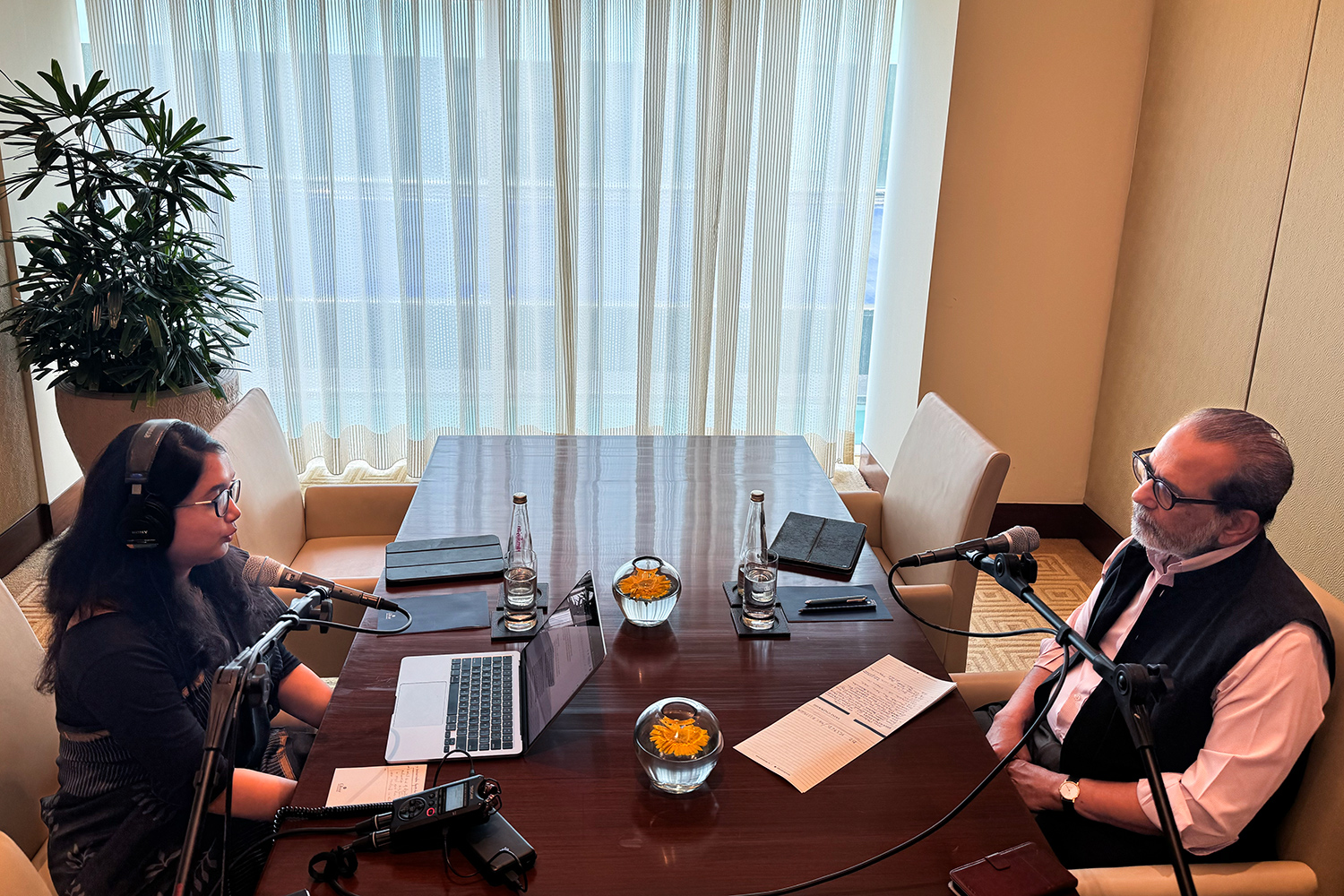
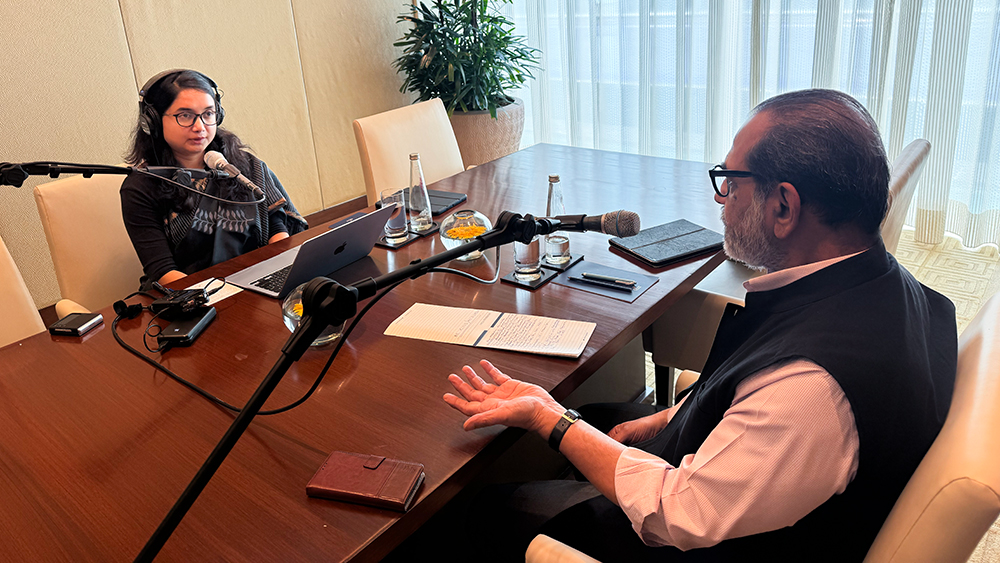
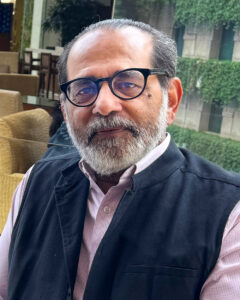
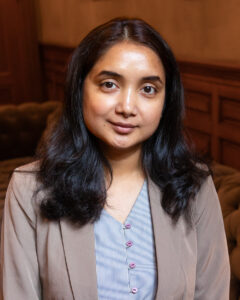
array(1) {
[0]=>
array(348) {
[0]=>
array(4) {
["speaker"]=>
string(14) "Nasima Khatoon"
["timestamp"]=>
string(8) "00:00:03"
["seconds"]=>
int(3)
["text"]=>
string(453) "Thank you, Ambassador for doing this interview. This is an interview with Ambassador Rakesh Sood conducted by Nasima Khatoon for the Oral History Project, a project of the Stanley Center for Peace and Security and BASIC. The interview is taking place on 2nd June 2026 in Gurgaon, India. This is session one of five. Sir, can you start by telling me a bit about where you grew up and what your early life was like? How did you get started in your career?"
}
[1]=>
array(4) {
["speaker"]=>
string(11) "Rakesh Sood"
["timestamp"]=>
string(8) "00:00:37"
["seconds"]=>
int(37)
["text"]=>
string(916) "I was born in Delhi and I studied in Delhi, so you can say I'm a quintessential Delhi person. As a student, I studied physics in university. I did my honors in physics and then did my postgraduate in physics. I was quite passionately interested in theoretical physics, I must say. Fortunately, I had been a good student so I had received scholarships almost all through my university. And there was scholarships in case I wanted to pursue my PhD. I had also in the course of doing my postgraduate degree in physics, I had also had occasion to visit the Bhabha Atomic Research Center and do some projects there for three years running on neutron physics. So that was always another option of going to Bhabha Atomic Research Center, joining them and then doing my PhD there. But I can't really understand, lots of my friends were preparing for the civil services exam and so I just thought that I would give it a shot."
}
[2]=>
array(4) {
["speaker"]=>
string(11) "Rakesh Sood"
["timestamp"]=>
string(8) "00:02:21"
["seconds"]=>
int(141)
["text"]=>
string(91) "So I decided to give it a shot and then before I knew it, I had joined the foreign service."
}
[3]=>
array(4) {
["speaker"]=>
string(14) "Nasima Khatoon"
["timestamp"]=>
string(8) "00:02:27"
["seconds"]=>
int(147)
["text"]=>
string(142) "That's great. So, your early posting, Tokyo to Brussels and then Dakar, Geneva, and subsequently Islamabad in quite different roles. So was..."
}
[4]=>
array(4) {
["speaker"]=>
string(11) "Rakesh Sood"
["timestamp"]=>
string(8) "00:02:43"
["seconds"]=>
int(163)
["text"]=>
string(842) "I joined the foreign service. I became a diplomat in 1976 and that was a very different time. It was a very small service. We barely recruited about 15 to 20 people in a year, the Ministry of External Affairs that is. And your first postings were invariably related to your language. So the language that I was supposed to learn was French. And so I ended up going to Brussels. I spent about 18 months there and then went to another French-speaking capital, which happened to be Dakar, capital of Senegal. Very different kind of an embassy. And then from there I came back. So I came back in about 1983. I spent about three years in Delhi. And then I would say that my career actually took a more decisive turn sometime in '86 when I got posted to Geneva as a first secretary, as an Indian delegate to the conference on disarmament in Geneva."
}
[5]=>
array(4) {
["speaker"]=>
string(11) "Rakesh Sood"
["timestamp"]=>
string(8) "00:04:11"
["seconds"]=>
int(251)
["text"]=>
string(649) "A lot of people sort of find that remarkable, but actually it was purely coincidental when I went there that once I ended up going there, I got involved with all kinds of multilateral negotiations, which then began to cover security related relationships in a big way. I served in Pakistan after Geneva, and came back to Delhi. By the time I came back to Delhi, the world had changed. I saw it changing when I was in Geneva. I was in Geneva when the Berlin Wall came down in '89. I was in Pakistan when the Soviet Union broke up, and had witnessed the withdrawal of the Soviet Union in 1989 from Afghanistan after a 10-year long disastrous debacle."
}
[6]=>
array(4) {
["speaker"]=>
string(11) "Rakesh Sood"
["timestamp"]=>
string(8) "00:05:23"
["seconds"]=>
int(323)
["text"]=>
string(682) "And when I came back to Delhi, it was a very different world that we were looking at. And I was asked to take over what was then the UN disarmament desk, which within six months I found that had very little to do with the UN. It had changed completely and most of it was now related to bilateral security related dialogues. One of the dialogues that had begun in 1992 was a dialogue with the United States. In fact, a lot of people give credit to the Bush administration in the 21st century, but the dialogue was actually begun by his father, Bush Sr. And it's an interesting story. This was, I think, 31st of January 1992, when the first ever UN Security Council summit took place."
}
[7]=>
array(4) {
["speaker"]=>
string(11) "Rakesh Sood"
["timestamp"]=>
string(8) "00:06:41"
["seconds"]=>
int(401)
["text"]=>
string(1061) "It is December 1991 when the Soviet Union broke up and Russia obviously was the successor state. And on 31st of January, there was a first ever summit level meeting. It was the British were presiding, as you know, the UN Security Council chair moves every month. So January of 1992, John Major, the British Prime Minister was presiding, president Bush Sr. was there, Indian Prime Minister Narasimha Rao was representing India because we were a non-permanent member of the security council at that time. I was not in the room. I was too junior. I was outside in case any advice was needed and the foreign secretary was there with them. And since then there have been two or three summits, but this was the first ever summit that had been convened of the UN Security Council since the UN's inception in 1945. And the reason was the growing threat perception arising out of proliferation because the Soviet Union having broken up, you had potential risks of loose nukes as the phrase was then current, and also a number of Soviet scientists in different countries."
}
[8]=>
array(4) {
["speaker"]=>
string(11) "Rakesh Sood"
["timestamp"]=>
string(8) "00:08:23"
["seconds"]=>
int(503)
["text"]=>
string(1030) "And it took a long time for the international community to then be able to convince Ukraine, Kazakhstan and Belarus to give up their nuclear weapons and join the NPT as non-nuclear weapon states. And we see that references to the Budapest memorandum even today. But those were some of the concerns and these concerns were very widely shared. So the Chinese were worried about it, as were the Russians and as were United States and all of West Europe. So on the margins of the UN Security Council Summit meeting, Prime Minister Narasimha Rao had a meeting with President Bush. And President Bush sort of talked about how the world had changed and things like that. And mentioned to him that, "Look, during the Cold War, we were often on different sides, that is India and the United States were often on different sides. And although there were many things that should have brought us closer, but politics often got in the way. But now that the world had changed, perhaps the time had come to start afresh and have a new dialogue.""
}
[9]=>
array(4) {
["speaker"]=>
string(11) "Rakesh Sood"
["timestamp"]=>
string(8) "00:09:58"
["seconds"]=>
int(598)
["text"]=>
string(805) "And obviously Prime Minister Narasimha Rao agreed with what the president was saying and the president told him, he said, "If you agree, Mr. Prime Minister, I think we should start with what has been the most divisive issue between our two countries. And I think we should start with the nuclear issue." Now, mind you, this is January of 1992, but what President Bush was referring to was the fact that US, which had been a partner in the early years, 1950s and '60s, with our civilian nuclear program ended in the '80s, had stopped supplying fuel as which it was committed to do for the Tarapur Nuclear Power plant, because India had conducted a peaceful nuclear explosion in 1974, which led to the setting up of the London Club, which eventually then got a different name as the Nuclear Suppliers Group."
}
[10]=>
array(4) {
["speaker"]=>
string(11) "Rakesh Sood"
["timestamp"]=>
string(8) "00:11:17"
["seconds"]=>
int(677)
["text"]=>
string(971) "And since India had not signed the NPT and proliferation was a major concern, so President Bush felt that this was a subject that the two countries would talk about because it had been a very contentious subject between India and the United States. So Prime Minister Narasimha Rao kind of said, "Are you sure, Mr. President, that we should have the most difficult subject first?" And the president laughed and he said, "I think challenging times and challenging subjects or something like that." And so that is how the dialogue began. The nuclear dialogue actually began in 1992 and I got involved. Similarly, we had other issues. We were engaged in negotiating confidence building measures with Pakistan, an exercise that had begun when I was political counselor in Pakistan in 1990. And I was involved with those as well. We were in the final stages of the negotiations of the Chemical Weapons Convention in Geneva, which I had been involved in when I was posted there."
}
[11]=>
array(4) {
["speaker"]=>
string(11) "Rakesh Sood"
["timestamp"]=>
string(8) "00:12:40"
["seconds"]=>
int(760)
["text"]=>
string(785) "I chaired one of the ad hoc working groups under the chairman of the ad hoc committee chairman, which was I think the Swedish ambassador, Ambassador Rolf Ekeus for some time and then it was the French ambassador, Ambassador Pierre Morel later on. So because I had been involved with that, it also felt to me in the ministry to kind of prepare India for becoming a state party to the Chemical Weapons Convention, which involved, because it had a fairly intensive verification regime, it involved the Ministry of Chemicals and Petrochemicals and it involved the private chemical industry of India. And they had to be brought into the fold in terms of providing returns on certain sensitive chemicals and things like that, which was the first time we were going to do something like that."
}
[12]=>
array(4) {
["speaker"]=>
string(11) "Rakesh Sood"
["timestamp"]=>
string(8) "00:13:47"
["seconds"]=>
int(827)
["text"]=>
string(1002) "Prime Minister Narasimha Rao also announced the Look East policy and so we began a closer engagement with the Southeast Asian countries, ASEAN in particular. And first we became a dialogue partner and then we became a full member of the ASEAN Regional Forum, which is a security dialogue platform of not just ASEAN, but ASEAN is at the core, but involves a lot of other countries, including China, Russia, Japan, South Korea, Australia, New Zealand, United States and Canada. So India became a member of that and that again since it related to security, I was dealing with that as well. So the UN was part of it, but not just the only part. And very quickly I realized, and that is how in the ministry we created what became known as the Disarmament and International Security Affairs Division or D&ISA Division, which I set up. And created the charter for that and realized how difficult it is to get things through bureaucracy, to create a new division with a new name and to get people to accept it."
}
[13]=>
array(4) {
["speaker"]=>
string(11) "Rakesh Sood"
["timestamp"]=>
string(8) "00:15:15"
["seconds"]=>
int(915)
["text"]=>
string(770) "And not just people in my own ministry, but people in other ministries because we had to deal with the atomic energy department, we had to deal with space department, we had to deal with the Ministry of Defense and the defense research and development, on export controls we had to deal with Ministry of Commerce and the Director General of Foreign Trade. On chemical weapons, we had to deal with the Department of Chemicals and the industry associations of the CII, the Confederation of Indian industry and so on. And on biological weapons, biotech, et cetera, we had to deal with the Department of Biotechnology. And to get them to understand what this creation called D&ISA division was, and how come it was all over the place was something which took a lot of doing."
}
[14]=>
array(4) {
["speaker"]=>
string(14) "Nasima Khatoon"
["timestamp"]=>
string(8) "00:16:11"
["seconds"]=>
int(971)
["text"]=>
string(380) "All right, sir, that is really extensive. I was, in fact, going to come back to the D&ISA division. Before that, can I please ask you to probably explain a bit more about your first posting at the Conference on Disarmament in 1986 as a young diplomat, probably how did it really feel at that room which carries so much of history, basically the League of Nations and that thing?"
}
[15]=>
array(4) {
["speaker"]=>
string(11) "Rakesh Sood"
["timestamp"]=>
string(8) "00:16:41"
["seconds"]=>
int(1001)
["text"]=>
string(807) "Well, you have been there, I take it. You've been to Geneva, you've seen the CD plenary room, a plenary hall, which used to be called Sal de Conse of the League of Nations, the Paladinasia. And it's a very impressive hall. If you look at the murals on the wall, these were done by a very famous Spanish artist. If I remember right, I think it was Jose Maria Sert and the Spanish government offered his services. So he came and I think... But ironically, just think of it. The League of Nations was set up after the end of World War I. By the time the building, the halls were completed and by the time Jose Maria Sert had completed his murals on the walls and on the ceilings, it was mid 1930s. And by mid 1930s, Hitler had already come to power in Germany. The League of Nations was increasingly hamstrung."
}
[16]=>
array(4) {
["speaker"]=>
string(11) "Rakesh Sood"
["timestamp"]=>
string(8) "00:18:10"
["seconds"]=>
int(1090)
["text"]=>
string(1041) "Spain was on the verge of breaking out in a civil war and that is the time when this hall, the Sal de Conse, was formally handed over by the Spanish government to the League of Nations. So it is ironical in a sense. And if you look at the murals, it is supposed to reflect 16th century, the beginnings of international law. The School of Salamanca and this was the famous school that brought together theologians, philosophers and Jurists together in Salamanca. And in 16th century, there was a famous Spanish thinker called Francisco de Vitoria and he laid these foundations. And that was so you have, if you remember, if you close your eyes and think on top on the ceiling, the mural has these arms reaching out to clasp each other's hands as a sign of cooperation. Whereas on the walls you have signs of war, you have signs of technology, you have signs of emancipation and you have the idea that there is technological progress is possible, and there is social progress is possible, and economic progress is possible, but there are wars."
}
[17]=>
array(4) {
["speaker"]=>
string(11) "Rakesh Sood"
["timestamp"]=>
string(8) "00:19:54"
["seconds"]=>
int(1194)
["text"]=>
string(189) "And on top is how these are overcome as it were. This was basically the message out of the murals, but every time the speeches got a little boring, it was always good to look at the murals."
}
[18]=>
array(4) {
["speaker"]=>
string(14) "Nasima Khatoon"
["timestamp"]=>
string(8) "00:20:10"
["seconds"]=>
int(1210)
["text"]=>
string(241) "Oh, that's good. All right, sir. I believe at the same time you were also part of a small group with Rafael Grossi, the present Director General of IAEA. How was your work experience with him? How he might have shaped the thinking of the..."
}
[19]=>
array(4) {
["speaker"]=>
string(11) "Rakesh Sood"
["timestamp"]=>
string(8) "00:20:31"
["seconds"]=>
int(1231)
["text"]=>
string(1025) "Well, Rafael was, I think, one of the junior most diplomats at that time in the Argentinian delegation. I think he was still a second secretary or a third secretary. And the CD was much smaller. There were only 40 countries that were members of the Conference on Disarmament, today there are 65. And so we worked very closely and the action was all on the chemical weapons because those were the only substantive negotiations that were taking place. Although my interest, given my background, was much more on the nuclear side. And we had a number of nuclear related items on the agenda, but somehow or the other we could not commence negotiations in the sense we could not get a negotiating mandate because the Conference on Disarmament rule is that it works by consensus. Ironically, the only time it did not work by consensus was 1996 and that's a separate story. That was with regard to the CTBT. And at that time I said, I predicted that the CTBT would never see the light of day and it has still not entered into force."
}
[20]=>
array(4) {
["speaker"]=>
string(11) "Rakesh Sood"
["timestamp"]=>
string(8) "00:22:11"
["seconds"]=>
int(1331)
["text"]=>
string(904) "And the irony is that the Conference on Disarmament has never, never been able to undertake any negotiation after 1996. But anyway, I was getting ahead of myself. Yes, so since the chemical weapons negotiations were the ones that were in high gear as it were because Soviet Union, at that time it was still Soviet Union, had accepted for the first time ever the concept of onsite inspections, which meant that there could be international inspectors going on the territory of Soviet Union to look at if there were valid suspicions, let's say, to look at if that particular unit or factory was producing chemical weapons other than what they had declared. So that gave a lot of impetus. And as I mentioned to you earlier, I chaired one of the working groups in the ad hoc committee, which was the primary body for negotiations. And that took a fair bit of time, but it also we had wonderful relationships."
}
[21]=>
array(4) {
["speaker"]=>
string(11) "Rakesh Sood"
["timestamp"]=>
string(8) "00:23:33"
["seconds"]=>
int(1413)
["text"]=>
string(842) "Rafael, his senior was the counsellor, Roberto Garcia Moritan, wonderful Argentinian. We had the Mexican ambassador there. There were some ambassadors that were quite remarkable. The Mexican ambassador there was Alfonso Garcia Robles, who was a Nobel Peace Prize winner for his work on the Treaty of Tlatelolco, the Latin America Nuclear Weapon Free Zone Project. And so he had received the... As a young diplomat, can you imagine looking at a Nobel Peace Prize winner who had got the Nobel Peace Prize for his work on nuclear issues? It is quite an eye-opener. And then we also used to have regularly high level visitors, ministers and so on, vice ministers, ministers coming to address the conference on this arm. So it was a very active place. If you think about it, this is also the time when there was arms control at a bilateral level."
}
[22]=>
array(4) {
["speaker"]=>
string(11) "Rakesh Sood"
["timestamp"]=>
string(8) "00:24:48"
["seconds"]=>
int(1488)
["text"]=>
string(1113) "In 1987, you saw the INF treaty being concluded that had taken about two years, two and a half years of negotiations to conclude that. And that was something that involved all the European countries, obviously, because it meant that the INF treaty meant that both the US and the Soviet Union would take out all intermediate range nuclear missiles of ranges between 500 to 5,500 kilometers, which they had deployed in Europe. So it directly affected Europeans because these missiles were deployed in Germany, in Italy, and elsewhere in Holland and so on, on the American side. And on the Soviet side they were deployed in Belarus, in Ukraine and Poland and so on. And I remember when these negotiations were going on, our Soviet and American colleagues would often get their colleagues who were working on these bilateral negotiations to come and brief the CD as to how these were going. And I think it was in 1988 perhaps if I remember right, or '89, that we actually visited one of the sites where the SS-20s were going to be destroyed. What I'm trying to explain is that you had a lot of this activity going on."
}
[23]=>
array(4) {
["speaker"]=>
string(11) "Rakesh Sood"
["timestamp"]=>
string(8) "00:26:24"
["seconds"]=>
int(1584)
["text"]=>
string(794) "There were active negotiations on a bilateral front. NGOs were very active in the field. You had chemical weapons negotiations going on. And at the same time in Europe you had the OSCE was going to be set up. The CSCE, Conference on Security and Cooperation in Europe had taken place under the initiative of Chancellor Willy Brandt of Germany. The first confidence building measures were being worked upon and I dare say, but I learned a lot from that, which is how we were able to negotiate some of the confidence building measures with Pakistan and subsequently in the 1990s with China. The 1993 agreement on peace and tranquility in the border regions, and the actual confidence building measures on troop movements and things like that in 1996. Compared to today, when arms control is dead."
}
[24]=>
array(4) {
["speaker"]=>
string(14) "Nasima Khatoon"
["timestamp"]=>
string(8) "00:27:38"
["seconds"]=>
int(1658)
["text"]=>
string(31) "Exactly, with new START also..."
}
[25]=>
array(4) {
["speaker"]=>
string(11) "Rakesh Sood"
["timestamp"]=>
string(8) "00:27:41"
["seconds"]=>
int(1661)
["text"]=>
string(780) "There is today no single treaty in arms control that is left and there is no negotiation that is going on. As I mentioned, the CD has been unable to begin any negotiation since 1996. And you see the NPT review conferences, we've just finished the 11th review conference last month, as usual, it ended in failure. The previous one had ended in failure without adopting a final document in 2022. The one prior to that in 2015 had also collapsed without adopting a final document. So people are talking about the CTBT, you have different countries, you had the US claiming that China has been violating and Russia has been violating, and therefore US is going to resume testing. Last year, President Trump made that announcement and shocked everybody until the Secretary of Energy..."
}
[26]=>
array(4) {
["speaker"]=>
string(11) "Rakesh Sood"
["timestamp"]=>
string(8) "00:28:51"
["seconds"]=>
int(1731)
["text"]=>
string(965) "In fact, if I remember right, President Trump had said, "I have directed the Department of War to begin preparations for testing." And then somebody had to correct him and then point out that the nuclear test sites in Nevada were under the Department of Energy and not the Department of War. And then the Secretary of the Department of Energy actually clarified that, "We maintain the site and what we undertake are lab testing and things like that. And as such, there are no plans for explosive testing." Which is what President Trump was hinting at. So you see the collapse of arms control all around. Compared to that, the 1980s was a very different time and you had very, very active diplomacy in the area that was taking place. Both at bilateral level among US and the Soviet Union, the two major powers of the day, as well as at a multilateral level in the United Nations. Both in Geneva as well as in New York in the first committee of the General Assembly."
}
[27]=>
array(4) {
["speaker"]=>
string(14) "Nasima Khatoon"
["timestamp"]=>
string(8) "00:30:00"
["seconds"]=>
int(1800)
["text"]=>
string(240) "All right, sir. So between your two Geneva postings, you were also, if I'm not wrong, has served as a joint secretary for disarmament and non-proliferation. And obviously it was the time you have already spoken about it, but the timeline..."
}
[28]=>
array(4) {
["speaker"]=>
string(11) "Rakesh Sood"
["timestamp"]=>
string(8) "00:30:16"
["seconds"]=>
int(1816)
["text"]=>
string(86) "By the way, it was Joint secretary for Disarmament and International Security Affairs."
}
[29]=>
array(4) {
["speaker"]=>
string(14) "Nasima Khatoon"
["timestamp"]=>
string(8) "00:30:20"
["seconds"]=>
int(1820)
["text"]=>
string(10) "All right."
}
[30]=>
array(4) {
["speaker"]=>
string(11) "Rakesh Sood"
["timestamp"]=>
string(8) "00:30:20"
["seconds"]=>
int(1820)
["text"]=>
string(183) "We didn't have non-prolifration Yes, it covered export controls. So in a sense it dealt with non-proliferation issues, but the term non-proliferation is not in the designation itself."
}
[31]=>
array(4) {
["speaker"]=>
string(14) "Nasima Khatoon"
["timestamp"]=>
string(8) "00:30:34"
["seconds"]=>
int(1834)
["text"]=>
string(220) "Okay. So it was a time when the 1998 Pokhran II test has also happened. So, can you explain a bit about what the environment was like at the Ministry of External Affair in India and what was your experience at that time?"
}
[32]=>
array(4) {
["speaker"]=>
string(11) "Rakesh Sood"
["timestamp"]=>
string(8) "00:30:49"
["seconds"]=>
int(1849)
["text"]=>
string(761) "Well, as I mentioned, when I came back to Delhi, I was involved in the final stages of providing the institutional support from the government of India for the Chemical Weapons Convention. And then after that in 1993, the CWC was concluded and in 1994, President Clinton announced an initiative to launch negotiations for a Comprehensive Test Ban Treaty in the CD. And again, it fell to me to be able to provide the necessary institutional support. So I used to coordinate the positions between our Department of Atomic Energy, and the Prime Minister's Office, and the Ministry of External Affairs and the other agencies. Let's not forget that at that time we had fairly conclusive evidence of the fact that Pakistan had actually produced a nuclear device with-"
}
[33]=>
array(4) {
["speaker"]=>
string(11) "Rakesh Sood"
["timestamp"]=>
string(8) "00:32:06"
["seconds"]=>
int(1926)
["text"]=>
string(267) "... produced a nuclear device with the help of China. As you know, China had not signed the NPT when it was opened for signature in 1968. China only signed the NPT in 1992. It became a party to the NPT in 1992. So, for all these years, China was not bound by the NPT."
}
[34]=>
array(4) {
["speaker"]=>
string(11) "Rakesh Sood"
["timestamp"]=>
string(8) "00:32:31"
["seconds"]=>
int(1951)
["text"]=>
string(1098) "And, today, the history of Pakistan's nuclear program is pretty well established. It felt that, particularly after the 1971 war with India when the country broke up and East Pakistan seceded as an independent country called Bangladesh, the Pakistan government had decided that the only way they could safeguard their security vis-a- vis India would be to have a nuclear device. And they began the whole enrichment program with A. Q. Khan; Dr. A. Q. Khan, who in a sense had been working with the Dutch company called Urenco, a uranium enrichment company. And he came back with the designs of centrifuges, and that is how the Pakistani nuclear program had its origin from there. So, during the '80s, it was actively assisted by China. The Pakistanis had carried out a cold test, which means they had tested all the components together of the device minus... without putting in the nuclear device, successfully by about '86, '87. And, subsequently, before the end of the '80s, they (China) had brought the Pakistani scientists and a Pakistani device and tested it at their own test site at Lop Nor."
}
[35]=>
array(4) {
["speaker"]=>
string(11) "Rakesh Sood"
["timestamp"]=>
string(8) "00:34:24"
["seconds"]=>
int(2064)
["text"]=>
string(746) "Our intelligence had given us their assessments of these activities, as had other Western intelligence agencies, to a very high degree of credibility. So we were conscious of the fact that this had direct bearings on our security, national security, in the sense that not only did we have a country, China namely, on our northern border with which we had a disputed boundary issue, that was a nuclear weapon state, that we also now had Pakistan on our western border as a country which was an undeclared nuclear weapon state. So one was a declared weapon state and the other was an undeclared weapon state, and the two had close strategic relationship. And so, therefore, we were still committed to the negotiations of the CTBT in a very big way."
}
[36]=>
array(4) {
["speaker"]=>
string(11) "Rakesh Sood"
["timestamp"]=>
string(8) "00:35:48"
["seconds"]=>
int(2148)
["text"]=>
string(1226) "But we also, because after all, if you look at the history of the CTBT, if you go to the website of the CTBTO and you look at the chapter on the history, you will find that one of the first big references and the initiatives was the initiative taken by Prime Minister Jawaharlal Nehru in the early 1950s because, at that time in 1954 when the big hydrogen bomb test took place, it was an atmospheric test. Can you imagine a megaton-level test taking place in the atmosphere and the kind of fallout and so on? And so he made an very impassioned plea for a ban on all testing as a first step towards giving up on nuclear weapons. And, given that old sort of history of the CTBT in which India had taken initiatives way back in the 1950s, so we were very closely involved, but we also wanted it to not just become a mere nonproliferation tool, but actually to become a genuine first step towards eliminating nuclear weapons. We were extremely perturbed when there was lack of interest in defining a nuclear test. I mean, after all, if you have a treaty that says, "Banning nuclear tests," what is a nuclear test? We should have a technical, proper technical definition. And we found that there was not much of an interest in it."
}
[37]=>
array(4) {
["speaker"]=>
string(11) "Rakesh Sood"
["timestamp"]=>
string(8) "00:37:36"
["seconds"]=>
int(2256)
["text"]=>
string(575) "I was at that time in charge of the division, which is the Joint Secretary heading that division, having set it up three, four years earlier, which would be like a bureau in the US State Department or an assistant secretary equivalent. And we were aware of the fact that the Americans were having discussions with the Russians and with the Chinese quietly on the whole definitional issue. But I suppose the approach being that 'til they had worked out what was going to be the final agreement on a definition that they would not present it to the CD, to the ad hoc committee."
}
[38]=>
array(4) {
["speaker"]=>
string(11) "Rakesh Sood"
["timestamp"]=>
string(8) "00:38:30"
["seconds"]=>
int(2310)
["text"]=>
string(709) "Eventually, when they did come out with it, it was called a zero yield explanation, a zero yield test ban. Most people are unaware of what that means, which is why even President Trump, last year when he announced that the US was ready to resume testing, it led to some kind of a confusion as to what it was that the US was planning to do. And the zero yield test is essentially a test where you begin a nuclear chain reaction, but you cut it very quickly. To initiate the nuclear chain reaction, you need a certain amount of conventional explosive power. And the zero yield definition is that you cut the nuclear chain reaction before it exceeds the nuclear explosive power that has been used to initiate it."
}
[39]=>
array(4) {
["speaker"]=>
string(14) "Nasima Khatoon"
["timestamp"]=>
string(8) "00:39:40"
["seconds"]=>
int(2380)
["text"]=>
string(50) "All right. So, in a way, that's a controlled test."
}
[40]=>
array(4) {
["speaker"]=>
string(11) "Rakesh Sood"
["timestamp"]=>
string(8) "00:39:42"
["seconds"]=>
int(2382)
["text"]=>
string(882) "It's a controlled explosive test because you have initiated a chain reaction, but you have cut the chain reaction. Now, it requires, obviously, a lot of very sophisticated engineering and sophisticated control mechanisms. A lot of computing has to go into design to actually simulate the test and, therefore, you need a lot of data. Now, the US obviously had enough data. And that is one of the reasons why the Chinese continued to test till early 1996, as did the French, because both the Russians and the Americans had data from nearly a thousand tests or over a thousand tests each, whereas these countries had comparatively much more limited data. And particularly you didn't really have computers in the '50s, '60s, '70s, so to have credible data that could enable you to design and simulate nuclear tests that could observe the zero yield treaty, a zero yield test-ban treaty."
}
[41]=>
array(4) {
["speaker"]=>
string(11) "Rakesh Sood"
["timestamp"]=>
string(8) "00:41:00"
["seconds"]=>
int(2460)
["text"]=>
string(442) "So, actually, the technical name for the CTBT should not be a comprehensive test-ban treaty. It should be a zero yield test-ban treaty, but it wouldn't go down that well. So when we saw this direction it was taking, we put forward a series of amendments to try and link the CTBT, to anchor it more firmly to nuclear disarmament. These amendments were put forward in January of 1996. I remember going to Geneva at that time and speaking there."
}
[42]=>
array(4) {
["speaker"]=>
string(11) "Rakesh Sood"
["timestamp"]=>
string(8) "00:41:45"
["seconds"]=>
int(2505)
["text"]=>
string(946) "And, also, I used to go to Geneva from Delhi every two months to just talk to the different delegations since I knew them from my earlier.(time).. many of them from my earlier stint and so on. And then I had the whole advantage of the physics background. And, at home, I would be also talking to the atomic energy people and checking with them and to... how things are and getting them to educate me a little more on the processes. But, once we found that this was not going to be the case, that our amendments were not gaining acceptance, we withdrew from the negotiations. In June of 1996, we announced that this is not the CTBT that we had envisaged. We took part in the negotiations in good faith. But, since this is not proceeding in the direction in which we would have liked to, we had suggested certain amendments. But since these have not enjoyed consensus, we don't want to stand in the way and we will withdraw from these negotiations."
}
[43]=>
array(4) {
["speaker"]=>
string(11) "Rakesh Sood"
["timestamp"]=>
string(8) "00:43:09"
["seconds"]=>
int(2589)
["text"]=>
string(435) "And, quite naturally, if we were withdrawing from the negotiations, we also withdrew the prospect of any verification sites like seismic monitoring stations and radionuclide monitoring stations or hydronuclear monitoring stations on Indian territory or in Indian waters. I mean, this is a sovereign right because every country as a member of the CD works by consensus. A country has the right whether to join or not to join the treaty."
}
[44]=>
array(4) {
["speaker"]=>
string(11) "Rakesh Sood"
["timestamp"]=>
string(8) "00:43:45"
["seconds"]=>
int(2625)
["text"]=>
string(614) "However, one month later, the article of entry into force was changed at an Australian initiative, or British initiative if I remember right, a British initiative. And they said that the treaty will enter into force if the following countries, and 44 countries were listed by name, sign and ratify, and included in that was India. So, at that time, when the treaty was open for signature, I had predicted two things. I said, "First, you have ensured that this treaty will never see the light of day. And, secondly, now it is just a question of time that India will have to test." And this is what happened in 1998."
}
[45]=>
array(4) {
["speaker"]=>
string(11) "Rakesh Sood"
["timestamp"]=>
string(8) "00:44:39"
["seconds"]=>
int(2679)
["text"]=>
string(463) "The fact that Pakistan followed within 13 days of our tests and carried out or claims to have carried out six tests, I mean, obviously, shows that Pakistan was not just ready, but had the devices because, if Pakistan did not have the devices, there is no way they could have fabricated six devices in 14 days. So it only served to prove the intelligence that we had had about Pakistan having become a undeclared nuclear weapon state by the time of the late 1980s."
}
[46]=>
array(4) {
["speaker"]=>
string(14) "Nasima Khatoon"
["timestamp"]=>
string(8) "00:45:19"
["seconds"]=>
int(2719)
["text"]=>
string(176) "Exactly. As you said, the ratification part, the countries which actually signed the treaty, I believe all of them didn’t even ratify it...the CTBT, I'm talking about, so to-"
}
[47]=>
array(4) {
["speaker"]=>
string(11) "Rakesh Sood"
["timestamp"]=>
string(8) "00:45:35"
["seconds"]=>
int(2735)
["text"]=>
string(410) "Well, the US signed. The US was the first to sign because it was a Clinton initiative. And, in 1996, when it was opened for signature, the US signed. But, later in the 1990s, President Clinton had lost credibility, partly on account of the Monica Lewinsky scandal and all the rest of it. And then there was a Republican majority in the senate which refused to ratify it, so the US remained unable to ratify it."
}
[48]=>
array(4) {
["speaker"]=>
string(11) "Rakesh Sood"
["timestamp"]=>
string(8) "00:46:06"
["seconds"]=>
int(2766)
["text"]=>
string(645) "The Chinese, who had also signed, saw that the US was not ratifying it and announced that they'll only ratify it after the US ratifies it, so that was out. You had Russia, which had ratified actually. And, as you know, last year, they withdrew their ratification to bring it to the same level as... They said, "Our level of adherence to the CTBT henceforth will be at the same level as that of the United States." And then, of course, India has neither signed nor ratified. Pakistan neither signed or ratified. There are other countries as well. And, given the overall state of arms control, I'm sorry to say, but my prediction still holds true."
}
[49]=>
array(4) {
["speaker"]=>
string(14) "Nasima Khatoon"
["timestamp"]=>
string(8) "00:46:57"
["seconds"]=>
int(2817)
["text"]=>
string(303) "Do you see, sir, any future possibility, any of these kind of treaties coming up or arms control at least moving forward, because we see probably the similar trend when it comes to nuclear disarmament also, Or do you think probably in the disarmament movement, we are doing better than the arms control?"
}
[50]=>
array(4) {
["speaker"]=>
string(11) "Rakesh Sood"
["timestamp"]=>
string(8) "00:47:17"
["seconds"]=>
int(2837)
["text"]=>
string(703) "Well, first of all, even with regard to... The Chemical Weapons Convention was the last disarmament convention. Because it actually eliminated all chemical weapons, it at least created a law, I'm not saying, but because, after that, even though there were reports, let's say, about the use of chemical weapons in Syria or elsewhere, it enabled the international community to take action against those countries. And the international community did come together to take action. So, having the law does not... Look at society, you have a law saying that stealing is illegal. That doesn't mean that stealing stops. What it means is that, if there is a thief, the thief can be prosecuted in a court of law."
}
[51]=>
array(4) {
["speaker"]=>
string(11) "Rakesh Sood"
["timestamp"]=>
string(8) "00:48:13"
["seconds"]=>
int(2893)
["text"]=>
string(809) "So, in that sense, that is what international law is. International law also requires enforcement. And the fact that you have a treaty like the Chemical Weapons Convention or other such treaties, you have the enforcement mechanism. But, today, the problem is that one reason why you don't have any negotiation is because you don't have any convergence of views among the major powers of the day. And, secondly, the UN has lost credibility to a great extent with its silence in recent years about the wars that have been taking place with gross violations of human rights and things like that. And having lost their credibility, so, therefore, the UN doesn't have that enforcement. And how will major powers enforce one against the other? I mean, that's impossible and when they themselves are engaged in wars."
}
[52]=>
array(4) {
["speaker"]=>
string(11) "Rakesh Sood"
["timestamp"]=>
string(8) "00:49:09"
["seconds"]=>
int(2949)
["text"]=>
string(907) "So, unless you see a change in the relationship among the major powers, I don't think we are going to see a return to arms control or disarmament or any kind of multilateral negotiations. In fact, if you look at the area of global trade, WTO, World Trade Organization, you see a complete collapse there with unilateral application of tariffs. So where do you see multilateralism? When there was COVID-19, we saw how ineffective the WHO, the World Health Organization was because all the Western countries, the developed countries resorted to vaccine nationalism. They wanted to hold up vaccines for their own use, for their second and third shorts rather than let it be globally distributed. So there is a tendency back towards a kind of nationalism. On one hand, we all talk about multipolarity, but we must understand that multipolarity without multilateralism is actually a recipe for chaos and conflict."
}
[53]=>
array(4) {
["speaker"]=>
string(14) "Nasima Khatoon"
["timestamp"]=>
string(8) "00:50:25"
["seconds"]=>
int(3025)
["text"]=>
string(722) "Okay, sir. Sir, going back to a bit about your educational background, do you believe... Because you had this interest in nuclear physics and eventually you ended up in Indian Foreign Services, do you think that actually helped you...the policy background and the scientific background, to understand the affair better? Because I was thinking that I'll ask you about the Disarmament and International Security Affairs division, what led you to think that... what was the thinking behind the creation of such an unique organization in India, because we really don't see, even if we are a nuclear weapon state, a lot, many organizations in India, which is working towards that direction, I mean, not very actively probably?"
}
[54]=>
array(4) {
["speaker"]=>
string(11) "Rakesh Sood"
["timestamp"]=>
string(8) "00:51:09"
["seconds"]=>
int(3069)
["text"]=>
string(48) "Sorry. I didn't... Can you repeat your question?"
}
[55]=>
array(4) {
["speaker"]=>
string(14) "Nasima Khatoon"
["timestamp"]=>
string(8) "00:51:13"
["seconds"]=>
int(3073)
["text"]=>
string(140) "Yes. I'm asking that... Your interest in nuclear physics, did that help you to understand the overall affair of nuclear policymaking better?"
}
[56]=>
array(4) {
["speaker"]=>
string(11) "Rakesh Sood"
["timestamp"]=>
string(8) "00:51:23"
["seconds"]=>
int(3083)
["text"]=>
string(12) "Obviously. ."
}
[57]=>
array(4) {
["speaker"]=>
string(14) "Nasima Khatoon"
["timestamp"]=>
string(8) "00:51:25"
["seconds"]=>
int(3085)
["text"]=>
string(5) "Okay."
}
[58]=>
array(4) {
["speaker"]=>
string(11) "Rakesh Sood"
["timestamp"]=>
string(8) "00:51:26"
["seconds"]=>
int(3086)
["text"]=>
string(788) "Because I could understand (the technicalities). Also no policies are made in a vacuum. Policies, all policies that are made have to serve national interest, whether it is a trade policy or whether it is an environment policy or whether it is a security-related policy or anything like that. That is a given, so, therefore, the fact that I had a background in nuclear physics, and many of the people with whom I had worked on my projects were now heading the nuclear establishment or were very senior people, I mean, Dr. Chidambaram who in the 1990s was head of the Department of Atomic Energy had been my project guide in 1973 to 1974 in neutron physics because, at that time, he was heading the neutron physics group. Dr. P. K. Iyengar had been the head of the physics program in BARC."
}
[59]=>
array(4) {
["speaker"]=>
string(14) "Nasima Khatoon"
["timestamp"]=>
string(8) "00:52:29"
["seconds"]=>
int(3149)
["text"]=>
string(280) "Sir, so was that a kind of... the creation of the Disarmament and International Security Affairs Division in MEA which you directed as the first director? So what was the real thinking behind that? Why did it come up at that time? I believe you were heading that 'til end of 2000-"
}
[60]=>
array(4) {
["speaker"]=>
string(11) "Rakesh Sood"
["timestamp"]=>
string(8) "00:52:48"
["seconds"]=>
int(3168)
["text"]=>
string(4) "Yes."
}
[61]=>
array(4) {
["speaker"]=>
string(14) "Nasima Khatoon"
["timestamp"]=>
string(8) "00:52:49"
["seconds"]=>
int(3169)
["text"]=>
string(122) "... and these long nine years. So can you like explain your... probably the tenure there and your experience at that time?"
}
[62]=>
array(4) {
["speaker"]=>
string(11) "Rakesh Sood"
["timestamp"]=>
string(8) "00:52:57"
["seconds"]=>
int(3177)
["text"]=>
string(849) "Well, as I explained to you, the disarmament was, before that, had become limited to UN disarmament, so it was speeches in the CD or speeches in the IAEA in Vienna or speeches in the UN General Assembly without it relating to anything bilateral in that sense. However, with the end of the Cold War, as I explained to you, India's requirements changed. We began talking to the United States for the first time on nuclear issues, something that had not happened since the 1970s. We found that Soviet Union, which had been a major supplier of weapons and, therefore, helped us in terms of our security, had broken up. We found that we had different economic interests which also made us turn eastwards. And they were looking at their security. A kind of a bipolar world situation that had created a certain security paradigm was no longer in existence."
}
[63]=>
array(4) {
["speaker"]=>
string(11) "Rakesh Sood"
["timestamp"]=>
string(8) "00:54:27"
["seconds"]=>
int(3267)
["text"]=>
string(921) "We were negotiating confidence-building measures with both Pakistan and China. We had dialogues with both Pakistan and China at the foreign secretary level and so on. And, obviously, because these related to security, the D&ISA Division got involved. Since nonproliferation had become a major objective after the Security Council Summit on the 31st of January in 1992, we also had to, as a responsible state, make sure that Indian dual-use chemicals or dual-use technologies or dual-use equipment are not exported out irresponsibly. And so we had to put into place a license scheme. How do I convince my private sector? He'd say, "Well, what's the problem? We are earning foreign exchange. India is short of foreign exchange." Do you remember in 1991, we had an acute foreign exchange crisis where we had to hypothecate our gold reserves to be able to tide over that and there was a big focus on getting foreign exchange?"
}
[64]=>
array(4) {
["speaker"]=>
string(11) "Rakesh Sood"
["timestamp"]=>
string(8) "00:55:39"
["seconds"]=>
int(3339)
["text"]=>
string(518) "And my commerce ministry friends would tell me, "What is wrong with you? The government is telling us to export. And you are stopping exports." So I had to explain to them that, "I'm not stopping exports, but I'm asking you to put it under license so that you can verify that it is actually going where you intend it to go and it is going to be used for what you intend it to be used for." But it required a lot of education, so, obviously, it all came into the Disarmament and International Security Affairs Division."
}
[65]=>
array(4) {
["speaker"]=>
string(14) "Nasima Khatoon"
["timestamp"]=>
string(8) "00:56:10"
["seconds"]=>
int(3370)
["text"]=>
string(287) "All right. So, sir, work on that direction was being held in the D&ISA Division, so it was also like... it was mostly...like what was the main function of the D&ISA department? It was mostly working on the policy part of it, the policy recommendations to the government or the different-"
}
[66]=>
array(4) {
["speaker"]=>
string(11) "Rakesh Sood"
["timestamp"]=>
string(8) "00:56:29"
["seconds"]=>
int(3389)
["text"]=>
string(13) "That is what-"
}
[67]=>
array(4) {
["speaker"]=>
string(14) "Nasima Khatoon"
["timestamp"]=>
string(8) "00:56:29"
["seconds"]=>
int(3389)
["text"]=>
string(16) "... departments-"
}
[68]=>
array(4) {
["speaker"]=>
string(11) "Rakesh Sood"
["timestamp"]=>
string(8) "00:56:29"
["seconds"]=>
int(3389)
["text"]=>
string(4) "Yes."
}
[69]=>
array(4) {
["speaker"]=>
string(14) "Nasima Khatoon"
["timestamp"]=>
string(8) "00:56:30"
["seconds"]=>
int(3390)
["text"]=>
string(28) "... that you have mentioned?"
}
[70]=>
array(4) {
["speaker"]=>
string(11) "Rakesh Sood"
["timestamp"]=>
string(8) "00:56:32"
["seconds"]=>
int(3392)
["text"]=>
string(4) "Yes."
}
[71]=>
array(4) {
["speaker"]=>
string(14) "Nasima Khatoon"
["timestamp"]=>
string(8) "00:56:32"
["seconds"]=>
int(3392)
["text"]=>
string(341) "All right. Sir, as I was asking previously that, given your background, do you see, in India, we have... recommend to come up with this kind of institution more where people from policy background and science background, I'm talking about nuclear policy, need to work together so that probably they have a better understanding of the issues?"
}
[72]=>
array(4) {
["speaker"]=>
string(11) "Rakesh Sood"
["timestamp"]=>
string(8) "00:56:58"
["seconds"]=>
int(3418)
["text"]=>
string(729) "Well, all ministries are designed to generate policy options for the government of the day, and then, based on the decisions that are taken, to have institutional mechanisms for implementation of those policies. That is essentially the job of a government. That doesn't mean that somebody who's necessarily dealing with agriculture needs to have a nuclear physics background, but, yes, it would certainly help if they had some background in agriculture. But it just so happened that I was fortunate in being there at that particular point in time and I had an interest in the subject. And it worked well, and then I just continued working in that field because, throughout this time, I was also involved with our bilateral talks."
}
[73]=>
array(4) {
["speaker"]=>
string(11) "Rakesh Sood"
["timestamp"]=>
string(8) "00:58:01"
["seconds"]=>
int(3481)
["text"]=>
string(491) "And, particularly after the nuclear tests in 1998, it became an extremely busy time because we were involved. We were traveling to different countries. We were having discussions and negotiations with different countries to explain to them the rationale for our nuclear tests and why it should not be seen as a proliferation, but more as something that we were driven to do because of our security environment. And we remained equally committed to non-proliferation as a strategic objective."
}
[74]=>
array(4) {
["speaker"]=>
string(14) "Nasima Khatoon"
["timestamp"]=>
string(8) "00:58:51"
["seconds"]=>
int(3531)
["text"]=>
string(390) "All right. So, after your service in D&ISA Division, you were sent as India's the first ambassador and the permanent representative to the Conference on Disarmament. So, sir, what was the idea behind creating first this kind of position in CD when it was not there earlier? And what was your experience at that time? You have already shared a bit about it, so if you can talk more about it?"
}
[75]=>
array(4) {
["speaker"]=>
string(11) "Rakesh Sood"
["timestamp"]=>
string(8) "00:59:22"
["seconds"]=>
int(3562)
["text"]=>
string(1729) "Well, the reason was very simple because, as I was explaining to you, I was involved with our... After the nuclear test, I was involved with our negotiations. One of the most intense periods of negotiations was with the United States, between US Deputy Secretary Strobe Talbott and the Indian Foreign Minister Jaswant Singh. We were meeting almost every second month. We had some 14 or 15 rounds of talks in something like 20 months. And this required generating an appropriate perception of India's role both in the region and globally, not merely seen through a nonproliferation prism or the NPT prism. And I think the fact that we were successful in that is what then led to subsequent negotiations which, again, I was involved in when I was posted in Washington, which led to the final nuclear agreement in 2008, the only exception that has been given which was, in a sense, I think, a result of those intensive negotiations that helped to change perceptions. I was also involved with other negotiations on the nuclear side and with other countries. With Israel, for example, I helped to set up the strategic dialogue with Israel in 1999. And I was involved with our negotiations with Pakistan which initially took a downturn after '98, but then, based on some of the initiatives that Prime Minister Vajpayee took of going to Lahore. But, remember, before going to Lahore, there had been work on creating an MOU on nuclear confidence-building measures which was the first time, which meant that India had to convey that, yes, of course, we accept that Pakistan is a nuclear weapon state. I mean, we had known that, but, after Pakistan tested, both countries had to acknowledge that reality. And that reality was acknowledged."
}
[76]=>
array(4) {
["speaker"]=>
string(11) "Rakesh Sood"
["timestamp"]=>
string(8) "01:02:02"
["seconds"]=>
int(3722)
["text"]=>
string(698) "So, given all this, and given my involvement in all of these negotiations, it was only natural that most of the other countries that have nuclear weapons, whether it is US or UK or France or China or Russia that have separate ambassadors for disarmament, and many other countries, even nonnuclear weapon states, many of them do, that India would also create a separate position of an ambassador for disarmament affairs. And so, when I went there, it was dedicated because, otherwise, the ambassador who was there would be splitting his time between the CD, the Human Rights Commission, the specialized agencies like WHO, ITU, ILO, and so on. And there are about a dozen such specialized agencies. ."
}
[77]=>
array(4) {
["speaker"]=>
string(14) "Nasima Khatoon"
["timestamp"]=>
string(8) "01:03:22"
["seconds"]=>
int(3802)
["text"]=>
string(492) "All right. Good morning, Ambassador. This is the second session of Oral History Interview with Ambassador Rakesh Sood conducted by Nasima Khatoon for the Oral History Project, a project of the Stanley Center for Peace and Security and BASIC. The interview is taking place on 3rd June, 2026, in Gurgaon, India. So, to catch up with yesterday's session, what kind of strategic partnerships India was developing around 1990s? And how was your involvement in that or what is your comment on that?"
}
[78]=>
array(4) {
["speaker"]=>
string(11) "Rakesh Sood"
["timestamp"]=>
string(8) "01:03:56"
["seconds"]=>
int(3836)
["text"]=>
string(440) "That's an interesting idea actually. Strategic partnerships was a description of relationships that did not really exist at least in the Indian foreign policy vocabulary during the Cold War because, as I had mentioned, India had a nonaligned foreign policy. I think everybody knows that. So, in that sense, there was a shift with the end of the Cold War. Now, if there are no two superpowers, then where are you nonaligned from? And that's-"
}
[79]=>
array(4) {
["speaker"]=>
string(14) "Nasima Khatoon"
["timestamp"]=>
string(8) "01:04:37"
["seconds"]=>
int(3877)
["text"]=>
string(8) "Exactly."
}
[80]=>
array(4) {
["speaker"]=>
string(11) "Rakesh Sood"
["timestamp"]=>
string(8) "01:04:38"
["seconds"]=>
int(3878)
["text"]=>
string(538) "By definition, it becomes a little difficult then to define it. So it's not that we were now going to be aligned or allied with the United States, but, obviously, we had a partnership. And I think, yesterday, I was talking about how the dialogue on nuclear issues was started. And it's not just India that had this realization. As I mentioned yesterday, it was President George Bush in early 1992 who suggested and who talked of the fact that the world had changed and we needed to engage more, including on issues that had been divisive."
}
[81]=>
array(4) {
["speaker"]=>
string(11) "Rakesh Sood"
["timestamp"]=>
string(8) "01:05:23"
["seconds"]=>
int(3923)
["text"]=>
string(412) "So, looking back, the first relationship that we used the word, where we used the word strategic partnership was actually in January of 1998 with France. President Chirac had come as the chief guest on our Republic Day. And, in his speech, he talked of India as a responsible nuclear power. He did not talk of... And, obviously, this is January of 1998, so... January of... sorry, January of, yes, 1998, because-"
}
[82]=>
array(4) {
["speaker"]=>
string(11) "Rakesh Sood"
["timestamp"]=>
string(8) "01:06:05"
["seconds"]=>
int(3965)
["text"]=>
string(577) "... January of 19... Yes, 1998, because we conducted the test in May of 1998. But he talked of India as a responsible nuclear power because we had an extensive civilian nuclear program, which had been one of the oldest in the world. We had started our first nuclear research reactor in the 1950s, which was the first research reactor in all of Asia. We started our first nuclear power plant in 19... It went operational in 1969. And again, it was the first nuclear power plant in all of Asia. So in that sense, and we had demonstrated a certain capability in 1974 with the PNE."
}
[83]=>
array(4) {
["speaker"]=>
string(11) "Rakesh Sood"
["timestamp"]=>
string(8) "01:06:59"
["seconds"]=>
int(4019)
["text"]=>
string(406) "So France in the joint statement that we issued with this visit, we talked of India and France having a strategic partnership. Then later on, of course, this term got or this adjective got applied to various other countries as well, including... Now today, we have a comprehensive global strategic partnership with the United States because it is such a multidimensional relationship as you can understand."
}
[84]=>
array(4) {
["speaker"]=>
string(11) "Rakesh Sood"
["timestamp"]=>
string(8) "01:07:36"
["seconds"]=>
int(4056)
["text"]=>
string(820) "But there are a number of other countries with which we had negotiations. I mean, one of the key countries at that time was Israel. Although we had had diplomatic relations with Israel, diplomatic recognition, but we had never opened an embassy in each other's country until 1992. So it is only in 1992 that we decided to establish full-fledged embassies in Tel Aviv and in Delhi, and we sent a resident ambassador. In fact, with Israel, the strategic partnership, I got involved with it because at that time the Israeli national security advisor was General David Ivry. And I had worked with Israel because after we had established full diplomatic relations with the establishment of embassies, we got involved with the regional peace process that had been started, and that had a number of multilateral working groups."
}
[85]=>
array(4) {
["speaker"]=>
string(11) "Rakesh Sood"
["timestamp"]=>
string(8) "01:08:55"
["seconds"]=>
int(4135)
["text"]=>
string(891) "One of the multilateral working groups what was abbreviated as the ACRS process, Arms Control and Regional Security process working group. It was co-chaired by Egypt and Israel, and had a number of other regional countries, and of course US and Russia and so on. And some European countries, US and Russia, and regional countries. And I guess India was seen as part of the region which had interests. And General David Ivry used to head the Israeli delegation. Subsequently, he became the national security advisor. And sometime in 1999 when he made the proposal. In fact, he sent his number two, who was also a good friend of mine, Ariel Levite, who came carrying a letter addressed to our Indian national security advisor. And that's how we set in motion the process for a new strategic partnership, which has been very useful in terms of both intelligence, defense, and strategic sharing."
}
[86]=>
array(4) {
["speaker"]=>
string(11) "Rakesh Sood"
["timestamp"]=>
string(8) "01:10:23"
["seconds"]=>
int(4223)
["text"]=>
string(382) "So a number of talks took place including with countries like Japan, countries like UK, but I would say that among the key strategic partnerships that we established at that point in time, some of these were the important ones. And there is an interesting kind of a way in which these emerged as it were, as a natural process of a changing world order after the end of the Cold War."
}
[87]=>
array(4) {
["speaker"]=>
string(14) "Nasima Khatoon"
["timestamp"]=>
string(8) "01:11:15"
["seconds"]=>
int(4275)
["text"]=>
string(131) "So sir, if I understand correctly, you were part of this multilateral groups that were setting up the strategic partnership, right?"
}
[88]=>
array(4) {
["speaker"]=>
string(11) "Rakesh Sood"
["timestamp"]=>
string(8) "01:11:23"
["seconds"]=>
int(4283)
["text"]=>
string(39) "These were bilateral, not multilateral."
}
[89]=>
array(4) {
["speaker"]=>
string(14) "Nasima Khatoon"
["timestamp"]=>
string(8) "01:11:25"
["seconds"]=>
int(4285)
["text"]=>
string(5) "Okay."
}
[90]=>
array(4) {
["speaker"]=>
string(11) "Rakesh Sood"
["timestamp"]=>
string(8) "01:11:26"
["seconds"]=>
int(4286)
["text"]=>
string(140) "It is India-US, India-Israel, India-France, so it is bilateral. A strategic partnership by definition cannot be with the multilateral group."
}
[91]=>
array(4) {
["speaker"]=>
string(14) "Nasima Khatoon"
["timestamp"]=>
string(8) "01:11:35"
["seconds"]=>
int(4295)
["text"]=>
string(62) "Yeah. The bilateral talks with whether it's Israel or UK. Yes."
}
[92]=>
array(4) {
["speaker"]=>
string(11) "Rakesh Sood"
["timestamp"]=>
string(8) "01:11:38"
["seconds"]=>
int(4298)
["text"]=>
string(39) "Yes, different sets of bilateral talks."
}
[93]=>
array(4) {
["speaker"]=>
string(14) "Nasima Khatoon"
["timestamp"]=>
string(8) "01:11:41"
["seconds"]=>
int(4301)
["text"]=>
string(39) "Okay. So you weree part of those talks?"
}
[94]=>
array(4) {
["speaker"]=>
string(11) "Rakesh Sood"
["timestamp"]=>
string(8) "01:11:41"
["seconds"]=>
int(4301)
["text"]=>
string(4) "Yes."
}
[95]=>
array(4) {
["speaker"]=>
string(14) "Nasima Khatoon"
["timestamp"]=>
string(8) "01:11:43"
["seconds"]=>
int(4303)
["text"]=>
string(114) "Okay. So sir, you were posted at different capacities in Islamabad. Can you please let me know more about it that-"
}
[96]=>
array(4) {
["speaker"]=>
string(11) "Rakesh Sood"
["timestamp"]=>
string(8) "01:11:53"
["seconds"]=>
int(4313)
["text"]=>
string(317) "I was only posted once as the Counselor (Political) in Islamabad, but what we were talking about was the period when I was the joint secretary in Delhi from 1992 until end of 2000. And the different work which D&ISA division or Disarmament and International Security Affairs division that I headed was involved with."
}
[97]=>
array(4) {
["speaker"]=>
string(14) "Nasima Khatoon"
["timestamp"]=>
string(8) "01:12:18"
["seconds"]=>
int(4338)
["text"]=>
string(284) "All right, sir. So moving forward from there, during 2002 and 2003, you are a member of the UN Secretary General's Disarmament Advisory Board. So can you please describe your role during that time, especially noting that the Iran war had just begun around that time with the district-"
}
[98]=>
array(4) {
["speaker"]=>
string(11) "Rakesh Sood"
["timestamp"]=>
string(8) "01:12:39"
["seconds"]=>
int(4359)
["text"]=>
string(9) "Iran war?"
}
[99]=>
array(4) {
["speaker"]=>
string(14) "Nasima Khatoon"
["timestamp"]=>
string(8) "01:12:39"
["seconds"]=>
int(4359)
["text"]=>
string(65) "With the disputed WMD dispute, I mean, the US-Iran confrontation."
}
[100]=>
array(4) {
["speaker"]=>
string(11) "Rakesh Sood"
["timestamp"]=>
string(8) "01:12:45"
["seconds"]=>
int(4365)
["text"]=>
string(28) "There's no war at that time."
}
[101]=>
array(4) {
["speaker"]=>
string(14) "Nasima Khatoon"
["timestamp"]=>
string(8) "01:12:48"
["seconds"]=>
int(4368)
["text"]=>
string(189) "I mean, the conflict started. So do you think that those closed door discussions actually shape how probably the verification and compliance mechanism should actually be or how was it, sir?"
}
[102]=>
array(4) {
["speaker"]=>
string(11) "Rakesh Sood"
["timestamp"]=>
string(8) "01:13:01"
["seconds"]=>
int(4381)
["text"]=>
string(944) "The UN Secretary General's advisory group on disarmament was looking more at subjects that were less political than let us say, the issues relating to Iran. And in any case, Iran at that time was enduring 2001, 2002, was not really a subject of concern. The Iranian concerns only began in 2003 when the first intelligence reports indicated that there was an enrichment program which had not been declared. So it was described as a clandestine enrichment program. That then led to the beginning of talks with the Europeans, and the Europeans took the lead. The E3 took the lead in a dialogue with Iran, France, Germany, UK, if I remember right, and the EU, Brussels, the special representative. But this was not the kind of subjects. These were active politically loaded subjects. So this is not what the UNSG's advisory board does. The UNSG's advisory board looks at specific (future) issues . I mean, the Iran issue in 2003 had become current."
}
[103]=>
array(4) {
["speaker"]=>
string(14) "Nasima Khatoon"
["timestamp"]=>
string(8) "01:14:46"
["seconds"]=>
int(4486)
["text"]=>
string(8) "Exactly."
}
[104]=>
array(4) {
["speaker"]=>
string(11) "Rakesh Sood"
["timestamp"]=>
string(8) "01:14:47"
["seconds"]=>
int(4487)
["text"]=>
string(1102) "It was not a future issue. People were occupied with it even in 2003 in different capitals. The IAEA Board of Governors was discussing it. So the UNSG's advisory board would look at things like greater transparency in armaments, let's say, weapons sales. Because if you remember with the end of the Cold War, almost across the board globally, defense budgets had started coming down. And there was a feeling that perhaps this advantageous situation that had been created could benefit if greater transparency in weapons or holdings or procurements could be introduced. So issues like that, some kind of confidence building measures. Perhaps some new weapon systems which may have been conceived of at that time where some restrictions or things like that could be brought in. That is essentially the UN Secretary General's Advisory Board and that's what they talk about. They seldom talk about contemporary political issues because the contemporary issues relating to arms control are already highly politicized and are being discussed in the Security Council, in the IAEA or elsewhere in other forums."
}
[105]=>
array(4) {
["speaker"]=>
string(14) "Nasima Khatoon"
["timestamp"]=>
string(8) "01:16:35"
["seconds"]=>
int(4595)
["text"]=>
string(368) "Right, sir. Sir, just after the Pokhran II test, you have mentioned in one of the articles, there was probably 14 rounds of talk within the span of two years between the then External Affair Minister, Mr. Jaswant Singh, and US Deputy Secretary of State, Mr. Strobe Talbott. Now you were very much overseeing this process, if I'm not wrong, as part of those bilaterals?"
}
[106]=>
array(4) {
["speaker"]=>
string(11) "Rakesh Sood"
["timestamp"]=>
string(8) "01:17:05"
["seconds"]=>
int(4625)
["text"]=>
string(172) "I would say I was not overlooking the process, but I was a key member of the team as somebody who brought in partly the foreign policy as well as the technical background."
}
[107]=>
array(4) {
["speaker"]=>
string(14) "Nasima Khatoon"
["timestamp"]=>
string(8) "01:17:18"
["seconds"]=>
int(4638)
["text"]=>
string(205) "Yes. And I believe, sir, you also worked with the American team, which contains Robert Einhorn and Norman [inaudible 01:17:25] Wulf, Gary Samore. So what was your working experience with them at that time?"
}
[108]=>
array(4) {
["speaker"]=>
string(11) "Rakesh Sood"
["timestamp"]=>
string(8) "01:17:31"
["seconds"]=>
int(4651)
["text"]=>
string(893) "Well, the American team, there were some sort of four or five fixed people on both sides who were there in all the rounds of talks, and then we would have some additional people present depending on the circumstances of the rounds. The people who were always present, one was... Of course, the delegations were headed by Deputy Secretary of State, Strobe Talbott on the US side, and Foreign Minister Jaswant Singh on the Indian side. On the Indian side, there were three other people who were always present. One was our ambassador in Washington, Ambassador Naresh Chandra. He was a regular presence in all the rounds of talks. I had the good fortune to be present in all the rounds. And my colleague who was the assistant secretary dealing with the United States in the foreign ministry (Alok Prasad) was also always present, and similarly our counterparts. So my counterpart was Bob Einhorn."
}
[109]=>
array(4) {
["speaker"]=>
string(11) "Rakesh Sood"
["timestamp"]=>
string(8) "01:18:59"
["seconds"]=>
int(4739)
["text"]=>
string(866) "Similarly, the US ambassador in Delhi (Amb Dick Celeste) would always be attending. And my colleague Alok Prasad, his counterpart, namely the assistant secretary which was Rick Inderfurth at that time, would also be present. He was the assistant secretary dealing with South Asia. And then of course sometimes we would have other representatives from... Like on the US side, they would have representatives from the Department of Energy, from the National Security Council. So that's how Gary Samore at that time was with the NSC. He would sometimes be present. Now I had known all these people when I was either in the CD or in the bilateral talks, as I mentioned, which we had started with the US in 1992, those talks would have their ups and downs. I mean, there was no fixed periodicity that we were meeting every month or every six months or anything like that."
}
[110]=>
array(4) {
["speaker"]=>
string(11) "Rakesh Sood"
["timestamp"]=>
string(8) "01:20:14"
["seconds"]=>
int(4814)
["text"]=>
string(295) "But yes, normally we would meet about once or twice a year. But then after India decided not to join the CTBT and withdrew from the negotiations, the talks drifted as it were. And then of course there were the nuclear tests. And as you know, US was very, very critical publicly of India's tests."
}
[111]=>
array(4) {
["speaker"]=>
string(11) "Rakesh Sood"
["timestamp"]=>
string(8) "01:20:52"
["seconds"]=>
int(4852)
["text"]=>
string(562) "But during those earlier rounds of talks between say '92 to '96, I had engaged with Bob Einhorn, Norman Wulf, Gary Samore, and other people in that context. So that's how I had known them. Regarding the Strobe Talbott-Jaswant Singh talks, I think that they were absolutely critical in changing the US perceptions about India and also making the US system more aware of India's security challenges and concerns. US is a global power, and they look at the world from different compartments as it were, because they've divided the world into different compartments."
}
[112]=>
array(4) {
["speaker"]=>
string(11) "Rakesh Sood"
["timestamp"]=>
string(8) "01:22:17"
["seconds"]=>
int(4937)
["text"]=>
string(712) "If they had somebody from the defense side on their team, particularly if the talks were taking place in Delhi, we would often ask somebody from the Ministry of Defense or from our services, from our integrated defense staff, one of the officers to do a presentation of India's security environment, maritime, military, borders, et cetera. Similarly, when we were in Washington, often somebody from Pentagon, Strobe Talbott would ask them or we would go to Pentagon and they would do a presentation for us to make us aware of that. One of the things that we found, or at least I realized was that the US has different commands. So at that time it was called PACOM or Pacific Command, which is located in Hawaii."
}
[113]=>
array(4) {
["speaker"]=>
string(11) "Rakesh Sood"
["timestamp"]=>
string(8) "01:23:14"
["seconds"]=>
int(4994)
["text"]=>
string(507) "Now, the Pacific Command covered all of what was in their parlance called Western Pacific in the US jargon. On our side, it basically covered the Pacific Ocean going up Korea, Japan, et cetera, coming down China, South China seas, going all the way up to Australia and New Zealand, as you can understand because It's located in Hawaii. And then covering all of Southeast Asia. And then coming to the Bay of Bengal, right? It did not cover Western Indian Ocean. Now India, as you know, is a peninsular power."
}
[114]=>
array(4) {
["speaker"]=>
string(11) "Rakesh Sood"
["timestamp"]=>
string(8) "01:24:02"
["seconds"]=>
int(5042)
["text"]=>
string(694) "So our security interests are both on the east and the west, maritime security and also... Particularly, because Pakistan is on our west and Pakistan opens out on the Arabian Sea, which is a Western Indian Ocean. And then further on to the Persian Gulf and to the Red Sea and to the East African coast, that was covered by the Central Command. Now, for the Central Command chief, if they looked at their area, they found that one of the most important countries with whom they were working was Pakistan. For the Pacific Command chief, among the important countries that they would work with would be Japan and South Korea, Australia and India as important military powers covering their region."
}
[115]=>
array(4) {
["speaker"]=>
string(11) "Rakesh Sood"
["timestamp"]=>
string(8) "01:25:07"
["seconds"]=>
int(5107)
["text"]=>
string(770) "So we would invariably have extremely positive inputs from the Pacific Command people because they were regular visitors to Delhi, but we had not much of an engagement with the Central Command. After all, the US government is one, but if they are getting two different inputs, because one input that I'm giving to the Pacific Command is that we have a difficult relationship with Pakistan because Pakistan is a sponsor of terrorism and there are infiltrations and all of that. The Central Command fellow is telling the people that Pakistan is extremely important to us. We have a very close relationship with the Pakistani military because they are cooperating with us and they have also helped us provide security in the Gulf region and so on. So you get two different."
}
[116]=>
array(4) {
["speaker"]=>
string(14) "Nasima Khatoon"
["timestamp"]=>
string(8) "01:26:05"
["seconds"]=>
int(5165)
["text"]=>
string(16) "Different ideas."
}
[117]=>
array(4) {
["speaker"]=>
string(11) "Rakesh Sood"
["timestamp"]=>
string(8) "01:26:07"
["seconds"]=>
int(5167)
["text"]=>
string(349) "…because the interests of the two people who are speaking are different. So I'm just using this as an example, in the process as we started engaging, we realized this and we told Strobe Talbott that, look, we find this strange. I'm not saying you shouldn't have a relationship with Pakistan, but at least we need to find some way of bridging this."
}
[118]=>
array(4) {
["speaker"]=>
string(11) "Rakesh Sood"
["timestamp"]=>
string(8) "01:26:38"
["seconds"]=>
int(5198)
["text"]=>
string(473) "So this is just an example of, as I said, of how ... we were able to change perceptions. And then the US realized that at the higher level at the National Security Advisor and National Security Council and so on, things needed to come together to be able to take a holistic view as it were of the India-US relationship. So in some ways, I would say, there was never any joint statement or anything like that that Mr. Jaswant Singh and Mr. Strobe Talbott ever came out with."
}
[119]=>
array(4) {
["speaker"]=>
string(11) "Rakesh Sood"
["timestamp"]=>
string(8) "01:27:17"
["seconds"]=>
int(5237)
["text"]=>
string(631) "There was no joint declaration because in that sense. Normally when prime ministers and presidents, when they meet summit-level meetings, because this was more like a process. As I said, they had something like 14 or 15 rounds of talks in something like 20 months. But I would say that I often describe this when I think back on these negotiations and I talk to Indian diplomats, young diplomats today, where I lecture from time to time, I often say that this was the most intense phase of India-US high level political engagement, the most inconclusive because there was no joint statement or declaration, but the most productive."
}
[120]=>
array(4) {
["speaker"]=>
string(14) "Nasima Khatoon"
["timestamp"]=>
string(8) "01:28:24"
["seconds"]=>
int(5304)
["text"]=>
string(14) "Exactly, yeah."
}
[121]=>
array(4) {
["speaker"]=>
string(11) "Rakesh Sood"
["timestamp"]=>
string(8) "01:28:26"
["seconds"]=>
int(5306)
["text"]=>
string(1055) "Because it helped change perceptions. Now we also had a lot of misgivings about the United States from the 1960s and '70s. In the 1970s when we had the Bangladesh crisis, the US sailed the USS Enterprise, an aircraft carrier, into the Bay of Bengal in a gesture of gunboat diplomacy. And so we had our own baggage; and the US had also taken the lead in putting sanctions on us, denying us technologies and all kinds of things, export controls through their non-proliferation, this thing. So we also had all of those, and so we also had to move from there to developing a partnership. And today as I said, India-US partnership is described as a... It began as a strategic partnership, then it became a comprehensive strategic partnership because it has so many dimensions. And then it became a comprehensive global strategic partnership because with Quad[inaudible 01:29:47] and things like that, that got added on. So it has taken a long time, but the seeds of that or the beginnings of that were I think laid during the Strobe Talbot-Jaswant Singh talks."
}
[122]=>
array(4) {
["speaker"]=>
string(14) "Nasima Khatoon"
["timestamp"]=>
string(8) "01:30:01"
["seconds"]=>
int(5401)
["text"]=>
string(243) "All right. As you said, there was significant improvement in bilateral relations between India and US after the talks, although it was inconclusive but the most productive one. Probably followed by that, was President Clinton's visit, in 2000."
}
[123]=>
array(4) {
["speaker"]=>
string(11) "Rakesh Sood"
["timestamp"]=>
string(8) "01:30:19"
["seconds"]=>
int(5419)
["text"]=>
string(17) "In March of 2000."
}
[124]=>
array(4) {
["speaker"]=>
string(14) "Nasima Khatoon"
["timestamp"]=>
string(8) "01:30:20"
["seconds"]=>
int(5420)
["text"]=>
string(8) "Yes. So-"
}
[125]=>
array(4) {
["speaker"]=>
string(11) "Rakesh Sood"
["timestamp"]=>
string(8) "01:30:22"
["seconds"]=>
int(5422)
["text"]=>
string(117) "So in that sense, the ice was broken. We were having a presidential visit after decades, after more than two decades."
}
[126]=>
array(4) {
["speaker"]=>
string(14) "Nasima Khatoon"
["timestamp"]=>
string(8) "01:30:33"
["seconds"]=>
int(5433)
["text"]=>
string(213) "All right. So do you also feel that subsequently 2005 and '08 the Civil Nuclear deal that it has to do a lot with these bilaterals. And were you also involved in the India-US Civil Nuclear deal to some capacities?"
}
[127]=>
array(4) {
["speaker"]=>
string(11) "Rakesh Sood"
["timestamp"]=>
string(8) "01:30:47"
["seconds"]=>
int(5447)
["text"]=>
string(924) "Well, yes, the process began because after 1998 the US had imposed a whole lot of fresh sanctions on us. So the first thing to do was to get those sanctions lifted. However, there were also sanctions that predated 1998. Some of the sanctions had come in post 1974. Some more had come in during the 1980s because India had a missile program, we had a space program. We were making our own launch vehicles. We were testing our own missiles. So there were a whole host of other sanctions that were imposed on India's space program, defense program, and so on, which predated 1998. So once we had the removal of the extra sanctions and brought the situation to 1998 pre the tests, then we had to work towards identifying some of the other sanctions where we were able to then have those relaxed and waived. On the space program, which is a peaceful program we were able to get some of the sanctions removed on ISRO, for example."
}
[128]=>
array(4) {
["speaker"]=>
string(11) "Rakesh Sood"
["timestamp"]=>
string(8) "01:32:44"
["seconds"]=>
int(5564)
["text"]=>
string(941) "There was a whole process. Then we also had a lot of difficulty in getting licenses because the US has a very elaborate system of export regulations, and there is a munitions list which is administered by the state department. There is the commerce department which has its own export regulations, a whole category of dual use technologies and things like that. And we would find it very difficult to navigate all that and to be able to have access to these technologies. Remember, this is also the time when the Indian economy was opening up, and we needed to have access to many of these things in order to be able to sustain a high level of economic growth and industrial development. So we had set up something called the High Technology Cooperation Group, something called the HTCG. Then as a means towards moving forward, we said, "All right." By the time President Clinton visited, the extra sanctions imposed in 1998 had been lifted."
}
[129]=>
array(4) {
["speaker"]=>
string(14) "Nasima Khatoon"
["timestamp"]=>
string(8) "01:34:17"
["seconds"]=>
int(5657)
["text"]=>
string(110) "Okay. So that was a time when the predated sanctions and the post 1998 sanctions were also lifted around 2000?"
}
[130]=>
array(4) {
["speaker"]=>
string(11) "Rakesh Sood"
["timestamp"]=>
string(8) "01:34:25"
["seconds"]=>
int(5665)
["text"]=>
string(1048) "Post 1998, I said. I said the extra sanctions that were imposed in 1998 were lifted by the time President Clinton came in March of 2000. However, to move things forward, you also needed waivers on a host of other sanctions that I explained on dual use technology and so on. Getting those relaxed was the task of what we called the Next Steps in Strategic Partnership, NSSP. Then as I have already said, we also needed to have access to certain dual use technology, machinery, components, equipment from the US. And for that a High Technology Cooperation Group was set up. So gradually, the US relaxed licensing controls once they were convinced of our non-proliferation credentials, once they were convinced that technologies sent to India were not going to leak out from India to other countries as they developed greater confidence on that. Some of those items were taken off the licensing requirement for India. US has a very complicated and impossible to navigate export control system. Different countries will fall into different categories."
}
[131]=>
array(4) {
["speaker"]=>
string(11) "Rakesh Sood"
["timestamp"]=>
string(8) "01:36:07"
["seconds"]=>
int(5767)
["text"]=>
string(1018) "And now because India has never been an ally of the US, but India is also not an adversary of the US, that is why we call it a partnership, right? So therefore many of those licensing requirements were removed. That was the work done by the High Technology Cooperation Group. So I was a part of the HTCG. I helped navigate the NSSP. The NSSP, the Next Steps in Strategic Partnership was completed in 2004. And then in 2005, the first steps now came the issue of opening up civil nuclear cooperation between India and the US, something that had existed in the 1950s and '60s, but had ended thereafter because India did not join the NPT. So that process began in 2005 with the first joint statement that was made saying that both countries will now move towards developing cooperation also on civilian nuclear cooperation. Because now the obstacles that were there on the export control, et cetera, had been taken care of. However, this process required some additional work to be done and that process took three years."
}
[132]=>
array(4) {
["speaker"]=>
string(11) "Rakesh Sood"
["timestamp"]=>
string(8) "01:37:48"
["seconds"]=>
int(5868)
["text"]=>
string(542) "A lot of people do not realize that by the time this process began, which was in July of 2005 and by the time it ended at the end of 2008, when we signed the 123 Agreement with the United States, President George Bush was at the end of his term. In fact, his term ended in January of 2009 because in the 2008 November elections, Obama had won. So his two terms were almost over by the time we actually completed it. So that is how long it took. And with both Dr. Manmohan Singh pushing it in Delhi and President Bush pushing it in Washington."
}
[133]=>
array(4) {
["speaker"]=>
string(14) "Nasima Khatoon"
["timestamp"]=>
string(8) "01:38:51"
["seconds"]=>
int(5931)
["text"]=>
string(438) "Thank you, sir. So as we understand, since then when the Civil Nuclear deal was signed, India’s Civil Nuclear Power was entirely a state domain until very recently when the sustainable harnessing and advancement of nuclear energy for transforming India or SHANTI Act actually opened it up to the private and foreign investment. So what possibilities do you see that didn't exist before or what is the future of this act in your opinion?"
}
[134]=>
array(4) {
["speaker"]=>
string(11) "Rakesh Sood"
["timestamp"]=>
string(8) "01:39:24"
["seconds"]=>
int(5964)
["text"]=>
string(389) "Well, after the agreement was signed with the United States, the 123 Agreement, it was also it went hand in hand with the waiver that India received from the Nuclear Suppliers Group, because the US is a member of Nuclear Suppliers Group. And for the US to change its law to make India a civilian nuclear energy partner under the 123 Section (of the Atomic Energy Act ), it required that..."
}
[135]=>
array(4) {
["speaker"]=>
string(11) "Rakesh Sood"
["timestamp"]=>
string(8) "01:40:06"
["seconds"]=>
int(6006)
["text"]=>
string(872) "It required that the waiver from the NSG be first given so that US government, US administration could engage in that and submit that to the US Congress. Otherwise, the Congress would have said, "How can you sign a cooperation agreement when your commitment to NSG prohibits it?" So the NSG first had to give a waiver which happened in September of 2008, following which we concluded our discussions and signed the one, two, three agreement. And in November it was approved by President Bush who submitted it to the Congress for approval. And once it was approved, then it actually came into effect. So that is the process. Now, we signed agreement after this waiver with a number of countries, some for supply of fuel, uranium, countries like Kazakhstan or countries in Africa and some we signed for building new civilian nuclear power plants like with France and the US."
}
[136]=>
array(4) {
["speaker"]=>
string(11) "Rakesh Sood"
["timestamp"]=>
string(8) "01:41:28"
["seconds"]=>
int(6088)
["text"]=>
string(692) "With the US, the idea was we had identified two areas where we would set up. One was for the nuclear power plant technology by Westinghouse and the other was by GE. So one of the sites was in I think Andhra Pradesh, Kovvada and another was on the western side, Mithi Virdi. But then in the US there had been a kind of drifting away from nuclear power plants. So Westinghouse had a joint cooperation with Toshiba because Japan had a number of nuclear power plants and GE similarly had a joint venture with Hitachi. Again, both Japanese companies, Toshiba and Hitachi, because as you know, Japan, because it doesn't have any oil, relies a lot either on imported fossil fuel or on nuclear power."
}
[137]=>
array(4) {
["speaker"]=>
string(11) "Rakesh Sood"
["timestamp"]=>
string(8) "01:42:48"
["seconds"]=>
int(6168)
["text"]=>
string(1894) "But then in 2011, we had the Fukushima disaster and the whole world turned away from nuclear power. So that led to a complete lack of interest. In the West, Germany decided that they would shut down all their nuclear power plants and so on. So as a result, nuclear power took a backseat. Meanwhile, in 2010, we had also passed a nuclear liability law and many of the foreign companies, particularly the French company, Areva, with which we were planning to set up power plants at Jaitapur. So the French and the American companies were concerned as to what their liability would be, under the new liability law of India. In fact, there were some Indian companies also that were very concerned about it. So I think overall it took quite some time. The government did try to explain about the implications of the liability law and why it was not open-ended, but still there were concerns and I think it took a long time, but subsequently the government came to understand that if it had to address these concerns, it had to change the law. So that is how you had the SHANTI Act that was passed last year in December, which is in fact much more broad based than just the liability law because in India under the Atomic Energy Act, nuclear power was a sector that was reserved for government and the Nuclear Power Corporation of India (NPCIL) is wholly owned entity belonging to the Department of Atomic Energy. Nuclear Power Corporation NPCIL owns the nuclear power plants and operates the nuclear power plants and designs them. It supervises the building, but it doesn't have... So it has engineers, but it doesn't do the actual construction, it gives contracts. It doesn't build all the boilers and the compressors and the pipes and so on. Other private companies do it, but they do it to the specifications that are laid down by the NPCIL. So in that sense, the NPCIL is the owner of all these."
}
[138]=>
array(4) {
["speaker"]=>
string(11) "Rakesh Sood"
["timestamp"]=>
string(8) "01:46:01"
["seconds"]=>
int(6361)
["text"]=>
string(550) "Now here the question arose that if we wanted to expand our nuclear power sector, then where would the investment come from? Because the NPCIL budget is a finite budget. It's a government department... But that would not be enough because the ambition that has been projected is that from the current level of 8. 8 gigawatts, it would go to 100 gigawatts, which is like a 12 times increase. It's a 1200% increase by 2047 and that would require a lot of investment. So even the old Atomic Energy Act was therefore done away with in the new SHANTI Act."
}
[139]=>
array(4) {
["speaker"]=>
string(11) "Rakesh Sood"
["timestamp"]=>
string(8) "01:46:57"
["seconds"]=>
int(6417)
["text"]=>
string(712) "So it is a big change where private entities can own and operate nuclear power plants. All nuclear power plants, which means they will own it and they will also operate it. However, there will be the licensing for that will still remain with the government and because these plants will be under safeguards, the safeguards obligation is the responsibility of the government of India. So therefore there is a regulatory board and a government licensing process which would be there to supervise this. And this makes it much more similar to the situation that exists in the West where you have privately owned and operated nuclear power plants like in the UK or in the US or in Canada or in, for example, in Japan."
}
[140]=>
array(4) {
["speaker"]=>
string(11) "Rakesh Sood"
["timestamp"]=>
string(8) "01:48:09"
["seconds"]=>
int(6489)
["text"]=>
string(648) "But this law was passed only in December last year and now the rules and regulations of that have to be notified, but there are already a number of Indian private companies, the Ambanis, Adanis, Jindals, Tata consulting engineers and so on who have expressed an interest in setting up nuclear power plants, either in cooperation within NPCIL or in cooperation with American or French partners, foreign partners, Russian partners as well. Because as you know, we have two power plants in Kudankulam, which are already operational, two more are under construction and two more are going to be under construction shortly and that is also a new design."
}
[141]=>
array(4) {
["speaker"]=>
string(11) "Rakesh Sood"
["timestamp"]=>
string(8) "01:49:12"
["seconds"]=>
int(6552)
["text"]=>
string(587) "And then our own design that we have, we have about 18 reactors of that design, which are currently functioning in India, which is the pressurized heavy water reactor. So some of the private players are looking at the possibility of modularizing that particular design and using that because it's a tried and tested design for which the Indian engineering companies and the Indian design companies and the Indian companies like Tatas or Larsen and Toubro or Walchand and so on, they're familiar with the kind of equipment that has to be produced and the specifications of that equipment."
}
[142]=>
array(4) {
["speaker"]=>
string(14) "Nasima Khatoon"
["timestamp"]=>
string(8) "01:50:09"
["seconds"]=>
int(6609)
["text"]=>
string(329) "So as you also mentioned about the Jaitapur nuclear energy project, which was supposed to probably use the French EdF technology and it's been on paper since over a decade, I believe. Were you also part of the negotiation of this energy project? And as you mentioned, is it the liability clause that was the main roadblock for..."
}
[143]=>
array(4) {
["speaker"]=>
string(11) "Rakesh Sood"
["timestamp"]=>
string(8) "01:50:28"
["seconds"]=>
int(6628)
["text"]=>
string(943) "Well, as I mentioned to you, after Fukushima accident in 2011, there was in any case a lack of interest. In fact, Areva went into liquidation and it was taken over by another French public sector company called EdF, Électricité de France. This had nothing to do with the Indian liability law. It was more to do with domestic French developments. Similarly, as I mentioned to you, Fukushima meant that there was no interest left with Toshiba or Hitachi and in any case, Westinghouse had done a JV because it was relying on the Japanese partners. US has not set up, has not built any nuclear plant except one in Georgia now, that is the only one that it has built in the last 25 years. So it is only now with consciousness about green energy, climate change issues, and so on, that there is a renewal of interest in nuclear power and with new technologies of modularization of reactors which would ensure greater safety and economies of scale."
}
[144]=>
array(4) {
["speaker"]=>
string(11) "Rakesh Sood"
["timestamp"]=>
string(8) "01:52:11"
["seconds"]=>
int(6731)
["text"]=>
string(926) "So the reactor that we were supposed to get from France for Jaitapur, that reactor was, it's a brand new kind of a design with additional safety features. There is one that was supposed to go online about 10 years ago. It has just been completed in France now, but at a cost which has gone about four times over of what was originally budgeted. Now obviously as a poor country, it is not going to be possible for us to be able to produce electricity at that kind of a price. So we have to find out ways by using more of local technology and things like that to see whether these designs can be economically viable for the Indian market. We cannot be selling electricity at 25 rupees a unit. Do you know that the current price of electricity today is about five to six rupees a unit? So we will have to make it worthwhile and we also are investing heavily in renewables like solar, like wind, like hydel (hydropower) and so on."
}
[145]=>
array(4) {
["speaker"]=>
string(11) "Rakesh Sood"
["timestamp"]=>
string(8) "01:53:52"
["seconds"]=>
int(6832)
["text"]=>
string(665) "And then we have plenty of reserves of coal, but the government is also committed to a target of net zero by 2070. So therefore today we have had a very ambitious development of renewable energy in India. Today there is about 540 gigawatts of installed power generation in India out of which about 50% is renewables and 50%, slightly less than 50% is thermal. And by thermal, I mean essentially coal, although there are one or two gas fired nuclear power plants, gas fired power plants as well. And then of course, as I mentioned, we have the nuclear power plants, which account for about 2.5% or 2.4% of the total generating capacity, which is about 8.8 gigawatts."
}
[146]=>
array(4) {
["speaker"]=>
string(14) "Nasima Khatoon"
["timestamp"]=>
string(8) "01:54:57"
["seconds"]=>
int(6897)
["text"]=>
string(203) "So as you mentioned, I believe in the solar energy sector also we are facing the similar problem. The cost of generating the power is really high like nuclear or even the maintenance of it. Is that true?"
}
[147]=>
array(4) {
["speaker"]=>
string(11) "Rakesh Sood"
["timestamp"]=>
string(8) "01:55:12"
["seconds"]=>
int(6912)
["text"]=>
string(2127) "No, no. With solar, the question is not that the cost is high because the price of solar cells has actually dropped by more than... It has become now something like one 10th or one 20th of what it was two decades ago. So the cost is not high, but the problem is how to store it because solar energy can only be produced at certain times of the day by definition. So at that time, if your demand... If you're going to switch off all electricity and air conditioning and everything and shut down all factories in the evening once the sun is gone, then it is fine. Then you can use solar energy for all your electric requirement. But since that is not possible, you have to have an economic way of storing solar power. This is a problem with all renewable storage. That is the new challenge. How do you store? Because even with wind power, you have a problem. The wind is not a constant. So when there are times of the day or times of the year, particularly in coastal areas where you will get a lot of wind and you can generate that electricity, but then you need to be able to store it. The advantage of thermal power or nuclear power is that it gives you a steady power load. So that is why it is used as base power load. And so the question is... But the demands for electricity change, like for example, in India, during the summer months, the demands shoot up because of the requirement of air conditioning. Now today with regard to hydroelectric dams, These dams will produce electricity when the reservoirs are full, which is just after monsoons. But when it is the dry season, let us say the month of January or February before the rains come in, at that time the reservoirs have very little water. So even the hydroelectric dams will not be able to generate that amount of electricity. So what people are now doing is pumped hydro as a concept of storage of electricity that when you have all this water, you use it and then you create a middle level reservoir and use that electricity to pump the water that is coming down back into that reservoir. So that acts as a storage, which you can then use in the lean season."
}
[148]=>
array(4) {
["speaker"]=>
string(14) "Nasima Khatoon"
["timestamp"]=>
string(8) "01:58:57"
["seconds"]=>
int(7137)
["text"]=>
string(37) "So that's a constant source of water."
}
[149]=>
array(4) {
["speaker"]=>
string(11) "Rakesh Sood"
["timestamp"]=>
string(8) "01:59:00"
["seconds"]=>
int(7140)
["text"]=>
string(435) "Well, to an extent, but it means it increases the cost of hydroelectricity because you then have to create a second reservoir, but it's a concept of storage. It's like a battery. So any form of storage is going to cost you money. If you have to put in batteries next to solar plants, solar units, or wind units, which can store this electricity from where the national grid can draw power, then all of that adds to costs of renewables."
}
[150]=>
array(4) {
["speaker"]=>
string(14) "Nasima Khatoon"
["timestamp"]=>
string(8) "01:59:36"
["seconds"]=>
int(7176)
["text"]=>
string(332) "So in this context, I just remember except for the cost, but also in India when it comes to hydropower projects, we also face problem which is related to the ecological problem or the indigenous tribe or their issue. I remember what was happening in Tawang[inaudible 01:59:55] back in 2017 when the massive hydropower project had..."
}
[151]=>
array(4) {
["speaker"]=>
string(11) "Rakesh Sood"
["timestamp"]=>
string(8) "01:59:58"
["seconds"]=>
int(7198)
["text"]=>
string(520) "Well, with hydro project, those are some of the issues because when you create these reservoirs, when you divert water streams, sometimes there is displacement of population. Some forest areas can get inundated and with greater ecological consciousness . you have to educate the people, you have to educate the public, you have to take them along, you have to provide them with alternative areas of where they're going to resettle these are issues especially in a highly populated, densely populated country like India."
}
[152]=>
array(4) {
["speaker"]=>
string(14) "Nasima Khatoon"
["timestamp"]=>
string(8) "02:00:45"
["seconds"]=>
int(7245)
["text"]=>
string(356) "So in this context, given India's three stage nuclear power program, recently probably we have moved to the prototype of fast breeder reactor from heavy water reactor in Kalpakkam , Tamil Nadu[inaudible 02:01:02]. So how do you see this development and how it is going to add in the SHANTI Act and the future collaborations with foreign countries probably?"
}
[153]=>
array(4) {
["speaker"]=>
string(11) "Rakesh Sood"
["timestamp"]=>
string(8) "02:01:15"
["seconds"]=>
int(7275)
["text"]=>
string(654) "The three stage program was conceived of because India does not have large reserves of uranium and we would have to depend on foreign supplies of uranium. Today the price of uranium is three times that of what it was after Fukushima because of the renewed interest in nuclear power. Now the design of the pressurized heavy water reactor that we have indigenized, what we try and do is we take the spent fuel and reprocess it to extract plutonium, which is also a fissile material and use that as a fuel in a breeder reactor. We have something called Thorium 232, which is not fissile, but fertile. It can be made fissile and exists in the monazite sands."
}
[154]=>
array(4) {
["speaker"]=>
string(11) "Rakesh Sood"
["timestamp"]=>
string(8) "02:02:44"
["seconds"]=>
int(7364)
["text"]=>
string(744) "And so we take that, introduce it in the breeder, which is fueled by plutonium and use the neutrons of the radiation to be able to convert the monazite sands into uranium 233, which can be used as a fuel, but it also means that instead of keeping the spent fuel, you have to reprocess it. So it adds an additional cost... But it also has certain other advantages in terms of helping you reduce the spent fuel management cost, because otherwise the spent fuel is highly radioactive. This way, if you are taking the fissile material out of the spent fuel, if you are reprocessing and taking plutonium out, then first and foremost, the quantity of spent fuel that is left is less. Second, it is less radioactive and so it makes for easier storage."
}
[155]=>
array(4) {
["speaker"]=>
string(11) "Rakesh Sood"
["timestamp"]=>
string(8) "02:04:13"
["seconds"]=>
int(7453)
["text"]=>
string(987) "But our breeder reactor program has been.slow.. There are not many countries that run these programs because there is very little interest in this technology. They would rather rely on uranium, especially countries that have access to uranium, let's say Canada or Australia or Russia and so on. So our breeder program has been extremely slow. The breeder reactor which went critical in March of this year or April of this year is running about 16 years behind schedule. And this is just a prototype. We will wait to see. It has just gone critical. It will take us at least eight to nine months before it starts generating power and at each stage it'll have to be observed and monitored and all the parameters checked continuously to see whether this can then be duplicated. And if you duplicate it, how long will that take? So this is why we are also looking at other options of various modular reactors, but so far none of the modular reactors have been certified by the United States."
}
[156]=>
array(4) {
["speaker"]=>
string(11) "Rakesh Sood"
["timestamp"]=>
string(8) "02:05:55"
["seconds"]=>
int(7555)
["text"]=>
string(535) "There are about seven-zero, 70 designs in different stages, either on paper or at different stages of development in the United States, but it has yet to be tested. It has yet to be developed as a prototype and yet to be certified by the US nuclear energy regulators. It's only after that, that they would be in a position to be able to share that technology or sell that technology to India as the case may be. But yes, it is an area which has a lot of potential now that there is a renewed interest in nuclear power across the world."
}
[157]=>
array(4) {
["speaker"]=>
string(14) "Nasima Khatoon"
["timestamp"]=>
string(8) "02:06:51"
["seconds"]=>
int(7611)
["text"]=>
string(113) "So is there any work going on for using thorium reserve probably because we have relatively more thorium reserve?"
}
[158]=>
array(4) {
["speaker"]=>
string(11) "Rakesh Sood"
["timestamp"]=>
string(8) "02:07:00"
["seconds"]=>
int(7620)
["text"]=>
string(470) "But this is the monazite sands that I talked about are essentially thorium. So thorium will be used as cladding, as blanketing in a breeder reactor. And because thorium itself is not a fissile material, but thorium with the radiation will yield itself into uranium 233, which is a fissile material and can be used as a fuel. And since India has, I think about 15 or 20% of the global supplies of thorium, it makes us self-sufficient in energy for about three, 400 years."
}
[159]=>
array(4) {
["speaker"]=>
string(14) "Nasima Khatoon"
["timestamp"]=>
string(8) "02:07:46"
["seconds"]=>
int(7666)
["text"]=>
string(13) "That's a lot."
}
[160]=>
array(4) {
["speaker"]=>
string(11) "Rakesh Sood"
["timestamp"]=>
string(8) "02:07:49"
["seconds"]=>
int(7669)
["text"]=>
string(28) "If we want to look that far."
}
[161]=>
array(4) {
["speaker"]=>
string(14) "Nasima Khatoon"
["timestamp"]=>
string(8) "02:07:57"
["seconds"]=>
int(7677)
["text"]=>
string(269) "This is the third session of the oral history interview with Amb. Rakesh Sood conducted by Nasima Khatoon for the World History Project, a project of the Stanley Center for Peace and Security and BASIC. The interview is taking place on 3rd June 2026 in Gurugram, India."
}
[162]=>
array(4) {
["speaker"]=>
string(14) "Nasima Khatoon"
["timestamp"]=>
string(8) "02:08:17"
["seconds"]=>
int(7697)
["text"]=>
string(186) "Sir, you were posted as the Deputy Chief of Mission in 2004 in Washington. Can you please share your experience of that time that you were staying and what was your work experience like?"
}
[163]=>
array(4) {
["speaker"]=>
string(11) "Rakesh Sood"
["timestamp"]=>
string(8) "02:08:33"
["seconds"]=>
int(7713)
["text"]=>
string(693) "Well, I spent actually less than 12 months in Washington during that posting. There's a particular reason that the government wanted me to go there. As we've already talked about I was in Geneva as the ambassador and I had completed my three years and I was due for another assignment and I had hoped to go somewhere as ambassador. I wasn't exactly too thrilled at being sent as Deputy Chief of Mission into Washington, but then the National Security Advisor, Mr. Mishra, when I spoke to him, he said, "Look..." 2004 was an election year. And he said, "We are going in for elections in India." And the ambassador was completing his term in February or March and he said it'll take a long time."
}
[164]=>
array(4) {
["speaker"]=>
string(11) "Rakesh Sood"
["timestamp"]=>
string(8) "02:10:17"
["seconds"]=>
int(7817)
["text"]=>
string(669) "We were also in the middle of what I mentioned to you, the next step in our relationship with the US, which was the NSSP, Next Steps in Strategic Partnership. He said we needed somebody who can make sure that it remains on track till the elections are over and things like that. And then the new government comes in and then it's only after that that we will have an ambassador. So you will actually end up being acting ambassador or chargé d'affaires for at least five, six months. So that was the background to how I ended up in Washington. And then I left by the end of the year and at that time by November we had concluded the Next Steps in Strategic Partnership."
}
[165]=>
array(4) {
["speaker"]=>
string(11) "Rakesh Sood"
["timestamp"]=>
string(8) "02:11:11"
["seconds"]=>
int(7871)
["text"]=>
string(395) "Even though we were in the middle of elections and so on, but since many of the people involved were people who I had worked with before I was able to, and since I was now there as an acting ambassador, I was able to move those things forward and clear the path to (move to) the next stage, which was the opening up of regularization or reinitiation of civilian nuclear cooperation with the US."
}
[166]=>
array(4) {
["speaker"]=>
string(14) "Nasima Khatoon"
["timestamp"]=>
string(8) "02:11:52"
["seconds"]=>
int(7912)
["text"]=>
string(84) "All right, sir. I believe after that you moved to Afghanistan straight away in 2005."
}
[167]=>
array(4) {
["speaker"]=>
string(11) "Rakesh Sood"
["timestamp"]=>
string(8) "02:11:58"
["seconds"]=>
int(7918)
["text"]=>
string(4) "Yes."
}
[168]=>
array(4) {
["speaker"]=>
string(14) "Nasima Khatoon"
["timestamp"]=>
string(8) "02:11:58"
["seconds"]=>
int(7918)
["text"]=>
string(214) "That was at the post Taliban reconstruction time and I believe this is a very diverse kind of service background that you have, having worked for disarmament for so long, how was the Afghanistan experience for you?"
}
[169]=>
array(4) {
["speaker"]=>
string(11) "Rakesh Sood"
["timestamp"]=>
string(8) "02:12:13"
["seconds"]=>
int(7933)
["text"]=>
string(968) "Well, I think while I had worked in the field of disarmament, arms control, non-proliferation, but largely I would say that it also gave me a very good appreciation of regional security. I had also served in Pakistan and I had engaged in discussions and negotiations on confidence building measures with Pakistan, both when I was posted in Islamabad as well as later on when I was in Delhi. And Afghanistan is very much part of India's neighborhood. And so we had closed our embassy in 1996 at the time of the Taliban takeover in Kabul and had only gone back at the end of 2001, early 2002 when there was a new government that was being conceived of after the 9/11 attacks and the Americans going into Afghanistan. So this was a new chapter that was opening and I was asked if I would be willing to go to Kabul and I promptly jumped at it and I said, "Yes, of course." And it turned out to be a very, very rewarding experience. We developed a very good relationship..."
}
[170]=>
array(4) {
["speaker"]=>
string(11) "Rakesh Sood"
["timestamp"]=>
string(8) "02:14:04"
["seconds"]=>
int(8044)
["text"]=>
string(181) "... developed a very good relationship because India committed itself in a very big way to the rebuilding of Afghanistan economically, with regard to our projects that we undertook."
}
[171]=>
array(4) {
["speaker"]=>
string(11) "Rakesh Sood"
["timestamp"]=>
string(8) "02:14:24"
["seconds"]=>
int(8064)
["text"]=>
string(518) "There were three things that we did when I was in Afghanistan. One was the humanitarian assistance of food and medicines. We hadcommitted to a million tons of wheat, but then there were some problems in transporting it because Pakistan would not allow us to send it by road, by truck, which would be the fastest way of getting it to Afghanistan. They found some excuse of the other. We sent one or two convoys of trucks, but then they said that our trucks were not good quality or they spoiled their roads or highways."
}
[172]=>
array(4) {
["speaker"]=>
string(11) "Rakesh Sood"
["timestamp"]=>
string(8) "02:15:26"
["seconds"]=>
int(8126)
["text"]=>
string(396) "But then, the UN said... The wheat was being supplied through the UN World Food Programme of the United Nations. So the United Nations then said, "We'll send our trucks to the border with India to pick them up." Then they found some other excuse. They said, "No, but if there is an accident and the wheat spills out, then it will not be good. This wheat may have some germs," or things like that."
}
[173]=>
array(4) {
["speaker"]=>
string(14) "Nasima Khatoon"
["timestamp"]=>
string(8) "02:15:59"
["seconds"]=>
int(8159)
["text"]=>
string(20) "[inaudible 02:16:00]"
}
[174]=>
array(4) {
["speaker"]=>
string(11) "Rakesh Sood"
["timestamp"]=>
string(8) "02:16:01"
["seconds"]=>
int(8161)
["text"]=>
string(764) "Yeah. Whatever. So ultimately, we decided to convert the wheat into high-protein biscuits, fortified high-protein biscuits, and supply the biscuits instead. But the biscuits also, they would not allow these biscuits to be transported over land, saying that because this is made in India and if there is an accident or this and that. So the biscuits used to be transported by sea. The biscuits used to be sent to Bombay and transported by sea to Bandar Abbas. From Bandar Abbas, in Iran, they would be transported by road to the Afghan border, and from there, it would be handed over. So it cost the UN World Food Programme more to transport them than the actual cost of the wheat and the manufacturing of that wheat into biscuits. But in any case, this was a gift."
}
[175]=>
array(4) {
["speaker"]=>
string(11) "Rakesh Sood"
["timestamp"]=>
string(8) "02:17:24"
["seconds"]=>
int(8244)
["text"]=>
string(1075) "So the other thing was - we were also staffing and running the only pediatric hospital in Afghanistan, which was, you can imagine, after so many years of conflict and things like that in Afghanistan, it was something that was highly appreciated. So one was the humanitarian assistance. The second was the infrastructure assistance. So we were engaged in road building, building of development projects, power transmission lines, dams, setting up cold storages. Because in Afghanistan, which is essentially an agricultural rural economy, you have a season where you get the harvest, and then the winters can be severe with snow and ice and everything is frozen. So to store perishables, like vegetables and fruit, of which they have plenty during the summer, spring, summer, and fall, but then in winter, you can't grow anything. All this has to be stored. So we built a number of large cold storage units across the country. We decided to build a special school for women's employment, for vocational training and things like that. So this was the other part, infrastructure."
}
[176]=>
array(4) {
["speaker"]=>
string(11) "Rakesh Sood"
["timestamp"]=>
string(8) "02:19:06"
["seconds"]=>
int(8346)
["text"]=>
string(949) "THe third part was human resource development, because I still remember what President Karzai said to Prime Minister Dr. Manmohan Singh when he visited. He told Dr. Manmohan Singh, he said, "Mr. Prime Minister, we have lost an entire generation to conflict. We need to rebuild it and we need your help." President Karzai had studied, he had done his university education, his BA and his MA, in India, in an Indian university. So he had fond memories of the Indian education system, and therefore asked if we could help in rebuilding that human resource. So we started modestly by giving a whole range of scholarships. Gradually, the number of scholarships went up. And then, since India is close by and it's relatively cheaper, higher education in India is much, much cheaper compared to West, so people started coming to India even on their own. I think by the time I left, we had something like 10,000 students coming every year from Afghanistan."
}
[177]=>
array(4) {
["speaker"]=>
string(11) "Rakesh Sood"
["timestamp"]=>
string(8) "02:20:32"
["seconds"]=>
int(8432)
["text"]=>
string(1072) "So three areas, as I said, where we helped. One was human resource development, but it was not just students going to India.... We also ran a number of short-term courses. We would send teachers into their ministries who would run three-month courses of English language. We would run specialized courses in management, finance and accounting for budgeting and things like that for their central bank , all that kind of thing. So there was a lot of effort, not just because the students who were coming to India to study, they would be there for three years or four years, as the case may be. But you also needed to build up people who were working in government, who were working in the municipalities, who were working in the public works department, who were working in the election commission and things like that, and train them on the job, as it were. So we did a lot of that, it was human resource development. We did a fair bit of infrastructure, we were among the most significant donors in infrastructure development. And we did a lot of humanitarian assistance."
}
[178]=>
array(4) {
["speaker"]=>
string(14) "Nasima Khatoon"
["timestamp"]=>
string(8) "02:21:50"
["seconds"]=>
int(8510)
["text"]=>
string(181) "All right, sir. Sir, during that time, because of the... How was the relation with Pakistan? Or did it shape your earlier understanding of Pakistan as a nuclear actor in the region?"
}
[179]=>
array(4) {
["speaker"]=>
string(11) "Rakesh Sood"
["timestamp"]=>
string(8) "02:22:05"
["seconds"]=>
int(8525)
["text"]=>
string(574) "Well, Pakistan has always had a complicated relationship with Afghanistan. In fact, in 1947, when India was divided and Pakistan was created and India became independent in 1947, Afghanistan had been an independent country because British India had never occupied Afghanistan. British India had had wars with Afghanistan, three wars, which are known as the Anglo-Afghan wars, but they had never gone and occupied Afghanistan, so Afghanistan had remained a monarchy. The boundary between British India then and Afghanistan was drawn in 1893, which is called the Durand Line."
}
[180]=>
array(4) {
["speaker"]=>
string(14) "Nasima Khatoon"
["timestamp"]=>
string(8) "02:23:34"
["seconds"]=>
int(8614)
["text"]=>
string(12) "Durand Line."
}
[181]=>
array(4) {
["speaker"]=>
string(11) "Rakesh Sood"
["timestamp"]=>
string(8) "02:23:36"
["seconds"]=>
int(8616)
["text"]=>
string(1016) "Now, obviously, that boundary, which was the boundary dividing British India from Afghanistan, then became the Western boundary of Pakistan because Pakistan inherited that boundary, the Durand Line. It became the boundary between Pakistan and Afghanistan. Except that Afghanistan had never accepted this boundary, because the manner in which the British drew this line was it passed through, it divided the Pashtun heartland. So it went through the Pashtun areas, dividing the communities, as it were, and the Pashtuns were very unhappy at this division. So this was one of the difficulties. And in fact, when India and Pakistan, when Pakistan then applied for membership of the United Nations after emerging as an independent country after being divided from India, Afghanistan opposed Pakistan's admission to the United Nations on the grounds that it did not have a settled boundary. I just mention this because it's an interesting aside in terms of the complex relationship that Pakistan has had with Afghanistan."
}
[182]=>
array(4) {
["speaker"]=>
string(11) "Rakesh Sood"
["timestamp"]=>
string(8) "02:25:39"
["seconds"]=>
int(8739)
["text"]=>
string(794) "Then, of course, during the communist rule in Afghanistan, beginning in the late mid-'70s, and then when the Soviets came in 1979, and through till '89 when the Soviets withdrew, Pakistan acted as the frontline state for the covert war which the US was waging through the CIA, no soldiers were sent, against the Soviet presence in Afghanistan and the communist rule in Afghanistan. So billions and billions of dollars of arms were sent. Mind you, this is the time when Pakistan was under military rule of General Zia-ul-Haq. And initially, when General Zia-ul-Haq took over, the Americans thought that they would impose sanctions, because he had not only done a military coup against the civilian leader, Zulfikar Ali Bhutto, but had also imprisoned him and then later hanged him, executed him."
}
[183]=>
array(4) {
["speaker"]=>
string(11) "Rakesh Sood"
["timestamp"]=>
string(8) "02:27:07"
["seconds"]=>
int(8827)
["text"]=>
string(747) "But then, in 1979, when the Soviets entered Afghanistan, all was forgotten and geopolitical interest took over and President Zia-ul-Haq became a very favored, shall I say, partner of the United States, because the US needed Pakistan because it was from Pakistan that they were training the Mujahideens, the Afghan refugees who had come into Pakistan, their camps were there in the border areas. So where these youngsters in those camps were being trained as freedom fighters, as Mujahideen, to go back and fight against the communists in Afghanistan. And this is also the time when Pakistan was able to import F-16 aircraft and Stinger missiles and all kinds of defense equipment and you had frequent visits, exchanges between Pakistan and the US."
}
[184]=>
array(4) {
["speaker"]=>
string(11) "Rakesh Sood"
["timestamp"]=>
string(8) "02:28:27"
["seconds"]=>
int(8907)
["text"]=>
string(779) "Later on, of course, once the communist rule ended and the Mujahideen went in, Pakistan was unable to manage the situation, and hence the next stage in Afghanistan was the creation of the Taliban in the madrasas on the border areas. And so then, the Taliban went in, beginning in 1994, and then took over the country by 1996. And the Taliban were seen as a much more hard-line Islamist grouping. Not many people would remember that the Taliban were sanctioned by both the United Nations and the US for their reintroduction of the Sharia, in terms of if somebody was caught who was a thief, then his hands would be chopped off, or for adultery, the punishment was stoning by death of the woman. And these were actually carried out in public. These punishments were done in public."
}
[185]=>
array(4) {
["speaker"]=>
string(11) "Rakesh Sood"
["timestamp"]=>
string(8) "02:29:56"
["seconds"]=>
int(8996)
["text"]=>
string(570) "And so, Afghanistan, being a poor country at that time in the 1990s, often they were denied assistance or things like that. Only three countries recognized the Taliban government, Pakistan, of course, and Saudi Arabia, and the UAE. No other country recognized the Taliban government. And in March of 2000, I think, was that the Taliban government got so angry at the fact that they were being ignored by the world, they said that as good Muslims, we do not approve of images. In Islam, you don't have images of gods or goddesses or anything like that, or of the prophet."
}
[186]=>
array(4) {
["speaker"]=>
string(11) "Rakesh Sood"
["timestamp"]=>
string(8) "02:31:01"
["seconds"]=>
int(9061)
["text"]=>
string(956) "So Afghanistan used to have these fantastic old monuments which were built more than a thousand years ago in Bamyan in the center of Afghanistan, which had huge statues of Buddha. Because at that time, there was a flourishing trade through Bamyan, and in the caves, there used to be Buddhist monks who would be meditating and so on. And these statues of Buddha in the mountains, which were something like about 55 meters high and 40 meters high, which would mean about 120 feet or more, 120 feet and 170 feet high, they were blown up with dynamite as a sign of the Taliban's anger. And today, those mountains stand with those holes where the statues once stood. And then, of course, came 9/11, and then the Taliban regime was thrown out. And it is then that India went back in, in 2002, to reestablish relations with the new government, where President Karzai had come in as interim president, and then later on, after elections, was the elected president."
}
[187]=>
array(4) {
["speaker"]=>
string(11) "Rakesh Sood"
["timestamp"]=>
string(8) "02:32:50"
["seconds"]=>
int(9170)
["text"]=>
string(285) "So as I said, Pakistan had always had a difficult, complex relationship. They had supported the Taliban, but now, as the Americans put pressure on them, they were obliged to support the Americans, because the Americans could only supply their soldiers and their presence there through-"
}
[188]=>
array(4) {
["speaker"]=>
string(14) "Nasima Khatoon"
["timestamp"]=>
string(8) "02:33:16"
["seconds"]=>
int(9196)
["text"]=>
string(9) "Pakistan."
}
[189]=>
array(4) {
["speaker"]=>
string(11) "Rakesh Sood"
["timestamp"]=>
string(8) "02:33:16"
["seconds"]=>
int(9196)
["text"]=>
string(677) "... Pakistan. Afghanistan is landlocked. So on one side, you have Iran, and on the other side, you have Pakistan. And since the relationship with Iran that the US has had since the Islamic Revolution of 1979 is a hostile adversarial relationship, they had to rely on Pakistan. But Pakistan, obviously, played a double game, which all the Americans knew and they have written about it, that on one hand, they gave shelter to the escaping Taliban who escaped from Afghanistan, they provided them with safe havens, and on the other hand, they supported the Americans and allowed the Americans, all their supplies to be rooted by road from the port in Pakistan, Karachi, and so on."
}
[190]=>
array(4) {
["speaker"]=>
string(14) "Nasima Khatoon"
["timestamp"]=>
string(8) "02:34:24"
["seconds"]=>
int(9264)
["text"]=>
string(93) "Sir, do you have anything else to add to your tenure in Afghanistan that you can remember or-"
}
[191]=>
array(4) {
["speaker"]=>
string(11) "Rakesh Sood"
["timestamp"]=>
string(8) "02:34:34"
["seconds"]=>
int(9274)
["text"]=>
string(679) "No, I can add plenty of things, because at the end of 20 years, in 2001, as I said, the Taliban were thrown out. And the whole world had been shocked at 9/11, and so, actually, nobody really regretted the fact that the Taliban were thrown out and the whole world joined together in rebuilding of Afghanistan, as it were. It was an exercise that was supported by all the P5 members, including Russia and China, and there was an international peacekeeping force there to build up law and order, a new constitution, elections, building of institutions, like the central bank and election commission and ministries and so on. And as I said, India was a major contributor in all this."
}
[192]=>
array(4) {
["speaker"]=>
string(11) "Rakesh Sood"
["timestamp"]=>
string(8) "02:35:48"
["seconds"]=>
int(9348)
["text"]=>
string(795) "But at the end of 20 years of this huge investment, the West withdrew, the US withdrew, everybody withdrew, and the Taliban are back, and I think there are many, many lessons to be learned from this as to what are the mistakes. The principle mistakes that were made were made by the United States, because the US had the lead in Afghanistan since it had taken the lead in ousting the Taliban in 2001, and they were among the bigger contributors, both financially and in terms of manpower and rebuilding. But then, they got distracted when they went into Iraq, and so the attention was taken away. And then, they saw through Pakistan's hypocrisy, but could not do without Pakistan's help. And so, they would use a carrot and stick policy, and Pakistan was able to manipulate this very, very well."
}
[193]=>
array(4) {
["speaker"]=>
string(11) "Rakesh Sood"
["timestamp"]=>
string(8) "02:37:10"
["seconds"]=>
int(9430)
["text"]=>
string(611) "And then, they introduced other practices, as it were, like in their counter narcotics, where they would try to use their money to buy off the opium producers or things like that because they needed their help as informants. So suddenly, the amount of opium that was growing increased and the drug problem grew. They introduced a new constitution and a political system with an elected president very similar to the US system where you have an elected president, but with that, you also need a system of checks and balances, which come from the Congress and the Senate and the media and the judiciary and so on."
}
[194]=>
array(4) {
["speaker"]=>
string(11) "Rakesh Sood"
["timestamp"]=>
string(8) "02:38:24"
["seconds"]=>
int(9504)
["text"]=>
string(710) "Now, all of these institutions were newly created, and so you had an enormously powerful, directly elected president, but then there was so much power that there was no real check and balance. So as a result, all the powers were concentrated in the people around the president, and then the Americans themselves started talking about corruption. But when you have so much centralization of power and when you have all the appointments were centralized through the palace... And it's not that President Karzai was not in any way corrupt or any such thing, I wouldn't say that, but all postings, all appointments, all aid, all economic assistance. And so, as a result, you had a very unbalanced kind of a system."
}
[195]=>
array(4) {
["speaker"]=>
string(11) "Rakesh Sood"
["timestamp"]=>
string(8) "02:39:47"
["seconds"]=>
int(9587)
["text"]=>
string(604) "Traditionally, even when, Afghanistan was a monarchy, and you would normally expect a monarchy to be a centralized system. But given the geography and history and the social character of Afghanistan, even kings always used to rule in a very decentralized fashion because Afghanistan is a multi-ethnic tribal society. They have Pashtuns, they have Tajiks, they have Uzbeks, they have Hazaras, they have Turkmens, and so on, they have Shias, and they have Sunnis. So there is a multiplicity. There are people who speak Pasho language and people who speak Dari language, and the regions are kind of divided."
}
[196]=>
array(4) {
["speaker"]=>
string(11) "Rakesh Sood"
["timestamp"]=>
string(8) "02:40:44"
["seconds"]=>
int(9644)
["text"]=>
string(651) "So even though it is a small country, but it is, because of its geographical terrain, mountains, deserts, plains, fertile valleys, and so on, it is a very diverse kind of a society, and therefore had to be ruled in a decentralized fashion, and hence the term Loya Jirga [foreign language 02:41:07] in Afghanistan, where the king, even though he was king, he could not arbitrarily pass a law. He would convene a meeting of the elders, this was the Jirga, from different parts of the country, and they would sit and discuss things, and only then, after they were convinced, would a law be passed. Now, this was a very consultative way of going about it."
}
[197]=>
array(4) {
["speaker"]=>
string(11) "Rakesh Sood"
["timestamp"]=>
string(8) "02:41:40"
["seconds"]=>
int(9700)
["text"]=>
string(1463) "But then, notionally, you had a parliament in the new Afghanistan, but people were not trained in parliamentary practices and debates and discussions, and parliament did not have the kind of support of a secretariat where issues could be presented to the members of parliament so that they could learn about it and debate those and things like that. So as a result, decisions were often taken by the executive. This is what I mean by the absence of checks and balances. In the absence of checks and balances, gradually, the Americans found that they were making these kind of mistakes, and so their presence there began to be resented. And then, even the US wanted to withdraw. They had already withdrawn from Iraq, because when President Obama was elected and took over in 2009, he had said that Iraq is an unnecessary war, but he had also said that Afghanistan was necessary because of 9/11. But then, by the time he left, he had already helped established or agreed that Taliban would open an office in Doha. And Taliban did open an international office in Doha in 2013. And President Trump, in his first term, then went and opened negotiations for US withdrawal, because President Trump said, "We are not going to be involved in war so far away, we need to rebuild at home." I think partly, it was the fatigue also that was setting in domestically as to what is America doing there. By this time, I think the US had spent more than $2 trillion in Afghanistan."
}
[198]=>
array(4) {
["speaker"]=>
string(14) "Nasima Khatoon"
["timestamp"]=>
string(8) "02:43:57"
["seconds"]=>
int(9837)
["text"]=>
string(12) "That's huge."
}
[199]=>
array(4) {
["speaker"]=>
string(11) "Rakesh Sood"
["timestamp"]=>
string(8) "02:43:59"
["seconds"]=>
int(9839)
["text"]=>
string(176) "And so, at the end of it, after 21 years, in 2021, even as the Americans were leaving, the Taliban was reentering Kabul. And there are many lessons in that Afghanistan chapter."
}
[200]=>
array(4) {
["speaker"]=>
string(14) "Nasima Khatoon"
["timestamp"]=>
string(8) "02:44:19"
["seconds"]=>
int(9859)
["text"]=>
string(62) "It's pretty much went back to the system it was before, right?"
}
[201]=>
array(4) {
["speaker"]=>
string(11) "Rakesh Sood"
["timestamp"]=>
string(8) "02:44:23"
["seconds"]=>
int(9863)
["text"]=>
string(358) "Well, I mean, initially, everybody said, "Oh this is the Pakistanis and the Americans. The Pakistanis convinced the Americans." And since the Americans were leaving, now they had decided they would leave, so they started saying, "Oh, this is Taliban 2.0, this is different," et cetera, et cetera. But once the Taliban came, what has happened? It is the same."
}
[202]=>
array(4) {
["speaker"]=>
string(14) "Nasima Khatoon"
["timestamp"]=>
string(8) "02:44:44"
["seconds"]=>
int(9884)
["text"]=>
string(8) "Exactly."
}
[203]=>
array(4) {
["speaker"]=>
string(11) "Rakesh Sood"
["timestamp"]=>
string(8) "02:44:48"
["seconds"]=>
int(9888)
["text"]=>
string(479) "They closed all higher education to girls. Then they said even the schools, girls no longer have access to education beyond class five or class six. All jobs, women have been asked to leave all jobs. The only jobs that they have are that of nurses in hospitals. So that is why, whether it is the Western countries, Europe, or others, or the United States, European countries, they have not established and reopened their embassies. But the Taliban have now been there since 2021."
}
[204]=>
array(4) {
["speaker"]=>
string(11) "Rakesh Sood"
["timestamp"]=>
string(8) "02:45:40"
["seconds"]=>
int(9940)
["text"]=>
string(734) "And now, the relationship between Pakistan and the Taliban government that they had given safe haven to for 20 years is bad and there has been fighting on the Pakistan-Afghanistan border. Because the Taliban, when they were fighting the Americans, they were housed largely in Pakistan. They would go across. At that time there were various other militant groups, whether it was the Al-Qaeda, whether it was the IS, whether it was the Tehrik-e Taliban Pakistan, whether it was the Uyghurs, whether it was the Uzbeks, militant groups who would all go and fight the Americans because they were fired with the same ideological fundamentalism, and they are now there in Afghanistan. They don't create trouble for the Taliban, by and large."
}
[205]=>
array(4) {
["speaker"]=>
string(11) "Rakesh Sood"
["timestamp"]=>
string(8) "02:46:43"
["seconds"]=>
int(10003)
["text"]=>
string(539) "But the TTP, the Tehrik-e Taliban Pakistan, which is the Pakistani Taliban, now want to take control of their own homelands, of the tribal areas in Pakistan. So they keep going and attacking military targets and so on in Pakistan, and the Pakistan army retaliates against them. And the Pakistan army has asked the Taliban government to hand over all these people, and the Taliban government says, "Well, they're our brothers. How can we do anything? You can negotiate with them." So we have seen a lot of tension on that border once again."
}
[206]=>
array(4) {
["speaker"]=>
string(14) "Nasima Khatoon"
["timestamp"]=>
string(8) "02:47:28"
["seconds"]=>
int(10048)
["text"]=>
string(168) "Okay. Sir, moving forward, your next posting to Nepal from 2008 to '11, did you go directly from your... That was your immediate posting after Afghanistan or was there-"
}
[207]=>
array(4) {
["speaker"]=>
string(11) "Rakesh Sood"
["timestamp"]=>
string(8) "02:47:42"
["seconds"]=>
int(10062)
["text"]=>
string(4) "Yes."
}
[208]=>
array(4) {
["speaker"]=>
string(14) "Nasima Khatoon"
["timestamp"]=>
string(8) "02:47:42"
["seconds"]=>
int(10062)
["text"]=>
string(288) "All right. So during your time, basically, it was covered by the monarch that was changing at that time, that was the end of the monarchy, and then the maoistintegration was happening, and then, obviously, the constitutional process was being stalled many times. It must have been a very-"
}
[209]=>
array(4) {
["speaker"]=>
string(14) "Nasima Khatoon"
["timestamp"]=>
string(8) "02:48:03"
["seconds"]=>
int(10083)
["text"]=>
string(183) "Very kind of bit of turbulent time for India-Nepal relation in terms of how to balance the thing. How did you navigate the relation given Nepal is a very important neighbor for India?"
}
[210]=>
array(4) {
["speaker"]=>
string(11) "Rakesh Sood"
["timestamp"]=>
string(8) "02:48:22"
["seconds"]=>
int(10102)
["text"]=>
string(300) "Yes. Somehow just as in Afghanistan, I had been witnessing a political transition taking place in that country. And when I went to Nepal in early 2008, I was again going to a country that was in the throes of a political transition. In many ways like Afghanistan, British India had had war with Nepal"
}
[211]=>
array(4) {
["speaker"]=>
string(11) "Rakesh Sood"
["timestamp"]=>
string(8) "02:49:05"
["seconds"]=>
int(10145)
["text"]=>
string(628) "And that was in the early 19th century and the war ended with Treaty of Sugauli in 1816, and Nepal had been a monarchy and continued as a monarchy also. When India became independent, we inherited the border with Nepal, and it was a close relationship between India and Nepal. So much so that India and Nepal share an open border. By open border, what I mean to say is that, an average Indian does not need a passport or a visa to go to Nepal and vice versa. Any ID document, photo ID, like a driving license, or an election card, a voter ID, any photo ID is enough to enable you to cross the border and go to the other country."
}
[212]=>
array(4) {
["speaker"]=>
string(11) "Rakesh Sood"
["timestamp"]=>
string(8) "02:50:42"
["seconds"]=>
int(10242)
["text"]=>
string(620) "Not only that, on a non-reciprocal basis, non-reciprocal, Nepalese are allowed to come to India to take employment. They don't need to have a work visa. In other words, they will be treated at par with Indian nationals. They can also buy property. They can open a bank account and so on. In fact, Nepalese nationals can sit for the public service exams, and can join Indian government services like, the revenue service, and like the customs and excise service, the account service and so on. Other than the civil service, the police service and the diplomatic service, they can join any other Indian government service."
}
[213]=>
array(4) {
["speaker"]=>
string(11) "Rakesh Sood"
["timestamp"]=>
string(8) "02:51:58"
["seconds"]=>
int(10318)
["text"]=>
string(865) "The number of Nepalese living in India today is difficult to document but would be in the range of anywhere from six to eight million. India has always been one of the largest countries to have helped Nepal in terms of its infrastructure, as well as, connectivity. Because Nepal is also landlocked. Nepal does not have... It depends on imports, whether it is for petroleum, oil, diesel, cooking gas, medicines, pharmaceuticals, chemicals, a lot of food grains and so on. Any factory that has to come up which requires machinery, for example, you are building a railway line or you're building roads, things like that. Nepal is also an agricultural country. So if you are setting up a food processing plant, or let's say even a simple thing like a biscuit factory, or you need machinery for that, that machinery has to come in. And invariably it comes in from India."
}
[214]=>
array(4) {
["speaker"]=>
string(11) "Rakesh Sood"
["timestamp"]=>
string(8) "02:53:36"
["seconds"]=>
int(10416)
["text"]=>
string(345) "The Nepali currency, because it is a relatively weak economy, the Nepali currency, in order to give it stability, has been pegged to the Indian rupee at 1 is to 1.6 (1:1.6), which means that there is no difference between the buying rate and selling rate. Which makes the Nepali rupee a stable currency, otherwise it would fluctuate very wildly."
}
[215]=>
array(4) {
["speaker"]=>
string(11) "Rakesh Sood"
["timestamp"]=>
string(8) "02:54:09"
["seconds"]=>
int(10449)
["text"]=>
string(1098) "So it's a very close kind of a relationship between India and Nepal, and has been so historically. However, in the 1990s, there was a Maoist insurgency that started emerging in Nepal. That insurgency lasted almost a decade. About 20,000 people lost their lives during that insurgency. Finally, that insurgency was brought to an end in 2006, and it was agreed that Nepal would now have a new constitution. In 2008, those elections were held. A new Constituent Assembly was elected. The Maoist had come into the peace process in 2006, and so they had emerged... They had converted themselves from being a militant insurgency into a political party. Of course, they still had their cadres, the liberation army cadres, the people with guns and all that. But they had gone into UN monitored cantonments. This was part of the peace process and the Maoist had emerged now as a political force. So by entering the political mainstream, that is how the new Constituent Assembly elections took place in early 2008. And I went there in 2008, just after the elections were over and the results were coming out."
}
[216]=>
array(4) {
["speaker"]=>
string(11) "Rakesh Sood"
["timestamp"]=>
string(8) "02:56:08"
["seconds"]=>
int(10568)
["text"]=>
string(901) "And the task for the newly elected Constituent Assembly was A, to form the government. And B, to draft a new constitution for Nepal. And the idea was that it would take the Constituent Assembly about two years to approve, to write and approve a new debate, draft and approve a new constitution for Nepal. However, the process took much longer, internal divisions took over. The first decision that the newly elected Constituent Assembly took was to abolish monarchy, and declare Nepal to be a republic, thereby abolishing the more than 240 year old monarchy. Elect a new president and so on. Also, then the new ministers had to be appointed and all of that. The Maoist had formed the government because they were the single largest party in the Constituent Assembly, but there was a lot of unhappiness because pretty soon the Maoist started... We started hearing about corruption and things like that."
}
[217]=>
array(4) {
["speaker"]=>
string(11) "Rakesh Sood"
["timestamp"]=>
string(8) "02:58:10"
["seconds"]=>
int(10690)
["text"]=>
string(1009) "And within a year, the people had become disenchanted. The Maoist prime minister had resigned. A new government, a new coalition came together. And this time the prime minister... But then now the Maoists who were now in opposition were angry. They would not allow the new coalition to work so they kept moving no confidence motions. They must have tried about eight or nine no confidence motions in parliament. They would just block the Constituent Assembly from doing its work and so on. Eventually, this coalition government also collapsed. Then the Maoist Party itself broke up, and another Maoist leader became prime minister. By this time, the Constituent Assembly, which had a two year term, kept giving itself six month, one year, six month, one year extensions. The constitution would not get written, but they would just keep giving themselves extensions. Finally the Supreme Court stepped in and said, "Enough is enough." And in 2013, five years after the first election, fresh elections were held."
}
[218]=>
array(4) {
["speaker"]=>
string(11) "Rakesh Sood"
["timestamp"]=>
string(8) "02:59:44"
["seconds"]=>
int(10784)
["text"]=>
string(921) "And it is only then, two years after the fresh elections, that finally a new constitution came to be adopted by Nepal. And we have seen in the recent elections that took place in Nepal, how all the old parties have been completely decimated, and people are now talking about a new Gen Z kind of a revolution that has taken place in Nepal. So the political transition that we saw happening is still unfolding in some way, but hopefully in a peaceful fashion. But that just means that there is so much more work and effort that needs to be put in to ensure proper development. Because Nepal is in a very ecologically fragile area, the Himalayan Mountains and the foothills of the Himalayas. And this is where all the rivers come down from these mountains and flow into India and things like that. So it remains a close neighbor, and we have, as I said, extremely close relationship and we follow the political developments."
}
[219]=>
array(4) {
["speaker"]=>
string(11) "Rakesh Sood"
["timestamp"]=>
string(8) "03:01:15"
["seconds"]=>
int(10875)
["text"]=>
string(395) "But the political transitions that have been underway, Nepal has had something like about 24 prime ministers in less than 20 years. So it reflects on the kind of political instability in the country. There has not been a single prime minister who has lasted a full five year term since 1990. So it would tell you how difficult it is to be able to have good policies and implement good policies."
}
[220]=>
array(4) {
["speaker"]=>
string(14) "Nasima Khatoon"
["timestamp"]=>
string(8) "03:01:59"
["seconds"]=>
int(10919)
["text"]=>
string(353) "Okay, we'll take a break, and then continue for next session. This is session four of the oral history interview with Ambassador Rakesh Sood conducted by Nasima Khatoon for the Oral History Project, a project of the Stanley Center for Peace and Security and BASIC. The interview is taking place on 3rd June 2026 in Gurgaon, India. This is third session."
}
[221]=>
array(4) {
["speaker"]=>
string(11) "Rakesh Sood"
["timestamp"]=>
string(8) "03:02:28"
["seconds"]=>
int(10948)
["text"]=>
string(7) "Fourth."
}
[222]=>
array(4) {
["speaker"]=>
string(14) "Nasima Khatoon"
["timestamp"]=>
string(8) "03:02:29"
["seconds"]=>
int(10949)
["text"]=>
string(29) "Okay. This is fourth session."
}
[223]=>
array(4) {
["speaker"]=>
string(14) "Nasima Khatoon"
["timestamp"]=>
string(8) "03:02:42"
["seconds"]=>
int(10962)
["text"]=>
string(612) "All right. So after your tenure in Nepal from 2008 to 2011, you were posted at France. No, sorry, 2011 onwards to 2013 probably till the time. And also given your background in disarmament and nuclear issue, your understanding of Force de frappe [inaudible 03:03:05] must be really good. So sir, also in the previous session, you have spoken about the erosion of non-proliferation regime, and probably multipolarity. So how do you see the France's recent announcement in March this year regarding the nuclear stockpile expansion? So is that going to worsen the situation more? In your opinion, how do you see it?"
}
[224]=>
array(4) {
["speaker"]=>
string(11) "Rakesh Sood"
["timestamp"]=>
string(8) "03:03:36"
["seconds"]=>
int(11016)
["text"]=>
string(1035) "Well, I think you have to look at the French announcement in the context of what is happening to nuclear arms control all around us. First, in Europe there is a growing security concern about Russia since the invasion of Ukraine. Second, there is also a concern that the US extended deterrence, the nuclear umbrella, and the US sort of security assurance is no longer as credible as it perhaps appeared during the Cold War when Soviet Union was seen as a threat to West Europe. Third, when UK was part of the European Union, there were two nuclear weapon states, UK and France, that were part of the European Union. Now after Brexit, you only have France. And so France is also trying to see if it can, in some fashion, obviously not be able to take the US' role but to enlarge its nuclear profile to provide some kind of assurances. And they have talked about it to European countries. Now whether how far they will go or not is an open question. But even in order to consider that they would need to expand their arsenal, that's one."
}
[225]=>
array(4) {
["speaker"]=>
string(11) "Rakesh Sood"
["timestamp"]=>
string(8) "03:05:37"
["seconds"]=>
int(11137)
["text"]=>
string(1889) "The second thing, all countries including US, including Russia and including China, are modernizing their nuclear arsenals, and in the process their nuclear arsenals are also growing in numbers. The most striking, of course, is China, which has seen a rapid expansion of its arsenal from a level of 350 or thereabouts to over 600 already, and estimated to cross 1,000 by 2030 and perhaps reach 1,500 by 2035. This is also accompanied by modernization in terms of development of hypersonics and MERS and so on. Leading people to question as to whether China will eventually modify its nuclear doctrine from no- first -use to launch -under- attack. China is also investing in early warning systems. Today out of about 8,000 or 8,500 satellites in orbit that the US has, And mind you this includes both private satellites like Starlink as well as US government satellites. China has the second largest number at about 1,900. Out of the 1,900, China has at least 300 dedicated military satellites, which is more than what Russia has. So clearly China is modernizing and putting into place communication systems, early warning systems, intelligence and surveillance systems and other such capabilities at a very robust kind of a pace. Russia, President Putin had announced about four years ago about Russia's nuclear modernization. We know that they have hypersonics, Avangard missiles, we know that they have nuclear powered underwater vessels or torpedo-like vessels which are unmanned and can carry a nuclear warhead. Both China and Russia have built very, very powerful intercontinental ballistic missiles that can actually have the capability of fractional orbits, which are called FOBS or fractional orbital bombardment systems. This is to overcome the missile defenses that the US has. In addition, Russia has also invested in Burevestnik. It has invested in the other dual use systems."
}
[226]=>
array(4) {
["speaker"]=>
string(11) "Rakesh Sood"
["timestamp"]=>
string(8) "03:09:29"
["seconds"]=>
int(11369)
["text"]=>
string(645) "The US has announced a modernization of its arsenal. President Trump is on record as having talked about it. So you see this kind of thing happening all around. Third, you have a technological breakthrough in terms of things like cyber and AI, and the impact that this will have on command control, integrity of nuclear systems and the like. So given all this, first, the growing security threat perception in Europe. Second, the collapse of nuclear arms control. Third, new technologies and its impact. And finally, modernization being undertaken by the three major nuclear actors. I don't think the French statement is particularly surprising."
}
[227]=>
array(4) {
["speaker"]=>
string(14) "Nasima Khatoon"
["timestamp"]=>
string(8) "03:10:43"
["seconds"]=>
int(11443)
["text"]=>
string(394) "Okay. So this is a recent development that you spoke about just now. During your tenure there, you were also conferred the France's Commander of the National Order of Merit, which is a very prestigious honor. So looking back, how did you feel about it? And what do you think was like those two years that were spent in France was one of your most consequential work in the field of disarmament?"
}
[228]=>
array(4) {
["speaker"]=>
string(11) "Rakesh Sood"
["timestamp"]=>
string(8) "03:11:16"
["seconds"]=>
int(11476)
["text"]=>
string(862) "Well, first of all, the award that I was given by the French government was I think in 2020, many years after I had left France. It was not while I was there. But to come back to your question about my tour in France, I think I mentioned earlier that I was there in Delhi in 1998 when President Jacques Chirac had visited, and India established its first sort of strategic partnership, as it was called then, with France. Subsequently, after May 1998, after India carried out its nuclear tests, Prime Minister Vajpayee had written to the heads of state and government of US, Russia, UK and France, personal letters in which he spelt out the rationale for India's tests. And also said that he would like to send a special envoy to be able to talk to them if they had time and could receive him, and to explain and address any concerns that that country may have."
}
[229]=>
array(4) {
["speaker"]=>
string(11) "Rakesh Sood"
["timestamp"]=>
string(8) "03:13:07"
["seconds"]=>
int(11587)
["text"]=>
string(446) "So we received positive response from President Chirac and so I had accompanied the special envoy, which was Mr. Brajesh Mishra, then national security advisor to Paris, to call on President Chirac. And that led to a series of technical level talks with the French on nuclear and security issues, which I then continued to lead with representatives from defense and atomic energy establishments. We had at least three, four rounds of those talks."
}
[230]=>
array(4) {
["speaker"]=>
string(11) "Rakesh Sood"
["timestamp"]=>
string(8) "03:14:00"
["seconds"]=>
int(11640)
["text"]=>
string(926) "So I had had an interaction with the French strategic community at that time. In a sense the relationship between the two countries had actually become closer since that time. So going back to France this time as ambassador was something which was quite comfortable in the sense that also coincidentally, and this is just sheer coincidence. At the time when President Chirac was there in 1998, his diplomatic advisor was Jean-David Levitte. Subsequently, Jean-David Levitte served as the French ambassador in New York to the United Nations, and also as the French ambassador in Washington. And then when I went back, it was President Sarkozy, who was the president. And coincidentally Jean-David Levitte was back as the diplomatic advisor to President Sarkozy. So it was a very fortunate coincidence, but it also meant that I had people I could talk to because he remembered his conversations with me of 1998, and welcomed me."
}
[231]=>
array(4) {
["speaker"]=>
string(11) "Rakesh Sood"
["timestamp"]=>
string(8) "03:15:41"
["seconds"]=>
int(11741)
["text"]=>
string(790) "Almost within a day of my reaching, I was at his office and we were able to pick up the relationship. At that time we were also involved with various other defense procurement issues and other strategic issues between the two countries. But it meant that I was going to a place where the door was already open. So I had a number of friends. I had, at that time, also dealt a lot with the then senior official at the foreign office there at the Quai d'Orsay Ambassador Gerard Errera, who had since retired. But his son had become a diplomat and was a senior ambassador now, Philippe Errera, who was their ambassador to NATO. And so it was interesting to... And the moment he knew I was there and he met me, and he said, "My father sends you his regards." And I went and called on his father."
}
[232]=>
array(4) {
["speaker"]=>
string(11) "Rakesh Sood"
["timestamp"]=>
string(8) "03:16:53"
["seconds"]=>
int(11813)
["text"]=>
string(103) "So we were able to find a lot of old friendships that one had built up over the years and resume those."
}
[233]=>
array(4) {
["speaker"]=>
string(14) "Nasima Khatoon"
["timestamp"]=>
string(8) "03:17:10"
["seconds"]=>
int(11830)
["text"]=>
string(407) "Your last three posting, it was quite diverse from Afghanistan to Nepal to France. Is it a regular thing for any diplomat in foreign service? Or, I mean, it's just the IFS rotation worked out that way? Or there was something else or your expertise in different field that played out? And if I can really, you can compare those three postings and which one probably the toughest one for you, if I may say so."
}
[234]=>
array(4) {
["speaker"]=>
string(11) "Rakesh Sood"
["timestamp"]=>
string(8) "03:17:41"
["seconds"]=>
int(11861)
["text"]=>
string(688) "They all had their charms, but as I said, it is not just a question of disarmament. Ultimately disarmament may be the end goal as it were, but I think we know that we live in the real world, and so ultimately the objective behind disarmament has to be an enhancement of security. And so the challenge is security. And actually if I think back all these three postings were linked in some ways to India's national security. Whether it was Afghanistan, whether it was Nepal or whether it was France, in different ways. So I don't see them... Yes, they may look very different and in different continents and all of that, but they were still linked in some ways to India's national security."
}
[235]=>
array(4) {
["speaker"]=>
string(14) "Nasima Khatoon"
["timestamp"]=>
string(8) "03:18:44"
["seconds"]=>
int(11924)
["text"]=>
string(371) "So in September 2013, you were appointed as the special envoy of the Prime Minister for disarmament and non-proliferation issues. So the position ended in May 2014 maybe after the change in the government. So what was your role like as a part of the envoy, which were probably the regular MEA officials were not doing [inaudible 03:19:07], how was it different from that?"
}
[236]=>
array(4) {
["speaker"]=>
string(11) "Rakesh Sood"
["timestamp"]=>
string(8) "03:19:12"
["seconds"]=>
int(11952)
["text"]=>
string(632) "Prime Minister Dr. Manmohan Singh was conscious of the fact that even though we had done a lot of work on achieving the breakthrough with the nuclear waiver from the Nuclear Suppliers Group and the 123 Agreement with the US, we had not been able to get the kind of new technologies and things like that, that we had perhaps visualized at that time. Of course, as I've already explained, there were different reasons. One, was Fukushima, and that was not something that we could have done anything about. But the other was the Liability Act. And so I worked, at that time, on what kind of changes to bring about in the liability law."
}
[237]=>
array(4) {
["speaker"]=>
string(11) "Rakesh Sood"
["timestamp"]=>
string(8) "03:20:21"
["seconds"]=>
int(12021)
["text"]=>
string(905) "However, in 2014 there were elections, and the Congress lost, and the BJPgovernment came in. And so obviously that exercise remained somewhat incomplete, although now it has been completed in a very big way, 12 years later by the BJP government with the SHANTI Act. Which has completely changed the liability law, and also changed the Atomic Energy Act. We've already discussed that. So somewhere I think that chapter has now come to a conclusion, but I have been writing about that particular aspect in the last 10 years or so. The second thing was Dr. Manmohan Singh wanted to revisit today's nuclear situation in 2013. So he asked me as to how the world had changed, and he was quite taken up as to how the nuclear regimes were changing or had changed. I think I mentioned some of that to you. I could already see that arms control no longer had the same kind of traction as it did during the Cold War."
}
[238]=>
array(4) {
["speaker"]=>
string(11) "Rakesh Sood"
["timestamp"]=>
string(8) "03:21:58"
["seconds"]=>
int(12118)
["text"]=>
string(78) "I could see that the CD, after 1996, had been unable to begin any negotiation-"
}
[239]=>
array(4) {
["speaker"]=>
string(11) "Rakesh Sood"
["timestamp"]=>
string(8) "03:22:06"
["seconds"]=>
int(12126)
["text"]=>
string(348) ".That the indefinite extension of the NPT in 1995 had led to a growing disinterest on the part of the P5 in the NPT review processes, which they felt now only looked at their nuclear arsenals and put the focus of attention on implementation of Article VI rather than the non-proliferation related obligations, which had by and large been fulfilled."
}
[240]=>
array(4) {
["speaker"]=>
string(11) "Rakesh Sood"
["timestamp"]=>
string(8) "03:22:52"
["seconds"]=>
int(12172)
["text"]=>
string(511) "So we organized an international conference on these issues, which was then held in Delhi where Prime Minister Dr. Manmohan Singh actually gave the inaugural address where he reiterated the no first use and also , highlighted the Sole Purpose concept to the Indian nuclear doctrine. There were a number of other international scholars and practitioners from different countries who came for that conference. Some of those papers have been put together in a small volume asthe nuclear order in the 21st century."
}
[241]=>
array(4) {
["speaker"]=>
string(11) "Rakesh Sood"
["timestamp"]=>
string(8) "03:23:50"
["seconds"]=>
int(12230)
["text"]=>
string(69) "Then in addition to that, given the fact that Afghanistan was always-"
}
[242]=>
array(4) {
["speaker"]=>
string(14) "Nasima Khatoon"
["timestamp"]=>
string(8) "03:23:55"
["seconds"]=>
int(12235)
["text"]=>
string(12) "Was in flux."
}
[243]=>
array(4) {
["speaker"]=>
string(11) "Rakesh Sood"
["timestamp"]=>
string(8) "03:23:57"
["seconds"]=>
int(12237)
["text"]=>
string(578) "In flux, Nepal was still in flux. So half the time, even though I was special envoy for nuclear issues, half the time he would make sure that I was called in for internal meetings on Afghanistan and Nepal and Pakistan and so on. So that also became, for whatever it was worth to see if there was any inputs that I could provide. But it was a short stint because, as you said, in 2014, there were elections. And with the coming in of the BJP and actually since I was in the prime minister's office at that time, I submitted, all of us submitted our resignations as is the custom."
}
[244]=>
array(4) {
["speaker"]=>
string(14) "Nasima Khatoon"
["timestamp"]=>
string(8) "03:25:00"
["seconds"]=>
int(12300)
["text"]=>
string(73) "So is there a similar post like that that still exists in the government?"
}
[245]=>
array(4) {
["speaker"]=>
string(11) "Rakesh Sood"
["timestamp"]=>
string(8) "03:25:02"
["seconds"]=>
int(12302)
["text"]=>
string(3) "No."
}
[246]=>
array(4) {
["speaker"]=>
string(14) "Nasima Khatoon"
["timestamp"]=>
string(8) "03:25:02"
["seconds"]=>
int(12302)
["text"]=>
string(176) "[inaudible 03:25:03]So. Okay. So you really feel your task was incomplete, but okay. With the SHANTI Act that has taken some shape at least. All right, I'll leave it with that."
}
[247]=>
array(4) {
["speaker"]=>
string(14) "Nasima Khatoon"
["timestamp"]=>
string(8) "03:25:11"
["seconds"]=>
int(12311)
["text"]=>
string(353) "So you have negotiated with Pakistan in multiple formats. So whether it's bilateral later on or the initial bilaterals or the track 2[inaudible 03:25:26] diplomacy being part of that, how do you see those interactions has shift your understanding of India- Pakistan risk reduction that you have written a lot about of late? What do you think about that?"
}
[248]=>
array(4) {
["speaker"]=>
string(11) "Rakesh Sood"
["timestamp"]=>
string(8) "03:25:43"
["seconds"]=>
int(12343)
["text"]=>
string(295) "Well, after I retired, after I left government in 2014, I have been engaged in some track 2 meetings between retired Indian officials and retired Pakistani officials to kind of be able to talk about these issues today when, unfortunately, official dialogue seems to be at a bit of a standstill."
}
[249]=>
array(4) {
["speaker"]=>
string(11) "Rakesh Sood"
["timestamp"]=>
string(8) "03:26:25"
["seconds"]=>
int(12385)
["text"]=>
string(118) "In the early days, my first negotiations with Pakistan began with the beginning of foreign sector level talks in 1990."
}
[250]=>
array(4) {
["speaker"]=>
string(14) "Nasima Khatoon"
["timestamp"]=>
string(8) "03:26:44"
["seconds"]=>
int(12404)
["text"]=>
string(63) "Okay. Around the Brasstacks crisis time...[inaudible 03:26:46]-"
}
[251]=>
array(4) {
["speaker"]=>
string(11) "Rakesh Sood"
["timestamp"]=>
string(8) "03:26:44"
["seconds"]=>
int(12404)
["text"]=>
string(19) "Brasstacks was '87."
}
[252]=>
array(4) {
["speaker"]=>
string(14) "Nasima Khatoon"
["timestamp"]=>
string(8) "03:26:44"
["seconds"]=>
int(12404)
["text"]=>
string(37) "Yeah, after that[inaudible 03:26:46]."
}
[253]=>
array(4) {
["speaker"]=>
string(11) "Rakesh Sood"
["timestamp"]=>
string(8) "03:26:46"
["seconds"]=>
int(12406)
["text"]=>
string(1043) "And this is the 1990 crisis was when the troubles in Kashmir erupted in December of '89 when then Home Minister Mufti Mohammad Sayeed, his daughter, Rubaiya Sayeed, was kidnapped by militants in Srinagar. And thereafter, mind you, '89 was the time when the Soviet exit had taken place from Afghanistan, it was a time when both the US and Pakistan were very happy about their achievement at having brought about a kind of a defeat of another superpower by using covert tactics, namely the Mujahideen, in which the Pakistani intelligence, the ISI had played a major role with the funding, et cetera, that had been provided by the CIA and also by the Saudis. A lot of this attention now with this ready-made new instrument led to the growth of another term called non-state actors. And we found the presence of non-state actors in Kashmir suddenly increasing. So in , May of 1990, there was a crisis between India and Pakistan, and that led to the(US Dy NSA) Gates’ visit. And in a sense it led to the beginning of confidence-building measures."
}
[254]=>
array(4) {
["speaker"]=>
string(14) "Nasima Khatoon"
["timestamp"]=>
string(8) "03:28:53"
["seconds"]=>
int(12533)
["text"]=>
string(9) "Measures."
}
[255]=>
array(4) {
["speaker"]=>
string(11) "Rakesh Sood"
["timestamp"]=>
string(8) "03:28:53"
["seconds"]=>
int(12533)
["text"]=>
string(563) "Negotiations between the two sides at the level of foreign secretaries. So that's where I got involved. And then subsequently, of course, when I came to Delhi, I remained actively involved till February of 1999 when Prime Minister Vajpayee visited Lahore to sign the famous Lahore MOU. Well, the MOU was signed by the foreign secretaries of the time, but it was negotiated on nuclear confidence-building measures. And I had worked and negotiated that. So it was almost an unbroken stretch of being involved in bilateral talks and negotiations from 1990 till 1999."
}
[256]=>
array(4) {
["speaker"]=>
string(11) "Rakesh Sood"
["timestamp"]=>
string(8) "03:29:47"
["seconds"]=>
int(12587)
["text"]=>
string(254) "So after retiring, then I got involved with the Track 2 element. And some of the people I had worked with officially at that time were, like me, now also retired and part of the Track 2. So it was a good occasion to reestablish some of those connections."
}
[257]=>
array(4) {
["speaker"]=>
string(11) "Rakesh Sood"
["timestamp"]=>
string(8) "03:30:11"
["seconds"]=>
int(12611)
["text"]=>
string(679) "I would say that at an official level after the nuclear test of 1998, the first thing was to reassure the world that India was not an irresponsible country because the general hypothesis going around in Western capitals was that South Asia was a nuclear flashpoint. That was the term that was increasingly used. I think the Kargil War that followed showed clearly that India was going to be determined to safeguard its territorial integrity and security. But at the same time, our nuclear weapons were not weapons of warfighting. These were weapons strictly for deterrence. And we had a doctrine of no first use. We were not engaging in an arms race with Pakistan or with China."
}
[258]=>
array(4) {
["speaker"]=>
string(11) "Rakesh Sood"
["timestamp"]=>
string(8) "03:31:28"
["seconds"]=>
int(12688)
["text"]=>
string(364) "There have been subsequent crises between India and Pakistan. And we have seen that the Indian government has also taken kinetic retaliatory measures at a conventional level. But I think both sides have shown that there is a natural hesitation, as there should be, about escalation and managing that escalation and ensuring that it remains at a conventional level."
}
[259]=>
array(4) {
["speaker"]=>
string(11) "Rakesh Sood"
["timestamp"]=>
string(8) "03:32:16"
["seconds"]=>
int(12736)
["text"]=>
string(469) "During 2025, Op-Sindoor, when India and Pakistan were engaged in firing across the LoC and air attacks and drone attacks and things like that, across each other's borders, I don't think that the nuclear threat was ever voiced by anybody. There was only one occasion when the Pakistani defence minister announced that there would be a meeting of the Nuclear Command Authority the next day. But then that meeting never happened and he said, "No meeting has taken place.""
}
[260]=>
array(4) {
["speaker"]=>
string(11) "Rakesh Sood"
["timestamp"]=>
string(8) "03:33:11"
["seconds"]=>
int(12791)
["text"]=>
string(803) "Unlike in the past when sometimes there would be some nuclear rhetoric that would be made use of, that would be employed by Pakistan. Not necessarily their prime minister or army chief, but other people in other capacities would voice this. So in that sense, there has been a shift, but the fact is that given the dangers of inadvertent or accidental escalation and the lack of dialogue today between India and Pakistan at an official level, I do think that it is important that we do have mechanisms in place so as to prevent any accidental or inadvertent escalation where nuclear weapons can be brought into play because Pakistan has a policy that they call full spectrum deterrence, which means that they would like to use nuclear weapons to deter India from undertaking any kind of hostile activity."
}
[261]=>
array(4) {
["speaker"]=>
string(11) "Rakesh Sood"
["timestamp"]=>
string(8) "03:34:36"
["seconds"]=>
int(12876)
["text"]=>
string(558) "Now, despite that, India has waged air strikes on Pakistani military targets and Pakistani terrorist targets. And Pakistan has not responded with nuclear weapons, which in a sense I think shows that there is that understanding on the Pakistani side as well. But this is not something that we should continue to just have faith in. It needs to be backed up by more robust communications at an official level and I do hope that those can be started, so that while even if there are hostilities, those hostilities are kept in check at the lowest possible level."
}
[262]=>
array(4) {
["speaker"]=>
string(14) "Nasima Khatoon"
["timestamp"]=>
string(8) "03:35:42"
["seconds"]=>
int(12942)
["text"]=>
string(225) "All right. So when you are part of these CBMs, did you see there is like genuine interest from Pakistani side also like to contribute in the risk reduction? Or it was more of a performative than actually anything substantive?"
}
[263]=>
array(4) {
["speaker"]=>
string(11) "Rakesh Sood"
["timestamp"]=>
string(8) "03:36:01"
["seconds"]=>
int(12961)
["text"]=>
string(537) "Most of the initiatives on confidence- building were actually taken by the Indian side, but to Pakistan's credit, I think they responded positively. Now, the hostilities between India and Pakistan have certain structural causes and it is difficult to think about how we can address those. But here with confidence- building measures, the idea is not to resolve these structural causes, but to engage in management of these differences till such time as we can resolve these structural causes, that they can be removed from the equation."
}
[264]=>
array(4) {
["speaker"]=>
string(11) "Rakesh Sood"
["timestamp"]=>
string(8) "03:36:54"
["seconds"]=>
int(13014)
["text"]=>
string(501) "So that is the whole purpose of confidence-building measures. That is the whole purpose of communication channels. That is the whole purpose of trying to prevent any inadvertent or accidental escalation where the leaders in both countries find themselves in a corner, as was happening in the case of let's say the 1962 Cuban Missile Crisis between the US and the Soviet Union, where they resorted to a back channel in order to find a way out between President Kennedy and General Secretary Khrushchev."
}
[265]=>
array(4) {
["speaker"]=>
string(14) "Nasima Khatoon"
["timestamp"]=>
string(8) "03:37:38"
["seconds"]=>
int(13058)
["text"]=>
string(103) "Sir, were you also part of the Lahore Declaration in 1999? That was followed by...[inaudible 03:37:43]-"
}
[266]=>
array(4) {
["speaker"]=>
string(11) "Rakesh Sood"
["timestamp"]=>
string(8) "03:37:43"
["seconds"]=>
int(13063)
["text"]=>
string(38) "Yes, I told you that I had negotiated-"
}
[267]=>
array(4) {
["speaker"]=>
string(14) "Nasima Khatoon"
["timestamp"]=>
string(8) "03:37:45"
["seconds"]=>
int(13065)
["text"]=>
string(26) "[inaudible 03:37:47].so..."
}
[268]=>
array(4) {
["speaker"]=>
string(11) "Rakesh Sood"
["timestamp"]=>
string(8) "03:37:46"
["seconds"]=>
int(13066)
["text"]=>
string(61) "... along with my Pakistani counterparts, the actual text of-"
}
[269]=>
array(4) {
["speaker"]=>
string(14) "Nasima Khatoon"
["timestamp"]=>
string(8) "03:37:53"
["seconds"]=>
int(13073)
["text"]=>
string(16) "The declaration."
}
[270]=>
array(4) {
["speaker"]=>
string(11) "Rakesh Sood"
["timestamp"]=>
string(8) "03:37:55"
["seconds"]=>
int(13075)
["text"]=>
string(91) "... the declaration and the MOU on nuclear CBMs that was signed by the foreign secretaries."
}
[271]=>
array(4) {
["speaker"]=>
string(14) "Nasima Khatoon"
["timestamp"]=>
string(8) "03:38:00"
["seconds"]=>
int(13080)
["text"]=>
string(142) "But that also was followed by the Kargil War, so how do you see, was it going parallelly, the military relations and the diplomatic relations?"
}
[272]=>
array(4) {
["speaker"]=>
string(11) "Rakesh Sood"
["timestamp"]=>
string(8) "03:38:11"
["seconds"]=>
int(13091)
["text"]=>
string(370) "Well, I can certainly say that nobody was more disappointed than let's say Prime Minister Vajpayee, who had taken this unprecedented step of traveling to Lahore, starting the bus and so on, and in a sense stepping back from what people were thinking that these two countries have now exploded nuclear weapons and they're going to blow each other up and things like that."
}
[273]=>
array(4) {
["speaker"]=>
string(11) "Rakesh Sood"
["timestamp"]=>
string(8) "03:38:46"
["seconds"]=>
int(13126)
["text"]=>
string(1010) "But then I think this is a lesson that perhaps is important for political leaders to understand, that despite that, despite being a BJP leader, despite having taken the first step with regard, in terms of the Lahore visit, despite having been betrayed because of Kargil, three months later in the month of May, this ... And by the way, Kargil was followed, it was in December of 1999 that the IC814, the flight from Kathmandu to Delhi was hijacked, first landed in Amritsar, then took off, went to Lahore, then took off and then eventually ended up in Kandahar. And it was the Taliban, at that time, it was quite clear what was happening and the Taliban were very close to the Pakistani establishment. Despite that, General Musharraf, who had engineered the Kargil conflict and had done a military coup and had sacked & then Prime Minister Nawaz Sharif. Despite that, Prime Minister Vajpayee actually invited Musharraf to Agra for talks. The talks did not go very well and there was no agreement that came out."
}
[274]=>
array(4) {
["speaker"]=>
string(11) "Rakesh Sood"
["timestamp"]=>
string(8) "03:40:40"
["seconds"]=>
int(13240)
["text"]=>
string(359) "Then we had the Parliament attack in December of 2001. And there was a mobilization that had taken place by the Indian Army on the border because the Parliament attack, had it actually been successful, could have had very, very serious repercussions on virtually the entire political leadership in Parliament, not just the government, but also the opposition."
}
[275]=>
array(4) {
["speaker"]=>
string(11) "Rakesh Sood"
["timestamp"]=>
string(8) "03:41:15"
["seconds"]=>
int(13275)
["text"]=>
string(759) "Now, and despite that, in 2003 we were able to put through, in 2002 end we were able to put through a ceasefire on the Line of Control. And based on that, Prime Minister Vajpayee actually visited Pakistan. So what I'm saying is that there is in all of this, it is not as if Prime Minister Vajpayee was hopelessly naive or anything like that, but I think he understood that there are certain demands of geography that will force you to overcome the legacy of history and you must always try as a leader to do that. And this is why I think that it is important that certain communication channels must always be kept to ensure that inadvertent or accidental escalations do not take place. I think Prime Minister Vajpayee's own example illustrates it abundantly."
}
[276]=>
array(4) {
["speaker"]=>
string(14) "Nasima Khatoon"
["timestamp"]=>
string(8) "03:42:32"
["seconds"]=>
int(13352)
["text"]=>
string(135) "Exactly. Sir, in all these conflicts, I mean, if we are going through the conflict management process, where do you situate US in this?"
}
[277]=>
array(4) {
["speaker"]=>
string(11) "Rakesh Sood"
["timestamp"]=>
string(8) "03:42:42"
["seconds"]=>
int(13362)
["text"]=>
string(6) "Sorry?"
}
[278]=>
array(4) {
["speaker"]=>
string(14) "Nasima Khatoon"
["timestamp"]=>
string(8) "03:42:43"
["seconds"]=>
int(13363)
["text"]=>
string(170) "Were do you situate US in this? Do they genuinely have contributed to the conflict management between India and Pakistan over that time? How do you see their involvement?"
}
[279]=>
array(4) {
["speaker"]=>
string(11) "Rakesh Sood"
["timestamp"]=>
string(8) "03:42:53"
["seconds"]=>
int(13373)
["text"]=>
string(851) "I think the US has played a role. I cannot say to what extent in more recent years, but certainly I can say that at the time of Kargil, as I mentioned, Kargil was happening in May, June, July of 1999. And March 2000, President Clinton was visiting. So we saw what happened during Kargil. It was very clear that there had been ... Initially, if you remember, Pakistan military was saying that, or Pakistan, even at that time, Prime Minister Nawaz Sharif was saying that, "We don't have anything to do with it. These are all freedom fighters," and things like that. And it was quite clear that that was not true. So Prime Minister Nawaz Sharif offered to send Sartaj Aziz, who was, I think, his foreign policy advisor at that time, to talk to us. And we had said that this was not going to be very helpful, but first the incursions they had to withdraw."
}
[280]=>
array(4) {
["speaker"]=>
string(11) "Rakesh Sood"
["timestamp"]=>
string(8) "03:44:30"
["seconds"]=>
int(13470)
["text"]=>
string(797) "It was gradually, we gathered enough intelligence, including the identity cards of the Pakistani military from the bodies of some of the so-called freedom fighters that they said who were killed in the firings at that time. In addition to that, when General Musharraf was visiting China in early June 1999, he was talking to his chief of staff, General Aziz in Rawalpindi. And we were able to intercept those telephone conversations, which made it abundantly clear that it was an operation that had been planned and executed by the Pakistan military. And the people were soldiers who were not wearing their uniforms and they belonged to the Northern Light Infantry and the Special Services. This was more than born out because 400 people were mentioned in August of 1999 for gallantry in this war."
}
[281]=>
array(4) {
["speaker"]=>
string(11) "Rakesh Sood"
["timestamp"]=>
string(8) "03:46:06"
["seconds"]=>
int(13566)
["text"]=>
string(583) "So once we had these intercepts and these were shared with friendly countries, including with Prime Minister Nawaz Sharif, I may say, because there was a feeling that perhaps he was not in the loop, he had not been fully briefed by his own military. So at that stage, President Clinton had reached out to Nawaz Sharif because China had told General Musharraf that, "You should not have done this, that this was a provocation. And just because both sides have nuclear weapons, you cannot use that as a shield behind which to undertake changes of the border in this arbitrary fashion.""
}
[282]=>
array(4) {
["speaker"]=>
string(11) "Rakesh Sood"
["timestamp"]=>
string(8) "03:47:07"
["seconds"]=>
int(13627)
["text"]=>
string(457) "And when this message came back to Nawaz Sharif, he reached out to President Clinton, to the US and said that, "If India can agree to discuss Kashmir, then we will try to help in persuading these freedom fighters to return." And India told US , "We are not going to negotiate with a gun to our head. We have never said no to dialogue, but this is not how it is going to happen. There has to be just an unconditional withdrawal from ..[inaudible 03:47:51].""
}
[283]=>
array(4) {
["speaker"]=>
string(11) "Rakesh Sood"
["timestamp"]=>
string(8) "03:47:52"
["seconds"]=>
int(13672)
["text"]=>
string(854) "So President Clinton invited Prime Minister Nawaz Sharif to Washington in the first week of July in 1999. By this time, we had also deployed our Air Force in Kargil and they were using standoff weapons to remove the people on the heights. And when Prime Minister Nawaz Sharif asked President Clinton to intervene and said that, "Look, we want to find a way out," President Clinton told him very clearly that, "Look, what you've done, what Pakistan has done is highly reckless and you should withdraw." And eventually, this subsequently, then Kargil War ended once the aggression had been vacated. The Indian military paid a heavy price for it. And by the third week of July, it was over. And two months later, Musharraf did a coup and deposed Nawaz Sharif. So in that particular instance, I do know that the US did play a constructive role in that sense."
}
[284]=>
array(4) {
["speaker"]=>
string(11) "Rakesh Sood"
["timestamp"]=>
string(8) "03:49:23"
["seconds"]=>
int(13763)
["text"]=>
string(733) "I know in 2001 also, because 2001, let's not forget that this is also the time when the US was in Afghanistan after 9/11. Now, the Pakistani said that, "Because Indian army has mobilized," this is after the Parliament attacks and, "Because the Indian army has mobilized, so therefore we need to deploy to counter the Indian deployments." But the US wanted Pakistanis to deploy on their Afghanistan border because they wanted Pakistan to nab the Taliban leadership and also, most important, Osama bin Laden because he was at that time living in Kandahar with the Taliban leaders. So they wanted to capture Osama bin Laden and the other Al-Qaeda leaders with him. So they were pushing Pakistan to deploy on the border with Afghanistan."
}
[285]=>
array(4) {
["speaker"]=>
string(11) "Rakesh Sood"
["timestamp"]=>
string(8) "03:50:37"
["seconds"]=>
int(13837)
["text"]=>
string(428) "Pakistan was using, as I said, the argument that they had to counter Indian deployments. Eventually this led Musharraf to give certain assurances, although it took more than six months. During that process, we know how Osama bin Laden ended up in Pakistan and how he was living in Abbottabad, which is a totally military garrison town, where he was then finally killed in 2011. So that is another time when the US played a role."
}
[286]=>
array(4) {
["speaker"]=>
string(11) "Rakesh Sood"
["timestamp"]=>
string(8) "03:51:16"
["seconds"]=>
int(13876)
["text"]=>
string(72) "In more recent times, I would say that we've seen President Trump claim-"
}
[287]=>
array(4) {
["speaker"]=>
string(14) "Nasima Khatoon"
["timestamp"]=>
string(8) "03:51:20"
["seconds"]=>
int(13880)
["text"]=>
string(39) "Pahalgam attack...[inaudible 03:51:22]."
}
[288]=>
array(4) {
["speaker"]=>
string(11) "Rakesh Sood"
["timestamp"]=>
string(8) "03:51:22"
["seconds"]=>
int(13882)
["text"]=>
string(658) "... considerable responsibility for having prevented a nuclear war between the two countries and so on. But by this time I have long been out of government and frankly, I don't think that either side had any intentions because I didn't see any other signs of it. Both sides engaged in relatively limited kind of offensive operations. But notwithstanding that, I think, as I've already said, and let me repeat, that in the fog of war, there's always a risk of inadvertent or accidental things happening. And for that to prevent anything from escalating to that level, you must have the fail-safe channels of communication and a habit of talking to each other."
}
[289]=>
array(4) {
["speaker"]=>
string(14) "Nasima Khatoon"
["timestamp"]=>
string(8) "03:52:23"
["seconds"]=>
int(13943)
["text"]=>
string(274) "Okay. So sir, around this time, 2000 basically, that was the time also that when you were hosted in conference on disarmament. Was there any discussion related to these issues or, as you have mentioned before, it was mostly how to reduce the future risks that is coming out?"
}
[290]=>
array(4) {
["speaker"]=>
string(11) "Rakesh Sood"
["timestamp"]=>
string(8) "03:52:43"
["seconds"]=>
int(13963)
["text"]=>
string(547) "No, these were bilateral issues and by definition, the conference on disarmament did not engage on bilateral issues. By that time, as I said, the conference on disarmament, I was in Geneva and while I was an ambassador to the conference on disarmament, but I was also following a host of other developments taking place, attending various other arms control disarmament-related conferences, often organized by think tanks, universities, conferences like the Munich Security Conference and things like that. So it was not just dealing with the ..."
}
[291]=>
array(4) {
["speaker"]=>
string(11) "Rakesh Sood"
["timestamp"]=>
string(8) "03:53:34"
["seconds"]=>
int(14014)
["text"]=>
string(539) "And also looking at other review conferences, like for example, Geneva also used to host the Biological Weapons Convention Review Conference. So I would be attending those. There is also the CCW, the Convention on Certain Conventional Weapons deemed to be excessively injurious to health, which has various protocols. And in that, there were negotiations taking place for amending the anti-personnel landmine protocol. So I was involved with those negotiations. These were at least two major review conferences that were a regular feature."
}
[292]=>
array(4) {
["speaker"]=>
string(11) "Rakesh Sood"
["timestamp"]=>
string(8) "03:54:25"
["seconds"]=>
int(14065)
["text"]=>
string(356) "I would also from time to time go across to the Hague for the Chemical Weapons Convention, which had by that time entered into force. And the OPCW was then looking at its implementation. So there was a host of other things that I was doing and reporting because don't forget, in 2001 you had the 9/11. So NATO, European members of NATO exercised Article V."
}
[293]=>
array(4) {
["speaker"]=>
string(11) "Rakesh Sood"
["timestamp"]=>
string(8) "03:55:01"
["seconds"]=>
int(14101)
["text"]=>
string(315) "So what did that mean? There was also a NATO expansion that had taken place in '97 and Bush undertook another NATO expansion in 2003. So NATO was moving eastward. NATO was getting into, out of area operations. We had also seen what was happening in Yugoslavia, the Balkans. Yugoslavia had broken up into Serbia and-"
}
[294]=>
array(4) {
["speaker"]=>
string(14) "Nasima Khatoon"
["timestamp"]=>
string(8) "03:55:31"
["seconds"]=>
int(14131)
["text"]=>
string(4) "Yes."
}
[295]=>
array(4) {
["speaker"]=>
string(11) "Rakesh Sood"
["timestamp"]=>
string(8) "03:55:32"
["seconds"]=>
int(14132)
["text"]=>
string(162) "So the security architecture was undergoing a phenomenal change on which it was necessary. It was not just going to the CD and attending meetings and coming away."
}
[296]=>
array(4) {
["speaker"]=>
string(14) "Nasima Khatoon"
["timestamp"]=>
string(8) "03:55:49"
["seconds"]=>
int(14149)
["text"]=>
string(7) "Got it."
}
[297]=>
array(4) {
["speaker"]=>
string(11) "Rakesh Sood"
["timestamp"]=>
string(8) "03:55:50"
["seconds"]=>
int(14150)
["text"]=>
string(206) "That's what I meant when I said that I saw my role as reporting on security related developments largely in the interests of Indian national security, not just in a narrow sense of negotiating this or that."
}
[298]=>
array(4) {
["speaker"]=>
string(14) "Nasima Khatoon"
["timestamp"]=>
string(8) "03:56:03"
["seconds"]=>
int(14163)
["text"]=>
string(37) "[inaudible 03:56:06]. All right, sir."
}
[299]=>
array(4) {
["speaker"]=>
string(14) "Nasima Khatoon"
["timestamp"]=>
string(8) "03:56:07"
["seconds"]=>
int(14167)
["text"]=>
string(425) "[inaudible 03:56:06] much later around 2010, Pakistan came up with this Nasr, obviously the development started much before that ...Nasr tactical nuclear weapon. Although in your opinion, the nuclear retoric are probably signaling that has reduced between India and Pakistan over the time, but how do you see that development because they're quite clear that it was probably to reduce the conventional parity gap with India?"
}
[300]=>
array(4) {
["speaker"]=>
string(11) "Rakesh Sood"
["timestamp"]=>
string(8) "03:56:35"
["seconds"]=>
int(14195)
["text"]=>
string(618) "Yes. I mean, I can understand the Pakistani rationale for having tactical nuclear weapons. But frankly, in the India-Pakistan context, I do not think that there is any nuclear weapon where you can do this distinction between tactical and intermediate and medium range and strategic and so on. These are definitions that arose out of the experience of U.S. Soviet nuclear arms control. And they are guided by the U.S. Soviet historic geographic realities. First of all, U.S. and Soviet Union at that time or Russia today do not share a border, right? They are separated by oceans. They don't have a territorial dispute."
}
[301]=>
array(4) {
["speaker"]=>
string(14) "Nasima Khatoon"
["timestamp"]=>
string(8) "03:57:43"
["seconds"]=>
int(14263)
["text"]=>
string(4) "Yes."
}
[302]=>
array(4) {
["speaker"]=>
string(11) "Rakesh Sood"
["timestamp"]=>
string(8) "03:57:44"
["seconds"]=>
int(14264)
["text"]=>
string(285) "So they defined strategic weapons as those that could reach Soviet or Russian mainland from U.S. mainland. So they made a definition of strategic. Intermediate became something in the middle and so this became weapons that had ranges between 500 to 5,500. Up to 5,500 was intermediate."
}
[303]=>
array(4) {
["speaker"]=>
string(14) "Nasima Khatoon"
["timestamp"]=>
string(8) "03:58:26"
["seconds"]=>
int(14306)
["text"]=>
string(4) "Yes."
}
[304]=>
array(4) {
["speaker"]=>
string(11) "Rakesh Sood"
["timestamp"]=>
string(8) "03:58:27"
["seconds"]=>
int(14307)
["text"]=>
string(599) "Then you had short range and then you had tactical and tactical, they even had rockets or artillery, nuclear artillery shells, which could be thrown 20 kilometers, 30 kilometers or something like that. Now in the India-Pakistan case where you have a disputed boundary, where you have non-state actors who may or may not be under the full control of the Pakistan authorities, their military or their intelligence and you have high density populations living on both sides close to the border. What is a tactical nuclear weapon? A tactical nuclear weapon in Amritsar could impact Lahore or vice versa."
}
[305]=>
array(4) {
["speaker"]=>
string(14) "Nasima Khatoon"
["timestamp"]=>
string(8) "03:59:29"
["seconds"]=>
int(14369)
["text"]=>
string(8) "Exactly."
}
[306]=>
array(4) {
["speaker"]=>
string(11) "Rakesh Sood"
["timestamp"]=>
string(8) "03:59:33"
["seconds"]=>
int(14373)
["text"]=>
string(1081) "So how do you make a distinction and a weapon with the range of 300 kilometers? it covers about half of Pakistan. So that would be a short range or what? So therefore under the circumstances, I think some of these distinctions no longer hold validity except in the US-Russia context. Tomorrow, if you think about it, let us say people talk about Taiwan as a potential area of conflict. Now the distance from the Chinese mainland across Taiwan straight to Taiwan is less than a hundred miles. And if you have aircraft carriers going through the Taiwan straight or submarines going through Taiwan straight, do they need to use weapons of 6,000 kilometer range? Or do the Chinese need to have that kind of 6,000 kilometer range to be able to use nuclear weapons of Taiwan? Obviously not. When the U.S. negotiates or tries to negotiate with China and U.S. has made proposals that we need to discuss arms control, the Chinese have a very simple answer. They say, "We don't have the kind of numbers you have, so first let us expand our arsenal to that level and then we'll talk to you.""
}
[307]=>
array(4) {
["speaker"]=>
string(11) "Rakesh Sood"
["timestamp"]=>
string(8) "04:01:14"
["seconds"]=>
int(14474)
["text"]=>
string(1022) "And meanwhile, they go on merrily modernizing. So the question is today therefore the whole nuclear arms control has to be looked at differently because of the multiple kinds of potential nuclear dyads that have emerged very different from the superpower diet of the U.S. Soviet nuclear dyad, which had its own dynamic, but that model of nuclear arms control cannot necessarily be applied ipso facto on every other dyad. Yes, it can be applied to the extent that the objective of arms control remains the same, to inject an element of stability and predictability in the relationship and prevent any accidental or inadvertent escalation. So that objective remains intact, but how you achieve that is in my view by lengthening the nuclear fuse by giving greater and greater time for nuclear decision making, by not permitting things to be on hair trigger alert and so on. So that has to be the way because that is the only way you can prevent and allow and by giving more time to allow proper decision making to take place."
}
[308]=>
array(4) {
["speaker"]=>
string(14) "Nasima Khatoon"
["timestamp"]=>
string(8) "04:02:50"
["seconds"]=>
int(14570)
["text"]=>
string(675) "Okay. So as you're talking about China here and you have just mentioned about China's relation with the USwhen it comes to nuclear weapons that we are not going to reduce until unless we are reaching the same level. If you see it from the South Asian context, obviously we have to include China invariably. So then do you think with those U.S. strategic attention kind of shifting and then Pakistan is obviously aligning towards China, at least when it comes to the nuclear domain, how do you see the risk reduction is possible in future? What will be your suggestion to bring in Beijing to probably any kind of negotiation table given what modernization is happening now? ."
}
[309]=>
array(4) {
["speaker"]=>
string(11) "Rakesh Sood"
["timestamp"]=>
string(8) "04:03:32"
["seconds"]=>
int(14612)
["text"]=>
string(710) "Well, we have had a dialogue with China, but China has always kind of shied away from talking about nuclear issues because they say that according to us, we are an NPT state party and we don't recognize nuclear weapons...so..., but I think this is basically just a Chinese fig leaf for the simple reason that the Chinese have a no first use and they know we have a no first use. And I think the proof of the fact that the Chinese-Indian relationship is, insofar as a nuclear factor is concerned, is completely stable is that despite the standoff in 2020, when for the first time in 40 years, lives were lost on the Line of Actual Control between India and China, there was no nuclear rhetoric, none whatsoever."
}
[310]=>
array(4) {
["speaker"]=>
string(11) "Rakesh Sood"
["timestamp"]=>
string(8) "04:04:43"
["seconds"]=>
int(14683)
["text"]=>
string(568) "Nobody talked about it on either side, nor did the rest of the world think that here was India and China who were killing each others soldiers and who then had 50,000 soldiers each staring eyeball to eyeball and that it would lead to nuclear war. Partly it is because of the kind of doctrinal approaches and partly it is because there was no nuclear rhetoric, and partly it is also because neither China nor India sees itself as an existential threat. However, when it comes to China with regard to Taiwan and therefore the US, that China sees Taiwan as part of China."
}
[311]=>
array(4) {
["speaker"]=>
string(14) "Nasima Khatoon"
["timestamp"]=>
string(8) "04:05:34"
["seconds"]=>
int(14734)
["text"]=>
string(4) "Yes."
}
[312]=>
array(4) {
["speaker"]=>
string(11) "Rakesh Sood"
["timestamp"]=>
string(8) "04:05:35"
["seconds"]=>
int(14735)
["text"]=>
string(81) "It becomes territorial. It sees the U.S. therefore as existential and vice versa."
}
[313]=>
array(4) {
["speaker"]=>
string(14) "Nasima Khatoon"
["timestamp"]=>
string(8) "04:05:46"
["seconds"]=>
int(14746)
["text"]=>
string(4) "Yes."
}
[314]=>
array(4) {
["speaker"]=>
string(11) "Rakesh Sood"
["timestamp"]=>
string(8) "04:05:46"
["seconds"]=>
int(14746)
["text"]=>
string(72) "So the nature of the threat in some ways determines how it is perceived."
}
[315]=>
array(4) {
["speaker"]=>
string(14) "Nasima Khatoon"
["timestamp"]=>
string(8) "04:05:59"
["seconds"]=>
int(14759)
["text"]=>
string(443) "So this brings me to the next question that, okay, you have mentioned about increasing the numbers or basically the warheads of nukes, as part of the modernization, but as you see the development of technology like hypersonic or MIRV technology, does actually the numbers of nukes[inaudible 04:06:25] really matter? How do you see these technologies coming up, whether it's influence of cyber in case of nuclear command control or development?"
}
[316]=>
array(4) {
["speaker"]=>
string(11) "Rakesh Sood"
["timestamp"]=>
string(8) "04:06:34"
["seconds"]=>
int(14794)
["text"]=>
string(31) "I've already spoken about this."
}
[317]=>
array(4) {
["speaker"]=>
string(14) "Nasima Khatoon"
["timestamp"]=>
string(8) "04:06:37"
["seconds"]=>
int(14797)
["text"]=>
string(132) "Do you see that is going to be the future probably threat in case of nuclear domain more than the number of warheads a country have?"
}
[318]=>
array(4) {
["speaker"]=>
string(11) "Rakesh Sood"
["timestamp"]=>
string(8) "04:06:45"
["seconds"]=>
int(14805)
["text"]=>
string(260) "I've already said this in the past about that all three countries, all the three major countries, US, Russia, and China are not just modernizing, but also now we have also seen expansion, particularly in the Chinese case and I've given figures on that account."
}
[319]=>
array(4) {
["speaker"]=>
string(14) "Nasima Khatoon"
["timestamp"]=>
string(8) "04:07:04"
["seconds"]=>
int(14824)
["text"]=>
string(275) "Also, do see in near future anytime that US, China and even Russia coming to table for this negotiation of any kind of arms control? Because the kind of modernization is happening that is straight away in violation with NPT, article four. So yes, although they're part of P5."
}
[320]=>
array(4) {
["speaker"]=>
string(11) "Rakesh Sood"
["timestamp"]=>
string(8) "04:07:26"
["seconds"]=>
int(14846)
["text"]=>
string(1006) "I think the P5 countries and the fact that the P5 are also the N5 under the NPT actually makes them less and less interested in the NPT because they feel that the NPT has done its job. It has created a permanent divide and let's not forget that the NPT was intended like a three-legged stool. The three legs of the stool, one was non-proliferation, one was international cooperation for peaceful users, and one was nuclear disarmment. Now over a period of time we have seen that two legs are wobbly. There is only one leg left. So when you have a review conference, which in principle is intended to strengthen the treaty and thereby the three legs, which leg are you going to strengthen the one that is already there and strong? Is that going to make the balance better or worse or will you try to strengthen the other two legs, but the other two legs do not interest. So the N5, because they are P5, they can also block it and so therefore why should they be interested in a review conference of the NPT?"
}
[321]=>
array(4) {
["speaker"]=>
string(14) "Nasima Khatoon"
["timestamp"]=>
string(8) "04:09:14"
["seconds"]=>
int(14954)
["text"]=>
string(466) "But sir, given the fact the ultimate objective of NPT was global nuclear disarmament, but given the present situation, do you really see that is, you have already spoken about it, but yes, when the kind of modernisation is happening, it's worrying. Also sir, how do you see the use of dual use technology in space? You have mentioned about the Chinese unused satellite. How do you see the Indian NavIC satellite coming up in that way, our own navigational satellite?"
}
[322]=>
array(4) {
["speaker"]=>
string(11) "Rakesh Sood"
["timestamp"]=>
string(8) "04:09:55"
["seconds"]=>
int(14995)
["text"]=>
string(918) "All countries that have any kind of space programs, and there are a large number of countries that have satellites, not as many countries have launch capabilities or sort of a full range of space activities as India has. But then it is also because India is a large country, it's like a continent. So in a sense that just like you have the European Space Agency, you have India. So you have to look at it then in addition to that, you have disputed borders, you have large maritime borders, so you need that kind of surveillance, you need that kind of monitoring, you need that whether it is for metrological purposes, whether it is for helping your fishermen, whether it is to do crop estimations, whether it is to do groundwater management, whether it is to do traffic management in urban areas, whether it is to monitor railway tracks for all these, whether it is to do town planning in terms of population mapping."
}
[323]=>
array(4) {
["speaker"]=>
string(11) "Rakesh Sood"
["timestamp"]=>
string(8) "04:11:08"
["seconds"]=>
int(15068)
["text"]=>
string(655) "So with all of this or desertification or flood management, one of the biggest problems that people in the Himalayan regions often talk about, which can have very, very damaging consequences are GLOFs, glacial outbursts of frozen lakes because Himalayas are a young mountain ecologically fragile and we have seen increasing number of avalanches and things like that. So the kind of monitoring that is needed, all this is today possible with the use of satellites only. And so for us, earth observation satellites, communication satellites and we use satellites for telemedicine. We are one of the first countries to have started using it for telemedicine."
}
[324]=>
array(4) {
["speaker"]=>
string(11) "Rakesh Sood"
["timestamp"]=>
string(8) "04:12:02"
["seconds"]=>
int(15122)
["text"]=>
string(770) "I had introduced telemedicine concept with Afghanistan because we would have a team of Indian doctors, coming to Afghanistan, sitting in a hospital there, looking at Afghan patients, doing an x-ray, sending it to Delhi to be analyzed and then having a teleconference, a satellite based teleconference to discuss with the specialist with the patient present, that kind of health services. So you need that for communication and then you need it for all the other military aspects as well. So it is all technologies are dual use. The key differences that space technologies and nuclear technologies were the last technologies that were developed by the government as the space, the missile, the whole missile and the first satellites, these were all military applications."
}
[325]=>
array(4) {
["speaker"]=>
string(11) "Rakesh Sood"
["timestamp"]=>
string(8) "04:13:15"
["seconds"]=>
int(15195)
["text"]=>
string(945) "Nuclear was once again, it was the search for the bomb and that is something that makes for a shift today. Today, when you look at the new technologies, internet, cyber and all that associated with it, the digital revolution that has taken place, the digital networks that exist and the biotechnology revolution, now the AI revolution, this is all taking place in the private sector. It's not taking place in government. And so therefore these technologies are A, already controlled, not by governments, but by private companies in different countries and for the governments and then these are being applied to large scale civilian application and look at AI, look at the data centers, they're not being used only by government. So how does government bring in the kind of arms control that it was able to bring in with regard to technologies which they once control like nuclear? Why is it difficult today to strengthen the outer space treaty?"
}
[326]=>
array(4) {
["speaker"]=>
string(14) "Nasima Khatoon"
["timestamp"]=>
string(8) "04:14:46"
["seconds"]=>
int(15286)
["text"]=>
string(4) "Yes."
}
[327]=>
array(4) {
["speaker"]=>
string(11) "Rakesh Sood"
["timestamp"]=>
string(8) "04:14:46"
["seconds"]=>
int(15286)
["text"]=>
string(94) "Why is it difficult today to do a verification protocol for the biological weapons convention?"
}
[328]=>
array(4) {
["speaker"]=>
string(14) "Nasima Khatoon"
["timestamp"]=>
string(8) "04:14:53"
["seconds"]=>
int(15293)
["text"]=>
string(4) "Yes."
}
[329]=>
array(4) {
["speaker"]=>
string(11) "Rakesh Sood"
["timestamp"]=>
string(8) "04:14:55"
["seconds"]=>
int(15295)
["text"]=>
string(602) "Because when the biological weapons convention was concluded in 1972, the idea of cracking the genetic code, the idea of engaging in CRISPR Cas9 technologies, the idea of gene splicing and mRNA vaccines, of manipulating viruses and so on, did not exist. Those technologies did not exist, but by the time those technologies have come, they're being used for all kinds of civilian use, but in the process they also have negative implications and people have tried to negotiate a protocol to strengthen the biological weapons convention but have failed. The same is true of the outer space treaty of 1967."
}
[330]=>
array(4) {
["speaker"]=>
string(11) "Rakesh Sood"
["timestamp"]=>
string(8) "04:15:53"
["seconds"]=>
int(15353)
["text"]=>
string(720) "It said that you will not have the obligations that it imposes are very simple. You cannot put nuclear weapons in orbit or in space. Ballistic missiles only transitthrough space, so it is not seen as orbiting or not seen as located in space, but tomorrow if you have anti-satellite weapons and you want to knock out and you think that the best way to do it is to have a very small nuclear explosion, you will have to have a nuclear weapon in space. If you have a fractional orbital bombardment system, then you need to put a missile in orbit and it will be powerful enough to do an orbit, not just have a ballistic trajectory, but before a ballistic trajectory, it does an orbital trajectory. So it would be a violation."
}
[331]=>
array(4) {
["speaker"]=>
string(11) "Rakesh Sood"
["timestamp"]=>
string(8) "04:16:54"
["seconds"]=>
int(15414)
["text"]=>
string(618) "So people are talking about strengthening the outer space treaty, but there is no likelihood that this can happen at this stage. The reason is that the relationship between the major powers of the day as today, it is not as if you did not have rivalries in the past, you also had, but on certain areas there were also convergences. Today you don't seem to be able to get a convergence on any single issue. For example, on space you have the artemis accords put forward by one country and you have a different set of proposals put forward by Russia and China on space. So you don't see a convergence among major powers."
}
[332]=>
array(4) {
["speaker"]=>
string(14) "Nasima Khatoon"
["timestamp"]=>
string(8) "04:17:52"
["seconds"]=>
int(15472)
["text"]=>
string(359) "I believe you kind of argued the same thing back in 2014 itself when proposing the international code of conduct for outer space and you argued that it'll not see the light of reality until somemajor space power took part in it. So like looking at that, that still holds true till date, but then what would be a credible space governance model for you ...or-"
}
[333]=>
array(4) {
["speaker"]=>
string(11) "Rakesh Sood"
["timestamp"]=>
string(8) "04:18:20"
["seconds"]=>
int(15500)
["text"]=>
string(596) "Well, you will have to, first and foremost, you have to strengthen the outer space treaty in terms of not permitting any... Now we have already seen a militarization of space. You don't want to see a weaponization of space and so I think that somewhere that is something that has to be focused on. So you must have... But as I said, the first condition of any forward movement is some kind of a convergence among the major powers of the day and unless you see that convergence, it becomes very difficult. Now, Prime Minister Karney of Canada had spoken recently about the middle powers and so on."
}
[334]=>
array(4) {
["speaker"]=>
string(14) "Nasima Khatoon"
["timestamp"]=>
string(8) "04:19:12"
["seconds"]=>
int(15552)
["text"]=>
string(4) "Yes."
}
[335]=>
array(4) {
["speaker"]=>
string(11) "Rakesh Sood"
["timestamp"]=>
string(8) "04:19:13"
["seconds"]=>
int(15553)
["text"]=>
string(882) "Can the middle powers get enough traction and can they produce an outcome? Because I was reflecting on the fact that NATO, Canada is a member of NATO, is a neighbor of the United States and President Trump is suggesting that Canada become the 51st state of the United States of America. So obviously Canada does not want to become the 51st state, Canada wants to remain independent. So suddenly it has woken up to the idea of independent middle powers, independent initiative. Europe has been under NATO, U.S. has extended nuclear umbrella, but since they find that umbrella potentially leaky, they are also talking about the European plan and see if that can work. But these countries are countries that have been aligned, allied and aligned in a sense. But for any order to emerge, you also need enforcement. So how do middle powers enforce? Middle powers don't have the capacity."
}
[336]=>
array(4) {
["speaker"]=>
string(11) "Rakesh Sood"
["timestamp"]=>
string(8) "04:20:31"
["seconds"]=>
int(15631)
["text"]=>
string(693) "I mean, if the U.S. and Soviet Union found shared merit or shared convergence in the NPT or preventing proliferation and thereby working together on negotiations of the NPT, they were able to then bring it to the United Nations and through chapter seven where both of them are permanent members and have veto powers were able to ensure at least some concept of enforcement. So in that sense, we have to in a real world, where that is why a lot of people today say that if we want to talk of environmental issues, for example, people always talk of multi-stakeholderism, multi-stakeholders should be present because large companies are equally involved in a whole range of environmental issues."
}
[337]=>
array(4) {
["speaker"]=>
string(11) "Rakesh Sood"
["timestamp"]=>
string(8) "04:21:37"
["seconds"]=>
int(15697)
["text"]=>
string(671) "Tomorrow, as more and more of these technologies, dual purpose technologies are already proliferating in the civilian domain, we will need to talk about perhaps some other way of negotiations. And traditionally, the arms control negotiations have always been dominated by state parties, states, sovereign states, because use of force or use of weapons is the sole prerogative of a sovereign state. That is what we have learned in international law, right? So therefore any constraints on use of force, weapons, doctrines has to be a state responsibility and that is how we have negotiated arms control or disarmament treaties. But will that change tomorrow? I don't know."
}
[338]=>
array(4) {
["speaker"]=>
string(14) "Nasima Khatoon"
["timestamp"]=>
string(8) "04:22:34"
["seconds"]=>
int(15754)
["text"]=>
string(179) "So you had a really extensive tenure in Indian Foreign Service of almost four decades. Do you feel any chapter of it was misunderstood by people who didn't really live through it?"
}
[339]=>
array(4) {
["speaker"]=>
string(11) "Rakesh Sood"
["timestamp"]=>
string(8) "04:22:48"
["seconds"]=>
int(15768)
["text"]=>
string(18) "Sorry, who people?"
}
[340]=>
array(4) {
["speaker"]=>
string(14) "Nasima Khatoon"
["timestamp"]=>
string(8) "04:22:50"
["seconds"]=>
int(15770)
["text"]=>
string(72) "Who didn't really live through it or any chapter of it is misunderstood?"
}
[341]=>
array(4) {
["speaker"]=>
string(11) "Rakesh Sood"
["timestamp"]=>
string(8) "04:22:55"
["seconds"]=>
int(15775)
["text"]=>
string(12) "Any chapter-"
}
[342]=>
array(4) {
["speaker"]=>
string(14) "Nasima Khatoon"
["timestamp"]=>
string(8) "04:22:56"
["seconds"]=>
int(15776)
["text"]=>
string(169) "In the sense your tenure, like the four decades in Indian Foreign Service, do you feel any part of it has been misunderstood by people who really didn't live through it?"
}
[343]=>
array(4) {
["speaker"]=>
string(11) "Rakesh Sood"
["timestamp"]=>
string(8) "04:23:08"
["seconds"]=>
int(15788)
["text"]=>
string(743) "Well, I mean in some ways, yes, because I think that when events are unfolding, they are unfolding in a somewhat unplanned haphazard fashion. With the benefit of hindsight, we convert it into history and there is an order that we see, but this is human nature. I mean, that is how we make history out of events. So I do think that perhaps some of this and then we try to put a certain, shall I say, a certain order on those events and try to find that this is what led to this, that led to this and there is a causality but actually when the events are happening, it's not if we could know that in advance, then perhaps we could prevent so many things. But when we see history, we also realize sometimes where how errors of judgment were made."
}
[344]=>
array(4) {
["speaker"]=>
string(11) "Rakesh Sood"
["timestamp"]=>
string(8) "04:24:26"
["seconds"]=>
int(15866)
["text"]=>
string(704) "And I think that is what is interesting. So perhaps when we look at nuclear issues, perhaps the way we looked at nuclear issues during the Cold War has to change somewhat. I'm not saying that the nuclear threat is less, certainly not, but perhaps the way we thought we were addressing it at that time, because the shape that the threat took, which was the U.S. Soviet arms race and the risk of U.S. Soviet exchange. The nuclear threat remains, but perhaps the nature of that threat has changed so perhaps the way we need to deal with it has also to reflect a change. New technologies, again, it has to reflect the degree of change in our thinking if we have to cope with the new challenges that it poses."
}
[345]=>
array(4) {
["speaker"]=>
string(14) "Nasima Khatoon"
["timestamp"]=>
string(8) "04:25:24"
["seconds"]=>
int(15924)
["text"]=>
string(217) "Okay. Sir, in addition to what we have discussed throughout the sessions, is there anything else that you think you should add to it or what will be your message for the future generation of diplomats for that matter?"
}
[346]=>
array(4) {
["speaker"]=>
string(11) "Rakesh Sood"
["timestamp"]=>
string(8) "04:25:40"
["seconds"]=>
int(15940)
["text"]=>
string(519) "Well, as I have already said, I didn't plan on being a diplomat, but I have enjoyed my career. I think I have benefited from my education, which I didn't think I would as a nuclear physicist in diplomacy, but that also ended up being a great advantage. So all in all, I think that it has been a good career and the fact that you have asked me to come and talk to you and you've spent so many hours with me, perhaps if some of this is interesting to you, then I think at least that in itself is a message for the future."
}
[347]=>
array(4) {
["speaker"]=>
string(14) "Nasima Khatoon"
["timestamp"]=>
string(8) "04:26:30"
["seconds"]=>
int(15990)
["text"]=>
string(180) "It's been an absolute honor to interact with you sir, and thank you so much for your time. With this, we come to the end of the final session. Thank you, Ambassador, for your time."
}
}
}
Rakesh Sood
Interviewed by Nasima Khatoon
--:--/--:--
Facilitated by Ben Loehrke
June 2-3, 2026 | Gurugram, India
Search
Download Transcript
Rakesh Sood | Oral History Project
This interview is based on Ambassador Rakesh Sood’s service of more than three decades in the Indian Foreign Service with a focus on nuclear disarmament and diplomacy. Through the 1990s he was closely involved in the negotiation of the Chemical Weapons Convention, Comprehensive Nuclear Test Ban Treaty, Biological Weapons Convention Review Conference, the amendment of the Anti-Personnel Landmines Protocol among others, giving a firsthand perspective of India’s negotiating positions and nuclear posture during the formative years. He later served as the Deputy Chief of Mission in Washington, set up the Disarmament and International Security Affairs Division in the Ministry of External Affairs, India, and was appointed Special Envoy of the Prime Minister for Disarmament and Non-Proliferation Issues. In these roles he was actively involved in India’s contribution to the global nuclear risk reduction framework. In this backdrop, this interview explores his reflections on India’s role in various bilateral and multilateral nuclear disarmament forums, India’s nuclear journey, the Outer Space Treaty, advancement of nuclear energy, and his tenure as Ambassador to Afghanistan, Nepal, and France.
The views expressed by the interviewer are personal and do not reflect the views or positions of any institution with which she is affiliated.
Thank you, Ambassador for doing this interview. This is an interview with Ambassador Rakesh Sood conducted by Nasima Khatoon for the Oral History Project, a project of the Stanley Center for Peace and Security and BASIC. The interview is taking place on 2nd June 2026 in Gurgaon, India. This is session one of five. Sir, can you start by telling me a bit about where you grew up and what your early life was like? How did you get started in your career?
I was born in Delhi and I studied in Delhi, so you can say I'm a quintessential Delhi person. As a student, I studied physics in university. I did my honors in physics and then did my postgraduate in physics. I was quite passionately interested in theoretical physics, I must say. Fortunately, I had been a good student so I had received scholarships almost all through my university. And there was scholarships in case I wanted to pursue my PhD. I had also in the course of doing my postgraduate degree in physics, I had also had occasion to visit the Bhabha Atomic Research Center and do some projects there for three years running on neutron physics. So that was always another option of going to Bhabha Atomic Research Center, joining them and then doing my PhD there. But I can't really understand, lots of my friends were preparing for the civil services exam and so I just thought that I would give it a shot.
So I decided to give it a shot and then before I knew it, I had joined the foreign service.
That's great. So, your early posting, Tokyo to Brussels and then Dakar, Geneva, and subsequently Islamabad in quite different roles. So was...
I joined the foreign service. I became a diplomat in 1976 and that was a very different time. It was a very small service. We barely recruited about 15 to 20 people in a year, the Ministry of External Affairs that is. And your first postings were invariably related to your language. So the language that I was supposed to learn was French. And so I ended up going to Brussels. I spent about 18 months there and then went to another French-speaking capital, which happened to be Dakar, capital of Senegal. Very different kind of an embassy. And then from there I came back. So I came back in about 1983. I spent about three years in Delhi. And then I would say that my career actually took a more decisive turn sometime in '86 when I got posted to Geneva as a first secretary, as an Indian delegate to the conference on disarmament in Geneva.
A lot of people sort of find that remarkable, but actually it was purely coincidental when I went there that once I ended up going there, I got involved with all kinds of multilateral negotiations, which then began to cover security related relationships in a big way. I served in Pakistan after Geneva, and came back to Delhi. By the time I came back to Delhi, the world had changed. I saw it changing when I was in Geneva. I was in Geneva when the Berlin Wall came down in '89. I was in Pakistan when the Soviet Union broke up, and had witnessed the withdrawal of the Soviet Union in 1989 from Afghanistan after a 10-year long disastrous debacle.
And when I came back to Delhi, it was a very different world that we were looking at. And I was asked to take over what was then the UN disarmament desk, which within six months I found that had very little to do with the UN. It had changed completely and most of it was now related to bilateral security related dialogues. One of the dialogues that had begun in 1992 was a dialogue with the United States. In fact, a lot of people give credit to the Bush administration in the 21st century, but the dialogue was actually begun by his father, Bush Sr. And it's an interesting story. This was, I think, 31st of January 1992, when the first ever UN Security Council summit took place.
It is December 1991 when the Soviet Union broke up and Russia obviously was the successor state. And on 31st of January, there was a first ever summit level meeting. It was the British were presiding, as you know, the UN Security Council chair moves every month. So January of 1992, John Major, the British Prime Minister was presiding, president Bush Sr. was there, Indian Prime Minister Narasimha Rao was representing India because we were a non-permanent member of the security council at that time. I was not in the room. I was too junior. I was outside in case any advice was needed and the foreign secretary was there with them. And since then there have been two or three summits, but this was the first ever summit that had been convened of the UN Security Council since the UN's inception in 1945. And the reason was the growing threat perception arising out of proliferation because the Soviet Union having broken up, you had potential risks of loose nukes as the phrase was then current, and also a number of Soviet scientists in different countries.
And it took a long time for the international community to then be able to convince Ukraine, Kazakhstan and Belarus to give up their nuclear weapons and join the NPT as non-nuclear weapon states. And we see that references to the Budapest memorandum even today. But those were some of the concerns and these concerns were very widely shared. So the Chinese were worried about it, as were the Russians and as were United States and all of West Europe. So on the margins of the UN Security Council Summit meeting, Prime Minister Narasimha Rao had a meeting with President Bush. And President Bush sort of talked about how the world had changed and things like that. And mentioned to him that, "Look, during the Cold War, we were often on different sides, that is India and the United States were often on different sides. And although there were many things that should have brought us closer, but politics often got in the way. But now that the world had changed, perhaps the time had come to start afresh and have a new dialogue."
And obviously Prime Minister Narasimha Rao agreed with what the president was saying and the president told him, he said, "If you agree, Mr. Prime Minister, I think we should start with what has been the most divisive issue between our two countries. And I think we should start with the nuclear issue." Now, mind you, this is January of 1992, but what President Bush was referring to was the fact that US, which had been a partner in the early years, 1950s and '60s, with our civilian nuclear program ended in the '80s, had stopped supplying fuel as which it was committed to do for the Tarapur Nuclear Power plant, because India had conducted a peaceful nuclear explosion in 1974, which led to the setting up of the London Club, which eventually then got a different name as the Nuclear Suppliers Group.
And since India had not signed the NPT and proliferation was a major concern, so President Bush felt that this was a subject that the two countries would talk about because it had been a very contentious subject between India and the United States. So Prime Minister Narasimha Rao kind of said, "Are you sure, Mr. President, that we should have the most difficult subject first?" And the president laughed and he said, "I think challenging times and challenging subjects or something like that." And so that is how the dialogue began. The nuclear dialogue actually began in 1992 and I got involved. Similarly, we had other issues. We were engaged in negotiating confidence building measures with Pakistan, an exercise that had begun when I was political counselor in Pakistan in 1990. And I was involved with those as well. We were in the final stages of the negotiations of the Chemical Weapons Convention in Geneva, which I had been involved in when I was posted there.
I chaired one of the ad hoc working groups under the chairman of the ad hoc committee chairman, which was I think the Swedish ambassador, Ambassador Rolf Ekeus for some time and then it was the French ambassador, Ambassador Pierre Morel later on. So because I had been involved with that, it also felt to me in the ministry to kind of prepare India for becoming a state party to the Chemical Weapons Convention, which involved, because it had a fairly intensive verification regime, it involved the Ministry of Chemicals and Petrochemicals and it involved the private chemical industry of India. And they had to be brought into the fold in terms of providing returns on certain sensitive chemicals and things like that, which was the first time we were going to do something like that.
Prime Minister Narasimha Rao also announced the Look East policy and so we began a closer engagement with the Southeast Asian countries, ASEAN in particular. And first we became a dialogue partner and then we became a full member of the ASEAN Regional Forum, which is a security dialogue platform of not just ASEAN, but ASEAN is at the core, but involves a lot of other countries, including China, Russia, Japan, South Korea, Australia, New Zealand, United States and Canada. So India became a member of that and that again since it related to security, I was dealing with that as well. So the UN was part of it, but not just the only part. And very quickly I realized, and that is how in the ministry we created what became known as the Disarmament and International Security Affairs Division or D&ISA Division, which I set up. And created the charter for that and realized how difficult it is to get things through bureaucracy, to create a new division with a new name and to get people to accept it.
And not just people in my own ministry, but people in other ministries because we had to deal with the atomic energy department, we had to deal with space department, we had to deal with the Ministry of Defense and the defense research and development, on export controls we had to deal with Ministry of Commerce and the Director General of Foreign Trade. On chemical weapons, we had to deal with the Department of Chemicals and the industry associations of the CII, the Confederation of Indian industry and so on. And on biological weapons, biotech, et cetera, we had to deal with the Department of Biotechnology. And to get them to understand what this creation called D&ISA division was, and how come it was all over the place was something which took a lot of doing.
All right, sir, that is really extensive. I was, in fact, going to come back to the D&ISA division. Before that, can I please ask you to probably explain a bit more about your first posting at the Conference on Disarmament in 1986 as a young diplomat, probably how did it really feel at that room which carries so much of history, basically the League of Nations and that thing?
Well, you have been there, I take it. You've been to Geneva, you've seen the CD plenary room, a plenary hall, which used to be called Sal de Conse of the League of Nations, the Paladinasia. And it's a very impressive hall. If you look at the murals on the wall, these were done by a very famous Spanish artist. If I remember right, I think it was Jose Maria Sert and the Spanish government offered his services. So he came and I think... But ironically, just think of it. The League of Nations was set up after the end of World War I. By the time the building, the halls were completed and by the time Jose Maria Sert had completed his murals on the walls and on the ceilings, it was mid 1930s. And by mid 1930s, Hitler had already come to power in Germany. The League of Nations was increasingly hamstrung.
Spain was on the verge of breaking out in a civil war and that is the time when this hall, the Sal de Conse, was formally handed over by the Spanish government to the League of Nations. So it is ironical in a sense. And if you look at the murals, it is supposed to reflect 16th century, the beginnings of international law. The School of Salamanca and this was the famous school that brought together theologians, philosophers and Jurists together in Salamanca. And in 16th century, there was a famous Spanish thinker called Francisco de Vitoria and he laid these foundations. And that was so you have, if you remember, if you close your eyes and think on top on the ceiling, the mural has these arms reaching out to clasp each other's hands as a sign of cooperation. Whereas on the walls you have signs of war, you have signs of technology, you have signs of emancipation and you have the idea that there is technological progress is possible, and there is social progress is possible, and economic progress is possible, but there are wars.
And on top is how these are overcome as it were. This was basically the message out of the murals, but every time the speeches got a little boring, it was always good to look at the murals.
Oh, that's good. All right, sir. I believe at the same time you were also part of a small group with Rafael Grossi, the present Director General of IAEA. How was your work experience with him? How he might have shaped the thinking of the...
Well, Rafael was, I think, one of the junior most diplomats at that time in the Argentinian delegation. I think he was still a second secretary or a third secretary. And the CD was much smaller. There were only 40 countries that were members of the Conference on Disarmament, today there are 65. And so we worked very closely and the action was all on the chemical weapons because those were the only substantive negotiations that were taking place. Although my interest, given my background, was much more on the nuclear side. And we had a number of nuclear related items on the agenda, but somehow or the other we could not commence negotiations in the sense we could not get a negotiating mandate because the Conference on Disarmament rule is that it works by consensus. Ironically, the only time it did not work by consensus was 1996 and that's a separate story. That was with regard to the CTBT. And at that time I said, I predicted that the CTBT would never see the light of day and it has still not entered into force.
And the irony is that the Conference on Disarmament has never, never been able to undertake any negotiation after 1996. But anyway, I was getting ahead of myself. Yes, so since the chemical weapons negotiations were the ones that were in high gear as it were because Soviet Union, at that time it was still Soviet Union, had accepted for the first time ever the concept of onsite inspections, which meant that there could be international inspectors going on the territory of Soviet Union to look at if there were valid suspicions, let's say, to look at if that particular unit or factory was producing chemical weapons other than what they had declared. So that gave a lot of impetus. And as I mentioned to you earlier, I chaired one of the working groups in the ad hoc committee, which was the primary body for negotiations. And that took a fair bit of time, but it also we had wonderful relationships.
Rafael, his senior was the counsellor, Roberto Garcia Moritan, wonderful Argentinian. We had the Mexican ambassador there. There were some ambassadors that were quite remarkable. The Mexican ambassador there was Alfonso Garcia Robles, who was a Nobel Peace Prize winner for his work on the Treaty of Tlatelolco, the Latin America Nuclear Weapon Free Zone Project. And so he had received the... As a young diplomat, can you imagine looking at a Nobel Peace Prize winner who had got the Nobel Peace Prize for his work on nuclear issues? It is quite an eye-opener. And then we also used to have regularly high level visitors, ministers and so on, vice ministers, ministers coming to address the conference on this arm. So it was a very active place. If you think about it, this is also the time when there was arms control at a bilateral level.
In 1987, you saw the INF treaty being concluded that had taken about two years, two and a half years of negotiations to conclude that. And that was something that involved all the European countries, obviously, because it meant that the INF treaty meant that both the US and the Soviet Union would take out all intermediate range nuclear missiles of ranges between 500 to 5,500 kilometers, which they had deployed in Europe. So it directly affected Europeans because these missiles were deployed in Germany, in Italy, and elsewhere in Holland and so on, on the American side. And on the Soviet side they were deployed in Belarus, in Ukraine and Poland and so on. And I remember when these negotiations were going on, our Soviet and American colleagues would often get their colleagues who were working on these bilateral negotiations to come and brief the CD as to how these were going. And I think it was in 1988 perhaps if I remember right, or '89, that we actually visited one of the sites where the SS-20s were going to be destroyed. What I'm trying to explain is that you had a lot of this activity going on.
There were active negotiations on a bilateral front. NGOs were very active in the field. You had chemical weapons negotiations going on. And at the same time in Europe you had the OSCE was going to be set up. The CSCE, Conference on Security and Cooperation in Europe had taken place under the initiative of Chancellor Willy Brandt of Germany. The first confidence building measures were being worked upon and I dare say, but I learned a lot from that, which is how we were able to negotiate some of the confidence building measures with Pakistan and subsequently in the 1990s with China. The 1993 agreement on peace and tranquility in the border regions, and the actual confidence building measures on troop movements and things like that in 1996. Compared to today, when arms control is dead.
Exactly, with new START also...
There is today no single treaty in arms control that is left and there is no negotiation that is going on. As I mentioned, the CD has been unable to begin any negotiation since 1996. And you see the NPT review conferences, we've just finished the 11th review conference last month, as usual, it ended in failure. The previous one had ended in failure without adopting a final document in 2022. The one prior to that in 2015 had also collapsed without adopting a final document. So people are talking about the CTBT, you have different countries, you had the US claiming that China has been violating and Russia has been violating, and therefore US is going to resume testing. Last year, President Trump made that announcement and shocked everybody until the Secretary of Energy...
In fact, if I remember right, President Trump had said, "I have directed the Department of War to begin preparations for testing." And then somebody had to correct him and then point out that the nuclear test sites in Nevada were under the Department of Energy and not the Department of War. And then the Secretary of the Department of Energy actually clarified that, "We maintain the site and what we undertake are lab testing and things like that. And as such, there are no plans for explosive testing." Which is what President Trump was hinting at. So you see the collapse of arms control all around. Compared to that, the 1980s was a very different time and you had very, very active diplomacy in the area that was taking place. Both at bilateral level among US and the Soviet Union, the two major powers of the day, as well as at a multilateral level in the United Nations. Both in Geneva as well as in New York in the first committee of the General Assembly.
All right, sir. So between your two Geneva postings, you were also, if I'm not wrong, has served as a joint secretary for disarmament and non-proliferation. And obviously it was the time you have already spoken about it, but the timeline...
By the way, it was Joint secretary for Disarmament and International Security Affairs.
All right.
We didn't have non-prolifration Yes, it covered export controls. So in a sense it dealt with non-proliferation issues, but the term non-proliferation is not in the designation itself.
Okay. So it was a time when the 1998 Pokhran II test has also happened. So, can you explain a bit about what the environment was like at the Ministry of External Affair in India and what was your experience at that time?
Well, as I mentioned, when I came back to Delhi, I was involved in the final stages of providing the institutional support from the government of India for the Chemical Weapons Convention. And then after that in 1993, the CWC was concluded and in 1994, President Clinton announced an initiative to launch negotiations for a Comprehensive Test Ban Treaty in the CD. And again, it fell to me to be able to provide the necessary institutional support. So I used to coordinate the positions between our Department of Atomic Energy, and the Prime Minister's Office, and the Ministry of External Affairs and the other agencies. Let's not forget that at that time we had fairly conclusive evidence of the fact that Pakistan had actually produced a nuclear device with-
... produced a nuclear device with the help of China. As you know, China had not signed the NPT when it was opened for signature in 1968. China only signed the NPT in 1992. It became a party to the NPT in 1992. So, for all these years, China was not bound by the NPT.
And, today, the history of Pakistan's nuclear program is pretty well established. It felt that, particularly after the 1971 war with India when the country broke up and East Pakistan seceded as an independent country called Bangladesh, the Pakistan government had decided that the only way they could safeguard their security vis-a- vis India would be to have a nuclear device. And they began the whole enrichment program with A. Q. Khan; Dr. A. Q. Khan, who in a sense had been working with the Dutch company called Urenco, a uranium enrichment company. And he came back with the designs of centrifuges, and that is how the Pakistani nuclear program had its origin from there. So, during the '80s, it was actively assisted by China. The Pakistanis had carried out a cold test, which means they had tested all the components together of the device minus... without putting in the nuclear device, successfully by about '86, '87. And, subsequently, before the end of the '80s, they (China) had brought the Pakistani scientists and a Pakistani device and tested it at their own test site at Lop Nor.
Our intelligence had given us their assessments of these activities, as had other Western intelligence agencies, to a very high degree of credibility. So we were conscious of the fact that this had direct bearings on our security, national security, in the sense that not only did we have a country, China namely, on our northern border with which we had a disputed boundary issue, that was a nuclear weapon state, that we also now had Pakistan on our western border as a country which was an undeclared nuclear weapon state. So one was a declared weapon state and the other was an undeclared weapon state, and the two had close strategic relationship. And so, therefore, we were still committed to the negotiations of the CTBT in a very big way.
But we also, because after all, if you look at the history of the CTBT, if you go to the website of the CTBTO and you look at the chapter on the history, you will find that one of the first big references and the initiatives was the initiative taken by Prime Minister Jawaharlal Nehru in the early 1950s because, at that time in 1954 when the big hydrogen bomb test took place, it was an atmospheric test. Can you imagine a megaton-level test taking place in the atmosphere and the kind of fallout and so on? And so he made an very impassioned plea for a ban on all testing as a first step towards giving up on nuclear weapons. And, given that old sort of history of the CTBT in which India had taken initiatives way back in the 1950s, so we were very closely involved, but we also wanted it to not just become a mere nonproliferation tool, but actually to become a genuine first step towards eliminating nuclear weapons. We were extremely perturbed when there was lack of interest in defining a nuclear test. I mean, after all, if you have a treaty that says, "Banning nuclear tests," what is a nuclear test? We should have a technical, proper technical definition. And we found that there was not much of an interest in it.
I was at that time in charge of the division, which is the Joint Secretary heading that division, having set it up three, four years earlier, which would be like a bureau in the US State Department or an assistant secretary equivalent. And we were aware of the fact that the Americans were having discussions with the Russians and with the Chinese quietly on the whole definitional issue. But I suppose the approach being that 'til they had worked out what was going to be the final agreement on a definition that they would not present it to the CD, to the ad hoc committee.
Eventually, when they did come out with it, it was called a zero yield explanation, a zero yield test ban. Most people are unaware of what that means, which is why even President Trump, last year when he announced that the US was ready to resume testing, it led to some kind of a confusion as to what it was that the US was planning to do. And the zero yield test is essentially a test where you begin a nuclear chain reaction, but you cut it very quickly. To initiate the nuclear chain reaction, you need a certain amount of conventional explosive power. And the zero yield definition is that you cut the nuclear chain reaction before it exceeds the nuclear explosive power that has been used to initiate it.
All right. So, in a way, that's a controlled test.
It's a controlled explosive test because you have initiated a chain reaction, but you have cut the chain reaction. Now, it requires, obviously, a lot of very sophisticated engineering and sophisticated control mechanisms. A lot of computing has to go into design to actually simulate the test and, therefore, you need a lot of data. Now, the US obviously had enough data. And that is one of the reasons why the Chinese continued to test till early 1996, as did the French, because both the Russians and the Americans had data from nearly a thousand tests or over a thousand tests each, whereas these countries had comparatively much more limited data. And particularly you didn't really have computers in the '50s, '60s, '70s, so to have credible data that could enable you to design and simulate nuclear tests that could observe the zero yield treaty, a zero yield test-ban treaty.
So, actually, the technical name for the CTBT should not be a comprehensive test-ban treaty. It should be a zero yield test-ban treaty, but it wouldn't go down that well. So when we saw this direction it was taking, we put forward a series of amendments to try and link the CTBT, to anchor it more firmly to nuclear disarmament. These amendments were put forward in January of 1996. I remember going to Geneva at that time and speaking there.
And, also, I used to go to Geneva from Delhi every two months to just talk to the different delegations since I knew them from my earlier.(time).. many of them from my earlier stint and so on. And then I had the whole advantage of the physics background. And, at home, I would be also talking to the atomic energy people and checking with them and to... how things are and getting them to educate me a little more on the processes. But, once we found that this was not going to be the case, that our amendments were not gaining acceptance, we withdrew from the negotiations. In June of 1996, we announced that this is not the CTBT that we had envisaged. We took part in the negotiations in good faith. But, since this is not proceeding in the direction in which we would have liked to, we had suggested certain amendments. But since these have not enjoyed consensus, we don't want to stand in the way and we will withdraw from these negotiations.
And, quite naturally, if we were withdrawing from the negotiations, we also withdrew the prospect of any verification sites like seismic monitoring stations and radionuclide monitoring stations or hydronuclear monitoring stations on Indian territory or in Indian waters. I mean, this is a sovereign right because every country as a member of the CD works by consensus. A country has the right whether to join or not to join the treaty.
However, one month later, the article of entry into force was changed at an Australian initiative, or British initiative if I remember right, a British initiative. And they said that the treaty will enter into force if the following countries, and 44 countries were listed by name, sign and ratify, and included in that was India. So, at that time, when the treaty was open for signature, I had predicted two things. I said, "First, you have ensured that this treaty will never see the light of day. And, secondly, now it is just a question of time that India will have to test." And this is what happened in 1998.
The fact that Pakistan followed within 13 days of our tests and carried out or claims to have carried out six tests, I mean, obviously, shows that Pakistan was not just ready, but had the devices because, if Pakistan did not have the devices, there is no way they could have fabricated six devices in 14 days. So it only served to prove the intelligence that we had had about Pakistan having become a undeclared nuclear weapon state by the time of the late 1980s.
Exactly. As you said, the ratification part, the countries which actually signed the treaty, I believe all of them didn’t even ratify it...the CTBT, I'm talking about, so to-
Well, the US signed. The US was the first to sign because it was a Clinton initiative. And, in 1996, when it was opened for signature, the US signed. But, later in the 1990s, President Clinton had lost credibility, partly on account of the Monica Lewinsky scandal and all the rest of it. And then there was a Republican majority in the senate which refused to ratify it, so the US remained unable to ratify it.
The Chinese, who had also signed, saw that the US was not ratifying it and announced that they'll only ratify it after the US ratifies it, so that was out. You had Russia, which had ratified actually. And, as you know, last year, they withdrew their ratification to bring it to the same level as... They said, "Our level of adherence to the CTBT henceforth will be at the same level as that of the United States." And then, of course, India has neither signed nor ratified. Pakistan neither signed or ratified. There are other countries as well. And, given the overall state of arms control, I'm sorry to say, but my prediction still holds true.
Do you see, sir, any future possibility, any of these kind of treaties coming up or arms control at least moving forward, because we see probably the similar trend when it comes to nuclear disarmament also, Or do you think probably in the disarmament movement, we are doing better than the arms control?
Well, first of all, even with regard to... The Chemical Weapons Convention was the last disarmament convention. Because it actually eliminated all chemical weapons, it at least created a law, I'm not saying, but because, after that, even though there were reports, let's say, about the use of chemical weapons in Syria or elsewhere, it enabled the international community to take action against those countries. And the international community did come together to take action. So, having the law does not... Look at society, you have a law saying that stealing is illegal. That doesn't mean that stealing stops. What it means is that, if there is a thief, the thief can be prosecuted in a court of law.
So, in that sense, that is what international law is. International law also requires enforcement. And the fact that you have a treaty like the Chemical Weapons Convention or other such treaties, you have the enforcement mechanism. But, today, the problem is that one reason why you don't have any negotiation is because you don't have any convergence of views among the major powers of the day. And, secondly, the UN has lost credibility to a great extent with its silence in recent years about the wars that have been taking place with gross violations of human rights and things like that. And having lost their credibility, so, therefore, the UN doesn't have that enforcement. And how will major powers enforce one against the other? I mean, that's impossible and when they themselves are engaged in wars.
So, unless you see a change in the relationship among the major powers, I don't think we are going to see a return to arms control or disarmament or any kind of multilateral negotiations. In fact, if you look at the area of global trade, WTO, World Trade Organization, you see a complete collapse there with unilateral application of tariffs. So where do you see multilateralism? When there was COVID-19, we saw how ineffective the WHO, the World Health Organization was because all the Western countries, the developed countries resorted to vaccine nationalism. They wanted to hold up vaccines for their own use, for their second and third shorts rather than let it be globally distributed. So there is a tendency back towards a kind of nationalism. On one hand, we all talk about multipolarity, but we must understand that multipolarity without multilateralism is actually a recipe for chaos and conflict.
Okay, sir. Sir, going back to a bit about your educational background, do you believe... Because you had this interest in nuclear physics and eventually you ended up in Indian Foreign Services, do you think that actually helped you...the policy background and the scientific background, to understand the affair better? Because I was thinking that I'll ask you about the Disarmament and International Security Affairs division, what led you to think that... what was the thinking behind the creation of such an unique organization in India, because we really don't see, even if we are a nuclear weapon state, a lot, many organizations in India, which is working towards that direction, I mean, not very actively probably?
Sorry. I didn't... Can you repeat your question?
Yes. I'm asking that... Your interest in nuclear physics, did that help you to understand the overall affair of nuclear policymaking better?
Obviously. .
Okay.
Because I could understand (the technicalities). Also no policies are made in a vacuum. Policies, all policies that are made have to serve national interest, whether it is a trade policy or whether it is an environment policy or whether it is a security-related policy or anything like that. That is a given, so, therefore, the fact that I had a background in nuclear physics, and many of the people with whom I had worked on my projects were now heading the nuclear establishment or were very senior people, I mean, Dr. Chidambaram who in the 1990s was head of the Department of Atomic Energy had been my project guide in 1973 to 1974 in neutron physics because, at that time, he was heading the neutron physics group. Dr. P. K. Iyengar had been the head of the physics program in BARC.
Sir, so was that a kind of... the creation of the Disarmament and International Security Affairs Division in MEA which you directed as the first director? So what was the real thinking behind that? Why did it come up at that time? I believe you were heading that 'til end of 2000-
Yes.
... and these long nine years. So can you like explain your... probably the tenure there and your experience at that time?
Well, as I explained to you, the disarmament was, before that, had become limited to UN disarmament, so it was speeches in the CD or speeches in the IAEA in Vienna or speeches in the UN General Assembly without it relating to anything bilateral in that sense. However, with the end of the Cold War, as I explained to you, India's requirements changed. We began talking to the United States for the first time on nuclear issues, something that had not happened since the 1970s. We found that Soviet Union, which had been a major supplier of weapons and, therefore, helped us in terms of our security, had broken up. We found that we had different economic interests which also made us turn eastwards. And they were looking at their security. A kind of a bipolar world situation that had created a certain security paradigm was no longer in existence.
We were negotiating confidence-building measures with both Pakistan and China. We had dialogues with both Pakistan and China at the foreign secretary level and so on. And, obviously, because these related to security, the D&ISA Division got involved. Since nonproliferation had become a major objective after the Security Council Summit on the 31st of January in 1992, we also had to, as a responsible state, make sure that Indian dual-use chemicals or dual-use technologies or dual-use equipment are not exported out irresponsibly. And so we had to put into place a license scheme. How do I convince my private sector? He'd say, "Well, what's the problem? We are earning foreign exchange. India is short of foreign exchange." Do you remember in 1991, we had an acute foreign exchange crisis where we had to hypothecate our gold reserves to be able to tide over that and there was a big focus on getting foreign exchange?
And my commerce ministry friends would tell me, "What is wrong with you? The government is telling us to export. And you are stopping exports." So I had to explain to them that, "I'm not stopping exports, but I'm asking you to put it under license so that you can verify that it is actually going where you intend it to go and it is going to be used for what you intend it to be used for." But it required a lot of education, so, obviously, it all came into the Disarmament and International Security Affairs Division.
All right. So, sir, work on that direction was being held in the D&ISA Division, so it was also like... it was mostly...like what was the main function of the D&ISA department? It was mostly working on the policy part of it, the policy recommendations to the government or the different-
That is what-
... departments-
Yes.
... that you have mentioned?
Yes.
All right. Sir, as I was asking previously that, given your background, do you see, in India, we have... recommend to come up with this kind of institution more where people from policy background and science background, I'm talking about nuclear policy, need to work together so that probably they have a better understanding of the issues?
Well, all ministries are designed to generate policy options for the government of the day, and then, based on the decisions that are taken, to have institutional mechanisms for implementation of those policies. That is essentially the job of a government. That doesn't mean that somebody who's necessarily dealing with agriculture needs to have a nuclear physics background, but, yes, it would certainly help if they had some background in agriculture. But it just so happened that I was fortunate in being there at that particular point in time and I had an interest in the subject. And it worked well, and then I just continued working in that field because, throughout this time, I was also involved with our bilateral talks.
And, particularly after the nuclear tests in 1998, it became an extremely busy time because we were involved. We were traveling to different countries. We were having discussions and negotiations with different countries to explain to them the rationale for our nuclear tests and why it should not be seen as a proliferation, but more as something that we were driven to do because of our security environment. And we remained equally committed to non-proliferation as a strategic objective.
All right. So, after your service in D&ISA Division, you were sent as India's the first ambassador and the permanent representative to the Conference on Disarmament. So, sir, what was the idea behind creating first this kind of position in CD when it was not there earlier? And what was your experience at that time? You have already shared a bit about it, so if you can talk more about it?
Well, the reason was very simple because, as I was explaining to you, I was involved with our... After the nuclear test, I was involved with our negotiations. One of the most intense periods of negotiations was with the United States, between US Deputy Secretary Strobe Talbott and the Indian Foreign Minister Jaswant Singh. We were meeting almost every second month. We had some 14 or 15 rounds of talks in something like 20 months. And this required generating an appropriate perception of India's role both in the region and globally, not merely seen through a nonproliferation prism or the NPT prism. And I think the fact that we were successful in that is what then led to subsequent negotiations which, again, I was involved in when I was posted in Washington, which led to the final nuclear agreement in 2008, the only exception that has been given which was, in a sense, I think, a result of those intensive negotiations that helped to change perceptions. I was also involved with other negotiations on the nuclear side and with other countries. With Israel, for example, I helped to set up the strategic dialogue with Israel in 1999. And I was involved with our negotiations with Pakistan which initially took a downturn after '98, but then, based on some of the initiatives that Prime Minister Vajpayee took of going to Lahore. But, remember, before going to Lahore, there had been work on creating an MOU on nuclear confidence-building measures which was the first time, which meant that India had to convey that, yes, of course, we accept that Pakistan is a nuclear weapon state. I mean, we had known that, but, after Pakistan tested, both countries had to acknowledge that reality. And that reality was acknowledged.
So, given all this, and given my involvement in all of these negotiations, it was only natural that most of the other countries that have nuclear weapons, whether it is US or UK or France or China or Russia that have separate ambassadors for disarmament, and many other countries, even nonnuclear weapon states, many of them do, that India would also create a separate position of an ambassador for disarmament affairs. And so, when I went there, it was dedicated because, otherwise, the ambassador who was there would be splitting his time between the CD, the Human Rights Commission, the specialized agencies like WHO, ITU, ILO, and so on. And there are about a dozen such specialized agencies. .
All right. Good morning, Ambassador. This is the second session of Oral History Interview with Ambassador Rakesh Sood conducted by Nasima Khatoon for the Oral History Project, a project of the Stanley Center for Peace and Security and BASIC. The interview is taking place on 3rd June, 2026, in Gurgaon, India. So, to catch up with yesterday's session, what kind of strategic partnerships India was developing around 1990s? And how was your involvement in that or what is your comment on that?
That's an interesting idea actually. Strategic partnerships was a description of relationships that did not really exist at least in the Indian foreign policy vocabulary during the Cold War because, as I had mentioned, India had a nonaligned foreign policy. I think everybody knows that. So, in that sense, there was a shift with the end of the Cold War. Now, if there are no two superpowers, then where are you nonaligned from? And that's-
Exactly.
By definition, it becomes a little difficult then to define it. So it's not that we were now going to be aligned or allied with the United States, but, obviously, we had a partnership. And I think, yesterday, I was talking about how the dialogue on nuclear issues was started. And it's not just India that had this realization. As I mentioned yesterday, it was President George Bush in early 1992 who suggested and who talked of the fact that the world had changed and we needed to engage more, including on issues that had been divisive.
So, looking back, the first relationship that we used the word, where we used the word strategic partnership was actually in January of 1998 with France. President Chirac had come as the chief guest on our Republic Day. And, in his speech, he talked of India as a responsible nuclear power. He did not talk of... And, obviously, this is January of 1998, so... January of... sorry, January of, yes, 1998, because-
... January of 19... Yes, 1998, because we conducted the test in May of 1998. But he talked of India as a responsible nuclear power because we had an extensive civilian nuclear program, which had been one of the oldest in the world. We had started our first nuclear research reactor in the 1950s, which was the first research reactor in all of Asia. We started our first nuclear power plant in 19... It went operational in 1969. And again, it was the first nuclear power plant in all of Asia. So in that sense, and we had demonstrated a certain capability in 1974 with the PNE.
So France in the joint statement that we issued with this visit, we talked of India and France having a strategic partnership. Then later on, of course, this term got or this adjective got applied to various other countries as well, including... Now today, we have a comprehensive global strategic partnership with the United States because it is such a multidimensional relationship as you can understand.
But there are a number of other countries with which we had negotiations. I mean, one of the key countries at that time was Israel. Although we had had diplomatic relations with Israel, diplomatic recognition, but we had never opened an embassy in each other's country until 1992. So it is only in 1992 that we decided to establish full-fledged embassies in Tel Aviv and in Delhi, and we sent a resident ambassador. In fact, with Israel, the strategic partnership, I got involved with it because at that time the Israeli national security advisor was General David Ivry. And I had worked with Israel because after we had established full diplomatic relations with the establishment of embassies, we got involved with the regional peace process that had been started, and that had a number of multilateral working groups.
One of the multilateral working groups what was abbreviated as the ACRS process, Arms Control and Regional Security process working group. It was co-chaired by Egypt and Israel, and had a number of other regional countries, and of course US and Russia and so on. And some European countries, US and Russia, and regional countries. And I guess India was seen as part of the region which had interests. And General David Ivry used to head the Israeli delegation. Subsequently, he became the national security advisor. And sometime in 1999 when he made the proposal. In fact, he sent his number two, who was also a good friend of mine, Ariel Levite, who came carrying a letter addressed to our Indian national security advisor. And that's how we set in motion the process for a new strategic partnership, which has been very useful in terms of both intelligence, defense, and strategic sharing.
So a number of talks took place including with countries like Japan, countries like UK, but I would say that among the key strategic partnerships that we established at that point in time, some of these were the important ones. And there is an interesting kind of a way in which these emerged as it were, as a natural process of a changing world order after the end of the Cold War.
So sir, if I understand correctly, you were part of this multilateral groups that were setting up the strategic partnership, right?
These were bilateral, not multilateral.
Okay.
It is India-US, India-Israel, India-France, so it is bilateral. A strategic partnership by definition cannot be with the multilateral group.
Yeah. The bilateral talks with whether it's Israel or UK. Yes.
Yes, different sets of bilateral talks.
Okay. So you weree part of those talks?
Yes.
Okay. So sir, you were posted at different capacities in Islamabad. Can you please let me know more about it that-
I was only posted once as the Counselor (Political) in Islamabad, but what we were talking about was the period when I was the joint secretary in Delhi from 1992 until end of 2000. And the different work which D&ISA division or Disarmament and International Security Affairs division that I headed was involved with.
All right, sir. So moving forward from there, during 2002 and 2003, you are a member of the UN Secretary General's Disarmament Advisory Board. So can you please describe your role during that time, especially noting that the Iran war had just begun around that time with the district-
Iran war?
With the disputed WMD dispute, I mean, the US-Iran confrontation.
There's no war at that time.
I mean, the conflict started. So do you think that those closed door discussions actually shape how probably the verification and compliance mechanism should actually be or how was it, sir?
The UN Secretary General's advisory group on disarmament was looking more at subjects that were less political than let us say, the issues relating to Iran. And in any case, Iran at that time was enduring 2001, 2002, was not really a subject of concern. The Iranian concerns only began in 2003 when the first intelligence reports indicated that there was an enrichment program which had not been declared. So it was described as a clandestine enrichment program. That then led to the beginning of talks with the Europeans, and the Europeans took the lead. The E3 took the lead in a dialogue with Iran, France, Germany, UK, if I remember right, and the EU, Brussels, the special representative. But this was not the kind of subjects. These were active politically loaded subjects. So this is not what the UNSG's advisory board does. The UNSG's advisory board looks at specific (future) issues . I mean, the Iran issue in 2003 had become current.
Exactly.
It was not a future issue. People were occupied with it even in 2003 in different capitals. The IAEA Board of Governors was discussing it. So the UNSG's advisory board would look at things like greater transparency in armaments, let's say, weapons sales. Because if you remember with the end of the Cold War, almost across the board globally, defense budgets had started coming down. And there was a feeling that perhaps this advantageous situation that had been created could benefit if greater transparency in weapons or holdings or procurements could be introduced. So issues like that, some kind of confidence building measures. Perhaps some new weapon systems which may have been conceived of at that time where some restrictions or things like that could be brought in. That is essentially the UN Secretary General's Advisory Board and that's what they talk about. They seldom talk about contemporary political issues because the contemporary issues relating to arms control are already highly politicized and are being discussed in the Security Council, in the IAEA or elsewhere in other forums.
Right, sir. Sir, just after the Pokhran II test, you have mentioned in one of the articles, there was probably 14 rounds of talk within the span of two years between the then External Affair Minister, Mr. Jaswant Singh, and US Deputy Secretary of State, Mr. Strobe Talbott. Now you were very much overseeing this process, if I'm not wrong, as part of those bilaterals?
I would say I was not overlooking the process, but I was a key member of the team as somebody who brought in partly the foreign policy as well as the technical background.
Yes. And I believe, sir, you also worked with the American team, which contains Robert Einhorn and Norman [inaudible 01:17:25] Wulf, Gary Samore. So what was your working experience with them at that time?
Well, the American team, there were some sort of four or five fixed people on both sides who were there in all the rounds of talks, and then we would have some additional people present depending on the circumstances of the rounds. The people who were always present, one was... Of course, the delegations were headed by Deputy Secretary of State, Strobe Talbott on the US side, and Foreign Minister Jaswant Singh on the Indian side. On the Indian side, there were three other people who were always present. One was our ambassador in Washington, Ambassador Naresh Chandra. He was a regular presence in all the rounds of talks. I had the good fortune to be present in all the rounds. And my colleague who was the assistant secretary dealing with the United States in the foreign ministry (Alok Prasad) was also always present, and similarly our counterparts. So my counterpart was Bob Einhorn.
Similarly, the US ambassador in Delhi (Amb Dick Celeste) would always be attending. And my colleague Alok Prasad, his counterpart, namely the assistant secretary which was Rick Inderfurth at that time, would also be present. He was the assistant secretary dealing with South Asia. And then of course sometimes we would have other representatives from... Like on the US side, they would have representatives from the Department of Energy, from the National Security Council. So that's how Gary Samore at that time was with the NSC. He would sometimes be present. Now I had known all these people when I was either in the CD or in the bilateral talks, as I mentioned, which we had started with the US in 1992, those talks would have their ups and downs. I mean, there was no fixed periodicity that we were meeting every month or every six months or anything like that.
But yes, normally we would meet about once or twice a year. But then after India decided not to join the CTBT and withdrew from the negotiations, the talks drifted as it were. And then of course there were the nuclear tests. And as you know, US was very, very critical publicly of India's tests.
But during those earlier rounds of talks between say '92 to '96, I had engaged with Bob Einhorn, Norman Wulf, Gary Samore, and other people in that context. So that's how I had known them. Regarding the Strobe Talbott-Jaswant Singh talks, I think that they were absolutely critical in changing the US perceptions about India and also making the US system more aware of India's security challenges and concerns. US is a global power, and they look at the world from different compartments as it were, because they've divided the world into different compartments.
If they had somebody from the defense side on their team, particularly if the talks were taking place in Delhi, we would often ask somebody from the Ministry of Defense or from our services, from our integrated defense staff, one of the officers to do a presentation of India's security environment, maritime, military, borders, et cetera. Similarly, when we were in Washington, often somebody from Pentagon, Strobe Talbott would ask them or we would go to Pentagon and they would do a presentation for us to make us aware of that. One of the things that we found, or at least I realized was that the US has different commands. So at that time it was called PACOM or Pacific Command, which is located in Hawaii.
Now, the Pacific Command covered all of what was in their parlance called Western Pacific in the US jargon. On our side, it basically covered the Pacific Ocean going up Korea, Japan, et cetera, coming down China, South China seas, going all the way up to Australia and New Zealand, as you can understand because It's located in Hawaii. And then covering all of Southeast Asia. And then coming to the Bay of Bengal, right? It did not cover Western Indian Ocean. Now India, as you know, is a peninsular power.
So our security interests are both on the east and the west, maritime security and also... Particularly, because Pakistan is on our west and Pakistan opens out on the Arabian Sea, which is a Western Indian Ocean. And then further on to the Persian Gulf and to the Red Sea and to the East African coast, that was covered by the Central Command. Now, for the Central Command chief, if they looked at their area, they found that one of the most important countries with whom they were working was Pakistan. For the Pacific Command chief, among the important countries that they would work with would be Japan and South Korea, Australia and India as important military powers covering their region.
So we would invariably have extremely positive inputs from the Pacific Command people because they were regular visitors to Delhi, but we had not much of an engagement with the Central Command. After all, the US government is one, but if they are getting two different inputs, because one input that I'm giving to the Pacific Command is that we have a difficult relationship with Pakistan because Pakistan is a sponsor of terrorism and there are infiltrations and all of that. The Central Command fellow is telling the people that Pakistan is extremely important to us. We have a very close relationship with the Pakistani military because they are cooperating with us and they have also helped us provide security in the Gulf region and so on. So you get two different.
Different ideas.
…because the interests of the two people who are speaking are different. So I'm just using this as an example, in the process as we started engaging, we realized this and we told Strobe Talbott that, look, we find this strange. I'm not saying you shouldn't have a relationship with Pakistan, but at least we need to find some way of bridging this.
So this is just an example of, as I said, of how ... we were able to change perceptions. And then the US realized that at the higher level at the National Security Advisor and National Security Council and so on, things needed to come together to be able to take a holistic view as it were of the India-US relationship. So in some ways, I would say, there was never any joint statement or anything like that that Mr. Jaswant Singh and Mr. Strobe Talbott ever came out with.
There was no joint declaration because in that sense. Normally when prime ministers and presidents, when they meet summit-level meetings, because this was more like a process. As I said, they had something like 14 or 15 rounds of talks in something like 20 months. But I would say that I often describe this when I think back on these negotiations and I talk to Indian diplomats, young diplomats today, where I lecture from time to time, I often say that this was the most intense phase of India-US high level political engagement, the most inconclusive because there was no joint statement or declaration, but the most productive.
Exactly, yeah.
Because it helped change perceptions. Now we also had a lot of misgivings about the United States from the 1960s and '70s. In the 1970s when we had the Bangladesh crisis, the US sailed the USS Enterprise, an aircraft carrier, into the Bay of Bengal in a gesture of gunboat diplomacy. And so we had our own baggage; and the US had also taken the lead in putting sanctions on us, denying us technologies and all kinds of things, export controls through their non-proliferation, this thing. So we also had all of those, and so we also had to move from there to developing a partnership. And today as I said, India-US partnership is described as a... It began as a strategic partnership, then it became a comprehensive strategic partnership because it has so many dimensions. And then it became a comprehensive global strategic partnership because with Quad[inaudible 01:29:47] and things like that, that got added on. So it has taken a long time, but the seeds of that or the beginnings of that were I think laid during the Strobe Talbot-Jaswant Singh talks.
All right. As you said, there was significant improvement in bilateral relations between India and US after the talks, although it was inconclusive but the most productive one. Probably followed by that, was President Clinton's visit, in 2000.
In March of 2000.
Yes. So-
So in that sense, the ice was broken. We were having a presidential visit after decades, after more than two decades.
All right. So do you also feel that subsequently 2005 and '08 the Civil Nuclear deal that it has to do a lot with these bilaterals. And were you also involved in the India-US Civil Nuclear deal to some capacities?
Well, yes, the process began because after 1998 the US had imposed a whole lot of fresh sanctions on us. So the first thing to do was to get those sanctions lifted. However, there were also sanctions that predated 1998. Some of the sanctions had come in post 1974. Some more had come in during the 1980s because India had a missile program, we had a space program. We were making our own launch vehicles. We were testing our own missiles. So there were a whole host of other sanctions that were imposed on India's space program, defense program, and so on, which predated 1998. So once we had the removal of the extra sanctions and brought the situation to 1998 pre the tests, then we had to work towards identifying some of the other sanctions where we were able to then have those relaxed and waived. On the space program, which is a peaceful program we were able to get some of the sanctions removed on ISRO, for example.
There was a whole process. Then we also had a lot of difficulty in getting licenses because the US has a very elaborate system of export regulations, and there is a munitions list which is administered by the state department. There is the commerce department which has its own export regulations, a whole category of dual use technologies and things like that. And we would find it very difficult to navigate all that and to be able to have access to these technologies. Remember, this is also the time when the Indian economy was opening up, and we needed to have access to many of these things in order to be able to sustain a high level of economic growth and industrial development. So we had set up something called the High Technology Cooperation Group, something called the HTCG. Then as a means towards moving forward, we said, "All right." By the time President Clinton visited, the extra sanctions imposed in 1998 had been lifted.
Okay. So that was a time when the predated sanctions and the post 1998 sanctions were also lifted around 2000?
Post 1998, I said. I said the extra sanctions that were imposed in 1998 were lifted by the time President Clinton came in March of 2000. However, to move things forward, you also needed waivers on a host of other sanctions that I explained on dual use technology and so on. Getting those relaxed was the task of what we called the Next Steps in Strategic Partnership, NSSP. Then as I have already said, we also needed to have access to certain dual use technology, machinery, components, equipment from the US. And for that a High Technology Cooperation Group was set up. So gradually, the US relaxed licensing controls once they were convinced of our non-proliferation credentials, once they were convinced that technologies sent to India were not going to leak out from India to other countries as they developed greater confidence on that. Some of those items were taken off the licensing requirement for India. US has a very complicated and impossible to navigate export control system. Different countries will fall into different categories.
And now because India has never been an ally of the US, but India is also not an adversary of the US, that is why we call it a partnership, right? So therefore many of those licensing requirements were removed. That was the work done by the High Technology Cooperation Group. So I was a part of the HTCG. I helped navigate the NSSP. The NSSP, the Next Steps in Strategic Partnership was completed in 2004. And then in 2005, the first steps now came the issue of opening up civil nuclear cooperation between India and the US, something that had existed in the 1950s and '60s, but had ended thereafter because India did not join the NPT. So that process began in 2005 with the first joint statement that was made saying that both countries will now move towards developing cooperation also on civilian nuclear cooperation. Because now the obstacles that were there on the export control, et cetera, had been taken care of. However, this process required some additional work to be done and that process took three years.
A lot of people do not realize that by the time this process began, which was in July of 2005 and by the time it ended at the end of 2008, when we signed the 123 Agreement with the United States, President George Bush was at the end of his term. In fact, his term ended in January of 2009 because in the 2008 November elections, Obama had won. So his two terms were almost over by the time we actually completed it. So that is how long it took. And with both Dr. Manmohan Singh pushing it in Delhi and President Bush pushing it in Washington.
Thank you, sir. So as we understand, since then when the Civil Nuclear deal was signed, India’s Civil Nuclear Power was entirely a state domain until very recently when the sustainable harnessing and advancement of nuclear energy for transforming India or SHANTI Act actually opened it up to the private and foreign investment. So what possibilities do you see that didn't exist before or what is the future of this act in your opinion?
Well, after the agreement was signed with the United States, the 123 Agreement, it was also it went hand in hand with the waiver that India received from the Nuclear Suppliers Group, because the US is a member of Nuclear Suppliers Group. And for the US to change its law to make India a civilian nuclear energy partner under the 123 Section (of the Atomic Energy Act ), it required that...
It required that the waiver from the NSG be first given so that US government, US administration could engage in that and submit that to the US Congress. Otherwise, the Congress would have said, "How can you sign a cooperation agreement when your commitment to NSG prohibits it?" So the NSG first had to give a waiver which happened in September of 2008, following which we concluded our discussions and signed the one, two, three agreement. And in November it was approved by President Bush who submitted it to the Congress for approval. And once it was approved, then it actually came into effect. So that is the process. Now, we signed agreement after this waiver with a number of countries, some for supply of fuel, uranium, countries like Kazakhstan or countries in Africa and some we signed for building new civilian nuclear power plants like with France and the US.
With the US, the idea was we had identified two areas where we would set up. One was for the nuclear power plant technology by Westinghouse and the other was by GE. So one of the sites was in I think Andhra Pradesh, Kovvada and another was on the western side, Mithi Virdi. But then in the US there had been a kind of drifting away from nuclear power plants. So Westinghouse had a joint cooperation with Toshiba because Japan had a number of nuclear power plants and GE similarly had a joint venture with Hitachi. Again, both Japanese companies, Toshiba and Hitachi, because as you know, Japan, because it doesn't have any oil, relies a lot either on imported fossil fuel or on nuclear power.
But then in 2011, we had the Fukushima disaster and the whole world turned away from nuclear power. So that led to a complete lack of interest. In the West, Germany decided that they would shut down all their nuclear power plants and so on. So as a result, nuclear power took a backseat. Meanwhile, in 2010, we had also passed a nuclear liability law and many of the foreign companies, particularly the French company, Areva, with which we were planning to set up power plants at Jaitapur. So the French and the American companies were concerned as to what their liability would be, under the new liability law of India. In fact, there were some Indian companies also that were very concerned about it. So I think overall it took quite some time. The government did try to explain about the implications of the liability law and why it was not open-ended, but still there were concerns and I think it took a long time, but subsequently the government came to understand that if it had to address these concerns, it had to change the law. So that is how you had the SHANTI Act that was passed last year in December, which is in fact much more broad based than just the liability law because in India under the Atomic Energy Act, nuclear power was a sector that was reserved for government and the Nuclear Power Corporation of India (NPCIL) is wholly owned entity belonging to the Department of Atomic Energy. Nuclear Power Corporation NPCIL owns the nuclear power plants and operates the nuclear power plants and designs them. It supervises the building, but it doesn't have... So it has engineers, but it doesn't do the actual construction, it gives contracts. It doesn't build all the boilers and the compressors and the pipes and so on. Other private companies do it, but they do it to the specifications that are laid down by the NPCIL. So in that sense, the NPCIL is the owner of all these.
Now here the question arose that if we wanted to expand our nuclear power sector, then where would the investment come from? Because the NPCIL budget is a finite budget. It's a government department... But that would not be enough because the ambition that has been projected is that from the current level of 8. 8 gigawatts, it would go to 100 gigawatts, which is like a 12 times increase. It's a 1200% increase by 2047 and that would require a lot of investment. So even the old Atomic Energy Act was therefore done away with in the new SHANTI Act.
So it is a big change where private entities can own and operate nuclear power plants. All nuclear power plants, which means they will own it and they will also operate it. However, there will be the licensing for that will still remain with the government and because these plants will be under safeguards, the safeguards obligation is the responsibility of the government of India. So therefore there is a regulatory board and a government licensing process which would be there to supervise this. And this makes it much more similar to the situation that exists in the West where you have privately owned and operated nuclear power plants like in the UK or in the US or in Canada or in, for example, in Japan.
But this law was passed only in December last year and now the rules and regulations of that have to be notified, but there are already a number of Indian private companies, the Ambanis, Adanis, Jindals, Tata consulting engineers and so on who have expressed an interest in setting up nuclear power plants, either in cooperation within NPCIL or in cooperation with American or French partners, foreign partners, Russian partners as well. Because as you know, we have two power plants in Kudankulam, which are already operational, two more are under construction and two more are going to be under construction shortly and that is also a new design.
And then our own design that we have, we have about 18 reactors of that design, which are currently functioning in India, which is the pressurized heavy water reactor. So some of the private players are looking at the possibility of modularizing that particular design and using that because it's a tried and tested design for which the Indian engineering companies and the Indian design companies and the Indian companies like Tatas or Larsen and Toubro or Walchand and so on, they're familiar with the kind of equipment that has to be produced and the specifications of that equipment.
So as you also mentioned about the Jaitapur nuclear energy project, which was supposed to probably use the French EdF technology and it's been on paper since over a decade, I believe. Were you also part of the negotiation of this energy project? And as you mentioned, is it the liability clause that was the main roadblock for...
Well, as I mentioned to you, after Fukushima accident in 2011, there was in any case a lack of interest. In fact, Areva went into liquidation and it was taken over by another French public sector company called EdF, Électricité de France. This had nothing to do with the Indian liability law. It was more to do with domestic French developments. Similarly, as I mentioned to you, Fukushima meant that there was no interest left with Toshiba or Hitachi and in any case, Westinghouse had done a JV because it was relying on the Japanese partners. US has not set up, has not built any nuclear plant except one in Georgia now, that is the only one that it has built in the last 25 years. So it is only now with consciousness about green energy, climate change issues, and so on, that there is a renewal of interest in nuclear power and with new technologies of modularization of reactors which would ensure greater safety and economies of scale.
So the reactor that we were supposed to get from France for Jaitapur, that reactor was, it's a brand new kind of a design with additional safety features. There is one that was supposed to go online about 10 years ago. It has just been completed in France now, but at a cost which has gone about four times over of what was originally budgeted. Now obviously as a poor country, it is not going to be possible for us to be able to produce electricity at that kind of a price. So we have to find out ways by using more of local technology and things like that to see whether these designs can be economically viable for the Indian market. We cannot be selling electricity at 25 rupees a unit. Do you know that the current price of electricity today is about five to six rupees a unit? So we will have to make it worthwhile and we also are investing heavily in renewables like solar, like wind, like hydel (hydropower) and so on.
And then we have plenty of reserves of coal, but the government is also committed to a target of net zero by 2070. So therefore today we have had a very ambitious development of renewable energy in India. Today there is about 540 gigawatts of installed power generation in India out of which about 50% is renewables and 50%, slightly less than 50% is thermal. And by thermal, I mean essentially coal, although there are one or two gas fired nuclear power plants, gas fired power plants as well. And then of course, as I mentioned, we have the nuclear power plants, which account for about 2.5% or 2.4% of the total generating capacity, which is about 8.8 gigawatts.
So as you mentioned, I believe in the solar energy sector also we are facing the similar problem. The cost of generating the power is really high like nuclear or even the maintenance of it. Is that true?
No, no. With solar, the question is not that the cost is high because the price of solar cells has actually dropped by more than... It has become now something like one 10th or one 20th of what it was two decades ago. So the cost is not high, but the problem is how to store it because solar energy can only be produced at certain times of the day by definition. So at that time, if your demand... If you're going to switch off all electricity and air conditioning and everything and shut down all factories in the evening once the sun is gone, then it is fine. Then you can use solar energy for all your electric requirement. But since that is not possible, you have to have an economic way of storing solar power. This is a problem with all renewable storage. That is the new challenge. How do you store? Because even with wind power, you have a problem. The wind is not a constant. So when there are times of the day or times of the year, particularly in coastal areas where you will get a lot of wind and you can generate that electricity, but then you need to be able to store it. The advantage of thermal power or nuclear power is that it gives you a steady power load. So that is why it is used as base power load. And so the question is... But the demands for electricity change, like for example, in India, during the summer months, the demands shoot up because of the requirement of air conditioning. Now today with regard to hydroelectric dams, These dams will produce electricity when the reservoirs are full, which is just after monsoons. But when it is the dry season, let us say the month of January or February before the rains come in, at that time the reservoirs have very little water. So even the hydroelectric dams will not be able to generate that amount of electricity. So what people are now doing is pumped hydro as a concept of storage of electricity that when you have all this water, you use it and then you create a middle level reservoir and use that electricity to pump the water that is coming down back into that reservoir. So that acts as a storage, which you can then use in the lean season.
So that's a constant source of water.
Well, to an extent, but it means it increases the cost of hydroelectricity because you then have to create a second reservoir, but it's a concept of storage. It's like a battery. So any form of storage is going to cost you money. If you have to put in batteries next to solar plants, solar units, or wind units, which can store this electricity from where the national grid can draw power, then all of that adds to costs of renewables.
So in this context, I just remember except for the cost, but also in India when it comes to hydropower projects, we also face problem which is related to the ecological problem or the indigenous tribe or their issue. I remember what was happening in Tawang[inaudible 01:59:55] back in 2017 when the massive hydropower project had...
Well, with hydro project, those are some of the issues because when you create these reservoirs, when you divert water streams, sometimes there is displacement of population. Some forest areas can get inundated and with greater ecological consciousness . you have to educate the people, you have to educate the public, you have to take them along, you have to provide them with alternative areas of where they're going to resettle these are issues especially in a highly populated, densely populated country like India.
So in this context, given India's three stage nuclear power program, recently probably we have moved to the prototype of fast breeder reactor from heavy water reactor in Kalpakkam , Tamil Nadu[inaudible 02:01:02]. So how do you see this development and how it is going to add in the SHANTI Act and the future collaborations with foreign countries probably?
The three stage program was conceived of because India does not have large reserves of uranium and we would have to depend on foreign supplies of uranium. Today the price of uranium is three times that of what it was after Fukushima because of the renewed interest in nuclear power. Now the design of the pressurized heavy water reactor that we have indigenized, what we try and do is we take the spent fuel and reprocess it to extract plutonium, which is also a fissile material and use that as a fuel in a breeder reactor. We have something called Thorium 232, which is not fissile, but fertile. It can be made fissile and exists in the monazite sands.
And so we take that, introduce it in the breeder, which is fueled by plutonium and use the neutrons of the radiation to be able to convert the monazite sands into uranium 233, which can be used as a fuel, but it also means that instead of keeping the spent fuel, you have to reprocess it. So it adds an additional cost... But it also has certain other advantages in terms of helping you reduce the spent fuel management cost, because otherwise the spent fuel is highly radioactive. This way, if you are taking the fissile material out of the spent fuel, if you are reprocessing and taking plutonium out, then first and foremost, the quantity of spent fuel that is left is less. Second, it is less radioactive and so it makes for easier storage.
But our breeder reactor program has been.slow.. There are not many countries that run these programs because there is very little interest in this technology. They would rather rely on uranium, especially countries that have access to uranium, let's say Canada or Australia or Russia and so on. So our breeder program has been extremely slow. The breeder reactor which went critical in March of this year or April of this year is running about 16 years behind schedule. And this is just a prototype. We will wait to see. It has just gone critical. It will take us at least eight to nine months before it starts generating power and at each stage it'll have to be observed and monitored and all the parameters checked continuously to see whether this can then be duplicated. And if you duplicate it, how long will that take? So this is why we are also looking at other options of various modular reactors, but so far none of the modular reactors have been certified by the United States.
There are about seven-zero, 70 designs in different stages, either on paper or at different stages of development in the United States, but it has yet to be tested. It has yet to be developed as a prototype and yet to be certified by the US nuclear energy regulators. It's only after that, that they would be in a position to be able to share that technology or sell that technology to India as the case may be. But yes, it is an area which has a lot of potential now that there is a renewed interest in nuclear power across the world.
So is there any work going on for using thorium reserve probably because we have relatively more thorium reserve?
But this is the monazite sands that I talked about are essentially thorium. So thorium will be used as cladding, as blanketing in a breeder reactor. And because thorium itself is not a fissile material, but thorium with the radiation will yield itself into uranium 233, which is a fissile material and can be used as a fuel. And since India has, I think about 15 or 20% of the global supplies of thorium, it makes us self-sufficient in energy for about three, 400 years.
That's a lot.
If we want to look that far.
This is the third session of the oral history interview with Amb. Rakesh Sood conducted by Nasima Khatoon for the World History Project, a project of the Stanley Center for Peace and Security and BASIC. The interview is taking place on 3rd June 2026 in Gurugram, India.
Sir, you were posted as the Deputy Chief of Mission in 2004 in Washington. Can you please share your experience of that time that you were staying and what was your work experience like?
Well, I spent actually less than 12 months in Washington during that posting. There's a particular reason that the government wanted me to go there. As we've already talked about I was in Geneva as the ambassador and I had completed my three years and I was due for another assignment and I had hoped to go somewhere as ambassador. I wasn't exactly too thrilled at being sent as Deputy Chief of Mission into Washington, but then the National Security Advisor, Mr. Mishra, when I spoke to him, he said, "Look..." 2004 was an election year. And he said, "We are going in for elections in India." And the ambassador was completing his term in February or March and he said it'll take a long time.
We were also in the middle of what I mentioned to you, the next step in our relationship with the US, which was the NSSP, Next Steps in Strategic Partnership. He said we needed somebody who can make sure that it remains on track till the elections are over and things like that. And then the new government comes in and then it's only after that that we will have an ambassador. So you will actually end up being acting ambassador or chargé d'affaires for at least five, six months. So that was the background to how I ended up in Washington. And then I left by the end of the year and at that time by November we had concluded the Next Steps in Strategic Partnership.
Even though we were in the middle of elections and so on, but since many of the people involved were people who I had worked with before I was able to, and since I was now there as an acting ambassador, I was able to move those things forward and clear the path to (move to) the next stage, which was the opening up of regularization or reinitiation of civilian nuclear cooperation with the US.
All right, sir. I believe after that you moved to Afghanistan straight away in 2005.
Yes.
That was at the post Taliban reconstruction time and I believe this is a very diverse kind of service background that you have, having worked for disarmament for so long, how was the Afghanistan experience for you?
Well, I think while I had worked in the field of disarmament, arms control, non-proliferation, but largely I would say that it also gave me a very good appreciation of regional security. I had also served in Pakistan and I had engaged in discussions and negotiations on confidence building measures with Pakistan, both when I was posted in Islamabad as well as later on when I was in Delhi. And Afghanistan is very much part of India's neighborhood. And so we had closed our embassy in 1996 at the time of the Taliban takeover in Kabul and had only gone back at the end of 2001, early 2002 when there was a new government that was being conceived of after the 9/11 attacks and the Americans going into Afghanistan. So this was a new chapter that was opening and I was asked if I would be willing to go to Kabul and I promptly jumped at it and I said, "Yes, of course." And it turned out to be a very, very rewarding experience. We developed a very good relationship...
... developed a very good relationship because India committed itself in a very big way to the rebuilding of Afghanistan economically, with regard to our projects that we undertook.
There were three things that we did when I was in Afghanistan. One was the humanitarian assistance of food and medicines. We hadcommitted to a million tons of wheat, but then there were some problems in transporting it because Pakistan would not allow us to send it by road, by truck, which would be the fastest way of getting it to Afghanistan. They found some excuse of the other. We sent one or two convoys of trucks, but then they said that our trucks were not good quality or they spoiled their roads or highways.
But then, the UN said... The wheat was being supplied through the UN World Food Programme of the United Nations. So the United Nations then said, "We'll send our trucks to the border with India to pick them up." Then they found some other excuse. They said, "No, but if there is an accident and the wheat spills out, then it will not be good. This wheat may have some germs," or things like that.
[inaudible 02:16:00]
Yeah. Whatever. So ultimately, we decided to convert the wheat into high-protein biscuits, fortified high-protein biscuits, and supply the biscuits instead. But the biscuits also, they would not allow these biscuits to be transported over land, saying that because this is made in India and if there is an accident or this and that. So the biscuits used to be transported by sea. The biscuits used to be sent to Bombay and transported by sea to Bandar Abbas. From Bandar Abbas, in Iran, they would be transported by road to the Afghan border, and from there, it would be handed over. So it cost the UN World Food Programme more to transport them than the actual cost of the wheat and the manufacturing of that wheat into biscuits. But in any case, this was a gift.
So the other thing was - we were also staffing and running the only pediatric hospital in Afghanistan, which was, you can imagine, after so many years of conflict and things like that in Afghanistan, it was something that was highly appreciated. So one was the humanitarian assistance. The second was the infrastructure assistance. So we were engaged in road building, building of development projects, power transmission lines, dams, setting up cold storages. Because in Afghanistan, which is essentially an agricultural rural economy, you have a season where you get the harvest, and then the winters can be severe with snow and ice and everything is frozen. So to store perishables, like vegetables and fruit, of which they have plenty during the summer, spring, summer, and fall, but then in winter, you can't grow anything. All this has to be stored. So we built a number of large cold storage units across the country. We decided to build a special school for women's employment, for vocational training and things like that. So this was the other part, infrastructure.
THe third part was human resource development, because I still remember what President Karzai said to Prime Minister Dr. Manmohan Singh when he visited. He told Dr. Manmohan Singh, he said, "Mr. Prime Minister, we have lost an entire generation to conflict. We need to rebuild it and we need your help." President Karzai had studied, he had done his university education, his BA and his MA, in India, in an Indian university. So he had fond memories of the Indian education system, and therefore asked if we could help in rebuilding that human resource. So we started modestly by giving a whole range of scholarships. Gradually, the number of scholarships went up. And then, since India is close by and it's relatively cheaper, higher education in India is much, much cheaper compared to West, so people started coming to India even on their own. I think by the time I left, we had something like 10,000 students coming every year from Afghanistan.
So three areas, as I said, where we helped. One was human resource development, but it was not just students going to India.... We also ran a number of short-term courses. We would send teachers into their ministries who would run three-month courses of English language. We would run specialized courses in management, finance and accounting for budgeting and things like that for their central bank , all that kind of thing. So there was a lot of effort, not just because the students who were coming to India to study, they would be there for three years or four years, as the case may be. But you also needed to build up people who were working in government, who were working in the municipalities, who were working in the public works department, who were working in the election commission and things like that, and train them on the job, as it were. So we did a lot of that, it was human resource development. We did a fair bit of infrastructure, we were among the most significant donors in infrastructure development. And we did a lot of humanitarian assistance.
All right, sir. Sir, during that time, because of the... How was the relation with Pakistan? Or did it shape your earlier understanding of Pakistan as a nuclear actor in the region?
Well, Pakistan has always had a complicated relationship with Afghanistan. In fact, in 1947, when India was divided and Pakistan was created and India became independent in 1947, Afghanistan had been an independent country because British India had never occupied Afghanistan. British India had had wars with Afghanistan, three wars, which are known as the Anglo-Afghan wars, but they had never gone and occupied Afghanistan, so Afghanistan had remained a monarchy. The boundary between British India then and Afghanistan was drawn in 1893, which is called the Durand Line.
Durand Line.
Now, obviously, that boundary, which was the boundary dividing British India from Afghanistan, then became the Western boundary of Pakistan because Pakistan inherited that boundary, the Durand Line. It became the boundary between Pakistan and Afghanistan. Except that Afghanistan had never accepted this boundary, because the manner in which the British drew this line was it passed through, it divided the Pashtun heartland. So it went through the Pashtun areas, dividing the communities, as it were, and the Pashtuns were very unhappy at this division. So this was one of the difficulties. And in fact, when India and Pakistan, when Pakistan then applied for membership of the United Nations after emerging as an independent country after being divided from India, Afghanistan opposed Pakistan's admission to the United Nations on the grounds that it did not have a settled boundary. I just mention this because it's an interesting aside in terms of the complex relationship that Pakistan has had with Afghanistan.
Then, of course, during the communist rule in Afghanistan, beginning in the late mid-'70s, and then when the Soviets came in 1979, and through till '89 when the Soviets withdrew, Pakistan acted as the frontline state for the covert war which the US was waging through the CIA, no soldiers were sent, against the Soviet presence in Afghanistan and the communist rule in Afghanistan. So billions and billions of dollars of arms were sent. Mind you, this is the time when Pakistan was under military rule of General Zia-ul-Haq. And initially, when General Zia-ul-Haq took over, the Americans thought that they would impose sanctions, because he had not only done a military coup against the civilian leader, Zulfikar Ali Bhutto, but had also imprisoned him and then later hanged him, executed him.
But then, in 1979, when the Soviets entered Afghanistan, all was forgotten and geopolitical interest took over and President Zia-ul-Haq became a very favored, shall I say, partner of the United States, because the US needed Pakistan because it was from Pakistan that they were training the Mujahideens, the Afghan refugees who had come into Pakistan, their camps were there in the border areas. So where these youngsters in those camps were being trained as freedom fighters, as Mujahideen, to go back and fight against the communists in Afghanistan. And this is also the time when Pakistan was able to import F-16 aircraft and Stinger missiles and all kinds of defense equipment and you had frequent visits, exchanges between Pakistan and the US.
Later on, of course, once the communist rule ended and the Mujahideen went in, Pakistan was unable to manage the situation, and hence the next stage in Afghanistan was the creation of the Taliban in the madrasas on the border areas. And so then, the Taliban went in, beginning in 1994, and then took over the country by 1996. And the Taliban were seen as a much more hard-line Islamist grouping. Not many people would remember that the Taliban were sanctioned by both the United Nations and the US for their reintroduction of the Sharia, in terms of if somebody was caught who was a thief, then his hands would be chopped off, or for adultery, the punishment was stoning by death of the woman. And these were actually carried out in public. These punishments were done in public.
And so, Afghanistan, being a poor country at that time in the 1990s, often they were denied assistance or things like that. Only three countries recognized the Taliban government, Pakistan, of course, and Saudi Arabia, and the UAE. No other country recognized the Taliban government. And in March of 2000, I think, was that the Taliban government got so angry at the fact that they were being ignored by the world, they said that as good Muslims, we do not approve of images. In Islam, you don't have images of gods or goddesses or anything like that, or of the prophet.
So Afghanistan used to have these fantastic old monuments which were built more than a thousand years ago in Bamyan in the center of Afghanistan, which had huge statues of Buddha. Because at that time, there was a flourishing trade through Bamyan, and in the caves, there used to be Buddhist monks who would be meditating and so on. And these statues of Buddha in the mountains, which were something like about 55 meters high and 40 meters high, which would mean about 120 feet or more, 120 feet and 170 feet high, they were blown up with dynamite as a sign of the Taliban's anger. And today, those mountains stand with those holes where the statues once stood. And then, of course, came 9/11, and then the Taliban regime was thrown out. And it is then that India went back in, in 2002, to reestablish relations with the new government, where President Karzai had come in as interim president, and then later on, after elections, was the elected president.
So as I said, Pakistan had always had a difficult, complex relationship. They had supported the Taliban, but now, as the Americans put pressure on them, they were obliged to support the Americans, because the Americans could only supply their soldiers and their presence there through-
Pakistan.
... Pakistan. Afghanistan is landlocked. So on one side, you have Iran, and on the other side, you have Pakistan. And since the relationship with Iran that the US has had since the Islamic Revolution of 1979 is a hostile adversarial relationship, they had to rely on Pakistan. But Pakistan, obviously, played a double game, which all the Americans knew and they have written about it, that on one hand, they gave shelter to the escaping Taliban who escaped from Afghanistan, they provided them with safe havens, and on the other hand, they supported the Americans and allowed the Americans, all their supplies to be rooted by road from the port in Pakistan, Karachi, and so on.
Sir, do you have anything else to add to your tenure in Afghanistan that you can remember or-
No, I can add plenty of things, because at the end of 20 years, in 2001, as I said, the Taliban were thrown out. And the whole world had been shocked at 9/11, and so, actually, nobody really regretted the fact that the Taliban were thrown out and the whole world joined together in rebuilding of Afghanistan, as it were. It was an exercise that was supported by all the P5 members, including Russia and China, and there was an international peacekeeping force there to build up law and order, a new constitution, elections, building of institutions, like the central bank and election commission and ministries and so on. And as I said, India was a major contributor in all this.
But at the end of 20 years of this huge investment, the West withdrew, the US withdrew, everybody withdrew, and the Taliban are back, and I think there are many, many lessons to be learned from this as to what are the mistakes. The principle mistakes that were made were made by the United States, because the US had the lead in Afghanistan since it had taken the lead in ousting the Taliban in 2001, and they were among the bigger contributors, both financially and in terms of manpower and rebuilding. But then, they got distracted when they went into Iraq, and so the attention was taken away. And then, they saw through Pakistan's hypocrisy, but could not do without Pakistan's help. And so, they would use a carrot and stick policy, and Pakistan was able to manipulate this very, very well.
And then, they introduced other practices, as it were, like in their counter narcotics, where they would try to use their money to buy off the opium producers or things like that because they needed their help as informants. So suddenly, the amount of opium that was growing increased and the drug problem grew. They introduced a new constitution and a political system with an elected president very similar to the US system where you have an elected president, but with that, you also need a system of checks and balances, which come from the Congress and the Senate and the media and the judiciary and so on.
Now, all of these institutions were newly created, and so you had an enormously powerful, directly elected president, but then there was so much power that there was no real check and balance. So as a result, all the powers were concentrated in the people around the president, and then the Americans themselves started talking about corruption. But when you have so much centralization of power and when you have all the appointments were centralized through the palace... And it's not that President Karzai was not in any way corrupt or any such thing, I wouldn't say that, but all postings, all appointments, all aid, all economic assistance. And so, as a result, you had a very unbalanced kind of a system.
Traditionally, even when, Afghanistan was a monarchy, and you would normally expect a monarchy to be a centralized system. But given the geography and history and the social character of Afghanistan, even kings always used to rule in a very decentralized fashion because Afghanistan is a multi-ethnic tribal society. They have Pashtuns, they have Tajiks, they have Uzbeks, they have Hazaras, they have Turkmens, and so on, they have Shias, and they have Sunnis. So there is a multiplicity. There are people who speak Pasho language and people who speak Dari language, and the regions are kind of divided.
So even though it is a small country, but it is, because of its geographical terrain, mountains, deserts, plains, fertile valleys, and so on, it is a very diverse kind of a society, and therefore had to be ruled in a decentralized fashion, and hence the term Loya Jirga [foreign language 02:41:07] in Afghanistan, where the king, even though he was king, he could not arbitrarily pass a law. He would convene a meeting of the elders, this was the Jirga, from different parts of the country, and they would sit and discuss things, and only then, after they were convinced, would a law be passed. Now, this was a very consultative way of going about it.
But then, notionally, you had a parliament in the new Afghanistan, but people were not trained in parliamentary practices and debates and discussions, and parliament did not have the kind of support of a secretariat where issues could be presented to the members of parliament so that they could learn about it and debate those and things like that. So as a result, decisions were often taken by the executive. This is what I mean by the absence of checks and balances. In the absence of checks and balances, gradually, the Americans found that they were making these kind of mistakes, and so their presence there began to be resented. And then, even the US wanted to withdraw. They had already withdrawn from Iraq, because when President Obama was elected and took over in 2009, he had said that Iraq is an unnecessary war, but he had also said that Afghanistan was necessary because of 9/11. But then, by the time he left, he had already helped established or agreed that Taliban would open an office in Doha. And Taliban did open an international office in Doha in 2013. And President Trump, in his first term, then went and opened negotiations for US withdrawal, because President Trump said, "We are not going to be involved in war so far away, we need to rebuild at home." I think partly, it was the fatigue also that was setting in domestically as to what is America doing there. By this time, I think the US had spent more than $2 trillion in Afghanistan.
That's huge.
And so, at the end of it, after 21 years, in 2021, even as the Americans were leaving, the Taliban was reentering Kabul. And there are many lessons in that Afghanistan chapter.
It's pretty much went back to the system it was before, right?
Well, I mean, initially, everybody said, "Oh this is the Pakistanis and the Americans. The Pakistanis convinced the Americans." And since the Americans were leaving, now they had decided they would leave, so they started saying, "Oh, this is Taliban 2.0, this is different," et cetera, et cetera. But once the Taliban came, what has happened? It is the same.
Exactly.
They closed all higher education to girls. Then they said even the schools, girls no longer have access to education beyond class five or class six. All jobs, women have been asked to leave all jobs. The only jobs that they have are that of nurses in hospitals. So that is why, whether it is the Western countries, Europe, or others, or the United States, European countries, they have not established and reopened their embassies. But the Taliban have now been there since 2021.
And now, the relationship between Pakistan and the Taliban government that they had given safe haven to for 20 years is bad and there has been fighting on the Pakistan-Afghanistan border. Because the Taliban, when they were fighting the Americans, they were housed largely in Pakistan. They would go across. At that time there were various other militant groups, whether it was the Al-Qaeda, whether it was the IS, whether it was the Tehrik-e Taliban Pakistan, whether it was the Uyghurs, whether it was the Uzbeks, militant groups who would all go and fight the Americans because they were fired with the same ideological fundamentalism, and they are now there in Afghanistan. They don't create trouble for the Taliban, by and large.
But the TTP, the Tehrik-e Taliban Pakistan, which is the Pakistani Taliban, now want to take control of their own homelands, of the tribal areas in Pakistan. So they keep going and attacking military targets and so on in Pakistan, and the Pakistan army retaliates against them. And the Pakistan army has asked the Taliban government to hand over all these people, and the Taliban government says, "Well, they're our brothers. How can we do anything? You can negotiate with them." So we have seen a lot of tension on that border once again.
Okay. Sir, moving forward, your next posting to Nepal from 2008 to '11, did you go directly from your... That was your immediate posting after Afghanistan or was there-
Yes.
All right. So during your time, basically, it was covered by the monarch that was changing at that time, that was the end of the monarchy, and then the maoistintegration was happening, and then, obviously, the constitutional process was being stalled many times. It must have been a very-
Very kind of bit of turbulent time for India-Nepal relation in terms of how to balance the thing. How did you navigate the relation given Nepal is a very important neighbor for India?
Yes. Somehow just as in Afghanistan, I had been witnessing a political transition taking place in that country. And when I went to Nepal in early 2008, I was again going to a country that was in the throes of a political transition. In many ways like Afghanistan, British India had had war with Nepal
And that was in the early 19th century and the war ended with Treaty of Sugauli in 1816, and Nepal had been a monarchy and continued as a monarchy also. When India became independent, we inherited the border with Nepal, and it was a close relationship between India and Nepal. So much so that India and Nepal share an open border. By open border, what I mean to say is that, an average Indian does not need a passport or a visa to go to Nepal and vice versa. Any ID document, photo ID, like a driving license, or an election card, a voter ID, any photo ID is enough to enable you to cross the border and go to the other country.
Not only that, on a non-reciprocal basis, non-reciprocal, Nepalese are allowed to come to India to take employment. They don't need to have a work visa. In other words, they will be treated at par with Indian nationals. They can also buy property. They can open a bank account and so on. In fact, Nepalese nationals can sit for the public service exams, and can join Indian government services like, the revenue service, and like the customs and excise service, the account service and so on. Other than the civil service, the police service and the diplomatic service, they can join any other Indian government service.
The number of Nepalese living in India today is difficult to document but would be in the range of anywhere from six to eight million. India has always been one of the largest countries to have helped Nepal in terms of its infrastructure, as well as, connectivity. Because Nepal is also landlocked. Nepal does not have... It depends on imports, whether it is for petroleum, oil, diesel, cooking gas, medicines, pharmaceuticals, chemicals, a lot of food grains and so on. Any factory that has to come up which requires machinery, for example, you are building a railway line or you're building roads, things like that. Nepal is also an agricultural country. So if you are setting up a food processing plant, or let's say even a simple thing like a biscuit factory, or you need machinery for that, that machinery has to come in. And invariably it comes in from India.
The Nepali currency, because it is a relatively weak economy, the Nepali currency, in order to give it stability, has been pegged to the Indian rupee at 1 is to 1.6 (1:1.6), which means that there is no difference between the buying rate and selling rate. Which makes the Nepali rupee a stable currency, otherwise it would fluctuate very wildly.
So it's a very close kind of a relationship between India and Nepal, and has been so historically. However, in the 1990s, there was a Maoist insurgency that started emerging in Nepal. That insurgency lasted almost a decade. About 20,000 people lost their lives during that insurgency. Finally, that insurgency was brought to an end in 2006, and it was agreed that Nepal would now have a new constitution. In 2008, those elections were held. A new Constituent Assembly was elected. The Maoist had come into the peace process in 2006, and so they had emerged... They had converted themselves from being a militant insurgency into a political party. Of course, they still had their cadres, the liberation army cadres, the people with guns and all that. But they had gone into UN monitored cantonments. This was part of the peace process and the Maoist had emerged now as a political force. So by entering the political mainstream, that is how the new Constituent Assembly elections took place in early 2008. And I went there in 2008, just after the elections were over and the results were coming out.
And the task for the newly elected Constituent Assembly was A, to form the government. And B, to draft a new constitution for Nepal. And the idea was that it would take the Constituent Assembly about two years to approve, to write and approve a new debate, draft and approve a new constitution for Nepal. However, the process took much longer, internal divisions took over. The first decision that the newly elected Constituent Assembly took was to abolish monarchy, and declare Nepal to be a republic, thereby abolishing the more than 240 year old monarchy. Elect a new president and so on. Also, then the new ministers had to be appointed and all of that. The Maoist had formed the government because they were the single largest party in the Constituent Assembly, but there was a lot of unhappiness because pretty soon the Maoist started... We started hearing about corruption and things like that.
And within a year, the people had become disenchanted. The Maoist prime minister had resigned. A new government, a new coalition came together. And this time the prime minister... But then now the Maoists who were now in opposition were angry. They would not allow the new coalition to work so they kept moving no confidence motions. They must have tried about eight or nine no confidence motions in parliament. They would just block the Constituent Assembly from doing its work and so on. Eventually, this coalition government also collapsed. Then the Maoist Party itself broke up, and another Maoist leader became prime minister. By this time, the Constituent Assembly, which had a two year term, kept giving itself six month, one year, six month, one year extensions. The constitution would not get written, but they would just keep giving themselves extensions. Finally the Supreme Court stepped in and said, "Enough is enough." And in 2013, five years after the first election, fresh elections were held.
And it is only then, two years after the fresh elections, that finally a new constitution came to be adopted by Nepal. And we have seen in the recent elections that took place in Nepal, how all the old parties have been completely decimated, and people are now talking about a new Gen Z kind of a revolution that has taken place in Nepal. So the political transition that we saw happening is still unfolding in some way, but hopefully in a peaceful fashion. But that just means that there is so much more work and effort that needs to be put in to ensure proper development. Because Nepal is in a very ecologically fragile area, the Himalayan Mountains and the foothills of the Himalayas. And this is where all the rivers come down from these mountains and flow into India and things like that. So it remains a close neighbor, and we have, as I said, extremely close relationship and we follow the political developments.
But the political transitions that have been underway, Nepal has had something like about 24 prime ministers in less than 20 years. So it reflects on the kind of political instability in the country. There has not been a single prime minister who has lasted a full five year term since 1990. So it would tell you how difficult it is to be able to have good policies and implement good policies.
Okay, we'll take a break, and then continue for next session. This is session four of the oral history interview with Ambassador Rakesh Sood conducted by Nasima Khatoon for the Oral History Project, a project of the Stanley Center for Peace and Security and BASIC. The interview is taking place on 3rd June 2026 in Gurgaon, India. This is third session.
Fourth.
Okay. This is fourth session.
All right. So after your tenure in Nepal from 2008 to 2011, you were posted at France. No, sorry, 2011 onwards to 2013 probably till the time. And also given your background in disarmament and nuclear issue, your understanding of Force de frappe [inaudible 03:03:05] must be really good. So sir, also in the previous session, you have spoken about the erosion of non-proliferation regime, and probably multipolarity. So how do you see the France's recent announcement in March this year regarding the nuclear stockpile expansion? So is that going to worsen the situation more? In your opinion, how do you see it?
Well, I think you have to look at the French announcement in the context of what is happening to nuclear arms control all around us. First, in Europe there is a growing security concern about Russia since the invasion of Ukraine. Second, there is also a concern that the US extended deterrence, the nuclear umbrella, and the US sort of security assurance is no longer as credible as it perhaps appeared during the Cold War when Soviet Union was seen as a threat to West Europe. Third, when UK was part of the European Union, there were two nuclear weapon states, UK and France, that were part of the European Union. Now after Brexit, you only have France. And so France is also trying to see if it can, in some fashion, obviously not be able to take the US' role but to enlarge its nuclear profile to provide some kind of assurances. And they have talked about it to European countries. Now whether how far they will go or not is an open question. But even in order to consider that they would need to expand their arsenal, that's one.
The second thing, all countries including US, including Russia and including China, are modernizing their nuclear arsenals, and in the process their nuclear arsenals are also growing in numbers. The most striking, of course, is China, which has seen a rapid expansion of its arsenal from a level of 350 or thereabouts to over 600 already, and estimated to cross 1,000 by 2030 and perhaps reach 1,500 by 2035. This is also accompanied by modernization in terms of development of hypersonics and MERS and so on. Leading people to question as to whether China will eventually modify its nuclear doctrine from no- first -use to launch -under- attack. China is also investing in early warning systems. Today out of about 8,000 or 8,500 satellites in orbit that the US has, And mind you this includes both private satellites like Starlink as well as US government satellites. China has the second largest number at about 1,900. Out of the 1,900, China has at least 300 dedicated military satellites, which is more than what Russia has. So clearly China is modernizing and putting into place communication systems, early warning systems, intelligence and surveillance systems and other such capabilities at a very robust kind of a pace. Russia, President Putin had announced about four years ago about Russia's nuclear modernization. We know that they have hypersonics, Avangard missiles, we know that they have nuclear powered underwater vessels or torpedo-like vessels which are unmanned and can carry a nuclear warhead. Both China and Russia have built very, very powerful intercontinental ballistic missiles that can actually have the capability of fractional orbits, which are called FOBS or fractional orbital bombardment systems. This is to overcome the missile defenses that the US has. In addition, Russia has also invested in Burevestnik. It has invested in the other dual use systems.
The US has announced a modernization of its arsenal. President Trump is on record as having talked about it. So you see this kind of thing happening all around. Third, you have a technological breakthrough in terms of things like cyber and AI, and the impact that this will have on command control, integrity of nuclear systems and the like. So given all this, first, the growing security threat perception in Europe. Second, the collapse of nuclear arms control. Third, new technologies and its impact. And finally, modernization being undertaken by the three major nuclear actors. I don't think the French statement is particularly surprising.
Okay. So this is a recent development that you spoke about just now. During your tenure there, you were also conferred the France's Commander of the National Order of Merit, which is a very prestigious honor. So looking back, how did you feel about it? And what do you think was like those two years that were spent in France was one of your most consequential work in the field of disarmament?
Well, first of all, the award that I was given by the French government was I think in 2020, many years after I had left France. It was not while I was there. But to come back to your question about my tour in France, I think I mentioned earlier that I was there in Delhi in 1998 when President Jacques Chirac had visited, and India established its first sort of strategic partnership, as it was called then, with France. Subsequently, after May 1998, after India carried out its nuclear tests, Prime Minister Vajpayee had written to the heads of state and government of US, Russia, UK and France, personal letters in which he spelt out the rationale for India's tests. And also said that he would like to send a special envoy to be able to talk to them if they had time and could receive him, and to explain and address any concerns that that country may have.
So we received positive response from President Chirac and so I had accompanied the special envoy, which was Mr. Brajesh Mishra, then national security advisor to Paris, to call on President Chirac. And that led to a series of technical level talks with the French on nuclear and security issues, which I then continued to lead with representatives from defense and atomic energy establishments. We had at least three, four rounds of those talks.
So I had had an interaction with the French strategic community at that time. In a sense the relationship between the two countries had actually become closer since that time. So going back to France this time as ambassador was something which was quite comfortable in the sense that also coincidentally, and this is just sheer coincidence. At the time when President Chirac was there in 1998, his diplomatic advisor was Jean-David Levitte. Subsequently, Jean-David Levitte served as the French ambassador in New York to the United Nations, and also as the French ambassador in Washington. And then when I went back, it was President Sarkozy, who was the president. And coincidentally Jean-David Levitte was back as the diplomatic advisor to President Sarkozy. So it was a very fortunate coincidence, but it also meant that I had people I could talk to because he remembered his conversations with me of 1998, and welcomed me.
Almost within a day of my reaching, I was at his office and we were able to pick up the relationship. At that time we were also involved with various other defense procurement issues and other strategic issues between the two countries. But it meant that I was going to a place where the door was already open. So I had a number of friends. I had, at that time, also dealt a lot with the then senior official at the foreign office there at the Quai d'Orsay Ambassador Gerard Errera, who had since retired. But his son had become a diplomat and was a senior ambassador now, Philippe Errera, who was their ambassador to NATO. And so it was interesting to... And the moment he knew I was there and he met me, and he said, "My father sends you his regards." And I went and called on his father.
So we were able to find a lot of old friendships that one had built up over the years and resume those.
Your last three posting, it was quite diverse from Afghanistan to Nepal to France. Is it a regular thing for any diplomat in foreign service? Or, I mean, it's just the IFS rotation worked out that way? Or there was something else or your expertise in different field that played out? And if I can really, you can compare those three postings and which one probably the toughest one for you, if I may say so.
They all had their charms, but as I said, it is not just a question of disarmament. Ultimately disarmament may be the end goal as it were, but I think we know that we live in the real world, and so ultimately the objective behind disarmament has to be an enhancement of security. And so the challenge is security. And actually if I think back all these three postings were linked in some ways to India's national security. Whether it was Afghanistan, whether it was Nepal or whether it was France, in different ways. So I don't see them... Yes, they may look very different and in different continents and all of that, but they were still linked in some ways to India's national security.
So in September 2013, you were appointed as the special envoy of the Prime Minister for disarmament and non-proliferation issues. So the position ended in May 2014 maybe after the change in the government. So what was your role like as a part of the envoy, which were probably the regular MEA officials were not doing [inaudible 03:19:07], how was it different from that?
Prime Minister Dr. Manmohan Singh was conscious of the fact that even though we had done a lot of work on achieving the breakthrough with the nuclear waiver from the Nuclear Suppliers Group and the 123 Agreement with the US, we had not been able to get the kind of new technologies and things like that, that we had perhaps visualized at that time. Of course, as I've already explained, there were different reasons. One, was Fukushima, and that was not something that we could have done anything about. But the other was the Liability Act. And so I worked, at that time, on what kind of changes to bring about in the liability law.
However, in 2014 there were elections, and the Congress lost, and the BJPgovernment came in. And so obviously that exercise remained somewhat incomplete, although now it has been completed in a very big way, 12 years later by the BJP government with the SHANTI Act. Which has completely changed the liability law, and also changed the Atomic Energy Act. We've already discussed that. So somewhere I think that chapter has now come to a conclusion, but I have been writing about that particular aspect in the last 10 years or so. The second thing was Dr. Manmohan Singh wanted to revisit today's nuclear situation in 2013. So he asked me as to how the world had changed, and he was quite taken up as to how the nuclear regimes were changing or had changed. I think I mentioned some of that to you. I could already see that arms control no longer had the same kind of traction as it did during the Cold War.
I could see that the CD, after 1996, had been unable to begin any negotiation-
.That the indefinite extension of the NPT in 1995 had led to a growing disinterest on the part of the P5 in the NPT review processes, which they felt now only looked at their nuclear arsenals and put the focus of attention on implementation of Article VI rather than the non-proliferation related obligations, which had by and large been fulfilled.
So we organized an international conference on these issues, which was then held in Delhi where Prime Minister Dr. Manmohan Singh actually gave the inaugural address where he reiterated the no first use and also , highlighted the Sole Purpose concept to the Indian nuclear doctrine. There were a number of other international scholars and practitioners from different countries who came for that conference. Some of those papers have been put together in a small volume asthe nuclear order in the 21st century.
Then in addition to that, given the fact that Afghanistan was always-
Was in flux.
In flux, Nepal was still in flux. So half the time, even though I was special envoy for nuclear issues, half the time he would make sure that I was called in for internal meetings on Afghanistan and Nepal and Pakistan and so on. So that also became, for whatever it was worth to see if there was any inputs that I could provide. But it was a short stint because, as you said, in 2014, there were elections. And with the coming in of the BJP and actually since I was in the prime minister's office at that time, I submitted, all of us submitted our resignations as is the custom.
So is there a similar post like that that still exists in the government?
No.
[inaudible 03:25:03]So. Okay. So you really feel your task was incomplete, but okay. With the SHANTI Act that has taken some shape at least. All right, I'll leave it with that.
So you have negotiated with Pakistan in multiple formats. So whether it's bilateral later on or the initial bilaterals or the track 2[inaudible 03:25:26] diplomacy being part of that, how do you see those interactions has shift your understanding of India- Pakistan risk reduction that you have written a lot about of late? What do you think about that?
Well, after I retired, after I left government in 2014, I have been engaged in some track 2 meetings between retired Indian officials and retired Pakistani officials to kind of be able to talk about these issues today when, unfortunately, official dialogue seems to be at a bit of a standstill.
In the early days, my first negotiations with Pakistan began with the beginning of foreign sector level talks in 1990.
Okay. Around the Brasstacks crisis time...[inaudible 03:26:46]-
Brasstacks was '87.
Yeah, after that[inaudible 03:26:46].
And this is the 1990 crisis was when the troubles in Kashmir erupted in December of '89 when then Home Minister Mufti Mohammad Sayeed, his daughter, Rubaiya Sayeed, was kidnapped by militants in Srinagar. And thereafter, mind you, '89 was the time when the Soviet exit had taken place from Afghanistan, it was a time when both the US and Pakistan were very happy about their achievement at having brought about a kind of a defeat of another superpower by using covert tactics, namely the Mujahideen, in which the Pakistani intelligence, the ISI had played a major role with the funding, et cetera, that had been provided by the CIA and also by the Saudis. A lot of this attention now with this ready-made new instrument led to the growth of another term called non-state actors. And we found the presence of non-state actors in Kashmir suddenly increasing. So in , May of 1990, there was a crisis between India and Pakistan, and that led to the(US Dy NSA) Gates’ visit. And in a sense it led to the beginning of confidence-building measures.
Measures.
Negotiations between the two sides at the level of foreign secretaries. So that's where I got involved. And then subsequently, of course, when I came to Delhi, I remained actively involved till February of 1999 when Prime Minister Vajpayee visited Lahore to sign the famous Lahore MOU. Well, the MOU was signed by the foreign secretaries of the time, but it was negotiated on nuclear confidence-building measures. And I had worked and negotiated that. So it was almost an unbroken stretch of being involved in bilateral talks and negotiations from 1990 till 1999.
So after retiring, then I got involved with the Track 2 element. And some of the people I had worked with officially at that time were, like me, now also retired and part of the Track 2. So it was a good occasion to reestablish some of those connections.
I would say that at an official level after the nuclear test of 1998, the first thing was to reassure the world that India was not an irresponsible country because the general hypothesis going around in Western capitals was that South Asia was a nuclear flashpoint. That was the term that was increasingly used. I think the Kargil War that followed showed clearly that India was going to be determined to safeguard its territorial integrity and security. But at the same time, our nuclear weapons were not weapons of warfighting. These were weapons strictly for deterrence. And we had a doctrine of no first use. We were not engaging in an arms race with Pakistan or with China.
There have been subsequent crises between India and Pakistan. And we have seen that the Indian government has also taken kinetic retaliatory measures at a conventional level. But I think both sides have shown that there is a natural hesitation, as there should be, about escalation and managing that escalation and ensuring that it remains at a conventional level.
During 2025, Op-Sindoor, when India and Pakistan were engaged in firing across the LoC and air attacks and drone attacks and things like that, across each other's borders, I don't think that the nuclear threat was ever voiced by anybody. There was only one occasion when the Pakistani defence minister announced that there would be a meeting of the Nuclear Command Authority the next day. But then that meeting never happened and he said, "No meeting has taken place."
Unlike in the past when sometimes there would be some nuclear rhetoric that would be made use of, that would be employed by Pakistan. Not necessarily their prime minister or army chief, but other people in other capacities would voice this. So in that sense, there has been a shift, but the fact is that given the dangers of inadvertent or accidental escalation and the lack of dialogue today between India and Pakistan at an official level, I do think that it is important that we do have mechanisms in place so as to prevent any accidental or inadvertent escalation where nuclear weapons can be brought into play because Pakistan has a policy that they call full spectrum deterrence, which means that they would like to use nuclear weapons to deter India from undertaking any kind of hostile activity.
Now, despite that, India has waged air strikes on Pakistani military targets and Pakistani terrorist targets. And Pakistan has not responded with nuclear weapons, which in a sense I think shows that there is that understanding on the Pakistani side as well. But this is not something that we should continue to just have faith in. It needs to be backed up by more robust communications at an official level and I do hope that those can be started, so that while even if there are hostilities, those hostilities are kept in check at the lowest possible level.
All right. So when you are part of these CBMs, did you see there is like genuine interest from Pakistani side also like to contribute in the risk reduction? Or it was more of a performative than actually anything substantive?
Most of the initiatives on confidence- building were actually taken by the Indian side, but to Pakistan's credit, I think they responded positively. Now, the hostilities between India and Pakistan have certain structural causes and it is difficult to think about how we can address those. But here with confidence- building measures, the idea is not to resolve these structural causes, but to engage in management of these differences till such time as we can resolve these structural causes, that they can be removed from the equation.
So that is the whole purpose of confidence-building measures. That is the whole purpose of communication channels. That is the whole purpose of trying to prevent any inadvertent or accidental escalation where the leaders in both countries find themselves in a corner, as was happening in the case of let's say the 1962 Cuban Missile Crisis between the US and the Soviet Union, where they resorted to a back channel in order to find a way out between President Kennedy and General Secretary Khrushchev.
Sir, were you also part of the Lahore Declaration in 1999? That was followed by...[inaudible 03:37:43]-
Yes, I told you that I had negotiated-
[inaudible 03:37:47].so...
... along with my Pakistani counterparts, the actual text of-
The declaration.
... the declaration and the MOU on nuclear CBMs that was signed by the foreign secretaries.
But that also was followed by the Kargil War, so how do you see, was it going parallelly, the military relations and the diplomatic relations?
Well, I can certainly say that nobody was more disappointed than let's say Prime Minister Vajpayee, who had taken this unprecedented step of traveling to Lahore, starting the bus and so on, and in a sense stepping back from what people were thinking that these two countries have now exploded nuclear weapons and they're going to blow each other up and things like that.
But then I think this is a lesson that perhaps is important for political leaders to understand, that despite that, despite being a BJP leader, despite having taken the first step with regard, in terms of the Lahore visit, despite having been betrayed because of Kargil, three months later in the month of May, this ... And by the way, Kargil was followed, it was in December of 1999 that the IC814, the flight from Kathmandu to Delhi was hijacked, first landed in Amritsar, then took off, went to Lahore, then took off and then eventually ended up in Kandahar. And it was the Taliban, at that time, it was quite clear what was happening and the Taliban were very close to the Pakistani establishment. Despite that, General Musharraf, who had engineered the Kargil conflict and had done a military coup and had sacked & then Prime Minister Nawaz Sharif. Despite that, Prime Minister Vajpayee actually invited Musharraf to Agra for talks. The talks did not go very well and there was no agreement that came out.
Then we had the Parliament attack in December of 2001. And there was a mobilization that had taken place by the Indian Army on the border because the Parliament attack, had it actually been successful, could have had very, very serious repercussions on virtually the entire political leadership in Parliament, not just the government, but also the opposition.
Now, and despite that, in 2003 we were able to put through, in 2002 end we were able to put through a ceasefire on the Line of Control. And based on that, Prime Minister Vajpayee actually visited Pakistan. So what I'm saying is that there is in all of this, it is not as if Prime Minister Vajpayee was hopelessly naive or anything like that, but I think he understood that there are certain demands of geography that will force you to overcome the legacy of history and you must always try as a leader to do that. And this is why I think that it is important that certain communication channels must always be kept to ensure that inadvertent or accidental escalations do not take place. I think Prime Minister Vajpayee's own example illustrates it abundantly.
Exactly. Sir, in all these conflicts, I mean, if we are going through the conflict management process, where do you situate US in this?
Sorry?
Were do you situate US in this? Do they genuinely have contributed to the conflict management between India and Pakistan over that time? How do you see their involvement?
I think the US has played a role. I cannot say to what extent in more recent years, but certainly I can say that at the time of Kargil, as I mentioned, Kargil was happening in May, June, July of 1999. And March 2000, President Clinton was visiting. So we saw what happened during Kargil. It was very clear that there had been ... Initially, if you remember, Pakistan military was saying that, or Pakistan, even at that time, Prime Minister Nawaz Sharif was saying that, "We don't have anything to do with it. These are all freedom fighters," and things like that. And it was quite clear that that was not true. So Prime Minister Nawaz Sharif offered to send Sartaj Aziz, who was, I think, his foreign policy advisor at that time, to talk to us. And we had said that this was not going to be very helpful, but first the incursions they had to withdraw.
It was gradually, we gathered enough intelligence, including the identity cards of the Pakistani military from the bodies of some of the so-called freedom fighters that they said who were killed in the firings at that time. In addition to that, when General Musharraf was visiting China in early June 1999, he was talking to his chief of staff, General Aziz in Rawalpindi. And we were able to intercept those telephone conversations, which made it abundantly clear that it was an operation that had been planned and executed by the Pakistan military. And the people were soldiers who were not wearing their uniforms and they belonged to the Northern Light Infantry and the Special Services. This was more than born out because 400 people were mentioned in August of 1999 for gallantry in this war.
So once we had these intercepts and these were shared with friendly countries, including with Prime Minister Nawaz Sharif, I may say, because there was a feeling that perhaps he was not in the loop, he had not been fully briefed by his own military. So at that stage, President Clinton had reached out to Nawaz Sharif because China had told General Musharraf that, "You should not have done this, that this was a provocation. And just because both sides have nuclear weapons, you cannot use that as a shield behind which to undertake changes of the border in this arbitrary fashion."
And when this message came back to Nawaz Sharif, he reached out to President Clinton, to the US and said that, "If India can agree to discuss Kashmir, then we will try to help in persuading these freedom fighters to return." And India told US , "We are not going to negotiate with a gun to our head. We have never said no to dialogue, but this is not how it is going to happen. There has to be just an unconditional withdrawal from ..[inaudible 03:47:51]."
So President Clinton invited Prime Minister Nawaz Sharif to Washington in the first week of July in 1999. By this time, we had also deployed our Air Force in Kargil and they were using standoff weapons to remove the people on the heights. And when Prime Minister Nawaz Sharif asked President Clinton to intervene and said that, "Look, we want to find a way out," President Clinton told him very clearly that, "Look, what you've done, what Pakistan has done is highly reckless and you should withdraw." And eventually, this subsequently, then Kargil War ended once the aggression had been vacated. The Indian military paid a heavy price for it. And by the third week of July, it was over. And two months later, Musharraf did a coup and deposed Nawaz Sharif. So in that particular instance, I do know that the US did play a constructive role in that sense.
I know in 2001 also, because 2001, let's not forget that this is also the time when the US was in Afghanistan after 9/11. Now, the Pakistani said that, "Because Indian army has mobilized," this is after the Parliament attacks and, "Because the Indian army has mobilized, so therefore we need to deploy to counter the Indian deployments." But the US wanted Pakistanis to deploy on their Afghanistan border because they wanted Pakistan to nab the Taliban leadership and also, most important, Osama bin Laden because he was at that time living in Kandahar with the Taliban leaders. So they wanted to capture Osama bin Laden and the other Al-Qaeda leaders with him. So they were pushing Pakistan to deploy on the border with Afghanistan.
Pakistan was using, as I said, the argument that they had to counter Indian deployments. Eventually this led Musharraf to give certain assurances, although it took more than six months. During that process, we know how Osama bin Laden ended up in Pakistan and how he was living in Abbottabad, which is a totally military garrison town, where he was then finally killed in 2011. So that is another time when the US played a role.
In more recent times, I would say that we've seen President Trump claim-
Pahalgam attack...[inaudible 03:51:22].
... considerable responsibility for having prevented a nuclear war between the two countries and so on. But by this time I have long been out of government and frankly, I don't think that either side had any intentions because I didn't see any other signs of it. Both sides engaged in relatively limited kind of offensive operations. But notwithstanding that, I think, as I've already said, and let me repeat, that in the fog of war, there's always a risk of inadvertent or accidental things happening. And for that to prevent anything from escalating to that level, you must have the fail-safe channels of communication and a habit of talking to each other.
Okay. So sir, around this time, 2000 basically, that was the time also that when you were hosted in conference on disarmament. Was there any discussion related to these issues or, as you have mentioned before, it was mostly how to reduce the future risks that is coming out?
No, these were bilateral issues and by definition, the conference on disarmament did not engage on bilateral issues. By that time, as I said, the conference on disarmament, I was in Geneva and while I was an ambassador to the conference on disarmament, but I was also following a host of other developments taking place, attending various other arms control disarmament-related conferences, often organized by think tanks, universities, conferences like the Munich Security Conference and things like that. So it was not just dealing with the ...
And also looking at other review conferences, like for example, Geneva also used to host the Biological Weapons Convention Review Conference. So I would be attending those. There is also the CCW, the Convention on Certain Conventional Weapons deemed to be excessively injurious to health, which has various protocols. And in that, there were negotiations taking place for amending the anti-personnel landmine protocol. So I was involved with those negotiations. These were at least two major review conferences that were a regular feature.
I would also from time to time go across to the Hague for the Chemical Weapons Convention, which had by that time entered into force. And the OPCW was then looking at its implementation. So there was a host of other things that I was doing and reporting because don't forget, in 2001 you had the 9/11. So NATO, European members of NATO exercised Article V.
So what did that mean? There was also a NATO expansion that had taken place in '97 and Bush undertook another NATO expansion in 2003. So NATO was moving eastward. NATO was getting into, out of area operations. We had also seen what was happening in Yugoslavia, the Balkans. Yugoslavia had broken up into Serbia and-
Yes.
So the security architecture was undergoing a phenomenal change on which it was necessary. It was not just going to the CD and attending meetings and coming away.
Got it.
That's what I meant when I said that I saw my role as reporting on security related developments largely in the interests of Indian national security, not just in a narrow sense of negotiating this or that.
[inaudible 03:56:06]. All right, sir.
[inaudible 03:56:06] much later around 2010, Pakistan came up with this Nasr, obviously the development started much before that ...Nasr tactical nuclear weapon. Although in your opinion, the nuclear retoric are probably signaling that has reduced between India and Pakistan over the time, but how do you see that development because they're quite clear that it was probably to reduce the conventional parity gap with India?
Yes. I mean, I can understand the Pakistani rationale for having tactical nuclear weapons. But frankly, in the India-Pakistan context, I do not think that there is any nuclear weapon where you can do this distinction between tactical and intermediate and medium range and strategic and so on. These are definitions that arose out of the experience of U.S. Soviet nuclear arms control. And they are guided by the U.S. Soviet historic geographic realities. First of all, U.S. and Soviet Union at that time or Russia today do not share a border, right? They are separated by oceans. They don't have a territorial dispute.
Yes.
So they defined strategic weapons as those that could reach Soviet or Russian mainland from U.S. mainland. So they made a definition of strategic. Intermediate became something in the middle and so this became weapons that had ranges between 500 to 5,500. Up to 5,500 was intermediate.
Yes.
Then you had short range and then you had tactical and tactical, they even had rockets or artillery, nuclear artillery shells, which could be thrown 20 kilometers, 30 kilometers or something like that. Now in the India-Pakistan case where you have a disputed boundary, where you have non-state actors who may or may not be under the full control of the Pakistan authorities, their military or their intelligence and you have high density populations living on both sides close to the border. What is a tactical nuclear weapon? A tactical nuclear weapon in Amritsar could impact Lahore or vice versa.
Exactly.
So how do you make a distinction and a weapon with the range of 300 kilometers? it covers about half of Pakistan. So that would be a short range or what? So therefore under the circumstances, I think some of these distinctions no longer hold validity except in the US-Russia context. Tomorrow, if you think about it, let us say people talk about Taiwan as a potential area of conflict. Now the distance from the Chinese mainland across Taiwan straight to Taiwan is less than a hundred miles. And if you have aircraft carriers going through the Taiwan straight or submarines going through Taiwan straight, do they need to use weapons of 6,000 kilometer range? Or do the Chinese need to have that kind of 6,000 kilometer range to be able to use nuclear weapons of Taiwan? Obviously not. When the U.S. negotiates or tries to negotiate with China and U.S. has made proposals that we need to discuss arms control, the Chinese have a very simple answer. They say, "We don't have the kind of numbers you have, so first let us expand our arsenal to that level and then we'll talk to you."
And meanwhile, they go on merrily modernizing. So the question is today therefore the whole nuclear arms control has to be looked at differently because of the multiple kinds of potential nuclear dyads that have emerged very different from the superpower diet of the U.S. Soviet nuclear dyad, which had its own dynamic, but that model of nuclear arms control cannot necessarily be applied ipso facto on every other dyad. Yes, it can be applied to the extent that the objective of arms control remains the same, to inject an element of stability and predictability in the relationship and prevent any accidental or inadvertent escalation. So that objective remains intact, but how you achieve that is in my view by lengthening the nuclear fuse by giving greater and greater time for nuclear decision making, by not permitting things to be on hair trigger alert and so on. So that has to be the way because that is the only way you can prevent and allow and by giving more time to allow proper decision making to take place.
Okay. So as you're talking about China here and you have just mentioned about China's relation with the USwhen it comes to nuclear weapons that we are not going to reduce until unless we are reaching the same level. If you see it from the South Asian context, obviously we have to include China invariably. So then do you think with those U.S. strategic attention kind of shifting and then Pakistan is obviously aligning towards China, at least when it comes to the nuclear domain, how do you see the risk reduction is possible in future? What will be your suggestion to bring in Beijing to probably any kind of negotiation table given what modernization is happening now? .
Well, we have had a dialogue with China, but China has always kind of shied away from talking about nuclear issues because they say that according to us, we are an NPT state party and we don't recognize nuclear weapons...so..., but I think this is basically just a Chinese fig leaf for the simple reason that the Chinese have a no first use and they know we have a no first use. And I think the proof of the fact that the Chinese-Indian relationship is, insofar as a nuclear factor is concerned, is completely stable is that despite the standoff in 2020, when for the first time in 40 years, lives were lost on the Line of Actual Control between India and China, there was no nuclear rhetoric, none whatsoever.
Nobody talked about it on either side, nor did the rest of the world think that here was India and China who were killing each others soldiers and who then had 50,000 soldiers each staring eyeball to eyeball and that it would lead to nuclear war. Partly it is because of the kind of doctrinal approaches and partly it is because there was no nuclear rhetoric, and partly it is also because neither China nor India sees itself as an existential threat. However, when it comes to China with regard to Taiwan and therefore the US, that China sees Taiwan as part of China.
Yes.
It becomes territorial. It sees the U.S. therefore as existential and vice versa.
Yes.
So the nature of the threat in some ways determines how it is perceived.
So this brings me to the next question that, okay, you have mentioned about increasing the numbers or basically the warheads of nukes, as part of the modernization, but as you see the development of technology like hypersonic or MIRV technology, does actually the numbers of nukes[inaudible 04:06:25] really matter? How do you see these technologies coming up, whether it's influence of cyber in case of nuclear command control or development?
I've already spoken about this.
Do you see that is going to be the future probably threat in case of nuclear domain more than the number of warheads a country have?
I've already said this in the past about that all three countries, all the three major countries, US, Russia, and China are not just modernizing, but also now we have also seen expansion, particularly in the Chinese case and I've given figures on that account.
Also, do see in near future anytime that US, China and even Russia coming to table for this negotiation of any kind of arms control? Because the kind of modernization is happening that is straight away in violation with NPT, article four. So yes, although they're part of P5.
I think the P5 countries and the fact that the P5 are also the N5 under the NPT actually makes them less and less interested in the NPT because they feel that the NPT has done its job. It has created a permanent divide and let's not forget that the NPT was intended like a three-legged stool. The three legs of the stool, one was non-proliferation, one was international cooperation for peaceful users, and one was nuclear disarmment. Now over a period of time we have seen that two legs are wobbly. There is only one leg left. So when you have a review conference, which in principle is intended to strengthen the treaty and thereby the three legs, which leg are you going to strengthen the one that is already there and strong? Is that going to make the balance better or worse or will you try to strengthen the other two legs, but the other two legs do not interest. So the N5, because they are P5, they can also block it and so therefore why should they be interested in a review conference of the NPT?
But sir, given the fact the ultimate objective of NPT was global nuclear disarmament, but given the present situation, do you really see that is, you have already spoken about it, but yes, when the kind of modernisation is happening, it's worrying. Also sir, how do you see the use of dual use technology in space? You have mentioned about the Chinese unused satellite. How do you see the Indian NavIC satellite coming up in that way, our own navigational satellite?
All countries that have any kind of space programs, and there are a large number of countries that have satellites, not as many countries have launch capabilities or sort of a full range of space activities as India has. But then it is also because India is a large country, it's like a continent. So in a sense that just like you have the European Space Agency, you have India. So you have to look at it then in addition to that, you have disputed borders, you have large maritime borders, so you need that kind of surveillance, you need that kind of monitoring, you need that whether it is for metrological purposes, whether it is for helping your fishermen, whether it is to do crop estimations, whether it is to do groundwater management, whether it is to do traffic management in urban areas, whether it is to monitor railway tracks for all these, whether it is to do town planning in terms of population mapping.
So with all of this or desertification or flood management, one of the biggest problems that people in the Himalayan regions often talk about, which can have very, very damaging consequences are GLOFs, glacial outbursts of frozen lakes because Himalayas are a young mountain ecologically fragile and we have seen increasing number of avalanches and things like that. So the kind of monitoring that is needed, all this is today possible with the use of satellites only. And so for us, earth observation satellites, communication satellites and we use satellites for telemedicine. We are one of the first countries to have started using it for telemedicine.
I had introduced telemedicine concept with Afghanistan because we would have a team of Indian doctors, coming to Afghanistan, sitting in a hospital there, looking at Afghan patients, doing an x-ray, sending it to Delhi to be analyzed and then having a teleconference, a satellite based teleconference to discuss with the specialist with the patient present, that kind of health services. So you need that for communication and then you need it for all the other military aspects as well. So it is all technologies are dual use. The key differences that space technologies and nuclear technologies were the last technologies that were developed by the government as the space, the missile, the whole missile and the first satellites, these were all military applications.
Nuclear was once again, it was the search for the bomb and that is something that makes for a shift today. Today, when you look at the new technologies, internet, cyber and all that associated with it, the digital revolution that has taken place, the digital networks that exist and the biotechnology revolution, now the AI revolution, this is all taking place in the private sector. It's not taking place in government. And so therefore these technologies are A, already controlled, not by governments, but by private companies in different countries and for the governments and then these are being applied to large scale civilian application and look at AI, look at the data centers, they're not being used only by government. So how does government bring in the kind of arms control that it was able to bring in with regard to technologies which they once control like nuclear? Why is it difficult today to strengthen the outer space treaty?
Yes.
Why is it difficult today to do a verification protocol for the biological weapons convention?
Yes.
Because when the biological weapons convention was concluded in 1972, the idea of cracking the genetic code, the idea of engaging in CRISPR Cas9 technologies, the idea of gene splicing and mRNA vaccines, of manipulating viruses and so on, did not exist. Those technologies did not exist, but by the time those technologies have come, they're being used for all kinds of civilian use, but in the process they also have negative implications and people have tried to negotiate a protocol to strengthen the biological weapons convention but have failed. The same is true of the outer space treaty of 1967.
It said that you will not have the obligations that it imposes are very simple. You cannot put nuclear weapons in orbit or in space. Ballistic missiles only transitthrough space, so it is not seen as orbiting or not seen as located in space, but tomorrow if you have anti-satellite weapons and you want to knock out and you think that the best way to do it is to have a very small nuclear explosion, you will have to have a nuclear weapon in space. If you have a fractional orbital bombardment system, then you need to put a missile in orbit and it will be powerful enough to do an orbit, not just have a ballistic trajectory, but before a ballistic trajectory, it does an orbital trajectory. So it would be a violation.
So people are talking about strengthening the outer space treaty, but there is no likelihood that this can happen at this stage. The reason is that the relationship between the major powers of the day as today, it is not as if you did not have rivalries in the past, you also had, but on certain areas there were also convergences. Today you don't seem to be able to get a convergence on any single issue. For example, on space you have the artemis accords put forward by one country and you have a different set of proposals put forward by Russia and China on space. So you don't see a convergence among major powers.
I believe you kind of argued the same thing back in 2014 itself when proposing the international code of conduct for outer space and you argued that it'll not see the light of reality until somemajor space power took part in it. So like looking at that, that still holds true till date, but then what would be a credible space governance model for you ...or-
Well, you will have to, first and foremost, you have to strengthen the outer space treaty in terms of not permitting any... Now we have already seen a militarization of space. You don't want to see a weaponization of space and so I think that somewhere that is something that has to be focused on. So you must have... But as I said, the first condition of any forward movement is some kind of a convergence among the major powers of the day and unless you see that convergence, it becomes very difficult. Now, Prime Minister Karney of Canada had spoken recently about the middle powers and so on.
Yes.
Can the middle powers get enough traction and can they produce an outcome? Because I was reflecting on the fact that NATO, Canada is a member of NATO, is a neighbor of the United States and President Trump is suggesting that Canada become the 51st state of the United States of America. So obviously Canada does not want to become the 51st state, Canada wants to remain independent. So suddenly it has woken up to the idea of independent middle powers, independent initiative. Europe has been under NATO, U.S. has extended nuclear umbrella, but since they find that umbrella potentially leaky, they are also talking about the European plan and see if that can work. But these countries are countries that have been aligned, allied and aligned in a sense. But for any order to emerge, you also need enforcement. So how do middle powers enforce? Middle powers don't have the capacity.
I mean, if the U.S. and Soviet Union found shared merit or shared convergence in the NPT or preventing proliferation and thereby working together on negotiations of the NPT, they were able to then bring it to the United Nations and through chapter seven where both of them are permanent members and have veto powers were able to ensure at least some concept of enforcement. So in that sense, we have to in a real world, where that is why a lot of people today say that if we want to talk of environmental issues, for example, people always talk of multi-stakeholderism, multi-stakeholders should be present because large companies are equally involved in a whole range of environmental issues.
Tomorrow, as more and more of these technologies, dual purpose technologies are already proliferating in the civilian domain, we will need to talk about perhaps some other way of negotiations. And traditionally, the arms control negotiations have always been dominated by state parties, states, sovereign states, because use of force or use of weapons is the sole prerogative of a sovereign state. That is what we have learned in international law, right? So therefore any constraints on use of force, weapons, doctrines has to be a state responsibility and that is how we have negotiated arms control or disarmament treaties. But will that change tomorrow? I don't know.
So you had a really extensive tenure in Indian Foreign Service of almost four decades. Do you feel any chapter of it was misunderstood by people who didn't really live through it?
Sorry, who people?
Who didn't really live through it or any chapter of it is misunderstood?
Any chapter-
In the sense your tenure, like the four decades in Indian Foreign Service, do you feel any part of it has been misunderstood by people who really didn't live through it?
Well, I mean in some ways, yes, because I think that when events are unfolding, they are unfolding in a somewhat unplanned haphazard fashion. With the benefit of hindsight, we convert it into history and there is an order that we see, but this is human nature. I mean, that is how we make history out of events. So I do think that perhaps some of this and then we try to put a certain, shall I say, a certain order on those events and try to find that this is what led to this, that led to this and there is a causality but actually when the events are happening, it's not if we could know that in advance, then perhaps we could prevent so many things. But when we see history, we also realize sometimes where how errors of judgment were made.
And I think that is what is interesting. So perhaps when we look at nuclear issues, perhaps the way we looked at nuclear issues during the Cold War has to change somewhat. I'm not saying that the nuclear threat is less, certainly not, but perhaps the way we thought we were addressing it at that time, because the shape that the threat took, which was the U.S. Soviet arms race and the risk of U.S. Soviet exchange. The nuclear threat remains, but perhaps the nature of that threat has changed so perhaps the way we need to deal with it has also to reflect a change. New technologies, again, it has to reflect the degree of change in our thinking if we have to cope with the new challenges that it poses.
Okay. Sir, in addition to what we have discussed throughout the sessions, is there anything else that you think you should add to it or what will be your message for the future generation of diplomats for that matter?
Well, as I have already said, I didn't plan on being a diplomat, but I have enjoyed my career. I think I have benefited from my education, which I didn't think I would as a nuclear physicist in diplomacy, but that also ended up being a great advantage. So all in all, I think that it has been a good career and the fact that you have asked me to come and talk to you and you've spent so many hours with me, perhaps if some of this is interesting to you, then I think at least that in itself is a message for the future.
It's been an absolute honor to interact with you sir, and thank you so much for your time. With this, we come to the end of the final session. Thank you, Ambassador, for your time.
Rakesh Sood
Ambassador Rakesh Sood is a postgraduate in physics and additionally in economics and defense studies. He has over 40 years of experience in the field of foreign affairs, economic diplomacy, and international security issues.
After joining the Indian Foreign Service in 1976, Ambassador Sood initially served in the Indian missions at Brussels, Dakar, Geneva, and Islamabad in different capacities and as Deputy Chief of Mission in Washington later in his career. He set up the Disarmament and International Security Affairs Division in the Foreign Ministry, which he led for nine years until the end of 2000.
During this period, Ambassador Sood was in charge of multilateral disarmament negotiations, bilateral dialogues with Pakistan, strategic dialogues with other countries— including US, UK, France, and Israel (especially after the nuclear tests in 1998)—non-proliferation related export controls, and dealt with India’s role in the ASEAN Regional Forum as part of the ‘look East’ policy.
He then served as India’s first Ambassador and Permanent Representative to the Conference on Disarmament at the United Nations in Geneva. He also chaired a number of international working groups, including those relating to negotiations on landmines and cluster munitions, and was a member of UN Secretary General’s Disarmament Advisory Board (2002-03).
Subsequently, he was India’s Ambassador to Afghanistan from 2005 to early 2008, Ambassador to Nepal from 2008 to 2011, and to France from 2011 to March 2013.
In September 2013, Ambassador Sood was appointed Special Envoy of the Prime Minister for Disarmament and Non-Proliferation Issues; a position he held until May 2014.
Since his retirement he has been writing and commenting regularly in both print and audio-visual media on India’s foreign policy, its economic dimensions, and regional and international security issues. He is a frequent speaker/contributor at various policy planning groups and reputed think-tanks in India and overseas.
From 2016-2022, Ambassador Sood held the position of Distinguished Fellow at the Observer Research Foundation.
In recent years, Ambassador Sood has been invited to serve on company boards as an independent Director.
Nasima Khatoon
Nasima Khatoon is an Assistant Professor (Research) at the Rashtriya Raksha University, India. She is also currently pursuing a Ph.D. in nuclear risk reduction with a focus on South Asia at Savitribai Phule Pune University, India.
She is a Certified Nuclear Security Fundamentals Professional from the World Institute for Nuclear Security (WINS), Austria. She is currently undertaking the 2026 CTBTO Research Fellowship, jointly organized by the Comprehensive Nuclear Test Ban Treaty Organisation (CTBTO) and the Center for Energy and Security Studies (CENESS). She was previously a mentor in the Youth Leader Fund for a World Without Nuclear Weapons (YLF) initiative by the United Nations Office for Disarmament Affairs (UNODA).
Her research focuses on nuclear missile developments in South Asia and China, nonproliferation, emerging missile technologies, and ballistic missile defense. Her work examines how emerging missile technologies shape strategic stability and crisis dynamics across South Asia’s nuclear dyads.
Nasima has authored and co-authored several articles, journal papers, and book chapters on nuclear missile developments in South Asia and China, emerging missile technologies, the India-China borderland, and the nuclear dynamics of South Asia. Her work has been published by Routledge, Springer, the Air Power Journal, Defense and Diplomacy Journal, and The Diplomat among others.
Earlier in her career, she was a Research Associate with the nuclear vertical of the Centre for Aerospace Power and Strategy Studies (CAPSS), New Delhi, and at the National Institute of Advanced Studies (NIAS), Bangalore, where she conducted field-based research on the India-China borderland in Arunachal Pradesh, India.
Co-hosted by BASIC and the Stanley Center for Peace and Security, the Oral History Project provides professional training on oral history methodology for policy researchers who seek to develop their research skillsets, add to the historical record, elevate the role of storytelling in policy discourse, and expand their professional networks.
Participants in the project are applying their training to prepare, conduct, publish, and archive oral history interviews with risk reduction practitioners.