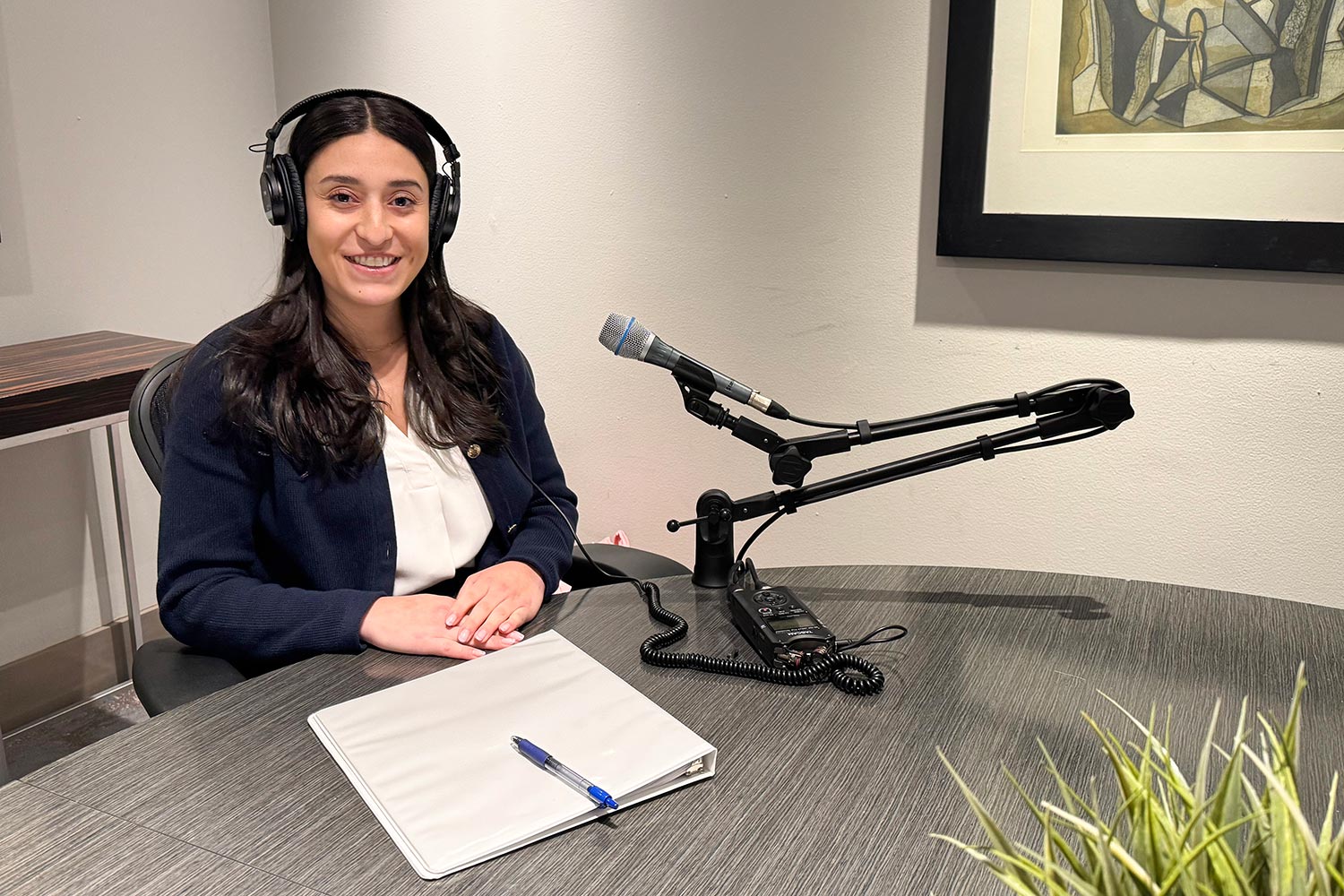
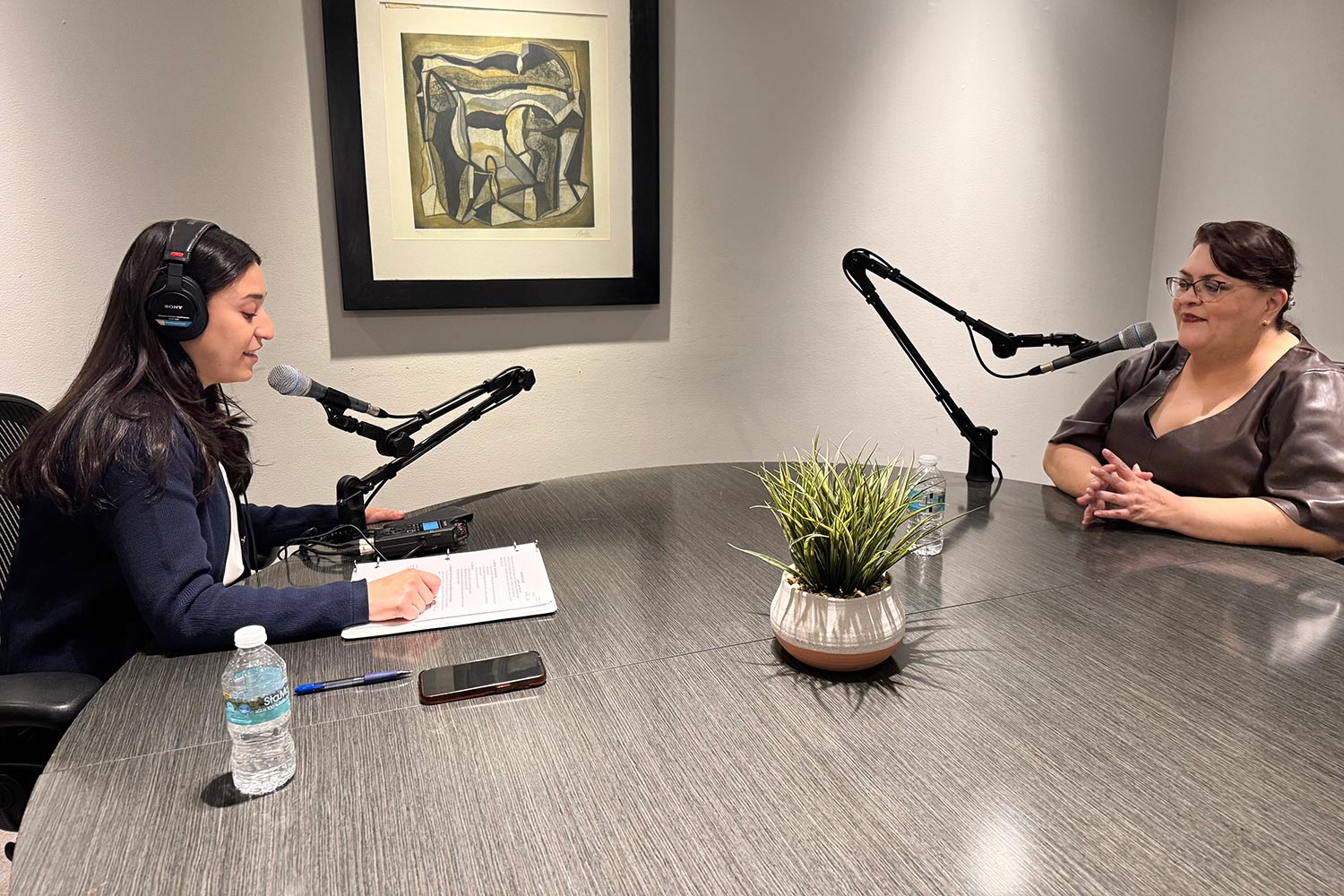
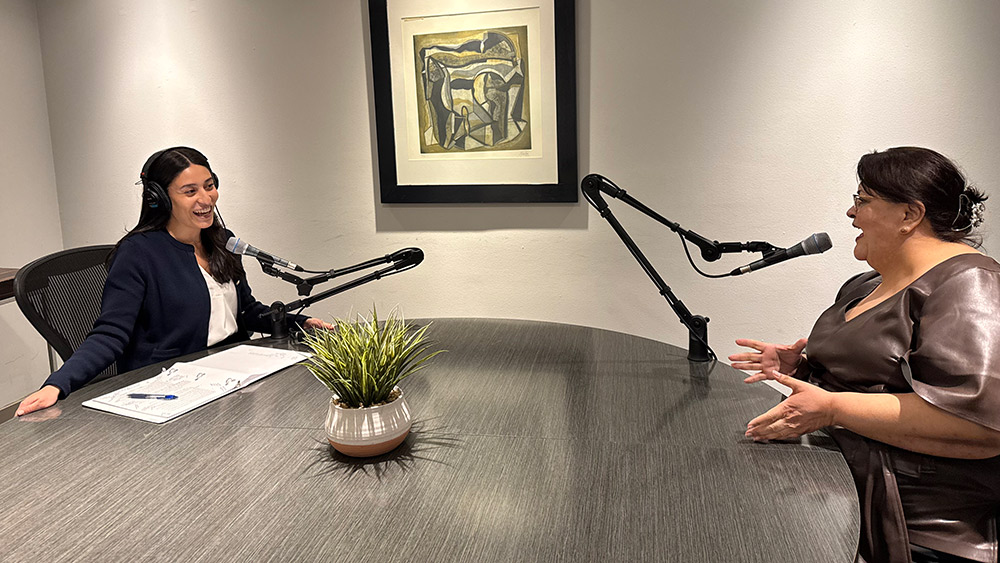
array(1) {
[0]=>
array(260) {
[0]=>
array(4) {
["speaker"]=>
string(12) "Isa Martinez"
["timestamp"]=>
string(8) "00:00:06"
["seconds"]=>
int(6)
["text"]=>
string(446) "This is an interview with María Antonieta Jáquez conducted by Isabel Martinez for the Oral History Project, a project of the Stanley Center for Peace and Security and Basic. The interview is taking place on March 26th, 2026, in Mexico City. This is session one of two. Tonie, thank you for taking the time today to meet with me. I'm wondering if we can start by you telling me a little about where you grew up and what your early life was like."
}
[1]=>
array(4) {
["speaker"]=>
string(34) "Counselor María Antonieta Jáquez"
["timestamp"]=>
string(8) "00:00:31"
["seconds"]=>
int(31)
["text"]=>
string(762) "Thank you, Isa, for the consideration and taking the time to talk to me. I was born in Mexico City 56 years ago. I was born the day the man landed on the moon, the day of the moon landing. So my mother says that nobody was paying attention to her at the hospital because they were watching TV. So my life has been linked to the international issues, that's how I say it. I grew up in a middle-class family in Mexico City. My father was an announcer. My mother is a teacher, was a teacher for many, many years. So I grew up in a small family. It's just me and my sister but we were very much into books and education and reading, and I was basically a nerd. At school, always interested in history. I didn't know that I was going to study international relations."
}
[2]=>
array(4) {
["speaker"]=>
string(34) "Counselor María Antonieta Jáquez"
["timestamp"]=>
string(8) "00:01:32"
["seconds"]=>
int(92)
["text"]=>
string(493) "Of course, I didn't know, and that was not on my mind. But when I realized, when I go back to my memories, that's the only thing that I was interested in. When I was talking to my parents, and my friends, and my cousins, being very little, I was asking them, "Do you know why there is this war? Why this conflict is happening?" Nobody knew anything about what I was talking about. But I was very interested in that and those issues, and very angry that the adults could not explain them to me."
}
[3]=>
array(4) {
["speaker"]=>
string(34) "Counselor María Antonieta Jáquez"
["timestamp"]=>
string(8) "00:02:07"
["seconds"]=>
int(127)
["text"]=>
string(559) "So I remember that a lot. So I remember growing up very focused in books and very much... I wouldn't say that I was a lonely child because I liked society a lot, and being in front of the school, teaching things, or the teachers would ask for volunteers to recite a poem or to direct the school for an event, and I was always a volunteer. So I always liked those things, but much of my time was watching TV, especially the news. And of course, I have been a Beatles maniac all my life. So I was listening to Beatles records since I was very, very, very young."
}
[4]=>
array(4) {
["speaker"]=>
string(12) "Isa Martinez"
["timestamp"]=>
string(8) "00:02:59"
["seconds"]=>
int(179)
["text"]=>
string(52) "Oh, nice. How did you get your start in your career?"
}
[5]=>
array(4) {
["speaker"]=>
string(34) "Counselor María Antonieta Jáquez"
["timestamp"]=>
string(8) "00:03:03"
["seconds"]=>
int(183)
["text"]=>
string(845) "As I said before, I was always very interested in international affairs, but I didn't know that there was a career or that this was an option for a major at school until I was in high school and there was some vocational orientation talk that described international relations as a science and that immediately got me interested and I started to fixate on studying this. So I studied international relations at the National University of Mexico. After that, I learned that in order to be a member of the Foreign Service, I had to apply for a national or for a very wide competitive test, which is still more or less the same as the one that is today. A lot of participation, you have to pass several rounds of exams, including a general knowledge about history, and law and culture, and political issues, foreign policy of Mexico, and languages."
}
[6]=>
array(4) {
["speaker"]=>
string(34) "Counselor María Antonieta Jáquez"
["timestamp"]=>
string(8) "00:04:23"
["seconds"]=>
int(263)
["text"]=>
string(836) "You have to pass a very difficult Spanish exam, which is very weird because that's my mother tongue, but you need to know a lot of the rules and very professional level exam. And after that, you have another round of exams with ambassadors interviewing you, and then you go to the Diplomatic Academy of Mexico, which is called Instituto Matías Romero. I did this in 1994, so that is 32 years ago. I passed the tests the first round. I was very... Or the first time, I was very lucky because many people do it several times, and I joined the Foreign Service then. I have been at the Ministry of Foreign Affairs at the Foreign Service for almost 32 years, and I consider myself very lucky, have had very good postings. Most of my postings have been multilateral, multilateral affairs, and most of my postings have been about disarmament."
}
[7]=>
array(4) {
["speaker"]=>
string(34) "Counselor María Antonieta Jáquez"
["timestamp"]=>
string(8) "00:05:32"
["seconds"]=>
int(332)
["text"]=>
string(979) "But though a lot of people don't know or don't think that I have been in other postings, but I have also been posted to the Consulate of Mexico in Toronto, to the Embassy of Mexico in Sweden. I have been in multilateral postings that have not had to do anything with disarmament. For example, I was delegated of Mexico to the WHO. I also dealt with issues related to drugs and crime in the '90s, and also to UNESCO for a while. So I have a very good idea of how multilateralism works, but most of my postings have been taken care of following the disarmament agenda. To this day, I have been following multilateral issues regarding nuclear weapons and all the weapons, especially at the UN, the disarmament, non-proliferation and arms control agenda since 2008, more or less, 2009 nonstop in different positions, especially in Geneva and New York and here in Mexico City as the deputy director general for disarmament and coordinator for disarmament, which is my current posting."
}
[8]=>
array(4) {
["speaker"]=>
string(12) "Isa Martinez"
["timestamp"]=>
string(8) "00:06:54"
["seconds"]=>
int(414)
["text"]=>
string(232) "Wonderful. Thank you. I'm curious if your time in the multilateral space, if kind of getting into nuclear policy, nuclear disarmament issues, if that was more of a choice of yours, or if that was sort of... What brought you to that?"
}
[9]=>
array(4) {
["speaker"]=>
string(34) "Counselor María Antonieta Jáquez"
["timestamp"]=>
string(8) "00:07:11"
["seconds"]=>
int(431)
["text"]=>
string(1134) "It was destiny. It was very difficult to understand at the moment because I was a very happy delegate in Geneva representing Mexico to the WHO. But at that time, there was a vacancy in disarmament affairs, and because Mexico is such an active actor in the fora and has always been attentive to everything that happens. My boss told me at the time, "I cannot afford a vacancy in disarmament. So we have decided that you're going to be in charge now because you have the knowledge." I had already just a little bit of a flashback. In the National University, I was assistant professor to a very important researcher in Mexico in the National University on disarmament issues. And she's still the teacher of disarmament issues at the National University, to this day. So I already knew some of those bases. Of course, that was in the 80s, and my mentor in the foreign service was one of the most important disarmament experts of Mexico, Ambassador Perla Carvalho, who was representative of Mexico, a woman. Mexico's representative to the Conference on Disarmament, when it was negotiating, she was very involved in the CTBT negotiations."
}
[10]=>
array(4) {
["speaker"]=>
string(34) "Counselor María Antonieta Jáquez"
["timestamp"]=>
string(8) "00:08:43"
["seconds"]=>
int(523)
["text"]=>
string(810) "And she taught me a lot. She taught me about the nuances, about the things that you don't read in books, things that go on in the corridors, and introduced me to a lot of people and gave me an idea of many famous names, like, "This is an expert for this issue, and this one is an expert for another issue." So I already had that type of information. So in 2009, when I was appointed member of the delegation to the Conference on Disarmament in Geneva, I said, "I understand that you know..." I said to my bosses, "I understand that you know that I have some knowledge about this, but I don't want to work in these issues." "Why?" They said, "I mean, we thought that you were going to be very happy." And I was happy, but I was also very worried because I told them for me, this type of work is not really work."
}
[11]=>
array(4) {
["speaker"]=>
string(34) "Counselor María Antonieta Jáquez"
["timestamp"]=>
string(8) "00:09:51"
["seconds"]=>
int(591)
["text"]=>
string(564) "It's my life. It's what I am. I identify myself with this agenda, the convictions, I have much the interests of Mexico, so I don't know how to work in that regard. I am very lucky because I don't have a conscious conflict, but at the same time, that has some implications, and it can be difficult. So at that moment, I rejected the position because of that, because I felt like with a conflict of interest, because I was so involved in the issues, but not working on those issues. But my bosses said, "No, you're going to be fine, and let us be the judge of that.""
}
[12]=>
array(4) {
["speaker"]=>
string(34) "Counselor María Antonieta Jáquez"
["timestamp"]=>
string(8) "00:10:35"
["seconds"]=>
int(635)
["text"]=>
string(570) "And that's how I started officially getting involved in the following of the agenda and also in some decision making. And so that was 18 years ago. And since then, I have been extremely fortunate that my government has found some use and some utility for my experience. And I have already been posted twice to different areas that have to do with the same issues. So I always say, and I repeat it, not all diplomats have that advantage or luck that my personal convictions match the interests of my government and position of my government, but I am very lucky for that."
}
[13]=>
array(4) {
["speaker"]=>
string(12) "Isa Martinez"
["timestamp"]=>
string(8) "00:11:29"
["seconds"]=>
int(689)
["text"]=>
string(284) "Thank you. So I would love to talk a little bit about the Treaty on the Prohibition of Nuclear Weapons, also TPNW, also known as the Ban Treaty. I'm wondering if maybe we can just start by you describing your role in getting what eventually became the TPNW entered into force in 2021."
}
[14]=>
array(4) {
["speaker"]=>
string(34) "Counselor María Antonieta Jáquez"
["timestamp"]=>
string(8) "00:11:51"
["seconds"]=>
int(711)
["text"]=>
string(925) "Thank you. When I started working at the Conference on Disarmament in Geneva, there were a lot of groups thinking and talking about how to revitalize negotiations, disarmament negotiations. And Mexico had put forward some ideas to basically try to bypass the deadlock that already existed at the Conference on Disarmament, just for the sake of the conversation. The Conference on Disarmament in Geneva is one of the institutions of the so-called disarmament machinery of the United Nations. And it has a mandate to negotiate international, legally binding agreements of global nature. And since 2000... I'm sorry, I made a mistake. Since 1996, it has not approved its program of work. So the Conference on Disarmament has worked since then towards trying to get an agreement on the program of work, but it has kept busy only. It has not worked really, because it has not fulfilled its mandate. It has not negotiated anything."
}
[15]=>
array(4) {
["speaker"]=>
string(34) "Counselor María Antonieta Jáquez"
["timestamp"]=>
string(8) "00:13:08"
["seconds"]=>
int(788)
["text"]=>
string(815) "So I mentioned this because jump-starting or revitalizing nuclear disarmament negotiations was on the mind of all the delegates in Geneva at the time. I'm talking about 2008, 2009, then the Review Conference of the Non-Proliferation Treaty NPT in 2010 ended up with a very good outcome, which is the action plan of that year that contains an expression of concern for the first time ever about what weapons do. The context of the NPT and also international fora for disarmament was very heavily marked by the narrative of who has the weapons, who does not have weapons, and why they don't have weapons, like Mexico. But the idea of talking about what weapons do was a little bit confined to side events, or think tanks, or academic discussions. It was not part of the mainstream discussion or narrative in the room."
}
[16]=>
array(4) {
["speaker"]=>
string(34) "Counselor María Antonieta Jáquez"
["timestamp"]=>
string(8) "00:14:25"
["seconds"]=>
int(865)
["text"]=>
string(967) "And after the 2010 action plan, with the expression of concern about the catastrophic consequences that any use of nuclear weapon would bring, and making that part of the discussions of why disarmament, non-proliferation, and peaceful uses norms had to be upheld, the narrative became different. And so at the time, we, me representing Mexico, and delegates from other countries representing other like-minded countries, like Austria, like Norway, like South Africa, Brazil, started talking about how can we make this the basis of a legally binding treaty that would cover or fulfill the legal gap that exists regarding nuclear weapons. What the concern was meant or was that the nuclear weapons were not subject of any explicit prohibition in any treaty at the time, with the exception of the Treaty of Tlatelolco, the Treaty on the Prohibition of Nuclear Weapons in Latin America and the Caribbean, which has it in the title, and that was imposed by Mexico in 1967."
}
[17]=>
array(4) {
["speaker"]=>
string(34) "Counselor María Antonieta Jáquez"
["timestamp"]=>
string(8) "00:15:59"
["seconds"]=>
int(959)
["text"]=>
string(1207) "There was no legally binding explicit prohibition of nuclear weapons. We call it the legal gap because other weapons of mass destruction, like chemical or biological weapons already were subject to explicit prohibitions in corresponding treaties. So that is why the focus was how to bring forward this type of prohibition in a legally binding treaty and how to frame it in such a way that would make sense for the international community, not only for the nuclear weapon-free-zones or not only for countries that were interested in negotiating at the Conference on Disarmament. So we put forward different resolutions at the general assembly, especially one in 2015, and that is called ‘taking forward multilateral nuclear disarmament negotiations’ that initially created two open-ended working groups in Geneva. The first one was in 2012, the second was in 2015. That one had a mandate to identify the elements of the Treaty. So thinking about these resolutions, thinking about how to move forward on these issues was part of my responsibilities here in Mexico before I was in Geneva, before Geneva, I was in Vienna, I already had the idea of trying to move forward on nuclear disarmament negotiations."
}
[18]=>
array(4) {
["speaker"]=>
string(34) "Counselor María Antonieta Jáquez"
["timestamp"]=>
string(8) "00:17:35"
["seconds"]=>
int(1055)
["text"]=>
string(907) "But when I was in Mexico in 2012 as deputy director general for disarmament, I had the honor and the responsibility to participate in the decision-making that created these resolutions that instructed the missions in New York and Geneva to continue this dialogue and to try to find the elements on these issues. Of course, I want to say something that is very important for diplomats to always remember is that no endeavor can be really fulfilled or made come true on our own. It is extremely important to recognize that we are party of a team, of a team of experts and diplomats. So, I don't know, my initiatives or my instructions would be nothing if I didn't have the excellent work of the Mexican diplomats in New York and in Geneva, especially Ambassador Lomonaco and Paola Ramirez at that time, working on these issues. But I got involved in the framing on how to create the Treaty from the beginning."
}
[19]=>
array(4) {
["speaker"]=>
string(34) "Counselor María Antonieta Jáquez"
["timestamp"]=>
string(8) "00:18:51"
["seconds"]=>
int(1131)
["text"]=>
string(930) "Then the Treaty got somewhat initiated in this open-ended working group, but then we needed to put forward another resolution in order to give a mandate from the general assembly to the negotiations of the Treaty. And when the negotiations started in New York, I was already part of the delegation in New York. So I was part of the delegation that was in the negotiations in New York. Nevertheless, my real or my most important incidents or influence was in the beginning of the process. I want to say something in particular, I want to emphasize something. One of the most difficult tasks that I think got a good impulse or gave a good impulse to the Treaty was the Conferences on the Humanitarian Impact of Nuclear Weapons. The first one in Oslo in 2013, the second one in Mexico in Nayarit in 2014, and the third one in Austria at the end of that same year, I was in charge with my team of organizing the conference in Nayarit."
}
[20]=>
array(4) {
["speaker"]=>
string(34) "Counselor María Antonieta Jáquez"
["timestamp"]=>
string(8) "00:20:10"
["seconds"]=>
int(1210)
["text"]=>
string(1018) "And that was a very difficult task, but a very satisfying one because I got the job of bringing forward and organizing first the meeting, defining the issues that we were going to cover that we would like to have a projection about so that we could discuss what would the impact of nuclear weapons globally would be like because the Oslo conference focused more on the immediate impact. So we wanted to focus about the global transcendence and impact. And I had the task of finding the speakers all over the world, and I had the pleasure of traveling, representing my government, asking speakers to come and speak without payment, without a mandate from the United Nations, and organizing a conference that was not mandated by the United Nations was very complicated for some governments to interiorize or to recognize some ownership about. So they didn't want to get involved at the beginning, but we managed to bring 146 governments represented in the conference and a lot of speakers that wanted to be part of this."
}
[21]=>
array(4) {
["speaker"]=>
string(34) "Counselor María Antonieta Jáquez"
["timestamp"]=>
string(8) "00:21:40"
["seconds"]=>
int(1300)
["text"]=>
string(1103) "At the end of the process, I had to even have a little bit of dilemmas because a lot of speakers wanted to come and I didn't have a space for them to speak or to showcase their work. But I always emphasize that this was a difficult task because people are accustomed to the United Nations conferences in which the United Nations are the secretariat, but this conference was organized and created by the government of Mexico. So we didn't have a secretariat. So we were the secretariat ourselves. So we had to do everything from the registration, from the preparation of materials, from organizing the program, from getting the speakers, getting the participants, organizing the discussion, moderating, facilitating the discussions, creating, writing the reports and the final report. And I was very happy to be part of that, very proud that that conference was called by the room, the point of no return towards the prohibition of nuclear weapons. And that is one of the most influential conferences, I think, that we have had towards that end. And I'm very happy to have had some participation in that."
}
[22]=>
array(4) {
["speaker"]=>
string(12) "Isa Martinez"
["timestamp"]=>
string(8) "00:23:02"
["seconds"]=>
int(1382)
["text"]=>
string(269) "Yes. Do you recall a little bit about or I'm wondering if you can recall how you were feeling, you talked about traveling to different locations to entice some speakers to come, but just in the lead-up process, how you were feeling prior to the conference taking place."
}
[23]=>
array(4) {
["speaker"]=>
string(34) "Counselor María Antonieta Jáquez"
["timestamp"]=>
string(8) "00:23:19"
["seconds"]=>
int(1399)
["text"]=>
string(978) "Oh, very nervous. First, I was sure that we were doing the right thing, but it was not black and white. We didn't know if all the governments were going to come, especially before the Oslo conference, which was the first one. We didn't know if we were going to get a good critical mass of delegations, because this was a process or conferences outside of the main fora. And we had a lot of opposition from some countries, especially of course, the nuclear weapon states, but not only them, some of their allies were actively engaging in some opposition or some campaigning against the conference, but also some countries that were not opposed to the issue, but were, I don't want to say afraid, but they were very concerned about doing things outside of the UN. And this is something that we had already seen in the Ottawa Process that led to the convention on prohibition of landmines in the '90s, but also in the Cluster Munitions Convention process, the Oslo process in 2010."
}
[24]=>
array(4) {
["speaker"]=>
string(34) "Counselor María Antonieta Jáquez"
["timestamp"]=>
string(8) "00:24:43"
["seconds"]=>
int(1483)
["text"]=>
string(1917) "Maybe because of that, we felt Mexico and the like-minded governments felt a little bit comfortable in having already watched this film twice before, and we knew that that was a reticence that we would need to overcome. I myself was very nervous about that, also very nervous about getting some experts that maybe would stand me up, that would not appear, that was always a possibility, or that during the conversations or the development of the discussion, countries would not feel comfortable to speak or to say that they were interested in what they were hearing, or that they believed some of the data that was being presented, or that they would challenge the process on site from the floor. That was always a possibility because, I repeat, it was a conference outside of the canons of the UN. I'm going to give you an example. At the conference on the humanitarian impact of nuclear weapons, we decided to sit all the participants by strict alphabetical order in Spanish, not first, or not by regions, or not the states at the front, and then think tanks and civil society organizations at the back. And some observers that are observers at the United Nations would be sitting next to states or organizations were sitting next to states. And for some governments, that was the first time that they would do that. So we were very nervous about that and conscious that this was not something that countries would be very accustomed to. So I was nervous, but I was also very hopeful that this conviction about explaining or bringing to the people of the 21st century what nuclear weapons would do was something missing from the debate at the UN. And I was extremely happy to try to contribute to that. Variables of the 21st-century debate or thinking about nuclear weapons where, for example, in the conference, the Nayarit Conference, we talked about what would happen if there was another detonation of any kind."
}
[25]=>
array(4) {
["speaker"]=>
string(34) "Counselor María Antonieta Jáquez"
["timestamp"]=>
string(8) "00:27:35"
["seconds"]=>
int(1655)
["text"]=>
string(623) "We would not enter into details of who had it, who did it, or why. Or let's just say for the sake of the argument that there was a detonation in a densely populated area, maybe a more dense area than Hiroshima or Nagasaki, like most of the cities are now, by the way. Who would take care of the displaced people, just one variable. So at the time when the conference was being organized, we were struggling with refugees, trends of mass displacement because of the Arab Spring conflicts, for example. Who is going to take care of all the displaced people? Who is going to pay for that? Are we going to set up refugee camps?"
}
[26]=>
array(4) {
["speaker"]=>
string(34) "Counselor María Antonieta Jáquez"
["timestamp"]=>
string(8) "00:28:26"
["seconds"]=>
int(1706)
["text"]=>
string(561) "Do we have money at the UN inside, for example, OCHA, or with humanitarian organizations to take care of these people? These are the variables of the 21st century. That's what we thought that we needed to talk about, not thinking about this like a historical issue that would not impact our lives today. And because of that framing, governments felt close to the debate and participated. The day that I felt happier in the conference, let me tell you this, was the last day of the conference because it was... Do you know Nayarit? Have you ever been to Nayarit?"
}
[27]=>
array(4) {
["speaker"]=>
string(12) "Isa Martinez"
["timestamp"]=>
string(8) "00:29:09"
["seconds"]=>
int(1749)
["text"]=>
string(3) "No."
}
[28]=>
array(4) {
["speaker"]=>
string(34) "Counselor María Antonieta Jáquez"
["timestamp"]=>
string(8) "00:29:09"
["seconds"]=>
int(1749)
["text"]=>
string(670) "It has a beautiful beach on the Pacific Ocean. Wonderful. So it was very warm. The sun was bright, bright, bright, bright, not a cloud in sight. And the beach was there, and the conference was scheduled to be closed in the middle of the day and the delegates didn't want to go. They wanted to continue listening to the list of speakers. So we received the request to extend the list of speakers until everybody could speak, and we didn't close the meeting, and nobody left. So, in the middle of the conduction of the conference, we had to speak to the facilities of the convention center of a hotel to ask them to let us stay there longer because nobody wanted to leave."
}
[29]=>
array(4) {
["speaker"]=>
string(34) "Counselor María Antonieta Jáquez"
["timestamp"]=>
string(8) "00:30:00"
["seconds"]=>
int(1800)
["text"]=>
string(465) "Everybody was there. Everybody was engaged. Everybody wanted to hear what the others had to say, and they had the beach there. So for me, that was a signal that this was something that was interesting and productive and meaningful for the delegates that attended the conference, and that we had managed to get attention to the issue. So I felt very calm then and happier than at the beginning of the process, in which I was a little bit uncertain on what to expect."
}
[30]=>
array(4) {
["speaker"]=>
string(12) "Isa Martinez"
["timestamp"]=>
string(8) "00:30:33"
["seconds"]=>
int(1833)
["text"]=>
string(254) "Wow, that's so interesting. I'm wondering too how extending it sort of brought maybe the group as a whole together or closer, the ability to do that and allow everyone to speak, what that kind of created the energy in the room, and how that felt for you."
}
[31]=>
array(4) {
["speaker"]=>
string(34) "Counselor María Antonieta Jáquez"
["timestamp"]=>
string(8) "00:30:51"
["seconds"]=>
int(1851)
["text"]=>
string(902) "The energy was very evident. It was palpable. It was igniting, the possibility of action, of agency, from the point of view of countries that sometimes feel a little bit left behind in the debate. So what I felt is that countries realized that we were not going to change the fora and the problems of the fora. For example, the UN management of these issues, the NPT dynamics or the CD lack of progress and work. But we had the chance to change a little bit the emphasis of the discussion, not agenda of the discussion, but the emphasis on the discussion. And one thing that really changed in my view, the environment and the narrative of the conference was that we decided in the government of Mexico at the time to place the debate, the general debate, the general exchange of views at the end of the conference, not at the beginning of the conference, like all the conferences of the United Nations."
}
[32]=>
array(4) {
["speaker"]=>
string(34) "Counselor María Antonieta Jáquez"
["timestamp"]=>
string(8) "00:32:10"
["seconds"]=>
int(1930)
["text"]=>
string(614) "So instead of having a segment of all the people speaking at the beginning, so we deliberately said the debate is going to be at the end. So first, we're going to hear the experts. Okay. On the first panel, that was another decision, was only of Hibakusha, survivors of the atomic bombs in Japan. We negotiated with different organizations of Hibakushas of first, second, third generation, and also the Red Cross in Hiroshima, and also organizations of survivors, including the one that won the Nobel Peace Prize a year ago, two years ago. We negotiated with them to bring examples or to bring speakers from their-"
}
[33]=>
array(4) {
["speaker"]=>
string(34) "Counselor María Antonieta Jáquez"
["timestamp"]=>
string(8) "00:33:02"
["seconds"]=>
int(1982)
["text"]=>
string(135) "groups that would give a sense of different aspects of the same concern, not to have the same interventions, repeating the same issues."
}
[34]=>
array(4) {
["speaker"]=>
string(34) "Counselor María Antonieta Jáquez"
["timestamp"]=>
string(8) "00:33:16"
["seconds"]=>
int(1996)
["text"]=>
string(381) "That panel was the first time ever that the survivors spoke before the states in the middle of a room of a governmental conference, and not at the end of the debate, or at a side event, or in a cafeteria with some representatives of some states. That changed the whole tone, because speaking about the effect of weapons from the point of view of survivors was completely different."
}
[35]=>
array(4) {
["speaker"]=>
string(34) "Counselor María Antonieta Jáquez"
["timestamp"]=>
string(8) "00:33:47"
["seconds"]=>
int(2027)
["text"]=>
string(350) "So, that changed the energy in the room. Focusing on human beings and on the characteristics of the weapon, instead of political issues was extremely important. We felt very enthusiastic about the possibilities of this energy that we were feeling in the room, about the engagement of the non-nuclear weapon states in the debate in a different manner."
}
[36]=>
array(4) {
["speaker"]=>
string(34) "Counselor María Antonieta Jáquez"
["timestamp"]=>
string(8) "00:34:16"
["seconds"]=>
int(2056)
["text"]=>
string(383) "That came very, very close to a consensus. I don't like to use that word, because it's been abused at the United Nations. But it emerged as a general understanding that this was the basis of possible work in the multilateral arena towards a new treaty. That was consolidated later in Vienna. But I think that that was the moment that we felt some ignition, and it was very important."
}
[37]=>
array(4) {
["speaker"]=>
string(12) "Isa Martinez"
["timestamp"]=>
string(8) "00:34:50"
["seconds"]=>
int(2090)
["text"]=>
string(471) "We're talking a lot about these internal decisions during the process and leading up to hosting this conference in Mexico. I'm curious what the actual, if you could share some insight into the process itself, into how you, your team, your colleagues, came to the decision of what you're speaking now, the order of running the conference, as well as even just the decision how to organize states and participants in general and the setup. I'd love to hear more about that."
}
[38]=>
array(4) {
["speaker"]=>
string(34) "Counselor María Antonieta Jáquez"
["timestamp"]=>
string(8) "00:35:20"
["seconds"]=>
int(2120)
["text"]=>
string(730) "Okay. I can share some views from my perspective as a Mexican diplomat. But I also have to say that Ambassador Alexander Kmentt's book, ‘The Treaty Banning Nuclear Weapons,’ a very, very good book about the process. I always recommend this book. Not because it's about an issue that is close to my heart, but it is really like a demonstration or like a manual or a handbook, on how to work in multilateral affairs. In that book, you can read a little bit about this, too, so it's not a secret. But the like-minded countries had already been working on several initiatives when Norway decided to launch the possibility of a conference, of a technical conference. It was their decision and their convening power and their money."
}
[39]=>
array(4) {
["speaker"]=>
string(34) "Counselor María Antonieta Jáquez"
["timestamp"]=>
string(8) "00:36:26"
["seconds"]=>
int(2186)
["text"]=>
string(457) "When that conference had some traction, my bosses here in Mexico said, "If this conference has some good amount of countries participating, and there is interest, we need to follow up. We need to keep the momentum." It depends on how the conference goes, announce that Mexico is going to follow up. The head of the delegation who was the ambassador in Geneva at the time, started to measure the environmental tone, and we started to see how it went in Oslo."
}
[40]=>
array(4) {
["speaker"]=>
string(34) "Counselor María Antonieta Jáquez"
["timestamp"]=>
string(8) "00:37:17"
["seconds"]=>
int(2237)
["text"]=>
string(427) "He already had some green lights from our bosses to decide to convene the conference as a follow-up. It was a difficult decision, because it entails a lot of resources, human resources, besides the obvious financial resources needed to do that. But it also implied to have difficult conversations with important partners, especially the nuclear weapon states. Nevertheless, Mexico has always followed a sovereign decision path."
}
[41]=>
array(4) {
["speaker"]=>
string(34) "Counselor María Antonieta Jáquez"
["timestamp"]=>
string(8) "00:37:58"
["seconds"]=>
int(2278)
["text"]=>
string(417) "There are issues in which we have agreed to disagree with very important partners, especially our neighbors, the United States, but also other countries that in different agendas, especially this one, don't see eye to eye. But that doesn't impede cooperation and collaboration. That has been the historical experience of Mexico, that we like to promote the diplomatic dialogue with countries that we don't agree with."
}
[42]=>
array(4) {
["speaker"]=>
string(34) "Counselor María Antonieta Jáquez"
["timestamp"]=>
string(8) "00:38:28"
["seconds"]=>
int(2308)
["text"]=>
string(388) "Otherwise, it's like preaching to the choir. You just talk with countries that are similar to you. We have never done that. We have always motivated dialogue and diplomatic solutions with countries that we don't agree with. Especially on this issue, we have a long tradition and experience of promoting a view about non-proliferation and disarmament that dates back to the '60s, at least."
}
[43]=>
array(4) {
["speaker"]=>
string(34) "Counselor María Antonieta Jáquez"
["timestamp"]=>
string(8) "00:39:04"
["seconds"]=>
int(2344)
["text"]=>
string(373) "We have experience in setting up ideas, preparing for initiatives, and having to work with the international community towards a goal. Sometimes the ideas do not succeed. We have had to withdraw proposals. The resolution on the establishment of the open-ended working group that led to the negotiation of the Treaty, the first time that we presented it, we had to withdraw."
}
[44]=>
array(4) {
["speaker"]=>
string(34) "Counselor María Antonieta Jáquez"
["timestamp"]=>
string(8) "00:39:39"
["seconds"]=>
int(2379)
["text"]=>
string(394) "The opposition did not come from the nuclear weapon states. It came from the wider community of non-nuclear weapon states in the UN, that did not want to work on other things outside of the CD, not outside of the United Nations, it was a general assembly resolution. But a lot of countries were reticent to say, "Let's not go out of any of the established fora." We had been accustomed to that."
}
[45]=>
array(4) {
["speaker"]=>
string(34) "Counselor María Antonieta Jáquez"
["timestamp"]=>
string(8) "00:40:12"
["seconds"]=>
int(2412)
["text"]=>
string(420) "We already knew that the committing of the conference and the participation in this process was going to imply a lot of extra work of managing expectations from our like-minded countries, but also managing the opposition of countries that don't see eye to eye. But that is the beauty of multilateralism. If we were only like-minded countries, we would be headed into the same direction without any possibility to adjust."
}
[46]=>
array(4) {
["speaker"]=>
string(34) "Counselor María Antonieta Jáquez"
["timestamp"]=>
string(8) "00:40:51"
["seconds"]=>
int(2451)
["text"]=>
string(311) "But because we have to build bridges across different sides of the spectrum, we need to adjust our positions and our work accordingly. That gives richer results, even if we don't manage to convince others. So, we always were thinking about that when in the process of preparing the process, but it was not easy."
}
[47]=>
array(4) {
["speaker"]=>
string(34) "Counselor María Antonieta Jáquez"
["timestamp"]=>
string(8) "00:41:22"
["seconds"]=>
int(2482)
["text"]=>
string(435) "In fact, the most difficult thing was to try to convince countries that it was their decision, their sovereign decision, to attend or not to attend. A frequent question or a frequent issue that is in the air after 12 years of these processes with nuclear weapon states and other countries that advocate for nuclear weapons as a basis of their security, if they attended the conference or not, or they were not invited, some people say."
}
[48]=>
array(4) {
["speaker"]=>
string(34) "Counselor María Antonieta Jáquez"
["timestamp"]=>
string(8) "00:42:01"
["seconds"]=>
int(2521)
["text"]=>
string(356) "I have read somewhere there, that there is this idea that they were not invited, but that's not true. Everybody was invited, and it was their sovereign decision to attend. In the same fashion that it is our sovereign decision to gather a group of countries to talk about whichever common issue we think that we can address, and maybe find common solutions."
}
[49]=>
array(4) {
["speaker"]=>
string(34) "Counselor María Antonieta Jáquez"
["timestamp"]=>
string(8) "00:42:24"
["seconds"]=>
int(2544)
["text"]=>
string(471) "There is nothing that impedes to have a conference in one way or the other, if some of the stakeholders decide not to attend. We needed to be prepared for that possibility. We regretted that the nuclear weapon states did not want to attend. Some possessors of nuclear weapons attended the conference and participated. I think that that created a little bit of pressure for the next conference, and in the Vienna conference, some of the nuclear weapon states participated."
}
[50]=>
array(4) {
["speaker"]=>
string(34) "Counselor María Antonieta Jáquez"
["timestamp"]=>
string(8) "00:43:01"
["seconds"]=>
int(2581)
["text"]=>
string(733) "We saw that as a process. But we need to be serene about that, and not to haste things and understand that sometimes we don't have the possibility of changing, or we don't have the ability to change the behavior, but we have the ability to maybe have some influence in how we address issues and that then some behaviors change. That was a long time ago, but at the moment, there was no other place than the United Nations where we could talk about these issues. So, we were very confident that this was the value added. We were not wrong, because to this date, now we're very happy that people talk about the consequences of nuclear weapons, even to deny the possibility of talking about that, but now everybody's talking about that."
}
[51]=>
array(4) {
["speaker"]=>
string(34) "Counselor María Antonieta Jáquez"
["timestamp"]=>
string(8) "00:43:59"
["seconds"]=>
int(2639)
["text"]=>
string(302) "Especially in this time and age, when we are having this interview, it is more important to talk about that, to remind ourselves not what we are doing, but why we are doing it. It's to avoid or to prevent that from happening. At the end of the day, we're very happy that we gave that discussion a push."
}
[52]=>
array(4) {
["speaker"]=>
string(12) "Isa Martinez"
["timestamp"]=>
string(8) "00:44:25"
["seconds"]=>
int(2665)
["text"]=>
string(337) "Right. Thank you. Do you remember maybe following the conference that you helped organize here in Mexico, what some of your main takeaways were, in addition to how you were feeling? And then knowing eventually you were going to also have the Vienna conference itself, how you were feeling during that time right following the conference?"
}
[53]=>
array(4) {
["speaker"]=>
string(34) "Counselor María Antonieta Jáquez"
["timestamp"]=>
string(8) "00:44:49"
["seconds"]=>
int(2689)
["text"]=>
string(394) "Well, we were very happy that Austria announced that they were going to continue to follow up, because that kept the momentum. But also we were very conscious that the European context would not be the same as the Latin American, or the Global South context, if you want to call it like that, no? We were very, very conscious about that, and worried that this might have different implications."
}
[54]=>
array(4) {
["speaker"]=>
string(34) "Counselor María Antonieta Jáquez"
["timestamp"]=>
string(8) "00:45:19"
["seconds"]=>
int(2719)
["text"]=>
string(465) "Nevertheless, we were very grateful to the Austrian government for their impetus, and early announcement that they were going to follow up, because that gave us the idea of how to proceed. The moment when the President of the conference in Nayarit, who was then the Under Secretary for Foreign Affairs, announced that in our chair's paper that was written, it was a summary, it was a report written under the responsibility of Mexico as the chair of the conference."
}
[55]=>
array(4) {
["speaker"]=>
string(34) "Counselor María Antonieta Jáquez"
["timestamp"]=>
string(8) "00:46:04"
["seconds"]=>
int(2764)
["text"]=>
string(341) "But that document said that, let me paraphrase, that historically we had seen that weapons that are eliminated are previously outlawed, not the other way around. Maybe we were making a mistake doing it the other way around, like asking or begging for the total elimination of nuclear weapons, without having some legally-binding prohibition."
}
[56]=>
array(4) {
["speaker"]=>
string(34) "Counselor María Antonieta Jáquez"
["timestamp"]=>
string(8) "00:46:35"
["seconds"]=>
int(2795)
["text"]=>
string(396) "That's why we felt that because of the discussions that we had in Nayarit and the amount of evidence and data from presentations that we heard that it was logical to think of nuclear weapons as the other weapons of mass destruction, so that the time had come for a legally-binding instrument to prohibit nuclear weapons. In that moment, the room erupted in applause. But that is one thing to say."
}
[57]=>
array(4) {
["speaker"]=>
string(12) "Isa Martinez"
["timestamp"]=>
string(8) "00:47:12"
["seconds"]=>
int(2832)
["text"]=>
string(29) "That's during the conference?"
}
[58]=>
array(4) {
["speaker"]=>
string(34) "Counselor María Antonieta Jáquez"
["timestamp"]=>
string(8) "00:47:13"
["seconds"]=>
int(2833)
["text"]=>
string(4) "Yes."
}
[59]=>
array(4) {
["speaker"]=>
string(12) "Isa Martinez"
["timestamp"]=>
string(8) "00:47:14"
["seconds"]=>
int(2834)
["text"]=>
string(5) "Okay."
}
[60]=>
array(4) {
["speaker"]=>
string(34) "Counselor María Antonieta Jáquez"
["timestamp"]=>
string(8) "00:47:14"
["seconds"]=>
int(2834)
["text"]=>
string(78) "When the chair was reading the chair's paper, the report written by the chair."
}
[61]=>
array(4) {
["speaker"]=>
string(34) "Counselor María Antonieta Jáquez"
["timestamp"]=>
string(8) "00:47:25"
["seconds"]=>
int(2845)
["text"]=>
string(452) "Okay. But that's one thing. One thing is to say, "We need this." Then the other thing is how we're going to do this. And that was the Vienna conference. The Vienna conference ended up also with a document on their Austrian responsibility, saying, "We have heard that there is a need for a legally-binding instrument in the previous conference. But now we say, we pledge, that Austria is willing to do this process." That was called the Austrian pledge."
}
[62]=>
array(4) {
["speaker"]=>
string(34) "Counselor María Antonieta Jáquez"
["timestamp"]=>
string(8) "00:47:59"
["seconds"]=>
int(2879)
["text"]=>
string(483) "When the Austrian pledge came out, it was very clear that now we have a process, not only like a description of what was needed, you know what I mean? It was a different, a different kind of multilateral call. Usually, I always joke a little bit at the UN, and say, "Usually the debates at the UN are like a person drowning, and you hear people describing the water over and over again. But there are very few voices proposing to take out the person that is drowning from the water.""
}
[63]=>
array(4) {
["speaker"]=>
string(34) "Counselor María Antonieta Jáquez"
["timestamp"]=>
string(8) "00:48:42"
["seconds"]=>
int(2922)
["text"]=>
string(334) "That was a takeaway from the process between Nayarit and Vienna in 2014. One thing is to say, "We need a treaty," because of this and this and this, "And we need to continue talking about the prevention of the consequences of nuclear weapons and to fortify the norm against the proliferation or disarmament." One thing is to say that."
}
[64]=>
array(4) {
["speaker"]=>
string(34) "Counselor María Antonieta Jáquez"
["timestamp"]=>
string(8) "00:49:08"
["seconds"]=>
int(2948)
["text"]=>
string(484) "Then the other thing is to say, "I am willing to pursue a process." When Austria did that, Mexico immediately decided to, of course, to join. We wanted to be part of the process, from the beginning part of the process. But the way that we joined the process of the Austrian pledge, was with all the heads of state of Latin America and the Caribbean, the whole region at the CELAC meeting. CELAC is the community of states of Latin America and the Caribbean. It's a consultation forum."
}
[65]=>
array(4) {
["speaker"]=>
string(34) "Counselor María Antonieta Jáquez"
["timestamp"]=>
string(8) "00:49:52"
["seconds"]=>
int(2992)
["text"]=>
string(420) "All the heads of state decided to join that pledge together. Because it was something that for us had already happened in 1962, after the missile crisis. Our region decided to start a process to negotiate the Treaty on the Prohibition of Nuclear Weapons in Latin America and the Caribbean, the Treaty of Tlatelolco, because of our conviction of prohibiting nuclear weapons in the region as a way to enhance our security."
}
[66]=>
array(4) {
["speaker"]=>
string(34) "Counselor María Antonieta Jáquez"
["timestamp"]=>
string(8) "00:50:25"
["seconds"]=>
int(3025)
["text"]=>
string(380) "But also to liberate or get some independence from the environment of the Cold War, and the idea that Latin America and the Caribbean could be a scene or a scenario for war, was very, very daunting. This is the reason why we started working on that as a collective effort. But it is also part of the convictions of our countries that wanted to eliminate the threat or possibility."
}
[67]=>
array(4) {
["speaker"]=>
string(34) "Counselor María Antonieta Jáquez"
["timestamp"]=>
string(8) "00:51:07"
["seconds"]=>
int(3067)
["text"]=>
string(337) "For us, the prohibition of nuclear weapons had already happened in the '60s. It was natural that the whole Latin America and the Caribbean together decided to join the efforts to prohibit nuclear weapons globally, with the Austrian call, or pledge. That's how the process started in the following years for the beginning of negotiations."
}
[68]=>
array(4) {
["speaker"]=>
string(34) "Counselor María Antonieta Jáquez"
["timestamp"]=>
string(8) "00:51:34"
["seconds"]=>
int(3094)
["text"]=>
string(206) "The main takeaway from the conference was that clarity about how we should start a process, not only describing what we need to do, but to demonstrate some will and some initiative to pursue that objective."
}
[69]=>
array(4) {
["speaker"]=>
string(12) "Isa Martinez"
["timestamp"]=>
string(8) "00:52:03"
["seconds"]=>
int(3123)
["text"]=>
string(333) "We'll talk a little bit more later about the Treaty of Tlatelolco, but I feel like you're making a really interesting point and connection here, and one certainly that I think you've made, I've read a bit about, but this role of the TPNW almost as a more like a globalized version of what you were familiar with [inaudible 00:52:24]."
}
[70]=>
array(4) {
["speaker"]=>
string(34) "Counselor María Antonieta Jáquez"
["timestamp"]=>
string(8) "00:52:23"
["seconds"]=>
int(3143)
["text"]=>
string(18) "Tlatelolco Global."
}
[71]=>
array(4) {
["speaker"]=>
string(12) "Isa Martinez"
["timestamp"]=>
string(8) "00:52:24"
["seconds"]=>
int(3144)
["text"]=>
string(9) "Yes. Yes."
}
[72]=>
array(4) {
["speaker"]=>
string(34) "Counselor María Antonieta Jáquez"
["timestamp"]=>
string(8) "00:52:26"
["seconds"]=>
int(3146)
["text"]=>
string(16) "We nicknamed it."
}
[73]=>
array(4) {
["speaker"]=>
string(12) "Isa Martinez"
["timestamp"]=>
string(8) "00:52:30"
["seconds"]=>
int(3150)
["text"]=>
string(11) "Oh, really?"
}
[74]=>
array(4) {
["speaker"]=>
string(34) "Counselor María Antonieta Jáquez"
["timestamp"]=>
string(8) "00:52:30"
["seconds"]=>
int(3150)
["text"]=>
string(50) "If you see the provisions, it's Tlatelolco Global."
}
[75]=>
array(4) {
["speaker"]=>
string(12) "Isa Martinez"
["timestamp"]=>
string(8) "00:52:32"
["seconds"]=>
int(3152)
["text"]=>
string(95) "Okay. No, and I guess, yes, for you, if that was a guiding post for the work on the Ban Treaty?"
}
[76]=>
array(4) {
["speaker"]=>
string(34) "Counselor María Antonieta Jáquez"
["timestamp"]=>
string(8) "00:52:44"
["seconds"]=>
int(3164)
["text"]=>
string(420) "Yeah. It is not a coincidence that today, of the parties to the TPNW, 74, most of them, more than a quarter, are from Latin America and the Caribbean. 25 are from the Latin America and the Caribbean. We don't have some countries on board yet, for different priorities in the legislative processes. But I am confident that Latin America and the Caribbean is going to be the first region that is going to become universal."
}
[77]=>
array(4) {
["speaker"]=>
string(34) "Counselor María Antonieta Jáquez"
["timestamp"]=>
string(8) "00:53:15"
["seconds"]=>
int(3195)
["text"]=>
string(307) "The same happened with the CTBT, with this Comprehensive Test-Ban Treaty in the '90s. The first region that has universally ratified the Comprehensive Test-Ban Treaty is Latin America and the Caribbean. We have this historical experience and tradition. It also has to do with the strength of the provisions."
}
[78]=>
array(4) {
["speaker"]=>
string(34) "Counselor María Antonieta Jáquez"
["timestamp"]=>
string(8) "00:53:45"
["seconds"]=>
int(3225)
["text"]=>
string(388) "We are going to talk more about Tlatelolco, but the Tlatelolco Treaty has some provisions, and many of them have to have compatibility with the provisions of the TPNW. In the negotiations, we could not get through a definition of nuclear weapon. But the only definition of nuclear weapons in a legally-binding instrument is in the Tlatelolco Treaty, in Article 5 of the Tlatelolco Treaty."
}
[79]=>
array(4) {
["speaker"]=>
string(34) "Counselor María Antonieta Jáquez"
["timestamp"]=>
string(8) "00:54:10"
["seconds"]=>
int(3250)
["text"]=>
string(390) "The NPT, which is one of the most universal treaties, and as you know, the cornerstone of the regime of disarmament and non-proliferation, does not have a definition of nuclear weapons. These are examples of how Latin American countries were well-poised to come to the negotiations with the proposals that we had already been discussing for more than 40 years in the Latin American context."
}
[80]=>
array(4) {
["speaker"]=>
string(34) "Counselor María Antonieta Jáquez"
["timestamp"]=>
string(8) "00:54:41"
["seconds"]=>
int(3281)
["text"]=>
string(1012) "This does not mean that it was easy. There was a lot of friction and contradiction with the partners in Latin America and the Caribbean for different issues, different emphasis. It is not true that if you negotiate amongst like-minded, negotiations are a piece of cake. There are always different interests that need to be considered in the outcomes. We think that the way that we approached the need for a global treaty had to do with three objectives, or with three purposes. One was to fulfill the need for the legal gap, to cover the legal gap that existed with nuclear weapons that were not prohibited before. The second thing was to explicitly give an explanation of what we thought about nuclear weapons that we don't find in any other treaty, especially in the NPT, which was the only one into force. The NPT just talks about who has the weapons, and who can't have the weapons, and how we're going to assure that it doesn't qualify the weapon. It doesn't give a sense on what we think about the weapons."
}
[81]=>
array(4) {
["speaker"]=>
string(34) "Counselor María Antonieta Jáquez"
["timestamp"]=>
string(8) "00:56:10"
["seconds"]=>
int(3370)
["text"]=>
string(448) "I'm going to give you a comparison. In the convention on the biological weapons, the prohibition of biological weapons, the BWC, in the preamble, the weapons are qualified as repugnant. That word is the word that is used. Well, that kind of qualification was not given to nuclear weapons in the NPT. That was part of the gap that we thought that we needed to close or to address. The TPNW was started with that indication, or with that orientation."
}
[82]=>
array(4) {
["speaker"]=>
string(34) "Counselor María Antonieta Jáquez"
["timestamp"]=>
string(8) "00:56:54"
["seconds"]=>
int(3414)
["text"]=>
string(473) "Then the third objective is to give fulfillment to obligations, previously acquired obligations and commitments for nuclear disarmament and non-proliferation. But the parties of the TPNW knew that even though we have these responsibilities and obligations, for example, under the NPT, as all the parties of the NPT have these obligations to pursue effective measures for nuclear disarmament, the responsibility of nuclear disarmament falls into the hands of the possessors."
}
[83]=>
array(4) {
["speaker"]=>
string(34) "Counselor María Antonieta Jáquez"
["timestamp"]=>
string(8) "00:57:31"
["seconds"]=>
int(3451)
["text"]=>
string(279) "If the possessors didn't want to attend the conference, or participate in the negotiations, or to fulfill obligations on nuclear disarmament, we were very, very clear that the treaty banning nuclear weapons might not end immediately in the destruction or elimination of arsenals."
}
[84]=>
array(4) {
["speaker"]=>
string(34) "Counselor María Antonieta Jáquez"
["timestamp"]=>
string(8) "00:57:52"
["seconds"]=>
int(3472)
["text"]=>
string(262) "We are not naive. We know the effects. Nevertheless, we, as in the Nayarit conference was evident, we were absolutely convinced that the only possible path towards elimination had to be preceded by the legally-binding elimination, and also prohibition provision."
}
[85]=>
array(4) {
["speaker"]=>
string(34) "Counselor María Antonieta Jáquez"
["timestamp"]=>
string(8) "00:58:14"
["seconds"]=>
int(3494)
["text"]=>
string(239) "The purpose of the Treaty has also to do with nuclear disarmament and non-proliferation, but that is a result or has to be seen a result of the very strong legally-binding explicit prohibition that didn't exist before in international law."
}
[86]=>
array(4) {
["speaker"]=>
string(12) "Isa Martinez"
["timestamp"]=>
string(8) "00:58:36"
["seconds"]=>
int(3516)
["text"]=>
string(258) "You spoke to this a little earlier, but I'm curious what, to you, explains the timing of the TPNW? If it is something you see as building up over time, it sounds like a little bit, or maybe if there were specific triggers that you think led to its inception?"
}
[87]=>
array(4) {
["speaker"]=>
string(34) "Counselor María Antonieta Jáquez"
["timestamp"]=>
string(8) "00:58:53"
["seconds"]=>
int(3533)
["text"]=>
string(363) "Yeah. The triggers were very clear after the 2010 Review Conference of the NPT. It was not casual that we could get an agreement then. It was the last time that the NPT community, so far, has agreed to an outcome. The international environment was not better than today. I always challenge that notion that there are conducive circumstances that lead to outcomes."
}
[88]=>
array(4) {
["speaker"]=>
string(34) "Counselor María Antonieta Jáquez"
["timestamp"]=>
string(8) "00:59:29"
["seconds"]=>
int(3569)
["text"]=>
string(851) "Because if you think about it, international relations are always difficult, are always dire in any century. If you pick any year of any century, you will find some complications and frictions amongst the powerful, or amongst one country against another. So, the international relations will always have problems to solve. But a multilateral for our work created to try to address common problems with common solutions. In the moment when the inception of the TPNW happened, we were seeing a lot of recognition from the Global South, and from countries without nuclear weapons, of the responsibility to influentiate the debate, and to change the dynamics of the conversation, and not to let only the powerful countries, or nuclear weapon states, or countries with a heavy stake in the negotiations, decide the agendas, decide the dynamics of the room."
}
[89]=>
array(4) {
["speaker"]=>
string(34) "Counselor María Antonieta Jáquez"
["timestamp"]=>
string(8) "01:00:44"
["seconds"]=>
int(3644)
["text"]=>
string(357) "For example, I see at the talks at the G20 that flourished at that time, as a very important parallelism. We saw initiatives from the Global South being a little bit more fruitful than before. Unfortunately, I don't have a lot of historical background proof that there are initiatives that started within the Security Council permanent members, for example."
}
[90]=>
array(4) {
["speaker"]=>
string(34) "Counselor María Antonieta Jáquez"
["timestamp"]=>
string(8) "01:01:20"
["seconds"]=>
int(3680)
["text"]=>
string(371) "I don't see these countries gathering together, and saying, "Let's address the health issues in Africa. Let's write a resolution on that." It has not happened like that. It has happened the other way around. Groups of countries push for some legitimate demands, interests, and then we negotiate together the best way to solve them. This happened a lot during those years."
}
[91]=>
array(4) {
["speaker"]=>
string(34) "Counselor María Antonieta Jáquez"
["timestamp"]=>
string(8) "01:01:51"
["seconds"]=>
int(3711)
["text"]=>
string(529) "I'm going to give you another example of a process that, for me, was very, very not similar. I'm not saying that it is the same, but it was similar in the way that it was conceived, and the way that it was implemented, which was the Framework Convention on Tobacco Control in 2007. For years, this issue had been around at the WHO. But it was [not] until there was a resolution and some conviction about protecting the rights and lives of non- smokers, that the Treaty came into life, and that's why we cannot smoke in this room."
}
[92]=>
array(4) {
["speaker"]=>
string(34) "Counselor María Antonieta Jáquez"
["timestamp"]=>
string(8) "01:02:39"
["seconds"]=>
int(3759)
["text"]=>
string(450) "It was a change of focus and framework, and placing human beings and humanitarian and humanistic proposals at the center of the public work, as public goods that gave some impulse to some multilateral ideas. So, a treaty banning tobacco maybe would not have succeeded, but a treaty controlling tobacco because of humanitarian grounds worked, and it became the first ever treaty on health issues. Very, very close to the date of the Review Conference."
}
[93]=>
array(4) {
["speaker"]=>
string(12) "Isa Martinez"
["timestamp"]=>
string(8) "01:03:36"
["seconds"]=>
int(3816)
["text"]=>
string(237) "Even just in the process of the conferences and pushing the TPNW forward, was that on your mind off and on, based off of the work you had had? Was that something that continuously came back to you as maybe an idea or conception for TPNW?"
}
[94]=>
array(4) {
["speaker"]=>
string(34) "Counselor María Antonieta Jáquez"
["timestamp"]=>
string(8) "01:03:53"
["seconds"]=>
int(3833)
["text"]=>
string(368) "Yes. Yes, yes, yes. We had examples from different areas of multilateral work on how things were successful and why. But the main influence, obviously, was the work on the landmines and cluster munitions conventions that happened a few years before. Not the landmines. The landmines was a little bit older, but the Cluster Munitions Convention came into force in 2010."
}
[95]=>
array(4) {
["speaker"]=>
string(34) "Counselor María Antonieta Jáquez"
["timestamp"]=>
string(8) "01:04:28"
["seconds"]=>
int(3868)
["text"]=>
string(288) "Those were examples also of how partnerships between civil society, governments and academia, in international relations and multilateral forum, were successful and fruitful into bringing some concrete ideas like a treaty and implementation, and an implementation bringing into existence."
}
[96]=>
array(4) {
["speaker"]=>
string(34) "Counselor María Antonieta Jáquez"
["timestamp"]=>
string(8) "01:04:59"
["seconds"]=>
int(3899)
["text"]=>
string(359) "Let's not forget Agenda 2030, which is very controversial now. But in 2015, it was being negotiated. I remember that when we were negotiating in New York the resolutions, in order to put forward the negotiations of the TPNW, everybody was talking about Agenda 2030. Agenda 2030 has two sustainable development goals that have an implication or a link to this."
}
[97]=>
array(4) {
["speaker"]=>
string(34) "Counselor María Antonieta Jáquez"
["timestamp"]=>
string(8) "01:05:30"
["seconds"]=>
int(3930)
["text"]=>
string(284) "One is the creation of partnerships, as I said before, between different sectors, including civil society, and also even industry and scientific community and academia, in order to put forward negotiations at a multilateral forum, but also to implement and bring justice to societies."
}
[98]=>
array(4) {
["speaker"]=>
string(34) "Counselor María Antonieta Jáquez"
["timestamp"]=>
string(8) "01:05:58"
["seconds"]=>
int(3958)
["text"]=>
string(66) "But the other of the goals is to create more just societies, is a-"
}
[99]=>
array(4) {
["speaker"]=>
string(34) "Counselor María Antonieta Jáquez"
["timestamp"]=>
string(8) "01:06:03"
["seconds"]=>
int(3963)
["text"]=>
string(623) "SDG 16, to create more just societies based on cooperation and international law, not on weapons. And although that, the SDG ended up explicitly mentioning small arms and light weapons and conventional weapons as a factor that could hinder development, and we could not talk about weapons of mass destruction in that negotiation. It didn't go through, although it was discussed in earlier stages. This created an idea and an environment that permeated negotiations elsewhere, especially the conviction that is reflected in the SDG's introduction, that there is no peace without development and no development without peace."
}
[100]=>
array(4) {
["speaker"]=>
string(34) "Counselor María Antonieta Jáquez"
["timestamp"]=>
string(8) "01:06:55"
["seconds"]=>
int(4015)
["text"]=>
string(559) "Those mutually reinforcing processes were important to take into consideration. And a lot of resolutions regarding weapons of mass destruction already talk about the relationship between disarmament and development, and so this emerged as an important issue that influenced the moment. So I think that that is why the Treaty could be adopted at the UN, because that was also a question. Would we have this Treaty negotiated outside of the United Nations like other treaties or not? But it was adopted by the UN because it fit into the environment of the time."
}
[101]=>
array(4) {
["speaker"]=>
string(12) "Isa Martinez"
["timestamp"]=>
string(8) "01:07:44"
["seconds"]=>
int(4064)
["text"]=>
string(113) "You mentioned the adoption at the UN, were you in New York, were you at the UN for the official adoption of TPNW?"
}
[102]=>
array(4) {
["speaker"]=>
string(34) "Counselor María Antonieta Jáquez"
["timestamp"]=>
string(8) "01:07:52"
["seconds"]=>
int(4072)
["text"]=>
string(449) "I was in New York, yes, but I was not in the room. I was Political Coordinator at the Mission of Mexico to the United Nations. And that day, 7 July, I remember a lot. There was another issue that Mexico had to attend so I had to attend the other thing, but I immediately felt my phone exploding in my handbag of many people calling me and saying, "Guess what? Guess what? Guess what? It has just been adopted at the United Nations General Assembly.""
}
[103]=>
array(4) {
["speaker"]=>
string(12) "Isa Martinez"
["timestamp"]=>
string(8) "01:08:27"
["seconds"]=>
int(4107)
["text"]=>
string(28) "How do you remember feeling?"
}
[104]=>
array(4) {
["speaker"]=>
string(34) "Counselor María Antonieta Jáquez"
["timestamp"]=>
string(8) "01:08:29"
["seconds"]=>
int(4109)
["text"]=>
string(738) "Oh, I could not believe it, not because I didn't think that we were going to succeed, but believe me, I still had certain doubts about the possibility of having that adoption at the UN so soon. I thought that maybe we were going to have more rounds of negotiations, and there was always a possibility of having the discussion and the negotiation outside of the UN as it had happened with the landmines and the cluster munitions. I thought maybe I should not discount those options, and maybe when we finished the first negotiations or the first round or wave of negotiations, there is going to be an agreement to continue them or to go elsewhere for some reasons. But so for me, it was a very great surprise and we celebrated in the team."
}
[105]=>
array(4) {
["speaker"]=>
string(12) "Isa Martinez"
["timestamp"]=>
string(8) "01:09:29"
["seconds"]=>
int(4169)
["text"]=>
string(32) "Yes. Tell me how you celebrated."
}
[106]=>
array(4) {
["speaker"]=>
string(34) "Counselor María Antonieta Jáquez"
["timestamp"]=>
string(8) "01:09:30"
["seconds"]=>
int(4170)
["text"]=>
string(562) "We went to have lunch at a very close by restaurant, but the real celebration came a little bit later in the night when we called the people in Mexico City, because I was in Mexico City as a Deputy Director General for Disarmament until 2016. The negotiation of the Treaty was in 2017 so the people of my team in Mexico called in the night so that we had a call to say, "Hey, we made it to here, and we are very happy that we could see some of my colleagues mentioned, I am so proud to feel part of a process from the beginning, from its inception till the end.""
}
[107]=>
array(4) {
["speaker"]=>
string(34) "Counselor María Antonieta Jáquez"
["timestamp"]=>
string(8) "01:10:23"
["seconds"]=>
int(4223)
["text"]=>
string(678) "And the same happened to me when it entered into force. When it entered into force, when the Treaty entered into force in January 2021, I was in New York and it was in the middle of the pandemic so we were working from home. We were a little bit uncomfortable because of the home office environment, and we had been working at the UN for a long time with distance work and online meetings, and we were not in the best of the moods. When I heard the confirmation that one country from Latin America had deposited the 50th instrument of ratification which was needed for the entry into force of the Treaty, which was Honduras, the last country, well, in order to enter into force."
}
[108]=>
array(4) {
["speaker"]=>
string(34) "Counselor María Antonieta Jáquez"
["timestamp"]=>
string(8) "01:11:23"
["seconds"]=>
int(4283)
["text"]=>
string(599) "I lived on a building on Second Avenue on a very high apartment, and from my balcony, I could see the United Nations. And that night, after talking to my bosses about the transcendence of the day and what it meant and giving some input to Mexico City because the Secretariat of Foreign Affairs published a press release welcoming the entry into force, but then in the middle of the night, I look at the United Nations from my balcony and I see a projection from a civil society artist that projected on the side of the Secretariat of the United Nations, the words, "Nuclear weapons are illegal now.""
}
[109]=>
array(4) {
["speaker"]=>
string(34) "Counselor María Antonieta Jáquez"
["timestamp"]=>
string(8) "01:12:18"
["seconds"]=>
int(4338)
["text"]=>
string(742) "And that made me a little bit sentimental. I started almost crying when I saw that, I said, "Oh my God, this is crazy. I am looking at this from the balcony of my house." But that was a very exciting day. And the following days were very busy because of meetings and organization with the coordination committee that had already been created of the core group, let's call them like that, expanded group in order to prepare for the first meeting of states parties of the Treaty, because we already knew that the moment that it entered into force, we had to organize the first meeting of states parties that could not take place in 2021, but the following year because of the pandemic environment. So after that, it was busy in a different way."
}
[110]=>
array(4) {
["speaker"]=>
string(12) "Isa Martinez"
["timestamp"]=>
string(8) "01:13:21"
["seconds"]=>
int(4401)
["text"]=>
string(336) "Yes, off to the races. Prior to, or I guess following the adoption of the TPNW at the UN and then leading up to ultimately its entrance into force, that in between, I mean, it was several years, but what was that time like? Was it a lot of lobbying? Was it talking with states? How was that experience for you during those couple years?"
}
[111]=>
array(4) {
["speaker"]=>
string(34) "Counselor María Antonieta Jáquez"
["timestamp"]=>
string(8) "01:13:48"
["seconds"]=>
int(4428)
["text"]=>
string(400) "It was busy. There was a lot of weird pressure because media, civil society, people from outside of the governmental sphere think that it is very easy for countries to ratify treaties. They start saying, "When are you going to ratify? When are you going to ratify? Why haven't you ratified? You see, you just signed a treaty and it's going to become dead letter. Nobody's going to ratify the Treaty.""
}
[112]=>
array(4) {
["speaker"]=>
string(34) "Counselor María Antonieta Jáquez"
["timestamp"]=>
string(8) "01:14:21"
["seconds"]=>
int(4461)
["text"]=>
string(325) "We felt a lot of pressure, more than during the negotiations, because like a terror movie of the '50s, the call was inside the house. It was civil society, and even our own friends racing each other to see who was going to ratify sooner than the other. That pressure was weird, but it was good because it kept us on our toes."
}
[113]=>
array(4) {
["speaker"]=>
string(34) "Counselor María Antonieta Jáquez"
["timestamp"]=>
string(8) "01:14:52"
["seconds"]=>
int(4492)
["text"]=>
string(323) "I didn't have to do a lot because I received the phone call from the Ministry of Foreign Affairs saying, "We already have the green light to ratify." And Mexico was the fourth country to ratify the TPNW, and so I was very happy to accompany my bosses to deposit the instrument of ratification at the United Nations. It was-"
}
[114]=>
array(4) {
["speaker"]=>
string(12) "Isa Martinez"
["timestamp"]=>
string(8) "01:15:17"
["seconds"]=>
int(4517)
["text"]=>
string(19) "What was that like?"
}
[115]=>
array(4) {
["speaker"]=>
string(34) "Counselor María Antonieta Jáquez"
["timestamp"]=>
string(8) "01:15:19"
["seconds"]=>
int(4519)
["text"]=>
string(673) "I felt as if my son was graduating. It felt very nice. I had never done that ever in my life. It was the first time ever that I had a chance to accompany my authorities to do that on behalf of Mexico. I felt very proud. It sounds very corny, I know, but it was very, very satisfying to see that our work has contributed to change, at least nationally or for our own national legislation and public policy. Something that was already there with Tlatelolco Treaty, but of regional implications. Now we have a global application norm that we had to make it real. And it was a sense of accomplishment, really. It was in January, we ratified, if I am not mistaken, January 2018."
}
[116]=>
array(4) {
["speaker"]=>
string(12) "Isa Martinez"
["timestamp"]=>
string(8) "01:16:30"
["seconds"]=>
int(4590)
["text"]=>
string(23) "And you go into the UN-"
}
[117]=>
array(4) {
["speaker"]=>
string(34) "Counselor María Antonieta Jáquez"
["timestamp"]=>
string(8) "01:16:31"
["seconds"]=>
int(4591)
["text"]=>
string(1073) "Yes. You go to the organization, Office of Legal Affairs, OLA, O-L-A, of the United Nations. You schedule an appointment and you send them your legal instrument, which is like a note verbal saying that this is the instrument of ratification of Mexico signed by the president because it has been in the case of Mexican, the Mexican system, ratified by the Senate of Mexico. It is a very official paper, and you make a small ceremony there with the Legal Affairs officer that receives the instrument. During those years and afterwards, after the opening for signature in 2017, we organized and we have organized the Mexico full front organization. We have participated in the organization of several events on the margins of the General Assembly of the United Nations because countries usually prefer to deposit their legal instruments when their presidents are in town. That gives an additional element for their agendas at the UN. So sometimes we have pressured some partners saying, "When are you going to ratify? When are you going to ratify?,” the TPNW in particular."
}
[118]=>
array(4) {
["speaker"]=>
string(34) "Counselor María Antonieta Jáquez"
["timestamp"]=>
string(8) "01:18:08"
["seconds"]=>
int(4688)
["text"]=>
string(137) "And they say, "No, we're going to wait until September when the president comes for the General Assembly." So we have to make a ceremony."
}
[119]=>
array(4) {
["speaker"]=>
string(34) "Counselor María Antonieta Jáquez"
["timestamp"]=>
string(8) "01:18:18"
["seconds"]=>
int(4698)
["text"]=>
string(731) "Those ceremonies have also been very exciting and very powerful. In the middle of the craziness of the General Assembly, we always separate the space at the United Nations lobby sometimes, or a room in which we have the country's flags. Or we also have, besides OLA, besides the Legal Affairs office, we have UNODA, the Disarmament Office of the United Nations participating and giving, maybe the High Commissioner for Disarmament give some words of encouragement to more countries signing and ratifying the Treaty. There is a week of, it's called the treaty week, a week in which we have the opportunity to do that, to regularize our situation in front of the UN, delivering our instruments of ratification of several instruments."
}
[120]=>
array(4) {
["speaker"]=>
string(34) "Counselor María Antonieta Jáquez"
["timestamp"]=>
string(8) "01:19:20"
["seconds"]=>
int(4760)
["text"]=>
string(328) "But for the TPNW, we have been preparing a special ceremony. At the moment, Austria and Uruguay are the coordinators for these efforts of universalization of the TPNW parties. They are the ones that are organizing these type of events, but at that moment, we were heavily involved in the early years before the entry into force."
}
[121]=>
array(4) {
["speaker"]=>
string(12) "Isa Martinez"
["timestamp"]=>
string(8) "01:19:49"
["seconds"]=>
int(4789)
["text"]=>
string(196) "And before the entry into force, was there maybe a plan in how to approach which states, whether to approach states maybe you thought were less likely to be interested, but still wanted to engage?"
}
[122]=>
array(4) {
["speaker"]=>
string(34) "Counselor María Antonieta Jáquez"
["timestamp"]=>
string(8) "01:20:04"
["seconds"]=>
int(4804)
["text"]=>
string(548) "There is always a plan that we need to strategize. I have to say also that another thing that happened in those days was that ICAN got the Nobel Peace Prize for the efforts towards banning nuclear weapons. And that was also a very important milestone that got us very, very excited. It was a recognition of the partnership that I talked about before, and we were very happy for our partners in civil society. I just mentioned it because they do a lot of work in talking to the governments about their internal processes, the ratification processes."
}
[123]=>
array(4) {
["speaker"]=>
string(34) "Counselor María Antonieta Jáquez"
["timestamp"]=>
string(8) "01:20:44"
["seconds"]=>
int(4844)
["text"]=>
string(410) "For governmental delegations or delegates like me, it's more difficult to talk about this because we don't want to interfere. We have a very strong non-intervention policy. It's one of our principles of foreign policy. And we recognize with a lot, a lot of honesty that ratification sometimes belongs to the realm of legislative priorities that don't have to do anything with political emphasis or convictions."
}
[124]=>
array(4) {
["speaker"]=>
string(34) "Counselor María Antonieta Jáquez"
["timestamp"]=>
string(8) "01:21:23"
["seconds"]=>
int(4883)
["text"]=>
string(607) "What I am trying to say, sometimes countries have the legal and obligation, the political conviction, the complete support of one cause or one issue, but then the legislative process or the legislative branch has other priorities and ratification of a treaty falls in the bottom of the basket of that legislative year, let's say. We cannot be very pushy, or to adopt a one-size fits all policy. We need to be very empathetic with the legislative processes of countries. We don't push that hard, but the civil society has a little bit more of influence in that and it has worked with us trying to strategize."
}
[125]=>
array(4) {
["speaker"]=>
string(34) "Counselor María Antonieta Jáquez"
["timestamp"]=>
string(8) "01:22:24"
["seconds"]=>
int(4944)
["text"]=>
string(247) "From the point of view of Mexico, we have tried to approach bilaterally most of the countries when we have bilateral meetings anywhere at the level that is required, we insist or at least we ask, "How is your process for ratification of the TPNW?""
}
[126]=>
array(4) {
["speaker"]=>
string(34) "Counselor María Antonieta Jáquez"
["timestamp"]=>
string(8) "01:22:42"
["seconds"]=>
int(4962)
["text"]=>
string(954) "And they tell us sometimes, "It is just a matter of bureaucracy at the congress or at the parliament." And we need to accept that information and not to make it a blaming game. The other thing that is important that I was thinking about when I was talking to you about the pressure that sometimes we felt in the race towards the entry into force, we also need to understand that the treaties, there are no universal treaties and the rate of ratification of the TPNW was really fast compared to other treaties of arms control or disarmament or non-proliferation, but that is not evident or apparent for the outside eye or the outside world. So media and the civil society feels that we are not doing enough, while in my view, the rate has been pretty steady and it has been amazing that we got the Treaty into force just four years after the opening for signature, and also that we have had some normality in the celebration of meetings of states parties."
}
[127]=>
array(4) {
["speaker"]=>
string(34) "Counselor María Antonieta Jáquez"
["timestamp"]=>
string(8) "01:24:11"
["seconds"]=>
int(5051)
["text"]=>
string(299) "This year is going to be the first Review Conference of the TPNW. For me, it's incredible. For me, it feels like yesterday when I talked to you about the thinking about the Treaty, blah, blah, blah, and now we are preparing for the review conference this year, so the son is going to university now."
}
[128]=>
array(4) {
["speaker"]=>
string(12) "Isa Martinez"
["timestamp"]=>
string(8) "01:24:31"
["seconds"]=>
int(5071)
["text"]=>
string(171) "Yes. I am curious how your role and involvement, especially during that time, 2017 to 2021, how you see that has changed with how your role is now in relation to the TPNW?"
}
[129]=>
array(4) {
["speaker"]=>
string(34) "Counselor María Antonieta Jáquez"
["timestamp"]=>
string(8) "01:24:49"
["seconds"]=>
int(5089)
["text"]=>
string(655) "Well, it changed because we were not advocating for an idea. We already had a Treaty and when we already had a Treaty, we had to change towards different areas of priority, universalization, I already mentioned, but implementation of the Treaty. And because this Treaty is already into force, we need the meeting of states parties, so we need to get involved in the organization of the meeting of states parties. That was not done in New York. I was in New York, so that was done in Geneva mainly with the delegations of disarmament experts. So after that, I came back to Mexico to my current position as Coordinator for Disarmament and Non-Proliferation."
}
[130]=>
array(4) {
["speaker"]=>
string(34) "Counselor María Antonieta Jáquez"
["timestamp"]=>
string(8) "01:25:38"
["seconds"]=>
int(5138)
["text"]=>
string(431) "The next step for me was to try to follow what to do or what we were doing in order to implement the agreements already adopted at the Conferences of States Parties so it changes. It's not an advocacy for something that doesn't exist. Now we need to implement something that exists. We need to be serious about this. We need to talk to our internal systems to remind them that we have this and that we are promoters of this Treaty."
}
[131]=>
array(4) {
["speaker"]=>
string(34) "Counselor María Antonieta Jáquez"
["timestamp"]=>
string(8) "01:26:11"
["seconds"]=>
int(5171)
["text"]=>
string(481) "And in the years 2020, 2023, we already had announced that Mexico was going to chair the second meeting of states parties of the TPNW. And so I had an involvement there in New York at the beginning of the process, but mostly here from here with the help of my very able colleagues in New York and also the Ambassador of Mexico to the UN, who is now my Minister of Foreign Affairs, Dr. Juan Ramón de la Fuente, who was the Chair of the Second Meeting of States Parties of the TPNW."
}
[132]=>
array(4) {
["speaker"]=>
string(34) "Counselor María Antonieta Jáquez"
["timestamp"]=>
string(8) "01:26:54"
["seconds"]=>
int(5214)
["text"]=>
string(444) "The Second Meeting of States Parties have a special impact and meaning because the first one, of course, was the very important one because it was the first time that the parties of the Treaty would meet together and talk about the implementation of the Treaty. And we had a very decisive participation in different areas, mainly in one that was the Article Four of the Treaty, which talks about possible establishment of a competent authority."
}
[133]=>
array(4) {
["speaker"]=>
string(34) "Counselor María Antonieta Jáquez"
["timestamp"]=>
string(8) "01:27:38"
["seconds"]=>
int(5258)
["text"]=>
string(562) "That is to say, what is going to happen if nuclear weapon states decide to join the Treaty? And the format of the Treaty is different to other proposals. It looks a little bit like the Chemical Weapons Convention when the processors of arsenals decided to join and then later informed about the destruction of their arsenals. So if nuclear weapons states or countries with nuclear weapons decide to join the TPNW, they will have to do that. They will have to join before the elimination or the destruction of arsenals. They need to declare and inform about that."
}
[134]=>
array(4) {
["speaker"]=>
string(34) "Counselor María Antonieta Jáquez"
["timestamp"]=>
string(8) "01:28:27"
["seconds"]=>
int(5307)
["text"]=>
string(977) "We conducted in New York the, I'm sorry, in Geneva, the facilitation of groups of states talking about this, about how to implement that when that happens, setting deadlines, setting possible protocols in order to do that. And also, my colleagues in Geneva conducted the discussion on the possibility of establishment of an authority for doing that. So there is a debate on whether we need an organization like the OPCW, like the organization, the prohibition of chemical weapons, or what we need is to give a new mandate or more activities for the organization, for the agency, for the International Atomic Agency, for verification, or we need another thing, okay? But this discussion has been considered not a priority because we don't see the nuclear weapon states joining the Treaty in the immediate future. Nevertheless, these are provisions under the Treaty which we take very seriously, so we need to conduct these consultations. So Mexico conducted these consultations."
}
[135]=>
array(4) {
["speaker"]=>
string(34) "Counselor María Antonieta Jáquez"
["timestamp"]=>
string(8) "01:29:53"
["seconds"]=>
int(5393)
["text"]=>
string(479) "And another important thing for the Mexican presidency that I want to mention and highlight a lot was that we decided, this was a decision of the Mexican team under the leadership of Dr. de la Fuente, we decided to have a specific debate or to propose that the chairs of the meetings of states parties propose a topic or a theme for the debate. It happens at the General Assembly when the president of the General Assembly says, "The topic of this year is going to be education.""
}
[136]=>
array(4) {
["speaker"]=>
string(34) "Counselor María Antonieta Jáquez"
["timestamp"]=>
string(8) "01:30:32"
["seconds"]=>
int(5432)
["text"]=>
string(466) "We expect that all the countries, yes, we talk about our priorities about the United Nations, but we also focus about education if that is the call of the president. We wanted to do that so that the debates at the TPNW meetings of states parties would not sound the same every time, and we would have some focused discussion on specific issues of importance. We decided to do that and starting leading by example, we chose the humanitarian impact of nuclear weapons."
}
[137]=>
array(4) {
["speaker"]=>
string(34) "Counselor María Antonieta Jáquez"
["timestamp"]=>
string(8) "01:31:10"
["seconds"]=>
int(5470)
["text"]=>
string(467) "So everybody said, "Why do you do that?" No. So because we did that, it was the first time ever that we talked about that issue at the headquarters of the United Nations in New York. Inside the room, not at the side event, not with civil society partners in a cafeteria, not presenting the reports from the Nayarit conference, no, having an actual debate on those issues with speakers guiding the discussion inside the room under the auspices of the General Assembly."
}
[138]=>
array(4) {
["speaker"]=>
string(34) "Counselor María Antonieta Jáquez"
["timestamp"]=>
string(8) "01:31:48"
["seconds"]=>
int(5508)
["text"]=>
string(610) "For us, it was a very meaningful issue, and parties appreciated it because it had never happened inside the UN. This debate helped a lot to continue talking about these issues. Also, Austria prepared another conference the previous year to showcase more studies and more new findings regarding this issue. We had that framework before. My involvement was to help the president's team to conduct the consultations, to continue organizing these issues. And then I went to the meeting of state parties to represent Mexico to participate in the delegation because the mission in New York was helping the president."
}
[139]=>
array(4) {
["speaker"]=>
string(34) "Counselor María Antonieta Jáquez"
["timestamp"]=>
string(8) "01:32:46"
["seconds"]=>
int(5566)
["text"]=>
string(468) "And so that was my involvement for the Second Meeting of State Parties. And after that, as I am the Coordinator, so I prepared instructions for the Mexican delegation that goes to those meetings now. So that is my role now, which is different and it is at the same time interesting, very, very different to be negotiating on the ground, but I appreciate it a lot because we have the opportunity also to present new issues, new priorities and topics of general concern."
}
[140]=>
array(4) {
["speaker"]=>
string(34) "Counselor María Antonieta Jáquez"
["timestamp"]=>
string(8) "01:33:28"
["seconds"]=>
int(5608)
["text"]=>
string(978) "Also at the Second Meeting of State Parties, we adopted a political declaration, which was the only document that was adopted that year, 2022, on nuclear issues in all the United Nations, because we didn't have agreement at the NPT context. And these political declarations of the TPNW parties are very important because they represent topics and concerns of the non-nuclear weapon states that sometimes are disregarded by the other forums, and also by researchers and scholars that think that the only ones that have security concerns are the nuclear weapon states. I always think of these political declarations as a demonstration, or as an example of the interests of the non-nuclear weapon states so I am very happy to be able to participate in the decision-making process for the Mexican delegation that participates in these debates. We are preparing now the Review Conference and hope that we will have also some important outcomes to signal these interests and concerns."
}
[141]=>
array(4) {
["speaker"]=>
string(12) "Isa Martinez"
["timestamp"]=>
string(8) "01:34:53"
["seconds"]=>
int(5693)
["text"]=>
string(299) "I'm curious what parts, there's so many parts of the TPNW process you have played a significant role in, an organizer in. I'm curious if there's a part of the process that you've enjoyed most, and also if there are even specific memories about that experience or specific time that stick out to you."
}
[142]=>
array(4) {
["speaker"]=>
string(34) "Counselor María Antonieta Jáquez"
["timestamp"]=>
string(8) "01:35:14"
["seconds"]=>
int(5714)
["text"]=>
string(299) "Yeah. I think that all the different aspects of involvement in a negotiation of a treaty, but also in the process afterwards that I am now explaining that has to do with implementation. All of them are useful and all of them are exciting. And as I said before, I cannot say that I do this on my own."
}
[143]=>
array(4) {
["speaker"]=>
string(34) "Counselor María Antonieta Jáquez"
["timestamp"]=>
string(8) "01:35:44"
["seconds"]=>
int(5744)
["text"]=>
string(769) "For me, the exciting part is to be part of a team, and to have very able colleagues on other sides of the trenches and being able to discuss with them how important it is for Mexico as a country to continue raising awareness about the reason why this is important, not what we do, as I said before, but why we do it, which is to prevent that nuclear weapons are ever used again, which is to stop the normalization or trivialization, banalization of the threat of use of nuclear weapons, to remind ourselves that there are 116 countries at the moment that are under treaties establishing nuclear weapon free zones and all of them, all of these countries are in the NPT and of those non-nuclear weapon states under the NPT, most of them are, 74, are parties to the TPNW."
}
[144]=>
array(4) {
["speaker"]=>
string(34) "Counselor María Antonieta Jáquez"
["timestamp"]=>
string(8) "01:36:55"
["seconds"]=>
int(5815)
["text"]=>
string(724) "That global minority does not regard nuclear weapons as the basis of security and has other international concerns, but at the same time, the most important security concern is the very survival of humanity because these are weapons that can question the existence of the planet and the consequences that they might have are too difficult to comprehend and to accept and to continue working in a team that promotes these issues wherever we are, in Vienna, Geneva, New York, or Mexico City, is very exciting. It feels as a very heavy responsibility of conserving and preserving the work and the legacy of many diplomats that have worked before me on these issues. And for me, that is one of the most exciting parts of my job."
}
[145]=>
array(4) {
["speaker"]=>
string(34) "Counselor María Antonieta Jáquez"
["timestamp"]=>
string(8) "01:38:07"
["seconds"]=>
int(5887)
["text"]=>
string(496) "But pertaining the TPNW, I have a memory of when I was Chief of Staff of my mentor in the '90s. And there was the briefing, the meeting to discuss what the outcome of the ICJ consultative opinion on the legality of nuclear weapons use was about, okay. So we were working in the office hearing what the court had concluded. And there was one part of the conclusion of the ICJ consultative opinion that says that several judges proposed that nuclear weapons could not be considered illegal because-"
}
[146]=>
array(4) {
["speaker"]=>
string(34) "Counselor María Antonieta Jáquez"
["timestamp"]=>
string(8) "01:39:03"
["seconds"]=>
int(5943)
["text"]=>
string(179) "... proposed that nuclear weapons could not be considered illegal, because there was no legally binding prohibition in the treaties, because there was not. Okay, so that was 1996."
}
[147]=>
array(4) {
["speaker"]=>
string(34) "Counselor María Antonieta Jáquez"
["timestamp"]=>
string(8) "01:39:14"
["seconds"]=>
int(5954)
["text"]=>
string(755) "And I remember in talking with some of the colleagues in those days when I was just a very, very young diplomat starting my career working on these issues. And I heard them say, "Well, now we need to start working on that prohibition." Okay. And that started to resonate on my mind, and that memory kept me very, very well grounded when we were presenting resolutions in 2015 in order to explore the possibility of having a mandate towards the negotiation of that prohibition of the General Assembly. So, that always makes me very happy to know that it's not my opinion, it's not my idea. It is not an initiative that was created in my team. It is the weight of a national position and conviction that guides us towards moving some of the debates forward."
}
[148]=>
array(4) {
["speaker"]=>
string(34) "Counselor María Antonieta Jáquez"
["timestamp"]=>
string(8) "01:40:24"
["seconds"]=>
int(6024)
["text"]=>
string(825) "And we have not been extremely thorough. We have many issues to cover still, but we will continue pushing for changes in the dynamics and in the conversation in this regard. And I always tell to my team nowadays, "You are very lucky because now, you're new to the team, you're working when we already have had the opportunity of seeing nuclear weapons being prohibited by a treaty, as well as chemical weapons, as landmines, cluster munitions.” When I joined the team, or when I finished my diplomatic training and joined the team, none of these treaties existed. And I have, in my lifetime, I have seen them being negotiated and come to existence and influence the debate. So, I like that moment when I can tell that to my team. So, I am very excited that we have seen things being conceived, and then coming to existence."
}
[149]=>
array(4) {
["speaker"]=>
string(12) "Isa Martinez"
["timestamp"]=>
string(8) "01:41:52"
["seconds"]=>
int(6112)
["text"]=>
string(179) "I'm curious how, maybe you see a connection between, or if you could speak to a connection between the TPNW and this idea of global nuclear risk reduction, risk reduction efforts."
}
[150]=>
array(4) {
["speaker"]=>
string(34) "Counselor María Antonieta Jáquez"
["timestamp"]=>
string(8) "01:42:05"
["seconds"]=>
int(6125)
["text"]=>
string(973) "Yeah. Oh, that's a very good question. I like it a lot, because nuclear risk reduction, sometimes it's seen as an issue from the nuclear weapon states and their allies, as if they are the only ones that need to reduce the risk. But also, as a way to distract from the disarmament norm implementation, or the non-proliferation activities implementation. We don't see it like that. We assume that nuclear risk reduction is not a substitute for nuclear disarmament and non-proliferation. But we need to work. There are a lot of activities that we need to do pending the total elimination of nuclear weapons. While nuclear weapons exist, we need to address some issues regarding their existence. And one of them is nuclear risk reduction. The reason why Mexico has participated actively in conversations and in debates a little bit more than other TPNW parties is because we are very worried that the concern about risk reduction just pertains the possibility of a nuclear war."
}
[151]=>
array(4) {
["speaker"]=>
string(34) "Counselor María Antonieta Jáquez"
["timestamp"]=>
string(8) "01:43:25"
["seconds"]=>
int(6205)
["text"]=>
string(882) "I don't know if I am clear. We are worried that the notion of risk reduction is only tied to the prevention of nuclear war. Why? Because we don't think that that's the only concern. For us, the risk that we need to prevent, the nuclear risk that we need to prevent, has to do also with the consequences of any detonation, even accidental ones. Or some activities that have to do with the existence of nuclear weapons. For example, uranium mining, or contamination of fields because of tests, or attention to victims because of tests. Okay? So, all of these constitute risks that need to be prevented. And if we don't see nuclear risks comprehensively, then the activities of nuclear risk reduction that pertain only to nuclear conflict or exacerbation of tensions, then, in our view, does not have a very solid foundation or a rationale of why we need to stop an exacerbation. Okay?"
}
[152]=>
array(4) {
["speaker"]=>
string(34) "Counselor María Antonieta Jáquez"
["timestamp"]=>
string(8) "01:44:44"
["seconds"]=>
int(6284)
["text"]=>
string(997) "So for us, again, talking about the consequences of nuclear weapons is not what we do, it's why everything else has to work. We can argue that the nuclear risk reduction has to work because of that, because if we don't solve or stop a crisis before it escalates, then we will end up with consequences of nuclear weapons. We can also agree and argue that that's why we need a treaty banning fissile materials for nuclear explosive devices, because what is the purpose of banning nuclear weapons if we cannot have a treaty ban in the production of fissile material? Why? Because of that, of the consequences of nuclear weapons. But nowadays that we have a lot of fears being also exacerbated and also more present in the news than ever, we need to make the consequences of nuclear weapons the basis of the reason why we need to have safer nuclear facilities. We need to have safer processes for verification of agreements. We need to have more arms control agreements now that they are in extension."
}
[153]=>
array(4) {
["speaker"]=>
string(34) "Counselor María Antonieta Jáquez"
["timestamp"]=>
string(8) "01:45:57"
["seconds"]=>
int(6357)
["text"]=>
string(830) "We have to talk about more communication and reduction of mistrust, more confidence building exercises, so that we don't have exacerbation for miscalculation, and because of the trust deficit that exists now in international affairs. So for us, all of these are tied. And we see a link between the need to exercise our position as countries that have banned nuclear weapons regionally first, now globally. Now we need to participate in these exercises and debates towards other areas that have to do with nuclear weapons, because otherwise these prohibitions would not be implemented in the global arena. But also, we are in a very dangerous time in which these risks are being increased by the minute for different reasons, and we need to continue upholding the norms that we have already created. So, definitely there is a link."
}
[154]=>
array(4) {
["speaker"]=>
string(34) "Counselor María Antonieta Jáquez"
["timestamp"]=>
string(8) "01:47:19"
["seconds"]=>
int(6439)
["text"]=>
string(317) "In this discussion in the TPNW context, some countries have said that there are mentions about exacerbation of tensions and the dangers of nuclear war in the political declarations, but you can see that countries that promote these topics are also prominent members of the TPNW community. So, I see consistency there."
}
[155]=>
array(4) {
["speaker"]=>
string(12) "Isa Martinez"
["timestamp"]=>
string(8) "01:47:50"
["seconds"]=>
int(6470)
["text"]=>
string(393) "Thank you, Tonie. I have many more questions for you, but I think now's a good time for a break, and then we'll reconvene. This is an interview with María Antonieta Jáquez conducted by Isabel Martinez for the Oral History Project, a project of the Stanley Center for Peace and Security and Basic. The interview is taking place on March 26th, 2026, in Mexico City. This is session two of two."
}
[156]=>
array(4) {
["speaker"]=>
string(12) "Isa Martinez"
["timestamp"]=>
string(8) "01:48:19"
["seconds"]=>
int(6499)
["text"]=>
string(136) "Tonie, earlier we spoke a little bit about the Treaty of Tlatelolco. I'm wondering if you could speak to the significance of the Treaty."
}
[157]=>
array(4) {
["speaker"]=>
string(34) "Counselor María Antonieta Jáquez"
["timestamp"]=>
string(8) "01:48:26"
["seconds"]=>
int(6506)
["text"]=>
string(578) "Yeah. The Treaty on the Prohibition of Nuclear Weapons in Latin America and the Caribbean, called Treaty of Tlatelolco because of the place where the Treaty was signed, open for signature, and part of the negotiation took place, which was the old headquarters of the Mexican Secretariat for Foreign Affairs. Now, we are not there working anymore. But this Treaty has a very meaningful and important role in shaping what we see as the Latin American participation in international peace and security, but also, it has other implications. I'm going to try to explain them briefly."
}
[158]=>
array(4) {
["speaker"]=>
string(34) "Counselor María Antonieta Jáquez"
["timestamp"]=>
string(8) "01:49:28"
["seconds"]=>
int(6568)
["text"]=>
string(562) "First, let me talk about the moment when the Treaty was negotiated. It was in the aftermath of the missile crisis in 1962. At that time, there was no treaty or nuclear weapons negotiated in the multilateral arena. The negotiations on disarmament were starting to take place at the Eighteen Nations Committee, which is the grandfather of the current Conference on Disarmament in Geneva, but not all countries participated, and there were no legally binding agreements on this issue. The NPT was negotiated afterwards, so the Treaty of Tlatelolco precedes the NPT."
}
[159]=>
array(4) {
["speaker"]=>
string(34) "Counselor María Antonieta Jáquez"
["timestamp"]=>
string(8) "01:50:14"
["seconds"]=>
int(6614)
["text"]=>
string(784) "And also, it was negotiated before other agreements. We need to take this into account. But there is no impediment in international law for countries to come together and negotiate, legislate on whatever they want, and whatever they need, for their national security concerns and purposes. And I wanted to remind ourselves of that, because nowadays we hear the description of the current environment as very convoluted and complicated with multiple crises colliding. And they say, some voices say that this is not an environment conducive to any multilateral agreement. Nevertheless, we have the lesson learned from the missile crisis, which was the coldest point in the Cold War, and the moment closest to a nuclear confrontation that we have experienced as an international society."
}
[160]=>
array(4) {
["speaker"]=>
string(34) "Counselor María Antonieta Jáquez"
["timestamp"]=>
string(8) "01:51:25"
["seconds"]=>
int(6685)
["text"]=>
string(847) "And after that, the Latin American countries came together in Mexico, convened by Mexico initially, and agreed to negotiate a legally binding agreement to prohibit nuclear weapons in the territories of Latin America and the Caribbean. Since the Treaty, as I said before, precedes others, the area of application of the Treaty of Tlatelolco is also something that we need to consider as a breakthrough, because the Treaty comprises a zone, not the addition of the regions of the countries that signed the Treaty. It established a nuclear weapons free zone in a densely populated area for the first time ever. Before, there were treaties prohibiting the placement of nuclear weapons, for example, at the sea and Antarctica, and later the bottom of the sea, but they were not densely populated areas. And this is something that we need to emphasize."
}
[161]=>
array(4) {
["speaker"]=>
string(34) "Counselor María Antonieta Jáquez"
["timestamp"]=>
string(8) "01:52:43"
["seconds"]=>
int(6763)
["text"]=>
string(315) "Establishing a zone includes not only the territories of the country signing, but also some areas that include high seas maritime zones. And this was before the existence of the law of the seas convention, UNCLOS, or the constitution of the oceans, as it's called. And this created a precedent for that negotiation."
}
[162]=>
array(4) {
["speaker"]=>
string(34) "Counselor María Antonieta Jáquez"
["timestamp"]=>
string(8) "01:53:14"
["seconds"]=>
int(6794)
["text"]=>
string(1028) "The political meaning of the Treaty goes beyond its legal provisions, because as I said, it was the first Treaty that established a prohibition, a legal prohibition, on several activities related to nuclear weapons like testing, developing, possessing, deployment and use. But it also represented, and that is a phrase that sounds very, very, very corny, but it is part of the rationale for convening the negotiations that the President of Mexico at the time used to convene other presidents, that was President Adolfo Lopez Mateos, who convened the presidents of some countries to come to Mexico to explore the possibility of establishing the agreement. And he used the word liberation, this is liberation for countries. And the meaning of this is important to underline. The countries of Latin America and the Caribbean, with the establishment of the nuclear weapon free zone, freed themselves from the logics and from the war games of the Cold War by placing their priorities elsewhere and not on pursuing the nuclear option."
}
[163]=>
array(4) {
["speaker"]=>
string(34) "Counselor María Antonieta Jáquez"
["timestamp"]=>
string(8) "01:54:36"
["seconds"]=>
int(6876)
["text"]=>
string(1170) "The countries of Latin America and the Caribbean demonstrated they did not pose a security risk in that regard, in the terms of the Cold War and the concerns of the main possessors of nuclear weapons and powers at the time, the United States and the former Soviet Union. The way that this played out has been historically recognized and traced, because nowadays, after 59 years of the establishment of the zone next year, we're going to celebrate six decades of the existence of the zone. You can see that these countries, Latin American and Caribbean, have contributed to the disarmament and non- proliferation regime by not pursuing the nuclear option, and also adopting very stringent controls on the possession of nuclear weapons. And also, they have contributed to the multilateral regime by participating in negotiations like the NPT and other negotiations like the TPNW, but they have also contributed to the nuclear risk reduction, because nuclear weapon free zones are in themselves a nuclear risk reduction measure. You can measure the moment when there was no nuclear weapon free zone, and now, and you can see how the risk of nuclear confrontation went down."
}
[164]=>
array(4) {
["speaker"]=>
string(34) "Counselor María Antonieta Jáquez"
["timestamp"]=>
string(8) "01:56:19"
["seconds"]=>
int(6979)
["text"]=>
string(1077) "Recently, we have had some incidents in the region involving some of the nuclear powers and non-nuclear weapon states. Nevertheless, this is not the first time that we have had this type of confrontation and military interventions. These, of course, are regrettable, and we should condemn. Nevertheless, we need to underline that non-nuclear weapons are involved. There is no reason for that. And this is a value that not other regions have. Not all the regions have. They have to survive in the uncertainty of the threat of use of nuclear weapons. The Tlatelolco Treaty has inspired other zones to do the same. And without this Treaty, maybe there would be in another shape or form, some security arrangements, but so far, five nuclear weapons free zones have been established after the example of Tlatelolco. These zones and the nuclearization treaties have different shapes and correspond to the particularities of the history and development of each of the zones, as it should be. These zones should be established by the will, by the sovereign will of the states involved."
}
[165]=>
array(4) {
["speaker"]=>
string(34) "Counselor María Antonieta Jáquez"
["timestamp"]=>
string(8) "01:57:52"
["seconds"]=>
int(7072)
["text"]=>
string(849) "Nevertheless, we need to always remind ourselves that, because of these, 116 countries are now bound by these treaties establishing nuclear weapons free zones. So, if Tlatelolco had not done this, I don't know if 116 countries would be now under treaties establishing nuclear weapon free zones. And most of the Southern Hemisphere is now a nuclear weapon free zone thanks to these treaties. And there are other zones, particularly Central Asia and Mongolia, that are in the Northern Hemisphere. So, these demonstrate, in concrete terms, the will of the global majority. There are other countries that cannot join a nuclear weapon free zone, because they don't have some adjacent partner not to do that. Nevertheless, they have declared with their actions and their political processes and legislation, that they don't want to pursue nuclear weapons."
}
[166]=>
array(4) {
["speaker"]=>
string(34) "Counselor María Antonieta Jáquez"
["timestamp"]=>
string(8) "01:59:07"
["seconds"]=>
int(7147)
["text"]=>
string(1117) "I want to use the example of Austria, that has a constitutional provision to declare themselves nuclear-free. Not nuclear weapon free, but nuclear-free. They don't even have nuclear energy applications in their energy matrix and production. So, the example of what can be done in that regard differs from the experience of Tlatelolco. But without the negotiation of the Tlatelolco Treaty, it would have been more difficult, I think, or maybe delayed, a little bit delayed, that the non-nuclear weapon states or countries in the Global South would have some access to the decision-making process on issues that are so vital for the survival of humanity. I think that the meaning and the influence of the Tlatelolco Treaty has to be underlined because of this, and also because it permeated other treaties. For example, Article Seven of the NPT would not exist in that shape if the Tlatelolco Treaty had not been negotiated before. That Treaty allows for regional arrangements to reinforce the non-proliferation norm, and the compatibility with the NPT was very important, and with the safeguards agreements of the IEA."
}
[167]=>
array(4) {
["speaker"]=>
string(34) "Counselor María Antonieta Jáquez"
["timestamp"]=>
string(8) "02:00:40"
["seconds"]=>
int(7240)
["text"]=>
string(507) "And finally, as we have discussed earlier today, the TPNW would not exist either, and the CTBT would have been a little bit more difficult to negotiate, although regrettably this Treaty has not entered into force yet, but it exists, and it has set a precedent and a standard that has to do with the prohibition of testing in the region, in the Tlatelolco Treaty. So these, in general terms, these are elements that are important when we value the nuclear weapon free zone in Latin America and the Caribbean."
}
[168]=>
array(4) {
["speaker"]=>
string(12) "Isa Martinez"
["timestamp"]=>
string(8) "02:01:22"
["seconds"]=>
int(7282)
["text"]=>
string(224) "Thank you. And I'm curious too, how you see sort of how you're talking about now, but how you see the relationship specifically between TPNW, the NPT, and the Treaty of Tlatelolco, how you see them all playing or connecting."
}
[169]=>
array(4) {
["speaker"]=>
string(34) "Counselor María Antonieta Jáquez"
["timestamp"]=>
string(8) "02:01:37"
["seconds"]=>
int(7297)
["text"]=>
string(1054) "Well, until 2022, no, I'm sorry, 2021, that the TPNW entered into force, the NPT was the only treaty into force regarding non-proliferation and disarmament. And the Treaty of Tlatelolco was the only treaty with the word prohibition in the title, and with the very detailed explicit prohibitions regarding activities. So, when the Treaty of Tlatelolco entered into force, there were some comments about whether there was a contradiction or no non-compatibility with the NPT, because NPT does not prohibit nuclear weapons or qualifies nuclear weapons as prohibited, as I said before. Nevertheless, the fact that the Treaty of Tlatelolco precedes the NPT puts some conditions or some precedent to permeate the negotiation of the NPT that allowed non-nuclear weapon states to demand the disarmament provisions and also activities and commitments and obligations from the nuclear weapon states. The TPNW went a little bit further, as we have said before, explicitly placing prohibitions in a treaty that had not been in any other treaty of global application."
}
[170]=>
array(4) {
["speaker"]=>
string(34) "Counselor María Antonieta Jáquez"
["timestamp"]=>
string(8) "02:03:18"
["seconds"]=>
int(7398)
["text"]=>
string(601) "For us, there is no discrepancy. For us, there is complete compatibility between the three treaties, and also with the CTBT. When the CTBT enters into force, it will join this architecture of treaties. What has happened with countries like Mexico that are parties to these treaties is that we have prohibited really nuclear weapons three times. In the Tlatelolco Treaty, in the NPT, because activities related to nuclear weapons are prohibited for Mexico under the NPT, and in the TPNW. So, for the Latin American countries at large, the adherence to these treaties represents a threefold prohibition."
}
[171]=>
array(4) {
["speaker"]=>
string(34) "Counselor María Antonieta Jáquez"
["timestamp"]=>
string(8) "02:04:14"
["seconds"]=>
int(7454)
["text"]=>
string(895) "I always say, nuclear weapon states should be extremely grateful to Latin American countries that have ensured to have all these prohibitions into motion, so that our system is blinded, and also completely and absolutely guarded by this triple prohibition, so that we don't pursue the nuclear adoption and we don't pose a threat to peace and security in the world. And I always end my remarks when I explain how important that Tlatelolco Treaty is, or all the nuclear weapon free zones, by saying, " You're welcome." Because if this had not happened, non-proliferation would be a little bit more difficult to explain and pursue. Unfortunately, at the time that we're talking, we need to uphold again the norm against proliferation. Now, there are a lot of voices trying to soften the possibility of having what they call it in some voices, “friendly proliferation.” We don't agree with that."
}
[172]=>
array(4) {
["speaker"]=>
string(34) "Counselor María Antonieta Jáquez"
["timestamp"]=>
string(8) "02:05:34"
["seconds"]=>
int(7534)
["text"]=>
string(485) "We agree that proliferation is proliferation. And if these countries, as I said before, like Mexico, that have prohibited nuclear weapons three times, and we have gone to this extreme of writing legislation about this for our systems, because of what these weapons mean and do, then we should not be as lax and complacent with the idea of countries acquiring nuclear weapons, or revitalizing as opposed to need or role for more countries to have these weapons in their security system."
}
[173]=>
array(4) {
["speaker"]=>
string(34) "Counselor María Antonieta Jáquez"
["timestamp"]=>
string(8) "02:06:21"
["seconds"]=>
int(7581)
["text"]=>
string(787) "My last comment regarding the interplay between the treaties, but also the meaning of the Tlatelolco Treaty, is that, at the end of the day, what the Treaty demonstrated was a little bit of a flaw in the concept of deterrence, because if deterrence is an infallible doctrine or condition where nuclear weapons serve a purpose, then why shouldn't all countries have a nuclear weapon? That would be peace on Earth, no? But the fact that the 116 countries have decided not to pursue nuclear weapons demonstrates that... And so far, they have not disappeared because of this. This demonstrates that there are ideological aspects to this issue that have to be acknowledged and respected. So, we respect a lot of countries that say that nuclear weapons are the basis of international security."
}
[174]=>
array(4) {
["speaker"]=>
string(34) "Counselor María Antonieta Jáquez"
["timestamp"]=>
string(8) "02:07:33"
["seconds"]=>
int(7653)
["text"]=>
string(678) "But the fact that nuclear weapon free zones exist, and the fact that one of these nuclear weapon free zones was negotiated and existed before the NPT, and before any other treaty, questions, or puts into question the validity of the proposal that nuclear weapons has the security blanket for everybody. For our countries, it's part of the risk and part of the problem, not part of the solution. So, we need to be very, very clear about that. The position of the countries on the nuclear weapon free zones gets strengthened and intertwined by the compatibility between the treaties that establish nuclear weapon free zones, Tlatelolco for starters, and then the NPT and the TPNW."
}
[175]=>
array(4) {
["speaker"]=>
string(12) "Isa Martinez"
["timestamp"]=>
string(8) "02:08:31"
["seconds"]=>
int(7711)
["text"]=>
string(210) "I'm curious if there are any stories your predecessors or mentors have shared about their experience in the process relating to the Treaty of Tlatelolco, or memories that they have that they've shared with you?"
}
[176]=>
array(4) {
["speaker"]=>
string(34) "Counselor María Antonieta Jáquez"
["timestamp"]=>
string(8) "02:08:45"
["seconds"]=>
int(7725)
["text"]=>
string(282) "Yeah. Well, I had the pleasure of meeting some people that participated in the negotiation itself of the Treaty of Tlatelolco. My first boss when I was a diplomat, and he was very close to Alfonso García Robles, who was the Nobel Peace Prize [winner] of 1982, Ambassador of Mexico."
}
[177]=>
array(4) {
["speaker"]=>
string(12) "Isa Martinez"
["timestamp"]=>
string(8) "02:09:08"
["seconds"]=>
int(7748)
["text"]=>
string(26) "What was your boss's name?"
}
[178]=>
array(4) {
["speaker"]=>
string(34) "Counselor María Antonieta Jáquez"
["timestamp"]=>
string(8) "02:09:09"
["seconds"]=>
int(7749)
["text"]=>
string(307) "My boss's name was Ambassador Sergio González Gálvez, who was the Under Secretary for Foreign Affairs when I started my career. And I had a pleasure, he has passed away, also Ambassador García Robles, I had the pleasure of talking to him once, or twice about some of the experiences regarding Tlatelolco."
}
[179]=>
array(4) {
["speaker"]=>
string(34) "Counselor María Antonieta Jáquez"
["timestamp"]=>
string(8) "02:09:36"
["seconds"]=>
int(7776)
["text"]=>
string(761) "More than the anecdotes, or the anecdotal element, one emphasis that he always mentioned me, or that has been mentioned that he cared about, was to let younger generations like me understand that, at the moment that the negotiations of the Tlatelolco Treaty were taking place, these negotiations started in 1963, from 1963 till 1964. There were no other negotiations taking place in other places, okay? So he always said, "Please, understand or absorb the creativity that needed to exist. Or the trade, the diplomatic trade that had to exist, for delegates, because it was not only the Mexican delegation, it was the delegations of the countries to put forward language that was completely unheard of, because no nuclear weapon states were negotiating on this."
}
[180]=>
array(4) {
["speaker"]=>
string(34) "Counselor María Antonieta Jáquez"
["timestamp"]=>
string(8) "02:11:01"
["seconds"]=>
int(7861)
["text"]=>
string(579) "Another thing that he was very worried about when he tried to make me understand what happened, was that there were a lot of mockery about non-nuclear weapon states negotiating [about nuclear weapons]. I heard once a delegate from another country that I'm not going to mention, saying, " Well, the Tlatelolco Treaty and the nuclear weapon free zones are like a group of monks trying to legislate about chastity. No?" Okay. The disarmament treaty for the disarmed countries, no? Nevertheless, what he and other diplomats that I worked with later made me understand, is that the..."
}
[181]=>
array(4) {
["speaker"]=>
string(34) "Counselor María Antonieta Jáquez"
["timestamp"]=>
string(8) "02:12:02"
["seconds"]=>
int(7922)
["text"]=>
string(852) "there are standards in international law and in international politics that need to be set out by all countries of the world, whether you are a stakeholder or not. In the SSOD-I, the first Special Session of the General Assembly on Disarmament that took place in 1978, which is a very important document so far because it's the only philosophical document that we have agreed without a vote at the General Assembly. And I always invite everybody to read it because a lot of the concepts that we repeat in international negotiations or resolutions or even treaties come from that agreement. So there is an article in that declaration that says that while we understand that the responsibility to disarm is of the possessors. Especially the nuclear weapon states with the biggest amount of arsenals that are like the leading roles of the arms race. Okay?"
}
[182]=>
array(4) {
["speaker"]=>
string(34) "Counselor María Antonieta Jáquez"
["timestamp"]=>
string(8) "02:13:21"
["seconds"]=>
int(8001)
["text"]=>
string(746) "All the peoples of the world have a say in international negotiations on disarmament and all the peoples of the world have some responsibility to create these standards. And this was 1978, so the Tlatelolco Treaty already existed. And to understand very, very well what kind of standards I'm talking about, I'm just going to mention some. I already mentioned provisions in the Tlatelolco Treaty that prohibit activities related to nuclear weapons. In the earlier part of our conversation, I already mentioned that the Tlatelolco Treaty has a definition of nuclear weapons while other treaties don't have that. So that's another precedent. And it is very clear. It says that nuclear weapons are not this or are this for the purposes of the Treaty."
}
[183]=>
array(4) {
["speaker"]=>
string(34) "Counselor María Antonieta Jáquez"
["timestamp"]=>
string(8) "02:14:16"
["seconds"]=>
int(8056)
["text"]=>
string(650) "And I want to mention another one that was very important for Mexico and for Ambassador González Gálvez, particularly, which is ... And of course for the Nobel Peace Prize [winner], Ambassador García Robles. The Tlatelolco Treaty has a provision for the entry into force of the Treaty. Part of the discussions during the negotiation was how are we going to call for this Treaty to enter into force? Are we going to set a number of parties to have ratified the Treaty in order for the Treaty to enter into force? Are we going to ask for all the countries that join the treaty to set up [a] safeguards agreement with the International Atomic Agency?"
}
[184]=>
array(4) {
["speaker"]=>
string(34) "Counselor María Antonieta Jáquez"
["timestamp"]=>
string(8) "02:15:06"
["seconds"]=>
int(8106)
["text"]=>
string(386) "By the way, again, bear in mind that the NPT did not exist yet. So calling for CSAs, Comprehensive Safeguards Agreements with the IAEA at the time was very avant-garde because there was no obligation in the NPT, not yet. So is that another condition that we're going to call for? Or are we going to call for all the countries of the region to join so that the zone is established? Okay?"
}
[185]=>
array(4) {
["speaker"]=>
string(34) "Counselor María Antonieta Jáquez"
["timestamp"]=>
string(8) "02:15:38"
["seconds"]=>
int(8138)
["text"]=>
string(516) "So there were a lot of negotiations about this and the agreement was that yes, we needed to consider all decisions as part of the entry into zone. Nevertheless, the Treaty established a provision for the provisional application of the Treaty, which is that yes, all of these conditions need to be set in place. But while these conditions are met, a country like Mexico signing and ratifying the Tlatelolco Treaty can waive all these requisites and declare that the Treaty is in force for Mexico and apply the Treaty."
}
[186]=>
array(4) {
["speaker"]=>
string(34) "Counselor María Antonieta Jáquez"
["timestamp"]=>
string(8) "02:16:23"
["seconds"]=>
int(8183)
["text"]=>
string(295) "That allowed for the application of the Treaty before all the countries of the zone joined the Treaty. It took us a lot of years for all the countries of the region to join and ratify the Treaty. So the Treaty was opened for signature in 1967. The last country of the region to join was in 2002."
}
[187]=>
array(4) {
["speaker"]=>
string(34) "Counselor María Antonieta Jáquez"
["timestamp"]=>
string(8) "02:16:52"
["seconds"]=>
int(8212)
["text"]=>
string(622) "Okay? This is a good practice to be observed. But in the meantime, we have, all the countries that had joined and ratified, the first 11 countries that had joined and ratified set into motion the establishment of the Organization for the Prohibition of Nuclear Weapons in Latin America and the Caribbean, OPANAL, which has its headquarters in Mexico City and also which is the only organization of its kind because there is no other Treaty that establishes an organization like that, just devoted to oversee the Treaty, the implementation of the Treaty, but also to seek nuclear disarmament and non-proliferation purposes."
}
[188]=>
array(4) {
["speaker"]=>
string(34) "Counselor María Antonieta Jáquez"
["timestamp"]=>
string(8) "02:17:44"
["seconds"]=>
int(8264)
["text"]=>
string(450) "And this organization has almost 60 years of existence. It continues working every day and it has the recognition of the world as the only organization that devotes itself to these matters and that has all the countries of Latin America and the Caribbean there because there are other regional organizations in Latin America and the Caribbean that don't have the same membership. Some Latin American countries do not take part of these organizations."
}
[189]=>
array(4) {
["speaker"]=>
string(34) "Counselor María Antonieta Jáquez"
["timestamp"]=>
string(8) "02:18:20"
["seconds"]=>
int(8300)
["text"]=>
string(747) "By the way, another novel thing or interesting thing to see is that the Treaty says that while the headquarters of the organization were going to be established in Mexico, a Mexican cannot be the secretary general of OPANAL, a Mexican national, because Ambassador García Robles, the Mexican delegation, wanted to ensure ownership from all the countries of the region. And a way to get everybody participating and interested is to open the possibility for countries to promote a national to lead the organization. Those are examples of things that would come up in the negotiation, but that were not discussed before, but demonstrate how difficult and vibrant was the negotiation, even amongst the equal partners, supposedly like-minded countries."
}
[190]=>
array(4) {
["speaker"]=>
string(34) "Counselor María Antonieta Jáquez"
["timestamp"]=>
string(8) "02:19:28"
["seconds"]=>
int(8368)
["text"]=>
string(384) "My last example of another of these issues that were a little complicated to solve was the activities. So the Treaty prohibits the testing, the development, the deployment, the possession, but it doesn't prohibit explicitly transit of nuclear weapons. And there was a debate, this issue was heavily discussed during the negotiations. The agreement was to leave that for a later stage."
}
[191]=>
array(4) {
["speaker"]=>
string(34) "Counselor María Antonieta Jáquez"
["timestamp"]=>
string(8) "02:20:05"
["seconds"]=>
int(8405)
["text"]=>
string(691) "You have to take into consideration that not all the countries of the region have a shore or have access to the sea, and there are others that are islands. Some of them were under the colonial rule of some countries. Not all of them were in the same condition. But the most important thing that I already said, I have to repeat, the Convention of the Law of the Sea did not exist yet. So the conceptualization of what the high seas are and what the exclusive economical exploitation zone is were not in place. So there was an agreement to declare the establishment of the zone with some parameters that were already consensual, like the high seas element, but the transit was left for later."
}
[192]=>
array(4) {
["speaker"]=>
string(34) "Counselor María Antonieta Jáquez"
["timestamp"]=>
string(8) "02:21:09"
["seconds"]=>
int(8469)
["text"]=>
string(505) "Later on, when the negotiation of the Law of the Sea was concreted, like 20 years later after Tlatelolco, the Latin American delegations were the strongest ones to address the issue of what this meant and the transit element was a little bit ambiguous in the constitution of the oceans, but it demonstrated that we had been talking about that for 20 years. And now it is considered to be comprised within the Treaty, although not explicitly, but it is an example of how this negotiation influenced others."
}
[193]=>
array(4) {
["speaker"]=>
string(34) "Counselor María Antonieta Jáquez"
["timestamp"]=>
string(8) "02:21:55"
["seconds"]=>
int(8515)
["text"]=>
string(540) "By the way, the head of the Mexican delegation for the beginning of the negotiations of the Law of the Sea was also Ambassador García Robles, and also Ambassador González Gálvez participated there and other important Mexican diplomats that upheld the parameters and the standards that we had already created in the Tlatelolco negotiation. But these are examples of how the Treaty has elements that are important to look at from the legal point of view, from the scholar point of view, but also from the diplomatic standard point of view."
}
[194]=>
array(4) {
["speaker"]=>
string(12) "Isa Martinez"
["timestamp"]=>
string(8) "02:22:39"
["seconds"]=>
int(8559)
["text"]=>
string(302) "Yeah, that's interesting. I'm kind of curious to dig in on the specific advice from your mentor, the idea of focusing in on or soaking in the creativity around you, especially in the process of the negotiation of this Treaty. I'm curious how you have found yourself carrying that advice in your career."
}
[195]=>
array(4) {
["speaker"]=>
string(34) "Counselor María Antonieta Jáquez"
["timestamp"]=>
string(8) "02:23:04"
["seconds"]=>
int(8584)
["text"]=>
string(399) "Well, first, thinking a little bit more about how sometimes we use the word ‘never’ with a lot of caveats in international relations. So the example of the Tlatelolco Treaty, but also the era that impacted my work as a diplomat, because I grew up studying international relations in the late '80s and early '90s, demonstrated to me that never is a very relative world in international relations."
}
[196]=>
array(4) {
["speaker"]=>
string(34) "Counselor María Antonieta Jáquez"
["timestamp"]=>
string(8) "02:23:46"
["seconds"]=>
int(8626)
["text"]=>
string(599) "So a funny anecdote. When I was helping the researcher at the university that I used to collaborate with in international relations classes on disarmament issues, when I was her student and her assistant, we had one day one talk with the Ambassador of Brazil at the time that explained to us why they would never join the Tlatelolco Treaty, because Brazil joined until very late in the process, and they were not parties of the NPT until 1993, '94. So when I was studying, they were not parties, that's my point. And they explained very convincingly why they would never join or they would not join."
}
[197]=>
array(4) {
["speaker"]=>
string(34) "Counselor María Antonieta Jáquez"
["timestamp"]=>
string(8) "02:24:43"
["seconds"]=>
int(8683)
["text"]=>
string(424) "I also heard in classes a lot of times why the Cold War would never end. And I remember a very interesting debate that sometimes brings me fuzzy memories in which we were debating whether Nelson Mandela would be freed from jail. I remember one class about the influence of Amnesty International, if they would have influence in getting Mandela out of jail. And the teacher said, "I don't think that is ever going to happen.""
}
[198]=>
array(4) {
["speaker"]=>
string(34) "Counselor María Antonieta Jáquez"
["timestamp"]=>
string(8) "02:25:20"
["seconds"]=>
int(8720)
["text"]=>
string(440) "So now I know that in international relations, ‘never’ is a very relative concept. So we should never say ‘never’ in international relations. So when I am working nowadays and they tell me there cannot be a prohibition of nuclear weapons for global purposes or global application, that a treaty like this would never succeed, I always say, "Let me explain to you what we have been doing with the TPNW." And this has already existed."
}
[199]=>
array(4) {
["speaker"]=>
string(34) "Counselor María Antonieta Jáquez"
["timestamp"]=>
string(8) "02:25:57"
["seconds"]=>
int(8757)
["text"]=>
string(296) "So this kind of reminder or constant reminder is very present in our work now because of how my generation or the X generation lived through international affairs that have changed completely, but that have not finished redefining themselves until now. So that is something important to consider."
}
[200]=>
array(4) {
["speaker"]=>
string(34) "Counselor María Antonieta Jáquez"
["timestamp"]=>
string(8) "02:26:38"
["seconds"]=>
int(8798)
["text"]=>
string(462) "We were told maybe that the Treaty of Tlatelolco would never enter into force because not all the countries of the region would join, and I think that ... I remember when I started working in multilateral issues at the United Nations division in 1995. Everybody was talking about, "How can we do outreach with the countries that are not parties to Tlatelolco Treaty yet?" And now all the countries are parties to this Treaty, all of them are parties to the CTBT."
}
[201]=>
array(4) {
["speaker"]=>
string(12) "Isa Martinez"
["timestamp"]=>
string(8) "02:27:11"
["seconds"]=>
int(8831)
["text"]=>
string(185) "At the time, what do you remember thinking when that was the conversation that, "Oh, we can't get this over the finish line," or, "Oh, what will it take to get other countries to join?""
}
[202]=>
array(4) {
["speaker"]=>
string(34) "Counselor María Antonieta Jáquez"
["timestamp"]=>
string(8) "02:27:20"
["seconds"]=>
int(8840)
["text"]=>
string(340) "We were very worried about the possibility of being rejected by these countries like, "Please don't mess into our internal affairs," and break some relationship with them. But we knew that they were like-minded with us, but the international security context at the time was changing and was different and they had some impediments to join."
}
[203]=>
array(4) {
["speaker"]=>
string(34) "Counselor María Antonieta Jáquez"
["timestamp"]=>
string(8) "02:27:56"
["seconds"]=>
int(8876)
["text"]=>
string(426) "The same happened with CTBT for many, many years. And some of the reticences of the countries are not even political, maybe they are practical or they have to do with the work of their legislative branch. So I remember thinking, "This is going to be very difficult." But I thought about it, okay? But I also saw how important it was to continue dialogue and to continue talking about these issues, even if they were difficult."
}
[204]=>
array(4) {
["speaker"]=>
string(34) "Counselor María Antonieta Jáquez"
["timestamp"]=>
string(8) "02:28:32"
["seconds"]=>
int(8912)
["text"]=>
string(485) "And later on, before TPNW, I saw the work of the team where in Mexico City and the team in Geneva and the team in New York, doing a lot of outreach to get the Convention on the Prohibition of Landmines into force and also taking care of this Treaty and also the Cluster Munitions Convention. So I understood and my team understood that that's what we do, create standards, try to uphold them, try to conserve them, now try to defend them. And the same goes for [the] Tlatelolco Treaty."
}
[205]=>
array(4) {
["speaker"]=>
string(34) "Counselor María Antonieta Jáquez"
["timestamp"]=>
string(8) "02:29:15"
["seconds"]=>
int(8955)
["text"]=>
string(512) "One important issue that I want to mention is that one thing that is being repeated to me and to younger generations of diplomats in disarmament is that we should not take these standards for granted. We should not say, "Oh, well, we have already prohibited nuclear weapons in Latin America and the Caribbean 60 years ago and established the OPANAL and the organization is going to self-sustain and that's it." No, we work towards the preserving and strengthening and evolution of these organizational standards."
}
[206]=>
array(4) {
["speaker"]=>
string(34) "Counselor María Antonieta Jáquez"
["timestamp"]=>
string(8) "02:29:55"
["seconds"]=>
int(8995)
["text"]=>
string(446) "Yesterday, 25th March 2026, I have an OPANAL meeting that lasted three hours just analyzing some administrative stuff and some political stuff. So yesterday, we had a council meeting of OPANAL. This is just an example of how we need to see all these issues as very current and not as something that we can drop and let it self- sustain. We need to work every day for all of this. And this is very important to understand and to put into practice."
}
[207]=>
array(4) {
["speaker"]=>
string(12) "Isa Martinez"
["timestamp"]=>
string(8) "02:30:50"
["seconds"]=>
int(9050)
["text"]=>
string(320) "I'm curious to hear a little bit about how you view Mexico's leadership in the establishment of the Treaty of Tlatelolco, how you view that as perhaps like shaping the role that you ended up playing in the TPNW process. How you view that connection and maybe even how that felt carrying that torch, if you will, forward."
}
[208]=>
array(4) {
["speaker"]=>
string(34) "Counselor María Antonieta Jáquez"
["timestamp"]=>
string(8) "02:31:12"
["seconds"]=>
int(9072)
["text"]=>
string(389) "Oh, yeah. Well, not only me, but I need to emphasize again that this is a part of a collective process. I would not be in this position if my bosses, if the bosses I had 10, 15 years ago or now would not have decided or grant me the opportunity to have this post or to exercise my career in these positions. So I see this as a responsibility that it is very important to internalize. Okay?"
}
[209]=>
array(4) {
["speaker"]=>
string(34) "Counselor María Antonieta Jáquez"
["timestamp"]=>
string(8) "02:31:57"
["seconds"]=>
int(9117)
["text"]=>
string(470) "So when I was a very, very young diplomat, before dealing with only disarmament issues or with having a focus on disarmament, I was the Chief of Staff of Director General for the UN and he had been the Chief of Staff of Ambassador García Robles, when Ambassador García Robles was the Secretary of Foreign Affairs. His name was Ambassador Joaquin Mercado. He has passed away. And he was the Director General for the UN, I was his Chief of Staff, like private secretary."
}
[210]=>
array(4) {
["speaker"]=>
string(34) "Counselor María Antonieta Jáquez"
["timestamp"]=>
string(8) "02:32:34"
["seconds"]=>
int(9154)
["text"]=>
string(476) "And one day he told me, he sent me to attend a consultation in Mexico for not global, but regional consultation on an issue. And I took note of everything. When I came back, he said, "What do you think about the ... How did the discussion go? Was it interesting?" And I said, "No, Ambassador, it was very boring because we spent like two hours erasing a comma in a paragraph and then putting it back. And then we erased it and then we put it back, so it was extremely boring.""
}
[211]=>
array(4) {
["speaker"]=>
string(34) "Counselor María Antonieta Jáquez"
["timestamp"]=>
string(8) "02:33:16"
["seconds"]=>
int(9196)
["text"]=>
string(904) "And he told me, "Look, little girl," he was always telling me, I was 26 or something at the time and he always said, "Look, little girl. If you really think that this is boring, if you don't believe that this comma that has been so boring for you today, in 100 years, when nobody remembers your name and there is no archeological proof of your existence on this planet, that comma is going to end up in a standard that is going to change the constitution of a country for the good. And when a country wants to establish a new piece of legislation for the benefit of their people, are going to look at the standards that have been created before, and maybe your comma is going to appear there. If you don't believe this, it is very important that at this moment you quit multilateral work because you're going to be very disappointed and you're going to feel very frustrated. So you need to believe this.""
}
[212]=>
array(4) {
["speaker"]=>
string(34) "Counselor María Antonieta Jáquez"
["timestamp"]=>
string(8) "02:34:37"
["seconds"]=>
int(9277)
["text"]=>
string(526) "So I was very shocked that he told me that, he was scolding me for that. But the more I work in disarmament affairs, but also in multilateral affairs, the more I hear young diplomats get desperate because they don't see immediate results, especially because now they have this instant culture of instant soup and instant results for everything, and having a lot of information at the tip of our fingers and not having to have so much effort. Or, for example, we don't need to go even for the library anymore, things like that."
}
[213]=>
array(4) {
["speaker"]=>
string(34) "Counselor María Antonieta Jáquez"
["timestamp"]=>
string(8) "02:35:21"
["seconds"]=>
int(9321)
["text"]=>
string(286) "So I hear them say, "No, this work is so complicated and it doesn't produce immediate results." And I agree. The results are not immediate, but that's not the point. The point is how important or transcendent are these negotiations for the future or for the good of humanity as a whole."
}
[214]=>
array(4) {
["speaker"]=>
string(34) "Counselor María Antonieta Jáquez"
["timestamp"]=>
string(8) "02:35:44"
["seconds"]=>
int(9344)
["text"]=>
string(765) "In this regard, I see that all the diplomats that have worked in these issues, before the diplomats that worked and negotiated on the Tlatelolco Treaty, when the UN was negotiated, so we have 80 years of experience of these diplomats trying to permeate the negotiations at the UN on all issues, peace and security development, all the issues. Then the Tlatelolco Treaty negotiations and the disarmament negotiations at the conference or the Committee on Disarmament in the '60s in Geneva, all these diplomats have struggled and have worked, many of them beyond their position maybe, beyond their working hours, in order to continue a legacy and also a conviction of a very strong national position against considering weapons as the basis of international security."
}
[215]=>
array(4) {
["speaker"]=>
string(34) "Counselor María Antonieta Jáquez"
["timestamp"]=>
string(8) "02:37:03"
["seconds"]=>
int(9423)
["text"]=>
string(612) "Because this is not about nuclear weapons only, we can trace the Mexican position regarding the need for a more secure and peaceful world based on international law and international cooperation and not on weapons from the criticism of Mexico, the comments of Mexico to the Dumbarton Oaks project of the charter of the United Nations in 1944. You can see the influence of Alfonso García Robles, by the way, at the conference of San Francisco in 1945. So this is not a one isolated issue. It has to do with several other issues that have sustained the position of Mexico towards all the years of multilateralism."
}
[216]=>
array(4) {
["speaker"]=>
string(34) "Counselor María Antonieta Jáquez"
["timestamp"]=>
string(8) "02:37:54"
["seconds"]=>
int(9474)
["text"]=>
string(300) "So today, the diplomats that work today on these issues have a responsibility of not only sustaining and maintaining this legacy, but pursuing new issues that reinforce this spirit and that are shaping the way this position is implemented in the new times with the same spirit and the same direction."
}
[217]=>
array(4) {
["speaker"]=>
string(34) "Counselor María Antonieta Jáquez"
["timestamp"]=>
string(8) "02:38:26"
["seconds"]=>
int(9506)
["text"]=>
string(692) "I'm going to give you an example. Last year, Mexico presented a resolution for the first time in a lot of time in the First Committee of the General Assembly on the concern about the possibility of application of AI in command and control of nuclear weapons. And the resolution was adopted by the General Assembly with 114 votes in favor. This is the beginning of a discussion. We wanted the UN to discuss about this, because there is a lot of discussion about responsibility of the use of artificial intelligence in the military domain, but we think that we need to talk about the concern too, about how command and control of nuclear weapons could be delegated to an algorithm or a machine."
}
[218]=>
array(4) {
["speaker"]=>
string(34) "Counselor María Antonieta Jáquez"
["timestamp"]=>
string(8) "02:39:18"
["seconds"]=>
int(9558)
["text"]=>
string(531) "And this is a concern of many delegations. We were right, the resolution passed. But in order to draft that delegation, the delegation of Mexico and New York worked a lot on this issue and was recognized with this work with the nomination to be Arms Control Persons of the Year by the Arms Control Association because of that. So my colleagues in New York worked very, very heavily to consult with the delegations, to facilitate the consultations, to draft the resolution, the concept note with me, of course, because I am Capital."
}
[219]=>
array(4) {
["speaker"]=>
string(34) "Counselor María Antonieta Jáquez"
["timestamp"]=>
string(8) "02:40:02"
["seconds"]=>
int(9602)
["text"]=>
string(862) "And in all the conversations that we had in order to fulfill the need for consultations, but also to take care of all the comments and the concerns of delegations, all the time we were trying to say, "We need to adapt. We need to conserve our spirit." This is something that the Mexican delegation would not say. So we need to go back to the basics of what the position is. So even with such a new item, a new issue, resolution, we need to uphold what we have created. And that was our work during the days before having this resolution presented and adopted. And we will continue to do that, choosing issues that are important, but that have the roots and the basis on all this legacy and the support of the 80 years of Mexican diplomacy at the UN that has been translated in a lot of important issues that have been approved and have been considered consensus."
}
[220]=>
array(4) {
["speaker"]=>
string(12) "Isa Martinez"
["timestamp"]=>
string(8) "02:41:19"
["seconds"]=>
int(9679)
["text"]=>
string(525) "And I do want to talk about legacy, but maybe right before getting to that, we go back to the story you shared about the comma and your time as Chief of Staff, because that's...the feedback you got from your mentor, from your boss at the time, it sounds like it could be a moment for reflection or an inflection point for you. I'm curious, sitting with that feedback, how you felt or what you were thinking. He's essentially saying, "Consider leaving if this doesn't suit you." I'm curious what you were thinking at the time."
}
[221]=>
array(4) {
["speaker"]=>
string(34) "Counselor María Antonieta Jáquez"
["timestamp"]=>
string(8) "02:41:58"
["seconds"]=>
int(9718)
["text"]=>
string(696) "I was very sad that he scolded me for being frank. But at the same time, I was very happy and thankful and I became more grateful later that he was explaining [to] me, again, not what I was doing or what the issues were, the directorate for the United Nations, what we did. No? He didn't talk about the issue. He talked to me about why we were working on these issues. And I think that was so valuable and that permitted my, or changed my way of thinking towards multilateralism forever because now for me it's always thinking this is not about what we are doing today or we need to find the purpose of why a lot of activities seem senseless in multilateral affairs, but they have a role to play."
}
[222]=>
array(4) {
["speaker"]=>
string(34) "Counselor María Antonieta Jáquez"
["timestamp"]=>
string(8) "02:43:03"
["seconds"]=>
int(9783)
["text"]=>
string(380) "And I try to remember that every time I get angry about a debate of five hours that repeats and repeats and repeats the same national positions that are well known. But then I get angry, of course, because I'm human and I get very, very bored. But then I remember that if we don't do that, then these issues are going to be lost in years. We need to maintain issues in the agenda."
}
[223]=>
array(4) {
["speaker"]=>
string(34) "Counselor María Antonieta Jáquez"
["timestamp"]=>
string(8) "02:43:35"
["seconds"]=>
int(9815)
["text"]=>
string(448) "And the General Assembly is like a snapshot at what the international community's thinking at a moment in time. So we need to maintain these issues in the agenda, even if they are repetition of what was said before, unless there is a major change or a dramatic change in what the international community's thinking about a point in time, then the statements are going to change. So that's why it's important to really try to [influence] the debate."
}
[224]=>
array(4) {
["speaker"]=>
string(12) "Isa Martinez"
["timestamp"]=>
string(8) "02:44:14"
["seconds"]=>
int(9854)
["text"]=>
string(133) "That's really interesting. And I think you said that your boss, this ambassador, was previously the Chief of Staff to García Robles."
}
[225]=>
array(4) {
["speaker"]=>
string(34) "Counselor María Antonieta Jáquez"
["timestamp"]=>
string(8) "02:44:21"
["seconds"]=>
int(9861)
["text"]=>
string(4) "Yes."
}
[226]=>
array(4) {
["speaker"]=>
string(12) "Isa Martinez"
["timestamp"]=>
string(8) "02:44:23"
["seconds"]=>
int(9863)
["text"]=>
string(118) "Did he ever share anything about the time during the Treaty of Tlatelolco or in general that experience, that process?"
}
[227]=>
array(4) {
["speaker"]=>
string(34) "Counselor María Antonieta Jáquez"
["timestamp"]=>
string(8) "02:44:29"
["seconds"]=>
int(9869)
["text"]=>
string(241) "Yes, he told me a lot of issues that I have already mentioned, for example, about how it was not like a walk in the park. It was difficult to negotiate things that were not done before, or we didn't have a precedent to really base ourselves."
}
[228]=>
array(4) {
["speaker"]=>
string(34) "Counselor María Antonieta Jáquez"
["timestamp"]=>
string(8) "02:44:56"
["seconds"]=>
int(9896)
["text"]=>
string(83) "I want to mention something that was also mentioned by him and by other people that"
}
[229]=>
array(4) {
["speaker"]=>
string(34) "Counselor María Antonieta Jáquez"
["timestamp"]=>
string(8) "02:45:03"
["seconds"]=>
int(9903)
["text"]=>
string(730) "worked with him, like Ambassador González Gálvez too. They said that Ambassador García Robles had a strong character and he was a very hard negotiator. In fact, there is a private joke that some Brazilian diplomats have shared with us that said that something like in the Diplomatic Academy of Brazil in Itamaraty, the diplomatic academy is called Rio Branco. And when the diplomats were being trained, Brazilian diplomats are considered some of the best in the world. They said, "Your final test is to swim in the Amazonian river infested by piranhas or spend an hour negotiating with García Robles." They used to say that. And I have heard that in several ways and fashion, different versions of this anecdote several times."
}
[230]=>
array(4) {
["speaker"]=>
string(34) "Counselor María Antonieta Jáquez"
["timestamp"]=>
string(8) "02:46:18"
["seconds"]=>
int(9978)
["text"]=>
string(424) "I did not know Ambassador García Robles. I saw him only once, when I was a student in an event of the National University. He died in 1991 when I was graduating so I did not know him. But I know... I have worked or I know some people that worked with him. And before he was, I know I already expressed, “Mr. Disarmament” [he] was called. He was a force that was expected in the room to make very important observations."
}
[231]=>
array(4) {
["speaker"]=>
string(34) "Counselor María Antonieta Jáquez"
["timestamp"]=>
string(8) "02:46:57"
["seconds"]=>
int(10017)
["text"]=>
string(569) "What I want to mention is that other diplomats of Mexico also helped shape the position of Mexico. And one thing that is a little bit difficult for me to understand now but also one of my personal quests at the moment is also to highlight the role of women diplomats from Mexico. Not only because Mexico has a feminist foreign policy but also because it is very fair to also consider that there are a lot of women that have participated in these issues and have contributed to the legacy, but to shaping the position of Mexico under these very important male diplomats."
}
[232]=>
array(4) {
["speaker"]=>
string(34) "Counselor María Antonieta Jáquez"
["timestamp"]=>
string(8) "02:47:52"
["seconds"]=>
int(10072)
["text"]=>
string(814) "One of them I have already mentioned, Ambassador Perla Carvalho who was my mentor. She was also Director General for the UN. And guess what? She was Secretary... I don't know how to say this in English, Under Secretary General of OPANAL. At a time when there was no secretary general, Mexico promoted the appointment of an under secretary general because no Mexican can be secretary general of OPANAL, but she was the Under Secretary General in order to continue working on the issues of OPANAL while a new secretary general was appointed. This is an example of how we don't take things for granted. If there is no secretary general, we need to have somebody in charge. Ambassador Perla Carvalho also was a leading negotiation figure for the CTBT when she was posted in Geneva under Ambassador Miguel Marín Bosch."
}
[233]=>
array(4) {
["speaker"]=>
string(34) "Counselor María Antonieta Jáquez"
["timestamp"]=>
string(8) "02:48:59"
["seconds"]=>
int(10139)
["text"]=>
string(850) "Miguel Marín Bosch was one of the most important disarmament experts of Mexico. He has also passed away. And I met him. I had the chance to meet him and to talk a lot about several issues. But he was one of the biggest promoters of disarmament, the education. And he proposed and was part of a group of experts of the Secretary General that produced a report in 2001, if I am not mistaken, on how countries should enhance disarmament education. And I wanted to mention this because part of the recommendations of that report is exactly what you are asking is we need to remind younger generations of public servants, not only diplomats, all public servants, what are the roots and initiatives that have shaped your position or that gives us this... I don't know, the basis or the foundation for your position and explain that to younger generations."
}
[234]=>
array(4) {
["speaker"]=>
string(34) "Counselor María Antonieta Jáquez"
["timestamp"]=>
string(8) "02:50:22"
["seconds"]=>
int(10222)
["text"]=>
string(1026) "But also Ambassador Marín Bosch used to say that it was very difficult that so far all the schools train children or teach children about agendas of the United Nations like climate change, like human rights or discrimination or women's issues, but not disarmament, not the peace and security issues. His position was to make this a public issue, and I believe that this is something that is very much needed at the moment. I mentioned this because a lot of the men and women that have worked on these issues, not only Ambassador García Robles, have been in charge of educating new generations, younger generations. And that is the obligation that I feel to continue doing. More than carrying a torch is using a lot of strength to work with very, very heavy work because we need to work every day, every single day, to continue following the issues, giving them some rationale, and picking new ones to continue promoting the view not only of Mexico or the role of Mexico but what the world needs to be better, a better place."
}
[235]=>
array(4) {
["speaker"]=>
string(34) "Counselor María Antonieta Jáquez"
["timestamp"]=>
string(8) "02:51:58"
["seconds"]=>
int(10318)
["text"]=>
string(761) "I always say to my team, and this is something that is completely the truth and I have mentioned this in this talk for a long time, I prefer to live in a world where there is a horizon or a standard that divides the law of the jungle and the civilization. I am not saying that there is no law of the jungle but we also need to recognize that there is law in the jungle. And I prefer to live in a world where nuclear weapons are not considered legal for everybody, where chemical weapons are banned, biological weapons are prohibited, landmines, cluster munitions, and where for example, the arms trade treaty exists. Because when I started, it was easier to talk about trading weapons, real weapons than toy weapons, because the lack of regulation and controls."
}
[236]=>
array(4) {
["speaker"]=>
string(34) "Counselor María Antonieta Jáquez"
["timestamp"]=>
string(8) "02:53:11"
["seconds"]=>
int(10391)
["text"]=>
string(455) "All of these treaties and all of these things that I'm saying... and I forgot about the nuclear tests being banned. All of these have existed or have come to existence in the last 30 years, in all the time that I have been a diplomat. I know how it is to live without these prohibitions in place, when I entered the foreign service, and now I know how it is to have them in place. I prefer to live in a world that has standards and I think that's our job."
}
[237]=>
array(4) {
["speaker"]=>
string(12) "Isa Martinez"
["timestamp"]=>
string(8) "02:53:45"
["seconds"]=>
int(10425)
["text"]=>
string(253) "And on that, I am curious what maybe advice you have, whether it's advice you've received or advice you've learned along the way through practice, what advice you have for colleagues looking to continue this work and continue alongside you in this work?"
}
[238]=>
array(4) {
["speaker"]=>
string(34) "Counselor María Antonieta Jáquez"
["timestamp"]=>
string(8) "02:54:03"
["seconds"]=>
int(10443)
["text"]=>
string(705) "Oh, thank you for the question. First is do not think that you are going to reinvent the wheel, everybody needs to be very humble and understand and learn about the experiences of the past and the work that a lot of people have done in order for us to be here. And then take all that information and be as creative and out of the box as possible within the limits of your own practice and the decisions that your government takes. But if you are interested in this issue, it is very important to study, to learn because this is not an easy field, none of them are, but the information is not as available as other agendas or areas of the UN. You need to study a lot to understand what has happened before."
}
[239]=>
array(4) {
["speaker"]=>
string(34) "Counselor María Antonieta Jáquez"
["timestamp"]=>
string(8) "02:55:09"
["seconds"]=>
int(10509)
["text"]=>
string(783) "Once you have understood that there is nothing new under the sun and that there are a lot of proposals that have already been put forward, you need to study them and value and measure them to see which ones maybe were not put forward or were not successful at one point in time but they can be taken up later. And if you understand that is part of your job, then you're going to be very successful. For example, the idea of a nuclear weapon free zone did not come from Mexico. It came from a Polish Ambassador in Geneva, Ambassador Rapacki. Nobody paid attention to him, it was not pursued in that fashion. But then it was taken up by Mexican and Latin American diplomats, especially Brazilian and Mexican at a point in time and then it was successful. That's what I'm talking about."
}
[240]=>
array(4) {
["speaker"]=>
string(34) "Counselor María Antonieta Jáquez"
["timestamp"]=>
string(8) "02:56:06"
["seconds"]=>
int(10566)
["text"]=>
string(415) "You need to know what has been done before, who has proposed, you need to understand the history. And maybe your job is not to think that you need to reinvent anything, you need to value what all of this is for, understand a purpose. And maybe your role is going to be to reignite something that was not successful in the past. But the most important thing is to understand the value and the purpose of what you do."
}
[241]=>
array(4) {
["speaker"]=>
string(12) "Isa Martinez"
["timestamp"]=>
string(8) "02:56:40"
["seconds"]=>
int(10600)
["text"]=>
string(182) "Thank you. And I think bringing it back to the TPNW, I'm curious, looking back how you felt about the TPNW at the time, compared to how you feel about it now, how you look at it now."
}
[242]=>
array(4) {
["speaker"]=>
string(34) "Counselor María Antonieta Jáquez"
["timestamp"]=>
string(8) "02:56:59"
["seconds"]=>
int(10619)
["text"]=>
string(816) "I was very surprised that we could manage to negotiate the Treaty in a short time and inside the United Nations. In fact, if you have interviewed me at the beginning of the negotiations, I was already thinking of we will need to go outside of the United Nations, to tell you the truth. Nevertheless, now I am more and more calm and proud about what we have done, what we have achieved. And we also need to be very honest about the processes. When a treaty did not exist and we needed to get it into... Or we needed it to exist, civil society and governments and academia were very excited and moving all kinds of resources and tools available in order to make this happen. Now that we have it into force, we need to shift attention to different issues and that can look as if there was some winding down of activity."
}
[243]=>
array(4) {
["speaker"]=>
string(34) "Counselor María Antonieta Jáquez"
["timestamp"]=>
string(8) "02:58:22"
["seconds"]=>
int(10702)
["text"]=>
string(796) "But it's not that it's just a change of focus and attention. For example, on implementation, on having a very successful Review Conference this year, having more countries join the TPNW family as signatories, as parties, member states, but also as observers. I think that from my point of view, it is very important to promote participation as observers, even from governments or organizations that are skeptical about the Treaty. If you don't participate, if you don't engage with that side of the... Or that part of the spectrum of opinions, then it's going to be very difficult to get agreements and consensus, understandings. We need to focus our attention to that place, not only to promote the Treaty as if it didn't exist. And these also can give experience and example for other purposes."
}
[244]=>
array(4) {
["speaker"]=>
string(34) "Counselor María Antonieta Jáquez"
["timestamp"]=>
string(8) "02:59:34"
["seconds"]=>
int(10774)
["text"]=>
string(969) "I think that the TPNW parties are very much aware of this and are being active [in] other places. One concern that existed at the beginning of the negotiations was some countries imagined that if we had this Treaty, then everybody was going to abandon the NPT, for example, or the CD. No. We keep working on these other treaties and fora, we keep presenting proposals. I have not heard any party of the TPNW saying that let's denounce the NPT or the Nuclear Weapon Free Zone Treaties. On the contrary, we are working more and with more proposals that have to do with the strengthening of these norms and standards. I think that we have come to that point where the TPNW parties are working even more than before on these issues. As I said before, we don't have just one mechanism or forum to work on. We have several and that gives us a lot of opportunities, a lot of work, but also a lot of opportunities to bring all these issues together and strengthen our position."
}
[245]=>
array(4) {
["speaker"]=>
string(12) "Isa Martinez"
["timestamp"]=>
string(8) "03:01:04"
["seconds"]=>
int(10864)
["text"]=>
string(55) "What do you want future generations to know about TPNW?"
}
[246]=>
array(4) {
["speaker"]=>
string(34) "Counselor María Antonieta Jáquez"
["timestamp"]=>
string(8) "03:01:08"
["seconds"]=>
int(10868)
["text"]=>
string(674) "That it was a very important landmark agreement. That because before the TPW, the only weapons of mass destruction that were considered prohibited were chemical and biological weapons, and nuclear weapons were considered even legitimate or important for some countries. Now, this has made it more difficult for the international community to justify that nuclear weapons are legitimate. We think that because of the existence of the TPNW and future generations will see the end of the movie, they will know if I am right or not, but it has raised or has given some hurdle to powerful countries to use nuclear weapons, or has raised the political cost to use nuclear weapons."
}
[247]=>
array(4) {
["speaker"]=>
string(34) "Counselor María Antonieta Jáquez"
["timestamp"]=>
string(8) "03:02:18"
["seconds"]=>
int(10938)
["text"]=>
string(740) "And at the end of the day, the 74, so far, parties of the TPNW, we hope that we are going to reach more very soon. They are demonstrating that they are willing to take more responsibilities and more international obligations on themselves to uphold this. And this is a very important trend to maintain. Many voices say, "What is the point of having a treaty regarding the prohibition of nuclear weapons if the ones having the weapons do not join or the weapons still exist?" And I always say, the point is to have a standard that considers these weapons prohibited because of the consequences that they have. If you don't have that, then there is no possibility of talking about parameters or considering possible solutions to this problem."
}
[248]=>
array(4) {
["speaker"]=>
string(34) "Counselor María Antonieta Jáquez"
["timestamp"]=>
string(8) "03:03:27"
["seconds"]=>
int(11007)
["text"]=>
string(1092) "All issues in the international arena have the same problem. But for example, we don't talk in these terms about other issues. We don't say, "Okay, what is the point of having a convention against torture if there are countries that are torturing? Let's make or let's negotiate another treaty that allows for some countries to torture and their allies to torture with them." We don't talk about the other issues in the same way that we talk about nuclear weapons so the TPNW has helped get us into the right track about the narrative regarding these weapons. And this is not going to go back, this is not going to change even in the current situation in which we see countries saying, "Let's build more nuclear weapons. Let's have other countries having nuclear weapons." It is very important to have this fine line between civilization and the law of the jungle that I was talking about. I will stand to be corrected but I am sure that this is going to raise the political cost of the possibility of experiencing the horror and the catastrophe that could bring nuclear weapons into humanity."
}
[249]=>
array(4) {
["speaker"]=>
string(12) "Isa Martinez"
["timestamp"]=>
string(8) "03:04:52"
["seconds"]=>
int(11092)
["text"]=>
string(227) "And bringing it back to the history of Mexico specifically on these issues and the role you've played in that, I'm curious what the legacy of Mexico on nuclear disarmament issues, on risk reduction issues, what it means to you."
}
[250]=>
array(4) {
["speaker"]=>
string(34) "Counselor María Antonieta Jáquez"
["timestamp"]=>
string(8) "03:05:09"
["seconds"]=>
int(11109)
["text"]=>
string(991) "Well, I am a very lucky diplomat, as I said before. Because as I've said, my convictions match the interests of my country. There is a common misunderstanding about countries without evident or very big military power or economic polls, there is a misunderstanding that we don't have security concerns or that we don't have national interests to pursue. My work has demonstrated to me that it is in the interest of my country, that there is a very important group of countries defending standards, that there is a group of countries in which my own participates that is upholding the standards, but also moving multilateralism to be efficient and to serve the purposes of the big amount of, or the majority of the countries of the world, not only a few. And I am very proud to be part of that. And I'm very happy that I have the opportunity to contribute to that from this area but also from others, because I see that consistency in the Mexican position regarding efficient multilateralism."
}
[251]=>
array(4) {
["speaker"]=>
string(34) "Counselor María Antonieta Jáquez"
["timestamp"]=>
string(8) "03:06:44"
["seconds"]=>
int(11204)
["text"]=>
string(607) "And I am extremely honored to have the chance to talk about this but also to be part of this. And Mexico has always been on the correct side of history regarding the most noble causes of the world. We are not infallible. We make mistakes like every country. But at the same time, we see the global trends and we are very appreciative of the possibility of, as I said before, creating a more peaceful world, a more secure world based on international law, international solidarity, international collaboration and cooperation, not on weapons, let alone weapons of mass destruction, much less nuclear weapons."
}
[252]=>
array(4) {
["speaker"]=>
string(34) "Counselor María Antonieta Jáquez"
["timestamp"]=>
string(8) "03:07:48"
["seconds"]=>
int(11268)
["text"]=>
string(838) "We think that this is something true. It has to do with other positions that we defend. I am very honored and proud to have worked so far many years on these issues. But at the same time, I feel very responsible and very worried that we can continue working in a very complicated world in which multilateralism is under attack and under criticism. We have now a new special responsibility and that is creating concerns for younger generations. But also for older people like me, we need to continue working. This new situation is also a sort of incentive to work. I see that because of what's... We need to continue doing this, not despite of the environment, it's because of the environment that we need to continue doing this, I keep thinking about that all the time and that's the meaning of the Mexican position on this matter for me."
}
[253]=>
array(4) {
["speaker"]=>
string(12) "Isa Martinez"
["timestamp"]=>
string(8) "03:09:11"
["seconds"]=>
int(11351)
["text"]=>
string(77) "Thank you. Is there anything else you'd like to add that we have not covered?"
}
[254]=>
array(4) {
["speaker"]=>
string(34) "Counselor María Antonieta Jáquez"
["timestamp"]=>
string(8) "03:09:17"
["seconds"]=>
int(11357)
["text"]=>
string(461) "I just wanted to say that the experience of Mexico and Latin American countries is also a demonstration of how partnerships, strategic partnerships don't have to do with the size of the countries or the might of the countries. It has to do more about identity and convictions. And there is a lot of talk about political will but nuclear weapon free zones, for example, are not a destiny or a geopolitical destiny. They were a very conscious, sovereign decision."
}
[255]=>
array(4) {
["speaker"]=>
string(34) "Counselor María Antonieta Jáquez"
["timestamp"]=>
string(8) "03:10:08"
["seconds"]=>
int(11408)
["text"]=>
string(447) "Mexican and Latin American countries could have taken other decisions. For example, Mexico is a neighbor to another country that took another decision. I always say we have to remind ourselves that Mexico is the only developing country that shares a very, very wide border with the only country that has used nuclear weapons. But on the other side of the border, there is a country that has decided to adhere, for example, to the nuclear umbrella."
}
[256]=>
array(4) {
["speaker"]=>
string(34) "Counselor María Antonieta Jáquez"
["timestamp"]=>
string(8) "03:10:39"
["seconds"]=>
int(11439)
["text"]=>
string(454) "This demonstrates that this is a decision of countries and geopolitical destinies do not exist in this matter. The same countries that can take the decision to go to work, can take the decision to uphold peace and to say, "I don't do this." We need to remind ourselves about that and to emphasize more and appreciate the role of the Global South, the non-nuclear weapon states, the countries in least developed positions or however you want to call them."
}
[257]=>
array(4) {
["speaker"]=>
string(34) "Counselor María Antonieta Jáquez"
["timestamp"]=>
string(8) "03:11:26"
["seconds"]=>
int(11486)
["text"]=>
string(572) "Sometimes we focus a lot on what certain poles of power do or think or proclaim without understanding or really appreciating the role and the influence of the middle powers, the Global South, the new trends that are reinforced and pushed by countries of regions that are not the typical ones that we look at when we talk about power and the peace and security. And there are a lot of examples of what can be done and these strategic alliances, partnerships should be recognized and promoted as good practices because we need to continue doing them amongst all the regions."
}
[258]=>
array(4) {
["speaker"]=>
string(12) "Isa Martinez"
["timestamp"]=>
string(8) "03:12:16"
["seconds"]=>
int(11536)
["text"]=>
string(181) "Thank you, Tonie. Thank you so much for your time today. Very much appreciate you spending some time reflecting and sharing your experiences, your memories, your stories. Thank you."
}
[259]=>
array(4) {
["speaker"]=>
string(34) "Counselor María Antonieta Jáquez"
["timestamp"]=>
string(8) "03:12:26"
["seconds"]=>
int(11546)
["text"]=>
string(205) "Thank you for considering inviting me and for considering the view of a country like mine and my own in this very important project. And thank you for focusing on important issues like this one. Thank you."
}
}
}
María Antonieta Jáquez
Interviewed by Isabel (Isa) Martinez
--:--/--:--
Facilitated by Luisa Kenausis and Sydney Sanchez
March 26, 2026 | Mexico City, Mexico
Search
Download Transcript
María Antonieta Jáquez | Oral History Project
Minister María Antonieta (Tonie) Jáquez reflects on Mexico’s decades-long leadership in multilateral nuclear disarmament and risk reduction, including the important role non-nuclear-weapon states can play in shaping global nuclear policy. Drawing on her career in the Mexican foreign service, she looks back on the diplomatic momentum behind nuclear disarmament in the early 2000s and her firsthand experience planning the 2014 Second Conference on the Humanitarian Impacts of Nuclear Weapons (HINW), a pivotal moment in the movement that helped catalyze the Treaty on the Prohibition of Nuclear Weapons (TPNW). She recalls Mexico’s advocacy for the TPNW through its 2021 entry into force and traces this work back to Mexico’s leadership following the 1962 Cuban Missile Crisis, when Mexico spearheaded the Latin American and Caribbean initiative that produced the Treaty of Tlatelolco – the world’s first populated nuclear-weapon-free zone (NWFZ). She highlights how Latin America and the Caribbean, and regional middle powers more broadly, can shape global nuclear norms and help drive meaningful change. Minister Jáquez closes by situating the Treaty of Tlatelolco within the broader nonproliferation architecture, drawing out its connections to both the Treaty on the Non-Proliferation of Nuclear Weapons (NPT) and the TPNW.
This is an interview with María Antonieta Jáquez conducted by Isabel Martinez for the Oral History Project, a project of the Stanley Center for Peace and Security and Basic. The interview is taking place on March 26th, 2026, in Mexico City. This is session one of two. Tonie, thank you for taking the time today to meet with me. I'm wondering if we can start by you telling me a little about where you grew up and what your early life was like.
Thank you, Isa, for the consideration and taking the time to talk to me. I was born in Mexico City 56 years ago. I was born the day the man landed on the moon, the day of the moon landing. So my mother says that nobody was paying attention to her at the hospital because they were watching TV. So my life has been linked to the international issues, that's how I say it. I grew up in a middle-class family in Mexico City. My father was an announcer. My mother is a teacher, was a teacher for many, many years. So I grew up in a small family. It's just me and my sister but we were very much into books and education and reading, and I was basically a nerd. At school, always interested in history. I didn't know that I was going to study international relations.
Of course, I didn't know, and that was not on my mind. But when I realized, when I go back to my memories, that's the only thing that I was interested in. When I was talking to my parents, and my friends, and my cousins, being very little, I was asking them, "Do you know why there is this war? Why this conflict is happening?" Nobody knew anything about what I was talking about. But I was very interested in that and those issues, and very angry that the adults could not explain them to me.
So I remember that a lot. So I remember growing up very focused in books and very much... I wouldn't say that I was a lonely child because I liked society a lot, and being in front of the school, teaching things, or the teachers would ask for volunteers to recite a poem or to direct the school for an event, and I was always a volunteer. So I always liked those things, but much of my time was watching TV, especially the news. And of course, I have been a Beatles maniac all my life. So I was listening to Beatles records since I was very, very, very young.
Oh, nice. How did you get your start in your career?
As I said before, I was always very interested in international affairs, but I didn't know that there was a career or that this was an option for a major at school until I was in high school and there was some vocational orientation talk that described international relations as a science and that immediately got me interested and I started to fixate on studying this. So I studied international relations at the National University of Mexico. After that, I learned that in order to be a member of the Foreign Service, I had to apply for a national or for a very wide competitive test, which is still more or less the same as the one that is today. A lot of participation, you have to pass several rounds of exams, including a general knowledge about history, and law and culture, and political issues, foreign policy of Mexico, and languages.
You have to pass a very difficult Spanish exam, which is very weird because that's my mother tongue, but you need to know a lot of the rules and very professional level exam. And after that, you have another round of exams with ambassadors interviewing you, and then you go to the Diplomatic Academy of Mexico, which is called Instituto Matías Romero. I did this in 1994, so that is 32 years ago. I passed the tests the first round. I was very... Or the first time, I was very lucky because many people do it several times, and I joined the Foreign Service then. I have been at the Ministry of Foreign Affairs at the Foreign Service for almost 32 years, and I consider myself very lucky, have had very good postings. Most of my postings have been multilateral, multilateral affairs, and most of my postings have been about disarmament.
But though a lot of people don't know or don't think that I have been in other postings, but I have also been posted to the Consulate of Mexico in Toronto, to the Embassy of Mexico in Sweden. I have been in multilateral postings that have not had to do anything with disarmament. For example, I was delegated of Mexico to the WHO. I also dealt with issues related to drugs and crime in the '90s, and also to UNESCO for a while. So I have a very good idea of how multilateralism works, but most of my postings have been taken care of following the disarmament agenda. To this day, I have been following multilateral issues regarding nuclear weapons and all the weapons, especially at the UN, the disarmament, non-proliferation and arms control agenda since 2008, more or less, 2009 nonstop in different positions, especially in Geneva and New York and here in Mexico City as the deputy director general for disarmament and coordinator for disarmament, which is my current posting.
Wonderful. Thank you. I'm curious if your time in the multilateral space, if kind of getting into nuclear policy, nuclear disarmament issues, if that was more of a choice of yours, or if that was sort of... What brought you to that?
It was destiny. It was very difficult to understand at the moment because I was a very happy delegate in Geneva representing Mexico to the WHO. But at that time, there was a vacancy in disarmament affairs, and because Mexico is such an active actor in the fora and has always been attentive to everything that happens. My boss told me at the time, "I cannot afford a vacancy in disarmament. So we have decided that you're going to be in charge now because you have the knowledge." I had already just a little bit of a flashback. In the National University, I was assistant professor to a very important researcher in Mexico in the National University on disarmament issues. And she's still the teacher of disarmament issues at the National University, to this day. So I already knew some of those bases. Of course, that was in the 80s, and my mentor in the foreign service was one of the most important disarmament experts of Mexico, Ambassador Perla Carvalho, who was representative of Mexico, a woman. Mexico's representative to the Conference on Disarmament, when it was negotiating, she was very involved in the CTBT negotiations.
And she taught me a lot. She taught me about the nuances, about the things that you don't read in books, things that go on in the corridors, and introduced me to a lot of people and gave me an idea of many famous names, like, "This is an expert for this issue, and this one is an expert for another issue." So I already had that type of information. So in 2009, when I was appointed member of the delegation to the Conference on Disarmament in Geneva, I said, "I understand that you know..." I said to my bosses, "I understand that you know that I have some knowledge about this, but I don't want to work in these issues." "Why?" They said, "I mean, we thought that you were going to be very happy." And I was happy, but I was also very worried because I told them for me, this type of work is not really work.
It's my life. It's what I am. I identify myself with this agenda, the convictions, I have much the interests of Mexico, so I don't know how to work in that regard. I am very lucky because I don't have a conscious conflict, but at the same time, that has some implications, and it can be difficult. So at that moment, I rejected the position because of that, because I felt like with a conflict of interest, because I was so involved in the issues, but not working on those issues. But my bosses said, "No, you're going to be fine, and let us be the judge of that."
And that's how I started officially getting involved in the following of the agenda and also in some decision making. And so that was 18 years ago. And since then, I have been extremely fortunate that my government has found some use and some utility for my experience. And I have already been posted twice to different areas that have to do with the same issues. So I always say, and I repeat it, not all diplomats have that advantage or luck that my personal convictions match the interests of my government and position of my government, but I am very lucky for that.
Thank you. So I would love to talk a little bit about the Treaty on the Prohibition of Nuclear Weapons, also TPNW, also known as the Ban Treaty. I'm wondering if maybe we can just start by you describing your role in getting what eventually became the TPNW entered into force in 2021.
Thank you. When I started working at the Conference on Disarmament in Geneva, there were a lot of groups thinking and talking about how to revitalize negotiations, disarmament negotiations. And Mexico had put forward some ideas to basically try to bypass the deadlock that already existed at the Conference on Disarmament, just for the sake of the conversation. The Conference on Disarmament in Geneva is one of the institutions of the so-called disarmament machinery of the United Nations. And it has a mandate to negotiate international, legally binding agreements of global nature. And since 2000... I'm sorry, I made a mistake. Since 1996, it has not approved its program of work. So the Conference on Disarmament has worked since then towards trying to get an agreement on the program of work, but it has kept busy only. It has not worked really, because it has not fulfilled its mandate. It has not negotiated anything.
So I mentioned this because jump-starting or revitalizing nuclear disarmament negotiations was on the mind of all the delegates in Geneva at the time. I'm talking about 2008, 2009, then the Review Conference of the Non-Proliferation Treaty NPT in 2010 ended up with a very good outcome, which is the action plan of that year that contains an expression of concern for the first time ever about what weapons do. The context of the NPT and also international fora for disarmament was very heavily marked by the narrative of who has the weapons, who does not have weapons, and why they don't have weapons, like Mexico. But the idea of talking about what weapons do was a little bit confined to side events, or think tanks, or academic discussions. It was not part of the mainstream discussion or narrative in the room.
And after the 2010 action plan, with the expression of concern about the catastrophic consequences that any use of nuclear weapon would bring, and making that part of the discussions of why disarmament, non-proliferation, and peaceful uses norms had to be upheld, the narrative became different. And so at the time, we, me representing Mexico, and delegates from other countries representing other like-minded countries, like Austria, like Norway, like South Africa, Brazil, started talking about how can we make this the basis of a legally binding treaty that would cover or fulfill the legal gap that exists regarding nuclear weapons. What the concern was meant or was that the nuclear weapons were not subject of any explicit prohibition in any treaty at the time, with the exception of the Treaty of Tlatelolco, the Treaty on the Prohibition of Nuclear Weapons in Latin America and the Caribbean, which has it in the title, and that was imposed by Mexico in 1967.
There was no legally binding explicit prohibition of nuclear weapons. We call it the legal gap because other weapons of mass destruction, like chemical or biological weapons already were subject to explicit prohibitions in corresponding treaties. So that is why the focus was how to bring forward this type of prohibition in a legally binding treaty and how to frame it in such a way that would make sense for the international community, not only for the nuclear weapon-free-zones or not only for countries that were interested in negotiating at the Conference on Disarmament. So we put forward different resolutions at the general assembly, especially one in 2015, and that is called ‘taking forward multilateral nuclear disarmament negotiations’ that initially created two open-ended working groups in Geneva. The first one was in 2012, the second was in 2015. That one had a mandate to identify the elements of the Treaty. So thinking about these resolutions, thinking about how to move forward on these issues was part of my responsibilities here in Mexico before I was in Geneva, before Geneva, I was in Vienna, I already had the idea of trying to move forward on nuclear disarmament negotiations.
But when I was in Mexico in 2012 as deputy director general for disarmament, I had the honor and the responsibility to participate in the decision-making that created these resolutions that instructed the missions in New York and Geneva to continue this dialogue and to try to find the elements on these issues. Of course, I want to say something that is very important for diplomats to always remember is that no endeavor can be really fulfilled or made come true on our own. It is extremely important to recognize that we are party of a team, of a team of experts and diplomats. So, I don't know, my initiatives or my instructions would be nothing if I didn't have the excellent work of the Mexican diplomats in New York and in Geneva, especially Ambassador Lomonaco and Paola Ramirez at that time, working on these issues. But I got involved in the framing on how to create the Treaty from the beginning.
Then the Treaty got somewhat initiated in this open-ended working group, but then we needed to put forward another resolution in order to give a mandate from the general assembly to the negotiations of the Treaty. And when the negotiations started in New York, I was already part of the delegation in New York. So I was part of the delegation that was in the negotiations in New York. Nevertheless, my real or my most important incidents or influence was in the beginning of the process. I want to say something in particular, I want to emphasize something. One of the most difficult tasks that I think got a good impulse or gave a good impulse to the Treaty was the Conferences on the Humanitarian Impact of Nuclear Weapons. The first one in Oslo in 2013, the second one in Mexico in Nayarit in 2014, and the third one in Austria at the end of that same year, I was in charge with my team of organizing the conference in Nayarit.
And that was a very difficult task, but a very satisfying one because I got the job of bringing forward and organizing first the meeting, defining the issues that we were going to cover that we would like to have a projection about so that we could discuss what would the impact of nuclear weapons globally would be like because the Oslo conference focused more on the immediate impact. So we wanted to focus about the global transcendence and impact. And I had the task of finding the speakers all over the world, and I had the pleasure of traveling, representing my government, asking speakers to come and speak without payment, without a mandate from the United Nations, and organizing a conference that was not mandated by the United Nations was very complicated for some governments to interiorize or to recognize some ownership about. So they didn't want to get involved at the beginning, but we managed to bring 146 governments represented in the conference and a lot of speakers that wanted to be part of this.
At the end of the process, I had to even have a little bit of dilemmas because a lot of speakers wanted to come and I didn't have a space for them to speak or to showcase their work. But I always emphasize that this was a difficult task because people are accustomed to the United Nations conferences in which the United Nations are the secretariat, but this conference was organized and created by the government of Mexico. So we didn't have a secretariat. So we were the secretariat ourselves. So we had to do everything from the registration, from the preparation of materials, from organizing the program, from getting the speakers, getting the participants, organizing the discussion, moderating, facilitating the discussions, creating, writing the reports and the final report. And I was very happy to be part of that, very proud that that conference was called by the room, the point of no return towards the prohibition of nuclear weapons. And that is one of the most influential conferences, I think, that we have had towards that end. And I'm very happy to have had some participation in that.
Yes. Do you recall a little bit about or I'm wondering if you can recall how you were feeling, you talked about traveling to different locations to entice some speakers to come, but just in the lead-up process, how you were feeling prior to the conference taking place.
Oh, very nervous. First, I was sure that we were doing the right thing, but it was not black and white. We didn't know if all the governments were going to come, especially before the Oslo conference, which was the first one. We didn't know if we were going to get a good critical mass of delegations, because this was a process or conferences outside of the main fora. And we had a lot of opposition from some countries, especially of course, the nuclear weapon states, but not only them, some of their allies were actively engaging in some opposition or some campaigning against the conference, but also some countries that were not opposed to the issue, but were, I don't want to say afraid, but they were very concerned about doing things outside of the UN. And this is something that we had already seen in the Ottawa Process that led to the convention on prohibition of landmines in the '90s, but also in the Cluster Munitions Convention process, the Oslo process in 2010.
Maybe because of that, we felt Mexico and the like-minded governments felt a little bit comfortable in having already watched this film twice before, and we knew that that was a reticence that we would need to overcome. I myself was very nervous about that, also very nervous about getting some experts that maybe would stand me up, that would not appear, that was always a possibility, or that during the conversations or the development of the discussion, countries would not feel comfortable to speak or to say that they were interested in what they were hearing, or that they believed some of the data that was being presented, or that they would challenge the process on site from the floor. That was always a possibility because, I repeat, it was a conference outside of the canons of the UN. I'm going to give you an example. At the conference on the humanitarian impact of nuclear weapons, we decided to sit all the participants by strict alphabetical order in Spanish, not first, or not by regions, or not the states at the front, and then think tanks and civil society organizations at the back. And some observers that are observers at the United Nations would be sitting next to states or organizations were sitting next to states. And for some governments, that was the first time that they would do that. So we were very nervous about that and conscious that this was not something that countries would be very accustomed to. So I was nervous, but I was also very hopeful that this conviction about explaining or bringing to the people of the 21st century what nuclear weapons would do was something missing from the debate at the UN. And I was extremely happy to try to contribute to that. Variables of the 21st-century debate or thinking about nuclear weapons where, for example, in the conference, the Nayarit Conference, we talked about what would happen if there was another detonation of any kind.
We would not enter into details of who had it, who did it, or why. Or let's just say for the sake of the argument that there was a detonation in a densely populated area, maybe a more dense area than Hiroshima or Nagasaki, like most of the cities are now, by the way. Who would take care of the displaced people, just one variable. So at the time when the conference was being organized, we were struggling with refugees, trends of mass displacement because of the Arab Spring conflicts, for example. Who is going to take care of all the displaced people? Who is going to pay for that? Are we going to set up refugee camps?
Do we have money at the UN inside, for example, OCHA, or with humanitarian organizations to take care of these people? These are the variables of the 21st century. That's what we thought that we needed to talk about, not thinking about this like a historical issue that would not impact our lives today. And because of that framing, governments felt close to the debate and participated. The day that I felt happier in the conference, let me tell you this, was the last day of the conference because it was... Do you know Nayarit? Have you ever been to Nayarit?
No.
It has a beautiful beach on the Pacific Ocean. Wonderful. So it was very warm. The sun was bright, bright, bright, bright, not a cloud in sight. And the beach was there, and the conference was scheduled to be closed in the middle of the day and the delegates didn't want to go. They wanted to continue listening to the list of speakers. So we received the request to extend the list of speakers until everybody could speak, and we didn't close the meeting, and nobody left. So, in the middle of the conduction of the conference, we had to speak to the facilities of the convention center of a hotel to ask them to let us stay there longer because nobody wanted to leave.
Everybody was there. Everybody was engaged. Everybody wanted to hear what the others had to say, and they had the beach there. So for me, that was a signal that this was something that was interesting and productive and meaningful for the delegates that attended the conference, and that we had managed to get attention to the issue. So I felt very calm then and happier than at the beginning of the process, in which I was a little bit uncertain on what to expect.
Wow, that's so interesting. I'm wondering too how extending it sort of brought maybe the group as a whole together or closer, the ability to do that and allow everyone to speak, what that kind of created the energy in the room, and how that felt for you.
The energy was very evident. It was palpable. It was igniting, the possibility of action, of agency, from the point of view of countries that sometimes feel a little bit left behind in the debate. So what I felt is that countries realized that we were not going to change the fora and the problems of the fora. For example, the UN management of these issues, the NPT dynamics or the CD lack of progress and work. But we had the chance to change a little bit the emphasis of the discussion, not agenda of the discussion, but the emphasis on the discussion. And one thing that really changed in my view, the environment and the narrative of the conference was that we decided in the government of Mexico at the time to place the debate, the general debate, the general exchange of views at the end of the conference, not at the beginning of the conference, like all the conferences of the United Nations.
So instead of having a segment of all the people speaking at the beginning, so we deliberately said the debate is going to be at the end. So first, we're going to hear the experts. Okay. On the first panel, that was another decision, was only of Hibakusha, survivors of the atomic bombs in Japan. We negotiated with different organizations of Hibakushas of first, second, third generation, and also the Red Cross in Hiroshima, and also organizations of survivors, including the one that won the Nobel Peace Prize a year ago, two years ago. We negotiated with them to bring examples or to bring speakers from their-
groups that would give a sense of different aspects of the same concern, not to have the same interventions, repeating the same issues.
That panel was the first time ever that the survivors spoke before the states in the middle of a room of a governmental conference, and not at the end of the debate, or at a side event, or in a cafeteria with some representatives of some states. That changed the whole tone, because speaking about the effect of weapons from the point of view of survivors was completely different.
So, that changed the energy in the room. Focusing on human beings and on the characteristics of the weapon, instead of political issues was extremely important. We felt very enthusiastic about the possibilities of this energy that we were feeling in the room, about the engagement of the non-nuclear weapon states in the debate in a different manner.
That came very, very close to a consensus. I don't like to use that word, because it's been abused at the United Nations. But it emerged as a general understanding that this was the basis of possible work in the multilateral arena towards a new treaty. That was consolidated later in Vienna. But I think that that was the moment that we felt some ignition, and it was very important.
We're talking a lot about these internal decisions during the process and leading up to hosting this conference in Mexico. I'm curious what the actual, if you could share some insight into the process itself, into how you, your team, your colleagues, came to the decision of what you're speaking now, the order of running the conference, as well as even just the decision how to organize states and participants in general and the setup. I'd love to hear more about that.
Okay. I can share some views from my perspective as a Mexican diplomat. But I also have to say that Ambassador Alexander Kmentt's book, ‘The Treaty Banning Nuclear Weapons,’ a very, very good book about the process. I always recommend this book. Not because it's about an issue that is close to my heart, but it is really like a demonstration or like a manual or a handbook, on how to work in multilateral affairs. In that book, you can read a little bit about this, too, so it's not a secret. But the like-minded countries had already been working on several initiatives when Norway decided to launch the possibility of a conference, of a technical conference. It was their decision and their convening power and their money.
When that conference had some traction, my bosses here in Mexico said, "If this conference has some good amount of countries participating, and there is interest, we need to follow up. We need to keep the momentum." It depends on how the conference goes, announce that Mexico is going to follow up. The head of the delegation who was the ambassador in Geneva at the time, started to measure the environmental tone, and we started to see how it went in Oslo.
He already had some green lights from our bosses to decide to convene the conference as a follow-up. It was a difficult decision, because it entails a lot of resources, human resources, besides the obvious financial resources needed to do that. But it also implied to have difficult conversations with important partners, especially the nuclear weapon states. Nevertheless, Mexico has always followed a sovereign decision path.
There are issues in which we have agreed to disagree with very important partners, especially our neighbors, the United States, but also other countries that in different agendas, especially this one, don't see eye to eye. But that doesn't impede cooperation and collaboration. That has been the historical experience of Mexico, that we like to promote the diplomatic dialogue with countries that we don't agree with.
Otherwise, it's like preaching to the choir. You just talk with countries that are similar to you. We have never done that. We have always motivated dialogue and diplomatic solutions with countries that we don't agree with. Especially on this issue, we have a long tradition and experience of promoting a view about non-proliferation and disarmament that dates back to the '60s, at least.
We have experience in setting up ideas, preparing for initiatives, and having to work with the international community towards a goal. Sometimes the ideas do not succeed. We have had to withdraw proposals. The resolution on the establishment of the open-ended working group that led to the negotiation of the Treaty, the first time that we presented it, we had to withdraw.
The opposition did not come from the nuclear weapon states. It came from the wider community of non-nuclear weapon states in the UN, that did not want to work on other things outside of the CD, not outside of the United Nations, it was a general assembly resolution. But a lot of countries were reticent to say, "Let's not go out of any of the established fora." We had been accustomed to that.
We already knew that the committing of the conference and the participation in this process was going to imply a lot of extra work of managing expectations from our like-minded countries, but also managing the opposition of countries that don't see eye to eye. But that is the beauty of multilateralism. If we were only like-minded countries, we would be headed into the same direction without any possibility to adjust.
But because we have to build bridges across different sides of the spectrum, we need to adjust our positions and our work accordingly. That gives richer results, even if we don't manage to convince others. So, we always were thinking about that when in the process of preparing the process, but it was not easy.
In fact, the most difficult thing was to try to convince countries that it was their decision, their sovereign decision, to attend or not to attend. A frequent question or a frequent issue that is in the air after 12 years of these processes with nuclear weapon states and other countries that advocate for nuclear weapons as a basis of their security, if they attended the conference or not, or they were not invited, some people say.
I have read somewhere there, that there is this idea that they were not invited, but that's not true. Everybody was invited, and it was their sovereign decision to attend. In the same fashion that it is our sovereign decision to gather a group of countries to talk about whichever common issue we think that we can address, and maybe find common solutions.
There is nothing that impedes to have a conference in one way or the other, if some of the stakeholders decide not to attend. We needed to be prepared for that possibility. We regretted that the nuclear weapon states did not want to attend. Some possessors of nuclear weapons attended the conference and participated. I think that that created a little bit of pressure for the next conference, and in the Vienna conference, some of the nuclear weapon states participated.
We saw that as a process. But we need to be serene about that, and not to haste things and understand that sometimes we don't have the possibility of changing, or we don't have the ability to change the behavior, but we have the ability to maybe have some influence in how we address issues and that then some behaviors change. That was a long time ago, but at the moment, there was no other place than the United Nations where we could talk about these issues. So, we were very confident that this was the value added. We were not wrong, because to this date, now we're very happy that people talk about the consequences of nuclear weapons, even to deny the possibility of talking about that, but now everybody's talking about that.
Especially in this time and age, when we are having this interview, it is more important to talk about that, to remind ourselves not what we are doing, but why we are doing it. It's to avoid or to prevent that from happening. At the end of the day, we're very happy that we gave that discussion a push.
Right. Thank you. Do you remember maybe following the conference that you helped organize here in Mexico, what some of your main takeaways were, in addition to how you were feeling? And then knowing eventually you were going to also have the Vienna conference itself, how you were feeling during that time right following the conference?
Well, we were very happy that Austria announced that they were going to continue to follow up, because that kept the momentum. But also we were very conscious that the European context would not be the same as the Latin American, or the Global South context, if you want to call it like that, no? We were very, very conscious about that, and worried that this might have different implications.
Nevertheless, we were very grateful to the Austrian government for their impetus, and early announcement that they were going to follow up, because that gave us the idea of how to proceed. The moment when the President of the conference in Nayarit, who was then the Under Secretary for Foreign Affairs, announced that in our chair's paper that was written, it was a summary, it was a report written under the responsibility of Mexico as the chair of the conference.
But that document said that, let me paraphrase, that historically we had seen that weapons that are eliminated are previously outlawed, not the other way around. Maybe we were making a mistake doing it the other way around, like asking or begging for the total elimination of nuclear weapons, without having some legally-binding prohibition.
That's why we felt that because of the discussions that we had in Nayarit and the amount of evidence and data from presentations that we heard that it was logical to think of nuclear weapons as the other weapons of mass destruction, so that the time had come for a legally-binding instrument to prohibit nuclear weapons. In that moment, the room erupted in applause. But that is one thing to say.
That's during the conference?
Yes.
Okay.
When the chair was reading the chair's paper, the report written by the chair.
Okay. But that's one thing. One thing is to say, "We need this." Then the other thing is how we're going to do this. And that was the Vienna conference. The Vienna conference ended up also with a document on their Austrian responsibility, saying, "We have heard that there is a need for a legally-binding instrument in the previous conference. But now we say, we pledge, that Austria is willing to do this process." That was called the Austrian pledge.
When the Austrian pledge came out, it was very clear that now we have a process, not only like a description of what was needed, you know what I mean? It was a different, a different kind of multilateral call. Usually, I always joke a little bit at the UN, and say, "Usually the debates at the UN are like a person drowning, and you hear people describing the water over and over again. But there are very few voices proposing to take out the person that is drowning from the water."
That was a takeaway from the process between Nayarit and Vienna in 2014. One thing is to say, "We need a treaty," because of this and this and this, "And we need to continue talking about the prevention of the consequences of nuclear weapons and to fortify the norm against the proliferation or disarmament." One thing is to say that.
Then the other thing is to say, "I am willing to pursue a process." When Austria did that, Mexico immediately decided to, of course, to join. We wanted to be part of the process, from the beginning part of the process. But the way that we joined the process of the Austrian pledge, was with all the heads of state of Latin America and the Caribbean, the whole region at the CELAC meeting. CELAC is the community of states of Latin America and the Caribbean. It's a consultation forum.
All the heads of state decided to join that pledge together. Because it was something that for us had already happened in 1962, after the missile crisis. Our region decided to start a process to negotiate the Treaty on the Prohibition of Nuclear Weapons in Latin America and the Caribbean, the Treaty of Tlatelolco, because of our conviction of prohibiting nuclear weapons in the region as a way to enhance our security.
But also to liberate or get some independence from the environment of the Cold War, and the idea that Latin America and the Caribbean could be a scene or a scenario for war, was very, very daunting. This is the reason why we started working on that as a collective effort. But it is also part of the convictions of our countries that wanted to eliminate the threat or possibility.
For us, the prohibition of nuclear weapons had already happened in the '60s. It was natural that the whole Latin America and the Caribbean together decided to join the efforts to prohibit nuclear weapons globally, with the Austrian call, or pledge. That's how the process started in the following years for the beginning of negotiations.
The main takeaway from the conference was that clarity about how we should start a process, not only describing what we need to do, but to demonstrate some will and some initiative to pursue that objective.
We'll talk a little bit more later about the Treaty of Tlatelolco, but I feel like you're making a really interesting point and connection here, and one certainly that I think you've made, I've read a bit about, but this role of the TPNW almost as a more like a globalized version of what you were familiar with [inaudible 00:52:24].
Tlatelolco Global.
Yes. Yes.
We nicknamed it.
Oh, really?
If you see the provisions, it's Tlatelolco Global.
Okay. No, and I guess, yes, for you, if that was a guiding post for the work on the Ban Treaty?
Yeah. It is not a coincidence that today, of the parties to the TPNW, 74, most of them, more than a quarter, are from Latin America and the Caribbean. 25 are from the Latin America and the Caribbean. We don't have some countries on board yet, for different priorities in the legislative processes. But I am confident that Latin America and the Caribbean is going to be the first region that is going to become universal.
The same happened with the CTBT, with this Comprehensive Test-Ban Treaty in the '90s. The first region that has universally ratified the Comprehensive Test-Ban Treaty is Latin America and the Caribbean. We have this historical experience and tradition. It also has to do with the strength of the provisions.
We are going to talk more about Tlatelolco, but the Tlatelolco Treaty has some provisions, and many of them have to have compatibility with the provisions of the TPNW. In the negotiations, we could not get through a definition of nuclear weapon. But the only definition of nuclear weapons in a legally-binding instrument is in the Tlatelolco Treaty, in Article 5 of the Tlatelolco Treaty.
The NPT, which is one of the most universal treaties, and as you know, the cornerstone of the regime of disarmament and non-proliferation, does not have a definition of nuclear weapons. These are examples of how Latin American countries were well-poised to come to the negotiations with the proposals that we had already been discussing for more than 40 years in the Latin American context.
This does not mean that it was easy. There was a lot of friction and contradiction with the partners in Latin America and the Caribbean for different issues, different emphasis. It is not true that if you negotiate amongst like-minded, negotiations are a piece of cake. There are always different interests that need to be considered in the outcomes. We think that the way that we approached the need for a global treaty had to do with three objectives, or with three purposes. One was to fulfill the need for the legal gap, to cover the legal gap that existed with nuclear weapons that were not prohibited before. The second thing was to explicitly give an explanation of what we thought about nuclear weapons that we don't find in any other treaty, especially in the NPT, which was the only one into force. The NPT just talks about who has the weapons, and who can't have the weapons, and how we're going to assure that it doesn't qualify the weapon. It doesn't give a sense on what we think about the weapons.
I'm going to give you a comparison. In the convention on the biological weapons, the prohibition of biological weapons, the BWC, in the preamble, the weapons are qualified as repugnant. That word is the word that is used. Well, that kind of qualification was not given to nuclear weapons in the NPT. That was part of the gap that we thought that we needed to close or to address. The TPNW was started with that indication, or with that orientation.
Then the third objective is to give fulfillment to obligations, previously acquired obligations and commitments for nuclear disarmament and non-proliferation. But the parties of the TPNW knew that even though we have these responsibilities and obligations, for example, under the NPT, as all the parties of the NPT have these obligations to pursue effective measures for nuclear disarmament, the responsibility of nuclear disarmament falls into the hands of the possessors.
If the possessors didn't want to attend the conference, or participate in the negotiations, or to fulfill obligations on nuclear disarmament, we were very, very clear that the treaty banning nuclear weapons might not end immediately in the destruction or elimination of arsenals.
We are not naive. We know the effects. Nevertheless, we, as in the Nayarit conference was evident, we were absolutely convinced that the only possible path towards elimination had to be preceded by the legally-binding elimination, and also prohibition provision.
The purpose of the Treaty has also to do with nuclear disarmament and non-proliferation, but that is a result or has to be seen a result of the very strong legally-binding explicit prohibition that didn't exist before in international law.
You spoke to this a little earlier, but I'm curious what, to you, explains the timing of the TPNW? If it is something you see as building up over time, it sounds like a little bit, or maybe if there were specific triggers that you think led to its inception?
Yeah. The triggers were very clear after the 2010 Review Conference of the NPT. It was not casual that we could get an agreement then. It was the last time that the NPT community, so far, has agreed to an outcome. The international environment was not better than today. I always challenge that notion that there are conducive circumstances that lead to outcomes.
Because if you think about it, international relations are always difficult, are always dire in any century. If you pick any year of any century, you will find some complications and frictions amongst the powerful, or amongst one country against another. So, the international relations will always have problems to solve. But a multilateral for our work created to try to address common problems with common solutions. In the moment when the inception of the TPNW happened, we were seeing a lot of recognition from the Global South, and from countries without nuclear weapons, of the responsibility to influentiate the debate, and to change the dynamics of the conversation, and not to let only the powerful countries, or nuclear weapon states, or countries with a heavy stake in the negotiations, decide the agendas, decide the dynamics of the room.
For example, I see at the talks at the G20 that flourished at that time, as a very important parallelism. We saw initiatives from the Global South being a little bit more fruitful than before. Unfortunately, I don't have a lot of historical background proof that there are initiatives that started within the Security Council permanent members, for example.
I don't see these countries gathering together, and saying, "Let's address the health issues in Africa. Let's write a resolution on that." It has not happened like that. It has happened the other way around. Groups of countries push for some legitimate demands, interests, and then we negotiate together the best way to solve them. This happened a lot during those years.
I'm going to give you another example of a process that, for me, was very, very not similar. I'm not saying that it is the same, but it was similar in the way that it was conceived, and the way that it was implemented, which was the Framework Convention on Tobacco Control in 2007. For years, this issue had been around at the WHO. But it was [not] until there was a resolution and some conviction about protecting the rights and lives of non- smokers, that the Treaty came into life, and that's why we cannot smoke in this room.
It was a change of focus and framework, and placing human beings and humanitarian and humanistic proposals at the center of the public work, as public goods that gave some impulse to some multilateral ideas. So, a treaty banning tobacco maybe would not have succeeded, but a treaty controlling tobacco because of humanitarian grounds worked, and it became the first ever treaty on health issues. Very, very close to the date of the Review Conference.
Even just in the process of the conferences and pushing the TPNW forward, was that on your mind off and on, based off of the work you had had? Was that something that continuously came back to you as maybe an idea or conception for TPNW?
Yes. Yes, yes, yes. We had examples from different areas of multilateral work on how things were successful and why. But the main influence, obviously, was the work on the landmines and cluster munitions conventions that happened a few years before. Not the landmines. The landmines was a little bit older, but the Cluster Munitions Convention came into force in 2010.
Those were examples also of how partnerships between civil society, governments and academia, in international relations and multilateral forum, were successful and fruitful into bringing some concrete ideas like a treaty and implementation, and an implementation bringing into existence.
Let's not forget Agenda 2030, which is very controversial now. But in 2015, it was being negotiated. I remember that when we were negotiating in New York the resolutions, in order to put forward the negotiations of the TPNW, everybody was talking about Agenda 2030. Agenda 2030 has two sustainable development goals that have an implication or a link to this.
One is the creation of partnerships, as I said before, between different sectors, including civil society, and also even industry and scientific community and academia, in order to put forward negotiations at a multilateral forum, but also to implement and bring justice to societies.
But the other of the goals is to create more just societies, is a-
SDG 16, to create more just societies based on cooperation and international law, not on weapons. And although that, the SDG ended up explicitly mentioning small arms and light weapons and conventional weapons as a factor that could hinder development, and we could not talk about weapons of mass destruction in that negotiation. It didn't go through, although it was discussed in earlier stages. This created an idea and an environment that permeated negotiations elsewhere, especially the conviction that is reflected in the SDG's introduction, that there is no peace without development and no development without peace.
Those mutually reinforcing processes were important to take into consideration. And a lot of resolutions regarding weapons of mass destruction already talk about the relationship between disarmament and development, and so this emerged as an important issue that influenced the moment. So I think that that is why the Treaty could be adopted at the UN, because that was also a question. Would we have this Treaty negotiated outside of the United Nations like other treaties or not? But it was adopted by the UN because it fit into the environment of the time.
You mentioned the adoption at the UN, were you in New York, were you at the UN for the official adoption of TPNW?
I was in New York, yes, but I was not in the room. I was Political Coordinator at the Mission of Mexico to the United Nations. And that day, 7 July, I remember a lot. There was another issue that Mexico had to attend so I had to attend the other thing, but I immediately felt my phone exploding in my handbag of many people calling me and saying, "Guess what? Guess what? Guess what? It has just been adopted at the United Nations General Assembly."
How do you remember feeling?
Oh, I could not believe it, not because I didn't think that we were going to succeed, but believe me, I still had certain doubts about the possibility of having that adoption at the UN so soon. I thought that maybe we were going to have more rounds of negotiations, and there was always a possibility of having the discussion and the negotiation outside of the UN as it had happened with the landmines and the cluster munitions. I thought maybe I should not discount those options, and maybe when we finished the first negotiations or the first round or wave of negotiations, there is going to be an agreement to continue them or to go elsewhere for some reasons. But so for me, it was a very great surprise and we celebrated in the team.
Yes. Tell me how you celebrated.
We went to have lunch at a very close by restaurant, but the real celebration came a little bit later in the night when we called the people in Mexico City, because I was in Mexico City as a Deputy Director General for Disarmament until 2016. The negotiation of the Treaty was in 2017 so the people of my team in Mexico called in the night so that we had a call to say, "Hey, we made it to here, and we are very happy that we could see some of my colleagues mentioned, I am so proud to feel part of a process from the beginning, from its inception till the end."
And the same happened to me when it entered into force. When it entered into force, when the Treaty entered into force in January 2021, I was in New York and it was in the middle of the pandemic so we were working from home. We were a little bit uncomfortable because of the home office environment, and we had been working at the UN for a long time with distance work and online meetings, and we were not in the best of the moods. When I heard the confirmation that one country from Latin America had deposited the 50th instrument of ratification which was needed for the entry into force of the Treaty, which was Honduras, the last country, well, in order to enter into force.
I lived on a building on Second Avenue on a very high apartment, and from my balcony, I could see the United Nations. And that night, after talking to my bosses about the transcendence of the day and what it meant and giving some input to Mexico City because the Secretariat of Foreign Affairs published a press release welcoming the entry into force, but then in the middle of the night, I look at the United Nations from my balcony and I see a projection from a civil society artist that projected on the side of the Secretariat of the United Nations, the words, "Nuclear weapons are illegal now."
And that made me a little bit sentimental. I started almost crying when I saw that, I said, "Oh my God, this is crazy. I am looking at this from the balcony of my house." But that was a very exciting day. And the following days were very busy because of meetings and organization with the coordination committee that had already been created of the core group, let's call them like that, expanded group in order to prepare for the first meeting of states parties of the Treaty, because we already knew that the moment that it entered into force, we had to organize the first meeting of states parties that could not take place in 2021, but the following year because of the pandemic environment. So after that, it was busy in a different way.
Yes, off to the races. Prior to, or I guess following the adoption of the TPNW at the UN and then leading up to ultimately its entrance into force, that in between, I mean, it was several years, but what was that time like? Was it a lot of lobbying? Was it talking with states? How was that experience for you during those couple years?
It was busy. There was a lot of weird pressure because media, civil society, people from outside of the governmental sphere think that it is very easy for countries to ratify treaties. They start saying, "When are you going to ratify? When are you going to ratify? Why haven't you ratified? You see, you just signed a treaty and it's going to become dead letter. Nobody's going to ratify the Treaty."
We felt a lot of pressure, more than during the negotiations, because like a terror movie of the '50s, the call was inside the house. It was civil society, and even our own friends racing each other to see who was going to ratify sooner than the other. That pressure was weird, but it was good because it kept us on our toes.
I didn't have to do a lot because I received the phone call from the Ministry of Foreign Affairs saying, "We already have the green light to ratify." And Mexico was the fourth country to ratify the TPNW, and so I was very happy to accompany my bosses to deposit the instrument of ratification at the United Nations. It was-
What was that like?
I felt as if my son was graduating. It felt very nice. I had never done that ever in my life. It was the first time ever that I had a chance to accompany my authorities to do that on behalf of Mexico. I felt very proud. It sounds very corny, I know, but it was very, very satisfying to see that our work has contributed to change, at least nationally or for our own national legislation and public policy. Something that was already there with Tlatelolco Treaty, but of regional implications. Now we have a global application norm that we had to make it real. And it was a sense of accomplishment, really. It was in January, we ratified, if I am not mistaken, January 2018.
And you go into the UN-
Yes. You go to the organization, Office of Legal Affairs, OLA, O-L-A, of the United Nations. You schedule an appointment and you send them your legal instrument, which is like a note verbal saying that this is the instrument of ratification of Mexico signed by the president because it has been in the case of Mexican, the Mexican system, ratified by the Senate of Mexico. It is a very official paper, and you make a small ceremony there with the Legal Affairs officer that receives the instrument. During those years and afterwards, after the opening for signature in 2017, we organized and we have organized the Mexico full front organization. We have participated in the organization of several events on the margins of the General Assembly of the United Nations because countries usually prefer to deposit their legal instruments when their presidents are in town. That gives an additional element for their agendas at the UN. So sometimes we have pressured some partners saying, "When are you going to ratify? When are you going to ratify?,” the TPNW in particular.
And they say, "No, we're going to wait until September when the president comes for the General Assembly." So we have to make a ceremony.
Those ceremonies have also been very exciting and very powerful. In the middle of the craziness of the General Assembly, we always separate the space at the United Nations lobby sometimes, or a room in which we have the country's flags. Or we also have, besides OLA, besides the Legal Affairs office, we have UNODA, the Disarmament Office of the United Nations participating and giving, maybe the High Commissioner for Disarmament give some words of encouragement to more countries signing and ratifying the Treaty. There is a week of, it's called the treaty week, a week in which we have the opportunity to do that, to regularize our situation in front of the UN, delivering our instruments of ratification of several instruments.
But for the TPNW, we have been preparing a special ceremony. At the moment, Austria and Uruguay are the coordinators for these efforts of universalization of the TPNW parties. They are the ones that are organizing these type of events, but at that moment, we were heavily involved in the early years before the entry into force.
And before the entry into force, was there maybe a plan in how to approach which states, whether to approach states maybe you thought were less likely to be interested, but still wanted to engage?
There is always a plan that we need to strategize. I have to say also that another thing that happened in those days was that ICAN got the Nobel Peace Prize for the efforts towards banning nuclear weapons. And that was also a very important milestone that got us very, very excited. It was a recognition of the partnership that I talked about before, and we were very happy for our partners in civil society. I just mentioned it because they do a lot of work in talking to the governments about their internal processes, the ratification processes.
For governmental delegations or delegates like me, it's more difficult to talk about this because we don't want to interfere. We have a very strong non-intervention policy. It's one of our principles of foreign policy. And we recognize with a lot, a lot of honesty that ratification sometimes belongs to the realm of legislative priorities that don't have to do anything with political emphasis or convictions.
What I am trying to say, sometimes countries have the legal and obligation, the political conviction, the complete support of one cause or one issue, but then the legislative process or the legislative branch has other priorities and ratification of a treaty falls in the bottom of the basket of that legislative year, let's say. We cannot be very pushy, or to adopt a one-size fits all policy. We need to be very empathetic with the legislative processes of countries. We don't push that hard, but the civil society has a little bit more of influence in that and it has worked with us trying to strategize.
From the point of view of Mexico, we have tried to approach bilaterally most of the countries when we have bilateral meetings anywhere at the level that is required, we insist or at least we ask, "How is your process for ratification of the TPNW?"
And they tell us sometimes, "It is just a matter of bureaucracy at the congress or at the parliament." And we need to accept that information and not to make it a blaming game. The other thing that is important that I was thinking about when I was talking to you about the pressure that sometimes we felt in the race towards the entry into force, we also need to understand that the treaties, there are no universal treaties and the rate of ratification of the TPNW was really fast compared to other treaties of arms control or disarmament or non-proliferation, but that is not evident or apparent for the outside eye or the outside world. So media and the civil society feels that we are not doing enough, while in my view, the rate has been pretty steady and it has been amazing that we got the Treaty into force just four years after the opening for signature, and also that we have had some normality in the celebration of meetings of states parties.
This year is going to be the first Review Conference of the TPNW. For me, it's incredible. For me, it feels like yesterday when I talked to you about the thinking about the Treaty, blah, blah, blah, and now we are preparing for the review conference this year, so the son is going to university now.
Yes. I am curious how your role and involvement, especially during that time, 2017 to 2021, how you see that has changed with how your role is now in relation to the TPNW?
Well, it changed because we were not advocating for an idea. We already had a Treaty and when we already had a Treaty, we had to change towards different areas of priority, universalization, I already mentioned, but implementation of the Treaty. And because this Treaty is already into force, we need the meeting of states parties, so we need to get involved in the organization of the meeting of states parties. That was not done in New York. I was in New York, so that was done in Geneva mainly with the delegations of disarmament experts. So after that, I came back to Mexico to my current position as Coordinator for Disarmament and Non-Proliferation.
The next step for me was to try to follow what to do or what we were doing in order to implement the agreements already adopted at the Conferences of States Parties so it changes. It's not an advocacy for something that doesn't exist. Now we need to implement something that exists. We need to be serious about this. We need to talk to our internal systems to remind them that we have this and that we are promoters of this Treaty.
And in the years 2020, 2023, we already had announced that Mexico was going to chair the second meeting of states parties of the TPNW. And so I had an involvement there in New York at the beginning of the process, but mostly here from here with the help of my very able colleagues in New York and also the Ambassador of Mexico to the UN, who is now my Minister of Foreign Affairs, Dr. Juan Ramón de la Fuente, who was the Chair of the Second Meeting of States Parties of the TPNW.
The Second Meeting of States Parties have a special impact and meaning because the first one, of course, was the very important one because it was the first time that the parties of the Treaty would meet together and talk about the implementation of the Treaty. And we had a very decisive participation in different areas, mainly in one that was the Article Four of the Treaty, which talks about possible establishment of a competent authority.
That is to say, what is going to happen if nuclear weapon states decide to join the Treaty? And the format of the Treaty is different to other proposals. It looks a little bit like the Chemical Weapons Convention when the processors of arsenals decided to join and then later informed about the destruction of their arsenals. So if nuclear weapons states or countries with nuclear weapons decide to join the TPNW, they will have to do that. They will have to join before the elimination or the destruction of arsenals. They need to declare and inform about that.
We conducted in New York the, I'm sorry, in Geneva, the facilitation of groups of states talking about this, about how to implement that when that happens, setting deadlines, setting possible protocols in order to do that. And also, my colleagues in Geneva conducted the discussion on the possibility of establishment of an authority for doing that. So there is a debate on whether we need an organization like the OPCW, like the organization, the prohibition of chemical weapons, or what we need is to give a new mandate or more activities for the organization, for the agency, for the International Atomic Agency, for verification, or we need another thing, okay? But this discussion has been considered not a priority because we don't see the nuclear weapon states joining the Treaty in the immediate future. Nevertheless, these are provisions under the Treaty which we take very seriously, so we need to conduct these consultations. So Mexico conducted these consultations.
And another important thing for the Mexican presidency that I want to mention and highlight a lot was that we decided, this was a decision of the Mexican team under the leadership of Dr. de la Fuente, we decided to have a specific debate or to propose that the chairs of the meetings of states parties propose a topic or a theme for the debate. It happens at the General Assembly when the president of the General Assembly says, "The topic of this year is going to be education."
We expect that all the countries, yes, we talk about our priorities about the United Nations, but we also focus about education if that is the call of the president. We wanted to do that so that the debates at the TPNW meetings of states parties would not sound the same every time, and we would have some focused discussion on specific issues of importance. We decided to do that and starting leading by example, we chose the humanitarian impact of nuclear weapons.
So everybody said, "Why do you do that?" No. So because we did that, it was the first time ever that we talked about that issue at the headquarters of the United Nations in New York. Inside the room, not at the side event, not with civil society partners in a cafeteria, not presenting the reports from the Nayarit conference, no, having an actual debate on those issues with speakers guiding the discussion inside the room under the auspices of the General Assembly.
For us, it was a very meaningful issue, and parties appreciated it because it had never happened inside the UN. This debate helped a lot to continue talking about these issues. Also, Austria prepared another conference the previous year to showcase more studies and more new findings regarding this issue. We had that framework before. My involvement was to help the president's team to conduct the consultations, to continue organizing these issues. And then I went to the meeting of state parties to represent Mexico to participate in the delegation because the mission in New York was helping the president.
And so that was my involvement for the Second Meeting of State Parties. And after that, as I am the Coordinator, so I prepared instructions for the Mexican delegation that goes to those meetings now. So that is my role now, which is different and it is at the same time interesting, very, very different to be negotiating on the ground, but I appreciate it a lot because we have the opportunity also to present new issues, new priorities and topics of general concern.
Also at the Second Meeting of State Parties, we adopted a political declaration, which was the only document that was adopted that year, 2022, on nuclear issues in all the United Nations, because we didn't have agreement at the NPT context. And these political declarations of the TPNW parties are very important because they represent topics and concerns of the non-nuclear weapon states that sometimes are disregarded by the other forums, and also by researchers and scholars that think that the only ones that have security concerns are the nuclear weapon states. I always think of these political declarations as a demonstration, or as an example of the interests of the non-nuclear weapon states so I am very happy to be able to participate in the decision-making process for the Mexican delegation that participates in these debates. We are preparing now the Review Conference and hope that we will have also some important outcomes to signal these interests and concerns.
I'm curious what parts, there's so many parts of the TPNW process you have played a significant role in, an organizer in. I'm curious if there's a part of the process that you've enjoyed most, and also if there are even specific memories about that experience or specific time that stick out to you.
Yeah. I think that all the different aspects of involvement in a negotiation of a treaty, but also in the process afterwards that I am now explaining that has to do with implementation. All of them are useful and all of them are exciting. And as I said before, I cannot say that I do this on my own.
For me, the exciting part is to be part of a team, and to have very able colleagues on other sides of the trenches and being able to discuss with them how important it is for Mexico as a country to continue raising awareness about the reason why this is important, not what we do, as I said before, but why we do it, which is to prevent that nuclear weapons are ever used again, which is to stop the normalization or trivialization, banalization of the threat of use of nuclear weapons, to remind ourselves that there are 116 countries at the moment that are under treaties establishing nuclear weapon free zones and all of them, all of these countries are in the NPT and of those non-nuclear weapon states under the NPT, most of them are, 74, are parties to the TPNW.
That global minority does not regard nuclear weapons as the basis of security and has other international concerns, but at the same time, the most important security concern is the very survival of humanity because these are weapons that can question the existence of the planet and the consequences that they might have are too difficult to comprehend and to accept and to continue working in a team that promotes these issues wherever we are, in Vienna, Geneva, New York, or Mexico City, is very exciting. It feels as a very heavy responsibility of conserving and preserving the work and the legacy of many diplomats that have worked before me on these issues. And for me, that is one of the most exciting parts of my job.
But pertaining the TPNW, I have a memory of when I was Chief of Staff of my mentor in the '90s. And there was the briefing, the meeting to discuss what the outcome of the ICJ consultative opinion on the legality of nuclear weapons use was about, okay. So we were working in the office hearing what the court had concluded. And there was one part of the conclusion of the ICJ consultative opinion that says that several judges proposed that nuclear weapons could not be considered illegal because-
... proposed that nuclear weapons could not be considered illegal, because there was no legally binding prohibition in the treaties, because there was not. Okay, so that was 1996.
And I remember in talking with some of the colleagues in those days when I was just a very, very young diplomat starting my career working on these issues. And I heard them say, "Well, now we need to start working on that prohibition." Okay. And that started to resonate on my mind, and that memory kept me very, very well grounded when we were presenting resolutions in 2015 in order to explore the possibility of having a mandate towards the negotiation of that prohibition of the General Assembly. So, that always makes me very happy to know that it's not my opinion, it's not my idea. It is not an initiative that was created in my team. It is the weight of a national position and conviction that guides us towards moving some of the debates forward.
And we have not been extremely thorough. We have many issues to cover still, but we will continue pushing for changes in the dynamics and in the conversation in this regard. And I always tell to my team nowadays, "You are very lucky because now, you're new to the team, you're working when we already have had the opportunity of seeing nuclear weapons being prohibited by a treaty, as well as chemical weapons, as landmines, cluster munitions.” When I joined the team, or when I finished my diplomatic training and joined the team, none of these treaties existed. And I have, in my lifetime, I have seen them being negotiated and come to existence and influence the debate. So, I like that moment when I can tell that to my team. So, I am very excited that we have seen things being conceived, and then coming to existence.
I'm curious how, maybe you see a connection between, or if you could speak to a connection between the TPNW and this idea of global nuclear risk reduction, risk reduction efforts.
Yeah. Oh, that's a very good question. I like it a lot, because nuclear risk reduction, sometimes it's seen as an issue from the nuclear weapon states and their allies, as if they are the only ones that need to reduce the risk. But also, as a way to distract from the disarmament norm implementation, or the non-proliferation activities implementation. We don't see it like that. We assume that nuclear risk reduction is not a substitute for nuclear disarmament and non-proliferation. But we need to work. There are a lot of activities that we need to do pending the total elimination of nuclear weapons. While nuclear weapons exist, we need to address some issues regarding their existence. And one of them is nuclear risk reduction. The reason why Mexico has participated actively in conversations and in debates a little bit more than other TPNW parties is because we are very worried that the concern about risk reduction just pertains the possibility of a nuclear war.
I don't know if I am clear. We are worried that the notion of risk reduction is only tied to the prevention of nuclear war. Why? Because we don't think that that's the only concern. For us, the risk that we need to prevent, the nuclear risk that we need to prevent, has to do also with the consequences of any detonation, even accidental ones. Or some activities that have to do with the existence of nuclear weapons. For example, uranium mining, or contamination of fields because of tests, or attention to victims because of tests. Okay? So, all of these constitute risks that need to be prevented. And if we don't see nuclear risks comprehensively, then the activities of nuclear risk reduction that pertain only to nuclear conflict or exacerbation of tensions, then, in our view, does not have a very solid foundation or a rationale of why we need to stop an exacerbation. Okay?
So for us, again, talking about the consequences of nuclear weapons is not what we do, it's why everything else has to work. We can argue that the nuclear risk reduction has to work because of that, because if we don't solve or stop a crisis before it escalates, then we will end up with consequences of nuclear weapons. We can also agree and argue that that's why we need a treaty banning fissile materials for nuclear explosive devices, because what is the purpose of banning nuclear weapons if we cannot have a treaty ban in the production of fissile material? Why? Because of that, of the consequences of nuclear weapons. But nowadays that we have a lot of fears being also exacerbated and also more present in the news than ever, we need to make the consequences of nuclear weapons the basis of the reason why we need to have safer nuclear facilities. We need to have safer processes for verification of agreements. We need to have more arms control agreements now that they are in extension.
We have to talk about more communication and reduction of mistrust, more confidence building exercises, so that we don't have exacerbation for miscalculation, and because of the trust deficit that exists now in international affairs. So for us, all of these are tied. And we see a link between the need to exercise our position as countries that have banned nuclear weapons regionally first, now globally. Now we need to participate in these exercises and debates towards other areas that have to do with nuclear weapons, because otherwise these prohibitions would not be implemented in the global arena. But also, we are in a very dangerous time in which these risks are being increased by the minute for different reasons, and we need to continue upholding the norms that we have already created. So, definitely there is a link.
In this discussion in the TPNW context, some countries have said that there are mentions about exacerbation of tensions and the dangers of nuclear war in the political declarations, but you can see that countries that promote these topics are also prominent members of the TPNW community. So, I see consistency there.
Thank you, Tonie. I have many more questions for you, but I think now's a good time for a break, and then we'll reconvene. This is an interview with María Antonieta Jáquez conducted by Isabel Martinez for the Oral History Project, a project of the Stanley Center for Peace and Security and Basic. The interview is taking place on March 26th, 2026, in Mexico City. This is session two of two.
Tonie, earlier we spoke a little bit about the Treaty of Tlatelolco. I'm wondering if you could speak to the significance of the Treaty.
Yeah. The Treaty on the Prohibition of Nuclear Weapons in Latin America and the Caribbean, called Treaty of Tlatelolco because of the place where the Treaty was signed, open for signature, and part of the negotiation took place, which was the old headquarters of the Mexican Secretariat for Foreign Affairs. Now, we are not there working anymore. But this Treaty has a very meaningful and important role in shaping what we see as the Latin American participation in international peace and security, but also, it has other implications. I'm going to try to explain them briefly.
First, let me talk about the moment when the Treaty was negotiated. It was in the aftermath of the missile crisis in 1962. At that time, there was no treaty or nuclear weapons negotiated in the multilateral arena. The negotiations on disarmament were starting to take place at the Eighteen Nations Committee, which is the grandfather of the current Conference on Disarmament in Geneva, but not all countries participated, and there were no legally binding agreements on this issue. The NPT was negotiated afterwards, so the Treaty of Tlatelolco precedes the NPT.
And also, it was negotiated before other agreements. We need to take this into account. But there is no impediment in international law for countries to come together and negotiate, legislate on whatever they want, and whatever they need, for their national security concerns and purposes. And I wanted to remind ourselves of that, because nowadays we hear the description of the current environment as very convoluted and complicated with multiple crises colliding. And they say, some voices say that this is not an environment conducive to any multilateral agreement. Nevertheless, we have the lesson learned from the missile crisis, which was the coldest point in the Cold War, and the moment closest to a nuclear confrontation that we have experienced as an international society.
And after that, the Latin American countries came together in Mexico, convened by Mexico initially, and agreed to negotiate a legally binding agreement to prohibit nuclear weapons in the territories of Latin America and the Caribbean. Since the Treaty, as I said before, precedes others, the area of application of the Treaty of Tlatelolco is also something that we need to consider as a breakthrough, because the Treaty comprises a zone, not the addition of the regions of the countries that signed the Treaty. It established a nuclear weapons free zone in a densely populated area for the first time ever. Before, there were treaties prohibiting the placement of nuclear weapons, for example, at the sea and Antarctica, and later the bottom of the sea, but they were not densely populated areas. And this is something that we need to emphasize.
Establishing a zone includes not only the territories of the country signing, but also some areas that include high seas maritime zones. And this was before the existence of the law of the seas convention, UNCLOS, or the constitution of the oceans, as it's called. And this created a precedent for that negotiation.
The political meaning of the Treaty goes beyond its legal provisions, because as I said, it was the first Treaty that established a prohibition, a legal prohibition, on several activities related to nuclear weapons like testing, developing, possessing, deployment and use. But it also represented, and that is a phrase that sounds very, very, very corny, but it is part of the rationale for convening the negotiations that the President of Mexico at the time used to convene other presidents, that was President Adolfo Lopez Mateos, who convened the presidents of some countries to come to Mexico to explore the possibility of establishing the agreement. And he used the word liberation, this is liberation for countries. And the meaning of this is important to underline. The countries of Latin America and the Caribbean, with the establishment of the nuclear weapon free zone, freed themselves from the logics and from the war games of the Cold War by placing their priorities elsewhere and not on pursuing the nuclear option.
The countries of Latin America and the Caribbean demonstrated they did not pose a security risk in that regard, in the terms of the Cold War and the concerns of the main possessors of nuclear weapons and powers at the time, the United States and the former Soviet Union. The way that this played out has been historically recognized and traced, because nowadays, after 59 years of the establishment of the zone next year, we're going to celebrate six decades of the existence of the zone. You can see that these countries, Latin American and Caribbean, have contributed to the disarmament and non- proliferation regime by not pursuing the nuclear option, and also adopting very stringent controls on the possession of nuclear weapons. And also, they have contributed to the multilateral regime by participating in negotiations like the NPT and other negotiations like the TPNW, but they have also contributed to the nuclear risk reduction, because nuclear weapon free zones are in themselves a nuclear risk reduction measure. You can measure the moment when there was no nuclear weapon free zone, and now, and you can see how the risk of nuclear confrontation went down.
Recently, we have had some incidents in the region involving some of the nuclear powers and non-nuclear weapon states. Nevertheless, this is not the first time that we have had this type of confrontation and military interventions. These, of course, are regrettable, and we should condemn. Nevertheless, we need to underline that non-nuclear weapons are involved. There is no reason for that. And this is a value that not other regions have. Not all the regions have. They have to survive in the uncertainty of the threat of use of nuclear weapons. The Tlatelolco Treaty has inspired other zones to do the same. And without this Treaty, maybe there would be in another shape or form, some security arrangements, but so far, five nuclear weapons free zones have been established after the example of Tlatelolco. These zones and the nuclearization treaties have different shapes and correspond to the particularities of the history and development of each of the zones, as it should be. These zones should be established by the will, by the sovereign will of the states involved.
Nevertheless, we need to always remind ourselves that, because of these, 116 countries are now bound by these treaties establishing nuclear weapons free zones. So, if Tlatelolco had not done this, I don't know if 116 countries would be now under treaties establishing nuclear weapon free zones. And most of the Southern Hemisphere is now a nuclear weapon free zone thanks to these treaties. And there are other zones, particularly Central Asia and Mongolia, that are in the Northern Hemisphere. So, these demonstrate, in concrete terms, the will of the global majority. There are other countries that cannot join a nuclear weapon free zone, because they don't have some adjacent partner not to do that. Nevertheless, they have declared with their actions and their political processes and legislation, that they don't want to pursue nuclear weapons.
I want to use the example of Austria, that has a constitutional provision to declare themselves nuclear-free. Not nuclear weapon free, but nuclear-free. They don't even have nuclear energy applications in their energy matrix and production. So, the example of what can be done in that regard differs from the experience of Tlatelolco. But without the negotiation of the Tlatelolco Treaty, it would have been more difficult, I think, or maybe delayed, a little bit delayed, that the non-nuclear weapon states or countries in the Global South would have some access to the decision-making process on issues that are so vital for the survival of humanity. I think that the meaning and the influence of the Tlatelolco Treaty has to be underlined because of this, and also because it permeated other treaties. For example, Article Seven of the NPT would not exist in that shape if the Tlatelolco Treaty had not been negotiated before. That Treaty allows for regional arrangements to reinforce the non-proliferation norm, and the compatibility with the NPT was very important, and with the safeguards agreements of the IEA.
And finally, as we have discussed earlier today, the TPNW would not exist either, and the CTBT would have been a little bit more difficult to negotiate, although regrettably this Treaty has not entered into force yet, but it exists, and it has set a precedent and a standard that has to do with the prohibition of testing in the region, in the Tlatelolco Treaty. So these, in general terms, these are elements that are important when we value the nuclear weapon free zone in Latin America and the Caribbean.
Thank you. And I'm curious too, how you see sort of how you're talking about now, but how you see the relationship specifically between TPNW, the NPT, and the Treaty of Tlatelolco, how you see them all playing or connecting.
Well, until 2022, no, I'm sorry, 2021, that the TPNW entered into force, the NPT was the only treaty into force regarding non-proliferation and disarmament. And the Treaty of Tlatelolco was the only treaty with the word prohibition in the title, and with the very detailed explicit prohibitions regarding activities. So, when the Treaty of Tlatelolco entered into force, there were some comments about whether there was a contradiction or no non-compatibility with the NPT, because NPT does not prohibit nuclear weapons or qualifies nuclear weapons as prohibited, as I said before. Nevertheless, the fact that the Treaty of Tlatelolco precedes the NPT puts some conditions or some precedent to permeate the negotiation of the NPT that allowed non-nuclear weapon states to demand the disarmament provisions and also activities and commitments and obligations from the nuclear weapon states. The TPNW went a little bit further, as we have said before, explicitly placing prohibitions in a treaty that had not been in any other treaty of global application.
For us, there is no discrepancy. For us, there is complete compatibility between the three treaties, and also with the CTBT. When the CTBT enters into force, it will join this architecture of treaties. What has happened with countries like Mexico that are parties to these treaties is that we have prohibited really nuclear weapons three times. In the Tlatelolco Treaty, in the NPT, because activities related to nuclear weapons are prohibited for Mexico under the NPT, and in the TPNW. So, for the Latin American countries at large, the adherence to these treaties represents a threefold prohibition.
I always say, nuclear weapon states should be extremely grateful to Latin American countries that have ensured to have all these prohibitions into motion, so that our system is blinded, and also completely and absolutely guarded by this triple prohibition, so that we don't pursue the nuclear adoption and we don't pose a threat to peace and security in the world. And I always end my remarks when I explain how important that Tlatelolco Treaty is, or all the nuclear weapon free zones, by saying, " You're welcome." Because if this had not happened, non-proliferation would be a little bit more difficult to explain and pursue. Unfortunately, at the time that we're talking, we need to uphold again the norm against proliferation. Now, there are a lot of voices trying to soften the possibility of having what they call it in some voices, “friendly proliferation.” We don't agree with that.
We agree that proliferation is proliferation. And if these countries, as I said before, like Mexico, that have prohibited nuclear weapons three times, and we have gone to this extreme of writing legislation about this for our systems, because of what these weapons mean and do, then we should not be as lax and complacent with the idea of countries acquiring nuclear weapons, or revitalizing as opposed to need or role for more countries to have these weapons in their security system.
My last comment regarding the interplay between the treaties, but also the meaning of the Tlatelolco Treaty, is that, at the end of the day, what the Treaty demonstrated was a little bit of a flaw in the concept of deterrence, because if deterrence is an infallible doctrine or condition where nuclear weapons serve a purpose, then why shouldn't all countries have a nuclear weapon? That would be peace on Earth, no? But the fact that the 116 countries have decided not to pursue nuclear weapons demonstrates that... And so far, they have not disappeared because of this. This demonstrates that there are ideological aspects to this issue that have to be acknowledged and respected. So, we respect a lot of countries that say that nuclear weapons are the basis of international security.
But the fact that nuclear weapon free zones exist, and the fact that one of these nuclear weapon free zones was negotiated and existed before the NPT, and before any other treaty, questions, or puts into question the validity of the proposal that nuclear weapons has the security blanket for everybody. For our countries, it's part of the risk and part of the problem, not part of the solution. So, we need to be very, very clear about that. The position of the countries on the nuclear weapon free zones gets strengthened and intertwined by the compatibility between the treaties that establish nuclear weapon free zones, Tlatelolco for starters, and then the NPT and the TPNW.
I'm curious if there are any stories your predecessors or mentors have shared about their experience in the process relating to the Treaty of Tlatelolco, or memories that they have that they've shared with you?
Yeah. Well, I had the pleasure of meeting some people that participated in the negotiation itself of the Treaty of Tlatelolco. My first boss when I was a diplomat, and he was very close to Alfonso García Robles, who was the Nobel Peace Prize [winner] of 1982, Ambassador of Mexico.
What was your boss's name?
My boss's name was Ambassador Sergio González Gálvez, who was the Under Secretary for Foreign Affairs when I started my career. And I had a pleasure, he has passed away, also Ambassador García Robles, I had the pleasure of talking to him once, or twice about some of the experiences regarding Tlatelolco.
More than the anecdotes, or the anecdotal element, one emphasis that he always mentioned me, or that has been mentioned that he cared about, was to let younger generations like me understand that, at the moment that the negotiations of the Tlatelolco Treaty were taking place, these negotiations started in 1963, from 1963 till 1964. There were no other negotiations taking place in other places, okay? So he always said, "Please, understand or absorb the creativity that needed to exist. Or the trade, the diplomatic trade that had to exist, for delegates, because it was not only the Mexican delegation, it was the delegations of the countries to put forward language that was completely unheard of, because no nuclear weapon states were negotiating on this.
Another thing that he was very worried about when he tried to make me understand what happened, was that there were a lot of mockery about non-nuclear weapon states negotiating [about nuclear weapons]. I heard once a delegate from another country that I'm not going to mention, saying, " Well, the Tlatelolco Treaty and the nuclear weapon free zones are like a group of monks trying to legislate about chastity. No?" Okay. The disarmament treaty for the disarmed countries, no? Nevertheless, what he and other diplomats that I worked with later made me understand, is that the...
there are standards in international law and in international politics that need to be set out by all countries of the world, whether you are a stakeholder or not. In the SSOD-I, the first Special Session of the General Assembly on Disarmament that took place in 1978, which is a very important document so far because it's the only philosophical document that we have agreed without a vote at the General Assembly. And I always invite everybody to read it because a lot of the concepts that we repeat in international negotiations or resolutions or even treaties come from that agreement. So there is an article in that declaration that says that while we understand that the responsibility to disarm is of the possessors. Especially the nuclear weapon states with the biggest amount of arsenals that are like the leading roles of the arms race. Okay?
All the peoples of the world have a say in international negotiations on disarmament and all the peoples of the world have some responsibility to create these standards. And this was 1978, so the Tlatelolco Treaty already existed. And to understand very, very well what kind of standards I'm talking about, I'm just going to mention some. I already mentioned provisions in the Tlatelolco Treaty that prohibit activities related to nuclear weapons. In the earlier part of our conversation, I already mentioned that the Tlatelolco Treaty has a definition of nuclear weapons while other treaties don't have that. So that's another precedent. And it is very clear. It says that nuclear weapons are not this or are this for the purposes of the Treaty.
And I want to mention another one that was very important for Mexico and for Ambassador González Gálvez, particularly, which is ... And of course for the Nobel Peace Prize [winner], Ambassador García Robles. The Tlatelolco Treaty has a provision for the entry into force of the Treaty. Part of the discussions during the negotiation was how are we going to call for this Treaty to enter into force? Are we going to set a number of parties to have ratified the Treaty in order for the Treaty to enter into force? Are we going to ask for all the countries that join the treaty to set up [a] safeguards agreement with the International Atomic Agency?
By the way, again, bear in mind that the NPT did not exist yet. So calling for CSAs, Comprehensive Safeguards Agreements with the IAEA at the time was very avant-garde because there was no obligation in the NPT, not yet. So is that another condition that we're going to call for? Or are we going to call for all the countries of the region to join so that the zone is established? Okay?
So there were a lot of negotiations about this and the agreement was that yes, we needed to consider all decisions as part of the entry into zone. Nevertheless, the Treaty established a provision for the provisional application of the Treaty, which is that yes, all of these conditions need to be set in place. But while these conditions are met, a country like Mexico signing and ratifying the Tlatelolco Treaty can waive all these requisites and declare that the Treaty is in force for Mexico and apply the Treaty.
That allowed for the application of the Treaty before all the countries of the zone joined the Treaty. It took us a lot of years for all the countries of the region to join and ratify the Treaty. So the Treaty was opened for signature in 1967. The last country of the region to join was in 2002.
Okay? This is a good practice to be observed. But in the meantime, we have, all the countries that had joined and ratified, the first 11 countries that had joined and ratified set into motion the establishment of the Organization for the Prohibition of Nuclear Weapons in Latin America and the Caribbean, OPANAL, which has its headquarters in Mexico City and also which is the only organization of its kind because there is no other Treaty that establishes an organization like that, just devoted to oversee the Treaty, the implementation of the Treaty, but also to seek nuclear disarmament and non-proliferation purposes.
And this organization has almost 60 years of existence. It continues working every day and it has the recognition of the world as the only organization that devotes itself to these matters and that has all the countries of Latin America and the Caribbean there because there are other regional organizations in Latin America and the Caribbean that don't have the same membership. Some Latin American countries do not take part of these organizations.
By the way, another novel thing or interesting thing to see is that the Treaty says that while the headquarters of the organization were going to be established in Mexico, a Mexican cannot be the secretary general of OPANAL, a Mexican national, because Ambassador García Robles, the Mexican delegation, wanted to ensure ownership from all the countries of the region. And a way to get everybody participating and interested is to open the possibility for countries to promote a national to lead the organization. Those are examples of things that would come up in the negotiation, but that were not discussed before, but demonstrate how difficult and vibrant was the negotiation, even amongst the equal partners, supposedly like-minded countries.
My last example of another of these issues that were a little complicated to solve was the activities. So the Treaty prohibits the testing, the development, the deployment, the possession, but it doesn't prohibit explicitly transit of nuclear weapons. And there was a debate, this issue was heavily discussed during the negotiations. The agreement was to leave that for a later stage.
You have to take into consideration that not all the countries of the region have a shore or have access to the sea, and there are others that are islands. Some of them were under the colonial rule of some countries. Not all of them were in the same condition. But the most important thing that I already said, I have to repeat, the Convention of the Law of the Sea did not exist yet. So the conceptualization of what the high seas are and what the exclusive economical exploitation zone is were not in place. So there was an agreement to declare the establishment of the zone with some parameters that were already consensual, like the high seas element, but the transit was left for later.
Later on, when the negotiation of the Law of the Sea was concreted, like 20 years later after Tlatelolco, the Latin American delegations were the strongest ones to address the issue of what this meant and the transit element was a little bit ambiguous in the constitution of the oceans, but it demonstrated that we had been talking about that for 20 years. And now it is considered to be comprised within the Treaty, although not explicitly, but it is an example of how this negotiation influenced others.
By the way, the head of the Mexican delegation for the beginning of the negotiations of the Law of the Sea was also Ambassador García Robles, and also Ambassador González Gálvez participated there and other important Mexican diplomats that upheld the parameters and the standards that we had already created in the Tlatelolco negotiation. But these are examples of how the Treaty has elements that are important to look at from the legal point of view, from the scholar point of view, but also from the diplomatic standard point of view.
Yeah, that's interesting. I'm kind of curious to dig in on the specific advice from your mentor, the idea of focusing in on or soaking in the creativity around you, especially in the process of the negotiation of this Treaty. I'm curious how you have found yourself carrying that advice in your career.
Well, first, thinking a little bit more about how sometimes we use the word ‘never’ with a lot of caveats in international relations. So the example of the Tlatelolco Treaty, but also the era that impacted my work as a diplomat, because I grew up studying international relations in the late '80s and early '90s, demonstrated to me that never is a very relative world in international relations.
So a funny anecdote. When I was helping the researcher at the university that I used to collaborate with in international relations classes on disarmament issues, when I was her student and her assistant, we had one day one talk with the Ambassador of Brazil at the time that explained to us why they would never join the Tlatelolco Treaty, because Brazil joined until very late in the process, and they were not parties of the NPT until 1993, '94. So when I was studying, they were not parties, that's my point. And they explained very convincingly why they would never join or they would not join.
I also heard in classes a lot of times why the Cold War would never end. And I remember a very interesting debate that sometimes brings me fuzzy memories in which we were debating whether Nelson Mandela would be freed from jail. I remember one class about the influence of Amnesty International, if they would have influence in getting Mandela out of jail. And the teacher said, "I don't think that is ever going to happen."
So now I know that in international relations, ‘never’ is a very relative concept. So we should never say ‘never’ in international relations. So when I am working nowadays and they tell me there cannot be a prohibition of nuclear weapons for global purposes or global application, that a treaty like this would never succeed, I always say, "Let me explain to you what we have been doing with the TPNW." And this has already existed.
So this kind of reminder or constant reminder is very present in our work now because of how my generation or the X generation lived through international affairs that have changed completely, but that have not finished redefining themselves until now. So that is something important to consider.
We were told maybe that the Treaty of Tlatelolco would never enter into force because not all the countries of the region would join, and I think that ... I remember when I started working in multilateral issues at the United Nations division in 1995. Everybody was talking about, "How can we do outreach with the countries that are not parties to Tlatelolco Treaty yet?" And now all the countries are parties to this Treaty, all of them are parties to the CTBT.
At the time, what do you remember thinking when that was the conversation that, "Oh, we can't get this over the finish line," or, "Oh, what will it take to get other countries to join?"
We were very worried about the possibility of being rejected by these countries like, "Please don't mess into our internal affairs," and break some relationship with them. But we knew that they were like-minded with us, but the international security context at the time was changing and was different and they had some impediments to join.
The same happened with CTBT for many, many years. And some of the reticences of the countries are not even political, maybe they are practical or they have to do with the work of their legislative branch. So I remember thinking, "This is going to be very difficult." But I thought about it, okay? But I also saw how important it was to continue dialogue and to continue talking about these issues, even if they were difficult.
And later on, before TPNW, I saw the work of the team where in Mexico City and the team in Geneva and the team in New York, doing a lot of outreach to get the Convention on the Prohibition of Landmines into force and also taking care of this Treaty and also the Cluster Munitions Convention. So I understood and my team understood that that's what we do, create standards, try to uphold them, try to conserve them, now try to defend them. And the same goes for [the] Tlatelolco Treaty.
One important issue that I want to mention is that one thing that is being repeated to me and to younger generations of diplomats in disarmament is that we should not take these standards for granted. We should not say, "Oh, well, we have already prohibited nuclear weapons in Latin America and the Caribbean 60 years ago and established the OPANAL and the organization is going to self-sustain and that's it." No, we work towards the preserving and strengthening and evolution of these organizational standards.
Yesterday, 25th March 2026, I have an OPANAL meeting that lasted three hours just analyzing some administrative stuff and some political stuff. So yesterday, we had a council meeting of OPANAL. This is just an example of how we need to see all these issues as very current and not as something that we can drop and let it self- sustain. We need to work every day for all of this. And this is very important to understand and to put into practice.
I'm curious to hear a little bit about how you view Mexico's leadership in the establishment of the Treaty of Tlatelolco, how you view that as perhaps like shaping the role that you ended up playing in the TPNW process. How you view that connection and maybe even how that felt carrying that torch, if you will, forward.
Oh, yeah. Well, not only me, but I need to emphasize again that this is a part of a collective process. I would not be in this position if my bosses, if the bosses I had 10, 15 years ago or now would not have decided or grant me the opportunity to have this post or to exercise my career in these positions. So I see this as a responsibility that it is very important to internalize. Okay?
So when I was a very, very young diplomat, before dealing with only disarmament issues or with having a focus on disarmament, I was the Chief of Staff of Director General for the UN and he had been the Chief of Staff of Ambassador García Robles, when Ambassador García Robles was the Secretary of Foreign Affairs. His name was Ambassador Joaquin Mercado. He has passed away. And he was the Director General for the UN, I was his Chief of Staff, like private secretary.
And one day he told me, he sent me to attend a consultation in Mexico for not global, but regional consultation on an issue. And I took note of everything. When I came back, he said, "What do you think about the ... How did the discussion go? Was it interesting?" And I said, "No, Ambassador, it was very boring because we spent like two hours erasing a comma in a paragraph and then putting it back. And then we erased it and then we put it back, so it was extremely boring."
And he told me, "Look, little girl," he was always telling me, I was 26 or something at the time and he always said, "Look, little girl. If you really think that this is boring, if you don't believe that this comma that has been so boring for you today, in 100 years, when nobody remembers your name and there is no archeological proof of your existence on this planet, that comma is going to end up in a standard that is going to change the constitution of a country for the good. And when a country wants to establish a new piece of legislation for the benefit of their people, are going to look at the standards that have been created before, and maybe your comma is going to appear there. If you don't believe this, it is very important that at this moment you quit multilateral work because you're going to be very disappointed and you're going to feel very frustrated. So you need to believe this."
So I was very shocked that he told me that, he was scolding me for that. But the more I work in disarmament affairs, but also in multilateral affairs, the more I hear young diplomats get desperate because they don't see immediate results, especially because now they have this instant culture of instant soup and instant results for everything, and having a lot of information at the tip of our fingers and not having to have so much effort. Or, for example, we don't need to go even for the library anymore, things like that.
So I hear them say, "No, this work is so complicated and it doesn't produce immediate results." And I agree. The results are not immediate, but that's not the point. The point is how important or transcendent are these negotiations for the future or for the good of humanity as a whole.
In this regard, I see that all the diplomats that have worked in these issues, before the diplomats that worked and negotiated on the Tlatelolco Treaty, when the UN was negotiated, so we have 80 years of experience of these diplomats trying to permeate the negotiations at the UN on all issues, peace and security development, all the issues. Then the Tlatelolco Treaty negotiations and the disarmament negotiations at the conference or the Committee on Disarmament in the '60s in Geneva, all these diplomats have struggled and have worked, many of them beyond their position maybe, beyond their working hours, in order to continue a legacy and also a conviction of a very strong national position against considering weapons as the basis of international security.
Because this is not about nuclear weapons only, we can trace the Mexican position regarding the need for a more secure and peaceful world based on international law and international cooperation and not on weapons from the criticism of Mexico, the comments of Mexico to the Dumbarton Oaks project of the charter of the United Nations in 1944. You can see the influence of Alfonso García Robles, by the way, at the conference of San Francisco in 1945. So this is not a one isolated issue. It has to do with several other issues that have sustained the position of Mexico towards all the years of multilateralism.
So today, the diplomats that work today on these issues have a responsibility of not only sustaining and maintaining this legacy, but pursuing new issues that reinforce this spirit and that are shaping the way this position is implemented in the new times with the same spirit and the same direction.
I'm going to give you an example. Last year, Mexico presented a resolution for the first time in a lot of time in the First Committee of the General Assembly on the concern about the possibility of application of AI in command and control of nuclear weapons. And the resolution was adopted by the General Assembly with 114 votes in favor. This is the beginning of a discussion. We wanted the UN to discuss about this, because there is a lot of discussion about responsibility of the use of artificial intelligence in the military domain, but we think that we need to talk about the concern too, about how command and control of nuclear weapons could be delegated to an algorithm or a machine.
And this is a concern of many delegations. We were right, the resolution passed. But in order to draft that delegation, the delegation of Mexico and New York worked a lot on this issue and was recognized with this work with the nomination to be Arms Control Persons of the Year by the Arms Control Association because of that. So my colleagues in New York worked very, very heavily to consult with the delegations, to facilitate the consultations, to draft the resolution, the concept note with me, of course, because I am Capital.
And in all the conversations that we had in order to fulfill the need for consultations, but also to take care of all the comments and the concerns of delegations, all the time we were trying to say, "We need to adapt. We need to conserve our spirit." This is something that the Mexican delegation would not say. So we need to go back to the basics of what the position is. So even with such a new item, a new issue, resolution, we need to uphold what we have created. And that was our work during the days before having this resolution presented and adopted. And we will continue to do that, choosing issues that are important, but that have the roots and the basis on all this legacy and the support of the 80 years of Mexican diplomacy at the UN that has been translated in a lot of important issues that have been approved and have been considered consensus.
And I do want to talk about legacy, but maybe right before getting to that, we go back to the story you shared about the comma and your time as Chief of Staff, because that's...the feedback you got from your mentor, from your boss at the time, it sounds like it could be a moment for reflection or an inflection point for you. I'm curious, sitting with that feedback, how you felt or what you were thinking. He's essentially saying, "Consider leaving if this doesn't suit you." I'm curious what you were thinking at the time.
I was very sad that he scolded me for being frank. But at the same time, I was very happy and thankful and I became more grateful later that he was explaining [to] me, again, not what I was doing or what the issues were, the directorate for the United Nations, what we did. No? He didn't talk about the issue. He talked to me about why we were working on these issues. And I think that was so valuable and that permitted my, or changed my way of thinking towards multilateralism forever because now for me it's always thinking this is not about what we are doing today or we need to find the purpose of why a lot of activities seem senseless in multilateral affairs, but they have a role to play.
And I try to remember that every time I get angry about a debate of five hours that repeats and repeats and repeats the same national positions that are well known. But then I get angry, of course, because I'm human and I get very, very bored. But then I remember that if we don't do that, then these issues are going to be lost in years. We need to maintain issues in the agenda.
And the General Assembly is like a snapshot at what the international community's thinking at a moment in time. So we need to maintain these issues in the agenda, even if they are repetition of what was said before, unless there is a major change or a dramatic change in what the international community's thinking about a point in time, then the statements are going to change. So that's why it's important to really try to [influence] the debate.
That's really interesting. And I think you said that your boss, this ambassador, was previously the Chief of Staff to García Robles.
Yes.
Did he ever share anything about the time during the Treaty of Tlatelolco or in general that experience, that process?
Yes, he told me a lot of issues that I have already mentioned, for example, about how it was not like a walk in the park. It was difficult to negotiate things that were not done before, or we didn't have a precedent to really base ourselves.
I want to mention something that was also mentioned by him and by other people that
worked with him, like Ambassador González Gálvez too. They said that Ambassador García Robles had a strong character and he was a very hard negotiator. In fact, there is a private joke that some Brazilian diplomats have shared with us that said that something like in the Diplomatic Academy of Brazil in Itamaraty, the diplomatic academy is called Rio Branco. And when the diplomats were being trained, Brazilian diplomats are considered some of the best in the world. They said, "Your final test is to swim in the Amazonian river infested by piranhas or spend an hour negotiating with García Robles." They used to say that. And I have heard that in several ways and fashion, different versions of this anecdote several times.
I did not know Ambassador García Robles. I saw him only once, when I was a student in an event of the National University. He died in 1991 when I was graduating so I did not know him. But I know... I have worked or I know some people that worked with him. And before he was, I know I already expressed, “Mr. Disarmament” [he] was called. He was a force that was expected in the room to make very important observations.
What I want to mention is that other diplomats of Mexico also helped shape the position of Mexico. And one thing that is a little bit difficult for me to understand now but also one of my personal quests at the moment is also to highlight the role of women diplomats from Mexico. Not only because Mexico has a feminist foreign policy but also because it is very fair to also consider that there are a lot of women that have participated in these issues and have contributed to the legacy, but to shaping the position of Mexico under these very important male diplomats.
One of them I have already mentioned, Ambassador Perla Carvalho who was my mentor. She was also Director General for the UN. And guess what? She was Secretary... I don't know how to say this in English, Under Secretary General of OPANAL. At a time when there was no secretary general, Mexico promoted the appointment of an under secretary general because no Mexican can be secretary general of OPANAL, but she was the Under Secretary General in order to continue working on the issues of OPANAL while a new secretary general was appointed. This is an example of how we don't take things for granted. If there is no secretary general, we need to have somebody in charge. Ambassador Perla Carvalho also was a leading negotiation figure for the CTBT when she was posted in Geneva under Ambassador Miguel Marín Bosch.
Miguel Marín Bosch was one of the most important disarmament experts of Mexico. He has also passed away. And I met him. I had the chance to meet him and to talk a lot about several issues. But he was one of the biggest promoters of disarmament, the education. And he proposed and was part of a group of experts of the Secretary General that produced a report in 2001, if I am not mistaken, on how countries should enhance disarmament education. And I wanted to mention this because part of the recommendations of that report is exactly what you are asking is we need to remind younger generations of public servants, not only diplomats, all public servants, what are the roots and initiatives that have shaped your position or that gives us this... I don't know, the basis or the foundation for your position and explain that to younger generations.
But also Ambassador Marín Bosch used to say that it was very difficult that so far all the schools train children or teach children about agendas of the United Nations like climate change, like human rights or discrimination or women's issues, but not disarmament, not the peace and security issues. His position was to make this a public issue, and I believe that this is something that is very much needed at the moment. I mentioned this because a lot of the men and women that have worked on these issues, not only Ambassador García Robles, have been in charge of educating new generations, younger generations. And that is the obligation that I feel to continue doing. More than carrying a torch is using a lot of strength to work with very, very heavy work because we need to work every day, every single day, to continue following the issues, giving them some rationale, and picking new ones to continue promoting the view not only of Mexico or the role of Mexico but what the world needs to be better, a better place.
I always say to my team, and this is something that is completely the truth and I have mentioned this in this talk for a long time, I prefer to live in a world where there is a horizon or a standard that divides the law of the jungle and the civilization. I am not saying that there is no law of the jungle but we also need to recognize that there is law in the jungle. And I prefer to live in a world where nuclear weapons are not considered legal for everybody, where chemical weapons are banned, biological weapons are prohibited, landmines, cluster munitions, and where for example, the arms trade treaty exists. Because when I started, it was easier to talk about trading weapons, real weapons than toy weapons, because the lack of regulation and controls.
All of these treaties and all of these things that I'm saying... and I forgot about the nuclear tests being banned. All of these have existed or have come to existence in the last 30 years, in all the time that I have been a diplomat. I know how it is to live without these prohibitions in place, when I entered the foreign service, and now I know how it is to have them in place. I prefer to live in a world that has standards and I think that's our job.
And on that, I am curious what maybe advice you have, whether it's advice you've received or advice you've learned along the way through practice, what advice you have for colleagues looking to continue this work and continue alongside you in this work?
Oh, thank you for the question. First is do not think that you are going to reinvent the wheel, everybody needs to be very humble and understand and learn about the experiences of the past and the work that a lot of people have done in order for us to be here. And then take all that information and be as creative and out of the box as possible within the limits of your own practice and the decisions that your government takes. But if you are interested in this issue, it is very important to study, to learn because this is not an easy field, none of them are, but the information is not as available as other agendas or areas of the UN. You need to study a lot to understand what has happened before.
Once you have understood that there is nothing new under the sun and that there are a lot of proposals that have already been put forward, you need to study them and value and measure them to see which ones maybe were not put forward or were not successful at one point in time but they can be taken up later. And if you understand that is part of your job, then you're going to be very successful. For example, the idea of a nuclear weapon free zone did not come from Mexico. It came from a Polish Ambassador in Geneva, Ambassador Rapacki. Nobody paid attention to him, it was not pursued in that fashion. But then it was taken up by Mexican and Latin American diplomats, especially Brazilian and Mexican at a point in time and then it was successful. That's what I'm talking about.
You need to know what has been done before, who has proposed, you need to understand the history. And maybe your job is not to think that you need to reinvent anything, you need to value what all of this is for, understand a purpose. And maybe your role is going to be to reignite something that was not successful in the past. But the most important thing is to understand the value and the purpose of what you do.
Thank you. And I think bringing it back to the TPNW, I'm curious, looking back how you felt about the TPNW at the time, compared to how you feel about it now, how you look at it now.
I was very surprised that we could manage to negotiate the Treaty in a short time and inside the United Nations. In fact, if you have interviewed me at the beginning of the negotiations, I was already thinking of we will need to go outside of the United Nations, to tell you the truth. Nevertheless, now I am more and more calm and proud about what we have done, what we have achieved. And we also need to be very honest about the processes. When a treaty did not exist and we needed to get it into... Or we needed it to exist, civil society and governments and academia were very excited and moving all kinds of resources and tools available in order to make this happen. Now that we have it into force, we need to shift attention to different issues and that can look as if there was some winding down of activity.
But it's not that it's just a change of focus and attention. For example, on implementation, on having a very successful Review Conference this year, having more countries join the TPNW family as signatories, as parties, member states, but also as observers. I think that from my point of view, it is very important to promote participation as observers, even from governments or organizations that are skeptical about the Treaty. If you don't participate, if you don't engage with that side of the... Or that part of the spectrum of opinions, then it's going to be very difficult to get agreements and consensus, understandings. We need to focus our attention to that place, not only to promote the Treaty as if it didn't exist. And these also can give experience and example for other purposes.
I think that the TPNW parties are very much aware of this and are being active [in] other places. One concern that existed at the beginning of the negotiations was some countries imagined that if we had this Treaty, then everybody was going to abandon the NPT, for example, or the CD. No. We keep working on these other treaties and fora, we keep presenting proposals. I have not heard any party of the TPNW saying that let's denounce the NPT or the Nuclear Weapon Free Zone Treaties. On the contrary, we are working more and with more proposals that have to do with the strengthening of these norms and standards. I think that we have come to that point where the TPNW parties are working even more than before on these issues. As I said before, we don't have just one mechanism or forum to work on. We have several and that gives us a lot of opportunities, a lot of work, but also a lot of opportunities to bring all these issues together and strengthen our position.
What do you want future generations to know about TPNW?
That it was a very important landmark agreement. That because before the TPW, the only weapons of mass destruction that were considered prohibited were chemical and biological weapons, and nuclear weapons were considered even legitimate or important for some countries. Now, this has made it more difficult for the international community to justify that nuclear weapons are legitimate. We think that because of the existence of the TPNW and future generations will see the end of the movie, they will know if I am right or not, but it has raised or has given some hurdle to powerful countries to use nuclear weapons, or has raised the political cost to use nuclear weapons.
And at the end of the day, the 74, so far, parties of the TPNW, we hope that we are going to reach more very soon. They are demonstrating that they are willing to take more responsibilities and more international obligations on themselves to uphold this. And this is a very important trend to maintain. Many voices say, "What is the point of having a treaty regarding the prohibition of nuclear weapons if the ones having the weapons do not join or the weapons still exist?" And I always say, the point is to have a standard that considers these weapons prohibited because of the consequences that they have. If you don't have that, then there is no possibility of talking about parameters or considering possible solutions to this problem.
All issues in the international arena have the same problem. But for example, we don't talk in these terms about other issues. We don't say, "Okay, what is the point of having a convention against torture if there are countries that are torturing? Let's make or let's negotiate another treaty that allows for some countries to torture and their allies to torture with them." We don't talk about the other issues in the same way that we talk about nuclear weapons so the TPNW has helped get us into the right track about the narrative regarding these weapons. And this is not going to go back, this is not going to change even in the current situation in which we see countries saying, "Let's build more nuclear weapons. Let's have other countries having nuclear weapons." It is very important to have this fine line between civilization and the law of the jungle that I was talking about. I will stand to be corrected but I am sure that this is going to raise the political cost of the possibility of experiencing the horror and the catastrophe that could bring nuclear weapons into humanity.
And bringing it back to the history of Mexico specifically on these issues and the role you've played in that, I'm curious what the legacy of Mexico on nuclear disarmament issues, on risk reduction issues, what it means to you.
Well, I am a very lucky diplomat, as I said before. Because as I've said, my convictions match the interests of my country. There is a common misunderstanding about countries without evident or very big military power or economic polls, there is a misunderstanding that we don't have security concerns or that we don't have national interests to pursue. My work has demonstrated to me that it is in the interest of my country, that there is a very important group of countries defending standards, that there is a group of countries in which my own participates that is upholding the standards, but also moving multilateralism to be efficient and to serve the purposes of the big amount of, or the majority of the countries of the world, not only a few. And I am very proud to be part of that. And I'm very happy that I have the opportunity to contribute to that from this area but also from others, because I see that consistency in the Mexican position regarding efficient multilateralism.
And I am extremely honored to have the chance to talk about this but also to be part of this. And Mexico has always been on the correct side of history regarding the most noble causes of the world. We are not infallible. We make mistakes like every country. But at the same time, we see the global trends and we are very appreciative of the possibility of, as I said before, creating a more peaceful world, a more secure world based on international law, international solidarity, international collaboration and cooperation, not on weapons, let alone weapons of mass destruction, much less nuclear weapons.
We think that this is something true. It has to do with other positions that we defend. I am very honored and proud to have worked so far many years on these issues. But at the same time, I feel very responsible and very worried that we can continue working in a very complicated world in which multilateralism is under attack and under criticism. We have now a new special responsibility and that is creating concerns for younger generations. But also for older people like me, we need to continue working. This new situation is also a sort of incentive to work. I see that because of what's... We need to continue doing this, not despite of the environment, it's because of the environment that we need to continue doing this, I keep thinking about that all the time and that's the meaning of the Mexican position on this matter for me.
Thank you. Is there anything else you'd like to add that we have not covered?
I just wanted to say that the experience of Mexico and Latin American countries is also a demonstration of how partnerships, strategic partnerships don't have to do with the size of the countries or the might of the countries. It has to do more about identity and convictions. And there is a lot of talk about political will but nuclear weapon free zones, for example, are not a destiny or a geopolitical destiny. They were a very conscious, sovereign decision.
Mexican and Latin American countries could have taken other decisions. For example, Mexico is a neighbor to another country that took another decision. I always say we have to remind ourselves that Mexico is the only developing country that shares a very, very wide border with the only country that has used nuclear weapons. But on the other side of the border, there is a country that has decided to adhere, for example, to the nuclear umbrella.
This demonstrates that this is a decision of countries and geopolitical destinies do not exist in this matter. The same countries that can take the decision to go to work, can take the decision to uphold peace and to say, "I don't do this." We need to remind ourselves about that and to emphasize more and appreciate the role of the Global South, the non-nuclear weapon states, the countries in least developed positions or however you want to call them.
Sometimes we focus a lot on what certain poles of power do or think or proclaim without understanding or really appreciating the role and the influence of the middle powers, the Global South, the new trends that are reinforced and pushed by countries of regions that are not the typical ones that we look at when we talk about power and the peace and security. And there are a lot of examples of what can be done and these strategic alliances, partnerships should be recognized and promoted as good practices because we need to continue doing them amongst all the regions.
Thank you, Tonie. Thank you so much for your time today. Very much appreciate you spending some time reflecting and sharing your experiences, your memories, your stories. Thank you.
Thank you for considering inviting me and for considering the view of a country like mine and my own in this very important project. And thank you for focusing on important issues like this one. Thank you.
María Antonieta (Tonie) Jáquez
Minister María Antonieta (Tonie) Jáquez has been a Mexican career diplomat for more than 30 years. Since 2022, Minister Jáquez has been the Coordinator for Disarmament and Nonproliferation at the Secretariat of Foreign Affairs of Mexico and the Deputy Representative of Mexico to the Agency for the Prohibition of Nuclear Weapons in Latin America and the Caribbean (OPANAL). From 2012-2016, she served as Acting Director General for the United Nations and Deputy Director General for Disarmament and the UN General Assembly at the Secretariat of Foreign Affairs of Mexico. In February 2014, she organized the Second Conference on the Humanitarian Impact of Nuclear Weapons in Nayarit, Mexico.
Prior to this, Minister Jáquez served in several diplomatic positions including at the Missions of Mexico to the UN in New York, Geneva, Vienna, and the Embassy of Mexico in Stockholm. She has been part of Mexican delegations to the First Committee of the General Assembly, the UN Disarmament Commission, and consultations and meetings of the Review Cycle of the Treaty on the Non-Proliferation of Nuclear Weapons. She has also represented Mexico at intergovernmental meetings and negotiations on the prohibition of biological and chemical weapons, antipersonnel landmines, cluster munitions, and other disarmament and nonproliferation issues.
Minister Jáquez is a member of the UN Qualified Group of Experts on Nuclear-Weapon-Free Zones that prepared a comprehensive study at the request of the Secretary General. She holds a bachelor’s degree in international relations from the National Autonomous University of Mexico (UNAM) and a Master’s in Diplomatic Studies from the Diplomatic Academy of Mexico (Instituto Matías Romero).
Isabel (Isa) Martinez
Isabel (Isa) Martinez is a nuclear policy professional specializing in weapons of mass destruction policy, nuclear risk reduction, and emerging and disruptive technologies. She was most recently the Nuclear Policy Analyst for the Office of Nuclear Forces Portfolio Management at the US Department of Defense (DoD). In that role, she contributed to a team responsible for managing and analyzing acquisition and resourcing decisions across the US nuclear enterprise. Prior to joining the DoD, Ms. Martinez served as Special Assistant for the Bureau of Arms Control, Deterrence, and Stability at the US Department of State (DOS). She supported key policy initiatives on nuclear risk reduction, outer space security, and the responsible military use of artificial intelligence. Prior to the DOS, Ms. Martinez directed the congressional briefing program at the Center for Arms Control and Non-Proliferation, organizing and moderating expert panels for US Members of Congress and their staff. She also managed the organization’s grant portfolio. She has also conducted research and supported programmatic work at the James Martin Center for Nonproliferation Studies and Open Nuclear Network. She holds a BA in Political Science.
Co-hosted by BASIC and the Stanley Center for Peace and Security, the Oral History Project provides professional training on oral history methodology for policy researchers who seek to develop their research skillsets, add to the historical record, elevate the role of storytelling in policy discourse, and expand their professional networks.
Participants in the project are applying their training to prepare, conduct, publish, and archive oral history interviews with risk reduction practitioners.