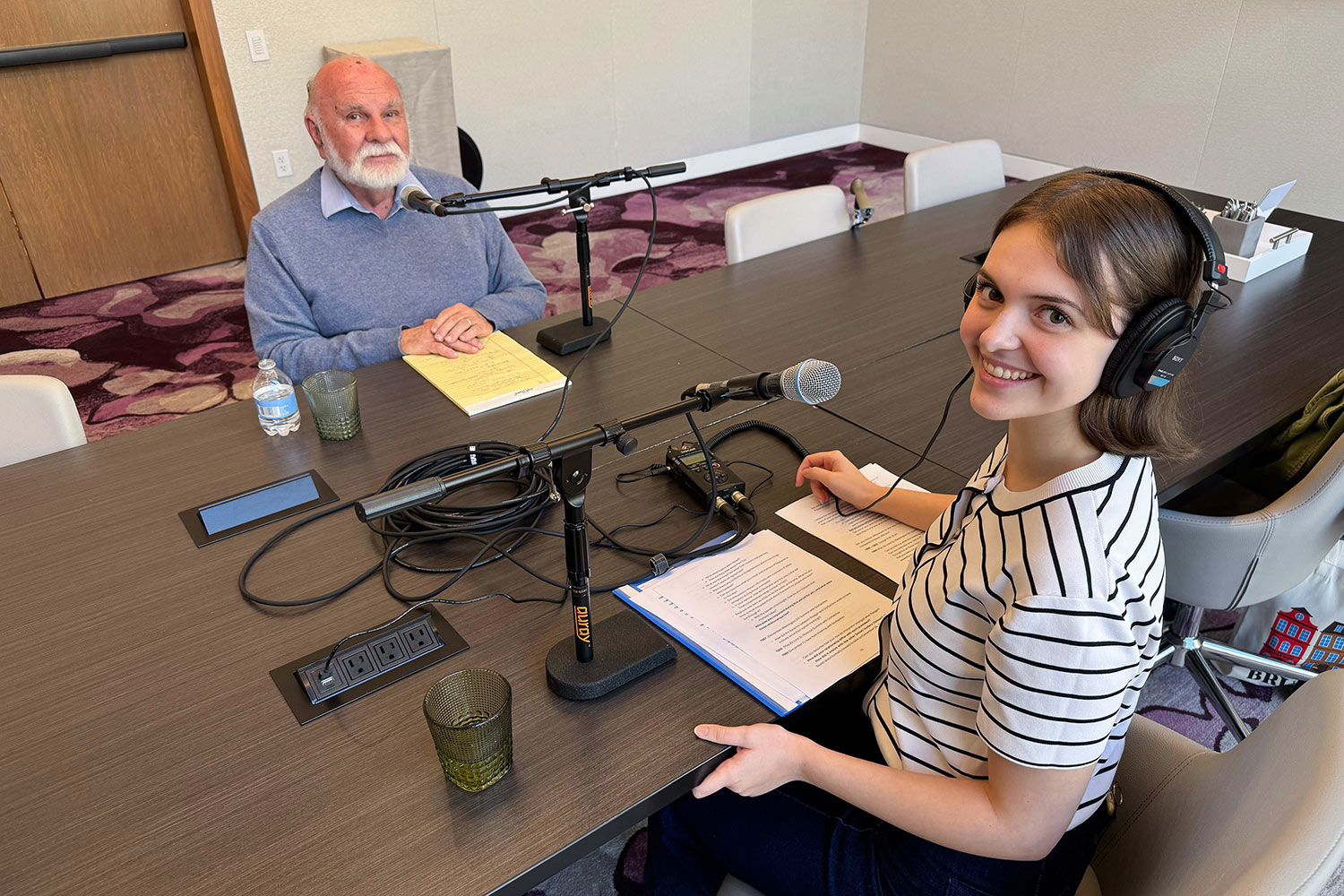
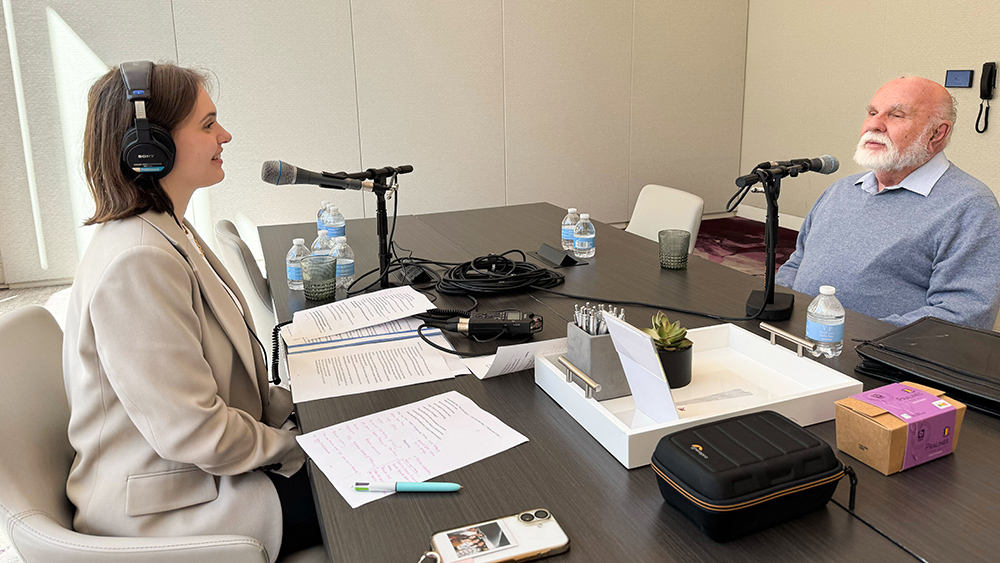
array(1) {
[0]=>
array(727) {
[0]=>
array(4) {
["speaker"]=>
string(15) "Francesca Azzia"
["timestamp"]=>
string(8) "00:00:01"
["seconds"]=>
int(1)
["text"]=>
string(399) "Hello. This is an interview with Dimitry Zarechnak conducted by Francesca Azzia for the Oral History Project, a project of the Stanley Center for Peace and Security and BASIC. This interview is taking place on 9th of March 2026 in Washington DC in the United States of America, and this is session one of three. Dimitry, thank you so much for joining me today. It is such a pleasure to speak to you."
}
[1]=>
array(4) {
["speaker"]=>
string(17) "Dimitry Zarechnak"
["timestamp"]=>
string(8) "00:00:25"
["seconds"]=>
int(25)
["text"]=>
string(369) "Well, it's a pleasure to speak with you as well. It'll be pleasant for me to recall all my interesting years at the State Department between 1971 and 1999. But basically, I guess the most interesting part was the Reagan-Gorbachev meetings, but all the time that I spent there was basically pretty interesting as well, so it's a pleasure for me to go over that with you."
}
[2]=>
array(4) {
["speaker"]=>
string(15) "Francesca Azzia"
["timestamp"]=>
string(8) "00:00:54"
["seconds"]=>
int(54)
["text"]=>
string(168) "And pleasure for me to learn all about it. Okay. So let's start from the beginning. Can you tell me where and when you were born and a little bit about your early life?"
}
[3]=>
array(4) {
["speaker"]=>
string(17) "Dimitry Zarechnak"
["timestamp"]=>
string(8) "00:01:04"
["seconds"]=>
int(64)
["text"]=>
string(916) "Okay. Well, I was born during the Second World War outside of Bratislava. It was in what was then Czechoslovakia, June 17th, 1944, so it was about a year before the end of the war. And since there was a war going on, it was a very difficult time for my parents obviously, and they recall that we were subject to American bombings at that time, because at that time in 1944, June, Czechoslovakia was still under Nazi occupation, so therefore, my mother would tell me how we lived, I think, on the fourth or fifth floor, and then whenever there was a siren, an air raid siren, we would hurry down to the basement of the building to be in a safer place. So that first year was a very traumatic one for me. It might have even had some kind of consequences on my character and so on. And anyway, my grandfather, my mother's father said that I had become sadder over that time, but who knows? Anyway, it was a hectic time."
}
[4]=>
array(4) {
["speaker"]=>
string(17) "Dimitry Zarechnak"
["timestamp"]=>
string(8) "00:02:21"
["seconds"]=>
int(141)
["text"]=>
string(876) "And then after the end of the ... Well, what happened was that as the war was coming to an end and my grandfather, my mother's father, and my own father were in Germany, and my mother and my grandmother were there with me outside of Bratislava. And then all of a sudden, we heard that there were Soviet tanks coming in, and this was a big problem because my parents were very active anti-communists, and they knew that if they were captured by the Soviets, it would be very bad news. So therefore, as my mother tells me, there was a truck coming through the town picking up everybody that wanted to leave for Austria, which was right on the border, of course. So my mother took me and her mother, and practically nothing else, left everything. It was the three of us in the truck, and we headed for Austria, right across the border, so it was definitely a very traumatic time."
}
[5]=>
array(4) {
["speaker"]=>
string(17) "Dimitry Zarechnak"
["timestamp"]=>
string(8) "00:03:34"
["seconds"]=>
int(214)
["text"]=>
string(432) "And then we ended up in a displaced persons camp in Austria, outside of Salzburg, and it was called Parsch, and I know a person from Salzburg from Austria that remembers that displaced person camp. And my brother was actually born there in 1946 in the displaced person camp. But eventually, people moved out of there to various other countries and we came to the United States in 1948, in December of 1948 when I was four years old."
}
[6]=>
array(4) {
["speaker"]=>
string(17) "Dimitry Zarechnak"
["timestamp"]=>
string(8) "00:04:19"
["seconds"]=>
int(259)
["text"]=>
string(547) "The trip across the Atlantic was on a small, I guess fairly small ship, and, apparently, it was one of the worst storms they ever had recorded in the Atlantic at that time. So I remember walking down the corridor, and then all of a sudden, the corridor slopes down before me and I'm flying down to the end. I hit the wall at the end. I remember that experience. And I was also very seasick. I'm still allergic to seasickness, and so I spent a lot of the time in the hospital there together with my brother as well. My mother was doing fairly well."
}
[7]=>
array(4) {
["speaker"]=>
string(17) "Dimitry Zarechnak"
["timestamp"]=>
string(8) "00:05:01"
["seconds"]=>
int(301)
["text"]=>
string(855) "But anyway, so after all that hectic trip, we did arrive in New York, but the thing is that in order to get on that ship, one had to be certified that everyone was in good health, and my father actually had polio. So the only way we got on the ship was the fact that my mother had bribed a German doctor to say that everything was okay, and it wasn't. But of course, the American authorities knew better than to trust all of these certifications and they discovered that my father had polio, so we were placed on Ellis Island outside of New York, which was a famous place where refugees spent a lot of time. And then about six months we spent there. And again, my memories of Ellis Island are very pleasant, despite the fact that it was not so pleasant for my parents. I remember being driven around in laundry carts by the staff, and it was a lot of fun."
}
[8]=>
array(4) {
["speaker"]=>
string(17) "Dimitry Zarechnak"
["timestamp"]=>
string(8) "00:06:06"
["seconds"]=>
int(366)
["text"]=>
string(543) "But after that, my father went to a ... I'm sorry, not polio, it was tuberculosis that he had. He had tuberculosis. He was sent to a famous tuberculosis clinic in Northern New York State in Saranac Lake where he was treated for, I think, about a year or so. My mother and my grand ... Well, my mother was staying outside of New York in New Jersey with a relative of my father's and my grandmother was working. She was working as an assistant, I think, to a famous ballerina. I don't remember her name. And my mother also had to work. Go ahead."
}
[9]=>
array(4) {
["speaker"]=>
string(15) "Francesca Azzia"
["timestamp"]=>
string(8) "00:06:49"
["seconds"]=>
int(409)
["text"]=>
string(50) "These were your grandparents from your mom's side?"
}
[10]=>
array(4) {
["speaker"]=>
string(17) "Dimitry Zarechnak"
["timestamp"]=>
string(8) "00:06:51"
["seconds"]=>
int(411)
["text"]=>
string(671) "From my mother's side, yes. My mother's side, yeah. Well, I can go back a little bit to describe that situation as well, even prior to that, where my mother was born in 1916, shortly before the revolution. But her father, my grandfather, was a colonel in the Kazakh army fighting the Bolsheviks, so they had to leave Russia not to be taken by the Bolsheviks. And so my mother was about six years old or so when they left Russia. And one of the memories that she has was that ... Well, her father was already out of the country, and she and her mother, my grandmother, were going to join the father. But in the passport, there was no mention of a child for my grandmother."
}
[11]=>
array(4) {
["speaker"]=>
string(17) "Dimitry Zarechnak"
["timestamp"]=>
string(8) "00:07:50"
["seconds"]=>
int(470)
["text"]=>
string(299) "So when this train stopped at the border, my grandmother would tell my mother to go into the woods and wait until the train started moving again and come back then. So I can imagine a six-year-old girl waiting out in the forest, waiting for the train to depart. But anyway, they fortunately made it."
}
[12]=>
array(4) {
["speaker"]=>
string(17) "Dimitry Zarechnak"
["timestamp"]=>
string(8) "00:08:09"
["seconds"]=>
int(489)
["text"]=>
string(147) "And so my mother grew up in Bratislava. She actually went to a German school there, learned to speak German fluently, and then met my father there."
}
[13]=>
array(4) {
["speaker"]=>
string(17) "Dimitry Zarechnak"
["timestamp"]=>
string(8) "00:08:19"
["seconds"]=>
int(499)
["text"]=>
string(739) "Now, my father's history is that he was born in the Carpathian Mountains in Czechoslovakia. The nationality is called Ruthenian or Ruthene, and the place where he was from, a very Russophile historically. And his mother told my father that at home, they speak Russian softly, which was ... The Ruthenians language is closer to Ukrainian, so his mother told my father that, "At home, you speak Russian softly. You need to speak Russian firmly." So he went to a Russian gymnasium in Prague to learn to speak Russian firmly, and basically, he spoke Russian like a native Russian, and Russian was spoken at home in our house. We were always considered to be Russian rather than Ruthenian, for example. So that's the history of that part of it."
}
[14]=>
array(4) {
["speaker"]=>
string(15) "Francesca Azzia"
["timestamp"]=>
string(8) "00:09:30"
["seconds"]=>
int(570)
["text"]=>
string(47) "So I wanted to ask you, your grandparents also-"
}
[15]=>
array(4) {
["speaker"]=>
string(17) "Dimitry Zarechnak"
["timestamp"]=>
string(8) "00:09:33"
["seconds"]=>
int(573)
["text"]=>
string(26) "You can interrupt anytime."
}
[16]=>
array(4) {
["speaker"]=>
string(15) "Francesca Azzia"
["timestamp"]=>
string(8) "00:09:35"
["seconds"]=>
int(575)
["text"]=>
string(175) "Yes. Okay, perfect. I didn't want to interrupt you because it's such a captivating story already, but I was wondering, why did your grandparents also decide to move to the US?"
}
[17]=>
array(4) {
["speaker"]=>
string(17) "Dimitry Zarechnak"
["timestamp"]=>
string(8) "00:09:51"
["seconds"]=>
int(591)
["text"]=>
string(646) "Okay. Well, I think just to follow my mother, because that part of it, I don't know that much about, but of course by that time, my brother and I were born, and I guess the alternative that they would have would be to ... Well, I think they would also be connected to the anti-Soviet connection that my mother and my father had, and even for the Russians that had no anti-Soviet connection in Czechoslovakia, they ended up being arrested and deported. In any case, the Soviets just decided that any Russian that they encountered in Europe was going to be deported, so they were aware of that and they were not going to subject themselves to that."
}
[18]=>
array(4) {
["speaker"]=>
string(15) "Francesca Azzia"
["timestamp"]=>
string(8) "00:10:42"
["seconds"]=>
int(642)
["text"]=>
string(61) "And when you arrived to the US, how old did you say you were?"
}
[19]=>
array(4) {
["speaker"]=>
string(17) "Dimitry Zarechnak"
["timestamp"]=>
string(8) "00:10:46"
["seconds"]=>
int(646)
["text"]=>
string(11) "I was four."
}
[20]=>
array(4) {
["speaker"]=>
string(15) "Francesca Azzia"
["timestamp"]=>
string(8) "00:10:48"
["seconds"]=>
int(648)
["text"]=>
string(24) "You were four years old?"
}
[21]=>
array(4) {
["speaker"]=>
string(17) "Dimitry Zarechnak"
["timestamp"]=>
string(8) "00:10:49"
["seconds"]=>
int(649)
["text"]=>
string(5) "Yeah."
}
[22]=>
array(4) {
["speaker"]=>
string(15) "Francesca Azzia"
["timestamp"]=>
string(8) "00:10:50"
["seconds"]=>
int(650)
["text"]=>
string(86) "What was it like to grow up in a Russian-speaking family in the US during those years?"
}
[23]=>
array(4) {
["speaker"]=>
string(17) "Dimitry Zarechnak"
["timestamp"]=>
string(8) "00:10:58"
["seconds"]=>
int(658)
["text"]=>
string(495) "Well, it was never a problem because my parents distinguished very clearly between being Russian and being Soviet, being communists, so there was never a concern about that. And shortly after we spent some time in New York, we moved to California where my parents were teaching Russian at an army language school there in Monterrey, California. And the US authorities obviously understood also that there was a big difference between Russians and communists, so I never felt a problem with that."
}
[24]=>
array(4) {
["speaker"]=>
string(15) "Francesca Azzia"
["timestamp"]=>
string(8) "00:11:36"
["seconds"]=>
int(696)
["text"]=>
string(50) "Of course. Do you have any memories of California?"
}
[25]=>
array(4) {
["speaker"]=>
string(17) "Dimitry Zarechnak"
["timestamp"]=>
string(8) "00:11:39"
["seconds"]=>
int(699)
["text"]=>
string(440) "Well, not many, because like I say, we moved shortly after. I was probably about five years old. Well, there was also pleasant memories. I remember riding on the bus from school to home. We were all riding on buses. And it was a long hill that the bus would come down and we would sometimes get off at the top of the hill, run down to the bottom of the hill and get on the bus again at the bottom of the hill, that sort of thing that young-"
}
[26]=>
array(4) {
["speaker"]=>
string(15) "Francesca Azzia"
["timestamp"]=>
string(8) "00:12:09"
["seconds"]=>
int(729)
["text"]=>
string(12) "Children do."
}
[27]=>
array(4) {
["speaker"]=>
string(17) "Dimitry Zarechnak"
["timestamp"]=>
string(8) "00:12:09"
["seconds"]=>
int(729)
["text"]=>
string(75) "... children like to do. Yeah, and so just spotted memories here and there."
}
[28]=>
array(4) {
["speaker"]=>
string(15) "Francesca Azzia"
["timestamp"]=>
string(8) "00:12:17"
["seconds"]=>
int(737)
["text"]=>
string(62) "And after ... So you were in California for a couple of years?"
}
[29]=>
array(4) {
["speaker"]=>
string(17) "Dimitry Zarechnak"
["timestamp"]=>
string(8) "00:12:20"
["seconds"]=>
int(740)
["text"]=>
string(4) "Yes."
}
[30]=>
array(4) {
["speaker"]=>
string(15) "Francesca Azzia"
["timestamp"]=>
string(8) "00:12:21"
["seconds"]=>
int(741)
["text"]=>
string(33) "And after that, where did you go?"
}
[31]=>
array(4) {
["speaker"]=>
string(17) "Dimitry Zarechnak"
["timestamp"]=>
string(8) "00:12:23"
["seconds"]=>
int(743)
["text"]=>
string(519) "Then my father got a job teaching at Georgetown, teaching Russian at Georgetown University in Washington DC, so we moved to Washington DC in 1948. I'm sorry, we came to the US and we moved in 1952, four years after that. And then my mother also started looking for work. She ended up working at the National Library of Medicine, also I think somehow connected with the Russian language. So both of them were working and my grandparents were home with us, with myself and my brother, so we were being taken good care of."
}
[32]=>
array(4) {
["speaker"]=>
string(17) "Dimitry Zarechnak"
["timestamp"]=>
string(8) "00:13:06"
["seconds"]=>
int(786)
["text"]=>
string(573) "So that's when we came to Washington. And we were in Washington all that time until ... My brother and I went to an elementary school in Washington, and there's a story connected with that as well, that there was an elementary school right on the same block where we lived, a public elementary school. And at one point, apparently the teacher told my mother that my mother should not let me read so much at home because I was bored in class as a result. And my mother had a PhD in Russian literature, and this did not sound good to my mother. This was not a good education."
}
[33]=>
array(4) {
["speaker"]=>
string(15) "Francesca Azzia"
["timestamp"]=>
string(8) "00:13:47"
["seconds"]=>
int(827)
["text"]=>
string(25) "Of course, I can imagine."
}
[34]=>
array(4) {
["speaker"]=>
string(17) "Dimitry Zarechnak"
["timestamp"]=>
string(8) "00:13:48"
["seconds"]=>
int(828)
["text"]=>
string(760) "So she started looking around for a different place to go for me for elementary school, and they found a Catholic school, and they had no problems with my reading too much at home. So I was very grateful to ... And beginning with the second grade up through graduation. Actually, after that, I went to a Catholic high school and a Catholic university, so I was always very grateful for the Catholic education that I got. And as a matter of fact, my brother and I were favorites of two of the nuns teaching there, and one story that one of the nuns told me is that she was head of the library, and when I walked in, I just looked at all the books and I said, "Oh my goodness." And this just impressed her so much that she just fell in love with me, so to speak."
}
[35]=>
array(4) {
["speaker"]=>
string(15) "Francesca Azzia"
["timestamp"]=>
string(8) "00:14:42"
["seconds"]=>
int(882)
["text"]=>
string(45) "What kinds of book would you read as a child?"
}
[36]=>
array(4) {
["speaker"]=>
string(17) "Dimitry Zarechnak"
["timestamp"]=>
string(8) "00:14:44"
["seconds"]=>
int(884)
["text"]=>
string(719) "Well, I would read Russian books and I loved to read fairy tales most of all, and I guess that love of fairy tales probably has carried on to my love of C.S. Lewis. He's my favorite writer and all of the Narnia books and so on, so I would read fairytales. Except that at one point when I was, I don't know how old I was, 10 or more, my mother thought that I would stop reading fairytales because they're not serious enough and I should start reading other things like Tolstoy. And I started reading Tolstoy. He has a book on childhood youth, and I could not read that book, and therefore, I stopped reading in Russian at that point. But since my father also had a PhD in Russian linguistics, the home was full of books-"
}
[37]=>
array(4) {
["speaker"]=>
string(15) "Francesca Azzia"
["timestamp"]=>
string(8) "00:15:33"
["seconds"]=>
int(933)
["text"]=>
string(9) "Of books?"
}
[38]=>
array(4) {
["speaker"]=>
string(17) "Dimitry Zarechnak"
["timestamp"]=>
string(8) "00:15:33"
["seconds"]=>
int(933)
["text"]=>
string(63) "... and this was just the kind of atmosphere that I grew up in."
}
[39]=>
array(4) {
["speaker"]=>
string(15) "Francesca Azzia"
["timestamp"]=>
string(8) "00:15:39"
["seconds"]=>
int(939)
["text"]=>
string(36) "And did you study Russian at school?"
}
[40]=>
array(4) {
["speaker"]=>
string(17) "Dimitry Zarechnak"
["timestamp"]=>
string(8) "00:15:42"
["seconds"]=>
int(942)
["text"]=>
string(766) "Well, the first time I studied ... Well, what happened was that I was interested in mathematics in high school. I was actually inspired by a person that rented a room in our house. He told me about a mathematician who figured out a way to add all the numbers between one and a hundred very quickly, and this was inspiring so I decided I wanted to do that. And I did well in high school and I even got what's called advanced placement in college in mathematics. So I ended up majoring in mathematics, getting a bachelor's degree in mathematics, which I ended up not liking very much and I wanted to drop it all and go to Germany. I had also studied German in high school because my mother spoke German fluently, so I wanted to go to Germany to perfect my German, but-"
}
[41]=>
array(4) {
["speaker"]=>
string(15) "Francesca Azzia"
["timestamp"]=>
string(8) "00:16:41"
["seconds"]=>
int(1001)
["text"]=>
string(46) "Would your mother speak German to you as well?"
}
[42]=>
array(4) {
["speaker"]=>
string(17) "Dimitry Zarechnak"
["timestamp"]=>
string(8) "00:16:45"
["seconds"]=>
int(1005)
["text"]=>
string(901) "No, no, but she helped me with my studies. So I wanted to go to Germany, but I had also applied for a fellowship in graduate school at the University of Toronto in mathematics, and they accepted me, and I felt that since they had accepted me for a fellowship, I shouldn't waste my parents' money in going to Germany. So I went there, spent a year there, but I really didn't like it at all. I didn't like mathematics there. And the problem was that in Canada, they have a European system, unlike the American system where there's only one exam at the end of the year. In the US, we have exams all the time. And there, they have only at the end of the year, and I wanted to take as few courses as possible, and I was teaching, of course, in my fellowship. So it was getting very tense. And soon after I started there, I decided that I really didn't want to do this and I wanted to do Russian literature."
}
[43]=>
array(4) {
["speaker"]=>
string(17) "Dimitry Zarechnak"
["timestamp"]=>
string(8) "00:17:56"
["seconds"]=>
int(1076)
["text"]=>
string(845) "So fortunately, my father taught at Georgetown University and he knew the head of the department there, and so he convinced me that if I convinced him, the head of the department, that if I applied, I would be accepted there for graduate school in Russian literature, despite the fact that I had no undergraduate credits in Russian literature, but of course I spoke Russian well. So I was accepted shortly after the beginning of the school year in Toronto ... So finally, about a month before the end of the school year in Toronto, things were getting tense and I decided that ... And one could withdraw from all the courses and even get a refund without getting a grade, so I thought I should do that, because even if I was going on in Russian literature, it wouldn't look good to have failing grades, despite the fact that it was not my major."
}
[44]=>
array(4) {
["speaker"]=>
string(17) "Dimitry Zarechnak"
["timestamp"]=>
string(8) "00:18:54"
["seconds"]=>
int(1134)
["text"]=>
string(233) "So about a month before the end, I withdrew, I got a refund. I kept teaching because that was part of the fellowship. But there was also a Russian movie festival going on in Toronto, so every day, I went to see another Russian movie."
}
[45]=>
array(4) {
["speaker"]=>
string(15) "Francesca Azzia"
["timestamp"]=>
string(8) "00:19:09"
["seconds"]=>
int(1149)
["text"]=>
string(83) "Can I ask you, what was life like in Toronto for you? Can you describe that for me?"
}
[46]=>
array(4) {
["speaker"]=>
string(17) "Dimitry Zarechnak"
["timestamp"]=>
string(8) "00:19:17"
["seconds"]=>
int(1157)
["text"]=>
string(104) "Well, it was the first time that I had been away from home or from my parents, so it was kind of lonely."
}
[47]=>
array(4) {
["speaker"]=>
string(15) "Francesca Azzia"
["timestamp"]=>
string(8) "00:19:23"
["seconds"]=>
int(1163)
["text"]=>
string(19) "You were 18, right?"
}
[48]=>
array(4) {
["speaker"]=>
string(17) "Dimitry Zarechnak"
["timestamp"]=>
string(8) "00:19:25"
["seconds"]=>
int(1165)
["text"]=>
string(548) "Something like that, yeah. Well, less. Let me think. I had skipped a grade in grade school, so I graduated in 1964 from ... No, no, in 1961 from high school, so I guess I was 17. Yeah, something like that. I was 17 years old, yeah. And I was renting a room there from a nice Polish lady, but I was alone. And although I immediately connected with the Russian community there through the church, so I did have a connection there through the church. But I think the main thing was that I did not like what I was studying, and that was the main issue."
}
[49]=>
array(4) {
["speaker"]=>
string(17) "Dimitry Zarechnak"
["timestamp"]=>
string(8) "00:20:17"
["seconds"]=>
int(1217)
["text"]=>
string(542) "But the funny thing was that after I got home, again, well, I was accepted at Georgetown in Washington so I came to live at home, and for some reason, and I still don't understand it, I felt so ... It was so difficult for me to live at home again, despite the fact that I was not at all happy there, and my parents were not at all critical of me or anything. And it took me, I think, a half a year just to get used to living at home again, but after that, it was okay. I spent two years in graduate school for a master's degree in Washington."
}
[50]=>
array(4) {
["speaker"]=>
string(15) "Francesca Azzia"
["timestamp"]=>
string(8) "00:20:56"
["seconds"]=>
int(1256)
["text"]=>
string(75) "Can I ask you, you mentioned that you found a Russian community in Toronto."
}
[51]=>
array(4) {
["speaker"]=>
string(17) "Dimitry Zarechnak"
["timestamp"]=>
string(8) "00:21:00"
["seconds"]=>
int(1260)
["text"]=>
string(6) "Right."
}
[52]=>
array(4) {
["speaker"]=>
string(15) "Francesca Azzia"
["timestamp"]=>
string(8) "00:21:01"
["seconds"]=>
int(1261)
["text"]=>
string(52) "Did you have anything like that when you were in DC?"
}
[53]=>
array(4) {
["speaker"]=>
string(17) "Dimitry Zarechnak"
["timestamp"]=>
string(8) "00:21:05"
["seconds"]=>
int(1265)
["text"]=>
string(790) "Yes, of course. Of course. Well, Russians often, as soon as they arrived someplace from abroad, they establish a church. That's one of the things, and so that was what happened in Washington as well. There was already a church there when we came. At that time, it was just a house church in the apartment of the priest, and then we moved to the Washington National Cathedral where we were given a space for Sunday services, which we had to set up the iconostasis and then take it down, but then eventually, we had started building our own church. So we have a nice, beautiful church now, and more and more people coming into it, including American converts to Orthodoxy more and more. So now, we have two services, one in English, one in what's called Slavonic. It's an old form of Russian."
}
[54]=>
array(4) {
["speaker"]=>
string(15) "Francesca Azzia"
["timestamp"]=>
string(8) "00:22:00"
["seconds"]=>
int(1320)
["text"]=>
string(10) "Beautiful."
}
[55]=>
array(4) {
["speaker"]=>
string(17) "Dimitry Zarechnak"
["timestamp"]=>
string(8) "00:22:01"
["seconds"]=>
int(1321)
["text"]=>
string(69) "Yeah. Yeah. So there's a very strong Russian community in Washington."
}
[56]=>
array(4) {
["speaker"]=>
string(15) "Francesca Azzia"
["timestamp"]=>
string(8) "00:22:06"
["seconds"]=>
int(1326)
["text"]=>
string(97) "What was it like to find another community in Toronto? Did that make you feel a bit more at home?"
}
[57]=>
array(4) {
["speaker"]=>
string(17) "Dimitry Zarechnak"
["timestamp"]=>
string(8) "00:22:13"
["seconds"]=>
int(1333)
["text"]=>
string(157) "Yes, of course, of course, because I absolutely wanted that and needed that, to have that kind of a connection with my Russian background, undoubtedly. Yeah."
}
[58]=>
array(4) {
["speaker"]=>
string(15) "Francesca Azzia"
["timestamp"]=>
string(8) "00:22:26"
["seconds"]=>
int(1346)
["text"]=>
string(150) "And going back to when you came back from DC, can you tell me more about ... You mentioned that it was difficult to go back to live with your parents."
}
[59]=>
array(4) {
["speaker"]=>
string(17) "Dimitry Zarechnak"
["timestamp"]=>
string(8) "00:22:33"
["seconds"]=>
int(1353)
["text"]=>
string(5) "Yeah."
}
[60]=>
array(4) {
["speaker"]=>
string(15) "Francesca Azzia"
["timestamp"]=>
string(8) "00:22:33"
["seconds"]=>
int(1353)
["text"]=>
string(30) "Can you tell me more about it?"
}
[61]=>
array(4) {
["speaker"]=>
string(17) "Dimitry Zarechnak"
["timestamp"]=>
string(8) "00:22:37"
["seconds"]=>
int(1357)
["text"]=>
string(543) "Yeah. Well, like I say, to this day, I really don't know why it was difficult because I was glad to be studying Russian literature, something that I was enjoying. And I never had a problem living with my parents before, and they certainly did not make it difficult in any way for me when I came back. Although initially, I guess my mother was disappointed that I was not going to be going on to mathematics because she felt that was a more promising career than Russian, but she never said anything about it. I never felt any kind of pressure."
}
[62]=>
array(4) {
["speaker"]=>
string(17) "Dimitry Zarechnak"
["timestamp"]=>
string(8) "00:23:11"
["seconds"]=>
int(1391)
["text"]=>
string(320) "So I don't know why, to tell you the truth. I think it was just the fact that I had been used to living in a certain way, and I think when you are used to living in a certain way and all of a sudden you're living in a different way, no matter what, well, maybe no matter what, but often, that in itself is disconcerting."
}
[63]=>
array(4) {
["speaker"]=>
string(17) "Dimitry Zarechnak"
["timestamp"]=>
string(8) "00:23:30"
["seconds"]=>
int(1410)
["text"]=>
string(429) "And in that regard, I remember, again, talking about C.S. Lewis, that when his wife died, it was very, very difficult for him, and I think one of the reasons was that he was just so ... Well, of course he loved her and he was just used to being with her, and he was saying it was like I have a bow and I'm pulling back the string, but there's nothing to shoot at, that type of thing. You're used to a certain way of doing things."
}
[64]=>
array(4) {
["speaker"]=>
string(15) "Francesca Azzia"
["timestamp"]=>
string(8) "00:24:00"
["seconds"]=>
int(1440)
["text"]=>
string(83) "So then once you came back to DC, you said you started to study Russian literature."
}
[65]=>
array(4) {
["speaker"]=>
string(17) "Dimitry Zarechnak"
["timestamp"]=>
string(8) "00:24:06"
["seconds"]=>
int(1446)
["text"]=>
string(5) "Yeah."
}
[66]=>
array(4) {
["speaker"]=>
string(15) "Francesca Azzia"
["timestamp"]=>
string(8) "00:24:07"
["seconds"]=>
int(1447)
["text"]=>
string(53) "What was it like to ... Was it also Russian language?"
}
[67]=>
array(4) {
["speaker"]=>
string(17) "Dimitry Zarechnak"
["timestamp"]=>
string(8) "00:24:11"
["seconds"]=>
int(1451)
["text"]=>
string(4) "Yes."
}
[68]=>
array(4) {
["speaker"]=>
string(15) "Francesca Azzia"
["timestamp"]=>
string(8) "00:24:11"
["seconds"]=>
int(1451)
["text"]=>
string(65) "What was it like to study Russian in an academic setting for you?"
}
[69]=>
array(4) {
["speaker"]=>
string(17) "Dimitry Zarechnak"
["timestamp"]=>
string(8) "00:24:17"
["seconds"]=>
int(1457)
["text"]=>
string(278) "Yeah. Well, I can go back a little bit back to Toronto since I was there and I had free time. For the first time in my life, I read something. I read Russian literature, more serious Russian literature. The first book was Crime and Punishment, and then Anna Karenina by Tolstoy."
}
[70]=>
array(4) {
["speaker"]=>
string(15) "Francesca Azzia"
["timestamp"]=>
string(8) "00:24:39"
["seconds"]=>
int(1479)
["text"]=>
string(19) "No more fairytales."
}
[71]=>
array(4) {
["speaker"]=>
string(17) "Dimitry Zarechnak"
["timestamp"]=>
string(8) "00:24:41"
["seconds"]=>
int(1481)
["text"]=>
string(574) "No more fairytales, yeah. And I felt that after I had read Crime and Punishment and Anna Karenina, that I felt my knowledge of Russian was tremendously increased after that. So of course, one has to read the language a lot in order to know it well, which I'm sure you can relate to as well. Yeah, so that was the beginning of my introduction to Russian literature. And then of course, once I started studying it formally, then it was the same type of thing. It was a very deep experience, which was later followed by two more years in graduate school at New York University."
}
[72]=>
array(4) {
["speaker"]=>
string(15) "Francesca Azzia"
["timestamp"]=>
string(8) "00:25:26"
["seconds"]=>
int(1526)
["text"]=>
string(186) "So that master's degree in Russian language and literature, can you tell me maybe about those years for you and if you had any mentors, and what relationships did you have at that stage?"
}
[73]=>
array(4) {
["speaker"]=>
string(17) "Dimitry Zarechnak"
["timestamp"]=>
string(8) "00:25:48"
["seconds"]=>
int(1548)
["text"]=>
string(946) "Okay. Well, like I say, the first two years were in Georgetown, the graduate school, and besides the learning, there was also a Russian club, which I ended up being the head of. And we had a choir, a Russian choir, and so one of the things that I remember that there was always a ... At the university, there was a Christmas Carol contest for the various languages, and prior to the time that I had come, the Russian group was not doing very well, partly because there really are no Christmas carols in Russian. They are mostly Ukrainian. So when I came, I decided that we needed to improve the situation, and I asked our choir director in church if he could help us out with the singing at the Christmas Carol. So of course, there are a lot of beautiful Russian Christmas chants in the church. They're composed by professional composers, and so that one time we came out on stage, everybody was holding candles and it was ... We got first place."
}
[74]=>
array(4) {
["speaker"]=>
string(15) "Francesca Azzia"
["timestamp"]=>
string(8) "00:27:00"
["seconds"]=>
int(1620)
["text"]=>
string(40) "Amazing. And so you enjoyed those years?"
}
[75]=>
array(4) {
["speaker"]=>
string(17) "Dimitry Zarechnak"
["timestamp"]=>
string(8) "00:27:06"
["seconds"]=>
int(1626)
["text"]=>
string(319) "I enjoyed those years a great deal, and also the subsequent years at the New York University. At the New York University was, I guess again, the first ... Well, it was not the first time. It was the second time I was away from home, but by that time, I was ready to be away from home, and it was a very good time there."
}
[76]=>
array(4) {
["speaker"]=>
string(15) "Francesca Azzia"
["timestamp"]=>
string(8) "00:27:25"
["seconds"]=>
int(1645)
["text"]=>
string(36) "What was life like in New York City?"
}
[77]=>
array(4) {
["speaker"]=>
string(17) "Dimitry Zarechnak"
["timestamp"]=>
string(8) "00:27:27"
["seconds"]=>
int(1647)
["text"]=>
string(586) "New York City. Well, I was there. The New York University campus was right next to Washington Square, downtown. It's a very Bohemian type of place, a very active type of place. Well, the place where I lived, the dormitory was an old hotel that the university had bought to have a dormitory there, and it was on the corner of two busy streets, Broadway and 10th Avenue. And there was a subway running underneath the hotel, so when the subway would run under, you could feel the shaking of the hotel, but you got used to it. A student at 19 years old or whatever can get used to anything."
}
[78]=>
array(4) {
["speaker"]=>
string(17) "Dimitry Zarechnak"
["timestamp"]=>
string(8) "00:28:19"
["seconds"]=>
int(1699)
["text"]=>
string(457) "And in general, I had a very good friend there who was an American, John Glad, who was studying Russian, and he was a very talented man. And at that time, he liked the fact that I was so interested in Russian and he decided he wanted to be closer with me so he could learn his Russian better, which he did. He ended up speaking Russian without an accent at all. So he was a good friend there and also had the Russian community, the Russian church community."
}
[79]=>
array(4) {
["speaker"]=>
string(17) "Dimitry Zarechnak"
["timestamp"]=>
string(8) "00:28:50"
["seconds"]=>
int(1730)
["text"]=>
string(269) "And one of the things there was that the Russian courses were geared to attracting older, retired people or people that could only come in the evenings, so their courses did not start till about 6:00 in the evening, so I took advantage of that and I slept in very late."
}
[80]=>
array(4) {
["speaker"]=>
string(15) "Francesca Azzia"
["timestamp"]=>
string(8) "00:29:11"
["seconds"]=>
int(1751)
["text"]=>
string(10) "Very good."
}
[81]=>
array(4) {
["speaker"]=>
string(17) "Dimitry Zarechnak"
["timestamp"]=>
string(8) "00:29:13"
["seconds"]=>
int(1753)
["text"]=>
string(22) "So it was a good time."
}
[82]=>
array(4) {
["speaker"]=>
string(15) "Francesca Azzia"
["timestamp"]=>
string(8) "00:29:15"
["seconds"]=>
int(1755)
["text"]=>
string(83) "Very good. And during your PhD, did you focus your study on any particular subject?"
}
[83]=>
array(4) {
["speaker"]=>
string(17) "Dimitry Zarechnak"
["timestamp"]=>
string(8) "00:29:23"
["seconds"]=>
int(1763)
["text"]=>
string(771) "Well, I was planning to write a dissertation on Solzhenitsyn. I don't know if you're familiar with Solzhenitsyn. He was a famous dissident at that time in Russia and a famous writer as well, probably one of the best Soviet writers during the Soviet period, but anti-Soviet. So I was planning to write a dissertation on him. I never got to write the dissertation because I got married after completing my graduate studies there, and I went to teach at a college, a women's college called Smith College in Massachusetts, Northampton, Massachusetts, which I taught for two years. And so I never got to write the dissertation. And then at the end of the two years at Smith College, they did not extend my contract. In other words, I was fired, and so I was looking for a job."
}
[84]=>
array(4) {
["speaker"]=>
string(15) "Francesca Azzia"
["timestamp"]=>
string(8) "00:30:26"
["seconds"]=>
int(1826)
["text"]=>
string(182) "Before getting to you looking for a new job, I was wondering if, when you decided to study in Russian literature, if you already had in mind that you wanted to become an interpreter?"
}
[85]=>
array(4) {
["speaker"]=>
string(17) "Dimitry Zarechnak"
["timestamp"]=>
string(8) "00:30:46"
["seconds"]=>
int(1846)
["text"]=>
string(679) "No, I had no idea that there was such a profession at that time. Well, the interesting thing was the fact that I actually had done some interpreting, but I never realized that there was such a profession. And the interpreting that I had done was once, I was ... Then I also went to a Russian scout camp in New York State, and I was called at one point by another Russian ... No. I was called by the racetrack at Yonkers Raceway saying that they had some Russian horses there that were running, and they had hired as an interpreter, a professor from, I think, Columbia University, but he was not doing very well, so they were desperately looking for somebody that could do better."
}
[86]=>
array(4) {
["speaker"]=>
string(17) "Dimitry Zarechnak"
["timestamp"]=>
string(8) "00:31:44"
["seconds"]=>
int(1904)
["text"]=>
string(340) "And I guess they contacted somebody at the State Department, an interpreter that knew me, although I had no idea that there was such a thing as the State Department, to tell you the truth, at that time. He contacted me because he knew me and he recommended me. So I came down with two of my scout colleagues to interpret for these horsemen."
}
[87]=>
array(4) {
["speaker"]=>
string(17) "Dimitry Zarechnak"
["timestamp"]=>
string(8) "00:32:07"
["seconds"]=>
int(1927)
["text"]=>
string(416) "And the first thing that I had to do was there was this interview on the radio with the host of the company, with one of the people on the team of the horsemen, and so I was supposed to interpret this interview that they were having over the radio which was listened to by a million people or something like that. So I told the host there that, "Don't use any technical terms. I'm not familiar with technical terms.""
}
[88]=>
array(4) {
["speaker"]=>
string(17) "Dimitry Zarechnak"
["timestamp"]=>
string(8) "00:32:40"
["seconds"]=>
int(1960)
["text"]=>
string(472) "So one of the things he asked the Russian trainers was that, "What did you do with the stud horse that we gave you?" I had no idea what a stud horse was, so I said, "What's a stud horse?" And he became so embarrassed, that this was a million people listening and this stupid person doesn't know what a stud horse. So he explained it to me, and then of course I explained it to them and everything was okay. And after that, every time he saw me, he just was so embarrassed."
}
[89]=>
array(4) {
["speaker"]=>
string(17) "Dimitry Zarechnak"
["timestamp"]=>
string(8) "00:33:14"
["seconds"]=>
int(1994)
["text"]=>
string(364) "And also, not too long after that, another one of my colleagues that was with the group was with the group at another racetrack in New York, and it was announced on the loudspeakers that the Russians were there. And then one of the policemen came up to my colleague that was with the group and he said, "Oh, are you the guy that didn't know what a stud horse was?""
}
[90]=>
array(4) {
["speaker"]=>
string(15) "Francesca Azzia"
["timestamp"]=>
string(8) "00:33:43"
["seconds"]=>
int(2023)
["text"]=>
string(10) "Very good."
}
[91]=>
array(4) {
["speaker"]=>
string(17) "Dimitry Zarechnak"
["timestamp"]=>
string(8) "00:33:44"
["seconds"]=>
int(2024)
["text"]=>
string(347) "So I became famous not even realizing. And after I was working there with these people, the people that hired me said that I was so good, they thought I was with the State Department. I had no idea what the State Department was. I thought it was the security people at the White House that guarded the President, so I had no idea at that time yet."
}
[92]=>
array(4) {
["speaker"]=>
string(15) "Francesca Azzia"
["timestamp"]=>
string(8) "00:34:10"
["seconds"]=>
int(2050)
["text"]=>
string(55) "All in all, what did that experience feel like for you?"
}
[93]=>
array(4) {
["speaker"]=>
string(17) "Dimitry Zarechnak"
["timestamp"]=>
string(8) "00:34:13"
["seconds"]=>
int(2053)
["text"]=>
string(35) "The experience of working with the-"
}
[94]=>
array(4) {
["speaker"]=>
string(15) "Francesca Azzia"
["timestamp"]=>
string(8) "00:34:16"
["seconds"]=>
int(2056)
["text"]=>
string(46) "Well, your first experience as an interpreter."
}
[95]=>
array(4) {
["speaker"]=>
string(17) "Dimitry Zarechnak"
["timestamp"]=>
string(8) "00:34:19"
["seconds"]=>
int(2059)
["text"]=>
string(307) "Well, it was enjoyable. I think I have a natural talent for interpreting, and I think the people that hired me felt that. They had obviously been working with a professor who was not that good, and so they were happy to have me and praised me for that, and I guess it was just the natural talent that I had."
}
[96]=>
array(4) {
["speaker"]=>
string(15) "Francesca Azzia"
["timestamp"]=>
string(8) "00:34:40"
["seconds"]=>
int(2080)
["text"]=>
string(110) "Before moving on with some questions about this, you also mentioned that you met your wife during those years?"
}
[97]=>
array(4) {
["speaker"]=>
string(17) "Dimitry Zarechnak"
["timestamp"]=>
string(8) "00:34:47"
["seconds"]=>
int(2087)
["text"]=>
string(4) "Yes."
}
[98]=>
array(4) {
["speaker"]=>
string(15) "Francesca Azzia"
["timestamp"]=>
string(8) "00:34:47"
["seconds"]=>
int(2087)
["text"]=>
string(30) "Can you tell me more about it?"
}
[99]=>
array(4) {
["speaker"]=>
string(17) "Dimitry Zarechnak"
["timestamp"]=>
string(8) "00:34:48"
["seconds"]=>
int(2088)
["text"]=>
string(745) "Sure. Well, she's also of Russian background like I am. She was born in 1946 in Italy shortly after the war, and also in a displaced person's camp, but as opposed to our situation where we moved to the United States, they moved to Argentina. So she grew up in Argentina for the first years of her life. And then her father got a job in Germany with a Russian, I guess, CIA sponsored company. And they lived there for a year or something like that. And then they came back to Argentina. And then eventually moved to the United States in 1963. So she was 19 at the time. She was born in '46, so she was 17 at the time, and that's when I met her. But I had the girlfriends before I met her, so it took me a while to get to understand what I needed."
}
[100]=>
array(4) {
["speaker"]=>
string(15) "Francesca Azzia"
["timestamp"]=>
string(8) "00:35:46"
["seconds"]=>
int(2146)
["text"]=>
string(54) "Of course. And you got married a few years after that?"
}
[101]=>
array(4) {
["speaker"]=>
string(17) "Dimitry Zarechnak"
["timestamp"]=>
string(8) "00:35:52"
["seconds"]=>
int(2152)
["text"]=>
string(496) "Yes. Well, we got engaged first, of course. And then after we got engaged, I spent two years in New York studying there. So she was very concerned about that because of all the girlfriends I had had before that. And she would write letters to me and the letters were so full of anguish that I finally said, "Don't write me any more letters. Let's just talk on the telephone." But then two years after that, after I finished graduate school, we got married because I had a teaching job in college."
}
[102]=>
array(4) {
["speaker"]=>
string(15) "Francesca Azzia"
["timestamp"]=>
string(8) "00:36:26"
["seconds"]=>
int(2186)
["text"]=>
string(78) "What was it like for you to find someone that had a similar background to you?"
}
[103]=>
array(4) {
["speaker"]=>
string(17) "Dimitry Zarechnak"
["timestamp"]=>
string(8) "00:36:31"
["seconds"]=>
int(2191)
["text"]=>
string(285) "Well, I think that for me was actually necessary. I felt that was necessary. That was the problem with my very first girlfriend when I was actually 17 years old. It turned out that she was born on the exact same day and same year that I was, June 17th, 1944. So you think that this is-"
}
[104]=>
array(4) {
["speaker"]=>
string(15) "Francesca Azzia"
["timestamp"]=>
string(8) "00:36:50"
["seconds"]=>
int(2210)
["text"]=>
string(12) "Meant to be."
}
[105]=>
array(4) {
["speaker"]=>
string(17) "Dimitry Zarechnak"
["timestamp"]=>
string(8) "00:36:51"
["seconds"]=>
int(2211)
["text"]=>
string(172) "... this is fate. Yeah. Well, it wasn't. And well, I think the main reason was that she wasn't Russian background, and I just felt this was something that I needed to have."
}
[106]=>
array(4) {
["speaker"]=>
string(15) "Francesca Azzia"
["timestamp"]=>
string(8) "00:37:03"
["seconds"]=>
int(2223)
["text"]=>
string(56) "Of course. I get that. Can you tell me your wife's name?"
}
[107]=>
array(4) {
["speaker"]=>
string(17) "Dimitry Zarechnak"
["timestamp"]=>
string(8) "00:37:06"
["seconds"]=>
int(2226)
["text"]=>
string(8) "Eugenia."
}
[108]=>
array(4) {
["speaker"]=>
string(15) "Francesca Azzia"
["timestamp"]=>
string(8) "00:37:09"
["seconds"]=>
int(2229)
["text"]=>
string(89) "Beautiful. So after you got married, you said that you went to work at the Smith College?"
}
[109]=>
array(4) {
["speaker"]=>
string(17) "Dimitry Zarechnak"
["timestamp"]=>
string(8) "00:37:16"
["seconds"]=>
int(2236)
["text"]=>
string(4) "Yes."
}
[110]=>
array(4) {
["speaker"]=>
string(15) "Francesca Azzia"
["timestamp"]=>
string(8) "00:37:17"
["seconds"]=>
int(2237)
["text"]=>
string(50) "And that wasn't your first time teaching, correct?"
}
[111]=>
array(4) {
["speaker"]=>
string(17) "Dimitry Zarechnak"
["timestamp"]=>
string(8) "00:37:21"
["seconds"]=>
int(2241)
["text"]=>
string(21) "It was my first time."
}
[112]=>
array(4) {
["speaker"]=>
string(15) "Francesca Azzia"
["timestamp"]=>
string(8) "00:37:21"
["seconds"]=>
int(2241)
["text"]=>
string(23) "It was your first time?"
}
[113]=>
array(4) {
["speaker"]=>
string(17) "Dimitry Zarechnak"
["timestamp"]=>
string(8) "00:37:22"
["seconds"]=>
int(2242)
["text"]=>
string(9) "Yes. Yes."
}
[114]=>
array(4) {
["speaker"]=>
string(15) "Francesca Azzia"
["timestamp"]=>
string(8) "00:37:23"
["seconds"]=>
int(2243)
["text"]=>
string(31) "Okay. Can you tell me about it?"
}
[115]=>
array(4) {
["speaker"]=>
string(17) "Dimitry Zarechnak"
["timestamp"]=>
string(8) "00:37:26"
["seconds"]=>
int(2246)
["text"]=>
string(23) "My first and only time."
}
[116]=>
array(4) {
["speaker"]=>
string(15) "Francesca Azzia"
["timestamp"]=>
string(8) "00:37:27"
["seconds"]=>
int(2247)
["text"]=>
string(65) "Your first and only. What was it like to teach your own language?"
}
[117]=>
array(4) {
["speaker"]=>
string(17) "Dimitry Zarechnak"
["timestamp"]=>
string(8) "00:37:30"
["seconds"]=>
int(2250)
["text"]=>
string(572) "Well, it was not a problem. My father was a linguist a Russian linguist, so not a problem. The problem was I also had the second year that I was there, I was also teaching a course in poetry, Russian poetry, and I think I didn't really know how to do that very well. The first semester, I had two students and one of them dropped out. So the second semester, fortunately, the one stayed so I could still teach my course. But maybe that was one of the reasons that they decided that not to keep me on anymore. They needed to have more people interested in what I was doing."
}
[118]=>
array(4) {
["speaker"]=>
string(15) "Francesca Azzia"
["timestamp"]=>
string(8) "00:38:09"
["seconds"]=>
int(2289)
["text"]=>
string(71) "So can you tell me about how you started your career as an interpreter?"
}
[119]=>
array(4) {
["speaker"]=>
string(17) "Dimitry Zarechnak"
["timestamp"]=>
string(8) "00:38:12"
["seconds"]=>
int(2292)
["text"]=>
string(740) "Okay. Well, as I say, when my contract was not extended, I was looking for a job. And at that time, I was not even aware, like I said, that there was such a thing as, despite the fact that the people at Yonkers Raceway mentioned the State Department, I still had no idea what that was. So I was looking for a job. And I was also looking to come back to Washington because my wife had never been away from her parents before we were married, so it was difficult for her. Well, she became pregnant soon after we married, so we had a small ... After a year, we had our first son and he, as a matter of fact, he was born with brain damage, so it was even more difficult. So I thought we should go back to Washington to be closer to her parents."
}
[120]=>
array(4) {
["speaker"]=>
string(17) "Dimitry Zarechnak"
["timestamp"]=>
string(8) "00:39:05"
["seconds"]=>
int(2345)
["text"]=>
string(391) "And as it happened, my mother told me that a friend of hers who worked at the State Department said that they were looking for a Russian interpreter at the State Department. They had some, but they needed more because it was the time of what was called détente between America and the Soviet Union. Well, I guess it's a French word. You understand that, of course, the lessening of tension."
}
[121]=>
array(4) {
["speaker"]=>
string(17) "Dimitry Zarechnak"
["timestamp"]=>
string(8) "00:39:32"
["seconds"]=>
int(2372)
["text"]=>
string(585) "And so they had two full-time Russian interpreters, one of whom spent most of his time in arms negotiations in Geneva. He was the senior interpreter, Bill Krimer was his name. Another one who was more in Washington, but they needed more people because there were more and more things happening between the two countries. And so they were interested in finding an interpreter. And my mother said they were interested in finding an interpreter, but to work for the State Department, you need to be a diplomat and it wouldn't work for you. So according to my mother, I was not a diplomat."
}
[122]=>
array(4) {
["speaker"]=>
string(17) "Dimitry Zarechnak"
["timestamp"]=>
string(8) "00:40:09"
["seconds"]=>
int(2409)
["text"]=>
string(197) "So I was going to show my mom that I could work for the State Department. Although, you don't have to really be much of a diplomat to work as an interpreter. You just have to be a good interpreter."
}
[123]=>
array(4) {
["speaker"]=>
string(15) "Francesca Azzia"
["timestamp"]=>
string(8) "00:40:21"
["seconds"]=>
int(2421)
["text"]=>
string(77) "You talked about your son. What was it like for you to have to go back to DC?"
}
[124]=>
array(4) {
["speaker"]=>
string(17) "Dimitry Zarechnak"
["timestamp"]=>
string(8) "00:40:28"
["seconds"]=>
int(2428)
["text"]=>
string(339) "Well, from my wife's point of view, of course, it was good because there was more support. My parents were there, her parents were there. So it was good from that point of view. And also we had a daughter born shortly thereafter, shortly after we came. And my wife was also pregnant by the time we got there. So she was born in 1972. Yeah."
}
[125]=>
array(4) {
["speaker"]=>
string(15) "Francesca Azzia"
["timestamp"]=>
string(8) "00:40:53"
["seconds"]=>
int(2453)
["text"]=>
string(26) "What are your kids' names?"
}
[126]=>
array(4) {
["speaker"]=>
string(17) "Dimitry Zarechnak"
["timestamp"]=>
string(8) "00:40:57"
["seconds"]=>
int(2457)
["text"]=>
string(149) "Well, the first son is Peter. Then the daughter is Vera. And there was a second son that was born two years after that in '74, Alex, Alexander. Also-"
}
[127]=>
array(4) {
["speaker"]=>
string(15) "Francesca Azzia"
["timestamp"]=>
string(8) "00:41:12"
["seconds"]=>
int(2472)
["text"]=>
string(276) "Yes, like the character of Narnia, but there were no connection there. In my case, it was, well, I'm a fairly religious man, so the connection for me was St. Peter, that he was such an emotional person and responded emotionally to Christ. So that was the connection for Peter."
}
[128]=>
array(4) {
["speaker"]=>
string(15) "Francesca Azzia"
["timestamp"]=>
string(8) "00:41:31"
["seconds"]=>
int(2491)
["text"]=>
string(19) "[Recorder stopped.]"
}
[129]=>
array(4) {
["speaker"]=>
string(17) "Dimitry Zarechnak"
["timestamp"]=>
string(8) "00:41:48"
["seconds"]=>
int(2508)
["text"]=>
string(25) "Okay. Where did we leave?"
}
[130]=>
array(4) {
["speaker"]=>
string(15) "Francesca Azzia"
["timestamp"]=>
string(8) "00:41:50"
["seconds"]=>
int(2510)
["text"]=>
string(48) "I think you were telling me about your children."
}
[131]=>
array(4) {
["speaker"]=>
string(17) "Dimitry Zarechnak"
["timestamp"]=>
string(8) "00:41:53"
["seconds"]=>
int(2513)
["text"]=>
string(45) "My children, who they were named in honor of."
}
[132]=>
array(4) {
["speaker"]=>
string(15) "Francesca Azzia"
["timestamp"]=>
string(8) "00:41:55"
["seconds"]=>
int(2515)
["text"]=>
string(16) "Children's name."
}
[133]=>
array(4) {
["speaker"]=>
string(17) "Dimitry Zarechnak"
["timestamp"]=>
string(8) "00:41:56"
["seconds"]=>
int(2516)
["text"]=>
string(133) "So I guess I indicated that Peter was named in honor of St. Peter and my daughter Vera was named in honor of my wife's grandmother, ."
}
[134]=>
array(4) {
["speaker"]=>
string(15) "Francesca Azzia"
["timestamp"]=>
string(8) "00:42:06"
["seconds"]=>
int(2526)
["text"]=>
string(6) "Yes. ."
}
[135]=>
array(4) {
["speaker"]=>
string(17) "Dimitry Zarechnak"
["timestamp"]=>
string(8) "00:42:07"
["seconds"]=>
int(2527)
["text"]=>
string(361) "And who was basically my wife's caretaker in Argentina since her mother, my wife's mother and my wife's father were working. So she had a great affinity, a great love for her grandmother. So she named my daughter in honor of her grandmother. And then my younger son I named in honor of Solzhenitsyn actually because he was very much a Russian hero at that time."
}
[136]=>
array(4) {
["speaker"]=>
string(15) "Francesca Azzia"
["timestamp"]=>
string(8) "00:42:36"
["seconds"]=>
int(2556)
["text"]=>
string(29) "Beautiful names, all of them."
}
[137]=>
array(4) {
["speaker"]=>
string(15) "Francesca Azzia"
["timestamp"]=>
string(8) "00:42:38"
["seconds"]=>
int(2558)
["text"]=>
string(135) "Okay. So you were telling me that ... Actually, I wanted to ask you, you said that your kids were all born close in time to each other?"
}
[138]=>
array(4) {
["speaker"]=>
string(17) "Dimitry Zarechnak"
["timestamp"]=>
string(8) "00:42:50"
["seconds"]=>
int(2570)
["text"]=>
string(27) "Yes. Two years apart. Yeah."
}
[139]=>
array(4) {
["speaker"]=>
string(15) "Francesca Azzia"
["timestamp"]=>
string(8) "00:42:52"
["seconds"]=>
int(2572)
["text"]=>
string(72) "So by the time you came back to DC, it was just your first son was born?"
}
[140]=>
array(4) {
["speaker"]=>
string(17) "Dimitry Zarechnak"
["timestamp"]=>
string(8) "00:42:56"
["seconds"]=>
int(2576)
["text"]=>
string(30) "Yeah, just the first son, yes."
}
[141]=>
array(4) {
["speaker"]=>
string(15) "Francesca Azzia"
["timestamp"]=>
string(8) "00:42:56"
["seconds"]=>
int(2576)
["text"]=>
string(42) "And they were born in the following years?"
}
[142]=>
array(4) {
["speaker"]=>
string(17) "Dimitry Zarechnak"
["timestamp"]=>
string(8) "00:42:59"
["seconds"]=>
int(2579)
["text"]=>
string(19) "Yeah. Right, right."
}
[143]=>
array(4) {
["speaker"]=>
string(15) "Francesca Azzia"
["timestamp"]=>
string(8) "00:43:01"
["seconds"]=>
int(2581)
["text"]=>
string(78) "Okay. So you were telling me about your mother not believing that you were ..."
}
[144]=>
array(4) {
["speaker"]=>
string(17) "Dimitry Zarechnak"
["timestamp"]=>
string(8) "00:43:05"
["seconds"]=>
int(2585)
["text"]=>
string(22) "I could be a diplomat."
}
[145]=>
array(4) {
["speaker"]=>
string(15) "Francesca Azzia"
["timestamp"]=>
string(8) "00:43:08"
["seconds"]=>
int(2588)
["text"]=>
string(64) "That you could be a diplomat. And you wanted to prove her wrong."
}
[146]=>
array(4) {
["speaker"]=>
string(17) "Dimitry Zarechnak"
["timestamp"]=>
string(8) "00:43:11"
["seconds"]=>
int(2591)
["text"]=>
string(6) "Right."
}
[147]=>
array(4) {
["speaker"]=>
string(15) "Francesca Azzia"
["timestamp"]=>
string(8) "00:43:12"
["seconds"]=>
int(2592)
["text"]=>
string(28) "How did you prove her wrong?"
}
[148]=>
array(4) {
["speaker"]=>
string(17) "Dimitry Zarechnak"
["timestamp"]=>
string(8) "00:43:20"
["seconds"]=>
int(2600)
["text"]=>
string(380) "Okay. Well, actually there's a story about how maybe I proved her right at one point in my career, but basically one doesn't have to be a diplomat to be a good interpreter. One just has to interpret well, to get across the message as both the essence and the feeling of it. But there was one time when I turned out not to be a good diplomat, and I can mention that if you want to."
}
[149]=>
array(4) {
["speaker"]=>
string(15) "Francesca Azzia"
["timestamp"]=>
string(8) "00:43:45"
["seconds"]=>
int(2625)
["text"]=>
string(5) "Sure."
}
[150]=>
array(4) {
["speaker"]=>
string(17) "Dimitry Zarechnak"
["timestamp"]=>
string(8) "00:43:47"
["seconds"]=>
int(2627)
["text"]=>
string(656) "It was, well, already later in the career when President Reagan was the president, and his Secretary of State was George Shultz. And so at one point, George Shultz was going to meet with a Russian foreign minister in, I think it was in Helsinki, for just a luncheon and a meeting. And so I was called by Shultz's secretary and said that, she told me that Shultz wanted me to translate the song Georgia On My Mind into Russian because the Russian foreign minister was from the country of Georgia in the Soviet Union. So Shultz wanted to make a good impression on him by singing Georgia On My Mind in Russia to him. Well, of course, the language was Russian."
}
[151]=>
array(4) {
["speaker"]=>
string(17) "Dimitry Zarechnak"
["timestamp"]=>
string(8) "00:44:42"
["seconds"]=>
int(2682)
["text"]=>
string(418) "So the problem is that the word for Georgia in Russian for the state is Georgia and for the country is Gruziya. They're different words. So I explained to the secretary this wouldn't work because they're two different words. And the secretary says, "Well, I'll tell the secretary, Secretary Shultz, that." And then I got a call back from the secretary's secretary and she said, "Secretary Shultz says, 'Do it anyway.'""
}
[152]=>
array(4) {
["speaker"]=>
string(17) "Dimitry Zarechnak"
["timestamp"]=>
string(8) "00:45:14"
["seconds"]=>
int(2714)
["text"]=>
string(466) "And so then I consulted with the senior Russian advisor at the White House, Matlock, Jack Matlock. And the way he suggested it is that let's split it. Let's do it two ways. Let's do it both ways. Let's say, "Georgia Gruziya." And he obviously was a diplomat. He knew how to diplomatically solve this problem. And me, a poor interpreter, did not realize that. So I proved my mother right in that one particular instance, but that was the only case that was a problem."
}
[153]=>
array(4) {
["speaker"]=>
string(15) "Francesca Azzia"
["timestamp"]=>
string(8) "00:45:52"
["seconds"]=>
int(2752)
["text"]=>
string(49) "Did Shultz sing the song or did you have to sing?"
}
[154]=>
array(4) {
["speaker"]=>
string(17) "Dimitry Zarechnak"
["timestamp"]=>
string(8) "00:45:56"
["seconds"]=>
int(2756)
["text"]=>
string(327) "No. Shultz wanted other people to sing the song. So I categorically refused to do that and I assigned another one of our interpreters. But in addition to that other interpreter, there was Jack Matlock himself and one of our other State Department officials, that they were a trio that sang that song in Russian to Shevardnadze."
}
[155]=>
array(4) {
["speaker"]=>
string(17) "Dimitry Zarechnak"
["timestamp"]=>
string(8) "00:46:21"
["seconds"]=>
int(2781)
["text"]=>
string(246) "And then after all that, Schultz came up to me and he said, "See, it worked." And I was on his blacklist after that. And he wrote some memoirs, and despite the fact that I worked with him for countless hours, he never mentioned me in his memoirs."
}
[156]=>
array(4) {
["speaker"]=>
string(15) "Francesca Azzia"
["timestamp"]=>
string(8) "00:46:37"
["seconds"]=>
int(2797)
["text"]=>
string(7) "Really?"
}
[157]=>
array(4) {
["speaker"]=>
string(17) "Dimitry Zarechnak"
["timestamp"]=>
string(8) "00:46:37"
["seconds"]=>
int(2797)
["text"]=>
string(26) "Yeah. Yeah. Unfortunately."
}
[158]=>
array(4) {
["speaker"]=>
string(15) "Francesca Azzia"
["timestamp"]=>
string(8) "00:46:44"
["seconds"]=>
int(2804)
["text"]=>
string(19) "That's interesting."
}
[159]=>
array(4) {
["speaker"]=>
string(15) "Francesca Azzia"
["timestamp"]=>
string(8) "00:46:44"
["seconds"]=>
int(2804)
["text"]=>
string(239) "I'm going to ask you more questions about that and about your relationship with the people you worked with. But I'm curious to know, to go back to where we left, tell me about the test that you had to take to get into the State Department."
}
[160]=>
array(4) {
["speaker"]=>
string(17) "Dimitry Zarechnak"
["timestamp"]=>
string(8) "00:46:57"
["seconds"]=>
int(2817)
["text"]=>
string(812) "Right. Okay. Well, it was a simple test, the one that we always gave when I was there up to 1999, it maybe still is. The test was we would read, a passage was read of a few paragraphs long, and I had to take notes on it, and then on the basis of those notes to give it back in Russian. It was read in English. There were two passages read. And so that's what I did in both those cases. And apparently I very much impressed the senior Russian interpreter that was in charge of the test. And he told the people that headed up the language services division that I did very well. And so they were happy to hear that. And they asked me a few questions about how am I Russian and so on, but basically I think that was the decisive result from that test. And they hired me right there to work for the State Department."
}
[161]=>
array(4) {
["speaker"]=>
string(17) "Dimitry Zarechnak"
["timestamp"]=>
string(8) "00:48:04"
["seconds"]=>
int(2884)
["text"]=>
string(562) "And one interesting thing about that also was that when I was looking for a job in Washington, I first applied to the Voice of America since I had actually worked there just on a very part-time basis before. When I was studying in New York, I worked there as a correspondent, New York correspondent for the Voice of America. So I applied to the Voice of America and they accepted me since they knew me. But then after that, the State Department also accepted me and they were paying better than the Voice of America, so I decided to go with the State Department."
}
[162]=>
array(4) {
["speaker"]=>
string(15) "Francesca Azzia"
["timestamp"]=>
string(8) "00:48:41"
["seconds"]=>
int(2921)
["text"]=>
string(73) "Very good. Besides, you also had experience translating about horses, so."
}
[163]=>
array(4) {
["speaker"]=>
string(17) "Dimitry Zarechnak"
["timestamp"]=>
string(8) "00:48:47"
["seconds"]=>
int(2927)
["text"]=>
string(18) "Yes, that's right."
}
[164]=>
array(4) {
["speaker"]=>
string(15) "Francesca Azzia"
["timestamp"]=>
string(8) "00:48:49"
["seconds"]=>
int(2929)
["text"]=>
string(10) "Very good."
}
[165]=>
array(4) {
["speaker"]=>
string(17) "Dimitry Zarechnak"
["timestamp"]=>
string(8) "00:48:51"
["seconds"]=>
int(2931)
["text"]=>
string(542) "Yeah, you know what? That reminded me, when I was with the trainer, with the horse trainers, we took a trip to another city where they had a racetrack. And accompanying us was the head of the Yonkers Raceway and also a New York Times correspondent, sports correspondent, he went with us. And at one point, the New York Times correspondent asked me, "What's the Russian word for exciting?" So I gave him a few Russian words for exciting, including “vozbuzhdayushchiy” (возбуждающий) And I had no idea why he was asking this.”"
}
[166]=>
array(4) {
["speaker"]=>
string(17) "Dimitry Zarechnak"
["timestamp"]=>
string(8) "00:49:33"
["seconds"]=>
int(2973)
["text"]=>
string(490) "Well, ‘vozbuzhdayushchiy’ is one of the terms, but it means more sexually exciting. And then the reason that he was asking this was that he printed a story about when we were at this other racetrack, the Russians saw some more stud horses, as it turned out. And he was writing about their excitement at seeing these stud horses, and I had no idea that that's what he was talking about. And so in the story, he used this word, and it turned out that they were sexually excited by the ..."
}
[167]=>
array(4) {
["speaker"]=>
string(15) "Francesca Azzia"
["timestamp"]=>
string(8) "00:50:12"
["seconds"]=>
int(3012)
["text"]=>
string(45) "The importance of context when you interpret."
}
[168]=>
array(4) {
["speaker"]=>
string(17) "Dimitry Zarechnak"
["timestamp"]=>
string(8) "00:50:16"
["seconds"]=>
int(3016)
["text"]=>
string(1032) "That's right. Absolutely. And that also reminds me of when ... There was also, from that point of view of sexual excitement, there was a visit by President Carter. This was actually, I was at the State Department at that time, but he visited Poland. And he had one of our Polish interpreters along with him, except that the primary language of this Polish interpreter was Russian rather than Polish. But also, it was a very difficult situation because the interpreter ... Well, Carter landed in Poland, and the interpreter was standing there at the microphone and he did not have the President's remarks in advance. And it was raining, I think on top of that. He was given these remarks in advance in a language that was not his best language. And the President said, "I love the Poles." And the word that he used in Polish also meant I love them physically. I have a physical love for them. And this made the headlines. This was the headline for the next day. So how important it is to have ahead of time, first of all, the speech-"
}
[169]=>
array(4) {
["speaker"]=>
string(15) "Francesca Azzia"
["timestamp"]=>
string(8) "00:51:20"
["seconds"]=>
int(3080)
["text"]=>
string(10) "Of course."
}
[170]=>
array(4) {
["speaker"]=>
string(17) "Dimitry Zarechnak"
["timestamp"]=>
string(8) "00:51:21"
["seconds"]=>
int(3081)
["text"]=>
string(31) "... which I will come to later."
}
[171]=>
array(4) {
["speaker"]=>
string(17) "Dimitry Zarechnak"
["timestamp"]=>
string(8) "00:51:23"
["seconds"]=>
int(3083)
["text"]=>
string(113) "But the next morning, my mother called me seeing this headline, and said, "Were you involved in that in any way?""
}
[172]=>
array(4) {
["speaker"]=>
string(15) "Francesca Azzia"
["timestamp"]=>
string(8) "00:51:28"
["seconds"]=>
int(3088)
["text"]=>
string(194) "Another example of proving her right. That's really good. Okay. I wonder if you could tell me a bit about what the interpretation team looked like at the State Department when you first started."
}
[173]=>
array(4) {
["speaker"]=>
string(17) "Dimitry Zarechnak"
["timestamp"]=>
string(8) "00:51:47"
["seconds"]=>
int(3107)
["text"]=>
string(472) "Right, right. Well, as I say, the chief interpreter would spend a lot of time in arms negotiations in Geneva. And he was not the only one there. There were other, what we call contract interpreters, which means part-time, just working for specific contracts. So he spent a lot of time in Geneva. The other interpreter was probably not as good an interpreter as he was. And he was basically based in Washington. So there were only two interpreters, and I was the third one."
}
[174]=>
array(4) {
["speaker"]=>
string(17) "Dimitry Zarechnak"
["timestamp"]=>
string(8) "00:52:15"
["seconds"]=>
int(3135)
["text"]=>
string(381) "Gradually, it built up because this whole relationship with the Soviet Union between the time I came there in 1971, I guess, and for the next 10 years or so, we kept increasing, and we had more and more. We had more staff interpreters, we had more contract interpreters until 1980 when the Soviet Union invaded Afghanistan and then everything went to zero because of that invasion."
}
[175]=>
array(4) {
["speaker"]=>
string(17) "Dimitry Zarechnak"
["timestamp"]=>
string(8) "00:52:44"
["seconds"]=>
int(3164)
["text"]=>
string(572) "But before then, well, first of all, even when I came on to the State Department, I explained that I had the situation at home with my handicap son, I couldn't travel a great deal. So despite that, they sent me on a month long trip with two Russian poets, but that's a separate issue. But after that, they knew that I didn't want to travel a great deal. So at one point they made me head of the Russian translating division as opposed to, translating section, as opposed to interpreting. So anyway, that's a whole ... I don't know how far we want to get into that as well."
}
[176]=>
array(4) {
["speaker"]=>
string(15) "Francesca Azzia"
["timestamp"]=>
string(8) "00:53:29"
["seconds"]=>
int(3209)
["text"]=>
string(10) "About the?"
}
[177]=>
array(4) {
["speaker"]=>
string(17) "Dimitry Zarechnak"
["timestamp"]=>
string(8) "00:53:31"
["seconds"]=>
int(3211)
["text"]=>
string(489) "Well, in other words, the first, I guess, year or so, I was ... Well, I was an interpreter all the time, but since they knew that I didn't want to travel a lot, and they needed somebody, since the workload was increasing with Russia, they needed somebody to head up this Russian translating section, which they had not had before. So they decided, well, okay, if I don't want to travel a lot, I can head up the Russian translating section, but I could still do interpreting. So I did that."
}
[178]=>
array(4) {
["speaker"]=>
string(17) "Dimitry Zarechnak"
["timestamp"]=>
string(8) "00:54:00"
["seconds"]=>
int(3240)
["text"]=>
string(467) "But then I really felt that I really wanted to do interpreting rather than just translating. And I was also thinking of the fact that this senior translator who was there at the time, before that, he ... And actually during that time, he also was a businessman and he owned an apartment building in New York, for example, but he said he really wanted to be an interpreter and not own apartment buildings. So I thought of his example as well, it kind of applied to me."
}
[179]=>
array(4) {
["speaker"]=>
string(17) "Dimitry Zarechnak"
["timestamp"]=>
string(8) "00:54:31"
["seconds"]=>
int(3271)
["text"]=>
string(365) "So after being ahead of the Russian translating section, after a while I said, "You know, I really want to be an interpreter." So they put me back into interpreting and that's when ... Well, and then I was head of assigning Russian contractors. We probably had about, I don't know, 50 Russian interpreters on contract. It was a very busy time with the Soviet Union-"
}
[180]=>
array(4) {
["speaker"]=>
string(15) "Francesca Azzia"
["timestamp"]=>
string(8) "00:54:52"
["seconds"]=>
int(3292)
["text"]=>
string(4) "Wow."
}
[181]=>
array(4) {
["speaker"]=>
string(17) "Dimitry Zarechnak"
["timestamp"]=>
string(8) "00:54:53"
["seconds"]=>
int(3293)
["text"]=>
string(25) "... up until Afghanistan."
}
[182]=>
array(4) {
["speaker"]=>
string(15) "Francesca Azzia"
["timestamp"]=>
string(8) "00:54:56"
["seconds"]=>
int(3296)
["text"]=>
string(104) "You mentioned a Russian trip. Can you tell me about it? Was that the first time that you went to Russia?"
}
[183]=>
array(4) {
["speaker"]=>
string(17) "Dimitry Zarechnak"
["timestamp"]=>
string(8) "00:55:03"
["seconds"]=>
int(3303)
["text"]=>
string(565) "Right. It was the first time. It was right after being hired by the State Department. I went to Russia and it was like, I guess the group was meteorology. So that's one of the things also that I had to deal with, and all interpreters have to deal with, is technical ... We have to try to prepare as much as possible for technical meetings that we are not experts in. And sometimes it can be very hard, but meteorology was not that hard. I actually bought a Russian English dictionary, and I guess I looked through some of the words. Anyway, that was the first trip."
}
[184]=>
array(4) {
["speaker"]=>
string(17) "Dimitry Zarechnak"
["timestamp"]=>
string(8) "00:55:41"
["seconds"]=>
int(3341)
["text"]=>
string(750) "But what stuck in my mind was that we were staying at a hotel outside of Red Square called the Rossiya, which I think is no longer there. And I woke up early because of jet lag and there were people running someplace, so I decided to go with them. They were running to get in line for Lenin's tomb. And by the time I got there, it was probably 6:00 in the morning, the line was closed for the day. And so all these people, the women were saying, "Oh, I've got people on the other side of the line. I need to get in." And this was so touching to me. Because of my Russian background, I almost started crying. To be in this Russian milieu, it was so touching for me as a Russian. So that's one of my main memory of that particular first trip to Russia."
}
[185]=>
array(4) {
["speaker"]=>
string(17) "Dimitry Zarechnak"
["timestamp"]=>
string(8) "00:56:29"
["seconds"]=>
int(3389)
["text"]=>
string(384) "Of course, after that, I wasn't quite so favorably impressed with all Russians. At one point, much later on when the plane that we were on was leaving the Soviet Union, and we crossed the border, and the pilot announced that we were crossing the border, everybody started applauding because it was such a repressive communist environment there. But the love for Russia still remained."
}
[186]=>
array(4) {
["speaker"]=>
string(15) "Francesca Azzia"
["timestamp"]=>
string(8) "00:56:55"
["seconds"]=>
int(3415)
["text"]=>
string(39) "Was that how you had imagined it to be?"
}
[187]=>
array(4) {
["speaker"]=>
string(17) "Dimitry Zarechnak"
["timestamp"]=>
string(8) "00:56:59"
["seconds"]=>
int(3419)
["text"]=>
string(344) "Well, I hadn't really imagined it to be much. I mean, I knew about communism, of course, and all of that, but I just didn't have that feeling of being surrounded in Russia by Russians. There was the Russian community in Washington, of course, and my parents, and their friends, but that was not the same as being in Russia among Russians. Yeah."
}
[188]=>
array(4) {
["speaker"]=>
string(15) "Francesca Azzia"
["timestamp"]=>
string(8) "00:57:29"
["seconds"]=>
int(3449)
["text"]=>
string(38) "Yeah. That's a very strong experience."
}
[189]=>
array(4) {
["speaker"]=>
string(17) "Dimitry Zarechnak"
["timestamp"]=>
string(8) "00:57:29"
["seconds"]=>
int(3449)
["text"]=>
string(35) "Yeah, very strong experience. Yeah."
}
[190]=>
array(4) {
["speaker"]=>
string(15) "Francesca Azzia"
["timestamp"]=>
string(8) "00:57:32"
["seconds"]=>
int(3452)
["text"]=>
string(109) "Can I ask you, I jotted down here, you mentioned that it is absolutely crucial to prepare for these meetings."
}
[191]=>
array(4) {
["speaker"]=>
string(17) "Dimitry Zarechnak"
["timestamp"]=>
string(8) "00:57:40"
["seconds"]=>
int(3460)
["text"]=>
string(17) "Yeah. Yeah. Yeah."
}
[192]=>
array(4) {
["speaker"]=>
string(15) "Francesca Azzia"
["timestamp"]=>
string(8) "00:57:40"
["seconds"]=>
int(3460)
["text"]=>
string(63) "Can you tell me about how you prepared for meetings like these?"
}
[193]=>
array(4) {
["speaker"]=>
string(17) "Dimitry Zarechnak"
["timestamp"]=>
string(8) "00:57:44"
["seconds"]=>
int(3464)
["text"]=>
string(520) "Okay. Well, as much as possible, we try to get remarks in advance and ... Well, okay. And so for whether it's going to be technical meeting or whether a political meeting, and I guess one example is the very first trip that Gorbachev, when he came to Washington, President Reagan greeted ... Well, we had the remarks in advance, and among these words that Reagan used was something like, "For the first time, we are meeting not with friends, but with adversaries." And in English ... And we had these remarks in advance."
}
[194]=>
array(4) {
["speaker"]=>
string(17) "Dimitry Zarechnak"
["timestamp"]=>
string(8) "00:58:33"
["seconds"]=>
int(3513)
["text"]=>
string(538) "And so the Russian word for ... in English, “adversary” doesn't sound so bad. We have a noble adversary. But in Russian, the word is “protivnik” (противник), and it sounds bad because there's a similar word, “protivnyy” (противный), which means “disgusting”. It just has a very bad sound. It sounds more like enemy. But that's the proper Russian word for adversary. And that's what ... We met as a group of interpreters beforehand. And we met, and we decided, well, if that's the word, we have to use it."
}
[195]=>
array(4) {
["speaker"]=>
string(17) "Dimitry Zarechnak"
["timestamp"]=>
string(8) "00:59:04"
["seconds"]=>
int(3544)
["text"]=>
string(746) "But then that evening, I was talking this over with my wife of Russian background, and we decided, "No, no, no, we can't do that," because it has such a bad sound in Russian. And so we decided to go with a different word, which was “sopernik” (соперник), which is “competitor”, which is obviously a lot softer than adversary. So that's the word that I used in that ... Well, it was on the White House lawn, and probably millions of people were watching this first visit of a Russian president of the United ... Well, at that time, he was the head of the Soviet Communist Party. So the whole world was watching this, and I was on the White House lawn translating these remarks. And I said “sopernik” instead of “protivnik”."
}
[196]=>
array(4) {
["speaker"]=>
string(17) "Dimitry Zarechnak"
["timestamp"]=>
string(8) "01:00:04"
["seconds"]=>
int(3604)
["text"]=>
string(455) "And the interesting thing was that subsequently, the day afterwards in Moscow, there was a report in the Washington Post by a reporter who was in Moscow listening to this, with a friend of his in an apartment, and his friend spoke English well. So when his friend heard this word adversary, he became very concerned what this would sound like in Russian. And when he heard my translation of it, he breathed the sigh of relief that it was going to be okay."
}
[197]=>
array(4) {
["speaker"]=>
string(17) "Dimitry Zarechnak"
["timestamp"]=>
string(8) "01:00:34"
["seconds"]=>
int(3634)
["text"]=>
string(416) "And also, the Soviet Foreign Minister was at that ceremony the day before, he had his own interpreter next to him. And his interpreter, when Reagan said adversary, he interpreted for him the right way, the “protivnik”. And the Soviet foreign minister just said, "Oh my goodness, what's going to happen here?" And then again, when he heard my word, he was very relieved. So very important to have this in advance."
}
[198]=>
array(4) {
["speaker"]=>
string(17) "Dimitry Zarechnak"
["timestamp"]=>
string(8) "01:01:04"
["seconds"]=>
int(3664)
["text"]=>
string(636) "And there's another connection to that, that later on, much later on, when Bush Sr. was president, Gorbachev came to the United States, Washington. And so we asked for the remarks ahead of time, knowing how important this could be. And this was a new team, and when there was a new team, they know nothing about nothing. And so they would not give it to me, because they were told nobody would have these remarks ahead of time. They of course have in mind the press, the press should not have this ahead of time. But they don't realize that the interpreter is not the press, the interpreter is somebody that needs to have these remarks."
}
[199]=>
array(4) {
["speaker"]=>
string(17) "Dimitry Zarechnak"
["timestamp"]=>
string(8) "01:01:48"
["seconds"]=>
int(3708)
["text"]=>
string(235) "And so when I heard this, I told my boss, "If you don't give me those remarks, you can find another interpreter." And he took this seriously. And I was serious about it because it can be a disastrous situation in a situation like that."
}
[200]=>
array(4) {
["speaker"]=>
string(17) "Dimitry Zarechnak"
["timestamp"]=>
string(8) "01:02:01"
["seconds"]=>
int(3721)
["text"]=>
string(752) "So fortunately what happened was that President Bush Sr. had a good friend of his who was the head of one of the departments in the State Department, the Department of Protocol. And we had a meeting, several of us had a meeting with him the day before, not only interpreters, but other people. And this person said that, "If you ever have any problems, just ask me." And so my boss went to this person and said, "We have a problem." The person went to President Bush and we got the text ahead of time. That's what it took to do something that obviously is so necessary and yet people, new people that come in don't realize, it took this kind of a connection to try to get to what you need to get. But just saying how important it is to have that. Yeah."
}
[201]=>
array(4) {
["speaker"]=>
string(15) "Francesca Azzia"
["timestamp"]=>
string(8) "01:02:52"
["seconds"]=>
int(3772)
["text"]=>
string(136) "And beyond having the material ahead of time, I guess there's also a difference between literal translation and interpretation, correct?"
}
[202]=>
array(4) {
["speaker"]=>
string(17) "Dimitry Zarechnak"
["timestamp"]=>
string(8) "01:03:01"
["seconds"]=>
int(3781)
["text"]=>
string(563) "Right, right. Well, literal translation, of course, is a kind of a vague term. In other words, to me, translation is translation. There's a good translation and a bad translation, and the only good translation is the one that expresses the exact same thought in the other language as is expressed in the original language. And there are various theories of various types of translations, all of that seems to me totally wrong. It's just that you either have a proper translation or you don't have a proper ... Or you have something less than the best translation."
}
[203]=>
array(4) {
["speaker"]=>
string(17) "Dimitry Zarechnak"
["timestamp"]=>
string(8) "01:03:38"
["seconds"]=>
int(3818)
["text"]=>
string(588) "But of course, interpreting is different in the sense that you don't have the time, especially when ... Well, like an example of this adversary, if this had come up without advanced preparation, it would have been a disaster. Well, that's one aspect of translation per se. But also interpretation is you can't be as precise as a translator. You just don't have the time to do that. Yeah. But you have to be able to get the thought across properly without necessarily being the finest type of ... Well, you call it literal translation, but whatever you call it, the most exact translation."
}
[204]=>
array(4) {
["speaker"]=>
string(15) "Francesca Azzia"
["timestamp"]=>
string(8) "01:04:26"
["seconds"]=>
int(3866)
["text"]=>
string(79) "What would you say are the key characteristics that make up a good interpreter?"
}
[205]=>
array(4) {
["speaker"]=>
string(17) "Dimitry Zarechnak"
["timestamp"]=>
string(8) "01:04:36"
["seconds"]=>
int(3876)
["text"]=>
string(318) "Of a good interpreter? Well, I think it sort of comes out in that test. In other words, I don't think diplomacy has anything to do with it, but the ability to ... Well, two aspects, knowledge of the language, obviously. You have to have a very good knowledge of both languages, very five out of five. And also, memory."
}
[206]=>
array(4) {
["speaker"]=>
string(17) "Dimitry Zarechnak"
["timestamp"]=>
string(8) "01:05:02"
["seconds"]=>
int(3902)
["text"]=>
string(561) "Now, again, there are two aspects of interpreting. There's consecutive interpreting, which somebody says something and the interpreter interprets, and simultaneous, like they have at the United Nations. And so for consecutive interpreting, this is what the test tests. You have to take notes on several paragraphs and this tests your memory. And even if you're not taking notes, it still tests your memory. In other words, you don't want to cut the person off more than necessary to interpret. So those two aspects, the memory and the knowledge of the language."
}
[207]=>
array(4) {
["speaker"]=>
string(17) "Dimitry Zarechnak"
["timestamp"]=>
string(8) "01:05:41"
["seconds"]=>
int(3941)
["text"]=>
string(136) "And also of course, if you try to get the feeling across, that makes it even better, but not all interpreters do that as well as others."
}
[208]=>
array(4) {
["speaker"]=>
string(15) "Francesca Azzia"
["timestamp"]=>
string(8) "01:05:50"
["seconds"]=>
int(3950)
["text"]=>
string(69) "Did you have to do more consecutive interpretation than simultaneous?"
}
[209]=>
array(4) {
["speaker"]=>
string(17) "Dimitry Zarechnak"
["timestamp"]=>
string(8) "01:06:19"
["seconds"]=>
int(3979)
["text"]=>
string(204) "Yeah. It sort of depends on the situation. Probably both. Well, as I say, with consecutive, the main thing is memory as opposed to just knowledge of the language, in addition to knowledge of the language."
}
[210]=>
array(4) {
["speaker"]=>
string(17) "Dimitry Zarechnak"
["timestamp"]=>
string(8) "01:06:31"
["seconds"]=>
int(3991)
["text"]=>
string(635) "And well, the way that we are tested is, like I say, there's several paragraphs are read and we need to take notes. And for most of the meetings, that's the way it worked. The head of the delegation or whoever was talking would say something for a few minutes probably. And you take notes and then on the basis of the notes, you give back the interpretation. And in our case, in most cases, the interpreter is interpreting. We interpret from English to the other language. Many people think that it's the other way around. For example, when Gorbachev speaks, we would interpret into English for Reagan, but that's not the way it works."
}
[211]=>
array(4) {
["speaker"]=>
string(17) "Dimitry Zarechnak"
["timestamp"]=>
string(8) "01:07:14"
["seconds"]=>
int(4034)
["text"]=>
string(372) "And it makes sense because we know better what our principal, as it's called, is was going to say. Usually there are briefings ahead of time, so we know what he's going to say. We understand the language. For example, if he's speaking with an accent in English, we can understand that better than the Soviet and then the Russian interpreter. So it works in that direction."
}
[212]=>
array(4) {
["speaker"]=>
string(17) "Dimitry Zarechnak"
["timestamp"]=>
string(8) "01:07:41"
["seconds"]=>
int(4061)
["text"]=>
string(685) "And simultaneous, of course, is different, that you're speaking at the same time as the person is speaking. And that's what they use at the United Nations. And one example of this was that when Reagan came and became President, and Secretary Shultz was the Secretary of State, he met first, or one of his early meetings was in Geneva with that then Foreign Minister Gromyko at that time. He was the previous Foreign Minister before Shevardnadze. And the meeting, well, it was in consecutive as most of the meetings were at that time, especially at the small meetings like that. And it went on, I think, for six hours or something like that. And so he wasn't happy with our interpreter."
}
[213]=>
array(4) {
["speaker"]=>
string(17) "Dimitry Zarechnak"
["timestamp"]=>
string(8) "01:08:35"
["seconds"]=>
int(4115)
["text"]=>
string(709) "But anyway, he went for six hours. So at one point, I can describe this later on in another session, I suggested that we use, instead of doing it in consecutive, we use simultaneous interpreting. And it was the first time, and when he had a meeting with the new foreign minister of Russia, Shevardnadze, in Helsinki, we took along our portable equipment, interpreting equipment, and we used that. And it was the first time it was used in a meeting like that. And after the meeting with the press, when there was a meeting with the press, Shultz said, "And the meeting only lasted three hours." So it was definitely something that was a definite improvement from his point of view and from every point of view."
}
[214]=>
array(4) {
["speaker"]=>
string(15) "Francesca Azzia"
["timestamp"]=>
string(8) "01:09:25"
["seconds"]=>
int(4165)
["text"]=>
string(73) "Is that because with consecutive interpretation, that adds a lot of time?"
}
[215]=>
array(4) {
["speaker"]=>
string(17) "Dimitry Zarechnak"
["timestamp"]=>
string(8) "01:09:29"
["seconds"]=>
int(4169)
["text"]=>
string(53) "Yes, that's right. It takes twice as long, obviously."
}
[216]=>
array(4) {
["speaker"]=>
string(15) "Francesca Azzia"
["timestamp"]=>
string(8) "01:09:30"
["seconds"]=>
int(4170)
["text"]=>
string(14) "Twice as long."
}
[217]=>
array(4) {
["speaker"]=>
string(17) "Dimitry Zarechnak"
["timestamp"]=>
string(8) "01:09:32"
["seconds"]=>
int(4172)
["text"]=>
string(119) "Twice as long because the person says something and then you give it back. And so it's taking twice as long to do that."
}
[218]=>
array(4) {
["speaker"]=>
string(15) "Francesca Azzia"
["timestamp"]=>
string(8) "01:09:38"
["seconds"]=>
int(4178)
["text"]=>
string(148) "With consecutive interpretation, do you also get to double check what the Soviet interpreter, that what he's interpreting or translating is correct?"
}
[219]=>
array(4) {
["speaker"]=>
string(17) "Dimitry Zarechnak"
["timestamp"]=>
string(8) "01:09:49"
["seconds"]=>
int(4189)
["text"]=>
string(507) "Yes, of course. Of course. At that level, at the highest level, usually there's not a problem with that. They're very good on our side and on their side. And so there's usually no problem with that part of it, but that's one of the ... And another aspect of that is that, for us, let's say there's only what they call a Four Eyes meeting, which means the head of our delegation and the head of the Russian delegation and only interpreters. Now, there's really six eyes there, but they call it the four eyes."
}
[220]=>
array(4) {
["speaker"]=>
string(15) "Francesca Azzia"
["timestamp"]=>
string(8) "01:10:24"
["seconds"]=>
int(4224)
["text"]=>
string(10) "Four Eyes."
}
[221]=>
array(4) {
["speaker"]=>
string(17) "Dimitry Zarechnak"
["timestamp"]=>
string(8) "01:10:26"
["seconds"]=>
int(4226)
["text"]=>
string(639) "And in that case, the interpreter not only does the interpreting, but also does the memorandum of conversation after the meeting, which, in my case, takes about three times as long because I'm trying to figure out all the notes that I've taken, which they're not word-for-word notes. So anyway, the interpreter is responsible not only for the interpretation, but also for the memorandum of conversation. So obviously it's a totally different situation than with simultaneous interpreting where, obviously, the interpreter is not taking notes at the same time that he's interpreting and somebody else has to do the note-taking in that case."
}
[222]=>
array(4) {
["speaker"]=>
string(15) "Francesca Azzia"
["timestamp"]=>
string(8) "01:11:06"
["seconds"]=>
int(4266)
["text"]=>
string(48) "I have a question. They're the memcons, correct?"
}
[223]=>
array(4) {
["speaker"]=>
string(17) "Dimitry Zarechnak"
["timestamp"]=>
string(8) "01:11:11"
["seconds"]=>
int(4271)
["text"]=>
string(6) "Right."
}
[224]=>
array(4) {
["speaker"]=>
string(15) "Francesca Azzia"
["timestamp"]=>
string(8) "01:11:12"
["seconds"]=>
int(4272)
["text"]=>
string(94) "Why were these memcons written by the interpreters and not by a note taker in the first place?"
}
[225]=>
array(4) {
["speaker"]=>
string(17) "Dimitry Zarechnak"
["timestamp"]=>
string(8) "01:11:19"
["seconds"]=>
int(4279)
["text"]=>
string(509) "Well, because initially, at least, now this would change over time, but often when the principals, as we call them, meet, they only have interpreters with them and they don't want to have too many people. Sometimes even the principal will say, "Well, I think I'd rather just have one interpreter rather than two interpreters." They want to keep this as closely as possible. And if you have a note taker in addition to the interpreter, then it makes it more formal and the principals often would not want that."
}
[226]=>
array(4) {
["speaker"]=>
string(17) "Dimitry Zarechnak"
["timestamp"]=>
string(8) "01:11:53"
["seconds"]=>
int(4313)
["text"]=>
string(451) "So that's the reason that only an interpreter is there, but also it means that the interpreter is the one that has to do the memcon as a result. But that's okay. We were trained to do that and we were expected to do that, except that when the meetings went on for hours and hours late into the evening, then I would end up spending all night doing the memcon. But again, after that, they decided it might be better to have a note taker rather than ..."
}
[227]=>
array(4) {
["speaker"]=>
string(15) "Francesca Azzia"
["timestamp"]=>
string(8) "01:12:24"
["seconds"]=>
int(4344)
["text"]=>
string(54) "And did you have any specific technique to take notes?"
}
[228]=>
array(4) {
["speaker"]=>
string(17) "Dimitry Zarechnak"
["timestamp"]=>
string(8) "01:12:28"
["seconds"]=>
int(4348)
["text"]=>
string(498) "Yeah, there's a specific ... We're taught that we have symbols for the most obvious, the most often thoughts that come up the most often, for example, "Greater than" or "I think" or something is good or something is bad. Anyway, these basic thoughts that come up in conversations, we would have symbols that relate to the future, the past, better, worse, things that come up a lot. And so total of symbols, I probably had about maybe 30 symbols, something like that, which sort of gets you through."
}
[229]=>
array(4) {
["speaker"]=>
string(17) "Dimitry Zarechnak"
["timestamp"]=>
string(8) "01:13:09"
["seconds"]=>
int(4389)
["text"]=>
string(652) "Now, obviously you can't use just symbols all the time, you have to take specific words down, but it's not shorthand. In other words, there's no attempt to get every single word. That would be impossible to actually interpret from. Well, basically, if your memory is good enough, you don't have to take notes at all. But if the person goes on for a while, your memory is not going to be good enough to remember all that, so you have to take notes, but take notes in such a way that it brings back to you the essential things that were said. So it's a very specific way of making me remember what it was that was said, but in as much detail as possible."
}
[230]=>
array(4) {
["speaker"]=>
string(15) "Francesca Azzia"
["timestamp"]=>
string(8) "01:13:51"
["seconds"]=>
int(4431)
["text"]=>
string(52) "So you would say that every interpreter has its own?"
}
[231]=>
array(4) {
["speaker"]=>
string(17) "Dimitry Zarechnak"
["timestamp"]=>
string(8) "01:13:55"
["seconds"]=>
int(4435)
["text"]=>
string(18) "Yes, that's right."
}
[232]=>
array(4) {
["speaker"]=>
string(15) "Francesca Azzia"
["timestamp"]=>
string(8) "01:13:56"
["seconds"]=>
int(4436)
["text"]=>
string(8) "Perfect."
}
[233]=>
array(4) {
["speaker"]=>
string(17) "Dimitry Zarechnak"
["timestamp"]=>
string(8) "01:13:56"
["seconds"]=>
int(4436)
["text"]=>
string(250) "That's right. Now, some of these things, like that particular aspect, I got in training when I came on at the State Department from my boss. And he was a good trainer, so he explained how all of that would work. So yes, that part I was trained to do."
}
[234]=>
array(4) {
["speaker"]=>
string(15) "Francesca Azzia"
["timestamp"]=>
string(8) "01:14:13"
["seconds"]=>
int(4453)
["text"]=>
string(39) "And did you receive any other training?"
}
[235]=>
array(4) {
["speaker"]=>
string(17) "Dimitry Zarechnak"
["timestamp"]=>
string(8) "01:14:15"
["seconds"]=>
int(4455)
["text"]=>
string(284) "Not really. Not in simultaneous, for example. So I was sort of thrown into it at one point, and I guess it was, more or less, okay. I think I tended to be a little too formal in my interpreting. And that was mentioned to me, and then I sort of relaxed and did it in a less tilted way."
}
[236]=>
array(4) {
["speaker"]=>
string(15) "Francesca Azzia"
["timestamp"]=>
string(8) "01:14:38"
["seconds"]=>
int(4478)
["text"]=>
string(86) "Can you describe to me, how did you train your memory, or did you just learn by doing?"
}
[237]=>
array(4) {
["speaker"]=>
string(17) "Dimitry Zarechnak"
["timestamp"]=>
string(8) "01:14:44"
["seconds"]=>
int(4484)
["text"]=>
string(323) "No. No, I just learned. In other words, I think I just have the natural talent for that. And I think we think an interpreter has to have a natural talent for memory. If you don't have the memory, you don't have it. Well, maybe. I don't know if it can be trained, but generally we assume that it's something that's inherent."
}
[238]=>
array(4) {
["speaker"]=>
string(15) "Francesca Azzia"
["timestamp"]=>
string(8) "01:15:06"
["seconds"]=>
int(4506)
["text"]=>
string(286) "And can I ask you as well about other elements that can help during an interpretation? For example, the way you deliver the interpretation, is that standard or do you try to emulate the intention or the emotions of, for example, the President or the person that you're interpreting for?"
}
[239]=>
array(4) {
["speaker"]=>
string(17) "Dimitry Zarechnak"
["timestamp"]=>
string(8) "01:15:29"
["seconds"]=>
int(4529)
["text"]=>
string(458) "Right, right. Well, of course, to some extent it's good to get the emotion across. On the other hand, you don't want to do it too much. In other words, if the person talking gets very angry and starts pounding at the table, you don't want to start pounding the table as well. The other person will see that the person is angry. On the one hand, it's good to have emotion. On the other hand, not necessarily the same level of emotion that the person speaking."
}
[240]=>
array(4) {
["speaker"]=>
string(15) "Francesca Azzia"
["timestamp"]=>
string(8) "01:15:59"
["seconds"]=>
int(4559)
["text"]=>
string(64) "Perfect. I'm going to just stop the recording here for a second."
}
[241]=>
array(4) {
["speaker"]=>
string(15) "Francesca Azzia"
["timestamp"]=>
string(8) "01:16:04"
["seconds"]=>
int(4564)
["text"]=>
string(121) "Okay. So maybe just one last question for you. Did you have any mentors when you started working in the State Department?"
}
[242]=>
array(4) {
["speaker"]=>
string(17) "Dimitry Zarechnak"
["timestamp"]=>
string(8) "01:16:13"
["seconds"]=>
int(4573)
["text"]=>
string(426) "No, not really a mentor. This senior interpreter, Bill Krimer, that tested me, he just impressed me because he spoke both English and Russian without an accent. That, to me, was impressive. I also speak English and Russian without an accent, but somehow it just impressed me that he was this person that could do both. So not as a mentor, but as someone that just was an example of the type of interpreter that I looked up to."
}
[243]=>
array(4) {
["speaker"]=>
string(15) "Francesca Azzia"
["timestamp"]=>
string(8) "01:16:46"
["seconds"]=>
int(4606)
["text"]=>
string(96) "Of course. Okay. I think this is good for me, unless there's anything else that you want to add."
}
[244]=>
array(4) {
["speaker"]=>
string(17) "Dimitry Zarechnak"
["timestamp"]=>
string(8) "01:16:53"
["seconds"]=>
int(4613)
["text"]=>
string(23) "No, I think we're okay."
}
[245]=>
array(4) {
["speaker"]=>
string(15) "Francesca Azzia"
["timestamp"]=>
string(8) "01:16:54"
["seconds"]=>
int(4614)
["text"]=>
string(29) "Everything went through okay?"
}
[246]=>
array(4) {
["speaker"]=>
string(17) "Dimitry Zarechnak"
["timestamp"]=>
string(8) "01:16:54"
["seconds"]=>
int(4614)
["text"]=>
string(5) "Yeah."
}
[247]=>
array(4) {
["speaker"]=>
string(15) "Francesca Azzia"
["timestamp"]=>
string(8) "01:16:55"
["seconds"]=>
int(4615)
["text"]=>
string(91) "Perfect. Okay. Then I'm going to see you in a while and we are going to record session two."
}
[248]=>
array(4) {
["speaker"]=>
string(17) "Dimitry Zarechnak"
["timestamp"]=>
string(8) "01:17:01"
["seconds"]=>
int(4621)
["text"]=>
string(5) "Okay."
}
[249]=>
array(4) {
["speaker"]=>
string(15) "Francesca Azzia"
["timestamp"]=>
string(8) "01:17:01"
["seconds"]=>
int(4621)
["text"]=>
string(10) "Thank you."
}
[250]=>
array(4) {
["speaker"]=>
string(17) "Dimitry Zarechnak"
["timestamp"]=>
string(8) "01:17:01"
["seconds"]=>
int(4621)
["text"]=>
string(5) "Okay."
}
[251]=>
array(4) {
["speaker"]=>
string(15) "Francesca Azzia"
["timestamp"]=>
string(8) "01:17:05"
["seconds"]=>
int(4625)
["text"]=>
string(294) "This is an interview with Dimitry Zarechnak conducted by Francesca Azzia for the Oral History Project, a project of the Stanley Center for Peace and Security and BASIC. This interview is taking place on 9th of March 2026 in Washington DC, United States of America. This is session two of three."
}
[252]=>
array(4) {
["speaker"]=>
string(15) "Francesca Azzia"
["timestamp"]=>
string(8) "01:17:24"
["seconds"]=>
int(4644)
["text"]=>
string(58) "Dimitry, thank you very much again for being here with us."
}
[253]=>
array(4) {
["speaker"]=>
string(17) "Dimitry Zarechnak"
["timestamp"]=>
string(8) "01:17:27"
["seconds"]=>
int(4647)
["text"]=>
string(12) "My pleasure."
}
[254]=>
array(4) {
["speaker"]=>
string(15) "Francesca Azzia"
["timestamp"]=>
string(8) "01:17:29"
["seconds"]=>
int(4649)
["text"]=>
string(146) "Okay. So I want to ask you if you can tell me about the first period working as an interpreter for the State Department? Can you tell me about it?"
}
[255]=>
array(4) {
["speaker"]=>
string(17) "Dimitry Zarechnak"
["timestamp"]=>
string(8) "01:17:48"
["seconds"]=>
int(4668)
["text"]=>
string(317) "Yeah, yeah. Okay. Well, I came on in 1971, and full-time. I guess I had one trip as a contractor, as we called it. In other words, not full-time, but as a contractor, that summer in 1971, which I already described in our previous conversation where I went to Moscow and I felt myself engulfed in all the Russian-ness."
}
[256]=>
array(4) {
["speaker"]=>
string(17) "Dimitry Zarechnak"
["timestamp"]=>
string(8) "01:18:16"
["seconds"]=>
int(4696)
["text"]=>
string(397) "But then after that, I came on full-time later on in 1971. And one of my very first meetings was actually interpreting for President Nixon, which was unusual, as later on it turned out that neither President Nixon nor his national security advisor, Henry Kissinger, wanted to use our interpreters at all. They wanted to keep everything very private so that no one could leak anything to the press."
}
[257]=>
array(4) {
["speaker"]=>
string(17) "Dimitry Zarechnak"
["timestamp"]=>
string(8) "01:18:48"
["seconds"]=>
int(4728)
["text"]=>
string(510) "But in this particular case, he was meeting with a Russian poet, Yevgeny Yevtushenko, who was a famous poet in Russia. And Yevtushenko was in the United States touring around, and he had an interpreter of his own from one of the colleges that he spoke at, maybe Queens College, and he was an American, his interpreter. But since this meeting was going to take place in the White House, the White House decided that they really wanted one of our State Department interpreters rather than this college professor."
}
[258]=>
array(4) {
["speaker"]=>
string(17) "Dimitry Zarechnak"
["timestamp"]=>
string(8) "01:19:25"
["seconds"]=>
int(4765)
["text"]=>
string(490) "And the whole reason that the meeting took place was that, at one point not too long before that meeting, Henry Kissinger was at some party that Yevtushenko was also at. And since this was the time just prior to Nixon's first visit to the Soviet Union, Kissinger thought it would be good for the President to meet with Yevtushenko so that Yevtushenko could tell the President what he could say to get in the good graces of the Russian intelligentsia. So that's how the meeting was arranged."
}
[259]=>
array(4) {
["speaker"]=>
string(17) "Dimitry Zarechnak"
["timestamp"]=>
string(8) "01:20:05"
["seconds"]=>
int(4805)
["text"]=>
string(664) "And when I came to the White House, and Yevtushenko was already there, and we were waiting outside of the Oval Office for the President, and we were just standing, talking together, and Yevtushenko asked me where I worked, and he asked me because I speak Russian fluently without an accent. So he immediately became somewhat suspicious since his interpreter, of course, was an American, he spoke with an American accent. But I didn't. So he asked me where I worked, and I said, "At the State Department." And he said, "Do you also work for the Russian embassy?" And I said, "No, one does not work for the State Department and the Russian embassy at the same time.""
}
[260]=>
array(4) {
["speaker"]=>
string(17) "Dimitry Zarechnak"
["timestamp"]=>
string(8) "01:20:53"
["seconds"]=>
int(4853)
["text"]=>
string(682) "Anyway, Nixon came in and there was the meeting, and Kissinger was there as well. And during the meeting, Yevtushenko was rather critical of the Soviet government, which was a dangerous thing to do at that point in 1972. So Yevtushenko always knew how to play one end versus the other, but of course he was being critical of the Soviet leadership and he did not really want this type of thing to come out in the Soviet Union. So when we were leaving the meeting with Yevtushenko, he told me, he said, "Dimitry, if you are really working for the KGB," the Soviet Secret Police, "then keep in mind that everything that I have said was for the benefit of our country." So just a cover."
}
[261]=>
array(4) {
["speaker"]=>
string(15) "Francesca Azzia"
["timestamp"]=>
string(8) "01:21:43"
["seconds"]=>
int(4903)
["text"]=>
string(4) "Wow."
}
[262]=>
array(4) {
["speaker"]=>
string(17) "Dimitry Zarechnak"
["timestamp"]=>
string(8) "01:21:44"
["seconds"]=>
int(4904)
["text"]=>
string(274) "But of course I was not working for the KGB. So one of these days, if I ever get to writing memoirs, I'll have to mention that little episode of his. It was very good. He subsequently came to live in the United States. I think he lived in Oklahoma and I think he died there."
}
[263]=>
array(4) {
["speaker"]=>
string(17) "Dimitry Zarechnak"
["timestamp"]=>
string(8) "01:22:02"
["seconds"]=>
int(4922)
["text"]=>
string(691) "But that was my first encounter with high-level interpreting. And it was a type of interpreting where it was consecutive with note-taking, as I explained in our previous session. And so after the meeting, I then had to write up the memcon for the meeting since I was there. Well, Kissinger was there for a while, but Kissinger was not the type of person that writes up memcon. So he was there for a while and he actually left after a while, which left just me and Nixon and Yevtushenko. So I was responsible for then writing up the memcon. It was my very first memcon and didn't seem like a problem to me. So that was how I got started interpreting on the high level at the State Department."
}
[264]=>
array(4) {
["speaker"]=>
string(15) "Francesca Azzia"
["timestamp"]=>
string(8) "01:22:48"
["seconds"]=>
int(4968)
["text"]=>
string(65) "What was it like for you to be in the same room as the President?"
}
[265]=>
array(4) {
["speaker"]=>
string(17) "Dimitry Zarechnak"
["timestamp"]=>
string(8) "01:22:53"
["seconds"]=>
int(4973)
["text"]=>
string(495) "Well, it was interesting. I have to say that my impression of Nixon was like he was a mummy with, deep inside, there was a heart inside that mummy. And of course, subsequently, he left the presidency under a great deal of pressure because what was called the Watergate scandal, where ... Well, anyway, he was the only president that I'm aware of that actually left the presidency before his scheduled time, and then he was replaced by his vice president. So that was my main impression of Nixon."
}
[266]=>
array(4) {
["speaker"]=>
string(15) "Francesca Azzia"
["timestamp"]=>
string(8) "01:23:28"
["seconds"]=>
int(5008)
["text"]=>
string(110) "You mentioned that Nixon was scared of leaks. Then how did interpretations work for him before things changed?"
}
[267]=>
array(4) {
["speaker"]=>
string(17) "Dimitry Zarechnak"
["timestamp"]=>
string(8) "01:23:40"
["seconds"]=>
int(5020)
["text"]=>
string(388) "Yeah. Well, the way it worked was that he and Kissinger, and I think it was primarily Kissinger's initiative, but Nixon probably agreed, just to use, when the meeting's with the Soviets, with the Russians, just to rely on the Russian interpreters and not on our interpreters. And not only that, but even the Secretary of State often was not aware of what was going on in the meetings for-"
}
[268]=>
array(4) {
["speaker"]=>
string(15) "Francesca Azzia"
["timestamp"]=>
string(8) "01:24:06"
["seconds"]=>
int(5046)
["text"]=>
string(11) "We're back."
}
[269]=>
array(4) {
["speaker"]=>
string(17) "Dimitry Zarechnak"
["timestamp"]=>
string(8) "01:24:07"
["seconds"]=>
int(5047)
["text"]=>
string(582) "Okay. Okay. Just an example of not using our interpreters or not letting anybody else know what's going on. In the very first trip that Nixon took to Russia, again, our interpreter was there, but he was not used during the meetings, and not only that, the situation was that the American delegation, or most of the delegation, was at the Roccia Hotel outside of the Kremlin, but the White House portion of the delegation, including Kissinger and Nixon, were housed within the Kremlin walls themselves. So at one point, the Secretary of State was in the hotel outside of the Kremlin."
}
[270]=>
array(4) {
["speaker"]=>
string(17) "Dimitry Zarechnak"
["timestamp"]=>
string(8) "01:24:54"
["seconds"]=>
int(5094)
["text"]=>
string(774) "So at one point, the Secretary of State called everybody into his room, into his suite, that were at the hotel, and everybody gathered around. The tea was passed around, and then the Secretary of State said, "Now, can anybody tell me what the hell is going on there in the Kremlin?" That was the whole approach of Kissinger and Nixon, keeping everything very much under wraps, just in case, so that nobody could leak anything to the press. And of course, we interpreters, as far as I know, never leaked anything to the press. That was understood. But there was such a paranoia about that from Kissinger's point of view that, as I say, not only the interpreters, but almost everybody else on the US side, including the Secretary of State, were not aware of what was going on."
}
[271]=>
array(4) {
["speaker"]=>
string(15) "Francesca Azzia"
["timestamp"]=>
string(8) "01:25:44"
["seconds"]=>
int(5144)
["text"]=>
string(60) "Did you interact a lot with Kissinger apart from this event?"
}
[272]=>
array(4) {
["speaker"]=>
string(17) "Dimitry Zarechnak"
["timestamp"]=>
string(8) "01:25:49"
["seconds"]=>
int(5149)
["text"]=>
string(359) "Well, there was one thing that I remember. Again, there was a meeting in New York with Kissinger and some Soviet delegates and I was asked to come up to interpret, and I was surprised because I knew that that was not the policy of Kissinger to use our interpreters. But when you're told to do something, you do it in the government and I guess any place else."
}
[273]=>
array(4) {
["speaker"]=>
string(17) "Dimitry Zarechnak"
["timestamp"]=>
string(8) "01:26:15"
["seconds"]=>
int(5175)
["text"]=>
string(479) "So I went up to New York and I was waiting in the room there next to where the meeting room was, our part of that suite. And everybody came into that room, both the Soviet side and the American side, not counting Kissinger. So everybody was there. And on their side, they had, not really an interpreter, but just a Soviet diplomat that was doing the interpreting. So he wasn't a professional interpreter. But I was there, so I started interpreting for our side, as is the custom."
}
[274]=>
array(4) {
["speaker"]=>
string(17) "Dimitry Zarechnak"
["timestamp"]=>
string(8) "01:26:49"
["seconds"]=>
int(5209)
["text"]=>
string(754) "And then after a while, Kissinger came into the main room there and everybody else followed him, but I was told not to go in. So I'm sitting there and, "Okay, well, here I am." And after a while, somebody came in and told me that I should go into the main room where Kissinger was. And there were probably about 20 people or so in that room. And then I walk into the room and Kissinger looks up and he said, "How many more are coming in?" And the person said, "Well, this is our interpreter, Mr. Kissinger." "I don't need two interpreters." And so I turned around and walked out. And I asked this man, "Well, why was I brought in there in the first place?" And they said, "Well, we thought you should be in there." So they thought, but Kissinger did not."
}
[275]=>
array(4) {
["speaker"]=>
string(15) "Francesca Azzia"
["timestamp"]=>
string(8) "01:27:39"
["seconds"]=>
int(5259)
["text"]=>
string(10) "He didn't."
}
[276]=>
array(4) {
["speaker"]=>
string(17) "Dimitry Zarechnak"
["timestamp"]=>
string(8) "01:27:42"
["seconds"]=>
int(5262)
["text"]=>
string(344) "So that was, unfortunately, my impression of Kissinger interpreter-wise. But he's a very talented man. There's no question about that. He's a very talented diplomat and he did get a big agreement between Egypt and Israel, which, of course, not connected with Russian. So talented, but from the point of interpretation, it was not very pleasant."
}
[277]=>
array(4) {
["speaker"]=>
string(15) "Francesca Azzia"
["timestamp"]=>
string(8) "01:28:04"
["seconds"]=>
int(5284)
["text"]=>
string(58) "Yes, I can imagine. How did you feel about this back then?"
}
[278]=>
array(4) {
["speaker"]=>
string(17) "Dimitry Zarechnak"
["timestamp"]=>
string(8) "01:28:09"
["seconds"]=>
int(5289)
["text"]=>
string(292) "Well, it was just insulting, obviously, to be treated that way, and also I think not really the best from the point of view of the substance of it. I also read fairly recently of an experience, well, from what our former senior Russian interpreter described and what happened during his time."
}
[279]=>
array(4) {
["speaker"]=>
string(17) "Dimitry Zarechnak"
["timestamp"]=>
string(8) "01:28:32"
["seconds"]=>
int(5312)
["text"]=>
string(748) "When Kissinger and Nixon met with Brezhnev in Russia, with only the Russian interpreter, and at one point, apparently, Nixon wanted to meet with Brezhnev on his own without Kissinger. So it was just a meeting with Kissinger and Brezhnev and their interpreter. And then after that, Kissinger asked their interpreter if he could give him the memcon, and the memcon was in Russian, and so he would have to translate that into English for Kissinger. And so the interpreter, his name is Sukhodrev, he was a famous interpreter at that time, he asked his boss, the foreign minister, Gromyko, if this was okay, that he would pass the memcon onto Kissinger, and the Soviet foreign minister said, "Nyet." And so that was that. And so they never had a memcon."
}
[280]=>
array(4) {
["speaker"]=>
string(17) "Dimitry Zarechnak"
["timestamp"]=>
string(8) "01:29:22"
["seconds"]=>
int(5362)
["text"]=>
string(284) "Now, of course, Nixon could relate to Kissinger more or less what was discussed, but there was no official memcon, there was no official record. And when you relay something that's being discussed on your own, from your own memory, not the same as when you have an official recording."
}
[281]=>
array(4) {
["speaker"]=>
string(15) "Francesca Azzia"
["timestamp"]=>
string(8) "01:29:36"
["seconds"]=>
int(5376)
["text"]=>
string(10) "Of course."
}
[282]=>
array(4) {
["speaker"]=>
string(17) "Dimitry Zarechnak"
["timestamp"]=>
string(8) "01:29:37"
["seconds"]=>
int(5377)
["text"]=>
string(798) "So that's just an extreme example of what happens, of what can happen, if you don't rely on your own interpreters. And it's this type of thing that I think, in part, is happening now when the President's assistant, Witkoff, goes to meet with Putin. He does not, as far as I know, take any interpreters with him. They rely on the Russian interpreters, and that's the same kind of tricky situation. Well, now, Witkoff goes not only alone, he goes with Kushner. That's, I guess, Trump's son-in-law. And I think somebody else goes. So there are other people to take notes. But initially he was there, as far as I know, on his own. So he was speaking, obviously can't take too many notes when you're speaking on your own. So it's a problem that people are not aware of, but they should be more aware of."
}
[283]=>
array(4) {
["speaker"]=>
string(15) "Francesca Azzia"
["timestamp"]=>
string(8) "01:30:27"
["seconds"]=>
int(5427)
["text"]=>
string(149) "And I wonder, back then, when it was still maybe more rare for you to translate for Nixon, what kinds of other translations would you have worked on?"
}
[284]=>
array(4) {
["speaker"]=>
string(17) "Dimitry Zarechnak"
["timestamp"]=>
string(8) "01:30:42"
["seconds"]=>
int(5442)
["text"]=>
string(484) "Well, one of my first interesting experiences was traveling around the country with two Soviet poets. Their names were Narovchatov and Lukonin. They were fairly well known in Russian. So this was arranged by the United States Information Agency. It was a month-long trip, which was a little frustrating for me because, like I indicated, I didn't want to be away from my family very much because I have a handicapped son. But anyway, what could I do? I was told to do it, and I did it."
}
[285]=>
array(4) {
["speaker"]=>
string(17) "Dimitry Zarechnak"
["timestamp"]=>
string(8) "01:31:15"
["seconds"]=>
int(5475)
["text"]=>
string(695) "And one of the aspects of that from the interpreting point of view is that, as I explained in our previous session, when we do consecutive interpreting, we generally listen, take notes, and then on the basis of those notes, we give it back in Russian. Now, these are two poets. And I have a degree in literature, so I know a little bit about poetry. I'm thinking that if they're speaking and I'm taking notes, that is not very poetic. That is not very artistic. It doesn't make a good impression. So I decided I would not be taking notes when they were speaking. I would just listen. And of course, well, hopefully they would not go on for too long, and if they did, I'd probably interrupt them."
}
[286]=>
array(4) {
["speaker"]=>
string(17) "Dimitry Zarechnak"
["timestamp"]=>
string(8) "01:31:58"
["seconds"]=>
int(5518)
["text"]=>
string(493) "So I was just listening, and then when they finished speaking, I would interpret without taking notes. And actually, you can do a better job, probably, interpreting that way than when you're taking notes, because all your attention is focused on listening and remembering and not scribbling down what was being said. It went that way all throughout the trip, and I think that was exactly the best way to do it, just to listen and to interpret. It's very much more artistic and poetic that way."
}
[287]=>
array(4) {
["speaker"]=>
string(17) "Dimitry Zarechnak"
["timestamp"]=>
string(8) "01:32:28"
["seconds"]=>
int(5548)
["text"]=>
string(591) "And at one point in Boston, we met with a group of poets, we had met with several groups along the way. And after the meeting was over, one of the young ladies said, "You know for a State Department ..." Oh, this was during the time of the Vietnam War, so a lot of commotion in the United States, a lot of young people not wanting to serve and so on. And so these were young people and the State Department, of course, was involved in the war. And she said to me ... Oh, they knew that I was from the State Department. And she said to me, "For a State Department person, you're pretty nice.""
}
[288]=>
array(4) {
["speaker"]=>
string(15) "Francesca Azzia"
["timestamp"]=>
string(8) "01:33:11"
["seconds"]=>
int(5591)
["text"]=>
string(19) "That's pretty good."
}
[289]=>
array(4) {
["speaker"]=>
string(17) "Dimitry Zarechnak"
["timestamp"]=>
string(8) "01:33:11"
["seconds"]=>
int(5591)
["text"]=>
string(5) "Yeah."
}
[290]=>
array(4) {
["speaker"]=>
string(15) "Francesca Azzia"
["timestamp"]=>
string(8) "01:33:21"
["seconds"]=>
int(5601)
["text"]=>
string(89) "And going back to the sensitivity to leaks, I would say, when did things start to change?"
}
[291]=>
array(4) {
["speaker"]=>
string(17) "Dimitry Zarechnak"
["timestamp"]=>
string(8) "01:33:27"
["seconds"]=>
int(5607)
["text"]=>
string(42) "As far as relations with the Soviet Union?"
}
[292]=>
array(4) {
["speaker"]=>
string(15) "Francesca Azzia"
["timestamp"]=>
string(8) "01:33:28"
["seconds"]=>
int(5608)
["text"]=>
string(51) "No, as far as the President using the interpreters."
}
[293]=>
array(4) {
["speaker"]=>
string(17) "Dimitry Zarechnak"
["timestamp"]=>
string(8) "01:33:34"
["seconds"]=>
int(5614)
["text"]=>
string(760) "Oh, you mean using our interpreters. Using interpreters, yeah. Well, they changed drastically after Nixon's ... Well, when Nixon left office, it was before his term actually was supposed to end. So he was replaced by Gerald Ford as President. But Kissinger was still the Secretary of State. Well, he went from national security advisor to Secretary of State, and he was still the Secretary of State. So therefore, he still had the same policy of not using our interpreter. So I never did get to interpret for Ford. I think there was actually another Russian diplomat that went. They had one meeting with Ford and Brezhnev in Vladivostok in Siberia, but I don't know whether that person actually ended up interpreting. So the policy was, more or less, the same."
}
[294]=>
array(4) {
["speaker"]=>
string(17) "Dimitry Zarechnak"
["timestamp"]=>
string(8) "01:34:23"
["seconds"]=>
int(5663)
["text"]=>
string(1160) "But once Jimmy Carter was elected after Nixon, the policy changed completely. The person that became Secretary of State, his name was Vance, just like our Vice President. And even after the election, but before Carter actually came into office, so the election is November, the person comes into office in January and ... And Vance invited ... He had a meeting with a Russian dissident, I think sometime between November and January, in New York, a famous Russian dissident at that time. His name was Amalrik, and he was predicting the fact that the Soviet Union would fall apart, which actually had happened after that. But anyway, he was a dissident and our Secretary of State wanted to meet with him in New York. So I went up to New York. And as I came into the secretary designate's office, he actually, he, himself, took my coat and hung it up. So there was such a marked contrast between Kissinger and this new Secretary of State who was obviously much more personable with regard to interpreters. Well, I was the only interpreter at the meeting, but it was a good meeting. So there was just a sea change of what was going on interpreting wise that time."
}
[295]=>
array(4) {
["speaker"]=>
string(15) "Francesca Azzia"
["timestamp"]=>
string(8) "01:35:56"
["seconds"]=>
int(5756)
["text"]=>
string(69) "And when was the first time that you interpreted for a Soviet leader?"
}
[296]=>
array(4) {
["speaker"]=>
string(17) "Dimitry Zarechnak"
["timestamp"]=>
string(8) "01:36:01"
["seconds"]=>
int(5761)
["text"]=>
string(455) "Well, actually when Brezhnev came to Washington to meet with Nixon, this was an unusual situation. Like I say, we were not supposed to attend any of those meetings. But what happened initially was that, at those meetings, it's usually the case, the Soviets stayed right across from the White House at a place called Blair House. That was their residence. And the tradition is that they then invite the US representatives to Blair House for a dinner there."
}
[297]=>
array(4) {
["speaker"]=>
string(17) "Dimitry Zarechnak"
["timestamp"]=>
string(8) "01:36:40"
["seconds"]=>
int(5800)
["text"]=>
string(581) "Now, at that point, we were not ... Well, the Soviets did not invite our interpreters. Obviously it was not something for them to do. But the White House thought, "Well, maybe our interpreters should be there because we want to know what's going on in those meetings." So we came, and then at the door, the Soviets, our names were not on the list because we were not invited, but we explained that the White House wants us to be there and I guess they sort of ... This was in the United States, across from the White House, and it was a little hard for them to refuse our going in."
}
[298]=>
array(4) {
["speaker"]=>
string(17) "Dimitry Zarechnak"
["timestamp"]=>
string(8) "01:37:17"
["seconds"]=>
int(5837)
["text"]=>
string(528) "So we ended up going in, so we were wondering, "Well, where should we sit? What do we do? We weren't invited to this thing." And then I noticed that Brezhnev was sitting next to Nixon on one hand, and on the other side, he was sitting next to someone else. I don't remember who it was. So I decided, and his, Brezhnev's, interpreter, Sukhodrev, was actually sitting at the table on the other side of Brezhnev. And so I decided to pull up a chair in back of Brezhnev on the other side, the side that Sukhodrev was not sitting on."
}
[299]=>
array(4) {
["speaker"]=>
string(17) "Dimitry Zarechnak"
["timestamp"]=>
string(8) "01:38:02"
["seconds"]=>
int(5882)
["text"]=>
string(510) "And at one point, Nixon was speaking with somebody and Brezhnev was speaking with somebody else, so I was there and Sukhodrev was not available to interpret. So I started interpreting for Brezhnev right there. And one of the things that I remember Brezhnev saying is that it was much easier, life was much easier when he was just the head of a plant in the Soviet Union and not the head of the whole country. And by then, he was already kind of old and getting senile. So that was my recollection of the first-"
}
[300]=>
array(4) {
["speaker"]=>
string(15) "Francesca Azzia"
["timestamp"]=>
string(8) "01:38:37"
["seconds"]=>
int(5917)
["text"]=>
string(17) "First impression."
}
[301]=>
array(4) {
["speaker"]=>
string(17) "Dimitry Zarechnak"
["timestamp"]=>
string(8) "01:38:39"
["seconds"]=>
int(5919)
["text"]=>
string(58) "... leader that I inadvertently ended up interpreting for."
}
[302]=>
array(4) {
["speaker"]=>
string(15) "Francesca Azzia"
["timestamp"]=>
string(8) "01:38:46"
["seconds"]=>
int(5926)
["text"]=>
string(64) "Very good. Can you tell me about you working with Ronald Reagan?"
}
[303]=>
array(4) {
["speaker"]=>
string(17) "Dimitry Zarechnak"
["timestamp"]=>
string(8) "01:38:53"
["seconds"]=>
int(5933)
["text"]=>
string(414) "Yeah. Yeah. Okay. Well, I guess the very first time was when ... Well, Reagan was famous, or one of the famous things that he said was that he called the Soviet Union the "Evil Empire," and so that was his approach towards communism and the Soviet Union. But towards the end of his first term, he was getting a lot of criticism that he was not engaging with the Soviets at all, so he decided that must be improved."
}
[304]=>
array(4) {
["speaker"]=>
string(17) "Dimitry Zarechnak"
["timestamp"]=>
string(8) "01:39:29"
["seconds"]=>
int(5969)
["text"]=>
string(751) "And so there was a meeting that he had at the periphery of the United Nations in New York where Gromyko, the Soviet Foreign Minister, was there as well. And of course with Reagan, the whole impression that he made, he was a good actor, and he was, when he spoke, he spoke very firmly, strongly about the "Evil Empire," and so on. But at that particular meeting, since he really, I think, was not particularly thrilled with meeting with the Soviet dignitary, but I guess it was decided for political purposes before the next election it would be good for him to do so. With Gromyko. And there was such a marked contrast between his demeanor. Talking with Gromyko, he was very unsure of himself, not at all the image that he projected to everybody else."
}
[305]=>
array(4) {
["speaker"]=>
string(17) "Dimitry Zarechnak"
["timestamp"]=>
string(8) "01:40:27"
["seconds"]=>
int(6027)
["text"]=>
string(429) "But the meeting went okay. It was not particularly important. But it was just a meeting for the sake of having the meeting. And also it was one of those cases where, as I say, we usually take notes, but in this case, I thought for a meeting like that, they were both standing up, that taking notes maybe was not the best thing to do. So as far as I recall, I ended up not taking notes and just listening and translating for them."
}
[306]=>
array(4) {
["speaker"]=>
string(15) "Francesca Azzia"
["timestamp"]=>
string(8) "01:40:55"
["seconds"]=>
int(6055)
["text"]=>
string(48) "What was your first impression of Ronald Reagan?"
}
[307]=>
array(4) {
["speaker"]=>
string(17) "Dimitry Zarechnak"
["timestamp"]=>
string(8) "01:40:59"
["seconds"]=>
int(6059)
["text"]=>
string(734) "Well, as I say, the impression that he gave publicly was a very strong, self-assertive man, and in that case, it was kind of the opposite. He wasn't quite sure. But in general, my impression of Reagan was that he truly believed the things that he said. He was not just a politician saying whatever people want to hear, but they are truly things that he believed. Well, anti-communism was certainly one of them, and that's his "Evil Empire." And in general, that he would speak his mind and not say ... And I think that's the reason that he got elected, that I think people felt his sincerity as opposed to probably most politicians. Of course, we now have a president that is also sincere, but I'm not sure how well that comes across."
}
[308]=>
array(4) {
["speaker"]=>
string(15) "Francesca Azzia"
["timestamp"]=>
string(8) "01:41:49"
["seconds"]=>
int(6109)
["text"]=>
string(15) "And after that?"
}
[309]=>
array(4) {
["speaker"]=>
string(17) "Dimitry Zarechnak"
["timestamp"]=>
string(8) "01:41:52"
["seconds"]=>
int(6112)
["text"]=>
string(503) "And after that. Okay. All right. Well, let's see. Reagan also had a meeting with Gromyko, the Foreign Minister, at the White House. And again, usually for those meetings, consecutive interpreting is used, but since Reagan also had a problem with hearing, it was decided that it would be better to do it simultaneously with earphones. But they didn't have that equipment at the White House, so we brought it in from the State Department, but without the State Department technician knowing how to use it."
}
[310]=>
array(4) {
["speaker"]=>
string(17) "Dimitry Zarechnak"
["timestamp"]=>
string(8) "01:42:32"
["seconds"]=>
int(6152)
["text"]=>
string(704) "So what happened was that they ended up putting the wrong earphones to the wrong people. So when I started interpreting into Russian, Reagan was listening to my Russian, which was also an example of how we should rely on technicians that know what they're doing in setting up meetings. But then they fixed it and they put the earphones in the right directions. And it was a good meeting. The interpreter that was interpreting then was also Sukhodrev. He was the star Soviet interpreter that had been interpreting for a long time for Brezhnev and Gromyko. So he was also interpreting simultaneously and I wasn't sure since he may not have been used to simultaneous interpreting, but it all went very well."
}
[311]=>
array(4) {
["speaker"]=>
string(15) "Francesca Azzia"
["timestamp"]=>
string(8) "01:43:21"
["seconds"]=>
int(6201)
["text"]=>
string(70) "Can you tell me a bit about the relationship that you had with Reagan?"
}
[312]=>
array(4) {
["speaker"]=>
string(17) "Dimitry Zarechnak"
["timestamp"]=>
string(8) "01:43:25"
["seconds"]=>
int(6205)
["text"]=>
string(463) "With Reagan? Well, there's not too much of a relationship because the thing is, is that when we interpret, as I say, we interpret what he's saying into the other language, so there's much more of an interaction between me and the other side, because the other side is listening to my Russian. And for all intents and purposes, when they're speaking Russian, they're speaking to me because Reagan is not understanding. So there's much more of a relationship there."
}
[313]=>
array(4) {
["speaker"]=>
string(17) "Dimitry Zarechnak"
["timestamp"]=>
string(8) "01:43:58"
["seconds"]=>
int(6238)
["text"]=>
string(540) "And the President is surrounded by a whole lot of people. The only time that I interacted with him or with other presidents is during the meetings and not before then as a rule. I mean, I listened to him when he was talking, but personal wise, there just wasn't the opportunity to really talk with him. One thing at the White House, they called me "The guy with the beard," because at that time, beards were not very popular, were not very usual. So I was the guy with the beard, and that's about how they knew me, "The guy with the beard.""
}
[314]=>
array(4) {
["speaker"]=>
string(15) "Francesca Azzia"
["timestamp"]=>
string(8) "01:44:40"
["seconds"]=>
int(6280)
["text"]=>
string(84) "That's really good. And what about the first time that you translated for Gorbachev?"
}
[315]=>
array(4) {
["speaker"]=>
string(17) "Dimitry Zarechnak"
["timestamp"]=>
string(8) "01:44:49"
["seconds"]=>
int(6289)
["text"]=>
string(994) "Okay. The first time there was a group of senators, this was before the meeting with Reagan. There was a group of senators that came to Moscow because Gorbachev was really the new kid on the block, so to speak. When he came to power, he was a totally different leader and it made it totally different. This was about 1984, '85. And he was in favor of openness, ‘glasnost’, freedom of speech, ‘perestroika’, restructuring of the economy, which was total contrast to what had existed in the Soviet Union for the 70 years before that. And when he made his first trip abroad as the secretary general of the Communist Party, he visited Margaret Thatcher in London, the Prime Minister, English Prime Minister. And he made a very good impression on her. And she said, "I can deal with Gorbachev. We can deal with him." She was very conservative, so for her to say something like that was very unusual. And Reagan liked Margaret Thatcher, and so he took her comments very much to heart as well."
}
[316]=>
array(4) {
["speaker"]=>
string(17) "Dimitry Zarechnak"
["timestamp"]=>
string(8) "01:46:04"
["seconds"]=>
int(6364)
["text"]=>
string(861) "Anyway, so that was what Gorbachev's image was. And the senators decided that it would be good for their image to meet with Gorbachev. There were 12 of them. So I went along for that trip with them. And as the meeting went on and on and for several hours, and so I was interpreting what our side was saying into Russian for Gorbachev. And then after a few hours, there was a senator from South Carolina, Strom Thurmond, speaking, and I was interpreting what he was saying. And right in the middle of my interpretation, Gorbachev was looking at me and he said, "Where are you from?" Because I was speaking Russian without an accent and he was interested. How come this American is speaking Russian without an accent? And his interpreter said that I was from the Carpathian Mountains and that's wrong. My father is from there, so I had to correct that in Russian."
}
[317]=>
array(4) {
["speaker"]=>
string(17) "Dimitry Zarechnak"
["timestamp"]=>
string(8) "01:47:06"
["seconds"]=>
int(6426)
["text"]=>
string(475) "I said that my father is from the Carpathian Mountains and Gorbachev said in Russian, "Oh, my father served in the war there." And I was getting very uncomfortable. This was a little conversation back and forth between me and Gorbachev, and the senators were wondering, "Well, what's going on?" And Gorbachev at that time, I think, realized that this was not a good place for a tête-à-tête with me, so we stopped and I continued to interpret what Strom Thurmond had said."
}
[318]=>
array(4) {
["speaker"]=>
string(17) "Dimitry Zarechnak"
["timestamp"]=>
string(8) "01:47:39"
["seconds"]=>
int(6459)
["text"]=>
string(346) "So one interesting aspect of that was that when Gorbachev first said, "Where are you from," in Russian, his interpreter automatically interpreted that, translated that and said in English, he said, "Where are you from?" And so the American senators thought that Gorbachev had picked up Strom Thurman's Southern accent and asked where he was from."
}
[319]=>
array(4) {
["speaker"]=>
string(15) "Francesca Azzia"
["timestamp"]=>
string(8) "01:48:01"
["seconds"]=>
int(6481)
["text"]=>
string(21) "Little did he know..."
}
[320]=>
array(4) {
["speaker"]=>
string(17) "Dimitry Zarechnak"
["timestamp"]=>
string(8) "01:48:04"
["seconds"]=>
int(6484)
["text"]=>
string(740) "Yeah. And so that was my first encounter with Gorbachev. And ever since then, we sort of became friends to the extent that we didn't see each other very often, only in meetings between our people, Reagan or Shultz, when he met with Gorbachev, but he always had a warm feeling towards me for that reason. And likewise, when somebody feels good about you, you feel good about them as well. So to the extent that after that first meeting that we had in Geneva, which I can describe, also when we were about to give the press conference, joint press conference, Gorbachev said, "Well, maybe the interpreters could just do it." And I could feel the people on our side going, "Oh." But it was a kind of good feeling that he had about me, I guess."
}
[321]=>
array(4) {
["speaker"]=>
string(15) "Francesca Azzia"
["timestamp"]=>
string(8) "01:48:57"
["seconds"]=>
int(6537)
["text"]=>
string(175) "And going back to glasnost and perestroika, could you tell that things had changed from the kinds of meetings that you were having here in the US with the Soviet counterparts?"
}
[322]=>
array(4) {
["speaker"]=>
string(17) "Dimitry Zarechnak"
["timestamp"]=>
string(8) "01:49:14"
["seconds"]=>
int(6554)
["text"]=>
string(402) "Yeah. Well, I think maybe we can go back to the first meeting which Reagan had with Gorbachev in Geneva. That was 1985. Well, the world was interested because here was Reagan who had called the Soviet Union the, "Evil Empire," meeting with the head of the Soviet Union. Of course, by that time, like he said, we were actually probably more closer to being friends than to being adversaries. But anyway."
}
[323]=>
array(4) {
["speaker"]=>
string(17) "Dimitry Zarechnak"
["timestamp"]=>
string(8) "01:49:50"
["seconds"]=>
int(6590)
["text"]=>
string(466) "And one of the things that actually happened even before that, in anticipation of that, there was several Soviet correspondents that wanted to interview Reagan prior to the trip so that they could write it up in their papers. And so there was a meeting and I was there to interpret, and I didn't have to interpret the President's answers because they all spoke English, but I had to interpret their questions from Russian to English for the President, so I did that."
}
[324]=>
array(4) {
["speaker"]=>
string(17) "Dimitry Zarechnak"
["timestamp"]=>
string(8) "01:50:24"
["seconds"]=>
int(6624)
["text"]=>
string(534) "And one of the things that Reagan said during that first meeting was he mentioned that in Vietnam, the Soviet supposedly dropped little toys that were really bombs that children picked up and blew up. And so this was part of the interview, and the interview was supposed to be totally unedited and that part was edited out. And then one of the correspondents that I ran into prior to their first meeting in Geneva, he said that nobody told us to edit that out. We did it ourselves because we were just afraid to put that in ourselves."
}
[325]=>
array(4) {
["speaker"]=>
string(15) "Francesca Azzia"
["timestamp"]=>
string(8) "01:51:02"
["seconds"]=>
int(6662)
["text"]=>
string(16) "Self-censorship."
}
[326]=>
array(4) {
["speaker"]=>
string(17) "Dimitry Zarechnak"
["timestamp"]=>
string(8) "01:51:09"
["seconds"]=>
int(6669)
["text"]=>
string(98) "But anyway, so that preceded the first meeting in Geneva, so I could describe that if you want to."
}
[327]=>
array(4) {
["speaker"]=>
string(15) "Francesca Azzia"
["timestamp"]=>
string(8) "01:51:15"
["seconds"]=>
int(6675)
["text"]=>
string(36) "Yeah, I would love to hear about it."
}
[328]=>
array(4) {
["speaker"]=>
string(17) "Dimitry Zarechnak"
["timestamp"]=>
string(8) "01:51:17"
["seconds"]=>
int(6677)
["text"]=>
string(5) "Okay."
}
[329]=>
array(4) {
["speaker"]=>
string(15) "Francesca Azzia"
["timestamp"]=>
string(8) "01:51:17"
["seconds"]=>
int(6677)
["text"]=>
string(49) "Can you tell me about your role during the event?"
}
[330]=>
array(4) {
["speaker"]=>
string(17) "Dimitry Zarechnak"
["timestamp"]=>
string(8) "01:51:20"
["seconds"]=>
int(6680)
["text"]=>
string(529) "Yeah. Yeah. So one of the things that sticks in my memory is that at the hotel I was sleeping ... Well, I stayed at a hotel the evening before and I couldn't fall asleep because I was so tense. And then I thought, "Well, no, this is not a good thing. I need to be fully awake for that first meeting." And then, well, I'm a Christian. And then I thought, "Well, I think God would forgive me if I made mistakes. And in the light of eternity, God would forgive me if I made mistakes." And that did it. I fell asleep and that was ..."
}
[331]=>
array(4) {
["speaker"]=>
string(15) "Francesca Azzia"
["timestamp"]=>
string(8) "01:51:59"
["seconds"]=>
int(6719)
["text"]=>
string(44) "Why do you think you were so tense for this?"
}
[332]=>
array(4) {
["speaker"]=>
string(17) "Dimitry Zarechnak"
["timestamp"]=>
string(8) "01:52:01"
["seconds"]=>
int(6721)
["text"]=>
string(208) "Well, it's a very, very crucial meeting. The first meeting between our president and the Soviet leader since Jimmy Carter, a long time before that. And so the whole world was watching, that's why I was tense."
}
[333]=>
array(4) {
["speaker"]=>
string(15) "Francesca Azzia"
["timestamp"]=>
string(8) "01:52:17"
["seconds"]=>
int(6737)
["text"]=>
string(75) "Of course. Can you tell me more about the meetings that happened at Geneva?"
}
[334]=>
array(4) {
["speaker"]=>
string(17) "Dimitry Zarechnak"
["timestamp"]=>
string(8) "01:52:24"
["seconds"]=>
int(6744)
["text"]=>
string(136) "Yeah. Okay. So the first meeting was what they call a one-on-one meeting. It's just Reagan and Gorbachev with interpreters, nobody else."
}
[335]=>
array(4) {
["speaker"]=>
string(15) "Francesca Azzia"
["timestamp"]=>
string(8) "01:52:32"
["seconds"]=>
int(6752)
["text"]=>
string(47) "So you were one of the four people in the room?"
}
[336]=>
array(4) {
["speaker"]=>
string(17) "Dimitry Zarechnak"
["timestamp"]=>
string(8) "01:52:37"
["seconds"]=>
int(6757)
["text"]=>
string(403) "I was one of the four people in the room, along with the Russian interpreter. And our people were concerned to keep that meeting short because they were concerned that the President was not as intellectually acute as Gorbachev and the Gorbachev would take advantage of him. So they thought that they should keep that meeting as short as possible. They wanted maybe a half an hour or something like that."
}
[337]=>
array(4) {
["speaker"]=>
string(17) "Dimitry Zarechnak"
["timestamp"]=>
string(8) "01:53:02"
["seconds"]=>
int(6782)
["text"]=>
string(523) "Now, you have to understand that if you have a half an hour meeting with interpreters, that means, in effect, each person is speaking only for one quarter of that time because Reagan speaks, I interpret, Gorbachev speaks, he interprets. So for a half an hour meeting, that means Reagan gets to speak for 15 minutes altogether, not for half an hour. Can't say too much in 15 minutes, but that was what our people here, his assistants, Reagan's assistants were hoping for because otherwise they thought it could not end well."
}
[338]=>
array(4) {
["speaker"]=>
string(17) "Dimitry Zarechnak"
["timestamp"]=>
string(8) "01:53:44"
["seconds"]=>
int(6824)
["text"]=>
string(218) "So Shultz understood that this was important for Reagan. This was not to be interrupted. And it went well. There was no problems. Gorbachev did not bamboozle the President or anything like that. So that was that first."
}
[339]=>
array(4) {
["speaker"]=>
string(17) "Dimitry Zarechnak"
["timestamp"]=>
string(8) "01:54:27"
["seconds"]=>
int(6867)
["text"]=>
string(237) "And of course then I had to write up the memorandum of conversation, which is available on the internet, by the way, since after about 17 years or so, all those conversations are declassified and you can find that memcon of that meeting."
}
[340]=>
array(4) {
["speaker"]=>
string(15) "Francesca Azzia"
["timestamp"]=>
string(8) "01:54:42"
["seconds"]=>
int(6882)
["text"]=>
string(78) "Can you describe for me what the room where Reagan and Gorbachev met was like?"
}
[341]=>
array(4) {
["speaker"]=>
string(17) "Dimitry Zarechnak"
["timestamp"]=>
string(8) "01:54:47"
["seconds"]=>
int(6887)
["text"]=>
string(371) "Well, the first room was where they met the one-on-one. It was just a fairly small room. I can't describe that too much. But then after that initial meeting, they went into a larger room, which was a conference, a regular conference room. And there, we set up simultaneous interpreting, and this time, including State Department technicians who knew what they were doing."
}
[342]=>
array(4) {
["speaker"]=>
string(17) "Dimitry Zarechnak"
["timestamp"]=>
string(8) "01:55:09"
["seconds"]=>
int(6909)
["text"]=>
string(1010) "But the curious thing, interesting thing, one of the interesting things about that meeting was that our people always want to make things look just right for the meetings. And one of the things that they did was they specially brought in a table from New York, which had been used for one of the meetings because it was a nice round table, oval-shaped, very attractive. And another thing that they did was to make things look nicer was that instead of having microphones on the table, like most people have during meetings, like we have now, they drilled holes into the table and put the microphones under the table in those holes so you couldn't see them on the table. Of course the only problem with that is that that hole can be covered up by something unintentionally and that's exactly what happened. Gorbachev put his briefing materials right on top of the hole, and his interpreter was interpreting what Gorbachev was saying and I thought, "We cannot do this. We've got to have good acoustics for this.""
}
[343]=>
array(4) {
["speaker"]=>
string(17) "Dimitry Zarechnak"
["timestamp"]=>
string(8) "01:56:11"
["seconds"]=>
int(6971)
["text"]=>
string(481) "And one of our technicians then asked me if he should remove Gorbachev's materials from on top of the hole. And of course, this looks a little strange, the meeting going on with the President and Gorbachev and somebody coming up and moving Gorbachev's materials. But I said, "We have to do this." So the technician went up and removed those materials from on top of that hole. It's probably something the technician will tell the rest of his life to the people, to his descendants."
}
[344]=>
array(4) {
["speaker"]=>
string(15) "Francesca Azzia"
["timestamp"]=>
string(8) "01:56:39"
["seconds"]=>
int(6999)
["text"]=>
string(25) "Very crucial role indeed."
}
[345]=>
array(4) {
["speaker"]=>
string(17) "Dimitry Zarechnak"
["timestamp"]=>
string(8) "01:56:43"
["seconds"]=>
int(7003)
["text"]=>
string(1328) "Yeah, yeah, yeah. And of course, then the subsequent meeting was at the Russian Embassy, and the Russians have much less concern about the exterior things, the way they look, as compared to the substance. So they didn't have any holes in any tables to have to worry about. They just had microphones at the tables. But one other thing about that meeting, which comes to mind, is that talking about differences in language. At the United Nations, it's the Secretary General, which is the head of the United Nations. And for some reason, in Russia, in English, they called the head of their party, the General Secretary. In Russian, it's the same word for both. It's “General'nyy Sekretar” (Генеральный Секретарь), both for Secretary General and General Secretary. And so when Reagan started addressing Gorbachev, he says, "General Secretary or is it Secretary General?" And of course in Russian it's the same thing, so it doesn't work. You can't translate that accurately. So I'm thinking, get off of this, get off of this, Mr. President. I'm not saying that, but he didn't talk about that long. I just kept repeating the word “General'nyy Sekretar” (Генеральный Секретарь). So he missed that little nuance of the difference between the two, Secretary General and General Secretary."
}
[346]=>
array(4) {
["speaker"]=>
string(15) "Francesca Azzia"
["timestamp"]=>
string(8) "01:58:06"
["seconds"]=>
int(7086)
["text"]=>
string(209) "Yeah. I was just wondering, from your unique position as an interpreter, especially during the bilateral meetings between Gorbachev and Reagan, what did you notice about their first impressions of one another?"
}
[347]=>
array(4) {
["speaker"]=>
string(17) "Dimitry Zarechnak"
["timestamp"]=>
string(8) "01:58:24"
["seconds"]=>
int(7104)
["text"]=>
string(683) "Well, of course, the impressions of them were already kind of formed in a way even before that when Gorbachev, what he was doing in the country, in Russia itself, in the meeting with Thatcher and so on. And then when Gorbachev came to power and the first time people could speak freely, the whole country was watching television because they had never seen an actual free debate in their parliament. It did not happen. Everybody voted for whatever the communist party was saying and supported it, and all of a sudden people were saying different things and the whole country was watching. So the impression of Gorbachev was already there. So it was something that they were aware of."
}
[348]=>
array(4) {
["speaker"]=>
string(17) "Dimitry Zarechnak"
["timestamp"]=>
string(8) "01:59:08"
["seconds"]=>
int(7148)
["text"]=>
string(766) "And Reagan also, now there were people in our government, especially I think in the defense department that were not happy with the good impression of the Soviet leader because I guess they and the CIA, they wanted Russia to be the enemy because that was their work to do that. But Reagan and Shultz definitely wanted this. Actually I think any president that we've had probably wanted to have good relations with the Soviet Union because it's such a powerful country, and Reagan was certainly one of them. And Shultz being Secretary of State, and of course the State Department is someone that facilitates diplomacy and conversation rather than negativity as a rule. And so Shultz very much supported the President, and Reagan very much relied on Shultz's judgment."
}
[349]=>
array(4) {
["speaker"]=>
string(17) "Dimitry Zarechnak"
["timestamp"]=>
string(8) "01:59:59"
["seconds"]=>
int(7199)
["text"]=>
string(648) "So even the initial feeling going in was going to be a positive one. And that's what it turned out to be. Of course, after that afternoon of the first meeting, first day of meeting, or maybe it was the second day, anyway, they met around the fireplace. There was a big picture of that. Actually, one of our former senior Russian interpreter was there for that meeting, and you could see them smiling at each other. And Reagan's reaction after all of that is to immediately, as they were walking away from that meeting, to invite Gorbachev to come to Washington. So it was just a spur of the moment type of reaction. So a very positive relationship."
}
[350]=>
array(4) {
["speaker"]=>
string(15) "Francesca Azzia"
["timestamp"]=>
string(8) "02:00:45"
["seconds"]=>
int(7245)
["text"]=>
string(113) "And would you say that this positive first encounter laid the foundations then to meet at Reykjavik, for example?"
}
[351]=>
array(4) {
["speaker"]=>
string(17) "Dimitry Zarechnak"
["timestamp"]=>
string(8) "02:00:53"
["seconds"]=>
int(7253)
["text"]=>
string(890) "Well, Reykjavik was a different situation altogether. Now, as I say, after Geneva, the plan was for Gorbachev to come to Washington. What happened, unfortunately in the interim, is that there was a Soviet spy that was arrested in New York, probably by the FBI. And subsequently, one of our reporters, Nicholas Daniloff, was arrested in Moscow as a tit-for-tat. So all of a sudden relations became very strained between our countries, which were not conducive to Gorbachev coming to Washington for a summit. So what to do? And what the Soviets did was they proposed to have a meeting in Reykjavik before this meeting in Washington to relieve tensions. And the way that happened was that there's Foreign Minister Shevardnadze came to meet with Shultz first and then with Reagan, but to Shultz first, and he proposed to Shultz to have this special summit meeting either in London or Reykjavik."
}
[352]=>
array(4) {
["speaker"]=>
string(17) "Dimitry Zarechnak"
["timestamp"]=>
string(8) "02:02:03"
["seconds"]=>
int(7323)
["text"]=>
string(806) "And when he was saying Reykjavik, he sort of had a smile on his face. And my impression was that he was kidding. Why would they want to meet in Reykjavik of all places rather than London? But his interpreter did not smile when he was interpreting that. He interpreted it seriously. So my impression was, well, maybe the interpreter didn't understand Shevardnadze's joke. But no, as it turned out, they were very serious about that proposal. And Shultz liked that proposal because Reykjavik was a place where there would be much less press scrutiny, much less people there. It could be a more quiet meeting. So Shultz liked that suggestion. And then they took that suggestion to Reagan, and I guess Reagan always relied on Shultz's judgment. So it was decided that that's where the meeting would take place."
}
[353]=>
array(4) {
["speaker"]=>
string(17) "Dimitry Zarechnak"
["timestamp"]=>
string(8) "02:02:54"
["seconds"]=>
int(7374)
["text"]=>
string(269) "And Reykjavik, of course, they only left them, what, nine days or something to do it. And also the problem with the spies was still present. That didn't go away automatically. So they had to resolve that problem before Reykjavik, which they didn't have much time to do."
}
[354]=>
array(4) {
["speaker"]=>
string(17) "Dimitry Zarechnak"
["timestamp"]=>
string(8) "02:03:11"
["seconds"]=>
int(7391)
["text"]=>
string(674) "And they finally did resolve that meeting and it was very ... Reading Shultz's memoirs, it came down to a decision of a judge in New York and the judge could have decided not to let the Soviet spy go. It was up to him. And if he had decided that, there would have been a totally different world, but the judge said that, yes, the Soviet spy can go in exchange for the US correspondent being let go. And as soon as he was let go, then everything was on for the meeting in Reykjavik. In the Soviet Union, judges don't make decisions like that. They're made by the party. In the U.S., decisions can be made like that by a judge, by one judge, and that was the case in New York."
}
[355]=>
array(4) {
["speaker"]=>
string(15) "Francesca Azzia"
["timestamp"]=>
string(8) "02:03:58"
["seconds"]=>
int(7438)
["text"]=>
string(18) "Historic decision."
}
[356]=>
array(4) {
["speaker"]=>
string(17) "Dimitry Zarechnak"
["timestamp"]=>
string(8) "02:03:59"
["seconds"]=>
int(7439)
["text"]=>
string(5) "Yeah."
}
[357]=>
array(4) {
["speaker"]=>
string(15) "Francesca Azzia"
["timestamp"]=>
string(8) "02:04:01"
["seconds"]=>
int(7441)
["text"]=>
string(125) "I mean, I guess the difference as well with the Geneva Summit was that both sides were able to prepare for months and months."
}
[358]=>
array(4) {
["speaker"]=>
string(17) "Dimitry Zarechnak"
["timestamp"]=>
string(8) "02:04:09"
["seconds"]=>
int(7449)
["text"]=>
string(6) "Right."
}
[359]=>
array(4) {
["speaker"]=>
string(15) "Francesca Azzia"
["timestamp"]=>
string(8) "02:04:10"
["seconds"]=>
int(7450)
["text"]=>
string(42) "Well, here you said it was just nine days."
}
[360]=>
array(4) {
["speaker"]=>
string(17) "Dimitry Zarechnak"
["timestamp"]=>
string(8) "02:04:11"
["seconds"]=>
int(7451)
["text"]=>
string(13) "Right, right."
}
[361]=>
array(4) {
["speaker"]=>
string(15) "Francesca Azzia"
["timestamp"]=>
string(8) "02:04:12"
["seconds"]=>
int(7452)
["text"]=>
string(45) "So how did you prepare for that in nine days?"
}
[362]=>
array(4) {
["speaker"]=>
string(17) "Dimitry Zarechnak"
["timestamp"]=>
string(8) "02:04:24"
["seconds"]=>
int(7464)
["text"]=>
string(737) "Right, right, right. Well, I didn't have a lot of chance to prepare. Well, like I say, it was a very unusual situation where in general for summit meetings, they were prepared well ahead of time. And the only thing that the principals have to do is to sort of sign off and have some nice conversations. In this case, this actually wasn't the case. And I read subsequently that Reagan actually was kind of frustrated that he had nothing to do at most of these meetings except to sign off on what was already done. Well, here, he had his chance to do something very different, and it turned out not to be quite as good as he had anticipated. And of course, the reason being that there was not enough chance to prepare for it ahead of time."
}
[363]=>
array(4) {
["speaker"]=>
string(17) "Dimitry Zarechnak"
["timestamp"]=>
string(8) "02:05:06"
["seconds"]=>
int(7506)
["text"]=>
string(471) "And when they arrived, well, they met, of course, they were already friends, so to speak, and they wanted to get things back on track before the Washington meeting. But still they felt something needed to be worked out in order for the meeting to be productive. And so in order to get something worked out, they created special working groups in various areas of disarmament and the working groups got to working as the Presidents met and between the times that they met."
}
[364]=>
array(4) {
["speaker"]=>
string(17) "Dimitry Zarechnak"
["timestamp"]=>
string(8) "02:05:44"
["seconds"]=>
int(7544)
["text"]=>
string(499) "So one of the things that happened during that meeting was that at one point, Gorbachev made a suggestion on the Intermediate Nuclear Forces treaty. And this went contrary to what our position with the allies was. But when Shultz heard it, he felt that it was something that could work despite the fact that it went contrary to our agreed position. And as Gorbachev presented this to Reagan, Reagan's initial reaction was, "No, it's not good because this is not what we agreed with with our allies.""
}
[365]=>
array(4) {
["speaker"]=>
string(17) "Dimitry Zarechnak"
["timestamp"]=>
string(8) "02:06:23"
["seconds"]=>
int(7583)
["text"]=>
string(508) "And as he was saying this, Shultz tugged at his sleeve and said, "It's okay." And Reagan was just dumbfounded. He's thinking, "Why is this okay? It goes against our position." But he trusted Shultz so much that he agreed with Shultz. "If Shultz says this is okay, this is okay." And I don't remember the details of what it was that Gorbachev was proposing, but so they agreed to that. And as a result of that, we had to call our allies and tell them, we agreed to something that was not agreed with you guys."
}
[366]=>
array(4) {
["speaker"]=>
string(15) "Francesca Azzia"
["timestamp"]=>
string(8) "02:06:57"
["seconds"]=>
int(7617)
["text"]=>
string(29) "What was their reaction like?"
}
[367]=>
array(4) {
["speaker"]=>
string(17) "Dimitry Zarechnak"
["timestamp"]=>
string(8) "02:06:59"
["seconds"]=>
int(7619)
["text"]=>
string(399) "Well, I'm sure that they were surprised, to say the least. But with Europe, whatever the United States does is what it agrees to, for the most part. And so, I think they had no choice but to go along with what was agreed. So it was just an interesting how, first of all, what kind of influence Shultz had with Reagan and also what kind of an influence the United States had with its European allies."
}
[368]=>
array(4) {
["speaker"]=>
string(17) "Dimitry Zarechnak"
["timestamp"]=>
string(8) "02:07:29"
["seconds"]=>
int(7649)
["text"]=>
string(325) "And one of the other things that just happened to come to mind right now is that there were downtimes between meetings. And at one of these downtimes, it was Reagan and Schulz and some of the advisors and I was there since I was participating, and Reagan remarked, "I've never worked so hard since the time of the elections.""
}
[369]=>
array(4) {
["speaker"]=>
string(17) "Dimitry Zarechnak"
["timestamp"]=>
string(8) "02:07:51"
["seconds"]=>
int(7671)
["text"]=>
string(863) "And talking about working so hard, that's another thing that came to mind, which is not connected with negotiations, but connected with Reagan, working hard. At one point, I was in the State Department cafeteria just having lunch with someone who, as it turned out, his wife was working at the White House, just cleaning up and arranging things, flowers and so on. And she told her husband, who was the person I was talking with, that Reagan was watching some movies, Japanese movies about Godzilla destroying Tokyo. And this lady was watching this and she mentioned to Reagan that her husband had some old movies of Reagan, very vintage movies. And Reagan said, "Oh, I don't have those. Do you think you could get those to me?" And the lady said, "Okay, I'll ask my husband." But Reagan said, "Don't tell Nancy because she doesn't like me watching those movies.""
}
[370]=>
array(4) {
["speaker"]=>
string(17) "Dimitry Zarechnak"
["timestamp"]=>
string(8) "02:08:58"
["seconds"]=>
int(7738)
["text"]=>
string(362) "And so the husband actually, or he gave the movies to his wife, the wife went to the White House when Nancy was not there and passed these old movies of Reagan's to the President, which is an indication of Reagan has his priorities about, instead of reading his briefing points, he would prefer to watch the movies and let Shultz and other people make decisions."
}
[371]=>
array(4) {
["speaker"]=>
string(15) "Francesca Azzia"
["timestamp"]=>
string(8) "02:09:20"
["seconds"]=>
int(7760)
["text"]=>
string(46) "He also had a passion for the movies for sure."
}
[372]=>
array(4) {
["speaker"]=>
string(17) "Dimitry Zarechnak"
["timestamp"]=>
string(8) "02:09:23"
["seconds"]=>
int(7763)
["text"]=>
string(5) "Yeah."
}
[373]=>
array(4) {
["speaker"]=>
string(15) "Francesca Azzia"
["timestamp"]=>
string(8) "02:09:26"
["seconds"]=>
int(7766)
["text"]=>
string(112) "I was just wondering whether you could describe for us what the atmosphere was like during the Reykjavik Summit."
}
[374]=>
array(4) {
["speaker"]=>
string(17) "Dimitry Zarechnak"
["timestamp"]=>
string(8) "02:09:36"
["seconds"]=>
int(7776)
["text"]=>
string(318) "Yeah. Well, like I say, it was a good atmosphere initially. Reagan was taught to say, in Russian, “doveryay no proveryay” (доверяй но проверяй)”, “trust but verify”. And Gorbachev knew that he was going to be saying this, so this wasn't a surprise to him. So anyway, the atmosphere was good."
}
[375]=>
array(4) {
["speaker"]=>
string(17) "Dimitry Zarechnak"
["timestamp"]=>
string(8) "02:09:57"
["seconds"]=>
int(7797)
["text"]=>
string(626) "And of course the basic problem there was, in Reykjavik, was that since none of these things had been worked out ahead of time, the working groups were working very hard to work something out, but since the positions were so different for the various areas, the positions that each side had in the work group was actually different. They never agreed on a common position. And so their conclusions of each side were presented individually to Reagan and to Gorbachev, but the conclusions differed. But they were so complicated, they were strategic and ballistic missiles, long range ballistic missiles, they were heavy bombers-"
}
[376]=>
array(4) {
["speaker"]=>
string(15) "Francesca Azzia"
["timestamp"]=>
string(8) "02:10:48"
["seconds"]=>
int(7848)
["text"]=>
string(15) "Very technical."
}
[377]=>
array(4) {
["speaker"]=>
string(17) "Dimitry Zarechnak"
["timestamp"]=>
string(8) "02:10:49"
["seconds"]=>
int(7849)
["text"]=>
string(296) "... they were submarine launches. There were so many different areas that it was hard to understand all the differences between them. In one case, we had more bombers and they had more submarines, or vice versa. And there was a balance there, but it was something that was not easy to understand."
}
[378]=>
array(4) {
["speaker"]=>
string(17) "Dimitry Zarechnak"
["timestamp"]=>
string(8) "02:11:07"
["seconds"]=>
int(7867)
["text"]=>
string(651) "So each side before the final meeting between Gorbachev and Reagan, each side, after working all night, presented, our position was presented to the President and the Soviet position was presented to Gorbachev in writing. And when Reagan and Gorbachev read these positions, they thought that they said the same thing, but they didn't. And so they were very happy that they had agreed on the elimination of nuclear weapons and that in 10 years they would come and meet again and there would be no more nuclear weapons on the earth and this would be wonderful. But of course, Gorbachev said that in order to have this, "We have to get rid of Star Wars.""
}
[379]=>
array(4) {
["speaker"]=>
string(17) "Dimitry Zarechnak"
["timestamp"]=>
string(8) "02:11:50"
["seconds"]=>
int(7910)
["text"]=>
string(30) "What was it called officially?"
}
[380]=>
array(4) {
["speaker"]=>
string(15) "Francesca Azzia"
["timestamp"]=>
string(8) "02:11:51"
["seconds"]=>
int(7911)
["text"]=>
string(42) "The SDI? The Strategic Defense Initiative."
}
[381]=>
array(4) {
["speaker"]=>
string(17) "Dimitry Zarechnak"
["timestamp"]=>
string(8) "02:11:51"
["seconds"]=>
int(7911)
["text"]=>
string(465) "The SDI, yes. Yeah. Strategic Defense Initiative, right, right. And so Reagan refused to do that, and that ended the whole thing. And the meeting ended, it was time to end anyway, and it was a great disappointment. And then on the cover of Time Magazine, you could see they had a photo of them coming out with the Soviet interpreter there between them. And I wasn't there because that's another story. I was always told to stay out of the picture whenever possible."
}
[382]=>
array(4) {
["speaker"]=>
string(15) "Francesca Azzia"
["timestamp"]=>
string(8) "02:12:24"
["seconds"]=>
int(7944)
["text"]=>
string(7) "Really?"
}
[383]=>
array(4) {
["speaker"]=>
string(17) "Dimitry Zarechnak"
["timestamp"]=>
string(8) "02:12:25"
["seconds"]=>
int(7945)
["text"]=>
string(214) "Yeah. But the Soviet interpreters were never told to do that. So they had to have somebody there, so he was there. Anyway, so they were very sad looking and it kind of all broke down because of the Star Wars thing."
}
[384]=>
array(4) {
["speaker"]=>
string(17) "Dimitry Zarechnak"
["timestamp"]=>
string(8) "02:12:39"
["seconds"]=>
int(7959)
["text"]=>
string(457) "But the thing is that, as I have said, they thought they had agreed on these positions, but they hadn't agreed. So if they had agreed on Star Wars, there would have been conflicting thoughts about what they had agreed to, and there would be maybe even worse in that case. They thought they had agreed, but then it turned out they hadn't agreed. And I thought, "Well, maybe they'll blame the interpreters for that," and I was just waiting for that to happen."
}
[385]=>
array(4) {
["speaker"]=>
string(17) "Dimitry Zarechnak"
["timestamp"]=>
string(8) "02:13:10"
["seconds"]=>
int(7990)
["text"]=>
string(739) "But what happened at that time was that there was this, what was called the Iran-Contra Affair, which was that one of Reagan's assistants actually talked to the Iranians about something that they would do in support for what we were doing with the Contras in Latin America. And this was a big scandal because we're not supposed to be talking to the Iranians. And he had some Bibles or something that he gave them, and this came out in the press and the whole thing ... This was all the press was talking about, and they had forgotten about Reykjavik two days after Reykjavik. So I was not concerned anymore that they would be blaming the interpreters for what happened. I don't think they would have, but anyway, somebody had to be blamed."
}
[386]=>
array(4) {
["speaker"]=>
string(15) "Francesca Azzia"
["timestamp"]=>
string(8) "02:14:01"
["seconds"]=>
int(8041)
["text"]=>
string(122) "Okay. What really fascinates me is how both Gorbachev and Reagan could talk about possibly eliminating all nuclear forces."
}
[387]=>
array(4) {
["speaker"]=>
string(17) "Dimitry Zarechnak"
["timestamp"]=>
string(8) "02:14:16"
["seconds"]=>
int(8056)
["text"]=>
string(6) "Right."
}
[388]=>
array(4) {
["speaker"]=>
string(15) "Francesca Azzia"
["timestamp"]=>
string(8) "02:14:17"
["seconds"]=>
int(8057)
["text"]=>
string(33) "What was the moment like for you?"
}
[389]=>
array(4) {
["speaker"]=>
string(17) "Dimitry Zarechnak"
["timestamp"]=>
string(8) "02:14:21"
["seconds"]=>
int(8061)
["text"]=>
string(1049) "Well, the thing is for me, I realized that they were talking about different things, which they didn't realize they were talking about. In other words, they thought that they had agreed to this, and I knew that that's not what our positions were. So that was ... In my head, I was going, "No." And the interesting thing about SDI, Star Wars is that Reagan truly believed that this was a technology that we could share with the Soviets, and if you can imagine that. And he truly believed that, and they expressed that at their first meeting in Geneva even, that this is something that we will share with you. And of course Gorbachev said something like, "Well, you don't even share some very basic technology with us. You're going to share the Star Wars?" And of course, it would have been totally impossible even as Reagan actually wanted that because nobody in Congress would even agree with that. It would be impossible. But he firmly believed that and that's why he was pushing it, why he didn't understand why Gorbachev didn't want it and so on."
}
[390]=>
array(4) {
["speaker"]=>
string(15) "Francesca Azzia"
["timestamp"]=>
string(8) "02:15:28"
["seconds"]=>
int(8128)
["text"]=>
string(47) "Was Reagan, do you think, going off the script?"
}
[391]=>
array(4) {
["speaker"]=>
string(17) "Dimitry Zarechnak"
["timestamp"]=>
string(8) "02:15:32"
["seconds"]=>
int(8132)
["text"]=>
string(746) "Well, Reagan, all presidents have their own scripts as we know with our present president. And Reagan, this is something that he wanted. He really wanted the Star Wars and he felt that this is something that we could simply share with the Soviets. It would not be a problem. In other words, that there would be no incentive to develop new nuclear weapons if we had a system that would shoot them all down. So it was something that he really wanted to do. But in reality, it's not something that would have been ... Really would not have been possible. I mean, apart from, well, the development, I don't know if it probably would have been pretty hard anyway to develop systems like that, Star Wars, but to share that would not have been possible."
}
[392]=>
array(4) {
["speaker"]=>
string(15) "Francesca Azzia"
["timestamp"]=>
string(8) "02:16:23"
["seconds"]=>
int(8183)
["text"]=>
string(165) "So I think you mentioned the photo at the end of the last day, but I wonder what was the mood like when both leaders realized that they couldn't get to an agreement?"
}
[393]=>
array(4) {
["speaker"]=>
string(17) "Dimitry Zarechnak"
["timestamp"]=>
string(8) "02:16:38"
["seconds"]=>
int(8198)
["text"]=>
string(693) "Well, that came at the very, very end, just probably a few minutes before they were scheduled to leave. And so, I mean, before that it was very positive. And then a few minutes later after Reagan refused to back down on Star Wars, he became very negative because the whole thing was a failure, so to speak. As they thought, they never agreed on anything. Although they had laid the seeds for the basic agreement on the Intermediate Nuclear Forces because Shultz had agreed to it in Gorbachev's proposal. But they weren't thinking of that. They were thinking of this overall non-nuclear world, and all of a sudden that came crashing down. So all of a sudden there was this great disappointment."
}
[394]=>
array(4) {
["speaker"]=>
string(15) "Francesca Azzia"
["timestamp"]=>
string(8) "02:17:23"
["seconds"]=>
int(8243)
["text"]=>
string(64) "Do you think they both believed that they could have reached it?"
}
[395]=>
array(4) {
["speaker"]=>
string(17) "Dimitry Zarechnak"
["timestamp"]=>
string(8) "02:17:26"
["seconds"]=>
int(8246)
["text"]=>
string(582) "Well, yes. Yeah, I think they did. I think Reagan was expecting that Gorbachev would agree to what we were proposing and Gorbachev, I guess, might have been expecting that even ... Yeah, Reagan said, "I don't know what else we could have done." And Gorbachev said, "Well, you could have said yes." So in other words, they were expecting it. But still, despite all of that, subsequently things got ... It didn't destroy the relationship. Things got back on track, and then I guess two years after that, they met in Washington again and everything was very good. They actually signed-"
}
[396]=>
array(4) {
["speaker"]=>
string(15) "Francesca Azzia"
["timestamp"]=>
string(8) "02:18:07"
["seconds"]=>
int(8287)
["text"]=>
string(12) "They signed."
}
[397]=>
array(4) {
["speaker"]=>
string(17) "Dimitry Zarechnak"
["timestamp"]=>
string(8) "02:18:08"
["seconds"]=>
int(8288)
["text"]=>
string(25) "... the INF Treaty. Yeah."
}
[398]=>
array(4) {
["speaker"]=>
string(15) "Francesca Azzia"
["timestamp"]=>
string(8) "02:18:12"
["seconds"]=>
int(8292)
["text"]=>
string(112) "I wonder if there were any conflicts or disagreements about how things were handled internally from the US side."
}
[399]=>
array(4) {
["speaker"]=>
string(17) "Dimitry Zarechnak"
["timestamp"]=>
string(8) "02:18:20"
["seconds"]=>
int(8300)
["text"]=>
string(23) "In Reykjavik, you mean?"
}
[400]=>
array(4) {
["speaker"]=>
string(15) "Francesca Azzia"
["timestamp"]=>
string(8) "02:18:20"
["seconds"]=>
int(8300)
["text"]=>
string(4) "Yes."
}
[401]=>
array(4) {
["speaker"]=>
string(17) "Dimitry Zarechnak"
["timestamp"]=>
string(8) "02:18:25"
["seconds"]=>
int(8305)
["text"]=>
string(736) "That's hard for me to know. I didn't deal with the lower level people involved. You said you read Ken Adelman's book. Maybe you can tell us more about that. So I don't know how the people inside felt there was anybody's fault. I mean, my own feeling was there simply wasn't enough time because they were so complicated, all those things that ... They say years and years. They started the arms control negotiations with the Soviets in Helsinki and then in Geneva, I participated in those as well. And they're very complicated and you just can't resolve things like that, of course, in a period of few days. And maybe people just realized that that was the case. And anyway, Iran-Contra came along and everybody forget about that anyway."
}
[402]=>
array(4) {
["speaker"]=>
string(17) "Dimitry Zarechnak"
["timestamp"]=>
string(8) "02:19:15"
["seconds"]=>
int(8355)
["text"]=>
string(181) "But as I say, Shultz after that kept saying that nevertheless, we had this basic understanding about the INF, Intermediate Nuclear Forces, and subsequently the agreement was signed."
}
[403]=>
array(4) {
["speaker"]=>
string(15) "Francesca Azzia"
["timestamp"]=>
string(8) "02:19:28"
["seconds"]=>
int(8368)
["text"]=>
string(190) "And can you tell me about what your relationships were like with the other people from the US side? And I also wonder if you had any contact with the other interpreters from the Soviet side."
}
[404]=>
array(4) {
["speaker"]=>
string(17) "Dimitry Zarechnak"
["timestamp"]=>
string(8) "02:19:43"
["seconds"]=>
int(8383)
["text"]=>
string(1055) "Soviet side, yeah. Okay. Well, of course I interpreted a great deal for Shultz, his meetings with the Soviet and then Russian foreign ministers. Yeah. And so it was a kind of a complicated relationship. Well, the first meeting that Shultz had with Gromyko, who was the Soviet foreign minister at that time in New York, Gromyko spoke English, knew English fairly well. So during that meeting, Shultz spoke English and no interpretation was required. When Gromyko spoke Russian, his interpreter again, Sukhodrev, interpreted into English from Russia. The whole process was kind of unsettling because Gromyko would go on and on and on and on and on. And Sukhodrev would take notes and then give it back a few, I don't know how many minutes later, but a lot of minutes. And it seemed to me, this is not a good way to ... You listen to somebody not understanding the person going on and on and only 10 minutes later you hear the interpretation. It doesn't make sense. Anyway, that was the first meeting. So I was with Shultz, but I wasn't interpreting for him."
}
[405]=>
array(4) {
["speaker"]=>
string(17) "Dimitry Zarechnak"
["timestamp"]=>
string(8) "02:21:00"
["seconds"]=>
int(8460)
["text"]=>
string(637) "Later on, Shultz had a meeting with Gromyko again in Geneva and another one of our interpreters was there, partly because I was having my own family situation where I couldn't go. And that meeting lasted for six hours. And as I said before, after that, when the meeting lasted only three hours due to simultaneous interpretation, Shultz was ecstatic. But after that ... Well, so I had never interpreted for Shultz prior to that, prior to the simultaneous meeting in Helsinki with the news foreign minister. But because of that meeting in Geneva with our other interpreter, Shultz was not happy with him for whatever ... I don't know why."
}
[406]=>
array(4) {
["speaker"]=>
string(17) "Dimitry Zarechnak"
["timestamp"]=>
string(8) "02:21:46"
["seconds"]=>
int(8506)
["text"]=>
string(708) "Anyway, Shultz told our office to find another interpreter. Now I had been with him, but I had never interpreted for him, so he didn't really witness my interpretation before that. And we were told that we were not to use any of our previous interpreters, but I had never interpreted. I had been there, but I hadn't interpreted for him. But that's what our boss was told. So our boss was told to find somebody else. So he decided to try another interpreter, but I would have to train her. So you can imagine my feeling being told that I wasn't good enough, although I had never been used, but I had to train this other interpreter. Well, so I was training her like I was a good employee, but it was a little-"
}
[407]=>
array(4) {
["speaker"]=>
string(15) "Francesca Azzia"
["timestamp"]=>
string(8) "02:22:39"
["seconds"]=>
int(8559)
["text"]=>
string(14) "I can imagine."
}
[408]=>
array(4) {
["speaker"]=>
string(17) "Dimitry Zarechnak"
["timestamp"]=>
string(8) "02:22:39"
["seconds"]=>
int(8559)
["text"]=>
string(394) "... unpleasant. Yeah. But before all that came to a head, I ended up ... I was interpreting for a meeting between [inaudible] and the Soviet delegation that was attended by one of Shultz's assistants. And I did so well that Shultz, that his assistant, Shultz's assistant, recommended me to Shultz, that I would do a good job despite the fact that they had said that they couldn't use any of us."
}
[409]=>
array(4) {
["speaker"]=>
string(17) "Dimitry Zarechnak"
["timestamp"]=>
string(8) "02:23:04"
["seconds"]=>
int(8584)
["text"]=>
string(410) "And I also told that assistant of Shultz's that instead of ... I had heard about the Geneva meeting lasting six hours and I had ... I said, "Well, why don't we try simultaneous interpreting instead of consecutive?" And we did, like I explained in our last session and it worked very well, and Shultz was very happy that it lasted three hours. And that was the first time that I actually interpreted for Shultz."
}
[410]=>
array(4) {
["speaker"]=>
string(17) "Dimitry Zarechnak"
["timestamp"]=>
string(8) "02:23:29"
["seconds"]=>
int(8609)
["text"]=>
string(630) "So that was my first meeting. And then after that, there were many meetings and they were many meetings that were in consecutive rather than simultaneous because it was he and Shevardnadze and for a meeting like that, it's a little awkward to set up equipment for meetings, just two people meeting one-on-one. So I would do those meetings and they would sometimes, I remember one meeting in New York lasting, I think like five hours or something like that towards night. And then I would have to write up the memcon since I was there. And I was dictating that till like in the morning hours, till 7:00 in the morning or something."
}
[411]=>
array(4) {
["speaker"]=>
string(15) "Francesca Azzia"
["timestamp"]=>
string(8) "02:24:08"
["seconds"]=>
int(8648)
["text"]=>
string(92) "In all these meetings, did you ever get to meet your counterpart, so the Soviet interpreter?"
}
[412]=>
array(4) {
["speaker"]=>
string(17) "Dimitry Zarechnak"
["timestamp"]=>
string(8) "02:24:14"
["seconds"]=>
int(8654)
["text"]=>
string(430) "Yes, yes. Well, especially with Gorbachev. Gorbachev had more or less one interpreter. Well, after a while, his name is Palazhchenko. And so I, yeah, I met with him, but we really don't have a chance to talk much because we're only there when the principals are there. And then when the principals are not there, we go back with them. We don't talk with each other. So there's not too much of a chance of communication between us."
}
[413]=>
array(4) {
["speaker"]=>
string(17) "Dimitry Zarechnak"
["timestamp"]=>
string(8) "02:24:45"
["seconds"]=>
int(8685)
["text"]=>
string(610) "Although at one time, I missed a chance when after one of these meetings in Moscow when relationships were very good, the Soviet interpreters there suggested that I stay on for a week and that we could discuss things and it would have been a great opportunity for me to actually talk with some Russian interpreters. But at home, I have a handicapped son and so on. So I thought that, "Well, I shouldn't leave my wife alone." But in retrospect, I think she would have been okay. And it would have been a unique experience for me to actually be in Russia and talk with Russian interpreters about the things were."
}
[414]=>
array(4) {
["speaker"]=>
string(15) "Francesca Azzia"
["timestamp"]=>
string(8) "02:25:23"
["seconds"]=>
int(8723)
["text"]=>
string(5) "Yeah."
}
[415]=>
array(4) {
["speaker"]=>
string(17) "Dimitry Zarechnak"
["timestamp"]=>
string(8) "02:25:25"
["seconds"]=>
int(8725)
["text"]=>
string(71) "But with the main interpreter, no, unfortunately, not much of a chance."
}
[416]=>
array(4) {
["speaker"]=>
string(15) "Francesca Azzia"
["timestamp"]=>
string(8) "02:25:30"
["seconds"]=>
int(8730)
["text"]=>
string(111) "And from the US side, were you the only interpreter present at these meetings, or would you take turns usually?"
}
[417]=>
array(4) {
["speaker"]=>
string(17) "Dimitry Zarechnak"
["timestamp"]=>
string(8) "02:25:37"
["seconds"]=>
int(8737)
["text"]=>
string(836) "Well, it sort of depended. For the main meetings between like Reagan and Gorbachev, I was the only one, but then they have an interpreter on their side as well. So in other words, the burden was not entirely up to me. We shared. For the working groups in Reykjavik, they had their own interpreters and we had our own interpreters. So I think probably were about five working groups working there. And so we had an interpreter working with all of the working groups on our side and likewise on their side. And these interpreters on our side, of course, I knew well. They were people ... Well, I was in charge of assigning the Russian interpreters for the division of the section of language services. So I knew them though, but not ... And I could have gotten to know the Russian interpreters better, but it didn't happen, unfortunately."
}
[418]=>
array(4) {
["speaker"]=>
string(15) "Francesca Azzia"
["timestamp"]=>
string(8) "02:26:30"
["seconds"]=>
int(8790)
["text"]=>
string(107) "Going back to the Reykjavik Summit, at the time I think that it was really seen as a failure by the public."
}
[419]=>
array(4) {
["speaker"]=>
string(17) "Dimitry Zarechnak"
["timestamp"]=>
string(8) "02:26:43"
["seconds"]=>
int(8803)
["text"]=>
string(6) "Right."
}
[420]=>
array(4) {
["speaker"]=>
string(15) "Francesca Azzia"
["timestamp"]=>
string(8) "02:26:43"
["seconds"]=>
int(8803)
["text"]=>
string(117) "But would you have agreed with that? And is your interpretation of that moment different today than it was back then?"
}
[421]=>
array(4) {
["speaker"]=>
string(17) "Dimitry Zarechnak"
["timestamp"]=>
string(8) "02:26:52"
["seconds"]=>
int(8812)
["text"]=>
string(510) "Well, of course, initially that was the feeling that it was a failure, but as Shultz pointed out, that it really laid the foundation for the INF Treaty, which was subsequently agreed to and signed in Washington. And of course, by the time they got to Washington, it was all worked out. They didn't have to spend all night working on it. It was already done. So very definitely the positive elements were there, and there was a real desire to continue not to have this wreck the relationship with the countries."
}
[422]=>
array(4) {
["speaker"]=>
string(15) "Francesca Azzia"
["timestamp"]=>
string(8) "02:27:32"
["seconds"]=>
int(8852)
["text"]=>
string(248) "I wonder if you can walk me through how the relationship changed between ... Or from your perspective as an interpreter present at these meetings between Reagan and Gorbachev after the INF treaty towards the end of the Cold War in the Soviet Union."
}
[423]=>
array(4) {
["speaker"]=>
string(17) "Dimitry Zarechnak"
["timestamp"]=>
string(8) "02:27:52"
["seconds"]=>
int(8872)
["text"]=>
string(826) "Right, right, right. Yeah. I think basically the term Cold War is interesting. I think the Cold War ended between our countries many different times, and the first time was the meeting between Kennedy and Khrushchev way back in the 1960s. That's when they said the Cold War had ended. Of course, then it started again when they shot down one of our spy planes. And so that Cold War began and it would start and end several times. And I think every participant of the Reagan administration would like to say that it ended at one particular time in Reykjavik or in Geneva, but it basically, I think the last time it ended was with Gorbachev when he came in, regardless of everything else. And it kept, the Cold War was really didn't ... Well, then eventually it became a hot war like it is now. It's not a Cold War with Ukraine."
}
[424]=>
array(4) {
["speaker"]=>
string(17) "Dimitry Zarechnak"
["timestamp"]=>
string(8) "02:28:52"
["seconds"]=>
int(8932)
["text"]=>
string(410) "But anyway, as far as the relationship goes, between Reagan and Gorbachev, it was always very good. And the last meeting that they had was during the last time that Reagan came to Moscow. They walked through ... Well, they walked through Red Square together and all that other things. And the last, the very last meeting was their meeting with, it was Gorbachev's Dacha outside of Moscow. It was just a dinner."
}
[425]=>
array(4) {
["speaker"]=>
string(17) "Dimitry Zarechnak"
["timestamp"]=>
string(8) "02:29:24"
["seconds"]=>
int(8964)
["text"]=>
string(488) "And one of the interesting things there was that prior to that, when Gorbachev was in Washington, the Soviets gave a dinner at the embassy for Reagan and others. And at one point, Reagan, I guess, was seated to Gorbachev on one side and seated to Gorbachev's wife on the other side. And at one point, Gorbachev was talking to whoever was on his other side, and Gorbachev's wife, Raisa, was talking to whoever was sitting on her other side. So Reagan was left alone with no one to talk to."
}
[426]=>
array(4) {
["speaker"]=>
string(17) "Dimitry Zarechnak"
["timestamp"]=>
string(8) "02:30:01"
["seconds"]=>
int(9001)
["text"]=>
string(768) "So there's one of those instances when an interpreter feels that maybe he should get in and make things more comfortable for the President, which I did. And knowing that Reagan liked jokes, I told him a joke which I had heard about Gorbachev. And the joke was that, well, one of Gorbachev's policies was he tried to cut down on drinking in the Soviet Union. And of course, Russians love to drink vodka. And so the joke was that there are a long lines of people standing to buy vodka in Moscow. And finally, one of them says, "Oh, this is disgusting. I'm going to go to the Kremlin and kill Gorbachev for this," so he leaves the line. And a few hours later, he comes back to the line and the guy says, "Well, did you kill him?" "No, the line there was even longer." So-"
}
[427]=>
array(4) {
["speaker"]=>
string(15) "Francesca Azzia"
["timestamp"]=>
string(8) "02:30:51"
["seconds"]=>
int(9051)
["text"]=>
string(14) "Did that help?"
}
[428]=>
array(4) {
["speaker"]=>
string(17) "Dimitry Zarechnak"
["timestamp"]=>
string(8) "02:30:53"
["seconds"]=>
int(9053)
["text"]=>
string(837) "And so Reagan enjoyed that. He likes that. The interesting thing was that at that last dinner later on in Moscow, Reagan says to Gorbachev ... No. Gorbachev says to Reagan ... Well, Reagan was a little hard of hearing by that point, and apparently he was told not to take his regular hearing aids because the Soviets would somehow put things into his mind through those hearing aids. So he didn't take his hearing aids, so his hearing was even worse. And so at that final dinner, he wasn't hearing things that well. And he would also say, when he couldn't hear something well, "And that reminds me of a story," and then he would go on and tell the story. Well, anyway, at one point, Gorbachev says, "And when I was in Washington, I heard this joke that there's a long line of people waiting to buy vodka in Moscow." I'm thinking, "Whoa.""
}
[429]=>
array(4) {
["speaker"]=>
string(15) "Francesca Azzia"
["timestamp"]=>
string(8) "02:31:50"
["seconds"]=>
int(9110)
["text"]=>
string(7) "Oh, no."
}
[430]=>
array(4) {
["speaker"]=>
string(17) "Dimitry Zarechnak"
["timestamp"]=>
string(8) "02:31:51"
["seconds"]=>
int(9111)
["text"]=>
string(378) "They must have had microphones under that table and they probably did. So somebody told them, maybe. Maybe, maybe he had heard the joke from somebody else, but maybe he heard that joke that I ... And so he started, "I heard this joke in the long line of people." And at that point, his wife, Raisa tugs him and said, "No, no, no, don't tell that joke. Don't tell that joke." So."
}
[431]=>
array(4) {
["speaker"]=>
string(15) "Francesca Azzia"
["timestamp"]=>
string(8) "02:32:10"
["seconds"]=>
int(9130)
["text"]=>
string(16) "Wives know best."
}
[432]=>
array(4) {
["speaker"]=>
string(17) "Dimitry Zarechnak"
["timestamp"]=>
string(8) "02:32:16"
["seconds"]=>
int(9136)
["text"]=>
string(297) "And so that was their last encounter. And well, I was thinking, of course, at that time that Reagan's hearing was so bad that it was probably a good thing that he was not going to be president for long because that was a problem. But the relationship was always a good one between the two of them."
}
[433]=>
array(4) {
["speaker"]=>
string(17) "Dimitry Zarechnak"
["timestamp"]=>
string(8) "02:32:35"
["seconds"]=>
int(9155)
["text"]=>
string(926) "And then it took a while to get things back on track once Bush became president because he was a new person and I think he had to ... There was actually a conversation which he had, which I learned, which I remember just recently, which Bush Sr. had with the Soviet foreign minister, Shevardnadze, and Shultz was present there. And apparently this conversation, this memcon was never released until just recently, and I had forgotten all about it. But at that point, Bush had just been elected, but not yet president in that interim. And he was telling Shevardnadze that he would not be able to be as positive with relations to the Soviet Union as Reagan was because Reagan has such an influence that he did not. And then unfortunately, almost a year passed ... Sorry. Almost a year passed before they really got together with the Soviets. And there was, I think, a lot of good time that it was wasted from that point of view."
}
[434]=>
array(4) {
["speaker"]=>
string(15) "Francesca Azzia"
["timestamp"]=>
string(8) "02:33:53"
["seconds"]=>
int(9233)
["text"]=>
string(105) "And at this time, I was wondering if you could give me some background on what was going on in your life."
}
[435]=>
array(4) {
["speaker"]=>
string(17) "Dimitry Zarechnak"
["timestamp"]=>
string(8) "02:34:01"
["seconds"]=>
int(9241)
["text"]=>
string(281) "Right. Yeah. Okay. Well, as I had mentioned before, my older son was handicapped. So that was keeping me busy. And for some of those reasons, I was not able to travel abroad like I had been before, like I had explained before. There was another interpreter that was used in Geneva."
}
[436]=>
array(4) {
["speaker"]=>
string(17) "Dimitry Zarechnak"
["timestamp"]=>
string(8) "02:34:27"
["seconds"]=>
int(9267)
["text"]=>
string(296) "So that was my family situation. There was always a tension for me between keeping my family life intact and happy. Not so much intact. It wasn't a question of making it intact, but just being there for my family and being away from home for a long time. So there was also always a consideration."
}
[437]=>
array(4) {
["speaker"]=>
string(15) "Francesca Azzia"
["timestamp"]=>
string(8) "02:34:57"
["seconds"]=>
int(9297)
["text"]=>
string(21) "What about your wife?"
}
[438]=>
array(4) {
["speaker"]=>
string(17) "Dimitry Zarechnak"
["timestamp"]=>
string(8) "02:34:59"
["seconds"]=>
int(9299)
["text"]=>
string(369) "Yeah. Well, as I indicated before, she was very instrumental in that one crucial decision that we made about using the word, the Russian word for adversary, not using the word for adversary. So that was very important. And of course, apart from that, we did have three small children during all this time, and as they were growing up, they were not so small, but still."
}
[439]=>
array(4) {
["speaker"]=>
string(17) "Dimitry Zarechnak"
["timestamp"]=>
string(8) "02:35:24"
["seconds"]=>
int(9324)
["text"]=>
string(561) "And finally, when I left, ended up leaving my full-time job at the State Department ... Sorry. It was when my older son, who was handicapped, he was being taken care of primarily by my wife's mother. And at one point, and my wife was working at that time, just as I was, and at one point he started ... My older son, Peter, started hitting my grandmother. And so that day, I came home from work and I never returned to work after that. I was only 55 years old, and but that's when I retired from full-time work. And I'm still there for my adult handicapped son."
}
[440]=>
array(4) {
["speaker"]=>
string(15) "Francesca Azzia"
["timestamp"]=>
string(8) "02:36:15"
["seconds"]=>
int(9375)
["text"]=>
string(46) "Was that a difficult decision for you to take?"
}
[441]=>
array(4) {
["speaker"]=>
string(17) "Dimitry Zarechnak"
["timestamp"]=>
string(8) "02:36:18"
["seconds"]=>
int(9378)
["text"]=>
string(564) "Well, it wasn't because at that point, sort of it became clear to me that that's what I had to do. And when I left work that day to be there, I wasn't anticipating that I would leave forever, but as it turned out, that's what happened, which of course made life difficult for my supervisors because I was a head of, not only the Russian interpreters, but also some other European language interpreters. And all of a sudden there was nobody there to do that. So it made it difficult for her, but I somehow never even considered that very much compared to my family."
}
[442]=>
array(4) {
["speaker"]=>
string(15) "Francesca Azzia"
["timestamp"]=>
string(8) "02:37:02"
["seconds"]=>
int(9422)
["text"]=>
string(200) "I have so many more questions to ask you about the end of your career, especially those last few years and what you did after, but I think for the moment, maybe we can stop here and continue tomorrow?"
}
[443]=>
array(4) {
["speaker"]=>
string(17) "Dimitry Zarechnak"
["timestamp"]=>
string(8) "02:37:23"
["seconds"]=>
int(9443)
["text"]=>
string(23) "Okay. That sounds good."
}
[444]=>
array(4) {
["speaker"]=>
string(15) "Francesca Azzia"
["timestamp"]=>
string(8) "02:37:24"
["seconds"]=>
int(9444)
["text"]=>
string(55) "Unless you have something else to add, you want to add?"
}
[445]=>
array(4) {
["speaker"]=>
string(17) "Dimitry Zarechnak"
["timestamp"]=>
string(8) "02:37:24"
["seconds"]=>
int(9444)
["text"]=>
string(27) "No. No, I think we're good."
}
[446]=>
array(4) {
["speaker"]=>
string(15) "Francesca Azzia"
["timestamp"]=>
string(8) "02:37:24"
["seconds"]=>
int(9444)
["text"]=>
string(51) "Okay. Very good. Thank you so much, Dimitry, again."
}
[447]=>
array(4) {
["speaker"]=>
string(17) "Dimitry Zarechnak"
["timestamp"]=>
string(8) "02:37:26"
["seconds"]=>
int(9446)
["text"]=>
string(5) "Sure."
}
[448]=>
array(4) {
["speaker"]=>
string(15) "Francesca Azzia"
["timestamp"]=>
string(8) "02:37:30"
["seconds"]=>
int(9450)
["text"]=>
string(320) "This is an interview with Dimitry Zarechnak conducted by Francesca Azzia for the Oral History Project, a project of the Stanley Center for Peace and Security and BASIC. This interview is taking place on 10th of March 2026 in Washington DC, United States of America. This is session three of three. Dimitry, welcome back."
}
[449]=>
array(4) {
["speaker"]=>
string(17) "Dimitry Zarechnak"
["timestamp"]=>
string(8) "02:37:48"
["seconds"]=>
int(9468)
["text"]=>
string(16) "Good to be back."
}
[450]=>
array(4) {
["speaker"]=>
string(15) "Francesca Azzia"
["timestamp"]=>
string(8) "02:37:49"
["seconds"]=>
int(9469)
["text"]=>
string(317) "Thank you so much for joining me again today. I believe that the last thing we talked about yesterday was your family situation in the last few years of your career at the State Department. Before asking you more about that, I would like to take a step back and ask you about your role in the INF Treaty negotiations."
}
[451]=>
array(4) {
["speaker"]=>
string(17) "Dimitry Zarechnak"
["timestamp"]=>
string(8) "02:38:09"
["seconds"]=>
int(9489)
["text"]=>
string(497) "Right. Right. Okay. Well, as I was saying, the last time the initial push or an additional good push for that came during the Reykjavik meeting where Gorbachev made a proposal that went against what we had agreed to with the allies. But when Shultz heard it, he thought it was a good idea, and despite the fact that the President was very surprised at this, but the President went along with Secretary Shultz, and subsequently this laid the basis for the further negotiation and further agreement."
}
[452]=>
array(4) {
["speaker"]=>
string(17) "Dimitry Zarechnak"
["timestamp"]=>
string(8) "02:38:44"
["seconds"]=>
int(9524)
["text"]=>
string(556) "Now, the final push for that agreement came later on in Geneva when Shultz met with the Russian Foreign Minister, Shevardnadze, because of the situation in any agreement of that sort was that there are great many technical details, which only the technical experts on both sides understand. And the technical experts may not agree among themselves on what the best solution is. That has to be done at the political level. But the problem is that at the political level, at the higher level, the politicians don't understand those details, so what do we do?"
}
[453]=>
array(4) {
["speaker"]=>
string(15) "Francesca Azzia"
["timestamp"]=>
string(8) "02:39:25"
["seconds"]=>
int(9565)
["text"]=>
string(128) "And especially because they didn't have enough time to prepare ahead of the Reykjavik Summit to iron out those details, correct?"
}
[454]=>
array(4) {
["speaker"]=>
string(17) "Dimitry Zarechnak"
["timestamp"]=>
string(8) "02:39:33"
["seconds"]=>
int(9573)
["text"]=>
string(183) "Yes, that's right. In other words, it could not have been done in Reykjavik, but since the foundation was laid there, then subsequently, that particular agreement was carried through."
}
[455]=>
array(4) {
["speaker"]=>
string(17) "Dimitry Zarechnak"
["timestamp"]=>
string(8) "02:39:46"
["seconds"]=>
int(9586)
["text"]=>
string(443) "But anyway, so the problem was that there was disagreement even after that among ... There were other things involved in that agreement rather than, except in addition to what Gorbachev proposed. There were many technical details, and not all of them were agreed to by the specific experts on both sides. So a political decision needed to be made at a higher level on both sides, but it was difficult for people at that level to understand it."
}
[456]=>
array(4) {
["speaker"]=>
string(17) "Dimitry Zarechnak"
["timestamp"]=>
string(8) "02:40:15"
["seconds"]=>
int(9615)
["text"]=>
string(759) "So in that sense, Shultz made a great contribution because he understood somehow more of those technical details than, let's say, Shevardnadze or other people at his level. And he, when he met with Shevardnadze, he made very specific proposals about those technical details, which would get the two sides together, and Shevardnadze agreed with that. And that was really the ultimate thing which sealed that agreement, that ability of Secretary Shultz to push that through, despite the fact that at that level, it was hard for people to understand the details. So in that sense, what he did was, in a very knowledgeable way, a good political and also a technical decision. And it's really because of him, I think, that that agreement was finally signed off on."
}
[457]=>
array(4) {
["speaker"]=>
string(15) "Francesca Azzia"
["timestamp"]=>
string(8) "02:41:11"
["seconds"]=>
int(9671)
["text"]=>
string(96) "What was your role in this? Were you there when Shevardnadze and Shultz were talking about this?"
}
[458]=>
array(4) {
["speaker"]=>
string(17) "Dimitry Zarechnak"
["timestamp"]=>
string(8) "02:41:17"
["seconds"]=>
int(9677)
["text"]=>
string(372) "That's right. That's right. That's why I felt that it was really Shultz's accomplishment to do that. I wasn't there for the technical discussions among the experts, but when it came push to shove and somebody needed to make a decision, it was Shultz and Shevardnadze that finally made that decision. I was the one that was there to interpret for that meeting between them."
}
[459]=>
array(4) {
["speaker"]=>
string(15) "Francesca Azzia"
["timestamp"]=>
string(8) "02:41:41"
["seconds"]=>
int(9701)
["text"]=>
string(93) "You also mentioned that the decision that they reached maybe was against the allied position."
}
[460]=>
array(4) {
["speaker"]=>
string(17) "Dimitry Zarechnak"
["timestamp"]=>
string(8) "02:41:50"
["seconds"]=>
int(9710)
["text"]=>
string(6) "Right."
}
[461]=>
array(4) {
["speaker"]=>
string(15) "Francesca Azzia"
["timestamp"]=>
string(8) "02:41:51"
["seconds"]=>
int(9711)
["text"]=>
string(66) "What was the relationship between the US and the allies back then?"
}
[462]=>
array(4) {
["speaker"]=>
string(17) "Dimitry Zarechnak"
["timestamp"]=>
string(8) "02:41:55"
["seconds"]=>
int(9715)
["text"]=>
string(5) "Well-"
}
[463]=>
array(4) {
["speaker"]=>
string(15) "Francesca Azzia"
["timestamp"]=>
string(8) "02:41:56"
["seconds"]=>
int(9716)
["text"]=>
string(22) "From your perspective?"
}
[464]=>
array(4) {
["speaker"]=>
string(17) "Dimitry Zarechnak"
["timestamp"]=>
string(8) "02:41:57"
["seconds"]=>
int(9717)
["text"]=>
string(376) "Yeah. I mean, I wasn't really familiar that intimately with that relationship because what I was familiar with was the relationship between the United States and Russia. So I didn't know that much about it. However, I did know that it was something that the allies didn't expect, but I also knew that basically the allies would go with whatever the United States wanted to do."
}
[465]=>
array(4) {
["speaker"]=>
string(17) "Dimitry Zarechnak"
["timestamp"]=>
string(8) "02:42:25"
["seconds"]=>
int(9745)
["text"]=>
string(744) "And another example of that was that at another meeting, at a totally different meeting with the allies in Europe, there was an issue that came up that really concerned only Europe, and the United States said that this and this should be done, and the Europeans said, "Okay." So in other words, I was surprised this is a European issue and the United States is telling Europe what it's supposed to be doing. But yes, that was what the situation was, and I think that's what it continues to be. And I guess it's understandable the Europeans are a set of many different countries with many different views, and I think they rely on the United States to be the person that brings them all together, to be the country that brings them all together."
}
[466]=>
array(4) {
["speaker"]=>
string(15) "Francesca Azzia"
["timestamp"]=>
string(8) "02:43:11"
["seconds"]=>
int(9791)
["text"]=>
string(140) "But in your capacity, of course, because you were interpreting English to Russian, you didn't have a lot of meetings with the European side?"
}
[467]=>
array(4) {
["speaker"]=>
string(17) "Dimitry Zarechnak"
["timestamp"]=>
string(8) "02:43:20"
["seconds"]=>
int(9800)
["text"]=>
string(7) "No. No."
}
[468]=>
array(4) {
["speaker"]=>
string(15) "Francesca Azzia"
["timestamp"]=>
string(8) "02:43:20"
["seconds"]=>
int(9800)
["text"]=>
string(5) "Okay."
}
[469]=>
array(4) {
["speaker"]=>
string(17) "Dimitry Zarechnak"
["timestamp"]=>
string(8) "02:43:22"
["seconds"]=>
int(9802)
["text"]=>
string(595) "No, I didn't, except for that one. Well, I was there. I don't remember what the reason was. Like I say, it was a totally different meeting and I think it was actually ... I don't even remember who the Secretary of State was at that time. And I think there was probably a side meeting involving Russia and that's why I was there. But at that particular stage, it was just the Europeans talking to ... And I was just there in the room to witness that. And so that was the reason that I was aware of that particular decision by the Europeans to go with whatever the United States wanted them to do."
}
[470]=>
array(4) {
["speaker"]=>
string(15) "Francesca Azzia"
["timestamp"]=>
string(8) "02:43:59"
["seconds"]=>
int(9839)
["text"]=>
string(92) "And going forward, I wonder if you could tell me about your role during the Bush presidency?"
}
[471]=>
array(4) {
["speaker"]=>
string(17) "Dimitry Zarechnak"
["timestamp"]=>
string(8) "02:44:07"
["seconds"]=>
int(9847)
["text"]=>
string(699) "Yeah. Okay. Well, after Reagan left office in 1998 ... Well, he left a little later in '89, but Bush was elected in 1988. And so it was a new relationship there to some extent with Russia. And as I indicated in our previous session, Bush had indicated to Shevardnadze, the Foreign Minister, that things might not be that easy to push forward with him because he did not have the status in the United States that Reagan did. So it took a while for them to actually get to interact with Russians, almost a whole year. And many people think that that was unfortunate because at that time, Gorbachev was experiencing more and more difficulties in Russia. And the Soviet Union was still the Soviet Union."
}
[472]=>
array(4) {
["speaker"]=>
string(17) "Dimitry Zarechnak"
["timestamp"]=>
string(8) "02:45:02"
["seconds"]=>
int(9902)
["text"]=>
string(193) "And so it would have been better for Bush and his administration to immediately start to interact and to assist Gorbachev, but that didn't happen for almost a year. So it took almost that long."
}
[473]=>
array(4) {
["speaker"]=>
string(17) "Dimitry Zarechnak"
["timestamp"]=>
string(8) "02:45:14"
["seconds"]=>
int(9914)
["text"]=>
string(558) "And then eventually in 1989, towards the end of the year, there was a meeting that Gorbachev did come to the United States, but the meeting was not so much in Washington, as in Camp David, which is in Maryland. It's sort of the rest place where presidents go sometimes to relax. Although many presidents prefer to go to other places, Bush Jr. preferred to go to his Texas ranch. And of course, our president prefers to go to Miami, to his residence there. But anyway, at that time, Bush Sr. would go to Camp David, and so that's where the meeting took place."
}
[474]=>
array(4) {
["speaker"]=>
string(17) "Dimitry Zarechnak"
["timestamp"]=>
string(8) "02:46:00"
["seconds"]=>
int(9960)
["text"]=>
string(411) "Now, by that time, in our office, there was a change and a different person was appointed to be the head of the Russian section. Actually, I was not officially the head of the Russian section until then. There was nobody officially the head, but my boss decided to appoint another interpreter to be the head of the Russian section. So I was not directly responsible for all of the interpreting assignments, but-"
}
[475]=>
array(4) {
["speaker"]=>
string(15) "Francesca Azzia"
["timestamp"]=>
string(8) "02:46:29"
["seconds"]=>
int(9989)
["text"]=>
string(34) "This is during what years exactly?"
}
[476]=>
array(4) {
["speaker"]=>
string(17) "Dimitry Zarechnak"
["timestamp"]=>
string(8) "02:46:31"
["seconds"]=>
int(9991)
["text"]=>
string(578) "This was the first meeting in 1989. This was when Bush was elected and the first meeting between Bush and Gorbachev. It took place in Camp David and the meeting ... Well, it was set up so that the meetings were in simultaneous interpreting, as I indicated. That's, in many ways, a preferred way to do it. Now, because that meeting involved not only just the Bush and Gorbachev, but also the delegations. So once there are other people involved, it becomes more acceptable and easier to set up simultaneous equipment rather than meeting just between the two people by themselves."
}
[477]=>
array(4) {
["speaker"]=>
string(17) "Dimitry Zarechnak"
["timestamp"]=>
string(8) "02:47:15"
["seconds"]=>
int(10035)
["text"]=>
string(524) "But one of the things that stood out for me for that meeting was that on the way back to Washington, they were of course flying in a special presidential helicopter. It was a big helicopter that seats many people. And Bush and Gorbachev were sitting up across from each other, and I was sitting on the opposite side of the aisle, which it was a small aisle, so it was easy to hear. And I was the only interpreter there, and for a situation like that, it's hard to actually have two interpreters. So I was the only one there."
}
[478]=>
array(4) {
["speaker"]=>
string(17) "Dimitry Zarechnak"
["timestamp"]=>
string(8) "02:47:51"
["seconds"]=>
int(10071)
["text"]=>
string(802) "So I was interpreting as they were talking with each other. At one point, they sort of ran out of things to talk about. And so it was a little uncomfortable. They were facing each other with nothing to talk about. And at that point, as sometimes happens, I felt that, well, maybe I needed to step in and encourage the conversation. And what happened was that at that point, we were flying about over where my own house was in Maryland. So I decided to mention to Gorbachev, "My house is right under where we are flying." And he said, "Oh." He got interested and he started asking me about whether I had a mortgage and so on. And he was asking that because in the Soviet Union at that time there were no such thing as mortgages. So he was saying that unfortunately we don't have that in our country yet."
}
[479]=>
array(4) {
["speaker"]=>
string(17) "Dimitry Zarechnak"
["timestamp"]=>
string(8) "02:48:43"
["seconds"]=>
int(10123)
["text"]=>
string(314) "And then of course, I felt I definitely needed to tell the President what we were talking about, so to get him involved in the conversation. So I explained to Bush what we had been talking about. Bush got interested and I guess they probably talked about mortgages after that point. And another interesting aspect-"
}
[480]=>
array(4) {
["speaker"]=>
string(15) "Francesca Azzia"
["timestamp"]=>
string(8) "02:49:01"
["seconds"]=>
int(10141)
["text"]=>
string(20) "That's really funny."
}
[481]=>
array(4) {
["speaker"]=>
string(17) "Dimitry Zarechnak"
["timestamp"]=>
string(8) "02:49:01"
["seconds"]=>
int(10141)
["text"]=>
string(5) "Yeah."
}
[482]=>
array(4) {
["speaker"]=>
string(15) "Francesca Azzia"
["timestamp"]=>
string(8) "02:49:02"
["seconds"]=>
int(10142)
["text"]=>
string(169) "It's really funny from the things you've told me, the stories that you've told me, I think Gorbachev seems to have taken a lot of interest in your personal life as well."
}
[483]=>
array(4) {
["speaker"]=>
string(17) "Dimitry Zarechnak"
["timestamp"]=>
string(8) "02:49:13"
["seconds"]=>
int(10153)
["text"]=>
string(539) "Yes. Well, yeah. Yeah, that's right. And also the fact that it was an issue that involved what was going on in the Soviet Union as well. So that's right. But also after that, several months after that, Bush had a meeting with the Italian Prime Minister and our interpreter that was interpreting for that meeting explained to us interpreters later on that at that meeting between Bush and the Italian Prime Minister, Bush was telling the Italian Prime Minister about this interesting conversation that he had with Gorbachev about mortgages."
}
[484]=>
array(4) {
["speaker"]=>
string(15) "Francesca Azzia"
["timestamp"]=>
string(8) "02:49:48"
["seconds"]=>
int(10188)
["text"]=>
string(16) "That's so funny."
}
[485]=>
array(4) {
["speaker"]=>
string(17) "Dimitry Zarechnak"
["timestamp"]=>
string(8) "02:49:49"
["seconds"]=>
int(10189)
["text"]=>
string(6) "So ..."
}
[486]=>
array(4) {
["speaker"]=>
string(15) "Francesca Azzia"
["timestamp"]=>
string(8) "02:49:51"
["seconds"]=>
int(10191)
["text"]=>
string(96) "And was the dynamic very different between Bush and Gorbachev than between Gorbachev and Reagan?"
}
[487]=>
array(4) {
["speaker"]=>
string(17) "Dimitry Zarechnak"
["timestamp"]=>
string(8) "02:49:59"
["seconds"]=>
int(10199)
["text"]=>
string(328) "Reagan. It was a good dynamic. There was no question about it. I mean, Bush is not such an infusive personality as Reagan, but the dynamic was good. There's no question about that. It was just the fact that the interaction was delayed by a whole year, which was unfortunate. But once it got started, it was a good dynamic. Yeah."
}
[488]=>
array(4) {
["speaker"]=>
string(15) "Francesca Azzia"
["timestamp"]=>
string(8) "02:50:19"
["seconds"]=>
int(10219)
["text"]=>
string(71) "And all of this happened before the 1990 Washington DC Summit, correct?"
}
[489]=>
array(4) {
["speaker"]=>
string(17) "Dimitry Zarechnak"
["timestamp"]=>
string(8) "02:50:26"
["seconds"]=>
int(10226)
["text"]=>
string(367) "Well, this was during the ... Well, it was the, I think '89 was the year, I think, when Gorbachev came to the United States. And, yeah. Basically, it took place not so much in Washington as the ... Well, yeah. It did take place in Washington first, and I explained the problem with that was with the speech that they didn't want to give to me ahead of time. Yes. Yes."
}
[490]=>
array(4) {
["speaker"]=>
string(15) "Francesca Azzia"
["timestamp"]=>
string(8) "02:50:56"
["seconds"]=>
int(10256)
["text"]=>
string(23) "Yes, that was it. Okay."
}
[491]=>
array(4) {
["speaker"]=>
string(17) "Dimitry Zarechnak"
["timestamp"]=>
string(8) "02:50:57"
["seconds"]=>
int(10257)
["text"]=>
string(13) "That was the-"
}
[492]=>
array(4) {
["speaker"]=>
string(15) "Francesca Azzia"
["timestamp"]=>
string(8) "02:50:59"
["seconds"]=>
int(10259)
["text"]=>
string(22) "So this was the event."
}
[493]=>
array(4) {
["speaker"]=>
string(17) "Dimitry Zarechnak"
["timestamp"]=>
string(8) "02:50:59"
["seconds"]=>
int(10259)
["text"]=>
string(13) "That's right."
}
[494]=>
array(4) {
["speaker"]=>
string(15) "Francesca Azzia"
["timestamp"]=>
string(8) "02:50:59"
["seconds"]=>
int(10259)
["text"]=>
string(5) "Okay."
}
[495]=>
array(4) {
["speaker"]=>
string(17) "Dimitry Zarechnak"
["timestamp"]=>
string(8) "02:51:00"
["seconds"]=>
int(10260)
["text"]=>
string(71) "This was the time. Yeah. And after that, they went to Camp David. Yeah."
}
[496]=>
array(4) {
["speaker"]=>
string(15) "Francesca Azzia"
["timestamp"]=>
string(8) "02:51:03"
["seconds"]=>
int(10263)
["text"]=>
string(144) "Okay. And of course, these are the last years of the Soviet Union. What was it like for you to interpret for the two leaders during that period?"
}
[497]=>
array(4) {
["speaker"]=>
string(17) "Dimitry Zarechnak"
["timestamp"]=>
string(8) "02:51:15"
["seconds"]=>
int(10275)
["text"]=>
string(953) "Right. Okay. Well, just a little more with Bush. After this meeting in Washington and Camp David, then Bush went to Moscow for a meeting there. And I think actually the START I agreement was concluded at that point. But anyway, what stuck in my mind was that on the trip back to the airport that Bush was taking, and he was accompanied by then vice president of the Soviet Union. I forget his name now, but anyway, he was Gorbachev's vice president. And this was in July, at the end of July 1991. And they were talking about what they would be doing during the summer. And this vice president was saying that, well, he was planning to do a lot of fishing and so on. And then later on, it turned out that he was part of the coup, or the attempted coup, that took place in August and a few weeks after that. So it was ironic as I think back of it. He's saying, "Well, I'm just going to go fishing." Well, he went fishing for a much, much bigger fish than-"
}
[498]=>
array(4) {
["speaker"]=>
string(15) "Francesca Azzia"
["timestamp"]=>
string(8) "02:52:27"
["seconds"]=>
int(10347)
["text"]=>
string(18) "Bigger fish, yeah."
}
[499]=>
array(4) {
["speaker"]=>
string(17) "Dimitry Zarechnak"
["timestamp"]=>
string(8) "02:52:28"
["seconds"]=>
int(10348)
["text"]=>
string(11) "Yeah. Yeah."
}
[500]=>
array(4) {
["speaker"]=>
string(15) "Francesca Azzia"
["timestamp"]=>
string(8) "02:52:28"
["seconds"]=>
int(10348)
["text"]=>
string(5) "Okay."
}
[501]=>
array(4) {
["speaker"]=>
string(17) "Dimitry Zarechnak"
["timestamp"]=>
string(8) "02:52:31"
["seconds"]=>
int(10351)
["text"]=>
string(547) "And so about the coup itself, yeah, I think you were interested in that. Yeah. Well, things were getting very unsettled in the Soviet Union because of all of the freedom that Gorbachev had granted to everybody, including the various republics. And especially the Baltic Republics were getting very restless. They were, I guess, the most independently minded because they had recently been reincorporated into the Soviet Union. Ukraine also, but part of Ukraine had always been part of Russia for centuries, but the Baltics especially were restive."
}
[502]=>
array(4) {
["speaker"]=>
string(17) "Dimitry Zarechnak"
["timestamp"]=>
string(8) "02:53:06"
["seconds"]=>
int(10386)
["text"]=>
string(851) "And so to try to alleviate that, Gorbachev proposed a new constitution, which all the Republics were supposed to vote on, which would give them much more freedom than they had before. And I guess the hardliners in the Soviet Union felt that this would be unacceptable, this new constitution. And just the day before it was supposed to sign, they had all planned ... They arrested Gorbachev, the hardliners at a dacha in the South of Russia. Totally unexpected, of course. And then so on television, everything went off except there were somber music, and I thought, "No, no, no, this is not going to work." Because the Russian people had had enough of communism by that point. They were delighted to have the freedom that Gorbachev had given, and I thought, "This is not going to work out." And subsequently, of course, it came to an end very quickly."
}
[503]=>
array(4) {
["speaker"]=>
string(17) "Dimitry Zarechnak"
["timestamp"]=>
string(8) "02:54:04"
["seconds"]=>
int(10444)
["text"]=>
string(528) "There was Yeltsin standing on the tank and also with the support of all the Russian people. And they made a large, huge Russian flag of the pre-revolutionary flag, which was white, blue and red, as opposed to red, white, and blue in the United States. Had the same colors, but a different order. There was this huge flag of hundreds of meters long that they were holding and there was Yeltsin standing on the tank. And of course the military was behind Yeltsin. So this coup lasted just a few, very few days and it was all over."
}
[504]=>
array(4) {
["speaker"]=>
string(17) "Dimitry Zarechnak"
["timestamp"]=>
string(8) "02:54:41"
["seconds"]=>
int(10481)
["text"]=>
string(1095) "But of course, because of that whole situation, the fact that ... And then yeah, Yeltsin came down and freed Gorbachev and only Gorbachev came back. But because of that, all of a sudden, the other Republics realized that they didn't want to go through any of this anymore, and they decided they really would want to separate from the Soviet Union, which is what happened. Well, actually it was initiated by Yeltsin himself because he probably felt that he could not be a legitimate president of the Soviet Union. He wasn't elected for that. But if they split off with, specifically in his case, with Ukraine and Belarus, if they split off, then they would have their own little company there that would be independent. And of course, once they agreed to separate Ukraine, Belarus, and Russia, all the other Republics said, "Well, we're going to do the same thing." And so the whole Soviet Union came crashing down very quickly by the end of December, that same year, 1991. And then Yeltsin was the President of ... Now he was the President of Russia, basically, and not the Soviet Union anymore."
}
[505]=>
array(4) {
["speaker"]=>
string(15) "Francesca Azzia"
["timestamp"]=>
string(8) "02:55:53"
["seconds"]=>
int(10553)
["text"]=>
string(265) "I'm wondering what that was like for you in the sense that both for your work, having worked directly as well in the same room as Gorbachev, so witnessing that, and also for your cultural ties with Russia, what was it like for you to witness this historical moment?"
}
[506]=>
array(4) {
["speaker"]=>
string(17) "Dimitry Zarechnak"
["timestamp"]=>
string(8) "02:56:12"
["seconds"]=>
int(10572)
["text"]=>
string(696) "Yeah. Yeah. Well, like I say, I did not at all believe that this return to communism would take place. And I was justified in that belief. So in other words, the existence of a free Russia was still in place. Gorbachev himself felt that he could combine communism and Russia, and I think that's ... I mean, communism and freedom, and that's really not possible. That's not what communism is all about. So he was wrong in that, and this was just a confirmation of the fact that he was wrong in that. And Yeltsin, of course, even before that, he already left the Communist Party. So the Communist Party still exists in Russia and it's got some weight, but it's not anything like it was before that."
}
[507]=>
array(4) {
["speaker"]=>
string(15) "Francesca Azzia"
["timestamp"]=>
string(8) "02:57:02"
["seconds"]=>
int(10622)
["text"]=>
string(10) "Of course."
}
[508]=>
array(4) {
["speaker"]=>
string(17) "Dimitry Zarechnak"
["timestamp"]=>
string(8) "02:57:03"
["seconds"]=>
int(10623)
["text"]=>
string(563) "In other words, I was still happy that that was still the situation. And it still is the situation now, except for the political aspect of it where there's really no toleration of criticism of Putin, but everything else is still there. There's the freedom of the press in all other respects, except for that one political element. There's freedom of religion, freedom of travel. So all of that is still there except for the one inability to criticize the President. So it's certainly a lot better than it was. There's no comparison to what it was under communism."
}
[509]=>
array(4) {
["speaker"]=>
string(15) "Francesca Azzia"
["timestamp"]=>
string(8) "02:57:44"
["seconds"]=>
int(10664)
["text"]=>
string(103) "Something I still haven't asked you about is if you had any family left in Russia or in Czechoslovakia?"
}
[510]=>
array(4) {
["speaker"]=>
string(17) "Dimitry Zarechnak"
["timestamp"]=>
string(8) "02:57:52"
["seconds"]=>
int(10672)
["text"]=>
string(616) "In Czechoslovakia, yes. My father was one of eight children, and some of them died when they were young, as happened in those days. But there is still one of his sisters in Czechoslovakia that I sometimes interact with over Facebook. She's actually ... She was the youngest of the children, and she is only about five years older than I am, despite the fact that she's my aunt, my father's sister. She visited the United States a long time ago when she was much younger. Now, it's harder for her to travel, obviously. I'm 81, so she's 86. But we do interact on Facebook sometimes, so it's a nice interaction to have."
}
[511]=>
array(4) {
["speaker"]=>
string(17) "Dimitry Zarechnak"
["timestamp"]=>
string(8) "02:58:36"
["seconds"]=>
int(10716)
["text"]=>
string(437) "So on my father's side, not on my mother's side. She was from Russia itself. I don't have any relatives there. Although I actually discovered that there is actually someone with my exact name in Russia, Dimitry Mikhailovich Zarechnak. And Mikhailovich, of course, is the patronymic that Russians use, the father's name, but I never tried to contact ... I don't know what the relationship there is and on what side, if I'm related or not."
}
[512]=>
array(4) {
["speaker"]=>
string(15) "Francesca Azzia"
["timestamp"]=>
string(8) "02:59:02"
["seconds"]=>
int(10742)
["text"]=>
string(86) "So during these changes, you were keeping in touch with your cousin in Czechoslovakia?"
}
[513]=>
array(4) {
["speaker"]=>
string(17) "Dimitry Zarechnak"
["timestamp"]=>
string(8) "02:59:10"
["seconds"]=>
int(10750)
["text"]=>
string(447) "Well, I'm trying to think. I don't think there was much of a concern there. I really wasn't in touch very much, except for the one time that my aunt came to the United States, and that was like in the 1970s, even way before. The interaction with Czechoslovakia was much easier than with the Soviet Union and some other, like East Germany or what have you. It was just much easier to have contact with them even before the fall of the Soviet Union."
}
[514]=>
array(4) {
["speaker"]=>
string(15) "Francesca Azzia"
["timestamp"]=>
string(8) "02:59:51"
["seconds"]=>
int(10791)
["text"]=>
string(73) "Were you ever able to go back to the place where you were born and visit?"
}
[515]=>
array(4) {
["speaker"]=>
string(17) "Dimitry Zarechnak"
["timestamp"]=>
string(8) "02:59:56"
["seconds"]=>
int(10796)
["text"]=>
string(611) "Well, I once tried, but this was also in the 1970s when it was still the Soviet Union and we were having negotiations in Vienna with the Russians. And I heard that one could go into Czechoslovakia, into Bratislava for a day without a visa. And so another interpreter and I got into a car and went there. And getting out of Austria was not a problem, but once we got to the Czechoslovak border, they said, "No, no, no, no, no. Austrians can get in without a visa for a day, but nobody else." So we had to just turn back and ... So I was never there. My brother visited several times, but I have never been there."
}
[516]=>
array(4) {
["speaker"]=>
string(15) "Francesca Azzia"
["timestamp"]=>
string(8) "03:00:40"
["seconds"]=>
int(10840)
["text"]=>
string(107) "That's really interesting. Can you describe for me what your role was like once the Soviet Union collapsed?"
}
[517]=>
array(4) {
["speaker"]=>
string(17) "Dimitry Zarechnak"
["timestamp"]=>
string(8) "03:00:52"
["seconds"]=>
int(10852)
["text"]=>
string(865) "Yeah. Well, I think it was basically the same thing as far as my specific role was. It was not much of a difference, except like I say, I was no longer in charge of who would be interpreting what. I had another boss, another Russian interpreter in charge of that. So it was a diminished role. And for that reason, my primary memories of my career with Reagan and Gorbachev rather than with Bush and Yeltsin, and then with Clinton and Yeltsin after that. Still, there were interesting moments there. And like I described one of them on the trip back from Moscow, well, that was still with Gorbachev. But then once Yeltsin came to the United States, it was also interesting, except that I have to say that for the very first visit that Yeltsin made, Yeltsin, now the new president, made to the United States, that was in, let's see, where was that? In 1990, what? 19-"
}
[518]=>
array(4) {
["speaker"]=>
string(15) "Francesca Azzia"
["timestamp"]=>
string(8) "03:02:01"
["seconds"]=>
int(10921)
["text"]=>
string(19) "You mean in Moscow?"
}
[519]=>
array(4) {
["speaker"]=>
string(17) "Dimitry Zarechnak"
["timestamp"]=>
string(8) "03:02:02"
["seconds"]=>
int(10922)
["text"]=>
string(35) "No, no. This was when Yeltsin came."
}
[520]=>
array(4) {
["speaker"]=>
string(15) "Francesca Azzia"
["timestamp"]=>
string(8) "03:02:05"
["seconds"]=>
int(10925)
["text"]=>
string(17) "'92, could it be?"
}
[521]=>
array(4) {
["speaker"]=>
string(17) "Dimitry Zarechnak"
["timestamp"]=>
string(8) "03:02:07"
["seconds"]=>
int(10927)
["text"]=>
string(1079) "Yeah. Well, I guess the first thing maybe that I could mention is that after the dissolution of the Soviet Union, which came at the end of 1991, of course we were very interested in establishing good relations with all of the various 14 other republics there. And so Secretary of State at that time, James Baker, decided that he would need to visit those former republics. And so in the space of ... In 1992, which was February 1992, which was just two months or after the dissolution of the Soviet Union, Baker visited six of those former republics within the space of three days. So it was like that movie that if this is Tuesday, this must be Belgium, something like that. It was even more than that. So it was a fascinating thing. And of course, in all of these former republics, their native language, so to speak, is not Russian, but Russian was the official language like English is for India or throughout the world. So Russian was the one that was being used in all of these meetings with all of these leaders and they certainly, all of them spoke Russian very fluently."
}
[522]=>
array(4) {
["speaker"]=>
string(17) "Dimitry Zarechnak"
["timestamp"]=>
string(8) "03:03:20"
["seconds"]=>
int(11000)
["text"]=>
string(266) "I was, for the press conference at one of the, maybe Kazakhstan, it was all in Russian and I was a little thinking, "Well, this is not their native language. Maybe we should have used another language," but it all went okay. But so it was interesting to see that ..."
}
[523]=>
array(4) {
["speaker"]=>
string(17) "Dimitry Zarechnak"
["timestamp"]=>
string(8) "03:03:40"
["seconds"]=>
int(11020)
["text"]=>
string(1024) "One interesting aspect of that particular trip where one of the countries we visited was Russia itself and we saw, we were shown the relics, the remains of the Tsar's family. The Tsar's family was executed by the communists shortly after revolution outside of Yekaterinburg and the Urals and they were, nobody knew where they were buried, but their burial site was actually discovered even during the Soviet Union by a scientist, but you couldn't tell anybody about this during the Soviet Union. And then once the Soviet Union collapsed, it was okay. And so we were actually Baker, this was shortly after it was publicly announced and Baker saw and all of us saw these, all the remains of all of the people that were executed. That included the doctor that was with the royal family and the woman that was helping them out. And they were all there except for two, that Anastasia and the boy, which were found later on. So it was fascinating to see the remains of the royal family that nobody knew where they had been before."
}
[524]=>
array(4) {
["speaker"]=>
string(15) "Francesca Azzia"
["timestamp"]=>
string(8) "03:05:05"
["seconds"]=>
int(11105)
["text"]=>
string(92) "For sure. What was it like to go to work in Moscow in your capacity in the State Department?"
}
[525]=>
array(4) {
["speaker"]=>
string(17) "Dimitry Zarechnak"
["timestamp"]=>
string(8) "03:05:18"
["seconds"]=>
int(11118)
["text"]=>
string(18) "To work in Moscow?"
}
[526]=>
array(4) {
["speaker"]=>
string(15) "Francesca Azzia"
["timestamp"]=>
string(8) "03:05:19"
["seconds"]=>
int(11119)
["text"]=>
string(69) "Yeah. Did you ever feel like you were observed or did it change from-"
}
[527]=>
array(4) {
["speaker"]=>
string(17) "Dimitry Zarechnak"
["timestamp"]=>
string(8) "03:05:24"
["seconds"]=>
int(11124)
["text"]=>
string(81) "Of course. Of course. Well, oh, you mean the change between the Soviet Union and-"
}
[528]=>
array(4) {
["speaker"]=>
string(15) "Francesca Azzia"
["timestamp"]=>
string(8) "03:05:28"
["seconds"]=>
int(11128)
["text"]=>
string(76) "No. I mean what was it like compared to working, for example, in the States?"
}
[529]=>
array(4) {
["speaker"]=>
string(17) "Dimitry Zarechnak"
["timestamp"]=>
string(8) "03:05:32"
["seconds"]=>
int(11132)
["text"]=>
string(405) "In the States. Well, of course, during the time, especially before the time of Gorbachev, when Gorbachev came in, it was still the Soviet Union, but still the whole atmosphere became very different at that time. Before that, of course, we were observed and that was taken for granted. And one example of that observation was that at that time, and the way the hotels worked, you've probably never been to-"
}
[530]=>
array(4) {
["speaker"]=>
string(15) "Francesca Azzia"
["timestamp"]=>
string(8) "03:05:59"
["seconds"]=>
int(11159)
["text"]=>
string(18) "No, unfortunately."
}
[531]=>
array(4) {
["speaker"]=>
string(17) "Dimitry Zarechnak"
["timestamp"]=>
string(8) "03:06:00"
["seconds"]=>
int(11160)
["text"]=>
string(334) "Anyway, but it wouldn't be like that now anyway. But at that time, the way the hotels work is that you didn't get a key of your own. The key to your room was given to you by a lady sitting on your floor. When you came up to that floor, she would give you your key, and then when you left your room, you would hand the key back to her."
}
[532]=>
array(4) {
["speaker"]=>
string(15) "Francesca Azzia"
["timestamp"]=>
string(8) "03:06:21"
["seconds"]=>
int(11181)
["text"]=>
string(7) "Really?"
}
[533]=>
array(4) {
["speaker"]=>
string(17) "Dimitry Zarechnak"
["timestamp"]=>
string(8) "03:06:22"
["seconds"]=>
int(11182)
["text"]=>
string(4) "Yes."
}
[534]=>
array(4) {
["speaker"]=>
string(15) "Francesca Azzia"
["timestamp"]=>
string(8) "03:06:22"
["seconds"]=>
int(11182)
["text"]=>
string(32) "So they had access to your room?"
}
[535]=>
array(4) {
["speaker"]=>
string(17) "Dimitry Zarechnak"
["timestamp"]=>
string(8) "03:06:24"
["seconds"]=>
int(11184)
["text"]=>
string(437) "Yes, yes. Well, they would have had that anyway, but yes, but you had no access to your own room except through that lady that had the key. And so what happened was that on the last, as we left Moscow, we went to the airport and there was a group of us with a group of Soviets standing together. And one of the Soviets said, "Where is the key to your room?" And I think, "Key to my room?" And I had forgotten to give it back to the lady."
}
[536]=>
array(4) {
["speaker"]=>
string(15) "Francesca Azzia"
["timestamp"]=>
string(8) "03:06:54"
["seconds"]=>
int(11214)
["text"]=>
string(8) "Oh, God."
}
[537]=>
array(4) {
["speaker"]=>
string(17) "Dimitry Zarechnak"
["timestamp"]=>
string(8) "03:06:55"
["seconds"]=>
int(11215)
["text"]=>
string(238) "And he was asking, and it was in my pocket, so I gave it to him and it was okay. And then we got on the plane and there was an announcement, "Is Zarechnak on board?" And a militia man comes onto the plane and he says, "Where is your key?""
}
[538]=>
array(4) {
["speaker"]=>
string(15) "Francesca Azzia"
["timestamp"]=>
string(8) "03:07:09"
["seconds"]=>
int(11229)
["text"]=>
string(7) "No way."
}
[539]=>
array(4) {
["speaker"]=>
string(17) "Dimitry Zarechnak"
["timestamp"]=>
string(8) "03:07:10"
["seconds"]=>
int(11230)
["text"]=>
string(161) "But that was an example of how things worked in the Soviet Union. And it really changed radically after that. There was nothing that I felt like that afterwards."
}
[540]=>
array(4) {
["speaker"]=>
string(15) "Francesca Azzia"
["timestamp"]=>
string(8) "03:07:37"
["seconds"]=>
int(11257)
["text"]=>
string(80) "Okay. So that was my follow-up question if it changed after, once it became the-"
}
[541]=>
array(4) {
["speaker"]=>
string(17) "Dimitry Zarechnak"
["timestamp"]=>
string(8) "03:07:42"
["seconds"]=>
int(11262)
["text"]=>
string(90) "Yes, yes. Of course. Of course it changed. It changed a great deal after that. Yeah, yeah."
}
[542]=>
array(4) {
["speaker"]=>
string(15) "Francesca Azzia"
["timestamp"]=>
string(8) "03:07:44"
["seconds"]=>
int(11264)
["text"]=>
string(16) "Okay. Very good."
}
[543]=>
array(4) {
["speaker"]=>
string(17) "Dimitry Zarechnak"
["timestamp"]=>
string(8) "03:07:45"
["seconds"]=>
int(11265)
["text"]=>
string(517) "And for that reason, people here in the West, they think, "Well, it was the fall of the Soviet Union in 1991 that really changed everything. And Yeltsin was there, he was the reason." And that's not the case at all. The real change came with Gorbachev in 1985. He was the one that created glasnost, and that's when things really started to change, and people here don't understand that. It was not the dissolution of the Soviet Union, that particular thing that happened that was the change, the change was Gorbachev."
}
[544]=>
array(4) {
["speaker"]=>
string(15) "Francesca Azzia"
["timestamp"]=>
string(8) "03:08:20"
["seconds"]=>
int(11300)
["text"]=>
string(223) "Yeah, actually that's an interesting reflection, especially from your, let's say, privileged point of view. If there's anything that is not understood about those years, according to you, is there anything else that is not-"
}
[545]=>
array(4) {
["speaker"]=>
string(17) "Dimitry Zarechnak"
["timestamp"]=>
string(8) "03:08:34"
["seconds"]=>
int(11314)
["text"]=>
string(185) "Anything else that's not understood? Well, what's not understood right now, I think, is the reason for the Ukraine war. I don't know if we want to go into that one or not. Probably not."
}
[546]=>
array(4) {
["speaker"]=>
string(15) "Francesca Azzia"
["timestamp"]=>
string(8) "03:08:45"
["seconds"]=>
int(11325)
["text"]=>
string(70) "But I think this is a very interesting observation that you just made."
}
[547]=>
array(4) {
["speaker"]=>
string(17) "Dimitry Zarechnak"
["timestamp"]=>
string(8) "03:08:49"
["seconds"]=>
int(11329)
["text"]=>
string(583) "Yes. Well, yes, and it's always frustrating for me to hear that and to hear the fact that ... Well, actually even in the present war, but like I say, we won't go into that, how people don't understand the real causes of what happened in Russia. When you're part of the whole thing, it gets very frustrating. And even in Russia, right now, Gorbachev is considered by many people to be a traitor because under him, the Soviet Union fell apart. And of course, Soviet Union was basically what Russia had been for centuries and centuries. And so for him, for them, Gorbachev is a traitor."
}
[548]=>
array(4) {
["speaker"]=>
string(17) "Dimitry Zarechnak"
["timestamp"]=>
string(8) "03:09:30"
["seconds"]=>
int(11370)
["text"]=>
string(521) "And it's very frustrating to me because Gorbachev was the one that gave them the freedom. And even in the church, people would call him a traitor, and there is a woman in our parish who also felt the same thing, she's from the Crimea. And I'm thinking, "Well, Gorbachev was the one that gave the church its freedom, which it still has. You don't understand that fact?" And they don't. All they think about is that the empire fell apart, and is Gorbachev's fault, and he's the traitor, and for me, that's very frustrating."
}
[549]=>
array(4) {
["speaker"]=>
string(15) "Francesca Azzia"
["timestamp"]=>
string(8) "03:10:00"
["seconds"]=>
int(11400)
["text"]=>
string(83) "Is that something that, in your community, was debated a lot or talked about a lot?"
}
[550]=>
array(4) {
["speaker"]=>
string(17) "Dimitry Zarechnak"
["timestamp"]=>
string(8) "03:10:07"
["seconds"]=>
int(11407)
["text"]=>
string(656) "Well, among the emigre community that I was brought up in, everything was very clear. But among the people that came recently from Russia, the Soviet Union fell apart a long time ago in 1991. It was 37 years ago or so. So especially the younger people, they don't understand that situation and they're not familiar with it and they just know that right now Russia is being pressured by Europe, by the United States and so on. And they feel that it's, "If only we had that ..." And many people in Russia now go back to Stalin, "Boy, he was a great strong leader," and even they have resurrected a bust of Stalin in the metro and Moscow and things like that."
}
[551]=>
array(4) {
["speaker"]=>
string(17) "Dimitry Zarechnak"
["timestamp"]=>
string(8) "03:10:59"
["seconds"]=>
int(11459)
["text"]=>
string(410) "And this is a result of all of the pressure that Russia feels is being put on by the West. And of course, there are a lot of people in the West that would like to see Russia destroyed, and so this is a result of that kind of pressure. And it's very frustrating to see their resurrection of Stalin and they want to change Volgograd, and on the Volga, back to Stalingrad like it was during the Great War. Anyway."
}
[552]=>
array(4) {
["speaker"]=>
string(15) "Francesca Azzia"
["timestamp"]=>
string(8) "03:11:29"
["seconds"]=>
int(11489)
["text"]=>
string(48) "I can imagine the frustration for you, for sure."
}
[553]=>
array(4) {
["speaker"]=>
string(17) "Dimitry Zarechnak"
["timestamp"]=>
string(8) "03:11:33"
["seconds"]=>
int(11493)
["text"]=>
string(39) "Yeah, of course, of course. Yeah. Yeah."
}
[554]=>
array(4) {
["speaker"]=>
string(15) "Francesca Azzia"
["timestamp"]=>
string(8) "03:11:34"
["seconds"]=>
int(11494)
["text"]=>
string(156) "And I was just wondering, I think you mentioned that during this period, you didn't have the same responsibilities because there was a new head, a new boss."
}
[555]=>
array(4) {
["speaker"]=>
string(17) "Dimitry Zarechnak"
["timestamp"]=>
string(8) "03:11:45"
["seconds"]=>
int(11505)
["text"]=>
string(16) "Yes. Yes, right."
}
[556]=>
array(4) {
["speaker"]=>
string(15) "Francesca Azzia"
["timestamp"]=>
string(8) "03:11:46"
["seconds"]=>
int(11506)
["text"]=>
string(105) "Did that mean that you were focusing on something else or that you had more time as well for your family?"
}
[557]=>
array(4) {
["speaker"]=>
string(17) "Dimitry Zarechnak"
["timestamp"]=>
string(8) "03:11:54"
["seconds"]=>
int(11514)
["text"]=>
string(568) "Well, I guess I was not traveling a great deal at that time. So yes, there was more time for my family and I had more reasons to be home, so that was true. That was a good part of it. Yeah. For example, in the meeting that Bush had, it was still Gorbachev at that time, but it was already this new head of the Russian group in Malta and I couldn't go because of family reasons that I had to stay. And actually it was a good thing because I get very seasick easily and the meeting was on the Soviet ship, so I would have not been in a good situation to interpret there."
}
[558]=>
array(4) {
["speaker"]=>
string(15) "Francesca Azzia"
["timestamp"]=>
string(8) "03:12:34"
["seconds"]=>
int(11554)
["text"]=>
string(71) "Pretty good. I think I lost a bit track of where we are in your career."
}
[559]=>
array(4) {
["speaker"]=>
string(17) "Dimitry Zarechnak"
["timestamp"]=>
string(8) "03:12:40"
["seconds"]=>
int(11560)
["text"]=>
string(36) "Okay. Well, we are now with Yeltsin."
}
[560]=>
array(4) {
["speaker"]=>
string(15) "Francesca Azzia"
["timestamp"]=>
string(8) "03:12:41"
["seconds"]=>
int(11561)
["text"]=>
string(23) "We're now with Yeltsin."
}
[561]=>
array(4) {
["speaker"]=>
string(17) "Dimitry Zarechnak"
["timestamp"]=>
string(8) "03:12:43"
["seconds"]=>
int(11563)
["text"]=>
string(168) "Yes. When Yeltsin comes to the United States. Yeah. So I can talk ... Well, I can mention one aspect of that visit, which has stuck out in my mind. Well, more than one."
}
[562]=>
array(4) {
["speaker"]=>
string(17) "Dimitry Zarechnak"
["timestamp"]=>
string(8) "03:12:59"
["seconds"]=>
int(11579)
["text"]=>
string(689) "Well, when Gorbachev came to the United States, the way the interpretation worked was that Reagan or Bush would say something, it was on the White House lawn, so Bush would say something, and then I had the speech ahead of time, like I say, and then I would interpret that consecutively. When Yeltsin came, there was a change in that they didn't feel it was necessary for him to speak on his own. No, no, I'm sorry. He spoke on his own. They didn't feel that it was necessary for my translation and my interpretation of Bush's remarks to be in consecutive. In other words, they just wanted me, and that was the case, to stand behind Yeltsin and whisper simultaneously what Bush was saying."
}
[563]=>
array(4) {
["speaker"]=>
string(17) "Dimitry Zarechnak"
["timestamp"]=>
string(8) "03:13:51"
["seconds"]=>
int(11631)
["text"]=>
string(228) "So obviously this was a degrading of the importance of Yeltsin in Russia compared to the Soviet Union. This was no longer a superpower anymore. We don't need to really pay as much attention to them as we did in the Soviet Union."
}
[564]=>
array(4) {
["speaker"]=>
string(15) "Francesca Azzia"
["timestamp"]=>
string(8) "03:14:06"
["seconds"]=>
int(11646)
["text"]=>
string(26) "That's really interesting."
}
[565]=>
array(4) {
["speaker"]=>
string(17) "Dimitry Zarechnak"
["timestamp"]=>
string(8) "03:14:09"
["seconds"]=>
int(11649)
["text"]=>
string(560) "Yeah. And so Bush's remarks ... Obviously, there are a lot of people around the world that in Russia were watching this, and they did not get the Russian interpretation of what Bush was saying. I was only interpreting simultaneously for Yeltsin, and I was thinking, "This is not a good thing to do. You're showing the fact that they're not an important country anymore. Just not a good idea, but who am I?" I wasn't part of that decision process. So I was just standing behind Yeltsin to interpret simultaneously. There's a photo of me on that, which you have."
}
[566]=>
array(4) {
["speaker"]=>
string(17) "Dimitry Zarechnak"
["timestamp"]=>
string(8) "03:14:45"
["seconds"]=>
int(11685)
["text"]=>
string(571) "And so I didn't even have the speech ahead of time. Yeah, for that particular, I don't think I even had the speech ahead of time because I didn't need to interpret it for everybody to hear. It was just for Yeltsin. And at one point, something came up that I didn't quite figure out how to say in Russia, and I just skipped over it. And obviously it wasn't important, but still, it was just for Yeltsin alone. And so I skipped over it. And then after that, one of our other American Russian interpreters asked me, "How did you interpret that word?" And I said, "I didn't.""
}
[567]=>
array(4) {
["speaker"]=>
string(15) "Francesca Azzia"
["timestamp"]=>
string(8) "03:15:26"
["seconds"]=>
int(11726)
["text"]=>
string(23) "Really? Yeah, actually."
}
[568]=>
array(4) {
["speaker"]=>
string(17) "Dimitry Zarechnak"
["timestamp"]=>
string(8) "03:15:31"
["seconds"]=>
int(11731)
["text"]=>
string(425) "That's a problem. And like I say, it wasn't crucial because it was only Yeltsin and probably what he was saying was not something super important. But still, that whole situation was ... And unfortunately, subsequently, this was the attitude of the United States, probably, well, it still is to some extent, with regard to Russia compared, it's no longer a superpower, so don't bother being too concerned with what they feel."
}
[569]=>
array(4) {
["speaker"]=>
string(15) "Francesca Azzia"
["timestamp"]=>
string(8) "03:15:59"
["seconds"]=>
int(11759)
["text"]=>
string(63) "So it's a bit also the diminishing of the role of interpreters?"
}
[570]=>
array(4) {
["speaker"]=>
string(17) "Dimitry Zarechnak"
["timestamp"]=>
string(8) "03:16:04"
["seconds"]=>
int(11764)
["text"]=>
string(25) "Yes. To some extent, yes."
}
[571]=>
array(4) {
["speaker"]=>
string(15) "Francesca Azzia"
["timestamp"]=>
string(8) "03:16:05"
["seconds"]=>
int(11765)
["text"]=>
string(151) "Can you clarify something for me? You said that the people that were watching this meeting could not hear your translation because you were whispering."
}
[572]=>
array(4) {
["speaker"]=>
string(17) "Dimitry Zarechnak"
["timestamp"]=>
string(8) "03:16:16"
["seconds"]=>
int(11776)
["text"]=>
string(6) "Right."
}
[573]=>
array(4) {
["speaker"]=>
string(15) "Francesca Azzia"
["timestamp"]=>
string(8) "03:16:16"
["seconds"]=>
int(11776)
["text"]=>
string(132) "But so did that mean that before, when you were doing consecutive translations in those meetings, that would be broadcasted as well?"
}
[574]=>
array(4) {
["speaker"]=>
string(17) "Dimitry Zarechnak"
["timestamp"]=>
string(8) "03:16:25"
["seconds"]=>
int(11785)
["text"]=>
string(15) "Yes, of course."
}
[575]=>
array(4) {
["speaker"]=>
string(15) "Francesca Azzia"
["timestamp"]=>
string(8) "03:16:25"
["seconds"]=>
int(11785)
["text"]=>
string(56) "Okay. How was that for you? How did you feel doing that?"
}
[576]=>
array(4) {
["speaker"]=>
string(17) "Dimitry Zarechnak"
["timestamp"]=>
string(8) "03:16:29"
["seconds"]=>
int(11789)
["text"]=>
string(31) "You mean the broadcasting part?"
}
[577]=>
array(4) {
["speaker"]=>
string(15) "Francesca Azzia"
["timestamp"]=>
string(8) "03:16:30"
["seconds"]=>
int(11790)
["text"]=>
string(61) "Yes, I mean knowing that millions of people are watching you."
}
[578]=>
array(4) {
["speaker"]=>
string(17) "Dimitry Zarechnak"
["timestamp"]=>
string(8) "03:16:33"
["seconds"]=>
int(11793)
["text"]=>
string(542) "Yeah, yeah, yeah. Well, somehow it didn't bother me that much. These days, many years, of course, since I've been retired for 27 years or something now, I get a lot more nervous speaking before people, even a small group, which actually I'm surprised at because back then, there are millions of people listening and I was not particularly nervous. I was already into the rhythm of doing that sort of thing and I was not. But now that I haven't done that for a long time, even speaking with a small number of people, I get nervous. It's funny."
}
[579]=>
array(4) {
["speaker"]=>
string(15) "Francesca Azzia"
["timestamp"]=>
string(8) "03:17:07"
["seconds"]=>
int(11827)
["text"]=>
string(193) "That's interesting how you can get this used to doing things. And about this topic of, let's say, diminishing also the importance of Russia, what was the reaction from the Russian side to this?"
}
[580]=>
array(4) {
["speaker"]=>
string(17) "Dimitry Zarechnak"
["timestamp"]=>
string(8) "03:17:24"
["seconds"]=>
int(11844)
["text"]=>
string(833) "Well, I think certainly that was one of the reasons that this negative attitude towards the United States began at that time. Well, another reason was that during what was happening in Yugoslavia, when Kosovo ... Kosovo was a part of Yugoslavia, but they were rebelling against Yugoslavia and United States was supporting Kosovo by bombing Belgrade and things like that with NATO was supporting. And of course, Russia was an ally of Yugoslavia, but Yeltsin gave into all of these things. So this was the type of thing that, here was the US bombing an ally of Russia, and Russia was doing nothing about it. And so there's another link in that direction where very bad feelings began to develop about United States, Europe, and also subsequently about Yeltsin as well, because he wasn't standing up to this attack on an ally of Russia."
}
[581]=>
array(4) {
["speaker"]=>
string(15) "Francesca Azzia"
["timestamp"]=>
string(8) "03:18:35"
["seconds"]=>
int(11915)
["text"]=>
string(184) "I found it very interesting, going back to the topic that were talking about before, the role of interpretation to a certain extent, also as a diplomatic tool. It's really interesting."
}
[582]=>
array(4) {
["speaker"]=>
string(17) "Dimitry Zarechnak"
["timestamp"]=>
string(8) "03:18:47"
["seconds"]=>
int(11927)
["text"]=>
string(905) "Yeah, yeah. Yeah, yeah, yeah. I can just mention one little aspect, another aspect of that Yeltsin trip. As I said, I was standing there behind Yeltsin and a photograph was taken of that. Well, how I found out about that was that at dinner the next day on June 17th, which happened to be my birthday, and I had forgotten all about the fact that it was my birthday because there were more important things going on. So after this, the dinner was at the Soviet Embassy, at the invitation of the Soviets, and I was there. And then after it was over, one of the White House assistants came up to me and presented this picture, and it was signed by Bush saying, "Happy birthday, Dimitry." And I thought, "Wow, I had forgotten all about the fact that it was my birthday, but here, Bush, or not Bush himself, but one of his assistants somehow found out that it was my birthday." So I thought, "Wow, that's nice.""
}
[583]=>
array(4) {
["speaker"]=>
string(15) "Francesca Azzia"
["timestamp"]=>
string(8) "03:19:45"
["seconds"]=>
int(11985)
["text"]=>
string(22) "That's touching. Yeah."
}
[584]=>
array(4) {
["speaker"]=>
string(17) "Dimitry Zarechnak"
["timestamp"]=>
string(8) "03:19:48"
["seconds"]=>
int(11988)
["text"]=>
string(92) "And then I came home, I showed that to my wife and she says, "Whoops." She had forgotten it."
}
[585]=>
array(4) {
["speaker"]=>
string(15) "Francesca Azzia"
["timestamp"]=>
string(8) "03:19:55"
["seconds"]=>
int(11995)
["text"]=>
string(56) "But the President of the United States hadn't, which is-"
}
[586]=>
array(4) {
["speaker"]=>
string(17) "Dimitry Zarechnak"
["timestamp"]=>
string(8) "03:19:58"
["seconds"]=>
int(11998)
["text"]=>
string(5) "Yeah."
}
[587]=>
array(4) {
["speaker"]=>
string(15) "Francesca Azzia"
["timestamp"]=>
string(8) "03:19:59"
["seconds"]=>
int(11999)
["text"]=>
string(21) "Oh wow, that's crazy."
}
[588]=>
array(4) {
["speaker"]=>
string(17) "Dimitry Zarechnak"
["timestamp"]=>
string(8) "03:20:00"
["seconds"]=>
int(12000)
["text"]=>
string(11) "Yeah, yeah."
}
[589]=>
array(4) {
["speaker"]=>
string(15) "Francesca Azzia"
["timestamp"]=>
string(8) "03:20:01"
["seconds"]=>
int(12001)
["text"]=>
string(42) "What was your relationship with Bush like?"
}
[590]=>
array(4) {
["speaker"]=>
string(17) "Dimitry Zarechnak"
["timestamp"]=>
string(8) "03:20:04"
["seconds"]=>
int(12004)
["text"]=>
string(247) "Well, like I had said before, the relationship between me and the presidents were not very intimate because there was just no opportunity to do that very much. Once the meeting is over, the President goes off with his group and talks about things."
}
[591]=>
array(4) {
["speaker"]=>
string(17) "Dimitry Zarechnak"
["timestamp"]=>
string(8) "03:20:20"
["seconds"]=>
int(12020)
["text"]=>
string(576) "Now, there was a difference between me and another interpreter who got into, later on with Clinton, into his good graces because the interpreter, after the interpreting for him, he would pat Clinton on the back and he would make sure ... And I think Clinton, he liked that and he got ... Well, anyway, for whatever reason, Clinton liked that particular interpreter more than he liked me, so that particular interpreter worked for him more than I did. And I'm not the type of person that would go out of his way to ingratiate myself with anybody other than what I needed to do."
}
[592]=>
array(4) {
["speaker"]=>
string(15) "Francesca Azzia"
["timestamp"]=>
string(8) "03:20:58"
["seconds"]=>
int(12058)
["text"]=>
string(86) "What was your relationship like with the other interpreters in the team at this stage?"
}
[593]=>
array(4) {
["speaker"]=>
string(17) "Dimitry Zarechnak"
["timestamp"]=>
string(8) "03:21:06"
["seconds"]=>
int(12066)
["text"]=>
string(51) "Yeah. With our interpreters, American interpreters?"
}
[594]=>
array(4) {
["speaker"]=>
string(15) "Francesca Azzia"
["timestamp"]=>
string(8) "03:21:09"
["seconds"]=>
int(12069)
["text"]=>
string(4) "Yes."
}
[595]=>
array(4) {
["speaker"]=>
string(17) "Dimitry Zarechnak"
["timestamp"]=>
string(8) "03:21:10"
["seconds"]=>
int(12070)
["text"]=>
string(821) "Well, hold on. Well, that first time when the other interpreter was made the head of the Russian section, he was actually a friend of mine, but he was a very emotional person. And well, of course I was a little surprised that he was made head of the section, but it wasn't my decision. But being a very emotional person here, he soon got into hot water conflicts with supervisors in the State Department, and the supervisors told my boss that they didn't want him anymore. And so, of course, that was the end of his ... And of course, he was so offended by this that he left full-time work at the State Department altogether. It was unfortunate. It was unfortunate, and I think that my direct boss didn't realize that he was not a good person to be in that position because of his emotionality, uncontrolled emotionality."
}
[596]=>
array(4) {
["speaker"]=>
string(17) "Dimitry Zarechnak"
["timestamp"]=>
string(8) "03:22:18"
["seconds"]=>
int(12138)
["text"]=>
string(786) "And with regard to the other person, the other interpreter that he got into Clinton's good graces, well, first of all, there was also a connection there between the interpreter that was assigned to be the head of the section who hated this other interpreter. And so for that first meeting with actually going back to Bush and Gorbachev and Camp David, this new person heading the Russian section did not even appoint him to go, the other interpreter, to go there with all the rest of our interpreters. And so this other interpreter had a good connection with Secretary Baker's staff, ladies on his staff. And so he convinced the ladies to convince the Secretary Baker to have him go anyway. And of course, if you have a good connection with the staff of the secretary, that's important."
}
[597]=>
array(4) {
["speaker"]=>
string(17) "Dimitry Zarechnak"
["timestamp"]=>
string(8) "03:23:17"
["seconds"]=>
int(12197)
["text"]=>
string(652) "And so as a result, the one other interpreter was fired anyway, and this guy had the connection with the staff of…So he was the one that became the primary interpreter for that reason until at one point he went way beyond bounds and he convinced somebody to take somebody off of the secretary's plane in order that he could be on the secretary's plane without ... And this incensed to the staff, secretary's staff, whom he had been in good relationship with. And so after that, he was no longer ... Well, as in any organization, there was a lot of infighting and so my role was up and down. Sometimes less important, sometimes more important. Anyway."
}
[598]=>
array(4) {
["speaker"]=>
string(15) "Francesca Azzia"
["timestamp"]=>
string(8) "03:24:08"
["seconds"]=>
int(12248)
["text"]=>
string(44) "Yeah. Also because of these external things."
}
[599]=>
array(4) {
["speaker"]=>
string(17) "Dimitry Zarechnak"
["timestamp"]=>
string(8) "03:24:11"
["seconds"]=>
int(12251)
["text"]=>
string(5) "Yeah."
}
[600]=>
array(4) {
["speaker"]=>
string(15) "Francesca Azzia"
["timestamp"]=>
string(8) "03:24:12"
["seconds"]=>
int(12252)
["text"]=>
string(170) "I think you raised an interesting topic that we haven't really talked about, which is the role of emotions. You said that your fellow interpreter was a bit too emotional."
}
[601]=>
array(4) {
["speaker"]=>
string(17) "Dimitry Zarechnak"
["timestamp"]=>
string(8) "03:24:22"
["seconds"]=>
int(12262)
["text"]=>
string(6) "Right."
}
[602]=>
array(4) {
["speaker"]=>
string(15) "Francesca Azzia"
["timestamp"]=>
string(8) "03:24:23"
["seconds"]=>
int(12263)
["text"]=>
string(30) "Can you tell me more about it?"
}
[603]=>
array(4) {
["speaker"]=>
string(17) "Dimitry Zarechnak"
["timestamp"]=>
string(8) "03:24:26"
["seconds"]=>
int(12266)
["text"]=>
string(883) "Well, I think you're probably familiar with emotional people that when something happens that bothers them, they can't control themselves, despite the fact that they need to control themselves. Especially if you're talking with supervisors, you don't tell them that what they're doing ... You don't get angry with them. That's not the way things work if you expect to stay in your job. So in my relationship with him, it was just friendly. I knew that that's the way he was. And we became friends during arms negotiations in Geneva when I was away from my family and so it was good to have him as a friend there to go to restaurants together. He was a good specialist on various international foods. So it was good to have as a friend there. And then after that, I felt a loyalty to him because he had helped me when I was alone without my family. But still, the emotions were there."
}
[604]=>
array(4) {
["speaker"]=>
string(15) "Francesca Azzia"
["timestamp"]=>
string(8) "03:25:36"
["seconds"]=>
int(12336)
["text"]=>
string(143) "Did you ever feel like there was a moment while you were interpreting, while you were working, that emotions were very hard to control for you?"
}
[605]=>
array(4) {
["speaker"]=>
string(17) "Dimitry Zarechnak"
["timestamp"]=>
string(8) "03:25:47"
["seconds"]=>
int(12347)
["text"]=>
string(35) "That I had to control the emotions?"
}
[606]=>
array(4) {
["speaker"]=>
string(15) "Francesca Azzia"
["timestamp"]=>
string(8) "03:25:49"
["seconds"]=>
int(12349)
["text"]=>
string(4) "Yes."
}
[607]=>
array(4) {
["speaker"]=>
string(17) "Dimitry Zarechnak"
["timestamp"]=>
string(8) "03:25:50"
["seconds"]=>
int(12350)
["text"]=>
string(564) "Well, I remember, not at that high level because I don't remember anything like that, but I remember one time way before in the 1970s, there was a fishing delegation between America and Soviet Union. And on our side, the person got very emotional about the fact that the Soviets were violating the agreements and so on. And of course I felt that emotion, so it affected me, but I didn't express that emotion to the extent that this person did. And of course that's one of the things you can't go overboard on imitating the emotion of what your principal is saying."
}
[608]=>
array(4) {
["speaker"]=>
string(15) "Francesca Azzia"
["timestamp"]=>
string(8) "03:26:33"
["seconds"]=>
int(12393)
["text"]=>
string(44) "Of course. That's really interesting though."
}
[609]=>
array(4) {
["speaker"]=>
string(17) "Dimitry Zarechnak"
["timestamp"]=>
string(8) "03:26:35"
["seconds"]=>
int(12395)
["text"]=>
string(5) "Yeah."
}
[610]=>
array(4) {
["speaker"]=>
string(15) "Francesca Azzia"
["timestamp"]=>
string(8) "03:26:36"
["seconds"]=>
int(12396)
["text"]=>
string(175) "And so was that the last time, sorry, going back again too, because I'm losing a little bit track of where we are, was that the last time then that you translated for Yeltsin?"
}
[611]=>
array(4) {
["speaker"]=>
string(17) "Dimitry Zarechnak"
["timestamp"]=>
string(8) "03:26:51"
["seconds"]=>
int(12411)
["text"]=>
string(706) "Actually, no. The last time was after that Washington meeting, Bush went to Moscow. And that was another interesting thing there. Also, like I say, Yeltsin accompanied Bush back to the airport as opposed ... With Gorbachev, it was the vice president that accompanied Bush. But in this case, it was Yeltsin himself. And it was a big ... Well, they were big men, so they were sitting in the back and it was suggested ... And with the security situation, the rule for our security is that they also need to have somebody in the car with the President. Now, there's not a lot of, in other words, there's not a lot of room in that car. There's room in the back. There's one seat in the front next to the driver."
}
[612]=>
array(4) {
["speaker"]=>
string(17) "Dimitry Zarechnak"
["timestamp"]=>
string(8) "03:27:50"
["seconds"]=>
int(12470)
["text"]=>
string(581) "And so the Soviet security did not feel that there was a need for a security person because this is Russia. They've got things covered. You don't need a security person in the car with the President. And so they thought that I could sit in that seat next to the driver. But our security insisted that they had to have somebody, and I guess they convinced the President that that was the case. Well, that they needed somebody in the car to interpret for them, as opposed to what Trump and Putin had in Alaska, which I think nobody was there to interpret, but hey, who cares? Anyway."
}
[613]=>
array(4) {
["speaker"]=>
string(15) "Francesca Azzia"
["timestamp"]=>
string(8) "03:28:27"
["seconds"]=>
int(12507)
["text"]=>
string(38) "Yeah. I'll ask you about that as well."
}
[614]=>
array(4) {
["speaker"]=>
string(17) "Dimitry Zarechnak"
["timestamp"]=>
string(8) "03:28:31"
["seconds"]=>
int(12511)
["text"]=>
string(381) "And so, but no, they felt that I should be there and of course that was a good idea, especially ... Well, Putin and Trump is a very short trip between where he landed and where they were going. So that wasn't that big a deal. But from the center of Moscow to the airport, it was a long trip, so they needed to have somebody there. But the problem was that where was I going to sit?"
}
[615]=>
array(4) {
["speaker"]=>
string(17) "Dimitry Zarechnak"
["timestamp"]=>
string(8) "03:28:51"
["seconds"]=>
int(12531)
["text"]=>
string(560) "And in the back, this is a long limousine. So in the back, there are the regular seats, but there are also folding chairs in front of each one. And so I could be sitting in one of those folding chairs. But our people told me, "No, no, no, you can't do that because they're big people. They need room, no folding chairs. So you need to squat in between them." "Well, okay, so I have to squat." And then so I came in there and I was squatting and the President says, "No, no, no, you don't need to squat. Open up that folding chair and sit on the folding chair.""
}
[616]=>
array(4) {
["speaker"]=>
string(15) "Francesca Azzia"
["timestamp"]=>
string(8) "03:29:27"
["seconds"]=>
int(12567)
["text"]=>
string(6) "Crazy."
}
[617]=>
array(4) {
["speaker"]=>
string(17) "Dimitry Zarechnak"
["timestamp"]=>
string(8) "03:29:27"
["seconds"]=>
int(12567)
["text"]=>
string(5) "Yeah."
}
[618]=>
array(4) {
["speaker"]=>
string(15) "Francesca Azzia"
["timestamp"]=>
string(8) "03:29:31"
["seconds"]=>
int(12571)
["text"]=>
string(40) "So that was the last image that you had."
}
[619]=>
array(4) {
["speaker"]=>
string(17) "Dimitry Zarechnak"
["timestamp"]=>
string(8) "03:29:33"
["seconds"]=>
int(12573)
["text"]=>
string(48) "That was the last meeting with Yeltsin and Bush."
}
[620]=>
array(4) {
["speaker"]=>
string(15) "Francesca Azzia"
["timestamp"]=>
string(8) "03:29:34"
["seconds"]=>
int(12574)
["text"]=>
string(97) "And going forward with this, after Bush, you said that you also worked for Bill Clinton, correct?"
}
[621]=>
array(4) {
["speaker"]=>
string(17) "Dimitry Zarechnak"
["timestamp"]=>
string(8) "03:29:51"
["seconds"]=>
int(12591)
["text"]=>
string(24) "Yes. Yes, Clinton. Yeah."
}
[622]=>
array(4) {
["speaker"]=>
string(15) "Francesca Azzia"
["timestamp"]=>
string(8) "03:29:52"
["seconds"]=>
int(12592)
["text"]=>
string(38) "Do you want to tell me a bit about it?"
}
[623]=>
array(4) {
["speaker"]=>
string(17) "Dimitry Zarechnak"
["timestamp"]=>
string(8) "03:29:53"
["seconds"]=>
int(12593)
["text"]=>
string(921) "Right. Okay. Well, as I say, by that time, this other interpreter who had also established good relations with Clinton was also working. But so, one of, I guess, my main memory of Clinton and Yeltsin was the celebration of the 50th anniversary of the ending of the Second World War, in 1995. So, there was a big dinner, and Yeltsin was sitting next to Clinton on one side, and the other side of Clinton was, as I recall, the daughter of the Italian Prime Minister. And so, she spoke no Russian, and of course Clinton spoke no Italian, and behind her was sitting the Italian interpreter, who spoke Italian, of course, and Russian, but no English. And of course, I didn't speak Italian. So, the way the interpretation went was that the Italian lady would say something in Italian, and her interpreter would put that into Russian for me, and I would put that into English for Clinton. So you can imagine, that was a process."
}
[624]=>
array(4) {
["speaker"]=>
string(15) "Francesca Azzia"
["timestamp"]=>
string(8) "03:30:56"
["seconds"]=>
int(12656)
["text"]=>
string(18) "Wow, that's crazy."
}
[625]=>
array(4) {
["speaker"]=>
string(17) "Dimitry Zarechnak"
["timestamp"]=>
string(8) "03:30:58"
["seconds"]=>
int(12658)
["text"]=>
string(332) "And at one point, the Italian lady says, in Italian, and I guess her interpreter says to me in Russian, "Does the President engage in footing?" And in Russian, there's no such thing as footing, there's no such word. Now, in Italian, maybe you understand. Well, anyway, at that time apparently what, in Italian, it meant was jogging."
}
[626]=>
array(4) {
["speaker"]=>
string(15) "Francesca Azzia"
["timestamp"]=>
string(8) "03:31:21"
["seconds"]=>
int(12681)
["text"]=>
string(8) "Ah okay."
}
[627]=>
array(4) {
["speaker"]=>
string(17) "Dimitry Zarechnak"
["timestamp"]=>
string(8) "03:31:23"
["seconds"]=>
int(12683)
["text"]=>
string(349) "That was the term that they used for jogging. And of course in Russian, it meant nothing. So, I asked the interpreter or the Italian interpreter," What is footing?" And so, he explained to me and I explained to Clinton, and by that time it had taken minutes and minutes and minutes, and that was the end of that conversation, the end of any attempt."
}
[628]=>
array(4) {
["speaker"]=>
string(15) "Francesca Azzia"
["timestamp"]=>
string(8) "03:31:40"
["seconds"]=>
int(12700)
["text"]=>
string(8) "Oh, God."
}
[629]=>
array(4) {
["speaker"]=>
string(17) "Dimitry Zarechnak"
["timestamp"]=>
string(8) "03:31:43"
["seconds"]=>
int(12703)
["text"]=>
string(170) "So, one example of how it's important maybe if you're arranging interpretation to think of how the communication is actually going to go, and not three-way communication."
}
[630]=>
array(4) {
["speaker"]=>
string(15) "Francesca Azzia"
["timestamp"]=>
string(8) "03:31:56"
["seconds"]=>
int(12716)
["text"]=>
string(17) "That's mad, yeah."
}
[631]=>
array(4) {
["speaker"]=>
string(17) "Dimitry Zarechnak"
["timestamp"]=>
string(8) "03:31:57"
["seconds"]=>
int(12717)
["text"]=>
string(53) "But I'm surprised that footing is no longer the term."
}
[632]=>
array(4) {
["speaker"]=>
string(15) "Francesca Azzia"
["timestamp"]=>
string(8) "03:32:00"
["seconds"]=>
int(12720)
["text"]=>
string(136) "Yeah, no, I didn't know about it. Okay, that's really good. Do you have any other things you want to share about your time with Clinton?"
}
[633]=>
array(4) {
["speaker"]=>
string(17) "Dimitry Zarechnak"
["timestamp"]=>
string(8) "03:32:12"
["seconds"]=>
int(12732)
["text"]=>
string(100) "Okay. Well, there are also telephone conversations. Let me just ask, how much time do we have about?"
}
[634]=>
array(4) {
["speaker"]=>
string(15) "Francesca Azzia"
["timestamp"]=>
string(8) "03:32:20"
["seconds"]=>
int(12740)
["text"]=>
string(18) "We should be good."
}
[635]=>
array(4) {
["speaker"]=>
string(17) "Dimitry Zarechnak"
["timestamp"]=>
string(8) "03:32:23"
["seconds"]=>
int(12743)
["text"]=>
string(510) "All right. Well, one thing that I wanted to also talk about is the telephone conversations between the presidents of the two countries. So, that can be ... One particular aspect of that was that when people talk in English, there's only one term that we use, “you”. There's no familiar or polite terms like in many other languages, like in Russian and in French there's “ty” (ты) and “tu” for familiar and “vy”(вы) and “vous” for polite, and I'm sure in Italian, there's the same thing."
}
[636]=>
array(4) {
["speaker"]=>
string(15) "Francesca Azzia"
["timestamp"]=>
string(8) "03:32:56"
["seconds"]=>
int(12776)
["text"]=>
string(20) "It's the same, yeah."
}
[637]=>
array(4) {
["speaker"]=>
string(17) "Dimitry Zarechnak"
["timestamp"]=>
string(8) "03:32:57"
["seconds"]=>
int(12777)
["text"]=>
string(484) "Yeah. But that creates a problem because when the President speaks to the Russian president, he's saying, "You." And what do I do, do I say “ty” (ты) or “vy” (вы)? Familiar or polite? And during Clinton's time when he was talking with Yeltsin, the Deputy Secretary of State, Strobe Talbott spoke Russian fluently. So, I asked him, "Well, what do you think I should do?" And he said, "Use the familiar term because they want to be on familiar terms." So, that's what I did."
}
[638]=>
array(4) {
["speaker"]=>
string(17) "Dimitry Zarechnak"
["timestamp"]=>
string(8) "03:33:32"
["seconds"]=>
int(12812)
["text"]=>
string(393) "And I guess in England, everybody got so polite that the polite “vous” became “you”, and everybody became so polite that it became the familiar term as well. It was just the one term. And how do we solve this problem? And one of the solutions is that in English, we can say we are on a first name basis rather than trying, there's no other way to do it, you can't resolve that problem."
}
[639]=>
array(4) {
["speaker"]=>
string(17) "Dimitry Zarechnak"
["timestamp"]=>
string(8) "03:34:22"
["seconds"]=>
int(12862)
["text"]=>
string(546) "And another aspect of how that came up was that after I retired, there was another interpreter that went with Clinton to visit Yeltsin when he was already not in power anymore. And Clinton, speaking with him ... And this other interpreter was very reluctant to use the “ty” (ты) form, the familiar form, because who is an interpreter to speak to the Russian president in a familiar way? And so he was using “vy”(вы) , and Yeltsin, as I heard, was very surprised. Why are we again on using “vy”(вы)rather than “ty”(ты) []?"
}
[640]=>
array(4) {
["speaker"]=>
string(15) "Francesca Azzia"
["timestamp"]=>
string(8) "03:35:00"
["seconds"]=>
int(12900)
["text"]=>
string(5) "Yeah."
}
[641]=>
array(4) {
["speaker"]=>
string(17) "Dimitry Zarechnak"
["timestamp"]=>
string(8) "03:35:03"
["seconds"]=>
int(12903)
["text"]=>
string(256) "And I was thinking, well, this dumb interpreter, I was telling him, "This is not you speaking to the President, it's our President speaking to the President, and our President wants to be familiar. He doesn't care what you think about this interpretation.""
}
[642]=>
array(4) {
["speaker"]=>
string(15) "Francesca Azzia"
["timestamp"]=>
string(8) "03:35:17"
["seconds"]=>
int(12917)
["text"]=>
string(85) "It's interesting because these are small things, but they really make the difference."
}
[643]=>
array(4) {
["speaker"]=>
string(17) "Dimitry Zarechnak"
["timestamp"]=>
string(8) "03:35:21"
["seconds"]=>
int(12921)
["text"]=>
string(21) "Yes, of course. Yeah."
}
[644]=>
array(4) {
["speaker"]=>
string(15) "Francesca Azzia"
["timestamp"]=>
string(8) "03:35:24"
["seconds"]=>
int(12924)
["text"]=>
string(126) "Was it often that you had to ask for clarifications to the President, for example, as to interpretation of what he was saying?"
}
[645]=>
array(4) {
["speaker"]=>
string(17) "Dimitry Zarechnak"
["timestamp"]=>
string(8) "03:35:35"
["seconds"]=>
int(12935)
["text"]=>
string(306) "Once in a while, not too frequently, because in general, we know in advance more or less what the President wants to say. So, once in a rare while it will happen that I'm not sure, and then I can ask, but that's only of course in consecutive. If we're doing simultaneous, there's no opportunity to do that."
}
[646]=>
array(4) {
["speaker"]=>
string(15) "Francesca Azzia"
["timestamp"]=>
string(8) "03:35:53"
["seconds"]=>
int(12953)
["text"]=>
string(114) "Of course. Yeah, yeah, yeah. Okay. So, going now to 1999, that was your last year working at the State Department."
}
[647]=>
array(4) {
["speaker"]=>
string(17) "Dimitry Zarechnak"
["timestamp"]=>
string(8) "03:36:01"
["seconds"]=>
int(12961)
["text"]=>
string(34) "Right, right, right, right, right."
}
[648]=>
array(4) {
["speaker"]=>
string(15) "Francesca Azzia"
["timestamp"]=>
string(8) "03:36:01"
["seconds"]=>
int(12961)
["text"]=>
string(25) "What was it like for you?"
}
[649]=>
array(4) {
["speaker"]=>
string(17) "Dimitry Zarechnak"
["timestamp"]=>
string(8) "03:36:05"
["seconds"]=>
int(12965)
["text"]=>
string(978) "Well, it was unexpected, I didn't expect to retire. But anyway, one of the last meetings that I had was with this deputy secretary of state meeting with the Russian Prime Minister, Primakov was his name. He was when Yeltsin was president. And Primakov speaks English fluently, but during this meeting, well, he was under a lot of pressure, apparently Yeltsin was about to fire him. So, he was under a lot of pressure and probably feeling very nervous. And the way the meetings were set up with interpretation when it's consecutive interpretation is that I would sit next to the principal because I can hear him well, and also I'm talking to his other head of state, or whatever it is, on the other side, so I'm sitting next to the person speaking. Makes sense. In this particular case, I had an excellent command of English, it was felt that I didn't have to sit down. He would be going back and forth in English, so I was sitting at the end of the table, I guess, just in case."
}
[650]=>
array(4) {
["speaker"]=>
string(17) "Dimitry Zarechnak"
["timestamp"]=>
string(8) "03:37:12"
["seconds"]=>
int(13032)
["text"]=>
string(615) "And at one point, it seemed that Primakov was having trouble understanding, and I think what Talbott was saying ... And I think it was just because he was so nervous to begin with, he was not focusing and having trouble understanding. So, I figured, well, I think maybe let's do this, let's add the interpretation to make him calm down. So, I asked the person sitting next to Talbott to move, and I sat in his place, and then I started slowly interpreting into Russian, just to calm him, to calm Primakov down, and it worked. Obviously he heard it in English, he heard it again in Russian, so everything was calmer."
}
[651]=>
array(4) {
["speaker"]=>
string(17) "Dimitry Zarechnak"
["timestamp"]=>
string(8) "03:37:52"
["seconds"]=>
int(13072)
["text"]=>
string(271) "And then, subsequently at my retirement, not too long after that, Talbott was there at my retirement luncheon, and what he mentioned was that I'm the type of interpreter that it's like giving some aspirin to the person that you're talking with, it calms that person down."
}
[652]=>
array(4) {
["speaker"]=>
string(15) "Francesca Azzia"
["timestamp"]=>
string(8) "03:38:11"
["seconds"]=>
int(13091)
["text"]=>
string(103) "Yes, but that's actually a very interesting observation. Interpretation can really play a role in this."
}
[653]=>
array(4) {
["speaker"]=>
string(17) "Dimitry Zarechnak"
["timestamp"]=>
string(8) "03:38:18"
["seconds"]=>
int(13098)
["text"]=>
string(23) "Absolutely. Absolutely."
}
[654]=>
array(4) {
["speaker"]=>
string(15) "Francesca Azzia"
["timestamp"]=>
string(8) "03:38:19"
["seconds"]=>
int(13099)
["text"]=>
string(88) "From what you've been telling me. That's a thing that really comes up from your stories."
}
[655]=>
array(4) {
["speaker"]=>
string(17) "Dimitry Zarechnak"
["timestamp"]=>
string(8) "03:38:23"
["seconds"]=>
int(13103)
["text"]=>
string(6) "Right."
}
[656]=>
array(4) {
["speaker"]=>
string(15) "Francesca Azzia"
["timestamp"]=>
string(8) "03:38:24"
["seconds"]=>
int(13104)
["text"]=>
string(31) "So, it's a very important tool."
}
[657]=>
array(4) {
["speaker"]=>
string(17) "Dimitry Zarechnak"
["timestamp"]=>
string(8) "03:38:27"
["seconds"]=>
int(13107)
["text"]=>
string(696) "One aspect of that also came to mind, I was once interpreting at our embassy in Moscow, and the ambassador, I guess, was meeting with a group of dissidents, and again, usually we take notes, and I felt that in that particular context, note-taking would create too much of a formality. So I just decided to listen and to interpret without notes. And it's actually, you can do a better job a little bit without notes, because you don't have to concentrate on writing, you just concentrate on the meaning, and so you can do a little more fluent in that way. And so, that's what I was doing. And then, after the end of the meeting, the ambassador said that I was the best interpreter he had ever had."
}
[658]=>
array(4) {
["speaker"]=>
string(15) "Francesca Azzia"
["timestamp"]=>
string(8) "03:39:15"
["seconds"]=>
int(13155)
["text"]=>
string(4) "Wow."
}
[659]=>
array(4) {
["speaker"]=>
string(17) "Dimitry Zarechnak"
["timestamp"]=>
string(8) "03:39:15"
["seconds"]=>
int(13155)
["text"]=>
string(241) "Yeah. So it's another aspect of taking notes as opposed to not taking notes, and getting a feel for the environment that you're working. Like when I was traveling with the poets as well, it would not be a good idea to take notes [inaudible]."
}
[660]=>
array(4) {
["speaker"]=>
string(15) "Francesca Azzia"
["timestamp"]=>
string(8) "03:39:29"
["seconds"]=>
int(13169)
["text"]=>
string(46) "To take notes, you were saying that yesterday."
}
[661]=>
array(4) {
["speaker"]=>
string(17) "Dimitry Zarechnak"
["timestamp"]=>
string(8) "03:39:32"
["seconds"]=>
int(13172)
["text"]=>
string(11) "Yeah, yeah."
}
[662]=>
array(4) {
["speaker"]=>
string(15) "Francesca Azzia"
["timestamp"]=>
string(8) "03:39:36"
["seconds"]=>
int(13176)
["text"]=>
string(268) "Okay. Going back to your decision as well to retire early, I know you talked about it yesterday, I was just wondering whether you could tell me more about the reasons behind this decision, and namely whether that was something that you were already considering before."
}
[663]=>
array(4) {
["speaker"]=>
string(17) "Dimitry Zarechnak"
["timestamp"]=>
string(8) "03:39:54"
["seconds"]=>
int(13194)
["text"]=>
string(831) "Yeah. No, I wasn't, it was totally unexpected actually. The situation was, well, as I explained before, I have an adult and a handicapped son, and my wife was working, and I was working, and my son was being taken care of by my wife's mother. And at one point, he started hitting her, and so this was not an acceptable situation. So just I found out about that one day at the State Department, and I left work to be with my son, and I never came back. Which made things difficult, of course, for things because at that time I was head of the Russian department. And subsequently I thought about it, and people would be calling my number, and getting my voicemail, but I wasn't there anymore. I didn't even realize how upsetting that would be for the whole system, but I wasn't thinking about that. I was just thinking about my son."
}
[664]=>
array(4) {
["speaker"]=>
string(17) "Dimitry Zarechnak"
["timestamp"]=>
string(8) "03:40:54"
["seconds"]=>
int(13254)
["text"]=>
string(479) "And I didn't expect to retire. I just expected to be home with him and to help out, and then I realized that since my wife was working, and her mother could no longer handle the situation, there was no other choice. For me, there was no real decision to be made, that that situation was more important than being an interpreter at the State Department. And I was fortunate in the fact that I had just turned 55, and at that point one could retire from the State Department at 55-"
}
[665]=>
array(4) {
["speaker"]=>
string(15) "Francesca Azzia"
["timestamp"]=>
string(8) "03:41:26"
["seconds"]=>
int(13286)
["text"]=>
string(24) "That was possible. Yeah."
}
[666]=>
array(4) {
["speaker"]=>
string(17) "Dimitry Zarechnak"
["timestamp"]=>
string(8) "03:41:26"
["seconds"]=>
int(13286)
["text"]=>
string(971) "... having worked 20 years or more. So, it was totally unexpected, and that's just what happened. After that, I did do some work on contract, as I say, on specific assignments. And one of those assignments was a telephone call, the very last time I had a conversation between presidents, President Obama, as it was, in 2012, and Putin at that time. And it was just after Obama's election and Putin's election. I can also describe that whole interpreting ... The way it works at the White House is that the President, I'm not sitting next to the President. The President is in the Oval Office probably. And I'm sitting in what's called the situation room on a separate phone. The situation room is a room where all the important decisions are made in the White House about war and so on. Anyway, so I sit there, and I'm just listening to what the President is saying, and taking notes at this time, you really have to take notes, and interpreting for Putin and vice versa."
}
[667]=>
array(4) {
["speaker"]=>
string(17) "Dimitry Zarechnak"
["timestamp"]=>
string(8) "03:42:32"
["seconds"]=>
int(13352)
["text"]=>
string(886) "And it was just after the election, Obama wanted to ... The relations with Putin were not very good for several reasons. Putin was not the Democrat that Gorbachev was. And also Obama, I had read, since I had already been retired at that point, that Obama previously had met with Medvedev, who was, at that time, actually the President of Russia, they switched off, so to speak. And then, he met with Putin separately, who was, at that time, not the President. And he actually, according to what I read in the papers, told Putin that Putin was not the wave of the future, that was. And I'm thinking, "How could you say that? How could the people that are advising you not understand that this is not the person you want to tell despite the fact that he's not the President? You do not want to tell him that he's not the ... You did not want to do that, and stupid advisors." Anyway, but-"
}
[668]=>
array(4) {
["speaker"]=>
string(15) "Francesca Azzia"
["timestamp"]=>
string(8) "03:43:38"
["seconds"]=>
int(13418)
["text"]=>
string(57) "Could you ever voice these opinions to the people behind-"
}
[669]=>
array(4) {
["speaker"]=>
string(17) "Dimitry Zarechnak"
["timestamp"]=>
string(8) "03:43:42"
["seconds"]=>
int(13422)
["text"]=>
string(813) "Well, it was too late. I was retired for ... And anyway, if I hadn't been retired, they wouldn't have cared. But it was something that I read in the newspaper, it was too late to do anything. And I had no contact with anybody at that point. Except that after that conversation, they actually, for the first time in my life, they required that I leave my notes, my little notes that nobody could decipher besides me anyway, leave my notes with them. And I always thought, "Well, what paranoia this is. This never happened." Well, just an example of how people in the White House have very little understanding, as a rule, unfortunately, of how things work, until they get used to it. And by that time there's a new administration, and there are new people that don't know anything about it. So, that's unfortunate."
}
[670]=>
array(4) {
["speaker"]=>
string(17) "Dimitry Zarechnak"
["timestamp"]=>
string(8) "03:44:35"
["seconds"]=>
int(13475)
["text"]=>
string(670) "But anyway, during this conversation, Putin was not liking Obama very much, and Obama wanted to make good with him. They had just won their respective elections, and Putin brought up a subject of, there's a famous Jewish library that is in Russia, called the Schneerson Library. And Putin started talking about the fact that it was important that Russia keep this collection of very important Jewish books. Obama had no idea what Putin was talking about, but I think Putin specifically wanted to stick it to him. So, obviously the relationship was not very good at that ... That was the very last interaction that I interpreted between an American and Russian president."
}
[671]=>
array(4) {
["speaker"]=>
string(15) "Francesca Azzia"
["timestamp"]=>
string(8) "03:45:24"
["seconds"]=>
int(13524)
["text"]=>
string(136) "You raised an interesting aspect of your job, which is, beyond knowing the language very well, you also understand the culture, correct?"
}
[672]=>
array(4) {
["speaker"]=>
string(17) "Dimitry Zarechnak"
["timestamp"]=>
string(8) "03:45:35"
["seconds"]=>
int(13535)
["text"]=>
string(20) "Right, right, right."
}
[673]=>
array(4) {
["speaker"]=>
string(15) "Francesca Azzia"
["timestamp"]=>
string(8) "03:45:36"
["seconds"]=>
int(13536)
["text"]=>
string(95) "Would you say that, from the US side, there was a lack of understanding of the Russian culture?"
}
[674]=>
array(4) {
["speaker"]=>
string(17) "Dimitry Zarechnak"
["timestamp"]=>
string(8) "03:45:43"
["seconds"]=>
int(13543)
["text"]=>
string(4) "Yes."
}
[675]=>
array(4) {
["speaker"]=>
string(15) "Francesca Azzia"
["timestamp"]=>
string(8) "03:45:43"
["seconds"]=>
int(13543)
["text"]=>
string(46) "And can interpreters help in that way as well?"
}
[676]=>
array(4) {
["speaker"]=>
string(17) "Dimitry Zarechnak"
["timestamp"]=>
string(8) "03:45:47"
["seconds"]=>
int(13547)
["text"]=>
string(1007) "Well, maybe in some ... One thing that comes to mind was that after ... Well, Secretary Baker at one point asked me, "Well, why, after the Russian Revolution of 1917, did the Soviets come into all these other countries, Kazakhstan and so on?" And he didn't realize that all of these other republics had been a part of Russia for centuries. This was not something new that was happening after the revolution. And this is one aspect of not understanding the whole history of the country you're dealing with. And obviously he was thinking that all of these republics that were former countries that were conquered by ... Well, they were conquered by Russia, that those areas were not independent countries back in centuries ago when Russia conquered them, and they were part of Russia for centuries and centuries. And Baker had no idea of that. And there's such a basic understanding of the country that one hopes you would have, but he didn't. Of course, I explained it to him so after that, he understood it."
}
[677]=>
array(4) {
["speaker"]=>
string(17) "Dimitry Zarechnak"
["timestamp"]=>
string(8) "03:47:00"
["seconds"]=>
int(13620)
["text"]=>
string(167) "But yeah, well, you're right there, I think ... And like I say, with this present war, I think there's also not that understanding of Russia, which people should have."
}
[678]=>
array(4) {
["speaker"]=>
string(15) "Francesca Azzia"
["timestamp"]=>
string(8) "03:47:10"
["seconds"]=>
int(13630)
["text"]=>
string(109) "And do you think interpreters could have been used more in that sense for their understanding of the culture?"
}
[679]=>
array(4) {
["speaker"]=>
string(17) "Dimitry Zarechnak"
["timestamp"]=>
string(8) "03:47:18"
["seconds"]=>
int(13638)
["text"]=>
string(142) "Well, of course, if the person like Baker asks for it. But if he doesn't ask for it, you don't know how much the person knows or doesn't know."
}
[680]=>
array(4) {
["speaker"]=>
string(15) "Francesca Azzia"
["timestamp"]=>
string(8) "03:47:28"
["seconds"]=>
int(13648)
["text"]=>
string(259) "Of course. I would like to ask you a few reflective questions now about your career. We have talked in depth about your career, I was wondering whether you could tell me about moments or meetings in these 30 years that stand out to you as the most meaningful."
}
[681]=>
array(4) {
["speaker"]=>
string(17) "Dimitry Zarechnak"
["timestamp"]=>
string(8) "03:47:49"
["seconds"]=>
int(13669)
["text"]=>
string(607) "Yeah. Yeah. Well, like I say, the most meaningful for me were certainly the meetings between Reagan and Gorbachev because at that ... Well, Gorbachev was really the one that ultimately, I think, the leader that led to the destruction of the Soviet Union and communism specifically. So, for me, that was certainly the biggest events of my life, with Reagan and Gorbachev. And Reagan, despite the fact that at that time, apparently, people in the defense department were not happy with this new relationship with Russia, for them. And the CIA, my wife was working at the CIA, and for them, we needed an enemy."
}
[682]=>
array(4) {
["speaker"]=>
string(17) "Dimitry Zarechnak"
["timestamp"]=>
string(8) "03:48:34"
["seconds"]=>
int(13714)
["text"]=>
string(598) "Anyway, but despite all that, I think Reagan certainly wanted this, and I felt very ... That relationship ... And also because of the fact that after that, as I was saying, there were other interpreters that were, to some extent, more involved than I was. So, those were certainly, the Reagan years were certainly the highlights of ... And my relationship with Gorbachev, because like I say, I'm speaking Russian, Gorbachev is listening to me. He's speaking Russian, and I'm listening to him. So the relationship is very intimate there as opposed to even with relationship with Reagan because it's-"
}
[683]=>
array(4) {
["speaker"]=>
string(15) "Francesca Azzia"
["timestamp"]=>
string(8) "03:49:17"
["seconds"]=>
int(13757)
["text"]=>
string(64) "Well, you represented Reagan for him to a certain extent, right?"
}
[684]=>
array(4) {
["speaker"]=>
string(17) "Dimitry Zarechnak"
["timestamp"]=>
string(8) "03:49:22"
["seconds"]=>
int(13762)
["text"]=>
string(30) "Yes, yes. Right, right, right."
}
[685]=>
array(4) {
["speaker"]=>
string(15) "Francesca Azzia"
["timestamp"]=>
string(8) "03:49:24"
["seconds"]=>
int(13764)
["text"]=>
string(94) "Yes. And I was wondering whether you could tell me about any difficult moments in your career."
}
[686]=>
array(4) {
["speaker"]=>
string(17) "Dimitry Zarechnak"
["timestamp"]=>
string(8) "03:49:31"
["seconds"]=>
int(13771)
["text"]=>
string(195) "Difficult moments? I don't remember any specific difficult moments except that many years afterwards, even not too long ago, I keep having nightmares about not having the materials ahead of time."
}
[687]=>
array(4) {
["speaker"]=>
string(15) "Francesca Azzia"
["timestamp"]=>
string(8) "03:49:48"
["seconds"]=>
int(13788)
["text"]=>
string(7) "Really?"
}
[688]=>
array(4) {
["speaker"]=>
string(17) "Dimitry Zarechnak"
["timestamp"]=>
string(8) "03:49:49"
["seconds"]=>
int(13789)
["text"]=>
string(177) "And not being where I'm supposed to be. Although I don't remember anything specific like that. So it's strange, it's sort of like the post, whatever it's called, after military."
}
[689]=>
array(4) {
["speaker"]=>
string(15) "Francesca Azzia"
["timestamp"]=>
string(8) "03:50:03"
["seconds"]=>
int(13803)
["text"]=>
string(22) "Post traumatic stress."
}
[690]=>
array(4) {
["speaker"]=>
string(17) "Dimitry Zarechnak"
["timestamp"]=>
string(8) "03:50:06"
["seconds"]=>
int(13806)
["text"]=>
string(663) "But one little thing that happened was that at one point I was going with a Senate delegation to the Soviet Union, and we went to London and Hungary and then Soviet Union, and I didn't realize, or I had forgotten that I needed to get a visa for Hungary. And so, I didn't have a visa for Hungary, and I only realized that when we were crossing the Atlantic on the way to London. And I told the assistant in charge at the delegation, "I don't have a visa for London." And she was not happy with me, for Hungary. And so, we landed in Hungary, and as we got off the plane, one of the Hungarian officials came up to me and said, "Don't tell anybody you're in Hungary.""
}
[691]=>
array(4) {
["speaker"]=>
string(15) "Francesca Azzia"
["timestamp"]=>
string(8) "03:50:54"
["seconds"]=>
int(13854)
["text"]=>
string(7) "Really?"
}
[692]=>
array(4) {
["speaker"]=>
string(17) "Dimitry Zarechnak"
["timestamp"]=>
string(8) "03:50:55"
["seconds"]=>
int(13855)
["text"]=>
string(278) "Yeah. And Hungary, of course, was very light on communism, they were very ... They had to put up with what they had to put up, but they did not want to enforce anything like that. So I was there for a day or two, whatever the delegation was there for, and I didn't tell anybody."
}
[693]=>
array(4) {
["speaker"]=>
string(15) "Francesca Azzia"
["timestamp"]=>
string(8) "03:51:11"
["seconds"]=>
int(13871)
["text"]=>
string(138) "That's really funny. Looking back, what part of your career as an interpreter are you most proud of, or any moment that come to your mind?"
}
[694]=>
array(4) {
["speaker"]=>
string(17) "Dimitry Zarechnak"
["timestamp"]=>
string(8) "03:51:23"
["seconds"]=>
int(13883)
["text"]=>
string(373) "Well, as I think it was probably that moment that I described before when Reagan first addressed Gorbachev at the White House, and he said that we are here as adversaries. I think that was probably ... Because if I had said the Russian word, that would have been very unpleasant situation. So, I think it was God's will, and with the help of my wife, that we got around it."
}
[695]=>
array(4) {
["speaker"]=>
string(15) "Francesca Azzia"
["timestamp"]=>
string(8) "03:51:48"
["seconds"]=>
int(13908)
["text"]=>
string(378) "Good combination, I would say. Really good. From what you've told me, it's clear that you had a front row seat during the end of the Cold War. And these leaders really had to overcome distrust, but they did in the end, also through dialogue. So I was wondering whether, from your firsthand experience, what do you think leaders from today could take from that moment in history?"
}
[696]=>
array(4) {
["speaker"]=>
string(17) "Dimitry Zarechnak"
["timestamp"]=>
string(8) "03:52:17"
["seconds"]=>
int(13937)
["text"]=>
string(748) "Yeah. Well, I think maybe understanding more of the country of Russia specifically, that you're dealing with its history and the threats that it feels, as opposed to once the Soviet Union dissolved, the West and the United States felt that it could do anything it wanted to because there was no more superpower to contend with. And of course the thing is Putin is not Gorbachev, he does not accept criticism of himself, in the press anyway. But apart from that, just understanding the country, apart from Putin, and why, for example, people in Russia, a majority probably like him, to try to understand that rather than just saying, "Well, we're the superpower and we're going to do whatever we want to," which I think is not the best way to do it."
}
[697]=>
array(4) {
["speaker"]=>
string(15) "Francesca Azzia"
["timestamp"]=>
string(8) "03:53:17"
["seconds"]=>
int(13997)
["text"]=>
string(112) "So, that is one of the lessons you would say from also the kind of Reagan/Gorbachev of time that you would give."
}
[698]=>
array(4) {
["speaker"]=>
string(17) "Dimitry Zarechnak"
["timestamp"]=>
string(8) "03:53:24"
["seconds"]=>
int(14004)
["text"]=>
string(343) "Right. Right. And of course, the difference there, the big difference was the Gorbachev was not Putin. He was, himself, willing to be criticized, and that was his great appeal in the West. And in Russia initially as well, except that after the Soviet Union fell apart, "Well, this was all Gorbachev's fault," but still, that was the situation."
}
[699]=>
array(4) {
["speaker"]=>
string(15) "Francesca Azzia"
["timestamp"]=>
string(8) "03:53:46"
["seconds"]=>
int(14026)
["text"]=>
string(85) "Looking back to these events, how do you feel about them now compared to at the time?"
}
[700]=>
array(4) {
["speaker"]=>
string(17) "Dimitry Zarechnak"
["timestamp"]=>
string(8) "03:53:51"
["seconds"]=>
int(14031)
["text"]=>
string(15) "Feel about who?"
}
[701]=>
array(4) {
["speaker"]=>
string(15) "Francesca Azzia"
["timestamp"]=>
string(8) "03:53:53"
["seconds"]=>
int(14033)
["text"]=>
string(123) "About the events, especially I would say this moment in this period of time that you were working for Reagan and Gorbachev."
}
[702]=>
array(4) {
["speaker"]=>
string(17) "Dimitry Zarechnak"
["timestamp"]=>
string(8) "03:54:01"
["seconds"]=>
int(14041)
["text"]=>
string(283) "Right. Well, like I say, for me, Gorbachev is the watershed moment of Russian history, and the history of the world, essentially, that he was the one that ultimately brought down communism, brought down the Soviet Union and so forth. And of course, his own personal liking of me, so."
}
[703]=>
array(4) {
["speaker"]=>
string(15) "Francesca Azzia"
["timestamp"]=>
string(8) "03:54:18"
["seconds"]=>
int(14058)
["text"]=>
string(65) "But do you think you were understanding that as it was happening?"
}
[704]=>
array(4) {
["speaker"]=>
string(17) "Dimitry Zarechnak"
["timestamp"]=>
string(8) "03:54:23"
["seconds"]=>
int(14063)
["text"]=>
string(328) "Yes, of course. It was very clear, because nobody expected that actually, when the Soviet Union had existed for 70 years until that point, and no one in the world, including Russia, was expecting all of a sudden for things to turn around completely there, and no more communist ideology, no more ... So, it was a total surprise."
}
[705]=>
array(4) {
["speaker"]=>
string(15) "Francesca Azzia"
["timestamp"]=>
string(8) "03:54:47"
["seconds"]=>
int(14087)
["text"]=>
string(190) "You've talked a lot about how your role, your career has evolved throughout the time. How do you think it has changed now? So since you have left the State Department, from what you can see?"
}
[706]=>
array(4) {
["speaker"]=>
string(17) "Dimitry Zarechnak"
["timestamp"]=>
string(8) "03:55:03"
["seconds"]=>
int(14103)
["text"]=>
string(37) "You mean the interpreting profession?"
}
[707]=>
array(4) {
["speaker"]=>
string(15) "Francesca Azzia"
["timestamp"]=>
string(8) "03:55:07"
["seconds"]=>
int(14107)
["text"]=>
string(4) "Yes."
}
[708]=>
array(4) {
["speaker"]=>
string(17) "Dimitry Zarechnak"
["timestamp"]=>
string(8) "03:55:07"
["seconds"]=>
int(14107)
["text"]=>
string(694) "Well, of course, I'm not that familiar with the particular situations that the interpreters face, but I think it's... I know the woman interpreter that interpreted for meetings between Trump and Putin, and she's a good interpreter. And so my impression is that she does a good job and everything was good now. So, as far as I know, things are okay. I think people are probably not as aware of the benefits of simultaneous interpretation, which that can bring to a meeting. It's not always possible or even desirable, but sometimes it might be desirable. So, I think with every new administration, there's not that additional realization of the good that simultaneous interpretation could bring."
}
[709]=>
array(4) {
["speaker"]=>
string(15) "Francesca Azzia"
["timestamp"]=>
string(8) "03:55:59"
["seconds"]=>
int(14159)
["text"]=>
string(71) "So that would be a piece of advice that you would give to interpreters?"
}
[710]=>
array(4) {
["speaker"]=>
string(17) "Dimitry Zarechnak"
["timestamp"]=>
string(8) "03:56:02"
["seconds"]=>
int(14162)
["text"]=>
string(698) "Yes. I think ... Well, not so much to interpreters, they're aware of that, but to the people in the White House or the State Department that are in charge of organizing these meetings. I have to bring in ... And it brought to mind one interview that I had with CNN fairly recently, and it was in connection with the fact that after the meeting between Trump and Putin, there was thought in Congress of subpoenaing the interpreter, our interpreter, to explain what had happened at that meeting because Trump was very positive about it, but then he walked it back. He was saying basically that he believed Putin, and of course, this was not a good thing to say politically in that very first meeting."
}
[711]=>
array(4) {
["speaker"]=>
string(17) "Dimitry Zarechnak"
["timestamp"]=>
string(8) "03:56:47"
["seconds"]=>
int(14207)
["text"]=>
string(375) "So they were thinking of summoning the interpreter, and I was asked by CNN ... Well, I had two meetings with CNN, one in which I explained what happens in an interpreting situation, which I mentioned before, that if it's a half an hour meeting, it's actually only a quarter of an hour for the particular president because of the interpretation, half that time, or 15 minutes."
}
[712]=>
array(4) {
["speaker"]=>
string(17) "Dimitry Zarechnak"
["timestamp"]=>
string(8) "03:57:14"
["seconds"]=>
int(14234)
["text"]=>
string(946) "And then the second meeting that they called me in for shortly after that one, I was a little surprised, that I thought I had explained everything that was to explain, and the woman said, "Well, during the meeting that if the President says something which goes against national security, what would you do, just to stay silent or tell somebody about it?" And it was such a surprise to me to think that the President, and that Trump was president, but still, that the President would actually do something against national security, it was totally a surprise to me. And I said, "Well, it's a hypothetical like asking what would I do if the moon exploded?" And this woman, she didn't know what to say. "Well, you interpreted for Reagan, and now it's Trump." And that stopped the interview right there. She was expecting me to come up with something. But for me really, the whole subject of that a president could do something, and this ... Anyway."
}
[713]=>
array(4) {
["speaker"]=>
string(15) "Francesca Azzia"
["timestamp"]=>
string(8) "03:58:17"
["seconds"]=>
int(14297)
["text"]=>
string(77) "But the topic of calling interpreters to testify, how do you feel about that?"
}
[714]=>
array(4) {
["speaker"]=>
string(17) "Dimitry Zarechnak"
["timestamp"]=>
string(8) "03:58:25"
["seconds"]=>
int(14305)
["text"]=>
string(529) "Well, that's what I explained to the woman as well. And I explained that in the first interview that I had, that if you do that, then the President or whoever you're interpreting for, will no longer want to use you at all, because the interpreter for the other side cannot be summoned to testify. And so, that would be a total collapse of the whole system if you summon the interpreter to testify. It would just eliminate the possibility of the President wanting to use our interpreters at all, and that would not be a good idea."
}
[715]=>
array(4) {
["speaker"]=>
string(15) "Francesca Azzia"
["timestamp"]=>
string(8) "03:59:04"
["seconds"]=>
int(14344)
["text"]=>
string(44) "Did they go ahead with it in the end or not?"
}
[716]=>
array(4) {
["speaker"]=>
string(17) "Dimitry Zarechnak"
["timestamp"]=>
string(8) "03:59:04"
["seconds"]=>
int(14344)
["text"]=>
string(16) "No, they didn't."
}
[717]=>
array(4) {
["speaker"]=>
string(15) "Francesca Azzia"
["timestamp"]=>
string(8) "03:59:04"
["seconds"]=>
int(14344)
["text"]=>
string(11) "Thankfully."
}
[718]=>
array(4) {
["speaker"]=>
string(17) "Dimitry Zarechnak"
["timestamp"]=>
string(8) "03:59:05"
["seconds"]=>
int(14345)
["text"]=>
string(53) "I think they sort of realized maybe that I was right."
}
[719]=>
array(4) {
["speaker"]=>
string(15) "Francesca Azzia"
["timestamp"]=>
string(8) "03:59:07"
["seconds"]=>
int(14347)
["text"]=>
string(141) "Yeah. So, maybe one last question for you. What would you want future generations to know about the role of interpreters during the Cold War?"
}
[720]=>
array(4) {
["speaker"]=>
string(17) "Dimitry Zarechnak"
["timestamp"]=>
string(8) "03:59:22"
["seconds"]=>
int(14362)
["text"]=>
string(526) "During the Cold War? Well, just that it's important to make sure that our side has its own interpreter there, rather than just relying on the other side. And of course, well, the interpreter has to be qualified, but then to work for the State Department as an interpreter, you have to be qualified. And all of the United States government basically relies on the State Department for interpretation, even Pentagon and so on, because that's where the State Department makes sure that it's very qualified people that work there."
}
[721]=>
array(4) {
["speaker"]=>
string(15) "Francesca Azzia"
["timestamp"]=>
string(8) "03:59:56"
["seconds"]=>
int(14396)
["text"]=>
string(72) "Is there anything else you would like to add to the discussion of today?"
}
[722]=>
array(4) {
["speaker"]=>
string(17) "Dimitry Zarechnak"
["timestamp"]=>
string(8) "04:00:05"
["seconds"]=>
int(14405)
["text"]=>
string(48) "Discuss today? No, I think that's probably good."
}
[723]=>
array(4) {
["speaker"]=>
string(15) "Francesca Azzia"
["timestamp"]=>
string(8) "04:00:09"
["seconds"]=>
int(14409)
["text"]=>
string(233) "Yeah. Okay. Unfortunately, I think our time has come to an end. I want to thank you again for being here with me today and telling me about your wonderful stories. It's been really interesting, so I really want to thank you for that."
}
[724]=>
array(4) {
["speaker"]=>
string(17) "Dimitry Zarechnak"
["timestamp"]=>
string(8) "04:00:21"
["seconds"]=>
int(14421)
["text"]=>
string(82) "Okay. Well, it's always my pleasure to remember how everything was many years ago."
}
[725]=>
array(4) {
["speaker"]=>
string(15) "Francesca Azzia"
["timestamp"]=>
string(8) "04:00:26"
["seconds"]=>
int(14426)
["text"]=>
string(31) "For me too. Thank you, Dimitry."
}
[726]=>
array(4) {
["speaker"]=>
string(17) "Dimitry Zarechnak"
["timestamp"]=>
string(8) "04:00:28"
["seconds"]=>
int(14428)
["text"]=>
string(16) "Okay. Thank you."
}
}
}
Dimitry Zarechnak
Interviewed by Francesca Azzia
--:--/--:--
Facilitated by Ben Loehrke
March 9-10, 2026 | Bethesda, MD, United States
Dimitry Zarechnak writes at left while U.S. President Ronald Reagan and Soviet Foreign Minister Eduard Shevardnadze meet in New York on October 24, 1985. Photo courtesy of Dimitry Zarechnak.
Dimitry Zarechnak, left, stands near U.S. President Ronald Reagan, center right, and Soviet leader Mikhail Gorbachev, right, outside Höfði House in Reykjavík, Iceland, on October 11, 1986, ahead of their first round of talks at the Reykjavík Summit on nuclear arms control and U.S.-Soviet relations. Photo courtesy of Dimitry Zarechnak.
Dimitry Zarechnak sits at the table, right, as U.S. President Ronald Reagan and Soviet leader Mikhail Gorbachev hold their first meeting at the Reykjavík Summit in Iceland on October 11, 1986. Photo courtesy of Dimitry Zarechnak.
President Reagan says goodbye to Soviet General Secretary Mikhail Gorbachev after the last meeting of the Washington Summit, December 8, 1987. Dimitry Zarechnak stands center. Courtesy National Archives, photo no. 75855879
President Reagan meets with General Secretary Gorbachev in the Oval Office Study with Dimitry Zarechnak, Reagan’s Russian-language interpreter, and Pavel Palazchenko, Gorbachev’s interpreter, in the Oval Office Study at the White House during the Washington Summit, Dec. 9, 1987. Courtesy National Archives, photo no. 75855891
Dimitry Zarechnak, center, walks with US President Ronald Reagan, right, and Mikhail Gorbachev, left, on the South Lawn of The White House in Washington DC during the Washington Summit, Dec. 10, 1987. Courtesy National Archives, photo no. 75855915
Dimitry Zarechnak, center left, stands with President Reagan, Mikhail Gorbachev, and Pavel Palazchenko as they tour the Red Square and the Moscow Kremlin during the Moscow Summit, May 31, 1988.
Courtesy National Archives, photo no. 276564827
https://catalog.archives.gov/id/276564827
Dimitry Zarechnak stands between U.S. President George H. W. Bush, right, and Russian President Boris Yeltsin when they met on the South Lawn of the White House in Washington, DC, during their June 16–17, 1992 summit. That evening, Yeltsin hosted a dinner for Bush at the Russian Embassy. Just before dinner, one of Bush's aides gave Zarechnak this framed photo, with Bush's birthday wish. Zarechnak says that he had completely forgotten, with all the commotion, that it was his birthday. Photo courtesy of Dimitry Zarechnak.
Search
Download Transcript
Dimitry Zarechnak | Oral History Project
In this interview, Dimitry Zarechnak reflects on three decades as a Russian-language interpreter at the US State Department, offering a rare behind-the-scenes perspective on diplomacy during the Cold War and its aftermath. Throughout his career, Zarechnak interpreted for six U.S. presidents in encounters with several Soviet and Russian leaders, during some of the most consequential moments in relations between the United States and the Soviet Union and Russia.
As one of the most prominent interpreters of his time, Zarechnak offers insight into the profession and the particular challenges of interpreting at the highest levels of diplomacy. He discusses his experiences at bilateral meetings, summits, and other high-level encounters, including during the Reagan-Gorbachev era, like the Geneva and Reykjavík Summits, and the negotiations that helped pave the way for the Intermediate-Range Nuclear Forces (INF) Treaty. He also reveals the often overlooked role interpreters can play in international diplomacy and nuclear risk reduction, and in facilitating communication between adversaries, and reflects on how the profession has evolved over time.
Hello. This is an interview with Dimitry Zarechnak conducted by Francesca Azzia for the Oral History Project, a project of the Stanley Center for Peace and Security and BASIC. This interview is taking place on 9th of March 2026 in Washington DC in the United States of America, and this is session one of three. Dimitry, thank you so much for joining me today. It is such a pleasure to speak to you.
Well, it's a pleasure to speak with you as well. It'll be pleasant for me to recall all my interesting years at the State Department between 1971 and 1999. But basically, I guess the most interesting part was the Reagan-Gorbachev meetings, but all the time that I spent there was basically pretty interesting as well, so it's a pleasure for me to go over that with you.
And pleasure for me to learn all about it. Okay. So let's start from the beginning. Can you tell me where and when you were born and a little bit about your early life?
Okay. Well, I was born during the Second World War outside of Bratislava. It was in what was then Czechoslovakia, June 17th, 1944, so it was about a year before the end of the war. And since there was a war going on, it was a very difficult time for my parents obviously, and they recall that we were subject to American bombings at that time, because at that time in 1944, June, Czechoslovakia was still under Nazi occupation, so therefore, my mother would tell me how we lived, I think, on the fourth or fifth floor, and then whenever there was a siren, an air raid siren, we would hurry down to the basement of the building to be in a safer place. So that first year was a very traumatic one for me. It might have even had some kind of consequences on my character and so on. And anyway, my grandfather, my mother's father said that I had become sadder over that time, but who knows? Anyway, it was a hectic time.
And then after the end of the ... Well, what happened was that as the war was coming to an end and my grandfather, my mother's father, and my own father were in Germany, and my mother and my grandmother were there with me outside of Bratislava. And then all of a sudden, we heard that there were Soviet tanks coming in, and this was a big problem because my parents were very active anti-communists, and they knew that if they were captured by the Soviets, it would be very bad news. So therefore, as my mother tells me, there was a truck coming through the town picking up everybody that wanted to leave for Austria, which was right on the border, of course. So my mother took me and her mother, and practically nothing else, left everything. It was the three of us in the truck, and we headed for Austria, right across the border, so it was definitely a very traumatic time.
And then we ended up in a displaced persons camp in Austria, outside of Salzburg, and it was called Parsch, and I know a person from Salzburg from Austria that remembers that displaced person camp. And my brother was actually born there in 1946 in the displaced person camp. But eventually, people moved out of there to various other countries and we came to the United States in 1948, in December of 1948 when I was four years old.
The trip across the Atlantic was on a small, I guess fairly small ship, and, apparently, it was one of the worst storms they ever had recorded in the Atlantic at that time. So I remember walking down the corridor, and then all of a sudden, the corridor slopes down before me and I'm flying down to the end. I hit the wall at the end. I remember that experience. And I was also very seasick. I'm still allergic to seasickness, and so I spent a lot of the time in the hospital there together with my brother as well. My mother was doing fairly well.
But anyway, so after all that hectic trip, we did arrive in New York, but the thing is that in order to get on that ship, one had to be certified that everyone was in good health, and my father actually had polio. So the only way we got on the ship was the fact that my mother had bribed a German doctor to say that everything was okay, and it wasn't. But of course, the American authorities knew better than to trust all of these certifications and they discovered that my father had polio, so we were placed on Ellis Island outside of New York, which was a famous place where refugees spent a lot of time. And then about six months we spent there. And again, my memories of Ellis Island are very pleasant, despite the fact that it was not so pleasant for my parents. I remember being driven around in laundry carts by the staff, and it was a lot of fun.
But after that, my father went to a ... I'm sorry, not polio, it was tuberculosis that he had. He had tuberculosis. He was sent to a famous tuberculosis clinic in Northern New York State in Saranac Lake where he was treated for, I think, about a year or so. My mother and my grand ... Well, my mother was staying outside of New York in New Jersey with a relative of my father's and my grandmother was working. She was working as an assistant, I think, to a famous ballerina. I don't remember her name. And my mother also had to work. Go ahead.
These were your grandparents from your mom's side?
From my mother's side, yes. My mother's side, yeah. Well, I can go back a little bit to describe that situation as well, even prior to that, where my mother was born in 1916, shortly before the revolution. But her father, my grandfather, was a colonel in the Kazakh army fighting the Bolsheviks, so they had to leave Russia not to be taken by the Bolsheviks. And so my mother was about six years old or so when they left Russia. And one of the memories that she has was that ... Well, her father was already out of the country, and she and her mother, my grandmother, were going to join the father. But in the passport, there was no mention of a child for my grandmother.
So when this train stopped at the border, my grandmother would tell my mother to go into the woods and wait until the train started moving again and come back then. So I can imagine a six-year-old girl waiting out in the forest, waiting for the train to depart. But anyway, they fortunately made it.
And so my mother grew up in Bratislava. She actually went to a German school there, learned to speak German fluently, and then met my father there.
Now, my father's history is that he was born in the Carpathian Mountains in Czechoslovakia. The nationality is called Ruthenian or Ruthene, and the place where he was from, a very Russophile historically. And his mother told my father that at home, they speak Russian softly, which was ... The Ruthenians language is closer to Ukrainian, so his mother told my father that, "At home, you speak Russian softly. You need to speak Russian firmly." So he went to a Russian gymnasium in Prague to learn to speak Russian firmly, and basically, he spoke Russian like a native Russian, and Russian was spoken at home in our house. We were always considered to be Russian rather than Ruthenian, for example. So that's the history of that part of it.
So I wanted to ask you, your grandparents also-
You can interrupt anytime.
Yes. Okay, perfect. I didn't want to interrupt you because it's such a captivating story already, but I was wondering, why did your grandparents also decide to move to the US?
Okay. Well, I think just to follow my mother, because that part of it, I don't know that much about, but of course by that time, my brother and I were born, and I guess the alternative that they would have would be to ... Well, I think they would also be connected to the anti-Soviet connection that my mother and my father had, and even for the Russians that had no anti-Soviet connection in Czechoslovakia, they ended up being arrested and deported. In any case, the Soviets just decided that any Russian that they encountered in Europe was going to be deported, so they were aware of that and they were not going to subject themselves to that.
And when you arrived to the US, how old did you say you were?
I was four.
You were four years old?
Yeah.
What was it like to grow up in a Russian-speaking family in the US during those years?
Well, it was never a problem because my parents distinguished very clearly between being Russian and being Soviet, being communists, so there was never a concern about that. And shortly after we spent some time in New York, we moved to California where my parents were teaching Russian at an army language school there in Monterrey, California. And the US authorities obviously understood also that there was a big difference between Russians and communists, so I never felt a problem with that.
Of course. Do you have any memories of California?
Well, not many, because like I say, we moved shortly after. I was probably about five years old. Well, there was also pleasant memories. I remember riding on the bus from school to home. We were all riding on buses. And it was a long hill that the bus would come down and we would sometimes get off at the top of the hill, run down to the bottom of the hill and get on the bus again at the bottom of the hill, that sort of thing that young-
Children do.
... children like to do. Yeah, and so just spotted memories here and there.
And after ... So you were in California for a couple of years?
Yes.
And after that, where did you go?
Then my father got a job teaching at Georgetown, teaching Russian at Georgetown University in Washington DC, so we moved to Washington DC in 1948. I'm sorry, we came to the US and we moved in 1952, four years after that. And then my mother also started looking for work. She ended up working at the National Library of Medicine, also I think somehow connected with the Russian language. So both of them were working and my grandparents were home with us, with myself and my brother, so we were being taken good care of.
So that's when we came to Washington. And we were in Washington all that time until ... My brother and I went to an elementary school in Washington, and there's a story connected with that as well, that there was an elementary school right on the same block where we lived, a public elementary school. And at one point, apparently the teacher told my mother that my mother should not let me read so much at home because I was bored in class as a result. And my mother had a PhD in Russian literature, and this did not sound good to my mother. This was not a good education.
Of course, I can imagine.
So she started looking around for a different place to go for me for elementary school, and they found a Catholic school, and they had no problems with my reading too much at home. So I was very grateful to ... And beginning with the second grade up through graduation. Actually, after that, I went to a Catholic high school and a Catholic university, so I was always very grateful for the Catholic education that I got. And as a matter of fact, my brother and I were favorites of two of the nuns teaching there, and one story that one of the nuns told me is that she was head of the library, and when I walked in, I just looked at all the books and I said, "Oh my goodness." And this just impressed her so much that she just fell in love with me, so to speak.
What kinds of book would you read as a child?
Well, I would read Russian books and I loved to read fairy tales most of all, and I guess that love of fairy tales probably has carried on to my love of C.S. Lewis. He's my favorite writer and all of the Narnia books and so on, so I would read fairytales. Except that at one point when I was, I don't know how old I was, 10 or more, my mother thought that I would stop reading fairytales because they're not serious enough and I should start reading other things like Tolstoy. And I started reading Tolstoy. He has a book on childhood youth, and I could not read that book, and therefore, I stopped reading in Russian at that point. But since my father also had a PhD in Russian linguistics, the home was full of books-
Of books?
... and this was just the kind of atmosphere that I grew up in.
And did you study Russian at school?
Well, the first time I studied ... Well, what happened was that I was interested in mathematics in high school. I was actually inspired by a person that rented a room in our house. He told me about a mathematician who figured out a way to add all the numbers between one and a hundred very quickly, and this was inspiring so I decided I wanted to do that. And I did well in high school and I even got what's called advanced placement in college in mathematics. So I ended up majoring in mathematics, getting a bachelor's degree in mathematics, which I ended up not liking very much and I wanted to drop it all and go to Germany. I had also studied German in high school because my mother spoke German fluently, so I wanted to go to Germany to perfect my German, but-
Would your mother speak German to you as well?
No, no, but she helped me with my studies. So I wanted to go to Germany, but I had also applied for a fellowship in graduate school at the University of Toronto in mathematics, and they accepted me, and I felt that since they had accepted me for a fellowship, I shouldn't waste my parents' money in going to Germany. So I went there, spent a year there, but I really didn't like it at all. I didn't like mathematics there. And the problem was that in Canada, they have a European system, unlike the American system where there's only one exam at the end of the year. In the US, we have exams all the time. And there, they have only at the end of the year, and I wanted to take as few courses as possible, and I was teaching, of course, in my fellowship. So it was getting very tense. And soon after I started there, I decided that I really didn't want to do this and I wanted to do Russian literature.
So fortunately, my father taught at Georgetown University and he knew the head of the department there, and so he convinced me that if I convinced him, the head of the department, that if I applied, I would be accepted there for graduate school in Russian literature, despite the fact that I had no undergraduate credits in Russian literature, but of course I spoke Russian well. So I was accepted shortly after the beginning of the school year in Toronto ... So finally, about a month before the end of the school year in Toronto, things were getting tense and I decided that ... And one could withdraw from all the courses and even get a refund without getting a grade, so I thought I should do that, because even if I was going on in Russian literature, it wouldn't look good to have failing grades, despite the fact that it was not my major.
So about a month before the end, I withdrew, I got a refund. I kept teaching because that was part of the fellowship. But there was also a Russian movie festival going on in Toronto, so every day, I went to see another Russian movie.
Can I ask you, what was life like in Toronto for you? Can you describe that for me?
Well, it was the first time that I had been away from home or from my parents, so it was kind of lonely.
You were 18, right?
Something like that, yeah. Well, less. Let me think. I had skipped a grade in grade school, so I graduated in 1964 from ... No, no, in 1961 from high school, so I guess I was 17. Yeah, something like that. I was 17 years old, yeah. And I was renting a room there from a nice Polish lady, but I was alone. And although I immediately connected with the Russian community there through the church, so I did have a connection there through the church. But I think the main thing was that I did not like what I was studying, and that was the main issue.
But the funny thing was that after I got home, again, well, I was accepted at Georgetown in Washington so I came to live at home, and for some reason, and I still don't understand it, I felt so ... It was so difficult for me to live at home again, despite the fact that I was not at all happy there, and my parents were not at all critical of me or anything. And it took me, I think, a half a year just to get used to living at home again, but after that, it was okay. I spent two years in graduate school for a master's degree in Washington.
Can I ask you, you mentioned that you found a Russian community in Toronto.
Right.
Did you have anything like that when you were in DC?
Yes, of course. Of course. Well, Russians often, as soon as they arrived someplace from abroad, they establish a church. That's one of the things, and so that was what happened in Washington as well. There was already a church there when we came. At that time, it was just a house church in the apartment of the priest, and then we moved to the Washington National Cathedral where we were given a space for Sunday services, which we had to set up the iconostasis and then take it down, but then eventually, we had started building our own church. So we have a nice, beautiful church now, and more and more people coming into it, including American converts to Orthodoxy more and more. So now, we have two services, one in English, one in what's called Slavonic. It's an old form of Russian.
Beautiful.
Yeah. Yeah. So there's a very strong Russian community in Washington.
What was it like to find another community in Toronto? Did that make you feel a bit more at home?
Yes, of course, of course, because I absolutely wanted that and needed that, to have that kind of a connection with my Russian background, undoubtedly. Yeah.
And going back to when you came back from DC, can you tell me more about ... You mentioned that it was difficult to go back to live with your parents.
Yeah.
Can you tell me more about it?
Yeah. Well, like I say, to this day, I really don't know why it was difficult because I was glad to be studying Russian literature, something that I was enjoying. And I never had a problem living with my parents before, and they certainly did not make it difficult in any way for me when I came back. Although initially, I guess my mother was disappointed that I was not going to be going on to mathematics because she felt that was a more promising career than Russian, but she never said anything about it. I never felt any kind of pressure.
So I don't know why, to tell you the truth. I think it was just the fact that I had been used to living in a certain way, and I think when you are used to living in a certain way and all of a sudden you're living in a different way, no matter what, well, maybe no matter what, but often, that in itself is disconcerting.
And in that regard, I remember, again, talking about C.S. Lewis, that when his wife died, it was very, very difficult for him, and I think one of the reasons was that he was just so ... Well, of course he loved her and he was just used to being with her, and he was saying it was like I have a bow and I'm pulling back the string, but there's nothing to shoot at, that type of thing. You're used to a certain way of doing things.
So then once you came back to DC, you said you started to study Russian literature.
Yeah.
What was it like to ... Was it also Russian language?
Yes.
What was it like to study Russian in an academic setting for you?
Yeah. Well, I can go back a little bit back to Toronto since I was there and I had free time. For the first time in my life, I read something. I read Russian literature, more serious Russian literature. The first book was Crime and Punishment, and then Anna Karenina by Tolstoy.
No more fairytales.
No more fairytales, yeah. And I felt that after I had read Crime and Punishment and Anna Karenina, that I felt my knowledge of Russian was tremendously increased after that. So of course, one has to read the language a lot in order to know it well, which I'm sure you can relate to as well. Yeah, so that was the beginning of my introduction to Russian literature. And then of course, once I started studying it formally, then it was the same type of thing. It was a very deep experience, which was later followed by two more years in graduate school at New York University.
So that master's degree in Russian language and literature, can you tell me maybe about those years for you and if you had any mentors, and what relationships did you have at that stage?
Okay. Well, like I say, the first two years were in Georgetown, the graduate school, and besides the learning, there was also a Russian club, which I ended up being the head of. And we had a choir, a Russian choir, and so one of the things that I remember that there was always a ... At the university, there was a Christmas Carol contest for the various languages, and prior to the time that I had come, the Russian group was not doing very well, partly because there really are no Christmas carols in Russian. They are mostly Ukrainian. So when I came, I decided that we needed to improve the situation, and I asked our choir director in church if he could help us out with the singing at the Christmas Carol. So of course, there are a lot of beautiful Russian Christmas chants in the church. They're composed by professional composers, and so that one time we came out on stage, everybody was holding candles and it was ... We got first place.
Amazing. And so you enjoyed those years?
I enjoyed those years a great deal, and also the subsequent years at the New York University. At the New York University was, I guess again, the first ... Well, it was not the first time. It was the second time I was away from home, but by that time, I was ready to be away from home, and it was a very good time there.
What was life like in New York City?
New York City. Well, I was there. The New York University campus was right next to Washington Square, downtown. It's a very Bohemian type of place, a very active type of place. Well, the place where I lived, the dormitory was an old hotel that the university had bought to have a dormitory there, and it was on the corner of two busy streets, Broadway and 10th Avenue. And there was a subway running underneath the hotel, so when the subway would run under, you could feel the shaking of the hotel, but you got used to it. A student at 19 years old or whatever can get used to anything.
And in general, I had a very good friend there who was an American, John Glad, who was studying Russian, and he was a very talented man. And at that time, he liked the fact that I was so interested in Russian and he decided he wanted to be closer with me so he could learn his Russian better, which he did. He ended up speaking Russian without an accent at all. So he was a good friend there and also had the Russian community, the Russian church community.
And one of the things there was that the Russian courses were geared to attracting older, retired people or people that could only come in the evenings, so their courses did not start till about 6:00 in the evening, so I took advantage of that and I slept in very late.
Very good.
So it was a good time.
Very good. And during your PhD, did you focus your study on any particular subject?
Well, I was planning to write a dissertation on Solzhenitsyn. I don't know if you're familiar with Solzhenitsyn. He was a famous dissident at that time in Russia and a famous writer as well, probably one of the best Soviet writers during the Soviet period, but anti-Soviet. So I was planning to write a dissertation on him. I never got to write the dissertation because I got married after completing my graduate studies there, and I went to teach at a college, a women's college called Smith College in Massachusetts, Northampton, Massachusetts, which I taught for two years. And so I never got to write the dissertation. And then at the end of the two years at Smith College, they did not extend my contract. In other words, I was fired, and so I was looking for a job.
Before getting to you looking for a new job, I was wondering if, when you decided to study in Russian literature, if you already had in mind that you wanted to become an interpreter?
No, I had no idea that there was such a profession at that time. Well, the interesting thing was the fact that I actually had done some interpreting, but I never realized that there was such a profession. And the interpreting that I had done was once, I was ... Then I also went to a Russian scout camp in New York State, and I was called at one point by another Russian ... No. I was called by the racetrack at Yonkers Raceway saying that they had some Russian horses there that were running, and they had hired as an interpreter, a professor from, I think, Columbia University, but he was not doing very well, so they were desperately looking for somebody that could do better.
And I guess they contacted somebody at the State Department, an interpreter that knew me, although I had no idea that there was such a thing as the State Department, to tell you the truth, at that time. He contacted me because he knew me and he recommended me. So I came down with two of my scout colleagues to interpret for these horsemen.
And the first thing that I had to do was there was this interview on the radio with the host of the company, with one of the people on the team of the horsemen, and so I was supposed to interpret this interview that they were having over the radio which was listened to by a million people or something like that. So I told the host there that, "Don't use any technical terms. I'm not familiar with technical terms."
So one of the things he asked the Russian trainers was that, "What did you do with the stud horse that we gave you?" I had no idea what a stud horse was, so I said, "What's a stud horse?" And he became so embarrassed, that this was a million people listening and this stupid person doesn't know what a stud horse. So he explained it to me, and then of course I explained it to them and everything was okay. And after that, every time he saw me, he just was so embarrassed.
And also, not too long after that, another one of my colleagues that was with the group was with the group at another racetrack in New York, and it was announced on the loudspeakers that the Russians were there. And then one of the policemen came up to my colleague that was with the group and he said, "Oh, are you the guy that didn't know what a stud horse was?"
Very good.
So I became famous not even realizing. And after I was working there with these people, the people that hired me said that I was so good, they thought I was with the State Department. I had no idea what the State Department was. I thought it was the security people at the White House that guarded the President, so I had no idea at that time yet.
All in all, what did that experience feel like for you?
The experience of working with the-
Well, your first experience as an interpreter.
Well, it was enjoyable. I think I have a natural talent for interpreting, and I think the people that hired me felt that. They had obviously been working with a professor who was not that good, and so they were happy to have me and praised me for that, and I guess it was just the natural talent that I had.
Before moving on with some questions about this, you also mentioned that you met your wife during those years?
Yes.
Can you tell me more about it?
Sure. Well, she's also of Russian background like I am. She was born in 1946 in Italy shortly after the war, and also in a displaced person's camp, but as opposed to our situation where we moved to the United States, they moved to Argentina. So she grew up in Argentina for the first years of her life. And then her father got a job in Germany with a Russian, I guess, CIA sponsored company. And they lived there for a year or something like that. And then they came back to Argentina. And then eventually moved to the United States in 1963. So she was 19 at the time. She was born in '46, so she was 17 at the time, and that's when I met her. But I had the girlfriends before I met her, so it took me a while to get to understand what I needed.
Of course. And you got married a few years after that?
Yes. Well, we got engaged first, of course. And then after we got engaged, I spent two years in New York studying there. So she was very concerned about that because of all the girlfriends I had had before that. And she would write letters to me and the letters were so full of anguish that I finally said, "Don't write me any more letters. Let's just talk on the telephone." But then two years after that, after I finished graduate school, we got married because I had a teaching job in college.
What was it like for you to find someone that had a similar background to you?
Well, I think that for me was actually necessary. I felt that was necessary. That was the problem with my very first girlfriend when I was actually 17 years old. It turned out that she was born on the exact same day and same year that I was, June 17th, 1944. So you think that this is-
Meant to be.
... this is fate. Yeah. Well, it wasn't. And well, I think the main reason was that she wasn't Russian background, and I just felt this was something that I needed to have.
Of course. I get that. Can you tell me your wife's name?
Eugenia.
Beautiful. So after you got married, you said that you went to work at the Smith College?
Yes.
And that wasn't your first time teaching, correct?
It was my first time.
It was your first time?
Yes. Yes.
Okay. Can you tell me about it?
My first and only time.
Your first and only. What was it like to teach your own language?
Well, it was not a problem. My father was a linguist a Russian linguist, so not a problem. The problem was I also had the second year that I was there, I was also teaching a course in poetry, Russian poetry, and I think I didn't really know how to do that very well. The first semester, I had two students and one of them dropped out. So the second semester, fortunately, the one stayed so I could still teach my course. But maybe that was one of the reasons that they decided that not to keep me on anymore. They needed to have more people interested in what I was doing.
So can you tell me about how you started your career as an interpreter?
Okay. Well, as I say, when my contract was not extended, I was looking for a job. And at that time, I was not even aware, like I said, that there was such a thing as, despite the fact that the people at Yonkers Raceway mentioned the State Department, I still had no idea what that was. So I was looking for a job. And I was also looking to come back to Washington because my wife had never been away from her parents before we were married, so it was difficult for her. Well, she became pregnant soon after we married, so we had a small ... After a year, we had our first son and he, as a matter of fact, he was born with brain damage, so it was even more difficult. So I thought we should go back to Washington to be closer to her parents.
And as it happened, my mother told me that a friend of hers who worked at the State Department said that they were looking for a Russian interpreter at the State Department. They had some, but they needed more because it was the time of what was called détente between America and the Soviet Union. Well, I guess it's a French word. You understand that, of course, the lessening of tension.
And so they had two full-time Russian interpreters, one of whom spent most of his time in arms negotiations in Geneva. He was the senior interpreter, Bill Krimer was his name. Another one who was more in Washington, but they needed more people because there were more and more things happening between the two countries. And so they were interested in finding an interpreter. And my mother said they were interested in finding an interpreter, but to work for the State Department, you need to be a diplomat and it wouldn't work for you. So according to my mother, I was not a diplomat.
So I was going to show my mom that I could work for the State Department. Although, you don't have to really be much of a diplomat to work as an interpreter. You just have to be a good interpreter.
You talked about your son. What was it like for you to have to go back to DC?
Well, from my wife's point of view, of course, it was good because there was more support. My parents were there, her parents were there. So it was good from that point of view. And also we had a daughter born shortly thereafter, shortly after we came. And my wife was also pregnant by the time we got there. So she was born in 1972. Yeah.
What are your kids' names?
Well, the first son is Peter. Then the daughter is Vera. And there was a second son that was born two years after that in '74, Alex, Alexander. Also-
Yes, like the character of Narnia, but there were no connection there. In my case, it was, well, I'm a fairly religious man, so the connection for me was St. Peter, that he was such an emotional person and responded emotionally to Christ. So that was the connection for Peter.
[Recorder stopped.]
Okay. Where did we leave?
I think you were telling me about your children.
My children, who they were named in honor of.
Children's name.
So I guess I indicated that Peter was named in honor of St. Peter and my daughter Vera was named in honor of my wife's grandmother, .
Yes. .
And who was basically my wife's caretaker in Argentina since her mother, my wife's mother and my wife's father were working. So she had a great affinity, a great love for her grandmother. So she named my daughter in honor of her grandmother. And then my younger son I named in honor of Solzhenitsyn actually because he was very much a Russian hero at that time.
Beautiful names, all of them.
Okay. So you were telling me that ... Actually, I wanted to ask you, you said that your kids were all born close in time to each other?
Yes. Two years apart. Yeah.
So by the time you came back to DC, it was just your first son was born?
Yeah, just the first son, yes.
And they were born in the following years?
Yeah. Right, right.
Okay. So you were telling me about your mother not believing that you were ...
I could be a diplomat.
That you could be a diplomat. And you wanted to prove her wrong.
Right.
How did you prove her wrong?
Okay. Well, actually there's a story about how maybe I proved her right at one point in my career, but basically one doesn't have to be a diplomat to be a good interpreter. One just has to interpret well, to get across the message as both the essence and the feeling of it. But there was one time when I turned out not to be a good diplomat, and I can mention that if you want to.
Sure.
It was, well, already later in the career when President Reagan was the president, and his Secretary of State was George Shultz. And so at one point, George Shultz was going to meet with a Russian foreign minister in, I think it was in Helsinki, for just a luncheon and a meeting. And so I was called by Shultz's secretary and said that, she told me that Shultz wanted me to translate the song Georgia On My Mind into Russian because the Russian foreign minister was from the country of Georgia in the Soviet Union. So Shultz wanted to make a good impression on him by singing Georgia On My Mind in Russia to him. Well, of course, the language was Russian.
So the problem is that the word for Georgia in Russian for the state is Georgia and for the country is Gruziya. They're different words. So I explained to the secretary this wouldn't work because they're two different words. And the secretary says, "Well, I'll tell the secretary, Secretary Shultz, that." And then I got a call back from the secretary's secretary and she said, "Secretary Shultz says, 'Do it anyway.'"
And so then I consulted with the senior Russian advisor at the White House, Matlock, Jack Matlock. And the way he suggested it is that let's split it. Let's do it two ways. Let's do it both ways. Let's say, "Georgia Gruziya." And he obviously was a diplomat. He knew how to diplomatically solve this problem. And me, a poor interpreter, did not realize that. So I proved my mother right in that one particular instance, but that was the only case that was a problem.
Did Shultz sing the song or did you have to sing?
No. Shultz wanted other people to sing the song. So I categorically refused to do that and I assigned another one of our interpreters. But in addition to that other interpreter, there was Jack Matlock himself and one of our other State Department officials, that they were a trio that sang that song in Russian to Shevardnadze.
And then after all that, Schultz came up to me and he said, "See, it worked." And I was on his blacklist after that. And he wrote some memoirs, and despite the fact that I worked with him for countless hours, he never mentioned me in his memoirs.
Really?
Yeah. Yeah. Unfortunately.
That's interesting.
I'm going to ask you more questions about that and about your relationship with the people you worked with. But I'm curious to know, to go back to where we left, tell me about the test that you had to take to get into the State Department.
Right. Okay. Well, it was a simple test, the one that we always gave when I was there up to 1999, it maybe still is. The test was we would read, a passage was read of a few paragraphs long, and I had to take notes on it, and then on the basis of those notes to give it back in Russian. It was read in English. There were two passages read. And so that's what I did in both those cases. And apparently I very much impressed the senior Russian interpreter that was in charge of the test. And he told the people that headed up the language services division that I did very well. And so they were happy to hear that. And they asked me a few questions about how am I Russian and so on, but basically I think that was the decisive result from that test. And they hired me right there to work for the State Department.
And one interesting thing about that also was that when I was looking for a job in Washington, I first applied to the Voice of America since I had actually worked there just on a very part-time basis before. When I was studying in New York, I worked there as a correspondent, New York correspondent for the Voice of America. So I applied to the Voice of America and they accepted me since they knew me. But then after that, the State Department also accepted me and they were paying better than the Voice of America, so I decided to go with the State Department.
Very good. Besides, you also had experience translating about horses, so.
Yes, that's right.
Very good.
Yeah, you know what? That reminded me, when I was with the trainer, with the horse trainers, we took a trip to another city where they had a racetrack. And accompanying us was the head of the Yonkers Raceway and also a New York Times correspondent, sports correspondent, he went with us. And at one point, the New York Times correspondent asked me, "What's the Russian word for exciting?" So I gave him a few Russian words for exciting, including “vozbuzhdayushchiy” (возбуждающий) And I had no idea why he was asking this.”
Well, ‘vozbuzhdayushchiy’ is one of the terms, but it means more sexually exciting. And then the reason that he was asking this was that he printed a story about when we were at this other racetrack, the Russians saw some more stud horses, as it turned out. And he was writing about their excitement at seeing these stud horses, and I had no idea that that's what he was talking about. And so in the story, he used this word, and it turned out that they were sexually excited by the ...
The importance of context when you interpret.
That's right. Absolutely. And that also reminds me of when ... There was also, from that point of view of sexual excitement, there was a visit by President Carter. This was actually, I was at the State Department at that time, but he visited Poland. And he had one of our Polish interpreters along with him, except that the primary language of this Polish interpreter was Russian rather than Polish. But also, it was a very difficult situation because the interpreter ... Well, Carter landed in Poland, and the interpreter was standing there at the microphone and he did not have the President's remarks in advance. And it was raining, I think on top of that. He was given these remarks in advance in a language that was not his best language. And the President said, "I love the Poles." And the word that he used in Polish also meant I love them physically. I have a physical love for them. And this made the headlines. This was the headline for the next day. So how important it is to have ahead of time, first of all, the speech-
Of course.
... which I will come to later.
But the next morning, my mother called me seeing this headline, and said, "Were you involved in that in any way?"
Another example of proving her right. That's really good. Okay. I wonder if you could tell me a bit about what the interpretation team looked like at the State Department when you first started.
Right, right. Well, as I say, the chief interpreter would spend a lot of time in arms negotiations in Geneva. And he was not the only one there. There were other, what we call contract interpreters, which means part-time, just working for specific contracts. So he spent a lot of time in Geneva. The other interpreter was probably not as good an interpreter as he was. And he was basically based in Washington. So there were only two interpreters, and I was the third one.
Gradually, it built up because this whole relationship with the Soviet Union between the time I came there in 1971, I guess, and for the next 10 years or so, we kept increasing, and we had more and more. We had more staff interpreters, we had more contract interpreters until 1980 when the Soviet Union invaded Afghanistan and then everything went to zero because of that invasion.
But before then, well, first of all, even when I came on to the State Department, I explained that I had the situation at home with my handicap son, I couldn't travel a great deal. So despite that, they sent me on a month long trip with two Russian poets, but that's a separate issue. But after that, they knew that I didn't want to travel a great deal. So at one point they made me head of the Russian translating division as opposed to, translating section, as opposed to interpreting. So anyway, that's a whole ... I don't know how far we want to get into that as well.
About the?
Well, in other words, the first, I guess, year or so, I was ... Well, I was an interpreter all the time, but since they knew that I didn't want to travel a lot, and they needed somebody, since the workload was increasing with Russia, they needed somebody to head up this Russian translating section, which they had not had before. So they decided, well, okay, if I don't want to travel a lot, I can head up the Russian translating section, but I could still do interpreting. So I did that.
But then I really felt that I really wanted to do interpreting rather than just translating. And I was also thinking of the fact that this senior translator who was there at the time, before that, he ... And actually during that time, he also was a businessman and he owned an apartment building in New York, for example, but he said he really wanted to be an interpreter and not own apartment buildings. So I thought of his example as well, it kind of applied to me.
So after being ahead of the Russian translating section, after a while I said, "You know, I really want to be an interpreter." So they put me back into interpreting and that's when ... Well, and then I was head of assigning Russian contractors. We probably had about, I don't know, 50 Russian interpreters on contract. It was a very busy time with the Soviet Union-
Wow.
... up until Afghanistan.
You mentioned a Russian trip. Can you tell me about it? Was that the first time that you went to Russia?
Right. It was the first time. It was right after being hired by the State Department. I went to Russia and it was like, I guess the group was meteorology. So that's one of the things also that I had to deal with, and all interpreters have to deal with, is technical ... We have to try to prepare as much as possible for technical meetings that we are not experts in. And sometimes it can be very hard, but meteorology was not that hard. I actually bought a Russian English dictionary, and I guess I looked through some of the words. Anyway, that was the first trip.
But what stuck in my mind was that we were staying at a hotel outside of Red Square called the Rossiya, which I think is no longer there. And I woke up early because of jet lag and there were people running someplace, so I decided to go with them. They were running to get in line for Lenin's tomb. And by the time I got there, it was probably 6:00 in the morning, the line was closed for the day. And so all these people, the women were saying, "Oh, I've got people on the other side of the line. I need to get in." And this was so touching to me. Because of my Russian background, I almost started crying. To be in this Russian milieu, it was so touching for me as a Russian. So that's one of my main memory of that particular first trip to Russia.
Of course, after that, I wasn't quite so favorably impressed with all Russians. At one point, much later on when the plane that we were on was leaving the Soviet Union, and we crossed the border, and the pilot announced that we were crossing the border, everybody started applauding because it was such a repressive communist environment there. But the love for Russia still remained.
Was that how you had imagined it to be?
Well, I hadn't really imagined it to be much. I mean, I knew about communism, of course, and all of that, but I just didn't have that feeling of being surrounded in Russia by Russians. There was the Russian community in Washington, of course, and my parents, and their friends, but that was not the same as being in Russia among Russians. Yeah.
Yeah. That's a very strong experience.
Yeah, very strong experience. Yeah.
Can I ask you, I jotted down here, you mentioned that it is absolutely crucial to prepare for these meetings.
Yeah. Yeah. Yeah.
Can you tell me about how you prepared for meetings like these?
Okay. Well, as much as possible, we try to get remarks in advance and ... Well, okay. And so for whether it's going to be technical meeting or whether a political meeting, and I guess one example is the very first trip that Gorbachev, when he came to Washington, President Reagan greeted ... Well, we had the remarks in advance, and among these words that Reagan used was something like, "For the first time, we are meeting not with friends, but with adversaries." And in English ... And we had these remarks in advance.
And so the Russian word for ... in English, “adversary” doesn't sound so bad. We have a noble adversary. But in Russian, the word is “protivnik” (противник), and it sounds bad because there's a similar word, “protivnyy” (противный), which means “disgusting”. It just has a very bad sound. It sounds more like enemy. But that's the proper Russian word for adversary. And that's what ... We met as a group of interpreters beforehand. And we met, and we decided, well, if that's the word, we have to use it.
But then that evening, I was talking this over with my wife of Russian background, and we decided, "No, no, no, we can't do that," because it has such a bad sound in Russian. And so we decided to go with a different word, which was “sopernik” (соперник), which is “competitor”, which is obviously a lot softer than adversary. So that's the word that I used in that ... Well, it was on the White House lawn, and probably millions of people were watching this first visit of a Russian president of the United ... Well, at that time, he was the head of the Soviet Communist Party. So the whole world was watching this, and I was on the White House lawn translating these remarks. And I said “sopernik” instead of “protivnik”.
And the interesting thing was that subsequently, the day afterwards in Moscow, there was a report in the Washington Post by a reporter who was in Moscow listening to this, with a friend of his in an apartment, and his friend spoke English well. So when his friend heard this word adversary, he became very concerned what this would sound like in Russian. And when he heard my translation of it, he breathed the sigh of relief that it was going to be okay.
And also, the Soviet Foreign Minister was at that ceremony the day before, he had his own interpreter next to him. And his interpreter, when Reagan said adversary, he interpreted for him the right way, the “protivnik”. And the Soviet foreign minister just said, "Oh my goodness, what's going to happen here?" And then again, when he heard my word, he was very relieved. So very important to have this in advance.
And there's another connection to that, that later on, much later on, when Bush Sr. was president, Gorbachev came to the United States, Washington. And so we asked for the remarks ahead of time, knowing how important this could be. And this was a new team, and when there was a new team, they know nothing about nothing. And so they would not give it to me, because they were told nobody would have these remarks ahead of time. They of course have in mind the press, the press should not have this ahead of time. But they don't realize that the interpreter is not the press, the interpreter is somebody that needs to have these remarks.
And so when I heard this, I told my boss, "If you don't give me those remarks, you can find another interpreter." And he took this seriously. And I was serious about it because it can be a disastrous situation in a situation like that.
So fortunately what happened was that President Bush Sr. had a good friend of his who was the head of one of the departments in the State Department, the Department of Protocol. And we had a meeting, several of us had a meeting with him the day before, not only interpreters, but other people. And this person said that, "If you ever have any problems, just ask me." And so my boss went to this person and said, "We have a problem." The person went to President Bush and we got the text ahead of time. That's what it took to do something that obviously is so necessary and yet people, new people that come in don't realize, it took this kind of a connection to try to get to what you need to get. But just saying how important it is to have that. Yeah.
And beyond having the material ahead of time, I guess there's also a difference between literal translation and interpretation, correct?
Right, right. Well, literal translation, of course, is a kind of a vague term. In other words, to me, translation is translation. There's a good translation and a bad translation, and the only good translation is the one that expresses the exact same thought in the other language as is expressed in the original language. And there are various theories of various types of translations, all of that seems to me totally wrong. It's just that you either have a proper translation or you don't have a proper ... Or you have something less than the best translation.
But of course, interpreting is different in the sense that you don't have the time, especially when ... Well, like an example of this adversary, if this had come up without advanced preparation, it would have been a disaster. Well, that's one aspect of translation per se. But also interpretation is you can't be as precise as a translator. You just don't have the time to do that. Yeah. But you have to be able to get the thought across properly without necessarily being the finest type of ... Well, you call it literal translation, but whatever you call it, the most exact translation.
What would you say are the key characteristics that make up a good interpreter?
Of a good interpreter? Well, I think it sort of comes out in that test. In other words, I don't think diplomacy has anything to do with it, but the ability to ... Well, two aspects, knowledge of the language, obviously. You have to have a very good knowledge of both languages, very five out of five. And also, memory.
Now, again, there are two aspects of interpreting. There's consecutive interpreting, which somebody says something and the interpreter interprets, and simultaneous, like they have at the United Nations. And so for consecutive interpreting, this is what the test tests. You have to take notes on several paragraphs and this tests your memory. And even if you're not taking notes, it still tests your memory. In other words, you don't want to cut the person off more than necessary to interpret. So those two aspects, the memory and the knowledge of the language.
And also of course, if you try to get the feeling across, that makes it even better, but not all interpreters do that as well as others.
Did you have to do more consecutive interpretation than simultaneous?
Yeah. It sort of depends on the situation. Probably both. Well, as I say, with consecutive, the main thing is memory as opposed to just knowledge of the language, in addition to knowledge of the language.
And well, the way that we are tested is, like I say, there's several paragraphs are read and we need to take notes. And for most of the meetings, that's the way it worked. The head of the delegation or whoever was talking would say something for a few minutes probably. And you take notes and then on the basis of the notes, you give back the interpretation. And in our case, in most cases, the interpreter is interpreting. We interpret from English to the other language. Many people think that it's the other way around. For example, when Gorbachev speaks, we would interpret into English for Reagan, but that's not the way it works.
And it makes sense because we know better what our principal, as it's called, is was going to say. Usually there are briefings ahead of time, so we know what he's going to say. We understand the language. For example, if he's speaking with an accent in English, we can understand that better than the Soviet and then the Russian interpreter. So it works in that direction.
And simultaneous, of course, is different, that you're speaking at the same time as the person is speaking. And that's what they use at the United Nations. And one example of this was that when Reagan came and became President, and Secretary Shultz was the Secretary of State, he met first, or one of his early meetings was in Geneva with that then Foreign Minister Gromyko at that time. He was the previous Foreign Minister before Shevardnadze. And the meeting, well, it was in consecutive as most of the meetings were at that time, especially at the small meetings like that. And it went on, I think, for six hours or something like that. And so he wasn't happy with our interpreter.
But anyway, he went for six hours. So at one point, I can describe this later on in another session, I suggested that we use, instead of doing it in consecutive, we use simultaneous interpreting. And it was the first time, and when he had a meeting with the new foreign minister of Russia, Shevardnadze, in Helsinki, we took along our portable equipment, interpreting equipment, and we used that. And it was the first time it was used in a meeting like that. And after the meeting with the press, when there was a meeting with the press, Shultz said, "And the meeting only lasted three hours." So it was definitely something that was a definite improvement from his point of view and from every point of view.
Is that because with consecutive interpretation, that adds a lot of time?
Yes, that's right. It takes twice as long, obviously.
Twice as long.
Twice as long because the person says something and then you give it back. And so it's taking twice as long to do that.
With consecutive interpretation, do you also get to double check what the Soviet interpreter, that what he's interpreting or translating is correct?
Yes, of course. Of course. At that level, at the highest level, usually there's not a problem with that. They're very good on our side and on their side. And so there's usually no problem with that part of it, but that's one of the ... And another aspect of that is that, for us, let's say there's only what they call a Four Eyes meeting, which means the head of our delegation and the head of the Russian delegation and only interpreters. Now, there's really six eyes there, but they call it the four eyes.
Four Eyes.
And in that case, the interpreter not only does the interpreting, but also does the memorandum of conversation after the meeting, which, in my case, takes about three times as long because I'm trying to figure out all the notes that I've taken, which they're not word-for-word notes. So anyway, the interpreter is responsible not only for the interpretation, but also for the memorandum of conversation. So obviously it's a totally different situation than with simultaneous interpreting where, obviously, the interpreter is not taking notes at the same time that he's interpreting and somebody else has to do the note-taking in that case.
I have a question. They're the memcons, correct?
Right.
Why were these memcons written by the interpreters and not by a note taker in the first place?
Well, because initially, at least, now this would change over time, but often when the principals, as we call them, meet, they only have interpreters with them and they don't want to have too many people. Sometimes even the principal will say, "Well, I think I'd rather just have one interpreter rather than two interpreters." They want to keep this as closely as possible. And if you have a note taker in addition to the interpreter, then it makes it more formal and the principals often would not want that.
So that's the reason that only an interpreter is there, but also it means that the interpreter is the one that has to do the memcon as a result. But that's okay. We were trained to do that and we were expected to do that, except that when the meetings went on for hours and hours late into the evening, then I would end up spending all night doing the memcon. But again, after that, they decided it might be better to have a note taker rather than ...
And did you have any specific technique to take notes?
Yeah, there's a specific ... We're taught that we have symbols for the most obvious, the most often thoughts that come up the most often, for example, "Greater than" or "I think" or something is good or something is bad. Anyway, these basic thoughts that come up in conversations, we would have symbols that relate to the future, the past, better, worse, things that come up a lot. And so total of symbols, I probably had about maybe 30 symbols, something like that, which sort of gets you through.
Now, obviously you can't use just symbols all the time, you have to take specific words down, but it's not shorthand. In other words, there's no attempt to get every single word. That would be impossible to actually interpret from. Well, basically, if your memory is good enough, you don't have to take notes at all. But if the person goes on for a while, your memory is not going to be good enough to remember all that, so you have to take notes, but take notes in such a way that it brings back to you the essential things that were said. So it's a very specific way of making me remember what it was that was said, but in as much detail as possible.
So you would say that every interpreter has its own?
Yes, that's right.
Perfect.
That's right. Now, some of these things, like that particular aspect, I got in training when I came on at the State Department from my boss. And he was a good trainer, so he explained how all of that would work. So yes, that part I was trained to do.
And did you receive any other training?
Not really. Not in simultaneous, for example. So I was sort of thrown into it at one point, and I guess it was, more or less, okay. I think I tended to be a little too formal in my interpreting. And that was mentioned to me, and then I sort of relaxed and did it in a less tilted way.
Can you describe to me, how did you train your memory, or did you just learn by doing?
No. No, I just learned. In other words, I think I just have the natural talent for that. And I think we think an interpreter has to have a natural talent for memory. If you don't have the memory, you don't have it. Well, maybe. I don't know if it can be trained, but generally we assume that it's something that's inherent.
And can I ask you as well about other elements that can help during an interpretation? For example, the way you deliver the interpretation, is that standard or do you try to emulate the intention or the emotions of, for example, the President or the person that you're interpreting for?
Right, right. Well, of course, to some extent it's good to get the emotion across. On the other hand, you don't want to do it too much. In other words, if the person talking gets very angry and starts pounding at the table, you don't want to start pounding the table as well. The other person will see that the person is angry. On the one hand, it's good to have emotion. On the other hand, not necessarily the same level of emotion that the person speaking.
Perfect. I'm going to just stop the recording here for a second.
Okay. So maybe just one last question for you. Did you have any mentors when you started working in the State Department?
No, not really a mentor. This senior interpreter, Bill Krimer, that tested me, he just impressed me because he spoke both English and Russian without an accent. That, to me, was impressive. I also speak English and Russian without an accent, but somehow it just impressed me that he was this person that could do both. So not as a mentor, but as someone that just was an example of the type of interpreter that I looked up to.
Of course. Okay. I think this is good for me, unless there's anything else that you want to add.
No, I think we're okay.
Everything went through okay?
Yeah.
Perfect. Okay. Then I'm going to see you in a while and we are going to record session two.
Okay.
Thank you.
Okay.
This is an interview with Dimitry Zarechnak conducted by Francesca Azzia for the Oral History Project, a project of the Stanley Center for Peace and Security and BASIC. This interview is taking place on 9th of March 2026 in Washington DC, United States of America. This is session two of three.
Dimitry, thank you very much again for being here with us.
My pleasure.
Okay. So I want to ask you if you can tell me about the first period working as an interpreter for the State Department? Can you tell me about it?
Yeah, yeah. Okay. Well, I came on in 1971, and full-time. I guess I had one trip as a contractor, as we called it. In other words, not full-time, but as a contractor, that summer in 1971, which I already described in our previous conversation where I went to Moscow and I felt myself engulfed in all the Russian-ness.
But then after that, I came on full-time later on in 1971. And one of my very first meetings was actually interpreting for President Nixon, which was unusual, as later on it turned out that neither President Nixon nor his national security advisor, Henry Kissinger, wanted to use our interpreters at all. They wanted to keep everything very private so that no one could leak anything to the press.
But in this particular case, he was meeting with a Russian poet, Yevgeny Yevtushenko, who was a famous poet in Russia. And Yevtushenko was in the United States touring around, and he had an interpreter of his own from one of the colleges that he spoke at, maybe Queens College, and he was an American, his interpreter. But since this meeting was going to take place in the White House, the White House decided that they really wanted one of our State Department interpreters rather than this college professor.
And the whole reason that the meeting took place was that, at one point not too long before that meeting, Henry Kissinger was at some party that Yevtushenko was also at. And since this was the time just prior to Nixon's first visit to the Soviet Union, Kissinger thought it would be good for the President to meet with Yevtushenko so that Yevtushenko could tell the President what he could say to get in the good graces of the Russian intelligentsia. So that's how the meeting was arranged.
And when I came to the White House, and Yevtushenko was already there, and we were waiting outside of the Oval Office for the President, and we were just standing, talking together, and Yevtushenko asked me where I worked, and he asked me because I speak Russian fluently without an accent. So he immediately became somewhat suspicious since his interpreter, of course, was an American, he spoke with an American accent. But I didn't. So he asked me where I worked, and I said, "At the State Department." And he said, "Do you also work for the Russian embassy?" And I said, "No, one does not work for the State Department and the Russian embassy at the same time."
Anyway, Nixon came in and there was the meeting, and Kissinger was there as well. And during the meeting, Yevtushenko was rather critical of the Soviet government, which was a dangerous thing to do at that point in 1972. So Yevtushenko always knew how to play one end versus the other, but of course he was being critical of the Soviet leadership and he did not really want this type of thing to come out in the Soviet Union. So when we were leaving the meeting with Yevtushenko, he told me, he said, "Dimitry, if you are really working for the KGB," the Soviet Secret Police, "then keep in mind that everything that I have said was for the benefit of our country." So just a cover.
Wow.
But of course I was not working for the KGB. So one of these days, if I ever get to writing memoirs, I'll have to mention that little episode of his. It was very good. He subsequently came to live in the United States. I think he lived in Oklahoma and I think he died there.
But that was my first encounter with high-level interpreting. And it was a type of interpreting where it was consecutive with note-taking, as I explained in our previous session. And so after the meeting, I then had to write up the memcon for the meeting since I was there. Well, Kissinger was there for a while, but Kissinger was not the type of person that writes up memcon. So he was there for a while and he actually left after a while, which left just me and Nixon and Yevtushenko. So I was responsible for then writing up the memcon. It was my very first memcon and didn't seem like a problem to me. So that was how I got started interpreting on the high level at the State Department.
What was it like for you to be in the same room as the President?
Well, it was interesting. I have to say that my impression of Nixon was like he was a mummy with, deep inside, there was a heart inside that mummy. And of course, subsequently, he left the presidency under a great deal of pressure because what was called the Watergate scandal, where ... Well, anyway, he was the only president that I'm aware of that actually left the presidency before his scheduled time, and then he was replaced by his vice president. So that was my main impression of Nixon.
You mentioned that Nixon was scared of leaks. Then how did interpretations work for him before things changed?
Yeah. Well, the way it worked was that he and Kissinger, and I think it was primarily Kissinger's initiative, but Nixon probably agreed, just to use, when the meeting's with the Soviets, with the Russians, just to rely on the Russian interpreters and not on our interpreters. And not only that, but even the Secretary of State often was not aware of what was going on in the meetings for-
We're back.
Okay. Okay. Just an example of not using our interpreters or not letting anybody else know what's going on. In the very first trip that Nixon took to Russia, again, our interpreter was there, but he was not used during the meetings, and not only that, the situation was that the American delegation, or most of the delegation, was at the Roccia Hotel outside of the Kremlin, but the White House portion of the delegation, including Kissinger and Nixon, were housed within the Kremlin walls themselves. So at one point, the Secretary of State was in the hotel outside of the Kremlin.
So at one point, the Secretary of State called everybody into his room, into his suite, that were at the hotel, and everybody gathered around. The tea was passed around, and then the Secretary of State said, "Now, can anybody tell me what the hell is going on there in the Kremlin?" That was the whole approach of Kissinger and Nixon, keeping everything very much under wraps, just in case, so that nobody could leak anything to the press. And of course, we interpreters, as far as I know, never leaked anything to the press. That was understood. But there was such a paranoia about that from Kissinger's point of view that, as I say, not only the interpreters, but almost everybody else on the US side, including the Secretary of State, were not aware of what was going on.
Did you interact a lot with Kissinger apart from this event?
Well, there was one thing that I remember. Again, there was a meeting in New York with Kissinger and some Soviet delegates and I was asked to come up to interpret, and I was surprised because I knew that that was not the policy of Kissinger to use our interpreters. But when you're told to do something, you do it in the government and I guess any place else.
So I went up to New York and I was waiting in the room there next to where the meeting room was, our part of that suite. And everybody came into that room, both the Soviet side and the American side, not counting Kissinger. So everybody was there. And on their side, they had, not really an interpreter, but just a Soviet diplomat that was doing the interpreting. So he wasn't a professional interpreter. But I was there, so I started interpreting for our side, as is the custom.
And then after a while, Kissinger came into the main room there and everybody else followed him, but I was told not to go in. So I'm sitting there and, "Okay, well, here I am." And after a while, somebody came in and told me that I should go into the main room where Kissinger was. And there were probably about 20 people or so in that room. And then I walk into the room and Kissinger looks up and he said, "How many more are coming in?" And the person said, "Well, this is our interpreter, Mr. Kissinger." "I don't need two interpreters." And so I turned around and walked out. And I asked this man, "Well, why was I brought in there in the first place?" And they said, "Well, we thought you should be in there." So they thought, but Kissinger did not.
He didn't.
So that was, unfortunately, my impression of Kissinger interpreter-wise. But he's a very talented man. There's no question about that. He's a very talented diplomat and he did get a big agreement between Egypt and Israel, which, of course, not connected with Russian. So talented, but from the point of interpretation, it was not very pleasant.
Yes, I can imagine. How did you feel about this back then?
Well, it was just insulting, obviously, to be treated that way, and also I think not really the best from the point of view of the substance of it. I also read fairly recently of an experience, well, from what our former senior Russian interpreter described and what happened during his time.
When Kissinger and Nixon met with Brezhnev in Russia, with only the Russian interpreter, and at one point, apparently, Nixon wanted to meet with Brezhnev on his own without Kissinger. So it was just a meeting with Kissinger and Brezhnev and their interpreter. And then after that, Kissinger asked their interpreter if he could give him the memcon, and the memcon was in Russian, and so he would have to translate that into English for Kissinger. And so the interpreter, his name is Sukhodrev, he was a famous interpreter at that time, he asked his boss, the foreign minister, Gromyko, if this was okay, that he would pass the memcon onto Kissinger, and the Soviet foreign minister said, "Nyet." And so that was that. And so they never had a memcon.
Now, of course, Nixon could relate to Kissinger more or less what was discussed, but there was no official memcon, there was no official record. And when you relay something that's being discussed on your own, from your own memory, not the same as when you have an official recording.
Of course.
So that's just an extreme example of what happens, of what can happen, if you don't rely on your own interpreters. And it's this type of thing that I think, in part, is happening now when the President's assistant, Witkoff, goes to meet with Putin. He does not, as far as I know, take any interpreters with him. They rely on the Russian interpreters, and that's the same kind of tricky situation. Well, now, Witkoff goes not only alone, he goes with Kushner. That's, I guess, Trump's son-in-law. And I think somebody else goes. So there are other people to take notes. But initially he was there, as far as I know, on his own. So he was speaking, obviously can't take too many notes when you're speaking on your own. So it's a problem that people are not aware of, but they should be more aware of.
And I wonder, back then, when it was still maybe more rare for you to translate for Nixon, what kinds of other translations would you have worked on?
Well, one of my first interesting experiences was traveling around the country with two Soviet poets. Their names were Narovchatov and Lukonin. They were fairly well known in Russian. So this was arranged by the United States Information Agency. It was a month-long trip, which was a little frustrating for me because, like I indicated, I didn't want to be away from my family very much because I have a handicapped son. But anyway, what could I do? I was told to do it, and I did it.
And one of the aspects of that from the interpreting point of view is that, as I explained in our previous session, when we do consecutive interpreting, we generally listen, take notes, and then on the basis of those notes, we give it back in Russian. Now, these are two poets. And I have a degree in literature, so I know a little bit about poetry. I'm thinking that if they're speaking and I'm taking notes, that is not very poetic. That is not very artistic. It doesn't make a good impression. So I decided I would not be taking notes when they were speaking. I would just listen. And of course, well, hopefully they would not go on for too long, and if they did, I'd probably interrupt them.
So I was just listening, and then when they finished speaking, I would interpret without taking notes. And actually, you can do a better job, probably, interpreting that way than when you're taking notes, because all your attention is focused on listening and remembering and not scribbling down what was being said. It went that way all throughout the trip, and I think that was exactly the best way to do it, just to listen and to interpret. It's very much more artistic and poetic that way.
And at one point in Boston, we met with a group of poets, we had met with several groups along the way. And after the meeting was over, one of the young ladies said, "You know for a State Department ..." Oh, this was during the time of the Vietnam War, so a lot of commotion in the United States, a lot of young people not wanting to serve and so on. And so these were young people and the State Department, of course, was involved in the war. And she said to me ... Oh, they knew that I was from the State Department. And she said to me, "For a State Department person, you're pretty nice."
That's pretty good.
Yeah.
And going back to the sensitivity to leaks, I would say, when did things start to change?
As far as relations with the Soviet Union?
No, as far as the President using the interpreters.
Oh, you mean using our interpreters. Using interpreters, yeah. Well, they changed drastically after Nixon's ... Well, when Nixon left office, it was before his term actually was supposed to end. So he was replaced by Gerald Ford as President. But Kissinger was still the Secretary of State. Well, he went from national security advisor to Secretary of State, and he was still the Secretary of State. So therefore, he still had the same policy of not using our interpreter. So I never did get to interpret for Ford. I think there was actually another Russian diplomat that went. They had one meeting with Ford and Brezhnev in Vladivostok in Siberia, but I don't know whether that person actually ended up interpreting. So the policy was, more or less, the same.
But once Jimmy Carter was elected after Nixon, the policy changed completely. The person that became Secretary of State, his name was Vance, just like our Vice President. And even after the election, but before Carter actually came into office, so the election is November, the person comes into office in January and ... And Vance invited ... He had a meeting with a Russian dissident, I think sometime between November and January, in New York, a famous Russian dissident at that time. His name was Amalrik, and he was predicting the fact that the Soviet Union would fall apart, which actually had happened after that. But anyway, he was a dissident and our Secretary of State wanted to meet with him in New York. So I went up to New York. And as I came into the secretary designate's office, he actually, he, himself, took my coat and hung it up. So there was such a marked contrast between Kissinger and this new Secretary of State who was obviously much more personable with regard to interpreters. Well, I was the only interpreter at the meeting, but it was a good meeting. So there was just a sea change of what was going on interpreting wise that time.
And when was the first time that you interpreted for a Soviet leader?
Well, actually when Brezhnev came to Washington to meet with Nixon, this was an unusual situation. Like I say, we were not supposed to attend any of those meetings. But what happened initially was that, at those meetings, it's usually the case, the Soviets stayed right across from the White House at a place called Blair House. That was their residence. And the tradition is that they then invite the US representatives to Blair House for a dinner there.
Now, at that point, we were not ... Well, the Soviets did not invite our interpreters. Obviously it was not something for them to do. But the White House thought, "Well, maybe our interpreters should be there because we want to know what's going on in those meetings." So we came, and then at the door, the Soviets, our names were not on the list because we were not invited, but we explained that the White House wants us to be there and I guess they sort of ... This was in the United States, across from the White House, and it was a little hard for them to refuse our going in.
So we ended up going in, so we were wondering, "Well, where should we sit? What do we do? We weren't invited to this thing." And then I noticed that Brezhnev was sitting next to Nixon on one hand, and on the other side, he was sitting next to someone else. I don't remember who it was. So I decided, and his, Brezhnev's, interpreter, Sukhodrev, was actually sitting at the table on the other side of Brezhnev. And so I decided to pull up a chair in back of Brezhnev on the other side, the side that Sukhodrev was not sitting on.
And at one point, Nixon was speaking with somebody and Brezhnev was speaking with somebody else, so I was there and Sukhodrev was not available to interpret. So I started interpreting for Brezhnev right there. And one of the things that I remember Brezhnev saying is that it was much easier, life was much easier when he was just the head of a plant in the Soviet Union and not the head of the whole country. And by then, he was already kind of old and getting senile. So that was my recollection of the first-
First impression.
... leader that I inadvertently ended up interpreting for.
Very good. Can you tell me about you working with Ronald Reagan?
Yeah. Yeah. Okay. Well, I guess the very first time was when ... Well, Reagan was famous, or one of the famous things that he said was that he called the Soviet Union the "Evil Empire," and so that was his approach towards communism and the Soviet Union. But towards the end of his first term, he was getting a lot of criticism that he was not engaging with the Soviets at all, so he decided that must be improved.
And so there was a meeting that he had at the periphery of the United Nations in New York where Gromyko, the Soviet Foreign Minister, was there as well. And of course with Reagan, the whole impression that he made, he was a good actor, and he was, when he spoke, he spoke very firmly, strongly about the "Evil Empire," and so on. But at that particular meeting, since he really, I think, was not particularly thrilled with meeting with the Soviet dignitary, but I guess it was decided for political purposes before the next election it would be good for him to do so. With Gromyko. And there was such a marked contrast between his demeanor. Talking with Gromyko, he was very unsure of himself, not at all the image that he projected to everybody else.
But the meeting went okay. It was not particularly important. But it was just a meeting for the sake of having the meeting. And also it was one of those cases where, as I say, we usually take notes, but in this case, I thought for a meeting like that, they were both standing up, that taking notes maybe was not the best thing to do. So as far as I recall, I ended up not taking notes and just listening and translating for them.
What was your first impression of Ronald Reagan?
Well, as I say, the impression that he gave publicly was a very strong, self-assertive man, and in that case, it was kind of the opposite. He wasn't quite sure. But in general, my impression of Reagan was that he truly believed the things that he said. He was not just a politician saying whatever people want to hear, but they are truly things that he believed. Well, anti-communism was certainly one of them, and that's his "Evil Empire." And in general, that he would speak his mind and not say ... And I think that's the reason that he got elected, that I think people felt his sincerity as opposed to probably most politicians. Of course, we now have a president that is also sincere, but I'm not sure how well that comes across.
And after that?
And after that. Okay. All right. Well, let's see. Reagan also had a meeting with Gromyko, the Foreign Minister, at the White House. And again, usually for those meetings, consecutive interpreting is used, but since Reagan also had a problem with hearing, it was decided that it would be better to do it simultaneously with earphones. But they didn't have that equipment at the White House, so we brought it in from the State Department, but without the State Department technician knowing how to use it.
So what happened was that they ended up putting the wrong earphones to the wrong people. So when I started interpreting into Russian, Reagan was listening to my Russian, which was also an example of how we should rely on technicians that know what they're doing in setting up meetings. But then they fixed it and they put the earphones in the right directions. And it was a good meeting. The interpreter that was interpreting then was also Sukhodrev. He was the star Soviet interpreter that had been interpreting for a long time for Brezhnev and Gromyko. So he was also interpreting simultaneously and I wasn't sure since he may not have been used to simultaneous interpreting, but it all went very well.
Can you tell me a bit about the relationship that you had with Reagan?
With Reagan? Well, there's not too much of a relationship because the thing is, is that when we interpret, as I say, we interpret what he's saying into the other language, so there's much more of an interaction between me and the other side, because the other side is listening to my Russian. And for all intents and purposes, when they're speaking Russian, they're speaking to me because Reagan is not understanding. So there's much more of a relationship there.
And the President is surrounded by a whole lot of people. The only time that I interacted with him or with other presidents is during the meetings and not before then as a rule. I mean, I listened to him when he was talking, but personal wise, there just wasn't the opportunity to really talk with him. One thing at the White House, they called me "The guy with the beard," because at that time, beards were not very popular, were not very usual. So I was the guy with the beard, and that's about how they knew me, "The guy with the beard."
That's really good. And what about the first time that you translated for Gorbachev?
Okay. The first time there was a group of senators, this was before the meeting with Reagan. There was a group of senators that came to Moscow because Gorbachev was really the new kid on the block, so to speak. When he came to power, he was a totally different leader and it made it totally different. This was about 1984, '85. And he was in favor of openness, ‘glasnost’, freedom of speech, ‘perestroika’, restructuring of the economy, which was total contrast to what had existed in the Soviet Union for the 70 years before that. And when he made his first trip abroad as the secretary general of the Communist Party, he visited Margaret Thatcher in London, the Prime Minister, English Prime Minister. And he made a very good impression on her. And she said, "I can deal with Gorbachev. We can deal with him." She was very conservative, so for her to say something like that was very unusual. And Reagan liked Margaret Thatcher, and so he took her comments very much to heart as well.
Anyway, so that was what Gorbachev's image was. And the senators decided that it would be good for their image to meet with Gorbachev. There were 12 of them. So I went along for that trip with them. And as the meeting went on and on and for several hours, and so I was interpreting what our side was saying into Russian for Gorbachev. And then after a few hours, there was a senator from South Carolina, Strom Thurmond, speaking, and I was interpreting what he was saying. And right in the middle of my interpretation, Gorbachev was looking at me and he said, "Where are you from?" Because I was speaking Russian without an accent and he was interested. How come this American is speaking Russian without an accent? And his interpreter said that I was from the Carpathian Mountains and that's wrong. My father is from there, so I had to correct that in Russian.
I said that my father is from the Carpathian Mountains and Gorbachev said in Russian, "Oh, my father served in the war there." And I was getting very uncomfortable. This was a little conversation back and forth between me and Gorbachev, and the senators were wondering, "Well, what's going on?" And Gorbachev at that time, I think, realized that this was not a good place for a tête-à-tête with me, so we stopped and I continued to interpret what Strom Thurmond had said.
So one interesting aspect of that was that when Gorbachev first said, "Where are you from," in Russian, his interpreter automatically interpreted that, translated that and said in English, he said, "Where are you from?" And so the American senators thought that Gorbachev had picked up Strom Thurman's Southern accent and asked where he was from.
Little did he know...
Yeah. And so that was my first encounter with Gorbachev. And ever since then, we sort of became friends to the extent that we didn't see each other very often, only in meetings between our people, Reagan or Shultz, when he met with Gorbachev, but he always had a warm feeling towards me for that reason. And likewise, when somebody feels good about you, you feel good about them as well. So to the extent that after that first meeting that we had in Geneva, which I can describe, also when we were about to give the press conference, joint press conference, Gorbachev said, "Well, maybe the interpreters could just do it." And I could feel the people on our side going, "Oh." But it was a kind of good feeling that he had about me, I guess.
And going back to glasnost and perestroika, could you tell that things had changed from the kinds of meetings that you were having here in the US with the Soviet counterparts?
Yeah. Well, I think maybe we can go back to the first meeting which Reagan had with Gorbachev in Geneva. That was 1985. Well, the world was interested because here was Reagan who had called the Soviet Union the, "Evil Empire," meeting with the head of the Soviet Union. Of course, by that time, like he said, we were actually probably more closer to being friends than to being adversaries. But anyway.
And one of the things that actually happened even before that, in anticipation of that, there was several Soviet correspondents that wanted to interview Reagan prior to the trip so that they could write it up in their papers. And so there was a meeting and I was there to interpret, and I didn't have to interpret the President's answers because they all spoke English, but I had to interpret their questions from Russian to English for the President, so I did that.
And one of the things that Reagan said during that first meeting was he mentioned that in Vietnam, the Soviet supposedly dropped little toys that were really bombs that children picked up and blew up. And so this was part of the interview, and the interview was supposed to be totally unedited and that part was edited out. And then one of the correspondents that I ran into prior to their first meeting in Geneva, he said that nobody told us to edit that out. We did it ourselves because we were just afraid to put that in ourselves.
Self-censorship.
But anyway, so that preceded the first meeting in Geneva, so I could describe that if you want to.
Yeah, I would love to hear about it.
Okay.
Can you tell me about your role during the event?
Yeah. Yeah. So one of the things that sticks in my memory is that at the hotel I was sleeping ... Well, I stayed at a hotel the evening before and I couldn't fall asleep because I was so tense. And then I thought, "Well, no, this is not a good thing. I need to be fully awake for that first meeting." And then, well, I'm a Christian. And then I thought, "Well, I think God would forgive me if I made mistakes. And in the light of eternity, God would forgive me if I made mistakes." And that did it. I fell asleep and that was ...
Why do you think you were so tense for this?
Well, it's a very, very crucial meeting. The first meeting between our president and the Soviet leader since Jimmy Carter, a long time before that. And so the whole world was watching, that's why I was tense.
Of course. Can you tell me more about the meetings that happened at Geneva?
Yeah. Okay. So the first meeting was what they call a one-on-one meeting. It's just Reagan and Gorbachev with interpreters, nobody else.
So you were one of the four people in the room?
I was one of the four people in the room, along with the Russian interpreter. And our people were concerned to keep that meeting short because they were concerned that the President was not as intellectually acute as Gorbachev and the Gorbachev would take advantage of him. So they thought that they should keep that meeting as short as possible. They wanted maybe a half an hour or something like that.
Now, you have to understand that if you have a half an hour meeting with interpreters, that means, in effect, each person is speaking only for one quarter of that time because Reagan speaks, I interpret, Gorbachev speaks, he interprets. So for a half an hour meeting, that means Reagan gets to speak for 15 minutes altogether, not for half an hour. Can't say too much in 15 minutes, but that was what our people here, his assistants, Reagan's assistants were hoping for because otherwise they thought it could not end well.
So Shultz understood that this was important for Reagan. This was not to be interrupted. And it went well. There was no problems. Gorbachev did not bamboozle the President or anything like that. So that was that first.
And of course then I had to write up the memorandum of conversation, which is available on the internet, by the way, since after about 17 years or so, all those conversations are declassified and you can find that memcon of that meeting.
Can you describe for me what the room where Reagan and Gorbachev met was like?
Well, the first room was where they met the one-on-one. It was just a fairly small room. I can't describe that too much. But then after that initial meeting, they went into a larger room, which was a conference, a regular conference room. And there, we set up simultaneous interpreting, and this time, including State Department technicians who knew what they were doing.
But the curious thing, interesting thing, one of the interesting things about that meeting was that our people always want to make things look just right for the meetings. And one of the things that they did was they specially brought in a table from New York, which had been used for one of the meetings because it was a nice round table, oval-shaped, very attractive. And another thing that they did was to make things look nicer was that instead of having microphones on the table, like most people have during meetings, like we have now, they drilled holes into the table and put the microphones under the table in those holes so you couldn't see them on the table. Of course the only problem with that is that that hole can be covered up by something unintentionally and that's exactly what happened. Gorbachev put his briefing materials right on top of the hole, and his interpreter was interpreting what Gorbachev was saying and I thought, "We cannot do this. We've got to have good acoustics for this."
And one of our technicians then asked me if he should remove Gorbachev's materials from on top of the hole. And of course, this looks a little strange, the meeting going on with the President and Gorbachev and somebody coming up and moving Gorbachev's materials. But I said, "We have to do this." So the technician went up and removed those materials from on top of that hole. It's probably something the technician will tell the rest of his life to the people, to his descendants.
Very crucial role indeed.
Yeah, yeah, yeah. And of course, then the subsequent meeting was at the Russian Embassy, and the Russians have much less concern about the exterior things, the way they look, as compared to the substance. So they didn't have any holes in any tables to have to worry about. They just had microphones at the tables. But one other thing about that meeting, which comes to mind, is that talking about differences in language. At the United Nations, it's the Secretary General, which is the head of the United Nations. And for some reason, in Russia, in English, they called the head of their party, the General Secretary. In Russian, it's the same word for both. It's “General'nyy Sekretar” (Генеральный Секретарь), both for Secretary General and General Secretary. And so when Reagan started addressing Gorbachev, he says, "General Secretary or is it Secretary General?" And of course in Russian it's the same thing, so it doesn't work. You can't translate that accurately. So I'm thinking, get off of this, get off of this, Mr. President. I'm not saying that, but he didn't talk about that long. I just kept repeating the word “General'nyy Sekretar” (Генеральный Секретарь). So he missed that little nuance of the difference between the two, Secretary General and General Secretary.
Yeah. I was just wondering, from your unique position as an interpreter, especially during the bilateral meetings between Gorbachev and Reagan, what did you notice about their first impressions of one another?
Well, of course, the impressions of them were already kind of formed in a way even before that when Gorbachev, what he was doing in the country, in Russia itself, in the meeting with Thatcher and so on. And then when Gorbachev came to power and the first time people could speak freely, the whole country was watching television because they had never seen an actual free debate in their parliament. It did not happen. Everybody voted for whatever the communist party was saying and supported it, and all of a sudden people were saying different things and the whole country was watching. So the impression of Gorbachev was already there. So it was something that they were aware of.
And Reagan also, now there were people in our government, especially I think in the defense department that were not happy with the good impression of the Soviet leader because I guess they and the CIA, they wanted Russia to be the enemy because that was their work to do that. But Reagan and Shultz definitely wanted this. Actually I think any president that we've had probably wanted to have good relations with the Soviet Union because it's such a powerful country, and Reagan was certainly one of them. And Shultz being Secretary of State, and of course the State Department is someone that facilitates diplomacy and conversation rather than negativity as a rule. And so Shultz very much supported the President, and Reagan very much relied on Shultz's judgment.
So even the initial feeling going in was going to be a positive one. And that's what it turned out to be. Of course, after that afternoon of the first meeting, first day of meeting, or maybe it was the second day, anyway, they met around the fireplace. There was a big picture of that. Actually, one of our former senior Russian interpreter was there for that meeting, and you could see them smiling at each other. And Reagan's reaction after all of that is to immediately, as they were walking away from that meeting, to invite Gorbachev to come to Washington. So it was just a spur of the moment type of reaction. So a very positive relationship.
And would you say that this positive first encounter laid the foundations then to meet at Reykjavik, for example?
Well, Reykjavik was a different situation altogether. Now, as I say, after Geneva, the plan was for Gorbachev to come to Washington. What happened, unfortunately in the interim, is that there was a Soviet spy that was arrested in New York, probably by the FBI. And subsequently, one of our reporters, Nicholas Daniloff, was arrested in Moscow as a tit-for-tat. So all of a sudden relations became very strained between our countries, which were not conducive to Gorbachev coming to Washington for a summit. So what to do? And what the Soviets did was they proposed to have a meeting in Reykjavik before this meeting in Washington to relieve tensions. And the way that happened was that there's Foreign Minister Shevardnadze came to meet with Shultz first and then with Reagan, but to Shultz first, and he proposed to Shultz to have this special summit meeting either in London or Reykjavik.
And when he was saying Reykjavik, he sort of had a smile on his face. And my impression was that he was kidding. Why would they want to meet in Reykjavik of all places rather than London? But his interpreter did not smile when he was interpreting that. He interpreted it seriously. So my impression was, well, maybe the interpreter didn't understand Shevardnadze's joke. But no, as it turned out, they were very serious about that proposal. And Shultz liked that proposal because Reykjavik was a place where there would be much less press scrutiny, much less people there. It could be a more quiet meeting. So Shultz liked that suggestion. And then they took that suggestion to Reagan, and I guess Reagan always relied on Shultz's judgment. So it was decided that that's where the meeting would take place.
And Reykjavik, of course, they only left them, what, nine days or something to do it. And also the problem with the spies was still present. That didn't go away automatically. So they had to resolve that problem before Reykjavik, which they didn't have much time to do.
And they finally did resolve that meeting and it was very ... Reading Shultz's memoirs, it came down to a decision of a judge in New York and the judge could have decided not to let the Soviet spy go. It was up to him. And if he had decided that, there would have been a totally different world, but the judge said that, yes, the Soviet spy can go in exchange for the US correspondent being let go. And as soon as he was let go, then everything was on for the meeting in Reykjavik. In the Soviet Union, judges don't make decisions like that. They're made by the party. In the U.S., decisions can be made like that by a judge, by one judge, and that was the case in New York.
Historic decision.
Yeah.
I mean, I guess the difference as well with the Geneva Summit was that both sides were able to prepare for months and months.
Right.
Well, here you said it was just nine days.
Right, right.
So how did you prepare for that in nine days?
Right, right, right. Well, I didn't have a lot of chance to prepare. Well, like I say, it was a very unusual situation where in general for summit meetings, they were prepared well ahead of time. And the only thing that the principals have to do is to sort of sign off and have some nice conversations. In this case, this actually wasn't the case. And I read subsequently that Reagan actually was kind of frustrated that he had nothing to do at most of these meetings except to sign off on what was already done. Well, here, he had his chance to do something very different, and it turned out not to be quite as good as he had anticipated. And of course, the reason being that there was not enough chance to prepare for it ahead of time.
And when they arrived, well, they met, of course, they were already friends, so to speak, and they wanted to get things back on track before the Washington meeting. But still they felt something needed to be worked out in order for the meeting to be productive. And so in order to get something worked out, they created special working groups in various areas of disarmament and the working groups got to working as the Presidents met and between the times that they met.
So one of the things that happened during that meeting was that at one point, Gorbachev made a suggestion on the Intermediate Nuclear Forces treaty. And this went contrary to what our position with the allies was. But when Shultz heard it, he felt that it was something that could work despite the fact that it went contrary to our agreed position. And as Gorbachev presented this to Reagan, Reagan's initial reaction was, "No, it's not good because this is not what we agreed with with our allies."
And as he was saying this, Shultz tugged at his sleeve and said, "It's okay." And Reagan was just dumbfounded. He's thinking, "Why is this okay? It goes against our position." But he trusted Shultz so much that he agreed with Shultz. "If Shultz says this is okay, this is okay." And I don't remember the details of what it was that Gorbachev was proposing, but so they agreed to that. And as a result of that, we had to call our allies and tell them, we agreed to something that was not agreed with you guys.
What was their reaction like?
Well, I'm sure that they were surprised, to say the least. But with Europe, whatever the United States does is what it agrees to, for the most part. And so, I think they had no choice but to go along with what was agreed. So it was just an interesting how, first of all, what kind of influence Shultz had with Reagan and also what kind of an influence the United States had with its European allies.
And one of the other things that just happened to come to mind right now is that there were downtimes between meetings. And at one of these downtimes, it was Reagan and Schulz and some of the advisors and I was there since I was participating, and Reagan remarked, "I've never worked so hard since the time of the elections."
And talking about working so hard, that's another thing that came to mind, which is not connected with negotiations, but connected with Reagan, working hard. At one point, I was in the State Department cafeteria just having lunch with someone who, as it turned out, his wife was working at the White House, just cleaning up and arranging things, flowers and so on. And she told her husband, who was the person I was talking with, that Reagan was watching some movies, Japanese movies about Godzilla destroying Tokyo. And this lady was watching this and she mentioned to Reagan that her husband had some old movies of Reagan, very vintage movies. And Reagan said, "Oh, I don't have those. Do you think you could get those to me?" And the lady said, "Okay, I'll ask my husband." But Reagan said, "Don't tell Nancy because she doesn't like me watching those movies."
And so the husband actually, or he gave the movies to his wife, the wife went to the White House when Nancy was not there and passed these old movies of Reagan's to the President, which is an indication of Reagan has his priorities about, instead of reading his briefing points, he would prefer to watch the movies and let Shultz and other people make decisions.
He also had a passion for the movies for sure.
Yeah.
I was just wondering whether you could describe for us what the atmosphere was like during the Reykjavik Summit.
Yeah. Well, like I say, it was a good atmosphere initially. Reagan was taught to say, in Russian, “doveryay no proveryay” (доверяй но проверяй)”, “trust but verify”. And Gorbachev knew that he was going to be saying this, so this wasn't a surprise to him. So anyway, the atmosphere was good.
And of course the basic problem there was, in Reykjavik, was that since none of these things had been worked out ahead of time, the working groups were working very hard to work something out, but since the positions were so different for the various areas, the positions that each side had in the work group was actually different. They never agreed on a common position. And so their conclusions of each side were presented individually to Reagan and to Gorbachev, but the conclusions differed. But they were so complicated, they were strategic and ballistic missiles, long range ballistic missiles, they were heavy bombers-
Very technical.
... they were submarine launches. There were so many different areas that it was hard to understand all the differences between them. In one case, we had more bombers and they had more submarines, or vice versa. And there was a balance there, but it was something that was not easy to understand.
So each side before the final meeting between Gorbachev and Reagan, each side, after working all night, presented, our position was presented to the President and the Soviet position was presented to Gorbachev in writing. And when Reagan and Gorbachev read these positions, they thought that they said the same thing, but they didn't. And so they were very happy that they had agreed on the elimination of nuclear weapons and that in 10 years they would come and meet again and there would be no more nuclear weapons on the earth and this would be wonderful. But of course, Gorbachev said that in order to have this, "We have to get rid of Star Wars."
What was it called officially?
The SDI? The Strategic Defense Initiative.
The SDI, yes. Yeah. Strategic Defense Initiative, right, right. And so Reagan refused to do that, and that ended the whole thing. And the meeting ended, it was time to end anyway, and it was a great disappointment. And then on the cover of Time Magazine, you could see they had a photo of them coming out with the Soviet interpreter there between them. And I wasn't there because that's another story. I was always told to stay out of the picture whenever possible.
Really?
Yeah. But the Soviet interpreters were never told to do that. So they had to have somebody there, so he was there. Anyway, so they were very sad looking and it kind of all broke down because of the Star Wars thing.
But the thing is that, as I have said, they thought they had agreed on these positions, but they hadn't agreed. So if they had agreed on Star Wars, there would have been conflicting thoughts about what they had agreed to, and there would be maybe even worse in that case. They thought they had agreed, but then it turned out they hadn't agreed. And I thought, "Well, maybe they'll blame the interpreters for that," and I was just waiting for that to happen.
But what happened at that time was that there was this, what was called the Iran-Contra Affair, which was that one of Reagan's assistants actually talked to the Iranians about something that they would do in support for what we were doing with the Contras in Latin America. And this was a big scandal because we're not supposed to be talking to the Iranians. And he had some Bibles or something that he gave them, and this came out in the press and the whole thing ... This was all the press was talking about, and they had forgotten about Reykjavik two days after Reykjavik. So I was not concerned anymore that they would be blaming the interpreters for what happened. I don't think they would have, but anyway, somebody had to be blamed.
Okay. What really fascinates me is how both Gorbachev and Reagan could talk about possibly eliminating all nuclear forces.
Right.
What was the moment like for you?
Well, the thing is for me, I realized that they were talking about different things, which they didn't realize they were talking about. In other words, they thought that they had agreed to this, and I knew that that's not what our positions were. So that was ... In my head, I was going, "No." And the interesting thing about SDI, Star Wars is that Reagan truly believed that this was a technology that we could share with the Soviets, and if you can imagine that. And he truly believed that, and they expressed that at their first meeting in Geneva even, that this is something that we will share with you. And of course Gorbachev said something like, "Well, you don't even share some very basic technology with us. You're going to share the Star Wars?" And of course, it would have been totally impossible even as Reagan actually wanted that because nobody in Congress would even agree with that. It would be impossible. But he firmly believed that and that's why he was pushing it, why he didn't understand why Gorbachev didn't want it and so on.
Was Reagan, do you think, going off the script?
Well, Reagan, all presidents have their own scripts as we know with our present president. And Reagan, this is something that he wanted. He really wanted the Star Wars and he felt that this is something that we could simply share with the Soviets. It would not be a problem. In other words, that there would be no incentive to develop new nuclear weapons if we had a system that would shoot them all down. So it was something that he really wanted to do. But in reality, it's not something that would have been ... Really would not have been possible. I mean, apart from, well, the development, I don't know if it probably would have been pretty hard anyway to develop systems like that, Star Wars, but to share that would not have been possible.
So I think you mentioned the photo at the end of the last day, but I wonder what was the mood like when both leaders realized that they couldn't get to an agreement?
Well, that came at the very, very end, just probably a few minutes before they were scheduled to leave. And so, I mean, before that it was very positive. And then a few minutes later after Reagan refused to back down on Star Wars, he became very negative because the whole thing was a failure, so to speak. As they thought, they never agreed on anything. Although they had laid the seeds for the basic agreement on the Intermediate Nuclear Forces because Shultz had agreed to it in Gorbachev's proposal. But they weren't thinking of that. They were thinking of this overall non-nuclear world, and all of a sudden that came crashing down. So all of a sudden there was this great disappointment.
Do you think they both believed that they could have reached it?
Well, yes. Yeah, I think they did. I think Reagan was expecting that Gorbachev would agree to what we were proposing and Gorbachev, I guess, might have been expecting that even ... Yeah, Reagan said, "I don't know what else we could have done." And Gorbachev said, "Well, you could have said yes." So in other words, they were expecting it. But still, despite all of that, subsequently things got ... It didn't destroy the relationship. Things got back on track, and then I guess two years after that, they met in Washington again and everything was very good. They actually signed-
They signed.
... the INF Treaty. Yeah.
I wonder if there were any conflicts or disagreements about how things were handled internally from the US side.
In Reykjavik, you mean?
Yes.
That's hard for me to know. I didn't deal with the lower level people involved. You said you read Ken Adelman's book. Maybe you can tell us more about that. So I don't know how the people inside felt there was anybody's fault. I mean, my own feeling was there simply wasn't enough time because they were so complicated, all those things that ... They say years and years. They started the arms control negotiations with the Soviets in Helsinki and then in Geneva, I participated in those as well. And they're very complicated and you just can't resolve things like that, of course, in a period of few days. And maybe people just realized that that was the case. And anyway, Iran-Contra came along and everybody forget about that anyway.
But as I say, Shultz after that kept saying that nevertheless, we had this basic understanding about the INF, Intermediate Nuclear Forces, and subsequently the agreement was signed.
And can you tell me about what your relationships were like with the other people from the US side? And I also wonder if you had any contact with the other interpreters from the Soviet side.
Soviet side, yeah. Okay. Well, of course I interpreted a great deal for Shultz, his meetings with the Soviet and then Russian foreign ministers. Yeah. And so it was a kind of a complicated relationship. Well, the first meeting that Shultz had with Gromyko, who was the Soviet foreign minister at that time in New York, Gromyko spoke English, knew English fairly well. So during that meeting, Shultz spoke English and no interpretation was required. When Gromyko spoke Russian, his interpreter again, Sukhodrev, interpreted into English from Russia. The whole process was kind of unsettling because Gromyko would go on and on and on and on and on. And Sukhodrev would take notes and then give it back a few, I don't know how many minutes later, but a lot of minutes. And it seemed to me, this is not a good way to ... You listen to somebody not understanding the person going on and on and only 10 minutes later you hear the interpretation. It doesn't make sense. Anyway, that was the first meeting. So I was with Shultz, but I wasn't interpreting for him.
Later on, Shultz had a meeting with Gromyko again in Geneva and another one of our interpreters was there, partly because I was having my own family situation where I couldn't go. And that meeting lasted for six hours. And as I said before, after that, when the meeting lasted only three hours due to simultaneous interpretation, Shultz was ecstatic. But after that ... Well, so I had never interpreted for Shultz prior to that, prior to the simultaneous meeting in Helsinki with the news foreign minister. But because of that meeting in Geneva with our other interpreter, Shultz was not happy with him for whatever ... I don't know why.
Anyway, Shultz told our office to find another interpreter. Now I had been with him, but I had never interpreted for him, so he didn't really witness my interpretation before that. And we were told that we were not to use any of our previous interpreters, but I had never interpreted. I had been there, but I hadn't interpreted for him. But that's what our boss was told. So our boss was told to find somebody else. So he decided to try another interpreter, but I would have to train her. So you can imagine my feeling being told that I wasn't good enough, although I had never been used, but I had to train this other interpreter. Well, so I was training her like I was a good employee, but it was a little-
I can imagine.
... unpleasant. Yeah. But before all that came to a head, I ended up ... I was interpreting for a meeting between [inaudible] and the Soviet delegation that was attended by one of Shultz's assistants. And I did so well that Shultz, that his assistant, Shultz's assistant, recommended me to Shultz, that I would do a good job despite the fact that they had said that they couldn't use any of us.
And I also told that assistant of Shultz's that instead of ... I had heard about the Geneva meeting lasting six hours and I had ... I said, "Well, why don't we try simultaneous interpreting instead of consecutive?" And we did, like I explained in our last session and it worked very well, and Shultz was very happy that it lasted three hours. And that was the first time that I actually interpreted for Shultz.
So that was my first meeting. And then after that, there were many meetings and they were many meetings that were in consecutive rather than simultaneous because it was he and Shevardnadze and for a meeting like that, it's a little awkward to set up equipment for meetings, just two people meeting one-on-one. So I would do those meetings and they would sometimes, I remember one meeting in New York lasting, I think like five hours or something like that towards night. And then I would have to write up the memcon since I was there. And I was dictating that till like in the morning hours, till 7:00 in the morning or something.
In all these meetings, did you ever get to meet your counterpart, so the Soviet interpreter?
Yes, yes. Well, especially with Gorbachev. Gorbachev had more or less one interpreter. Well, after a while, his name is Palazhchenko. And so I, yeah, I met with him, but we really don't have a chance to talk much because we're only there when the principals are there. And then when the principals are not there, we go back with them. We don't talk with each other. So there's not too much of a chance of communication between us.
Although at one time, I missed a chance when after one of these meetings in Moscow when relationships were very good, the Soviet interpreters there suggested that I stay on for a week and that we could discuss things and it would have been a great opportunity for me to actually talk with some Russian interpreters. But at home, I have a handicapped son and so on. So I thought that, "Well, I shouldn't leave my wife alone." But in retrospect, I think she would have been okay. And it would have been a unique experience for me to actually be in Russia and talk with Russian interpreters about the things were.
Yeah.
But with the main interpreter, no, unfortunately, not much of a chance.
And from the US side, were you the only interpreter present at these meetings, or would you take turns usually?
Well, it sort of depended. For the main meetings between like Reagan and Gorbachev, I was the only one, but then they have an interpreter on their side as well. So in other words, the burden was not entirely up to me. We shared. For the working groups in Reykjavik, they had their own interpreters and we had our own interpreters. So I think probably were about five working groups working there. And so we had an interpreter working with all of the working groups on our side and likewise on their side. And these interpreters on our side, of course, I knew well. They were people ... Well, I was in charge of assigning the Russian interpreters for the division of the section of language services. So I knew them though, but not ... And I could have gotten to know the Russian interpreters better, but it didn't happen, unfortunately.
Going back to the Reykjavik Summit, at the time I think that it was really seen as a failure by the public.
Right.
But would you have agreed with that? And is your interpretation of that moment different today than it was back then?
Well, of course, initially that was the feeling that it was a failure, but as Shultz pointed out, that it really laid the foundation for the INF Treaty, which was subsequently agreed to and signed in Washington. And of course, by the time they got to Washington, it was all worked out. They didn't have to spend all night working on it. It was already done. So very definitely the positive elements were there, and there was a real desire to continue not to have this wreck the relationship with the countries.
I wonder if you can walk me through how the relationship changed between ... Or from your perspective as an interpreter present at these meetings between Reagan and Gorbachev after the INF treaty towards the end of the Cold War in the Soviet Union.
Right, right, right. Yeah. I think basically the term Cold War is interesting. I think the Cold War ended between our countries many different times, and the first time was the meeting between Kennedy and Khrushchev way back in the 1960s. That's when they said the Cold War had ended. Of course, then it started again when they shot down one of our spy planes. And so that Cold War began and it would start and end several times. And I think every participant of the Reagan administration would like to say that it ended at one particular time in Reykjavik or in Geneva, but it basically, I think the last time it ended was with Gorbachev when he came in, regardless of everything else. And it kept, the Cold War was really didn't ... Well, then eventually it became a hot war like it is now. It's not a Cold War with Ukraine.
But anyway, as far as the relationship goes, between Reagan and Gorbachev, it was always very good. And the last meeting that they had was during the last time that Reagan came to Moscow. They walked through ... Well, they walked through Red Square together and all that other things. And the last, the very last meeting was their meeting with, it was Gorbachev's Dacha outside of Moscow. It was just a dinner.
And one of the interesting things there was that prior to that, when Gorbachev was in Washington, the Soviets gave a dinner at the embassy for Reagan and others. And at one point, Reagan, I guess, was seated to Gorbachev on one side and seated to Gorbachev's wife on the other side. And at one point, Gorbachev was talking to whoever was on his other side, and Gorbachev's wife, Raisa, was talking to whoever was sitting on her other side. So Reagan was left alone with no one to talk to.
So there's one of those instances when an interpreter feels that maybe he should get in and make things more comfortable for the President, which I did. And knowing that Reagan liked jokes, I told him a joke which I had heard about Gorbachev. And the joke was that, well, one of Gorbachev's policies was he tried to cut down on drinking in the Soviet Union. And of course, Russians love to drink vodka. And so the joke was that there are a long lines of people standing to buy vodka in Moscow. And finally, one of them says, "Oh, this is disgusting. I'm going to go to the Kremlin and kill Gorbachev for this," so he leaves the line. And a few hours later, he comes back to the line and the guy says, "Well, did you kill him?" "No, the line there was even longer." So-
Did that help?
And so Reagan enjoyed that. He likes that. The interesting thing was that at that last dinner later on in Moscow, Reagan says to Gorbachev ... No. Gorbachev says to Reagan ... Well, Reagan was a little hard of hearing by that point, and apparently he was told not to take his regular hearing aids because the Soviets would somehow put things into his mind through those hearing aids. So he didn't take his hearing aids, so his hearing was even worse. And so at that final dinner, he wasn't hearing things that well. And he would also say, when he couldn't hear something well, "And that reminds me of a story," and then he would go on and tell the story. Well, anyway, at one point, Gorbachev says, "And when I was in Washington, I heard this joke that there's a long line of people waiting to buy vodka in Moscow." I'm thinking, "Whoa."
Oh, no.
They must have had microphones under that table and they probably did. So somebody told them, maybe. Maybe, maybe he had heard the joke from somebody else, but maybe he heard that joke that I ... And so he started, "I heard this joke in the long line of people." And at that point, his wife, Raisa tugs him and said, "No, no, no, don't tell that joke. Don't tell that joke." So.
Wives know best.
And so that was their last encounter. And well, I was thinking, of course, at that time that Reagan's hearing was so bad that it was probably a good thing that he was not going to be president for long because that was a problem. But the relationship was always a good one between the two of them.
And then it took a while to get things back on track once Bush became president because he was a new person and I think he had to ... There was actually a conversation which he had, which I learned, which I remember just recently, which Bush Sr. had with the Soviet foreign minister, Shevardnadze, and Shultz was present there. And apparently this conversation, this memcon was never released until just recently, and I had forgotten all about it. But at that point, Bush had just been elected, but not yet president in that interim. And he was telling Shevardnadze that he would not be able to be as positive with relations to the Soviet Union as Reagan was because Reagan has such an influence that he did not. And then unfortunately, almost a year passed ... Sorry. Almost a year passed before they really got together with the Soviets. And there was, I think, a lot of good time that it was wasted from that point of view.
And at this time, I was wondering if you could give me some background on what was going on in your life.
Right. Yeah. Okay. Well, as I had mentioned before, my older son was handicapped. So that was keeping me busy. And for some of those reasons, I was not able to travel abroad like I had been before, like I had explained before. There was another interpreter that was used in Geneva.
So that was my family situation. There was always a tension for me between keeping my family life intact and happy. Not so much intact. It wasn't a question of making it intact, but just being there for my family and being away from home for a long time. So there was also always a consideration.
What about your wife?
Yeah. Well, as I indicated before, she was very instrumental in that one crucial decision that we made about using the word, the Russian word for adversary, not using the word for adversary. So that was very important. And of course, apart from that, we did have three small children during all this time, and as they were growing up, they were not so small, but still.
And finally, when I left, ended up leaving my full-time job at the State Department ... Sorry. It was when my older son, who was handicapped, he was being taken care of primarily by my wife's mother. And at one point, and my wife was working at that time, just as I was, and at one point he started ... My older son, Peter, started hitting my grandmother. And so that day, I came home from work and I never returned to work after that. I was only 55 years old, and but that's when I retired from full-time work. And I'm still there for my adult handicapped son.
Was that a difficult decision for you to take?
Well, it wasn't because at that point, sort of it became clear to me that that's what I had to do. And when I left work that day to be there, I wasn't anticipating that I would leave forever, but as it turned out, that's what happened, which of course made life difficult for my supervisors because I was a head of, not only the Russian interpreters, but also some other European language interpreters. And all of a sudden there was nobody there to do that. So it made it difficult for her, but I somehow never even considered that very much compared to my family.
I have so many more questions to ask you about the end of your career, especially those last few years and what you did after, but I think for the moment, maybe we can stop here and continue tomorrow?
Okay. That sounds good.
Unless you have something else to add, you want to add?
No. No, I think we're good.
Okay. Very good. Thank you so much, Dimitry, again.
Sure.
This is an interview with Dimitry Zarechnak conducted by Francesca Azzia for the Oral History Project, a project of the Stanley Center for Peace and Security and BASIC. This interview is taking place on 10th of March 2026 in Washington DC, United States of America. This is session three of three. Dimitry, welcome back.
Good to be back.
Thank you so much for joining me again today. I believe that the last thing we talked about yesterday was your family situation in the last few years of your career at the State Department. Before asking you more about that, I would like to take a step back and ask you about your role in the INF Treaty negotiations.
Right. Right. Okay. Well, as I was saying, the last time the initial push or an additional good push for that came during the Reykjavik meeting where Gorbachev made a proposal that went against what we had agreed to with the allies. But when Shultz heard it, he thought it was a good idea, and despite the fact that the President was very surprised at this, but the President went along with Secretary Shultz, and subsequently this laid the basis for the further negotiation and further agreement.
Now, the final push for that agreement came later on in Geneva when Shultz met with the Russian Foreign Minister, Shevardnadze, because of the situation in any agreement of that sort was that there are great many technical details, which only the technical experts on both sides understand. And the technical experts may not agree among themselves on what the best solution is. That has to be done at the political level. But the problem is that at the political level, at the higher level, the politicians don't understand those details, so what do we do?
And especially because they didn't have enough time to prepare ahead of the Reykjavik Summit to iron out those details, correct?
Yes, that's right. In other words, it could not have been done in Reykjavik, but since the foundation was laid there, then subsequently, that particular agreement was carried through.
But anyway, so the problem was that there was disagreement even after that among ... There were other things involved in that agreement rather than, except in addition to what Gorbachev proposed. There were many technical details, and not all of them were agreed to by the specific experts on both sides. So a political decision needed to be made at a higher level on both sides, but it was difficult for people at that level to understand it.
So in that sense, Shultz made a great contribution because he understood somehow more of those technical details than, let's say, Shevardnadze or other people at his level. And he, when he met with Shevardnadze, he made very specific proposals about those technical details, which would get the two sides together, and Shevardnadze agreed with that. And that was really the ultimate thing which sealed that agreement, that ability of Secretary Shultz to push that through, despite the fact that at that level, it was hard for people to understand the details. So in that sense, what he did was, in a very knowledgeable way, a good political and also a technical decision. And it's really because of him, I think, that that agreement was finally signed off on.
What was your role in this? Were you there when Shevardnadze and Shultz were talking about this?
That's right. That's right. That's why I felt that it was really Shultz's accomplishment to do that. I wasn't there for the technical discussions among the experts, but when it came push to shove and somebody needed to make a decision, it was Shultz and Shevardnadze that finally made that decision. I was the one that was there to interpret for that meeting between them.
You also mentioned that the decision that they reached maybe was against the allied position.
Right.
What was the relationship between the US and the allies back then?
Well-
From your perspective?
Yeah. I mean, I wasn't really familiar that intimately with that relationship because what I was familiar with was the relationship between the United States and Russia. So I didn't know that much about it. However, I did know that it was something that the allies didn't expect, but I also knew that basically the allies would go with whatever the United States wanted to do.
And another example of that was that at another meeting, at a totally different meeting with the allies in Europe, there was an issue that came up that really concerned only Europe, and the United States said that this and this should be done, and the Europeans said, "Okay." So in other words, I was surprised this is a European issue and the United States is telling Europe what it's supposed to be doing. But yes, that was what the situation was, and I think that's what it continues to be. And I guess it's understandable the Europeans are a set of many different countries with many different views, and I think they rely on the United States to be the person that brings them all together, to be the country that brings them all together.
But in your capacity, of course, because you were interpreting English to Russian, you didn't have a lot of meetings with the European side?
No. No.
Okay.
No, I didn't, except for that one. Well, I was there. I don't remember what the reason was. Like I say, it was a totally different meeting and I think it was actually ... I don't even remember who the Secretary of State was at that time. And I think there was probably a side meeting involving Russia and that's why I was there. But at that particular stage, it was just the Europeans talking to ... And I was just there in the room to witness that. And so that was the reason that I was aware of that particular decision by the Europeans to go with whatever the United States wanted them to do.
And going forward, I wonder if you could tell me about your role during the Bush presidency?
Yeah. Okay. Well, after Reagan left office in 1998 ... Well, he left a little later in '89, but Bush was elected in 1988. And so it was a new relationship there to some extent with Russia. And as I indicated in our previous session, Bush had indicated to Shevardnadze, the Foreign Minister, that things might not be that easy to push forward with him because he did not have the status in the United States that Reagan did. So it took a while for them to actually get to interact with Russians, almost a whole year. And many people think that that was unfortunate because at that time, Gorbachev was experiencing more and more difficulties in Russia. And the Soviet Union was still the Soviet Union.
And so it would have been better for Bush and his administration to immediately start to interact and to assist Gorbachev, but that didn't happen for almost a year. So it took almost that long.
And then eventually in 1989, towards the end of the year, there was a meeting that Gorbachev did come to the United States, but the meeting was not so much in Washington, as in Camp David, which is in Maryland. It's sort of the rest place where presidents go sometimes to relax. Although many presidents prefer to go to other places, Bush Jr. preferred to go to his Texas ranch. And of course, our president prefers to go to Miami, to his residence there. But anyway, at that time, Bush Sr. would go to Camp David, and so that's where the meeting took place.
Now, by that time, in our office, there was a change and a different person was appointed to be the head of the Russian section. Actually, I was not officially the head of the Russian section until then. There was nobody officially the head, but my boss decided to appoint another interpreter to be the head of the Russian section. So I was not directly responsible for all of the interpreting assignments, but-
This is during what years exactly?
This was the first meeting in 1989. This was when Bush was elected and the first meeting between Bush and Gorbachev. It took place in Camp David and the meeting ... Well, it was set up so that the meetings were in simultaneous interpreting, as I indicated. That's, in many ways, a preferred way to do it. Now, because that meeting involved not only just the Bush and Gorbachev, but also the delegations. So once there are other people involved, it becomes more acceptable and easier to set up simultaneous equipment rather than meeting just between the two people by themselves.
But one of the things that stood out for me for that meeting was that on the way back to Washington, they were of course flying in a special presidential helicopter. It was a big helicopter that seats many people. And Bush and Gorbachev were sitting up across from each other, and I was sitting on the opposite side of the aisle, which it was a small aisle, so it was easy to hear. And I was the only interpreter there, and for a situation like that, it's hard to actually have two interpreters. So I was the only one there.
So I was interpreting as they were talking with each other. At one point, they sort of ran out of things to talk about. And so it was a little uncomfortable. They were facing each other with nothing to talk about. And at that point, as sometimes happens, I felt that, well, maybe I needed to step in and encourage the conversation. And what happened was that at that point, we were flying about over where my own house was in Maryland. So I decided to mention to Gorbachev, "My house is right under where we are flying." And he said, "Oh." He got interested and he started asking me about whether I had a mortgage and so on. And he was asking that because in the Soviet Union at that time there were no such thing as mortgages. So he was saying that unfortunately we don't have that in our country yet.
And then of course, I felt I definitely needed to tell the President what we were talking about, so to get him involved in the conversation. So I explained to Bush what we had been talking about. Bush got interested and I guess they probably talked about mortgages after that point. And another interesting aspect-
That's really funny.
Yeah.
It's really funny from the things you've told me, the stories that you've told me, I think Gorbachev seems to have taken a lot of interest in your personal life as well.
Yes. Well, yeah. Yeah, that's right. And also the fact that it was an issue that involved what was going on in the Soviet Union as well. So that's right. But also after that, several months after that, Bush had a meeting with the Italian Prime Minister and our interpreter that was interpreting for that meeting explained to us interpreters later on that at that meeting between Bush and the Italian Prime Minister, Bush was telling the Italian Prime Minister about this interesting conversation that he had with Gorbachev about mortgages.
That's so funny.
So ...
And was the dynamic very different between Bush and Gorbachev than between Gorbachev and Reagan?
Reagan. It was a good dynamic. There was no question about it. I mean, Bush is not such an infusive personality as Reagan, but the dynamic was good. There's no question about that. It was just the fact that the interaction was delayed by a whole year, which was unfortunate. But once it got started, it was a good dynamic. Yeah.
And all of this happened before the 1990 Washington DC Summit, correct?
Well, this was during the ... Well, it was the, I think '89 was the year, I think, when Gorbachev came to the United States. And, yeah. Basically, it took place not so much in Washington as the ... Well, yeah. It did take place in Washington first, and I explained the problem with that was with the speech that they didn't want to give to me ahead of time. Yes. Yes.
Yes, that was it. Okay.
That was the-
So this was the event.
That's right.
Okay.
This was the time. Yeah. And after that, they went to Camp David. Yeah.
Okay. And of course, these are the last years of the Soviet Union. What was it like for you to interpret for the two leaders during that period?
Right. Okay. Well, just a little more with Bush. After this meeting in Washington and Camp David, then Bush went to Moscow for a meeting there. And I think actually the START I agreement was concluded at that point. But anyway, what stuck in my mind was that on the trip back to the airport that Bush was taking, and he was accompanied by then vice president of the Soviet Union. I forget his name now, but anyway, he was Gorbachev's vice president. And this was in July, at the end of July 1991. And they were talking about what they would be doing during the summer. And this vice president was saying that, well, he was planning to do a lot of fishing and so on. And then later on, it turned out that he was part of the coup, or the attempted coup, that took place in August and a few weeks after that. So it was ironic as I think back of it. He's saying, "Well, I'm just going to go fishing." Well, he went fishing for a much, much bigger fish than-
Bigger fish, yeah.
Yeah. Yeah.
Okay.
And so about the coup itself, yeah, I think you were interested in that. Yeah. Well, things were getting very unsettled in the Soviet Union because of all of the freedom that Gorbachev had granted to everybody, including the various republics. And especially the Baltic Republics were getting very restless. They were, I guess, the most independently minded because they had recently been reincorporated into the Soviet Union. Ukraine also, but part of Ukraine had always been part of Russia for centuries, but the Baltics especially were restive.
And so to try to alleviate that, Gorbachev proposed a new constitution, which all the Republics were supposed to vote on, which would give them much more freedom than they had before. And I guess the hardliners in the Soviet Union felt that this would be unacceptable, this new constitution. And just the day before it was supposed to sign, they had all planned ... They arrested Gorbachev, the hardliners at a dacha in the South of Russia. Totally unexpected, of course. And then so on television, everything went off except there were somber music, and I thought, "No, no, no, this is not going to work." Because the Russian people had had enough of communism by that point. They were delighted to have the freedom that Gorbachev had given, and I thought, "This is not going to work out." And subsequently, of course, it came to an end very quickly.
There was Yeltsin standing on the tank and also with the support of all the Russian people. And they made a large, huge Russian flag of the pre-revolutionary flag, which was white, blue and red, as opposed to red, white, and blue in the United States. Had the same colors, but a different order. There was this huge flag of hundreds of meters long that they were holding and there was Yeltsin standing on the tank. And of course the military was behind Yeltsin. So this coup lasted just a few, very few days and it was all over.
But of course, because of that whole situation, the fact that ... And then yeah, Yeltsin came down and freed Gorbachev and only Gorbachev came back. But because of that, all of a sudden, the other Republics realized that they didn't want to go through any of this anymore, and they decided they really would want to separate from the Soviet Union, which is what happened. Well, actually it was initiated by Yeltsin himself because he probably felt that he could not be a legitimate president of the Soviet Union. He wasn't elected for that. But if they split off with, specifically in his case, with Ukraine and Belarus, if they split off, then they would have their own little company there that would be independent. And of course, once they agreed to separate Ukraine, Belarus, and Russia, all the other Republics said, "Well, we're going to do the same thing." And so the whole Soviet Union came crashing down very quickly by the end of December, that same year, 1991. And then Yeltsin was the President of ... Now he was the President of Russia, basically, and not the Soviet Union anymore.
I'm wondering what that was like for you in the sense that both for your work, having worked directly as well in the same room as Gorbachev, so witnessing that, and also for your cultural ties with Russia, what was it like for you to witness this historical moment?
Yeah. Yeah. Well, like I say, I did not at all believe that this return to communism would take place. And I was justified in that belief. So in other words, the existence of a free Russia was still in place. Gorbachev himself felt that he could combine communism and Russia, and I think that's ... I mean, communism and freedom, and that's really not possible. That's not what communism is all about. So he was wrong in that, and this was just a confirmation of the fact that he was wrong in that. And Yeltsin, of course, even before that, he already left the Communist Party. So the Communist Party still exists in Russia and it's got some weight, but it's not anything like it was before that.
Of course.
In other words, I was still happy that that was still the situation. And it still is the situation now, except for the political aspect of it where there's really no toleration of criticism of Putin, but everything else is still there. There's the freedom of the press in all other respects, except for that one political element. There's freedom of religion, freedom of travel. So all of that is still there except for the one inability to criticize the President. So it's certainly a lot better than it was. There's no comparison to what it was under communism.
Something I still haven't asked you about is if you had any family left in Russia or in Czechoslovakia?
In Czechoslovakia, yes. My father was one of eight children, and some of them died when they were young, as happened in those days. But there is still one of his sisters in Czechoslovakia that I sometimes interact with over Facebook. She's actually ... She was the youngest of the children, and she is only about five years older than I am, despite the fact that she's my aunt, my father's sister. She visited the United States a long time ago when she was much younger. Now, it's harder for her to travel, obviously. I'm 81, so she's 86. But we do interact on Facebook sometimes, so it's a nice interaction to have.
So on my father's side, not on my mother's side. She was from Russia itself. I don't have any relatives there. Although I actually discovered that there is actually someone with my exact name in Russia, Dimitry Mikhailovich Zarechnak. And Mikhailovich, of course, is the patronymic that Russians use, the father's name, but I never tried to contact ... I don't know what the relationship there is and on what side, if I'm related or not.
So during these changes, you were keeping in touch with your cousin in Czechoslovakia?
Well, I'm trying to think. I don't think there was much of a concern there. I really wasn't in touch very much, except for the one time that my aunt came to the United States, and that was like in the 1970s, even way before. The interaction with Czechoslovakia was much easier than with the Soviet Union and some other, like East Germany or what have you. It was just much easier to have contact with them even before the fall of the Soviet Union.
Were you ever able to go back to the place where you were born and visit?
Well, I once tried, but this was also in the 1970s when it was still the Soviet Union and we were having negotiations in Vienna with the Russians. And I heard that one could go into Czechoslovakia, into Bratislava for a day without a visa. And so another interpreter and I got into a car and went there. And getting out of Austria was not a problem, but once we got to the Czechoslovak border, they said, "No, no, no, no, no. Austrians can get in without a visa for a day, but nobody else." So we had to just turn back and ... So I was never there. My brother visited several times, but I have never been there.
That's really interesting. Can you describe for me what your role was like once the Soviet Union collapsed?
Yeah. Well, I think it was basically the same thing as far as my specific role was. It was not much of a difference, except like I say, I was no longer in charge of who would be interpreting what. I had another boss, another Russian interpreter in charge of that. So it was a diminished role. And for that reason, my primary memories of my career with Reagan and Gorbachev rather than with Bush and Yeltsin, and then with Clinton and Yeltsin after that. Still, there were interesting moments there. And like I described one of them on the trip back from Moscow, well, that was still with Gorbachev. But then once Yeltsin came to the United States, it was also interesting, except that I have to say that for the very first visit that Yeltsin made, Yeltsin, now the new president, made to the United States, that was in, let's see, where was that? In 1990, what? 19-
You mean in Moscow?
No, no. This was when Yeltsin came.
'92, could it be?
Yeah. Well, I guess the first thing maybe that I could mention is that after the dissolution of the Soviet Union, which came at the end of 1991, of course we were very interested in establishing good relations with all of the various 14 other republics there. And so Secretary of State at that time, James Baker, decided that he would need to visit those former republics. And so in the space of ... In 1992, which was February 1992, which was just two months or after the dissolution of the Soviet Union, Baker visited six of those former republics within the space of three days. So it was like that movie that if this is Tuesday, this must be Belgium, something like that. It was even more than that. So it was a fascinating thing. And of course, in all of these former republics, their native language, so to speak, is not Russian, but Russian was the official language like English is for India or throughout the world. So Russian was the one that was being used in all of these meetings with all of these leaders and they certainly, all of them spoke Russian very fluently.
I was, for the press conference at one of the, maybe Kazakhstan, it was all in Russian and I was a little thinking, "Well, this is not their native language. Maybe we should have used another language," but it all went okay. But so it was interesting to see that ...
One interesting aspect of that particular trip where one of the countries we visited was Russia itself and we saw, we were shown the relics, the remains of the Tsar's family. The Tsar's family was executed by the communists shortly after revolution outside of Yekaterinburg and the Urals and they were, nobody knew where they were buried, but their burial site was actually discovered even during the Soviet Union by a scientist, but you couldn't tell anybody about this during the Soviet Union. And then once the Soviet Union collapsed, it was okay. And so we were actually Baker, this was shortly after it was publicly announced and Baker saw and all of us saw these, all the remains of all of the people that were executed. That included the doctor that was with the royal family and the woman that was helping them out. And they were all there except for two, that Anastasia and the boy, which were found later on. So it was fascinating to see the remains of the royal family that nobody knew where they had been before.
For sure. What was it like to go to work in Moscow in your capacity in the State Department?
To work in Moscow?
Yeah. Did you ever feel like you were observed or did it change from-
Of course. Of course. Well, oh, you mean the change between the Soviet Union and-
No. I mean what was it like compared to working, for example, in the States?
In the States. Well, of course, during the time, especially before the time of Gorbachev, when Gorbachev came in, it was still the Soviet Union, but still the whole atmosphere became very different at that time. Before that, of course, we were observed and that was taken for granted. And one example of that observation was that at that time, and the way the hotels worked, you've probably never been to-
No, unfortunately.
Anyway, but it wouldn't be like that now anyway. But at that time, the way the hotels work is that you didn't get a key of your own. The key to your room was given to you by a lady sitting on your floor. When you came up to that floor, she would give you your key, and then when you left your room, you would hand the key back to her.
Really?
Yes.
So they had access to your room?
Yes, yes. Well, they would have had that anyway, but yes, but you had no access to your own room except through that lady that had the key. And so what happened was that on the last, as we left Moscow, we went to the airport and there was a group of us with a group of Soviets standing together. And one of the Soviets said, "Where is the key to your room?" And I think, "Key to my room?" And I had forgotten to give it back to the lady.
Oh, God.
And he was asking, and it was in my pocket, so I gave it to him and it was okay. And then we got on the plane and there was an announcement, "Is Zarechnak on board?" And a militia man comes onto the plane and he says, "Where is your key?"
No way.
But that was an example of how things worked in the Soviet Union. And it really changed radically after that. There was nothing that I felt like that afterwards.
Okay. So that was my follow-up question if it changed after, once it became the-
Yes, yes. Of course. Of course it changed. It changed a great deal after that. Yeah, yeah.
Okay. Very good.
And for that reason, people here in the West, they think, "Well, it was the fall of the Soviet Union in 1991 that really changed everything. And Yeltsin was there, he was the reason." And that's not the case at all. The real change came with Gorbachev in 1985. He was the one that created glasnost, and that's when things really started to change, and people here don't understand that. It was not the dissolution of the Soviet Union, that particular thing that happened that was the change, the change was Gorbachev.
Yeah, actually that's an interesting reflection, especially from your, let's say, privileged point of view. If there's anything that is not understood about those years, according to you, is there anything else that is not-
Anything else that's not understood? Well, what's not understood right now, I think, is the reason for the Ukraine war. I don't know if we want to go into that one or not. Probably not.
But I think this is a very interesting observation that you just made.
Yes. Well, yes, and it's always frustrating for me to hear that and to hear the fact that ... Well, actually even in the present war, but like I say, we won't go into that, how people don't understand the real causes of what happened in Russia. When you're part of the whole thing, it gets very frustrating. And even in Russia, right now, Gorbachev is considered by many people to be a traitor because under him, the Soviet Union fell apart. And of course, Soviet Union was basically what Russia had been for centuries and centuries. And so for him, for them, Gorbachev is a traitor.
And it's very frustrating to me because Gorbachev was the one that gave them the freedom. And even in the church, people would call him a traitor, and there is a woman in our parish who also felt the same thing, she's from the Crimea. And I'm thinking, "Well, Gorbachev was the one that gave the church its freedom, which it still has. You don't understand that fact?" And they don't. All they think about is that the empire fell apart, and is Gorbachev's fault, and he's the traitor, and for me, that's very frustrating.
Is that something that, in your community, was debated a lot or talked about a lot?
Well, among the emigre community that I was brought up in, everything was very clear. But among the people that came recently from Russia, the Soviet Union fell apart a long time ago in 1991. It was 37 years ago or so. So especially the younger people, they don't understand that situation and they're not familiar with it and they just know that right now Russia is being pressured by Europe, by the United States and so on. And they feel that it's, "If only we had that ..." And many people in Russia now go back to Stalin, "Boy, he was a great strong leader," and even they have resurrected a bust of Stalin in the metro and Moscow and things like that.
And this is a result of all of the pressure that Russia feels is being put on by the West. And of course, there are a lot of people in the West that would like to see Russia destroyed, and so this is a result of that kind of pressure. And it's very frustrating to see their resurrection of Stalin and they want to change Volgograd, and on the Volga, back to Stalingrad like it was during the Great War. Anyway.
I can imagine the frustration for you, for sure.
Yeah, of course, of course. Yeah. Yeah.
And I was just wondering, I think you mentioned that during this period, you didn't have the same responsibilities because there was a new head, a new boss.
Yes. Yes, right.
Did that mean that you were focusing on something else or that you had more time as well for your family?
Well, I guess I was not traveling a great deal at that time. So yes, there was more time for my family and I had more reasons to be home, so that was true. That was a good part of it. Yeah. For example, in the meeting that Bush had, it was still Gorbachev at that time, but it was already this new head of the Russian group in Malta and I couldn't go because of family reasons that I had to stay. And actually it was a good thing because I get very seasick easily and the meeting was on the Soviet ship, so I would have not been in a good situation to interpret there.
Pretty good. I think I lost a bit track of where we are in your career.
Okay. Well, we are now with Yeltsin.
We're now with Yeltsin.
Yes. When Yeltsin comes to the United States. Yeah. So I can talk ... Well, I can mention one aspect of that visit, which has stuck out in my mind. Well, more than one.
Well, when Gorbachev came to the United States, the way the interpretation worked was that Reagan or Bush would say something, it was on the White House lawn, so Bush would say something, and then I had the speech ahead of time, like I say, and then I would interpret that consecutively. When Yeltsin came, there was a change in that they didn't feel it was necessary for him to speak on his own. No, no, I'm sorry. He spoke on his own. They didn't feel that it was necessary for my translation and my interpretation of Bush's remarks to be in consecutive. In other words, they just wanted me, and that was the case, to stand behind Yeltsin and whisper simultaneously what Bush was saying.
So obviously this was a degrading of the importance of Yeltsin in Russia compared to the Soviet Union. This was no longer a superpower anymore. We don't need to really pay as much attention to them as we did in the Soviet Union.
That's really interesting.
Yeah. And so Bush's remarks ... Obviously, there are a lot of people around the world that in Russia were watching this, and they did not get the Russian interpretation of what Bush was saying. I was only interpreting simultaneously for Yeltsin, and I was thinking, "This is not a good thing to do. You're showing the fact that they're not an important country anymore. Just not a good idea, but who am I?" I wasn't part of that decision process. So I was just standing behind Yeltsin to interpret simultaneously. There's a photo of me on that, which you have.
And so I didn't even have the speech ahead of time. Yeah, for that particular, I don't think I even had the speech ahead of time because I didn't need to interpret it for everybody to hear. It was just for Yeltsin. And at one point, something came up that I didn't quite figure out how to say in Russia, and I just skipped over it. And obviously it wasn't important, but still, it was just for Yeltsin alone. And so I skipped over it. And then after that, one of our other American Russian interpreters asked me, "How did you interpret that word?" And I said, "I didn't."
Really? Yeah, actually.
That's a problem. And like I say, it wasn't crucial because it was only Yeltsin and probably what he was saying was not something super important. But still, that whole situation was ... And unfortunately, subsequently, this was the attitude of the United States, probably, well, it still is to some extent, with regard to Russia compared, it's no longer a superpower, so don't bother being too concerned with what they feel.
So it's a bit also the diminishing of the role of interpreters?
Yes. To some extent, yes.
Can you clarify something for me? You said that the people that were watching this meeting could not hear your translation because you were whispering.
Right.
But so did that mean that before, when you were doing consecutive translations in those meetings, that would be broadcasted as well?
Yes, of course.
Okay. How was that for you? How did you feel doing that?
You mean the broadcasting part?
Yes, I mean knowing that millions of people are watching you.
Yeah, yeah, yeah. Well, somehow it didn't bother me that much. These days, many years, of course, since I've been retired for 27 years or something now, I get a lot more nervous speaking before people, even a small group, which actually I'm surprised at because back then, there are millions of people listening and I was not particularly nervous. I was already into the rhythm of doing that sort of thing and I was not. But now that I haven't done that for a long time, even speaking with a small number of people, I get nervous. It's funny.
That's interesting how you can get this used to doing things. And about this topic of, let's say, diminishing also the importance of Russia, what was the reaction from the Russian side to this?
Well, I think certainly that was one of the reasons that this negative attitude towards the United States began at that time. Well, another reason was that during what was happening in Yugoslavia, when Kosovo ... Kosovo was a part of Yugoslavia, but they were rebelling against Yugoslavia and United States was supporting Kosovo by bombing Belgrade and things like that with NATO was supporting. And of course, Russia was an ally of Yugoslavia, but Yeltsin gave into all of these things. So this was the type of thing that, here was the US bombing an ally of Russia, and Russia was doing nothing about it. And so there's another link in that direction where very bad feelings began to develop about United States, Europe, and also subsequently about Yeltsin as well, because he wasn't standing up to this attack on an ally of Russia.
I found it very interesting, going back to the topic that were talking about before, the role of interpretation to a certain extent, also as a diplomatic tool. It's really interesting.
Yeah, yeah. Yeah, yeah, yeah. I can just mention one little aspect, another aspect of that Yeltsin trip. As I said, I was standing there behind Yeltsin and a photograph was taken of that. Well, how I found out about that was that at dinner the next day on June 17th, which happened to be my birthday, and I had forgotten all about the fact that it was my birthday because there were more important things going on. So after this, the dinner was at the Soviet Embassy, at the invitation of the Soviets, and I was there. And then after it was over, one of the White House assistants came up to me and presented this picture, and it was signed by Bush saying, "Happy birthday, Dimitry." And I thought, "Wow, I had forgotten all about the fact that it was my birthday, but here, Bush, or not Bush himself, but one of his assistants somehow found out that it was my birthday." So I thought, "Wow, that's nice."
That's touching. Yeah.
And then I came home, I showed that to my wife and she says, "Whoops." She had forgotten it.
But the President of the United States hadn't, which is-
Yeah.
Oh wow, that's crazy.
Yeah, yeah.
What was your relationship with Bush like?
Well, like I had said before, the relationship between me and the presidents were not very intimate because there was just no opportunity to do that very much. Once the meeting is over, the President goes off with his group and talks about things.
Now, there was a difference between me and another interpreter who got into, later on with Clinton, into his good graces because the interpreter, after the interpreting for him, he would pat Clinton on the back and he would make sure ... And I think Clinton, he liked that and he got ... Well, anyway, for whatever reason, Clinton liked that particular interpreter more than he liked me, so that particular interpreter worked for him more than I did. And I'm not the type of person that would go out of his way to ingratiate myself with anybody other than what I needed to do.
What was your relationship like with the other interpreters in the team at this stage?
Yeah. With our interpreters, American interpreters?
Yes.
Well, hold on. Well, that first time when the other interpreter was made the head of the Russian section, he was actually a friend of mine, but he was a very emotional person. And well, of course I was a little surprised that he was made head of the section, but it wasn't my decision. But being a very emotional person here, he soon got into hot water conflicts with supervisors in the State Department, and the supervisors told my boss that they didn't want him anymore. And so, of course, that was the end of his ... And of course, he was so offended by this that he left full-time work at the State Department altogether. It was unfortunate. It was unfortunate, and I think that my direct boss didn't realize that he was not a good person to be in that position because of his emotionality, uncontrolled emotionality.
And with regard to the other person, the other interpreter that he got into Clinton's good graces, well, first of all, there was also a connection there between the interpreter that was assigned to be the head of the section who hated this other interpreter. And so for that first meeting with actually going back to Bush and Gorbachev and Camp David, this new person heading the Russian section did not even appoint him to go, the other interpreter, to go there with all the rest of our interpreters. And so this other interpreter had a good connection with Secretary Baker's staff, ladies on his staff. And so he convinced the ladies to convince the Secretary Baker to have him go anyway. And of course, if you have a good connection with the staff of the secretary, that's important.
And so as a result, the one other interpreter was fired anyway, and this guy had the connection with the staff of…So he was the one that became the primary interpreter for that reason until at one point he went way beyond bounds and he convinced somebody to take somebody off of the secretary's plane in order that he could be on the secretary's plane without ... And this incensed to the staff, secretary's staff, whom he had been in good relationship with. And so after that, he was no longer ... Well, as in any organization, there was a lot of infighting and so my role was up and down. Sometimes less important, sometimes more important. Anyway.
Yeah. Also because of these external things.
Yeah.
I think you raised an interesting topic that we haven't really talked about, which is the role of emotions. You said that your fellow interpreter was a bit too emotional.
Right.
Can you tell me more about it?
Well, I think you're probably familiar with emotional people that when something happens that bothers them, they can't control themselves, despite the fact that they need to control themselves. Especially if you're talking with supervisors, you don't tell them that what they're doing ... You don't get angry with them. That's not the way things work if you expect to stay in your job. So in my relationship with him, it was just friendly. I knew that that's the way he was. And we became friends during arms negotiations in Geneva when I was away from my family and so it was good to have him as a friend there to go to restaurants together. He was a good specialist on various international foods. So it was good to have as a friend there. And then after that, I felt a loyalty to him because he had helped me when I was alone without my family. But still, the emotions were there.
Did you ever feel like there was a moment while you were interpreting, while you were working, that emotions were very hard to control for you?
That I had to control the emotions?
Yes.
Well, I remember, not at that high level because I don't remember anything like that, but I remember one time way before in the 1970s, there was a fishing delegation between America and Soviet Union. And on our side, the person got very emotional about the fact that the Soviets were violating the agreements and so on. And of course I felt that emotion, so it affected me, but I didn't express that emotion to the extent that this person did. And of course that's one of the things you can't go overboard on imitating the emotion of what your principal is saying.
Of course. That's really interesting though.
Yeah.
And so was that the last time, sorry, going back again too, because I'm losing a little bit track of where we are, was that the last time then that you translated for Yeltsin?
Actually, no. The last time was after that Washington meeting, Bush went to Moscow. And that was another interesting thing there. Also, like I say, Yeltsin accompanied Bush back to the airport as opposed ... With Gorbachev, it was the vice president that accompanied Bush. But in this case, it was Yeltsin himself. And it was a big ... Well, they were big men, so they were sitting in the back and it was suggested ... And with the security situation, the rule for our security is that they also need to have somebody in the car with the President. Now, there's not a lot of, in other words, there's not a lot of room in that car. There's room in the back. There's one seat in the front next to the driver.
And so the Soviet security did not feel that there was a need for a security person because this is Russia. They've got things covered. You don't need a security person in the car with the President. And so they thought that I could sit in that seat next to the driver. But our security insisted that they had to have somebody, and I guess they convinced the President that that was the case. Well, that they needed somebody in the car to interpret for them, as opposed to what Trump and Putin had in Alaska, which I think nobody was there to interpret, but hey, who cares? Anyway.
Yeah. I'll ask you about that as well.
And so, but no, they felt that I should be there and of course that was a good idea, especially ... Well, Putin and Trump is a very short trip between where he landed and where they were going. So that wasn't that big a deal. But from the center of Moscow to the airport, it was a long trip, so they needed to have somebody there. But the problem was that where was I going to sit?
And in the back, this is a long limousine. So in the back, there are the regular seats, but there are also folding chairs in front of each one. And so I could be sitting in one of those folding chairs. But our people told me, "No, no, no, you can't do that because they're big people. They need room, no folding chairs. So you need to squat in between them." "Well, okay, so I have to squat." And then so I came in there and I was squatting and the President says, "No, no, no, you don't need to squat. Open up that folding chair and sit on the folding chair."
Crazy.
Yeah.
So that was the last image that you had.
That was the last meeting with Yeltsin and Bush.
And going forward with this, after Bush, you said that you also worked for Bill Clinton, correct?
Yes. Yes, Clinton. Yeah.
Do you want to tell me a bit about it?
Right. Okay. Well, as I say, by that time, this other interpreter who had also established good relations with Clinton was also working. But so, one of, I guess, my main memory of Clinton and Yeltsin was the celebration of the 50th anniversary of the ending of the Second World War, in 1995. So, there was a big dinner, and Yeltsin was sitting next to Clinton on one side, and the other side of Clinton was, as I recall, the daughter of the Italian Prime Minister. And so, she spoke no Russian, and of course Clinton spoke no Italian, and behind her was sitting the Italian interpreter, who spoke Italian, of course, and Russian, but no English. And of course, I didn't speak Italian. So, the way the interpretation went was that the Italian lady would say something in Italian, and her interpreter would put that into Russian for me, and I would put that into English for Clinton. So you can imagine, that was a process.
Wow, that's crazy.
And at one point, the Italian lady says, in Italian, and I guess her interpreter says to me in Russian, "Does the President engage in footing?" And in Russian, there's no such thing as footing, there's no such word. Now, in Italian, maybe you understand. Well, anyway, at that time apparently what, in Italian, it meant was jogging.
Ah okay.
That was the term that they used for jogging. And of course in Russian, it meant nothing. So, I asked the interpreter or the Italian interpreter," What is footing?" And so, he explained to me and I explained to Clinton, and by that time it had taken minutes and minutes and minutes, and that was the end of that conversation, the end of any attempt.
Oh, God.
So, one example of how it's important maybe if you're arranging interpretation to think of how the communication is actually going to go, and not three-way communication.
That's mad, yeah.
But I'm surprised that footing is no longer the term.
Yeah, no, I didn't know about it. Okay, that's really good. Do you have any other things you want to share about your time with Clinton?
Okay. Well, there are also telephone conversations. Let me just ask, how much time do we have about?
We should be good.
All right. Well, one thing that I wanted to also talk about is the telephone conversations between the presidents of the two countries. So, that can be ... One particular aspect of that was that when people talk in English, there's only one term that we use, “you”. There's no familiar or polite terms like in many other languages, like in Russian and in French there's “ty” (ты) and “tu” for familiar and “vy”(вы) and “vous” for polite, and I'm sure in Italian, there's the same thing.
It's the same, yeah.
Yeah. But that creates a problem because when the President speaks to the Russian president, he's saying, "You." And what do I do, do I say “ty” (ты) or “vy” (вы)? Familiar or polite? And during Clinton's time when he was talking with Yeltsin, the Deputy Secretary of State, Strobe Talbott spoke Russian fluently. So, I asked him, "Well, what do you think I should do?" And he said, "Use the familiar term because they want to be on familiar terms." So, that's what I did.
And I guess in England, everybody got so polite that the polite “vous” became “you”, and everybody became so polite that it became the familiar term as well. It was just the one term. And how do we solve this problem? And one of the solutions is that in English, we can say we are on a first name basis rather than trying, there's no other way to do it, you can't resolve that problem.
And another aspect of how that came up was that after I retired, there was another interpreter that went with Clinton to visit Yeltsin when he was already not in power anymore. And Clinton, speaking with him ... And this other interpreter was very reluctant to use the “ty” (ты) form, the familiar form, because who is an interpreter to speak to the Russian president in a familiar way? And so he was using “vy”(вы) , and Yeltsin, as I heard, was very surprised. Why are we again on using “vy”(вы)rather than “ty”(ты) []?
Yeah.
And I was thinking, well, this dumb interpreter, I was telling him, "This is not you speaking to the President, it's our President speaking to the President, and our President wants to be familiar. He doesn't care what you think about this interpretation."
It's interesting because these are small things, but they really make the difference.
Yes, of course. Yeah.
Was it often that you had to ask for clarifications to the President, for example, as to interpretation of what he was saying?
Once in a while, not too frequently, because in general, we know in advance more or less what the President wants to say. So, once in a rare while it will happen that I'm not sure, and then I can ask, but that's only of course in consecutive. If we're doing simultaneous, there's no opportunity to do that.
Of course. Yeah, yeah, yeah. Okay. So, going now to 1999, that was your last year working at the State Department.
Right, right, right, right, right.
What was it like for you?
Well, it was unexpected, I didn't expect to retire. But anyway, one of the last meetings that I had was with this deputy secretary of state meeting with the Russian Prime Minister, Primakov was his name. He was when Yeltsin was president. And Primakov speaks English fluently, but during this meeting, well, he was under a lot of pressure, apparently Yeltsin was about to fire him. So, he was under a lot of pressure and probably feeling very nervous. And the way the meetings were set up with interpretation when it's consecutive interpretation is that I would sit next to the principal because I can hear him well, and also I'm talking to his other head of state, or whatever it is, on the other side, so I'm sitting next to the person speaking. Makes sense. In this particular case, I had an excellent command of English, it was felt that I didn't have to sit down. He would be going back and forth in English, so I was sitting at the end of the table, I guess, just in case.
And at one point, it seemed that Primakov was having trouble understanding, and I think what Talbott was saying ... And I think it was just because he was so nervous to begin with, he was not focusing and having trouble understanding. So, I figured, well, I think maybe let's do this, let's add the interpretation to make him calm down. So, I asked the person sitting next to Talbott to move, and I sat in his place, and then I started slowly interpreting into Russian, just to calm him, to calm Primakov down, and it worked. Obviously he heard it in English, he heard it again in Russian, so everything was calmer.
And then, subsequently at my retirement, not too long after that, Talbott was there at my retirement luncheon, and what he mentioned was that I'm the type of interpreter that it's like giving some aspirin to the person that you're talking with, it calms that person down.
Yes, but that's actually a very interesting observation. Interpretation can really play a role in this.
Absolutely. Absolutely.
From what you've been telling me. That's a thing that really comes up from your stories.
Right.
So, it's a very important tool.
One aspect of that also came to mind, I was once interpreting at our embassy in Moscow, and the ambassador, I guess, was meeting with a group of dissidents, and again, usually we take notes, and I felt that in that particular context, note-taking would create too much of a formality. So I just decided to listen and to interpret without notes. And it's actually, you can do a better job a little bit without notes, because you don't have to concentrate on writing, you just concentrate on the meaning, and so you can do a little more fluent in that way. And so, that's what I was doing. And then, after the end of the meeting, the ambassador said that I was the best interpreter he had ever had.
Wow.
Yeah. So it's another aspect of taking notes as opposed to not taking notes, and getting a feel for the environment that you're working. Like when I was traveling with the poets as well, it would not be a good idea to take notes [inaudible].
To take notes, you were saying that yesterday.
Yeah, yeah.
Okay. Going back to your decision as well to retire early, I know you talked about it yesterday, I was just wondering whether you could tell me more about the reasons behind this decision, and namely whether that was something that you were already considering before.
Yeah. No, I wasn't, it was totally unexpected actually. The situation was, well, as I explained before, I have an adult and a handicapped son, and my wife was working, and I was working, and my son was being taken care of by my wife's mother. And at one point, he started hitting her, and so this was not an acceptable situation. So just I found out about that one day at the State Department, and I left work to be with my son, and I never came back. Which made things difficult, of course, for things because at that time I was head of the Russian department. And subsequently I thought about it, and people would be calling my number, and getting my voicemail, but I wasn't there anymore. I didn't even realize how upsetting that would be for the whole system, but I wasn't thinking about that. I was just thinking about my son.
And I didn't expect to retire. I just expected to be home with him and to help out, and then I realized that since my wife was working, and her mother could no longer handle the situation, there was no other choice. For me, there was no real decision to be made, that that situation was more important than being an interpreter at the State Department. And I was fortunate in the fact that I had just turned 55, and at that point one could retire from the State Department at 55-
That was possible. Yeah.
... having worked 20 years or more. So, it was totally unexpected, and that's just what happened. After that, I did do some work on contract, as I say, on specific assignments. And one of those assignments was a telephone call, the very last time I had a conversation between presidents, President Obama, as it was, in 2012, and Putin at that time. And it was just after Obama's election and Putin's election. I can also describe that whole interpreting ... The way it works at the White House is that the President, I'm not sitting next to the President. The President is in the Oval Office probably. And I'm sitting in what's called the situation room on a separate phone. The situation room is a room where all the important decisions are made in the White House about war and so on. Anyway, so I sit there, and I'm just listening to what the President is saying, and taking notes at this time, you really have to take notes, and interpreting for Putin and vice versa.
And it was just after the election, Obama wanted to ... The relations with Putin were not very good for several reasons. Putin was not the Democrat that Gorbachev was. And also Obama, I had read, since I had already been retired at that point, that Obama previously had met with Medvedev, who was, at that time, actually the President of Russia, they switched off, so to speak. And then, he met with Putin separately, who was, at that time, not the President. And he actually, according to what I read in the papers, told Putin that Putin was not the wave of the future, that was. And I'm thinking, "How could you say that? How could the people that are advising you not understand that this is not the person you want to tell despite the fact that he's not the President? You do not want to tell him that he's not the ... You did not want to do that, and stupid advisors." Anyway, but-
Could you ever voice these opinions to the people behind-
Well, it was too late. I was retired for ... And anyway, if I hadn't been retired, they wouldn't have cared. But it was something that I read in the newspaper, it was too late to do anything. And I had no contact with anybody at that point. Except that after that conversation, they actually, for the first time in my life, they required that I leave my notes, my little notes that nobody could decipher besides me anyway, leave my notes with them. And I always thought, "Well, what paranoia this is. This never happened." Well, just an example of how people in the White House have very little understanding, as a rule, unfortunately, of how things work, until they get used to it. And by that time there's a new administration, and there are new people that don't know anything about it. So, that's unfortunate.
But anyway, during this conversation, Putin was not liking Obama very much, and Obama wanted to make good with him. They had just won their respective elections, and Putin brought up a subject of, there's a famous Jewish library that is in Russia, called the Schneerson Library. And Putin started talking about the fact that it was important that Russia keep this collection of very important Jewish books. Obama had no idea what Putin was talking about, but I think Putin specifically wanted to stick it to him. So, obviously the relationship was not very good at that ... That was the very last interaction that I interpreted between an American and Russian president.
You raised an interesting aspect of your job, which is, beyond knowing the language very well, you also understand the culture, correct?
Right, right, right.
Would you say that, from the US side, there was a lack of understanding of the Russian culture?
Yes.
And can interpreters help in that way as well?
Well, maybe in some ... One thing that comes to mind was that after ... Well, Secretary Baker at one point asked me, "Well, why, after the Russian Revolution of 1917, did the Soviets come into all these other countries, Kazakhstan and so on?" And he didn't realize that all of these other republics had been a part of Russia for centuries. This was not something new that was happening after the revolution. And this is one aspect of not understanding the whole history of the country you're dealing with. And obviously he was thinking that all of these republics that were former countries that were conquered by ... Well, they were conquered by Russia, that those areas were not independent countries back in centuries ago when Russia conquered them, and they were part of Russia for centuries and centuries. And Baker had no idea of that. And there's such a basic understanding of the country that one hopes you would have, but he didn't. Of course, I explained it to him so after that, he understood it.
But yeah, well, you're right there, I think ... And like I say, with this present war, I think there's also not that understanding of Russia, which people should have.
And do you think interpreters could have been used more in that sense for their understanding of the culture?
Well, of course, if the person like Baker asks for it. But if he doesn't ask for it, you don't know how much the person knows or doesn't know.
Of course. I would like to ask you a few reflective questions now about your career. We have talked in depth about your career, I was wondering whether you could tell me about moments or meetings in these 30 years that stand out to you as the most meaningful.
Yeah. Yeah. Well, like I say, the most meaningful for me were certainly the meetings between Reagan and Gorbachev because at that ... Well, Gorbachev was really the one that ultimately, I think, the leader that led to the destruction of the Soviet Union and communism specifically. So, for me, that was certainly the biggest events of my life, with Reagan and Gorbachev. And Reagan, despite the fact that at that time, apparently, people in the defense department were not happy with this new relationship with Russia, for them. And the CIA, my wife was working at the CIA, and for them, we needed an enemy.
Anyway, but despite all that, I think Reagan certainly wanted this, and I felt very ... That relationship ... And also because of the fact that after that, as I was saying, there were other interpreters that were, to some extent, more involved than I was. So, those were certainly, the Reagan years were certainly the highlights of ... And my relationship with Gorbachev, because like I say, I'm speaking Russian, Gorbachev is listening to me. He's speaking Russian, and I'm listening to him. So the relationship is very intimate there as opposed to even with relationship with Reagan because it's-
Well, you represented Reagan for him to a certain extent, right?
Yes, yes. Right, right, right.
Yes. And I was wondering whether you could tell me about any difficult moments in your career.
Difficult moments? I don't remember any specific difficult moments except that many years afterwards, even not too long ago, I keep having nightmares about not having the materials ahead of time.
Really?
And not being where I'm supposed to be. Although I don't remember anything specific like that. So it's strange, it's sort of like the post, whatever it's called, after military.
Post traumatic stress.
But one little thing that happened was that at one point I was going with a Senate delegation to the Soviet Union, and we went to London and Hungary and then Soviet Union, and I didn't realize, or I had forgotten that I needed to get a visa for Hungary. And so, I didn't have a visa for Hungary, and I only realized that when we were crossing the Atlantic on the way to London. And I told the assistant in charge at the delegation, "I don't have a visa for London." And she was not happy with me, for Hungary. And so, we landed in Hungary, and as we got off the plane, one of the Hungarian officials came up to me and said, "Don't tell anybody you're in Hungary."
Really?
Yeah. And Hungary, of course, was very light on communism, they were very ... They had to put up with what they had to put up, but they did not want to enforce anything like that. So I was there for a day or two, whatever the delegation was there for, and I didn't tell anybody.
That's really funny. Looking back, what part of your career as an interpreter are you most proud of, or any moment that come to your mind?
Well, as I think it was probably that moment that I described before when Reagan first addressed Gorbachev at the White House, and he said that we are here as adversaries. I think that was probably ... Because if I had said the Russian word, that would have been very unpleasant situation. So, I think it was God's will, and with the help of my wife, that we got around it.
Good combination, I would say. Really good. From what you've told me, it's clear that you had a front row seat during the end of the Cold War. And these leaders really had to overcome distrust, but they did in the end, also through dialogue. So I was wondering whether, from your firsthand experience, what do you think leaders from today could take from that moment in history?
Yeah. Well, I think maybe understanding more of the country of Russia specifically, that you're dealing with its history and the threats that it feels, as opposed to once the Soviet Union dissolved, the West and the United States felt that it could do anything it wanted to because there was no more superpower to contend with. And of course the thing is Putin is not Gorbachev, he does not accept criticism of himself, in the press anyway. But apart from that, just understanding the country, apart from Putin, and why, for example, people in Russia, a majority probably like him, to try to understand that rather than just saying, "Well, we're the superpower and we're going to do whatever we want to," which I think is not the best way to do it.
So, that is one of the lessons you would say from also the kind of Reagan/Gorbachev of time that you would give.
Right. Right. And of course, the difference there, the big difference was the Gorbachev was not Putin. He was, himself, willing to be criticized, and that was his great appeal in the West. And in Russia initially as well, except that after the Soviet Union fell apart, "Well, this was all Gorbachev's fault," but still, that was the situation.
Looking back to these events, how do you feel about them now compared to at the time?
Feel about who?
About the events, especially I would say this moment in this period of time that you were working for Reagan and Gorbachev.
Right. Well, like I say, for me, Gorbachev is the watershed moment of Russian history, and the history of the world, essentially, that he was the one that ultimately brought down communism, brought down the Soviet Union and so forth. And of course, his own personal liking of me, so.
But do you think you were understanding that as it was happening?
Yes, of course. It was very clear, because nobody expected that actually, when the Soviet Union had existed for 70 years until that point, and no one in the world, including Russia, was expecting all of a sudden for things to turn around completely there, and no more communist ideology, no more ... So, it was a total surprise.
You've talked a lot about how your role, your career has evolved throughout the time. How do you think it has changed now? So since you have left the State Department, from what you can see?
You mean the interpreting profession?
Yes.
Well, of course, I'm not that familiar with the particular situations that the interpreters face, but I think it's... I know the woman interpreter that interpreted for meetings between Trump and Putin, and she's a good interpreter. And so my impression is that she does a good job and everything was good now. So, as far as I know, things are okay. I think people are probably not as aware of the benefits of simultaneous interpretation, which that can bring to a meeting. It's not always possible or even desirable, but sometimes it might be desirable. So, I think with every new administration, there's not that additional realization of the good that simultaneous interpretation could bring.
So that would be a piece of advice that you would give to interpreters?
Yes. I think ... Well, not so much to interpreters, they're aware of that, but to the people in the White House or the State Department that are in charge of organizing these meetings. I have to bring in ... And it brought to mind one interview that I had with CNN fairly recently, and it was in connection with the fact that after the meeting between Trump and Putin, there was thought in Congress of subpoenaing the interpreter, our interpreter, to explain what had happened at that meeting because Trump was very positive about it, but then he walked it back. He was saying basically that he believed Putin, and of course, this was not a good thing to say politically in that very first meeting.
So they were thinking of summoning the interpreter, and I was asked by CNN ... Well, I had two meetings with CNN, one in which I explained what happens in an interpreting situation, which I mentioned before, that if it's a half an hour meeting, it's actually only a quarter of an hour for the particular president because of the interpretation, half that time, or 15 minutes.
And then the second meeting that they called me in for shortly after that one, I was a little surprised, that I thought I had explained everything that was to explain, and the woman said, "Well, during the meeting that if the President says something which goes against national security, what would you do, just to stay silent or tell somebody about it?" And it was such a surprise to me to think that the President, and that Trump was president, but still, that the President would actually do something against national security, it was totally a surprise to me. And I said, "Well, it's a hypothetical like asking what would I do if the moon exploded?" And this woman, she didn't know what to say. "Well, you interpreted for Reagan, and now it's Trump." And that stopped the interview right there. She was expecting me to come up with something. But for me really, the whole subject of that a president could do something, and this ... Anyway.
But the topic of calling interpreters to testify, how do you feel about that?
Well, that's what I explained to the woman as well. And I explained that in the first interview that I had, that if you do that, then the President or whoever you're interpreting for, will no longer want to use you at all, because the interpreter for the other side cannot be summoned to testify. And so, that would be a total collapse of the whole system if you summon the interpreter to testify. It would just eliminate the possibility of the President wanting to use our interpreters at all, and that would not be a good idea.
Did they go ahead with it in the end or not?
No, they didn't.
Thankfully.
I think they sort of realized maybe that I was right.
Yeah. So, maybe one last question for you. What would you want future generations to know about the role of interpreters during the Cold War?
During the Cold War? Well, just that it's important to make sure that our side has its own interpreter there, rather than just relying on the other side. And of course, well, the interpreter has to be qualified, but then to work for the State Department as an interpreter, you have to be qualified. And all of the United States government basically relies on the State Department for interpretation, even Pentagon and so on, because that's where the State Department makes sure that it's very qualified people that work there.
Is there anything else you would like to add to the discussion of today?
Discuss today? No, I think that's probably good.
Yeah. Okay. Unfortunately, I think our time has come to an end. I want to thank you again for being here with me today and telling me about your wonderful stories. It's been really interesting, so I really want to thank you for that.
Okay. Well, it's always my pleasure to remember how everything was many years ago.
For me too. Thank you, Dimitry.
Okay. Thank you.
Dimitry Zarechnak
Dimitry Zarechnak served as Russian-language interpreter for the Department of State from 1971 to 1999. Over nearly three decades, from the height of the Cold War through its end and aftermath, he interpreted for seven US presidents, in encounters with Soviet and Russian leaders including Leonid Brezhnev, Mikhail Gorbachev, Boris Yeltsin, and Vladimir Putin. In this capacity, Zarechnak interpreted at high-level bilateral meetings and superpower summits, including the 1985 Geneva Summit and the 1986 Reykjavík Summit between Ronald Reagan and Gorbachev. As one of the principal interpreters for high-level US-Soviet and, later, US-Russian exchanges of his time, Zarechnak witnessed and took part in that era’s most consequential exchanges between Washington and Moscow. Since retiring, he has returned occasionally for individual interpreting assignments and has spoken publicly, including to national media, about the profession and the responsibilities it carries.
Francesca Azzia
Francesca Azzia is a junior policy officer in the Nuclear Policy Directorate at NATO. Her focus areas include Chemical, Biological, Radiological and Nuclear (CBRN) Defence, and emerging challenges to nuclear deterrence. Francesca previously worked in the Innovation Unit and in the Data and AI Policy Unit in NATO’s former Innovation, Hybrid and Cyber Division.
Prior to joining NATO, she worked on AI ethics and AI applications for defense. Francesca holds a Master’s Degree in International and Diplomatic Relations from the University of Bologna, and a Bachelor’s Degree in History and Anthropology from Ca’ Foscari University of Venice.
Co-hosted by BASIC and the Stanley Center for Peace and Security, the Oral History Project provides professional training on oral history methodology for policy researchers who seek to develop their research skillsets, add to the historical record, elevate the role of storytelling in policy discourse, and expand their professional networks.
Participants in the project are applying their training to prepare, conduct, publish, and archive oral history interviews with risk reduction practitioners.
Dimitry Zarechnak writes at left while U.S. President Ronald Reagan and Soviet Foreign Minister Eduard Shevardnadze meet in New York on October 24, 1985. Photo courtesy of Dimitry Zarechnak.
Dimitry Zarechnak, left, stands near U.S. President Ronald Reagan, center right, and Soviet leader Mikhail Gorbachev, right, outside Höfði House in Reykjavík, Iceland, on October 11, 1986, ahead of their first round of talks at the Reykjavík Summit on nuclear arms control and U.S.-Soviet relations. Photo courtesy of Dimitry Zarechnak.
Dimitry Zarechnak sits at the table, right, as U.S. President Ronald Reagan and Soviet leader Mikhail Gorbachev hold their first meeting at the Reykjavík Summit in Iceland on October 11, 1986. Photo courtesy of Dimitry Zarechnak.
President Reagan says goodbye to Soviet General Secretary Mikhail Gorbachev after the last meeting of the Washington Summit, December 8, 1987. Dimitry Zarechnak stands center. Courtesy National Archives, photo no. 75855879
President Reagan meets with General Secretary Gorbachev in the Oval Office Study with Dimitry Zarechnak, Reagan’s Russian-language interpreter, and Pavel Palazchenko, Gorbachev’s interpreter, in the Oval Office Study at the White House during the Washington Summit, Dec. 9, 1987. Courtesy National Archives, photo no. 75855891
Dimitry Zarechnak, center, walks with US President Ronald Reagan, right, and Mikhail Gorbachev, left, on the South Lawn of The White House in Washington DC during the Washington Summit, Dec. 10, 1987. Courtesy National Archives, photo no. 75855915
Dimitry Zarechnak, center left, stands with President Reagan, Mikhail Gorbachev, and Pavel Palazchenko as they tour the Red Square and the Moscow Kremlin during the Moscow Summit, May 31, 1988.
Courtesy National Archives, photo no. 276564827
https://catalog.archives.gov/id/276564827
Dimitry Zarechnak stands between U.S. President George H. W. Bush, right, and Russian President Boris Yeltsin when they met on the South Lawn of the White House in Washington, DC, during their June 16–17, 1992 summit. That evening, Yeltsin hosted a dinner for Bush at the Russian Embassy. Just before dinner, one of Bush's aides gave Zarechnak this framed photo, with Bush's birthday wish. Zarechnak says that he had completely forgotten, with all the commotion, that it was his birthday. Photo courtesy of Dimitry Zarechnak.